
Dog breed profile
Billy Dog in India: Price, Registry Numbers and Reality
The Billy is a French pack hound so rare that the French studbook registered twelve of them in 2025. This page reads the FCI standard line by line, prices the only Indian figure that exists, and shows the arithmetic that breaks it.
Quick answer
No Billy dog price in India exists, because no Billy is available in India. One page publishes Rs 10,125 to Rs 12,657, which divides by 84.38 into USD 119.99 and USD 150.00 exactly. France, the breed's home, registered 12 Billys in 2025. This large white French pack hound rates 2 of 5 for Indian heat tolerance.
This page reports published veterinary and registry data for general information and is not veterinary advice. No breed-specific health data exists for the Billy, so nothing here substitutes for examination by a registered veterinarian who has seen your dog. Consult a qualified veterinary practitioner before acting on any health, feeding or exercise decision, and treat suspected heatstroke or ear infection as an emergency requiring veterinary attention.
Billy at a glance
What the Billy dog actually is
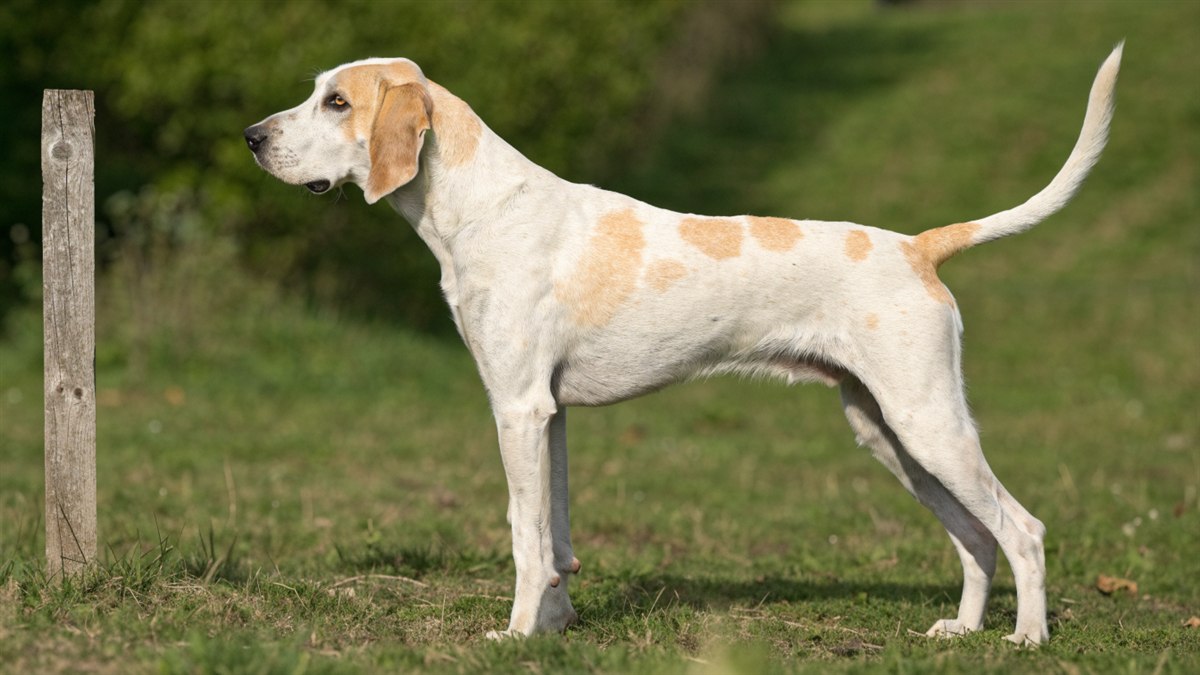
The Billy is a large white French pack scent hound recognised by the FCI as Standard N 25, Group 6 Section 1.1, Large-sized Hounds, with working trial. It was rebuilt in the Haut-Poitou in the late nineteenth century from three now-extinct hound strains, and it is still bred almost entirely to hunt roe deer, red deer and wild boar in a pack.
We read FCI-Standard N 25 in both its official texts before writing a word of this page, and we confirmed the breed name printed inside each document. The English text is headed FCI-Standard N 25, BILLY, dated 24.04.1997, with the note that the official language is French. The French original carries the same number and the same breed name. That check matters more than it sounds: FCI URLs have served the wrong breed's page to researchers before, so the document's own heading is the only proof worth having.
The FCI nomenclature record settles the registry recognition question cleanly. The Billy was accepted on a definitive basis on 14 October 1963, the standard currently in force was published on 28 December 1973, the country of origin is France, and the breed is subject to a working trial. Definitive recognition means this is not a provisional or emerging breed. It has been a full FCI breed for over sixty years and is simply very rare.
Height at the withers, and the weight that does not exist
The standard gives one measurement and only one. Height at the withers runs 60 to 70 cm for dogs and 58 to 62 cm for bitches. There is no weight clause anywhere in either text, no ideal body mass, and no proportion ratio. The Societe Centrale Canine, the French kennel club that administers the breed, confirms this in the bluntest possible way: its official Billy page prints Poids: NP under the weight heading, meaning not specified.
That single detail dismantles most of what you will read about this breed. English-language pages print 23 to 32 kg. English Wikipedia prints 72 to 104 lb, a maximum of 47 kg. Convert them and the two ranges barely touch: 23 to 32 kg is 51 to 71 lb, while 72 to 104 lb is 32.7 to 47.2 kg. Two incompatible weight ranges circulate for one breed, neither traces to a standard, and the kennel club that owns the standard says no figure exists.
| Clause | What the standard says | Why it matters in India |
|---|---|---|
| Size | Dogs 60-70 cm, bitches 58-62 cm at the withers | A large dog by any Indian flat's standard |
| Weight | No clause. None at all | Every kilogram figure online is unsourced |
| Hair | Short, harsh to the touch, often slightly coarse | Minimal insulation against direct sun |
| Colour | Pure white, milk-coffee white, or white with light orange or lemon patches | A white dog in tropical sun |
| Skin | White, sometimes with deep brown or almost black spots, supple and fine | Thin, largely unpigmented skin under a thin coat |
| Ears | Medium leathers, set on relatively high for a French hound, rather flat | Pendulous but less so than a Basset, still a covered canal |
| Gait | Gallops easily | Built to cover ground, not to pace a balcony |
| Disqualifying | Aggressive or overly shy; black or red hair; pronounced overshot mouth | Temperament faults are disqualifying, but no temperament is described |
Utilisation is listed as one word, Hound, and the classification adds "with working trial". In FCI terms that means the breed cannot gain a full international show title without proving it works. The Billy is defined by its job, and the job is running in a pack behind large game.
A scent hound, not a companion breed that happens to hunt
The French kennel club describes the Billy in working terms throughout. It is a grand chien courant used to hunt cerf, sanglier and chevreuil, built as an athlete with solid bone and powerful musculature, and it can cover 40 to 50 km in a single day's hunting. Nothing in that description is about living with a family. The breed's only parent club, the Club du Chien d'Ordre, exists specifically for the breeds used in venerie, hunting with hounds.
So the honest one-line answer to "what is a Billy" is this. It is a rare working pack hound whose defining paperwork describes a body, a colour and a job, and says nothing whatsoever about what the dog is like to live with.
What FCI-Standard N 25 does not contain, and what that breaks
FCI-Standard N 25 omits four things most breed standards include, and each omission invalidates a claim you will find repeated across the Billy pages currently ranking. The standard carries no Behaviour and Temperament clause, no Brief Historical Summary, no weight, and no lifespan.
Read the English text end to end and the structure is General Appearance, Head, Neck, Body, Limbs, Gait, Skin, Coat, Size, Faults, Disqualifying Faults, N.B.. The French original follows the identical order. Modern FCI standards normally open with an Important Proportions block and a Behaviour and Temperament block. Standard N 25 has neither, because it was published on 28 December 1973 and reformatted in 1997 without adding them.
French Wikipedia states the position plainly, in one sentence that no English page repeats: le standard FCI ne donne pas de temperament typique pour la race, the FCI standard gives no typical temperament for the breed. That is independent confirmation of what we read ourselves. Every temperament paragraph published about this breed is therefore sourced to something other than the document that defines it.
The lifespan that Royal Canin India credits to the FCI
Royal Canin's Indian breed page prints Avg life expectancy: 12-15 years and, immediately above it, the line "Source: key facts and characteristics sourced from Federation Cynologique Internationale (FCI)". FCI-Standard N 25 contains no lifespan figure at all, in either language Federation Cynologique Internationale. An Indian-domain page from a global pet-food brand is attributing a number to a document that does not contain it.
The rest of the ranking set disagrees with itself and with Royal Canin. One aggregator gives 12 to 15 years, another about 10 to 15, a French page 10 to 12, and a UK page about 12. Not one cites a study, a registry record or a mortality dataset. We treat the whole cluster as unsourced and publish no Billy lifespan on this page.
Three different dates for one standard
English Wikipedia states "The standard for the breed was established in 1885" with no citation attached to that sentence. The Indian page that prices the breed says the standard came out in 1886. The FCI's own record gives 28 December 1973 for the valid standard and 14 October 1963 for definitive acceptance. Only the third of those three is a primary source, and it is the one nobody repeats.
The Societe de Venerie reproduces Standard FCI N 25 on its own Billy page, correctly headed with the breed name. Its fault list adds a clause absent from both current FCI texts, that bright tan markings are not to be sought without being disqualifying, and omits the two general disqualifications for an aggressive or overly shy dog. It appears to be reproducing an older revision. Where a club text and the FCI text differ, we quote the FCI text and say so.
| Question | FCI-Standard N 25 | Royal Canin India | English aggregators |
|---|---|---|---|
| Weight | No clause | Not stated | 23-32 kg or 32.7-47.2 kg |
| Lifespan | No clause | 12-15 years, credited to the FCI | 10-15 years, uncited |
| Temperament | No clause | Needs little training, great watchdog | Gentle, stubborn, vocal |
| Standard date | 28.12.1973 | Not stated | 1885 or 1886 |
The practical consequence for a buyer is simple. When somebody quotes you a Billy's adult weight, temperament or lifespan as though it were breed fact, ask which document it came from. On this breed the honest answer is usually that it came from another website, which got it from a third, none of which opened the standard. The breed club has published no temperament profile either, so there is no second authority to fall back on.
The reconstruction, and how small the founder base really was
The Billy was rebuilt twice, and the second rebuild started from a founder base that the best-sourced account puts at two surviving hounds. Separating what is documented from what is merely repeated matters here, because the whole breed rests on those few animals.
Gaston Hublot du Rivault, a veneur of the Poitou, set out at the end of the nineteenth century to recreate the chiens blancs du roy, also called chiens blancs greffiers, the white hounds that furnished the French royal packs for more than two centuries. He built the new breed from three older Poitou strains that no longer exist, the Montemboeuf, the Ceris and the Larye, selecting hard for the pale coat of the first two Wikipedia (French), Billy (chien). The breed took the name of his property.
Three things the sources cannot agree on
The founding story is repeated everywhere and settled nowhere. English Wikipedia names the breeder "Gaston Hublot de Rivault Taco" and the place "Chateau de Billy";. French Wikipedia and the French kennel club both write Hublot du Rivault, and French Wikipedia locates the property in the commune of Billy, now absorbed into Maisontiers, with no chateau mentioned.
The royal ancestor's origin is contradicted inside a single article. French Wikipedia's opening paragraph credits the white royal hounds to Louis XI, while its own History section, citing the Societe Centrale Canine, credits Louis XII. We follow the kennel club, which says Louis XII, and note that the page citing it says something different two paragraphs above.
1927, the war, and the number two
The pack was dispersed in 1927 and the breed came close to extinction. English Wikipedia states that only two hounds survived World War II, attributing it to Bruce Fogle's Encyclopedia of the Dog, page 196. That is a named print source with a page number, which is more than any other figure on this breed carries. It is also, on this site's rules, a claim we cannot open and verify ourselves, so we report it as attributed rather than confirmed.
The Indian page that prices the breed muddies it further, writing that reports show two survived and that "some sources say up to ten dogs might have survived", without naming any of those sources. Two and ten are very different founder bases. Treat the low figure as the sourced one and the high figure as unsupported.
The rebuild itself is better documented. Anthony de Rivault, the founder's son, revived the breed after the war by crossing the survivors with the Poitevin, the Porcelaine and the Harrier, all three of them separate FCI breeds with their own standards Federation Cynologique Internationale. So the modern Billy is not a pure remnant population. It is a reconstruction whose recent ancestry includes at least three other hounds.
Recovering a breed from two animals requires repeated close matings. The Prevention of Cruelty to Animals (Dog Breeding and Marketing) Rules 2017 permit only out breeding and line breeding. The Second Schedule's Common breeding techniques paragraph, sub-paragraph (3), prohibits in breeding, defined as mating relatives of the 2nd to 4th grade within the first four generations, and prohibits incest breeding between parents and children or brother and sister. An Indian breeder repeating what saved this breed in France would be breaking the law.
The genetic consequence is acknowledged by French sources rather than hidden. French Wikipedia says the breed's survival is made difficult by a very fragile genetic inheritance, and that it is subject to hereditary problems that endanger it, citing a 2008 French encyclopedia of dog breeds. No specific condition is named, no prevalence is given, and no screening scheme exists to measure it, which is exactly the gap the health section of this page deals with.
One postscript worth knowing. The Billy did not only survive, it contributed. It became one of the foundation breeds of the Grand Anglo-Francais Blanc et Orange in the late nineteenth century, which means its genes persist in French hound packs well beyond the twelve dogs the studbook now records each year.
How rare the Billy is, in registration numbers
The French studbook registered 12 Billys in 2025 and 1 in 2024. That is the whole global picture for a breed that exists almost nowhere else, and it is published openly in the Societe Centrale Canine's LOF statistics, which no page ranking for this breed has bothered to open.
The 2025 LOF table lists the Billy inside Group VI with three numbers: 1 registration in 2024, 12 in 2025, and 5 confirmations in 2025. Confirmation is the French adult assessment a dog needs before it counts as definitively registered, so 5 of the 12 have so far cleared it, which is 41.7 percent.
A number that small means nothing without a familiar comparison, so here is the same table, same year, same country, same document.
| Breed | 2024 | 2025 | Confirmed 2025 | 2025 vs the Billy |
|---|---|---|---|---|
| Golden Retriever | 14,402 | 15,062 | 1,613 | 1,255 times as many |
| Beagle | 3,514 | 3,089 | 822 | 257 times as many |
| Basset Hound | 798 | 703 | 125 | 59 times as many |
| Porcelaine | 326 | 384 | 188 | 32 times as many |
| Ariegeois | 242 | 227 | 131 | 19 times as many |
| Billy | 1 | 12 | 5 | the baseline |
| Poitevin | 110 | 1 | 0 | 12 times fewer |
| Harrier | 0 | 1 | 1 | 12 times fewer |
Work the arithmetic yourself. France registered 15,062 Golden Retrievers and 12 Billys in the same year, so 15,062 divided by 12 gives 1,255 Goldens for every Billy. Group VI as a whole, every scent hound and related breed in France, totalled 11,720 registrations in 2025. The Billy's 12 is 0.102 percent of its own group.
Thirty-two breeders, twelve puppies
The French kennel club publishes the breeders too. Its official Billy breeder list returns 32 eleveurs de race Billy, spread across twenty departments from Charente-Maritime and Vienne to Guadeloupe and Martinique. Set that against 12 registrations and the ratio is 0.375 registered dogs per registered breeder per year. On average a French Billy breeder registers one dog every two and a half years.
That is not a supply chain. It is a small number of hunting kennels keeping a working pack alive, and it is the single most useful fact for anyone in India wondering why they cannot find one.
The revival breeds are in trouble too
Two of the three breeds used to rebuild the Billy are now scarcer than it is. The Poitevin fell from 110 registrations in 2024 to 1 in 2025, with zero confirmations, and the Harrier recorded 1. Only the Porcelaine is healthy, at 384. If the Billy needed another outcross rescue today, two of its three historical lifelines would be unable to provide one.
India and the United States both record nothing
The Kennel Club of India registered 33,880 pure-bred dogs with its studbook in 2025, across every breed it recognises, from 7,412 litters, and 1,425,001 in total since the studbook began. It publishes no breed-level breakdown in the FCI statistics, so no Indian Billy count exists to quote, in either direction. We looked, found no per-breed table, and say so rather than inventing a zero.
The American Kennel Club position is checkable and unambiguous. Its Foundation Stock Service list, revised 10 June 2026, carries 88 breeds across seven groups, and the Hound Group's 20 entries include the Porcelaine, the Bavarian Mountain Scent Hound and the Segugio Italiano. The Billy appears in none of the seven groups. The page loaded in full and lists every breed, so this is an absence read off a complete document rather than an empty search result.
Twelve registrations in the breed's home country in a full year tells an Indian buyer everything the price pages will not. There is no export surplus, no commercial kennel scale, and no realistic path by which a puppy reaches Mumbai or Bengaluru. Every other number on this page follows from that one.
Why searching for this breed returns the wrong dog, and how to search properly
The breed name is a search trap. Billy is a common human name, a common English noun and the name of a great many products, so an ordinary search returns large numbers of confidently irrelevant results. Adding the French terms chien courant and FCI 25 fixes it, and we ran both versions to show the difference.
Two searches, run in the same session, produced opposite outcomes.
| Query | Region | What came back |
|---|---|---|
| billy dog price in india puppy for sale | India | Ten results, none about the breed. Every one about the American Bully or the Bully Kutta |
| "Billy" chien courant race francaise standard FCI 25 elevage | France | Ten results, nine genuinely about the breed, including the FCI Group 6 list and the French kennel club |
The Indian search was not broken. It returned live commerce pages quoting real rupee prices, from Rs 35,000 to Rs 75,000 in one case and Rs 70,000 to Rs 3,00,000 in another Zoodle, American Bully Price in India. It worked perfectly and answered a different question, because in an Indian retail index the string billy resolves to bully.
The same trap inside PubMed
Medical databases collapse the name too, just differently. A loose PubMed query, Billy AND "dogs"[MeSH Terms], returns 8 records. Open them and two are COVID detection-dog studies in PLoS One carrying an author named Billy C, and a third is a review of canine musculoskeletal modelling. The precise breed query returns zero with its translation echoed back unchanged, while a control query in the same session returned nine records.
That pairing is the whole lesson. A non-zero count is not evidence of coverage, and a zero is only evidence when a control proves the search ran.
Two name traps built into the ranking pages themselves
The Indian page that prices this breed contains both. It carries a heading offering a "Billy adoptable dog" from Battersea Dogs and Cats Home for GBP 220, which is a London rescue rehoming an individual dog, and Billy is one of the commonest dog names in Britain. Nothing about that paragraph concerns a French pack hound.
The same page's feeding advice then recommends a premium food brand whose name contains the word Billy. A food brand sharing a breed's name is a coincidence, not a recommendation, and an Indian reader paying for it is buying a homonym.
How to search for this breed and get the breed
- Add the French name of the type, chien courant, which no other Billy shares.
- Add the standard number, FCI 25, which is unique to this breed in the entire nomenclature.
- Search fr.wikipedia and centrale-canine.fr directly rather than through a general query.
- Treat any result quoting rupees as suspect until you have confirmed it names the FCI standard.
- Discard any page whose price divides cleanly by an exchange rate.
Most breed pages do not need to explain how to search for the breed. This one does, because an Indian buyer typing the name into a phone will be shown a different dog with a real price attached, and will have no signal that a substitution happened. Knowing the FCI number is the cheapest protection available, and it costs nothing to check.
Billy dog price in India, and why the one figure that exists is wrong
There is no Billy dog price in India, because there are no Billys in India. Exactly one page on the internet publishes a rupee figure for this breed, it is Rs 10,125 to Rs 12,657, and dividing both ends by 84.38 turns them into USD 119.99 and USD 150.00 to the paisa.
Start with the arithmetic, because you can check it on a phone calculator in ten seconds.
| Published rupee figure | Divided by 84.38 | Result |
|---|---|---|
| Rs 10,125 | 10,125 / 84.38 | USD 119.99 |
| Rs 12,657 | 12,657 / 84.38 | USD 150.00 |
USD 150.00 multiplied by 84.38 returns 12,657.00 exactly. USD 119.99 multiplied by 84.38 returns 10,124.76, which rounds to 10,125. Two round dollar figures, one of them a classic 119.99 price point, run through a single exchange rate and printed as an Indian breeder price. This is the fourth time this site has caught the 84.38 conversion producing a fake Indian price, and it is the cleanest example yet.
The same page tells you what it really is, twice over. It offers a heading about a "Billy adoptable dog" at Battersea Dogs and Cats Home for GBP 220, roughly Rs 23,000. Battersea is a London rescue that rehomes individual dogs, and Billy is one of the commonest dog names in Britain. That heading is chasing people searching for a rescue dog called Billy, not a French pack hound. Its feeding advice then recommends a premium food brand called Billy plus Margot, which shares the breed's name and nothing else.
What an Indian search actually returns
We ran the India-region query billy dog price in india puppy for sale and got ten results. Not one was about the Billy breed. Every result was about the American Bully or the Bully Kutta, including an Indian breeder quoting Rs 35,000 to Rs 75,000 and a price guide quoting Rs 70,000 to Rs 3,00,000.
That result set is also its own control. The search plainly worked, returning live Indian commerce pages with real rupee prices, so the zero Billy results is a genuine finding rather than a blocked query. If you type the breed name into an Indian search box, the market answers with a different dog.
The Indian marketplaces do not list this breed at all
We tested the obvious listing URL directly rather than trusting a search. A major Indian puppy marketplace's billy-puppies-for-sale path resolves to its 404 page, reading "Sorry, this page isn't available. The link you followed may be broken, or the page may have been removed";. We paired it with a deliberate nonsense slug on the same host, which produced the identical 404. The marketplace treats this breed exactly as it treats a word that does not exist.
That is a cleaner absence than any search result. The site has no Billy category, no Billy listing and no Billy shell page waiting to be filled.
A page existing is not a dog existing, and a page not existing is not proof nobody will offer you one privately. Ask any seller for the KCI registration number, the FCI or SCC pedigree naming Standard N 25, the DGFT import authorisation or pet book in the importer's own name, and the microchip number. Four documents, one phone call. Nothing else settles it.
The rest of the ranking set quotes no rupee figure at all
Wamiz UK publishes a heading called "Billy: Purchase price" and carries no rupee amount and no India content. The only other page anywhere that quotes money gives a USD 100 to 200 American shelter adoption fee, which is a US rescue fee for a breed that US rescues do not have, since the American Kennel Club does not record it in any programme.
So the price answer for India is that the breed is unavailable, not expensive. A genuinely rare breed with 12 annual registrations in its home country has no price here because it has no supply here, and any figure you are quoted is either a converted dollar number or a different dog wearing the name. For a real Indian price benchmark on a comparable hound, look at the Beagle, which is genuinely sold here and documented across multiple Indian price pages Premium Pet House, Beagle Price in India, and read our Beagle guide instead.
The only real published Billy price is French, and we will not convert it
One genuine published price for this breed exists, and it is in euros. A French breed database gives a purchase price of 1,000 to 1,500 euros and an annual upkeep cost of 1,500 to 1,600 euros. We print those figures as euros and deliberately refuse to convert them into rupees, because converting a European price is exactly the error that produced the fake Indian number.
Woopets, a French breed reference, publishes both figures with explicit minimum and maximum fields. Prix d'achat: 1000 euros to 1500 euros. Cout d'entretien annuel: 1500 euros to 1600 euros. Those are the only money figures for this breed anywhere that are attached to a market where the breed actually exists.
| Figure | Currency and market | What it is |
|---|---|---|
| 1,000 to 1,500 | Euros, France | Purchase price where 12 dogs a year are registered |
| 1,500 to 1,600 | Euros per year, France | Annual upkeep at French food and veterinary prices |
| 10,125 to 12,657 | Rupees, claimed for India | USD 119.99 and USD 150.00 run through one exchange rate |
Look at the third row against the first two. The French purchase price is a four-figure euro number. The claimed Indian price is a four-figure rupee number. Those are not the same quantity, and no exchange rate reconciles them. The Indian figure is not a discount on the French one, it is a different number that happens to have four digits.
Why converting the euro figure would be just as wrong
It is tempting to multiply 1,000 euros by today's rate and call the answer an Indian price. Resist it, for three separate reasons.
- Currency conversion is not price discovery. A French breeder price reflects French demand, French cost of raising a litter and French registration overhead, none of which exist here.
- There is no Indian transaction to price. A price requires a buyer and a seller in the same market, and India has neither for this breed.
- Conversion is the precise mechanism that produced the fake figure this page exposes. The petsarmy number is a dollar price times 84.38, and a euro price times any rate is the same trick in a different currency.
The annual upkeep figure needs the same caution and one extra caveat. Woopets' 1,500 to 1,600 euros a year is built on French veterinary fees, French food prices and a French climate that never asks an owner to spend anything on heat management. An Indian owner of any large dog faces a different cost shape, with more spent on parasite control and skin care and less on winter provision.
Use the euro band as a reality check on scarcity rather than as a price. A dog that costs 1,000 to 1,500 euros in the country that has 32 registered breeders is not a dog that sells for twelve thousand rupees anywhere. If somebody quotes you a low four-figure rupee price for a Billy, the euro figure alone tells you the quote is not describing this breed.
The same French page also gives a life expectancy of 10 to 12 years, which is the lowest figure in the ranking set and disagrees with the 12 to 15 years published by an English aggregator and by Royal Canin India. Neither cites a source, so we carry the spread rather than picking a winner. Our Beagle page shows what a properly evidenced Indian price section looks like when the breed genuinely trades here.
Import rules: why no lawful Billy supply chain can form in India
Indian import policy classes dogs as Restricted under ITC(HS) 01061900 and permits entry for only three purposes, none of which is buying or breeding. We read DGFT Trade Notice 22/2022-23 in full rather than summarising someone else's summary, and the relevant text is short enough to quote.
The trade notice, dated 19 December 2022, prints the tariff line as a table. ITC(HS) 01061900, item description "Mammals: Other", Import Policy Restricted, subject to Policy Condition 6 of that chapter. Restricted means an import authorisation is required unless a specific exemption applies.
Policy Condition (7) then limits dog imports to three purposes and lists them. A pet dog with a valid pet book and relevant records in the name of the importer. Dogs imported by R&D organisations for research with the recommendation of CPCSEA. Internal security use by the Defence and Police Force. Policy Condition (8) closes the gap: "Import of commercial dogs for breeding or any other commercial activities other than the purposes mentioned above is not permitted."
Paragraph 6 of the notice repeats it as an instruction to officials. Applications for trading or breeding purposes, or made on behalf of another person or entity, shall be duly rejected. So an Indian kennel cannot lawfully import a Billy to breed from, and cannot lawfully import one on your behalf either.
| Provision | What it says |
|---|---|
| ITC(HS) 01061900 | Dogs are Restricted, subject to Policy Condition 6 |
| Policy Condition (7) | Entry only as a pet with a pet book in the importer's name, for CPCSEA-recommended research, or for Defence and Police use |
| Policy Condition (8) | Commercial import for breeding or other commercial activity is not permitted |
| Paragraph 6 | Applications for trading or breeding, or on behalf of another person, shall be duly rejected |
| Paragraph 7 | Entry only through Delhi, Mumbai, Chennai, Hyderabad, Bangalore and Kolkata; DAHD added Kochi for pets arriving under the baggage rules in October 2024 |
| Baggage route | Without DGFT authorisation only for a person transferring residence after two years' continuous stay abroad, up to two pets |
| Paragraph 5 | Begin the authorisation process at least two months before travel |
| Paragraph 8 | Advance NOC from the port Quarantine Officer, seven days before travel, relaxable to three |
The only door that is actually open
One route exists and it is narrow. If you have lived abroad for two continuous years, own a Billy, hold its pet book in your own name, and are transferring residence to India, you may bring up to two pets in as passenger baggage without a DGFT authorisation. Land at one of the seven named ports, obtain the Advance NOC seven days ahead, and expect quarantine where required. That is a person moving home with their own dog, which is precisely what the policy is designed to allow. The full route is set out in how to import a dog to India.
What the policy is designed to stop is the thing an Indian buyer is actually trying to do, which is acquire a French hound they have never met. Combine the import policy with the registry position and the conclusion is arithmetic rather than opinion. France produced 12 registrable Billys in 2025, India's own kennel club publishes no Billy record, and the law forbids a commercial import. There is no legal path by which a supply chain forms.
An application made on behalf of another person is one of the two categories the trade notice orders rejected outright. Anyone offering to handle the paperwork and hand you the dog is describing a transaction the notice explicitly refuses, and anyone quoting you a landed price for it has not read the document. Ask them for the ITC(HS) code they intend to import under.
Nothing here is a criticism of the breed. It is the difference between a dog being expensive and a dog being unobtainable, and for the Billy in India the honest answer is the second. If you want a large scent hound you can lawfully import or, far more sensibly, buy from a registered Indian breeder, the Beagle and the Basset Hound are both established here and both KCI-recognised.
Monthly cost of ownership, and why we publish no rupee figure
We publish no monthly cost for a Billy in India, for two reasons that are worth understanding rather than skipping. No Billy is kept in India that we could find a record of, and the breed standard gives no weight, so the largest recurring line in any dog budget cannot even be calculated.
Food is the biggest monthly cost for a large dog, and food quantity is a function of body mass. FCI-Standard N 25 states no weight, the French kennel club prints NP in its weight field, and the two weight ranges circulating online, 23 to 32 kg and 32.7 to 47.2 kg, differ by more than the entire body mass of a Beagle. Feed a 47 kg dog on a 23 kg dog's ration and you have starved it. Any page that hands you a confident monthly cost for this breed has silently picked one of two contradictory weights.
What the cost structure would actually look like
The breed's own kennel club describes a seasonal feeding pattern rather than a flat one. During the hunting season the Billy needs a complete diet weighted towards fat, with fish oil preferred and a vitamin E supplement, sold industrially as high-energy food. Outside the season its energy needs drop and a plain maintenance ration is enough, with fat and protein reduced and fibre increased. The club adds a warning worth repeating: une nourriture trop riche peut etre plus nocive qu'utile, food that is too rich can do more harm than good.
An Indian pet owner never runs the working half of that cycle, because there is no hound-pack hunting season here. That means a pet Billy in India sits on the maintenance ration year-round, and a keeper who feeds high-energy food to an athletic dog that no longer works is buying obesity at a premium price.
| Cost line | Can it be estimated for a Billy in India? | Why |
|---|---|---|
| Food | No | No published weight, so no ration can be computed |
| Core vaccination course | Yes, as for any large pup | Indian rules set the schedule, not the breed |
| Ear care and dermatology | Partly | Base rates exist for Indian dogs, none for this breed |
| Heat management | Yes, and it is not optional | Cooling and shade are structural costs in Indian cities |
| Exercise provision | Yes, and it is the real cost | A hound bred to cover 40-50 km a day needs land or a vehicle |
| Breed-specific screening | Not applicable | No screening scheme exists anywhere for this breed |
The two costs that are genuinely breed-driven
First, ear and skin care. Canine otitis externa ran at 18.14 percent of 281 dogs screened over a year in and around Durg, Chhattisgarh, which is 51 affected dogs, and the authors note that dogs with long ears are more susceptible. A drop-eared hound in a humid Indian city sits on the wrong side of that base rate, and repeated ear treatment is a recurring line, not a one-off.
Second, exercise. This is the line most Indian buyers underestimate, because it is not a product you buy. A dog the French kennel club describes as covering 40 to 50 km in a working day needs either land or a daily vehicle trip to somewhere it can run safely off-lead. In a metro that is a real, quantifiable monthly cost in fuel and time, and it does not go away in May.
Ask two questions. Which body weight is the food line based on, and where did that weight come from? Because the breed standard has no weight, the honest answer is that the number was chosen, not derived. A budget built on a chosen number is a guess with a decimal point on it.
For a realistic Indian monthly cost on a comparable large scent hound that genuinely lives here, our Beagle and Basset Hound pages work from breeds with published Indian price and care data. This page will carry a Billy cost table when a verifiable Indian Billy owner and a verifiable weight both exist, and not before.
Heat tolerance in Indian cities, rated from the coat the standard describes
We rate the Billy's heat tolerance 2 out of 5 for India, and the rating comes from the standard rather than from anyone's opinion. A short, harsh coat over fine, largely white skin gives poor sun protection, and a body built to gallop for a working day in temperate western France is built for the exact activity that causes most heatstroke.
Three clauses do the work. Hair is "short, harsh to the touch, often slightly coarse". Colour is "pure white or milk-coffee white, or white with light orange or lemon patches or mantle". Skin is "white, sometimes with deep brown or almost black spots, supple and fine";. The French original says the same. Read together, that is a short-coated dog with thin, mostly unpigmented skin underneath, which is the worst combination for direct tropical sun. The pale coat reflects, but there is no melanin under it where the hair parts, at the ear margins, or on the belly.
The heatstroke evidence points at exercise, not at parked cars
A VetCompass study of 905,543 dogs under UK primary veterinary care in 2016 identified 1,259 heat-related illness events in 1,222 dogs, and found that exertional heat-related illness was the predominant trigger at 74.2 percent of the 879 events where a cause was recorded, against 12.9 percent environmental and 5.2 percent vehicular confinement. The paper's title is the summary: dogs do not die just in hot cars.
Now put that beside the breed. The French kennel club describes a dog that gallops easily and covers 40 to 50 km in a day's hunting. The FCI standard's only movement clause is "gallops easily";. This is an animal whose entire design is sustained exertion, and sustained exertion is what 74.2 percent of heat-related illness events came from. A Billy in Chennai does not need a locked car to overheat. It needs a keen owner and an afternoon.
| City type | Practical verdict | What has to change |
|---|---|---|
| Chennai, Mumbai, Kolkata, coastal humid | Poor fit | Exercise before sunrise only; humidity blocks evaporative cooling |
| Delhi, Jaipur, Nagpur, dry and very hot | Poor fit in summer | Months of near-total activity restriction; sunburn risk on pale skin |
| Bengaluru, Pune, moderate plateau | The least bad Indian option | Still needs shade, early hours and open ground |
| Shimla, Gangtok, Ooty, hill stations | Workable on temperature | Land to run on remains the binding problem, not heat |
Indian law already names this problem
The Prevention of Cruelty to Animals (Dog Breeding and Marketing) Rules 2017 contain a clause that reads as though it were written for imported breeds. Paragraph 21(1) of the Second Schedule bars keeping in outdoor facilities, without the attending veterinary practitioner's written approval, dogs "that are not accustomed to the temperatures prevalent in the area or region in question" and "dog breeds that cannot tolerate the temperatures prevalent in the area or region in question";. Paragraph 21(3) requires shelters that protect from the direct rays of the sun.
Those rules bind establishments rather than pet owners, but the standard they set is the right one to hold yourself to. A French pack hound in a Hyderabad summer is precisely a dog not accustomed to the temperatures prevalent in the region.
Two sources disagree about cold, and neither cites anything
French Wikipedia states the Billy resiste aux climats rudes, that it withstands harsh climates. The Indian page that prices the breed says the opposite, that its short fine coat gives little protection and it copes poorly with cold. Neither carries a source. We publish the disagreement rather than choosing, and note that in India the question is almost academic, because heat is the constraint everywhere except the hill stations.
Walk before sunrise and after dark, never in the middle of the day, and never let a keen hound self-regulate on a hot morning because it will not. Provide deep shade rather than a tarpaulin. Watch the ear margins, muzzle and belly for sun damage on any pale dog. Wet the coat and use airflow to cool a hot dog rather than relying on shade alone, and treat a dog that keeps running when it should stop as a medical situation.
Temperament and household fit, where the sources openly contradict each other
No document with authority describes the Billy's temperament, so every published personality profile is somebody's opinion. The French kennel club, French Wikipedia and Royal Canin India each describe a different dog, and on the two questions an Indian buyer cares about most, guarding and other dogs, they say opposite things.
Start from what the standard does say, which is exactly one thing. "Aggressive or overly shy" is a disqualifying fault, alongside a pronounced overshot mouth and black or red hair. So temperament is judged in the show ring while never being described. The FCI will disqualify a Billy for its character without ever having told you what that character should be.
| Question | French kennel club | French Wikipedia | Royal Canin India |
|---|---|---|---|
| Guarding | Not addressed | Very rarely bites, makes a poor guard dog | Makes a great watchdog |
| Training need | Must be taught group life and obedience from puppyhood | Working, intelligent, easy to educate | Needs little training |
| Other dogs | A pack dog by definition | Tolerates other dogs badly, works better alone than in a group | Not addressed |
| City life | Not a town dog, would become very depressed alone in a city | Not at all suited to town life | Requires outdoor space |
| Voice | Not addressed | Long, light, well-timbred voice | Beautiful high-pitched voice, most vociferous when tracking |
Two of those rows matter enough to spell out. Royal Canin's Indian page says the Billy makes a great watchdog and needs little training. French Wikipedia says the breed is tres peu mordeur, il fait un pietre gardien, very rarely bites and makes a poor guard dog. The French kennel club's whole behaviour entry is about how much foundation training a Billy needs. An Indian buyer choosing this breed as a guard dog on the strength of an Indian-domain page would be choosing against the two French sources closest to it.
The pack contradiction is real and unresolved
French Wikipedia carries both positions in the same article. Its lead says the Billy is never aggressive except with its own kind, even within the pack. Its working section, citing a 2008 French breed encyclopedia, says the breed is not very friendly toward other dogs and works better alone than in a group. That is an odd thing to say about a pack hound, and it is the opposite of what every English aggregator asserts about the breed getting on well with other dogs.
We publish the disagreement rather than resolving it, because resolving it would mean inventing a fact. What both French sources agree on is that group living has to be taught. The kennel club describes it happening in the kennel, through daily exercises before feeding, teaching the dog to answer its name, walk in a group and stop at the handler's voice. That is not a personality description. It is a training programme for an animal that does not arrive socialised to other dogs by default.
Solitude, voice and the Indian flat
Two traits are agreed by everyone and both are decisive for apartment living. The Billy copes very badly with being alone, and it is loud. Royal Canin describes a high-pitched voice that is most vocal when the dog is tracking. A hound that bays is doing its job, and a hound that bays at 6 am in a shared building is a complaint.
The French kennel club is blunter than any English page dares to be. Le Billy n'est pas un chien de ville, the Billy is not a town dog, and it says a Billy kept alone in a city would be made very depressed. Read that sentence as advice from the body that administers the breed, not as an aesthetic preference.
A large scent hound bred to pursue wild boar and deer carries serious prey drive, and Indian residential streets contain free-roaming dogs, cats, cattle and goats. An off-lead Billy that picks up a line has no reliable reason to stop. Nobody should test this breed's recall against Indian traffic, and no owner should socialise a young one by simply exposing it to street animals and hoping.
The household this breed suits is an active rural or semi-rural one with land, other dogs it grew up with, and somebody home most of the day. It is a poor fit for a first-time owner, for a flat, and for anyone buying a dog primarily to guard a property. If the appeal is a friendly, moderate-sized scent hound that genuinely works in Indian homes, read our Beagle guide instead.
Training a pack hound, and the one skill everything else depends on
To train a Billy, build recall first and treat everything else as secondary, because a scent hound that will not come back is the only genuinely dangerous version of this breed. The French kennel club's own training description is a pack curriculum, not a pet obedience course, and it starts before the food bowl goes down.
The Societe Centrale Canine describes exactly three foundation behaviours and where they are taught. In the kennel, through daily exercises carried out notably before meals are distributed, the young Billy learns to answer to its name, to walk with the group, and to stop at the handler's voice. Two of those three are recall components. The third is impulse control in a group.
Notice what is not on that list. No sit, no stay, no heel, no household manners. The French kennel club is describing how to make a dog controllable in open country at distance, which is the only obedience a working pack needs and, by coincidence, the only obedience that keeps a hound alive near Indian traffic.
Is it easy or hard to train? The sources split
French Wikipedia, citing a French breed encyclopedia, calls the Billy hard-working, intelligent and facile a eduquer, easy to educate. Royal Canin India goes further and lists "Needs little training" as a key fact. English pages say the opposite, describing a dog that loses focus the moment it finds a scent and ignores a recall it has known for years Dog Temperament, Billy Dog Temperament.
Both can be true at once, and probably are. An independent hound learns quickly in a quiet room and becomes functionally deaf on a live scent line. Treat "needs little training" as the most misleading three words on any Indian page about this breed. It is the kind of claim that produces an under-trained large dog in a country where a loose hound meets traffic within minutes.
A realistic training timeline
| Age | Priority | Realistic expectation |
|---|---|---|
| 8 to 16 weeks | Name response, food-bowl impulse control, calm handling of ears and feet | Fast progress indoors, none outdoors |
| 4 to 6 months | Recall on a long line, never off it; lead manners | Recall reliable at home, unreliable on grass |
| 6 to 12 months | Recall under mild scent distraction; settle when alone | Expect regression as the nose matures |
| 12 to 24 months | Recall under real distraction; stop on voice at distance | Manageable, never guaranteed |
| Lifelong | Maintain recall with high-value food weekly | A hound's recall decays if it is not paid |
Keep sessions short and frequent rather than long. Five to ten minutes several times a day suits a dog whose attention is easily pulled away, and food works better than praise on a breed that the French kennel club itself trains around mealtimes Pets Army (petsarmy.co.in). Use positive reinforcement, and note that the same approach is what Indian law expects of anyone keeping dogs at scale, since the 2017 Rules require an approved written exercise and socialisation plan rather than force.
How much company the law thinks a dog needs
One number from the Rules is worth borrowing even though it binds establishments rather than pet owners. The exercise and socialisation plan must provide socialising with people equalling at least three hours per day for an adult dog and five hours per day for pups under four months. If you cannot socialise a puppy for five hours a day, you cannot meet the standard Indian law sets for a commercial kennel, and a breed that copes badly with solitude is the wrong one to test that on.
Never let a Billy off-lead anywhere it could reach a road, and do not treat a good recall on a quiet morning as evidence it will hold on a scent. Use a long line in open ground, and a securely fenced area for genuine freedom. This is not pessimism about training. It is the standard advice for every large scent hound, including the ones that are far easier to train than this one.
Exercise requirements, measured against 40 to 50 km a day
The French kennel club states the Billy can cover 40 to 50 km in a single day's hunting, and that figure is the honest benchmark for its exercise requirements. No Indian city routine reaches it, which means the question is not how to satisfy this breed but how much of a deficit you are prepared to manage.
Two primary sources agree on the number. The Societe Centrale Canine says the Billy gallops easily and peut parcourir de 40 a 50 km au cours d'une journee de chasse. French Wikipedia repeats it with the same attribution. The FCI standard's only movement clause, "gallops easily", says the same thing in fewer words.
That is not a daily requirement, because a hunting day is not every day. It is a statement about capacity, and capacity is what tells you what the dog was built for. An athletic animal with that ceiling does not become content on two twenty-minute road walks.
The legal floor, and why it is only a floor
Indian law sets a minimum for dogs kept at commercial scale that is worth knowing. The 2017 Rules require an exercise plan approved and signed by the breeder and the attending veterinarian, and list acceptable provision including a fenced area or lead work and exercising for at least thirty minutes twice per day. One hour a day, split, is what the law considers adequate for a kennelled dog of any breed.
Set one hour against a 40 to 50 km capacity and the gap is obvious. The legal minimum keeps a dog from suffering. It does not make a pack hound tired.
| Provision | Realistic in an Indian metro? | Notes |
|---|---|---|
| 60 to 90 minutes of brisk lead work, split | Yes, before sunrise and after dark | The floor, not the target |
| Daily off-lead running in secure fencing | Rarely | Almost no Indian city has safely fenced open ground |
| Scent work and nosework games indoors | Yes | The cheapest way to tire a hound's brain |
| Long weekend runs on open land | Only with a vehicle | The single biggest practical cost of the breed |
| Free running in daytime heat | No, at any time of year in most cities | Exertion is the dominant heatstroke trigger |
The Indian constraint is heat, not willingness
The dog will run in 38 degree heat if you let it, and that is precisely the danger. A VetCompass study of 905,543 UK dogs found 74.2 percent of heat-related illness events were exertional rather than environmental or vehicular. A breed with this much stamina and no ability to judge its own limit is the archetype of that statistic. In India the constraint is that the hours in which a Billy could safely be exercised hard are the hours most owners are asleep.
Plan around it rather than around the dog's enthusiasm. Exercise before sunrise and after dark for most of the year, carry water, and cool the dog actively with wetting and airflow rather than waiting for shade to do it. Stop the session while the dog still wants more, which on this breed means stopping early every single time.
What happens without it
An under-exercised energetic hound does not simply lie down. English sources describe destructiveness and problem behaviour developing without sufficient physical and mental work, and the French kennel club uses stronger language, saying a Billy kept alone in a city would be made very depressed. Neither outcome is a training failure. Both are a housing mismatch.
Scatter feeding, box searches and tracking games use the part of the dog that a treadmill cannot. They are not equivalent to a hunting day, but they are available indoors at 2 pm in May, which running is not. Any Indian owner of any scent hound should build the day around nosework and treat walks as the supplement.
Grooming and ear cleaning in Indian humidity
Coat care for a Billy is close to trivial and ear care is not, so put your effort where the risk is. The standard describes short, harsh hair that needs a weekly brush, while the drop ear over a warm, humid canal is the one conformational feature that reliably costs Indian owners money.
The coat clause reads "short, harsh to the touch, often slightly coarse", over skin described as supple and fine. A weekly brush removes dead hair and lets you inspect the skin, and that is the whole grooming routine. There is no undercoat to blow, no clipping schedule and no stripping.
Do not shave a short-coated dog to cool it. The coat is the only barrier between fine, largely unpigmented skin and Indian sun, and a heat-sensitive dog with sunburn is worse off than a hot one.
Ear risk, with the actual numbers
A VetCompass study of a random sample of 22,333 dogs from 905,554 under UK primary veterinary care found a one-year period prevalence of otitis externa of 7.30 percent (95 percent CI 6.97 to 7.65). Compared with breeds carrying erect ears, breeds with pendulous ear carriage had 1.76 times the odds (95 percent CI 1.48 to 2.10) and breeds with V-shaped drop ears had 1.84 times the odds (95 percent CI 1.53 to 2.21). Named hounds sat higher still, with the Basset Hound at odds ratio 5.87 and the Beagle at 2.54.
The Billy's ear is genuinely less extreme than a Basset's. The standard calls the leathers medium, "set on relatively high for a French hound", rather flat and turning slightly inwards at the bottom. That is a moderately dropped ear, not a heavy one. It still covers the canal, so treat the 1.76 figure as the relevant one rather than the Basset's 5.87.
The Indian picture, and a seasonal disagreement worth publishing
An Indian series is more useful than a UK one for planning. Roy and colleagues screened 281 dogs presented to the Teaching Veterinary Clinical Complex at Anjora and government hospitals in and around Durg, Chhattisgarh, over one year, and found 51 positive for otitis externa, an overall prevalence of 18.14 percent. Fifty-one of 281 divides out to 18.15 percent, so the paper's arithmetic holds.
Its seasonal result is the part that matters, and it cuts against the assumption that the monsoon is the dangerous season. Of the 51 cases, 21 presented in summer (41.18 percent), 17 in the rains (33.33 percent) and 13 in winter (25.49 percent). Each divides out exactly against 51. The authors note their finding agrees with other Indian work reporting a summer peak, while citing older research linking incidence to late summer with high humidity.
So for a humid Indian city the honest advice is to check ears all year and not to relax in April because the rains have not started.
| When | What to do | Why |
|---|---|---|
| Daily | Lift the leather, look and smell | Costs ten seconds and catches everything early |
| Weekly | Wipe the visible outer ear with a dry cloth | Low-harm cleaning is what the evidence supports |
| After any swim or bath | Dry the ear thoroughly before anything else | Moisture in a covered canal is the mechanism |
| Never | Cotton buds into the canal, or daily flushing | Overzealous cleaning is itself a documented cause |
| At any smell, head shake or scratch | Veterinary examination, not a home remedy | Cytology decides the treatment, guessing does not |
The low-harm approach is the study authors' own recommendation, which names ear cleaning with a dry paper cloth, judicious use of antimicrobial ear cleaners and avoidance of overzealous ear-cleaning. The Indian series reaches the same place from the other direction, listing abrasive and improper ear cleaning alongside swimming as causes.
A PCR survey of 525 dogs across four Indian cities found 49.7 percent infected with at least one tick-borne pathogen, and ticks on 53 percent of the dogs examined. The 2017 Rules require that regular de-ticking be practised at the time of grooming. On a short-coated dog every tick is visible, so a weekly brush is also a weekly tick check, and on a pale coat you have no excuse for missing one.
Health risks and lifespan, with the denominators shown
No published prevalence figure exists for any disease in the Billy, no screening scheme exists to generate one, and no peer-reviewed paper on the breed exists in PubMed. We proved each of those absences with a control query rather than inferring them from an empty page, and we publish no borrowed figures from other hounds.
Take the claims one at a time, with the check that was run.
1. No peer-reviewed literature on the breed
The PubMed query "Billy"[All Fields] AND ("hound"[All Fields] OR "dog breed"[All Fields]) returned a count of 0, with the query translation echoed back unaltered and no phrases ignored. That last detail matters, because PubMed silently rewrites queries it cannot match and the rewrite is invisible in a result count. Here there was no rewrite.
The control ran in the same session. "Beagle"[All Fields] AND "otitis externa"[All Fields] returned 9 records with five PubMed IDs. The tool works. The zero is real.
The inverse trap was checked too. A deliberately loose query, Billy AND "dogs"[MeSH Terms], returns 8 records, which looks like coverage until you open them. We opened three. Two are COVID detection-dog papers in PLoS One that match on an author surname, Billy C, and the third is a review of musculoskeletal modelling in dogs. None concerns the breed. A non-zero count on this breed name is noise, not literature.
2. No screening programme, and a threshold that explains why
The Billy's only parent club is the Club du Chien d'Ordre, whose published remit is the improvement and continuation of the breeds used in venerie. It publishes no health scheme, no DNA panel and no hip protocol. The French kennel club's own Billy page has a heading called Alimentation et Sante, and everything printed under it is feeding advice. There is no health content on it at all.
The Orthopedic Foundation for Animals explains the arithmetic of why no figures could exist even if somebody wanted them. "Breeds are not included in the OFA statistics tables until a minimum number of individuals have been evaluated. For hips, each breed must have at least 100 evaluations in the database. For all other databases, there must be at least 50";. France registered 12 Billys in 2025. At that rate a breed would need roughly eight years of total global output, every dog screened, to reach the hip threshold once.
3. No lifespan, and no dataset containing the breed
The largest published study of companion-dog longevity analysed 584,734 unique dogs in the UK, including 284,734 deceased, across 155 breeds. We retrieved the full article text, all 151,762 characters of it, and searched it. It contains zero occurrences of the word Billy and zero of Poitevin. The breed is not in the dataset.
So the lifespan figures circulating for this breed rest on nothing. Royal Canin India says 12 to 15 years and credits the FCI, whose standard contains no lifespan. An English aggregator says 12 to 15, a French one 10 to 12, and another about 10 to 15. This page publishes no Billy lifespan. That is the honest outcome, and it is a more useful thing to know than a made-up number.
The one health signal that is genuinely attributable
French sources do say something, and it is qualitative. French Wikipedia states that the breed's continuation is made difficult by a very fragile genetic inheritance, and that it is subject to hereditary problems that endanger its survival, citing a 2008 French encyclopedia of dog breeds. No condition is named and no rate is given. Given a founder base reported as two hounds after the war, a warning about inherited disease is exactly what you would expect, and the absence of any measurement is exactly what a 12-dog registration year predicts.
Ranking pages attribute ear infections, hip and elbow dysplasia, dermatitis, cold sensitivity and a tendency to obesity to this breed. Not one carries a citation, a sample size or a study. Those are the standard conditions of any large drop-eared dog, applied to a breed nobody has measured. Treat them as a sensible watch list for a large hound and not as Billy-specific findings.
The Indian health problems that would actually reach this dog
Since no breed-specific health data exists, the useful question becomes what threatens any large, outdoor-working dog in India. Three answers have real Indian denominators behind them: tick-borne disease at roughly half of dogs sampled, ear disease at around one in five clinic cases, and exertional heat illness.
Tick-borne disease, the biggest Indian number on this page
A survey of 525 dogs across four Indian cities used PCR alongside blood smears and found 261 of 525 dogs, 49.7 percent (95 percent CI 45.4 to 54.1), infected with one or more tick-borne pathogen. Divide it out and 261 over 525 is 49.71 percent, so the figure holds. Potential tick vectors, most commonly Rhipicephalus, were found on 278 of the dogs, 53 percent.
| Pathogen | Prevalence | 95% CI |
|---|---|---|
| Hepatozoon canis | 30% | 26.0 to 34.0 |
| Ehrlichia canis | 20.6% | 17.2 to 24.3 |
| Mycoplasma haemocanis | 12.2% | 9.5 to 15.3 |
| Anaplasma platys | 6.5% | 4.5 to 8.9 |
| Babesia vogeli | 5.5% | 3.7 to 7.8 |
| Babesia gibsoni | 0.2% | 0.01 to 1.06 |
| Any of the above | 49.7% | 45.4 to 54.1 |
One methodological detail from that paper should change how you talk to your vet. On microscopy alone, only 12 of the 525 blood smears, 2.3 percent, showed anything, and what they showed was Hepatozoon gamonts. PCR found nearly fifty percent. A clear blood smear is not a clear result. Co-infection with more than one pathogen occurred in 39 percent of cases, so finding one pathogen raises the odds of a second.
A hound that works in long grass is the highest-exposure dog in that population, and a short-coated, pale animal is at least the easiest one to inspect. Year-round tick prevention is not optional in India for a dog like this.
Ear disease, and a breed list with no hounds in it
The Durg series found otitis externa in 51 of 281 dogs, 18.14 percent, over a year. Its breed breakdown is worth reading for what is missing. German Shepherd accounted for 31.37 percent of cases, Labrador Retriever 19.6, Spitz 17.64, Rottweiler 11.76, then Pug, Saint Bernard, Doberman, Dalmatian and Cocker Spaniel. No hound of any kind appears, which tells you about the Indian dog population rather than about hound ear health.
That is the practical problem with a rare imported breed. Indian veterinary caseload data is built from the breeds Indians actually keep, so an Indian vet's pattern recognition for a French pack hound starts at zero.
What Indian law already requires to be tested
The 2017 Rules name a genetic-defect testing list, and it is more specific than most breed clubs manage. Paragraph 8(10) of the Second Schedule requires that dogs "shall have been tested for genetic defects, including hip dysplasia, progressive retinal atrophy, night blindness, hypothyroidism, entropion, ectropion, overshot, undershot jaw, wry mouth, two or more missing teeth, unilateral cryptorchid or full cryptorchid males";.
Note what that means for the Billy specifically. Indian law mandates testing for an overshot jaw, and a pronounced overshot mouth is a disqualifying fault in FCI-Standard N 25. The two documents happen to agree, which almost never happens on this breed. The same Rules require a veterinary examination of each dog at a breeding establishment at least once every month, and set the puppy vaccination window as starting at seven to eight weeks and usually completing at eighteen weeks.
Bring the FCI standard, print the two lines that matter, and say plainly that no breed-specific screening data exists. A good Indian vet will then treat the dog as a large drop-eared scent hound with high exertional heat risk and high tick exposure, which is the correct clinical frame. What you must not do is hand over an aggregator page and let unsourced breed disease lists shape the workup.
Feeding a breed with no published weight
Feed a Billy to body condition rather than to a chart, because the breed has no published weight to build a chart from. The French kennel club publishes a real, breed-specific feeding protocol, and it is seasonal: high-energy food during the hunting season and a plain maintenance ration outside it.
The Societe Centrale Canine's feeding entry is unusually concrete for this breed, and it is worth reading in full because nothing else about the Billy is this specific.
| Period | What the club specifies |
|---|---|
| Hunting season | A complete diet of fat, protein and fibre, weighted more heavily towards fat |
| Preferred fats | Certain fats are favoured, fish oil named specifically |
| Supplement | Extra vitamin E, from milk, cereal germ and eggs |
| Protein | Choose a food rich in protein |
| Commercial equivalent | What the industry sells as high-energy food |
| Outside the season | Lower energy needs, a plain maintenance ration |
| Adjustments | Reduce fat and protein, increase fibre, stop vitamin and mineral supplements unless there is a specific deficiency |
| The warning | Food that is too rich can be more harmful than useful |
Why the Indian version of this protocol is the maintenance half
An Indian pet Billy has no hunting season. There is no organised hound-pack hunting here, so the working half of the club's cycle never applies, and the dog sits permanently on the ration the club prescribes for the off-season. That means moderate fat, moderate protein, more fibre, and no routine vitamin or mineral supplementation.
This is the exact seam where overseas breed advice goes wrong in India. Copy the club's hunting-season paragraph onto an Indian page and you are telling an owner to feed high-energy food to a dog that will never work, in a climate where the dog cannot be exercised hard for months at a time. The club's own closing warning covers it, and it is the sentence Indian pages leave out.
Feeding without a target weight
Because FCI-Standard N 25 states no weight and the French kennel club prints NP in its weight field Societe Centrale Canine, nobody can hand you a gram figure. Body condition scoring replaces it, and it is more reliable anyway.
- Feel the ribs through a thin layer of covering, without pressing hard, on a short-coated dog where this is easy.
- Look for a waist behind the ribs when viewed from above.
- Look for an abdominal tuck when viewed from the side, which the standard describes as a slight tuck-up.
- Weigh the dog monthly at the same clinic and record the trend rather than the number.
- Adjust the ration by about ten percent and wait two weeks before adjusting again.
Indian law sets the floor for what goes in the bowl. The 2017 Rules require food that is uncontaminated, wholesome, palatable and of sufficient quantity and nutritive value to maintain the normal condition and weight of the animal, with the diet appropriate to the individual animal's age and condition, and feeding pans of durable, cleanable material protected from the rain. That last clause is a monsoon provision and it applies to any outdoor feeding station in India.
Availability in India
Nothing on the club's list is hard to source here. Large-breed maintenance foods, fish oil and vitamin E are all widely available in Indian pet retail, and none of it is breed-specific. What is not available is a Billy-formulated anything, and any product sold to you as such is marketing. Watch specifically for the name trap: at least one page recommends a premium food brand whose name simply contains the word Billy, which is a coincidence of branding and not a breed recommendation.
A dog built to cover 40 to 50 km in a working day, kept in an Indian city where it cannot run hard for much of the year, is in permanent energy surplus unless the ration is cut to match. That is the single most predictable health problem this breed would have in India, and it is entirely under the owner's control.
Puppy timeline, month by month through the first year
No Billy-specific growth curve exists, because the breed has no published weight to plot. What follows is a first-year plan for a large scent-hound puppy in India, anchored wherever possible to Indian legal requirements and to the French kennel club's own foundation training, and honest about the parts nobody can specify.
| Age | What happens | The Indian complication |
|---|---|---|
| 7 to 8 weeks | Vaccination course begins, per the 2017 Rules | Confirm the course started before you took the pup, in writing |
| 8 to 12 weeks | Name response, handling of ears and feet, crate and settle work | Every ear handled daily from day one, forever |
| 3 months | Microchipping by a veterinary practitioner, as the Rules require for pups over three months | Get the number written into your own records, not just the seller's |
| Up to 18 weeks | Vaccination course usually completes | Do not shortcut the window to start outdoor walks earlier |
| Under 4 months | Intensive people contact, and no housing with unrelated adult dogs | The Rules set five hours a day of socialising for this age |
| 4 to 6 months | Long-line recall begins; teething; first real growth spurt | First hot season, restrict all daytime activity |
| 6 to 9 months | Recall under mild distraction; adult teeth complete | Monsoon, ear checks become daily not weekly |
| 9 to 12 months | Near adult height, still filling out; adolescence tests everything | Regression in recall is normal, not failure |
| 12 to 24 months | Large breeds continue maturing well past a year | Keep joint-loading work light until growth settles |
What Indian law fixes, and what it leaves open
Three of those rows are not advice, they are requirements set out in the Prevention of Cruelty to Animals (Dog Breeding and Marketing) Rules 2017. Vaccination "can start at the age of seven-eight weeks, and are usually completed at the age of eighteen weeks". Identification of pups over three months is performed by a veterinary practitioner through micro-chipping. And pups less than four months of age are not to be housed with adult dogs other than their dam or foster dam.
The socialisation figure is the one most Indian buyers have never heard. The Rules' exercise and socialisation plan specifies five hours per day for pups less than four months of age and three hours per day for adults. That is the standard a commercial kennel is held to. A working household that cannot come close should think hard before taking on a breed that copes badly with solitude.
Foundation training, the French kennel club's version
The club describes what a young Billy learns and when. From its youngest age it is taught collective life and obedience, through daily exercises carried out notably before meals: answering to its name, walking in a group, and stopping at the handler's voice. Build those three into the first six months and you have the only skills that matter later. Leave them and you have a large hound with no brakes.
The two things nobody can tell you
First, target weight at any age, because the standard has none and the French kennel club prints NP. Track the growth trend and body condition instead of chasing a number.
Second, adult height in advance. The standard gives an adult range of 60 to 70 cm for dogs and 58 to 62 cm for bitches, which is a 10 cm spread in males. Your puppy could finish anywhere in it.
A puppy has less heat tolerance than an adult, and the 2017 Rules specifically bar keeping young animals in outdoor facilities without written veterinary approval, alongside dogs not accustomed to the local temperatures. A pale, thin-coated pup in its first Indian April needs indoor cool, shade, and exercise confined to the dark hours. Treat that season as a health event to be managed, not a training opportunity to be pushed through.
Billy compared with the breeds an Indian buyer will actually be shown
The Billy's real competition in India is not other French hounds, it is whatever an Indian search returns when you type the breed name. That turns out to be the American Bully and the Bully Kutta, so this comparison covers both, alongside the two large scent hounds that genuinely trade here.
| Breed | French 2025 registrations | Obtainable in India? | Indian price evidence |
|---|---|---|---|
| Billy | 12 | No | One page, and its figure divides by 84.38 into US dollars |
| Poitevin | 1 | No | None found |
| Porcelaine | 384 | No | None found; it is at least in the AKC Foundation Stock Service |
| Basset Hound | 703 | Yes | Multiple Indian sources |
| Beagle | 3,089 | Yes | Multiple Indian price pages, city by city |
| American Bully | Not an FCI breed | Yes | Rs 35,000 to 75,000, and Rs 70,000 to 3,00,000 |
| Bully Kutta | Not an FCI breed | Yes | Regional, chiefly Punjab and neighbouring states |
The two rows at the bottom are not there for balance. They are there because an India-region search for billy dog price in india puppy for sale returned ten results and every one of them was about the American Bully or the Bully Kutta. Those are the dogs the Indian market answers with, and a buyer who has not noticed the substitution will be sold one of them.
Billy against the two breeds it is genuinely comparable to
| Point | Billy | Beagle | Basset Hound |
|---|---|---|---|
| FCI standard | N 25, Group 6 Section 1.1, large hounds | Group 6, small hounds | Group 6, small hounds |
| Height at the withers | 60-70 cm dogs, 58-62 cm bitches | Small, flat-friendly | Low but heavy |
| Published weight | None. The standard has no weight clause | Published | Published |
| Otitis externa odds vs erect-eared breeds | Not measured; pendulous ear type carries 1.76 | 2.54 as a breed | 5.87 as a breed |
| Screening scheme | None exists anywhere | Established | Established |
| Peer-reviewed lifespan data | None | Yes | Yes |
| Available in India | No | Yes | Yes |
| Suits an Indian flat | No | Often | Sometimes |
Read that table honestly and the Billy loses on every practical axis except one. It is a magnificent working hound, and if you have land, a pack and a reason to run it, nothing here is a criticism of the dog. What the table says is that an Indian pet buyer gets a worse-evidenced, harder-to-source, harder-to-house version of a job the Beagle already does here with published data behind it.
Its closest relatives, and why they do not help
The Poitevin shares the Billy's founder strains and is slightly larger, at 62 to 72 cm for dogs against the Billy's 60 to 70. It registered one dog in France in 2025, so it is not an alternative, it is a warning. The Porcelaine, one of the three breeds used to rebuild the Billy, sits in FCI Section 1.2 as a medium-sized hound, registered 384 dogs, and is the only one of the group the American Kennel Club records at all, in its Foundation Stock Service.
The appeal of a large, pale, deep-voiced French pack hound is real. The Indian answer to it is not a smuggled import, it is either a breed that genuinely lives here or an Indian hound with the same working temperament. Our Basset Hound, Beagle and Dalmatian guides cover the available options, and the Rajapalayam is a large white Indian hound whose heat tolerance was settled by the climate it comes from.
Mistakes Indian buyers make with this breed
Most Billy mistakes in India happen before anyone owns a dog, because the commonest error is believing that an Indian Billy transaction exists at all. The rest come from copying French working advice into an Indian flat, or from trusting numbers that no document supports.
Mistakes made while buying
- Believing the rupee price. Rs 10,125 to Rs 12,657 divides by 84.38 into USD 119.99 and USD 150.00 exactly. Do that division on any Indian price you are quoted for any rare breed.
- Assuming a live URL means a live dog. Indian marketplace listing pages resolve for breed slugs that have never been stocked. Ask for the KCI registration number and the dam's papers, not a page.
- Not noticing the substitution. An Indian search for this breed returns the American Bully and the Bully Kutta. If the dog you are shown is muscular, broad-headed and Rs 70,000, you are not looking at a French pack hound.
- Paying somebody to import one. The DGFT trade notice orders applications for trading or breeding, or made on behalf of another person, to be duly rejected.
Mistakes made after arrival
- Buying it as a guard dog. Royal Canin's Indian page calls it a great watchdog. French Wikipedia says it very rarely bites and makes a poor guard dog.
- Believing it needs little training. That phrase, on an Indian-domain page, is how a large scent hound with no recall ends up loose near traffic.
- Feeding the hunting-season ration. The French kennel club prescribes high-fat, high-protein food during the season and a plain maintenance ration outside it, and warns that food which is too rich can do more harm than good. An Indian pet is permanently outside the season.
- Guessing a target weight. The standard has no weight clause and the French kennel club prints NP. Feed to body condition and weigh monthly.
- Shaving the coat to cool the dog. The short coat is the only protection over fine, largely unpigmented skin. Shave a white dog in India and you have made it worse.
- Over-cleaning the ears. Overzealous ear cleaning is itself a documented cause of otitis externa, and the low-harm approach the evidence supports is a dry wipe of the outer ear plus daily inspection.
Three mistakes specific to Indian conditions
Treating the monsoon as the only ear season. The Durg series found otitis externa peaking in summer at 41.18 percent of cases, against 33.33 percent in the rains and 25.49 percent in winter. Check ears in April, not just in July.
Exercising because the dog is willing. A breed with a 40 to 50 km working capacity will not stop itself, and exertion accounted for 74.2 percent of heat-related illness events in a study of 905,543 dogs. Stop the session while the dog still wants more.
Skipping tick prevention. Roughly half of dogs in a four-city Indian survey carried at least one tick-borne pathogen, and a clear blood smear does not clear the dog, since microscopy found only 2.3 percent of what PCR found.
The Billy was saved by close breeding from a tiny founder base. Repeating that in India is not merely unwise, it is prohibited. Only out breeding and line breeding are permitted under the 2017 Rules, while in breeding within the first four generations and incest breeding between parents and children or brother and sister are both prohibited. Anyone offering you a puppy from a deliberately close mating is describing an offence.
None of these mistakes requires bad faith. They happen because the pages ranking for this breed contain a weight nobody published, a lifespan nobody measured, a temperament nobody described and a price nobody paid. Checking each figure against the FCI standard and the French kennel club takes about ten minutes and removes almost all of the risk Societe Centrale Canine.
Adoption and responsible sourcing
No Billy rescue exists in India, and no Indian shelter has one waiting. What you can do instead is verify anything you are offered against four documents, and, if what you actually want is a large scent hound, adopt one that is genuinely here and genuinely needs a home.
Start with the verification, because it settles most cases in a single phone call. Any genuine Billy in India would have arrived through the one legal route, which means paperwork exists.
| Document | What to ask for | What a refusal means |
|---|---|---|
| DGFT import authorisation or baggage record | The ITC(HS) code and the port of entry, from the seven permitted | There is no lawful path without one |
| Pet book or pet passport in the importer's name | The name on it, matched to the person selling | Policy Condition (7) requires the importer's own name |
| FCI or SCC pedigree naming Standard N 25 | A scan showing the breed and the studbook number | A pedigree that names no standard is not a pedigree |
| Microchip number and Indian vaccination record | The number, written down, and the vet who implanted it | The 2017 Rules require microchipping of pups over three months |
If a seller cannot produce the first two, the dog did not enter India lawfully as a Billy. Applications for trading or breeding purposes, and applications made on behalf of another person, are ordered to be duly rejected under the trade notice, so a commercial Indian Billy simply has no legitimate origin story.
The Battersea confusion, and why it will keep happening
You will find UK rescue results for "Billy" and they will not be this breed. One Indian page even builds a heading around adopting a "Billy" from Battersea Dogs and Cats Home at GBP 220. Battersea rehomes individual dogs and Billy is a very common dog name. Before you get excited about a rescue listing, check whether the word is the dog's name or the dog's breed. On this breed that check is the difference between the two.
The honest Indian adoption route
If the appeal was a large, active, gentle hound with a voice and a nose, several are available here and several need homes.
- Indian shelters and municipal pounds rehome large mixed hounds constantly, and a scent-driven street-bred dog offers the same nose work at a fraction of the risk.
- Breed-specific rescue for the Beagle and Basset Hound, both of which are surrendered in India in real numbers precisely because buyers underestimated their exercise and vocal needs.
- The Indian Pariah Dog, which is already adapted to the climate that would limit a Billy, and which no import notice restricts.
- The Rajapalayam, a large white Indian hound whose heat tolerance is settled by its origin rather than argued about.
If you are buying rather than adopting
Buy only from a breeder registered under the Prevention of Cruelty to Animals (Dog Breeding and Marketing) Rules 2017, and use the Rules as your checklist rather than the seller's brochure. They require a consultant veterinary practitioner, a monthly medical examination of each dog, individual health records, a written exercise and socialisation plan approved by the attending veterinarian, and micro-chipping of breeding stock and pups over three months. A breeder who cannot show those records is operating outside the law, whatever breed is on the label.
Follow the breed properly rather than chasing a dog. The French kennel club lists 32 registered Billy breeders and publishes the studbook figures every year, so the population is genuinely trackable from India. Meanwhile, adopt a hound that is already here. That combination gives you the breed you admire and a dog that can actually live well in your city, which is not a compromise so much as the only version of this that works.
Billy dog questions, answered from the primary sources
What is the Billy dog price in India?
No genuine Billy dog price in India exists, because the breed is not available here. One page publishes Rs 10,125 to Rs 12,657, and both figures divide by 84.38 into USD 119.99 and USD 150.00 exactly, which means the number is a converted dollar price rather than an Indian one.
How rare is the Billy dog?
The French studbook registered 12 Billys in 2025 and 1 in 2024, against 15,062 Golden Retrievers in the same table, so France produced roughly one Billy for every 1,255 Goldens. The French kennel club lists 32 registered Billy breeders, which works out at 0.375 registrations per breeder per year.
What is the average lifespan of a Billy Dog?
Nobody knows, and this page publishes no figure. The FCI standard contains no lifespan, PubMed returns zero papers on the breed, and the largest longevity study, covering 584,734 dogs across 155 breeds, does not contain the word Billy anywhere in its text.
How large do Billy Dogs typically grow?
Dogs stand 60 to 70 cm at the withers and bitches 58 to 62 cm, which is the only measurement FCI-Standard N 25 gives. The standard states no weight at all, and the French kennel club prints NP, meaning not specified, in its weight field.
What is the temperament of a Billy Dog?
The FCI standard describes no temperament, which French Wikipedia states explicitly. The published descriptions contradict each other, with Royal Canin India calling it a great watchdog while French Wikipedia says it very rarely bites and makes a poor guard dog.
Are Billy Dogs easy to train?
Sources split. French Wikipedia calls the breed easy to educate and Royal Canin India says it needs little training, while English pages describe a hound that ignores recall on a scent. Build recall first, use a long line, and never treat a good recall as guaranteed.
How much exercise does a Billy Dog need daily?
Use the French kennel club's benchmark of 40 to 50 km in a hunting day as the capacity, not the daily requirement. In India plan 60 to 90 minutes of brisk work split before sunrise and after dark, plus daily scent games, and accept that this is a floor rather than enough.
Do Billy Dogs shed a lot and how should they be groomed?
The coat is short, harsh and slightly coarse, so a weekly brush is the whole grooming routine. Never shave it, because the coat is the only protection over fine, largely unpigmented skin. Put the effort into daily ear inspection instead.
What are common health concerns for Billy Dogs?
None are measured. No screening scheme exists, the parent club publishes no health programme, and OFA requires 100 hip evaluations before a breed appears in its tables. French sources describe a fragile genetic inheritance without naming a condition or giving a rate.
Are Billy Dogs good with children and other pets?
French Wikipedia describes a dog friendly with people and children that tolerates other dogs badly and works better alone than in a group, which contradicts the English pages. With wild boar and deer in its working history, small pets are a genuine prey-drive risk.
Can I import a Billy dog to India?
Only as your own pet when transferring residence after two years abroad, with a pet book in your own name. DGFT Trade Notice 22/2022-23 classes dogs as Restricted under ITC(HS) 01061900 and orders applications for trading or breeding purposes to be duly rejected.
Is the Billy dog recognised by the Kennel Club of India?
The Kennel Club of India publishes no breed-level table in the FCI statistics, so no Billy record exists to confirm or deny. It registered 33,880 pure-bred dogs across all breeds in 2025. The American Kennel Club does not list the Billy in any of its 88 Foundation Stock Service breeds.
Can a Billy dog handle Indian heat?
Poorly. We rate heat tolerance 2 of 5, from a short coat over fine white skin and a body built for sustained galloping. A study of 905,543 dogs found 74.2 percent of heat-related illness events were exertional, which is exactly this breed's failure mode.
What kind of dog is Billy?
The Billy is a large white French pack scent hound, FCI-Standard N 25 in Group 6 Section 1.1, Large-sized Hounds, with working trial, accepted by the FCI on a definitive basis on 14 October 1963. Dogs stand 60 to 70 cm at the withers and bitches 58 to 62 cm, the coat is short and harsh in pure white, milk-coffee white or white with light orange or lemon patches, and the standard gives no weight at all. It was rebuilt in the Haut-Poitou in the late nineteenth century and is still bred almost entirely to hunt roe deer, red deer and wild boar in a pack.
Compare with similar breeds
Billy sits in 1 Bonbeno group. Each one compares it directly against the breeds it is genuinely an alternative to, on the same figures.