
Breed profile
King's White Hound: The India Guide
The white running hound of the French kings, extinct for three centuries, read out of the 1561 book that first described it rather than out of the encyclopedia article everything else copies.
Quick answer
The king's white hound is extinct and has been for about three hundred years. It was the white running hound of the French royal packs, called chien blanc, baux or greffier in its own time, and it was crossed with slower Normandy hounds from about 1700 and then with English hounds under Louis XV. On Bonbeno's two-condition test it was not a breed, because no written standard existed for it in its own lifetime. Heat tolerance 2 of 5.
This page summarises historical hunting literature, registry documents, published veterinary research and Indian legal, climate and care-cost data for general information. It is not a diagnosis and it is not treatment advice. Consult a registered veterinarian who has examined your own animal before acting on anything here, particularly on heat management and parasite control.
King's White Hound at a glance
What the King's White Hound was
The King's White Hound was the white running hound of the French royal packs, a large fast scent hound built for stag hunting and almost nothing else, and it is extinct. In its own century nobody called it that; it was the chien blanc, the baux, or the greffier.
Start with the name, because the modern one is a translation of a translation. The earliest full description of the dog is chapter 2 of Jacques du Fouilloux's La Venerie of 1561, and that chapter is headed 'Du naturel et complexion des Chiens blancs, dictz Baulx, et surnommez Greffiers', of the nature and constitution of the white dogs, called baux and nicknamed greffiers. Sir Walter Gilbey, writing in English in 1913, identifies the same animal in the Master of Game as 'the White Hounds of France, otherwise known as baux or greffiers, which hunt no other beast but the hart';.
It was one of four royal varieties, not a curiosity. France's own federation for hunting with hounds states that from the fifteenth to the eighteenth century the only running hounds known and recognised in France were the four royal varieties, so named because they exclusively and durably made up the monarchs' packs, and that du Fouilloux sets out all four in detail: the white hounds of the King, the fawns of Brittany, the greys of Saint Louis and the black hounds of the Abbey of Saint Hubert in the Ardennes.
What it looked like, as far as anyone recorded
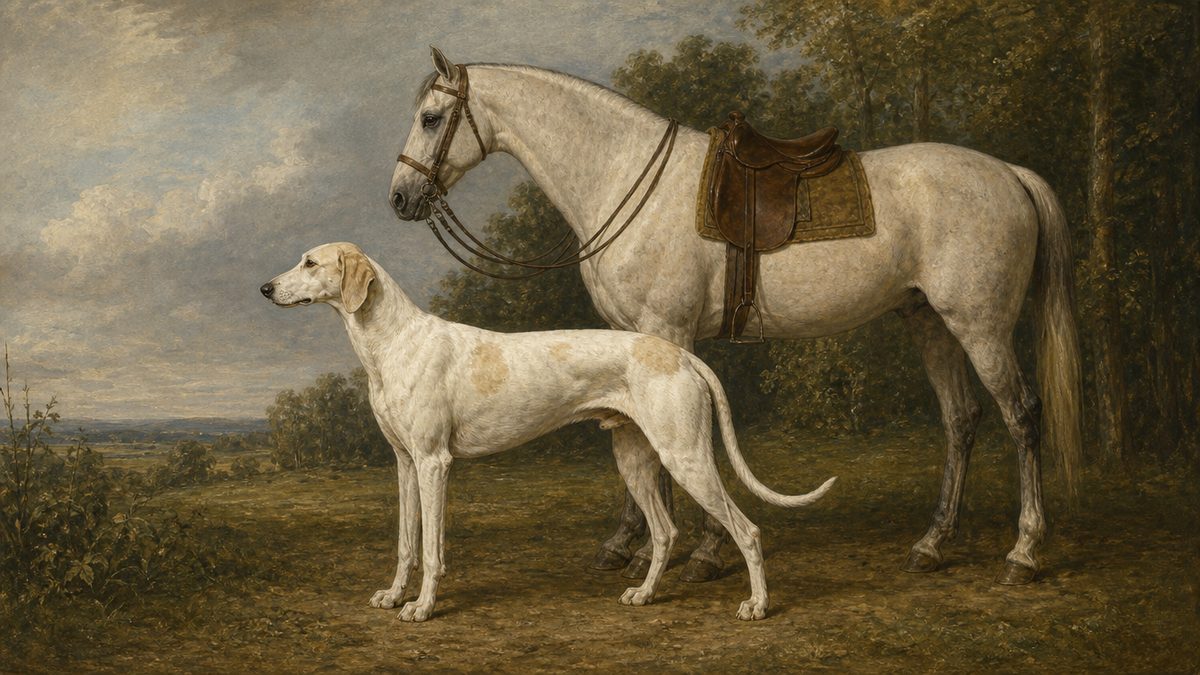
Gilbey's appendix is the fullest description in English and it is four pages long. It calls the dog large, powerful and very fast, says its courage was a great recommendation because it was not easily disturbed by the crowd of horsemen who would accompany a royal personage in the hunting field, and reports that ancient drawings show it shaped much like a greyhound or a Scottish deerhound, with the accounts of its speed bearing out the pictures. Its principal fault, he adds, was a tendency to run at tame beasts.
The colour is the part everyone gets wrong. Gilbey states plainly that it was white only in name, for the colour varied much: some were white, some white spotted with red or tan, some marked or spotted with black or dun, some all black, and others 'like unto fryse', which he glosses as frieze or badger colour. An all-black King's White Hound is not a contradiction. It is what the source says.
Why this page exists
Every page ranking for this name in India descends from one encyclopedia article, and that article cites two books. We opened both. What we found is set out below and it does not match: the pages cited for the Count of Toulouse and for the year 1725 contain neither, the 1561 source contradicts the modern origin story in two places, and five of the six modern French breeds we checked make no claim to this hound in their own registry standard at all.
This dog was real, famous, swift, and never standardised. Kennel club recognition never touched it, because it died before kennel clubs existed. It has no size, no weight, no lifespan and no health record, because those are things a breed registry produces and no registry ever held it. What it has instead is four centuries of hunting literature, and that turns out to be more interesting.
What the 1561 book actually says
Du Fouilloux's La Venerie of 1561 is the earliest full account of this hound, and read in the original it disagrees with the modern summary twice: the King did not want Souillard, and the white greffiers are not Saint Hubert stock.
Souillard first. Du Fouilloux writes that the white dogs were brought forward in France by the late grand Seneschal of Normandy, and that before him they were held in little esteem, chiefly among gentlemen, because they are not commonly run at all game but only at the stag. Then: 'Le premier de la race avoit nom Souillard, lequel fut donné par un pauvre gentil homme au feu Roy Loys: qui n'en feit pas grand compte, d'autant qu'il aymoit sur tout les Chiens gris, desquelz estoyt toute sa meute.'
The King did not think much of him. That is the sentence, and it is the opposite of the story now in circulation. The first of the race was named Souillard, given by a poor gentleman to the late King Louis, who made no great account of him, because above all he loved the grey hounds, of which his whole pack consisted. The Seneschal Gaston, present with the gentleman who had offered the dog and seeing that the King did not like him, asked for him in order to give him to the wisest lady of the kingdom. The dog that founded the royal white pack entered it as a royal refusal.
The Saint Hubert question, settled in 1561
Du Fouilloux answers it directly and in the negative. He records finding a book by a huntsman addressed to a Prince of Lorraine containing a blason given to a limer named Souillart, which was white, and quotes it: 'De sainct Hubert sortit mon premier nom, Filz de Souillart Chien de tresgrand renom.' Then he draws the conclusion himself: 'Dont est à presumer qu'il en sort quelques uns blancs, mais ilz ne sont de la race des Greffiers, que nous avons pour le jourd'huy';. It is to be presumed that some white ones come out of that line, but they are not of the race of the Greffiers we have today.
A modern registry document agrees with him. FCI Standard 220 for the Chien Français Blanc et Noir states that the breed evolved from the Saintonge Hound, that it has no connection with the Saint Hubert, and that there is probably a distant ancestry with the famous white Greffier dogs of the sixteenth century. Two documents 447 years apart separate the white greffiers from the Saint Hubert. The page currently ranking first calls Souillard a pure white Saint Hubert Hound.
Barraud, without the Talbot
The Queen of Scots gift is in du Fouilloux, and it is thinner than the retelling. He writes that the Queen of Scotland afterwards gave the King a white dog named Barraud, from which Marconnoy, lieutenant of the Venerie, bred a line whose dogs are excellent and much stronger than all the others. He gives no year, and he does not call Barraud a Talbot. The modern account supplies both, a Talbot Hound and the year 1560, from later authors.
Du Fouilloux also records the crossing programme in progress. Princes, he says, have had the races of the white dogs and the fawn dogs mixed together, and they are much stronger for it and better at running the stag, though such dogs are not common among gentlemen because they will do only one job and take no account of hares or other small game, and because they are prone to run at domestic livestock. That last line is the same fault Gilbey names three and a half centuries later.
The 1561 heat claim, and what it is worth in India
Du Fouilloux says twice that these hounds did not stop running for heat, and derives the whole race from North Africa on that basis. It is the most India-relevant sentence written about any French hound, and it does not survive contact with an Indian summer.
Here is the passage. Most of the running hounds of France, du Fouilloux says, came out of Brittany, except the white dogs, whose race he believes came from Barbary. He had asked about it at La Rochelle among sea pilots, and in particular an old man named Alfonce who had several times been at the court of a Barbary king called the Doncherib, a great hunter of the reindeer or stag by force, who told him that all the dogs of that king's venery were white and that all the dogs of that country were too.
Then the claim itself: 'Et certes je croy qu'a la verité les Chiens blancs sont venuz des regions chaudes, d'autant qu'ilz ne laissent a courir pour quelque chaleur qu'il face: ce que les autres Chiens ne font pas.' Certainly, he believes, the white dogs came from hot countries, inasmuch as they do not leave off running for whatever heat there may be, which other dogs do not do. He supports it with Gaston Phébus, who he says had been in Mauritania and seen the stag taken by force with dogs he calls Baux which likewise do not leave off running for any heat there can be.
He repeats it about the Barraud line, and adds the qualifier that matters. Such dogs are dedicated to kings, he writes, being fine hunters, questing, furious and high-nosed, who do not leave off hunting for any heat there may be, without breaking at the crush of the piqueurs or at the noise and shouting of the men continually around princes; but they want to be accompanied by piqueurs, and they fear water a little, chiefly in winter when the weather turns cold. A hound praised for heat and cautious about cold water is a specific, coherent animal.
Now put a number on the heat
The heat du Fouilloux meant was a French summer. NASA POWER's twenty-year climatology for Versailles, queried by explicit coordinates, returns an annual mean of 10.75 C, a warmest month of July at 18.86 C and a January mean of 3.15 C. Poitiers, the Poitou country where these hounds were bred and where the Billy later tried to recreate them, returns 11.90 C annually with a July mean of 20.59 C. That is what a sixteenth-century French veneur called heat.
| Place | Annual mean | Warmest month mean | Highest reading on record |
|---|---|---|---|
| Versailles | 10.75 C | 18.86 C in July | 38.15 C |
| Poitiers | 11.90 C | 20.59 C in July | 42.32 C |
| Bengaluru | 23.74 C | 28.37 C in April | 40.38 C |
| Kolkata | 25.81 C | 31.53 C in May | 46.81 C |
| Delhi | 25.60 C | 35.88 C in June | 48.79 C |
| Chennai | 27.95 C | 31.51 C in May | 42.70 C |
Delhi's warmest month runs 17.0 C above Versailles's warmest month as a monthly mean NASA POWER 20-year meteorological…. Chennai's annual mean of 27.95 C is 9.1 C above Versailles's warmest month, so an Indian coastal city is hotter all year than a French July ever gets. Kolkata adds 73.9 percent mean humidity to a 31.53 C May mean and a 46.81 C May record high. Bengaluru is the mildest Indian option and still runs 12.99 C above Versailles annually.
A historical source calling a breed heat-tolerant is describing its own climate, not yours. Run the numbers before importing the adjective. The same correction applies to every European breed sold in India on a line lifted from a nineteenth-century sporting book.
Bonbeno's two-condition test, applied to its own period
The King's White Hound fails the first condition of Bonbeno's two-condition test and passes the second only weakly, so on this site's own rule it was a type rather than a breed, and the reasons are documentary rather than dismissive.
Bonbeno maintains a page for dog types that are not breeds, and its rule is that a breed has a written standard and a studbook behind it, so an individual animal can be measured against something. Both must exist in the animal's own lifetime. That last clause is not pedantry; it is the trap this site documented on the Old English Bulldog, where a standard written thirty years after the sport ended describes the show dog that replaced the animal rather than the animal.
Condition one, a written breed standard: not met
No prescriptive standard for this hound existed while it lived, and the date is checkable from France's own federation. The Société de Vènerie records that the regrouping of hound enthusiasts within it, working with the Société Centrale Canine founded in 1882, allowed the lineages to be identified from the beginning of the last century, and that most were then endowed with a standard, imprecise but legitimate, defining the specific characters of their morphotype and allowing conformity to be judged. That is the early twentieth century, and kennel club recognition of any French hound is a twentieth-century event. The royal white pack had been crossed away from about 1700.
What existed instead was venery literature, and it describes rather than prescribes. Du Fouilloux 1561 gives temperament, colour, origin and working faults, and a separate chapter on the signs by which one may know a good and handsome hound, but that chapter is about choosing an individual dog of any race, not about conforming a white one to a type. Charles IX's remark that the royal hounds were as tall as greyhounds with heads as fine as those of braques is a compliment, not a clause.
The FCI documents that mention this hound at all were published in 1999 and 2008 FCI Standard No. 220. Those are 274 and 283 years after 1725. They are the standards of the breeds that cite it, not its own.
Condition two, a studbook: weakly met
This half is more interesting than expected, and it is where this hound does better than most extinct names. The Société de Vènerie states that each equipage or hunter kept its own livre de chenil, its own kennel book, and adds that the veneurs, it should be recalled, invented the keeping of genealogical documents and often maintain their own kennel books unchanged for centuries. The royal packs were the most closely administered kennels in France.
The surviving evidence is consistent with that. Individual sires are named and remembered across generations in the earliest source, which is exactly what a kennel book leaves behind: Souillard as the first of the race, Barraud from the Queen of Scots, and a line bred from him by a named lieutenant of the Venerie. A twentieth-century veterinary doctoral thesis was written on this pack, Jean-Jacques Rupp's Les Chiens blancs du roy, Paris 1959, and is cited in modern academic work on the French court's animals alongside the royal accounts and the Colbert manuscripts.
But Bonbeno has not seen a royal kennel book for the white hounds, and a private kennel book is not a public studbook in any case. France's Livre des Origines came with the Société Centrale Canine in the 1880s. So the honest score is a documented record-keeping practice rather than a sighted register.
| Condition | Status | Evidence |
|---|---|---|
| A written standard existed in the animal's own lifetime | Not met | French hound standards begin in the early twentieth century; the pack was crossed away from about 1700 |
| A studbook recorded its individuals | Weakly met | Kennel books were kept per equipage and named sires survive from 1561, but no royal register for these hounds has been seen |
Compare the Lobito Herreño, built the same week. That dog has a published written standard and only a private association register. This one has a documented register practice and no standard at all. Two populations, the same test, opposite halves failed.
Which modern breeds actually claim descent, in their own documents
Six French hound standards were checked and only one names this hound, and that one hedges with the word or. The other five say nothing about it, including the breed most often described as its recreation.
The claim that this hound founded the modern French pack breeds is everywhere, so we went to the registry documents rather than to the encyclopedias. Each standard below was downloaded from the FCI and extracted with pypdf on 2 September 2026, and searched for the words Greffier, King, royal and white hound.
| Breed | FCI standard | Standard published | What it says |
|---|---|---|---|
| Grand Griffon Vendéen | 282 | 09.01.1999 | Descends 'from the Greffier or from the so-called King's white hound' |
| Chien Français Blanc et Noir | 220 | 04.11.2008 | 'probably a distant ancestry with the famous white Greffier dogs of the XVIth century' |
| Billy | 25 | 28.12.1973 | Nothing. The standard carries no historical summary at all |
| Porcelaine | 30 | 19.10.1964 | Nothing. No historical summary |
| Poitevin | 24 | 17.11.1978 | Nothing. Its only 'white hound' is a disqualifying fault |
| Griffon Nivernais | 17 | 24.03.2004 | Only that Francis I abandoned it in the royal packs 'who preferred white hounds' |
The one that names it, hedges twice
Standard 282 is worth quoting exactly. Its brief historical summary opens: 'Initially only the Grand Vendéen existed. It was a short-haired variety of Vendéen descending from the « Greffier » or from the so-called « King's white hound ». Neither should we forget mentioning the « griffon fauve de Bretagne » in its origins because the former enters for an important part into the bloodlines of the « Greffier ».';. The word is or. The FCI does not commit to which of two names the ancestor went by.
There is a second hedge that almost nobody notices. The only date attached to the King's white hound in that standard is not in the standard. It sits in a footnote reading '(* Early 16th century - Translator's note.)', added by John Miller and Raymond Triquet, whose credit line at the top gives the official language as French. So the sixteenth-century dating that circulates on the strength of an FCI standard was supplied by the standard's translators.
The recreation that its own club calls an attempt
The Billy is the breed most often equated with this hound, and the Société Centrale Canine is precise about it. Its Billy page says the breed was created at the end of the nineteenth century by a Poitou veneur, M. Hublot du Rivault, who named it after his property, and that by various crosses he attempted to reconstitute the famous chiens Blanc du Roy, created by Louis XII and then called chiens Blanc Greffier, dogs which for more than two centuries made the reputation of the French royal packs. Attempted is the verb the national kennel club chose.
Note also that the kennel club and the encyclopedia disagree about who started the line. The SCC says the chiens Blanc du Roy were created by Louis XII, who reigned from 1498. Wikipedia traces them to Souillard, given to Louis XI in 1470. Du Fouilloux 1561, the earliest of the three, names only 'feu Roy Loys' and gives no date at all. One reign apart, three accounts, and the oldest is the vaguest.
The federation's own framing is an inference, and says so
The Griffon Nivernais standard is the odd one out and it is useful precisely because it is not a descent claim. FCI 17 records that the Nivernais was much appreciated for 200 years up to Louis XI's reign and was then abandoned in the royal packs by Francis I, who preferred white hounds. That is a registry document confirming the royal preference from the losing side, without asserting any ancestry. France's hunting federation makes the descent claim itself in the most careful available form. Having listed the four royal varieties, it writes that one may reasonably deduce that all today's running hounds derive, more or less directly, by crossings among themselves or with other less fixed strains since disappeared, from these historical lineages. Reasonably deduce. That is a modest and defensible claim, and it is what the aggregators turn into a pedigree.
How it ended, and the extinction date nobody can source
The King's White Hound was crossed out of existence rather than killed off, and the process ran from about 1700 under Louis XIV to the reign of Louis XV. The commonly quoted extinction date of 1725 does not appear in the source it is usually cited to.
The reason is almost comic and it is well attested. Gilbey writes that the French royal pack of white hounds held its position and fame until the later years of Louis XIV, who reigned from 1643 to 1715, when they underwent a change: the king was growing old, could no longer ride to hounds, and wished to follow the chase on wheels. The white hounds were too fast to be followed thus, so to meet the old king's wishes they were crossed with the breed known as Normandy hounds, and this blood was introduced into the royal kennels about the year 1700.
The Normandy hound was chosen because it was slow. Gilbey records the Count de Canteleu's view that it descended from crosses between the Saint Huberts and other breeds, partly on the evidence of its tricolour coat, that it was a large hound standing between 26 and 30 inches with a fine powerful voice, a staunch and close hunter admirable for retrieving a cold scent, but that its chief recommendation as a cross with the white hounds of Louis XIV lay in the fact that it was slow. A royal pack was deliberately downgraded so that a carriage could keep up with it.
Louis XV tried to undo it
The successor wanted the speed back. Gilbey writes that Louis XV, who reigned from 1715 to 1774, wished to restore the speed of the royal pack, that the cross-bred White-Normandy hounds did not satisfy him, and that to achieve his end he procured some cross-bred hounds from England, his reason being that they were fleeter and more vigorous and better hunters than his own pack. France's hunting federation records the same turn independently, that under Louis XV, wishing to go faster to take stags, the king surrounded himself with English dogs reputed faster.
Two crossings in one generation is what ends a strain. The pack was slowed with Normandy blood around 1700 and then accelerated with English blood after 1715, and nothing that had made the white hound distinct survived being pulled in both directions.
About that 1725
The year is quoted everywhere and its usual citation does not support it. The encyclopedia article ranking first says that in 1725 the pack was dispersed and the king adopted a new pack of English Foxhound crosses, citing Desmond Morris and Walter Gilbey. We read Gilbey's Appendix A, the pages cited, in full. The string 1725 appears zero times in the entire book. Gilbey gives no dispersal date at all; he ends with Louis XV procuring English hounds and stops.
The date may still be right. A French hound compendium and the SCC both describe the royal packs as running until the 1720s, and the SCC says the white hounds made the reputation of the royal packs for more than two centuries. Bonbeno's position is that 1725 is a plausible date from sources we have not verified, and that it should not be cited to Gilbey, because Gilbey does not say it.
An extinction date is the single most copied fact about an extinct breed, and it is the one nobody checks. If you see 1725 attached to a Gilbey citation, the citation has been carried along by a chain of writers rather than opened by any of them.
Auditing the page that ranks first, against the books it cites
The Wikipedia article on this hound is the source of every other page in the Indian search results, and three of its statements do not survive a check against the books it cites. One is a factual error about a real person.
Credit first, because the article is not junk. It is properly referenced, it names four sources, it correctly reports that the dog is extinct, and its account of the Louis XIV carriage story matches Gilbey closely. It is better than everything below it in the results. It is also the reason its errors propagate.
1. The Count of Toulouse was not Louis XV's son
The article says that at the beginning of his reign Louis XV wanted to revive the pack, 'so his son the Count of Toulouse procured English Staghounds';. Louis Alexandre de Bourbon, Count of Toulouse, was born on 6 June 1678 and died on 1 December 1737, and he was the legitimated son of Louis XIV by Madame de Montespan, created Count of Toulouse in 1681 and grand admiral of France at the age of five. Louis XV was born in 1710. The Count was thirty-two years older than the king whose son he is called.
The same sentence cites Gilbey, and Gilbey does not mention him. The word Toulouse appears zero times in Hounds in Old Days. Gilbey attributes the English purchase to Louis XV himself and names no intermediary.
2. The hedge that gets dropped
Gilbey is careful about the speed claims and the article is not. Gilbey writes: 'It is stated that they would run down a stag in half an hour, and the most vigorous stag could not stand up before them for more than three-quarters of an hour, and that they would kill as many as four stags one after another in a day's hunting';. It is stated. The article reports them as fact, saying the hounds were renowned throughout Europe for their speed, being able to run a stag down in half an hour and kill four stags in a day's hunting.
There is a documentary anchor under the half hour, and it is worth knowing. Gilbey quotes a letter of January 1524 to the Marshal de Montmorency describing a royal hunt in which, once the dogs were laid on in the underwood, the stag 'did not run more than half an hour from the time we laid the dogs on the scent';. One documented run is not a breed characteristic, and Gilbey's own footnote traces the letter to the Count de la Ferrière's Les Chasses de François I of 1869 rather than to an archive he had opened.
3. Souillard, and the Saint Hubert
The article says the hounds descended from a pure white Saint Hubert Hound named Souillard gifted to Louis XI by a poor squire from Poitou in 1470, and that the hound was passed to the king's daughter. Du Fouilloux in 1561 says the King made no great account of the dog because he loved grey hounds, and separately says in terms that white dogs out of the Saint Hubert line are not of the race of the Greffiers. The direction of the gift is right; the enthusiasm and the breed attribution are not in the earliest source.
| Statement on the ranking page | Cited to | What we found |
|---|---|---|
| 'his son the Count of Toulouse procured English Staghounds' | Alderton and Gilbey | 'Toulouse' occurs zero times in Gilbey; the Count was Louis XIV's son, born 1678 |
| 'In 1725 the pack was dispersed' | Morris and Gilbey | '1725' occurs zero times in Gilbey |
| 'able to run a stag down in half an hour' | Gilbey | Gilbey writes 'It is stated that', and sources it to a secondary work of 1869 |
| Souillard was 'a pure white St. Hubert Hound' | Morris | Du Fouilloux 1561 says white Saint Hubert dogs 'are not of the race of the Greffiers' |
Hounds in Old Days is out of copyright and the full text is free. Appendix A runs from page 121 to page 124. Search it for Toulouse and for 1725, and you will find what we found in about thirty seconds.
What the rest of page one is selling
Below the encyclopedia article the Indian results for this name are a fan site, a hobby forum, two social posts, a marketplace and a magazine feature, and the marketplace offers a herdbook, a gestation calculator and listing alerts for a dog extinct since the eighteenth century.
Position six is the instructive one. A pet marketplace publishes a page titled 'King's White Hound Dog: Breed Facts, Prices & Breeders' whose prose is actually careful: it says the name refers to a managed strain of royal pack hounds rather than to white-coated dogs of any modern breed, that no responsible buyer should expect to find a true King's White Hound today, that it is generally regarded as extinct, and that any present-day claim should be treated as reconstruction or influence rather than direct survival. That is a better sentence than most pages manage.
Then the template runs. The same page carries a colour list of 59 entries, among them albino, blue merle, harlequin, leucistic, red merle, reverse brindle, blue roan, dapple, domino and tuxedo, for an animal whose only detailed colour account records white, white with tan or black spots, dun, all black and badger Sir Walter Gilbey, Hounds in Old Days. It offers to alert you the moment a new listing goes live. It maintains a King's White Hound Herdbook with no records, a Breeders directory with none listed, and a Dog Gestation Calculator preset for the breed.
Its featured listings are the tell. On the King's White Hound page, the three featured animals on the day we looked were a dog named Louie in Bugscuffle, Tennessee, an animal named Cedrych Galin Grier in Earlham, Iowa, and a blue pullet in Ravenna, Texas. A pullet is a young hen. Bonbeno has recorded this exact pattern before, a blue pullet featured on a dog breed page on the same domain, and finding it twice on two unrelated breeds makes it a property of the template rather than an accident.
The rest of the page
- Position 2 is a hobby breed site whose one-line summary, that the Chien Blanc du Roi was a pack of scenthounds kept by a line of French kings from the fifteenth to the eighteenth centuries, is accurate and unsourced.
- Position 3 is a fan wiki hosted on a fandom platform, reproducing the encyclopedia lead verbatim.
- Position 4 is a forum thread whose opening post is visibly machine-mangled English about a poor landowner in 1470 and a rare pure white coat colour.
- Positions 5 is a social post reproducing the same lead paragraph under a different heading.
- Positions 8 and 9 are genuine writing, a long-running dog-writer's archive and a British country magazine, both of which mention the hound in passing while discussing living French breeds.
- Position 10 is a French-language extinct-breeds directory page that restates the encyclopedia article in translation.
And the search itself is broken
An India-located Bing pull for this breed name on 2 September 2026 did not return dog results at all. It returned ten pages about a '3.0 Chapter 2 De-escalation Student Test', from a worksheets site, a flashcards site, a document-sharing site, a concrete industry standards body and a jobs board, under 'About 16,700 results';. The refinement chips on that page read 'Missing: Student Test' and 'Must include: Student Test', naming a phrase that appears nowhere in what we typed, which is the documented signature of being shown someone else's result set. A Labrador Retriever control in the same session returned ten genuine Indian Labrador price pages.
If your own search for an obscure breed returns something absurd, the engine is substituting rather than telling you the breed does not exist. Run a common breed as a control before you conclude anything from a strange result set, in either direction.
Price in India: there is no price, and there is no dog
No price in india exists for the King's White Hound because the animal has not existed for roughly three hundred years. Anything offered under this name in India is a different dog, and this section explains what the buyer is really being sold.
The absence here is unusually easy to establish. The dog is extinct on every account, including the marketplace page that would most like to sell you one Wikipedia, 'King's White Hound'. There is no living population anywhere in the world, so there is no supply, no breeder and no price in France either.
The Indian search result set contained no Indian domain and no rupee figure at any position. That observation comes with a working control: a Labrador Retriever search in the same session returned ten Indian price pages quoting bands from INR 30,000 to INR 1,20,000. The instrument finds Indian dog prices when they exist.
What a seller using this name is actually offering
- A Billy, the living French breed created at the end of the nineteenth century in an attempt to reconstitute this hound, which its own kennel club describes as an attempt rather than a recreation.
- A white or lemon-and-white foxhound cross, which will look broadly like the old paintings and has no connection to them.
- A template page carrying a generic colour list, a herdbook with no rows and a gestation calculator, generated for every breed name the site holds.
- Nothing at all, which is the honest answer and the one a buyer should expect.
If a rupee figure is ever quoted at you
Run two divisions before anything else. Divide the figure by 84.38 and by 74; if it lands on a round dollar amount such as 800 or 1,500, you are looking at a foreign price converted into rupees rather than an Indian price. Then ask which register the animal is entered in, because no register in the world holds this hound: it is absent from the FCI's definitive nomenclature under K, where King Charles Spaniel is present as a control, and from the provisional list.
The Kennel Club of India issues pedigrees against FCI nomenclature, so an animal with no FCI entry cannot receive an FCI-linked Indian pedigree. That closes the paperwork route as firmly as extinction closes the biological one.
This page carries no breed price and that is right rather than incomplete. Bonbeno would rather publish a proven absence than a number nobody can trace. What an Indian reader can act on is the cost of keeping a large athletic dog in India, which is real and is set out next.
What a large running hound costs to keep in India
Budget roughly Rs 6,000 to Rs 10,000 a month for a 28 to 32 kg athletic hound in an Indian metro, before boarding and before anything goes wrong. Every figure below was read from the seller's own page on 2 September 2026.
The cost of ownership here is a size and workload question rather than a breed question, and nothing in it is specific to an extinct hound. It is included because an Indian reader who arrives searching this name is usually looking at a living large hound instead, and these are the numbers that apply to one. Where a figure is one chain's promotional floor rather than a market average, we say so.
| Item | Published figure | Source and caveat |
|---|---|---|
| Puppy core vaccination course, 4 visits | From Rs 6,499 | One clinic chain's starts-at floor |
| Annual booster | From Rs 3,199 | Same chain |
| Anti-rabies, single shot | Rs 699 | Same chain |
| Consultation | Rs 500 to 1,000 | One data point, not two: two organisations publish this range byte-identically |
| Tick, flea and worm cover, 15-30 kg | Rs 1,103 a month | Rs 3,308 for three tablets; a 32 kg dog needs the next band up |
| Bath and basic grooming | From Rs 934 | Delhi price list; a smooth hound needs no haircut |
| Boarding, per 24 hours | Rs 899 | Bengaluru operator; a wider published range runs Rs 500 to 2,000 |
| Municipal registration, Delhi | Rs 500 | Renewal also Rs 500, late fee Rs 100 a month |
| Municipal licence, Chennai | Rs 50 | Corporation's own veterinary page |
The clinic figures come from one chain's own price pages, which print Rs 6,499 for the four-visit puppy course, Rs 3,199 for the annual booster and Rs 699 for a single anti-rabies shot, and Rs 934 for a bath in Delhi. Parasite cover is the line that scales with weight: the 15 to 30 kg pack of a combined tick, flea and worm tablet is Rs 3,308 for three months, or Rs 1,103 a month, and a dog above 30 kg needs the larger and dearer band. Boarding at a Bengaluru operator runs Rs 899 for up to 24 hours. Municipal charges are small and vary widely, Rs 500 to register in Delhi against Rs 50 for a licence in Chennai.
Where the published ranges disagree
One widely quoted range should be counted once, not twice. A dog-welfare organisation and a general insurer publish identical consultation figures of Rs 500 to 1,000 and identical core-vaccination figures of Rs 1,500 to 3,000, matching to the rupee on both quantities. Two unrelated bodies agreeing exactly on two separate numbers is evidence that one copied the other. The same source gives grooming at Rs 300 to 2,000 and boarding at Rs 500 to 2,000 a day, both far wider than a metro clinic's list price, which is what a national range looks like.
Food is arithmetic. A 30 kg working hound eats roughly 400 to 480 g of a dry adult food a day, and a large-breed adult formula sold in India works out near Rs 637 a kilogram, so food alone runs about Rs 7,600 to Rs 9,200 a month. Check grams per day against the pack in front of you, because energy density varies by roughly 20 percent between brands.
Parasite control, not food, punishes a lapse. At about Rs 1,100 a month it looks skippable, and the Indian tick-borne-disease figures in the health section are the reason it is the best value in Indian dog ownership.
Suitability for the Indian climate, worked from measurements
No Indian city resembles the climate this hound was bred in, and the gap is between 13 and 17 degrees of annual mean. Heat tolerance is rated 2 of 5 despite a sixteenth-century source praising this specific dog for running in heat.
The home baseline is a cool, wet, low-variance oceanic climate. NASA POWER's twenty-year climatology, queried by explicit latitude and longitude rather than by place name, returns for Versailles an annual mean of 10.75 C, a mean relative humidity of 82.3 percent, a July mean of 18.86 C and a January mean of 3.15 C. Poitiers returns 11.90 C annually and 20.59 C in July. Both cells check out against the real ground: 116.43 m returned for a Versailles near 130 m, and 133.84 m for a Poitiers near 116 m, so the model is describing the actual towns rather than a mountain the way it does in hill country. One column needs a label rather than an assumption. The record-high column is NASA POWER's T2M_MAX, the hottest single reading the twenty-year climatology holds for that month, so it is an extreme rather than an average afternoon, and it belongs beside the other record highs and never beside a monthly mean.
City by city
Delhi is the extreme case and the arithmetic is stark. Its June mean of 35.88 C is 17.0 C above the warmest month this hound ever worked in, and its June record high of 48.79 C is 10.6 C above Versailles's July record high of 38.15 C NASA POWER 20-year meteorological…. Chennai is less peaky and worse across the year: an annual mean of 27.95 C is 9.1 C above Versailles's warmest single month, so there is no cool season to recover in. Kolkata pairs a 31.53 C May mean, and a 46.81 C May record high, with 73.9 percent annual humidity, and hot and humid together is the combination that defeats evaporative cooling in a dog. Mumbai runs 26.77 C annually with a 31.19 C May mean and a 44.85 C May record high.
Bengaluru is the only Indian metro where the question is arguable, and it is still a large gap. Its annual mean of 23.74 C sits 12.99 C above Versailles and its coolest month, January at 21.10 C, is warmer than a French July. Its 841.72 m cell elevation checks against a real elevation near 920 m, so the figure is the city rather than an artefact.
Reconciling the 1561 praise with the numbers
Du Fouilloux's claim that these dogs do not leave off running for whatever heat there may be is a genuine primary statement about this animal, and it is not evidence that the dog would cope in India. It is a comparison between one French hound and other French hounds, made by a man whose hottest working month averaged under 21 C. Its evidentiary basis is also worth naming: hearsay from a La Rochelle sea pilot about a Barbary king's kennel, plus a reading of Gaston Phébus on dogs in Mauritania. That is an origin hypothesis, not a heat trial.
The transferable modern evidence points the other way for a fast pack hound. Hall 2020 in Animals, working from 905,543 UK dogs under primary veterinary care in 2016, recorded 1,259 heat-related illness events in 1,222 dogs and found that of the 879 events with a recorded trigger, 652, or 74.2 percent, were exertional rather than environmental. An animal selected to run a stag to a standstill is the exact profile that finding warns about, and it was measured in a temperate country.
Indian law reaches the same place from a different direction. Second Schedule Part IV paragraph 21(1) of the Prevention of Cruelty to Animals (Dog Breeding and Marketing) Rules 2017 bars keeping in outdoor facilities, without the attending veterinary practitioner's written approval, dogs not accustomed to local temperatures and breeds that cannot tolerate them. A dog whose entire selection history happened below 21 C is squarely within that description.
A historical source calling a breed heat-hardy is grading it against its neighbours in its own climate. Versailles in July averages 18.86 C. Delhi in June averages 35.88 C and has recorded 48.79 C. No amount of sixteenth-century praise closes either gap.
Temperament, and the one trait every source agrees on
Two contemporary sources describe the same temperament and it is a working one: this hound was steady in crowds, single-minded about the stag, and prone to run at livestock. Nothing about household behaviour was ever recorded.
The crowd tolerance is the best-documented trait of any extinct breed on this site, because two writers 352 years apart say the same thing. Gilbey writes that its courage was a great recommendation, as it was not easily disturbed by the crowd of horsemen who would accompany a royal personage in the hunting field. Du Fouilloux says the same in 1561: such dogs are dedicated to kings because they do not break at the crush of the piqueurs, nor at the noise and shouting of the men continually around princes, and they hold the change better than any other kind of dog.
Charles IX supplies the working praise. Gilbey quotes him on the hounds in the royal kennels of his reign, that they were as tall as greyhounds with heads as fine as those of braques, that they only hunted the right scent, and that when the game tried to put them off they behaved gloriously. Gilbey adds his own footnote explaining that braque and its cousins rache and brache were applied to dog hounds and bitch hounds that hunted by scent.
The fault, twice recorded
Both sources name the same defect. Gilbey: its principal fault was a tendency to run at tame beasts. Du Fouilloux: such dogs will do only one job, take no account of hares or other small game, and are prone to run at domestic livestock. In an Indian context that is not an antique detail. A hound with that fault in a country with free-roaming cattle, goats and village dogs is a liability the moment it is off a lead.
What was never recorded
- Behaviour with children. No source mentions it, because nobody kept these dogs as household animals.
- Behaviour with other household dogs outside a pack. Pack tolerance is documented; domestic tolerance is not.
- Separation behaviour, which is a modern concept applied to a kennel animal.
- Trainability in any household sense. What is recorded is pack discipline under mounted huntsmen.
- Any temperament score, survey or bite statistic, none of which existed.
A living descendant's club says the practical thing. The Société Centrale Canine's page for the Billy states flatly that it is not a town dog, that its atavism makes it a hunting dog made to live in a group in the open air and to run at will, and that keeping one alone in a city would make it very depressed. That is a national kennel club warning readers away from urban keeping of a hound of this type, and it is the most useful temperament sentence available.
Training a pack hound, and why it is different work
A pack hound is trained to a group and to a job, not to a living room, and the French kennel club describes the method plainly: kennel routine, daily exercises and obedience learned before meals. Everything below applies to a living pack breed, because this one cannot be trained.
The method is on record and it is unusually specific. The Société Centrale Canine writes of the Billy that it is a pack dog which must be taught collective life and obedience to man from its earliest age, that the elementary rules of that discipline are inculcated at the kennel by daily exercises, notably before the distribution of meals, and lists them: answer to its name, walk in a group, stop at the man's voice. Three commands, taught around food, in a group.
That is a different training problem from the one an Indian flat presents. A pack hound learns to work at a distance with other dogs and to disengage on a human voice, which is the single hardest recall to build in a scent hound anywhere. Nothing in the historical record about this hound suggests it was easier: du Fouilloux notes that dogs of this race want to be accompanied by piqueurs, meaning they were worked with mounted handlers rather than sent out alone.
If you are training a living hound of this type in India
- Book the vaccination course early so the socialisation window is not lost waiting for cover; one Indian chain prices the four-visit course from Rs 6,499.
- Teach the stop-on-voice before the recall, because a hound already running will stop sooner than it will turn.
- Train around food, as the kennel method does, since a scent hound values food above praise.
- Proof the livestock problem deliberately, given that the historical fault of this type is running at tame beasts and Indian streets contain cattle, goats and free-roaming dogs.
- Work only in the cool hours, because heat shortens a hound's attention long before it shortens its breath.
Realistic timelines
Expect a reliable recall around eighteen to twenty-four months in a large scent hound, not six. Loose-lead walking lands earlier, at four to six months, provided the dog is getting real movement elsewhere. What takes longest is the willingness to leave a scent, and in some individuals it never becomes reliable enough to justify an off-lead walk in an Indian city, which is a fact about the type rather than a training failure.
The temptation on a hot day is to compress the same work into a shorter, hotter window. Hall 2020 found exertional illness accounted for 652 of 879 triggered heat events, so that compression is precisely the mistake the data warns against.
The exercise requirement, and what an Indian city can supply
A hound of this type needs two to three hours of real movement a day, and the French kennel club puts a number on it: a Billy covers 40 to 50 km in a day's hunting. An Indian metro cannot supply that in the months it most matters.
Start with the recorded workload. The Société Centrale Canine states that the Billy gallops easily and can cover 40 to 50 km in the course of a day's hunting. The historical claims about this hound are wilder and hedged, but they point the same way: Gilbey reports it was stated that the white hounds would run a stag down in half an hour, that the most vigorous stag could not stand up before them for more than three-quarters of an hour, and that they would kill as many as four stags one after another in a day.
What that translates to in India
- Sixty to ninety minutes before sunrise, at a working pace rather than a stroll.
- Sixty minutes after dark, once paving has cooled enough to hold the back of a hand against.
- Twenty to thirty minutes of scent work indoors during the heat of the day, which tires a scent hound faster than distance does.
- One long weekly outing on open ground in the cool season, because a running hound needs to run rather than walk.
- A securely fenced space, because the documented fault of this type is running at livestock and an Indian street supplies plenty.
The constraint nobody plans for is surface temperature. Delhi's June air temperature averages 35.88 C and its record for the month is 48.79 C, and paving in direct sun sits well above air temperature, which removes the middle of the day entirely for eight to ten weeks. Chennai's May, averaging 31.51 C with a record high of 42.70 C, does the same across a longer season, because its annual mean of 27.95 C leaves no genuinely cool months to catch up in.
What happens without it
An under-exercised running hound does not settle; it self-employs. The predictable results are fence-testing and escape, sustained baying at street noise, destructive chewing, and a hardening of exactly the livestock-chasing fault the sources record. None of that is misbehaviour. It is a working animal with no work.
If two hours a day in the cool hours is not realistic every day for a decade, a large pack hound is the wrong dog in India, and no amount of enthusiasm for its history changes that.
Grooming a smooth hound in Indian humidity
A smooth-coated hound is the cheapest coat in India to keep: a weekly brush, a monthly bath and deliberate ear drying. The only coat detail recorded for this hound is colour, and the colour record is stranger than the aggregators suggest.
The sources describe colour and say nothing about coat length as a problem, which is itself informative. Gilbey's four pages discuss colour variation at length, calling the dog white only in name and listing white, white spotted with red or tan, marked or spotted with black or dun, all black, and badger colour, without once suggesting the coat needed work. Its living relatives are smooth: the SCC describes the Billy's coat as short, hard to the touch and often a little coarse.
The Indian routine for any smooth hound
- Brush weekly with a rubber curry or short-bristle brush, twice weekly during a seasonal coat change.
- Bathe roughly monthly, or after a muddy monsoon outing, with a plain dog shampoo rather than a medicated one unless a vet has prescribed it.
- Dry the ears deliberately after every bath and every swim, because a drop ear left damp in Indian humidity is the commonest avoidable ear problem in this country.
- Check between the toes weekly through the monsoon, where grass seeds and damp skin cause more trouble than the coat ever will.
- Watch unpigmented skin on a mainly white dog, because sun damage lands on pink skin and can be mistaken for infection.
Do not copy the overseas instruction to towel a hound off and let it air dry. That advice is written for a temperate climate. Indian veterinary series report canine ear disease clustering heavily in the monsoon months, and bathing without protecting the ear canal is repeatedly named as a cause, so the correction is simply to dry the ears with a soft cloth and let the coat air dry rather than treating the two the same way.
What it saves
No haircut means the most expensive line on an Indian grooming bill disappears. A Delhi price list runs a haircut from Rs 1,359 and a bath from Rs 934, so a household brushing at home and buying an occasional professional bath sits at the bottom of that range. Over a year the difference against a coated breed needing a monthly Rs 1,869 bath and style is several thousand rupees.
A short coat is insulation against heat as well as cold, and shaving removes the dog's own shade while doing nothing for its core temperature. A dog that looks too hot needs shade, water and a changed schedule.
Health, life expectancy and what nobody ever measured
No health data of any kind exists for this hound. There is no life expectancy, no inherited-disease record and no veterinary literature under any of its names, so this section covers what an Indian owner of a large hound can act on instead.
The absence is complete and it was tested rather than assumed. On 2 September 2026 PubMed returned zero records for 'King's White Hound', 'Chien Blanc du Roi', 'Chien Blanc du Roy', 'chiens blancs du roy' and 'Greffier hound';. Controls in the same session were healthy: Labrador retriever hip dysplasia returned 126 records and Beagle otitis externa returned 11. The database was answering; the names are simply not in it.
One translation line is worth publishing on its own. Searching 'Chien Blanc du Roy' produced the translation 'chien'[All Fields] AND 'blanc'[All Fields] AND du roy[Author]. PubMed had turned the last two words of a French breed name into an author search. This site has recorded the same behaviour on the King Charles Spaniel, and the lesson repeats: read the translation line, because a zero produced by an author-field search is not a finding about a dog.
Life expectancy: none published, and none will be
A life expectancy comes from a mortality dataset, and there is no dataset. Neither of the two substantial descriptions of this hound records how long one lived: du Fouilloux discusses working qualities and origin, Gilbey discusses appearance, colour and speed. Any lifespan quoted for this breed online has been borrowed from a living hound, so Bonbeno publishes none.
Size and weight: also never recorded
There is no size and weight figure for this dog anywhere. Gilbey calls it large and powerful and compares its shape to a greyhound or Scottish deerhound, and the only measurement in his four pages belongs to the Normandy hound that replaced it, standing between 26 and 30 inches. A modern site printing a height range and a weight range for this hound has invented both, because those measurements are undocumented in every source that describes the animal.
What a large hound in India actually faces
Ticks, not genetics. Published Indian surveys of dogs presented at veterinary clinics report high rates of tick-borne disease: a West Bengal series of 584 dogs found Babesia gibsoni in 76.54 percent, Anaplasma in 55.75 percent and two or more pathogens in 72.9 percent of all 584 dogs screened, and a Kerala series of 120 dogs found Babesia in 66.7 percent and Ehrlichia canis in 5.0 percent, peaking pre-monsoon between March and May.
Both studies sampled clinically suspected dogs or clinic caseloads rather than random populations. Among dogs tested at veterinary clinics is the honest framing. The figures are still the reason a roughly Rs 1,100 monthly parasite tablet is the best-value decision in Indian dog ownership.
Heat is the second risk and it has one transferable number. Hall 2020 in Scientific Reports, from 905,543 UK dogs under primary veterinary care, recorded 395 confirmed heat-related illness events, a case fatality of 14.18 percent, and an odds ratio of 1.42 with a confidence interval of 1.12 to 1.80 for dogs at or above their breed and sex mean bodyweight. This hound was obviously not in that model, so only the bodyweight factor transfers, and it transfers as a direction rather than a rate.
Indian law names a screening list that would apply to any large hound bred here. Second Schedule Part III paragraph 8(10) of the Prevention of Cruelty to Animals (Dog Breeding and Marketing) Rules 2017 requires breeding dogs to have been tested for genetic defects including hip dysplasia, progressive retinal atrophy, night blindness, hypothyroidism, entropion, ectropion, overshot and undershot jaw, wry mouth, two or more missing teeth and cryptorchidism. The word is including, so the list is illustrative. There is no patella requirement and no dental requirement anywhere in the Rules.
Feeding a large running hound in India
Feed to body condition rather than to a chart, because bodyweight is the one quantified heat risk that transfers to a working hound. A 30 kg hound on a standard dry food eats roughly 400 to 480 g a day, which costs about Rs 7,600 to Rs 9,200 a month.
The reason to be strict is not cosmetic. Hall 2020 in Scientific Reports found dogs at or above their breed and sex mean bodyweight carried an odds ratio of 1.42 for heat-related illness, and that finding was measured in Britain. In an Indian summer, two extra kilograms on a running hound are a measurable risk.
Nothing historical helps you here, and it is worth saying why. No source records what these hounds weighed, so there is no breed mean to feed toward. Use a body condition score instead: ribs easily felt under a thin fat cover, a visible waist from above, and an abdominal tuck from the side.
The seasonal split a hunting kennel uses
The French kennel club sets out the working pattern, and it is a genuinely useful model. During the hunting season, it says, a hound's food must be complete in fat, protein and fibre but richer in fat, with certain fats such as fish oil preferred and a supplement of vitamin E recommended, and a high-protein feed chosen; outside the season energy needs are lower, so fats and proteins come down, fibre goes up and, absent a particular deficiency, vitamin and mineral supplementation stops, because too rich a diet can be more harmful than useful.
Translated to India, the seasons invert. The working window here is the cool months, roughly October to February in the plains, and the low-activity window is the hot one. So the richer ration belongs to the Indian winter and the maintenance ration to the summer, which is the opposite of the European calendar and the reason imported feeding advice misfires.
Life-stage feeding
- Eight to sixteen weeks: four meals a day of a large-breed puppy food, weighed rather than scooped.
- Four to nine months: three meals a day, reducing to two by about nine months.
- Nine to eighteen months: two meals, on a large-breed formula while the growth plates close.
- Adult: two meals a day, weighed monthly rather than judged by eye.
- Seven years and older: same volume, lower calorie density, evening meal moved later in summer.
The monthly figure is arithmetic rather than a quoted price. At Rs 637 a kilogram for a large-breed dry adult food and 400 to 480 g a day, food alone is Rs 255 to Rs 306 a day. A 15 kg bag lasts about 31 to 37 days at that rate. Check grams per day against the pack in front of you before treating any monthly figure as yours.
A running hound in an Indian summer drinks far more than one in a French winter, and dehydration arrives before appetite loss. Offer water in two places, refresh it twice daily, and treat a dog that stops drinking as a same-day veterinary problem.
The first year, month by month
You cannot buy a King's White Hound puppy, so read this as the plan for a large pack hound in India, built around the Indian heat calendar and Indian vaccination pricing rather than a European one.
The single most important scheduling decision is when the puppy turns four months old. The window from four to nine months is when a large hound needs steady low-impact movement, and in a plains city that window is unusable between March and June: Delhi's June averages 35.88 C against a record 48.79 C, and Chennai's May averages 31.51 C against a record 42.70 C NASA POWER climatology for Chennai. Aim for a puppy that reaches four to nine months between October and February.
| Age | What matters most | Typical Indian cost |
|---|---|---|
| 8 to 10 weeks | Home settling, crate and mat work, first vaccination visit. Indian law forbids the sale of pups under eight weeks under Rule 8(1)(a). | Course from Rs 6,499 across four visits |
| 10 to 16 weeks | The socialisation window. Strangers, traffic, lifts, watchmen, and controlled exposure to cattle and goats, given this type's recorded livestock fault. | Included above |
| 4 to 6 months | Stop-on-voice before recall. Begin monthly parasite cover. | About Rs 1,103 a month |
| 6 to 9 months | Two meals a day. Municipal registration where required. | Rs 500 in Delhi, Rs 50 in Chennai |
| 9 to 12 months | Build real fitness, cool months only. Growth plates still closing in a large hound. | Rs 7,600 to 9,200 a month for food |
| 12 to 18 months | Annual booster, adult health check, hip and elbow imaging before any breeding is contemplated. | Booster from Rs 3,199 |
What not to do in the first year
- Do not force distance running before the growth plates close, at roughly fourteen to eighteen months in a large hound.
- Do not delay socialisation until the vaccination course finishes, because the window closes before the course does; carry the puppy to busy places instead.
- Do not skip parasite cover through the monsoon, when the Indian tick pressure described in the health section peaks.
- Do not exercise on hot paving, and test it with the back of your hand before every walk between March and June.
- Do not let a young scent hound rehearse chasing livestock even once, because the type's documented fault is exactly that.
One legal point applies to every dog sold in India regardless of breed. Rule 8(1)(a) of the Prevention of Cruelty to Animals (Dog Breeding and Marketing) Rules 2017 provides that pups less than eight weeks in age are not sold, and that is a genuine Rule rather than a Second Schedule paragraph.
The Rules run from 1 to 13, so any citation reading Rule 14 or higher is wrong on its face; everything numbered above 13 is a Second Schedule paragraph, and those run 1 to 30 continuously across four Parts.
What Indian law would say about a dog like this
Indian law permits a dog to enter only as your own pet and rejects imports for trading or breeding outright, and its outdoor-housing clause reaches a hound bred below 21 C directly. No Indian law names this breed, because no Indian instrument names an extinct one.
The import position sits in one document and it is short. Under ITC(HS) 01061900 mammals including pet dogs are Restricted, and Trade Notice 22/2022-23 of 19 December 2022 sets out Policy Condition 7, which allows import of dogs only for a pet dog with a valid pet book and relevant records in the name of the importer, for dogs imported by R&D organisations with the recommendation of CPCSEA, and for internal security by the Defence and Police Force. Policy Condition 8 states that import of commercial dogs for breeding or any other commercial activity is not permitted.
The notice is blunt about applications. It records that any applications for trading or breeding purposes, or applications made on behalf of some other person or entity, shall be duly rejected, and it allows import of pet animals only through the airports and seaports of Delhi, Mumbai, Chennai, Hyderabad, Bangalore and Kolkata. DAHD added a seventh port, Cochin International Airport at Kochi, for pets arriving under the baggage rules in October 2024. It also advises owners to begin the import authorisation process at least two months before travel. There is no commercial import licence available for a dog of any breed on this route. The full route is set out in how to import a dog to India.
The housing clause that would bite
One clause was written for exactly this situation. Second Schedule Part IV paragraph 21(1) of the Prevention of Cruelty to Animals (Dog Breeding and Marketing) Rules 2017 bars keeping animals in outdoor facilities, without the written approval of the attending veterinary practitioner, where they are dogs not accustomed to local temperatures, breeds that cannot tolerate them such as long-haired breeds in high temperature locations, or sick, infirm, aged or young animals. A hound selected below 21 C is a dog not accustomed to local temperatures, and it is that limb rather than the coat limb that applies.
Breeding rules that would apply to any recreation attempt
- In-breeding and incest breeding are both prohibited by Second Schedule Part II paragraph 6(3), which defines in-breeding as mating between relatives of the second to fourth grade within the first four generations and incest breeding as parent to child or brother to sister.
- Tail docking, ear cropping, de-barking, de-clawing and any change of appearance by artificial means are strictly forbidden by Second Schedule Part II paragraph 6(8).
- Breeding to create new breeds of dogs or unusual looks is strictly prohibited by Second Schedule Part II paragraph 6(9), which is the clause a modern attempt to recreate an extinct breed in India would have to answer.
- Genetic-defect testing before breeding is required by Second Schedule Part III paragraph 8(10).
- Sale of pups under eight weeks is prohibited by Rule 8(1)(a).
Paragraph 6(9) deserves a moment because it is genuinely awkward for reconstruction projects. A programme that crossed several living French hounds in order to produce something resembling an extinct one is, on the face of the words, breeding to create a new breed of dog. Bonbeno is not asserting that any such project has been prosecuted in India; we are pointing out that the clause is there and that an Indian breeder attempting what Hublot du Rivault did in France in the 1880s would have to reckon with it Animal Welfare Board of India.
No breed ban applies
No Indian law in force today bans owning, breeding or selling this hound or any of its living relatives. The 2024 central circular listing breeds for a proposed prohibition was quashed by the Karnataka High Court on 10 April 2024 and set aside by the Delhi High Court on 16 April 2024, and the Centre told the Bombay High Court in January 2025 that it is not acting on it. Its full list survives in CBIC Instruction 05/2024-Customs of 14 March 2024 and prints 24 comma-separated entries, while press reports say 23 because they fold the closing Bandog clause in, and 25 appears where Japanese Tosa and Akita is split into two. No French hound appears on it.
Head to head against the living dogs a reader would cross-shop
Compare this hound with the living French breeds that claim it and with the Indian dog a reader can adopt tomorrow, and the pattern is clear: every living option has a standard and a studbook behind it, and one of them is already built for the weather.
A reader arriving on this name is usually deciding between a story and a dog. The comparison below is between the story and four dogs that exist, judged on the three things that decide whether an animal is obtainable in India: a written standard, a registry that will paper it, and a climate it can survive.
| Dog | Written breed standard | FCI registered | Claims descent from this hound | Realistic in India |
|---|---|---|---|---|
| King's White Hound | None, ever | Absent under K, with a control present | Not applicable | Extinct |
| Billy | FCI 25, published 1973 | Yes | Its kennel club says du Rivault attempted it; its standard says nothing | Very rare, but a registry route exists |
| Grand Griffon Vendéen | FCI 282, published 1999 | Yes | Yes, hedged with 'or' | Very rare outside France |
| Chien Français Blanc et Noir | FCI 220, published 2008 | Yes | 'probably a distant ancestry' | Very rare outside France |
| Porcelaine | FCI 30, published 1964 | Yes | Its standard makes no claim at all | Very rare outside France |
| Indian Pariah Dog | Not applicable | Not applicable | No | Adoptable free in every Indian city |
Against the Billy
The Billy is the closest living thing to what this page describes, and its own paperwork is more modest than its reputation. France's kennel club says du Rivault attempted to reconstitute the chiens Blanc du Roy by various crosses at the end of the nineteenth century, and the FCI standard for the breed carries no historical summary at all, so the descent claim exists at national level and not at international level. As a dog it is a 58 to 70 cm smooth pack hound that will cover 40 to 50 km in a hunting day, and its club says plainly it is not a town dog.
Against the Grand Griffon Vendéen
The Grand Griffon Vendéen is the only one of six standards checked that names this hound, and even there the FCI writes that the Grand Vendéen descended from the Greffier or from the so-called King's white hound. If a reader's interest is specifically in the royal white line, this is the breed whose registry document comes nearest to acknowledging it, and it is a rough-coated dog rather than a smooth one.
Against the Indian Pariah Dog
For an Indian household the honest comparison is with the Indian Pariah Dog, and it is not close. A medium, smooth-coated, athletic, heat-adapted landrace, adoptable free in every Indian city, with none of the climate mismatch and none of the paperwork problem. If what appeals about this hound is the athletic outline, the smooth coat and the working temperament, an Indian pariah supplies all three without asking a dog bred below 21 C to live at 35 C.
If you want the history, read this page. If you want a dog, adopt an Indian pariah. If you specifically want a French pack hound and can supply two hours of cool-hour exercise a day, look at the Billy and expect a long wait.
What readers get wrong about this hound
Six mistakes recur, and five of them come from one encyclopedia article being copied without anyone opening the books it cites. The sixth comes from taking a sixteenth-century compliment as a modern measurement.
1. Treating the Billy as this hound
The Billy is a late-nineteenth-century recreation attempt, in the word its own national kennel club uses. A dog assembled from three Poitou strains in the 1880s to resemble a hound last seen in the 1720s is a new breed with a historical target, and the FCI standard for it makes no descent claim at all.
2. Believing the modern breeds all descend from it
Five of six French hound standards checked make no reference to this hound, including the Porcelaine and the Poitevin, which are routinely named as its descendants FCI Standard No. 24, Poitevin. France's own hunting federation frames the descent as something one may reasonably deduce rather than something documented. Report the claim with its source, as this page does, rather than as a pedigree.
3. Quoting 1725 to Gilbey
The year 1725 appears zero times in Hounds in Old Days, which is the book most often cited for it. Gilbey ends his account with Louis XV buying English hounds and gives no dispersal date. The date may be correct from another source; it is not correct to cite it to this one.
4. Repeating the speed claims without the hedge
Gilbey writes 'It is stated that' before the half-hour stag and the four stags in a day, and traces his material to a secondary work of 1869. The ranking page reports both as established fact. A hedge that survives 1913 and dies in 2024 is the commonest way a historical claim hardens into a statistic.
5. Calling Souillard a St Hubert Hound
Du Fouilloux in 1561 writes that although white dogs may come out of the Saint Hubert line, they are not of the race of the Greffiers we have today, and FCI Standard 220 says independently that the breed it describes has no connection with the Saint Hubert while probably having a distant ancestry with the white Greffier dogs. Two documents, 447 years apart, on the same side.
6. Reading a 1561 compliment as a heat rating
Du Fouilloux really does write that these hounds do not leave off running for whatever heat there may be. He was writing where the warmest month averages 18.86 C. A dog praised for enduring a French July is not thereby qualified for a Delhi June averaging 35.88 C, with a record high of 48.79 C, and treating the compliment as a rating is how European breeds get sold in India on the strength of antique prose.
An India-located search for this breed name returned ten pages about a de-escalation training test, with refinement chips naming a phrase nobody typed. If your search returns something absurd, the engine is substituting rather than reporting an absence.
Adoption, and what to do with an interest in this hound
You cannot adopt a King's White Hound, and the honest recommendation is to adopt an Indian dog and read the sources for the history. If the attachment is to the French pack hound as a living type, the route runs through the French breed clubs and a long wait.
No rescue anywhere holds this animal, because it has not existed since the eighteenth century. No breeder holds it either, and no register would recognise one: it is absent from the FCI's definitive nomenclature under the letter K, where King Charles Spaniel is present as an in-document control proving that a breed whose name begins with King would appear there, and absent from the twenty-one-entry provisional list.
Adopt the dog that is already here
The Indian Pariah Dog answers most of what draws people to this one. Smooth-coated, athletic, medium-sized, alert to strangers without being fragile about crowds, and adapted to the climate outside your window rather than to one 15 C cooler. Adoption costs nothing, every Indian metro has shelters and independent rescuers placing them, and the animal arrives with no import paperwork, no pedigree fee and no heat problem.
If you want a living French pack hound
- Approach the breed club through the Société Centrale Canine rather than through any listing site, because these breeds are held in working packs rather than sold as pets.
- Expect to be refused if you cannot show ground, because the club's own page says a hound of this type kept alone in a city becomes deeply depressed.
- Understand that any dog you acquire enters India only as your own pet, with a valid pet book in your own name, and never as breeding or trading stock.
- Budget quarantine, transport and veterinary certification honestly, on top of the Rs 6,000 to 10,000 monthly keeping cost for a dog this size.
- Verify the register entry before money changes hands, because a large white hound with a good story and no papers is the exact animal this page exists to warn about.
And if the interest is really historical
Read the sources instead, because they are free and better than any summary. Du Fouilloux's La Venerie of 1561 is online in the original French, Gilbey's Hounds in Old Days of 1913 is out of copyright with the white hound in Appendix A at pages 121 to 124, and a full veterinary doctoral thesis was written on these dogs, Jean-Jacques Rupp's Les Chiens blancs du roy, Paris 1959, which modern academic work on the French court's animals still cites. Three centuries after the last of them, that is a better inheritance than a puppy.
Bonbeno wrote it to answer a question honestly rather than to move a dog. The King's White Hound was real, famous, never standardised and is long gone; the breeds that claim it mostly do not claim it in writing; and an Indian household is better served by a dog already built for the weather.
King's White Hound: the questions worth asking
Is the King's White Hound extinct?
Yes. The royal white pack was crossed with slower Normandy hounds from about the year 1700, because Louis XIV had grown too old to ride and wanted to follow the chase on wheels, and Louis XV then brought in cross-bred hounds from England to restore the speed. Nothing recognisable as the old white hound survived that.
What is the price of a King's White Hound in India?
There is no price in india, and there is no price anywhere, because the animal does not exist. Any listing under this name is selling something else. India also lists live dogs as a Restricted import and rejects applications to import dogs for trading or breeding purposes, so even a living version could not be traded here.
What did the King's White Hound look like?
Large, powerful and very fast, shaped much like a greyhound or a Scottish deerhound according to the drawings. It was white only in name: recorded colours run from pure white through white spotted with tan or black to dun, all black, and a badger colour that one writer rendered as like unto frieze.
Was Souillard a St Hubert Hound?
The earliest source says the opposite. Du Fouilloux quotes a hunting blason in which a white limer named Souillart claims Saint Hubert descent, and then writes that although some white ones may come out of that line, they are not of the race of the Greffiers we have today. FCI Standard 220 independently says the same, that there is no connection with the Saint Hubert.
Was the King's White Hound a real breed?
Not on Bonbeno's two-condition test. A breed needs a written standard and a studbook in its own lifetime, and no written standard for this hound existed while it lived. France's own hunting federation dates written standards for the French running hounds to the beginning of the twentieth century, roughly 180 years after this pack was crossed away.
Which modern breeds descend from the King's White Hound?
Fewer than the internet suggests. Of six French hound standards checked, only the Grand Griffon Vendéen's names it, and it hedges, saying the breed descends from the Greffier or from the so-called King's white hound. The Billy, Porcelaine and Poitevin standards carry no historical summary at all.
Is the Billy the same as the Chien Blanc du Roi?
No, and France's own kennel club is careful about it. Its Billy page says Hublot du Rivault attempted to reconstitute the famous chiens Blanc du Roy at the end of the nineteenth century. Attempted is the verb, the FCI standard for the Billy makes no historical claim at all, and a reconstruction from other stock is not the original animal.
Could the King's White Hound handle Indian heat?
Its own contemporary said it did not stop for heat, and that heat was not Indian heat. Du Fouilloux wrote in 1561 that these dogs do not leave off running for any heat there may be. Versailles averages 18.86 C in its warmest month; Delhi averages 35.88 C in June, seventeen degrees higher, and its record for the month is 48.79 C.
How long did the King's White Hound live?
Nobody recorded a life expectancy for it. There is no veterinary literature under any of its names, no kennel-club life table and no mortality study, so any lifespan figure quoted for this hound online has been copied from a living breed. Bonbeno publishes none.
How big was the King's White Hound?
No size or weight figure was ever recorded for it. Gilbey's appendix calls it large and powerful and compares its shape to a greyhound, and the only measurement in those four pages belongs to the Normandy hound that replaced it, standing between 26 and 30 inches.
Why does a search for this breed return nothing useful?
Because the query is being substituted rather than answered. A Bing India search for this breed name on 2 September 2026 returned ten pages about a de-escalation training test, with refinement chips naming a term nobody searched for, while a Labrador control in the same session returned genuine Indian results.
Can I adopt a dog like the King's White Hound in India?
You can adopt an Indian pariah dog today, free, in any Indian city. It is medium, smooth-coated, athletic and already adapted to the climate, which matters because heat-related illness in dogs is overwhelmingly exertional rather than environmental, and an imported running hound in an Indian summer is exactly the wrong combination.
Que signifie "chien blanc du roy" ?
The question asks what chien blanc du roy means, and the answer is the King's White Hound: the white running hound of the French royal packs, built for stag hunting and almost nothing else, and extinct for about three hundred years. In its own century nobody called it that; it was the chien blanc, the baux or the greffier. France's own federation for hunting with hounds records that from the fifteenth to the eighteenth century the only running hounds recognised in France were the four royal varieties, so named because they exclusively and durably made up the monarchs' packs, and the white hounds of the King were one of the four. The Société Centrale Canine says they were created by Louis XII, then called chiens Blanc Greffier, and made the reputation of the royal packs for more than two centuries.
Quels étaient les chiens des rois de France ?
The question asks what the dogs of the kings of France were, and du Fouilloux's La Venerie of 1561 sets out all four royal varieties: the white hounds of the King, the fawns of Brittany, the greys of Saint Louis and the black hounds of the Abbey of Saint Hubert in the Ardennes. The white pack began as a royal refusal, a dog named Souillard given to the late King Louis who made no great account of him because he loved the grey hounds, of which his whole pack consisted. From about 1700 Louis XIV, too old to ride, had the white hounds crossed with slow Normandy hounds so a carriage could keep up, and Louis XV then brought in cross-bred English hounds to restore the speed, which is how the white hound was crossed out of existence.
Compare with similar breeds
King's White Hound sits in 3 Bonbeno groups. Each one compares it directly against the breeds it is genuinely an alternative to, on the same figures.