
Indian breed profile
Jonangi Dog: The Duck Herder of Kolleru Lake, Full Breed Guide
A short-coated Andhra Pradesh landrace that herded ducks around Kolleru Lake, lost its job to aquaculture, and was driven close to extinction. It is also the breed with the least reliable published data of any dog on this site, and this page says so instead of filling the gaps.
Quick answer
The Jonangi is a rare indigenous dog breed of coastal Andhra Pradesh that herded ducks around Kolleru Lake until aquaculture replaced duck farming. It has a very short coat, a wrinkled forehead, tulip ears, a strong digging habit and a yodel instead of a bark. No major kennel club recognises it and ICAR-NBAGR has not registered it, so almost every published figure about it is unverified.
This guide is general information for Indian pet owners and is not a diagnosis. Always consult a registered veterinarian near you before acting on anything you read here, and treat any sudden change in your dog's condition as urgent.
Jonangi at a glance
What a Jonangi actually is
The Jonangi is an indigenous dog breed of coastal Andhra Pradesh, also called Jonangi Jagilam or Kolleti Jagilam, historically concentrated near Kolleru Lake in the West Godavari and Krishna districts and used to herd ducks, hunt small game and guard property. It is a short-haired working landrace, not a show breed, and no major kennel club recognises it.
Start with kennel club recognition, because it explains everything that follows. ICAR-NBAGR, the national body that formally registers India's animal genetic resources, has registered exactly five indigenous dog breeds: Rajapalayam and Chippiparai from Tamil Nadu, the Mudhol Hound from Karnataka, the Gaddi from Himachal Pradesh and the Changkhi from Ladakh. The Jonangi is not among them. The same bureau has registered 242 indigenous animal breeds in total across all species and has been adding new ones steadily since it first registered indigenous pig and donkey breeds in 2012, so the absence is not for want of a registration mechanism. It means no government-authenticated breed descriptor exists for this dog, and every measurement you will read anywhere, including on this page, is somebody's private estimate.
What a Jonangi looks like
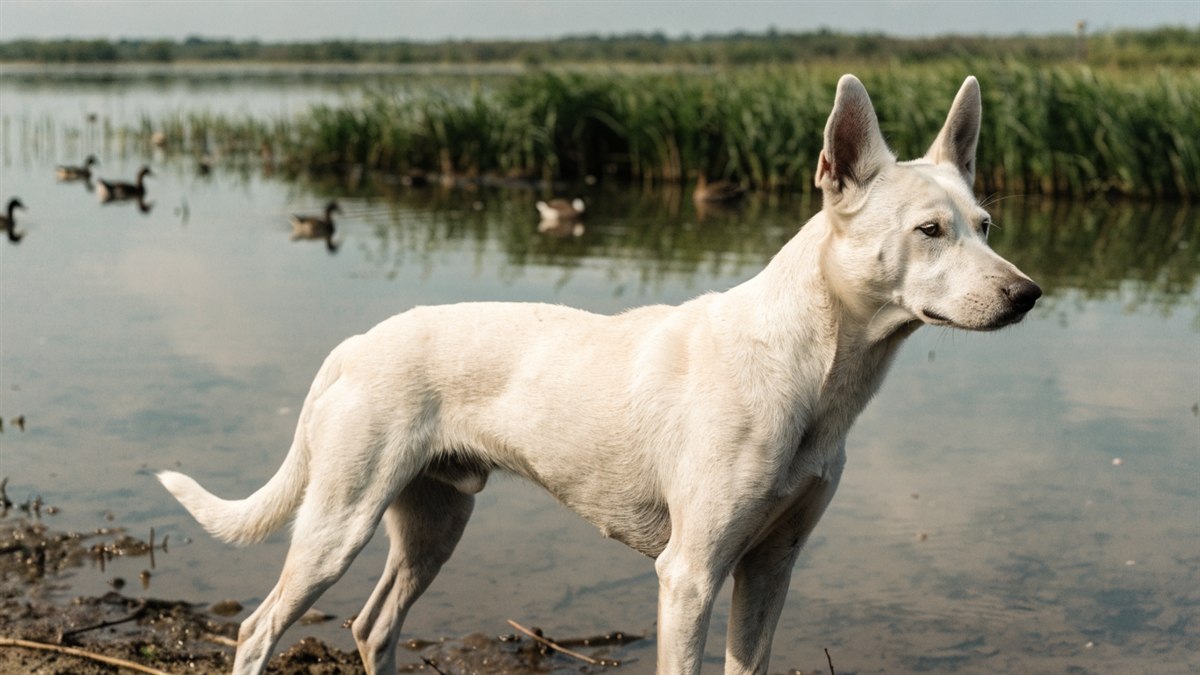
The physical description is the one thing sources broadly agree on. A Jonangi carries a short, dense coat with no undercoat, in white, white with black spots, black, grey or brindle. The head is the giveaway: a wrinkled forehead under tulip-shaped ears, a short muzzle and a squat face, with the tail carried curled over the back. Several writers reach for the same comparison and describe a leaner English Bull Terrier with pricked ears.
The coat is sparser than the word short suggests. The naturalist S Theodore Baskaran, whose The Book of Indian Dogs is the most substantial modern survey of the country's indigenous breeds, describes the Jonangi as having a coat so sparse that the skin is visible through it, and lists the breed among the pristine indigenous breeds. That is why the dog turns up on hairless-breed listings and why several social posts call it hypoallergenic, a claim no veterinary source on this page supports.
Where the published measurements fall apart
No two sources agree on how big a Jonangi is. The spread across seven published pages runs from 13 kg to 39 kg, which is the difference between a Beagle and a German Shepherd. We publish the disagreement rather than picking a midpoint, because averaging contradictory guesses produces a number that describes no real dog.
| Source | Height | Weight |
|---|---|---|
| Wikipedia | 46 to 56 cm (18 to 22 in) | Males 25 to 39 kg, females 20 to 29 kg |
| Animalia | 46 to 56 cm | Males 25 to 39 kg, females 20 to 29 kg |
| Dogster | 17 to 21 in | 28 to 48 lb (about 13 to 22 kg) |
| The Smart Canine | 17 to 21 in | 28 to 48 lb |
| DogWellness | 43 to 53 cm (17 to 21 in) | 16 to 25 kg (35 to 55 lb) |
| HonestDog | 43 to 53 cm | 12 to 21 kg |
| HubPages | 13 to 17 in | 13 to 21 kg |
| Hepper | 12 to 18 in | 25 to 60 lb (about 11 to 27 kg) |
Two sources put an adult male at 39 kg. One puts the breed's ceiling at 13 kg. Both cannot be right, and no registry exists to settle it. Treat every Jonangi figure on the internet, including the ones we quote here, as an unverified estimate rather than a breed standard.
Two further descriptions are worth naming because they contradict the mainstream account outright. NativeBreed dates the breed to more than 2,000 years ago in the Krishna and Godavari deltas, splits it into a smaller hunting type of about 20 to 25 lb and a larger guarding type reaching 70 lb, and attributes the yodel vocalisation to communication while hunting in dense forests, with no mention of ducks at all. HonestDog, meanwhile, relocates the breed's history to the dry regions of Andhra Pradesh and Telangana, dates it to 1600, and elsewhere on the same page calls the Jonangi a rare Indian cat breed. That last error is not a typo we are point-scoring on. It is the clearest available evidence that a large share of what ranks for this breed was generated rather than researched.
Jonangi price in India, and why no honest figure exists
No reliable Jonangi price in India has been published by any source we could verify. The most careful listing we found simply records the breed as rarely available with the price varying, and gives no figure at all. Anyone quoting you a firm range is quoting a guess.
This section is deliberately short on numbers, because the numbers do not exist. Bonbeno reports published price ranges as editorial content and does not broker sales, so what follows is a map of the claims and their reliability rather than a shopping guide.
| Source | Claimed price | How much weight to give it |
|---|---|---|
| HubPages, Top Indian Dog Breeds | Rarely available, price varies | The most honest answer on the list. Gives no figure because it has none. |
| Hepper | No price. States you are unlikely to find a breeder | Consistent with the rarity. Treats the question as unanswerable. |
| DogWellness | Rs 15,000 to Rs 50,000 | An affiliate blog, no method stated, no source given for the range. |
| HonestDog | EUR 1,800 to EUR 3,000 | A German platform quoting German puppy prices. Irrelevant to India, and the page also calls the breed a cat. |
The fake-Jonangi problem
A rare breed with no registry and no verifiable standard is the ideal product for a dishonest seller, and Indian buyers are already being caught. The author of the most-cited Indian breed-price roundup warned a reader directly that many fake Jonangi dogs, mixed breeds, are sold online by some sellers, and told him to verify before buying. There is no pedigree paper you can check, because no body issues one.
The practical consequence is uncomfortable but simple. If you cannot verify a Jonangi, you cannot know you bought one. A short-coated pariah-type dog with erect ears and a wrinkled brow can be sold as a Jonangi and nobody, including a vet, can prove otherwise without provenance from the native tract itself.
Paying Rs 25,000 for a dog whose breed nobody can confirm is not a purchase, it is a wager. If you want this dog because you care about the landrace, source it from the Kolleru or Krishna delta region through people who actually keep working Jonangis, and expect to travel. If you want a hardy short-coated Indian dog, adopt an indie and save the money.
What a Jonangi actually costs to keep
No published Indian source states a monthly cost of ownership for a Jonangi backed by any method, so Bonbeno does not publish a total. What is knowable now is the shape of the spend, and it is unusual: near-zero grooming cost paired with an unusually high exercise and containment cost.
Where a Jonangi costs less than an imported breed
- Grooming is effectively free. The short coat needs a weekly brush and an occasional bath, with no professional trimming ever required.
- No cooling spend. Double-coated imports in Indian metros cost real money to keep cool through summer. A Jonangi's heat tolerance removes that line entirely.
- Food scales with a medium build. Even on the highest published weight figures this is a medium to large dog, not a giant breed.
- No inherited-disease screening bill. There is no screening scheme to pay for, because no breed health programme exists.
Where a Jonangi costs more
- Containment. Every source that discusses housing specifies a securely fenced yard, both because the breed will dig and because it will wander. In an Indian city that is the single largest hidden cost of this dog.
- Exercise time. Published guidance sits at 60 to 90 minutes daily. Time is a cost even when it is not a bill.
- Year-round tick and flea control. This is the real recurring veterinary line for any dog kept in India, and the study evidence is blunt about the pressure.
- Core vaccination and boosters. Non-negotiable, and no different from any other dog.
- Skin and ear care after swimming. A dog that works or plays in water needs its ears checked routinely to prevent moisture buildup and infection.
Set against an imported breed the arithmetic is favourable on paper and misleading in practice. You will spend far less on the coat and far more on the fence. An owner who budgets for a low-maintenance dog because the grooming is cheap, then keeps it in a 900 square foot flat, has bought the expensive version of this breed without realising it.
Heat tolerance and the Indian climate
The Jonangi handles Indian heat better than almost any breed you can name, because a very short coat with no undercoat is exactly what coastal Andhra summers selected for. Its weakness is the opposite end of the range, and Indian owners in the north routinely underestimate it.
The breed is described as exceptionally well adapted to Indian conditions, with the short coat providing adequate protection against heat and the dog showing resilience across weather conditions, provided it has shade and fresh water in extreme heat. The digging behaviour is part of the same adaptation. Jonangis excavate cool pits and lie in them, which is an instinctive way to shed heat in a hot climate.
Heat tolerance is not heat immunity
Heat stroke remains a veterinary emergency in any dog and it develops fast. Purina India puts the danger threshold at a body temperature of 40.5 C or above, lists severe panting, difficulty breathing, severe salivating, vomiting, diarrhoea and collapse among the signs, and warns that heat stroke can develop in as little as 30 minutes of vigorous exercise in hot weather. Lack of water, an enclosed space, excessive humidity, obesity and intense exercise are all listed risk factors.
Read that against a breed whose owners are told to walk it 60 to 90 minutes a day. The Jonangi's risk profile in an Indian summer is not its coat, it is its workload. A dog that will keep running past the point of sense in 38 C is in more danger than a lazy dog with a thicker coat.
- Walk before 7 am and after 7 pm through April to June across most of the plains, and keep midday sessions to nothing.
- Carry water on every walk and keep constant access at home, since hydration and shade are the prevention measures Purina names first.
- Check tarmac with the back of your hand before you walk. A short coat says nothing about paw pads.
- Stop the session on early panting, not on collapse. The 30-minute window is real.
Cold and monsoon, the two under-discussed problems
A coat sparse enough to show skin through it is a liability below about 15 C. One long-term owner account published on HonestDog states plainly that the dog tolerates no cold at all and that nothing happens in winter without a dog coat. In Delhi, Chandigarh, Lucknow or Pune in January, budget for a coat and shorten evening walks.
The monsoon cuts both ways. A short coat dries fast, which spares the Jonangi the hot spots and fungal skin trouble that plague double-coated breeds through an Indian July. Against that, the breed swims, and the wrinkled forehead folds plus post-swim ear moisture are the two places skin and ear infections start. Dry the folds and check the ears after every swim, and the monsoon becomes a non-event.
Temperament and household fit
A Jonangi is a one-person or one-family dog, loyal to its own people, watchful with everyone else, and happiest with a job. It is an agile working breed that covers ground efficiently and coexists well with farm animals including poultry, goats, sheep and cattle.
Two behaviours define daily life with this energetic working dog and both surprise new owners. The first is the voice. A Jonangi almost never barks and yodels instead, and the yodeling is distinctive enough that people who have not heard it usually assume the dog is unwell. The yodel vocalisation is believed to have been used to communicate across open water without startling the ducks the dog was herding. The second is digging. The breed is known for digging ditches to rest in, and owners report the dog will choose a self-dug pit over an expensive bed.
Every source that covers the behaviour treats it as hard-wired rather than corrective. Manage it by giving the dog a permitted digging patch, not by punishing it. An owner who wants a manicured lawn has chosen the wrong breed and no amount of training will fix that.
Where sources genuinely disagree about strangers
The mainstream account has the Jonangi wary and territorial: naturally suspicious of outsiders, a strong watchdog, protective without being aggressive without cause. Dogster departs from that and states the breed is usually very friendly towards strangers. We are not averaging those. If you are choosing this dog as a guard, plan for the wary version and be pleasantly surprised. If you are choosing it as a doorstep greeter, choose a different breed.
Prey drive is the trait most likely to end badly in an Indian household. Dogster records a very high prey drive and advises against homes with smaller animals without serious training, and HonestDog warns that off-lead reliability is often difficult to achieve because the drive for anything that moves overrides recall. Note the irony: a breed that coexisted with ducks and poultry as a job is not automatically safe with a neighbour's cat, because a herding relationship built over generations of work is not the same thing as a low prey drive.
Who this breed suits
- Good fit. A farmhouse, a fenced independent house, or a semi-rural plot with a family that wants a watchful working dog and will walk it daily.
- Poor fit. A metro apartment. Every source that addresses housing says a yard, and the digging habit and energy make a flat a cruelty rather than a compromise.
- Poor fit. A first-time owner who wants a biddable dog. This is a primitive breed that evaluates situations for itself rather than deferring.
- Watch item. Households with small pets, given the recorded prey drive.
Training a Jonangi
To train a Jonangi, build the relationship first and use reward-based methods throughout, because the breed responds to devotion rather than to pressure and shuts down under harsh handling. Proper socialisation and positive reinforcement are what turn a Jonangi puppy into a confident adult.
Sources split on why the breed trains well, and the disagreement matters because it changes your expectations. One account argues the Jonangi is easily trainable not because it is unusually intelligent but because it is totally devoted, easygoing and eager to please. The Smart Canine goes further and says the breed is not among the smartest, while still calling ease of training one of its main selling points because the dog is biddable. DogWellness takes the opposite view and describes an intelligent but independent dog that needs patience and consistency. Dogster splits the difference, noting the breed is not known as the most intelligent but is still easily trainable with effort and patience.
The practical reading is that this dog will work hard for a person it trusts and will question instructions it sees no point in. Train the relationship, not the command list.
The socialisation window closes early
The AVSAB position statement puts the primary and most important period for puppy socialisation in the first three months of life, and states that socialisation before the vaccination course is complete should be the standard of care. For a breed with a documented territorial streak and wariness of strangers, those twelve weeks are the difference between a confident watchdog and a reactive one. Socialise the puppy to people, other dogs, traffic, lifts, autos and water, and do it before the window closes rather than after the last booster.
What to train, in order
- Build trust before commands. A primitive landrace works for a person, not for a system.
- Socialise heavily to strangers and other dogs inside the first three months.
- Train a recall you never fully rely on. Prey drive can override it and honest sources say so.
- Channel the energy into a job. Fetch, agility and swimming all work as rewards for a working breed.
- Redirect digging rather than suppress it. Give the dog a sanctioned patch and accept the rest.
- Never hit or shout. The breed reacts poorly to harsh methods and punishment.
Two independent sources describe a hunting and herding drive strong enough to break recall HonestDog, Jonangi, Temperament. In an Indian city with open traffic and free-ranging dogs, treat off-lead work in unfenced space as something this breed does not do, regardless of how good your obedience is on a quiet morning.
How much exercise a Jonangi needs
A Jonangi needs 60 to 90 minutes of real exercise daily, made up of running, swimming or fetch plus mental work. Hepper puts the floor at 60 minutes a day split across two walks, with scent work and agility on top given the breed's hunting heritage.
This is one of the highest exercise requirements on Bonbeno, and unlike most high-energy figures it is not a marketing number. The breed is described as extremely agile and lively with high energy, able to cover very large distances and to move easily over difficult terrain. Because Jonangis largely had to fend for themselves after the duck work ended, they travel long distances with long strides.
| Source | Stated requirement |
|---|---|
| DogWellness | 60 to 90 minutes daily, plus a job or interactive play |
| Hepper | 60 minutes across two walks, plus scent work and agility |
| Dogster | Walked once or twice daily plus backyard playtime, or the dog becomes destructive |
| The Smart Canine | Too much energy for an apartment. A medium to large fenced yard is ideal |
The failure mode is specific and every source names it. An under-exercised Jonangi digs. It will spend a good part of the day excavating holes if it is not properly walked, and Dogster warns that insufficient exercise produces frustration and destructive behaviour. You do not get a bored dog that sleeps. You get a bored dog that renovates.
- Split the session in two and put both outside peak heat, given the 30-minute heat stroke window in hot weather.
- Swim the dog where it is safe to. This is a water breed by history and swimming burns energy without loading joints in the heat.
- Add scent work and agility, since mental work counts toward the daily total for a working breed.
- Give a sanctioned digging patch so the excavation happens where you chose rather than where the dog did.
Grooming a Jonangi in Indian humidity
Grooming a Jonangi takes minutes a week. Brush the coat weekly, bathe only when the dog is genuinely dirty, and clean the ears and clip the nails on schedule. There is no professional grooming requirement at any point in this dog's life.
The coat is short, dense and carries no undercoat, which is why the breed sheds relatively little and does not develop a strong dog odour. Weekly brushing with a rubber curry or hound glove lifts what dead hair there is. Bathing once every month or two is enough, and over-bathing in Indian water quality causes more skin trouble than it prevents.
The three things that actually need doing
- Check for ticks at every brush. This is the real grooming task in India, not the coat. Ticks were found on 53 percent of the dogs examined in the national tick-borne disease survey.
- Dry and check the forehead folds. The wrinkled brow is the breed's signature and its skin-infection risk, particularly if the dog is kept in damp conditions.
- Check ears after every swim. Moisture buildup after water work is the standard route to ear infection in any swimming dog.
One point specific to this breed. Because the coat is sparse enough that skin shows through it, a white or piebald Jonangi has meaningfully less sun protection than a normal short-coated dog. Keep pale dogs out of prolonged direct midday sun, which is guidance Purina India gives for dogs generally and which applies with more force here.
Set that against a double-coated import kept in Chennai or Kolkata, where humidity turns the undercoat into a matting and hot-spot problem that costs money every month. On grooming alone, the Jonangi is one of the cheapest dogs in the country to keep.
Health and lifespan, and how little is known
There is almost no veterinary literature on the Jonangi specifically. No breed health survey, no screening scheme, no registry morbidity data and no peer-reviewed study of the breed exists that we could find. Anyone presenting a Jonangi disease list as established fact is presenting somebody's impression.
HonestDog states the position plainly and it is the most useful health sentence published about this breed anywhere: the Jonangi is a primitive landrace for which no mandatory genetic health tests currently exist due to a lack of standardised breeding structures, and very little scientific data is available. The Smart Canine reaches the same conclusion from the other direction, noting information on their health is hard to find but that the breed appears robust with few inherited diseases.
| Source | Conditions listed | Evidence offered |
|---|---|---|
| Dogster | Ear infections, skin allergies, arthritis, hip dysplasia, lower urinary tract problems | None stated |
| Hepper | Ear infections, hip dysplasia, arthritis, eye problems, glaucoma | None stated |
| HonestDog | Hip dysplasia, patellar luxation, non-specific hereditary eye disease | States openly that very little scientific data exists |
| DogWellness | Skin infections, ear infections | None stated, but both follow logically from folds and swimming |
| NativeBreed | Hip dysplasia, ear infections, skin allergies | None stated |
Hip dysplasia, ear infection and skin allergy appear on the default health list of hundreds of breed pages. Seeing them repeated across five Jonangi pages that cite no data is evidence of copying, not of prevalence. The honest summary is that nobody has measured this breed's inherited disease burden.
Lifespan, where the sources split roughly in half
Published lifespan estimates cluster into two groups. Animalia, Dogster and DogWellness all give 12 to 16 years. Petzcare India gives 12 to 15. The Smart Canine gives 10 to 14, HonestDog gives 10 to 14 and Hepper and NativeBreed both give 10 to 12 NativeBreed, Jonangi Dog Breed. That is a six-year spread on a single breed, and none of the figures is traceable to a mortality dataset.
The health risks that are actually documented in India
What is measured, and measured well, is the disease pressure any dog faces in this country. A national survey of 525 dogs across four Indian cities found 49.7 percent PCR positive for at least one tick-borne pathogen, with Hepatozoon canis at 30 percent, Ehrlichia canis at 20.6 percent, Mycoplasma haemocanis at 12.2 percent, Anaplasma platys at 6.5 percent and Babesia vogeli at 5.5 percent, and ticks visible on 53 percent of the dogs examined. Concurrent infection with more than one pathogen occurred in 39 percent of positive cases.
That study is about Indian dogs, not about Jonangis, and we are not pretending otherwise. It is the correct reference point precisely because it is measured. Year-round tick control, full core vaccination, scheduled deworming and an annual veterinary examination will do more for a Jonangi's life expectancy than any breed-specific screening you could invent for it.
- Run year-round tick and flea control. This is the single highest-value health spend for a dog in India.
- Complete the core vaccination course and keep boosters current. Hardiness is not immunity.
- Check ears and forehead folds weekly, since both are moisture traps in a swimming dog.
- Book a baseline veterinary examination at acquisition, whatever the seller says.
- Feed to body condition rather than to a chart, because no reliable weight standard exists for this breed to chart against.
Feeding a Jonangi
Feed a Jonangi as a lean, muscular, high-activity medium dog on a complete balanced diet, and feed to body condition rather than to a weight chart. No breed-specific nutritional requirement has been established for the Jonangi, and no source that claims one supports it.
The general guidance is unremarkable and that is the point. A high-quality diet with the necessary minerals and micronutrients works, whether dry, canned or home prepared after speaking to your vet, with constant access to clean fresh water. Dogster adds that the diet should be built on animal protein to keep the dog lean and muscular.
The Indian feeding reality
Jonangis are not fussy eaters and have digestive systems adapted to rural Indian food, and many Indian owners feed a mix of rice, curd and meat, which works provided it is actually balanced. That caveat carries the whole sentence. Rice and curd with scraps of meat is not a complete diet, and a working dog running 60 to 90 minutes a day on it will show the shortfall in coat and condition before it shows in weight.
- Feed a complete balanced diet appropriate to life stage, in two meals rather than one.
- Weigh food rather than eyeball it, because no published weight standard exists to sanity-check the dog against.
- Adjust for the exercise load. A Jonangi worked hard needs more than a chart for its bodyweight suggests, and a Jonangi kept in a flat needs less.
- Watch for weight gain if under-exercised. HonestDog specifically flags a tendency to gain weight without enough exercise.
- Introduce any new food across a week rather than overnight, particularly for a dog moved from a village diet to commercial kibble.
Bonbeno reviews Indian pet food brands separately and tests products first-hand before publishing a verdict. See our testing method for what a Bonbeno food review does and does not claim.
Jonangi puppy: the first year, month by month
Plan the first year around one hard deadline and two behaviours that will surface on their own. The deadline is socialisation, which matters most in the first three months of life. The behaviours are digging and prey drive, and both arrive whether you prepared or not.
Litters run to 3 to 5 puppies and females typically come into season twice a year, with fertility comparable to other Indian breeds. That is a small litter for a rare breed, and it is part of why the population recovered so slowly after the collapse.
8 to 16 weeks
- Start the core vaccination course immediately and keep to schedule.
- Socialise hard and early, because this is the primary window and it should happen before the course is complete.
- Introduce water deliberately. A breed with a swimming history is easier to teach now than at a year old.
- Keep training sessions to about ten minutes and reward-based throughout.
- Book the baseline veterinary examination and start tick prevention from the first week at home.
4 to 6 months
Lead work consolidates and the first digging appears. Give the puppy a sanctioned patch now rather than fighting the instinct later, because every source treats the behaviour as hard-wired. Fence work matters here too: check the base of the boundary, since a dog that digs pits for comfort will also dig under a gate out of curiosity.
6 to 12 months
Two things surface in this window. Territorial and watchdog behaviour firms up, which is the payoff for the socialisation you did earlier. Prey drive also matures, and this is when off-lead recall starts failing on moving targets. Do not conclude your training was wrong. Conclude that the breed has a ceiling on off-lead reliability and manage to it.
Sterilisation timing is a conversation with your veterinarian rather than a fixed date, and it is a more open question in a rare landrace than in a common breed, because every intact well-bred Jonangi matters to a population that nearly disappeared.
12 months onward
Move to the adult routine of 60 to 90 minutes daily across walks, running or swimming plus mental work. Adult weight is where the published data is least useful, so use body condition scoring with your vet rather than any breed chart, given a published range spanning 13 kg to 39 kg HubPages, Top 20 Indian Dog Breeds, Cost.
Jonangi vs Indian Pariah Dog
Choose the Indian Pariah Dog unless you specifically want a high-drive working dog and have the land for it. For the large majority of Indian households the indie is the better and cheaper animal, and it is available now, in numbers, for nothing.
This is the comparison that matters, because both dogs are short-coated Indian landraces that handle heat by default and need almost no grooming. The differences are in energy, availability and verifiability, and they are decisive.
| Factor | Jonangi | Indian Pariah Dog |
|---|---|---|
| Availability | Rare, concentrated in coastal Andhra Pradesh and nearby states | Everywhere. More in shelters than can be placed |
| Cost | No verifiable published price | Usually free to adopt |
| Verifiability | No registry, no standard, fake dogs reported | No pedigree needed, nothing to fake |
| Exercise | 60 to 90 minutes daily, high drive | Moderate daily walks |
| Apartment fit | Poor. Needs a fenced yard | Good. Evolved in Indian cities |
| Heat tolerance | Excellent, very short coat | Excellent, short coat |
| Cold tolerance | Poor. Needs a coat in north Indian winter | Moderate |
| Voice | Yodels rather than barks | Barks normally |
| Digging | Digs resting pits, hard-wired | Not a breed trait |
| Health evidence | Almost none published | Better documented, low inherited burden |
| Conservation value in adopting | High. The population nearly collapsed | None needed. The dogs are already here |
Read the table honestly and the Jonangi wins on exactly two counts: it is a specialist working dog with more drive than an average indie, and keeping one supports a landrace that came close to disappearing. Everything else favours the pariah, and the verifiability line is the one that should decide it for most buyers. You can adopt an indie today and know exactly what you have. You cannot buy a Jonangi today and prove what you have.
If you live in an Indian metro flat and want a hardy short-coated dog, adopt an indie and stop reading here. If you farm or live semi-rurally in coastal Andhra Pradesh, Karnataka or Tamil Nadu and want a working guard and herding dog with local roots, the Jonangi is a genuine and worthwhile choice. Very few readers are in the second group and we would rather say so than sell the breed to the first.
Against India's other regional working breeds, the picture is similar. The Rajapalayam, the Mudhol Hound and the Kombai are all more findable, more documented and, in the case of the first three, registered by ICAR-NBAGR with a published breed descriptor. If you want an Indian working breed and are not specifically attached to the Jonangi's history, those are easier dogs to buy safely.
Mistakes Indian Jonangi owners actually make
Most Jonangi mistakes trace to one root error, which is treating internet breed data as fact when the breed has no registry behind it. The rest are housing errors made by people who read low grooming needs and stopped reading.
- Buying an unverified dog at a premium. There is no pedigree paper for this breed because no body issues one, and mixed-breed dogs are already being sold as Jonangis online. Verify provenance or do not pay.
- Keeping one in a flat. Every source that addresses housing specifies a yard and warns that apartment life does not suit the breed's energy.
- Trying to train out the digging. The digging behaviour is described as instinctive and hard to remove. Redirect it to a permitted patch instead.
- Repeating the webbed-feet claim as fact. The claim that Jonangis possess webbed feet appears on one affiliate blog and in social video captions, and is absent from Wikipedia, Animalia, Dogster, Hepper and The Smart Canine. Report it as an unverified claim, not as a breed trait.
- Assuming heat tolerance means heat safety. A high-drive dog worked in an Indian summer can reach heat stroke inside 30 minutes.
- Ignoring winter. A coat sparse enough to show skin through it needs a dog coat in a north Indian January.
- Skipping tick control because the dog looks hardy. Half the Indian dogs tested in a national survey carried a tick-borne pathogen.
- Expecting a retriever temperament. This is a primitive one-family dog that is wary of strangers and questions instructions it sees no reason for.
- Letting it off lead in open ground. Prey drive overrides recall, and two independent sources say so.
- Using a published weight chart. The range across sources spans 13 kg to 39 kg Jonangi, Wikipedia. Use body condition scoring instead.
Nine of those ten mistakes come from trusting a page that had no basis for what it published. When you research this breed, check whether the source names its evidence. Almost none do, and the one that admits it has none is more useful than the four that quietly invented a health list.
Adoption, sourcing and the conservation question
To acquire a Jonangi responsibly, go to the native tract rather than to an online listing, and verify provenance with the people who actually keep working dogs there. There is no shelter pipeline for this breed and no registry to check, so the person you buy from is the only verification available.
Conservation status and what happened to this breed
The Jonangi's conservation status is precarious and its decline is one of the clearest cases in Indian dog history of a working breed dying with its job. The dogs were once abundant in and around Kolleru Lake, where local duck farmers used them to herd ducks. When duck herding stopped paying and farmers moved to aquaculture, the breed's primary function disappeared and the dogs were left in a semi-feral state to fend for themselves. They adapted by developing a fishing technique, and that adaptation is what turned them from an asset into a target: aquaculture farmers began treating them as pests and killing them, pushing the breed toward extinction.
The scale of the habitat change is documented independently. A 2001 satellite assessment found roughly 42 percent of the 245 sq km Kolleru Lake occupied by aquaculture, with 1,050 fish ponds inside the lake covering 103 sq km. The lake was designated a Ramsar wetland of international importance in November 2002, and the Andhra Pradesh government ran Operation Kolleru in 2006 to clear encroachment. In other words, the ecosystem that supported duck herding was converted within a single generation, and the dog went with it.
That decline is part of a broader pattern. Baskaran's four decades of research concluded that about 25 indigenous Indian dog breeds survive today, down from a far larger historical number, with cross-breeding, colonial-era imports and near-total absence of government interest as the causes. Veterinarians and breeders in Andhra Pradesh and Tamil Nadu have recognised that the Jonangi is vanishing and have begun counter-measures, and owners now show their dogs at beach festival shows in Andhra Pradesh in the hope of generating interest in preserving a native breed.
Where the breed is now
Jonangis are currently found mainly in Andhra Pradesh, Karnataka, Tamil Nadu, Maharashtra and Goa, and the breed has picked up renewed interest among Asil chicken breeders and farmers who want a livestock guard. A handful of enthusiastic breeders in India are the reason the breed still exists at all, and numbers are reported to be rising slowly. Sourcing, in practice, means the Kolleru Lake region and the surrounding delta districts, and puppies are typically acquired directly from families who keep them as working dogs rather than from anything resembling a kennel.
A verification checklist that works without a registry
- See the parents working. In the absence of papers, a dam and sire doing the job on the property is the strongest provenance available.
- Source from the native tract. Coastal Andhra Pradesh, particularly the Kolleru and Krishna delta area, is where the surviving population is.
- Treat online listings with suspicion. Fake Jonangi dogs, mixed breeds, are already being sold online to Indian buyers.
- Do not accept a pedigree certificate as proof. No major kennel club recognises the breed and ICAR-NBAGR has not registered it, so any certificate offered is meaningless.
- Book your own veterinary examination in the first week regardless of what you are told about the dog's health.
- Start tick prevention immediately, since a farm-reared dog in coastal India is very likely to arrive with ticks.
Should you adopt an indie instead?
Usually, yes, and we say so knowing it costs us nothing to say. An Indian Pariah Dog delivers most of what draws people to the Jonangi, namely heat tolerance, a low-maintenance short coat and hardiness, at zero cost, with no verification problem and no risk of funding a fake. Shelters in every Indian metro have more indies than they can place.
Take the breed on if you live in or near its native tract, keep livestock or land, want a working guard and herder, and can source a dog from people who keep them for the job. That is the situation in which a Jonangi is not a novelty purchase but a continuation of the thing the breed was for. In every other situation, adopt.
One closing point on the ethics. Creating urban demand for a rare breed with no registry, no health data and no verification path is how you get a market in fake dogs rather than a conservation programme. The breed's realistic future runs through farmers who use it, through Asil chicken breeders wanting livestock protection, and through eventual ICAR-NBAGR characterisation of the kind already completed for Rajapalayam, Chippiparai, the Mudhol Hound, the Gaddi and the Changkhi. It does not run through Instagram.
Jonangi questions people actually search
What animal breed is the Jonangi?
A Jonangi is a rare indigenous dog breed of coastal Andhra Pradesh, also called Jonangi Jagilam or Kolleti Jagilam. It was traditionally used to herd ducks around Kolleru Lake, hunt small game and guard property, and it has a short dense coat, a wrinkled forehead and tulip ears.
Are Jonangi dogs good family pets?
Yes, for the right family. Jonangis bond intensely with one person or one household and are affectionate with their own people, but they are wary of strangers, high energy and hard-wired to dig. They suit an active family with a fenced yard far better than an apartment household.
How much exercise do they need?
Published guidance puts a Jonangi at 60 to 90 minutes of real exercise daily, made up of running, swimming or fetch plus mental work. Hepper sets the floor at 60 minutes split across two walks. An under-exercised Jonangi digs holes and becomes destructive rather than settling down.
Do they bark?
Rarely. The Jonangi almost never barks and yodels instead, which is one of the breed's most distinctive traits. The yodel vocalisation is thought to have let the dog communicate across water without startling the ducks it was herding. Owners hearing it for the first time often assume the dog is unwell.
How long does a Jonangi live?
Published estimates disagree by six years. Animalia, Dogster and DogWellness give 12 to 16 years, Petzcare India gives 12 to 15, The Smart Canine and HonestDog give 10 to 14, and Hepper and NativeBreed give 10 to 12. None of those figures traces to a mortality dataset, so treat all of them as estimates.
How much grooming does a Jonangi need?
Very little. Brush the short coat weekly, bathe only when the dog is genuinely dirty, and keep up nail trimming, dental care and ear cleaning. The real weekly job in India is checking for ticks and drying the forehead folds and ears after the dog has been in water.
Is a Jonangi good for families with children?
Sources broadly say yes with supervision, and several note the breed does well with older children and with farm animals it was raised alongside. The caveats are its high prey drive around smaller pets and the need for heavy socialisation in the first three months of life.
What colors does the Jonangi come in?
White, white with occasional black spots, black, grey and brindle are the colours recorded for the breed. Other listings add fawn, biscuit, chocolate, red and piebald. Because there is no breed standard and considerable interbreeding, colour varies widely even within a single litter.
Is a Jonangi the right dog for me?
Probably only if you have land. Every source that addresses housing says the Jonangi needs a securely fenced yard, 60 to 90 minutes of daily exercise and an owner comfortable with a primitive, independent dog that questions instructions. First-time owners and apartment households are advised against it.
What is the price of a Jonangi dog in India?
No verifiable price exists. The most careful published listing records the breed as rarely available with the price varying and gives no figure, and Hepper says you are unlikely to find a breeder at all. One affiliate blog quotes Rs 15,000 to Rs 50,000 without stating any source or method.
Do Jonangi dogs have webbed feet?
There is no reliable evidence that they do. The claim appears on one Indian affiliate blog and in social video captions. Wikipedia, Animalia, Dogster, Hepper and The Smart Canine all describe the breed in detail and none of them mentions webbed feet. Treat it as an unverified claim.
Is the Jonangi recognised by any kennel club?
No. The Jonangi is not recognised as a breed by any major kennel club, and ICAR-NBAGR has not registered it either. The bureau has registered five Indian dog breeds so far: Rajapalayam, Chippiparai, Mudhol Hound, Gaddi and Changkhi. Any Jonangi pedigree certificate offered to you is therefore meaningless.
Why did the Jonangi almost go extinct?
The breed lost its job. Duck farmers around Kolleru Lake switched to more profitable aquaculture, leaving the dogs semi-feral. They survived by fishing, which made aquaculture farmers treat them as pests and kill them. Roughly 42 percent of the 245 sq km lake was under fish ponds by 2001.
What is the Jonangi dog's temperament?
A Jonangi is a one-person or one-family dog, loyal to its own people, watchful with everyone else, and happiest with a job. Two behaviours define daily life with it: it almost never barks and yodels instead, and it digs ditches to rest in, which every source treats as hard-wired rather than corrective. Sources disagree about strangers, the mainstream account calling it wary and territorial while one calls it very friendly, so plan for the wary version. Prey drive is recorded as very high, and off-lead reliability is often difficult because the drive for anything that moves overrides recall.
Why is Mudhol dog famous?
On this page's record, because it is documented and registered where the Jonangi is not. The Mudhol Hound of Karnataka is one of only five indigenous dog breeds ICAR-NBAGR has registered, alongside the Rajapalayam, Chippiparai, Gaddi and Changkhi, and it carries a published breed descriptor. Against the Jonangi it is more findable and more documented, which makes it an easier Indian working breed to buy safely if you are not specifically attached to the Jonangi's history.
Compare with similar breeds
Jonangi sits in 2 Bonbeno groups. Each one compares it directly against the breeds it is genuinely an alternative to, on the same figures.