
Breed profile
Taiwan Dog (Formosan Mountain Dog): The India Guide
A definitively recognised FCI breed with zero papers in the veterinary literature under any of its six English names, and two Japan Kennel Club registrations in its first year on that register.
Quick answer
No verified taiwan dog price in india exists, because no Indian breeder, kennel-club register or rescue carries the breed. The FCI recognises it definitively as standard 348, yet it has zero records in the veterinary literature under any English name and made its first Japan Kennel Club appearance in 2025 with two dogs. Budget Indian care costs of roughly Rs 5,500 to Rs 10,000 a month instead.
This page summarises published breed-standard text, registry records, peer-reviewed veterinary research and Indian government instruments for general information. It is not a diagnosis and it is not treatment advice. Consult a registered veterinarian near you about your own dog before acting on anything here, and treat heat collapse and any sudden collapse after exercise as same-day emergencies rather than as things to raise at the next check-up.
Taiwan Dog at a glance
What the Taiwan Dog is, and what the breed standard actually says
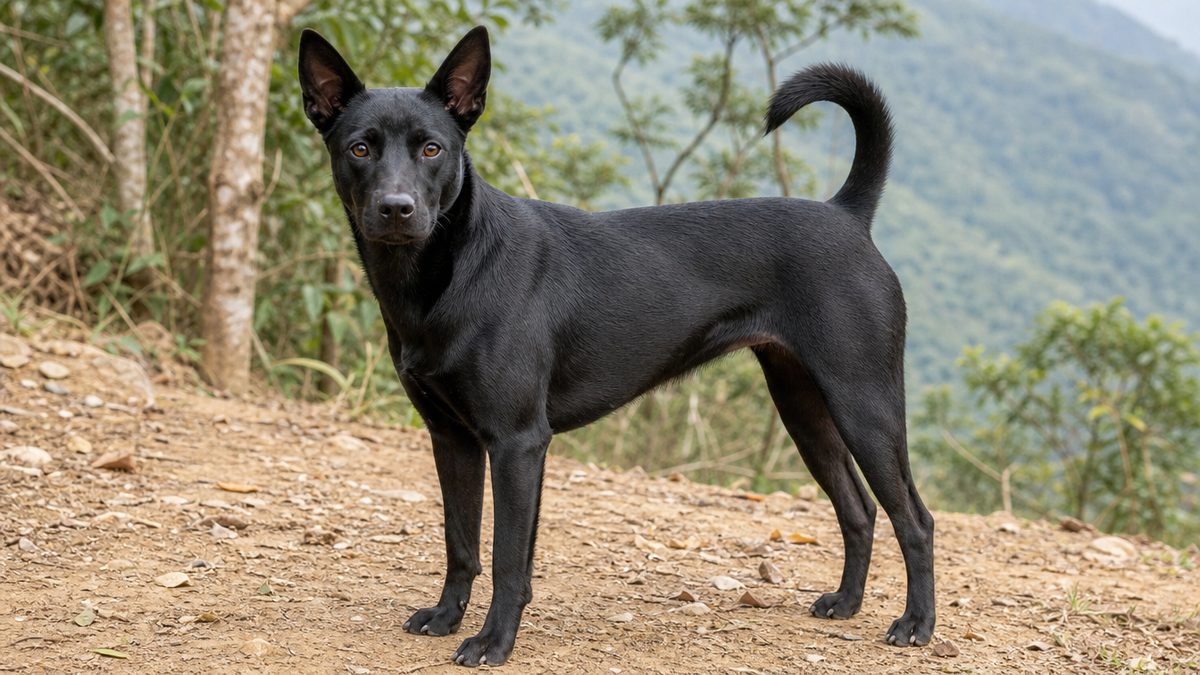
The Taiwan Dog is a medium, dry, sinewy hunting and watch dog from Taiwan's central mountain districts, and it is FCI standard 348.
The FCI classification places it in Group 5, Spitz and primitive types, Section 7, Primitive type Hunting Dogs, accepted on a provisional basis on 9 November 2004 and on a definitive basis on 9 June 2015, without a working trial. Its country of origin is Taiwan, its official authentic language is English, and both Taiwan and India sit on the FCI's member list. The recognition is definitive rather than provisional, which decides whether a dog can compete for the CACIB at all: the breed sits in the FCI's Group 5 definitive list under Taiwan with a CACIB award and is absent from the 20-entry provisional register. A hardy island landrace with a standard behind it is a different proposition from a hardy island landrace without one, and that difference is the whole value of the paperwork.
The standard opens with a compact physical description: a medium-sized dog with a triangular head, almond-shaped eyes, thin pricked ears and a sickle tail, dry, sinewy and well balanced. Behaviour gets one sentence, and it is worth quoting in full because it is the whole temperament clause: extremely faithful to his master, keen in sense, alert in movement, bold and fearless.
The proportions that define the outline
FCI 348 sets three ratios rather than the usual one. Length of muzzle to length of skull is 4.5 to 5.5, so the skull is longer than the muzzle. Depth of chest to height at the withers is 4.5 to 4.7 out of 10, so the chest does not reach the elbow. Height at withers to length of body is 10 to 10.5, with females allowed to be slightly longer.
That third ratio makes the breed nearly square, which the standard says outright, and it is the fastest way to separate a real Taiwan Dog from a leggy local dog with pricked ears. A chest that reaches the elbow is wrong for this breed, which is unusual among hunting dogs.
Size, weight, coat and colour
Males stand 48 to 53 cm and weigh 14 to 18 kg; females stand 43 to 48 cm and weigh 12 to 16 kg. This standard states a weight, which the Shikoku and Thai Ridgeback standards do not, so a buyer has a real number to check against.
The coat is short and hard, lying tight to the body, between 1.5 and 3 cm long, and hair exceeding 4.5 cm is a disqualifying fault. Permitted colours are black, brindle, fawn, white, white and black, white and fawn, and white and brindle.
| Attribute | FCI Standard 348, 2015 | AKC Foundation Stock Service |
|---|---|---|
| Height, male | 48 to 53 cm | 17 to 20 inches, 43.2 to 50.8 cm |
| Height, female | 43 to 48 cm | 17 to 20 inches, 43.2 to 50.8 cm |
| Weight | 14 to 18 kg male, 12 to 16 kg female | 26 to 40 pounds, 11.8 to 18.1 kg |
| Coat | Short and hard, 1.5 to 3 cm | Smooth and short, seasonal shedding |
| Life expectancy | Not stated | 9 to 13 years |
| Job | Hunting dog, watch dog, companion dog | Not stated on the page |
Ears not pricked, an undershot or overshot bite, a missing canine tooth, and hair longer than 4.5 cm are all disqualifying under FCI 348. A curled tail carried over the back is a fault rather than a disqualification, but only since 2015, which the history section explains.
Origins: what the standard claims, and what the genetics actually shows
FCI 348 traces the Taiwan Dog to hunting dogs that lived with ancient inhabitants of Taiwan's central mountains, on the strength of a 1980 university study that visited twenty-nine indigenous tribes.
The standard's history is unusually specific for an FCI document. It records that scholars from National Taiwan University, Japan's Gifu University and Nagoya University carried out a cooperative study in 1980 on the native Taiwan Dog, that they visited twenty-nine tribes of local inhabitants, and that the study confirmed the present Taiwan Dog as a descendant of those hunting dogs. The breed is now popular across the island as a watch and companion dog.
The phrase that changed, and why it matters to an Indian reader
The current English text says South Asian hunting dogs. The superseded 2004 text says something different: discendenti dei cani da caccia del Sud-Est asiatico chiamati cani paria, that is descendants of the hunting dogs of South-East Asia called pariah dogs.
Those are not the same claim. South Asia is the Indian subcontinent; South-East Asia is not. An Indian reader meeting the current phrasing would reasonably infer an ancestral link to India, and the earlier text of the same standard does not support it. The word pariah, which is itself of Tamil origin and is the word Indian free-ranging dogs are described by, was also dropped.
Bonbeno cannot say which version is right, because the 2004 English original was not retrievable and only the Italian translation of it survives at ENCI. What can be said is that the standard's history passage changed between editions, in a direction that reads very differently to an Indian audience, and that no page anywhere notes it.
What the independent genetics says
The nearest peer-reviewed work runs the other way. A 2013 Y-chromosome study of 338 Australian dingoes, New Guinea singing dogs and Island Southeast Asian village dogs concluded that dingoes could have arrived in Australia directly from Taiwan, independently of later dispersals of dogs through Thailand. In that picture Taiwan is a source of Austronesian dog dispersal rather than a destination for South Asian dogs.
That study samples village dogs and never names the Taiwan Dog breed, so it is context rather than breed evidence, and this page treats it that way. It is still the only genetic work that bears on the question at all.
An FCI standard is a primary source for what the FCI says, not automatically for the underlying fact. Its measurements are reliable and its history passages are translated prose that drifts. Where a history claim matters, find the study it cites and read that instead.
The standard changed in 2015, and three of the changes matter
Between the 2004 and 2015 editions of FCI 348 the height ceilings rose by a centimetre in each sex, a curled tail stopped being a disqualifying fault, and the Japanese patronage line disappeared.
The two documents are both public and both extractable, so the comparison is checkable rather than asserted. The 2004 edition is dated 22.12.2004 with an original valid standard of 09.11.2004; the current edition is dated 18.08.2015 with a valid standard of 09.06.2015.
| Field | 2004 edition | 2015 edition |
|---|---|---|
| Patronage | Giappone, that is Japan | No patronage line |
| Height, male | 48 to 52 cm | 48 to 53 cm |
| Height, female | 43 to 47 cm | 43 to 48 cm |
| Weight | 14 to 18 kg male, 12 to 16 kg female | Unchanged |
| Curled tail | Disqualifying fault | Ordinary fault |
| Missing teeth | Absence of fewer than three PM1 permitted | Lack of PM1 and M3 acceptable |
| Ancestry described as | South-East Asian pariah dogs | South Asian hunting dogs |
The patronage line is the structural change
The 2004 document prints PATRONATO: Giappone. FCI patronage is how a breed enters the system when its country of origin has no member body to sponsor it, so in 2004 a Taiwanese breed was carried into the FCI by Japan. The 2015 edition has no patronage line, and Taiwan now appears on the FCI's own member list.
That is the difference between a breed being sponsored and a breed being held by its own country, and it is a real milestone that the breed's English-language coverage does not record.
A small defect in the current document
The 2015 fault list prints Level bite twice, once immediately after Shyness and again three lines later. It is a duplication rather than a contradiction and it changes nothing substantive, but it is worth naming because this page's whole argument is that the documents are worth reading rather than summarising.
A height ceiling decides which dogs can be shown and therefore which dogs get bred. Raising the male ceiling from 52 to 53 cm brought a slice of the existing population inside the standard rather than outside it, and for a breed this small that is a meaningful change to the gene pool available to breeders.
How rare is the Taiwan Dog outside Taiwan? Two dogs in Japan, in 2025
The Japan Kennel Club registered the Taiwan Dog for the first time ever in 2025, at two dogs and rank 124 of 141 breeds.
The JKC is the largest register in the region, recording 302,530 dogs across 141 breeds in 2025. In that table the Taiwan Dog appears at two registrations, ranked 124th, one place above the Cirneco dell'Etna and just ahead of a block of breeds on a single registration each.
The finding that makes the number mean something is what came before it. The breed appears in none of the JKC's 1999, 2005, 2010, 2015, 2020, 2023 or 2024 tables, all read from raw page markup in the same session. Two dogs in 2025 is not a decline; it is a first appearance.
| Breed | 2025 registrations | Rank of 141 |
|---|---|---|
| Shiba | 3,598 | 16 |
| Akita | 263 | 40 |
| Kai | 60 | 70 |
| Shikoku | 51 | 78 |
| Hokkaido | 24 | 90 |
| Taiwan Dog | 2 | 124 |
| Rhodesian Ridgeback | 1 | 131 |
What a register does and does not tell you
A registration count is puppies registered in one year with one body, not a population, and this is one body in a neighbouring country rather than the breed's own. Taiwan's own register is not published in a form this page could read, so the honest statement is that the breed is common enough in Taiwan to be described by its own standard as popular across the island, and vanishingly rare in every register outside it that can be checked.
Bonbeno publishes no worldwide population estimate, because no register anywhere publishes a figure that would support one.
The literature is empty too, and that zero is real
Seven English name forms return zero PubMed records: Taiwan dog, Taiwan dogs, Taiwanese dog, Formosan dog, Formosan Mountain Dog, Taiwan native dog, and native dogs combined with Taiwan. Every one of those queries came back with a clean, unrewritten translation line, and the control returned 126 in the same session, so these are genuine absences rather than search artefacts.
The Chinese forms behave differently and must not be counted. 台灣犬, 臺灣犬 and 台湾犬 each return zero with a blank translation line, which means the query was emptied rather than run. That zero measures the search engine, not the literature.
Formosan combined with dog returns five records, and every one is about the Formosan ferret-badger, termite-detector dogs or pancreatic histology. A non-zero count on an ambiguous name is not coverage, and this is why the page opens the records rather than reporting the number.
Taiwan dog price in India: no verified figure, and a template where one should be
No verified taiwan dog price in india exists, and the single Indian page carrying a figure prints a cost row it also prints for two unrelated breeds.
poodles.in gives a buying price of Rs 30,000 to Rs 60,000 and a monthly care total of Rs 3,550 to Rs 5,400. Alone, that reads as a market observation. Beside two other pages on the same site, it is a preset.
One cost row, three unrelated breeds
The same site prints the identical monthly total for the Shikoku, a Japanese double-coated mountain spitz, and for the Thai Ridgeback poodles.in, Thai Ridgeback Price in India. All three carry food at Rs 2,250 to Rs 3,000, grooming at Rs 700 to Rs 1,200 and health at Rs 600 to Rs 1,200, and the three lines sum exactly to Rs 3,550 and Rs 5,400 at both ends.
The page falsifies its own row. It states that the Taiwan Dog eats about 700 calories a day, the Shikoku about 1,000, and the Thai Ridgeback about 1,500, a spread of more than two to one, and gives all three the same food line poodles.in, Thai Ridgeback Price in India. A page cannot be describing a real feeding cost while telling you the three dogs eat different amounts.
Running the currency tests on the buying price
Rs 30,000 divided by 84.38 is 355.53, by 74 is 405.41, and by 80 is 375.00. Rs 60,000 divided by 84.38 is 711.07, by 74 is 810.81, and by 80 is 750.00. None of those quotients is a price a seller would print, and the 80 results are the arithmetic artefact that any figure ending in four zeros produces.
So these are rupee-native, arbitrary numbers rather than a converted foreign list. That matters because it means nobody has priced this breed in India at all, not even by converting a Taiwanese asking price.
| Line | Taiwan Dog | Shikoku | Thai Ridgeback |
|---|---|---|---|
| Buying price | Rs 30,000 to Rs 60,000 | Rs 55,000 to Rs 1,00,000 | Rs 60,000 to Rs 1,00,000 |
| Monthly care | Rs 3,550 to Rs 5,400 | Rs 3,550 to Rs 5,400 | Rs 3,550 to Rs 5,400 |
| Food | Rs 2,250 to Rs 3,000 | Rs 2,250 to Rs 3,000 | Rs 2,250 to Rs 3,000 |
| Grooming | Rs 700 to Rs 1,200 | Rs 700 to Rs 1,200 | Rs 700 to Rs 1,200 |
| Health | Rs 600 to Rs 1,200 | Rs 600 to Rs 1,200 | Rs 600 to Rs 1,200 |
| Stated daily intake | About 700 calories | About 1,000 calories | About 1,500 calories |
The same site returns HTTP 200 with the title "Dog Breed Not Found" for the Thai Bangkaew Dog, the Ryukyu and the Pungsan. Read the returned page title before recording that any Indian listing exists for a rare breed, because the status code will not tell you.
The real cost of ownership in India for a 15 kg short-coated dog
Keeping a 12 to 18 kg short-coated dog in an Indian metro costs roughly Rs 5,500 to Rs 10,000 a month once parasite control, food, vaccination and consultations are counted honestly.
The purchase price is unavailable and unverifiable; the running cost is neither. These are the figures an Indian reader planning for a medium hunting breed actually needs, and every one comes from a page that was opened.
The lines you can price
- Parasite control at Rs 1,103 a month, from NexGard Spectra for 15 to 30 kg dogs at Rs 3,308 for three tablets, covering ticks, fleas, roundworm and hookworm in one product.
- Vaccination at Rs 699 for anti-rabies and Rs 899 for the 9-in-1, or an annual booster course from Rs 3,199.
- Consultation at Rs 500 to Rs 1,000 a visit, and boarding at Rs 500 to Rs 2,000 a day.
- Municipal registration at Rs 500 in Delhi or Rs 50 in Chennai, which is a yearly line.
- Grooming at Rs 100 to Rs 500, which is the lowest line on this page because the coat is 1.5 to 3 cm long.
The spread on one identical vaccine is the actionable fact
The same 9-in-1 vaccine costs Rs 600 at a Goa government veterinary hospital, from Rs 899 at a Vetic clinic, and from Rs 1,999 through a vet-at-home service that also charges a Rs 699 visit fee. A 3.3 times spread on one drug is a function of delivery model rather than of the medicine, and knowing it is worth more to an owner than any breed price.
Chennai residents have a free option. Greater Chennai Corporation runs six pet clinics providing treatment and anti-rabies vaccination at no cost, and issued 9,115 pet licences in 2024 at Rs 50 each.
| Line | Low | High | Note |
|---|---|---|---|
| Food | Rs 2,600 | Rs 4,800 | For a lean, active 12 to 18 kg dog |
| Parasite control | Rs 1,103 | Rs 1,103 | NexGard Spectra 15 to 30 kg, monthly |
| Vaccination, spread | Rs 150 | Rs 320 | Annual booster divided by twelve |
| Vet consultations | Rs 250 | Rs 1,000 | Two to twelve visits a year |
| Grooming | Rs 100 | Rs 500 | A 1.5 to 3 cm coat needs very little |
| Contingency | Rs 1,200 | Rs 1,200 | The line that stops a Rs 20,000 bill becoming a crisis |
| Total | Rs 5,403 | Rs 8,923 | Before boarding or a cooling bill |
Boarding. A rare breed with no local vet familiarity is harder to place when you travel, and a Bengaluru boarding directory now carries an explicit warning about generator backup for air conditioning during March to May load-shedding. Ask any kennel what happens when the power goes.
Heat tolerance: a subtropical island breed meeting Indian plains heat
Taipei runs an annual mean of 22.95 C against Chennai's 27.95 C and is eleven points more humid, so this breed arrives used to damp air and not to Indian heat.
NASA POWER, queried at 25.0330 N 121.5654 E, returns a Taipei cell at 100.59 m against a real elevation near 10 m, an annual mean of 22.95 C, a July peak of 28.26 C, a January mean of 16.99 C, and annual relative humidity of 83.12 percent. Chennai's cell returns 27.95 C and 72.39 percent.
The elevation check matters on the second point. A Taitung cell, in the breed's mountain heartland, comes back at 595.09 m against a real elevation near 10 m, an error of about 585 m, so that cell is describing the Central Mountain Range rather than the town. This page uses Taipei as the lowland baseline and says plainly that no reliable satellite figure for Taitung town could be obtained.
The humidity is not the problem
Taipei at 83.12 percent annual relative humidity is wetter than Chennai at 72.39, Mumbai at 67.39 and Delhi at 45.56. A Taiwan Dog has never met dry air. What it has not met is a 28 C annual baseline or a Delhi June at 35.88 C, and heat rather than damp is what this breed has to adapt to in India. It is moderately heat-tolerant rather than heat-adapted, and the distinction decides which Indian city suits it.
| Place | Cell elevation | Annual mean | Hottest month | Annual humidity |
|---|---|---|---|---|
| Taipei | 100.59 m | 22.95 C | July, 28.26 C | 83.12 percent |
| Bengaluru | 841.72 m | 23.74 C | April, 28.37 C | 67.94 percent |
| Pune | 635.99 m | 23.86 C | April, 28.93 C | 66.80 percent |
| Delhi | 206.37 m | 25.60 C | June, 35.88 C | 45.56 percent |
| Kolkata | 7.35 m | 25.81 C | May, 31.53 C | 73.93 percent |
| Mumbai | 97.15 m | 26.77 C | May, 31.19 C | 67.39 percent |
| Chennai | 48.95 m | 27.95 C | May, 31.51 C | 72.39 percent |
Bengaluru and Pune are the closest Indian match
Bengaluru's 23.74 C annual mean and Pune's 23.86 C sit within a degree of Taipei's 22.95 C, and both peak in April rather than May, at 28.37 C and 28.93 C respectively. That is the closest an Indian city gets to this breed's home climate, and the difference is that both are drier.
Delhi is the outlier in the other direction. Its June mean of 35.88 C is nearly eight degrees above anything Taipei records, and its January mean of 16.99 C in Taipei against 13.61 C in Delhi means a north Indian winter is also a little colder than the breed's own.
What the heat evidence supports
Hall 2020 in Animals recorded 1,259 heat-related illness events from 1,222 UK dogs, of which 879 had a recorded trigger, and 652 of those 879, or 74.2 percent, were exertional. The companion paper puts case fatality at 14.18 percent across 395 confirmed events and reports 1.42 times the odds for dogs at or above their breed and sex mean bodyweight. This breed was not modelled in either paper, so no breed-level odds ratio exists for it and none is offered.
Walk before sunrise and after dark from March to June in the plains, carry water, and stop at the first wide flat-tongued pant that does not settle within a minute of standing still. A short coat helps a dog lose heat and does not make it immune, and the risk here is exertion rather than sunshine.
Where in India a Taiwan Dog could actually live
Bengaluru and Pune are the two large Indian cities whose annual climate comes within a degree of Taipei's, and both are drier than the breed's homeland rather than hotter.
Bengaluru runs 23.74 C annually and peaks in April at 28.37 C; Pune runs 23.86 C and peaks in April at 28.93 C. Against Taipei's 22.95 C annual mean and 28.26 C July peak, those are close matches on temperature and materially drier on humidity.
Both cities peak in April rather than May and are coolest in December rather than January, which is worth planning around: the hard six weeks for this breed in Bengaluru are late March to early May, not the monsoon.
The coastal cities are workable, the north is the problem
Chennai, Mumbai and Kolkata all sit four to five degrees above the homeland's annual mean and are drier. A short-coated dog manages that with an early morning, an evening walk and shade in between. Delhi, Jaipur and Nagpur are a different proposition, because a June mean approaching 36 C leaves no safe daytime window at all.
Hill stations, and why this page gives no numbers for them
Bonbeno does not publish satellite climate figures for Indian hill stations, because the model's grid cells for them are wrong by 700 to 1,935 metres in both directions. The Taitung reading on this page is the same failure in the breed's own country, at 585 m of error, which is exactly why it is flagged rather than used.
What can be said without a number is that a place staying below about 25 C through the hot months, with nights dropping into the teens, suits this breed. Most of India is not that place for six months of the year.
The Indian disease pressure a short coat does not protect against
A West Bengal study of 584 client-owned dogs presenting at a Kolkata animal health centre found Babesia gibsoni in 76.54 percent, Anaplasma in 55.75 percent, and two or more concurrent pathogens in 72.9 percent of the 584 dogs screened. A southern Indian study of 120 clinically affected dogs found Babesia in 66.7 percent, peaking pre-monsoon between March and May.
Both sampled dogs already brought to a clinic with signs rather than random populations, so they describe risk among dogs that get sick. Read that way they still make year-round parasite control the least negotiable line in an Indian budget for any short-coated dog.
Look at the hottest month's mean and then at the night. A city averaging 24 C annually but hitting 29 C in April with 24 C nights gives a dog no window to unload heat. Bengaluru and Pune pass that test better than any other Indian metro, and they are the honest answer for this breed.
Indian import law, and what it means for this breed
Indian law permits you to bring in a Taiwan Dog as your own accompanying pet and rejects any application to import one to breed or to sell.
DGFT Trade Notice 22/2022-23 of 19 December 2022 places dogs under ITC (HS) 01061900 as a Restricted import. Three routes are permitted and the notice names them: a pet accompanying an owner with a valid pet book in the importer's name, research use with a CPCSEA recommendation, and Defence or Police use. Applications for trading or breeding purposes shall be duly rejected.
Read that against the register numbers and the conclusion is structural. A breed that appeared in the region's largest studbook for the first time in 2025, at two dogs, and that has no lawful Indian breeding import route, cannot form an Indian supply chain. There is no import licence that changes this, and FCI recognition does not change it either.
If you are moving to India with your own dog
- Confirm the dog enters under the personal pet route rather than the commercial one, because the two run on different instruments.
- Carry the pet book in the importer's own name, which is the document the trade notice specifically requires.
- Plan the arrival for the cool half of the year if you are landing in Delhi or another northern city, since a dog from a 22.95 C annual mean meeting a 35.88 C June is a five to thirteen degree step change.
- Register the dog with your municipality on arrival, at Rs 500 in Delhi or Rs 50 in Chennai Greater Chennai Corporation.
- Take the FCI standard to your first veterinary appointment, because no Indian practice will have seen the breed and the weight range matters for dosing.
What Indian breeding law would require
The Prevention of Cruelty to Animals (Dog Breeding and Marketing) Rules 2017 bind anyone breeding or selling dogs in India. Second Schedule Part III paragraph 8(10) requires that breeding dogs have been tested for named genetic defects, including hip dysplasia and progressive retinal atrophy. Rule 8(1)(a) prohibits selling pups under eight weeks old.
Second Schedule Part IV paragraph 21(1) also bars keeping a dog in outdoor housing, without the attending veterinary practitioner's written approval, where the dog is not accustomed to local temperatures. A dog imported from a 22.95 C annual mean into a Delhi summer is precisely the case that clause covers, whatever its coat length.
The 2017 Rules run 1 to 13 and there is no Rule 14. Everything numbered above 13 is a Second Schedule paragraph, so a page citing the outdoor-housing clause as "Rule 21" is citing something that does not exist. The string Rule 21 appears zero times in the gazette.
Temperament: extremely faithful to one person, bold and fearless
FCI 348 gives this breed one sentence of temperament, and every word of it is a warning as well as a description.
The sentence reads: extremely faithful to his master, keen in sense, alert in movement, bold and fearless. Faithful to his master, rather than to a household, describes a single-person bond. Keen in sense and alert in movement describe a dog that notices everything. Bold and fearless describes a dog that does not back down.
The AKC adds the practical layer, recording the breed as loyal, intelligent and agile, with a medium barking level, and filing it as better with children and with other dogs under supervision. Its utilisation in the FCI standard is hunting dog, watch dog and companion dog, in that order.
Who this breed suits
- Owners who want a watchful, physically capable dog and are comfortable with one that chooses its person.
- Owners in Bengaluru, Pune or a coastal city who can exercise a dog twice a day, every day.
- Owners with secure boundaries, because an agile dog that can turn 180 degrees at speed is a dog that tests fences.
- Owners who will socialise a puppy hard between eight and sixteen weeks and keep going through the second fear period.
- Owners who already live with a primitive breed and know what an independent recall costs.
Who should look elsewhere
- First-time owners, because a bold, fearless watch breed with a single-person bond is a demanding first dog.
- Households with a toddler, given the AKC's supervision qualifier and the breed's hunting background.
- Households with cats or free-ranging poultry, for the same reason.
- Anyone in Delhi or another north Indian city unwilling to restructure the day around dawn and dusk in summer.
- Anyone who wants a dog that greets guests warmly at the door, which a watch breed does not.
The standard disqualifies an aggressive or overly shy dog outright and lists shyness separately as an ordinary fault. That pairing is the tell of a breed with a real confidence problem when badly bred or badly socialised, and it is the single thing to test hardest when meeting a litter.
This is a working hunting and watch dog from a mountain landrace, not a companion breed that happens to look primitive. It bonds hard to one person, watches everyone else, and needs a job. Wanting a rare breed is not a reason to take one on.
Training a mountain landrace that bonds to one person
To train a Taiwan Dog, pay heavily for voluntary attention from its chosen person, build management before obedience, and treat the fence as part of the training plan.
This is a landrace that survived in Taiwan's central mountain districts alongside hunters rather than under them. Every part of that history selects for independent judgement. The standard's phrase, extremely faithful to his master, is the training constraint in five words: the dog works for one person and evaluates the rest.
The five things worth teaching first
- Name response, paid every time for six months, because a dog that voluntarily looks at you can be redirected out of anything.
- A hand-target, which moves the dog without a collar grab and defuses a stand-off at the door with a visitor.
- Mat settling, which is what makes an alert watch breed liveable in an Indian flat with a doorbell.
- Loose-lead walking on a Y-front harness, taught before the puppy reaches 12 kg rather than after.
- A stationary wait at doors, gates and lift openings, which is the behaviour that actually prevents an escape.
Off-lead recall is deliberately absent from that list. The standard describes a dog agile enough to turn 180 degrees quickly, which is a description of an animal that can be gone before you finish saying its name. Use a long line in open ground and a properly fenced area for free running.
Socialisation, in an Indian city
A puppy that will live in Chennai or Bengaluru has to meet autorickshaw noise, temple loudspeakers, cattle, cyclists, monkeys and free-ranging dogs before sixteen weeks, at a distance it can cope with. A breed whose standard disqualifies an overly shy dog and separately lists shyness as a fault is a breed where that window decides the adult.
Compulsion breaks this dog faster than most. A bold, independent breed that is corrected hard becomes evasive rather than compliant, and the behaviour you punished happens further away from you next time.
Expect name response and a hand-target inside three weeks. Expect mat settling in six. Expect loose-lead walking to take three months and door manners to hold by six. Do not expect a park recall around a squirrel at any age, and spend the money on the fence instead.
Exercise: a powerful gait and a reaching stride, on an Indian clock
A Taiwan Dog needs 60 to 90 minutes of real daily exercise, and in the Indian plains that has to fit into the cool ends of the day from March to June.
The standard describes a powerful gait with a reaching stride, and a dog agile enough to turn 180 degrees quickly. That is a hunting mover, built for broken mountain ground rather than for pavement circuits, and two short lead walks will not satisfy it.
The Indian constraint is the clock rather than the dog. Chennai's May mean is 31.51 C and Delhi's June mean is 35.88 C, against a homeland July peak of 28.26 C, so the safe working window in the plains narrows to the hour before sunrise and the hour after full dark.
What 60 to 90 minutes should contain
- Thirty to forty-five minutes of continuous forward movement, on a long line wherever the ground is open.
- Fifteen minutes of scent work, which tires a hunting breed faster than distance and can be done indoors in May.
- Ten minutes of structured play with rules, so that arousal has an off switch built into it.
- Free running only inside a boundary the dog cannot clear or slip.
- A real rest afterwards on a cool floor, because recovery is part of the session.
Why the exertional risk is the one that matters
Hall 2020 in Animals recorded 1,259 heat-related illness events from 1,222 UK dogs, of which 879 carried a recorded trigger, and 652 of those 879, or 74.2 percent, were exertional rather than environmental or vehicular. Exercise is how dogs overheat, and an owner running a hunting breed at 10 a.m. in an Indian May is choosing the highest-risk category available.
The companion paper reports a case fatality of 14.18 percent across 395 confirmed events, and 1.42 times the odds of an event for dogs at or above their breed and sex mean bodyweight. Keeping this breed lean is the one modifiable factor with a published number attached, and the FCI standard makes that easy by giving a weight range of 14 to 18 kg in males.
Stop if the tongue widens and flattens, if the dog seeks shade unprompted, if the pant does not settle within a minute of standing still, or if the stride shortens. Wet the belly, groin and paws rather than the back, offer water, and get to a veterinarian the same day if the dog does not normalise within ten minutes.
Grooming a 1.5 to 3 cm coat in Indian conditions
A Taiwan Dog needs about ten minutes of grooming a week, which makes it one of the lowest-maintenance imported breeds an Indian owner can keep.
FCI 348 specifies hair that is short and hard, lying tight to the body, between 1.5 and 3 cm long, with hair over 4.5 cm a disqualifying fault. The neck carries no dewlap. The AKC records seasonal rather than continuous shedding. There is no undercoat to rake and no drying problem in the monsoon.
The weekly routine
- Rubber curry mitt over the whole dog once a week, which lifts the dead hair a short coat sheds and takes five minutes.
- Hands-on check over ears, throat, armpits, groin and between the toes, which is a tick check rather than a grooming task.
- Nails every three weeks, since a dog exercised on soft ground will not wear them down.
- Ears checked weekly, because pricked ears stay dry but still collect Indian dust.
- Bath only when actually dirty, roughly every eight to ten weeks.
Ticks are the job a short coat makes easier
A short coat does not repel ticks; it makes them findable, which is worth something in a country where a Kolkata clinic caseload of 584 dogs showed Babesia gibsoni in 76.54 percent and two or more concurrent pathogens in 72.9 percent of those screened. A southern Indian series of 120 clinically affected dogs put Babesia at 66.7 percent, peaking pre-monsoon.
Combine a weekly hands-on sweep with monthly NexGard Spectra at Rs 1,103 for a 15 to 30 kg dog and that is the whole prevention programme for this coat.
One thing not to do
Do not clip a short-coated dog to make it cooler in an Indian summer. There is almost nothing to remove, and what is there is the only barrier between the skin and Indian ultraviolet. A white or white-and-fawn dog, both permitted colours under the standard, is the most exposed and should be kept out of direct midday sun.
Run both hands over the whole dog against the lie of the coat once a week, checking ears, throat, armpits, groin and between the toes, then the mitt. On a 1.5 to 3 cm coat that is the entire grooming programme, and it is a disease check rather than a cosmetic one.
Health: no literature, no screening scheme, and no lifespan study
The Taiwan Dog has no published health literature at all, and the honest answer for a buyer is to ask for the parents' test results because no breed average exists to fall back on.
This is a stronger absence than most rare breeds show. Seven English name forms return zero PubMed records with clean, unrewritten translation lines, and the control returned 126 in the same session. There is no case report, no prevalence survey, no genetic study of the breed, and no screening scheme.
What a real zero looks like, and how this one was tested
A zero on one name is a zero on one name, so this page tried Taiwan dog, Taiwan dogs, Taiwanese dog, Formosan dog, Formosan Mountain Dog, Taiwan native dog, and native dogs combined with Taiwan. All seven came back at zero with the query PubMed actually ran printed out and unchanged, which is what makes the absence a finding rather than an artefact.
The Chinese forms are excluded from that conclusion. 台灣犬, 臺灣犬 and 台湾犬 each return zero with a blank translation line, meaning the query was emptied before it ran. Bonbeno makes no claim about Chinese-language veterinary literature on this breed, because it could not be searched.
A count is also not coverage. Formosan combined with dog returns five records whose titles are about the Formosan ferret-badger, a glaucoma drug, termite-detector dogs and pancreatic histology. Reporting five without opening them would have been worse than reporting zero.
The absences, stated plainly
- No published life expectancy. McMillan 2024's Table S5 lists the Taiwan Dog with Included in Survival Analysis set to N, so the breed was considered and excluded rather than overlooked.
- No published hip or elbow screening statistics for the breed.
- No breed-club health survey in any language this page could reach.
- No genetic test panel marketed for the breed's own mutations.
- The AKC's 9 to 13 year figure, published without a named data source.
For scale rather than substitution, McMillan's nearest measured East Asian breeds are the Shiba Inu at a median 14.6 years on 91 deaths with a hazard ratio of 0.45 against crossbreds, and the Akita at 11.4 years on 2,358 deaths. Neither figure belongs to the Taiwan Dog and neither should be quoted as if it did.
What the standard itself flags
The disqualifying faults in FCI 348 include a missing canine tooth and an undershot or overshot bite, and Indian law reaches the same ground from the other side: Second Schedule Part III paragraph 8(10) of the 2017 Rules names undershot jaw and two or more missing teeth among the genetic defects a breeding dog must have been tested for. A dentition check is therefore both a show requirement and a legal one in India.
Ask for the sire's and dam's hip scores with the scheme named, an ophthalmologist's certificate dated within the last year, and a written note of what happened to the oldest dog in the line and when. On a breed with no published data at all, those three answers are the entire health picture available to you.
Feeding a 15 kg working landrace in India
Feed a Taiwan Dog to a visible waist and easily felt ribs rather than to a chart, because bodyweight at or above the breed mean is the one heat risk factor with a published odds ratio behind it.
Hall 2020 in Scientific Reports found that dogs at or above their breed and sex mean bodyweight carried 1.42 times the odds of a heat-related illness event, with a confidence interval of 1.12 to 1.80. In an Indian climate that turns body condition into a safety question, and this breed makes it easy to check because its standard states a weight.
FCI 348 gives 14 to 18 kg in males and 12 to 16 kg in females, while the AKC gives 26 to 40 pounds, that is 11.8 to 18.1 kg. Those two ranges nearly coincide, which is unusual on this site and means a buyer has a genuine target rather than a guess.
Portion and life stage
- Puppies to four months, four meals a day on an all-breed growth food with controlled calcium.
- Four to eight months, three meals, watching that growth stays steady rather than fast.
- Eight months onward, two meals a day, timed around the cool exercise windows.
- Adults at 12 to 18 kg, roughly 220 to 320 g of a good dry food a day, adjusted weekly by feel rather than by the bag.
- Seniors from about eight years, the same weight held steady, with joint support discussed with your own veterinarian.
The Indian availability question
Everything a medium active dog needs is stocked in every Indian metro, and the practical decision is price and consistency rather than formulation. Budget Rs 2,600 to Rs 4,800 a month for food for a dog this size, change brands over a week rather than overnight, and move the main meal to after the evening walk during the hot months.
Do not exercise within an hour of a full meal. The standard describes a chest that is fairly deep though not reaching the elbow, which is less bloat-prone than a very deep-chested breed, but stacking a full stomach on top of Indian heat is an avoidable risk in any conformation.
Weigh the dog at your veterinary clinic every three months and write the number down. Indian clinics will do it free, and on a breed with a stated 14 to 18 kg range a written series tells you immediately whether the dog is drifting out of its own standard.
The first year, month by month
A Taiwan Dog puppy's first year runs from a hard socialisation push before sixteen weeks to a second fear period around eight months and full physical maturity near eighteen months.
- Weeks 8 to 10. Home, crate, name response, four meals a day, and the first vaccination discussion with your own veterinarian. Indian law prohibits the sale of pups under eight weeks, so a younger puppy is a red flag about the seller.
- Weeks 10 to 16. The socialisation window. Traffic, lifts, autorickshaws, cattle, cyclists and other dogs at a distance the puppy can cope with, and handling by strangers.
- Months 4 to 5. Adult teeth arrive and chewing peaks. Check the bite, because an undershot or overshot bite and a missing canine are both disqualifying under the standard.
- Months 5 to 6. Prey drive and agility both appear. The long line becomes permanent equipment in open ground and the fence gets checked properly.
- Months 6 to 8. A second fear period is common in primitive breeds. Repeat easy versions of things the dog already knows rather than adding pressure.
- Months 8 to 12. Growth slows, and the daily load can move toward the adult 60 to 90 minutes.
- Months 12 to 18. Physical maturity completes. Hold off repetitive high-impact work such as long road running until your veterinarian confirms the growth plates have closed.
The Indian calendar matters as much as the age
A puppy turning four months old in April in Chennai spends its most important learning weeks in the hottest part of the year, when the safe outdoor window is about two hours a day. A puppy turning four months in November gets four cool months to work with. If you have any choice about timing, choose the cool half of the year.
In Bengaluru or Pune the pressure is lower, because both peak in April at under 29 C and drop to 20 C or below in December. Those two cities give a puppy of this breed the widest usable calendar in India.
Everything on this list can slip except the eight to sixteen week window. A bold, watchful landrace that misses it in an Indian city becomes an adult that cannot cope with an Indian city, and the standard's disqualification of an overly shy dog is the breed telling you this failure mode is real.
Taiwan Dog against the breeds an Indian buyer would cross-shop
Against every breed an Indian buyer would consider alongside it, the Taiwan Dog loses on availability and on published health data, and wins only if the specific appeal is a Taiwanese mountain landrace.
| Breed | Size | Heat tolerance | Available in India | 2025 Japan Kennel Club |
|---|---|---|---|---|
| Taiwan Dog | 43 to 53 cm, 12 to 18 kg | 3 of 5 | No | 2 dogs, first appearance |
| Shikoku | 49 to 55 cm, 15 to 23 kg | 2 of 5 | No | 51 dogs |
| Thai Ridgeback | 51 to 61 cm | 4 of 5 | No | Not listed |
| Shiba Inu | Small, 8 to 11 kg | 2 of 5 | Yes, imported | 3,598 dogs |
| Akita | Large, 64 to 70 cm | 1 of 5 | Yes | 263 dogs |
| Indian Pariah Dog | 18 to 25 kg | 5 of 5 | Free to adopt | Not registered |
| Kombai | Medium boar hound | 5 of 5 | Yes, regionally | Not registered |
Against the Shikoku
These two are the closest comparison in this batch, and the difference is climate rather than temperament. Both are medium primitive hunting breeds from East Asian mountains with pricked ears and a short-to-medium coat. The Shikoku comes from a place with a 16.07 C annual mean and a 5.75 C January; this breed comes from one with 22.95 C and 16.99 C. For India that gap matters more than anything in either standard.
Against the Thai Ridgeback
The Thai Ridgeback is the only breed in this group whose homeland is hotter than Chennai, so if Indian heat tolerance is the deciding factor it wins outright. The Taiwan Dog's advantage is documentation: a definitive FCI standard that states a weight, two published editions to compare, and an FCI member body in its own country Federation Cynologique Internationale.
Against an Indian landrace
The honest comparison for an Indian buyer is the Indian Pariah Dog. It is a free-ranging landrace of similar size and build, rated 5 of 5 for heat tolerance where this breed rates 3, free to adopt in every metro, and familiar to every Indian veterinarian. What it does not have is a breed standard, and that is the only thing the Taiwan Dog offers that it does not.
If the appeal is a medium, short-coated, alert, independent landrace with pricked ears and a sickle tail, India already has one, it adopts free, and no import licence is involved. If the appeal is specifically a Taiwanese breed with an FCI pedigree, the only lawful route into India is bringing your own dog with you.
Six mistakes Indian buyers make with this breed
The six recurring mistakes are trusting a template price, reading an old standard as current, treating a name-search zero as a research failure, planning for humidity instead of heat, under-fencing, and buying a landrace expecting a companion breed.
- Treating a printed Indian price as market data. The one Indian page carrying a Taiwan Dog price prints a monthly cost row byte-identical to its own Shikoku and Thai Ridgeback rows, on a site that says the three breeds eat 700, 1,000 and 1,500 calories a day poodles.in, Shikoku Price in India poodles.in, Thai Ridgeback Price in India.
- Quoting the 2004 standard's figures as current. The male height ceiling moved from 52 to 53 cm, a curled tail stopped being a disqualifying fault, and the patronage line disappeared, all between 2004 and 2015 FCI-Standard No 348 TAIWAN DOG.
- Reading a search zero as a research failure. Seven English name forms return zero PubMed records with clean translations, which is a real absence and a fact about the breed rather than about the searching.
- Planning for Indian humidity. Taipei runs 83.12 percent annual relative humidity against Chennai's 72.39, so this breed arrives used to damp air and unfamiliar only with the heat.
- Under-fencing the garden. The standard describes a dog agile enough to turn 180 degrees quickly, and a landrace that lived semi-independently in mountain villages is not a dog that respects a low wall.
- Buying a landrace and expecting a companion breed. The FCI lists its utilisation as hunting dog, watch dog, companion dog, in that order, and describes it as bold and fearless rather than biddable.
A seventh mistake, made by the tools rather than by buyers
A Bing India control query for this session returned About 16,200 results and ten genuine Indian Labrador price pages, so the organic instrument was working, and no People Also Ask module appeared in the raw markup even for that control on desktop or mobile. Anyone reporting that this breed has no search questions on the strength of an unrendered fetch is reporting a limit of their tool.
The same discipline applies to any rupee figure quoted by an AI answer. Trace it to a page, then confirm the number appears in that page's own markup, because this site has documented answer engines converting foreign asking prices into rupees in the same breath as saying no Indian price exists.
Paying a premium for a dog described as a Taiwan Dog with no verifiable pedigree. With no Indian register, no lawful breeding import route, and an appearance that a medium Indian free-ranging dog with pricked ears can superficially resemble, any Indian dog offered as this breed needs FCI papers you can check, or it is something else.
Adoption, and what to do instead of waiting for a Taiwan Dog
No Taiwan Dog is available to adopt in India, and the useful answer names what an Indian adopter can actually get that meets the same want.
Rescue works on supply. A breed with no Indian population produces no Indian rescues, and no Indian shelter network lists the Taiwan Dog. That follows from a breed with no lawful breeding import route and a first-ever appearance in the region's largest register in 2025 at two dogs.
What an Indian adopter can get that meets the same want
- An Indian Pariah Dog, if the appeal is a medium, short-coated, alert and independent landrace with pricked ears. Free to adopt in every metro and rated 5 of 5 for heat tolerance.
- A Kombai through a Tamil Nadu rescue, if the appeal is a hunting dog with genuine drive in a climate it evolved for.
- A Chippiparai, if the appeal is a lean, short-coated athletic dog for a hot climate.
- An Indian Spitz, if the appeal is a small, alert, pricked-eared dog that Indian veterinarians already know.
- A Shiba Inu, if the appeal is specifically an East Asian primitive breed and you can accept a small one.
How to verify any dog offered to you as a Taiwan Dog
- Ask which register issued the pedigree, and expect an FCI member body. There is no Indian register for the breed.
- Check the four disqualifying faults first: ears not pricked, an undershot or overshot bite, a missing canine tooth, and hair over 4.5 cm.
- Check the outline against the standard's proportions, because the breed is nearly square and its chest does not reach the elbow.
- Weigh and measure the dog. The FCI range is 48 to 53 cm and 14 to 18 kg in a male, so a 25 kg dog is not this breed.
- Ask for the parents' health results by name and scheme, since no breed-average data exists anywhere to fall back on.
If you are importing your own dog
The personal pet route is lawful and is the only one that is. Bring the pet book in your own name, plan a northern arrival for the cool half of the year, register with your municipality at Rs 500 in Delhi or Rs 50 in Chennai, and take a printed copy of FCI 348 to the first veterinary appointment so the practice has a weight range on file Greater Chennai Corporation FCI-Standard No 348 TAIWAN DOG.
We report published price ranges as editorial content. We do not broker sales, recommend breeders, accept payment for placement, or link puppy listings, and we will not publish an Indian price for a breed with no Indian market. Where adoption is the honest answer, we say so and name what is actually available.
Taiwan Dog questions Indian buyers actually ask
How much do Taiwan dogs cost?
No verified taiwan dog price in india exists. No Indian breeder, kennel-club register, rescue or verifiable listing carries the breed. The single Indian page printing a figure, poodles.in, quotes Rs 30,000 to Rs 60,000 alongside a monthly cost row identical to the rupee with the same site's Shikoku and Thai Ridgeback pages, so treat that puppy price as a template value rather than an Indian observation.
Is the Taiwan Dog recognised by the FCI?
Yes, definitively. The FCI accepted the Taiwan Dog on a provisional basis on 9 November 2004 and on a definitive basis on 9 June 2015, as standard 348 in Group 5 Spitz and primitive types, Section 7 Primitive type Hunting Dogs, with English as the authentic language and no working trial required.
Is the Taiwan Dog the same as the Formosan Mountain Dog?
Yes, they are the same breed under different names. The FCI files it as TAIWAN DOG, the AKC as Taiwan Dog, and English-language sources also use Formosan Mountain Dog, Taiwan native dog and Formosan dog. Every one of those five names returns zero records in a PubMed title and abstract search, which is a finding about the literature rather than about the naming.
How big does a Taiwan Dog get?
FCI 348 gives males 48 to 53 cm at the withers and 14 to 18 kg, and females 43 to 48 cm and 12 to 16 kg. Unlike the Shikoku and Thai Ridgeback standards, this one states a weight. The AKC publishes a narrower 17 to 20 inches, which is 43.2 to 50.8 cm, with a ceiling 2.2 cm below the FCI's male maximum.
Did the Taiwan Dog standard change?
Yes, in three ways between 2004 and 2015, and no page records them. The male height ceiling rose from 52 to 53 cm and the female ceiling from 47 to 48 cm, a curled tail carried over the back moved from a disqualifying fault to an ordinary fault, and the history passage changed from South-East Asian pariah dogs to South Asian hunting dogs.
Where does the Taiwan Dog come from?
The FCI standard traces it to hunting dogs that lived with ancient inhabitants of Taiwan's central mountainous districts, citing a 1980 cooperative study by National Taiwan University, Japan's Gifu University and Nagoya University that visited twenty-nine indigenous tribes. The current English text calls the ancestors South Asian; the superseded 2004 Italian text calls them South-East Asian pariah dogs.
Can a Taiwan Dog handle Indian heat?
Moderately, and better on the coast than inland. Taipei's cell returns a 22.95 C annual mean against Chennai's 27.95 C, so the homeland is five degrees cooler, but it is also more humid at 83.12 percent against 72.39. The short coat of 1.5 to 3 cm helps. A Delhi June at 35.88 C is well outside anything this breed evolved with.
How long does a Taiwan Dog live?
No independent study has measured it. The AKC publishes 9 to 13 years without naming a source, and McMillan 2024 lists the Taiwan Dog in Table S5 with Included in Survival Analysis set to N, so the breed was considered and then excluded rather than overlooked. No hazard ratio or median survival exists for it.
Are Taiwan dogs rare?
Outside Taiwan it is very rare. The Japan Kennel Club, which registers about 300,000 dogs a year across 141 breeds, recorded the Taiwan Dog for the first time in 2025 with two dogs at rank 124, and the breed appears in none of its 1999, 2005, 2010, 2015, 2020, 2023 or 2024 tables.
Can I import a Taiwan Dog into India?
Only as your own accompanying pet. DGFT Trade Notice 22/2022-23 places dogs under ITC (HS) 01061900 as a Restricted import, permits entry for a pet with a valid pet book in the importer's name, for research with a CPCSEA recommendation, or for Defence and Police use, and states that applications for trading or breeding purposes shall be duly rejected.
What does a Taiwan Dog cost to keep in India each month?
Budget Rs 5,500 to Rs 10,000 a month for a 12 to 18 kg short-coated dog. That covers food, Rs 1,103 a month for NexGard Spectra at the 15 to 30 kg dose, an annual booster from Rs 3,199 spread across the year, and Rs 500 to Rs 1,000 a consultation. Grooming is the cheapest line on the page.
Is the Taiwan Dog a good first dog?
No. The standard describes a dog extremely faithful to his master, keen in sense, alert in movement, bold and fearless, and the AKC files it as better with children and with other dogs under supervision. A bold hunting and watch breed with a strong single-person bond is a demanding first dog in an Indian flat.
Are there Taiwan Dogs in India at all?
None that can be verified. Two Indian marketplaces returned bot-challenge pages rather than content, so nothing can be concluded from them either way, and the only Indian breed page that resolves is running a template. Bonbeno publishes no Indian population estimate because no register, rescue or importer record exists to build one from.
What dog breed is native to Taiwan?
The Taiwan Dog, also called the Formosan Mountain Dog, which the FCI holds as standard 348 in Group 5. The standard's history is unusually specific: it records that scholars from National Taiwan University, Japan's Gifu University and Nagoya University carried out a cooperative study in 1980 on the native Taiwan Dog, visited twenty-nine tribes of local inhabitants, and confirmed the present Taiwan Dog as a descendant of the hunting dogs that lived with the ancient inhabitants of the island's central mountainous districts. The FCI accepted it provisionally on 9 November 2004 and definitively on 9 June 2015, and it is now popular across the island as a watch and companion dog.
How smart is a Formosan Mountain Dog?
Smart in the way a mountain landrace is smart, which is independent rather than obedient. The AKC records the breed as loyal, intelligent and agile with a medium barking level, and the FCI standard's single temperament sentence calls it keen in sense, alert in movement, bold and fearless, a dog that notices everything and does not back down. It survived in Taiwan's central mountain districts alongside hunters rather than under them, and every part of that history selects for independent judgement; the standard's phrase, extremely faithful to his master, is the training constraint in five words, because the dog works for one person and evaluates the rest. No published temperament or cognition study exists for the breed.