
Breed profile
Chongqing Dog: The India Guide
A Chinese landrace whose own standard prints an FCI classification the FCI has never granted, whose published population runs from 200 to under 2,000 with no census behind either number, and which Google India cannot find at all: search its price here and you get twenty-two Chow Chow pages.
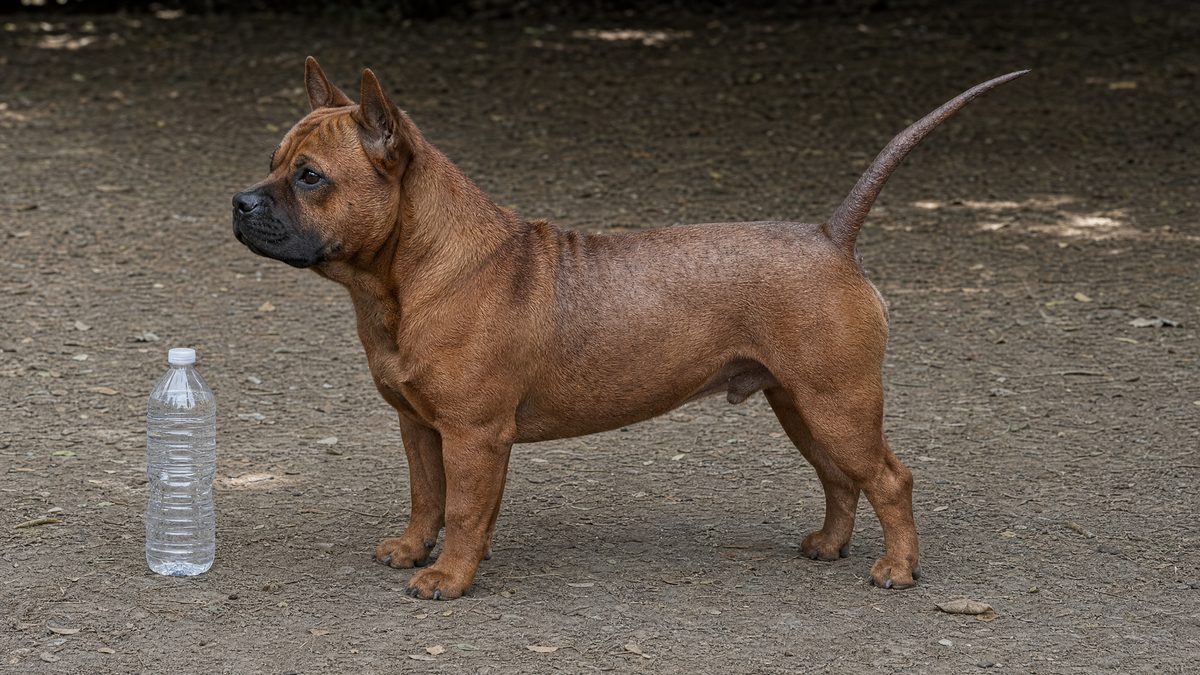
Quick answer
The Chongqing dog is a rare medium-sized Chinese landrace guard dog, 40 to 45 cm at the withers, short-coated, with a stiff bamboo tail and naturally pricked ears. No FCI or Kennel Club of India route exists for it, no Indian source publishes a rupee price, and its worldwide population is not reliably documented: published estimates run from 200 to under 2,000 with no census behind either.
This page summarises published breed-standard text, government notifications, registry datasets and peer-reviewed veterinary research for general information. It is not a diagnosis and it is not treatment advice. Consult a registered veterinarian who has examined your own dog before acting on anything here, and be aware that almost no Indian veterinarian will have seen this breed, that no screening scheme exists for it, and that no reference range or breed baseline is available to compare your dog against.
Chongqing dog traits, rated for India
What the Chongqing dog is
The Chongqing dog is a medium-sized, short-coated Chinese landrace guard dog from the mountains of eastern Sichuan, standing 40 to 45 cm at the withers for dogs and 35 to 40 cm for bitches under the only published breed standard, and carrying a short harsh coat with no undercoat in red or black. It is rare, it is not recognised by the FCI, and almost nothing published about it in English can be traced to a document.
Two dogs share the name, and that matters before anything else. Embark, the largest breed-ancestry testing service, states that the term Chongqing Dog sometimes encompasses two different breeds belonging to the same ancestry group: the Chinese Chongqing Dog, a molosser-like dog with a short muzzle, and the Chuandong Hound, a scenthound with a longer muzzle. Wikipedia records the same ambiguity in one line. English breed pages date the split to 2018 and describe the two as seeking different FCI groups, 2 for the molosser and 6 for the scenthound. This page is about the molosser.
Size and weight, and where the weight figure comes from
The China Kennel Union standard gives an ideal height at withers of 40 to 45 cm for dogs and 35 to 40 cm for bitches, and it gives no weight anywhere in the document. That absence matters, because every weight figure in circulation therefore has no standard behind it. Wikipedia prints 33 to 55 lbs and a height of 35 to 45 cm, neither of which matches the standard's split by sex. Embark gives males 44 to 54 lb and females 33 to 44 lb, and Dog Breed Info gives the same numbers converted, 20 to 25 kg for males and 15 to 20 kg for females. Treat 20 to 25 kg as the working figure for a male and note that it is a convention rather than a rule.
| Source | Male height | Female height | Weight |
|---|---|---|---|
| China Kennel Union standard | 40-45 cm | 35-40 cm | Not stated anywhere |
| Chongqing Dog Club UK standard | 40-45 cm | 35-40 cm | Not stated anywhere |
| Embark breed library | 16-20 in (40.6-50.8 cm) | 14-16 in (35.6-40.6 cm) | 44-54 lb male, 33-44 lb female |
| Dog Breed Info Center | 15-18 in (40-45 cm) | 14-16 in (35-40 cm) | 20-25 kg male, 15-20 kg female |
| Wikipedia | 35-45 cm, not split by sex | 35-45 cm, not split by sex | 33-55 lbs, not split by sex |
The bamboo tail, and a disagreement worth knowing about
The bamboo tail is the breed's signature and the sources do not agree on it. The China Kennel Union standard says the tail is set high, stays straight and stiff, is carried high, and is moderately long, round at base and tapering to a fine point. The UK club repeats that wording and adds that the tail can not be curled and is the outstanding characteristic of this breed. Wikipedia, by contrast, says the tail should be short and held upright, often described as a bamboo stick. Short and moderately long are not the same claim. What both sides agree on is that the tail is naturally straight, stiff and largely hairless, and Embark notes it is not unusual for the ears and tail to be hairless. Nothing in any source describes a docked tail.
History, and how much of it is actually known
The ancient origin story is not evidence, and the breed's own club says so. The China Kennel Union traces the breed to the Western Han dynasty, 202 BC to AD 8, citing pottery dog statues found in a Han graveyard in the Jiangbei area of Chongqing on 20 April 2000. The Chongqing Dog Club UK opens its history page by conceding that there was almost no interest in canine historical research in China until recently, that this makes it nearly impossible to make any definitive statements on the history of the breed, and that anything said about it before the 1980s is little more than speculation. Whole-genome work puts the divergence of East Asian dog populations from their common ancestor at roughly 2,000 to 11,000 years ago, which is a statement about populations and not about any modern breed.
Watch how that speculation hardens into fact as it travels. The top-ranking page in the Indian result set writes that clay figurines found in tombs prove they have existed since the Han Dynasty, 206 BC to AD 220. Prove is doing an enormous amount of work in that sentence. Han pottery dogs establish that dogs of a certain type existed in that region two thousand years ago. They cannot establish continuity of a modern breed, and the breed's own club says as much. The same page also assigns the breed to an Asian and Oceanian group, which is that company's own internal taxonomy rather than any kennel club's classification, and a reader can easily mistake it for one.
Is the Chongqing dog a recognised breed?
No kennel club recognition exists for the Chongqing dog at international level. We checked the registers themselves rather than the breed pages, and the breed is absent from the FCI's definitive nomenclature, absent from its provisional register, and absent under all three of its published names.
The FCI's definitive list for the letter C returns 44 breeds, read live on 26 August 2026. It contains the Chinese Crested Dog at number 288 and the Chow Chow at 205. It does not contain the Chongqing dog and it does not contain the Chuandong Hound. The letter E list returns 16 breeds and does not contain the East Sichuan Hound, which is the breed's other published English name. The provisional register, checked at the FCI's real provisional URL rather than the decoy page that serves an English Setter, carries 20 breeds with the four newest dated 11 February 2026, and none of them is this one.
So where does FCI Group 2 come from?
It comes from the China Kennel Union's own standard, which prints the line FCI-CLASSIFICATION: Group 2 directly under the breed's name. That is a statement of where the breed would sit if it were recognised. It is not recognition, and the FCI's nomenclature does not honour it. The distinction is easy to lose because the China Kennel Union is a full FCI member, listed at 12th Floor, LuoMai Building, Chaoyang District, Beijing. A full member's national standard for a national breed still has to pass through the FCI's own recognition process, and this one has not.
Dog Breed Info, ranking second in the Indian result set for this breed, holds both positions at once. Its origin section says the breed is seeking FCI classification group 2, and its Recognition block a few lines later lists FCI = Federation Cynologique Internationale, Group 2 as though it were held. Its own photo captions describe a European kennel as FCI Certificated. If you read only the Recognition block, you would come away believing something the FCI's register contradicts.
What the other registries on that list actually are
- APRI, the American Pet Registry Inc, is a commercial registry that records what an owner declares.
- DRA, the Dog Registry of America Inc, is a second commercial registry of the same kind.
- CKCA, the Chongqing Kennel Club of America, is a breed-specific club rather than a national kennel club.
- CCDC and CCDBC, the Chinese Chongqing Dog Club and the Chinese Chongqing Dog Breeding Center, are the breed's own bodies in China.
- None of the five issues a studbook pedigree that a full FCI member kennel club is obliged to accept.
The Indian consequence
The Kennel Club of India is itself a full FCI member, registered at AA Block, Anna Nagar, Chennai. Its imported-dog checklist requires an export pedigree in original, and the entire question is whether the issuing register is one the KCI will accept. The KCI filed 32,219 puppy registrations and 33,880 pure-bred dog registrations with the FCI for 2025, against an approximate national dog population of 17,111,342, so the pedigree system in India is small, formal and FCI-shaped. A breed with no FCI number has no obvious way into it.
The Orthopedic Foundation for Animals does list CHINESE CHONGQING DOG in its advanced-search breed selector, between CHIHUAHUA and CHINESE CRESTED, with LABRADOR RETRIEVER, CHOW CHOW and CHINESE SHAR-PEI present in the same retrieval as controls. That means OFA will accept a submission under the name. It is not evidence that any dog has been submitted, and OFA requires 100 hip evaluations, or 50 for its other databases, before a breed appears in its statistics at all.
How many Chongqing dogs are there? Nobody knows
The Chongqing dog's population is not reliably documented, and any figure you are given is somebody's estimate rather than a count. The two figures the ranking pages publish differ by a factor of ten, and neither carries a survey, a census or a registry behind it.
101dogbreeds states that today, an estimated 200 purebred Chongqings are in existence. The breed's own UK club states that there are currently well under 2,000 purebred Chinese Chongqing Dogs, and frames the claim by saying there are fewer of them on earth than there are Giant Pandas. Both sentences are written in the same confident register. Neither names a source. Notice what the panda framing does: China's wild giant panda population is one of the most intensively surveyed animal counts in the world, so an unsourced dog figure has been pegged to a real number belonging to a different species. That is a rhetorical device, not a census.
| Claim | Source | Evidence offered |
|---|---|---|
| An estimated 200 purebred Chongqings in existence | 101dogbreeds | None |
| Well under 2,000 purebred dogs, fewer than giant pandas | Chongqing Dog Club UK | None |
| Population declined rapidly with urbanisation, restored from the 1970s | China Kennel Union standard | Narrative, no figures |
| Numbers greatly reduced after 1949, still rare even in China | Fan wiki, ranking fifth | None |
| Any Chinese state count of the breed | Ministry of Agriculture and Rural Affairs | Does not exist, dogs excluded from the catalogue |
Why no official Chinese figure exists
China does maintain a national register of domestic animal breeds, and dogs are not in it. The National Catalogue of Livestock and Poultry Genetic Resources, published by the Ministry of Agriculture and Rural Affairs on 29 May 2020, lists 33 kinds of domestic livestock and poultry: 17 traditionally raised species including pigs, cows, sheep, goats, horses, camels, donkeys, rabbits, chickens, ducks, geese, pigeons and quails, plus 16 special livestock including sika deer, reindeer, alpacas, ostriches, emus, minks and raccoon dogs. Dogs were excluded. The single Chinese state instrument that would carry a breed-level population figure for a Chinese landrace therefore does not cover this breed, and no substitute has been published.
The academic record is empty too, and that took proving
Searching PubMed for the phrase Chongqing dog returns 333 records, which looks like a literature. It is not. PubMed silently rewrote the phrase into chongqing[All Fields] AND dog[All Fields], and Chongqing is a city of tens of millions with major research universities, so the results are papers on canine probiotics, eggshell membrane peptides, popliteal leiomyosarcoma and Beagle polytrauma models. Restricting the query to titles returns exactly one record, a 2023 report on a dog acting as a passive mechanical carrier of SARS-CoV-2 in Chongqing, which names the city and not the breed. A control query run in the same session, labrador retriever hip dysplasia, returned 126 genuine records, so the search itself was working. There is no peer-reviewed veterinary literature on this breed.
The genetic literature that does exist covers Chinese indigenous dogs as a group and not this breed by name. A 170K SNP survey of 157 unrelated dogs from 15 Chinese indigenous breeds found lower linkage disequilibrium, shorter runs of homozygosity and larger within-breed genetic distances than in Western breeds, with Chinese and Western dogs separating cleanly on both PCA and the neighbour-joining tree. That is a real and useful finding about Chinese landraces in general. It is not a population count, and it is not about the Chongqing dog specifically.
Bonbeno will not print a population number for this breed. The honest statement is that the Chongqing dog is rare, that its published estimates range from 200 to under 2,000 with no evidence attached to either, and that no government, registry or study has counted it.
Chongqing dog price in India
There is no Chongqing dog price in india, because there is no Indian market for the breed. Not one Indian breeder page, marketplace listing or price guide publishes a rupee figure for it, and an India-located search for the price returns a different breed entirely.
We pulled the Indian result set twice on 26 August 2026, with the search location set to India. The query chongqing dog price in india returned twelve results and every one of them was a Chow Chow page: Supertails, Mr n Mrs Pet, Quora, TradeIndia, HappyPet, Dav Pet Lovers, JustDial, Instagram and a Delhi kennel. A second wording, chongqing dog price in india rupees cost buy, returned ten results and every one of those was a Chow Chow too. Twenty-two results, zero Chongqing dogs.
That is a real property of the result set and not a broken query, because we ran the control the same way in the same session. Rajapalayam dog price in india returned Indian breeder pages, an Indian cooperative kennel's Instagram, an Indian Quora thread and the Wikipedia article, exactly as it should. The tool works and the geotargeting works. Google India simply has nothing to serve for this breed and substitutes the nearest Chinese breed it does have.
What Indian commerce sites return instead
Restricting the same search to India's four biggest pet and trade marketplaces produces something stranger. A site-restricted query across mrnmrspet.com, asiapets.in, tradeindia.com and indiamart.com returned ten results and not one of them was an animal. They were listings for mylar film, essential oil diffusers, ultrasound machines, plastic injections, mist sprayers, plastic packaging, chicken feet and PET lamination film, all sourced from suppliers in the Chinese municipality of Chongqing. On Indian commerce platforms, Chongqing is a manufacturing city and PET is polyethylene terephthalate. There is no dog behind the word.
| Query | Results returned | About the Chongqing dog | About something else |
|---|---|---|---|
| chongqing dog price in india | 12 | 0 | 12, all Chow Chow |
| chongqing dog price in india rupees cost buy | 10 | 0 | 10, all Chow Chow |
| Site-restricted to four Indian marketplaces | 10 | 0 | 10, industrial goods from Chongqing city |
| Control: rajapalayam dog price in india | 6 | n/a | 0, all correctly on-breed |
Why no lawful Indian supply chain can form
Two facts close the market between them. First, the breed has no FCI number, so a full FCI member kennel club has no register to enter it in Federation Cynologique Internationale. Second, India's import policy places dogs at ITC HS 01061900 as Restricted, and permits entry only for a pet dog with a valid pet book in the importer's own name, for research with a CPCSEA recommendation, or for Defence and Police use. Commercial import for breeding is not permitted, and applications for trading or breeding purposes shall be duly rejected. With no registry route and no commercial import route, no Indian breeding population can lawfully come into existence.
Ask which register issued the pedigree, ask for the DGFT import licence number, and ask to see the quarantine clearance. A dog offered locally as this breed either arrived as a private pet and is being resold, which the trade notice forbids, or it is a different dog with a rare name attached.
Testing the only published prices for this breed
Test any figure you are quoted against the three exchange rates Indian breed pages have been repeatedly caught using, because the only published purchase prices for this breed anywhere are in US dollars and a rupee version of them is arithmetic rather than a market rate.
The single purchase figure in the entire Indian-facing result set is 800 to 2,000 US dollars, published by 101dogbreeds. That is an American range on an American page. Run it through the three rates and you get the numbers a converted Indian page would print.
| Rate used | USD 800 becomes | USD 2,000 becomes |
|---|---|---|
| 84.38 | Rs 67,504 | Rs 1,68,760 |
| 74.00 | Rs 59,200 | Rs 1,48,000 |
| 80.00 | Rs 64,000 | Rs 1,60,000 |
Use the table as a detector, not as a price. If a seller's rupee figure divides cleanly into a round dollar amount at any of those three rates, it was converted rather than quoted. Treat a match at 84.38 as the strong signal. Treat a match at 80 with more care, because 1,000 divided by 80 is 12.5, so any rupee figure ending in three zeros divides cleanly at 80 by construction and the match proves nothing on its own. A match at 80 is worth something only when the resulting dollar figure is also a number a seller would actually print.
The other figures in circulation, and what they are worth
- USD 800 to 2,000 is the only purchase range in the Indian-facing result set, and it is on a US aggregator page.
- No Indian source publishes any rupee figure for this breed at all, verified across two India-located pulls and a marketplace-restricted search TradeIndia, city listing page….
- The Chow Chow, which is what Google India serves in place of this breed, is published at Rs 30,000 to Rs 1,00,000 by one Indian source and Rs 65,000 to Rs 1,50,000 and above by another Mr n Mrs Pet, Chow Chow Puppies For Sale….
- That Chow Chow spread is itself worth reading. Two Indian sources, the same year, the same breed, and the lower bound of one is more than double the other.
The real cost is not the purchase price
A lawful import carries a document stack, and the stack is the expensive part. The Kennel Club of India's imported-dog checklist requires the export pedigree in original, the airway bill in original from country of import to final destination, the air ticket in original, the boarding pass with payment, the DGFT licence, customs clearance, quarantine clearance, a pet passport and a notarised affidavit. DGFT advises beginning the import authorisation application at least two months before travel, and permits entry only through Delhi, Mumbai, Chennai, Hyderabad, Bangalore or Kolkata, with quarantine at the port where required. DAHD added a seventh port, Cochin International Airport at Kochi, for pets arriving under the baggage rules in October 2024. None of that appears on any page currently ranking for this breed. The full route is set out in how to import a dog to India.
Bonbeno reports published price ranges as editorial content with the source and the date attached. We do not broker sales, recommend breeders or link puppy listings, and we will not publish a rupee price for a breed no Indian source prices.
Cost of ownership in India for a 20 to 25 kg short-coated dog
Budget Rs 6,000 to Rs 14,000 a month and Rs 80,000 to Rs 2,00,000 in the first year for a dog of this size in India, because the cost of ownership is set by weight, coat and city rather than by breed rarity. A Chongqing dog at 40 to 45 cm and roughly 20 to 25 kg sits at the top of the medium band and the bottom of the large one.
| Cost line | Medium breed | Large breed | What this breed needs |
|---|---|---|---|
| Dry and wet food | Rs 2,500-4,000 | Rs 4,000-6,000 | Upper medium, a 20-25 kg working-type dog |
| Routine vet visits | Rs 800-1,500 | Rs 1,000-2,000 | Higher, because no local vet knows the breed |
| Vaccination, annual | Rs 1,500 | Rs 1,800 | Standard |
| Grooming | Rs 800-1,500 | Rs 500-1,200 | Lowest on the page, a 3 cm single coat |
| Training, six months | Rs 2,000-5,000 | Rs 3,000-8,000 | Upper end, a high prey drive guard dog |
| Treats and toys | Rs 500-1,000 | Rs 600-1,200 | Standard |
| Flea, tick and deworming | Rs 400-700 | Rs 500-800 | Upper end, see the tick-borne disease section |
| Monthly total | Rs 6,000-10,000 | Rs 8,000-14,000 | Rs 7,000-12,000 realistically |
Those bands come from a 2026 Indian cost survey, which also reports that city prices vary by 15 to 30 percent, with Mumbai and Delhi the most expensive markets, and that a first year runs Rs 80,000 to Rs 2,00,000 including purchase, vaccinations, food, training and supplies. Nothing in that structure is breed-specific, which is the point. Rarity does not make a dog cheaper to keep.
Three lines where this breed differs from the average
- Grooming is the cheapest line on the page. The coat is short, harsh, about 3 cm long and carries no undercoat at all, so there is no clipping, no de-shedding and no seasonal blow-out to pay for Dog Breed Info Center, Chongqing Dog.
- Parasite control is the line to overspend on rather than trim. A West Bengal clinic series found 72.9 percent of dogs carrying two or more tick-borne pathogens concurrently.
- Veterinary cost carries a hidden premium. No Indian veterinarian will have seen this breed, so every consultation starts from a blank slate, and no OFA screening data exists to hand over.
The import surcharge nobody budgets for
A first year for an imported dog is not the Rs 80,000 to Rs 2,00,000 band. That band assumes a domestic purchase. Add the import authorisation, quarantine at one of the seven permitted ports, the airway bill, the air ticket and the notarised affidavit, and the first-year figure moves well beyond it Kennel Club of India Department of Animal Husbandry…. Treat any quote that lands inside the domestic band as a quote for a dog that did not lawfully arrive.
Across a 10 to 12 year life expectancy at the middle of the monthly band, this dog costs roughly Rs 12 lakh to keep before a single emergency. The purchase price, whatever it turns out to be, is the smallest number in that calculation.
Heat tolerance: a hot-origin breed, which is rarer than it sounds
The Chongqing dog's heat tolerance rates 3 out of 5 on this site, and it is one of the few imported breeds that earns a middling rather than a poor score, because it comes from a genuinely hot place. Chongqing's August maximum of 43.68C is higher than Chennai's 37.74C. That is the good news, and it is real. The rest of this section is about why it is not enough.
Almost every imported breed page on this site has to explain that the dog came from somewhere cold. This one does not. We queried NASA's POWER climatology by explicit latitude and longitude, 29.5637N and 106.5504E, so that no other city could be served by accident, and checked the returned geometry against the coordinates sent. Chongqing runs a July mean of 28.38C, an August mean of 28.14C, an August maximum of 43.68C and a September maximum of 43.76C, at an annual mean relative humidity of 75.73 percent. That is a hot, wet summer by any Indian standard.
| City | Annual mean | Coldest month mean | August mean | August max | Annual mean RH | Months at or above 25C mean |
|---|---|---|---|---|---|---|
| Chongqing | 18.19C | 6.42C, January | 28.14C | 43.68C | 75.73% | 3 |
| Chennai | 27.95C | 24.09C, January | 28.99C | 37.74C | 72.39% | 10 |
| Mumbai | 26.77C | 23.19C, January | 26.05C | 31.60C | 67.39% | 9 |
| Delhi | 25.60C | 13.61C, January | 29.79C | 43.82C | 45.56% | 7 |
| Bengaluru | 23.74C | 20.22C, December | 23.31C | 33.62C | 67.94% | 3 |
The number that decides it is not the peak, it is the count
Read the last column rather than the fourth. Chongqing has three months a year with a monthly mean at or above 25C and a January mean of 6.42C. Chennai has ten such months and its coldest month still averages 24.09C, which is warmer than Chongqing's May. The origin climate gave this dog a hard summer and then a genuine winter to recover in. Chennai and Mumbai do not supply the second half of that cycle, and a dog adapted to seasonal heat is not the same thing as a dog adapted to permanent heat.
So the correct framing is not that this breed will overheat on arrival. It is that this breed has never been asked to hold up under nine or ten consecutive months of it, and nobody has ever measured what happens when it is. There is no peer-reviewed literature on this breed at all, so its heat performance in India is genuinely unknown rather than reassuringly documented.
The coat is the breed's real advantage
The standard describes hair that is short and very harsh without any undercoat, running about 3 cm long, sparse along the spine, and sparse enough on the ears and tail that Embark notes those areas are often bare Dog Breed Info Center, Chongqing Dog Embark Veterinary. A single short coat with no insulating undercoat is exactly what you want in Indian heat, and it is the opposite of what a Chow Chow carries. Never clip it anyway. A short single coat still shades the skin, and a sparse-coated dog in Indian sun is an animal you keep out of the midday sun rather than one you shave.
Chongqing's annual mean relative humidity of 75.73 percent is higher than Chennai's 72.39 percent and far higher than Delhi's 45.56 percent. This breed is adapted to wet heat, not dry heat. The Indian city that would stress it most is not the hottest one, it is Delhi in April and May, where relative humidity falls to 24.19 and 23.38 percent against maxima of 45.59C and 48.08C.
City by city: where in India this breed would cope best
Bengaluru and Pune suit this breed best of the Indian metros, because their annual means of 23.74C and 23.86C sit closest to Chongqing's summer without the year-round load of the coastal cities. Chennai is the hardest, and Delhi is hard for a different reason than most people expect.
| City | Annual mean | Coldest month | August mean | August RH | Months at or above 25C | Verdict for this breed |
|---|---|---|---|---|---|---|
| Bengaluru | 23.74C | 20.22C, December | 23.31C | 78.69% | 3 | Best fit. Same count of hot months as Chongqing |
| Pune | 23.86C | 19.62C, December | 23.30C | 90.80% | 4 | Close second on heat, hardest on skin humidity |
| Delhi | 25.60C | 13.61C, January | 29.79C | 74.90% | 7 | Brutal peaks, and a dry season this breed has never met |
| Hyderabad | 26.10C | 20.76C, December | 25.53C | 80.30% | 7 | Manageable if May, at a 33.30C mean, is managed |
| Kolkata | 25.81C | 17.31C, January | 28.24C | 89.07% | 8 | Wet heat it understands, for nearly three times as many months |
| Mumbai | 26.77C | 23.19C, January | 26.05C | 90.36% | 9 | Nine hot months and near-saturated monsoon air |
| Chennai | 27.95C | 24.09C, January | 28.99C | 72.41% | 10 | Hardest. The coldest month is warmer than Chongqing's May |
| Chongqing, for reference | 18.19C | 6.42C, January | 28.14C | 72.92% | 3 | Hot summer, real winter, full recovery every year |
Why Bengaluru wins and Chennai loses
Bengaluru carries exactly three months at or above a 25C monthly mean, March through May, which is the same count Chongqing carries in June, July and August. The seasons are shifted but the load is comparable, and Bengaluru's August mean of 23.31C is nearly five degrees cooler than Chongqing's. A dog built for a three-month furnace finds Bengaluru's shape familiar. Chennai runs the opposite profile: an August mean of 28.99C that is actually hotter than Chongqing's, ten months at or above 25C, and a coldest month of 24.09C that is warmer than Chongqing's May. The difference is not intensity. It is that Chennai never lets up.
The Delhi problem is dryness, not heat
Delhi looks like a good fit on the peak-temperature line, since its August maximum of 43.82C is almost exactly Chongqing's 43.68C. It is not. Delhi's annual mean relative humidity is 45.56 percent against Chongqing's 75.73 percent, and in April and May it collapses to 24.19 and 23.38 percent while maxima reach 45.59C and 48.08C. A dog whose thermoregulation evolved in air that is three-quarters saturated is meeting radiant dry heat for the first time. Evaporative cooling by panting works better in dry air, which helps, but water loss rises sharply and a sparse-coated dog takes far more direct radiant load.
Practical rules for an Indian summer
- Walk before 07:00 and after 19:00 from March to June in every city on the table above.
- Skip the walk entirely on days the local maximum passes 38C, and use indoor work instead.
- Watch exertion rather than parked cars, because exertional heat-related illness accounted for 74.2 percent of canine events in the largest study of triggers, against 5.2 percent for vehicular confinement.
- Keep drinking water in at least two rooms, because a wet-heat-adapted dog in Delhi's April loses more than it expects to.
- Treat 16.9C as the number that should frighten you, because that was the median ambient temperature on days when UK dogs presented with heat-related illness. No Indian city has a month that cool.
Temperament and household fit
The Chongqing dog is a loyal, fearless, independent guard dog with high prey drive that bonds hard to one household and stays reserved with strangers, which makes it a poor first dog and a poor apartment dog in a busy Indian building. Every description below comes from a breed standard or a breed club, because no behavioural study of this breed exists.
The China Kennel Union standard puts the temperament in nine words: guardian of property and family, fearless, muscular, tough and agile, and notes that in the past it has been used for hunting. The UK club expands that to fearless, confident and calm, loyal to the owner and the entire family, a great guard dog known for its good alertness and courage, and adds that they do not trust strangers until they know they are of no threat. Wikipedia records strong characters, an outgoing temperament, a confident attitude, strong prey drive and excellent scenting abilities.
What that adds up to in an Indian flat
It adds up to a dog that will guard a shared corridor as though it were yours. Read the behaviour Dog Breed Info describes: if its owner is not present and a stranger approaches, the dog heightens watchfulness and makes its presence known, and if the owner is present and shows the stranger is friendly, it drops its guard. In a standalone house with a gate, that is a working guard dog. In a Mumbai or Bengaluru apartment block with a shared lift, a domestic help, three delivery riders a day and a security guard who changes every quarter, it is a dog making twenty judgement calls a day about people it does not know and whose owner is at work.
Dog Breed Info goes further and says breeders in the United States usually will not sell to anyone living in an apartment, and that the breed will do okay in an apartment if sufficiently exercised but that it is not ideal. Take that as the breed community's own view rather than as evidence, but take it seriously: it is one of the few consistent statements across the English sources.
Prey drive is the trait that will surprise you
The prey drive is not decorative. The breed was developed for hunting in the mountains of eastern Sichuan, and its recorded quarry ran to deer, rabbits, wild goats and boar Chongqing Dog Club (United Kingdom). A 2019 discussion thread among dog people, ranking seventh in the Indian result set, describes the breed as loud watchdogs with high energy and high prey drive, and notes that primitive hunting breeds are generally not easy to handle. In an Indian city that means street cats, monkeys where they occur, and free-ranging dogs on every walk. Plan for a secure harness and a dog that is never off-lead in an unfenced space.
Who this breed suits, and who it does not
- Suits an experienced owner with a fenced independent house and a settled household routine.
- Suits a home where one adult is present most of the day and can supervise arrivals.
- Does not suit a first-time owner, because an independent primitive guard dog is not a forgiving first project.
- Does not suit a high-traffic apartment with shared corridors, lifts and rotating staff.
- Does not suit a household with resident cats or small pets unless the dog is raised with them from eight weeks.
Every source that discusses this breed's temperament says the same thing about strangers. Socialise the puppy hard between eight and sixteen weeks with people, other dogs and non-canine pets, because a reserved guard breed that misses that window becomes a reactive adult, and India's shared urban spaces punish reactivity harder than most countries do.
Training a primitive guard breed, and the advice we will not repeat
Train this breed on early socialisation and impulse control rather than on obedience polish, because an independent landrace guard dog cooperates when it sees the point and disengages when it does not. No behavioural study of the Chongqing dog exists, so nothing below is breed-specific evidence and we will say so where it matters.
The breed community's own description is useful and its prescription is not. Dog Breed Info writes that because the Chongqing dog is an evolutionary breed and not manmade, its natural instincts are extremely keen, and that it requires a dominant owner that is not heavy-handed, doing best with an owner who is calm but firm, confident and consistent with the rules. The observation about keen instincts matches every other source. The prescription is dominance-framed language, and Bonbeno does not repeat it, because no study of this breed supports any particular handling method and because specific, observable instructions do the same work without the ideology.
What actually needs training in an Indian city
- Doorbell and gate neutrality. This dog will announce a delivery rider by default, so train an alternative behaviour from week nine rather than at month nine.
- Recall under prey distraction. The breed was bred to hunt deer, boar and ground birds in mountain country, and a street cat will beat your recall unless you have proofed it.
- Loose-lead walking before the dog reaches 20 kg. A fully grown male at 20 to 25 kg that pulls is a two-person dog on an Indian pavement.
- Handling tolerance for ears, feet and mouth. You will be doing tick checks daily in most Indian cities, and a guard breed that resents handling makes that a fight.
- Settle on a mat. A dog making twenty judgement calls a day about corridor traffic needs an off switch that you can cue.
The socialisation window is the whole game
Socialise between eight and sixteen weeks or accept the adult you get. India's law sets the floor at the same point the behavioural window opens: Rule 8(1)(a) of the Dog Breeding and Marketing Rules 2017 requires that pups less than eight weeks in age are not sold. A puppy that arrives at eight weeks therefore lands with the window already open and roughly eight weeks of it left. Spend those eight weeks on people of different ages and dress, on lifts and stairwells, on two-wheelers and autos, on the building's staff, and on calm adult dogs. Every source that describes this breed's adult temperament describes reserve towards strangers Dog Breed Info Center, Chongqing Dog Wikipedia, Chongqing dog, English article, and reserve that was never shaped becomes reactivity.
What this breed is not for
Do not train this dog for bite work. Dog Breed Info states plainly that they are natural guard dogs with high drive but are not suitable for competitive or police bite work. That is the breed community's own assessment of its own dog and it points the same way as the standard, which describes a guardian of property and family rather than a trained protection animal. A guard dog that already makes its own decisions does not need a bite command added.
Whatever the pedigree question, register the dog with your municipal corporation and microchip it. An unregistered dog of an unrecognised breed with no import paperwork is the hardest animal in India to get back if it is lost, and the hardest to defend if a complaint is made about it.
Daily exercise requirement, and what the sources disagree about
Give this dog 45 to 60 minutes of real work a day, split across two sessions outside the heat, because the two English sources that quantify it disagree by a factor of two and the honest answer sits between them. Dog Breed Info says at least 30 minutes of vigorous exercise a day. 101dogbreeds says about an hour of strenuous activity.
Neither figure rests on anything. There is no exercise-physiology study of this breed, no working trial requirement attached to its standard, and no breed-club activity guidance with numbers behind it China Kennel Union. What the sources do agree on is the shape of the requirement: a medium, muscular, agile hunting-derived dog that was worked in mountain country and that Dog Breed Info describes as a good jogging and hiking companion needing at least a daily brisk long walk.
| Source | Stated requirement | Evidence behind it |
|---|---|---|
| Dog Breed Info Center | At least 30 minutes of vigorous exercise daily | None stated |
| 101dogbreeds | About one hour of strenuous activity daily | None stated |
| China Kennel Union standard | No figure. Describes gait as robust and powerful | The standard itself |
| Chongqing Dog Club UK | No figure | None |
| Bonbeno working figure | 45 to 60 minutes across two sessions, outside peak heat | The midpoint, adjusted for Indian heat below |
Why the Indian version of that number is a timing problem, not a duration problem
The duration is not what will hurt this dog. The timing is. Exertional heat-related illness accounted for 74.2 percent of the canine heat-related illness events with a recorded trigger, 652 of 879, across 905,543 UK dogs, against 12.9 percent environmental and 5.2 percent vehicular confinement. Dogs are far more likely to be killed by a walk than by a car. And the median ambient temperature on the days UK dogs presented with heat-related illness was 16.9C, a temperature no Indian city reaches as a monthly mean in any month of the year.
A workable Indian schedule
- October to February: 25 to 30 minutes twice a day, any time outside 11:00 to 16:00.
- March to June: 20 to 25 minutes before 07:00 and 20 to 25 minutes after 19:30, and nothing in between.
- Monsoon: keep the duration, dry the dog properly afterwards, and check between the toes for ticks.
- Any day the local maximum passes 38C: cancel the walk and use scentwork, food puzzles and settle training indoors instead.
- Any day the dog slows, widens its stance or stops pulling: end the session immediately and cool it down.
Scentwork deserves particular attention here, because it is the substitution that actually works for this breed. Wikipedia records excellent scenting abilities alongside the strong prey drive, and the breed's ancestors were mountain hunting dogs. Hiding food across three rooms and letting the dog find it burns a hunting breed down in fifteen minutes with no thermal load at all, which is exactly what an Indian April needs.
Dog Breed Info states that the Chongqing dog is a natural hunter and should never be allowed to roam without supervision. In Indian cities that means street cats, free-ranging dogs and traffic, in that order of temptation and that order of danger.
Grooming a 3 cm single coat in Indian humidity
Groom this breed in ten minutes a week and spend the saved time on skin and parasite checks instead, because a short harsh coat with no undercoat is the lowest-maintenance coat on this site and the highest-exposure skin. The standard describes hair that is short and very harsh without any undercoat, running sparse along the spine, and Dog Breed Info measures it at about 3 cm.
There is nothing to clip, nothing to strip and no seasonal blow-out. Dog Breed Info's whole grooming instruction is that the breed does not require a lot of grooming and should be bathed only when necessary. That is correct as far as it goes, and it is written for a temperate climate. Two things change in India.
1. Bathe only when necessary means something different in a monsoon
Bathing frequency is not the Indian problem. Drying is. A short harsh coat dries fast, which is an advantage, but water that sits in the ear canal does not, and the ears on this breed are pricked, triangular and often sparsely haired to the point of being bare Embark Veterinary. Dry the ear entrance after every bath and after every wet walk, and do not push anything into the canal. A pricked ear is far better ventilated than a drop ear, so this breed starts ahead of a Basset Hound or a Cocker, but ventilation is an advantage you can still throw away.
2. The skin is exposed in a way the coat description hides
Read the standard's coat clause carefully. It says the coat is sparse from the withers along the spinal column, radiating about 3 cm on each side and extending lengthwise including the croup and above the tail from root to tip. Embark adds that it is not unusual for the ears and tail to be hairless. So the topline, the tail and the ear leathers are the least protected surfaces on the dog, and they are also the surfaces that take direct overhead sun in an Indian afternoon. Keep this heat-sensitive dog in shade at midday rather than relying on a coat that is thinnest exactly where the sun lands hardest.
The ten-minute weekly routine
- Rubber curry mitt over the whole body, two minutes, which is all a 3 cm harsh coat needs.
- Tick sweep by hand: ears, ear folds, neck, armpits, groin, between the toes, tail base. Three minutes.
- Ear entrance wipe with a dry pad, one minute. Never a cotton bud into the canal.
- Nails checked, trimmed if they click on tile. Two minutes.
- Teeth brushed, and read the head-shape section below before you decide this is optional. Two minutes.
What the coat tells you about shedding claims
This breed is sold on low shedding by at least one ranking page. A single short coat does shed less volume than a double coat, which is true and unremarkable. It is not a hypoallergenic claim and no source makes one, which is to their credit, because there is no evidence for classifying any dog breed as hypoallergenic. Do not pay a premium for a low-shedding label on a breed whose own standard describes a harsh coat that sheds normally.
Grooming is the cheapest line in this breed's Indian cost of ownership, at Rs 500 to Rs 1,500 a month against Rs 1,500 to Rs 3,000 for a small coated breed. Over a 10 to 12 year life expectancy that is a real saving, and it is the one place where this breed is genuinely easier than the alternatives.
Health risks: what is known, and how little that is
Nothing is known about this breed's inherited disease risk, and that is a finding rather than a gap. There is no peer-reviewed literature on the Chongqing dog, no OFA statistics, no published screening scheme and no breed health survey. Every health statement in the ranking set is therefore an assertion, and one of them is an assertion we can show is unsafe.
Take the OFA result first, because it took work to establish and it is conclusive. The Orthopedic Foundation for Animals lists CHINESE CHONGQING DOG in its advanced-search breed selector, between CHIHUAHUA and CHINESE CRESTED, so OFA will accept a submission under that name. Its actual statistics dataset is a different matter. We retrieved the full disease-statistics payload, 5,886,681 characters holding 13,164 table rows across 517 tables, and searched it case-insensitively. CHONGQING returns zero. The controls run in the same session returned LABRADOR 109, CHOW CHOW 40, SHAR 44 and BERGAMASCO 1, so the tables genuinely loaded and the zero is a real absence. All 103 occurrences of CHINESE resolve to exactly two breeds, the Chinese Crested and the Chinese Shar-Pei. OFA publishes no hip, elbow, patella or any other figure for this breed.
That absence has a specific meaning rather than a vague one. OFA requires 100 hip evaluations, or 50 for its other databases, before a breed appears in the statistics at all. So fewer than 100 Chongqing dogs have ever had their hips evaluated and submitted. For a breed whose advocates say fewer than 2,000 exist worldwide, that is not surprising. It does mean there is no baseline for a vet to compare your dog against.
The claim that should stop you
Dog Breed Info states that natural selection has successfully eliminated undesirable traits in the breed, that furthermore there has been no inbreeding among the Chongqing Dog, and that therefore no known major health problems exist. Three sentences, three problems. Natural selection does not eliminate late-onset disease, because a dog that reproduces at two is unaffected by what kills it at nine. No inbreeding is arithmetically hard to reconcile with a global population the same source community puts under 2,000. And no known major health problems is literally true and completely uninformative on a breed with zero studies and zero registry statistics. Nobody has looked. That is not the same as nothing being there.
Life expectancy: four figures, one of them from a page contradicting itself
| Source | Life expectancy stated | Comment |
|---|---|---|
| Dog Breed Info Center | About 10 to 12 years | The most plausible figure for a 20-25 kg dog |
| Wikipedia | A long lifespan of up to 15 years | Cites the breed's own conservation project |
| 101dogbreeds, Quick Information table | Approximately 18 years | Implausible for any dog of this weight |
| 101dogbreeds, its own FAQ block | Around 10 to 14 years | The same page, a different number |
| Any longevity study | None exists | No breed appears in mortality data without a dataset |
Publish that spread rather than averaging it. An 18-year life expectancy on a 20 to 25 kg dog would make this the longest-lived medium breed on earth, and the same page gives 10 to 14 a few screens further down. Wikipedia's up to 15 years traces to the breed's own conservation project rather than to a mortality dataset. Use 10 to 12 years for planning, from the source that gives the most conservative figure, and understand that it is a convention rather than a measurement.
With no breed-specific screening scheme, screen for what Indian law requires of a breeding dog and what the conformation suggests. Second Schedule Part III paragraph 8(10) of the Dog Breeding and Marketing Rules 2017 requires testing for hip dysplasia, progressive retinal atrophy, night blindness, hypothyroidism, entropion, ectropion, overshot and undershot jaw, wry mouth, two or more missing teeth and cryptorchidism. That list is the closest thing to a screening protocol this breed has in India.
The short muzzle and the undershot bite, and why Indian law names both
The Chongqing dog's breed standard requires a short muzzle and an undershot bite, and Indian law names undershot jaw as a genetic defect a breeding dog must have been tested for. That collision is the single most consequential thing on this page for anyone planning to breed here, and no ranking page mentions it.
Read what the standard actually asks for. Under Important Proportions the China Kennel Union writes that the length of skull and the length of the muzzle are approximately 2:1. Under Muzzle it writes strong, square, noticeably shorter than the skull. Under Jaws and Teeth it writes jaw strong with undershot bite and set square to the jaws, undershot bite more than 5 mm undesirable. Under Eyes it writes slightly protruding but never exaggerated. Under Skull it writes natural wrinkles on top of the skull, and under Cheeks, prominent, due to the strong development of the muscle. The UK club reproduces all of it.
One caution about that 2:1 figure before anyone converts it. The standard does not define where it measures skull length from, so the ratio cannot be turned into the craniofacial ratio the veterinary literature uses, and we are not going to pretend otherwise. What can be said without any arithmetic is that a standard which requires a muzzle noticeably shorter than the skull, an obligatory undershot bite, prominent cheeks and slightly protruding eyes is describing a shortened, broadened head rather than a moderate one.
Where Indian law lands on it
Second Schedule Part III paragraph 8(10) of the Prevention of Cruelty to Animals (Dog Breeding and Marketing) Rules 2017, notified as G.S.R. 496(E) on 23 May 2017, reads that the dogs shall have been tested for genetic defects, including hip dysplasia, progressive retinal atrophy, night blindness, hypothyroidism, entropion, ectropion, overshot, undershot jaw (when incisors do not touch or mesh), wry mouth, two or more missing teeth, unilateral cryptorchid or full cryptorchid males. The qualifier matters and we quote it in full deliberately. The law targets an undershot jaw where the incisors do not touch or mesh, and the standard tolerates an undershot bite of up to 5 mm, which is comfortably past the point at which incisors meet.
Note the citation carefully, because this document numbers its clauses twice. There is a Rule 8 in the body of the Rules, headed Conditions for sale, whose 8(1)(a) prohibits selling pups under eight weeks. Separately there is a Second Schedule Part III paragraph 8, headed Veterinary care, and it is that paragraph's sub-clause (10) that carries the genetic-defect list. Citing it as Rule 8(10) sends a reader to the wrong provision.
And paragraph 6(9), which is the harder one
Second Schedule Part II paragraph 6(9) reads, in full, that breeding to create new breeds of dogs or unusual looks shall be strictly prohibited. A standard that prizes facial wrinkles, prominent cheeks, slightly protruding eyes and a mandatory malocclusion is describing exactly the territory that clause covers. We are not lawyers and this page is not legal advice. We are pointing out that an Indian breeder working to this standard would be selecting for a trait the same Rules list as a genetic defect, and doing it under a clause that prohibits breeding for unusual looks.
The heat consequence, which is the part a pet owner should care about
Skull shape is the strongest breed-level risk factor in the canine heat-illness literature. Brachycephalic dogs had 4.21 times the odds of heat-related illness compared to mesocephalic dogs in a study of 167,751 UK dogs, with a 95 percent confidence interval of 3.22 to 5.49. In a separate VetCompass study, skull shape was associated with a fatal outcome, and the risk of death was greater in dogs with reduced capacity to thermoregulate. In the largest incidence study, brachycephalic skull shape was a significant risk factor and the Chow Chow was named among the highest-risk breeds.
Those studies classify dogs by breed, using breed lists. A breed no registry recognises cannot appear on such a list, so the Chongqing dog has never been assigned to a skull-shape category in any dataset. Its risk is unmeasured, not low. Ask a veterinarian to assess your individual dog's airway rather than assuming the absence of a published figure means the absence of a problem.
Indian disease pressure: ticks first, and the numbers do not agree
Budget for year-round tick control before anything else, because tick-borne infection is the dominant health risk for any dog in India and the two best recent Indian surveys disagree about its scale by a factor of eight. Publishing that disagreement is more useful than picking one.
| Pathogen | Punjab, 719 dogs, multiplex PCR | West Bengal, 584 dogs, five-target qPCR |
|---|---|---|
| Babesia gibsoni | 8.9% | 76.54% (447/584) |
| Babesia canis or vogeli | 1.1% (B. vogeli) | 27.10% (158/583) (B. canis) |
| Ehrlichia canis | 2.6% | 16.61% (97/584) |
| Hepatozoon canis or sp. | 5.1% | 28.94% (169/584) |
| Anaplasma spp. | Not tested | 55.75% (325/583) |
| Two or more pathogens at once | Concurrent infections under 0.5% each | 72.9% of dogs |
The Punjab study screened 719 blood samples by microscopy and multiplex PCR and found Babesia gibsoni in 8.9 percent, Babesia vogeli in 1.1 percent, Ehrlichia canis in 2.6 percent and Hepatozoon canis in 5.1 percent. The West Bengal study analysed peripheral blood from 584 client-owned dogs presenting at a state animal health centre in Kolkata between July 2024 and December 2025, using a five-target qPCR panel, and found Babesia gibsoni in 76.54 percent, Anaplasma species in 55.75 percent, Hepatozoon in 28.94 percent, Babesia canis in 27.10 percent and Ehrlichia canis in 16.61 percent, with 72.9 percent of dogs carrying two or more concurrent pathogens and 34.9 percent carrying three or more.
Why the two figures differ, and what to do with that
Do not average them. Three things differ. The populations differ: a survey sample against a clinic caseload, and dogs presenting at a health centre are sick dogs. The assays differ: multiplex PCR against a five-target real-time panel with different sensitivity. And the regions differ, with Kolkata sitting at an annual mean relative humidity of 73.93 percent and an August figure of 89.07 percent, against a drier Punjab. Read the Punjab figure as a floor for a general population and the West Bengal figure as what a humid-city clinic sees, and act on the higher one.
The diagnostic point that will save your dog
Microscopy misses most of it. In the West Bengal series, microscopy missed 130 of 158 Babesia canis positives and 146 of 169 Hepatozoon positives, and the discordant samples had significantly higher median cycle-threshold values, confirming failure at low parasitaemia. If your vet reports a clear blood smear on a dog with intermittent fever, lethargy or unexplained bruising, ask about PCR. The same study found Ehrlichia canis was the sole driver of acute multi-systemic illness, producing significantly lower platelet counts, and proposed a platelet count below 109 x 10^4 per cubic millimetre as a practical threshold to prompt molecular testing.
What this means for a short-coated, sparsely furred breed
The coat cuts both ways. A 3 cm harsh single coat with bare ear leathers and a largely hairless tail Embark Veterinary makes ticks far easier to find than on a Chow Chow or a Tibetan Mastiff, which is a genuine advantage you should exploit with a daily hand sweep. It also means there is less coat between a questing tick and skin. Net, the visibility advantage wins if you actually look, and is worth nothing if you do not.
Ear folds and ear leathers first, because they are nearly bare on this breed. Then the neck under the collar, the armpits, the groin, between every toe, and the tail base. Do it after every walk during the monsoon and at least three times a week the rest of the year.
Feeding: portions, body condition and one bite-shaped problem
Feed a Chongqing dog as you would any 20 to 25 kg working-type dog, on a complete diet split across two meals, and watch two things this breed makes specific: bodyweight, because weight above the breed mean raises heat-illness risk, and prehension, because the standard mandates an undershot bite China Kennel Union.
There is no published nutritional requirement for this breed, no feeding trial and no breed-club guidance with numbers, so nothing below is breed-specific evidence. What can be pinned down is the size band. Using the widely circulated 20 to 25 kg for a male and 15 to 20 kg for a female, this dog sits at the top of the medium band on Indian cost tables, where food runs Rs 2,500 to Rs 4,000 a month, and just under the large band at Rs 4,000 to Rs 6,000.
The bodyweight finding you should act on
Higher bodyweight relative to the breed and sex mean was an independent risk factor for heat-related illness in a study of 905,543 UK dogs, alongside brachycephalic skull shape and a bodyweight over 50 kg. That is one of the very few heat findings that an owner controls directly and completely. In a country where this dog will face nine or ten months above a 25C monthly mean in the coastal metros, keeping it lean is not cosmetic. Ribs easily felt under a thin fat cover, a visible waist from above and a tucked abdomen from the side is the target, and it is worth weighing monthly rather than eyeballing.
The undershot bite changes how the dog eats
An undershot jaw is not a cosmetic quirk at the food bowl. Where the incisors do not touch or mesh, the dog cannot shear or nibble efficiently with the front of the mouth and compensates with the molars and the tongue. The China Kennel Union standard requires the undershot bite and tolerates up to 5 mm of it, which is well past the point of incisor contact. In practice that means three adjustments.
- Choose a kibble the dog can actually pick up. A larger, flatter piece is easier for an undershot jaw than small dense pellets.
- Use a slow feeder if the dog swallows whole, which an inefficient front bite encourages.
- Brush the teeth properly, because malocclusion changes where plaque collects and Indian law lists two or more missing teeth among the genetic defects a breeding dog must be tested for.
Life-stage feeding in an Indian household
| Stage | Meals a day | Focus | Indian note |
|---|---|---|---|
| 8 to 16 weeks | 4 | Growth diet, socialisation-friendly training treats | Arrives at eight weeks at the earliest under Rule 8(1)(a) |
| 4 to 6 months | 3 | Controlled growth, avoid over-supplementation | Heat cuts appetite from March, so shift meals to cool hours |
| 6 to 12 months | 2 | Transition to adult diet, monitor body condition monthly | Growth plates still open, so no forced roadwork |
| 1 to 7 years | 2 | Lean maintenance, adjust for the season | Feed less in April to June when activity drops |
| 8 years onward | 2 | Joint and weight management, more frequent vet checks | Life expectancy of about 10 to 12 years makes eight the senior threshold |
Feed the dog on Indian shelf reality rather than on an imported plan. Complete diets from the mainstream Indian retailers cover this size band comfortably, and there is no breed-specific formulation to chase. Split the daily ration into two meals timed away from the walk, because exertional heat-related illness accounts for 74.2 percent of canine heat events and a full stomach before a hot walk helps nothing.
A wet-heat-adapted dog meeting Delhi's April, at 24.19 percent relative humidity and a 45.59C maximum, loses water faster than its instincts expect. Keep bowls in at least two rooms and refresh them twice a day in summer.
Indian law and this breed, including one thing the standard gets right
Indian law and this breed's own standard agree on ears and tails, which is unusual and worth stating plainly: the Chongqing dog is not a cropped or docked breed. The China Kennel Union standard says the ears are firmly pricked and not cropped, and describes a natural, high-set, stiff, tapering tail. Second Schedule Part II paragraph 6(8) of the Dog Breeding and Marketing Rules 2017 forbids both procedures. For once there is nothing to reconcile.
That is genuinely unusual on this site. The Dobermann, the Boxer, the Cane Corso, the Great Dane and the Miniature Pinscher all carry standards that describe or historically permitted cropped ears or docked tails, and every one of those pages has to explain that the appearance in the photographs is illegal to produce in India. The Chongqing dog does not. Both published standards state that the ears are not cropped Chongqing Dog Club (United Kingdom), and the tail is the breed's defining natural feature. Wikipedia states the same thing in one line: their ears are naturally pricked, and not cropped.
So if you are ever shown a Chongqing dog with cropped ears or a docked tail, two things are true at once. The animal has been mutilated in a way paragraph 6(8) calls strictly forbidden, and it has been mutilated away from its own breed standard rather than towards it.
The exact text of paragraph 6(8), because summaries of it are unreliable
The clause reads: there shall be no tail docking, ear cropping, de-barking, de-clawing, branding, dyeing, injecting substances to enhance visual appeal, performing a surgery or procedure to camouflage or hide any defect or infirmity or any other kind of mutilation of any body part of the pup and any change of appearance by artificial means is strictly forbidden. We extracted that from the gazette PDF ourselves with pypdf, 14 pages and 51,953 characters, because summaries of this document circulate with invented rule numbers. It sits in the Second Schedule, Part II, headed General requirements to be adhered to by breeders, as sub-clause 8 of paragraph 6. It is not Rule 6(8), and citing it that way sends a reader to a different provision.
The provisions that do bite for this breed
| Location | What it says | Relevance here |
|---|---|---|
| Second Schedule Part II para 6(3) | In breeding and incest breeding prohibited; in breeding defined as relatives of the 2nd to 4th grade within four generations | Decisive for a breed whose global population is claimed to be under 2,000 |
| Second Schedule Part II para 6(4) | Female dogs shall not be mated after the age of eight years | Standard, but binding |
| Second Schedule Part II para 6(8) | No docking, cropping, de-barking, de-clawing or change of appearance by artificial means | Agrees with the breed standard for once |
| Second Schedule Part II para 6(9) | Breeding to create new breeds or unusual looks strictly prohibited | Bears on wrinkles, prominent cheeks and protruding eyes |
| Second Schedule Part III para 8(10) | Genetic-defect testing including undershot jaw and two or more missing teeth | Names the trait this breed's standard mandates |
| Rule 8(1)(a), in the body of the Rules | Pups less than eight weeks in age are not sold | The earliest a puppy may lawfully change hands |
Paragraph 6(3) is the one that would stop an Indian breeding programme
A founder population small enough to be described as under 2,000 worldwide, with a handful of animals ever imported into any one country, cannot be bred without close relatives. Paragraph 6(3) permits only out breeding, the mating of dogs not at all related, and line breeding, the mating of dogs marginally related. It prohibits in breeding, which it defines as breeding between relatives of the second to fourth grade in straight or side line within the first four generations, giving uncle to niece, nephew to aunt, cousin to cousin and grandparent to grandchild as examples, and it prohibits incest breeding outright. Anyone planning to found this breed in India would run into that clause within two generations.
Dogs sit at ITC HS 01061900 as Restricted. Entry is permitted only for a pet dog with a valid pet book in the importer's own name, for R&D with a CPCSEA recommendation, or for Defence and Police use, through the airports and seaports of Delhi, Mumbai, Chennai, Hyderabad, Bengaluru and Kolkata and, since October 2024, Kochi airport. Applications for trading or breeding purposes shall be duly rejected.
Month by month through the first year
Plan the first year around three deadlines: the socialisation window that closes near sixteen weeks, the vaccination course that runs to about eighteen weeks, and the first Indian summer, which will arrive before the dog is fully grown. Everything else is negotiable.
| Age | What matters most | What you do about it |
|---|---|---|
| 8 weeks | The legal and behavioural floor | Rule 8(1)(a) forbids sale below eight weeks. Do not accept a younger puppy |
| 8-10 weeks | Vaccination course starts | Pups may start vaccination at seven to eight weeks under Part III para 8(9) |
| 8-12 weeks | The socialisation window is open | People, lifts, stairwells, two-wheelers, autos, building staff, calm adult dogs |
| 12-16 weeks | The window is closing | Keep going. A reserved guard breed that misses this becomes a reactive adult |
| To 18 weeks | Vaccination usually completes | Para 8(9) says the course is usually completed at about eighteen weeks |
| 4-6 months | Teething, and the bite becomes readable | Ask your vet to record the adult bite and count the teeth |
| 6-9 months | Growth plates still open | No forced roadwork, no stairs drilling, no jumping games |
| First hot season | The first real heat test | Walks before 07:00 and after 19:30 only, from March |
| 9-12 months | Adolescent guarding switches on | Re-run doorbell and gate training. It will regress |
| 12 months | Adult weight, roughly 20-25 kg male | Reset food portions and weigh monthly |
Weeks eight to sixteen decide the dog you keep
Every source that describes this breed's adult temperament describes reserve towards strangers and a strong guarding instinct Chongqing Dog Club (United Kingdom) Dog Breed Info Center, Chongqing Dog. None of them says the reserve is fixed at birth. In an Indian apartment the socialisation list is specific and unglamorous: the lift, the stairwell, the watchman's chair, the delivery rider's helmet, the domestic help arriving with a key, the sound of a two-wheeler starting under the window, and children moving fast. Get through that list before sixteen weeks and you have a manageable adult. Skip it and you have a dog that barks at the building.
Vaccination, quoted from the Rules rather than paraphrased
Second Schedule Part III paragraph 8(9) of the Dog Breeding and Marketing Rules 2017 states that all pups shall be vaccinated, which can start at the age of seven to eight weeks, and are usually completed at the age of eighteen weeks. That is the statutory frame in India. Your veterinarian sets the actual protocol, which will vary with local disease pressure, and in a country with the tick-borne burden described above the preventive schedule matters at least as much as the core vaccines.
The first summer is the one to plan for
A puppy bought in November meets its first Indian April at about six months, still growing, with an immature ability to regulate temperature and an adolescent enthusiasm for running. That is the worst combination this breed will ever present. Exertional heat-related illness is the dominant trigger at 74.2 percent of events, and young dogs had greater odds of exertional heat-related illness specifically. Move the walks, shorten them, and put the energy into scentwork indoors.
If the puppy is imported, the DGFT licence, customs clearance, quarantine clearance and export pedigree exist on the day it lands or they never will Directorate General of Foreign Trade. Collect them at handover. A year later, nobody will find them for you.
Chongqing dog compared with the breeds Indian buyers actually see
Compare the Chongqing dog against the Chow Chow first, because the Chow Chow is literally what Google India returns when you search for a Chongqing dog price in india. Two separate India-located pulls on 26 August 2026 gave twenty-two results between them and every one was a Chow Chow page. The table below sets the Chongqing dog beside the three breeds an Indian buyer is realistically choosing between.
| Point | Chongqing dog | Chow Chow | Chinese Shar-Pei | Indian Pariah Dog |
|---|---|---|---|---|
| FCI recognised | No, absent from both the definitive and provisional registers | Yes, standard 205 | Yes, standard 309 | No, and no standard sought |
| KCI pedigree possible | No route established | Yes | Yes | Registered as Indian native stock, not FCI |
| Published breed standard | China Kennel Union only, plus a UK club copy | FCI | FCI | None |
| Peer-reviewed literature on the breed | None found | Named a top heat-illness risk breed | Extensive, on skin and fever syndrome | Growing Indian literature |
| Height at withers | 40-45 cm dogs, 35-40 cm bitches | 46-56 cm | 44-51 cm | Typically 46-64 cm |
| Coat | Short, harsh, no undercoat, about 3 cm | Dense double coat | Harsh short or brush coat | Short single coat |
| Skull shape | Skull to muzzle about 2:1, undershot bite required | Broad, short muzzle | Short broad muzzle | Mesocephalic |
| Published Indian price | None found in any Indian source | Rs 30,000 to Rs 1,50,000 across two sources | Widely listed | Rs 0 to Rs 2,000 adoption fee |
| Lawful supply route into India | Import only, personal pet book, no commercial route | Domestic breeders | Domestic breeders | Local shelter or street |
| Heat tolerance rating on this site | 3 of 5 | 1 of 5 | 2 of 5 | 5 of 5 |
Read that first row as the whole argument. The Chow Chow and the Shar-Pei are FCI-recognised breeds with numbered standards, which means the Kennel Club of India, itself a full FCI member, can issue a pedigree for them. The Chongqing dog has no such number. It is absent from the FCI's definitive nomenclature under C, absent under E as the East Sichuan Hound, and absent from the provisional register Federation Cynologique Internationale. That single fact removes the ordinary Indian purchase route before any question of price, temperament or heat tolerance arises.
The Chow Chow comparison also carries the sharpest health warning available. In a VetCompass study of 905,543 UK dogs, the Chow Chow was one of three breeds named explicitly as a significant heat-related illness risk, alongside the Bulldog and the French Bulldog. Nobody has ever run that analysis on a Chongqing dog, because no Chongqing dog has ever appeared in a veterinary epidemiology dataset large enough to name it. Absence of a warning is not a clean bill of health. It is an empty column, and this table shows you exactly which columns are empty.
Where the Indian Pariah Dog wins outright
The Indian Pariah Dog beats the Chongqing dog on every axis that matters for an Indian household, and it is not close. It is short-coated and heat-adapted to the actual subcontinent rather than to a Chinese river basin with a real winter. It costs between nothing and Rs 2,000 to adopt against a Rs 80,000 to Rs 2,00,000 first year for any imported pedigree dog. It has a mesocephalic skull, so it sits outside the conformation group that carries 4.21 times the odds of heat-related illness. If what attracts you to the Chongqing dog is a short-coated, muscular, alert, independent guard dog with high prey drive and a strong bond to one family, the honest answer is that you can walk to a shelter and get one.
The Chow Chow and the Chinese Shar-Pei share the blue-black tongue, the facial wrinkles and the Han-dynasty ancestry story with the Chongqing dog. The breed's own UK club says all three are almost certainly closely related. The difference is that two of them are documented breeds with standards, screening schemes and literature, and one is not.
Mistakes Indian buyers make with the Chongqing dog
The commonest mistake is accepting a recognition claim without opening the register. Every other error on this page follows from that one, because a buyer who believes the breed is FCI Group 2 will also believe the pedigree, the price and the health assurances that come bundled with it.
1. Treating the FCI-CLASSIFICATION line as recognition
The China Kennel Union prints FCI-CLASSIFICATION: Group 2 at the head of its Chongqing Dog standard. That line is a claim about where the breed would sit if recognised, not a statement that it is. The FCI's own definitive list for the letter C runs to 44 breeds and contains the Chinese Crested Dog at 288 and the Chow Chow at 205, but no Chongqing dog. The second-ranking English breed page manages both positions on one screen, writing that the breed is seeking FCI classification group 2 and then listing FCI Group 2 in its Recognition block as though held. Verify the claim in the register, not on the breed page.
2. Believing an alphabet-soup registry is a kennel club
APRI, DRA and CKCA look like credentials and are not. The American Pet Registry Inc and the Dog Registry of America Inc are commercial registries that record what an owner declares. Neither runs a studbook the Kennel Club of India will accept. The KCI's own imported-dog checklist demands an export pedigree in original, and the whole question is which registry issued it. A certificate from a registry no national kennel club recognises converts into nothing at Chennai.
3. Repeating a population number nobody counted
Two of the pages ranking for this breed give populations that differ by a factor of ten, an estimated 200 against well under 2,000, and neither cites a survey. China's Ministry of Agriculture and Rural Affairs excluded dogs from the National Catalogue of Livestock and Poultry Genetic Resources published on 29 May 2020, so the state instrument that counts a domestic animal breed does not cover this one. If you quote a number for this breed, you are quoting somebody's guess.
4. Reading no known health problems as good news
One ranking page states that natural selection has successfully eliminated undesirable traits, that there has been no inbreeding among the Chongqing dog, and that therefore no known major health problems exist. Set that against the same internet's claim that fewer than 2,000 of these dogs exist. A closed population of that size cannot avoid inbreeding, and the Rules that govern Indian breeders define in breeding as mating between relatives of the second to fourth grade within the first four generations and prohibit it outright. No known health problems, on a breed with zero peer-reviewed literature and no published screening scheme, means nobody has looked.
5. Assuming a heat-origin breed is heat-proof in India
Chongqing is genuinely hot. Its August maximum of 43.68C is higher than Chennai's 37.74C. The mistake is concluding that the breed is therefore fine here. Chongqing has three months a year with a monthly mean at or above 25C and a January mean of 6.42C. Chennai has ten such months and a coldest month of 24.09C. The origin gave this dog a hot summer and a real winter to recover in, and India does not supply the second half.
6. Paying a rupee price that was never a rupee price
No Indian source publishes a rupee figure for this breed at all, so any number you are quoted has been invented on the spot or converted from a foreign one. Test it before you believe it. The only published purchase figure anywhere in the ranking set is 800 to 2,000 US dollars, which at the three exchange rates Indian breed pages have been caught using comes to roughly Rs 67,500 to Rs 1,68,800 at 84.38, Rs 59,200 to Rs 1,48,000 at 74, and Rs 64,000 to Rs 1,60,000 at 80. If a seller's figure divides cleanly by one of those, you are looking at arithmetic rather than a market.
Importing a dog into India for breeding or resale is not a grey area. DGFT Trade Notice 22/2022-23 states that any applications for trading or breeding purposes, or applications made on behalf of some another person or entity, shall be duly rejected. An import licence exists only for your own pet, for CPCSEA-recommended research, or for Defence and Police use.
Adoption and responsible sourcing for the Chongqing dog in India
There is no adoption route to a Chongqing dog in India, because there is no Indian population to surrender one from. What follows is therefore the honest version: how to verify the animal if you are somehow offered one, and what to adopt instead if the traits are what you actually want.
Start by accepting that this breed has never entered India through a lawful commercial channel. Imports of dogs sit under ITC HS 01061900 as Restricted, and the only permitted purposes are a pet dog with a valid pet book in the importer's own name, research by an organisation with a CPCSEA recommendation, and internal security use by the Defence and Police Force. Entry is confined to the airports and seaports of Delhi, Mumbai, Chennai, Hyderabad, Bengaluru and Kolkata and, since October 2024, Kochi airport. A dog offered to you locally as a Chongqing dog has therefore either arrived as somebody's personal pet and been resold, which the same notice forbids, or it is not a Chongqing dog.
How to verify a dog that is offered to you as this breed
- Ask which register issued the pedigree, then open that register yourself. If the answer is APRI, DRA or CKCA, you are holding a receipt, not a pedigree.
- Ask for the DGFT import licence, the customs clearance and the quarantine clearance by number. The KCI's own import checklist requires all three, so a legally imported dog has them.
- Ask what the DNA test actually proves. Embark, the largest breed-ancestry service, states plainly that its Chinese Chongqing Dog result currently includes dogs of both breeds, meaning it cannot separate a Chongqing dog from a Chuandong Hound.
- Check the tail and ears against the standard. The China Kennel Union describes a high-set, straight, stiff, moderately long tail tapering to a fine point, and ears that are medium sized, triangular, firmly pricked and not cropped.
- Walk away from any cropped or docked animal. Second Schedule Part II paragraph 6(8) of the Dog Breeding and Marketing Rules 2017 forbids tail docking and ear cropping outright.
What to adopt instead, and why it is a better dog here
Adopt an Indian Pariah Dog if what you want is the trait set rather than the name. You want a short-coated, muscular, fearless, alert and independent dog with strong prey drive that bonds hard to one family and guards a house without training. That describes the Indian street dog exactly, and it describes a landrace shaped by the Indian climate rather than by a Sichuanese one. Adoption costs between nothing and about Rs 3,000, which typically covers vaccination, deworming and microchipping. The saving against an imported pedigree dog's first year of Rs 80,000 to Rs 2,00,000 buys about eighteen months of that dog's food and preventive care.
Consider a Rampur Greyhound if the guarding and prey drive matter more than size, or a Chow Chow if the Chinese ancestry and the blue-black tongue are the draw and you accept a far worse heat profile. Do not consider a Pug, a Bulldog or a French Bulldog as a substitute on looks, because their skull shape carries 4.21 times the odds of heat-related illness against mesocephalic dogs and India offers no cool season to recover in.
If you are already committed to importing one
Budget on the KCI's checklist rather than on the seller's quote. You need the export pedigree in original, the airway bill in original from country of import to final destination, the air ticket in original, the boarding pass with payment, the DGFT licence, customs clearance, quarantine clearance, the pet passport and a notarised affidavit. DGFT advises starting the import authorisation application at least two months before travel. Whether the KCI will then accept a pedigree from a register the FCI does not recognise is a question to put to Anna Nagar in writing before you buy the dog, not after.
We report published prices and legal routes as editorial content. We do not recommend breeders, link puppy listings or quote a live price as an offer. Every figure on this page carries the source and the date it was read, so you can check whether it still stands.
Chongqing dog: questions people actually ask
What is the Chongqing dog price in India?
No Indian source publishes a price for this breed. Two India-located searches on 26 August 2026 returned twenty-two results between them and every one was a Chow Chow page, while a control query for a Rajapalayam returned Indian breeder pages normally. The only published purchase figure anywhere in the ranking set is 800 to 2,000 US dollars on an American aggregator.
Is the Chongqing dog recognised by the FCI or the Kennel Club of India?
No. The FCI's definitive nomenclature for the letter C lists 44 breeds and does not include it, the letter E list does not include the East Sichuan Hound, and the provisional register lists 20 breeds and does not include it either. The China Kennel Union prints an FCI Group 2 line on its own standard, but that is a claim rather than a grant.
How rare is the Chongqing dog breed?
Nobody knows, and we will not print a number. One ranking page says an estimated 200 purebred dogs exist and the breed's own UK club says well under 2,000, a tenfold spread with no survey behind either. China's Ministry of Agriculture excluded dogs from the National Catalogue of Livestock and Poultry Genetic Resources in 2020, so no state count exists.
What are common health concerns for Chinese Chongqing Dogs?
None are documented, which is not the same as none existing. There are no peer-reviewed studies on this breed, no OFA statistics across 13,164 rows, and no published screening scheme. One ranking page states that no known major health problems exist, on a breed nobody has ever studied. Treat that as an absence of evidence rather than evidence of absence.
How big do Chinese Chongqing Dogs get?
The China Kennel Union standard gives an ideal height at withers of 40 to 45 cm for dogs and 35 to 40 cm for bitches, and gives no weight anywhere in the document. The widely circulated 20 to 25 kg for males and 15 to 20 kg for females comes from breed aggregators rather than from any standard.
What is the temperament of a Chongqing dog?
Fearless, loyal, alert and independent, with a strong guarding default and high prey drive. The China Kennel Union standard calls it a guardian of property and family, fearless, muscular, tough and agile. Every source describes reserve towards strangers that relaxes when the owner signals a visitor is safe. No behavioural study of the breed exists.
Are Chinese Chongqing Dogs easy to train?
No. This is an independent landrace that cooperates when it sees the point, so recall under prey distraction is the hard part and doorbell neutrality needs training from week nine. The breed community's own advice is dominance-framed, which we do not repeat, because no study of this breed supports any particular handling method.
How much exercise does a Chinese Chongqing Dog need daily?
The two sources that quantify it disagree by a factor of two, with Dog Breed Info saying at least 30 minutes of vigorous exercise and 101dogbreeds saying about an hour of strenuous activity. Neither cites anything. Plan on 45 to 60 minutes split across two sessions, timed before 07:00 and after 19:30 through an Indian summer.
Do Chinese Chongqing Dogs shed a lot and how should they be groomed?
They shed moderately and need almost no grooming. The coat is short, harsh, about 3 cm long and carries no undercoat, so a rubber curry mitt once a week covers it. Spend the saved time on daily tick checks instead, especially on the nearly bare ear leathers and the largely hairless tail.
Is a Chinese Chongqing Dog good with children and other pets?
Sources describe it as good with respectful children and reserved with unfamiliar dogs, but the prey drive is the real constraint. This breed was worked on deer, rabbits, wild goats and boar, so resident cats and small pets are a genuine risk unless the dog is raised alongside them from eight weeks.
What is the average lifespan of a Chongqing dog?
Published life expectancy runs 10 to 12 years, up to 15 years, and approximately 18 years across three sources, with one page giving two different figures on itself. Use 10 to 12 years for planning. Monthly cost of ownership in India for this size band runs Rs 7,000 to Rs 12,000, which is roughly Rs 12 lakh across a life.
Can I import a Chongqing dog into India?
Only as your own pet. Dogs sit at ITC HS 01061900 as Restricted, and entry is permitted only for a pet dog with a valid pet book in the importer's own name, for research with a CPCSEA recommendation, or for Defence and Police use, through seven ports. Applications for trading or breeding purposes shall be duly rejected.
Is the Chongqing dog's tail docked, and are its ears cropped?
Neither. The China Kennel Union standard states the ears are firmly pricked and not cropped, and describes a natural high-set stiff tail tapering to a fine point. Second Schedule Part II paragraph 6(8) of India's Dog Breeding and Marketing Rules 2017 forbids both procedures anyway, so standard and law agree for once.
Can a Chongqing dog handle the Indian climate?
Better than most imported breeds, and not as well as its origin suggests. Chongqing's August maximum of 43.68C beats Chennai's 37.74C, so this is a hot-climate dog. But Chongqing has three months at or above a 25C monthly mean and a January of 6.42C, while Chennai has ten and never drops below 24.09C.
What is the difference between a Chongqing dog and a Chuandong Hound?
The Chongqing dog is the molosser-like one with a short muzzle and the Chuandong Hound is the scenthound with a longer muzzle, split from a common ancestry. Embark, the largest breed-ancestry service, states that its Chinese Chongqing Dog result currently includes dogs of both breeds, so a DNA test cannot currently separate them.
How much does a Chongqing dog cost?
The only published purchase figure anywhere in the ranking set is 800 to 2,000 US dollars, on an American aggregator, and no Indian source publishes a price at all: two India-located searches for the breed's price returned twenty-two results between them and every one was a Chow Chow page. Once owned, a dog of this size band costs roughly Rs 7,000 to Rs 12,000 a month in India, about Rs 12 lakh across a life, and the only lawful way one reaches India is as your own pet under the DGFT trade notice.
Compare with similar breeds
Chongqing Dog sits in 1 Bonbeno group. Each one compares it directly against the breeds it is genuinely an alternative to, on the same figures.