
Breed profile
Kunming Dog: The India Guide
A Chinese police breed that holds new-breed certificate number one in China's dog category, appears in no FCI, AKC or UKC register, and is not a wolfdog: the paper Wikipedia cites for its wolf ancestry says German Shepherd crossed with Kunming village dogs and never mentions a wolf.
Quick answer
The Kunming dog is a Chinese police and military working dog bred from German Shepherds and Kunming village dogs from the 1950s, named in 1988 and certified as a Chinese new breed in 2007. It is not a wolfdog: no published study reports wolf ancestry. It sits in no FCI, AKC or UKC register, no Indian seller lists one, and its plateau homeland never reaches a 25C monthly mean while Chennai does so ten months a year.
This page summarises registry documents, government notifications and peer-reviewed veterinary research for general information. It is not a diagnosis and it is not treatment advice. Consult a registered veterinarian who has examined your own dog before acting on anything here, and understand that for this breed there is no published screening scheme, no published life expectancy and almost no chance that an Indian veterinarian has seen one, so there is no breed baseline to compare your dog against.
Kunming dog traits, rated for India
What the Kunming dog actually is
The Kunming dog is a Chinese working dog created on purpose by a state agency, not a landrace that turned up in a village and got a name. Breeding began in the 1950s at what is now the Kunming Police Dog Base of China's Ministry of Public Security, the breed passed ministry acceptance and was formally named in 1988, and in 2007 it was certified as a new breed by China's National Livestock and Poultry Genetic Resources Committee.
Two peer-reviewed papers written partly by staff at the base itself give the founding recipe in one sentence each. The 2021 origin study says the breed was developed in the 1950s by hybridising German Shepherd dogs imported from the Soviet Union with Kunming indigenous village dogs. The 2024 temperament study opens by saying the same thing and adds the certification date. That is a rare thing on this site: a breed whose own institution publishes its parentage in the scientific literature rather than in a club legend.
Size and weight, and where the numbers come from
No published breed standard exists for the Kunming dog in any language we could open, so every size figure on the internet traces back to English Wikipedia. Its infobox gives 60 to 75 cm at the withers for males, 60 to 65 cm for females, and 26 to 42 kg overall. Treat those as reported rather than as standard, because the reference Wikipedia attaches to its height sentence is a study of female reproductive parameters that measures litters, gestation and birth weight and never measures height at all.
The one body measurement that does come from a real dataset is birth weight. Across 567 litters and 4,298 puppies from 203 bitches at the base between 2008 and 2014, mean birth weight was 407.25 g with a standard error of 1.21 g. That is a genuine breed figure, and it is the only one on this page.
Coat colours and the genetics behind them
The Kunming dog is published in three colour lines, named in Chinese as black-back, straw-yellow and wolf-grey. A 2013 paper resequenced three pigmentation genes, MC1R, CBD103 and ASIP, in two Kunming dog populations and found MC1R under balancing selection in both, with a significant Fst value between the populations, while CBD103 and ASIP showed no comparable signal. The authors conclude that high heterozygosity and allelic differences at MC1R may explain both the mixed yellow and black coat and the colour difference between the two groups. English Wikipedia describes the same two populations as Wolf Black and Back Black.
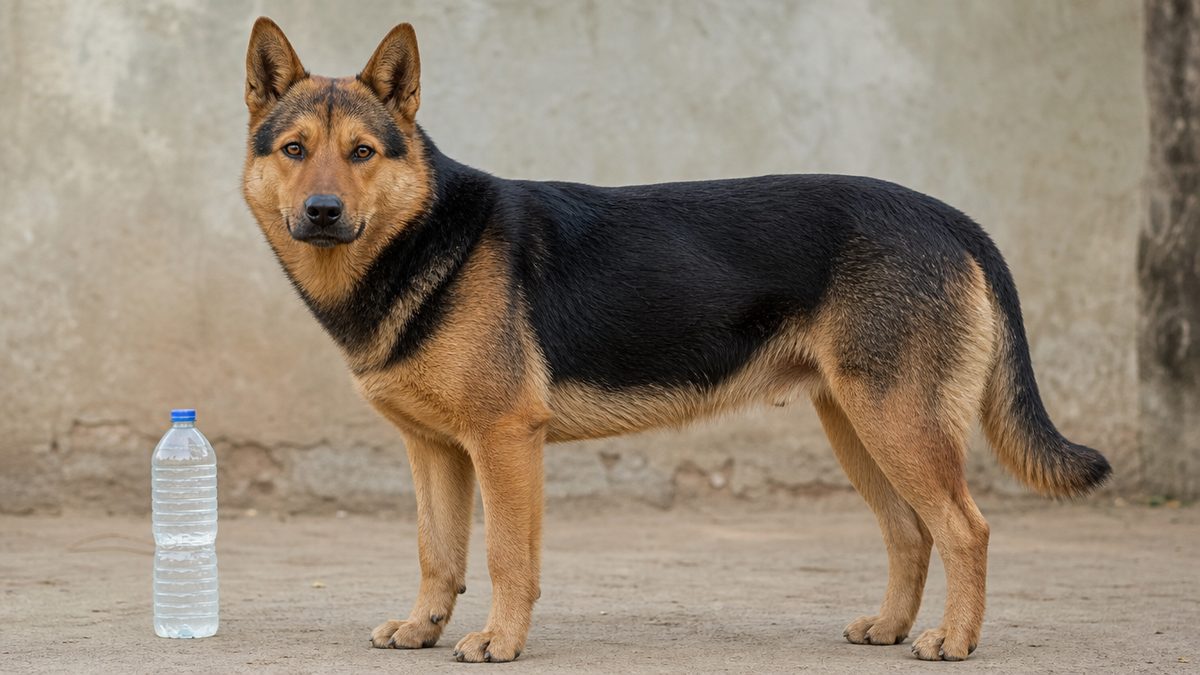
The coat itself is a thick double coat with a dense undercoat, which matters more in India than any measurement on this page. The ears are firmly pricked, natural and never cropped, and the outline reads as a working dog rather than as the roached, dropped-croup silhouette of a modern show-line German Shepherd.
Working roles
The breed's working roles are the reason it exists and the reason it is documented at all. Xinhua, reporting the Ministry of Public Security in December 2025, describes the Kunming dog as an all-rounder across policing, emergency rescue and customs anti-smuggling work, naming scent discrimination, trail tracking, evidence search, counter-terrorism response and disaster rescue, and reports that it has been sent to more than ten countries and regions including Singapore, Vietnam and Pakistan. The 2021 origin paper adds Thailand and North Korea to that export list.
This breed is repeatedly sold in English as a wolfdog. No study we could open reports wolf ancestry in it, including the study the top-ranking page cites for exactly that claim. The section below traces where the wolf came from.
Is the Kunming dog a recognised breed?
Kennel club recognition of the Kunming dog does not exist anywhere in the world, while Chinese state certification of it plainly does. Those are two different things and almost every page about this breed collapses them into one, in one direction or the other.
We checked the registers themselves rather than repeating what a breed site says about them. The FCI's definitive nomenclature under the letter K returns 14 breeds, five of them Asian working or guardian types that act as controls, and the Kunming dog is not among them. Under the letter C, where any breed published as Chinese Kunming Dog would file, the register returns 44 breeds of which exactly two are Chinese, the Chinese Crested Dog at 288 and the Chow Chow at 205. The provisional register, read at its real address rather than the decoy path that serves an English Setter page, returns 20 breeds and carries no Chinese entry at all.
The American position is the same. The AKC's site-wide breed selector lists every fully recognised breed plus every breed in the Foundation Stock Service in one string, and reading it as raw text on 2 September 2026 turns up Chinese Crested, Chinese Shar-Pei, Chow Chow, Pekingese, Shih Tzu, Lhasa Apso, three Tibetan breeds and the Taiwan Dog. Kunming appears zero times, and Labrador Retriever, German Shepherd Dog, Belgian Malinois and Rottweiler are all present, so the list loaded properly and the zero is real.
| Register | What we read | Result for this breed | Control that passed |
|---|---|---|---|
| FCI definitive, letter K | 14 breeds, read live 2 Sep 2026 | Absent | Kai 317, Kishu 318, Korea Jindo 334, Kazakh Tazy 372 |
| FCI definitive, letter C | 44 breeds, two of them Chinese | Absent | Chow Chow 205, Chinese Crested Dog 288 |
| FCI provisional | 20 breeds, heading confirmed | Absent | Kazakh Tazy 372, Continental Bulldog 369 |
| AKC, including Foundation Stock Service | Full breed selector, raw text | Absent | German Shepherd Dog, Chow Chow, Chinese Shar-Pei |
| China Kennel Union native-dog club | Standards for five breeds, appraisals for six | Absent | Chongqing dog, Laizhou Hong, Xiasi dog |
| China, National Livestock and Poultry Genetic Resources Committee | New-breed certificate list 2007-2008 | PRESENT, certificate Nong 08 No. 1 | 13 pig, cattle, sheep and poultry entries |
What the Chinese certificate is, and what it is not
China's own kennel body does not fill the gap either, and the detail is worth having because it is where the Kunming dog differs from every other Chinese breed on this site. The China Kennel Union is a full FCI member, and it runs a China Native Dog Conservation Club whose charter states in its own words that it works on ancient Chinese native breeds that are not recognised by the FCI, drafting standards, appraising dogs and submitting breeds for certification so that they may in time reach the standard for FCI registration. That club's own event log for 2016 to 2018 names six breeds it appraised, the Shaanxi Xian hound, the Laizhou Hong, the Xiasi dog, the Taicang dog, the Chongqing dog and the Chuandong hound, and carries published standards for five. The Kunming dog appears in neither list. So the one Chinese organisation actively working to get native breeds toward FCI recognition has never taken up the country's most successful working breed, which stays unrecognised by every kennel club in the world while holding a state livestock certificate no other dog holds.
The Kunming dog holds Nong 08 New Breed Certificate No. 1, issued to the Kunming Police Dog Base of the Ministry of Public Security. That record sits in the National Animal Husbandry Station's own 2012 volume on the new breeds appraised across 2007 and 2008, where the other 13 entries are pigs, cattle, sheep and poultry carrying the prefixes Nong 01, Nong 02, Nong 03 and Nong 09. The Nong 08 prefix is the dog category, and the number after it is one. So far as the published record goes, this is the first dog breed China ever certified as a livestock genetic resource.
That certificate is a livestock document, not a pedigree document. It says a Chinese state committee accepted the population as a distinct new breed. It confers no studbook an Indian registry would accept, no FCI nomenclature number, and no route to a show ring outside China. An Indian buyer who reads international recognition into it is reading a farm-animal register as a kennel club, which is exactly the confusion this page exists to clear.
The register that struck dogs out
Ministry of Agriculture and Rural Affairs Announcement No. 303 of 27 May 2020, approved by the State Council, published China's National Catalogue of Livestock and Poultry Genetic Resources and left dogs out of it entirely. We downloaded the gazette text and counted characters directly: across 1,672 characters of visible text the character for dog appears 0 times in either of its two common forms, and Kunming appears 0 times. The catalogue lists 12 traditional groups covering 17 species and 16 special livestock groups, including raccoon dog, mink, silver fox and Arctic fox, each marked non-edible.
Put the two documents side by side and a real sequence appears that no English page mentions. In 2007 and 2008 a dog could be, and was, certified as a Chinese livestock genetic resource. In 2020 dogs as a species were removed from the catalogue that governs which animals may be farmed, transported and traded commercially. The Kunming dog's certificate predates that change and the change did not revoke it, but nothing else has been added since and nothing else can be.
History: a breed with a state programme behind it
The Kunming dog's history is documented to a standard almost no rare breed on this site can match, because a government agency ran the programme and published about it. Systematic breeding began at the Ministry of Public Security's Kunming Police Dog Base in the 1950s, ministry acceptance and formal naming came in 1988, and national breed certification followed in 2007.
Xinhua, reporting the Ministry of Public Security on 18 December 2025, gives that sequence in a single sentence and adds the method, describing decades of scientific selection at the base. Chinese coverage of the same announcement names the technique as population successive-generation selection, a closed-herd method borrowed from livestock breeding rather than from kennel practice. That is consistent with where the breed ended up: certified by an agriculture committee, on a livestock certificate.
| When | What happened | Source |
|---|---|---|
| 1950s | Systematic breeding begins at the Kunming Police Dog Base using German Shepherds imported from the Soviet Union crossed with Kunming village dogs | Xinhua 2025; Current Zoology 2021 |
| 1988 | The breed passes Ministry of Public Security acceptance and is formally named the Kunming dog | Xinhua 2025 |
| 2007 | Certified as a new breed by China's National Livestock and Poultry Genetic Resources Committee | Xinhua 2025; Current Zoology 2021; Reproduction and Breeding 2024 |
| 2007-08 | Certificate issued as Nong 08 New Breed Certificate No. 1 to the Kunming Police Dog Base | National Animal Husbandry Station 2012 |
| 2008-2014 | 1,004 heats from 203 bitches recorded at the base, later published | Animal Science Journal 2018 |
| 2019 onward | Annual five-part temperament test begins on all breeding dogs at the base | Reproduction and Breeding 2024 |
| Dec 2025 | The Ministry of Public Security announces a national push to widen the breed's share of China's police dog force | Xinhua 2025 |
Where the sources disagree
Two disagreements are worth publishing rather than smoothing over. The first is the start date. Xinhua and both scientific papers put the programme's beginning in the 1950s Li JX, Huang QG, Wang SZ, Zhou QJ, Gao X, while Chinese Wikipedia dates the breeding work from 1960 and describes roughly 45 years of selection. The second is the founding stock. The Current Zoology paper says German Shepherd dogs imported from the Soviet Union, Chinese Wikipedia says East German Shepherds imported from the Soviet Union and East Germany, and English Wikipedia's own history section reports that the Yunnan police selected 20 local dogs from the plateau city of Kunming whose coats were wolf-black and straw-yellow, some with black backs, and that those became the three strains.
The 2021 behavioural study is the only source that tests the German Shepherd question rather than asserting it, and its answer is specific. Comparing seven behaviour items across 262 breeding dogs at the base, it found the German Shepherd nearest to the Kunming dog by Euclidean distance at 1.26, against 1.63 for the Belgian Malinois and 2.65 for the Eastern German Shepherd, and concluded that the breed more likely descends from Kunming village dogs crossed with ordinary German Shepherds than with Eastern German Shepherds. The authors add that genome sequencing would be needed to confirm it. So the standard Chinese Wikipedia account of an East German foundation is the one the evidence points away from.
The cloned dog, and what training one costs
One more documented episode is worth knowing because it shows what this breed is worth to the institution that made it. A female Kunming dog named Kunxun was born on 19 December 2018 in Beijing, cloned from a seven-year-old serving police dog in Pu'er, Yunnan, that had carried a first-level merit commendation since 2016, and she entered service in August 2019. Reported alongside that programme is a figure that sets the real cost of the breed's working output: training one meritorious Kunming police dog takes four to five years and costs roughly 500,000 yuan, with no guarantee of success. Bonbeno publishes no rupee conversion of that figure, because converting a foreign price into rupees is how invented Indian prices get made.
Note one cross-check that does work. Kunxun is reported as weighing 540 g at birth, against a breed mean birth weight of 407.25 g measured across 4,298 puppies. She was a large puppy by her own breed's standard, which is a small thing, but it is the kind of consistency check that tells you two independent sources are describing the same animal.
A note on how these dates were checked, because this breed's literature is easy to get wrong. Every bibliographic field on this page, including author lists, volumes and page ranges, was taken from the record we resolved rather than typed from memory. Resolving the temperament paper's DOI through Crossref returned its real article identifier, and it differs from the one a sensible guess produces: an assembled ScienceDirect identifier ending 487 returns HTTP 404 while the real one ends 480. A guessed identifier rarely errors loudly, which is why we do not guess them.
The wolfdog name: where the wolf came from, and why it is not there
No published study reports wolf ancestry in the Kunming dog, including the study the top-ranking English page cites for exactly that claim. The wolf appears to be a translation artefact, and tracing it is the single most useful thing this page can do for a reader who typed kunming wolfdog into a search box.
English Wikipedia's lead sentence describes the breed as a wolf-dog developed in Kunming in the 1950s from Alsatians hybridised with local dogs, even wolf-dog hybrids, and attaches the 2021 Current Zoology origin paper to that sentence. We read that paper in full. It says the breed was developed by hybridising German Shepherd dogs imported from the Soviet Union with Kunming indigenous village dogs, and it contains no wolf claim anywhere. The citation is real, the link works, and the number of times the source supports the sentence attached to it is zero.
The same Wikipedia article then contradicts its own lead two paragraphs later. Its Breed origin and genetics section reports that the 2021 behavioural study found the Kunming dog's behavioural stereotypes more consistent with a cross between indigenous village dogs of Kunming and German Shepherd Dogs than with Eastern German Shepherd Dogs. No wolf in that sentence either. The article nonetheless files itself in the wolfdogs category.
The likely mechanism, in two Chinese words
Chinese has an ordinary, everyday word for a shepherd or Alsatian type of dog that reads literally as wolf dog, and it is the standard term. A German Shepherd is routinely called a German wolf dog in Chinese. Separately, one of the Kunming dog's three colour lines is named wolf-grey. So a Chinese sentence saying the Yunnan police selected twenty local shepherd-type dogs with wolf-grey and straw-yellow coats becomes, read word for word into English, twenty local wolfdogs with wolf-coloured coats. English Wikipedia's own history section carries that translated phrasing today, sourced to a China Daily report.
Two independent tests support the artefact reading rather than the wolf reading. PubMed returns zero records for the phrase Kunming wolfdog and zero for Kunming wolf dog, both with quoted-phrase-not-found warnings, while the phrase Kunming dog returns five records and four working controls came back sane in the same session. And the only large genomic survey of Chinese indigenous breeds that included Asian grey wolves as a comparison group covered 15 Chinese breeds and 157 dogs and never sampled the Kunming dog at all, so the study that could have detected wolf admixture in it has not been run.
We can say that no source we opened reports wolf ancestry in this breed, that the source most often cited for it does not contain it, and that no genomic study has tested the question. We cannot say the breed has no wolf ancestry, because proving that needs the sequencing the 2021 authors themselves called for. The honest position is that the claim is unevidenced, not that it is disproved.
Why this matters in India specifically
The word wolfdog is not harmless in an Indian search box. Searching kunming dog price in india on 2 September 2026 returned twelve organic results of which six concerned a completely different animal: a wolf and Caucasian Shepherd cross bought in Bengaluru for about Rs 50 crore, pulled into the result set by the generic term wolf dog price in india rather than by this breed. Positions two, three, four, five, six and nine were all that story or generic wolfdog price content.
That story also fails its own arithmetic, which is worth showing because it is the cheapest fabrication test there is. NDTV reports the dog as eight months old and weighing more than 5 kilograms, then says two sentences later that it eats 3 kg of raw meat every day. A dog eating 3 kg of meat daily is not a 5 kg dog, and a Caucasian Shepherd cross at eight months is nearer 40 kg. The same article spells the animal's name Cadabomb Okami in its headline and Cadaboms Okami in its body. None of it describes a Kunming dog, and none of those rupee figures belongs anywhere near this breed.
Kunming dog price in India: there is none, and here is the proof
No Kunming dog price in India exists, because no Indian seller lists the breed. Bonbeno publishes no rupee figure for it, and every rupee number you will find attached to this name online belongs to a different animal.
An India-located search for kunming dog price in india on 2 September 2026 returned twelve organic results. English Wikipedia held position one. The only commercial listing for the breed itself was an American puppy marketplace. Six of the twelve concerned a wolf and Caucasian Shepherd cross sold in Bengaluru, and the rest were foreign breed-information pages. Not one Indian breeder, classified listing or marketplace page offered a Kunming dog.
That zero is worth something only because the instrument proved itself. The control query labrador retriever price in india, run in the same session with the same tool and the same India geotargeting, returned ten genuine Indian price pages including two complete city-by-city tables. A search that returns nothing because it was never really run is not evidence of anything. This one was run, and it worked.
What you are actually being offered instead
Three different substitutions turn up when an Indian buyer searches this breed, and naming them is more useful than any price would be.
- A ₹50 crore wolf-Caucasian Shepherd cross. NDTV reported in March 2025 that a Bengaluru owner paid about 5.7 million US dollars for a hybrid described as the first of its kind. It has no connection to this breed, and the report contradicts itself by putting the dog at more than 5 kilograms at eight months while eating 3 kg of raw meat a day.
- A generic wolf dog price in india city list. One social result in the pull printed bands like ₹45,000 to ₹55,000 for Mumbai and ₹60,000 to ₹75,000 for Delhi males, attached to no identified breed at all.
- A German Shepherd. Because the Kunming dog looks like one and descends partly from one, Indian sellers approached about a Kunming dog will offer a German Shepherd, which Supertails prices at ₹20,000 to ₹75,000.
Any rupee figure attached to the name Kunming dog in India is either a different breed's price or an invention. Nobody in India is lawfully importing this breed for sale, so nobody has a price to quote. If a seller gives you one, ask which register the pedigree comes from, and then read the register.
The only real price figure that exists, and why we do not convert it
One genuine cost figure is published for this breed anywhere, and it is not a purchase price. Chinese reporting of the Ministry of Public Security programme states that training one meritorious Kunming police dog takes four to five years and costs roughly 500,000 yuan, with a high elimination rate among candidates. That is a state training budget, not a market price, and Bonbeno publishes no rupee conversion of it. Converting a foreign figure at an exchange rate is precisely how fabricated Indian prices are manufactured, and this site has caught that pattern repeatedly on other breeds.
For the same reason this page prints no imported-puppy estimate. There is no lawful route to import a dog into India for sale or breeding, and a dog with no FCI-format pedigree has nothing the Kennel Club of India could register against. A price for something that cannot lawfully be sold here would be a fiction with a rupee sign on it.
If you want the honest comparison, look at what the same money buys in a breed you can actually verify. A KCI-registered Labrador runs ₹60,000 to ₹90,000 on one national seller's own published bands, a champion-bloodline one ₹90,000 to ₹1,20,000, and the same seller repeats the identical ₹30,000 to ₹1,20,000 range for all eight cities in its table. Supertails puts the same breed at ₹8,000 to ₹80,000. Two sources, one breed, a floor that differs by nearly four times. That spread is what a real Indian price looks like, disagreements included.
Cost of ownership in India for a 26 to 42 kg double-coated dog
Budget ₹8,000 to ₹14,000 a month to keep a dog of this size in India, and treat that as a size-band figure rather than a Kunming dog figure. No cost data specific to this breed exists in India, because no Kunming dog is known to live here.
Supertails publishes a monthly running-cost table that is honest about what it is, because it labels its columns by size band and names example breeds instead of pretending the numbers are breed-specific. Its Large column covers the Labrador, German Shepherd and Golden Retriever, which is the right band for a 26 to 42 kg working dog. Sites that hide this structure are the ones to worry about; this one prints it.
| Line item | Large band (Lab, GSD, Golden) | Giant band (Great Dane, St Bernard) |
|---|---|---|
| Dry or wet food | ₹4,000 to ₹6,000 | ₹6,000 to ₹10,000 |
| Routine vet visits | ₹1,000 to ₹2,000 | ₹1,500 to ₹3,000 |
| Vaccinations | ₹1,800 a year | ₹2,000 a year |
| Grooming | ₹500 to ₹1,200 | ₹600 to ₹1,500 |
| Training, over six months | ₹3,000 to ₹8,000 | ₹5,000 to ₹10,000 |
| Treats and toys | ₹600 to ₹1,200 | ₹800 to ₹1,500 |
| Flea control and deworming | ₹500 to ₹800 | ₹600 to ₹1,000 |
| Monthly total | ₹8,000 to ₹14,000 | ₹12,000 to ₹20,000 |
Three lines that move for this breed specifically
Two of the eight rows above would sit at the top of their range for a Kunming dog in India, and one would sit at the bottom, for reasons that come from the breed rather than from the band.
- Training, at the top. This is a dog selected for boldness, working motivation and aggression on a five-part test designed by a police ministry, and its measured heritability for obedience to a handler is 0.03, effectively nil. Whatever obedience you get, you will have to train in rather than buy in. Budget the ₹8,000 end of the six-month range and expect to keep paying past it.
- Cooling, which the table does not have a row for. A thick double coat in a city with ten months above a 25C mean turns air conditioning from a luxury into a running cost. Add it to your own arithmetic before you add anything else.
- Grooming, at the bottom. A double coat needs brushing and drying rather than clipping, and clipping it would be actively harmful, so the ₹500 to ₹1,200 line is one place this breed is genuinely cheap. Never shave a double coat to cool a dog down.
The first-year arithmetic
Twelve months at the band midpoint of about ₹11,000 comes to roughly ₹1,32,000 before any purchase price, before any import cost, and before cooling. Add a first-year vaccination course, sterilisation and the crate, bedding and containment a 40 kg working dog needs, and a realistic Indian first year for a dog of this size runs comfortably past ₹1,50,000. That figure is the same whether the dog is a Kunming dog, a German Shepherd or a large indie, which is the most useful thing on this page for a buyer weighing a rare import against a dog already living in India.
An Indian indie of similar size costs ₹0 to ₹2,000 through adoption and arrives already acclimatised to the climate you live in. The monthly cost of ownership afterwards is the same. The difference between the two routes is entirely in the acquisition, and in this breed's case the acquisition does not lawfully exist.
Heat tolerance: a plateau breed at a tropical latitude
The Kunming dog is poorly adapted to Indian heat, and the reason is elevation rather than latitude. Kunming sits at 25 degrees north, further from the equator than Kolkata but well south of Delhi, and 1,891 m of Yunnan plateau turns that tropical latitude into a place with an annual mean of 15.34C and no hot season at all.
We queried NASA POWER by explicit latitude and longitude rather than by place name, so no other city can be served by accident, and we checked the returned cell elevation as well as the returned coordinates. That second check matters here more than on any other page this site has built, because a mountain cell can miss the town under it by more than a kilometre. Kunming's cell came back at 2,021.13 m against the city's own elevation near 1,891 m, an overstatement of about 130 m. At a lapse rate near 6.5C per 1,000 m that is roughly 0.85C of artificial cooling, small enough that the cell is usable and worth stating rather than hiding.
| Place | Annual mean | Coldest month | Hottest month | Months at or above 25C mean |
|---|---|---|---|---|
| Kunming, Yunnan | 15.34C | 7.70C (Jan) | 20.88C (Jun) | 0 |
| Chennai | 27.95C | 24.09C (Jan) | 31.51C (May) | 10 |
| Mumbai | 26.77C | 23.19C (Jan) | 31.19C (May) | 9 |
| Kolkata | 25.81C | 17.31C (Jan) | 31.53C (May) | 8 |
| Hyderabad | 26.10C | 20.76C (Dec) | 33.30C (May) | 7 |
| Delhi | 25.60C | 13.61C (Jan) | 35.88C (Jun) | 7 |
| Pune | 23.86C | 19.62C (Dec) | 28.93C (Apr) | 4 |
| Bengaluru | 23.74C | 20.22C (Dec) | 28.37C (Apr) | 3 |
| Shillong | 17.96C | 10.74C (Jan) | 22.38C (Aug) | 0 |
Reading that table honestly
Two things make this breed heat-sensitive in a way its photographs hide. The coat is the obvious one, since a dense undercoat is an insulating air layer that works in both directions and cannot be taken off. The less obvious one is drive: a dog selected for hours of tracking and searching does not self-limit in heat, and the heat-illness literature is clear that exertion rather than confinement is what kills fit working dogs.
The single most decision-relevant line is the last column. Kunming spends zero months of the year at or above a 25C monthly mean. Chennai spends ten, Mumbai nine and Kolkata eight. A dog whose entire evolutionary and selective history sits on the left of that table has no acquired heat tolerance to bring to the right of it, and a thick double coat with a dense undercoat is the wrong equipment for the journey.
Kunming's hottest month, June at 20.88C, is cooler than Bengaluru's coldest month by a margin so small that the two nearly touch: Bengaluru's December mean is 20.22C. Put plainly, the warmest month this breed's homeland ever sees is roughly the coolest month one of India's mildest big cities ever sees. Chennai's coldest month, at 24.09C, is more than three degrees warmer than anything Kunming experiences in a year.
Humidity moves the same way. Computing wet-bulb temperature from the returned monthly means using the Stull formula gives Kunming an annual figure near 12.1C and a July peak near 17.6C, against roughly 24.0C annual and 26.1C in May for Chennai. Wet-bulb is the number that matters for a panting animal, because it is the temperature evaporative cooling can actually reach, and a nine-point gap at peak is not something a fan closes.
Second Schedule Part IV paragraph 21(1) of the Prevention of Cruelty to Animals (Dog Breeding and Marketing) Rules, 2017 bars keeping in outdoor facilities, without the attending veterinary practitioner's written approval, dogs not accustomed to the temperatures prevalent in the area and breeds that cannot tolerate them, giving long-haired breeds in high temperature locations as its own example. Note the citation form: this is a Second Schedule paragraph, and the string Rule 21 appears zero times in the gazette.
City by city: where in India this breed would cope best
Only the Indian hill stations come close to Kunming's climate, and the nearest match on the plains is not close at all. If you are determined to work out where a plateau-bred double-coated dog would suffer least in India, the honest answer is a hill town, with a caveat about how the data behaves there.
Shillong is the best plains-accessible analogue we measured, at an annual mean of 17.96C with zero months at or above a 25C monthly mean. That is the same last-column score as Kunming and the closest annual mean of any Indian point in our set. But the elevation check that passed for Kunming fails here and has to be reported. POWER returned the Shillong cell at 1,224.61 m against a town near 1,496 m, an understatement of about 271 m, which at 6.5C per 1,000 m means the returned figures read roughly 1.8C too warm. Corrected, real Shillong sits near 16.2C annual, which is within a degree of Kunming's 15.34C.
That correction is an estimate and this page labels it one. What it changes is the ranking rather than the conclusion: Shillong is closer to Kunming than the raw cell suggests, not further.
The four bands, and what each means for this dog
- Eastern and northeastern hill towns, and Himalayan hill stations. Shillong, Darjeeling, Gangtok and similar places are the only Indian locations whose annual mean lands within a few degrees of Kunming. A Kunming dog could live here without fighting the climate every day. Verify the specific town's real elevation before trusting any gridded climate figure for it, because hill cells are where this data is least reliable.
- Bengaluru and Pune. Three and four months above a 25C mean respectively, and coldest months near 20C. These are India's most survivable big cities for a heavy-coated dog, and they are still four to five months a year warmer than anything the breed's homeland offers. Shade, timing and cooling become daily management rather than seasonal.
- Delhi. Seven months above 25C, a June mean of 35.88C and a recorded monthly maximum of 48.79C, offset by a January mean of 13.61C that is the only Indian figure in our set to approach Kunming's winter. Delhi gives this breed one comfortable quarter and one genuinely dangerous one.
- Chennai, Mumbai and Kolkata. Eight to ten months above a 25C mean, coldest months of 24.09C, 23.19C and 17.31C, and August relative humidity that runs high enough to blunt evaporative cooling. There is no configuration of air conditioning, shade and night walks that makes a thick double coat comfortable here across a year.
Practical management, if the dog is already with you
Walk at first light and after dark, and drop the middle of the day entirely from May to September. Check paw pads on tar before you step onto it. Provide continuous shade and standing water rather than a bowl that empties. Watch for heat-related illness signs that are not panting: stumbling, vomiting, collapse and a rectal temperature above 40C are emergencies, and the UK emergency-care study puts the event fatality rate for heat-related illness at 26.56 percent, with a 95 percent confidence interval of 21.66 to 32.25 percent.
Two findings from the same literature apply to this breed even though the breed itself was never studied. Bodyweight above the breed and sex mean raised the odds of heat-related illness in a cohort of 905,543 UK dogs, and so did being over two years old. And the larger of the two Hall papers found exertional heat-related illness to be the predominant trigger at 74.2 percent of events with a recorded cause, ahead of environmental heat at 12.9 percent and vehicular confinement at 5.2 percent. For a working breed with a very high exercise need, that is the finding that matters. The danger is not a hot car. It is the walk you took at four in the afternoon because the dog was restless.
Do not shave a double coat to cool the dog. The undercoat is insulation in both directions and shaving it removes sun protection while doing nothing useful for heat loss, since dogs do not sweat through skin. Brush the undercoat out instead, and cool the dog with shade, water and airflow.
Temperament: what a police ministry's own test says
The Kunming dog's temperament is documented by measurement rather than by adjective, which is unusual and useful. Its own breeding institution runs an annual five-part test on every breeding dog and publishes the scores, and those scores say the breed is bold and motivated but scores below the German Shepherd and Belgian Malinois on every item tested.
Since 2019 the Kunming Police Dog Base has tested roughly 40 male and 60 female breeding dogs a year on five subsets, each scored 1 to 5 by at least five professional judges. The test was designed by the Police Dog Reproduction and Breeding Work Administrative Committee of the Ministry of Public Security to assess obedience through following the trainer, boldness through reaction to a stranger, working motivation through tease by towel and chase and fetch, and aggression through chase and fetch and tug of war.
| Subset | What it measures | Mean score of 5 | Standard deviation | Heritability |
|---|---|---|---|---|
| Tease by towel | Working motivation | 3.97 | 0.89 | 0.10 |
| Reaction to stranger | Boldness | 3.94 | 0.99 | 0.13 |
| Chase and fetch | Motivation and aggression | 3.79 | 1.16 | 0.14 |
| Following to trainer | Obedience | 3.36 | 0.99 | 0.03 |
| Tug of war | Aggression | 3.27 | 1.32 | 0.10 |
Read that table in order and a clear personality appears. This dog is strongest on motivation and boldness and weakest on obedience and on the tug-of-war item, which also carries the widest spread at a standard deviation of 1.32. In plain terms it is a keen, confident, alert dog that is variable about biting games and least consistent about doing what it is told.
How it compares with the breeds it works alongside
The comparison is published and it is not flattering. A separate study tested 262 breeding dogs at the same base across four breeds, 115 of them Kunming dogs, 117 Belgian Malinois, 23 German Shepherds and 7 Eastern German Shepherds, on seven behaviour items. The Kunming dog had the lowest breed effect on every single one of the seven, and the Eastern German Shepherd the highest on every one. The authors write plainly that the overall behavioural test scores of the Kunming dog are lower than the other three as a working dog, and that more intensive selection on performance behaviour and temperament is needed.
The 2024 temperament paper repeats that judgement in its own introduction, saying the breed's evaluation is not as excellent as the two world-class working breeds, the German Shepherd dog and the Belgian Malinois. When an institution publishes that about the breed it created and is currently promoting nationally, it is worth believing.
Household fit, for an Indian home
This is a guard dog by selection and a family dog only by accident. It is independent enough that obedience does not come free, alert enough to react to every arrival at a gate, and driven enough that boredom turns into behaviour. Nothing in the published record suggests aggression toward its own household, and nothing in it suggests the tolerant, unbothered temperament that survives an Indian apartment block with shared corridors, festival noise and a stream of delivery visitors.
- Suits a household with a securely fenced independent house, an owner with working-dog experience, daily structured work, and a genuine need for a guarding presence.
- Does not suit a flat, a first-time owner, a household that is out ten hours a day, or a family that wants a dog for the children rather than for the gate.
- Needs to be socialised deliberately and early, because a breed selected on reaction to strangers will otherwise generalise that reaction to everyone who walks past.
Training: what the heritability number actually tells you
To train a Kunming dog, plan for obedience to be entirely your work rather than partly the breeder's. The breed's measured heritability for following its trainer is 0.03, the lowest of its five tested traits and close to zero, which means the trait barely passes from parent to offspring and has to be built in each individual dog.
Heritability estimates from the breed's own breeding population run from 0.03 to 0.14 across the five subsets: following to trainer 0.03, tease by towel 0.10, tug of war 0.10, reaction to stranger 0.13 and chase and fetch 0.14. The authors compare those against published values for other working breeds, which run from 0.00 to 0.26, and conclude that following to trainer is limited for selective breeding while the other four are usable as breeding traits.
Turn that around for an owner and it says something practical. Whatever prey drive, boldness and grip this dog has, it largely arrived with. Whatever obedience it has, you put there. A buyer choosing a Kunming dog because a police force uses one is buying the raw material of a police dog, not the finished article, and the finished article takes four to five years of professional work at a reported cost near 500,000 yuan with a high failure rate.
What works with this breed
- Start structured work at eight weeks and never stop. The Indian Rules put the earliest lawful sale at eight weeks, so that is when the clock starts.
- Pay for professional help in the first year rather than the third. Supertails puts six months of training in the large-breed band at ₹3,000 to ₹8,000, which is the cheapest insurance on this page.
- Train motivation-first, not correction-first. The breed scores highest on tease by towel and chase and fetch, so a toy and a chase are stronger currency than food or pressure.
- Build a formal out or release from the beginning. Tug of war is the most variable item in the breed's own test at a standard deviation of 1.32, which means grip and release differ a lot between individuals.
- Socialise to Indian street life specifically. Auto rickshaws, cattle, firecrackers, cricket balls and the doorbell are the test, not a quiet park.
What this breed resists
It resists repetition without purpose, and it resists handlers who are inconsistent about the same rule. A dog bred and selected on a boldness item is not going to defer to hesitancy. Expect a long adolescence, expect testing at around eight to fourteen months, and expect the guarding behaviour to switch on without being asked for.
This breed does not need protection work to guard. Reaction to strangers is one of the five traits it is bred and scored on. Adding bite work to an untrained young dog in a residential Indian neighbourhood produces a liability, not a security system. Train the recall, the settle and the release instead, and let the alerting look after itself.
One more finding belongs in the training section rather than the health one, because it is where an owner meets it. Researchers used continuous circling as a marker for obsessive-compulsive behaviour and were able to assemble ten circling Kunming dogs and ten unaffected ones for whole-genome sequencing, alongside the same design in Belgian Malinois. A breed in which twenty dogs can be sorted that way is a breed in which under-stimulation shows up as stereotypy. If your Kunming dog starts circling, that is a welfare signal and a workload signal, and it needs a veterinary behaviourist rather than a correction.
Exercise: the number nobody has measured, and the safe default
No published source gives a daily exercise requirement for the Kunming dog, so this page gives no minute count. What the record does give is the shape of the requirement, and it is the shape of a working dog with a documented stereotypy risk rather than of a pet that needs a walk.
The breed is deployed operationally in scent discrimination, trail tracking, evidence search, counter-terrorism response, disaster rescue and customs anti-smuggling work. Those are jobs measured in hours of concentration, not in kilometres. A dog selected across seventy years for that workload and then kept as a household pet has an appetite no walk satisfies.
What happens without it, with a citation
The consequence is documented in this specific breed, which is rare. The obsessive-compulsive study used continuous circling as its phenotype and successfully recruited ten circling Kunming dogs and ten unaffected controls, then identified eleven candidate genes overlapping significantly with genes from a human OCD genome-wide association study, two of which, PPP2R2B and ADAMTSL3, alter dendritic spine density and morphology. Compulsive circling is not a hypothetical failure mode for this breed. It is the phenotype researchers went looking for and found.
A workable Indian routine
Split the requirement into physical work and mental work, and put the physical half outside the heat window.
- Two structured sessions a day, at first light and after dark, from March to October in most of India. The middle of the day is not a training window in a country where seven to ten months clear a 25C monthly mean.
- Scent work indoors, every day, without exception. Hidden food, scattered kibble, a scent article in one of six boxes. This is the half that stops the circling, and it is the half that works in an Indian summer because it happens on a tiled floor under a fan.
- One long session a week that is genuinely long. Tracking on grass, a hill walk in cool weather, or structured retrieve work with a proper release.
- Nothing forced in the heat. Exertional heat-related illness accounted for 74.2 percent of events with a recorded trigger in a cohort of 1,259 events, well ahead of environmental heat at 12.9 percent and vehicular confinement at 5.2 percent.
The dangerous combination for this breed in India is a high-drive dog, an owner making up for a missed morning, and a 4pm walk in May. Exertional heat illness is a young fit dog's disease, not an old sick dog's, and this is a young fit dog with a very high drive to keep going past the point where it should stop.
One honest limitation belongs here. Neither Hall study modelled the Kunming dog, because neither cohort contained one, so the odds ratios in those papers are not this breed's odds ratios. What transfers is the mechanism and the transferable risk factors: bodyweight at or above the breed and sex mean raised risk in a 905,543-dog cohort, and so did age over two years. A well-muscled adult Kunming dog sits in both categories.
Grooming a thick double coat in Indian humidity
Grooming a Kunming dog in India is a drying and de-shedding job rather than a clipping job, and it is the cheapest line in this dog's budget at ₹500 to ₹1,200 a month in the large-breed band. The one rule that matters more than all the technique is never to shave the coat.
The breed carries a thick double coat with a dense undercoat, published by English Wikipedia as simply a double coat and described in Chinese sources as medium in length rather than long. That puts it between a smooth-coated working breed and a Tibetan Mastiff in workload, and the practical consequence in India is that it holds water and holds heat.
The weekly routine
- Undercoat rake twice a week in cool months and every second day through a shedding period, working in sections down to the skin rather than skimming the topcoat.
- Slicker brush over the top afterwards, to lift what the rake has loosened rather than to do the loosening.
- Bath only when genuinely dirty, and never more than about once a month. A double coat stripped of oils mats faster and dries slower.
- Dry to the skin every time the dog gets wet, including after rain. Towel first, then a dryer on cool, then check the armpits, groin, the base of the tail and behind the ears with your fingers.
- Plug the ears before any bath, and dry the ear canals afterwards.
Why drying matters more here than in Kunming
The homeland this coat evolved for runs at 71.4 percent annual mean relative humidity and never gets hot, so a wet dog in Kunming dries in cool moving air. Mumbai in August and Kolkata in the monsoon do not offer that. A double-coated dog left to air dry in Indian monsoon humidity stays damp against the skin for hours, and damp skin under dense undercoat is where hot spots, yeast and ear infections start. Overseas breed-care guidance that says to towel a dog and let it air dry is written for climates that do not exist here, and following it in an Indian monsoon is one of the commonest imported mistakes on this site.
Shaving removes the undercoat's insulating air layer and the topcoat's sun protection at once, and it does nothing useful for cooling because dogs lose heat by panting rather than through the skin. A shaved double coat often grows back patchy and coarser. If the dog is overheating, the answer is shade, water, airflow and timing, not a clipper.
Ticks, which are a grooming problem in India
Grooming a thick-coated dog in India is also the main tick check, and the numbers justify treating it that way. A multiplex PCR survey of 719 dogs in Punjab found Babesia gibsoni in 8.9 percent, Hepatozoon canis in 5.1 percent, Ehrlichia canis in 2.6 percent and Babesia vogeli in 1.1 percent, against microscopic prevalences of 5.0, 1.0, 1.4 and 0.1 percent respectively. Microscopy missed most of what PCR found, which matters because microscopy is what a routine Indian clinic runs first.
Work through the coat with your fingers rather than your eyes: ears, the fold behind them, under the collar, the armpits, between the toes and around the anus. A dense undercoat hides a feeding tick completely, and on a black-back dog you will not see one at all. Keep a monthly preventive going year round rather than seasonally, and note that flea and deworming already sits in the cost table at ₹500 to ₹800 a month for this size band.
Health problems and life expectancy: what exists and what does not
No published life expectancy exists for the Kunming dog, and no hip, elbow or eye screening scheme covers it anywhere in the world. That absence is the most important health fact on this page, because it means no veterinarian, in India or China, has a breed baseline to compare your dog against.
The two large UK life-table studies this site normally leans on cannot help here. The Dogs Trust longevity study partitions 584,734 unique dogs including 284,734 deceased across 155 named breeds, and the Kunming dog is not one of them. The RVC VetCompass life tables cover 30,563 dogs that died between January 2016 and July 2020 and give an all-breed life expectancy at age 0 of 11.23 years with a 95 percent confidence interval of 11.19 to 11.27, but again break out only breeds present in the UK population. A page that borrowed the 11.23-year all-breed figure and printed it as this breed's lifespan would be substituting a population average for a measurement, so this page prints no lifespan at all.
If you see the Dogs Trust longevity figures quoted anywhere, note that the paper carries an Author Correction published on 16 April 2024 that revises a Miniature Dachshund median in one figure legend. It changes nothing for this breed, and almost nobody who quotes the parent paper mentions it exists.
What screening you can and cannot get
No breed club, kennel club or orthopaedic registry runs a screening scheme for the Kunming dog, because no registry recognises it. There is no CHIC number, no breed-specific hip statistics table and no published prevalence for any inherited condition. What you can do is screen the individual dog against the general canine standards a good Indian veterinary hospital already runs.
Indian law is unusually helpful here, because it lists what a breeding dog must have been tested for regardless of breed. Second Schedule Part III paragraph 8(10) of the 2017 Rules requires that dogs shall have been tested for genetic defects, including hip dysplasia, progressive retinal atrophy, night blindness, hypothyroidism, entropion, ectropion, overshot and undershot jaw where the incisors do not touch or mesh, wry mouth, two or more missing teeth, and unilateral or full cryptorchid males. The word including matters: that list is illustrative rather than closed, so a condition not named is not thereby excluded.
| Question | Status for the Kunming dog | What you can do |
|---|---|---|
| Life expectancy | No published figure anywhere | Nothing. Do not accept a number from a seller |
| Hip and elbow scores | No breed statistics table exists | Radiograph the individual dog; the 2017 Rules name hip dysplasia |
| Eye conditions | No breed screening scheme | Ophthalmic exam; PRA and night blindness are named in law |
| Thyroid | No breed data | Thyroid panel; hypothyroidism is named in law |
| Compulsive circling | Documented in the breed at genome level | Veterinary behaviourist, and audit workload first |
| Coat-colour genetics | MC1R under balancing selection, two populations | Nothing clinical; this is population biology |
| Gut microbiota | Characterised against GSD and Malinois | Nothing clinical yet |
| Reproduction | 1,004 heats and 567 litters published | The best-evidenced area of the breed's health |
Heat-related illness, the risk that is real in India
The heat-illness literature does not include this breed, and this page will not import an odds ratio onto a dog the authors never studied. What transfers are the mechanism and the general risk factors. In a cohort of 905,543 UK dogs under primary veterinary care in 2016, 395 confirmed heat-related illness events gave an incidence of 0.04 percent with an event fatality rate of 14.18 percent, and significant risk factors included bodyweight above the breed and sex mean and age over two years. In UK emergency practice in 2022, 384 events among 167,751 dogs gave a much higher event fatality rate of 26.56 percent.
Both figures come from a country whose median ambient temperature on heat-illness days is far below any Indian month. A plateau-bred double-coated working dog in Chennai is not covered by either study, and the sensible reading is that the UK numbers are a floor rather than an estimate.
The circling study: the breed's best-documented health finding is behavioural
The single most specific health finding published about the Kunming dog concerns compulsive circling, not joints or eyes. Researchers used continuous circling as a phenotype for obsessive-compulsive disorder, sequenced twenty Kunming dogs, and found genes that overlap significantly with human OCD findings.
The study screened two independent breeds, the Belgian Malinois and the Kunming dog, then whole-genome sequenced ten circling dogs and ten unaffected dogs in each. Population differentiation analysis identified 11 candidate genes in the extreme tail of the differentiated regions between cases and controls, and those genes overlapped significantly with genes identified in a human OCD genome-wide association study. Functional work showed that two of them, PPP2R2B and ADAMTSL3, affect the density and morphology of dendritic spines. One of the authors is based at the Kunming Police Dog Base itself.
Two things follow for an owner, and neither is the alarming one.
- This is not evidence that the breed is unusually prone to OCD compared with other working breeds. The design needed circling dogs, and it recruited them in the Malinois too. What it establishes is that the phenotype exists in the breed in recruitable numbers.
- It is evidence that circling in this breed has a genetic component and is therefore not simply a training failure to be corrected. A dog that starts circling needs a veterinary behaviourist, a workload audit and a medical rule-out, in that order.
Why this matters more in India than in Yunnan
Compulsive behaviours in working breeds track under-stimulation, confinement and lack of predictable routine. An Indian apartment amplifies all three. The breed's own annual test scores it on working motivation and boldness rather than on tolerance of idleness, and its lowest and least heritable score is obedience. Put a dog built for eight-hour tracking work in a 900 square foot flat with two twenty-minute walks and the published phenotype is exactly what you would expect to see.
Repetitive circling, tail chasing, flank sucking or pacing in a working dog is a welfare problem. Rule out pain, neurological disease and ear disease first with a veterinarian, then audit the dog's daily mental workload honestly. Punishing the behaviour makes it worse, because it adds the anxiety that maintains it.
The Indian disease pressure this breed will actually meet
Whatever this breed's inherited risks turn out to be, the conditions that will present in an Indian clinic are the ones every dog here meets. The Punjab multiplex PCR survey of 719 dogs found Babesia gibsoni at 8.9 percent, Hepatozoon canis at 5.1 percent, Ehrlichia canis at 2.6 percent and Babesia vogeli at 1.1 percent by PCR, with concurrent infections of Babesia gibsoni and Hepatozoon canis in 0.4 percent and of Babesia gibsoni and Ehrlichia canis in a further 0.4 percent. Breed, sex and location were all significantly associated with Babesia gibsoni infection.
The gap between the two test methods is the practical lesson. Microscopy found Babesia gibsoni in 5.0 percent against PCR's 8.9 percent, and Hepatozoon canis in 1.0 percent against PCR's 5.1 percent. If your dog is unwell and a routine blood smear comes back clean, that is not a negative result for tick-borne disease. Ask for PCR.
A gut-microbiota study offers one more piece of breed-specific baseline, and it is genuinely novel. Comparing the Kunming dog, German Shepherd and Belgian Malinois under identical husbandry, researchers found 257 species across 146 genera and 10 phyla, dominated by Firmicutes at 57.44 percent, Fusobacteriota at 28.86 percent and Bacteroidota at 7.63 percent, and reported that the Belgian Malinois gut flora was significantly richer than that of either the Kunming dog or the German Shepherd. There is no clinical action to take from that yet. It is recorded here because it is the only comparative physiology this breed has.
Feeding a 26 to 42 kg working dog in India
Feed a Kunming dog to body condition rather than to a chart, because no breed-specific feeding data exists and the one weight-related risk factor the literature does give runs against overfeeding. Budget ₹4,000 to ₹6,000 a month for food in the large-breed band.
Two published findings shape how to feed this breed, and neither is a portion size. The first is that bodyweight at or above the breed and sex mean was a significant risk factor for heat-related illness in a cohort of 905,543 dogs. In a hot country, keeping a working dog lean is not cosmetic. The second is the gut-microbiota comparison, which found the Kunming dog's flora significantly different from the German Shepherd's and the Belgian Malinois' at both phylum and genus level under identical feeding, which is a reason not to assume German Shepherd feeding guidance transfers exactly.
Life-stage feeding
- Eight weeks to four months, four meals a day. Use a large-breed puppy formulation with controlled calcium, because rapid growth in a large breed is a joint problem rather than a virtue.
- Four to seven months, three meals a day. This is the fastest growth window and the easiest one to overfeed.
- Seven to twelve months, two meals a day, and stay on large-breed puppy food until roughly 14 to 18 months rather than switching at a year.
- Adult, two meals a day, split morning and evening so neither sits close to a working session.
- Senior, two meals with the protein kept up and the calories down.
Indian availability and cost
Every ingredient this dog needs is available in India, and the size band tells you the budget. Supertails puts large-breed food at ₹4,000 to ₹6,000 a month, treats and toys at ₹600 to ₹1,200, and flea control and deworming at ₹500 to ₹800. Large-breed dry food from the major brands sold here, home-cooked diets balanced by a veterinary nutritionist, and mixed feeding all work. What does not work is an unbalanced rice and curd diet for a 40 kg growing working dog, which is still the commonest Indian feeding mistake in this weight class.
Feed two or three smaller meals rather than one large one, do not exercise for an hour either side of a meal, and use a slow feeder if the dog eats fast. Gastric dilatation and volvulus is a surgical emergency in deep-chested breeds and the window is measured in hours. Know your nearest 24-hour surgical facility before you need it.
Body condition, which replaces the chart nobody has
Run your hands over the ribs weekly. You should feel each rib easily under a thin layer of covering without seeing them from across the room, and there should be a visible waist from above and a tuck from the side. In a country where seven to ten months of the year clear a 25C monthly mean, err lean. Every extra kilogram on a double-coated dog in Chennai is a kilogram of heat it has to shed with a coat built for a place that never reaches a 25C monthly mean.
The first year, month by month, with the only real breed data on this page
The Kunming dog's first weeks are better documented than almost any rare breed's, because its breeding institution published 567 litters. Mean litter size is 7.19 puppies with a range of 1 to 15, mean gestation is 61.64 days and mean birth weight is 407.25 g.
Those figures come from 1,004 recorded heats, 753 of them with mating, in 203 bitches at the Kunming Police Dog Base between 2008 and 2014, producing 567 litters and 4,298 puppies. Pregnancy rate was 79.42 percent and whelping rate 75.30 percent, the sex ratio was 1.03 males to 1.00 female, and oestrus occurred in every month of the year with no significant seasonal difference, confirming the breed as a non-seasonal breeder.
The paper reports 567 litters and 4,298 puppies alongside a mean litter size of 7.19. Dividing 4,298 by 567 gives 7.58, not 7.19, so those three numbers cannot all describe the same set. The whelping-rate arithmetic does close exactly, since 567 of 753 matings is 75.30 percent, which suggests the litter-size line rather than the counts is where the discrepancy sits. We publish both figures and the division rather than picking one.
| Age | What is happening | What you do |
|---|---|---|
| Birth | Mean birth weight 407.25 g after a mean 61.64-day gestation | Nothing. The puppy is with its dam |
| 7 to 8 weeks | Vaccination can begin, per the Rules | First vaccinations; no lawful sale before eight weeks |
| 8 to 12 weeks | Primary socialisation window closing | Meet Indian street life daily; short sessions, no forced exposure |
| 3 to 4 months | Fastest growth begins; four meals a day | Large-breed puppy food; no forced exercise on hard surfaces |
| Up to 18 weeks | Vaccination course usually completed | Finish the course before public exposure |
| 4 to 7 months | Peak growth; three meals a day | Structured training; professional class if you can afford one |
| 6 months | Sale after six months requires sterilisation under the Rules unless to a licensed breeder | Decide on neutering with your vet, not by rule of thumb |
| 7 to 12 months | Adolescence; guarding behaviour switches on | Hold the rules steady; two meals a day |
| 8 to 14 months | Testing phase; stereotypy risk if under-worked | Add daily scent work indoors; watch for circling |
| 12 months | CKU-style native-breed rules would allow mating here; Indian law does not for males | Second Schedule Part II paragraph 6(7) sets 18 months for a stud dog |
| 14 to 18 months | Growth plates closing | Switch to adult food; only now begin sustained roadwork, in cool hours |
Two Indian legal markers people miss
Rule 8(1)(a) in the body of the 2017 Rules requires that pups less than eight weeks in age are not sold, and Rule 8(1)(b) requires that dogs over six months are not sold without first being sterilised unless the buyer is another licensed breeder. Note the citation form carefully. Those are Rules in the body of the instrument. The breeding-technique and housing provisions quoted elsewhere on this page are Second Schedule paragraphs, and the Rules themselves stop at Rule 13, so any citation reading Rule 21 is wrong by construction.
The second marker is the one prospective breeders get wrong. Second Schedule Part II paragraph 6(6) provides that no female dog shall be exploited to give birth to more than five litters of pups during her lifespan, and paragraph 6(7) bars using a male for breeding before his eighteenth month. Set that against the only published breeding programme for this breed: 567 litters from 203 bitches is a mean of 2.79 litters per bitch across the seven-year window, comfortably inside the Indian cap. It is a rare case where a foreign working programme and Indian law point the same way.
Indian law, import, and one clause this breed collides with
Owning a Kunming dog is lawful in India, but creating one here would not be, and importing one for sale would not be either. The 2017 Rules contain a clause that lands directly on how this breed came into existence, and no page about it has noticed.
Start with what is settled. No Indian law in force today bans owning, breeding or selling any particular dog breed. A 2024 central circular listing breeds for a ban was quashed by the Karnataka High Court on 10 April 2024 and set aside by the Delhi High Court on 16 April 2024, and the Centre told the Bombay High Court in January 2025 that it is not acting on it. Bonbeno has not seen the circular itself and the reproductions disagree on how many breeds it named, so this page states the legal position and not a breed count. The Kunming dog does not appear on any reproduction of that list in any case.
The clause this breed's own history runs into
Second Schedule Part II paragraph 6(9) of the Prevention of Cruelty to Animals (Dog Breeding and Marketing) Rules, 2017 reads, in the gazette text we extracted ourselves, that breeding to create new breeds of dogs or unusual looks shall be strictly prohibited. That is precisely what the Kunming Police Dog Base did between the 1950s and 1988: it crossed German Shepherds with local village dogs and selected across generations until a new breed existed, then had it certified as one.
This does not make the breed illegal in India, and nothing here suggests it does. The clause governs breeders operating in India under these Rules; it has no reach over a state programme in Yunnan and no retrospective effect on a dog already alive. What it does mean is concrete and worth saying plainly. The programme that produced this breed could not lawfully be run in India today, and an Indian breeder who tried to recreate a Kunming-type dog by crossing German Shepherds with indies would be doing the thing paragraph 6(9) prohibits.
Housing, heat and the clause everyone miscites
Second Schedule Part IV paragraph 21(1), headed Outdoor housing facilities, bars keeping in outdoor facilities, without the attending veterinary practitioner's written approval, dogs that are not accustomed to the temperatures prevalent in the area or region in question, dog breeds that cannot tolerate them such as long-haired breeds in high temperature locations, and sick, infirm, aged or young animals. A plateau-bred double-coated dog in Chennai fits the first two limbs of that clause about as squarely as any dog could.
This is Second Schedule Part IV paragraph 21(1), not Rule 21. We extracted the 14-page gazette with pypdf and the string Rule 21 appears zero times in 51,953 characters. The Rules themselves run only from Rule 1 to Rule 13, so every provision numbered above 13 is a Second Schedule paragraph. Anyone citing a Rule 21 at you has not read the document.
Import, and what we could not verify
Importing a dog into India for trading or breeding is not permitted, and importing one as a pet needs an import licence or the baggage route with documentation in the importer's own name. Bonbeno normally quotes the DGFT trade notice directly for this. On 2 September 2026 we could not: the DGFT's own hosted PDF of the notice returned HTTP 403 to two independent tools, so we could not read the primary text and this page therefore quotes no clause from it and gives no port list. An unverifiable citation is worse than none.
What we can verify is the part that actually blocks this breed, and it is a registry problem rather than a customs one. The FCI's member register lists India as a full member represented by the Kennel Club of India, so the pedigree an Indian registry works against is an FCI-format one. A breed absent from FCI nomenclature under every name we searched has no such pedigree to present, so even a lawful personal pet import arrives as an unregistrable dog. Anyone who offers to register your imported Kunming dog with the KCI should be asked to name the register the export pedigree comes from, and then that register should be read.
- Owning one in India, lawful, with no breed-specific restriction in force.
- Importing one to sell or breed, not permitted under India's restricted-import policy for dogs.
- Registering one with the Kennel Club of India, not possible, because no FCI-recognised register issues its pedigree.
- Breeding a new Kunming-type dog in India, prohibited by Second Schedule Part II paragraph 6(9).
- Housing one outdoors in a hot Indian city, requires the attending veterinarian's written approval under Second Schedule Part IV paragraph 21(1).
Kunming dog compared with the dogs an Indian buyer can actually get
Every practical comparison for this breed ends the same way: the dog it most resembles is available in India for ₹20,000 to ₹75,000 and the dog it most resembles in temperament is available for nothing at a shelter. The table below sets the Kunming dog against the four dogs Indian buyers cross-shop it with.
| Breed | Indian price | Recognised by FCI | Coat | Heat fit for plains India | Available in India |
|---|---|---|---|---|---|
| Kunming dog | No Indian price exists | No | Thick double | Poor, plateau origin | No |
| German Shepherd | ₹20,000 to ₹75,000 | Yes, standard 166 | Double, medium or long | Poor to moderate | Yes, widely |
| Belgian Malinois | ₹30,000 to ₹1,00,000 | Yes, standard 15 | Short double | Moderate | Yes |
| Chow Chow | ₹30,000 to ₹1,00,000 | Yes, standard 205 | Very heavy double | Poor, named in heat-illness study | Yes |
| Indian pariah dog | ₹0 to ₹2,000 by adoption | No | Short single | Excellent, native | Yes, everywhere |
Against the German Shepherd, which is the real question
One physical point belongs before the table. The Kunming dog is a lean, muscular working dog rather than a heavy one, published at 26 to 42 kg on a 60 to 75 cm frame, which is a lighter build than the Laizhou Hong or a Chow Chow carries at similar heights.
The Kunming dog is not a German Shepherd, and the differences are measured rather than asserted. A gut-microbiota study compared the two breeds plus the Belgian Malinois under identical husbandry and found significant differences at both phylum and genus level. A behaviour study of 262 dogs found the German Shepherd nearest to the Kunming dog of the three comparison breeds, at a Euclidean distance of 1.26, while still scoring higher on all seven items.
Visually the two diverge in ways worth knowing before you accept a dog as one or the other. The Kunming dog carries a level or slightly sloping topline rather than the pronounced roach and dropped croup of a modern show-line German Shepherd, stands taller in the rear than in front on many descriptions, and carries a shorter coat than a long-coated German Shepherd. Its tail hangs with a light curve rather than curling over the back.
For an Indian buyer the practical conclusion is blunt. If what you want is a large, alert, trainable, protective working dog with prick ears, the German Shepherd gives you that with an FCI standard, a Kennel Club of India registration route, an Indian price you can compare across sellers, a large Indian veterinary familiarity, and no import problem. The Kunming dog gives you the same silhouette with none of those.
Against the other Chinese breeds on this site
The Kunming dog sits at one end of a spectrum this site has now measured at three points. The Fu Quan is a Chinese breed name with no register, no state certificate and no peer-reviewed study, whose most quoted population figure footnotes a government notice about livestock and silkworms. The Chongqing dog is a genuine landrace with a China Kennel Union standard that prints an FCI classification the FCI has never granted, and no literature. The Kunming dog has five peer-reviewed papers, a Chinese state certificate and a documented seventy-year programme, and still no kennel club anywhere recognises it.
If the appeal is a hardy, alert, independent, heat-adapted dog that guards a house and costs almost nothing to acquire, the Indian pariah dog is that dog and it is available in every Indian city today. It carries a short single coat built for this climate, needs no import licence, and needs no acclimatisation because it is already acclimatised.
Seven mistakes Indian buyers make with the Kunming dog name
Most Kunming dog mistakes in India happen before the dog does, at the search box and the seller's WhatsApp. Seven recur, and every one of them is checkable in under five minutes.
- Believing the wolfdog. The paper the top-ranking page cites for wolf ancestry does not contain a wolf. It says German Shepherd crossed with Kunming village dogs, and the same article's own body section repeats that two paragraphs later. Search the source for the claim before accepting the claim.
- Reading the 2007 Chinese certificate as international recognition. It is Nong 08 New Breed Certificate No. 1, a livestock genetic-resource certificate issued by an agriculture committee. It is real, it is significant, and it is not a kennel club register. The FCI, AKC and UKC all return nothing.
- Accepting an FCI pedigree for the breed. No FCI register lists it under any name we searched, so no FCI pedigree for it can exist. If a seller offers one, ask which register issued it and read that register yourself.
- Taking a rupee price from an Indian search result. Six of twelve results in our India-located price pull were about a wolf-Caucasian Shepherd cross sold for about ₹50 crore. None of those figures describes this breed.
- Trusting a size or lifespan figure. The height range everyone quotes is attributed on Wikipedia to a study of female reproductive parameters that measures no heights at all, and no published life expectancy exists for the breed anywhere.
- Buying it as a low-maintenance German Shepherd alternative. Its own institution publishes that it scores lowest of four breeds on all seven behaviour items tested, and that its obedience heritability is 0.03.
- Housing it outdoors in a hot Indian city. A double-coated plateau breed in a place with ten months above a 25C mean is the exact case Second Schedule Part IV paragraph 21(1) addresses.
The check that catches most of these
One habit catches items one, two, three and five together. When a page makes a claim and attaches a citation, open the citation and search it for the claim's own keyword. On this breed that single check finds a wolf that is not in the wolf paper and a height that is not in the height paper Li JX, Huang QG, Wang SZ, Zhou QJ, Gao X Wei YF, Wan JS, Chen FL, Chen C, Li J. A working link is not a supporting source.
Two mistakes that are about the dog rather than the paperwork
The first is under-working it and calling the result stubbornness. A breed whose published research includes twenty dogs sorted by whether they circle compulsively is a breed that tells you loudly when its mental workload is too low. Circling, pacing and tail chasing are welfare signals, and the response is a veterinary behaviourist and a workload audit rather than a correction.
The second is shaving the coat in April. Owners of double-coated dogs in India do this every year with good intentions, and it removes sun protection and insulation while doing nothing for heat loss, because dogs shed heat by panting rather than through the skin. Brush the undercoat out, move the walks to first light and after dark, and give shade, water and airflow.
Ask three questions and stop after the first that fails. Which register issued the pedigree, and may I see the register entry? Under which DGFT authorisation was the parent imported? And which Indian veterinarian has treated this breed before? There is currently no honest set of answers to all three, which is the most useful thing this page can tell an Indian buyer.
Adoption and responsible sourcing
Adoption is the only realistic route to a dog of this type in India, because no lawful supply of Kunming dogs exists here. What Indian shelters do have, in every city, is large alert working-type dogs that need the same job, the same training and the same shade.
Start by separating the want from the name. Buyers drawn to the Kunming dog usually want four things: a large protective presence, prick ears and a working silhouette, high intelligence, and something uncommon. The first three are available in Indian shelters this week. The fourth is the only part a Kunming dog adds, and it is the part that costs an import you cannot lawfully make and a registration you cannot obtain.
Where to look in India
- Municipal and NGO shelters in every metro hold large indies and German Shepherd crosses continuously, and the intake of working-type dogs rises after every festival season.
- Breed-specific rescue exists in India for the German Shepherd, and a Shepherd cross gives you the Kunming dog's silhouette and much of its temperament with a veterinary community that knows the breed.
- Ex-service and retired working dogs are occasionally rehomed through Indian police and army channels. These are the closest thing in India to what a Kunming dog is, and they come already trained.
- Foster first if you can. A month of fostering a large working-type dog tells you more about whether your household can absorb one than any breed page, including this one.
How to verify a source, whatever the dog
The same checks apply whether you adopt or buy, and Indian law gives you the standard. A breeder must be registered, must not sell a pup under eight weeks under Rule 8(1)(a), must not sell a dog over six months without sterilising it first under Rule 8(1)(b), and must have had breeding dogs tested for the genetic defects listed in Second Schedule Part III paragraph 8(10), a list that names hip dysplasia, progressive retinal atrophy, night blindness, hypothyroidism, entropion, ectropion and jaw defects among others.
- Ask to see the dam, on the premises, with the litter. A seller who will not show you the mother is not a breeder.
- Ask for the registration number of the breeding establishment and check it, rather than accepting a photograph of a certificate.
- Ask which genetic-defect tests were run on both parents, and ask for the reports rather than a verbal assurance.
- Verify the dog's age against its teeth with your own veterinarian before money changes hands, because eight weeks is a legal floor and not a suggestion.
- Walk away from any seller who quotes a price for a breed with no register. There is nothing to price.
If you want this dog's job done in an Indian home, adopt a large indie or a Shepherd cross, spend the money you saved on six months of professional training at ₹3,000 to ₹8,000, and put the rest toward the cooling and the fencing a working dog actually needs. You will get a better outcome than an import that cannot be registered, cannot be screened against a breed baseline, and was bred for a plateau that never reaches a 25C monthly mean.
Bonbeno does not recommend breeders, does not link puppy listings and does not broker sales. We report published price ranges as editorial content, and on this breed there is no Indian range to report, which is itself the finding.
Kunming dog: questions Indian readers actually ask
Is the Kunming dog a wolfdog?
No published evidence supports wolf ancestry in the Kunming dog. The 2021 Current Zoology paper that English Wikipedia cites for its wolf-dog description states that the breed was developed in the 1950s by hybridising German Shepherd dogs imported from the Soviet Union with Kunming indigenous village dogs, and the word wolf does not appear in that account at all. The 2024 temperament study says the same thing in its opening line.
Is the Kunming dog recognised by any kennel club?
No international kennel federation recognises the Kunming dog. It is absent from the FCI definitive register under the letter K, which returns 14 breeds with five Asian controls present, absent from the letter C, which returns 44 breeds of which exactly two are Chinese, absent from the 20-breed provisional register, and absent from the AKC breed selector that lists both fully recognised and Foundation Stock Service breeds.
What is the Kunming dog price in India?
No Kunming dog price in India exists, because no Indian seller lists the breed. An India-located search on 2 September 2026 returned twelve results with no Indian seller among them, while the control query for Labrador prices returned ten genuine Indian price pages in the same session. Bonbeno publishes no rupee figure for this breed rather than converting a foreign one.
How much does a Kunming dog cost per month in India?
Budget Rs 8,000 to Rs 14,000 a month for a dog of this size in India, and understand that this is a size-band figure and not a breed observation. Supertails publishes that range for its Large column, which names the Labrador, German Shepherd and Golden Retriever as examples, broken down as food Rs 4,000 to Rs 6,000, routine vet visits Rs 1,000 to Rs 2,000, grooming Rs 500 to Rs 1,200 and flea and deworming Rs 500 to Rs 800.
Can you import a Kunming dog to India?
Importing a dog into India for breeding or sale is not permitted, and importing one as a pet requires paperwork the Kunming dog cannot easily supply. India is a full FCI member through the Kennel Club of India, so the pedigree an Indian registry will accept is an FCI-format one, and no such pedigree exists for a breed absent from FCI nomenclature. Bonbeno could not open the DGFT's own trade notice on 2 September 2026 and therefore quotes no clause from it.
How long do Kunming dogs live?
No published life expectancy exists for the Kunming dog. The two large UK life-table studies that this site normally uses cover 155 and several hundred breeds respectively and neither includes it, and no Chinese source we could open gives a figure. A page that invented one would be guessing, so this one gives none.
What are the differences between a Kunming Dog and a German Shepherd?
No, though it descends partly from one and is routinely mistaken for one. A gut-microbiota study compared the two breeds plus the Belgian Malinois under identical husbandry and found significant differences at both phylum and genus level, and a behaviour study of 262 dogs at the Kunming Police Dog Base found the German Shepherd nearest to the Kunming dog by Euclidean distance at 1.26 while still scoring measurably higher on every one of seven items.
Why is the Kunming dog called a wolfdog in English?
The name almost certainly comes from a translation. Chinese sources describe the founding stock using the ordinary Chinese word for a shepherd or Alsatian type of dog, which reads literally as wolf dog, and one of the breed's three colour lines is named wolf-grey. English pages take that literally and file the breed under wolfdogs, which is how a police breed built from German Shepherds acquired a wolf that no study has ever found.
Can a Kunming dog handle Indian heat?
A Kunming dog is poorly suited to most of India on the numbers. Its home city has an annual mean of 15.34C, a January mean of 7.70C and zero months at or above a 25C monthly mean, while Chennai runs an annual mean of 27.95C with ten such months and never drops below 24.09C even in January. The breed carries a thick double coat built for the first of those places.
What health problems does the Kunming dog have?
The best-documented health finding for the breed is behavioural rather than orthopaedic. Researchers used continuous circling as an obsessive-compulsive phenotype, sequenced ten circling and ten unaffected Kunming dogs alongside the same design in Belgian Malinois, and identified eleven candidate genes overlapping significantly with human OCD findings. No hip, elbow or eye screening scheme exists for the breed anywhere.
How many puppies does a Kunming dog have?
Kunming dogs average 7.19 puppies per litter with a recorded range of 1 to 15, from the largest breeding dataset published for any Chinese working breed: 567 litters and 4,298 puppies from 203 bitches at the Kunming Police Dog Base between 2008 and 2014. Mean gestation was 61.64 days and mean birth weight 407.25 g.
Is the Kunming dog recognised by the Chinese government?
Yes, and this is the part every English page gets wrong in one direction or the other. The breed passed Ministry of Public Security acceptance in 1988 and was certified by China's National Livestock and Poultry Genetic Resources Committee in 2007, holding Nong 08 New Breed Certificate No. 1. That is a Chinese state livestock certificate, and it is not kennel-club recognition of any kind.
What colours do Kunming dogs come in?
Kunming dogs are published in three colour lines: black-back, straw-yellow and wolf-grey. A 2013 genetics paper resequenced MC1R, CBD103 and ASIP in two Kunming dog populations and found MC1R under balancing selection in both, with significant differentiation between the populations, which the authors say may explain both the mixed yellow and black coat and the colour difference between the two groups.
Should an Indian family adopt instead of chasing a Kunming dog?
Adoption is the only realistic route to a dog of this type in India, because no lawful supply of Kunming dogs exists here. Indian shelters routinely hold large alert working-type dogs and mixes, an Indian indie costs Rs 0 to Rs 2,000 through adoption against Rs 20,000 to Rs 75,000 for a German Shepherd puppy, and a dog already living in Indian heat needs no acclimatisation at all.
Are Kunming wolfdogs good pets?
This is a guard dog by selection and a family dog only by accident. Its own breeding base publishes annual scores showing a bold, motivated dog that is weakest on obedience, and nothing in the record suggests the tolerant temperament that survives an Indian apartment block with shared corridors, festival noise and delivery visitors. Nothing suggests aggression toward its own household either. In India the question is moot: no lawful supply exists, and adoption is the only realistic route to a dog of this type.
What breeds make up the kunming dog?
German Shepherd dogs imported from the Soviet Union crossed with Kunming indigenous village dogs, starting in the 1950s at the Kunming Police Dog Base, according to two peer-reviewed papers written partly by the base's own staff. No wolf appears in that recipe. A 2021 behaviour study of 262 dogs found the ordinary German Shepherd nearest to the Kunming dog at a Euclidean distance of 1.26, against 2.65 for the Eastern German Shepherd, so the East German foundation story is the one the evidence points away from.
Compare with similar breeds
Kunming Dog sits in 1 Bonbeno group. Each one compares it directly against the breeds it is genuinely an alternative to, on the same figures.