
Breed profile
Thai Bangkaew Dog: The India Guide
A thickly coated white spitz from a Thai province whose April is hotter than a Chennai May, and the only breed in this group whose standard calls it easy to train.
Quick answer
No verified thai bangkaew price in india exists, because no Indian breeder, register, rescue or listing carries the breed, and even the Indian template farms that invent prices for other rare breeds return a not-found page for this one. What makes it unusual for India is its homeland: Phitsanulok province peaks at 32.48 C in April, hotter than Chennai's hottest month, on a dog with a full double coat and a ruff.
This page summarises published breed-standard text, registry records, peer-reviewed veterinary research and Indian government instruments for general information. It is not a diagnosis and it is not treatment advice. Consult a registered veterinarian near you about your own dog before acting on anything here, and treat heat collapse and any coat kept damp against the skin through an Indian monsoon as problems to act on the same week rather than at the next check-up.
Thai Bangkaew Dog at a glance
What the Thai Bangkaew Dog is, and what the breed standard actually says
The Thai Bangkaew Dog is a square, double-coated medium spitz from Bangkaew village in Phitsanulok province, and FCI 358 classifies it as a companion dog rather than a working one.
That classification is the first surprise. The FCI classification places it in Group 5, Spitz and primitive types, Section 5, Asian Spitz and related breeds, accepted provisionally on 14 April 2011 and definitively on 21 June 2022, without a working trial. Its utilization line reads simply Companion dog, where every other breed in this East Asian group is filed as a hunting dog. The recognition is definitive rather than provisional, which decides whether a dog can compete for the CACIB: the breed sits in the FCI's Group 5 definitive list under Thailand with a CACIB award and is absent from the 20-entry provisional register. Because India is a full FCI member represented by the Kennel Club of India, an Indian kennel club pedigree is administratively possible even though no Indian dog exists to carry one, and a hardy village population formalised in 1957 is exactly the kind of breed that route was built for.
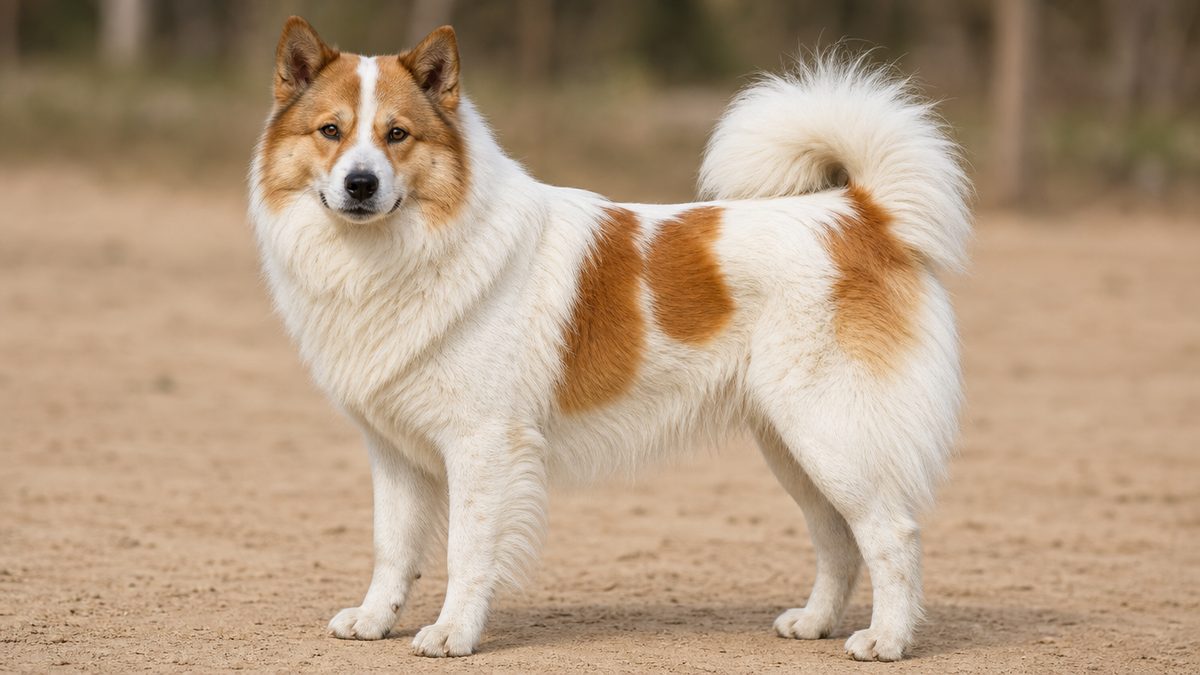
The standard describes a square built, well proportioned dog, never low on legs, with a fairly wide and deep chest, a double coat that forms a ruff around the neck and shoulders, and a pluming tail, more pronounced in males than in females. Length of body to height at the withers is 1 to 1, and the length of leg is slightly greater than the depth of chest.
The temperament clause no other standard in this group carries
FCI 358 reads: alert, intelligent, loyal, watchful and obedient. The breed is easy to train. It could be slightly aloof towards strangers. Set that beside the Shikoku standard's enthusiastic hunter, the Thai Ridgeback's tough and active with excellent jumping ability, and the Taiwan Dog's bold and fearless, and the difference in what an owner is taking on is obvious.
An FCI standard saying outright that a breed is easy to train is rare, and it is the single most useful sentence on this page for an Indian household deciding between these six breeds.
Size, coat and colour
Males stand a minimum of 46 cm and a maximum of 55 cm at the withers, and females 41 to 50 cm, with no weight stated at all. The coat is a double coat with a straight coarse guard coat over a soft dense undercoat, moderately long on the body, longer around the neck and shoulders forming a ruff, with feathering behind the forelegs and long hair to the hocks, and short hair on the head and the fronts of the legs.
Colour is white with well defined patches, in any shade of lemon, red, fawn, tan or grey, with or without blackened hair tips even to the extent of looking tri-coloured, and also white with solid black patches. Symmetrical markings on the head covering the eyes and ears are preferred.
| Attribute | What the standard says |
|---|---|
| Height, male | Minimum 46 cm, maximum 55 cm |
| Height, female | Minimum 41 cm, maximum 50 cm |
| Weight | Not stated |
| Proportion | Length of body to height at withers, 1 to 1 |
| Coat | Double, coarse guard coat over a soft dense undercoat, with a ruff |
| Colour | White with well defined patches; all white is a severe fault |
| Utilization | Companion dog |
| Temperament | Alert, intelligent, loyal, watchful, obedient, easy to train |
Drop ears, a natural stubbed tail, a curled or kinked tail, and a short or smooth coat all disqualify under FCI 358. An all white coat, or white with just some ticking, is a severe fault. That last one catches almost every buyer, because the picture in most people's heads of this breed is a plain white dog.
Origins: an abbot's dog, an extinct wild dog, and a date of 1957
FCI 358 traces the Thai Bangkaew Dog to a cross between a Buddhist abbot's local black and white female dog and a now extinct wild dog, with selective breeding from single litters in 1957 producing the modern generations.
The standard names the place precisely: Bangkaew village, in the Thanang-ngam area of the Bang Rakam district of Phitsanulok province in Thailand. It calls the breed a precious heritage of Phitsanulok province, and records that the dogs are bred widely in the province and have become famous nationwide, so that they are now bred in every part of Thailand.
What the origin story does and does not establish
The abbot-and-wild-dog account is what every English page repeats, and it comes from the standard itself rather than from a study, so it is a record of what the FCI publishes rather than a genetic finding. Bonbeno reports it as the standard's own history and does not treat it as evidence of a wild-dog ancestor.
The genuinely load-bearing date is 1957, when the standard says selective breeding from single litters produced the generations seen today. That makes this a mid-twentieth-century breed formalised from a village population, which is a very different object from the Jomon-era landraces elsewhere in this group.
The genetics, which nobody cites
A 2024 study genotyped about 82 Bangkaew dogs from various Thai localities at 15 microsatellite markers, with mitochondrial D-loop sequencing for maternal inheritance, and reported high genetic diversity with low potential for inbreeding. For a breed founded from single litters within living memory, that is a better result than the origin story would predict.
The same paper makes a quiet observation about how the breed is documented: for the Bangkaew, only traits and pedigree from parental history are recorded. That is why the authors built an optimised ten-locus microsatellite panel for individual identification, reduced from fifteen loci for time and cost efficiency.
A breed identified by parental history alone cannot resolve a disputed pedigree. A validated ten-locus panel can. For an Indian buyer that is the practical difference between a claim and a check, and it is the reason this page leads with the 2024 study rather than with the abbot.
Heat tolerance: a double coat from a province hotter than Chennai
Phitsanulok province peaks at a 32.48 C monthly mean in April, hotter than Chennai's 31.51 C in May, which means this full double coat evolved somewhere hotter than an Indian metro.
NASA POWER, queried at 16.8298 N 100.2654 E, returns a Phitsanulok cell at 85.97 m against a real elevation near 44 m, an annual mean of 27.73 C, an April peak of 32.48 C, a December low of 23.78 C, and annual relative humidity of 67.79 percent. Chennai's cell returns 27.95 C annual, a May peak of 31.51 C, and 72.39 percent humidity.
So the homeland is 0.22 C cooler on the annual mean, 0.97 C hotter in its hottest month, and 4.6 points drier. On temperature alone this is close to a straight swap, which is not something this site can say about most double-coated breeds. The practical reading is that this is a moderately heat-tolerant dog carrying a coat that looks like a warning and is not one, and that it is unavailable in India for supply reasons rather than climate ones. The scarcity is not an Indian artefact either: the Japan Kennel Club's 2025 table of 141 breeds and 302,530 dogs carries the Taiwan Dog at two registrations and returns nothing at all for this breed.
| Place | Cell elevation | Annual mean | Hottest month | Coolest month | Annual humidity |
|---|---|---|---|---|---|
| Phitsanulok, Thailand | 85.97 m | 27.73 C | April, 32.48 C | December, 23.78 C | 67.79 percent |
| Bengaluru | 841.72 m | 23.74 C | April, 28.37 C | December, 20.22 C | 67.94 percent |
| Pune | 635.99 m | 23.86 C | April, 28.93 C | December, 19.62 C | 66.80 percent |
| Delhi | 206.37 m | 25.60 C | June, 35.88 C | January, 13.61 C | 45.56 percent |
| Kolkata | 7.35 m | 25.81 C | May, 31.53 C | January, 17.31 C | 73.93 percent |
| Mumbai | 97.15 m | 26.77 C | May, 31.19 C | January, 23.19 C | 67.39 percent |
| Chennai | 48.95 m | 27.95 C | May, 31.51 C | January, 24.09 C | 72.39 percent |
Why the rating is 3 and not 5
Two things hold it back. The homeland is drier than coastal India, at 67.79 percent against Chennai's 72.39 and Kolkata's 73.93, and a soft dense undercoat in a humid coastal monsoon is a drying problem regardless of the air temperature. And heat-related illness in dogs is overwhelmingly exertional rather than ambient, which no coat protects against.
Hall 2020 in Animals recorded 1,259 heat-related illness events from 1,222 UK dogs, of which 879 carried a recorded trigger, and 652 of those 879, or 74.2 percent, were exertional. The companion paper reports a case fatality of 14.18 percent across 395 confirmed events and 1.42 times the odds for dogs at or above their breed and sex mean bodyweight. This breed was not modelled in either, so no breed-level odds ratio exists for it.
The Indian city that is genuinely harder than home
Delhi. Its June mean of 35.88 C is 3.4 degrees above Phitsanulok's hottest month, and its January mean of 13.61 C is ten degrees below Phitsanulok's coolest. A north Indian year asks this dog to handle a wider range than it evolved with at both ends, which no other city in the table does.
This site normally treats a dense double coat as a warning for India. Here the coat came from a province whose April is hotter than a Chennai May, so the warning does not transfer. What does transfer is the monsoon: a soft dense undercoat that stays damp against the skin is a skin problem in any climate, and coastal India is wetter than the homeland.
Where in India a Thai Bangkaew Dog could actually live
Chennai, Mumbai and Kolkata match this breed's homeland on temperature more closely than any other Indian cities, and Bengaluru and Pune are simply easier versions of it.
Chennai's 27.95 C annual mean against Phitsanulok's 27.73 C is a 0.22 degree difference. Mumbai at 26.77 C and Kolkata at 25.81 C sit slightly below. Bengaluru at 23.74 C and Pune at 23.86 C are four degrees cooler than home and drier, which for a double-coated dog is a straightforward improvement.
The month structure differs in a way worth planning around. Phitsanulok peaks in April and bottoms in December; Chennai peaks in May and bottoms in January; Bengaluru and Pune both peak in April and bottom in December, which is the same shape as the homeland.
The monsoon is the real Indian constraint on this coat
A soft dense undercoat under a coarse guard coat will not air dry at coastal Indian monsoon humidity, and a coat that stays damp against the skin is where hot spots and yeast start. That is a grooming problem rather than a heat problem, and it is the reason this breed rates 4 for grooming load where the short-coated Thai Ridgeback rates 1.
Tick-borne disease, which the ruff makes harder to check
A West Bengal study of 584 client-owned dogs presenting at a Kolkata animal health centre found Babesia gibsoni in 76.54 percent, Anaplasma in 55.75 percent, and two or more concurrent pathogens in 72.9 percent of the 584 dogs screened. A southern Indian study of 120 clinically affected dogs found Babesia in 66.7 percent, peaking pre-monsoon between March and May.
Both are clinic caseloads of dogs already showing signs rather than random population samples, so they describe risk among dogs that get sick. On a breed whose standard requires a ruff around the neck and shoulders, the practical consequence is that a tick check has to be done with fingers on skin rather than by looking.
One Thai finding that transfers directly
A rickettsial survey run in Bangkaew District of Phatthalung province sampled ticks, fleas and chiggers from dogs and rodents and found Rickettsia genes in 29 percent of tick pools and 98 percent of flea pools. That district is not this breed's home province and the study is not about the breed, but it is a useful reminder that a Thai dog comes from a heavy vector environment and is arriving in another one.
Bathe less often than you think and dry more thoroughly than you think. Every bath in a coastal Indian monsoon needs a forced-air dryer or a long session with a stand fan and towels, worked down to the skin through the ruff rather than over the surface.
Thai Bangkaew price in India: no market, and not even a fabricated figure
No verified thai bangkaew price in india exists, and unlike the other East Asian breeds in this group the Indian template farms do not even carry a page for it.
That is a cleaner absence than the usual finding and it is worth showing rather than asserting. Five Indian breed and marketplace sites were probed by URL on 9 September 2026, each with a Labrador Retriever control. The control returned a complete page carrying 28 rupee figures, so the site and the URL pattern were both live.
The Thai Bangkaew path on that same site returns HTTP 200 with the title Dog Breed Not Found and zero rupee figures, exactly as the Ryukyu and Pungsan paths do. A status-code check passes all three. Only reading the returned title reveals that the page does not exist.
What that site does for the breeds it does carry
The same site prints an identical monthly care total of Rs 3,550 to Rs 5,400 for the Shikoku, the Thai Ridgeback and the Taiwan Dog, built from food Rs 2,250 to Rs 3,000, grooming Rs 700 to Rs 1,200 and health Rs 600 to Rs 1,200, while telling readers the three breeds eat about 1,000, 1,500 and 700 calories a day. The three lines sum exactly to the total at both ends.
So the absence of a Bangkaew page is not evidence that the breed is rarer than those three. It is evidence that the template has not been run for it yet, and an Indian buyer who searches next year may well find a fabricated figure where today there is none.
What to check if a price ever appears
- Divide it by 84.38, 80 and 74 and look at the quotients. A round dollar or euro figure means a converted foreign asking price rather than an Indian observation.
- Compare the monthly cost row against two other breeds on the same site. If the three component lines match to the rupee, the row is a preset.
- Read the page title, not the status code, because a soft 404 returns HTTP 200.
- Check whether the photographs show a plain white dog, which the standard treats as a severe fault.
- Ask which register issued the pedigree, and expect an FCI member body, since both Thailand and India are FCI members.
We will not convert a Thai asking price into rupees and present it as an Indian puppy price, and we will not estimate one from a comparable breed. Where no Indian market exists, the honest number is none, and the useful content is the running cost of a dog this size.
The real cost of ownership in India for a medium double-coated dog
Keeping a medium double-coated dog in an Indian metro costs roughly Rs 6,000 to Rs 11,000 a month, and grooming is a real line on this breed rather than a token one.
That grooming difference is the whole reason this budget runs above the Thai Ridgeback's. A short smooth coat needs a rubber mitt; a coarse guard coat over a soft dense undercoat with a ruff needs proper bathing and drying, and in an Indian monsoon it needs it done well.
The lines you can price
- Parasite control at Rs 1,103 a month, from NexGard Spectra for 15 to 30 kg dogs at Rs 3,308 for three tablets, covering ticks, fleas, roundworm and hookworm together.
- Vaccination at Rs 699 for anti-rabies and Rs 899 for the 9-in-1, or an annual booster course from Rs 3,199.
- Grooming from Rs 934 for a bath and from Rs 1,869 for a complete bath and styling at a Delhi clinic chain, against a wider published Indian range of Rs 300 to Rs 2,000 Voice of Stray Dogs.
- Consultation at Rs 500 to Rs 1,000 a visit, and boarding at Rs 500 to Rs 2,000 a day.
- Municipal registration at Rs 500 in Delhi or Rs 50 in Chennai, which is a yearly line.
The spread on one identical vaccine
The same 9-in-1 vaccine costs Rs 600 at a Goa government veterinary hospital, from Rs 899 at a Vetic clinic, and from Rs 1,999 through a vet-at-home service that also charges a Rs 699 visit fee. A 3.3 times spread on one drug is a function of delivery model rather than of the medicine, and Chennai residents can do better still: Greater Chennai Corporation runs six pet clinics giving treatment and anti-rabies vaccination free of cost.
| Line | Low | High | Note |
|---|---|---|---|
| Food | Rs 2,800 | Rs 5,000 | For a lean, active medium dog |
| Parasite control | Rs 1,103 | Rs 1,103 | NexGard Spectra 15 to 30 kg, monthly |
| Vaccination, spread | Rs 150 | Rs 320 | Annual booster divided by twelve |
| Vet consultations | Rs 250 | Rs 1,000 | Two to twelve visits a year |
| Grooming | Rs 700 | Rs 2,000 | A ruff and an undercoat in a monsoon country |
| Contingency | Rs 1,200 | Rs 1,200 | The line that stops a Rs 20,000 bill becoming a crisis |
| Total | Rs 6,203 | Rs 10,623 | Before boarding or a cooling bill |
A forced-air pet dryer costs less than a year of professional baths and is the single most useful thing an Indian owner of a dense-coated dog can buy. The alternative is a coat that never dries to the skin between June and September, which is how skin problems start.
Temperament: watchful, obedient, and slightly aloof with strangers
FCI 358 describes the Thai Bangkaew Dog as alert, intelligent, loyal, watchful and obedient, says the breed is easy to train, and adds that it could be slightly aloof towards strangers.
That is the entire temperament clause and it is unusually favourable. Every other breed in this East Asian group is described in terms of drive, endurance or fearlessness. This one is described in terms of biddability, and it is filed as a companion dog rather than a hunting dog.
The aloofness qualifier is the part to plan around. A watchful dog that is reserved with strangers will announce visitors and will need managed introductions, which in an Indian apartment block with shared corridors and frequent deliveries is a daily rather than an occasional issue.
Who this breed suits
- Owners who want a spitz look with a trainable temperament rather than a hunting drive.
- Owners in Bengaluru, Pune or a coastal city who can commit to real coat care through the monsoon.
- Owners who want a watchful dog in the house and will manage introductions rather than avoiding them.
- Owners with 45 to 60 minutes a day for exercise rather than the 90 the hunting breeds in this group need.
- Owners who will socialise a puppy through the eight to sixteen week window and keep going.
Who should look elsewhere
- Anyone unwilling to dry a dense coat to the skin after every monsoon bath.
- Anyone wanting a dog that greets every visitor warmly, which an aloof watch breed does not.
- Anyone in a small flat who cannot absorb two heavy seasonal sheds a year.
- Anyone expecting the plain white dog of the photographs, since an all white coat is a severe fault.
- Anyone in India hoping to buy one, because no lawful supply exists.
The standard disqualifies an aggressive or overly shy dog outright, which is the usual FCI formula, and does not list shyness separately as an ordinary fault the way the Shikoku and Taiwan Dog standards do. On a breed described as obedient and easy to train, that is consistent.
On paper this is the most household-compatible breed in this group of six: a companion classification, a standard that says easy to train, and a homeland hotter than Chennai. The costs are the coat and the complete absence of any lawful route to owning one in India.
Training the one breed in this group its own standard calls easy
To train a Thai Bangkaew Dog, take the standard at its word and build a normal obedience foundation, because this is not the independent hunting landrace the rest of this group is.
FCI 358 states that the breed is easy to train and describes it as obedient. That is a materially different starting point from a Shikoku, whose standard calls it an enthusiastic hunter docile towards his master, or a Taiwan Dog, whose standard calls it bold and fearless.
It does not mean the dog is a Labrador. Watchfulness and aloofness with strangers are the two traits that need work, and both are handled by socialisation and management rather than by obedience drills.
The five things worth teaching first
- Name response, paid every time for the first six months, which is the foundation everything else sits on.
- Mat settling, which is what makes a watchful breed liveable when the doorbell goes in an Indian flat.
- A hand-target, which moves the dog past a stranger without a collar grab.
- Loose-lead walking on a Y-front harness, taught before the puppy reaches 12 kg.
- Handling and grooming tolerance, taught from week nine, because this coat will be brushed and dried for the next fourteen years.
That last item is on the list because of the coat rather than the temperament. A dog that has been handled, brushed and dried since puppyhood will tolerate a forced-air dryer; a dog first introduced to one at three years old often will not.
Socialisation, in an Indian city
A puppy that will live in Chennai or Bengaluru has to meet autorickshaw noise, temple loudspeakers, delivery riders, cattle, cyclists and free-ranging dogs before sixteen weeks, at a distance it can cope with. On a breed the standard describes as slightly aloof towards strangers, that window decides whether the adult can share a building.
Compulsion is unnecessary here in a way it is not with the hunting breeds beside it. A standard that says easy to train is describing a dog that will work for food and clarity, and reaching for corrections on such a dog is choosing the harder route.
Expect name response and a hand-target inside two weeks. Expect mat settling in four to six. Expect loose-lead walking in six to ten weeks. Expect a workable recall in a fenced area within a few months, which is more than this site can promise for any other breed in this group.
Exercise: 45 to 60 minutes, which is less than the rest of this group
A Thai Bangkaew Dog needs 45 to 60 minutes of real daily exercise, materially less than the hunting breeds beside it, because its standard classifies it as a companion.
FCI 358 asks for flexible and strong movement with good reach and drive, but never with exaggerated reach, drive and speed, keeping a level topline and a proud carriage of head and tail. That is a description of a sound moving dog rather than a stamina athlete, and the utilization line says companion dog.
Set against a Shikoku's noteworthy endurance or a Thai Ridgeback's reachy stride, this is the breed in the group that fits an ordinary Indian working day. It still needs daily work, and an under-exercised watchful dog in a flat becomes a barking one.
What 45 to 60 minutes should contain
- Thirty to forty minutes of walking at the dog's pace rather than yours, in the cool ends of the day.
- Ten minutes of scent work or food puzzles, which tires a watchful dog and can be done indoors in April.
- Structured play with rules, so that arousal has an off switch.
- Free running inside a secure boundary, which for a non-jumping companion breed is a lower bar than for the hunting breeds in this group.
- A rest on a cool floor afterwards, because recovery matters most on a dog carrying an undercoat.
Why the exertional risk still applies
Hall 2020 in Animals found that 652 of the 879 heat-related illness events with a recorded trigger were exertional, that is 74.2 percent, and the companion paper puts case fatality at 14.18 percent across 395 confirmed events with 1.42 times the odds for dogs at or above their breed and sex mean bodyweight. A homeland hotter than Chennai does not exempt a dog from the mechanism that actually causes heat illness.
Thai data gives a useful body-condition benchmark. A study of 340 Thai and mongrel dogs put average body fat at 27.52 percent overall and 24.83 percent in the Thai Bangkaew, the lowest of the breeds measured, and found body fat rising from about five years of age.
Stop if the tongue widens and flattens, if the dog seeks shade unprompted, if the pant does not settle within a minute of standing still, or if the stride shortens. Wet the belly, groin and paws rather than the back, offer water, and get to a veterinarian the same day if the dog does not normalise within ten minutes.
Grooming a ruff and an undercoat in Indian humidity
The Thai Bangkaew Dog needs weekly line-brushing, daily work through two annual sheds, and thorough drying to the skin after every bath, which is the hardest care job in this group of six breeds.
FCI 358 specifies a double coat with a straight coarse guard coat and a soft dense undercoat, moderately long on the body, longer around the neck and shoulders forming a ruff more pronounced in males, with feathering behind the forelegs and long hair to the hocks behind, and short hair on the head and the fronts of the legs. The standard adds that the coat must never be so exaggerated as to obscure the body shape.
The weekly routine
- Line-brush weekly with an undercoat rake and a slicker, in sections down to the skin, concentrating on the ruff and the feathering where the coat packs first.
- Brush daily through each seasonal shed, and expect a great deal of undercoat.
- Bathe every six to eight weeks at most, because more often strips the coat of its oils.
- Dry to the skin every single time, with a forced-air dryer or a stand fan and towels, and plug the ears before the water goes on.
- Check between the toes, under the tail and through the ruff weekly for ticks, with fingers rather than by looking.
Never clip this coat for the Indian summer
A double coat insulates in both directions. The undercoat traps air and the coarse guard coat blocks direct sun on the skin. Clipping removes the sun barrier and exposes skin that has never met Indian ultraviolet, and it does not make the dog cooler. Removing dead undercoat by brushing is what makes a dog cooler, and it takes fifteen minutes.
A short or smooth coat is a disqualifying fault in this breed, which is the standard's own way of saying that the coat is not optional to the animal.
Ticks, and why the ruff makes them harder
Against Indian clinic data showing Babesia gibsoni in 76.54 percent of 584 dogs screened at a Kolkata centre and two or more concurrent pathogens in 72.9 percent of them, a weekly hands-on sweep matters more on this coat than on any other in this group. Combine it with monthly NexGard Spectra at Rs 1,103 for a 15 to 30 kg dog.
Rake the ruff, the trousers and the tail, which is where undercoat packs first, then run both hands over the whole dog against the lie of the coat checking ears, throat, armpits, groin and between the toes. Ten minutes a week is the difference between a healthy coat in Chennai and a matted one.
Health: three studies, one of them about a different place entirely
The Thai Bangkaew Dog has three published studies naming it, no screening scheme, and no measured lifespan, and a fourth search hit belongs to a district that shares the breed's name.
That last point is the reason to read records rather than count them. A PubMed title and abstract search for Bangkaew returns four records. Three are about the breed. The fourth is a survey of Rickettsia and Orientia tsutsugamushi in ticks, fleas and chiggers in Bangkaew District, Phatthalung Province, which is a place in southern Thailand and not this breed's home province.
The breed's own FCI name finds nothing at all. A search for Thai Bangkaew Dog returns zero records, while Thai Bangkaew returns two and Bangkaew returns four. That is the second breed in this batch whose official name is the one that fails, after the Thai Ridgeback Dog.
What the three on-breed studies establish
- Genetic diversity is high and inbreeding potential low, from about 82 dogs genotyped at 15 microsatellite markers with mtDNA D-loop analysis, in a study that also built an optimised 10-locus identification panel.
- Average body fat is 24.83 percent, the lowest of the breeds measured in a study of 340 Thai and mongrel dogs, against 27.52 percent overall, with body fat rising from about five years of age.
- Breed-specific normal electroretinography values exist, and the Thai Bangkaew had the longest implicit times of the four breeds tested on four separate measures.
- Nothing else. No prevalence survey, no case report, no screening scheme and no genetic disease panel for the breed.
Why the eye study is the most clinically useful of the three
The electroretinography paper established normal values for the poodle, the Labrador retriever, the Thai ridgeback and the Thai Bangkaew, and found significant differences between the four breeds on nearly every measure. Its own conclusion is that breed-specific limits of normality are necessary for individual clinics and laboratories.
For an Indian owner that is an actionable fact. If a veterinary ophthalmologist assesses a Thai Bangkaew against a generic canine reference range, the breed's naturally longer implicit times could read as abnormal when they are not.
The absences, stated plainly
- No published life expectancy. McMillan 2024's Table S5 lists 345 breeds and this one appears in none of them, not even with an exclusion flag.
- No published hip or elbow screening statistics for the breed.
- No breed-club health survey in English.
- No genetic test panel for breed-specific mutations, only the identification panel.
- No weight in the breed standard, which makes body condition scoring the only feeding target.
For scale rather than substitution, McMillan's nearest measured spitz is the Japanese Spitz at a median 13.0 years on 117 deaths with a hazard ratio of 0.86 and p = 0.10, and the Shiba Inu at 14.6 years on 91 deaths. Neither figure belongs to this breed.
Ask for the sire's and dam's hip scores with the scheme named, an ophthalmologist's certificate dated within the last year, and whether the litter has been genotyped on the published ten-locus panel. On a breed with three papers and no screening scheme, those three answers are the whole health picture available to you.
Feeding a medium double-coated dog in India
Feed a Thai Bangkaew Dog to a visible waist and easily felt ribs, because the breed standard gives no weight at all and body condition is the only honest target.
FCI 358 states a height range and no weight, which means a 46 cm female and a 55 cm male have nothing but a body condition score between them. That is not a defect in the standard; it is the reason this section leads with condition rather than with grams.
Thai data gives the benchmark. A study of 340 Thai and mongrel dogs measured by bioelectrical impedance put average body fat at 27.52 percent overall and 24.83 percent in the Thai Bangkaew, the lowest of the breeds measured, with a regression of body fat on body condition score of y = 0.84 + 8.36x and an R squared of 0.7219. Body fat rose from about five years of age.
Portion and life stage
- Puppies to four months, four meals a day on an all-breed growth food with controlled calcium.
- Four to eight months, three meals, watching that growth stays steady rather than fast.
- Eight months onward, two meals a day, timed around the cool ends of the day.
- Adults, roughly 250 to 380 g of a good dry food a day depending on size, adjusted weekly by feel rather than by the bag.
- From five years, re-weigh monthly and cut the portion before the waist disappears, because that is when the Thai data shows body fat climbing.
Why body condition matters more on a coated dog in India
Hall 2020 in Scientific Reports found that dogs at or above their breed and sex mean bodyweight carried 1.42 times the odds of a heat-related illness event, with a confidence interval of 1.12 to 1.80. On a dog carrying an undercoat and a ruff through an Indian April, that is the one modifiable risk factor with a published number behind it.
A coated dog also hides weight gain. On a short-coated breed an owner sees the waist go; on this one the ruff and the body coat conceal a kilogram or two, which is exactly why the monthly weighing habit matters more here.
Indian availability
Everything a medium active dog needs is stocked in every Indian metro, and the practical decision is price and consistency rather than formulation. Budget Rs 2,800 to Rs 5,000 a month for food, change brands over a week rather than overnight, and move the main meal to after the evening walk in the hot months.
Weigh the dog at your veterinary clinic every three months and write the number down. Indian clinics will do it free. On a breed whose standard states no weight, that written series is the only benchmark the animal will ever have, and it is what tells you the coat is hiding a gain.
The first year, month by month
A Thai Bangkaew puppy's first year runs from grooming conditioning in week nine to a second fear period around eight months and full coat and physical maturity near eighteen months.
- Weeks 8 to 10. Home, crate, name response, and the first grooming sessions, which on this coat start before the coat needs them. Indian law prohibits the sale of pups under eight weeks, so a younger puppy is a red flag about the seller.
- Weeks 10 to 16. The socialisation window. Traffic, lifts, autorickshaws, delivery riders, cattle, cyclists and other dogs at a distance the puppy can cope with, which matters on a breed described as slightly aloof towards strangers.
- Months 4 to 5. Adult teeth arrive and chewing peaks. Loose-lead walking is taught now, and the dryer is introduced as a normal weekly event rather than an emergency.
- Months 5 to 6. The puppy coat begins to be replaced. Line-brushing becomes a real weekly job rather than a token one.
- Months 6 to 8. A second fear period is common. Repeat easy versions of things the dog already knows rather than adding pressure.
- Months 8 to 12. The adult double coat comes in with the first proper shed, and the ruff begins to show, more in a male than a female.
- Months 12 to 18. Physical and coat maturity complete. Hold off repetitive high-impact work until your veterinarian confirms the growth plates have closed.
The Indian calendar for this breed
A puppy that turns four months old in April in Chennai spends its most important learning weeks in the hottest part of the year, and a puppy that turns four months in November gets four cool months to work with. The homeland peaks in April too, so the seasonal shape is familiar to the breed even if the humidity is not.
The monsoon has its own job on this coat. The socialisation walks still have to happen, and a wet double-coated puppy has to be dried to the skin every time or the skin problems start in the first year rather than the fifth.
The eight to sixteen week socialisation window, and grooming tolerance. A dog that has been brushed and dried since week nine will accept a forced-air dryer for life; a dog first introduced to one at three years old often will not, and on this coat in this climate that becomes a health problem rather than an inconvenience.
Indian import law, and what the 2017 Rules would require
Indian law permits you to bring in a Thai Bangkaew Dog as your own accompanying pet and rejects any application to import one to breed or to sell.
DGFT Trade Notice 22/2022-23 of 19 December 2022 places dogs under ITC (HS) 01061900 as a Restricted import. Three routes are permitted and the notice names them: a pet accompanying an owner with a valid pet book in the importer's name, research use with a CPCSEA recommendation, and Defence or Police use. Applications for trading or breeding purposes shall be duly rejected.
There is no import licence a would-be Indian breeder can apply for that changes this. Recognition does not help either: both Thailand and India sit on the FCI's member list, so an FCI pedigree issued in Thailand is administratively recognisable in India, and the import route is still closed for trade.
If you are moving to India with your own dog
- Confirm the dog enters under the personal pet route rather than the commercial one, because the two run on different instruments.
- Carry the pet book in the importer's own name, which is the document the trade notice specifically requires.
- Plan a coastal arrival outside the monsoon if you can, because the first months are when a dense coat and an unfamiliar humidity meet.
- Register the dog with your municipality on arrival, at Rs 500 in Delhi or Rs 50 in Chennai Greater Chennai Corporation.
- Take a printed copy of FCI 358 to the first veterinary appointment, because no Indian practice will have seen the breed and the standard states no weight.
What the 2017 Rules would require of a breeder
The Prevention of Cruelty to Animals (Dog Breeding and Marketing) Rules 2017 bind anyone breeding or selling dogs in India. Second Schedule Part III paragraph 8(10) requires that breeding dogs have been tested for named genetic defects, including hip dysplasia, progressive retinal atrophy and two or more missing teeth. That last item matters here, because the standard makes missing more than three teeth a severe fault.
One clause bites this coat directly. Second Schedule Part IV paragraph 21(1) bars keeping a dog in outdoor housing without the attending veterinary practitioner's written approval where the breed cannot tolerate local temperatures, naming long-haired breeds in high temperature locations. A ruffed double-coated spitz in an Indian yard is the case that clause describes, even though this particular coat came from a hot country.
The 2017 Rules run 1 to 13 and there is no Rule 14. Everything numbered above 13 is a Second Schedule paragraph, so a page citing the outdoor-housing heat clause as Rule 21 is citing something that does not exist. The string Rule 21 appears zero times in the gazette.
Thai Bangkaew against the breeds an Indian buyer would cross-shop
Against the other five East Asian breeds in this group the Thai Bangkaew has the most household-friendly standard and the heaviest coat, and against an Indian spitz it loses only on availability.
| Breed | Standard's utilization | Coat | Heat tolerance | Available in India |
|---|---|---|---|---|
| Thai Bangkaew Dog | Companion dog | Double, with a ruff | 3 of 5 | No |
| Thai Ridgeback | Hunting and companion dog | Short and smooth | 4 of 5 | No |
| Taiwan Dog | Hunting, watch and companion dog | Short and hard, 1.5 to 3 cm | 3 of 5 | No |
| Shikoku | Hunting dog, companion | Harsh outer, dense undercoat | 2 of 5 | No |
| Ryukyu | Boar hunting, no standard | Double but not dense | 5 of 5 | No |
| Japanese Spitz | Companion | Profuse white double coat | 2 of 5 | Yes |
| Indian Spitz | Companion | Double | 4 of 5 | Yes, widely |
Against the Thai Ridgeback
Thailand's two FCI breeds are opposites. The Ridgeback is a short-coated hunting breed from the humid east coast with a standard that names jumping ability; this is a double-coated companion breed from the drier north-central plain with a standard that says easy to train. For an Indian flat the Bangkaew is the easier temperament and the harder coat.
The two were studied together in both Thai papers this page relies on, which is unusual and useful: the same body-fat study measured 24.83 percent in the Bangkaew against 26.42 percent in the Ridgeback, and the same eye study established normal values for both.
Against the Japanese Spitz
This is the comparison that matters most in India, because the Japanese Spitz is available here and looks superficially similar. The differences are colour and size: this breed is white with well defined patches and an all white coat is a severe fault, where the Japanese Spitz is white. McMillan measured the Japanese Spitz at a median 13.0 years on 117 deaths; this breed has no measured lifespan at all McMillan KM, Bielby J, Williams CL.
Against an Indian spitz
The honest comparison for an Indian buyer is the Indian Spitz. It is a double-coated spitz India already keeps in numbers, familiar to every Indian veterinarian, available without an import route, and rated higher for heat tolerance. What it does not have is an FCI standard, which is the only thing the Thai Bangkaew offers that it does not.
If the appeal is a trainable, watchful, medium double-coated spitz, India already has one and it costs nothing to source. If the appeal is specifically a Thai breed with an FCI pedigree, the only lawful route into India is bringing your own dog with you.
Six mistakes buyers make about this breed
The six recurring mistakes are expecting a plain white dog, reading the double coat as a cold-climate trait, searching the breed's own FCI name, counting search hits without opening them, clipping the coat for the Indian summer, and treating an absent Indian page as an absent breed.
- Expecting a plain white dog. FCI 358 requires white with well defined patches and makes an all white coat, or white with just some ticking, a severe fault.
- Reading the double coat as cold adaptation. The breed's home province peaks at 32.48 C in April, which is hotter than Chennai's hottest month at 31.51 C.
- Searching the breed's own FCI name. Thai Bangkaew Dog returns zero PubMed records while Thai Bangkaew returns two and Bangkaew returns four.
- Counting search hits without opening them. One of those four Bangkaew records is a rickettsial survey in a district of the same name in a different Thai province.
- Clipping the coat for an Indian summer. A short or smooth coat is a disqualifying fault in this breed, which is the standard's own way of saying the coat is not optional to the animal.
- Treating the absence of an Indian page as proof of rarity. The Indian template sites manufacture prices for three other East Asian breeds and simply have not run the template for this one yet.
A seventh mistake, made by the tools
Queries containing the token Thai were substituted outright on Bing India in this session, returning Thai Airways, Thai cuisine and Thai restaurants in Ranchi for a different Thai breed, while the Labrador control returned ten genuine Indian Labrador price pages. Nothing about the Indian market for a Thai breed can be read off such a result set, in either direction, and this page draws no conclusion from it.
The same discipline applies to any rupee figure quoted by an AI answer. Trace it to a page, then confirm the number appears in that page's own markup, because this site has documented answer engines converting foreign asking prices into rupees in the same breath as saying no Indian price exists.
Paying a premium for a white spitz described as a Thai Bangkaew. With no Indian register and no lawful breeding import route, and with a plain white coat being a severe fault under the standard, an all-white Indian dog offered as this breed is either mismarked or something else entirely.
Adoption, and what to do instead of waiting for a Thai Bangkaew
No Thai Bangkaew Dog is available to adopt in India, and the useful answer names what an Indian adopter can actually get that meets the same want.
Rescue works on supply. A breed with no Indian population produces no Indian rescues, and no Indian shelter network lists the Thai Bangkaew Dog. That follows from a breed with no lawful breeding import route and no Indian register.
What an Indian adopter can get that meets the same want
- An Indian Spitz, if the appeal is a trainable double-coated spitz. Widely available, familiar to every Indian veterinarian, and no import route needed.
- A Japanese Spitz, if the appeal is specifically a white double-coated companion spitz with a measured lifespan behind it.
- An Indian Pariah Dog, if the appeal is a medium alert dog that handles Indian heat, free to adopt in every metro.
- A Rajapalayam, if the appeal is a large white Indian dog with a guarding presence, sourced regionally.
- A rescue spitz cross, which Indian shelters carry in numbers and which will suit a first-time owner better than any import.
How to verify any dog offered to you as a Thai Bangkaew
- Ask which register issued the pedigree, and expect an FCI member body, since both Thailand and India are members.
- Check the four disqualifying faults first: drop ears, a natural stubbed tail, a curled or kinked tail, and a short or smooth coat.
- Check the colour. White with well defined patches is required and an all white coat is a severe fault.
- Check the outline. The body is square, at length to height of 1 to 1, with the length of leg slightly greater than the depth of chest.
- Ask whether the dog has been genotyped on the published ten-locus microsatellite panel, which is the only objective identification tool that exists for this breed.
If you are importing your own dog
The personal pet route is lawful and is the only one that is. Bring the pet book in your own name, register with your municipality on arrival at Rs 500 in Delhi or Rs 50 in Chennai, and budget for a forced-air dryer before you budget for anything else Greater Chennai Corporation.
We report published price ranges as editorial content. We do not broker sales, recommend breeders, accept payment for placement, or link puppy listings, and we will not publish an Indian price for a breed with no Indian market. Where adoption is the honest answer, we say so and name what is actually available.
Thai Bangkaew Dog questions Indian buyers actually ask
What is the Thai Bangkaew price in India?
No verified thai bangkaew price in india exists. No Indian breeder, kennel-club register, rescue or listing carries the breed, and the Indian template sites that manufacture a price for the Shikoku, the Thai Ridgeback and the Taiwan Dog return an HTTP 200 page titled Dog Breed Not Found for this one, on a Labrador control that returns a complete page with 28 rupee figures.
Is the Thai Bangkaew Dog recognised by the FCI?
Yes, definitively. The FCI accepted the Thai Bangkaew Dog on a provisional basis on 14 April 2011 and on a definitive basis on 21 June 2022, as standard 358 in Group 5 Spitz and primitive types, Section 5 Asian Spitz and related breeds, with English as the authentic language and no working trial required.
Where does the Thai Bangkaew Dog come from?
From Bangkaew village in the Thanang-ngam area of Bang Rakam district, Phitsanulok province in Thailand. The standard's own history traces the breed to a cross between a Buddhist abbot's local black and white female dog and a now extinct wild dog, and records that selective breeding from single litters in 1957 produced the generations seen today.
Can a Thai Bangkaew Dog handle Indian heat?
Better than its coat suggests, and the homeland climate is why. Phitsanulok province runs an annual mean of 27.73 C and peaks at 32.48 C in April, which is hotter than Chennai's hottest month at 31.51 C. This is a full double coat with a ruff that evolved somewhere hotter than an Indian metro, so the usual double-coat warning does not transfer cleanly.
How much grooming does a Thai Bangkaew Dog need?
Real weekly work, and more in an Indian monsoon. FCI 358 specifies a straight coarse guard coat over a soft dense undercoat, moderately long on the body and longer around the neck and shoulders where it forms a ruff, with feathering behind the forelegs and long hair to the hocks. The Indian problem is drying to the skin rather than brushing.
Are all Thai Bangkaew Dogs white?
No, and an all white dog is a severe fault. The standard requires white with well defined patches, in any shade of lemon, red, fawn, tan or grey, with or without blackened hair tips, and lists an all white coat or white with just some ticking among its severe faults. Symmetrical head markings covering the eyes and ears are preferred.
Is the Thai Bangkaew Dog easy to train?
Its own standard says so, which is unusual. FCI 358 describes the breed as alert, intelligent, loyal, watchful and obedient, states that the breed is easy to train, and adds that it could be slightly aloof towards strangers. No other standard in this group of East Asian breeds uses the words obedient or easy to train.
How big does a Thai Bangkaew Dog get?
FCI 358 gives males a minimum of 46 cm and a maximum of 55 cm at the withers, and females 41 to 50 cm, with no weight stated at all. The body is square, with length of body to height at the withers at exactly 1 to 1, and the length of leg slightly greater than the depth of chest.
Is the Thai Bangkaew Dog inbred?
The published evidence says no. A 2024 study genotyped about 82 Bangkaew dogs from various Thai localities at 15 microsatellite markers with mitochondrial D-loop analysis, and reported high genetic diversity with low potential for inbreeding, while developing an optimised 10-locus panel for individual identification.
How long does a Thai Bangkaew Dog live?
No figure exists and none should be quoted. McMillan 2024, the largest UK longevity study, lists 345 breeds in its Table S5 and this breed appears in none of them, not even with an exclusion flag, unlike the Thai Ridgeback Dog, the Taiwan Dog, the Shikoku, the Hokkaido, the Kishu and the Korean Jindo, all of which are listed and flagged N.
Can I import a Thai Bangkaew Dog into India?
Only as your own accompanying pet. DGFT Trade Notice 22/2022-23 places dogs under ITC (HS) 01061900 as a Restricted import, permits entry for a pet with a valid pet book in the importer's name, for research with a CPCSEA recommendation, or for Defence and Police use, and states that applications for trading or breeding purposes shall be duly rejected.
What does a Thai Bangkaew Dog cost to keep in India each month?
Budget Rs 6,000 to Rs 11,000 a month for a medium double-coated dog. That covers food, Rs 1,103 a month for NexGard Spectra at the 15 to 30 kg dose, an annual booster from Rs 3,199 spread across the year, Rs 500 to Rs 1,000 a consultation, and grooming, which on this coat is a real line rather than a token one.
Why does searching the breed's full name find nothing?
Because the breed's own FCI name is the one that returns zero. A PubMed title and abstract search for Thai Bangkaew Dog returns no records, while Thai Bangkaew returns two and Bangkaew alone returns four, one of which is a rickettsial survey in a district of the same name in a different Thai province entirely.
How much does a Thai Bangkaew Dog cost?
No verified purchase price exists for India. No Indian breeder, kennel-club register, rescue or listing carries the breed, and the Indian template sites that manufacture a price for the Shikoku, the Thai Ridgeback and the Taiwan Dog return a Dog Breed Not Found page for this one. The only cost this page can verify is upkeep: budget Rs 6,000 to Rs 11,000 a month in India for a medium double-coated dog, covering food, parasite prevention, boosters, consultations and grooming.
Are bangkaew dogs intelligent?
Its own breed standard says so. FCI 358 describes the Thai Bangkaew Dog as alert, intelligent, loyal, watchful and obedient, states that the breed is easy to train, and adds that it could be slightly aloof towards strangers. No other standard in this group of East Asian breeds uses the words obedient or easy to train, so the wording is unusual and worth some weight.
Compare with similar breeds
Thai Bangkaew Dog sits in 1 Bonbeno group. Each one compares it directly against the breeds it is genuinely an alternative to, on the same figures.