
Indian breed profile
Haofa Dog (Tangkhul Hui): The Manipur Breed, Measured
Manipur's Tangkhul hound, the one Indian breed with a real published characterisation study behind it. Here is what the study measured, what it did not, and where the tradition it records now meets Indian law.
Quick answer
The haofa dog, also called the Tangkhul Hui, is a medium-sized indigenous hunting and guarding hound of Manipur, reared by the Tangkhul community in the Ukhrul and Kamjong districts. A 2024 Central Agricultural University study measured 100 adult Haofa at 58 to 61 cm at the wither and 22 to 31 kg, with an average litter of 5.79 puppies. It is not registered by ICAR-NBAGR, the FCI or the Kennel Club of India, and its population is estimated near 1,000.
This guide is general information for Indian dog owners and is not a diagnosis. Consult your nearby vet, a registered veterinarian, before acting on anything you read here, and treat any sudden collapse, breathing difficulty or refusal to eat as urgent.
Haofa trait ratings for Indian conditions
What the Haofa dog is
The Haofa dog is a medium-sized indigenous hunting and guarding hound of Manipur, reared since time immemorial by the Tangkhul community living in the Ukhrul and Kamjong districts of the state. It is the one Indian dog breed with a proper published characterisation study behind it, and almost everything on this page comes from that study rather than from the pages currently ranking for its name.
In April 2024 the Indian Journal of Animal Sciences published "Haofa dog - An indigenous canine germplasm from Manipur, India", by a team from the College of Agriculture, Central Agricultural University, Imphal, working with the Department of Veterinary and Animal Husbandry, Government of Manipur, and the ICAR North Eastern Hill Region Manipur Centre. The team recorded physical and morphometric characters on 100 adult Haofa, 50 male and 50 female, took 69 separate body-weight observations, and interviewed 100 Haofa owners using the ICAR-NBAGR questionnaire for phenotypic characterisation of indigenous livestock, modified for a dog. That is a real sample, collected in the breeding tract, by named scientists, and it settles several questions the internet has been guessing at.
Its conclusion is unambiguous. The Haofa is "morphologically different from the other exotic breeds, crossbreeds or local dogs found in the state. Hence, it deserves to be recognized as a distinct breed of dog";.
The names, and why the dog does not own its own
Haofa and Tangkhul Hui are the same dog, and Haofa is the name to lead with. Wikipedia's list of dog breeds from India carries the animal as a single entry, "Haofa Tangkhul Hui", described as a hunting dog used by the Tangkhul people. Hui is simply the word for dog in Meitei, the majority language of the Manipur valley, so Tangkhul Hui reads as the Tangkhuls' dog rather than as a formal breed title. Local usage adds Hao-Fa and Tangkhul Hui Haofa, and the annual village festival is called the Haofa Phanit.
The naming split is not cosmetic. Google's own autocomplete, pulled for India, shows that the string "haofa" is dominated by an unrelated watch brand, with "is haofa a good watch brand" and "is haofa tourbillon real" as the returned suggestions, while "why is haofa" resolves entirely to queries about Haifa, the Israeli city. Question-form searching therefore lands on "tangkhul hui", and buying-intent searching lands on "haofa dog price". A reader who finds only one of the two names sees only half the material that exists.
| Attribute | Detail | Source |
|---|---|---|
| Type | Indigenous hunting and guarding hound, now mainly a pet and guard dog | IJAnS 2024 |
| Breeding tract | Ukhrul (25.0954N, 94.3617E) and Kamjong (24.8570N, 94.5135E) districts, Manipur | IJAnS 2024 |
| Named villages | Ukhrul, Phungcham, Tolloi, Tuinem, Nunghar, Kasom Khullen, Phungyar, Kamjong | IJAnS 2024 |
| Kept by | The Tangkhul community, who treat the dog as a family member | IJAnS 2024 |
| Also called | Tangkhul Hui, Hao-Fa, Tangkhul Hui Haofa | Wikipedia, The Ukhrulian U-News Mag, Haofa Phanit |
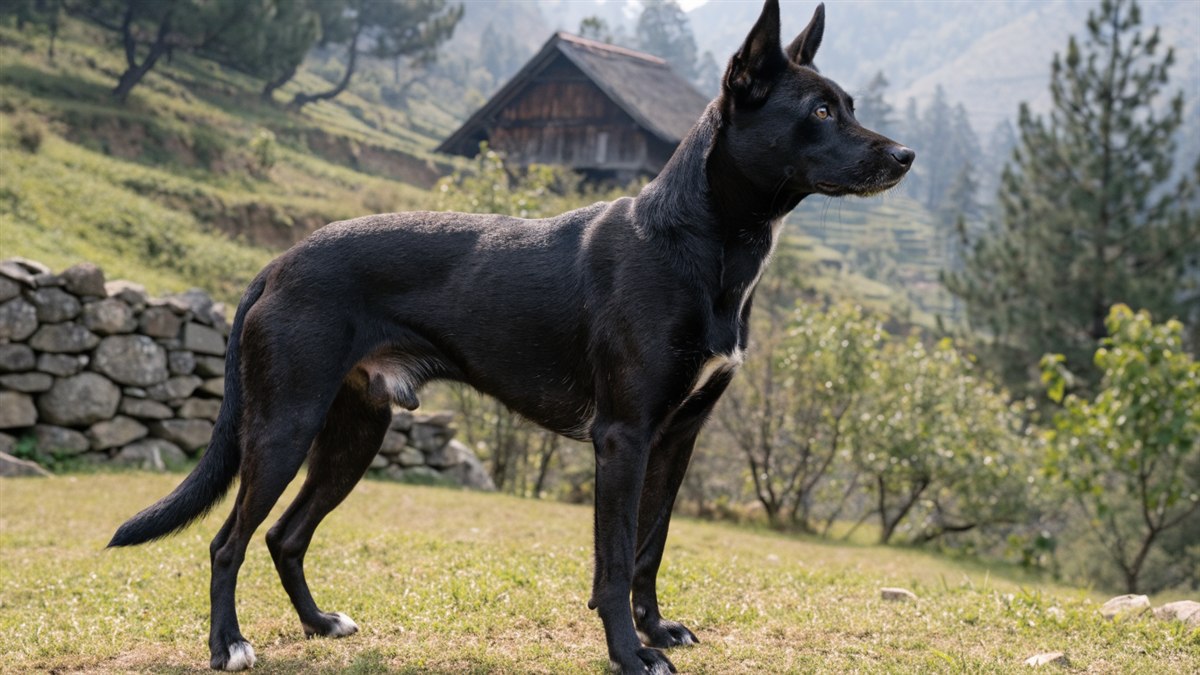
| Coat | Short coat, black with grey skin, sometimes a white strip on the ventral area and white tips to the legs | IJAnS 2024 |
| Height at wither | Male mean 61.24 cm (range 56-65), female mean 58.36 cm (range 54-65), n=50 each | IJAnS 2024 |
| Adult body weight | Male mean 25.13 kg (range 23-31, n=35), female mean 23.84 kg (range 22-29, n=34) | IJAnS 2024 |
| Litter size | Mean 5.79, range 3 to 8, n=101 records | IJAnS 2024 |
| Lifespan | Not published. No study has measured it | See the health section |
| Registered by ICAR-NBAGR | No. Application filed July 2022, still not on the register | NBAGR U-News Mag, Haofa Phanit |
| Recognised by the FCI | No | FCI nomenclature |
| Estimated population | Around 1,000, of which roughly 150 in Phungcham village | PHLA via The Ukhrulian |
What the study actually measured, and what it did not
The paper recorded 23 morphometric characters and seven reproductive parameters, all as a mean plus or minus a standard error with a range and a sample size. It contains no percentage anywhere. That matters, because a reader arriving from a breed page full of confident percentages should know that the one measured source on this dog does not deal in them. Where the paper describes a practice as usual or as affecting the majority, it says so in words and gives no count, so no Bonbeno page will convert those words into a number.
What the study measured, in plain terms, is a compact, upstanding, short-coated dog. Male body length averages 58.90 cm against a wither height of 61.24 cm, so the dog is very slightly taller than it is long, at a ratio of 0.96. Female proportions are almost identical at 0.97. Chest girth runs to 68.66 cm in males against that same 61.24 cm height, which is where the paper's "broad chest" comes from. Sexual dimorphism is modest: males average about 5 percent taller and about 5 percent heavier than females, which is a much smaller gap than in most guarding breeds.
Table 1 prints the male height-at-rump range as 55.11-1.00 against a mean of 59.78 cm, which cannot be a range as printed. It also prints the female lower hind limb range as 15.10-17.20 cm against a mean of 17.58 cm, which puts the mean above the stated maximum. Both are typesetting slips rather than data problems, and every other row is internally consistent. Note too that the Methods section describes the limb measurements as leg lengths while Table 1 labels the same rows as foot lengths, and a 28.5 cm foot is not plausible on a 61 cm dog, so read those rows as limb segments.
Height and weight: what was measured against what is published
Published height and weight figures for this breed disagree with the measured ones by margins that are not small, and the worst offender is the page most people read first.
| Source | Male height | Male weight | Litter size |
|---|---|---|---|
| IJAnS 2024, measured on 100 dogs | Mean 61.24 cm, range 56-65 | Mean 25.13 kg, range 23-31 | Mean 5.79, range 3-8 |
| Wikipedia infobox | 61 cm, same figure for both sexes | 70-90 kg (150-200 lb) | 1 to 3 |
| DogBreedInfo | 61-66 cm (24-26 in) | 28-32 kg (62-71 lb) | About 6 to 8 |
| MyLilPaw | 61-66 cm (24-26 in) | Not stated | Not stated |
| The Smart Canine | 22-26 in | 27-32 kg (60-70 lb) | Not stated |
| Snuffalo | Male unknown, female 18-21 in | Female 55-71 lb | Not stated |
Read the top two rows together. Wikipedia's height, 61 cm, matches the measured male mean almost exactly, and its weight, 70 to 90 kg, is nearly three times the measured mean. A 61 cm dog weighing 90 kg would be a physical curiosity, and the same 70 to 90 kg band appears on other unregistered Indian breed articles, which is what a copied figure looks like. The measured weight is 22 to 31 kg across both sexes. If a seller quotes you 70 kg for a Haofa, the seller has read Wikipedia and not the study.
The litter row is the same problem in the other direction. Wikipedia says 1 to 3. DogBreedInfo says about 6 to 8. The study recorded 101 whelping records with a mean of 5.79 and a range of 3 to 8. Only one of those three numbers was counted.
Appearance, in the study's own words
The Haofa is black with grey skin, and a minority carry a white strip on the ventral area and white tips to the legs. The head is medium sized with a slightly trapezoid outline, a prominent forehead, a straight nasal bridge, a dark nose and a black muzzle. The eyes are golden, oval and medium. Ears are medium in length, horizontal in orientation and flat in shape. The coat is short. Limbs are proportionate and moderate in muscularity front and rear.
One measurement in that description carries more weight for an Indian buyer than the rest. Male snout length averages 9.74 cm against a head length of 23.10 cm, which is a muzzle-to-skull ratio of about 0.42, and the female figure is 0.44. That is a normal mesocephalic head, nowhere near the flattened faces that dominate heat-illness risk in dogs. The climate section builds on that number.
History, and the part nobody can settle
The breed is believed to have migrated along with the Tangkhuls to the Ukhrul district and the adjoining Tangkhul Somra tracts in Myanmar many years ago, and the information relating to its parent stock or pedigree is not known. That sentence is the honest state of the evidence, and it is worth holding on to, because several ranking pages fill the gap with an origin story.
The written record is thin to the point of being a single line. The president of the Phungcham Haofa Lovers Association told the first Haofa festival that Ursula Graham Bower, the British anthropologist who worked in the Naga Hills, recorded the dog vividly in her memoir in 1939, and that other than that there is no written record available. Bonbeno has not been able to open that memoir to verify the passage, so we report the claim as the claim it is rather than as a source.
The Tangkhul community considers the dogs one of the members of their own family and gives them an important place in their society. In the past they were used for both hunting and guarding the master's house and property, and because their instincts and sniffing power are strong, coupled with high stamina, they are also considered fierce hunters. With the change in lifestyle of the people, their use nowadays is mainly confined to pet and guard dogs and to some extent for their aesthetic value.
Two types, one bear, and a sighthound that is not there
Two types of Haofa are commonly recognised among the Tangkhuls. The smaller one is favoured for hunting small game, particularly animals that live inside burrows and holes. The bigger type has a short bluish-black coat with a long muzzle and wide jaws, somewhat resembling a bear, a thick chest that tapers slightly into the waist, and wide paws that provide the traction and grip needed when cornering fast game. The same report adds the line that matters most for anyone deciding what this dog is: "Though not known to be speedy, they have superb stamina and can chase games for long distances."
Now follow the bear. In the Manipur reporting it is a simile about the larger type's muzzle and jaws. In the English-language breed pages it became an ancestry. One page that ranks for the breed is headlined "The Dog that Evolved from the Asiatic Black Bear", and its own text then says plainly that this is folklore, arising because the dog's muzzle resembles that of an Asiatic black bear, and that the breed's actual speciality was hunting wild boar and bear. The headline asserts what the article denies. Another ranking page repeats it as "local legend has it that they were bred from the Asian black bear";. A third markets the breed as the "Indian Bear Hound". Dogs and bears belong to different families and cannot interbreed, so treat every version of this as folklore about a muzzle.
The sighthound label fails the same test. A UPSC current-affairs page states that the Haofa "is originally a sighthound dog" and calls it "a large sized dog";, and a breed guide describes its temperament as being "like most sighthounds";. A sighthound is defined by sight and speed. The peer-reviewed description credits strong instincts, sniffing power and high stamina, the community reporting says explicitly that the dog is not speedy, and the measured build is a square, broad-chested dog with a chest girth larger than its height, not the deep, narrow, tucked frame of a Kanni or a Rajapalayam. Treat this as a scent-and-stamina hunting dog, because that is what has been measured and described.
Haofa dog price in India, and why there is barely a market
There is no national market for the haofa dog, so a haofa dog price in India is a Manipur price or it is not a Haofa price at all. Only two published figures survive scrutiny. A 2021 procurement intent by the Directorate General Assam Rifles at Shillong quoted Rs 9,000 per puppy, and one Indian breed page gives a range of Rs 5,000 to Rs 20,000 MyLilPaw, Tangkhul Hui Dog: Price in India.
For most Indian breeds this section compares a spread of published price claims. Here the spread barely exists, and that absence is the finding. The Haofa is not sold through pet shops, is not listed by the national puppy marketplaces, and for at least one year was under a village ban on sale to outsiders. Anyone quoting you a confident city-wise price band for this breed is quoting something they made up.
| Figure | What it actually is | Date | Source |
|---|---|---|---|
| Rs 9,000 per puppy | A stated procurement intent by the Directorate General Assam Rifles, Laitkor, Shillong, routed through a named Imphal dog training centre | 4 May 2021 | PHLA president, reported by The Ukhrulian |
| Rs 5,000 to Rs 20,000 | A single sentence on an Indian breed blog, with no city, no year and no source | 2023 | MyLilPaw |
| Rs 5,000 | Not a price. The fine set by Phungcham village on any resident keeping a non-Haofa dog | October 2021 | The Frontier Manipur |
| No sale to outsiders | A village resolution barring the sale of any Haofa puppy to outsiders for the whole of 2022, to rebuild numbers | October 2021 | The Frontier Manipur |
The dollar test, which this breed passes
Indian breed pages routinely publish a rupee price that is a United States dollar figure run through one exchange rate, and the tell is that dividing the rupee number returns a round dollar amount. Bonbeno has caught this on three other breeds at a rate of 84.38. Run the Haofa figures through it and nothing lands: Rs 9,000 divides to 106.66 dollars, Rs 5,000 to 59.26 and Rs 20,000 to 237.02. None of those is a price anybody would quote. The Haofa numbers are rupee-native, which is what you would expect of a dog that has never been exported and has no overseas price history to copy from.
That is a small piece of good news in a thin evidence base. It does not make Rs 5,000 to Rs 20,000 a researched figure. It only means the figure was not laundered from dollars.
Why the supply is this tight
Three separate constraints hold the supply down at once, and they compound.
- Population. The Phungcham Haofa Lovers Association put the total Haofa population at around 1,000 across the district's villages, with roughly 150 of those in Phungcham itself.
- Reproductive rate. The study measured a whelping interval of 10.20 months and a mean litter of 5.79, so a Haofa bitch produces on average roughly one litter a year.
- Deliberate restriction. Phungcham's village assembly resolved in October 2021 that no Haofa puppy would be sold to outsiders during 2022, specifically in order to increase the numbers of Haofa.
- Purity policing. The same assembly barred every other breed from the village, gave owners of non-local dogs until March 2022 to dispose of them, and set a fine of Rs 5,000 for non-compliance.
Against that, demand is described as heavy. The characterisation study records that puppies born in the September to October window are considered good dogs and are in high demand among interested rearers, and that breeders travel between villages across the two districts to find dogs with the desired characters. Manipur reporting says Haofas are in high demand not just in Nagaland but in other states of the country. Tight supply plus rising demand is exactly the condition under which a buyer outside Manipur gets sold something else.
The president of the Phungcham Haofa Lovers Association put it plainly at the first Haofa festival: every black dog with cropped ears and tails is not a Haofa. Since the traditional look is the identifying feature most buyers rely on, and since that look can be created surgically on any black dog, the appearance you are being sold is the least reliable evidence available. Verify the breeding tract, the village and the parents, not the ears.
The legal position on buying a Haofa puppy
Anyone who owns dogs for breeding and sale of dogs and pups is a breeder under Indian law, and no breeder may carry on breeding activity without a certificate of registration from the State Animal Welfare Board. The definition at rule 2(1)(c) of the Prevention of Cruelty to Animals (Dog Breeding and Marketing) Rules 2017 is wide, and it includes traders and intermediate handlers. The characterisation study records that the main source of income of the Haofa breeders is from the sale of pups and from giving breeding service to other breeders' females in oestrus, which places them squarely inside that definition whether or not anyone has registered.
Two further conditions bind the sale itself. Rule 8(1)(a) requires that pups less than eight weeks in age are not sold, and rule 8(1)(e) requires that each pup sold is micro-chipped with a complete record of treatment and vaccination. The traditional Haofa practice of separating puppies from the mother at two months sits exactly at that eight-week floor rather than below it, which is worth saying because it is one of the few points where custom and the Rules already agree.
What you are actually likely to be offered
Outside Manipur, the realistic answer is that you cannot buy this dog. No ranking page lists a working breeder contact, the national marketplaces do not carry the breed, and the auto-generated breed pages that appear in the results carry no price at all. One of them runs to 78 headings, including sections on pet insurance coverage, air travel and end-of-life care, while listing the male height as unknown and giving a female height band that sits entirely below the measured range. That page exists in the same shape for every breed. It is not evidence of a market.
If a seller in Delhi, Mumbai, Bengaluru or Pune advertises a Haofa puppy, the probability that it is a black Indian pariah dog, a black Labrador cross or a random black mixed-breed with surgically altered ears is high, and the alteration itself would be an offence. Ask for the village, the sire and dam, and photographs of the parents in the breeding tract. If those are not available, walk.
Monthly cost of owning a Haofa in India, bounded honestly
Bonbeno publishes no monthly cost figure in rupees for the Haofa, because no Indian cost survey exists for this breed and we will not borrow another breed's numbers to fill the gap. What can be published is the cost structure, and the measured facts that drive each line of it.
This is the section where most breed pages invent the most. A monthly cost in rupees looks authoritative, it is impossible for a reader to check, and it is almost always a number copied from a page about a different dog. The Haofa has 100 measured dogs behind it and zero measured household budgets, so the useful thing to give you is the shape of the spend and the specific breed facts that move it up or down.
| Cost line | What the evidence says | Direction |
|---|---|---|
| Food | Adult body weight measured at 22 to 31 kg across both sexes, mean 25.13 kg male and 23.84 kg female. In the breeding tract the dogs are given the same food cooked for the master, generally twice a day, with meat sometimes added | Mid. A 25 kg dog, not a 70 kg one |
| Grooming | Short coat, recorded as short in both the study and the community description TFM Ukhrul Correspondent. No clipping, no stripping, no professional trim needed | Low. Near zero if you groom at home |
| Core vaccination | Many owners in the tract give no vaccination at all; some vaccinate against canine distemper, parvovirus, rabies and infectious canine hepatitis. An urban owner has to add this line in full | Adds. Assume the full core schedule |
| Rabies vaccination | In the home tract the state has supplied it free: 100 shots in July 2022 and 200 shots in February 2023, with 140 Haofas vaccinated across two days at Phungcham. Outside Manipur you pay | Adds outside the tract |
| Tick and flea control | Tick infestation ran at 80 percent in Mumbai and 75.3 percent in Delhi against 17 percent in the hill state of Sikkim in a 525-dog Indian survey. A hill-bred dog moved to the plains needs year-round control | Adds sharply in the plains |
| Breeder registration | Only if you breed. A non-refundable fee of five thousand rupees on application, a certificate valid two years, and a further five thousand rupees on renewal, under rule 4 of the Dog Breeding and Marketing Rules 2017 | Rs 5,000, breeders only |
| Micro-chipping | Mandatory. Every pup sold must be micro-chipped, and identification of breeding stock and of pups over three months must be performed by a veterinary practitioner | Adds once per dog |
The cheapest line and the most expensive one
Grooming is the cheapest line this breed will ever hand you. A short single coat on a 25 kg dog needs a rubber curry brush and ten minutes twice a week, and there is no reason to ever put a Haofa in front of a professional groomer. Compare that with the double-coated hill guardians a plains buyer often cross-shops it against, which carry a season of moult and a standing clipping temptation that a vet will tell you to resist.
The most expensive line is parasite control, and it is expensive only if you move the dog. In its own district, tick pressure is low enough that the community's dog-health conversation is about rabies, not ticks. Move the same dog to Mumbai and the survey evidence says four dogs in five carry ticks. That is a monthly cost the Haofa's home tract simply does not generate.
The hidden cost nobody prices
The real financial risk with this breed is not the monthly cost at all. It is paying a Haofa price for a dog that is not a Haofa. With no registry, no accession number, no pedigree system and no breed club outside Phungcham, there is no document that proves what you bought U-News Mag, Haofa Phanit. The characterisation study exists precisely so that a register can one day be built on it, and until that register exists, the only verification available is the village, the parents and the people.
The moment ICAR-NBAGR issues an accession number for the Haofa, an official breed descriptor is published alongside it, the way it was for the Gaddi and Changkhi dogs in January 2025 ICAR-National Bureau of Animal Genetic…. That descriptor is the document a buyer can measure a dog against. Until then this page will keep saying that no such document exists rather than printing one that does not.
Heat tolerance in Indian conditions, rated 3 out of 5
Bonbeno rates the Haofa 3 out of 5 for heat tolerance in India, and the reasoning comes from the breed's own measured coat and body, not from an impression. The anatomy is genuinely favourable: a short single coat, a normal-length muzzle and a mean adult weight near 25 kg. What pulls the rating down to the middle is that the coat is solid black and that nothing in this dog's history has ever selected it for the Indian plains.
Manipur's hill climate is not the Indian plains, and the difference is the whole point of this section. Ukhrul district records a range of 3 to 33 degrees Celsius with an average annual rainfall of 1,763.7 mm, and the district headquarters sits at 2,020 m above sea level in terrain running from 913 m to 3,114 m. That is a temperate hill environment. A dog shaped by it has never had to solve the problem an Indian plains summer sets.
Three measured features that help the dog
- A short single coat. The study records a short coat with no mention of an undercoat, and the community description of the larger type calls it a short bluish-black coat. There is no dense insulating layer between the skin and the air, which is the single biggest structural advantage a dog can have in Indian heat.
- A normal muzzle. Male snout length averages 9.74 cm against a head length of 23.10 cm, and the female figures are 9.48 cm against 21.76 cm. That works out to a muzzle-to-skull ratio of about 0.42 in males and 0.44 in females, which is squarely mesocephalic. A dog cools almost entirely by panting across the moist surfaces of the nose, mouth and airway, and this dog has the full apparatus. The UK study of heat-related illness in 905,543 dogs found the highest breed risk in the Chow Chow, the Bulldog and the French Bulldog, which are precisely the flat-faced and heavy-coated end of the population.
- A moderate body mass. Adult weight was measured at 22 to 31 kg across both sexes. Heat production scales with body mass while the surface available to shed it scales with area, so a 25 kg dog is mechanically better placed than a 50 kg one at the same coat length. The same UK study found higher bodyweight relative to the breed and sex mean to be an independent risk factor for heat-related illness, along with being over two years of age.
Two features that pull the rating back down
The coat is solid black, with grey skin underneath, and only a minority of dogs carry any white at all. A black coat absorbs a far larger share of incident solar radiation than a light one, so in direct Indian sun the surface of this dog heats faster than a cream or fawn dog of the same size and coat length. That is not a reason to avoid the breed. It is a reason to time the walk, and it is why the exercise section puts the second walk after dark rather than at dusk.
The larger problem is that no selection pressure has ever acted on this dog for plains heat. Its breeding tract is a hill district, its owners are hill communities, and the study collected its only lowland data from Imphal East and Imphal West, which are valley districts of Manipur and not plains cities. The India Meteorological Department's 1991 to 2020 normals put the scale of the change in numbers.
| Station | Mean daily max, May | Mean daily max, annual | Highest ever recorded | Annual rainfall |
|---|---|---|---|---|
| Imphal, Manipur (781 m) | 29.3 C | 27.7 C | 36.1 C on 29 April 1999 | 1,381.0 mm over 93.8 rain days |
| Chennai Meenambakkam | 38.3 C | 33.7 C | 49.1 C on 13 May | 1,408.4 mm over 60.2 rain days |
| New Delhi Safdarjung | 39.9 C | 31.4 C | 47.2 C on 29 May | 758.9 mm over 40.6 rain days |
Read the May column first. A Delhi May day averages 10.6 degrees hotter at its peak than an Imphal May day, and Imphal itself sits 1,239 m below Ukhrul town, so the breeding tract is cooler again than the figures in that row Ukhrul District Administration. Across the whole year Chennai runs 6.0 degrees hotter at its daily maximum than Imphal does. This is not a dog being asked to tolerate a warm week. It is a dog being asked to live permanently at a temperature its ancestors never met.
The rainfall line is the one people misread
Imphal and Chennai receive almost the same annual rainfall, 1,381.0 mm against 1,408.4 mm, and the resemblance ends there. Imphal spreads that water over 93.8 rain days at a July daily maximum of 29.7 degrees with 84 percent relative humidity in the morning. Chennai concentrates its water into 60.2 rain days at an August daily maximum of 34.9 degrees. The Haofa is thoroughly used to being wet. It is not used to being wet at 35 degrees, and the difference between warm-humid and hot-humid is exactly where evaporative cooling stops working.
Delhi delivers the opposite trap. Its May humidity falls to 46 percent in the morning and 28 percent in the afternoon, which makes panting efficient but makes dehydration fast, and then July arrives at a 35.6 degree daily maximum with 76 percent morning humidity. A hill dog handles neither phase well without management.
The parasite argument, which is the strongest India-specific evidence there is
A survey of 525 dogs across four Indian climatic zones gives the clearest picture of what changes when a hill dog moves down. Tick infestation was found on 80 percent of dogs in Mumbai and 75.3 percent in Delhi, against 17 percent in Sikkim and 11 percent in Ladakh. The pathogen numbers follow. Ehrlichia canis was found in 39.5 percent of Delhi dogs and 27.2 percent of Mumbai dogs, and in zero percent of the 101 Sikkim dogs. Hepatozoon canis reached 43.8 percent in Mumbai and 38.3 percent in Delhi, and zero percent in Sikkim. Multiple infections with two or more tick-borne pathogens were found only in Delhi and Mumbai.
Sikkim is not Manipur, and those dogs were strays and shelter dogs rather than Haofas, so read the study as a climate gradient and not as a Haofa figure. What it establishes is that the eastern Himalayan hill environment this breed comes from carries a fraction of the vector load of the Indian plains, and that a dog with no acquired exposure walks into that load on arrival. Dogs infested with ticks were 3.3 times more likely to test positive for at least one tick-borne pathogen.
| Setting | Verdict | Why |
|---|---|---|
| Ukhrul, Kamjong and the Manipur hills | Ideal | The breeding tract. 3 to 33 C, 2,020 m at the district headquarters |
| Imphal valley | Workable | Already home to some of the study's dogs. Annual mean daily max 27.7 C India Meteorological Department |
| Shillong, Kohima, Gangtok, Aizawl | Workable | Comparable Northeast hill climate, and the nearest thing to home outside Manipur |
| Pune, Bengaluru, Shimla, Dehradun | Manageable with discipline | Cooler than the coastal and northern plains, but still a large step up in heat and tick load |
| Delhi, Lucknow, Jaipur | Hard | May daily max near 40 C, then a humid July. Shade, water and night walks are not optional |
| Chennai, Mumbai, Kolkata, Ahmedabad | Hardest | Sustained heat with humidity, and the highest measured tick load in the country Abd Rani P A M, Irwin P J, Coleman G T |
Frantic panting that does not settle, a bright red tongue and gums, thick ropey drool, staggering, vomiting or collapse mean stop everything. Move the dog into shade, wet it with cool running water rather than ice, aim a fan at it, and get to a vet immediately. Consult your nearby vet the same day even if the dog appears to recover, because heat-related illness carried an event fatality rate of 14.18 percent in the UK primary-care study and internal damage can continue after the dog looks better.
Why 3 and not 4. A 4 would say this dog handles Indian heat about as well as an animal shaped for it, and nothing in the evidence supports that. Why 3 and not 2. A 2 would put it alongside the double-coated Himalayan guardians, and the Haofa's short single coat, normal muzzle and 25 kg frame are a materially different machine. It sits in the middle because its hardware is good and its history is wrong, and an owner who respects the second fact can work with the first.
Temperament and household fit
The Haofa is reared by the Tangkhul community as a pet because of its intelligence, gentleness, obedience and loyalty to its owners, and the community considers the dogs members of the family. Every one of those four words comes from the peer-reviewed description, and every one of them describes a dog living a life that an Indian city cannot reproduce.
Read the management paragraph of the study before you read the temperament words, because it is the context that makes them mean something. Haofa dogs are reared in the master's house of a Tangkhul family. The dog roams extensively within the locality during the day time, and lives and sleeps in the owner's house. Some owners construct a cage or wooden box for the Haofa, but it is usually not locked.
That is a free-roaming village dog with a home. It self-exercises across a hill locality all day, chooses its own company, returns to a family that treats it as one of its own, and sleeps indoors. A gentle, obedient, loyal temperament emerging from that arrangement tells you what the dog is like when its needs are already met. It does not tell you what the same dog is like in a two-bedroom flat in Pune with a two-walk day.
What the different sources agree and disagree on
| Source | Description |
|---|---|
| IJAnS 2024, peer-reviewed | Intelligent, gentle, obedient, loyal. Strong instincts and sniffing power with high stamina, and therefore considered a fierce hunter |
| The Frontier Manipur, community reporting | "Haofa is very loyal. However, their temperament can be somewhat aloof and nonchalant. Usually, their intelligence grows with age" |
| DogBreedInfo | "A very intelligent and obedient yet fierce dog. This breed learns very quick and is friendly to family members, but aloof to strangers" |
| Haofa owner, quoted in The News Mill | "They are really friendly and their maintenance is very low. They are also not picky eaters" |
| Wikipedia | "An intelligent breed that make good watchdogs" |
The consistent core across every source is loyal, intelligent and reserved with strangers. The word that recurs in the Manipur sources and is missing from the English ones is aloof, and it is doing real work. An aloof dog is not an unfriendly dog. It is a dog that does not need you every minute, does not perform enthusiasm on demand, and will not behave like a Labrador at the door. If you want a dog that greets guests, this is the wrong breed. If you want a dog that watches guests and then settles, this is close to the description.
The hunting drive, described by people who hunted with them
A former hunter quoted in Manipur reporting gave two details that no breed page carries and that matter more than any temperament adjective. The dogs "would sometimes follow a random person holding a gun or follow gunshot noises since they are accustomed to hunting", and "the female Haofas are prone to consuming the dead prey while hunting, while the males wait for the hunter";.
Take the first one seriously. A dog that orients to the sight of a gun and to the sound of a shot, and then goes, is a dog whose recall competes with a very old and very strong instinct. In a hill village that behaviour is useful and the risk is low. On an Indian city road it is a dog crossing traffic toward a firecracker. Any Haofa outside its breeding tract stays on a lead in open ground until you have a recall you would stake money on, and even then a long line is the sensible default.
The second detail is a sex difference in behaviour that has been observed by the people who used the dogs, and it is not in the peer-reviewed paper. Treat it as field observation rather than as a finding, and note that it points the same way: this is a breed with genuine, independent prey drive rather than a retriever's biddable version of it.
Guarding, and what it means in a flat
In the past the dogs were used for both hunting and guarding the master's house and property, and they are well known for guarding houses and farms and for living closely with their masters. With the change in the lifestyle of the people, their use nowadays is mainly confined to pet and guard dogs.
A guard dog with a strong stranger-discrimination instinct in a shared apartment corridor is a management problem, not a security feature. The dog has no way to distinguish the neighbour, the delivery rider and the intruder, and every one of them arrives at the same door. This breed does far better with a compound, a gate and a defined boundary than with a lift lobby.
Who should buy this dog, and who should not
- Buy if you live in the Northeast hills or a comparable climate, have a compound or reliable off-lead ground, want a reserved and self-possessed dog rather than a demonstrative one, and are willing to be the person who keeps the ears and tail natural.
- Buy if you are in the breeding tract and want to keep an indigenous breed alive in the place it belongs, which is the single most useful thing anyone can do for this dog.
- Do not buy if you want a first dog. There is no breed club outside one village, no breed standard, no registry, no published health data and no experienced network to ask.
- Do not buy if you live in a plains metro flat. The heat, the tick load, the corridor traffic and the recall risk all point the same way.
- Do not buy if the seller cannot name the village and show you the parents, because what you are being offered is then almost certainly a black dog and not a Haofa.
No behavioural study has ever been done on this breed. Everything in this section comes from a phenotypic characterisation paper that recorded temperament from owner interviews, from Manipur community reporting, and from breed pages with no stated source. Nobody has run a validated behaviour questionnaire on a Haofa population, so treat the consistency across sources as encouraging rather than as measurement.
Training a Haofa, and the one thing it resists
To train a Haofa, build every session on scent and stamina and treat recall as the single hard problem, because that is where a very old hunting instinct competes with you. The breed is described as intelligent and obedient in the peer-reviewed characterisation, and six of them have now completed a formal 48-week military dog course, so trainability is not in doubt.
The strongest evidence on this breed's trainability is not a breed page. It is the Assam Rifles. Lt Col Alok Palei, Officer Commanding of the Assam Rifles Dog Training Centre at Jorhat in Assam, said that as of February 2026 the force had trained six Tangkhul Hui dogs and inducted them: "Till date, we have trained six dogs from the Manipur breed and inducted them into our force";. Once inducted, dogs at the centre undergo 12 weeks of basic training followed by a 36-week advanced course.
That is 48 weeks of structured work completed by a breed with no training tradition outside a hill district, no established club method and no published temperament testing. It is a small sample and it should be read as one, but it is a great deal more than most rare Indian breeds can point to.
Why the armed forces went looking for this dog
The induction followed a Ministry of Home Affairs directive requiring all Central Armed Police Forces to include at least two Indian dog breeds in their canine units, and the Kombai of Tamil Nadu was inducted alongside the Tangkhul Hui. Lt Col Palei's stated reasoning is worth quoting for what it says about imported breeds in India: the directive aims to address the challenges linked to foreign breeds, which may be prone to hereditary disorders and often find it difficult to adapt to India's diverse climatic and geographical conditions.
The Assam Rifles has an authorised canine strength of 344 dogs, with 253 currently deployed across the Northeast and Jammu and Kashmir, supported by 1,200 trained handlers, and its canine units have earned more than 140 central government medals for excellence in tracking, explosives detection and narcotics operations. Those medals belong to the units, not specifically to the six Haofas, and nobody should read them as a Haofa performance record.
The one behaviour that resists you
Recall in the presence of prey and gunfire is the training problem with this breed, and it is documented rather than inferred. A former hunter reported that the dogs would sometimes follow a random person holding a gun, or follow gunshot noises, because they are accustomed to hunting. That is not disobedience. It is a working response that the community deliberately selected for over generations.
- Start recall indoors before the puppy is ever off lead outdoors, and pay it with food every single time for the first year.
- Move to a long line of 10 to 15 metres for all outdoor work, and keep using it long after you think you can stop.
- Proof against sound deliberately. Indian cities run on firecrackers, and a dog that orients to gunshots needs a planned, gradual, rewarded exposure programme rather than a first encounter during Diwali.
- Give the nose a job. Scatter feeding, find-it games and simple tracking lines use the exact capability the breed was built around, and a dog whose nose has worked is a dog that settles.
- Accept the ceiling. A hunting dog with strong independent drive will never have a Border Collie's recall in a high-distraction environment. Manage the environment rather than expecting the dog to override itself.
Timelines, and the maturity note nobody else carries
Manipur community reporting adds a detail that should shape your training plan: "Usually, their intelligence grows with age";. Read alongside the study's measured age at first mating of 19.08 months in males and 16.12 months in females, that points to a dog that matures slowly and keeps developing well past its first birthday. Owners who judge a Haofa at eight months are judging it too early.
| Age | Priority | What good looks like |
|---|---|---|
| 8 to 16 weeks | Socialisation window. Meet people, surfaces, traffic sounds, other dogs | Curious rather than fearful, recovers quickly from a startle |
| 4 to 6 months | Name, recall on a long line, lead manners, handling for grooming and ticks | Comes back reliably in a quiet park on a line |
| 6 to 12 months | Sound proofing, settle on a mat, stranger-at-the-door protocol | Watches a visitor, then disengages when asked |
| 12 to 18 months | Scent work, longer stamina outings, impulse control around prey | Can be called off a squirrel on a long line |
| 18 months onward | Consolidation. The dog is still maturing | A reserved, settled adult that is easy to live with |
Socialisation, and why it matters more here than usual
A breed described as friendly to family members but aloof to strangers, and used historically as a house and farm guard, needs deliberate socialisation rather than the incidental kind Singh T H Ranadhir, Singh M Norjit. In the breeding tract the dog socialises itself by roaming the locality all day. In a city you have to build that exposure on purpose, in short positive doses, and you have to start before sixteen weeks.
Weight the programme toward calm neutrality with strangers rather than toward enthusiastic greeting. You are not trying to make this dog love visitors. You are trying to make it decide, quickly and without drama, that a visitor is not its problem.
Six dogs completing a 48-week course proves the breed can be trained to a professional standard by professionals with a structured programme. It does not prove the breed is easy for a first-time owner, and it does not tell you the failure rate, because no figure for how many were started has been published. Read it as evidence of capability, not of convenience.
Daily exercise, and the living conditions this dog needs
A Haofa's baseline requirement is a full day of low-intensity roaming, because that is exactly what it gets at home: the study records that the dog roams extensively within the locality during the day time and returns to sleep in the owner's house. Two structured hours a day is a floor for a Haofa kept in a city, not a target, and it is roughly triple what one ranking page suggests.
The exercise disagreement in the ranking set is stark, and one side of it is measurable. A breed guide gives "about 45 minutes or so of exercise to expend their energy, per day". Another says only that the dog needs to be walked daily. The peer-reviewed field description says the dog roams extensively across a hill locality every day, all day. Forty-five minutes is not a substitute for that, and anyone using it as a planning figure is going to end up with a frustrated dog.
Stamina, not speed, which changes what you do
The Manipur description is precise about the kind of fitness involved: "Though not known to be speedy, they have superb stamina and can chase games for long distances";. This is a distance dog, not a sprint dog, and the measured build agrees. A body length of 58.90 cm against a wither height of 61.24 cm gives a near-square, upstanding frame with a chest girth of 68.66 cm, which is the shape of an animal built to keep going rather than to accelerate.
Practically, that means long steady walks and hill work beat fetch and sprint games. It also means a Haofa will keep going past the point where it should stop in Indian heat, which is exactly the combination that produces heatstroke. Stamina breeds do not self-limit.
| Slot | What | Why |
|---|---|---|
| Before sunrise | 45 to 60 minutes of steady walking, on lead or long line | The coolest part of an Indian day, and the only safe window in summer |
| Mid-morning | 10 to 15 minutes of scent work indoors, scatter feeding or find-it | Uses the nose the breed was built around, costs no heat load |
| Afternoon | Nothing. Shade, water, rest | Delhi's May daily maximum averages 39.9 C and Chennai's 38.3 C |
| After dark | 45 to 60 minutes of walking, plus training reps | Ground has cooled. Black tarmac holds heat long after sunset |
| Weekly | One longer hill or trail outing where the climate permits | Matches the stamina the breed actually has |
Living conditions, in plain terms
DogBreedInfo says the Tangkhul Hui "can live in an apartment if it is sufficiently exercised";. That sentence appears on that site for almost every breed and it is doing no work here. Bonbeno's position is different and it rests on three specific facts about this dog rather than on a general rule.
- It is a guard dog with stranger discrimination, and an apartment corridor delivers a stranger to its door several times a day.
- It orients to gunshots and to people carrying guns, which in an Indian city means firecrackers, and a balcony is not a safe place for that reaction.
- Its normal life is unsupervised daytime roaming, and no flat replaces that with two walks.
A house with a walled compound and a gate is the right setting. A ground-floor flat with a small private yard is workable. A high-rise flat with lift-lobby traffic is the hardest version of this dog, and if that is your housing, a heat-adapted Indian pariah dog will give you a better life and a better outcome for the dog.
Press the back of your hand flat on the road for seven seconds. If you cannot hold it there, a black dog with bare pads cannot walk on it. On an Indian summer evening tarmac stays dangerous for hours after sunset, which is why the second walk on this plan goes after dark rather than at dusk.
Grooming a short black coat in Indian humidity
Grooming a Haofa takes about ten minutes twice a week with a rubber curry brush, because the study records a short coat with no undercoat described and the community description calls it a short bluish-black coat TFM Ukhrul Correspondent. This is the lowest-maintenance coat of any Indian breed Bonbeno has documented, and the real grooming job here is not the hair. It is the ticks.
A short single coat in Indian humidity is close to the ideal case. There is no undercoat to pack down and rot, no seasonal blow that fills the house, no matting behind the ears, and no clipping decision to get wrong. You groom to distribute skin oils, to remove dead hair, and above all to get your hands over every square inch of the dog twice a week so that nothing is hiding on it.
The routine
- Brush twice a week with a rubber curry or a hound glove, working against the lie of the coat and then with it.
- Check for ticks at every session, working ears, neck, armpits, groin, between the toes and under the tail. This is the part that matters.
- Bathe rarely, roughly once every six to eight weeks or when the dog is genuinely dirty, using a mild dog shampoo and drying the ears afterward.
- Trim nails every three to four weeks. A dog whose historic exercise was hill roaming wears nails down naturally, and a city dog on soft ground does not.
- Brush teeth several times a week, because no dental data exists for this breed and prevention is cheaper than a scale under anaesthetic.
Natural ears are easier to look after than cropped ones
The Haofa's natural ear is medium in length, horizontal in orientation and flat in shape, and Wikipedia and other descriptions record the ear as erect. An erect, well-ventilated ear is the easy case in Indian conditions. Air moves through it, water leaves it, and the humid dark canal that gives spaniels and retrievers their monsoon ear infections does not form.
This matters when you meet the cropping argument. The reason given in the Manipur sources for cutting the ears is not hygiene. It is to prevent opponents from biting these appendages while fighting. So the health rationale that gets offered for cropping in other breeds does not even apply here, and the breed's own natural ear is already the low-risk design. Leave it alone, wipe the outer ear weekly with a dry cotton pad, and dry the ears after every bath.
Tick control is the actual grooming task
In a 525-dog survey across four Indian climatic zones, 80 percent of Mumbai dogs and 75.3 percent of Delhi dogs carried ticks against 17 percent in Sikkim and 11 percent in Ladakh, and dogs carrying ticks were 3.3 times more likely to test positive for a tick-borne pathogen. A Haofa moved from a hill district to a plains city crosses that gradient in one flight.
Run a year-round preventive on your vet's recommendation rather than a seasonal one, treat the environment as well as the dog, and use the twice-weekly brush as your inspection. A short black coat makes a tick easy to feel and hard to see, so work by touch.
A short single coat is already the coolest configuration this dog has. Clipping it removes the physical barrier between Indian sun and grey skin on an animal that is solid black, and increases sunburn and skin damage without improving cooling. Shade, water and timing do the cooling work. Scissors do not.
Health, lifespan and what has genuinely never been measured
No lifespan has ever been measured for the Haofa, no inherited-disease prevalence has ever been surveyed, and no genetic screening scheme exists for the breed anywhere. The 2024 characterisation study measured 23 morphometric and seven reproductive parameters and reports no lifespan at all, and every lifespan figure you will find online was written without one.
This section is general information, not a diagnosis, and it is deliberately thin because the evidence is. Consult your nearby vet, a veterinarian registered under the Indian Veterinary Council Act, before acting on anything here, and treat collapse, laboured breathing, pale gums, repeated vomiting or a refusal to eat as urgent.
The lifespan figures, and where they come from
Four ranking pages publish a lifespan for this breed. None of them cites a source, and three of them give the same number.
| Source | Lifespan claimed | Basis given |
|---|---|---|
| IJAnS 2024, the only measured study | Not reported | The study did not set out to measure it |
| MyLilPaw | 12 to 15 years on average | None |
| DogBreedInfo | About 12 to 15 years | None |
| The Smart Canine | 12 to 15 years | None |
| Snuffalo | 9 to 14 years | None |
Three identical bands and one outlier, with no source behind any of them, is what a copy chain looks like rather than what data looks like. Bonbeno publishes no lifespan for the Haofa. If you want a working expectation for planning, a healthy mesocephalic 25 kg dog is a medium breed, and medium breeds generally outlive giant ones. That is a general fact about dogs, not a fact about this dog, and we will not dress it up as one.
The disease-resistance claim, read in full
The study's management section says this, and the whole sentence matters: "Regarding the disease, the Haofa dogs are usually resistant to many of the local diseases of dogs and no vaccination is given. However, some of the dog owners vaccinate against common endemic dog diseases such as canine distemper, parvo virus infection, rabies, infectious canine hepatitis, etc. The mortality is reported to be very little as compared to the crossbred or exotic breeds reared in other parts of the state";.
A UPSC current-affairs page compresses that into four words: "They are very resistant to diseases";. That compression drops the clause that matters. What the study actually documents is a population that is largely unvaccinated and whose owners report low mortality. Those are two separate observations from the same interviews, not a demonstration of immunity. No serological survey, no post-mortem series and no clinical case records exist for this breed, so nobody has tested the resistance claim in either direction.
There is a plausible mechanism underneath it that is worth stating carefully. A closed landrace bred for function in a hill district, with no show ring, no exaggeration and no popular-sire effect, is more likely to be structurally sound than a heavily selected exotic breed. That is a reasonable prior. It is not a finding, and it is not a reason to skip vaccination.
What to vaccinate against, and why rabies is not optional in India
The study names the diseases the vaccinating minority of owners protect against: canine distemper, canine parvovirus infection, rabies and infectious canine hepatitis. That is the core schedule. Indian law expects it too: under the Dog Breeding and Marketing Rules 2017, all pups shall be vaccinated starting at the age of seven to eight weeks with the course usually completed at eighteen weeks.
The rabies case in India is made by the national numbers. An Indian Council of Medical Research community survey covering 60 districts across 15 states estimated about 9.1 million animal bites and 5,726 human rabies deaths a year in India, with roughly three in four bites caused by dogs. That is the environment your dog lives in and the environment your neighbours live in.
The Haofa community has taken this seriously and it is worth recording. The Manipur Veterinary and Animal Husbandry Department supplied 100 anti-rabies shots free of cost for a drive at Phungcham on 9 July 2022, and 200 more free shots for a second drive in February 2023, in which 140 Haofas were vaccinated over two days at Phungcham with further sessions planned at Paorei and Varangalai. A village of roughly 150 Haofas vaccinating 140 dogs is close to full coverage.
The screening the law requires and nobody can currently do
Indian law is more demanding here than most owners realise. Second Schedule Part III paragraph 8(10) of the Dog Breeding and Marketing Rules 2017 states that dogs "shall have been tested for genetic defects, including hip dysplasia, progressive retinal atrophy, night blindness, hypothyroidism, entropion, ectropion, overshot, undershot jaw (when incisors do not touch or mesh), wry mouth, two or more missing teeth, unilateral cryptorchid or full cryptorchid males".
For a registered breed with a national club, that list is achievable. For the Haofa it currently is not. There is no breed screening scheme, no published hip or elbow scoring for any Haofa, and no eye certification programme in the breeding tract. Bonbeno searched for orthopaedic or ophthalmic screening data on this breed and found none in any register. A conscientious Haofa breeder can still do the clinically achievable parts, which are the eye examination, the thyroid panel, the bite check and the cryptorchidism check, all of which a general practice vet can perform.
The genetics gap, measured against a breed that closed it
The characterisation paper states plainly that the information relating to the Haofa's parent stock or pedigree is not known. Compare what has been done for the Gaddi dog of Himachal Pradesh, which was phenotypically characterised in 2022 and registered by ICAR-NBAGR in January 2025 The Tribune, NBAGR recognises 10 new breeds…. Whole-genome resequencing of two Gaddi dogs at a mean depth of about 40 times produced 10,914,188 single nucleotide polymorphisms, with functional annotation pointing at genes associated with muscle contraction, signal transduction and metabolism.
Nothing remotely comparable exists for the Haofa. That is not a criticism of the Manipur team, whose paper explicitly frames itself as the step that should enable registration. It is a statement of where the breed sits: one good phenotypic study, zero genomic work, and an ancestry question that only sequencing can settle.
The inbreeding problem the numbers create
A population of around 1,000 animals, with roughly 150 concentrated in a single village that has barred all other breeds, is a small closed gene pool. Indian law prohibits in-breeding, defined as mating between relatives of the second to fourth grade in straight or side line within the first four generations, and prohibits incest breeding between parents and children or between siblings. Only out breeding and line breeding are permitted.
Complying with that in a 1,000-dog population requires pedigree records that nobody is currently keeping. The one mitigation already in place is a good one and it comes from the breeders themselves: the study records that in order to maintain a good breeding stock, breeders travel to different villages of the two districts to find dogs with the desired characters. That is deliberate outcrossing within the breed, and it is the right instinct. Written records would make it verifiable.
The health risks that are real for an Indian Haofa today
- Rabies exposure, which is a national risk rather than a breed risk, and the one vaccination nobody should skip.
- Tick-borne disease if the dog is moved to the plains, where Ehrlichia canis reached 39.5 percent of sampled Delhi dogs and Hepatozoon canis 43.8 percent of Mumbai dogs, against zero for both in the hill state of Sikkim.
- Heat-related illness, carrying a 14.18 percent event fatality rate in the largest primary-care study available, in a dog with a black coat and no history of plains heat.
- Unvaccinated core disease, since the tract's own norm is no vaccination and a dog acquired from there may arrive with nothing on board.
- Trauma from fighting, which is the stated reason the ears and tails are traditionally cut, and therefore a real feature of how these dogs live in the tract.
DogBreedInfo calls the Tangkhul Hui "a very healthy and hardy breed, with little health problems";. That may well turn out to be true. It has not been tested, because no prevalence study, no screening scheme, no mortality series and no genomic work exist for this breed. A hardy reputation and an absence of data look identical from the outside, and only one of them is evidence. Consult your nearby vet and vaccinate on schedule rather than relying on a reputation.
Feeding a Haofa, and the household-diet question
Haofa dogs in the breeding tract are given the same food that is cooked for their master, are generally fed twice a day, and sometimes get meat as well. That single sentence is the whole documented feeding practice for this breed, and it tells you two useful things: the dog is an omnivorous household eater rather than a specialist, and its owners have never bought commercial dog food.
A Haofa owner in Manipur described the dogs as "really friendly", said "their maintenance is very low", and added that "they are also not picky eaters";. Nothing in the record contradicts that. There is no reported food sensitivity, no reported allergy pattern and no breed-specific dietary restriction anywhere in the literature, because the literature is one paper.
The target weight, anchored on measurement rather than a chart
Most breed pages give a feeding target by quoting a generic weight band. This breed has something better. Working Haofas in their home tract were weighed on a digital balance: 35 adult males averaged 25.13 kg with a range of 23 to 31 kg, and 34 adult females averaged 23.84 kg with a range of 22 to 29 kg. Those are the weights of functional, active dogs living the life the breed was shaped for, which makes them a far better feeding anchor than any published guess.
Use the World Small Animal Veterinary Association nine-point body condition score alongside that number, aiming for 4 or 5 out of 9, where the ribs are easily felt under a thin fat cover, the waist is visible from above and the abdomen tucks up when viewed from the side. Weight alone is not enough, because a 27 kg Haofa can be either a well-muscled male at the top of the range or an overweight female.
Every dimension in Table 1 is larger in males except one. Female paunch girth averages 52.32 cm against a male 51.76 cm, even though females are smaller in height, body length, chest girth and weight. The paper does not comment on it. Bonbeno's reading is that a sample of breeding females from a population with a 10.20 month whelping interval will include animals at various stages of reproductive condition, which would produce exactly this. Treat it as a plausible explanation and not as a finding, and do not use female paunch girth as a body condition guide.
Household food, done properly
The traditional practice works because it is a real household diet in a rice-eating, fish-and-meat-eating region, not because dogs thrive on leftovers. If you feed a Haofa a home diet in India, the things that go wrong are predictable.
- Too little protein, when rice or roti dominates and meat, fish, egg or paneer appears only occasionally.
- Too much salt and spice, which household food carries by default and dogs do not need.
- No calcium balance, which matters most in a growing puppy and is the commonest home-diet failure in India.
- Onion and garlic, which are in almost every Indian gravy and are toxic to dogs in quantity.
- Cooked bones, which splinter, and which a hunting breed is more likely to be offered.
The practical answer for most Indian owners is either a good commercial complete food, or a home diet formulated with a vet so that protein, calcium and phosphorus actually add up. Commercial food availability is a real constraint in the breeding tract itself and a non-issue in any metro, so this is one of the few areas where a city owner has the easier job.
Meals a day, and a legal footnote for breeders
Twice a day for an adult, three or four times for a puppy under six months, matches both the traditional practice and normal veterinary advice. One point is worth flagging for anyone breeding rather than simply keeping a Haofa. The Second Schedule of the Dog Breeding and Marketing Rules 2017 requires that dogs in a breeding establishment be supplied with an adequate quantity of wholesome food "at suitable intervals of not more than eight hours";, which is a tighter standard than two meals twelve hours apart. It binds registered establishments rather than ordinary pet owners, and a breeder building a compliant routine should read it carefully.
Feeding through an Indian summer
Shift the main meal to after dark, keep water available in more than one place and refresh it several times a day, and do not feed a large meal immediately before or after exercise. Appetite drops in heat, which is normal, and a dog that refuses food for more than a day in hot weather needs a vet rather than a wait. Consult your nearby vet before making any significant change to a growing puppy's diet, because getting growth nutrition wrong on a medium breed has consequences that show up later in the joints.
Ear cropping and tail docking: the tradition, and the law
The characterisation study records that Haofa ears are "usually cropped at an early age" and that the tails are "docked usually at a young age";. Both procedures are strictly forbidden in India under the Prevention of Cruelty to Animals (Dog Breeding and Marketing) Rules 2017. This section sets out what the tradition is, what the law says, and where the two do not meet.
What the practice is, as the sources record it
The peer-reviewed description is specific about both the natural form and the altered one. The ears are medium in length, horizontal in orientation and flat in shape, "but are usually cropped in the majority of the dogs at an early age", and the tails are usually semi-curved and docked usually at a young age. The paper gives no count. It says usually and it says majority, and it never converts either word into a number, so neither will this page.
The Manipur reporting is more precise on timing and on the reason. "Traditionally, the ears and tails of male Haofa are cut off when they are about two months old and only the tails of female Haofa are cut to distinguish their gender. This modification in the ears and tails prevent opponents from biting these appendages while fighting";. The same report gives a second rationale for the tail: "Dogs generally curl their tails between their legs when they are frightened. Thus, the logic of cutting their tails is to prevent their opponents from sensing their fear."
Those are functional rationales rather than cosmetic ones, and they should be reported as such. This is not a show-ring practice. It is a working custom with a stated purpose, recorded by the community that keeps it.
| Source | Males | Females |
|---|---|---|
| The Frontier Manipur, 2021 | Ears and tail cut at about two months | Only the tail cut, to distinguish gender |
| The News Mill, 2024 | "Both their tails and ears docked" | "Only the ears are docked" |
| IJAnS 2024 | Ears usually cropped, tail usually docked | Not distinguished by sex |
| Wikipedia | Ears and tails docked | Not distinguished by sex |
| Northeast Live, 2026 | Ears and tails docked | Not distinguished by sex |
Two sources describe a sex-differentiated practice and they contradict each other exactly: one says only the female tail is cut, the other says only the female ears. Bonbeno cannot resolve that from published material and does not intend to guess. The point of printing both is that a reader who is told the practice identifies the sex of the dog should know that the published accounts of how it does so disagree.
The legal position, quoted from the gazette
The Prevention of Cruelty to Animals (Dog Breeding and Marketing) Rules 2017 were notified by the Ministry of Environment, Forest and Climate Change as G.S.R. 496(E) on 23 May 2017 under section 38 of the Prevention of Cruelty to Animals Act 1960, and came into force on publication. The relevant provision sits in the Second Schedule, Part II, headed General requirements to be adhered to by breeders, at paragraph 6(8). It reads, verbatim:
"There shall be no tail docking, ear cropping de-barking, de-clawing, branding, dyeing, injecting substances to enhance visual appeal, performing a surgery or procedure to camouflage or hide any defect or infirmity or any other kind of mutilation of any body part of the pup and any change of appearance by artificial means is strictly forbidden.";
Three things about that text are worth being precise on, because clause numbers for this document are widely misreported. It is paragraph 6(8) of the Second Schedule, not rule 6(8) of the Rules, and the Second Schedule header reads "[See rules 5(2) and 6]", which is where the confusion comes from. Paragraph 6 itself is headed Common breeding techniques, so sub-paragraph (8) sits inside a paragraph mostly about mating. And the very next sub-paragraph, 6(9), adds that "Breeding to create new breeds of dogs or unusual looks shall be strictly prohibited";. Bonbeno grepped the machine-readable gazette text for the exact phrase before quoting it.
Who the Rules actually bind
The Second Schedule binds breeders. Rule 6 of the Rules states that every breeder shall comply with the standards and requirements set out in the Second Schedule, and rule 2(1)(c) defines a breeder as "an individual or group of persons who own dogs of specific breeds for breeding and sale of dogs and pups", including traders and intermediate handlers.
That definition reaches the people described in the study. It records that the main source of income of the Haofa breeders is from the sale of pups and from giving breeding service to females of other breeders in oestrus. Anyone in that position is a breeder for the purposes of the Rules, is required to hold a certificate of registration from the State Animal Welfare Board under rule 3, and is bound by paragraph 6(8).
For a household that simply keeps one Haofa and never breeds or sells, the Second Schedule is not the binding instrument. The Prevention of Cruelty to Animals Act 1960 remains the parent statute in any event, and a veterinary practitioner asked to perform either procedure is being asked to perform something the Rules describe as strictly forbidden.
Where the tradition and the law actually collide
The collision is not really about the surgery. It is about identification. With no registry, no accession number, no pedigree and no published breed standard, the cropped ears and cut tail are the visible marker that tells a buyer this is a Haofa. Remove the marker and, under current conditions, there is no document that replaces it.
The community already knows this is a weak marker. The president of the Phungcham Haofa Lovers Association told the first Haofa festival that every black dog with cropped ears and tails is not a Haofa. A characteristic that can be created with a knife on any dog is, by definition, not a breed characteristic, and paragraph 6(9)'s prohibition on any change of appearance by artificial means points the same way.
There is a route out of the collision, and it is the one the Manipur scientists are already on. A registered breed carries an official descriptor and an accession number, the way the Gaddi dog carries INDIA_DOG_0600_GADDI_19004 and the Changkhi carries INDIA_DOG_3800_CHANGKHI_19005. A descriptor identifies a dog by its measured natural phenotype: the wither height, the body length, the chest girth, the coat, the eye colour, the natural ear carriage and the natural semi-curved tail that this study has already recorded. That is what makes surgery unnecessary as an identifier, and it is one more reason the registration question in the next section matters.
What this means for you, practically
- Do not have it done, and do not ask for it. The procedures are strictly forbidden under the Second Schedule and no Indian vet should be performing them.
- Do not treat cropped ears as proof of breed. The community's own leadership says the look does not identify the dog.
- Verify by origin instead. The village, the sire, the dam and the breeding tract are the evidence available today.
- If you acquire a dog already altered, the procedure is in the past and the dog needs nothing further from you. Care for the ears and tail as they are, and do not repeat the practice with the next generation.
- Expect Bonbeno's image of this breed to show natural ears and a natural tail, because an Indian reader should not be shown a surgically altered animal as the breed's normal appearance.
A documented community practice with a functional rationale, recorded in a peer-reviewed paper in 2024, is prohibited by a 2017 statutory instrument that makes no exception for tradition or function. Both of those statements are true at the same time. This page reports the practice because it is part of what has been measured about this dog, and reports the law because an Indian reader needs to know it before making a decision.
Is the Haofa a registered breed? The answer, with dates
The Haofa is not a registered breed. The application went to ICAR-NBAGR in July 2022, and when Bonbeno checked the Bureau's own register on 20 August 2026 it listed five dog breeds with accession numbers and the Haofa was not among them. One widely-read article states that the breed has been officially registered, and the register does not support it.
Breed recognition in India runs through a statutory process, not through a kennel club, and it is worth understanding before reading anything else about this breed's status. ICAR-NBAGR at Karnal developed a methodology for characterising Indian dog breeds through systematic survey in the area of distribution, along with a Breed Descriptor format for dogs. Phenotypic characterisation of the Rajapalayam and the Chippiparai was completed by NBAGR itself, Karnataka completed the Mudhol Hound, and all three were registered by ICAR and gazette notified by the Government of India. Characterisation comes first, registration second, gazette notification third.
What the register actually shows
| Breed | Home tract | Accession number |
|---|---|---|
| Rajapalayam | Tamil Nadu | INDIA_DOG_1800_RAJAPALAYAM_19001 |
| Chippiparai | Tamil Nadu | INDIA_DOG_1800_CHIPPIPARAI_19002 |
| Mudhol Hound | Karnataka | INDIA_DOG_0800_MUDHOL HOUND_19003 |
| Gaddi | Himachal Pradesh | INDIA_DOG_0600_GADDI_19004 |
| Changkhi | Ladakh | INDIA_DOG_3800_CHANGKHI_19005 |
Five breeds, five accession numbers, no Haofa. The Bureau's Breed Registration Cell page gives the same count, five for dog, inside a national total of 242 indigenous animal breeds plus four synthetic breeds. That total is current to the 13th meeting of the Breed Registration Committee, held on 12 November 2025 at New Delhi, which registered thirteen indigenous and three synthetic breeds and included no dog.
The register has moved a long way while this application has sat still. In August 2022, one month after the Haofa application was filed, ICAR announced that the 10th Breed Registration Committee meeting had taken the national total to 212 registered indigenous breeds, of which three were dogs. By November 2025 the total stood at 242 indigenous breeds plus four synthetic breeds, and the dog count had risen from three to five. Thirty breeds were added in that period and two of them were dogs. Neither was the Haofa.
The timeline, dated from the sources
| Date | What happened | Source |
|---|---|---|
| Around 2018 | A proposal to recognise the Haofa as a registered canine breed was given at an ICAR North East Zone meeting at Guwahati | Dr N G Ibotombi Singh, Director of Veterinary and Animal Husbandry, Manipur |
| 3 February 2021 | A team from Central Agricultural University, Imphal visited Phungcham and collected the detailed breed information | PHLA U-News Mag, Haofa Phanit |
| 4 May 2021 | Directorate General Assam Rifles, Shillong, records an intent to purchase Haofa puppies at Rs 9,000 each | PHLA president |
| 10 October 2021 | The Phungcham Haofa Lovers Association is founded | PHLA president |
| 25 May 2022 | The Governor and Chief Minister of Manipur inspect the Haofa display at the Shirui Lily Festival and instruct the department to start the recognition process | Dr N G Ibotombi Singh |
| 5 to 6 July 2022 | The research work is completed and the application for registration is sent to NBAGR at Haryana | PHLA president and Dr Ibotombi Singh TFM Ukhrul Correspondent |
| 8 December 2022 | The first Phungcham Haofa Phanit is held. Dr Ranadhir Singh tells the gathering the registration process is at the final stage | The Frontier Manipur |
| 23 June 2023 | The characterisation manuscript is received by the Indian Journal of Animal Sciences | IJAnS |
| April 2024 | The characterisation study is published, concluding the breed deserves recognition | IJAnS 94(4): 329-332 |
| 6 January 2025 | The 12th Breed Registration Committee meeting registers the Gaddi dog and the Changkhi dog. No Haofa | The Tribune |
| 17 July 2025 | A national news agency reports that an application has been submitted to NBAGR for national-level recognition | ANI |
| 12 November 2025 | The 13th Breed Registration Committee meeting registers sixteen breeds. No dog | ICAR |
| 20 August 2026 | NBAGR's register lists five dog breeds. The Haofa is not one of them | ICAR-NBAGR |
The claim that it is already registered
In July 2024 The News Mill wrote that "the breed has been officially registered at the Indian Council of Agricultural Research-National Bureau of Animal Genetic Resources (ICAR-NBAGR)";. A year later, in July 2025, ANI reported instead that an application has been submitted to NBAGR for national-level recognition. The Bureau's own register, checked on the date above, agrees with ANI.
Bonbeno's position is that the breed is not registered, stated with the date of the check so a later reader can see whether it has moved. A public register can lag a committee decision, so if you are reading this well after August 2026, open the Bureau's dog list yourself rather than trusting this paragraph.
The detail that makes the delay odd
ICAR-NBAGR funded the study. The acknowledgements of the characterisation paper thank the Director of ICAR-National Bureau of Animal Genetic Resources, Karnal, Haryana, "for providing financial assistance to carry out the present research work and other required technical support to conduct the study", and the Methods section states that the data were collected using the ICAR-NBAGR questionnaire for phenotypic characterisation of indigenous livestock species, modified for a dog.
So the Bureau paid for the survey, supplied the instrument, and has published a register that does not include the resulting breed nearly four years after the application. Nothing in the public record explains why. Bonbeno reports the gap rather than guessing at a reason for it.
Kennel clubs, and a claim we could not verify
The Federation Cynologique Internationale does not recognise the Haofa. Its nomenclature page for breeds beginning with H lists eleven breeds, from the Haldenstover to the Hygenhund, with no Haofa and no Tangkhul entry. Wikipedia's infobox records the breed as not recognised, and Wikipedia's list of Indian breeds shows no kennel club against it while showing KCI against the Chippiparai, Kanni, Kombai, Mudhol Hound and Rajapalayam List of dog breeds from India, Wikipedia.
Against that, one search summary repeated a claim that the Haofa Tangkhul Hui is recognised by the Indian National Kennel Club and the Kennel Club of India. Bonbeno could not verify it. The Kennel Club of India's own website publishes downloadable registration and administrative forms and carries no breed list or breed standard we could open. We are recording the claim as unverified rather than repeating it, and rather than asserting a negative we could not test.
What registration would actually change
- An accession number, which gives the breed a permanent national identity in the same format the Gaddi and Changkhi received.
- An official breed descriptor, which is the document a buyer can measure a dog against and the thing that makes cropped ears redundant as an identifier.
- Gazette notification, which is the step that followed registration for the Rajapalayam, Chippiparai and Mudhol Hound.
- A basis for state support, since the study's own recommendation is a State Breeding Farm holding selected males and females for in situ conservation, plus training programmes, health camps and dog shows in the native tract.
- A defensible market, because a registered breed with a descriptor is far harder to counterfeit with a black dog and a knife.
Haofa puppy: month by month through the first year
A Haofa puppy arrives in a fixed annual window, because the breeding season starts in June and July and whelping begins in September and October, and puppies born in that period are considered good dogs and are in high demand among rearers. Plan backwards from that. A puppy leaving its dam at two months in November is meeting its first Indian summer at about eight months old.
The measured breeding calendar
This breed has something almost no Indian breed has: seven reproductive parameters measured on a real sample rather than estimated.
| Parameter | Mean | Range | Records |
|---|---|---|---|
| Age at first oestrus | 11.55 months | 10.00 to 14.00 | 101 |
| Oestrus duration | 8.77 days | 8.00 to 14.00 | 101 |
| Age at first mating, male | 19.08 months | 18.00 to 22.00 | 105 |
| Age at first mating, female | 16.12 months | 14.00 to 18.00 | 101 |
| Age at first whelping | 18.27 months | 16.00 to 20.00 | 101 |
| Whelping interval | 10.20 months | 8.00 to 12.00 | 101 |
| Litter size | 5.79 | 3.00 to 8.00 | 101 |
One presentational point before you use that table. The study interviewed 100 owners, and the record counts in it run to 101 and 105. The most likely explanation is that an owner reported on more than one dog, so the unit is records rather than owners, but the paper does not say so and Bonbeno is not going to pretend it does. The numbers themselves are internally consistent and the weight table's 35 plus 34 matches the 69 observations stated in the abstract exactly.
Two places where the measured practice sits outside the Rules
This is worth doing carefully, because it is arithmetic anyone can check and nobody has published it.
Rule 5(2) of the Second Schedule states that only normal, healthy, mature female dogs "that have reached their eighteenth month shall be bred", and rule 5(7) sets the same eighteenth-month floor for males. The measured male age at first mating is 19.08 months with a range of 18 to 22, which clears the floor on every record. The measured female age at first mating is 16.12 months with a range of 14 to 18, which means every recorded first mating of a female falls at or below the legal threshold.
The second gap is the whelping interval. Rule 5(4) states that female dogs shall not be used such that they give birth before the end of twelve months from the day they last gave birth, and rule 5(5) permits only one litter in one year. The measured whelping interval is 10.20 months with a range of 8 to 12. The mean sits inside the twelve-month floor and the bottom of the range sits well inside it.
The Rules bind registered breeding establishments, and they set a standard rather than describe a practice. A community rearing dogs the way it has for generations is not running a licensed kennel. What the arithmetic shows is that anyone who does register a Haofa breeding establishment will have to change the breeding calendar the study documents, by waiting until the eighteenth month for females and by holding the whelping interval to a full twelve months. Both of those changes reduce output from an already small population, which is a real tension worth naming rather than glossing over.
Month by month
| Age | What is happening | Your job |
|---|---|---|
| 0 to 8 weeks | With the dam and litter in the owner's house. Mean litter 5.79 | Nothing yet. Visit, see the dam, see the village |
| 7 to 8 weeks | Vaccination can begin | Confirm the first shot is given and recorded |
| 8 weeks | The legal earliest sale age, and the traditional separation age of about two months TFM Ukhrul Correspondent | Collect. Get the micro-chip number and the vaccination record |
| 8 to 16 weeks | The socialisation window. It closes and does not reopen | People, surfaces, traffic noise, calm dogs, handling, every day |
| 18 weeks | The core vaccination course is usually complete | Start controlled outdoor exposure. Begin year-round tick control |
| 4 to 6 months | Fast growth. Adult teeth in | Recall on a long line, nail trims, twice-weekly tick sweeps |
| 6 to 9 months | Adolescence. Guarding and stranger discrimination appear | Door protocol, settle on a mat, deliberate sound proofing before Diwali |
| 9 to 12 months | Females can reach first oestrus from 10 months, mean 11.55 | Decide on neutering with your vet. Do not breed |
| 12 months | Near adult size. Male mean 25.13 kg, female 23.84 kg | Switch to adult feeding. Keep body condition at 4 or 5 of 9 |
| 12 to 24 months | Still maturing. "Usually, their intelligence grows with age"; | Keep training. Judge the dog at two, not at one |
The first summer, which is the part specific to India
A Haofa born in the traditional September to October window and collected at eight weeks reaches its first hot season at roughly eight to ten months old. That is the moment when the owner has the least experience of the dog and the dog has the least experience of the climate. Build the summer routine in March, before you need it: the pre-sunrise walk, the after-dark walk, the shaded rest area, water in more than one place, and the seven-second road test. Do not wait for the first 40 degree day to work out the plan.
The counterpart in the hills is that the puppy's first winter is easy. Ukhrul's recorded range runs down to 3 degrees Celsius and Imphal's January mean daily minimum is 5.2 degrees India Meteorological Department, which is what this breed's coat is calibrated to. Cold is not the problem anywhere in India for a Haofa.
Haofa against the Indian breeds it is measured beside
The Haofa's own characterisation paper compares it directly against five other Indian breeds, which is a rare luxury, because it means the comparison rests on measured figures rather than on impressions. Its adult body weight is almost the same as the Kanni and the Rajapalayam, heavier than the Caravan dog, and materially lighter than the Gaddi dog.
| Breed | Adult male weight | Registered by ICAR-NBAGR | Basis |
|---|---|---|---|
| Haofa (Tangkhul Hui) | 25.13 kg mean, 23 to 31 range, n=35 | No | Measured, IJAnS 2024 |
| Rajapalayam | 24.69 kg mean, female 21.42 kg | Yes, INDIA_DOG_1800_RAJAPALAYAM_19001 | Measured on 88 adults, IJAnS 2017 ICAR-National Bureau of Animal Genetic… |
| Kanni | Described as almost the same as the Haofa | No | As reported in the Haofa paper |
| Chippiparai | Not stated. Higher body length and height at rump than the Haofa | Yes, INDIA_DOG_1800_CHIPPIPARAI_19002 | As reported in the Haofa paper ICAR-National Bureau of Animal Genetic… |
| Caravan dog | Lighter than the Haofa. Higher height at wither | No | As reported in the Haofa paper |
| Gaddi dog | 38.70 kg male, 32.25 kg female | Yes, INDIA_DOG_0600_GADDI_19004 | As reported in the Haofa paper, from the Gaddi characterisation Sankhyan Varun, Thakur Rakesh |
| Mudhol Hound | Not compared in the Haofa paper | Yes, INDIA_DOG_0800_MUDHOL HOUND_19003 | ICAR-NBAGR register |
| Changkhi | Not compared in the Haofa paper | Yes, INDIA_DOG_3800_CHANGKHI_19005 | ICAR-NBAGR register |
The Haofa paper cites the Gaddi characterisation as "Varun S, Rakesh T, Dogra P K and Ankaj T". The actual authors are Sankhyan Varun, Thakur Rakesh, Dogra P K and Thakur Ankaj, so the given names have been used as surnames in the reference list Singh T H Ranadhir et al.. If a search for Varun S returns nothing, that is why.
Haofa against the Rajapalayam
These two are almost exactly the same weight and could hardly be more different in everything else. The Rajapalayam is white with pink skin, and the Haofa is black with grey skin Singh T H Ranadhir et al.. The Rajapalayam is a southern sighthound bred for the plains heat of Virudhunagar district; the Haofa is a Northeast hill scent-and-stamina hunter. In an Indian summer that colour and climate difference matters more than the shared 25 kg.
The reproductive comparison in the paper is also instructive. The Rajapalayam's age at first oestrus is reported at 12 to 15 months and first mating in females at 18 to 24 months, against measured Haofa figures of 11.55 months and 16.12 months. The Haofa is the earlier-maturing of the two on the reproductive axis, even though the community reports that its intelligence keeps developing with age.
Haofa against the Gaddi and the Changkhi
This is the comparison that explains the registration section. The Gaddi and the Changkhi are the two Indian dog breeds most recently added to the national register, both on 6 January 2025. The Gaddi was phenotypically characterised in 2022 and has since had two individuals whole-genome resequenced at about 40 times depth, producing 10,914,188 SNPs. The Haofa was characterised in 2024 and has had no genomic work at all.
On size the two are not close. A 38.70 kg Gaddi male against a 25.13 kg Haofa male is a different class of dog, and the Gaddi is a livestock guardian built to face predators while the Haofa is a hunting and house-guarding dog. A buyer cross-shopping the two is comparing a guardian against a hunter.
Haofa against the Meitei Hui, the other Manipur dog
Manipur has a second indigenous dog, the Meitei Hui of the Imphal valley, and Wikipedia keeps a hatnote on the Haofa article specifically to stop readers confusing the two Meitei Hui, Wikipedia. The Meitei Hui has no characterisation study, no measured figures, no registration and no application on the public record. Set side by side, the Haofa's position looks a great deal stronger: it has 100 measured dogs, 23 morphometric characters and a filed application. Both are unregistered, and only one of them has the evidence to change that.
Haofa against the Indian pariah dog, which is the real alternative
For most Indian households outside the Northeast, the honest comparison is not with another rare breed. It is with the free-to-adopt, heat-adapted Indian pariah dog, and the pariah wins on nearly every practical axis in a plains city: heat tolerance, tick exposure history, local vet familiarity, availability, cost and the absence of any risk of being sold a counterfeit. The Haofa's advantages are its history, its evidence base and its place in a specific community, and none of those transfer to a flat in a hot city.
| If you are | Consider | Why |
|---|---|---|
| In Ukhrul, Kamjong or a Manipur hill village | A Haofa | You are in the breeding tract, and keeping the breed alive at home is the highest-value thing anyone can do for it |
| Elsewhere in the Northeast hills | A Haofa, if you can verify the source | Comparable climate, comparable tick load, and a realistic chance of an authentic dog |
| In a plains metro flat | An Indian pariah dog | Heat-adapted, locally available, free to adopt, and no counterfeit risk |
| Wanting a large livestock guardian | A registered Gaddi | A 38.70 kg guardian with an accession number and a published descriptor |
| Wanting a South Indian sighthound | A Rajapalayam or a Chippiparai | Both registered, both measured, both built for plains heat Raja K N, Singh P K, Mishra A K, Ganguly I |
Mistakes Indian owners actually make with this breed
Almost every mistake made with a Haofa traces back to one root cause: the internet describes a different dog from the one that was measured. Correct the size, the classification, the lifespan and the disease claim, and most of the rest follows.
1. Believing the 70 to 90 kg weight
Wikipedia's infobox says 70 to 90 kg. The measured range across 69 weighed adults is 22 to 31 kg. Owners who plan around the larger number buy the wrong crate, the wrong harness, the wrong parasite dose band and the wrong food quantity, and they arrive expecting a mastiff. Plan for a 25 kg dog.
2. Treating cropped ears and a cut tail as proof of breed
The president of the breed's own association says every black dog with cropped ears and tails is not a Haofa. The look can be produced surgically on any black dog, and producing it is strictly forbidden under Indian law in any case. Verify by village, sire and dam.
3. Buying one in a plains metro
There is no supply chain for this breed outside Manipur. The population is around 1,000, one village that holds roughly 150 of them resolved to sell none to outsiders for a full year, and the reproductive rate is about one litter a year Singh T H Ranadhir et al.. A Haofa puppy advertised in Delhi or Chennai is far more likely to be a black mixed-breed than a Haofa.
4. Skipping vaccination because the breed is called disease-resistant
The study's sentence is that the dogs are usually resistant to many local diseases "and no vaccination is given";. Those are two facts reported together, not a demonstration of immunity, and a UPSC page that compresses them into "very resistant to diseases" has dropped the important half. India records an estimated 5,726 human rabies deaths a year. Vaccinate on schedule.
5. Not starting tick control the day the dog arrives from the hills
Zero percent of 101 sampled dogs in the hill state of Sikkim carried Ehrlichia canis or Hepatozoon canis. In Delhi the figures were 39.5 percent and 38.3 percent, and in Mumbai 27.2 percent and 43.8 percent. A dog that arrives from a low-pressure hill environment has no acquired exposure and meets the full load on day one.
6. Planning exercise around 45 minutes a day
One ranking page gives 45 minutes. The study describes a dog that roams extensively across a hill locality all day. Two structured hours, split across the cool ends of the day, is the working minimum outside the tract.
7. Trusting a 12 to 15 year lifespan as though it were measured
Three pages give 12 to 15 years and one gives 9 to 14, and none of the four cites anything The Smart Canine Snuffalo, Tangkhul Hui breed page. The only measured study on this breed reports no lifespan. Plan for a medium dog and do not treat any published band as evidence.
8. Quoting a bite force
One ranking page gives 200 to 400 psi for this breed, and Google's autocomplete confirms that "haofa dog breed bite force" is a query real people type. No bite force study has ever been conducted on a Haofa. The number is answering demand rather than measuring a dog.
9. Letting a young Haofa off lead in open ground
The dogs would sometimes follow a random person holding a gun, or follow gunshot noises, because they are accustomed to hunting. In an Indian city that instinct meets firecrackers and traffic. Long line until the recall is genuinely proofed, and often after that too.
10. Shaving the coat in summer
The coat is short and single. Clipping it exposes grey skin under a solid black dog to Indian sun without improving cooling. Shade, water and timing do that job.
11. Reading aloof as a training failure
Manipur reporting describes the temperament as somewhat aloof and nonchalant alongside very loyal. A dog that does not greet your guests has not failed. It is doing what a house-guarding hunting breed does, and forcing enthusiasm out of it is how you get a reactive dog instead of a reserved one.
12. Judging the dog at eight months
The community view is that a Haofa's intelligence grows with age, and the measured male age at first mating of 19.08 months points at slow maturation. Keep training and reassess at two years.
Asking a vet or anyone else to crop a Haofa puppy's ears or dock its tail so that it looks like the dogs in the photographs. Tail docking and ear cropping are strictly forbidden under Second Schedule Part II paragraph 6(8) of the Dog Breeding and Marketing Rules 2017, along with any other kind of mutilation and any change of appearance by artificial means.
Adoption, responsible sourcing and the conservation option
There is no Haofa rescue and no Haofa rehoming network anywhere in India, so adoption in the usual sense is not available for this breed. What is available, and what matters more, is supporting the breed where it lives and adopting an Indian dog where you live.
Why there is nothing to adopt
A breed with a population of around 1,000 animals, concentrated in two hill districts of one state, held largely by families who treat the dogs as members of their own households, does not generate a surrender stream. That is a good sign about how the dogs are kept, and it means the rescue route that exists for popular breeds simply does not exist here.
If you live outside the Northeast, adopt an Indian dog instead
For a household in Bengaluru, Pune, Hyderabad, Delhi, Mumbai, Chennai or Kolkata, the Indian pariah dog does everything a Haofa would do in that setting and does most of it better. It is heat-adapted rather than hill-adapted, it has grown up inside the local tick and disease pressure, every neighbourhood vet knows it, it is free, and there is no possibility of being sold a counterfeit. Municipal shelters, Animal Birth Control programme partners and local rescue groups have far more dogs than homes.
That is not a consolation prize. It is the recommendation.
If you are in Manipur, the highest-value thing you can do
Keep a Haofa in its own tract, and keep it properly. The characterisation study's own conclusion sets out what the breed needs, and none of it involves exporting dogs. It recommends that government organisations, ICAR institutes, universities and NGOs establish a State Breeding Farm holding selected males and females, with distribution to interested breeders for in situ conservation in the breeding tract; that training programmes on scientific breeding, healthcare and management be organised alongside regular health camps; that dog shows be held at regular intervals, preferably in the native tract; and that a Haofa Dogs Breeding Society be established at local and state level to preserve the purity of the breed.
The state has said the same thing in public. Manipur's Minister for Veterinary and Animal Husbandry, Khashim Vashum, told the first Haofa Phanit that "by preserving Haofa, the indigenous canine breed of Tangkhul community of Manipur, we are not only protecting a rare and endangered species but also preserving an important part of cultural heritage";. The association's own assessment is blunter: "With the Haofa population hovering around 1000 in numbers, there is no doubt that it is an endangered breed";.
Some of that already exists. The Phungcham Haofa Lovers Association was founded on 10 October 2021 with around 40 members by February 2023, has run free anti-rabies drives with departmental support, displayed the breed at the Shirui Lily Festival, and has organised the Haofa Phanit annually since December 2022 TFM Ukhrul Correspondent TFM Ukhrul Correspondent. The Vice President of the association has said publicly that there is an urgent need to establish a Haofa Breeding Centre to propagate and increase its dwindling number.
If you are buying, the verification checklist
- Name the village. Ukhrul, Phungcham, Tolloi, Tuinem, Nunghar, Kasom Khullen, Phungyar and Kamjong are the villages the study names as the breeding tract. A seller who cannot name one is not in the tract.
- See the dam, ideally the sire. Photographs in the tract, not studio shots. Measure against the published figures: a male at 61 cm and 25 kg, a female at 58 cm and 24 kg.
- Ask for the breeder's certificate of registration from the State Animal Welfare Board, which rule 3 requires of anyone breeding and selling dogs.
- Confirm the pup is at least eight weeks old, which rule 8(1)(a) requires, and which matches the traditional separation age of about two months TFM Ukhrul Correspondent.
- Get the micro-chip number, the vaccination record and a receipt, all of which rule 8(1) requires of a lawful sale.
- Refuse a cropped or docked puppy from a current litter. The procedures are strictly forbidden and a breeder still performing them is telling you how the rest of the operation runs.
- Walk away from a shipped puppy. Nobody should be flying an eight-week-old hill puppy into a plains summer, and no legitimate breeder in this tract is running a courier service.
What Bonbeno will not do
Bonbeno does not recommend breeders, does not link puppy listings and does not broker sales. The prices on this page are reported from published sources as editorial content and are not offers. If this breed matters to you, the useful actions are supporting in situ conservation in Ukhrul and Kamjong, backing the registration application that has been pending since July 2022, and adopting an Indian dog wherever you actually live.
The Haofa is a well-documented, genuinely rare Manipur breed whose best future is in Manipur. Support it there, adopt an Indian pariah dog here, and let the registration process finish.
Haofa dog questions Indian searchers actually ask
What is the haofa dog price in India?
Only two published Haofa price figures survive checking. The Directorate General Assam Rifles at Shillong recorded an intent to buy Haofa puppies at Rs 9,000 each on 4 May 2021, and one Indian breed blog gives a range of Rs 5,000 to Rs 20,000 with no city, year or source attached. There is no city-wise price band for this breed, because there is no market outside Manipur.
Where can I find a haofa dog for sale?
Realistically, only in Ukhrul or Kamjong district in Manipur, and even there supply is tight. The total population is estimated near 1,000, Phungcham village resolved in 2021 to sell no puppies to outsiders through 2022, and a female produces roughly one litter a year. Bonbeno does not recommend breeders or link listings, and a Haofa advertised in a plains metro is very likely a different dog.
What is the haofa dog breed bite force?
Nobody has measured it. One ranking page gives 200 to 400 psi and cites nothing, and the peer-reviewed characterisation study records 23 morphometric characters without any bite measurement. Google's autocomplete shows this is a real query, which is exactly why an invented number spreads. Treat any psi figure for this breed as fabricated.
What is the haofa dog size?
Measured on 100 adults, a male Haofa averages 61.24 cm at the wither and 25.13 kg, and a female averages 58.36 cm and 23.84 kg. The full weight range across both sexes is 22 to 31 kg. Wikipedia's figure of 70 to 90 kg is roughly three times the measured weight and should not be used.
Is the Tangkhul Hui the same as the Haofa?
Yes. They are the same dog, and Wikipedia's list of Indian breeds carries it as one entry, Haofa Tangkhul Hui. Hui is simply the word for dog in Meitei, so Tangkhul Hui reads as the Tangkhuls' dog. Haofa is the name to lead with, and searching only one of the two names returns roughly half the material that exists.
Is the haofa dog registered as a breed?
No. The application went to ICAR-NBAGR at Karnal in July 2022, and the Bureau's register lists five dog breeds, Rajapalayam, Chippiparai, Mudhol Hound, Gaddi and Changkhi, with the Haofa absent. One 2024 news article states the breed has been officially registered, which the register does not support. Check the Bureau's own dog list for the current position.
Is the haofa dog a sighthound?
No, and several ranking pages get this wrong. A sighthound hunts by sight and speed. The peer-reviewed description credits strong instincts, powerful sniffing ability and high stamina, the Manipur reporting says the breed is not known to be speedy, and the measured build is a near-square dog with a chest girth larger than its wither height. It is a scent-and-stamina hunting dog.
Why are haofa dog ears cropped and tails docked?
The stated traditional reason is to stop an opponent biting the ears or tail during a fight, and a second reason given for the tail is that a dog tucking its tail signals fear to an opponent. The characterisation study records that ears are usually cropped at an early age and tails docked at a young age. Both procedures are strictly forbidden in India under the Dog Breeding and Marketing Rules 2017.
How long does a haofa dog live?
Nobody knows. The only measured study on this breed reports no lifespan at all. Three ranking pages give 12 to 15 years and one gives 9 to 14, and not one of the four cites a source. Bonbeno publishes no lifespan for the Haofa rather than repeating an unsourced band as though it were data.
Can a haofa dog live in Delhi, Mumbai or Chennai?
It is the hardest version of owning this dog. Delhi's mean daily maximum in May is 39.9 C and Chennai's is 38.3 C, against 29.3 C at Imphal, and the breeding tract sits higher and cooler again. Tick infestation ran at 80 percent in Mumbai and 75.3 percent in Delhi against 17 percent in a hill state. It can be done with shade, night walks and year-round parasite control, and a pariah dog would be the better choice.
Did the haofa dog evolve from a bear?
No. Dogs and bears belong to different families and cannot interbreed. The Manipur reporting describes the larger type as having a long muzzle and wide jaws, somewhat resembling a bear, which is a simile about appearance. English breed pages turned that into an ancestry, including one headlined that the dog evolved from the Asiatic black bear while its own text calls the claim folklore.
Is the haofa dog good with children and other dogs?
The breed is described as gentle, obedient and loyal to its own family and as aloof with outsiders, which suits a settled household better than a busy one. Other dogs are the harder question. The traditional reason for cutting the ears and tail is to limit injury during fights, so assume dog-to-dog work is needed and socialise from eight weeks.
Where is the haofa dog from in Manipur?
The breeding tract is Ukhrul and Kamjong districts, and the study names Ukhrul, Phungcham, Tolloi, Tuinem, Nunghar, Kasom Khullen, Phungyar and Kamjong villages specifically. Some dogs are also kept in Imphal East and Imphal West. Phungcham village is the centre of the conservation effort and holds roughly 150 Haofas.
How many haofa dogs are left?
The Phungcham Haofa Lovers Association estimates around 1,000 across the district's villages, with roughly 150 in Phungcham itself, and calls the breed endangered on that basis. No census has been published, so treat the figure as a community estimate rather than a count. It is the only population number anyone has offered.
What is the Tangkhul breed of dog?
The Tangkhul breed of dog is the Haofa, also called the Tangkhul Hui, a medium-sized indigenous hunting and guarding hound of Manipur reared since time immemorial by the Tangkhul community in the Ukhrul and Kamjong districts. A 2024 Central Agricultural University study measured 100 adults at 58 to 61 cm at the wither and 22 to 31 kg, with an average litter of 5.79 puppies. It is not registered by ICAR-NBAGR, the FCI or the Kennel Club of India, and its population is estimated near 1,000.
Compare with similar breeds
Haofa (Tangkhul Hui) sits in 1 Bonbeno group. Each one compares it directly against the breeds it is genuinely an alternative to, on the same figures.