
Breed profile
Kars Shepherd Dog: the registered standard, the measured dog, and India
A north-east Anatolian livestock guardian with two Turkish state registrations, no FCI standard, no breed code at its own national kennel club, and a registered weight band that no measured dog has ever reached.
Quick answer
The kars shepherd dog is a north-east Anatolian livestock guardian that passes half of Bonbeno's two-condition test: it has a written standard, in fact two Turkish state registrations from 2002, but no studbook anywhere holds it. Its registered standard demands 75 to 110 kg from an adult male, while every measured adult mean ever published sits near 45 kg. No verifiable kars shepherd dog price in india exists. Bonbeno rates heat tolerance 1 of 5.
This page reports published research, registry data and primary documents for general information. It is not a diagnosis and it is not a treatment plan. Exactly one peer-reviewed paper exists on this breed and it measures growth and fertility rather than disease, so nothing here is breed-specific medical guidance, and heat stress in a heavily coated 45 kg guardian can become an emergency within hours in an Indian summer. Consult a qualified veterinarian in your own city before acting on anything here, and treat any collapsed, panting-and-unresponsive or distressed dog as an emergency rather than looking anything up.
Kars Shepherd Dog at a glance
What the Kars shepherd dog actually is
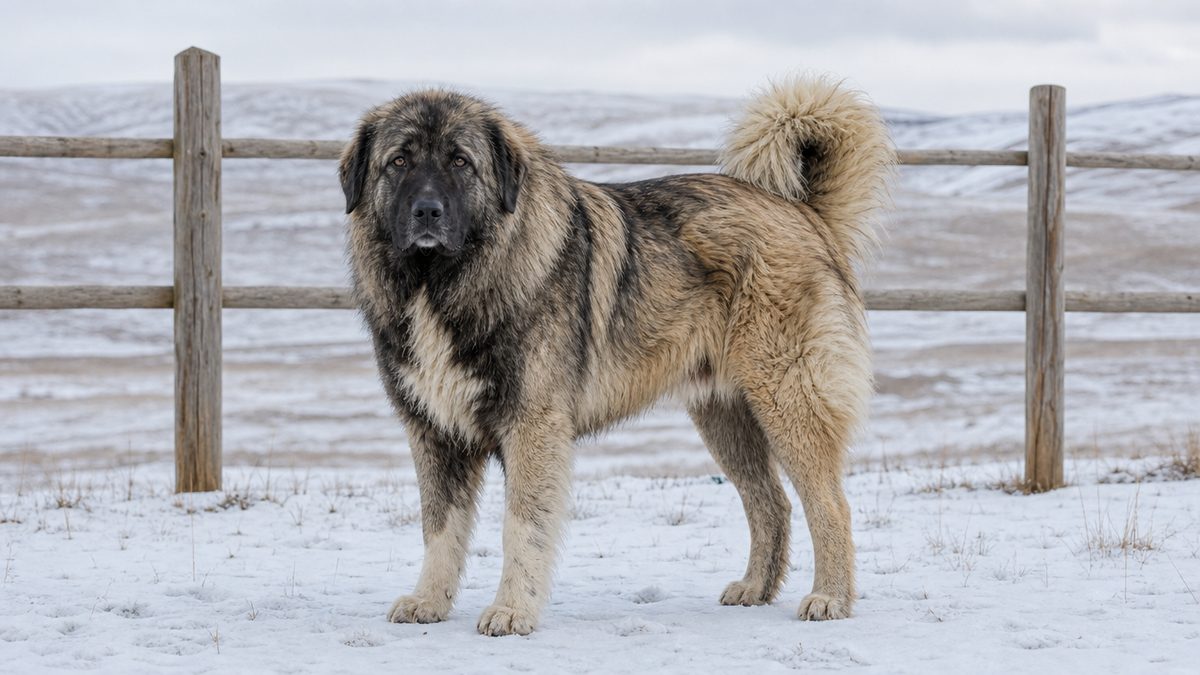
The Kars shepherd dog is a large, shaggy livestock guardian of north-eastern Turkiye, bred to hold sheep and cattle against wolves and bears on highland pasture above 1,700 m. Turkish sources call it Kars coban kopegi, and just as often Kars Kafkas coban kopegi, because Kafkas means Caucasian and the dog looks like the Caucasian Shepherd across the border.
It is found across seven north-eastern provinces. Yilmaz and Ertugrul name Artvin, Agri, Ardahan, Erzurum, Igdir, Kars and Van, and record that the same dog carries different local names in different valleys: killi, meaning hairy, around Kars, Erzurum, Igdir and Agri, sacakli, meaning fringed, in Ardahan, and tuylu, meaning furry, in Artvin. A breed with three local names and no single one is a good early sign that you are looking at a regional population rather than a manufactured show breed.
The first formal description is recent and it has a name attached. The American writer David Nelson presented a general classification of the native dogs of Turkiye at the International Symposium on Turkish Shepherd Dogs in Konya in 1996, and that paper is where the Kars enters the literature as a distinct dog. The 2025 Kafkas University study repeats the same account: first reported by David Nelson at Konya in 1996, then registered by the Military Veterinary School following an application to the Turkish Patent and Trademark Office in 2002. Thirty years is not long for a breed history, and no page ranking for this name says so.
A guardian, not a herder
The job is containment rather than movement. A herding dog moves stock where a person points; a livestock guardian lives with the flock and decides for itself what is a threat. Turkish descriptions of the Kars are blunt about what that produces: a dog that is fierce toward an intruder, that uses its paws readily and has a strong jaw, that is intelligent with a developed protective instinct, and whose adaptation to cold and harsh conditions is strong. The same descriptions say everything belonging to the home falls inside its protection zone, children, cats, birds, other dogs and the house itself, and that it is wary and unfriendly toward anyone outside the family including guests.
That is a working brief, not a temperament rating, and it is the honest starting point for anyone in an Indian city reading this page. A dog selected to be independent, territorial and protective enough to face a bear alone at night does not become a different animal because it now lives behind a gate in Gurgaon.
What it looks like
The coat is the identifying feature and it comes in two layers. Kafkas University researchers describe a long, grizzled and harsh outer coat over a short, soft undercoat, and say the combination is what lets the dog lie out on top of the snow while other dogs stay in the kennel. Yilmaz and Ertugrul add that the hair is longest on the neck and on the backs of the hind legs, so the neck reads as a mane and the dog looks bigger-headed and more frightening from the front than it is. That is a genuine double coat on a genuinely shaggy, cold-adapted dog.
Colour is variable and no source agrees on the list. Yilmaz and Ertugrul report plain black, plain white, grizzled, red, yellow and brown, usually in two or even three colours with the darker covering more area. The registered specification is narrower, describing black on the head, ears and the underline running back from beneath the chest, with the rest a matt colour shifting from yellow to dirty yellow and mixed here and there with black, and yellow tones on the feet darkening upward. English Wikipedia widens it again to black, white, grey, red, yellow and brown with frequent white markings on chest, neck and forelegs.
The document that settles most of these questions has never been read by anyone writing about the breed. Turkiye's patent office serves the Kars registration certificate as a three-page image scan with no text layer, so no crawler has indexed its contents and no article quotes it. Bonbeno extracted the page images and read them. What is inside changes the size question completely, and the next four sections are about that.
Is the Kars a breed? It is the first split verdict on Bonbeno's own test
The Kars passes one of Bonbeno's two conditions and fails the other, which no breed measured against the rule has done before. The rule is published on Bonbeno's page for names used like breeds that are not breeds, and it is short: a breed has a written standard and a studbook behind it, so a puppy can be measured against something. The Kars has the standard. It has no studbook.
Take the conditions one at a time, because a test only means something if it can come out either way. Bonbeno applied the same rule to the Koolie, an Australian working dog no national kennel club recognises, and concluded that the Koolie is a breed, because three Australian organisations register it and its club publishes a written conformation document. It applied the rule to the Kuchi and reached the opposite answer, because Afghanistan has no organising body for dogs at all. The Kars lands between them, and that is worth saying plainly rather than rounding to a verdict.
Condition one: is there a written standard? Yes, and there are two
Turkiye registered this dog twice in 2002, through two different state bodies, and almost nobody knows both. The Turkish Patent Institute registered Kars Turk Coban Kopegi as a *mense adi*, an appellation of origin, under registration number 40. Separately, the Turkish Standards Institution registered the breed as TS 12892 on 27 November 2002, a document Yilmaz and Ertugrul cite by name as *Kars Turk Coban Kopegi Standardi*.
The split in the secondary literature is neat and complete. English Wikipedia says the breed was registered with the Turkish Standards Institution in 2002 and never mentions the patent office. The 2025 peer-reviewed paper says it was registered following an application to the Turkish Patent and Trademark Office and never mentions the standards institution. Each names one registration. Neither names both. The two documents interlock: the patent-office specification instructs that a label carry the mark and number of *this standard*, which is the TSE number.
Condition two: is there a studbook? No
No register anywhere holds a Kars, and the cleanest proof comes from Turkiye's own kennel club. The Kopek Irklari ve Kinoloji Federasyonu is the sole FCI member in Turkiye, and it does list the breed. Its entry reads Grup 11, a group the page itself labels *FCI Tarafindan Taninmayan Irklar*, breeds not recognised by the FCI. The Irk Kodu, the breed code field, is printed as a dash.
Run the control on the same site and the gap opens. KIF's Akbash entry sits in the same Grup 11 and carries breed code AKB, a line reading *Dernegi Var* meaning it has a breed club, a homeland, a colour, and full sections on history, general appearance, important proportions and character. Grup 11 holds 33 breeds out of 460 on the site, so the group is populated and functioning. The Kars is simply the emptiest entry in it: no code, no club, no description, no colour.
| Condition | Koolie | Kuchi | Kars |
|---|---|---|---|
| A written standard | Yes, a club conformation document | No. No body exists to publish one | Yes, two. An appellation of origin and TS 12892 |
| A studbook | Yes, three Australian registers | No. No registry anywhere | No. Its own national kennel club prints no breed code |
| National kennel club recognition | No | No | Listed, in a group defined by non-recognition |
| Verdict on Bonbeno's rule | A breed | A type, not a breed | Split: a standard without a register |
Why a split verdict is not a fudge
The two conditions do different work, and the Kars shows what each one is for. A written standard tells you what the dog is supposed to be. A studbook tells you whether the animal in front of you is one. Having the first without the second produces exactly the situation this page documents in the next section: a precise, numeric, state-registered description of a dog, and no mechanism anywhere that checks a single living animal against it. That is why the registered weight band has been able to sit unchallenged for twenty-four years while every dog anyone actually weighed came in at half of it.
The practical consequence for an Indian reader is immediate. The Kennel Club of India is India's FCI member and issues pedigree documents against FCI nomenclature, and the Kars is absent from that nomenclature. So no KCI paperwork for a Kars is possible, and a seller offering registered papers for one is offering papers for a different breed.
Inside the registration document nobody has read
The Kars breed standard is a three-page scanned certificate on the Turkish patent office's server, and it contains a more precise description than most FCI standards do. Bonbeno extracted the page images and read them, because pypdf returns zero characters from all three pages and no page carries a single font resource, which is the signature of an image scan that no machine has ever read.
That matters before anything else in the document does. This project's own rule is that a PDF with no text layer cannot have been read by whoever cited it. Here the rule cuts the other way: the certificate is genuine and its contents are real, but no crawler, aggregator or breed site has ever seen them, which is precisely why the same six sentences circulate about this dog everywhere in English.
The front page: what was registered, by whom, and when
The certificate is headed *T.C. Turk Patent Enstitusu, Cografi Isaret Tescil Belgesi*. It records registration number 40, application number C 2001/003 filed 3 May 2001, type *Mense Adi*, and the geographical indication KARS TURK COBAN KOPEGI. The applicant is the Askeri Veteriner Okulu ve Egitim Merkezi Komutanligi, the Turkish Army's Military Veterinary School and Training Centre Command, at Gemlik, Bursa. A national dog breed whose intellectual property is held by the army is unusual enough to be worth a sentence anywhere, and it appears in none of the English coverage.
The closing paragraph resolves a date conflict rather than creating one. It states that the indication was announced in Resmi Gazete number 24639 of 13 January 2002, that no objection was received, and that under Article 12 of Decree-Law 555 on the Protection of Geographical Indications it is registered with effect from 13 January 2002. The online registry, meanwhile, prints a *Tescil Tarihi* of 10 December 2002, and the certificate is signed in the president's hand on 9 December. Both dates are real and they mean different things: 13 January 2002 is when protection began, and December 2002 is when the entry was made. Secondary Turkish sources print one or the other and none explains the gap.
An appellation of origin whose delimited area is an entire country
A *mense adi* is the stronger of the two Turkish geographical-indication categories, and its whole logic is that the product's qualities come from one delimited place. This certificate names the province of Kars in its title and then prints Cografi Sinirlari: Turkiye, geographical boundaries: Turkiye. Page three says the same thing again in words, that dogs meeting the above standards are raised in every region within Turkiye where they can be produced. The registry's own record files the entry under province Kars. So the appellation is named for one province and delimited to fifty-four times its area.
The same page carries the export control that Turkish Wikipedia repeats without a source: permission of the Military Veterinary School and Training Centre Command is required to take a Kars Turk Coban Kopegi out of the country Vikipedi (Turkish Wikipedia). That single sentence is why a genuine Kars is rare outside Turkiye and why nothing about the Indian market that follows should surprise anyone.
The scoring scheme, which is the real breed standard
Page two is where the document stops being a certificate and becomes a breed standard. It sorts dogs into six groups by age and sex, gives each a withers height band and a mass band, then scores the animal out of 100 points across six headings.
| Heading | What is judged | Points |
|---|---|---|
| Genel gorunum, general appearance | Harmony, behaviour, weight | 25 |
| Bas, head | Nose, head, ear, eye | 20 |
| Renk, colour | Head, body, foot | 20 |
| Govde, body | Height, depth, length | 15 |
| Bacaklar, legs | Length, paws | 10 |
| Kuyruk, tail | Length, appearance | 10 |
| Total | 100 |
Two rules sit under that table and both are sharper than anything in an FCI standard. A dog scoring 75 points or more is first class and one scoring 50 to 74 is second class. And a dog that scores less than 40 percent of the full points for any single characteristic falls outside the standard altogether, whatever its total. Scoring is done by a panel of at least three experts, and each characteristic's score is the simple arithmetic mean of what the three of them gave it.
Pages two and three are written in the register of a produce standard, because that is what a geographical indication normally protects. Every breeding animal is a *numune*, a sample. A label must be fixed to the cage carrying the owner's name and address, the mark and number of the standard, the name of the goods, its group, its class, the number of breeding dogs in each cage and their age in months and years. Breeding adults travel in cages of one to two head and puppies in cages of one to four. The inspection certificate issued on export is valid for thirty days. None of that is cruelty on its face, but it is the vocabulary of a cheese specification applied to a live animal, and it is worth knowing before you read the next section's numbers.
The registered weight is roughly double every dog anyone has weighed
Four published size frames exist for the Kars shepherd dog and they agree on height while disagreeing on weight by a factor of nearly two. The registered Turkish standard demands 75 to 110 kg from an adult male. Every measured population mean ever published sits near 45 kg, at a shoulder height the standard itself would accept.
Set them side by side and the shape of the disagreement is immediately visible. The heights overlap; the weights do not.
| Source | Height | Weight | What it is |
|---|---|---|---|
| Registered standard 2002, adult male over 16 months | 70-100 cm | 75-110 kg | Turkish appellation of origin, read from the scanned certificate |
| Registered standard 2002, adult female over 12 months | 65-90 cm | 60-100 kg | Same document |
| Yilmaz and Ertugrul 2012, measured adult males | 72.6 cm ± 0.78 | 45.3 kg ± 1.17 | Measured population means in a Turkish journal |
| Yilmaz and Ertugrul 2012, measured adult females | 71.9 cm ± 1.55 | 43.3 kg ± 2.00 | Same paper |
| Bektasoglu and Kirmizibayrak 2025, at 12 months | 69.34 cm ± 0.29 | 40.63 kg ± 0.35 | 57 puppies followed from birth at Kafkas University |
| Anadolu Ajansi 2023 | 60-80 cm | around 70 kg | Turkiye's state news agency, no method given |
Do the subtraction. The registered floor for an adult male is 75 kg. The measured adult male mean is 45.3 kg. The standard's minimum is 29.7 kg heavier than the average dog, which is to say the floor of the band sits 66 percent above the mean of the population it claims to describe. Not one measured group mean published anywhere for this breed reaches the bottom of its own registered weight range.
The heights agree, and that is what makes the weight claim untenable
If the standard were simply describing a bigger regional type, the heights would be wrong too. They are not. The registered adult male band runs 70 to 100 cm and the measured adult male mean is 72.6 cm, comfortably inside it. The 2025 study reached 69.34 cm at twelve months and dogs are still growing at that age. So the two documents are describing dogs of the same height and disagreeing only about how much those dogs weigh.
That is not a difference of type, it is a difference of build, and the build implied by the standard does not exist. A dog 72.6 cm at the shoulder weighing 75 to 110 kg would be far heavier for its height than a Kangal, whose FCI standard gives males 72 to 78 cm and 48 to 60 kg. Measured against measured, the Kars is a slightly lighter dog than a Kangal of the same height. Measured against its own paperwork, it would be 15 to 50 kg heavier than one. English Wikipedia, working from measurements rather than the standard, describes the Kars as slightly smaller than the Akbash and the Kangal, which is the opposite of what the registered document implies.
Where the 75 to 110 kg figure went next
It became the number the internet repeats. Turkish Wikipedia gives the breed's weight as 75 to 110 kg and a maximum height of 100 cm, and sources it not to the certificate but to a pet retailer's blog. Those are the registered standard's adult-male row, laundered through a shop. Meanwhile Turkiye's own state news agency, reporting on the geographical indication itself, prints a shoulder height of 60 to 80 cm and a weight reaching around 70 kg, which matches neither the certificate nor the measurements and whose 60 cm floor sits below the standard's female minimum.
The English commercial pages then convert the measured figures and present them as the standard. Basepaws lists average male weight as 98 pounds and average male height as 28.5 inches, which are 44.5 kg and 72.4 cm, the measured means in imperial dress. So the same breed is simultaneously a 45 kg dog on the English pages and a 75 to 110 kg dog on the Turkish ones, and nobody has put the two beside each other.
Bonbeno reports the measured figures as the breed's size and the registered band as the breed's paperwork, and says so every time either appears. The reason is method rather than preference: 45.3 kg is a mean with a standard error attached, taken from dogs somebody weighed, and 75 to 110 kg is a band in a document with no measurement behind it that anyone has published. Where a standard and a measurement disagree about a living population, the measurement is the evidence and the standard is the claim. If you are ever offered a Kars on the strength of its registered weight, ask which dog was weighed.
Which registries hold the Kars, and which hold the dog it resembles
No international registry holds the Kars shepherd dog under any name. The FCI does not list it, Turkiye's own FCI member files it in a group defined by FCI non-recognition, and the only internationally recognised breed drawn from this population belongs to Russia rather than Turkiye.
Bonbeno read the FCI's letter K index directly rather than assembling a URL, because on fci.be the trailing number decides the document and a guessed one serves another breed. The page's own heading confirmed it as the breeds nomenclature. Fourteen breeds are listed under K and the Kars is not among them.
| FCI name | Number | Why it matters here |
|---|---|---|
| Kangal Coban Kopegi | 331 | Control. Turkiye's recognised guardian, present |
| Kavkazskaia Ovtcharka, Caucasian Shepherd Dog | 328 | Control. The dog the Kars resembles, present |
| Kraski Ovcar, Karst Shepherd Dog | 278 | Control, present |
| Kazakh Tazy | 372 | Control, present |
| Komondor | 53 | Control, present |
| Kuvasz | 54 | Control, present |
| Kars, under any spelling | none | Absent, on a page where six controls are present |
Six controls on the same document in the same session make that a real absence rather than a broken query. The FCI files the Caucasian Shepherd Dog under its Russian name, Kavkazskaia Ovtcharka, which is why an English reader scanning the C section may miss it entirely.
Grup 11: a group the FCI does not have
The FCI has ten groups. Turkiye's FCI member has eleven. The Kopek Irklari ve Kinoloji Federasyonu index carries 460 breeds, and the eleventh group holds 33 of them under the heading *FCI Tarafindan Taninmayan Irklar*, breeds not recognised by the FCI. Alongside the Kars it holds the Akbas, the Aksaray Malaklisi, the Anadolu Sultan Tazisi, the Zerdava, the Tonya Finosu and the Trakya Kopoyu, plus foreign non-FCI dogs like the American Bulldog, the Moscow Watchdog and the Boerboel.
So Turkiye's own kennel club is doing something quietly honest here. Rather than printing an FCI group the FCI has never granted, which is the pattern this site has found on Greek, Irish and Chinese national bodies, KIF has built an explicit holding pen for breeds it recognises and the FCI does not, and put its own national breeds in it. That is a better piece of record-keeping than most national clubs manage, and it makes the Kars's status legible at a glance.
The recognised version of this dog is Russian
The Caucasian Shepherd Dog holds FCI standard 328, Group 2, Section Molossian type, Mountain subsection, accepted on a definitive basis on 23 August 1984, with its official valid standard published on 13 October 2010 and English as the authentic language. Its country of origin of the breed is recorded as the RUSSIAN FEDERATION.
That is the same structure Bonbeno found on the Kuchi, where the only FCI standard covering an Afghan population is the Central Asia Shepherd Dog, origin USSR, patronage Russia. The pattern repeats here: a livestock guardian population spread across a mountain range and several countries is recognised internationally under the name and flag of the one country that filed the paperwork. Turkish researchers say the Kars closely resembles the Caucasian Ovcharka morphologically, and a Turkish shepherd's dog is therefore recognised abroad, if at all, as a Russian breed.
A DNA panel cannot tell the Kars from the Akbash
One commercial source says the quiet part out loud. Basepaws, which sells a canine ancestry test, states on its own Kars page that it analyses this breed as part of a group that also includes the Akbash, and explains that some breeds lack the number of genetic differences required to distinguish the populations from one another. Set that against the sibling finding on the Akbash page, where Turkiye's own gazette records that scientific work had shown the Kangal and the Akbas to be different from each other, and the picture sharpens: the state distinguishes some of its native guardians and a commercial panel cannot separate these two.
None of this means the dogs are the same animal. It means that if you are ever offered a Kars outside Turkiye, neither a pedigree nor a swab can confirm the claim, because there is no register to check the first against and no panel that resolves the second.
The Kennel Club of India is the FCI's full member for India and issues pedigrees against FCI nomenclature. Since the Kars is absent from that nomenclature, no KCI registration for a Kars is possible. If Indian papers are offered with a dog described as a Kars, read what breed the papers actually name. In practice the only plausible entry is Caucasian Shepherd Dog, which is a different, FCI-recognised, Russian-origin breed with a considerably worse published hip record.
Five things are called Kars, and only one of them is a dog
Searching this breed by name fails in a specific, reproducible way that every reader will hit. The word Kars is simultaneously a Turkish province, an anime villain, a stock ticker, an American snack brand and a village in Ontario, and adding the words shepherd, dog, breed or temperament to the query changes nothing at all.
Bonbeno ran the test rather than asserting it. Bing was asked two genuinely different questions on 2 September 2026: *kars shepherd dog*, and *kars dog breed temperament*. Both returned byte-identical ten-result sets, in identical order, under an identical count of About 31,200 results.
| Position | Result | What it is |
|---|---|---|
| 1 | jojowiki.com | Kars, the antagonist of JoJo's Bizarre Adventure: Battle Tendency |
| 2 | Wikipedia, Kars | The Turkish city, not the dog |
| 3 | kraneshares.com | KARS, an electric-vehicle ETF |
| 4 | secondnaturebrands.com | Kar's Nuts snacks and trail mixes |
| 5 | stockanalysis.com | KARS ETF stock price |
| 6 | finance.yahoo.com | KARS ETF quote |
| 7 | zacks.com | KARS ETF profile |
| 8 | amazon.com | Kar's Nuts, a brand since 1933 |
| 9 | finance.yahoo.com | KARS ETF holdings |
| 10 | barchart.com | KARS ETF quote |
| Total about a dog | Zero of ten |
Why this is capture rather than a broken search engine
The distinction matters and this project keeps them apart deliberately. In substitution the engine is broken and hands you somebody else's results. In homonym capture the engine works perfectly, the results genuinely match the string you typed, and the string means something else in the world. Every result above really is about something called Kars. Nothing failed.
Two things follow, and Bonbeno acts on both. First, no absence may be read off that search, because identical output for two different questions means the engine is not reading either of them. No People Also Ask box could be captured on the day this page was built. A rendered Google India result on 18 September 2026 did carry one, 4 questions, and the FAQ below answers 2 of them verbatim. Second, everything this page says about the Indian market rests on a different instrument: the India-located Firecrawl pulls, whose control query for Labrador prices returned ten genuine Indian Labrador pages carrying live rupee prices in the same session.
A sixth collision, inside the dog world itself
The Indian for-sale pull surfaced one more. Two of its ten results were the Kars Dog Club of Ontario, Canada, whose show records appear on a Rottweiler kennel's page and in a Canadian show-entry PDF. Kars is a village south of Ottawa, and its dog club has nothing to do with Turkiye. So even a search restricted to dogs returns a Canadian kennel club rather than a Turkish breed.
The literature collides too, in three separate ways
PubMed was searched across twelve query forms in one session with the printed query translations read each time. The results are a small catalogue of how a breed name can fail:
- Kars the province swamps Kars the dog. The query *"Kars dog"* returns 46 records and *"Kars dogs"* returns 45, but the quoted phrase is not found and the translation reads kars AND dogs. Kafkas University's veterinary faculty is in Kars, so scores of Turkish veterinary papers name the province and the animal in the same abstract without being about this breed at all.
- Coban becomes an antibiotic. The query *"Kars coban kopegi"* returns zero, and the translation shows PubMed expanded *coban* to monensin, the ionophore whose trade name is Coban. The Turkish word for shepherd is a feed additive in PubMed's index.
- Caucasian becomes a race category. The query *"Caucasian Ovcharka"* returns 170,158 records, because PubMed maps Caucasian to the MeSH term white people. Searching the recognised breed's Russian name returns six figures of human medicine.
- The isolate is tiny. Restricting to title and abstract, *Kars[tiab] AND shepherd[tiab]* returns two records, one of which is a human anthrax paper about the Kars region. Controls in the same session were healthy: Labrador plus hip dysplasia 124 records, and *"Kangal dog"* 4 records with all four genuinely on-breed.
If you want to read about this dog rather than an ETF, search the Turkish name Kars coban kopegi or Kars Kafkas coban kopegi, or the English phrase Kars Shepherd, and expect Turkish-language results. The single best English-language document is the 2025 Kafkas University growth study, which is open access. The single best Turkish one is the registration certificate quoted in the previous section, and no search engine will ever surface its contents, because it has no text layer to index.
Kars shepherd dog price in India: there is no price, and here is the proof
No kars shepherd dog price in india exists, because no Indian seller offers the breed. Two India-located searches on 2 September 2026 returned no Indian listing, no breeder and no rupee figure for the dog, against a control run on the same instrument in the same session that returned ten genuine Indian Labrador pages with live prices.
The control is the part that makes the absence worth anything. A search returning nothing proves nothing until you have shown the search works. The query *labrador retriever price in india* returned Mr n Mrs Pet with a full quality-tier table at ₹30,000 to ₹60,000 for basic, ₹60,000 to ₹90,000 for KCI registered and ₹90,000 to ₹1,20,000 for champion bloodline, plus Supertails at ₹8,000 to ₹70,000, Pets Lifestyle at ₹15,000 to ₹50,000, a Tradeindia Delhi supplier page and five more Indian pages. The instrument was working. It simply has nothing to return for this breed.
What an Indian search does return
The results are worth naming, because naming what a reader is actually being offered is more useful than any price. The pull for *kars dog price in india* returned Supertails' generic 40-breed price list, an Instagram reel about a ₹50 crore wolfdog in Bengaluru, Wrapinfur's 50-breed list, two YouTube price videos, a Quora thread, a Basil Pet Care listicle on expensive breeds and a Scribd kennel price chart. Not one of them mentions the Kars. They rank because they are India's general dog-price pages, and Google had nothing breed-specific to offer.
The one rupee figure that did surface is worth a sentence on its own. A for-sale query returned an Etsy listing shipping to India for a Kars embroidered baseball cap at ₹2,957, reduced from ₹3,285. That is the only live rupee price attached to this name in an Indian search result, and it is a hat.
No conversion, and no borrowed number
Bonbeno publishes no converted price for this breed and no figure borrowed from a related dog. Both would be fabrication. This site has repeatedly caught Indian pages publishing dollar prices with the symbol swapped or divided at 84.38, 80, 74 or 66.67, and has caught an answer engine inventing a rupee band for a page containing no rupee figure at all. There is nothing here to divide, because no seller anywhere in India has published a number.
Nor will Bonbeno print the Caucasian Shepherd Dog price in its place. Indian sellers do list Caucasian Shepherds, and a buyer told a dog is a Kars is most likely being shown one, but a price for a different FCI-recognised breed is not this breed's price and presenting it as one is exactly how the numbers this site keeps debunking get made.
Two structural reasons no Indian price can form
This is not a gap waiting to be filled. Two documents close it from both ends.
- Turkiye controls the exit. The registration certificate states that permission of the Military Veterinary School and Training Centre Command is required to take a Kars Turk Coban Kopegi out of the country, and the inspection certificate issued on export is valid for thirty days. A breed whose own state treats it as a protected genetic resource does not flow into a foreign pet market.
- India closes the entry. Live dogs sit at ITC(HS) 01061900 as a Restricted import, and the Directorate General of Foreign Trade states that applications to import for trading or breeding purposes shall be duly rejected. Entry is permitted only for a pet accompanying its owner with a valid pet book in that owner's name, for research with CPCSEA recommendation, or for Defence and Police use.
Put those together and there is no lawful route by which a breeding population of Kars shepherd dogs could be founded in India. A one-off dog could arrive with a returning owner. A supply chain could not.
The one dedicated Kars page ranking in an Indian search is Creatures.com, titled *Kars Dog: Breed Facts, Prices and Breeders*. It carries no price. Its marketplace, herdbook, community-profile and breeder counters all read zero, it offers a Dog Gestation Calculator preset for the breed, and its featured listings on this dog page include a blue pullet in Ravenna, Texas. It also lists 55 coat colours including albino, blue merle, harlequin, leucistic and both Gray and Grey, the same colour spelled twice, for a dog whose registered standard describes one colour pattern. Bonbeno cites that page only as evidence of automated generation and never for a fact.
Cost of ownership in India for a 45 kg guardian, which is real even when the price is not
Keeping a 45 kg heavy-coated guardian in an Indian city costs roughly ₹6,000 to ₹12,000 a month before anything goes wrong, and the two lines that swell are food and cooling. There is no Kars purchase price to quote, but every running cost below is a published Indian figure that applies to any dog of this size living here.
The distinction between a breed price and a care cost is the whole reason this section exists. Inventing a purchase figure would be fabrication. Reporting what Indian owners actually pay to keep a large dog is not, and it is what a reader planning for one needs.
The published Indian baseline
Voice of Stray Dogs puts total monthly dog ownership in India at ₹3,000 to ₹10,000 and beyond, and annual spending for most owners at ₹25,000 to ₹80,000 or more, with lifetime cost across ten to fifteen years running to ₹3 lakh to ₹10 lakh. Those are all-breed numbers. A Kars sits at the top of every band and above several.
| Line | Published Indian figure | What a Kars-sized dog realistically lands on |
|---|---|---|
| Food | ₹1,500-4,000 medium; ₹5,000+ for large working breeds | ₹5,000-8,000 |
| Preventive veterinary care | ₹5,000-8,000 per year | ₹450-700 per month, spread |
| Grooming | ₹300-2,000 per session | ₹1,200-2,000 per month at two sessions |
| Tick and flea control | Inside preventive care | Non-optional, see the health section |
| Boarding when you travel | ₹500-2,000 per day | ₹5,000-20,000 per ten-day trip |
| Typical monthly total | ₹6,000-12,000 |
Grooming is where this breed diverges from the average large dog. A double coat with a dense undercoat needs a real session, not a rinse, and VOSD prices a full session for a large long-haired breed at the top of its ₹300 to ₹2,000 range. Two sessions a month through a monsoon is not indulgence, it is how you avoid the skin and ear problems the grooming section covers.
The one-off costs before month one
The first month is the expensive one. VOSD prices a starter kit at ₹2,000 to ₹5,000, and the first vaccinations, deworming and health check at another ₹2,000 to ₹5,000, putting the first month at ₹15,000 to ₹25,000 or more before anything unexpected happens. For a guardian breed you should add two lines the average owner does not need.
- Fencing and gate management. A territorial guardian that can clear or dig a boundary is a liability rather than a security system. Budget for a real fence before the dog arrives, not after the first incident.
- Professional training and behaviour support. A basic course runs ₹5,000 to ₹15,000 and a behaviourist assessment and programme ₹3,000 to ₹10,000. For a breed that will not train the way a retriever does, this is a first-year cost rather than a remedial one.
The costs that only appear in an Indian summer
Cooling is a running cost that no international breed page prices, and for a cold-adapted dog in an Indian plain it is not optional. A room that stays under about 27 C through May and June means either an air conditioner running for a large part of the day or a genuinely shaded, cross-ventilated ground-floor space. Neither is free, and the electricity is a real monthly line that scales with your city's climate. The climate section sets out exactly how far this dog's homeland sits from Chennai, Delhi and Mumbai.
The other Indian-specific line is emergency capacity. A one to three day hospitalisation at a good clinic runs ₹8,000 to ₹30,000, and orthopaedic intervention after a road accident ₹30,000 to ₹80,000. For a giant-breed guardian with no published hip data of its own and a close relative among the worst breeds on record for hip dysplasia, a reserve fund is a planning assumption rather than a worry.
VOSD notes that a dog costing ₹4,000 a month to maintain in Pune may cost ₹7,000 a month in South Delhi, and that veterinary fees in Mumbai and Bengaluru run considerably higher than in tier 2 and tier 3 cities. VOSD's own average across 1,800-plus dogs in a seven-acre facility is over ₹5,000 per dog per month, at institutional scale with in-house medical capacity. A single large guardian in a metro flat will not beat that number.
Heat tolerance: the hottest month at home is colder than Chennai's coldest
The Kars shepherd dog is the least heat-suited livestock guardian Bonbeno has rated, at 1 of 5. Its home town's hottest month averages 18.36 C while Chennai's coolest month averages 24.09 C, so the warmest four weeks a Kars evolved for are 5.7 C colder than the mildest four weeks in Chennai.
Bonbeno queried NASA POWER by explicit latitude and longitude rather than by place name, because climate sites have repeatedly served this project a complete, correctly formatted document for the wrong town. Each query below echoes back its coordinates and the elevation the model is standing at.
| Place | Cell elevation | Annual mean | Hottest month | Coldest month |
|---|---|---|---|---|
| Kars city, Turkiye | 1,970 m | 5.47 C | August, 18.36 C | January, -8.75 C |
| Ardahan, Turkiye | 2,059 m | 3.78 C | August, 16.50 C | January, -9.64 C |
| Bengaluru | 842 m | 23.74 C | April, 28.37 C | December, 20.22 C |
| Pune | 636 m | 23.86 C | April, 28.93 C | December, 19.62 C |
| Delhi | 206 m | 25.60 C | June, 35.88 C | January, 13.61 C |
| Mumbai | 97 m | 26.77 C | May, 31.19 C | January, 23.19 C |
| Chennai | 49 m | 27.95 C | May, 31.51 C | January, 24.09 C |
Read the last column against the fourth. Kars's hottest month, 18.36 C, is colder than the coldest month in every Indian city in that table, including Delhi's January at 13.61 C only by a small margin the other way. Against Bengaluru, India's mildest large city, the gap is still 1.86 C in the wrong direction: Bengaluru's coolest month, December at 20.22 C on a cell elevation of 841.72 m, is warmer than the warmest month a Kars was shaped by.
The elevation check, because this is exactly the terrain where it fails
NASA POWER returns a grid cell, not a point, and in mountains the cell's mean elevation can miss the town beneath it badly. Eastern Anatolia is mountains, so the check is not optional. The Kars cell reports 1,970.25 m against a real city elevation near 1,768 m, an overstatement of about 202 m. The Ardahan cell reports 2,058.62 m against a town near 1,829 m, about 230 m high.
At a lapse rate near 6.5 C per 1,000 m, a 202 m overstatement makes the model roughly 1.3 C colder than the real Kars. Correct for it and the hottest month becomes about 19.7 C rather than 18.36 C. That is a real correction and Bonbeno publishes it as an estimate, but it changes nothing about the argument: 19.7 C is still 4.4 C below Chennai's coolest month. The Indian plains cells, by contrast, are accurate to within tens of metres, so the Indian half of the comparison needs no correction at all.
The counter-example is worth showing, because it is where this check earns its keep. The Shimla cell reports 897.65 m against a real town elevation near 2,200 m, an error of about 1,302 m in the opposite direction. Anyone reading Shimla's figures straight off the model would conclude a hill station is far warmer than it is, and would then advise a cold-adapted dog into the wrong place for the wrong reason.
Why a big coated dog fails specifically
Two of the strongest risk factors in the UK heat-illness literature apply to this breed by body plan rather than by breed name. Hall and colleagues, writing in *Scientific Reports*, found that dogs at or above their breed and sex mean bodyweight carried 1.42 times the odds of heat-related illness (95 percent CI 1.12 to 1.80), and dogs over 50 kg carried 3.42 times the odds (95 percent CI 1.54 to 7.57). The Kars was not in that model, so Bonbeno claims only the transferable factor: a heavy dog at the top of its own range is at raised risk, and a large male at 50 kg-plus enters the highest band the paper measured.
The companion paper in *Animals* explains where the danger actually comes from, and it is not the parked car. Of the 879 heat-illness events with a recorded trigger, 652, or 74.2 percent, were exertional rather than environmental or vehicular. Dogs overheat doing things. For a guardian that patrols a boundary all day, that is the relevant mechanism.
India's Dog Breeding and Marketing Rules 2017 bar keeping certain dogs in outdoor facilities without the written approval of the attending veterinary practitioner. The clause is Second Schedule Part IV paragraph 21(1), Outdoor housing facilities, not Rule 21; the Rules themselves stop at Rule 13, so any citation reading Rule 14 or higher is wrong by construction. It names dogs not accustomed to local temperatures, and breeds that cannot tolerate them such as long-haired breeds in high temperature locations. A long-haired dog from a 5.47 C annual mean, kept outdoors in an Indian summer, is the exact case that paragraph describes. Add the India Meteorological Department heat-wave thresholds the WHO reproduces for India and the outdoor option closes for most of the country from March to June.
Legal status in India: not banned, not importable for breeding, and not registrable
No Indian law in force today bans owning, breeding or selling a Kars shepherd dog, and the breed was never named in the circular people remember. What Indian law does do is close the commercial import route, leave the dog outside every register India recognises, and restrict how it may lawfully be housed.
Start with the ban question, because it is the one buyers ask. The central circular of 12 March 2024 listed breeds the government proposed to prohibit, and the Kars is not among the names reproduced in the press coverage of that list. Bonbeno has not seen the circular itself and the reported count of breeds it names varies between 19 and 25 across sources, so this page states what it can: the Kars does not appear in the reproduced list, and the Caucasian Shepherd Dog does.
That distinction may not protect anyone in practice. A dog imported or sold in India as a Caucasian Shepherd is a Caucasian Shepherd for every administrative purpose, whatever a seller calls it. Since a Kars cannot be registered here as a Kars, the paperwork on any such dog will name the recognised breed, which is the one that was on the list.
The circular no longer has force
The legal position is settled enough to state plainly. The Karnataka High Court quashed the circular on 10 April 2024, and the Delhi High Court set it aside on 16 April 2024. So no Indian law in force today bans owning, breeding or selling any of the breeds it named. Karnataka expressly left the door open to a properly made Rules amendment after due process, so this is neither a ban nor a settled all-clear, and anyone planning around it should check the position again.
You cannot lawfully import one to breed or sell
Live dogs sit at ITC(HS) 01061900 as a Restricted import under Policy Conditions 7 and 8, and the Directorate General of Foreign Trade is explicit that applications to import dogs for trading or breeding purposes shall be duly rejected. Entry is permitted only for a pet accompanying its owner with a valid pet book in the owner's name, for research and development with CPCSEA recommendation, or for Defence and Police use.
Turkiye closes the other end. The registration certificate requires permission from the Military Veterinary School and Training Centre Command before a Kars leaves the country. Between an export permission held by an army school and an Indian rule that rejects breeding imports outright, no lawful breeding population of this dog can be founded in India. That is the structural reason the price section has nothing to report.
The 2017 Rules clauses that actually bite for this breed
Four provisions of the Prevention of Cruelty to Animals (Dog Breeding and Marketing) Rules 2017 matter for a large coated guardian, and it is worth citing each in the form it is actually written, because this project has corrected 61 miscitations of these clauses across its own pages.
| Provision | Correct citation | What it says |
|---|---|---|
| Outdoor housing in heat | Second Schedule Part IV paragraph 21(1), not Rule 21 | Bars outdoor housing without the attending veterinary practitioner's written approval for dogs not accustomed to local temperatures and for breeds that cannot tolerate them, such as long-haired breeds in high temperature locations |
| Sale below eight weeks | Rule 8(1)(a), a genuine Rule | Pups less than eight weeks in age are not sold |
| Mutilation and appearance | Second Schedule Part II paragraph 6(8) | No tail docking, ear cropping, de-barking, de-clawing, branding, dyeing, and any change of appearance by artificial means is strictly forbidden |
| Close breeding | Second Schedule Part II paragraph 6(3) | Prohibits in-breeding within the first four generations, naming uncle to niece, nephew to aunt, cousin to cousin and grandparent to grandchild, and incest breeding between parents and children or brother and sister |
| Genetic-defect testing | Second Schedule Part III paragraph 8(10) | Breeding dogs shall have been tested for genetic defects including hip dysplasia, progressive retinal atrophy, night blindness, hypothyroidism, entropion, ectropion, overshot and undershot jaw, wry mouth, two or more missing teeth and cryptorchidism |
Paragraph 6(3) is worth a moment for anyone thinking about a founder population. A breed with no Indian presence would have to be built from a handful of imported animals, and close mating within four generations is exactly what that produces. Indian law forbids it, so the arithmetic of founding a Kars line here does not work even before the import rule closes the door.
Indian paragraph 8(10) requires that a breeding dog have been screened for hip dysplasia among other defects. The Turkish registration certificate independently requires that adult breeding dogs undergo a hip dysplasia examination as part of the *damizlik* inspection, alongside checking the pedigree and vaccination card. Two unrelated legal instruments, twenty-two years and four thousand kilometres apart, ask for the same test on the same joint. Nobody has published a single result.
Temperament and household fit: who should not buy this dog
The Kars shepherd dog suits a rural Indian property with livestock, a boundary and an experienced handler, and suits almost nothing else. Its own registered description calls it fierce toward an intruder, notes that it strikes with its paws and has a powerful jaw, and Turkish accounts add that it is wary and unfriendly toward everyone outside the family, guests included.
Take those descriptions seriously, because they were written by the people who bred the dog rather than by anyone selling it. The registration certificate lists, as breed characteristics rather than as warnings: very good protective quality, fierce against the enemy, uses its paws easily, has a paw-striking ability, strong jaw structure, intelligent, developed protective instinct. Turkish Wikipedia adds that everything belonging to the home falls inside its protection zone, children, cats, birds, other dogs and the house itself, and immediately follows that with the instruction not to leave it alone with small children.
Yilmaz and Ertugrul are blunter still. They record that the breed generally tends to bond to one person, that it is not especially friendly toward its surroundings, and that these are quite hard-natured dogs. The mane on the neck, they note, makes the dog look bigger-headed and more frightening from the front, which is a working feature rather than a cosmetic one.
What an Indian home actually generates
The mismatch is not about aggression in the abstract. It is about traffic. An Indian household of any kind produces a steady daily stream of people who are strangers to the dog and are not going away: domestic help, a cook, a maali, a dhobi, a courier, a food-delivery rider, a meter reader, a plumber, a society guard doing rounds, and relatives who arrive without warning. A guard dog selected to treat an approaching stranger as its job will treat every one of those as its job, and a guard dog cannot tell a courier from an intruder.
In a flat this is unmanageable. A shared corridor gives a territorial guardian a doorway to defend and no territory beyond it, and a lift lobby puts strangers inside the protection zone several times a day. Bonbeno rates apartment suitability 1 of 5 for this breed and would say the same about any livestock guardian.
Who it could work for
There is a real profile, and it is narrow.
- Owns rural or peri-urban land with a genuine boundary. Not a compound wall the dog can clear, and not a gate that opens onto a public lane.
- Has livestock or a real property to guard. A guardian without a charge invents one, and the invented charge is usually the front gate and everyone who passes it.
- Has kept a large independent breed before. A first dog should not be a 45 kg animal bred to make its own decisions about threats.
- Lives somewhere genuinely cool for part of the year. Even then, read the climate section first, because no Indian city gets cold enough to make this an easy fit.
- Accepts that visitors will need managing forever. Socialisation reduces reactivity; it does not produce a dog that greets strangers.
Who should not, and the honest alternatives
If you live in a flat, if you want a family dog that greets guests, if this is your first large dog, if you travel often, or if you are in Chennai, Mumbai, Kolkata or coastal Kerala, this is the wrong breed and no amount of training changes that. The failure mode is predictable: a powerful, aloof, under-exercised guardian that barks at the whole street, cannot be walked past other dogs, and ends up confined, which is where guardian breeds become genuinely dangerous.
The honest alternatives are better dogs for an Indian reader, not consolation prizes. The Himalayan Sheepdog does the same job at a similar altitude and already lives here. The Bakharwal is India's own high-altitude flock guardian. If what you actually want is a large Turkish guardian with real paperwork, the Kangal has an FCI standard, a breed code at KIF and an Indian presence, all of which the Kars lacks.
Basepaws lists this breed's activity level as Low and its grooming requirement as Low, while simultaneously recording shedding as Heavy and the coat as a medium-to-long double coat. A heavy-shedding double-coated mountain guardian is not a low-grooming, low-activity dog, and the same page's own fields contradict each other. Where a breed page's spec card disagrees with itself, treat the whole card as generated rather than observed.
Training a dog selected to need no instructions
To train a Kars shepherd dog, aim for reliable management rather than obedience, and expect the work to run over two to three years rather than two to three months. This is a livestock guardian, bred to stand alone against wolves and bears at night and decide for itself what a threat is, and that decision-making is the trait the breed exists for.
The starting point is a trait rating, not a technique. Bonbeno rates trainability 1 of 5 for this breed, the lowest on the site alongside the Kuchi, and the reason is selection history rather than intelligence. Turkish descriptions call the Kars intelligent and clever with a developed protective instinct in the same breath as fierce toward an enemy. A dog that could not think would not be useful on a mountain at night. A dog that waits to be told what to do would be useless there too.
What actually works
Four things move the needle with guardian breeds, and all four are unglamorous.
- Socialise early, wide and calmly. The window closes fast. Introduce the puppy to the specific human traffic your Indian household generates, delivery riders, domestic staff, the society guard, and do it before sixteen weeks. You are teaching the dog who belongs, not teaching it to like strangers.
- Manage the environment rather than the dog. A guardian that never gets the chance to rehearse a bad response does not learn one. That means a real gate protocol, a place the dog goes when the doorbell rings, and never a shared corridor as the dog's territory.
- Reward the behaviour you want, and expect the dog to consider your request. Compulsion produces resistance in a breed this size and this independent. A short pause before compliance is normal and is not defiance.
- Keep sessions short and end early. Five focused minutes twice a day beats a half-hour that ends in a battle.
What does not work, and what it costs
Correction-based handling is the common failure and it is expensive with a 45 kg dog. So is the assumption that a guardian will generalise: a Kars that is calm with your family is not thereby calm with your neighbour's, and a dog reliable at home is not reliable at a vet's clinic. Plan for muzzle conditioning as a routine life skill rather than as a response to an incident, because a dog this size will need restraint at some point and a first muzzle experience in a clinic corridor goes badly.
Bonbeno's cost section prices a basic professional course at ₹5,000 to ₹15,000 and a behaviourist assessment and programme at ₹3,000 to ₹10,000. For most breeds those are optional. For this one, budget the first as a first-year cost and keep the second in reserve.
A realistic timeline
| Age | What is happening | What you work on |
|---|---|---|
| 8-16 weeks | Socialisation window. Deciduous teeth erupted around day 25 and eyes opened around day 14, so the puppy has been taking in the world for months | Every category of visitor, surfaces, handling, crate, muzzle games, car |
| 4-8 months | Confidence rising, size arriving fast. The 2025 study puts a Kars at 12.10 kg by three months and 21.89 kg by six | Loose-lead walking while you still outweigh the dog, recall as a game, gate protocol |
| 8-14 months | Guarding behaviour switches on. Barking at the boundary becomes self-rewarding | Interrupting rehearsal, structured introductions, no unsupervised gate access |
| 14-24 months | Territorial maturity. The dog now has opinions about visitors it did not have at a year | Consistency, management, re-socialisation to anything new |
| 2-3 years | Adult judgement settles | Maintenance. This is where a well-managed guardian becomes genuinely easy to live with |
The middle rows are where owners lose the dog. Between eight and fourteen months a guardian starts doing the job it was bred for, and the barking, boundary patrolling and visitor challenges arrive suddenly in an animal that was pleasant at eight months. Nothing has gone wrong; the breed has arrived.
Two mistakes, opposite directions, same outcome. Suppressing every alert with punishment produces a dog that stops warning and goes straight to the bite, which is far more dangerous than a barker. Deliberately encouraging territorial aggression, which some Indian sellers of guardian breeds actively market, produces an animal nobody can safely handle and which no clinic will treat without sedation. What you want is a dog that alerts, defers to you, and settles. That is achievable and it takes years.
Daily exercise, and why the Indian clock matters more than the distance
A Kars shepherd dog needs about 90 minutes of low-intensity movement a day, split across the coolest hours, plus a territory it can patrol. The distance is easy for a fit guardian. The scheduling is the hard part in India, because the hours a dog would naturally choose to walk in are the hours an Indian city is hottest.
Get the type of exercise right before the amount. This is a patrolling dog, not a running dog. Its work was to cover ground slowly, hold a position, and be awake at night, which is why owners who try to satisfy a guardian with a fast morning run end up with a fit dog that is still bored. Ninety minutes of walking, sniffing and boundary-checking does more than thirty minutes of hard exercise, and it does not push a heavy-coated animal into heat load.
The clock, city by city
The exertional finding in the heat-illness literature is what drives this. Of 879 heat-illness events with a recorded trigger, 652 were exertional, which is 74.2 percent, against 113 environmental and 46 from vehicular confinement. Dogs overheat while doing something. So the intervention that matters is not shade, it is timing.
| City | Hottest month and mean | Peak daily maximum | Practical window |
|---|---|---|---|
| Chennai | May, 31.51 C | 42.70 C | Before 06:00 and after 21:00, March to September |
| Mumbai | May, 31.19 C | 44.85 C | Before 06:00 and after 21:00, and watch humidity year round |
| Delhi | June, 35.88 C | 48.79 C | Before 05:30 and after 21:30, April to July; comfortable December to February |
| Pune | April, 28.93 C | 43.20 C | Before 06:30 and after 20:00 in summer; workable mornings in winter |
| Bengaluru | April, 28.37 C | 40.38 C | Before 07:00 and after 19:30; the mildest large-city option in India |
Delhi is the instructive case. Its June daily maximum of 48.79 C is the harshest in that table, but its January mean of 13.61 C is by some distance the most comfortable. A Kars would find a Delhi winter genuinely pleasant and a Delhi June lethal, which means the routine has to change twice a year rather than being set once. Chennai and Mumbai offer no such relief: Chennai's coolest month still averages 24.09 C and Mumbai's 23.19 C, both above the warmest month this dog evolved in.
Humidity compounds it in the coastal cities. Chennai's hottest month sits at 64.5 percent relative humidity, and panting is a less effective cooling mechanism as humidity climbs, so a Chennai May at 31.51 C is harder on a coated dog than a Delhi April at a higher air temperature and far lower humidity.
What replaces distance when you cannot walk
On days when the outdoor window closes entirely, and in an Indian summer that is most days, the dog still needs occupation. Guardians are not satisfied by fetch.
- Scatter feeding indoors. Spread the day's ration across a room and let the dog work for it. This uses the nose, which tires a guardian faster than the legs.
- Frozen enrichment. A frozen stuffed toy does double duty as occupation and as cooling in the middle of the day.
- A patrol route indoors or on a shaded veranda. Let the dog check its boundary. This is not neurotic behaviour, it is the job.
- Short structured training blocks. Five minutes twice a day, as the training section describes, uses more of a guardian than an hour of pacing does.
A powerful guardian with too little to do does not become lethargic. It becomes a boundary specialist: barking at every passer-by, charging the gate, and escalating with each rehearsal because barking works, in the sense that the person always leaves. That is how an Indian society complaint starts, and it is also how a dog ends up permanently confined, which is the point at which guardian breeds become genuinely unsafe. Ninety minutes at the right hours prevents more behaviour problems in this breed than any training method does.
Grooming a two-layer mountain coat through an Indian monsoon
To groom a Kars shepherd dog in India, brush the undercoat out twice a week year round and daily through each shed, dry the dog completely after every wetting, and never clip the coat off. The coat is two distinct layers doing two different jobs, and removing it does not cool the dog.
Kafkas University researchers describe the structure precisely: first a long, grizzled and harsh outer coat, and beneath it a short and soft layer, and they say it is having both at once that lets the dog handle the region's harsh climate. They add the detail that makes the point stick, that you find other dogs inside the kennel when snow is falling and the Kars lying out on top of the snow, comfortable. The registered standard describes the same coat from the outside as mixed and standing off in appearance, and Yilmaz and Ertugrul note the hair is longest on the neck and the backs of the hind legs.
Why clipping is the wrong instinct
Every Indian owner of a double coat eventually considers a summer clip, and for this coat it is a mistake. The outer coat shades the skin and the undercoat traps air, and a clipped dog loses the shading while keeping the heat load. Worse, a coarse guard coat clipped short often grows back patchily on an adult mountain breed. The correct summer intervention is to remove dead undercoat aggressively and completely, which is a brushing job, not a clipper job.
That is where the real work sits. A slicker plus an undercoat rake, twice a week normally and daily through a shed, is the routine that keeps a dog like this comfortable. VOSD prices professional sessions at ₹300 to ₹2,000, with a large long-haired dog at the top of that band, and a Kars in an Indian city will realistically want two sessions a month plus home maintenance.
The monsoon is a different problem from the summer
This is the point where overseas breed-club advice fails an Indian reader, and this site has caught it before. Guidance written for a cold northern climate routinely says to towel a dog off and let it air dry. In an Indian monsoon, a dense undercoat under a coarse outer coat does not air dry. It stays damp against the skin for hours in ambient humidity above 60 percent, which is exactly the condition hot spots and bacterial skin infections need.
- Dry to the skin, every time. Towel, then a dryer or a fan on the undercoat, not just the surface. Run your fingers to the skin behind the shoulders and at the base of the tail and check it is genuinely dry.
- Check the ears after every wetting. Drop ears over a damp coat in humid heat is the standard set-up for otitis externa, and this breed's registered description gives it wide, dropping, black-haired ears.
- Do not bathe more often than you need to. Frequent bathing in humidity strips the coat and keeps the skin damp. Brushing removes far more dirt from a mountain coat than shampoo does.
- Dry the feet. Interdigital dermatitis in a heavy-boned dog walking wet ground is a recurring Indian monsoon complaint across large breeds.
Ticks are a grooming job here, not just a veterinary one
In India the brush is also the tick check, and the numbers justify making it a habit. A survey of 525 dogs across Delhi, Mumbai, Sikkim and Ladakh detected a tick-borne pathogen by PCR in 261 of them, 49.7 percent, with a 95 percent confidence interval of 45.4 to 54.1. Roughly one dog in two carried something. In a coat with a dense undercoat you will not see a tick; you have to feel for it, working systematically over the neck ruff, behind the ears, in the armpits and along the tail base.
That is not a reason to panic, it is a reason to build the routine. Year-round preventive tick control, prescribed by your own vet rather than bought off a shelf, plus a hands-on check at every brushing, is the whole protocol.
A hardy working breed still needs its nails done, and a dog exercising on soft Indian ground rather than Anatolian rock will not wear them down. VOSD prices a dental cleaning under anaesthesia at ₹3,000 to ₹8,000 and notes that skipping dental care leads to extractions costing far more. For a large guardian, both jobs are far easier if you started handling the feet and mouth during the socialisation window, which is the argument the training section makes for muzzle and handling games at eight weeks.
Health: one study exists, it measured stillbirths, and the number is high
Exactly one peer-reviewed paper exists on the Kars shepherd dog, and it reports a stillbirth rate of 27.95 percent across 32 litters in Turkiye's own conservation nucleus. No lifespan study exists, no screening dataset exists, and the Orthopedic Foundation for Animals holds no row for the breed at all.
Start with what is genuinely known about this breed's health issues, because it is short. Bektasoglu and Kirmizibayrak followed 21 bitches and 57 puppies at Kafkas University's research farm in Kars and published the results in *Veterinary Medicine and Science* in 2025. It is a growth and fertility study rather than a disease study, and it is the entire breed-specific literature.
The stillbirth figure, checked against its own arithmetic
Across 32 births the study recorded 161 puppies, of which 45 were stillborn. That is 27.95 percent, and Bonbeno recomputed it rather than copying it: 45 divided by 161 is 0.2795, and the paper's own mean of 1.40 stillborn puppies per litter reproduces from 45 divided by 32. The litter-size figure checks the same way, 161 divided by 32 giving the reported 5.03.
The split by sex is stark and the paper reports it without comment: 29 of the stillborn puppies were female and 16 male, against 76 females and 85 males born in total. Bonbeno reports those counts as published and draws no conclusion from them, because a single colony over a few years is a small base for a sex-linked claim.
| Measure | Value | Base |
|---|---|---|
| Mean litter size | 5.03 ± 0.17, range 4 to 8 | 32 births |
| Stillbirth rate | 27.95 percent, 45 of 161 puppies | 32 births |
| Survival to weaning at day 45 | 87.1 percent | 116 live-born |
| Survival to 2 months | 84.5 percent | 116 live-born |
| Age at first oestrus | 427.01 ± 2.04 days, range 420 to 437 | 10 bitches |
| Inter-oestrus interval | 234.72 ± 5.42 days, range 221 to 274 | 11 bitches |
| Gestation | 62.78 ± 0.25 days, range 60 to 65 | 21 bitches |
| Oestrus and whelping rate | 100 percent each | 21 bitches |
One seasonal pattern in that paper is worth an Indian reader's attention. Oestrus occurred most often in autumn at 37.50 percent and in spring at 34.37 percent, and least often in summer at 6.25 percent. A dog whose reproductive cycle all but shuts down through a Kars summer, where August averages 18.36 C, is not an animal whose physiology was tuned for an Indian one.
What is not known, said three times
There is no lifespan figure for this breed. The only study follows puppies to twelve months and reports none. Commercial pages print 12 to 15 years with no study behind it, and Bonbeno publishes no lifespan for the Kars rather than borrowing one. The large UK life-table work by McMillan and colleagues covers named breeds in a British population, and the Kars is not among them, so importing a median from it would be fabrication wearing a citation.
There is no screening dataset. OFA's full statistics dump, 2.23 million characters retrieved on 2 September 2026 and searched case-insensitively, returns zero occurrences of KARS, with Labrador at 109, Tibetan Mastiff at 24, Anatolian at 21 and Kuvasz at 7 present in the same file. The controls passing is what makes that a real absence. OFA requires 100 hip evaluations before publishing a breed, so the honest statement is that the Kars has no row in OFA's published statistics tables, not that it is absent from the database.
There is no inherited-disease list. Basepaws states plainly that no genetic conditions are currently tightly associated with the breed and that its genetics are not well documented, which is an unusually honest line from a company selling DNA tests, and it is the correct answer.
The one number worth borrowing, and why
The nearest relative that does have an OFA row is the Caucasian Shepherd, and its record is poor. 49.2 percent of 118 evaluations were dysplastic, ranking it the tenth worst breed in the table, with 46.6 percent normal split 4.2 excellent, 28.8 good and 13.6 fair. For comparison, the Kangal sits at 23.3 percent dysplastic of 146 evaluations at rank 40. Bonbeno does not present the Caucasian figure as the Kars's rate, because it is a different breed with a different history. It is offered as the only relevant benchmark that exists, and it argues for screening rather than assuming.
The Turkish registration certificate requires a hip dysplasia examination on adult breeding dogs as part of the inspection, alongside checking the pedigree and vaccination card. India's Second Schedule Part III paragraph 8(10) requires that breeding dogs have been tested for genetic defects including hip dysplasia. Twenty-four years of Turkish registration and no published hip result exists for this breed anywhere. If you are ever offered a Kars, or a dog described as one, ask for a hip score and read which breed the certificate names.
Feeding a slow-growing giant in India, life stage by life stage
To feed a Kars shepherd dog in India, use a large-breed puppy formulation until about eighteen months, keep the dog lean, and target the measured growth curve rather than the registered standard's weight band. The only published growth data for this breed puts it at 40.63 kg at twelve months, not the 75 to 110 kg its paperwork claims.
That distinction is the whole feeding argument, and it is why the size section came first. An owner who feeds a growing Kars toward a 75 kg target is overfeeding a dog whose own species-typical trajectory ends near 45 kg. Overfeeding a large-breed puppy is the single most reliable way to damage its joints, and this is a breed with no published hip data and a close relative among the worst breeds on record for hip dysplasia.
The measured growth curve
Bektasoglu and Kirmizibayrak weighed 57 puppies from birth to twelve months, and their curve is the only one that exists for this dog.
| Age | Mean live weight | What it means for feeding |
|---|---|---|
| Birth | 0.510 ± 0.003 kg | Colostrum in the first hours. This is a small newborn for a giant breed |
| Weaning, day 45 | 4.31 ± 0.03 kg | Transition onto solids gradually across two weeks |
| 3 months | 12.10 ± 0.18 kg | Four meals a day. Growth is fastest now and easiest to overshoot |
| 6 months | 21.89 ± 0.23 kg | Three meals. Roughly half of adult weight already |
| 12 months | 40.63 ± 0.35 kg | Two meals. Still on puppy formulation |
| Adult, measured males | 45.3 ± 1.17 kg | Adult maintenance. This is the real target |
The dog reaches roughly 90 percent of its measured adult weight by twelve months, then finishes slowly. That last stretch is when owners switch to adult food too early or too late; large-breed puppy formulation to about eighteen months is the safer default, and your own vet's body-condition assessment beats any age rule.
What to feed in India, practically
Any complete large-breed food that meets AAFCO or FEDIAF profiles will do the job, and the brand matters far less than the amount. What matters more in India is the practical set of constraints owners actually run into.
- Budget for a large working dog, not a medium one. VOSD prices quality food for a medium dog at ₹1,500 to ₹4,000 a month and states that large working breeds push past ₹5,000. A 45 kg guardian lands at ₹5,000 to ₹8,000.
- Split the ration and never feed around exertion. Two meals a day for an adult, with an hour either side of any walk kept clear. Deep-chested large breeds are the classic bloat population and this is a deep-chested breed.
- Feed for the season. Appetite drops in an Indian summer and a cold-adapted dog may genuinely eat less from April to June. Move calories to the cooler end of the day rather than forcing the bowl.
- Water in more than one place. A guardian that has parked itself at the gate will not walk across a compound for water in May. Put a bowl where the dog actually is.
- Homemade is possible and needs supervision. Indian home diets are common and workable for a dog this size, but a growing giant-breed puppy needs its calcium and phosphorus balanced by someone qualified, not estimated.
Body condition beats the scale
Because the registered weight is unreliable and the measured mean comes from one Turkish colony, weight alone is a poor target for an individual dog. Use condition instead. You should be able to feel the ribs easily under a thin fat cover without pressing, see a waist from above, and see an abdominal tuck from the side. Under a shaggy double coat none of that is visible, which is exactly why you have to use your hands rather than your eyes on this breed. That is one more reason the twice-weekly brushing routine in the grooming section earns its place: it is also the weekly body check.
If you are ever responsible for a litter, the measured figures give you real anchors: first oestrus at 427 days, an inter-oestrus interval of 234.7 days, gestation at 62.78 days, and a mean litter of 5.03. A 234-day cycle means a bitch of this breed comes into season roughly every eight months rather than every six, which changes planning. Note also that Indian law bars breeding without registration and prohibits in-breeding within four generations under Second Schedule Part II paragraph 6(3), and that with no lawful import route there is no way to bring in unrelated stock.
Month by month through the first year, from the only data that exists
A Kars shepherd dog puppy opens its eyes at about 14 days, cuts its first deciduous teeth at about 25 days, weighs 12.10 kg at three months and 40.63 kg at twelve. Every developmental milestone below comes from the same 57-puppy Kafkas University cohort, which is the only place this breed has ever been followed from birth.
That is unusual and worth flagging. Most rare-breed pages estimate a puppy timeline from generic large-breed development. This one does not need to: Bektasoglu and Kirmizibayrak recorded milestones directly, giving mean age at first opening of the eyelids of 14.02 days, at first opening of the external ear canal 16.95 days, at first eruption of deciduous teeth 25.21 days, and at eruption of the first permanent teeth 12.51 weeks.
| Age | Measured development | What you do in India |
|---|---|---|
| Birth to 2 weeks | 0.51 kg at birth; eyes open around day 14 | Nothing but warmth, weight checks and the dam. Survival to weaning in the study was 87.1 percent |
| 2-4 weeks | Ear canals open around day 17; first teeth around day 25 | Gentle handling begins. Sound and surface exposure |
| 6-7 weeks | Weaning weight 4.31 kg around day 45 | First vaccination and deworming as your vet directs. Budget ₹2,000-5,000 for the first round |
| 8 weeks | Legal minimum age of sale in India | Rule 8(1)(a) bars sale below eight weeks. Socialisation window opens properly |
| 8-16 weeks | Permanent teeth start around 12.5 weeks | The most important eight weeks of the dog's life. Every visitor category, every surface, crate, car, muzzle games, handling of feet and ears |
| 3 months | 12.10 kg | Four meals. Lead work while you can still physically manage the puppy |
| 4-6 months | Reaching 21.89 kg by 6 months | Three meals. Recall as a game. Establish the gate protocol before guarding switches on |
| 6-9 months | Rapid frame growth | Two to three meals. Avoid forced or repetitive exercise on hard ground while growth plates are open |
| 9-12 months | 40.63 kg and 69.34 cm at the withers by 12 months | Guarding behaviour arrives. Manage rather than punish. Two meals, still on puppy formulation |
Three things that are specific to an Indian first year
The generic timeline above is the easy part. Three Indian realities reshape it.
- The socialisation window may fall in the hot season. A puppy born in December hits eight to sixteen weeks in February and March, which in most of India is workable. A puppy born in February hits the same window in April and May, when you cannot take it out at the hours you need to. Plan the window around the calendar, and do the work indoors and at dawn if you have to, but do not skip it.
- Tick exposure starts the moment the puppy goes outside. Roughly one Indian dog in two carried a tick-borne pathogen in a 525-dog survey. Ask your vet about age-appropriate preventive cover at the first visit rather than the third.
- Growth-plate protection matters more in a dog whose adult weight is disputed. Because there is no published hip data for the breed and its closest relative has a very poor record, the conservative route is to avoid stairs, jumping and long hard-surface walks until eighteen months.
Where the year usually goes wrong
Two failure points, both predictable. The first is between three and six months, when the puppy is charming, growing fast and easy to over-feed toward a size the registered standard implies and the dog will never reach. The second is between nine and fourteen months, when a friendly adolescent becomes a protective adult and starts having opinions about the gate. Owners who read that second change as the dog turning on them, rather than as the breed arriving on schedule, are the ones who end up confining the animal.
The only measured population of this breed is a Turkish research colony with a 27.95 percent stillbirth rate across 32 litters. That is a state-funded conservation programme with veterinary oversight. Anyone in India offering a Kars litter is by definition working outside every register, without an import route, and without the health data that would let you assess the parents. The adoption section covers what to ask, and the honest answer for most readers is to look at a breed you can verify.
The Kars against the guardians an Indian buyer can actually verify
Compare the Kars shepherd dog on paperwork rather than on looks, and it loses to every guardian an Indian buyer can realistically reach. It is the only dog in this table with a written standard and no register, and the only one for which an Indian buyer can obtain neither a pedigree nor a hip score.
The comparison that matters is not which dog is bigger. It is what you can check before you hand over money, and what happens to the animal in an Indian summer.
| Breed | International standard | Studbook route in India | OFA hip record | Bonbeno heat rating |
|---|---|---|---|---|
| Kars Shepherd | None. Turkish appellation of origin and TS 12892 only | None. Absent from FCI nomenclature, so no KCI pedigree | No row at all | 1 of 5 |
| Kangal Shepherd Dog | FCI 331, accepted 6 June 1989 | Yes, via KCI against FCI nomenclature | 23.3 percent dysplastic of 146, rank 40 | 2 of 5 |
| Caucasian Shepherd Dog | FCI 328, accepted 23 August 1984, origin Russian Federation | Yes, via KCI | 49.2 percent dysplastic of 118, rank 10 worst | 1 of 5 |
| Akbash | None. Absent from the FCI, KIF Grup 11 with code AKB | None via FCI, but a named breed code and club exist in Turkiye | No row | 1 of 5 |
| Himalayan Sheepdog | None | Already present in India, no import needed | No row | 3 of 5 |
| Tibetan Mastiff | FCI 230 | Yes, via KCI, and an established Indian market | Holds an OFA row | 1 of 5 |
Kars against Kangal, which is the comparison buyers actually make
These two are close in height and far apart in everything administrative. A Kangal male under FCI 331 stands 72 to 78 cm and weighs 48 to 60 kg. A measured Kars male stands 72.6 cm and weighs 45.3 kg. So they are the same height and the Kars is slightly lighter, which is exactly what English Wikipedia reports when it calls the Kars slightly smaller than the Akbash and the Kangal.
The differences that matter to a buyer are elsewhere. The Kangal holds FCI standard 331 and a breed code at KIF, so a Kangal can carry a KCI pedigree in India and has a published OFA hip record. The Kars holds neither. And the coats differ: the Kangal's guard coat runs 3 to 7 cm under its standard, while the Kars carries a long grizzled outer coat over dense underwool, which is a heavier coat for an Indian climate on an already unsuitable dog.
Kars against Caucasian Shepherd, which is the substitution you will actually be offered
This is the practically important row. Indian sellers do list Caucasian Shepherds, and since no Kars can be registered here, a dog offered as a Kars is most likely one. The two look alike, Turkish researchers say so, and only one of them has papers.
The trade-off is not obviously in the buyer's favour either way. The Caucasian Shepherd is FCI-recognised with a Russian country of origin, so it can carry a KCI pedigree, but its OFA hip record is among the worst on file at 49.2 percent dysplastic of 118 evaluations, and it was named in the 2024 central circular. The Kars has no record at all, good or bad. Verifiable and poor beats unverifiable, because a bad number you can act on is more useful than no number.
The comparison nobody makes: Kars against a dog already in India
If what you want is a heavy-coated mountain guardian for Indian land, the Himalayan Sheepdog does the job at a similar altitude, in this climate, without an import licence, and the Bakharwal is India's own flock guardian. Neither has an FCI standard either, so on the documentation question they are no worse off than the Kars, and on every other question they are far ahead: you can see the parents, you can meet dogs living in Indian conditions, and no army holds an export permission over them.
Go with the Kangal. It is the only Turkish livestock guardian with an FCI standard, a breed code at its own national kennel club, a published hip dataset and a real Indian presence, and it is a slightly heavier dog with a shorter coat than the Kars. Bonbeno still rates its heat tolerance only 2 of 5 and Turkiye's own kennel club says on its Kangal page that the breed does not much like very hot and humid weather, so this is a recommendation between guardian breeds rather than a recommendation for one.
Nine mistakes Indian buyers and writers make with this dog
The commonest mistake with the Kars shepherd dog is believing the registered weight, and the second commonest is believing an Indian listing. Each of the nine below has a specific document behind it, and each can be checked in a few minutes by anyone who wants to.
- Quoting 75 to 110 kg as the breed's weight. That band is the registered standard's adult-male row, and no measured population comes near it. Yilmaz and Ertugrul weighed adult males at 45.3 kg and the 2025 cohort reached 40.63 kg at twelve months. Turkish Wikipedia prints 75 to 110 kg sourced to a pet retailer's blog, and that is where most of the internet gets it.
- Assuming the breed is unrecognised because the FCI does not list it. It is registered twice by the Turkish state, as an appellation of origin at the patent office and as Turkish Standard TS 12892 Yilmaz O, Ertugrul M. Turkiye Yerli Kopek…. Non-recognition by the FCI is not the same as having no standard, and this page's whole argument depends on keeping the two ideas apart.
- Assuming it is a breed because it has a standard. The other half of the same error. Turkiye's own FCI member gives the Kars no breed code where it gives the Akbash AKB, so there is a document to measure a dog against and no register to record the result in.
- Treating it as a Caucasian Shepherd, or vice versa. They resemble each other and Turkish researchers say so, but FCI 328 is a distinct recognised breed with its country of origin recorded as the Russian Federation. One carries a KCI pedigree in India and the other cannot.
- Believing a page that promises prices. The one dedicated Kars page ranking in India is titled Breed Facts, Prices and Breeders and contains no price, no breeder, no herdbook record and no profile, while listing 55 coat colours including both Gray and Grey and featuring a blue pullet in Texas.
- Calling it heat-tolerant because it is hardy. Toughness in cold does not transfer. Kars city has an annual mean of 5.47 C and a hottest month of 18.36 C, colder than Chennai's coolest month at 24.09 C NASA POWER Climatology API. A dog described as lying out on top of the snow is not a heat-tolerant animal.
- Citing the outdoor-housing clause as Rule 21. India's 2017 Rules stop at Rule 13, so any citation reading Rule 14 or higher is wrong by construction. The heat clause is Second Schedule Part IV paragraph 21(1). This site corrected eighteen instances of exactly that error across its own pages.
- Reading a search result as evidence. Two different queries returned byte-identical result sets under an identical count, and none of the ten results was about a dog. Anyone who searched this breed on Bing and concluded anything from what came back, in either direction, learned nothing.
- Believing the hypoallergenic claim, which attaches to almost every rare breed. It is unsupported for every dog. Vredegoor and colleagues measured Can f 1 across 196 dogs of so-called hypoallergenic breeds against 160 controls and found the hypoallergenic group carried more allergen in hair and coat, concluding there is no evidence for the classification. A dog that sheds a dense undercoat twice a year is not an allergy-safe dog.
The mistake this page itself had to avoid
It is worth naming the trap Bonbeno nearly walked into, because a reader can use it. The obvious move on a breed with no Indian market is to reach for the nearest recognised relative's numbers and present them as the breed's: the Caucasian Shepherd's OFA hip figure as this dog's hip risk, or a Kangal price as this dog's price. Both would have produced a fuller-looking page and both would have been fabrication.
What this page does instead is name the benchmark and label it as a benchmark. The Caucasian Shepherd's 49.2 percent dysplastic of 118 evaluations is presented as the closest relevant figure that exists and explicitly not as the Kars's rate, and no rupee figure appears for the breed at all. A page with an honest gap in it is more useful than a page that filled the gap with somebody else's dog.
If a seller quotes you a size, ask which document it comes from. There are only four candidates and they disagree by nearly a factor of two: the 2002 registration certificate at 75 to 110 kg, Yilmaz and Ertugrul's measured 45.3 kg, the 2025 cohort's 40.63 kg at twelve months, and Anadolu Ajansi's around 70 kg. A seller who cannot name the source is quoting an aggregator, and an aggregator quoting 75 to 110 kg is quoting a document nobody has read.
Adoption, sourcing, and the honest recommendation
Adopt rather than import, because there is no lawful way to buy a Kars shepherd dog in India and no way to verify one if you did. If you want the dog this breed actually is, a large independent guardian for real land in a cool part of the country, India already has two and both are reachable without a licence.
Start with what the evidence supports. No Indian seller offers this breed, proven with a control that returned ten genuine Indian Labrador pages in the same session. The Directorate General of Foreign Trade rejects import applications for trading or breeding purposes outright. Turkiye requires its Military Veterinary School's permission before the dog leaves the country. Nothing about that adds up to a purchase route, and anyone telling you otherwise is describing a different dog.
If someone offers you a Kars in India, ask five questions
The point of these is not to catch a liar. It is to find out which breed you are actually being offered, which is usually a genuine question with a genuine answer.
- What breed do the papers name? A Kars cannot be registered with the Kennel Club of India, because the KCI issues pedigrees against FCI nomenclature and the breed is absent from it. If papers exist, they name something else, most likely Caucasian Shepherd Dog.
- Where did the parents come from, and under what import authorisation? There are only three lawful routes into India for a live dog and none of them supplies a breeder. A straight answer here settles almost everything.
- Can I see a hip score, and for which breed? Both Turkish and Indian rules ask for a hip examination on breeding dogs, and no Kars hip result has ever been published anywhere.
- How old is the puppy? Rule 8(1)(a) of India's 2017 Rules bars the sale of pups under eight weeks, and it is a genuine Rule rather than a Schedule paragraph.
- Can I meet the mother, in the place the puppies were raised? This is the oldest question in dog buying and it remains the most useful one. A seller who will not show you the dam and the premises is not selling you a puppy, they are moving one.
The adoption route, which is the real recommendation
India has a large population of dogs needing homes, and for most readers of this page that is the better answer, not the consolation one. VOSD prices adoption at ₹500 to ₹2,000 against ₹80,000 or more for a bred puppy, and points out that the purchase price is the smallest number in a ten to fifteen year commitment running to ₹3 lakh to ₹10 lakh. If you have land and want a guardian, large independent dogs of guardian type come through Indian rescues regularly, and you can meet an adult whose temperament you can actually assess rather than gambling on a puppy.
If you specifically want a mountain guardian, look at the Himalayan Sheepdog and the Bakharwal. Both do this breed's job, both live in Indian conditions already, and neither requires you to import anything. If you want a Turkish guardian with paperwork you can check, the Kangal is the only one that offers it.
Where a Kars is genuinely worth supporting
The breed itself is not the problem, and it is worth saying so. Yilmaz and Ertugrul record that apart from the Kangal, every Turkish shepherd dog breed is in danger of extinction or under severe threat. Kafkas University's veterinary faculty has run a conservation nucleus for the Kars at its research farm for several years, collecting dogs from surrounding villages, breeding selectively and publishing what it finds, and the 2025 paper is the first real data the breed has ever had. That is what saving a landrace looks like, and it is happening in Kars rather than in a foreign pet market.
The most useful thing an Indian reader can do for this breed is not to buy one. It is to stop repeating the numbers that make it look like something it is not, and to adopt or buy a dog you can actually verify.
Go to Turkiye, work with the people conserving it, and understand that the export permission sits with an army school. In India, accept that you will be buying an unregistered dog of unverifiable parentage, from a supply chain that cannot lawfully exist, into a climate whose mildest month is warmer than the breed's hottest. If that is still the plan, at minimum: buy nothing sight unseen, take the dog to your own vet before money changes hands, insist on hip imaging whatever the paperwork says, and read the climate section again before deciding which city you will keep it in.
Kars shepherd dog: the questions buyers actually ask
Is the Kars shepherd dog a real breed?
It is half a breed on Bonbeno's own test. A breed needs a written standard and a studbook. The Kars has two written standards, a Turkish appellation of origin registered in 2002 and Turkish Standard TS 12892, but no register anywhere holds it, and Turkiye's own FCI member kennel club prints its breed code as a dash.
How big is a Kars shepherd dog?
Measured adult males average 45.3 kg at 72.6 cm at the shoulder, and a 2025 study of 57 puppies reached 40.63 kg and 69.34 cm at twelve months. The registered Turkish standard demands 75 to 110 kg from an adult male, which is roughly double what anyone has ever weighed.
Is the Kars the same as a Caucasian Shepherd Dog?
No, though they look alike and Turkish researchers say so plainly. The Caucasian Shepherd Dog holds FCI standard 328, accepted on a definitive basis on 23 August 1984, with its country of origin recorded as the Russian Federation. The Kars appears nowhere in FCI nomenclature under any name.
What is the Kars shepherd dog price in India?
No verifiable price exists, because no Indian seller offers the breed. Two India-located searches on 2 September 2026 returned no listing, no breeder and no price, against a control that returned ten genuine Indian Labrador pages with live rupee prices in the same session.
Can a Kars shepherd dog be registered with the Kennel Club of India?
No. The KCI is India's FCI member and issues pedigrees against FCI nomenclature, and the Kars is absent from that nomenclature entirely. Any dog offered to you in India as a registered Kars is either unregistered or registered as something else, most likely as a Caucasian Shepherd Dog.
Can a Kars shepherd dog tolerate Indian heat?
Very poorly. Kars city has an annual mean of 5.47 C and its hottest month averages 18.36 C, which is 5.7 C colder than Chennai's coolest month at 24.09 C. Bonbeno rates this breed 1 of 5 for heat tolerance, the lowest rating on the site.
Is the Kars shepherd dog banned in India?
No. The Kars was not named in the 12 March 2024 central circular, and that circular no longer has force in any case: the Karnataka High Court quashed it on 10 April 2024 and the Delhi High Court set it aside on 16 April 2024. No Indian law in force today bans owning any of those breeds.
Can I import a Kars shepherd dog into India?
Only as your own accompanied pet, and not to breed or sell. Live dogs sit at ITC(HS) 01061900 as a Restricted import, and the Directorate General of Foreign Trade states that applications for trading or breeding purposes shall be duly rejected, so no lawful supply chain can form here.
How long does a Kars shepherd dog live?
Nobody knows, and the figures circulating are not measurements. The only peer-reviewed study of the breed follows puppies to twelve months and reports no lifespan at all. Ranking pages print 12 to 15 years with no study behind it, and Bonbeno publishes no lifespan figure for this breed.
Does the Kars shepherd dog have hip problems?
No published dataset exists. The Orthopedic Foundation for Animals holds no row for the Kars, with Labrador, Anatolian and Tibetan Mastiff controls all present in the same retrieval. Its nearest relative that does have a row, the Caucasian Shepherd, is the tenth worst breed on record at 49.2 percent dysplastic of 118 evaluations.
Is the Kars shepherd dog hypoallergenic?
No dog is, and this one sheds a dense undercoat twice a year. Vredegoor and colleagues measured Can f 1 across 196 dogs of so-called hypoallergenic breeds against 160 controls and found the hypoallergenic group carried more allergen, not less, concluding there is no evidence for the classification.
Why do searches for the Kars dog return an electric vehicle fund?
Because the name collides five ways. KARS is a KraneShares electric-vehicle ETF ticker, Kar's Nuts is an American snack brand from 1933, Kars is a JoJo's Bizarre Adventure villain, Kars is a village near Ottawa with its own dog club, and Kars is a Turkish province. Adding the words dog and breed changes nothing.
Is Caucasian Shepherd available in India?
Yes, and that is the practically important fact on this page: Indian sellers do list Caucasian Shepherds, and since no Kars can be registered in India, a dog offered to you as a Kars is most likely a Caucasian Shepherd. The two look alike and Turkish researchers say so. The Caucasian Shepherd Dog holds FCI standard 328 with its country of origin recorded as the Russian Federation, so it can carry a KCI pedigree, but its OFA hip record is among the worst on file at 49.2 percent dysplastic of 118 evaluations, and it was named in the 12 March 2024 central circular, which the Karnataka and Delhi High Courts have since quashed and set aside.
Are Kangal legal in India?
No Indian law in force today bans owning, breeding or selling any breed, including the Kangal. The central circular of 12 March 2024 that proposed prohibiting a list of breeds was quashed by the Karnataka High Court on 10 April 2024 and set aside by the Delhi High Court on 16 April 2024, though Karnataka left the door open to a properly made Rules amendment after due process, so check the position again before planning around it. The Kangal is also the Turkish guardian with real paperwork: FCI standard 331, a breed code at KIF and an Indian presence, all of which the Kars lacks.
Compare with similar breeds
Kars Shepherd Dog sits in 1 Bonbeno group. Each one compares it directly against the breeds it is genuinely an alternative to, on the same figures.