
Breed profile
Kurdish Mastiff (Pshdar dog): the one study, the fighting trade, and India
A giant livestock guardian landrace of Iraqi Kurdistan with no standard, no studbook, no kennel club in its own country, one research group's worth of literature, and an Indian market that sells you something else under a similar name.
Quick answer
The kurdish mastiff, or Pshdar dog, fails both of Bonbeno's two conditions for a breed: it has no written standard and no studbook, and Iraq is not an FCI member. One study has ever measured it, putting mean body weight at 73.50 kg plus or minus 13.33 across 74 dogs. No Indian seller offers one; an Indian search for it returns ten Kangal pages, two selling a Kurdish Kangal. Bonbeno rates heat tolerance 2 of 5.
This page reports published research, registry data and primary documents for general information. It is not a diagnosis and it is not a treatment plan. Three papers exist on this breed and none of them studies disease in it beyond a single tick-borne pathogen, so nothing here is breed-specific medical guidance. Bloat in a giant deep-chested dog and heat stress in an Indian summer are both emergencies that can kill within hours. Consult a qualified veterinarian in your own city before acting on anything here, and treat a distended abdomen, unproductive retching, restlessness, collapse or unresponsiveness as an emergency rather than looking anything up.
Kurdish Mastiff at a glance
What the Kurdish Mastiff actually is
The Kurdish Mastiff is a giant livestock guardian landrace of the mountains of Iraqi Kurdistan, kept by shepherds to hold flocks against wolves and bears. Its more precise name is the Pshdar dog, after the Pshdar district of Sulaymaniyah Governorate near the Iranian border, and Kurdish speakers write it Segi Pisderi.
Wikipedia files the same animal under four names, and the redirect proves they are one dog rather than several. The article title is Kurdish Mastiff, the infobox gives Pshdar dog as the common nickname, the lead adds Assyrian Shepherd and Pisder dog, and the URL for Pshdar dog returns the Kurdish Mastiff page marked Redirected from Pshdar dog. That matters practically, because a buyer researching this dog will meet all four names and has no way to tell whether they are being offered one breed or four.
The population is small and the estimate is a ceiling rather than a count. The only study to survey the dogs says the native population is thought not to exceed a few thousand head. Read that carefully: it is an upper bound with a hedge attached, and Wikipedia converts it into a flat statement that the dogs number around a few thousand. The difference between not exceeding and around is the difference between a limit and a measurement, and nobody has counted these dogs.
The job, and the second job
The first job is guarding, and Kurdish reporting describes it plainly. A shepherd in the Pshdar district, tending sheep with two of the dogs beside him, told Kurdistan Chronicle that the Pishdar is very strong and fearless and is not afraid of anything, not even a pack of wolves, and that without one you cannot be a shepherd there. The same account describes the dogs sleeping through the day and staying awake at night, which is what a livestock guardian does rather than a herding dog.
The second job is the one no breed page leads with, and this page will. These dogs are also used in organised dog fighting. Kurdistan Chronicle reports fighting occurring monthly through the autumn and winter in Pshdar, drawing crowds of around 2,000 and more popular locally than football, despite being prohibited in the Kurdistan Region. Rudaw, reporting from the Iranian Kurdish district of Saqqez, describes a breeder bringing puppies from the Kurdistan Region of Iraq to raise and sell across Iran for guard duties or blood sport, and states outright that the dogs are cruelly misused for dog fighting.
What it looks like, from the one study and one 1892 book
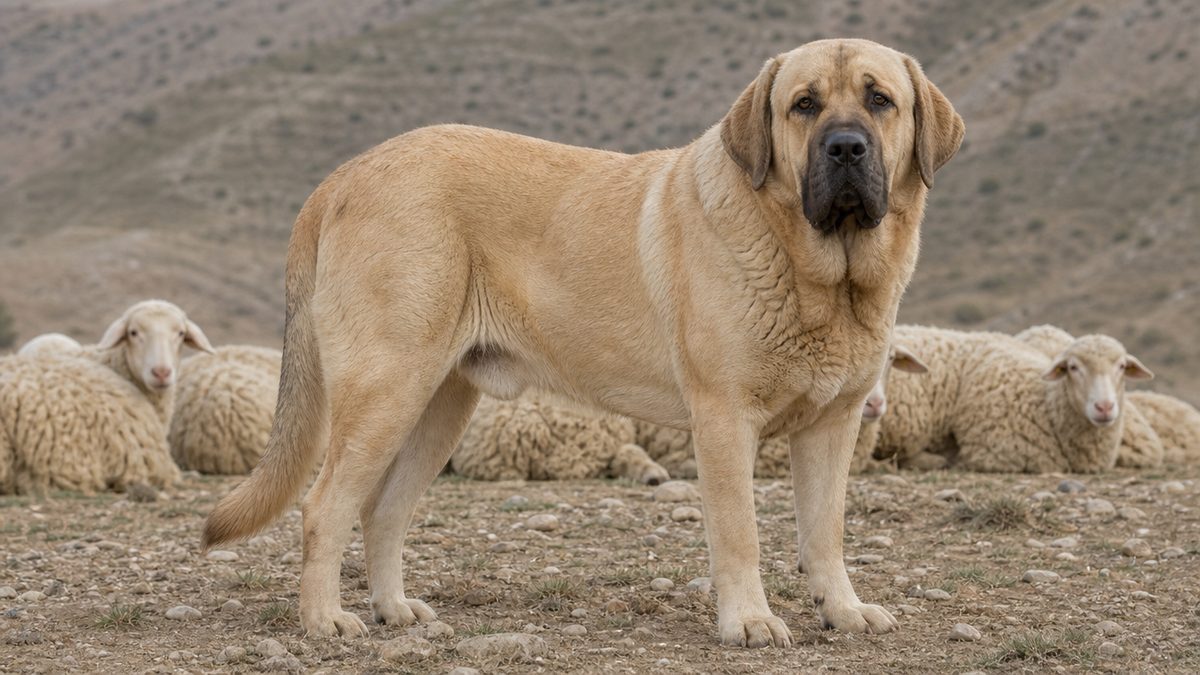
The measured dog is giant and long-bodied. The single study to measure the breed weighed and measured 74 dogs across nine locations in Sulaymaniyah Governorate and reported a mean body weight of 73.50 kg with a standard deviation of 13.33 kg, and a mean body length of 75.71 cm. Its own figure caption describes a yellow Pishdar dog with a long tail that curves up over the back when the dog is warning.
The oldest description in English is from 1892 and it is worth reading for what it does not settle. John Paul Dudley's *Homo Et Canis* describes a dog resembling the English Mastiff, mainly tawny, with a long tail and a large head, tall and ponderous, treated as almost sacred by its Kurdish owner and unable to bear a change of country. But it places the dog in Kurdistan in northern Asia Minor and that region of Asia, a span that takes in Anatolia, so it does not distinguish this dog from the Turkish guardians of the same description. A 134-year-old travel-adjacent account is evidence that the name is old. It is not evidence about the breed's boundaries.
Rudaw's report states that Pshdar dogs are among the oldest breeds in Asia, dating back 5,000 years, and the figure circulates widely. No source anywhere supports it. There is no archaeological study of this population, no genetic dating, and no breed record older than the 1892 mention. Bonbeno reports the claim as a claim and publishes no age for the breed. The general antiquity of guardian dogs in Mesopotamia is real; a specific 5,000-year lineage for this specific dog is not evidenced.
Is the Kurdish Mastiff a breed? It fails both of Bonbeno's conditions
The Kurdish Mastiff fails both conditions of Bonbeno's two-condition test, so this site treats it as a type rather than a breed. The rule is published on Bonbeno's own page for names used like breeds that are not breeds, and it is short: a breed has a written standard and a studbook behind it, so a puppy can be measured against something. This dog has neither, and there is no body anywhere that could supply either.
Registry recognition is the whole question here, and a test only means something if it can come out either way, so it is worth naming the range. Bonbeno applied the same rule to the Koolie, an Australian working dog no national kennel club recognises, and concluded that the Koolie is a breed, because three Australian organisations register it and its club publishes a written conformation document. It applied the rule to the Kars and got a split verdict, because Turkiye registered that dog twice in 2002 and then gave it no breed code. The Kurdish Mastiff sits at the far end: nothing on either side.
Condition one: is there a written standard? No, and no body exists to write one
The absence is structural rather than accidental, and the FCI's own members register shows why. Bonbeno read that register in full on 2 September 2026, confirming the page's own heading, and Iraq appears nowhere in it. The controls are the striking part: Turkey, Iran, Pakistan, Jordan, Kuwait, Lebanon, Bahrain, the United Arab Emirates, Egypt, Israel, Armenia, Azerbaijan, Georgia, the Russian Federation and India are all listed. Iraq is the gap in an otherwise complete regional map.
So there is no Iraqi national canine organisation to author a standard and no route by which one could be adopted internationally. The FCI's own letter K nomenclature confirms the downstream result: fourteen breeds are listed, including Kangal 331, Kavkazskaia Ovtcharka 328, Karst Shepherd 278, Kazakh Tazy 372, Komondor 53 and Kuvasz 54, and there is no Kurdish Mastiff. Six controls present on one page in one session makes that a real absence.
One further check is worth running because it could have gone the other way. Turkiye's kennel club maintains an explicit Grup 11 for breeds the FCI does not recognise, holding 33 dogs including several Turkish natives and several foreign ones. Bonbeno searched all 460 entries in that index for Kurdish, Pshdar, Pishdar, Pisder, Assyrian and Iraq. All six return zero, with Kangal and Akbas present as controls. Even the region's one kennel club with a home for unrecognised breeds has no room for this one.
Condition two: is there a studbook? No, and the substitute is revealing
No register anywhere holds this dog, no herdbook exists, and there is nothing to enter a litter into. What exists instead is worth describing, because it is what a market produces when no institution does. Rudaw's report from Saqqez quotes the breeder Milad Faizi explaining his own documentation system: he makes the dogs ID cards himself, recording each dog's date of birth and the vaccines and medications it needs, so that its medical care is easier later.
That is a genuinely useful thing for a breeder to do and it is not a studbook. It records one man's animals for one man's purposes. It cannot verify parentage to anyone else, it is not held by any body, and it does not survive the breeder. A buyer handed such a card has a vaccination record, not pedigree documents.
| Condition | Koolie | Kars | Kurdish Mastiff | Kuchi |
|---|---|---|---|---|
| A written standard | Yes, a club document | Yes, two state registrations | No. No Iraqi body exists to publish one | No |
| A studbook | Yes, three registers | No | No. A breeder's own ID cards are the nearest thing | No |
| Home country in the FCI | Yes, but the breed is excluded | Yes, via KIF | No. Iraq is absent from the register | No |
| Verdict on Bonbeno's rule | A breed | Split | A type, not a breed | A type, not a breed |
Landrace is not the reason, and this is where writers go wrong
Being a landrace does not by itself put a dog on Bonbeno's types-not-breeds page, and the rule says so. The English Shepherd is a landrace with United Kennel Club registration since 1927, and the Africanis is a landrace with a published Kennel Union of Southern Africa emerging-breed standard. Both are landraces and both have a document, so neither belongs there. What decides it is a missing document, not the way the population was shaped.
The Kurdish Mastiff is a landrace *and* has no document, and the conjunction is what settles it. None of this is a criticism of the dogs. An unregistered dog is not an inferior dog, and the shepherds using these animals against wolves do not need a studbook. It means only that in a market where the document is usually the pitch, there is no document to check, and the practical consequence for an Indian buyer is absolute: since the Kars is absent from FCI nomenclature no KCI registration is possible for it either, and the same is true here.
The one study that measured this dog, and what every page drops from it
One study has ever measured the Kurdish Mastiff, and it reports a mean body weight of 73.50 kg with a standard deviation of 13.33 kg across 74 dogs. Every page that quotes it drops the dispersion, and the best of them says openly that it could not reach the paper and is working from secondary summaries. Bonbeno read the full text.
The paper is Abd Alsada, AL-Barzinji and Abbass, *Genetic Evaluation and Factors Affecting Body Weight and Dimensions of Pishdar Dog in Iraqi, Kurdistan*, published in *Biochemical and Cellular Archives* volume 20 issue 1, pages 2761 to 2767, in 2020, received 26 October 2019 and accepted 25 January 2020. The authors are at the College of Veterinary Medicine at the University of Sulaimani and the College of Agriculture Engineering Science at Salahaddin University in Erbil. It is worth knowing the venue: *Biochemical and Cellular Archives* is a general multidisciplinary journal rather than a veterinary one, which is unusual for a morphometry paper and is a fact rather than a verdict.
What it actually found
The sample is 74 dogs, 46 males and 28 females, aged one to twelve years, drawn from nine named locations across Sulaymaniyah Governorate with coordinates printed for each: Dukan, Halabja, Huwana, Pishdar, Rania, Sangasar, Qala-Diza, Sitak and Sulaymaniyah city.
| Location | Mean body weight | What the SD tells you |
|---|---|---|
| Qala-Diza | 80.00 ± 18.25 kg | Heaviest group mean, and the widest spread |
| Dukan | 78.16 ± 8.13 kg | |
| Rania | 76.00 ± 8.09 kg | |
| Halabja | 75.00 ± 0.00 kg | A standard deviation of zero means one dog |
| Sitak | 75.00 ± 0.00 kg | Also one dog |
| Pishdar | 73.75 ± 17.96 kg | The district the breed is named for |
| Huwana | 72.50 ± 10.60 kg | |
| Sulaymaniyah city | 72.16 ± 15.79 kg | |
| Sangasar | 67.50 ± 8.21 kg | Lightest group mean |
| Overall | 73.50 ± 13.33 kg | n = 74 |
Two of the nine locations report a standard deviation of exactly 0.00. A standard deviation of zero across a group means the group contains one animal, so Halabja and Sitak each rest on a single dog, and their identical 75.00 kg is a coincidence of two individual weights rather than a regional finding. Nobody quoting this study has said so.
Four things the downstream pages lose
Reading the paper rather than a summary corrects four separate distortions, and they compound.
- The dispersion vanishes. Every page prints 73.50 kg. The paper prints 73.50 ± 13.33 kg, which means roughly two thirds of these dogs fall between 60 and 87 kg. On a landrace with no selection standard, the spread is the finding.
- The location means become a range. Wikipedia writes that the average is at 73.50 kg, reaching from 67 kg in Sangasar to 80 kg in Qira Diza. Those are two group means, not the lightest and heaviest dogs, and reading them as a range makes the breed look far more uniform than it is.
- A digit and a place name both drift. The paper says Sangasar averaged 67.5 kg and names the heaviest location Qala-Diza. Wikipedia prints 67 kg and Qira Diza. Neither error is large; both show that nobody in the chain opened the source.
- The population hedge disappears. The paper says the native population is *thought to be not exceeding* a few thousand head. Wikipedia says the dogs *number around* a few thousand. An unverified upper bound has become a count.
The genetic result, which is the part with real consequences
The same paper ran a mixed-model genetic evaluation and reported estimated breeding values for body weight ranging from minus 45.0 to plus 35.0 kg, concluding that there is high genetic variation among these dogs and that selection could substantially change growth performance. An 80 kg spread in breeding value, on a population whose mean weight is 73.5 kg, is enormous. It is exactly what an unselected landrace looks like from the inside, and it is the strongest single argument that no published size figure describes a predictable animal.
The team's companion paper assessed genetic diversity in the same population using RAPD-PCR markers, and a later paper from an overlapping group screened the dogs for a tick-borne pathogen. Those three papers are the whole literature, and the health section returns to what that means.
Heights of up to 90 cm and top weights of 80 kg appear in regional media with no method behind them, and social posts circulate a spec card giving males 65 to 110 kg and heights 77 to 95 cm that matches no published source at all. Bonbeno publishes the study's measured mean and its standard deviation, reports the media figures as reported, and prints no height for the breed, because no study has measured one.
Kurdish Mastiff, Pshdar, Kurdish Kangal: what each name actually buys you
Four names describe this dog and a fifth describes a different one. Kurdish Mastiff, Pshdar dog, Pisder dog and Assyrian Shepherd are the same animal. Kurdish Kangal is a sales label attached to a Kangal, and in India it is the label you will actually be offered.
The first four are settled by the encyclopaedia's own plumbing. The Wikipedia article is titled Kurdish Mastiff, gives Pshdar dog as the common nickname, names Assyrian Shepherd and Pisder dog in its first sentence, and serves the same page when you ask for Pshdar dog, marked Redirected from Pshdar dog. Kurdish speakers write it Segi Pisderi. One dog, four labels, and the district of Pshdar in Sulaymaniyah Governorate underneath all of them.
The fifth name is a different breed with a different legal status
The Kangal is a standardised Turkish breed from Sivas province with FCI standard 331, accepted on a definitive basis on 6 June 1989. It has a breed code at Turkiye's kennel club, a published hip dataset, and a route to a Kennel Club of India pedigree. The Kurdish Mastiff has none of those. Kurdish Kangal is not a third breed sitting between them. No registry anywhere recognises the term.
That would be a pedantic distinction if it did not decide what an Indian buyer receives. It does. The Indian page ranking for the term is Poddarkennel's *Kurdish Kangal Dog Puppy For Sale*, and its body copy is the Kangal's.
The template seam, which proves the page is assembled
This site has a diagnostic for pages built by substituting a name into a template, and it fires cleanly here. The tell is which text carries the advertised name and which carries the real one.
| Where on the page | What it says | What that means |
|---|---|---|
| H1 and page title | Kurdish Kangal | Auto-filled from the URL slug kurdish-kangal.html |
| First colour line | The Kurdish Kangal Dog has a black mask and black velvety ears | The one body sentence carrying the advertised name |
| Distinct Feature | The Kangal Dog is a large, powerful, heavy-boned dog ... its continued use in Turkey | A Kangal description, naming Turkey |
| Activity | Kangal Dog is slightly longer than tall ... double coat that is moderately short and quite dense | A Kangal description |
| Temperament | The common Kangal Dog is as a matter of first importance a stock gatekeeper canine | A Kangal description, and spun |
| Character | The Kangal Dog is not prescribed for condo life | A Kangal description |
Every heading and every body sentence except one names the Kangal and locates the dog in Turkey. Only the slug-derived title and a single colour line say Kurdish. That split is the seam between what the software filled in and what a person pasted.
The prose is spun as well, which is its own tell. A standard English Kangal description reading *first and foremost a stock guardian dog*, *alert, territorial and protective*, *the strength, the speed and the courage to intercept and confront*, *good fencing is therefore wise* and *a dog communicates his displeasure with growling and eventually biting* appears here as *as a matter of first importance a stock gatekeeper canine*, *ready, regional and cautious*, *the quality, the pace and the mettle to capture and defy*, *Great fencing is in this way keen* and *adog speaks his disappointment with snarling and in the long run gnawing*. Those are synonym substitutions applied to somebody else's text, not writing.
The same page advertises With KCI Paper, 100 percent Pure Breed, All India Home Delivery and a Life Long Breed Guarentee, and carries no price at all despite a meta description promising puppy price. The Kennel Club of India issues pedigrees against FCI nomenclature, and neither Kurdish Mastiff nor Kurdish Kangal appears in it under any spelling. So a KCI paper cannot say Kurdish Kangal. If papers come with such a dog, they say Kangal, and you are buying a Kangal. That may be a perfectly good dog. It is not the animal you searched for, and you should know which one you are paying for.
The entire world literature on this dog is three papers by one research group
Three published papers exist on the Kurdish Mastiff and all three come from one research group at the University of Sulaimani and Salahaddin University in Erbil. Two of them share a first author. No independent team anywhere has ever studied this breed, and that single fact frames everything else on this page.
Bonbeno searched PubMed across eleven query forms in one session on 2 September 2026, reading the printed query translation each time, with controls returning sane counts in the same session: Labrador plus hip dysplasia at 124 records, and *"Kangal dog"* at 4 records, all four genuinely on-breed. The instrument was healthy. Here is what it returned.
| Query | Count | What actually came back |
|---|---|---|
| "Kurdish Mastiff" | 0 | PubMed mapped Kurdish to the Supplementary Concept kurdish people |
| "Assyrian Shepherd" | 0 | It mapped Assyrian to the Supplementary Concept assyrian people |
| "Pishdar dog" | 0 | Nothing, on this spelling |
| "Pshdar dog" | 1 | The spelling change finds the paper |
| Pshdar | 1 | The same single record |
| Pishdar | 4 | All noise. Pishdar is a Kurdish surname, so the hits are a social-anxiety paper, a Parkinson's paper, a study of female genital mutilation and one on sewage sludge and Bermudagrass |
| "Pisder dog" | 404,531 | PubMed discarded Pisder entirely and searched dog |
| Kurdish AND dog AND Iraq | 2 | The one real paper, plus a 2000 article on chemical warfare |
| Labrador AND "hip dysplasia" (control) | 124 | Healthy |
| "Kangal dog" (control) | 4 | Healthy, all on-breed |
Three separate failure modes in one table
Each row above fails differently, and naming the mechanisms is more useful than the counts.
- The name collapses into an ethnicity. Both *Kurdish* and *Assyrian* map to MeSH Supplementary Concepts for the peoples, so the breed name is swallowed by human population research before the search begins. Bonbeno hit the identical mechanism on the Kars, where *Caucasian* maps to the MeSH term white people and the Caucasian Ovcharka's Russian name returns over 170,000 human medical records.
- One letter decides everything. *"Pishdar dog"* returns zero and *"Pshdar dog"* returns the only indexed paper on the breed. An agent searching the spelling the study itself uses in its title would have reported the literature as empty.
- A dropped token inflates a count into nonsense. *"Pisder dog"* returns 404,531 records because PubMed threw away *Pisder* and searched *dog*. A six-figure count for a Kurdish landrace is proof of a rewrite, not of literature.
- The bare name is a surname. *Pishdar* alone returns four records, none about dogs, because it is a Kurdish family name.
PubMed's zero is not the whole literature, and that is the important part
The morphometry paper that every page in the world quotes is not in PubMed at all. *Biochemical and Cellular Archives* is not indexed there, which is why *"Pishdar dog"* returns nothing while the paper plainly exists. Anyone who ran a PubMed search, found zero and concluded the breed had never been studied would have been wrong, and the correction cost one spelling change and one search outside PubMed.
| Paper | Year | What it measured | Indexed in PubMed |
|---|---|---|---|
| Abd Alsada, AL-Barzinji and Abbass, *Biochemical and Cellular Archives* 20(1):2761-2767 | 2020 | Body weight and 24 body dimensions of 74 dogs, plus a BLUP genetic evaluation | No |
| Abd Alsada Alwaeily and Al-Barzinji, RAPD-PCR study | 2020 | Genetic diversity in the same population | No |
| Arif, Khan, Al-Sada and Al-Barzinji, *Veterinary World* 17(12):2797-2801 | 2024 | Anaplasma platys in 75 dogs by PCR of the 16S rRNA gene | Yes, PMID 39897350 |
Two of the four authors of the 2024 paper, Al-Sada and Al-Barzinji, are authors of the 2020 morphometry paper Arif ED, Khan KMH, Al-Sada IHA. So the three papers are one continuous programme rather than three independent looks at the same dog, and nothing in them has been replicated by anyone else.
It does not mean the work is wrong. It is careful, it prints its coordinates, its sample sizes and its standard deviations, and it is the only reason anybody can say anything quantitative about this dog. It means that every number on this page and every number on every other page about this breed rests on one team's fieldwork in one governorate, and that no independent replication exists. Treat the figures as the best available rather than as settled, and be sceptical of any page that presents them without that qualification.
Kurdish Mastiff price in India: you are being quoted a different dog
No kurdish mastiff price in india exists, because no Indian seller offers the breed. What an Indian search returns instead is ten pages about the Kangal, two of them selling a Kurdish Kangal, and that substitution is the finding rather than the gap.
Run the search and read the results rather than the count. An India-located pull for *kurdish mastiff price in india* on 2 September 2026 returned Supertails on Kangal dog price, a YouTube video on Kangal puppies for sale in India, a Quora thread on buying a Turkish Kangal in India, a Facebook post offering Kurdish Kangal pups for pre-order in Delhi, an Instagram page on Kangal puppy price, Patmypets on Kangal dog price, Poddarkennel's Kurdish Kangal page, a Pinterest board on Kangal dog price, another Kangal price video and DogsIndia's homepage. Not one result names the Kurdish Mastiff or the Pshdar dog.
The control is what makes that worth anything. The query *labrador retriever price in india*, on the same instrument in the same session, returned ten genuine Indian Labrador pages with live rupee prices, including a full quality-tier table running ₹30,000 to ₹60,000 for basic, ₹60,000 to ₹90,000 for KCI registered and ₹90,000 to ₹1,20,000 for champion bloodline. The instrument works. It simply has no Kurdish Mastiff to return.
The Indian prices that do appear belong to the Kangal
Every rupee figure a search for this breed surfaces in India is a Kangal price. Supertails and Patmypets both publish ₹60,000 to ₹1,50,000 for a Kangal, and Bonbeno's own Kangal page establishes that those two pages carry one table between them, with five of six city rows matching to the rupee and the sixth differing only because a zero was dropped. So the numbers an Indian buyer will be shown for a Kurdish Mastiff are a second-hand price for a different breed, taken from a table that is itself a duplicate.
Bonbeno prints none of them as this breed's price in india, and prints no converted figure either. This site has repeatedly caught Indian pages publishing dollar prices with the symbol stripped or divided at 84.38, 80, 74 or 66.67, and has caught an answer engine inventing a rupee band for a page containing no rupee figure at all. There is nothing here to convert, because no Indian seller has published a number for this dog.
The one real price, and why it stays in dollars
A genuine figure does exist, in the home range. Kurdistan Chronicle reports that Pishdars are valuable in the Kurdistan Region, particularly in mountainous areas, with prices for some exceeding USD 10,000. Its shepherd interviewee says plainly that most shepherds cannot afford one and must take a puppy, breed their own, or borrow a dog from someone else.
Bonbeno publishes no rupee conversion of that figure and no reader should make one. The reason is method rather than caution. A converted price is not an observation about India; it is arithmetic dressed as a market. This site has traced Indian breed prices that turned out to be American price lists divided by a single rate, and the exceptions in those tables were always the rows a human had typed by hand. Printing a rupee equivalent of USD 10,000 here would manufacture exactly the kind of figure the rest of this page exists to debunk.
Two structural reasons no Indian price can form
- India closes the commercial import route. Live dogs sit at ITC(HS) 01061900 as a Restricted import under Policy Conditions 7 and 8, and the Directorate General of Foreign Trade states that applications to import for trading or breeding purposes shall be duly rejected. Entry is allowed only for a pet accompanying its owner with a valid pet book in that owner's name, for research with CPCSEA recommendation, or for Defence and Police use. There is no import route that founds a breeding population.
- There is nothing to register at the far end. Even a lawfully imported pet cannot be entered on any Indian register, because the KCI issues pedigrees against FCI nomenclature and this breed is absent from it. A dog with no possible papers has no premium market, and a market with no premium has no published price.
Creatures.com is a domain Bonbeno has repeatedly caught generating false breed content, and its Kars page is a clean example: two paragraphs of generic text, 55 listed coat colours including albino, blue merle, harlequin and both Gray and Grey, all four counters at zero, and a blue pullet in Texas among the featured listings on a dog page. Its Kurdish Mastiff page is the opposite. It separates the Pshdar from the Kangal correctly, calls Kurdish Kangal a marketing label, cites the 2020 study and Rudaw, says outright that no breed standard, studbook, health survey or screening scheme exists, and adds that apart from the mean weight its figures reach it through secondary summaries rather than the study itself. Same domain, same week, opposite quality. A verdict about a site is not a verdict about a page, and the only way to tell is to open both.
Cost of ownership in India for a 73 kg guardian, which is real even when the price is not
Keeping a 73 kg guardian in an Indian city costs roughly ₹8,000 to ₹15,000 a month before anything goes wrong, and food alone runs ₹6,000 to ₹9,000. There is no Kurdish Mastiff purchase price to quote, but every running cost below is a published Indian figure that applies to any dog of this size living here.
The distinction between a breed price and a care cost is why this section exists. Inventing a purchase figure would be fabrication. Reporting what Indian owners actually pay to keep a giant dog is not, and it is what anyone planning for one needs.
Start from the national baseline. Voice of Stray Dogs puts total monthly dog ownership in India at ₹3,000 to ₹10,000 and beyond, annual spending for most owners at ₹25,000 to ₹80,000 or more, and lifetime cost across ten to fifteen years at ₹3 lakh to ₹10 lakh. Those are all-breed figures. At 73.5 kg this dog sits above every band in that sentence.
| Line | Published Indian figure | What a 73 kg dog realistically lands on |
|---|---|---|
| Food | ₹1,500-4,000 medium; ₹5,000+ for large working breeds | ₹6,000-9,000 |
| Preventive veterinary care | ₹5,000-8,000 per year | ₹450-700 per month, spread |
| Tick and flea control | Inside preventive care | Non-negotiable in India, see the health section |
| Grooming | ₹300-2,000 per session | ₹600-1,200 per month; a short coat is the one cheap line |
| Boarding when you travel | ₹500-2,000 per day | ₹5,000-20,000 per ten-day trip |
| Typical monthly total | ₹8,000-15,000 |
Food is the line that breaks budgets. VOSD prices quality food for a medium dog at ₹1,500 to ₹4,000 a month and says large working breeds push past ₹5,000. A 73 kg dog is roughly twice a Labrador, and the food bill scales with it. Grooming, unusually for a guardian breed, is the cheap line: the coat is short to medium rather than a long mountain coat, so you are paying for nail, ear and dental care rather than for undercoat work.
The costs that only exist because of this dog's size and job
- Fencing before the dog arrives. A 73 kg territorial guardian that can clear or dig a boundary is a liability rather than a security system, and the fence is a capital cost you incur first, not after the first incident.
- Professional training and behaviour support, as a first-year cost. A basic course runs ₹5,000 to ₹15,000 and a behaviourist assessment and programme ₹3,000 to ₹10,000. For a breed that will not train like a retriever, treat the first as planned spending.
- A real emergency reserve. A one to three day hospitalisation at a good clinic costs ₹8,000 to ₹30,000, and orthopaedic intervention after a road accident ₹30,000 to ₹80,000. For a giant deep-chested dog, add the possibility of emergency bloat surgery, which is a same-night decision rather than a planned one.
- Cooling, which is electricity. A guardian from a 19.5 percent humidity summer needs a genuinely cool space through an Indian one, and in most of the country that means an air conditioner running for part of the day. It is a recurring line no international breed page prices.
Two Indian realities that change the arithmetic
City matters more than breed on several lines. VOSD notes that a dog costing ₹4,000 a month in Pune may cost ₹7,000 in South Delhi, and that veterinary fees in Mumbai and Bengaluru run considerably higher than in tier 2 and tier 3 cities. Its own average across more than 1,800 dogs in a seven-acre facility is over ₹5,000 per dog per month, achieved at institutional scale with in-house medical capacity. A single giant guardian in a metro flat will not beat that.
The second reality is that the cost of ownership here is genuinely knowable while the purchase price is not, and that asymmetry is worth sitting with. Anyone who tells you what a Kurdish Mastiff costs to buy in India is guessing or selling you a Kangal. Anyone can tell you what it costs to keep, because that depends on the dog's size and your city, both of which are known.
If ₹8,000 to ₹15,000 a month plus a fence and a reserve fund is the real number, compare it against what the same money buys elsewhere. A Himalayan Sheepdog or a Bakharwal does the same job at a similar size, already lives in this climate, and can be met in person before you commit. The running cost is nearly identical; the difference is that you can see the dog and its parents first.
Heat tolerance: this dog is arid-adapted, not heat-proof
The Kurdish Mastiff handles dry heat and fails in humid heat, which is the opposite of what most Indian buyers assume about a mountain guardian. Its homeland reaches 32.08 C in July at 19.5 percent relative humidity. Chennai's hottest month is cooler at 31.51 C and sits at 64.52 percent, and that difference is the whole argument.
Bonbeno queried NASA POWER by explicit latitude and longitude rather than by place name, using the exact coordinates the 2020 study prints for its own Pishdar sampling point, 36 degrees 9 minutes 47 seconds north by 45 degrees 7 minutes 6 seconds east NASA POWER Climatology API. Every query below echoes back its coordinates and the elevation the model is standing at, because a climate figure for the wrong place would discredit the most original argument on this page.
| Place | Annual mean | Hottest month | Humidity in that month | Peak daily max |
|---|---|---|---|---|
| Pishdar district, Iraq | 17.75 C | July, 32.08 C | 19.50 percent | 46.10 C |
| Sulaymaniyah, Iraq | 17.06 C | July, 31.24 C | 19.03 percent | 45.69 C |
| Saqqez, Iran | 11.77 C | July, 25.90 C | 25.58 percent | 40.25 C |
| Delhi | 25.60 C | June, 35.88 C | 36.42 percent | 48.79 C |
| Bengaluru | 23.74 C | April, 28.37 C | 48.73 percent | 40.38 C |
| Mumbai | 26.77 C | May, 31.19 C | 60.19 percent | 44.85 C |
| Chennai | 27.95 C | May, 31.51 C | 64.52 percent | 42.70 C |
Three of those rows carry their own elevation echo and their own coordinates: Sulaymaniyah city at a 1,056.28 m cell, Saqqez in Iranian Kurdistan at 1,781.02 m, and Bengaluru, India's mildest large city, at 841.72 m with an April mean of 28.37 C. Read the Pishdar and Chennai rows against each other. Chennai's hottest month is 0.57 C cooler than Pishdar's and carries 45 percentage points more humidity. A dog cools itself by evaporating water off the surfaces of its airway, and that mechanism gets progressively less effective as the air it is panting into fills with water. So a Chennai May at 31.51 C is far harder on this dog than a Pishdar July at 32.08 C, despite the lower number, and that is why Bonbeno rates heat tolerance 2 of 5 rather than 1.
The corollary is unusual and worth acting on: Delhi suits this breed better than Chennai or Mumbai do, even though Delhi is hotter. A Delhi June at 35.88 C and 36.42 percent humidity is dry heat of the kind this dog evolved in, and a Delhi January at 13.61 C is genuinely pleasant for it. Coastal humidity is the enemy here, not the thermometer, which is the reverse of the advice most guardian-breed pages give.
The elevation check, and it failed badly in exactly the place it should
NASA POWER returns a grid cell rather than a point, and in mountainous terrain the cell's mean elevation can miss the ground beneath it by hundreds of metres. Iraqi Kurdistan is exactly that terrain, so the check is mandatory. Bonbeno compared each POWER cell elevation against SRTM 30 m elevation at the same coordinates.
| Point | POWER cell | Real SRTM | Error |
|---|---|---|---|
| Pishdar sampling point | 936.65 m | 621 m | +316 m |
| Qaladze town | 936.65 m | 627 m | +310 m |
| Ranya | 1,531.95 m | 575 m | +957 m |
| Sulaymaniyah | 1,056.28 m | 845 m | +211 m |
| Saqqez, Iran | 1,781.02 m | 1,516 m | +265 m |
The Ranya row is unusable without correction. The model is standing 957 m above the town, and at a lapse rate near 6.5 C per 1,000 m that makes its figures roughly 6.2 C too cold. Corrected, Ranya's annual mean rises from 13.04 C to about 19.3 C, which is close to the Pishdar cell's 17.75 C and consistent with two towns 30 km apart in the same plain. Bonbeno publishes the correction as an estimate and labels it one, and uses the Pishdar cell rather than the Ranya cell for every comparison above.
A second tell fired at the same time and it is worth naming. The Pishdar sampling point and Qaladze town, about two kilometres apart, returned byte-identical output: the same 936.65 m elevation, the same 17.75 C annual mean, the same 32.08 C July and the same 19.50 percent humidity, to the decimal. That is one grid cell queried twice. It cannot distinguish the two places and Bonbeno does not present the match as a finding.
Why a 73 kg dog is at risk in India whatever the humidity
A Kurdish Mastiff enters the highest weight band the heat-illness literature measures, and the danger comes from movement rather than from parked cars. Two findings transfer to this dog by body plan rather than by breed name, and one Indian legal clause follows from them.
Two of the strongest risk factors in the heat-illness literature apply to this dog by body plan rather than by breed name. Hall and colleagues, in *Scientific Reports*, found dogs at or above their breed and sex mean bodyweight carried 1.42 times the odds of heat-related illness (95 percent CI 1.12 to 1.80), and dogs over 50 kg carried 3.42 times the odds (95 percent CI 1.54 to 7.57). This breed was not in that model, so Bonbeno claims only the transferable point: a mean of 73.5 kg puts the average dog of this type well inside the highest weight band the paper measured.
The companion paper in *Animals* explains where the danger comes from. Of the 879 heat-illness events with a recorded trigger, 652, or 74.2 percent, were exertional, against 113 environmental and 46 from vehicular confinement. Dogs overheat while doing something, which for a guardian that patrols means the timing of exercise matters more than the shade does.
India's Dog Breeding and Marketing Rules 2017 bar keeping certain dogs in outdoor facilities without the attending veterinary practitioner's written approval. The clause is Second Schedule Part IV paragraph 21(1), Outdoor housing facilities, not Rule 21; the Rules themselves stop at Rule 13, so any citation numbered 14 or higher is wrong by construction. It names dogs not accustomed to local temperatures and breeds that cannot tolerate them. Read alongside the India Meteorological Department heat-wave thresholds the WHO reproduces for India, the outdoor option closes across most of the country from March to June for a dog of this size.
Legal status in India: not banned, not importable, and the fighting problem is the real one
No Indian law bans owning a Kurdish Mastiff, and the breed was never named in the circular people remember. What Indian law does do is close the commercial import route, leave the dog outside every register India recognises, and criminalise the activity a significant part of this breed's trade exists for.
Deal with the ban question first. The central circular of 12 March 2024 listed breeds the government proposed to prohibit, and neither Kurdish Mastiff nor Pshdar dog appears among the names reproduced in the press coverage of that list. Bonbeno has not seen the circular itself and the reported count of breeds varies between 19 and 25 across sources, so this page states only what it can check.
In any case the circular no longer has force. The Karnataka High Court quashed it on 10 April 2024 and the Delhi High Court set it aside on 16 April 2024. No Indian law in force today bans owning, breeding or selling any of the breeds it named. Karnataka expressly left open a properly made Rules amendment after due process, so this is neither a ban nor a settled all-clear.
You cannot lawfully import one to breed or sell
Live dogs sit at ITC(HS) 01061900 as a Restricted import under Policy Conditions 7 and 8, and the Directorate General of Foreign Trade states that applications for trading or breeding purposes shall be duly rejected. Entry is permitted only for a pet accompanying its owner with a valid pet book in that owner's name, for research and development with CPCSEA recommendation, or for Defence and Police use.
Rabies control adds friction on any route. The United States Centers for Disease Control lists Iraq, Iran, Turkey and India all as high-risk countries for dog rabies as of its 15 April 2026 revision. That is a US instrument rather than an Indian one, so it does not govern an import into India, but it tells you the disease context both ends of any such movement sit in, and it is why quarantine and titre paperwork is heavy wherever this dog goes.
Dog fighting: what Indian law says, and what the penalty actually is
Dog fighting is illegal in India under two separate clauses of the Prevention of Cruelty to Animals Act 1960, and the penalties are small enough that saying them out loud matters. This section belongs on this breed page rather than any other, because organised fighting is a documented and continuing part of this dog trade.
This is the clause that matters for this breed, because organised fighting is a documented and ongoing part of its trade Rudaw, Saqqez dog breeder raises famed…. Two separate provisions of the Prevention of Cruelty to Animals Act 1960 apply, and they are not equivalent.
| Provision | What it covers | Cognizable? |
|---|---|---|
| Section 11(1)(m)(ii) | Incites any animal to fight or bait any other animal, under a chapeau reading solely with a view to providing entertainment | No |
| Section 11(1)(n) | Organises, keeps, uses or acts in the management of any place for animal fighting | Yes, section 31 makes clauses (l), (n) and (o) cognizable |
So the *venue* offence is cognizable and the *inciting* offence is not, and writing that dog fighting is simply a cognizable offence in India flattens a distinction that decides whether police can act without a warrant. The penalties under section 11(1) deserve stating rather than skipping: a first offence attracts a fine of ten to fifty rupees, and a second within three years a fine of twenty-five to one hundred rupees, or up to three months' imprisonment, or both. A page that says fighting is illegal without saying what the penalty is leaves the reader with a false impression of deterrence.
One historical point, because dates get misattributed. Neither fighting clause existed in the 1960 Act as passed. Both took their current form through section 10 of Act 26 of 1982, with effect from 30 July 1982. Citing them as PCA Act 1960 provisions remains correct, since an Act is cited by its year of enactment, but if you are ever making a claim about when this conduct became an offence in India, the year is 1982.
Three more clauses that bite for a giant guardian
- Ear cropping. Working dogs of this type in the home range frequently have their ears cropped short. In India that is prohibited outright: Second Schedule Part II paragraph 6(8) bars tail docking, ear cropping, de-barking, de-clawing and any change of appearance by artificial means. A cropped dog cannot lawfully be produced here, and Bonbeno will not illustrate one.
- Sale below eight weeks. Rule 8(1)(a), a genuine Rule rather than a Schedule paragraph, provides that pups less than eight weeks in age are not sold.
- Close breeding. Second Schedule Part II paragraph 6(3) prohibits in-breeding within the first four generations, naming uncle to niece, nephew to aunt, cousin to cousin and grandparent to grandchild, and incest breeding between parents and children or brother and sister. Any attempt to found a line here from a handful of imported dogs runs straight into it.
A significant share of the demand pulling these dogs out of Pshdar is fighting demand. Kurdistan Chronicle reports Iranian buyers purchasing increasing numbers for fighting competitions involving gambling, an owner warning that the district will soon have very few dogs left, dogs being stolen for their value and one recovered from Iran with police help, and fighting continuing monthly through autumn and winter before crowds of around 2,000 although it is prohibited in the Kurdistan Region. Rudaw reports puppies moved from Iraq into Iran explicitly for guard duties or blood sport. Buying into that trade from India would be funding it, and it would be illegal at the far end and pointless at this one. There is no version of acquiring this dog that both works and is clean.
Temperament and household fit: who should not buy this dog
The Kurdish Mastiff suits a working rural property with livestock, a real boundary and an experienced handler, and suits nothing else. Its own keepers say so: a Ranya owner with eleven of them keeps every one on a farm outside town because, in his words, they are not suitable as pets in a home or an apartment.
Take the owners' descriptions seriously, because they come from people who live with the dogs rather than from anyone selling them. Kurdistan Chronicle's interviewees describe the dogs as calm and obedient with their own people but always on high alert and ready to charge at any sign of danger, working through the night against wolves and bears, and a shepherd in the Pshdar district says flatly that without one you cannot be a shepherd there.
That is a job description, not a temperament rating, and it translates directly into what an Indian household would experience. A guard dog selected to face a wolf pack alone at two in the morning does not become a different animal because it now lives behind a gate in Pune.
What an Indian home generates that this dog cannot process
The mismatch is about traffic rather than aggression in the abstract. An Indian household of almost any kind produces a daily stream of people who are strangers to the dog and are not going away: domestic help, a cook, a maali, a dhobi, a courier, a food-delivery rider, a meter reader, a plumber, a society guard on rounds, and relatives who arrive unannounced. A protective guardian treats each of those as its job, every time.
In a flat this is unworkable. A shared corridor gives a territorial dog a doorway to defend and no territory beyond it, and a lift lobby puts strangers inside the protection zone several times a day. Bonbeno rates apartment suitability 1 of 5 here and would say the same of any livestock guardian, but the weight makes it worse: at a mean of 73.5 kg this dog outweighs most of the adults it would meet.
The narrow profile it could work for
- Owns rural or peri-urban land with a genuine boundary. Not a wall the dog can clear, and not a gate opening onto a public lane.
- Has livestock or a real property to guard. A guardian without a charge invents one, and the invented charge is the front gate and everyone who passes it.
- Has kept a large independent breed before. A first dog should never be a 73 kg animal bred to make its own decisions about threats.
- Can supply ten kilometres of movement a day. That is the figure an owner in the home range gives, and the exercise section takes it seriously.
- Lives somewhere dry. This is an arid-climate dog, so inland northern India is a far better fit than any coastal city.
- Accepts that visitors need managing forever. Socialisation reduces reactivity. It does not produce a dog that greets strangers.
Who should not, and what goes wrong
If you live in a flat, want a family dog that greets guests, are buying your first large dog, travel often, or live in Chennai, Mumbai, Kolkata or coastal Kerala, this is the wrong dog and no training changes that. The failure mode is predictable and this site has watched it play out across guardian breeds: a powerful, aloof, under-exercised dog becomes a boundary specialist, barking at every passer-by and charging the gate, escalating each time because the person always leaves. That produces a society complaint, then confinement, and a confined guardian is where these breeds become genuinely dangerous.
There is a second failure mode specific to this dog and it is worse. A breed with a documented fighting trade attracts buyers who want that, and Indian sellers of guardian breeds do market aggression. A dog encouraged toward it becomes an animal no clinic will handle without sedation and no one can rehome.
If you want a large guardian for Indian land, the Himalayan Sheepdog and the Bakharwal do this job here already, and you can meet an adult and its parents before committing. If you want specifically a big Middle Eastern or Anatolian guardian with paperwork you can check, the Kangal has an FCI standard, a KCI route and a published hip dataset. If what draws you is the size, the Tibetan Mastiff is the giant guardian with an actual Indian market. None of these is a consolation prize; each is a dog you can verify.
Training a dog selected to work without instructions
To train a Kurdish Mastiff, aim for reliable management rather than obedience and expect two to three years rather than two to three months. This is a livestock guardian bred to hold a flock against wolves and bears alone at night and to decide for itself what a threat is, and that judgement is the trait the dog exists for.
Bonbeno rates trainability 1 of 5 for this breed, and the reason is selection history rather than intelligence. Owners in the home range describe the dogs as calm and obedient with their own people while always on high alert and ready to charge at danger. A dog that could not think would be useless on a mountain at night, and a dog that waited to be told would be useless there too.
What works
- Socialise early, wide and calmly. The window closes fast. Introduce the puppy to the specific human traffic your Indian household generates, delivery riders, domestic staff, the society guard, and get it done before sixteen weeks. You are teaching the dog who belongs, not teaching it to like strangers.
- Manage the environment rather than the dog. A guardian that never rehearses a bad response does not learn one. That means a gate protocol, a place the dog goes when the bell rings, and never letting a shared corridor become its territory.
- Reward what you want and expect the dog to consider your request. Compulsion produces resistance in a 73 kg independent animal. A pause before compliance is normal and is not defiance.
- Condition a muzzle as a routine life skill. A dog this size will need restraint at a clinic sooner or later, and a first muzzle experience in a corridor goes badly. Start it in the socialisation window.
- Keep sessions short. Five focused minutes twice a day beats a half-hour that ends in a contest of wills.
What does not work, and one thing that must never be tried
Correction-based handling is the common failure and it is dangerous at this weight. So is assuming a guardian generalises: a dog calm with your family is not thereby calm with your neighbour's, and reliable at home is not reliable at a vet's.
The thing that must never be tried is deliberately encouraging fighting drive. It is worth saying plainly on this page rather than any other, because this breed has a documented fighting trade behind it Rudaw, Saqqez dog breeder raises famed…, and Indian sellers of guardian breeds do market aggression. Beyond the ethics, section 11(1)(m)(ii) of the Prevention of Cruelty to Animals Act covers inciting an animal to fight, and the practical result is an animal that cannot be handled, treated or rehomed.
A realistic timeline, with the one Indian complication
| Age | What is happening | What you work on |
|---|---|---|
| 8-16 weeks | The socialisation window, and the only one you get | Every visitor category, surfaces, crate, car, muzzle games, handling of feet, ears and mouth |
| 4-8 months | Size arriving faster than judgement | Loose-lead walking while you still outweigh the dog, recall as a game, the gate protocol |
| 8-14 months | Guarding switches on. Barking at the boundary becomes self-rewarding | Interrupting rehearsal, structured introductions, no unsupervised gate access |
| 14-24 months | Territorial maturity. The dog now has opinions it did not have at a year | Consistency and management. Re-socialise to anything new |
| 2-3 years | Adult judgement settles | Maintenance. A well-managed guardian becomes genuinely easy to live with here |
The Indian complication is the calendar. A puppy born in February hits eight to sixteen weeks in April and May, when in most of the country you cannot take it out during the hours you need. Plan the socialisation window against the season, do the work indoors and at dawn if you must, and never skip it, because there is no second window.
Two opposite mistakes with the same outcome. Punishing every alert produces a dog that stops warning and goes straight to the bite, which is far more dangerous than a barker. Encouraging territorial aggression produces an animal nobody can safely handle. What you want is a dog that alerts, defers to you and settles. That is achievable with this breed and it takes years, not weeks, and the budget line is real: VOSD prices a basic professional course at ₹5,000 to ₹15,000 and a behaviourist assessment and programme at ₹3,000 to ₹10,000.
Exercise: the owners say ten kilometres a day, and the Indian clock decides when
A Kurdish Mastiff needs distance rather than intensity, and its own keepers put the figure at ten kilometres a day. In India the hard part is not the distance but the hours: the times a big arid-climate dog would choose to move are the times an Indian city is most dangerous for it.
The ten-kilometre figure comes from an owner rather than a study, and it deserves the qualification. Kardost Hasan, who keeps eleven of these dogs near Ranya, told Kurdistan Chronicle that Pishdars are not suitable in a home or an apartment because they need to run at least ten kilometres every day, which is why he keeps them all on a farm and takes them daily to run and swim at Ranya Lake a few hundred metres away. Treat it as an experienced keeper's illustration rather than a measured requirement. The direction is not in doubt, and Bonbeno rates exercise need 5 of 5, the highest on the site.
Get the type right before the amount. This is a patrolling and covering dog rather than a sprinting one, so ninety minutes to two hours of walking, sniffing and boundary-checking does more for it than thirty minutes of hard running, and it does not push a 73 kg animal into heat load. The swimming detail from Ranya is worth copying where you can: water work moves a giant dog without loading its joints or its thermoregulation.
The clock, city by city
The exertional finding drives this. Of 879 heat-illness events with a recorded trigger, 652, or 74.2 percent, were exertional, against 113 environmental and 46 from vehicular confinement. Dogs overheat while doing something, so timing beats shade.
| City | Hottest month | Humidity then | Practical window |
|---|---|---|---|
| Delhi | June, 35.88 C, peak 48.79 C | 36.42 percent | Before 05:30 and after 21:30 April to July. December to February is genuinely comfortable for this dog |
| Bengaluru | April, 28.37 C | 48.73 percent | Before 07:00 and after 19:30. The mildest large-city option |
| Pune | April, 28.93 C | 42.11 percent | Before 06:30 and after 20:00 in summer, workable mornings in winter |
| Mumbai | May, 31.19 C | 60.19 percent | Before 06:00 and after 21:00, and humidity limits the dog year round |
| Chennai | May, 31.51 C | 64.52 percent | Before 06:00 and after 21:00, and the coolest month still averages 24.09 C |
Delhi is the instructive case for this particular breed and the answer is counter-intuitive. Its June peak of 48.79 C is the harshest figure in the table, but at 36.42 percent humidity it is the same *kind* of heat this dog evolved in, and its January mean of 13.61 C is close to ideal for it. Chennai and Mumbai offer no such relief: Chennai's coolest month still averages 24.09 C and Mumbai's 23.19 C, both in humid air. A dry 36 C is easier on this dog than a humid 31 C, and any exercise plan that ignores that gets the seasons backwards.
What replaces distance when the window closes
In an Indian summer the outdoor window will close for weeks at a time, and a guardian is not satisfied by fetch.
- Scatter feeding indoors. Spread the day's ration across a room and let the dog work for it. The nose tires a guardian faster than the legs.
- Frozen enrichment. A frozen stuffed toy does double duty as occupation and as mid-day cooling.
- A patrol route on a shaded veranda or indoors. Letting the dog check its boundary is not neurotic behaviour; it is the job.
- Water, where it is safe and available. The Ranya keepers swim their dogs daily. A shallow pool in shade does more for a 73 kg dog in May than a walk does.
- Short structured training blocks. Five minutes twice a day uses more of a guardian than an hour of pacing.
It does not produce a lazy dog. It produces a boundary specialist that barks at every passer-by and charges the gate, escalating with each rehearsal because barking appears to work. In India that is a society complaint, then confinement, and a confined 73 kg guardian is the point at which these breeds become genuinely unsafe. Ninety minutes to two hours at the right hours prevents more behaviour problems in this dog than any training method does, and it is the single most demanding commitment on this page.
Grooming a short mountain coat in Indian humidity, and the tick check that matters more
To groom a Kurdish Mastiff in India, brush weekly, dry the dog to the skin after every wetting, and treat every brushing as a tick check. The coat is the easiest thing about this breed. Roughly one Indian dog in two carries a tick-borne pathogen, and in a 73 kg dog you find ticks with your hands rather than your eyes.
Start with the good news, because there is some. Unlike most mountain guardians this dog carries a short to medium coat rather than a long standing-off double coat, so there is no undercoat blow to rake out twice a year and no clipping dilemma. Regional descriptions and the 1892 account agree on a mainly tawny, hardy working coat. VOSD prices professional grooming at ₹300 to ₹2,000 per session with long-haired large breeds at the top of that band; a short-coated giant sits near the bottom, so budget ₹600 to ₹1,200 a month rather than double that.
The monsoon problem, which is skin rather than coat
This is where overseas guardian-dog advice fails an Indian reader, and this site has caught it before. Guidance written for a dry mountain climate routinely says to towel a dog off and let it air dry. In an Indian monsoon with ambient humidity above 60 percent, even a short coat over heavy loose skin does not air dry. It stays damp in the folds, and this breed has folds: keepers describe loose skin and pronounced dewlaps at the throat as a working feature, because loose skin slides over the muscle beneath.
- Dry into the folds, not just the surface. Towel, then work a dryer or a fan into the throat, the neck and behind the elbows. Run your fingers to the skin and check it is genuinely dry.
- Check the ears after every wetting. The natural ear on this dog is pendulous and hangs close to the head, which over a damp neck in humid heat is the standard set-up for otitis externa.
- Bathe less, not more. Frequent bathing in humidity keeps the skin damp and strips the coat. Brushing removes more dirt from a working coat than shampoo does.
- Dry the feet. Interdigital dermatitis in a heavy-boned dog walking wet ground is a recurring Indian monsoon complaint across large breeds.
Ticks: the numbers, and why the brush is the tool
In India the brushing session is really a tick inspection, and the arithmetic justifies making it a fixed habit. A survey of 525 dogs across Delhi, Mumbai, Sikkim and Ladakh detected a tick-borne disease agent by PCR in 261 of them, 49.7 percent, with a 95 percent confidence interval of 45.4 to 54.1. Roughly one dog in two carried something. The breakdown matters for what you watch for: Hepatozoon canis at 30 percent, Ehrlichia canis at 20.6 percent, Mycoplasma haemocanis at 12.2 percent, Anaplasma platys at 6.5 percent, Babesia vogeli at 5.5 percent and Babesia gibsoni at 0.2 percent.
This breed's one disease study is about exactly that family of pathogens, which makes the comparison unusually direct. Arif and colleagues screened 75 Pshdar dogs in the Sulaymaniyah, Dukan and Ranya districts by PCR of the 16S rRNA gene and found Anaplasma platys in 2 of them, 2.7 percent. Set the two side by side and the direction is clear: the same pathogen runs at 6.5 percent in Indian dogs against 2.7 percent in this breed at home, so an Indian move raises this dog's exposure to the one infection anybody has ever measured in it.
In practice that means year-round preventive tick control prescribed by your own vet rather than bought off a shelf, plus a systematic hands-on check at every brushing. Work the neck and throat folds, behind and inside the ears, the armpits, the groin and the tail base. On a dog with loose skin you will not see a tick; you have to feel for it.
The parts owners forget
A hardy working breed still needs its nails done, and a dog exercising on soft Indian ground rather than Kurdish rock will not wear them down. VOSD prices a dental cleaning under anaesthesia at ₹3,000 to ₹8,000 and notes that skipping dental care leads to extractions costing far more. On a 73 kg dog both jobs are far easier if you started handling the feet and mouth during the socialisation window, which is one more reason the training section puts that work at eight weeks.
Working dogs of this type in the home range frequently have their ears cropped short. In India that is prohibited outright by Second Schedule Part II paragraph 6(8) of the 2017 Rules, which bars ear cropping, tail docking, de-barking, de-clawing and any change of appearance by artificial means. If a dog is offered to you here with cropped ears, either it was mutilated abroad or it was mutilated here in breach of the Rules, and either way the natural pendulous ear is what this dog is supposed to have.
Health issues: one pathogen has been measured, and everything else is inference
One health study exists for the Kurdish Mastiff and it looked for a single tick-borne organism, finding Anaplasma platys in 2 of 75 dogs. There is no lifespan study, no screening dataset, no inherited-disease list and no registry to hold one. Everything else on this page about health is reasoning from body plan, and it is labelled as such.
The one study is Arif, Khan, Al-Sada and Al-Barzinji in *Veterinary World* in December 2024. They collected 75 dog blood samples from the centre of Sulaymaniyah and from the Dukan and Ranya districts, ran PCR for the 16S ribosomal RNA gene of *Anaplasma platys*, and found only two dogs positive, 2.7 percent. Bonbeno checked the arithmetic: 2 of 75 is 2.67 percent, which rounds to the 2.7 the paper prints.
Two details are worth carrying. The sequence was deposited in GenBank as accession OR467538 and, with four nucleotide changes, showed 99.72 percent similarity to strains identified as human infections and to strains found in recognised tick vectors. And the authors note this was the first molecular detection of the A. platys 16S rRNA gene anywhere in the Kurdistan region of Iraq. The dogs were sampled without clinical signs, so 2.7 percent is a carriage rate in apparently healthy animals rather than a disease rate.
The Indian comparison, which is the useful part
Because that study picked a pathogen India has also surveyed, the two can be compared directly rather than by analogy.
| Population | Sample | A. platys | Any tick-borne pathogen |
|---|---|---|---|
| Pshdar dogs, Sulaymaniyah Governorate, Iraq | 75 | 2.7 percent (2 dogs) | Not assessed |
| Dogs in Delhi, Mumbai, Sikkim and Ladakh | 525 | 6.5 percent | 49.7 percent (261 of 525, 95 percent CI 45.4-54.1) |
So the one infection anyone has measured in this breed is roughly 2.4 times commoner in Indian dogs than in Pshdar dogs at home, and India adds a whole tick-borne burden that has never been assessed in this breed at all, with Hepatozoon canis at 30 percent and Ehrlichia canis at 20.6 percent leading it. That is a genuine, sourced reason to treat tick control here as a primary health intervention rather than routine maintenance.
What is not known, said three times
There is no lifespan figure for this breed. No study has measured survival. Kurdistan Chronicle reports 10 to 13 years from regional sources with no method stated, and Bonbeno reports that as a claim and publishes no lifespan of its own. The large UK life-table work by McMillan and colleagues covers named breeds in a British population and this dog is not among them, so importing a median from it would be fabrication wearing a citation.
There is no screening dataset and no register to build one. No kennel club holds this breed, so there is no body to collect hip scores, no scheme to submit them to and no population figure to compute a rate against. This is the practical cost of failing Bonbeno's second condition, and it lands squarely on health.
There is no inherited-disease list. Nobody has looked. The breed's own genetic work measured diversity and breeding values rather than disease alleles.
What a 73 kg deep-chested dog is at risk of anyway
Two conditions follow from the body plan rather than the breed, and both are worth planning for.
- Bloat, or gastric dilatation and volvulus. The Merck Veterinary Manual describes GDV as occurring primarily in large, deep-chested breeds, with risk rising with age, rapid eating, single large meals and an anxious temperament. It is rapidly life-threatening. A distended abdomen, unproductive retching and restlessness mean call a vet immediately rather than wait. Feeding twice daily rather than once, and keeping an hour clear either side of exercise, are the cheap interventions; ask your own vet about preventive gastropexy.
- Hip dysplasia. Dogs of this size carry raised risk, compounded by rapid growth and over-nutrition in a puppy. No hip dysplasia data exists for this breed, and the feeding section explains why growing the dog slowly is the intervention you actually control.
- Heat-related illness. Dogs over 50 kg carried 3.42 times the odds in the UK cohort (95 percent CI 1.54 to 7.57), and a 73.5 kg mean puts this dog well inside that band.
If a dog is offered to you anywhere as a Kurdish Mastiff, ask to screen it: hip imaging read by a veterinary radiologist, a tick-borne disease panel, and a full physical before money moves. You will not be offered a breed hip score, because none exists anywhere in the world, and you will not be offered health testing on the parents, because there is no scheme. That is not a reason to skip the tests on the individual dog in front of you. It is the reason they are the only evidence you will ever have.
Feeding a giant with no growth curve, in India
To feed a Kurdish Mastiff, use a large-breed puppy formulation to about eighteen months, split every meal, and grow the dog slowly toward the low end of its published weight rather than the high end. No growth curve exists for this breed, so body condition is the only target you can actually steer by.
The absence is the starting point. Unlike the sibling Kars page, where a Turkish study weighed 57 puppies monthly from birth, nobody has ever followed a Kurdish Mastiff puppy. The one measurement study sampled adults aged one to twelve years and reports a mean of 73.50 kg with a standard deviation of 13.33. There is no birth weight, no weaning weight, no three-month or six-month figure. Any growth chart you find for this breed was extrapolated from other giant breeds.
Aim low within the range, and here is why
The study's genetic evaluation reported estimated breeding values for body weight ranging from minus 45.0 to plus 35.0 kg, which is an 80 kg spread on a population averaging 73.5 kg. Practically, that means an individual puppy's adult size is genuinely unpredictable, and feeding toward the top of the published band is feeding toward a number that may have nothing to do with this dog.
Overfeeding a giant-breed puppy is the reliable way to damage its joints, and this breed has no published hip data of any kind to reassure you. So the conservative route is not conservatism, it is the only defensible one: grow the dog slowly, keep it lean through adolescence, and let the adult size be whatever it turns out to be.
The practical Indian constraints
- Budget for a giant, not a large dog. VOSD prices quality food for a medium dog at ₹1,500 to ₹4,000 a month and says large working breeds push past ₹5,000. At 73 kg, expect ₹6,000 to ₹9,000, and more during growth.
- Split every meal and keep exercise clear of it. Two meals a day for an adult, three or four for a growing puppy, with an hour clear either side of any walk. Merck names rapid eating and single large meals among the factors raising GDV risk in large deep-chested dogs, and this is the cheapest intervention on this page.
- Feed to the season. Appetite drops in an Indian summer. Move calories to the cooler end of the day rather than forcing the bowl, and expect a genuinely reduced intake from April to June.
- Water where the dog actually is. A guardian that has parked itself at the gate will not cross a compound for water in May. Put a bowl at the post.
- Homemade is workable and needs supervision. Indian home diets suit a dog this size, but a growing giant-breed puppy needs its calcium and phosphorus balanced by someone qualified rather than estimated.
Body condition is the target, not the scale
Because there is no growth curve and the adult range is enormous, weight alone is a poor target for an individual. Use condition. You should be able to feel the ribs easily under a thin fat cover without pressing, see a waist from above and an abdominal tuck from the side. On a dog with heavy loose skin and a dewlap, none of that is visible, so you assess it with your hands, which is one more reason the grooming section makes the weekly brush a whole-body check.
One further reason to keep this dog lean is climate. Bodyweight at or above the breed and sex mean carried 1.42 times the odds of heat-related illness in the UK cohort, and dogs over 50 kg carried 3.42 times the odds. In India that risk is not theoretical, and a lean 68 kg dog is measurably safer through a hot season than a heavy 80 kg one.
There are no breed reproductive figures to plan against. The Kurdish Mastiff has no published litter size, no gestation figure of its own, no age at first oestrus and no stillbirth rate, because no study has looked. That is a sharp contrast with the Kars, where a Turkish conservation programme published all of those from 32 litters. Note also that Indian law bars breeding without registration, and Second Schedule Part II paragraph 6(3) prohibits in-breeding within four generations , which, with no lawful import route for unrelated stock, makes founding a line here arithmetically impossible before it is legally impossible.
The first year, and the honest admission that nobody has measured it
No study has ever followed a Kurdish Mastiff puppy, so the timeline below is a giant-breed guardian schedule adapted to Indian conditions rather than breed data. Bonbeno says so up front because the alternative, printing a confident month-by-month chart, is what every other page does and none of it is measured.
The contrast with the sibling breed is the clearest way to show the gap. On the Kars, a Turkish university programme weighed and measured 57 puppies from birth to twelve months and published eyelid opening at 14.02 days, first deciduous teeth at 25.21 days and live weights at every stage. For the Kurdish Mastiff there is none of that. The one measurement study sampled adults aged one to twelve, and the other two papers looked at genetics and at one pathogen Arif ED, Khan KMH, Al-Sada IHA.
| Age | What is happening | What you do in India |
|---|---|---|
| Birth to 6 weeks | With the dam. No breed figures exist for birth weight or milestones | Nothing but warmth, weight checks and the dam. Handle gently from about two weeks |
| 6-7 weeks | Weaning | First vaccination and deworming as your vet directs. Budget ₹2,000-5,000 for the first round |
| 8 weeks | Legal minimum age of sale in India | Rule 8(1)(a) bars sale below eight weeks. The socialisation window opens properly |
| 8-16 weeks | The only socialisation window you get | Every visitor category your household generates, surfaces, crate, car, muzzle games, handling of feet, ears and mouth. Start tick prevention |
| 4-6 months | Frame growing fast, judgement not | Lead work while you can still physically manage the puppy. Three to four meals. Avoid stairs and hard-surface repetition |
| 6-9 months | Adolescent size, adolescent decisions | Establish the gate protocol before guarding switches on. Two to three meals, still puppy formulation |
| 9-14 months | Guarding arrives, often suddenly | Manage rather than punish. Keep growth slow and the dog lean |
| 14-24 months | Territorial maturity | Consistency, management, re-socialisation to anything new. Switch to adult food around 18 months on your vet's assessment |
Three things specific to an Indian first year
- The socialisation window may land in the hot season. A puppy born in February hits eight to sixteen weeks in April and May, when you cannot take it out at the hours you need. Plan the window against the calendar and do the work indoors and at dawn if you must, because there is no second one.
- Tick exposure starts the day the puppy goes outside. Roughly one Indian dog in two carried a tick-borne pathogen in a 525-dog survey, and the one pathogen ever measured in this breed runs 2.4 times commoner here than at home. Ask about age-appropriate cover at the first visit rather than the third.
- Growth-plate protection matters more when nothing is known. With no hip data for the breed anywhere, the conservative route is the only informed one: no stairs, no jumping, no long hard-surface walks until eighteen months.
Where the year usually goes wrong
Two failure points, both predictable. The first is between three and six months, when the puppy is charming and easy to over-feed toward a size somebody quoted from a page that got it from a spec card. The second is between nine and fourteen months, when a friendly adolescent starts having opinions about the gate. Owners who read that change as the dog turning on them, rather than as the breed arriving on schedule, are the ones who confine the animal, and confinement is where guardian breeds become dangerous.
There is no lawful commercial import route into India for this dog and no register anywhere to hold it. So an Indian litter offered as Kurdish Mastiff has parents whose origin cannot be documented and whose breed cannot be confirmed by paperwork or by a panel. Given that every Indian search for this breed returns Kangal pages, the single most likely truth is that you are being shown Kangals or Kangal crosses. Ask what breed the parents' papers name, and read the answer rather than the label on the advertisement.
The Kurdish Mastiff against the guardians an Indian buyer can actually verify
Compare these dogs on what you can check before money moves, and the Kurdish Mastiff loses to every guardian an Indian buyer can realistically reach. It is the only dog in this table with no standard, no studbook and no national body behind it, and the only one whose measured weight comes from a single unreplicated study.
The comparison that matters is not which dog is bigger. It is what evidence exists, what paperwork is possible, and what the animal does in an Indian summer.
| Breed | Standard | KCI pedigree possible? | Published measurement | Bonbeno heat rating |
|---|---|---|---|---|
| Kurdish Mastiff | None. Iraq is not an FCI member | No | 73.50 ± 13.33 kg, one study, 74 dogs, never replicated | 2 of 5 |
| Kangal Shepherd Dog | FCI 331, accepted 6 June 1989 | Yes | FCI standard gives males 48-60 kg; OFA holds 146 hip evaluations | 2 of 5 |
| Kars Shepherd Dog | Two Turkish state registrations, no studbook | No | 45.3 kg measured adult males, against a registered 75-110 kg | 1 of 5 |
| Caucasian Shepherd Dog | FCI 328, origin Russian Federation | Yes | OFA holds 118 hip evaluations, 49.2 percent dysplastic | 1 of 5 |
| Tibetan Mastiff | FCI 230 | Yes | Holds an OFA row, and an established Indian market | 1 of 5 |
| Himalayan Sheepdog | None | No, but already present in India | None published | 3 of 5 |
Kurdish Mastiff against Kangal, which is the substitution you will actually meet
This is the practically important row, because in India the choice is not really between these two breeds. It is between a Kurdish Mastiff you cannot get and a Kangal sold to you as one.
On evidence the Kangal wins on every axis. It has FCI standard 331 with a definitive acceptance date of 6 June 1989, a breed code at Turkiye's own kennel club, a published OFA hip dataset, and a route to Indian papers. The Kurdish Mastiff has one study of 74 dogs by one research group. On size the measured Kurdish Mastiff is substantially the heavier animal, at a 73.50 kg mean against the Kangal standard's 48 to 60 kg for males, but a field mean and a standard's band are not the same kind of measurement and the individual ranges overlap heavily.
Do not let size decide it. A seller arguing that a bigger dog is therefore the real Kurdish one is making a sales pitch, not an identification, and the 13.33 kg standard deviation on the only measurement means a genuine Pshdar dog can weigh 60 kg.
Kurdish Mastiff against Kars, which is the sibling case on this site
The Kars is the instructive comparison because the two fail differently. The Kars has two written Turkish standards from 2002 and no studbook, so it passes one of Bonbeno's conditions and fails the other. The Kurdish Mastiff has neither, because Iraq is absent from the FCI members register while Turkey is in it.
That difference has a visible consequence. The Kars has a registered weight band that no measured dog reaches, which is a documented disagreement a reader can check. The Kurdish Mastiff has no band at all, so there is nothing to disagree with and nothing to check a puppy against. Having a wrong standard is a better position than having none, because a wrong standard can be corrected and an absent one cannot be consulted.
The comparison nobody makes: against a dog already in India
If you want a large guardian for Indian land, the Himalayan Sheepdog and the Bakharwal do the job here, in this climate, without an import licence. Neither has an FCI standard either, so on documentation they are no worse off than the Kurdish Mastiff. On everything else they are far ahead: you can see the parents, meet adults living in Indian conditions, and buy without funding a cross-border trade that feeds a fighting circuit.
Rank by what you can verify. A Tibetan Mastiff or a Kangal gives you an FCI standard, an Indian pedigree route and a published hip dataset, and both are genuinely obtainable here. A Caucasian Shepherd gives you papers and a poor hip record, which is still more useful than no record. The Kurdish Mastiff gives you a name, one study, and a market that will hand you a different dog. Verifiable and imperfect beats unverifiable, every time.
Nine mistakes Indian buyers and writers make with this dog
The commonest mistake with the Kurdish Mastiff is buying a Kangal by accident, and the second is quoting 73.50 kg as though it were a precise figure. Each of the nine below has a specific document behind it and each can be checked in minutes by anyone who wants to.
- Buying a Kurdish Kangal and thinking it is this breed. No registry recognises the term. The Indian page ranking for it prints Kangal body copy with a Kangal's 58 kg and black mask, names Turkey throughout, and advertises KCI papers that cannot say Kurdish Kangal because the FCI nomenclature holds no such breed Federation Cynologique Internationale.
- Quoting 73.50 kg as a precise figure. The paper prints 73.50 ± 13.33 kg across 74 dogs, and every downstream page drops the dispersion. Roughly two thirds of these dogs fall between 60 and 87 kg, which is a very different animal at each end.
- Reading the location means as a range. Wikipedia writes that the average reaches from 67 kg in Sangasar to 80 kg in Qira Diza. Those are two group means, the paper says Sangasar was 67.5, and it spells the place Qala-Diza. Two of the nine locations rest on a single dog each.
- Turning a population ceiling into a count. The study says the native population is thought not to exceed a few thousand head. Wikipedia says the dogs number around a few thousand. Nobody has counted these dogs.
- Repeating the 5,000-year claim. Rudaw prints it and it circulates everywhere. No archaeological or genetic study supports it, and the oldest written mention of the name is 1892.
- Concluding from PubMed that the breed is unstudied. *"Pishdar dog"* returns zero and *"Pshdar dog"* returns one, and the paper everyone quotes is not in PubMed at all because its journal is not indexed there. A zero on one spelling in one database is not an absence.
- Calling it heat-tolerant because its homeland is hot. The homeland reaches 32.08 C in July at 19.5 percent humidity. Chennai is cooler at 31.51 C and sits at 64.52 percent. This dog is arid-adapted, not heat-tolerant in the Indian coastal sense, and dry Delhi suits it better than humid Chennai.
- Citing the outdoor-housing clause as Rule 21. India's 2017 Rules stop at Rule 13, so any citation numbered 14 or higher is wrong by construction. The heat clause is Second Schedule Part IV paragraph 21(1).
- Believing the hypoallergenic claim, which attaches to almost every rare breed. Vredegoor and colleagues measured Can f 1 across 196 dogs of so-called hypoallergenic breeds against 160 controls and found the hypoallergenic group carried more allergen, concluding there is no evidence for the classification.
The mistake this page itself had to avoid, twice
It is worth naming both, because a reader can use them.
The first was the temptation to convert. A real price exists in the home range, above USD 10,000 for a top dog, and printing a rupee equivalent would have filled the empty price in india section with a number. It would also have manufactured exactly the kind of figure the rest of this page debunks, so this page prints no conversion and says why.
The second was the temptation to borrow. With no health data for this breed, the obvious move is to reach for a related dog's numbers, and there is a ready-made one: the Caucasian Shepherd's OFA hip record. Presenting it as this breed's risk would have been fabrication with a citation attached. Instead this page reports the one thing anybody has measured, Anaplasma platys in 2 of 75 dogs, and says plainly that everything else is inference from body plan.
If a seller quotes a weight, ask which source. There is only one measurement in existence and it carries a standard deviation of 13.33 kg. If a seller offers papers, read which breed they name; the only breed a KCI certificate can name here is one that appears in FCI nomenclature, and this one does not. And if a page tells you the breed is recognised somewhere, check the FCI members register for Iraq: it is not there, while Turkey, Iran, Pakistan, Jordan and India all are. Those three checks take about five minutes and settle almost every claim made about this dog.
Adoption, sourcing, and the honest recommendation
Adopt in India rather than chase this breed, because there is no lawful route to buy one here, no way to verify one if you did, and a real chance that buying would fund a fighting trade. If you want the dog this breed actually is, India already has two guardians that do the same job and you can meet them first.
The evidence is not ambiguous. No Indian seller offers this breed, proven against a control that returned ten genuine Indian Labrador pages in the same session. The Directorate General of Foreign Trade rejects import applications for trading or breeding purposes outright. No register anywhere holds the dog, because Iraq is absent from the FCI members register. And a documented share of the demand pulling these animals out of Pshdar is fighting demand Rudaw, Saqqez dog breeder raises famed….
If someone offers you one in India, ask five questions
The point is not to catch a liar. It is to find out which dog you are being offered, which is usually a question with a real answer.
- What breed do the papers name? A Kurdish Mastiff cannot be registered with the Kennel Club of India, because the KCI issues pedigrees against FCI nomenclature and the breed is absent from it under every spelling. If papers exist, they name something else, and in practice that is the Kangal.
- Where did the parents come from, and under what import authorisation? There are only three lawful routes into India for a live dog and none of them supplies a breeder. A straight answer settles almost everything.
- Can I see the dam, in the place the puppies were raised? The oldest question in dog buying and still the most useful. A seller who will not show you the mother and the premises is moving a puppy rather than selling one.
- How old is the puppy? Rule 8(1)(a) of India's 2017 Rules bars the sale of pups under eight weeks, and it is a genuine Rule rather than a Schedule paragraph.
- Will you accept a pre-purchase veterinary examination, including hip imaging and a tick-borne disease panel? No breed screening scheme exists anywhere for this dog, so the individual examination is the only evidence you will ever have.
The adoption route, which is the real recommendation
For most readers of this page adoption is the better answer rather than the consolation one. VOSD prices adoption at ₹500 to ₹2,000 against ₹80,000 or more for a bred puppy, and points out that the purchase price is the smallest number in a ten to fifteen year commitment running to ₹3 lakh to ₹10 lakh. If you have land and want a guardian, large independent dogs of guardian type come through Indian rescues regularly, and you can assess an adult's temperament directly instead of gambling on a puppy whose adult size is genuinely unpredictable.
If you specifically want a mountain guardian, look at the Himalayan Sheepdog and the Bakharwal. If you want a giant with paperwork, the Tibetan Mastiff and the Kangal both have FCI standards and real Indian presence. Every one of those is a dog you can adopt or buy after meeting it.
Where support for this breed actually belongs
The dogs are not the problem and it is worth saying so. A small research group at the University of Sulaimani and Salahaddin University has produced the only three papers that exist on this population, measuring 74 dogs, assessing their genetic diversity and screening 75 of them for a tick-borne pathogen Arif ED, Khan KMH, Al-Sada IHA. Owners in Pshdar and Ranya are keeping working lines and, in at least one case reported by Kurdistan Chronicle, refusing to sell them at all, gifting them to friends and lending them to shepherds through the summer instead.
That is what conserving a landrace looks like, and it is happening in Sulaymaniyah rather than in a foreign pet market. The most useful thing an Indian reader can do for this dog is not to buy one. It is to stop repeating the figures that make it look like something it is not, and to buy or adopt a dog you can actually check.
Understand what you would be joining. Kurdistan Chronicle reports Iranian buyers taking increasing numbers of these dogs for fighting competitions involving gambling, an owner warning the district will soon have very few left, and dogs being stolen for their value. Rudaw reports puppies moved from Iraq into Iran explicitly for guard duties or blood sport. Adding foreign demand to that pressure does not help the breed, it accelerates the drain. If you still want to support the population, support the people conserving and studying it where it lives. In India, the honest recommendation is a different dog, and there are four good ones linked from this page.
Kurdish Mastiff: the questions buyers actually ask
Is the Kurdish Mastiff the same as the Pshdar dog?
Yes. Kurdish Mastiff, Pshdar dog, Pisder dog and Assyrian Shepherd all name the same landrace guardian of Iraqi Kurdistan, and the Wikipedia title Pshdar dog is a redirect to Kurdish Mastiff. The Kurdish form is Segi Pisderi, after the Pshdar district of Sulaymaniyah Governorate.
Is the Kurdish Mastiff a recognised breed?
No, and there is a structural reason. Iraq appears nowhere in the FCI members and contract partners register, while Turkey, Iran, Pakistan, Jordan, Kuwait, Lebanon and India all do, so no Iraqi national body exists to author a standard or seek recognition. No kennel club anywhere holds this dog.
How big does a Kurdish Mastiff get?
The one study to measure the breed weighed 74 dogs and found a mean body weight of 73.50 kg with a standard deviation of 13.33 kg, and a mean body length of 75.71 cm. Regional reporting adds heights to 90 cm and weights to 80 kg, but with no standardised measurement behind them.
What is the Kurdish Mastiff price in India?
No verifiable price exists, because no Indian seller offers this breed. Every one of the ten results of an India-located search is about the Kangal, and two of them sell a Kurdish Kangal. The control query for Labrador prices returned ten genuine Indian pages with live rupee prices in the same session.
What is a Kurdish Kangal?
It is a sales label rather than a breed, and no registry anywhere recognises it. The Indian page ranking for it prints a Kangal breed description word for word, giving 58 kg, 30 to 32 inches and a black mask, then advertises KCI papers that cannot exist for any dog called a Kurdish Kangal.
Can a Kurdish Mastiff be registered with the Kennel Club of India?
No. The KCI is India's FCI member and issues pedigrees against FCI nomenclature, and neither Kurdish Mastiff nor Pshdar dog appears in that nomenclature under any spelling. Any Indian paperwork offered with such a dog names a different breed, in practice the Kangal.
Can a Kurdish Mastiff handle Indian heat?
Only dry Indian heat, and even then poorly. Its homeland reaches 32.08 C in July at 19.5 percent relative humidity, while Chennai's hottest month is cooler at 31.51 C but sits at 64.52 percent, and panting cools a dog far less well in humid air. Bonbeno rates heat tolerance 2 of 5.
How long does a Kurdish Mastiff live?
No study has ever measured it. Kurdistan Chronicle reports a life expectancy of 10 to 13 years from regional sources with no method stated, and Bonbeno publishes that as a claim rather than a figure. Giant breeds generally live shorter lives than that range implies.
Does the Kurdish Mastiff have health problems?
Nothing breed-specific has been measured. The only disease study found Anaplasma platys, a tick-borne rickettsial pathogen, in 2 of 75 dogs, which is 2.7 percent. Beyond that, plan for the giant deep-chested risks: bloat and hip dysplasia, both of which are managed rather than cured.
Is the Kurdish Mastiff used for dog fighting?
Yes, and it is the single biggest ethical problem with the trade. Kurdistan Chronicle reports fighting occurring monthly through autumn and winter before crowds of around 2,000 despite being prohibited in the Kurdistan Region, and Rudaw reports puppies taken from Iraq into Iran for guard duties or blood sport.
Is dog fighting illegal in India?
Yes, under two separate clauses, though the penalties are small. Section 11(1)(m)(ii) of the Prevention of Cruelty to Animals Act 1960 covers inciting an animal to fight, and section 11(1)(n) covers keeping or managing a place for animal fighting. Section 31 makes the venue offence cognizable and the inciting offence not.
Is the Kurdish Mastiff hypoallergenic?
No dog is. Vredegoor and colleagues measured Can f 1 across 196 dogs of so-called hypoallergenic breeds against 160 controls and found the hypoallergenic group carried more allergen in hair and coat, not less, concluding there is no evidence for the classification at all.
Are Kurdish mastiffs good family dogs?
No. The breed suits a working rural property with livestock, a real boundary and an experienced handler, and its own keepers say so: a Ranya owner with eleven of them keeps every one on a farm because they are not suitable as pets in a home or an apartment. Owners describe dogs that are calm with their own people but always on high alert and ready to charge, and an Indian household's daily stream of help, couriers and relatives is exactly what a guardian treats as its job.
Is a Mastiff considered an aggressive dog?
For this mastiff the honest word is protective rather than aggressive in the abstract: the mismatch with Indian life is about the traffic of strangers a guardian is bred to challenge, not a hair-trigger temper. Two things make it worse. The breed has a documented fighting trade behind it, and Indian sellers of guardian breeds do market aggression; encouraging that produces an animal no clinic will handle without sedation, and section 11(1)(m)(ii) of the Prevention of Cruelty to Animals Act covers inciting an animal to fight.
Is a Kangal a Turkish Mastiff?
The Kangal is Turkey's standardised livestock guardian from Sivas province, holding FCI standard 331 accepted on 6 June 1989, a breed code at Turkiye's kennel club, a published hip dataset and a route to a Kennel Club of India pedigree. It is a different dog from the Kurdish Mastiff, whose one measurement study reports a 73.50 kg mean against the Kangal standard's 48 to 60 kg for males, and Kurdish Kangal is a sales label that no registry anywhere recognises.
Compare with similar breeds
Kurdish Mastiff sits in 2 Bonbeno groups. Each one compares it directly against the breeds it is genuinely an alternative to, on the same figures.