
Breed profile
Chortai Dog in India: Price, Heat Tolerance and Registry Reality
A steppe sighthound with a real registry standard, four spellings, and no verifiable presence in India.
Quick answer
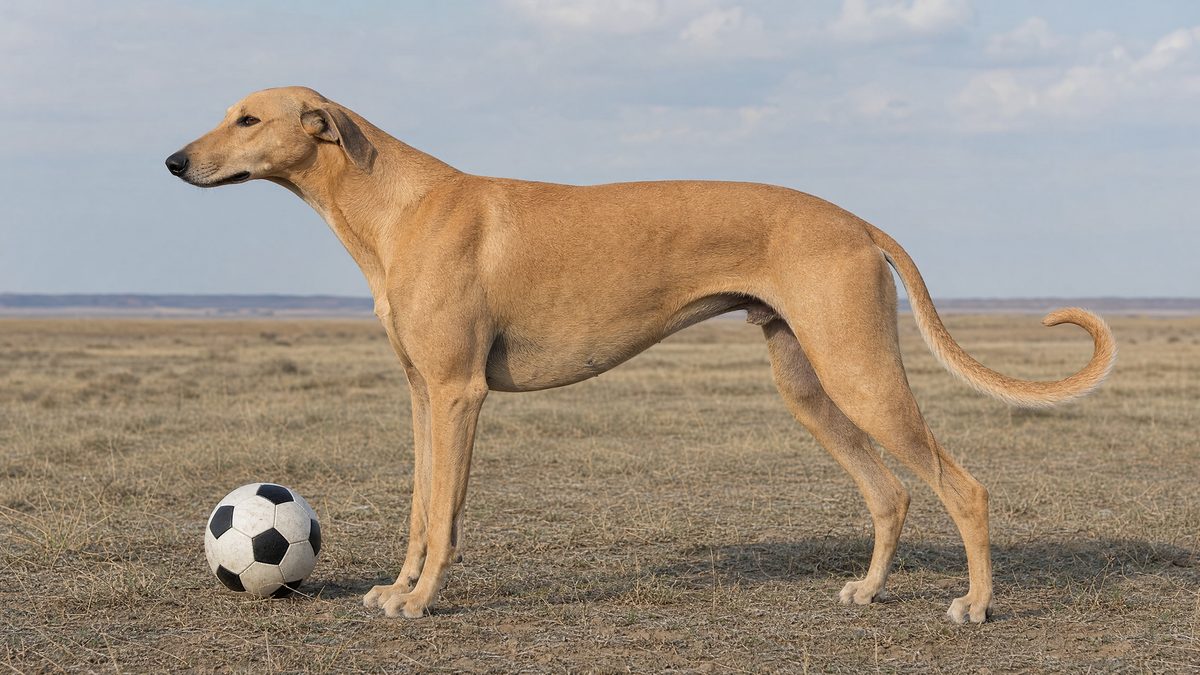
The Chortai dog, also spelt Chortaj and called Khortaya Borzaya in Russian, is a short-coated steppe sighthound standing 65 to 75 cm at the withers. The Russian Kynological Federation publishes its breed standard, and that standard states on its own face that the FCI has not recognised the breed. India has no Chortai market, no import route for one, and no published Chortai health data.
This page summarises published breed-standard text, registry records, government documents and peer-reviewed veterinary research for general information. It is not a diagnosis and it is not treatment advice. Consult a registered veterinarian about your own dog before acting on anything here, and treat a rectal temperature at or above 41.0 degrees Celsius after exertion in heat as an emergency requiring immediate cooling and veterinary attention.
Chortai traits, rated for Indian conditions
What the Chortai is, according to the only registry that defines it
The Chortai is a large short-coated steppe sighthound defined by a single living breed standard, published by the Russian Kynological Federation and approved by Presidium decision of 14 September 2022.
That standard is the whole factual base for this breed, so it is worth stating what it actually contains. It gives the origin as Russia, describes a dog of above-average to large size in a square or slightly elongated format, of dry strong type, with dry sculpted musculature that is long rather than rounded, strong bone with flattened limb bones, and marked sexual dimorphism. It gives one size figure and no weight: height at the withers of 65 to 75 cm in males and 61 to 71 cm in females, with a deviation of more than 2 cm treated as a serious fault.
The head is dry, wedge-shaped and elongated, with the muzzle equal in length to the skull and a smooth, weakly marked stop. Eyes are large, oval and obliquely set, as dark as possible whatever the coat colour. The ears are the identifying feature: medium sized, drawn back along the neck, thin, narrow, slightly pointed, set at or just below the outer corners of the eyes and almost as long as the muzzle, lifting on the cartilage when the dog is roused. Rose ears are not permitted.
The short coat is the point, and it is what the photographs get wrong
The standard permits guard hair that is springy and straight, up to 2.5 cm long on the body, with at most sparse longer furnishings on the backs of the thighs and a sparse short fringe under the tail. The undercoat is imperceptible in summer and only slightly developed in winter. The skin is thin and elastic, without folds and without marked subcutaneous tissue. That is a genuinely short-coated dog, and it is the single cleanest way to tell it from the Borzoi in a photograph.
Colours are broad: fawn through cream, burmatny, red, murugy, grey, grey-and-tan, black-and-tan, black, black with a red cast, and white, any of them solid, with white markings, or pied. Blue eyes are a disqualifying fault, as is a corkscrew tail and any colour the standard does not list.
History, as the registry tells it
The RKF's own historical note traces the word rather than the dog. In the seventeenth century the word khort meant a sighthound-shaped dog in the most general sense, in the Bukvar of Karion Istomin. The term khortaya applied to smooth-coated sighthounds first appears in the list of dogs of Anna Ioannovna's kennel yard, printed in volume III of Tsarskaya i imperatorskaya okhota na Rusi in 1739. The first zootechnical description of the breed was given by P. M. Machevarianov in 1859, and the formation of the khortaya was influenced by the Gorskaya, the Krymskaya and, to a lesser extent, the Russkaya Psovaya Borzaya.
English-language sources tell a compatible but looser story. Wikipedia's stub says the breed developed from the now-extinct Krymstaja and Gorskaja, that one was exhibited at London Zoo in 1829 as a Russian Greyhound, and that it received Soviet recognition at a Cynological Congress in Moscow in 1952. The RKF puts the first official Soviet standard at 1951. Bonbeno reports both dates rather than picking one, because the two documents disagree by a year and neither of them shows its working.
Purpose, which explains almost everything about living with one
The standard's purpose clause says the khortaya is used to take hare, fox and small ungulates, and less often wolf, that it combines high speed with endurance and a high catch rate, and that it characteristically uses scent when searching. Its stated gait is telling: an unhurried trot or even a walk until quarry lifts, then full gallop. A dog that idles until it sees something worth chasing is a calm housemate and a hard one to recall.
No weight range. No life expectancy. No screening requirement. No litter-size figure. Everything you will read online under those headings has been supplied by someone other than the registry, and most of it can be traced back to two or three blog pages.
Chortai, Chortaj, Khortaya Borzaya: one breed or several?
Chortai, Chortaj, Khortaya Borzaya and Hortaya Borzaya are four spellings of one breed, and the encyclopaedias treat them as one entity even where their own navigation boxes suggest otherwise.
This is worth settling first because almost every downstream error follows from it. English Wikipedia's article lives at Chortai. Query the MediaWiki API and it reports that Hortaya borzaya, Hortaya Borzaya and Chortaj are all redirects into that same page, which carries page id 4845761 and runs to just 3,164 bytes of wikitext. The article's own sighthound navigation box lists Chortai and Hortaya borzaya as if they were two separate breeds, but both links resolve to the same article.
The Wikidata item behind that page carries eighteen language links, and they are all the same animal under local names: Chortaj in German, Norwegian, Polish and Swedish, Khortai in French, Hortaya borzaya in Spanish and Malay, Chortaja borzaja in Czech, Hortai in Finnish, Levriero della steppa, the steppe greyhound, in Italian, Khortaya borzaya in Russian and Ukrainian hort in Ukrainian. Eighteen encyclopaedias, one breed, twelve spellings.
Where the confusion is real rather than clerical
Two genuine distinctions hide underneath the spelling noise, and both matter.
- This breed is not the Borzoi. The Borzoi is Russkaya Psovaya Borzaya, FCI standard 193, a long-coated dog of 75 to 85 cm desirable height in males with silky wavy hair and pronounced feathering. Psovaya means long-coated. Khortaya means smooth-coated. They are the coated and the smooth branches of Russian sighthound breeding, and the words themselves say so.
- This breed is not the South Russian Steppe Borzaya. The RKF recognises Yuzhnorusskaya Stepnaya Borzaya as a separate breed with its own standard, also first adopted in 1951 and also prepared by the RKF standards commission on 25 December 2021. English Wikipedia blurs the two, saying post-revolutionary crossing produced what is now the South Russian Steppe Hound. In the registry they are two breeds, listed side by side.
- Ukraine and Russia both claim it, and the documents disagree. The RKF standard states the origin as Russia and describes the breed as bred in the south of Russia. Russian Wikipedia's own infobox gives the place of origin as Ukraine and traces the breed to Kievan Rus. English Wikipedia says Ukraine and Russia. Bonbeno reports the disagreement rather than resolving it, because it is a live political question and not a cynological one.
The naming mess is visible on the ranking pages themselves
Dogs Global serves a page at a URL ending hortaya-borzaya whose H1 reads Chortaj, headed No dogs registered yet. Basepaws files the breed as Hortaya Borzaya and lists Chortai, Chortaj, Eastern Greyhound and Russian Greyhound as alternate names. Dogzone and Europetnet both use Hortaya borzaya Europetnet, 'Hortaya borzaya' pet resource…. Creatures uses Chortai and explicitly quotes the RKF standard for the Hortaya Borzaya as the source of its height figures. Nobody is wrong about the animal. Everybody is inconsistent about the label, and a search engine trying to assemble one entity out of that has very little to work with.
When you search for this dog, search Khortaya Borzaya and Хортая борзая as well as Chortai. The Russian spelling is where the breed standard, the show entries and the working-trial records live. The English spellings mostly return blogs about each other.
Which registries recognise the Chortai, and which do not
One registry recognises the Chortai: the Russian Kynological Federation, which publishes its breed standard. The Federation Cynologique Internationale, the American Kennel Club, The Kennel Club and by extension the Kennel Club of India do not.
This section exists because the recognition question is the one every ranking page gets wrong, and because it is the question that decides whether an Indian buyer can register a puppy at all. Every claim below was checked against the register itself rather than inferred, and each check was run with a control so that an absence means absence rather than a broken query.
| Registry | Recognises the Chortai | How this was checked |
|---|---|---|
| Russian Kynological Federation | Yes, national breed | Full standard PDF, approved by Presidium 14.09.2022, listed under Porода признана РКФ |
| Federation Cynologique Internationale | No | A to Z nomenclature pulled for all 26 letters, 362 breeds returned, no matching entry |
| FCI provisional register | No | 21 breeds listed, including Kazakh Tazy 372 from September 2024 |
| American Kennel Club | No | Full breed directory, controls Borzoi, Saluki, Azawakh and Sloughi all present |
| The Kennel Club, United Kingdom | No | Breed standards A to Z, same four controls all present |
| Kennel Club of India | No route exists | KCI is a full FCI member, so it issues pedigrees against FCI nomenclature |
The strongest evidence comes from the registry that does recognise it
The RKF standard prints an FCI classification at the top, Group 10 Sighthounds, Section 3 Short-haired sighthounds, with working trials. Two lines below, in bold, it states that the breed has not been recognised by the Federation Cynologique Internationale to date. That is the sponsoring registry saying in its own document that the international body has not accepted the breed. No further inference is needed, and any page printing an FCI number for this dog is contradicting the standard it is quoting.
How the FCI absence was proved rather than assumed
The FCI's alphabetical nomenclature was pulled letter by letter for all 26 letters. It returned 362 distinct breed entries. The letter C returned 44 breeds including Chart Polski and Cane Corso Italiano; the letter H returned 11 including Hamiltonstovare and Hovawart. Searching those 362 entries for Chort, Hortay, Khort, Borz and Stepp returns exactly one hit, Borzoi Russian Hunting Sighthound, and four greyhounds appear under their own names: Greyhound, Hungarian Greyhound, Polish Greyhound and Spanish Greyhound. The query works. The breed is not there.
The provisional register was checked separately, because a breed can sit outside definitive recognition and still hold an FCI standard. It carries 21 breeds, the most recent additions dated 11 February 2026, and it includes the Kazakh Tazy at number 372, recognised provisionally on 3 September 2024. A Central Asian steppe sighthound cleared that route two years ago. This one is not on the list, and its absence points in the never-admitted direction rather than the promoted-out direction.
Why that closes the door in India specifically
The FCI's own members register lists INDIA as a Full member, represented by the Kennel Club of India at Anna Nagar, Chennai 600 040. The same register lists the RUSSIAN FEDERATION as a Full member represented by the Russian Kynological Federation and UKRAINE as a Full member represented by the Ukrainian Kennel Union. So both of the national bodies that could sponsor this breed are already inside the FCI, and it is still outside the nomenclature. An Indian buyer cannot obtain a KCI pedigree for a breed the FCI does not list, which means any Indian paperwork offered with a Chortai puppy is either for a different breed or is not a kennel-club document.
The AKC and The Kennel Club were checked the same way. The AKC's full breed directory returns Borzoi, Greyhound, Whippet, Saluki, Azawakh and Sloughi and returns nothing for any Chortai spelling. The Kennel Club's breed standards A to Z gives the same result on the same controls. That absence matters for a second reason: the CYP2B11 anaesthesia study selected its sighthound sample using the AKC's breed inclusion for sighthounds, so a breed outside the AKC could not have been sampled.
The URL fci.be/en/nomenclature/sighthounds-10.html returns HTTP 200 and serves a complete, correctly formatted page for the BORDER TERRIER, because FCI nomenclature URLs resolve on the trailing number and 10 is the Border Terrier's. If you verify any of this yourself, read the breed name printed inside the page before you believe the absence.
Chortai price in India: there is no price, and here is the proof
No Chortai price in India can be quoted, because no verified Indian listing for the breed exists under any of its four spellings and no lawful commercial import route exists to create one.
This is the answer to the query, and it is a finding rather than a gap. It was established three ways, each with a control, because a zero that has not been tested is just a failed search.
1. The search engines cannot find the dog in India
A direct fetch of Google India returned a 92 KB JavaScript shell with no result text, and returned the identical empty shell for the control query labrador retriever price in india. Nothing was concluded from Google. Bing India was then queried with the same control in the same session, and it worked: labrador retriever price in india returned About 17,800 results whose ten organic hits were all Indian dog-price pages, including Fluffyn, Mr n Mrs Pet, Premium Pet House and Puppiezo.
On that same working search, chortai dog returned About 20,800 results whose ten organic hits were, every one of them, YouTube-to-MP3 converter sites. And chortai price in india returned About 50 results whose ten organic hits were, every one of them, the Kerala Revenue Department's land-records eServices portal. Fifty results, none about a dog. That is what a query with no Indian commercial content behind it looks like when the index has nothing to serve.
The contrast is the useful part. For the control breed the Indian market is loud and specific: one ranking page gives a Labrador puppy price of Rs 8,000 to Rs 30,000 for pet quality, Rs 24,000 to Rs 45,000 with Kennel Club of India papers, Rs 40,000 to Rs 80,000 for show quality and Rs 1,20,000 to Rs 1,60,000 for an imported bloodline, plus city bands from Rs 6,000 to Rs 25,000 in Kolkata to Rs 9,000 to Rs 36,000 in Mumbai. Another gives KCI-registered Labradors at Rs 25,000 to Rs 45,000 and unregistered dogs at Rs 8,000 to Rs 15,000. That is what a breed with an Indian market looks like on the same search engine on the same day. The Chortai has none of it.
2. No Indian listing exists to check
Searching Indian results for the breed under both common spellings returns an Etsy poster that ships to India, a Pinterest pin, a Finnish dog-collar review, a Facebook group post and stock-photo libraries. There is no Indian marketplace page, no breeder listing and no shell listing page. That last point distinguishes this breed from most rare breeds Bonbeno has covered: with the Borzoi, Indian listing sites at least generated empty template pages that offered a different dog. Here they have not bothered to generate a template at all.
3. The law forecloses the only route that would create a price
Dogs enter India under ITC(HS) 01061900 with an import policy of Restricted. Import is permitted only for a pet dog with a valid pet book in the importer's own name, for research organisations with a CPCSEA recommendation, or for internal security by the Defence and Police Force, and Policy Condition 8 states that import of commercial dogs for breeding or any other commercial activity is not permitted. Paragraph 6 adds that any applications for trading or breeding purposes shall be duly rejected. A commercial supply chain cannot lawfully form, so a market price cannot form either.
What a rupee figure would mean if you saw one
Treat any Chortai price in india quoted in rupees as a converted or borrowed number until proved otherwise, and test it in a calculator before you argue with the seller.
- Divide by 84.38. Indian pages routinely publish a US dollar figure run through one exchange rate. A quotient that lands on a round dollar amount such as 800, 1,500 or 2,000 is the tell.
- Divide by 74 as well. A separate converted price list circulating in India resolves cleanly at 74, and Rs 74,000 recurs across unrelated breeds because it is USD 1,000.
- Treat a match at 80 with suspicion. Because 1,000 divided by 80 is 12.5, any rupee figure ending in three zeros divides cleanly at 80 by construction, so a match there proves nothing on its own.
- Reject Rs 98,999 outright. It is a recurring house price point on one Indian listing site, attached to whichever puppy is in stock, and it has appeared on pages for breeds that site does not stock at all.
Bonbeno publishes no Chortai price for India because no verifiable one exists. If a seller quotes you one, ask which document the dog's pedigree comes from. The FCI does not list the breed, the Kennel Club of India works to FCI nomenclature, and the only registry that does recognise it is in Moscow.
Monthly cost of keeping a 30 kg sighthound in India
The monthly cost of a Chortai-sized sighthound in an Indian city is a modelled figure rather than an observed one, because no Chortai is verifiably kept in India, so this section prices the dog the standard describes instead of the breed anyone has surveyed.
Be clear about what this is. The RKF standard gives a height of 65 to 75 cm in males and no weight at all. A lean sighthound of that height sits broadly in the same body-mass band as a Greyhound, whose FCI standard gives an ideal 71 to 76 cm for males. So the cost model below is built for a dog of roughly 28 to 33 kg in good body condition, and every line is a structure to price locally rather than a number Bonbeno has observed for this breed.
The closest honest Indian benchmark, and where two Indian sources disagree
The nearest published Indian cost data for a dog of this size is for the Labrador Retriever, and two Indian pricing pages that both rank for it do not agree with each other. WhatsTheCost puts monthly maintenance, veterinary care, food and grooming at Rs 4,000 to Rs 10,000. Fluffyn puts monthly upkeep at Rs 5,000 to Rs 9,000, and breaks it down into food at Rs 3,500 to Rs 6,000, veterinary care averaged across the year at Rs 800 to Rs 2,000, and grooming at Rs 500 to Rs 1,000. Both figures are published in 2026 and the ranges overlap without matching, so treat the honest Indian monthly cost for a large dog as roughly Rs 4,000 to Rs 10,000 and not as a precise number.
| Line | Published Labrador figure | What changes for a lean 30 kg sighthound |
|---|---|---|
| Food | Rs 3,500 to Rs 6,000 a month | Similar or slightly higher, because a working-built dog carries more muscle |
| Veterinary, averaged | Rs 800 to Rs 2,000 a month | Higher, because there is no breed baseline and more testing is needed |
| Grooming | Rs 500 to Rs 1,000 a month | Lower. A 2.5 cm coat does not need a professional groomer |
| Total, one source | Rs 5,000 to Rs 9,000 | Fluffyn, May 2026 |
| Total, the other source | Rs 4,000 to Rs 10,000 | WhatsTheCost, June 2026 |
| Unexpected illness contingency | Rs 5,000 to Rs 15,000 | Hold more, because one anaesthetic event is the real risk here |
Two of those lines are worth pausing on. Grooming genuinely costs less for this breed than for a Labrador, because the standard caps body hair at 2.5 cm and the summer undercoat is imperceptible. Veterinary costs genuinely run higher, and not because the dog is sickly. They run higher because your vet has no published reference intervals to read the bloodwork against, so the diagnostic path is longer on the first pass.
The cost lines that are genuinely different for this dog
- Food volume, not food price. A 30 kg working-built dog eats meaningfully more than the 10 to 15 kg dogs most Indian cost guides model, and a sighthound in real work eats more again.
- Bedding, replaced often. The standard specifies skin that is thin and elastic with no marked subcutaneous tissue, which is the anatomy that produces pressure calluses and hygromas on hard Indian floors. Orthopaedic bedding is a recurring cost here, not a luxury.
- Tick control, year-round and non-negotiable. In a survey of 525 dogs across four Indian cities, 49.7 percent were PCR-positive for at least one tick-borne pathogen and ticks were found on 53 percent of the dogs examined. Budget a monthly preventative, not a seasonal one.
- Cooling, as infrastructure. For a dog formed where the annual mean temperature is 10.9 degrees Celsius, a fan is not a cooling plan in a Chennai May.
- Diagnostics that cost more because nobody has a baseline. A sighthound's bloodwork is read against its own history, so the first well-dog panel is an investment rather than an expense.
The cost line nobody prices, and it is the biggest one
The genuine financial risk with this breed in India is not the monthly cost. It is a single anaesthetic event. Sighthounds are the breed group reported to recover slowly from injectable anaesthetics, and the CYP2B11-H3 haplotype associated with poor metabolism of propofol and the thiobarbiturates was found in 10 of 19 sighthound breeds sampled at an average frequency of 9 percent, over four-fold higher than the 1.7 percent seen across 45 non-sighthound breeds. Add an unplanned overnight on fluids to any routine neutering estimate you are given, and choose the clinic on its anaesthesia protocol rather than its price.
And the cost that is zero, which changes the arithmetic
There is no purchase price to amortise, because there is nothing lawful to buy. If you have already imported the dog as a genuine pet with a pet book in your own name, the acquisition cost was airline crate, veterinary health certificate, Advance No Objection Certificate from the quarantine officer and freight. If you have not, the correct monthly cost for a Chortai in India is the monthly cost of the Indian sighthound you buy instead.
Take your city's real figures for a 30 kg dog, add a monthly tick preventative, add bedding replacement twice a year, and hold a contingency for one anaesthetic event. Bonbeno does not publish a single rupee monthly cost for this breed because doing so would imply a population of Indian owners that does not exist.
Heat tolerance: the steppe is hot, but it is not humid
Rate Chortai heat tolerance at 2 out of 5 for India, because the breed was formed where the annual mean temperature is 10.9 degrees Celsius and where the peak monthly wet-bulb temperature is 8.5 degrees lower than Kolkata's.
The lazy version of this argument says the Chortai is a cold-climate dog and will suffer in India. That is half wrong, and the half that is wrong matters, so here is the arithmetic. NASA POWER climatology for 2001 to 2020 was queried by explicit latitude and longitude for the breed's homeland and for six Indian cities, which removes any chance of a wrong place being served.
| Place | Annual mean air temp | Hottest month max | Peak monthly wet-bulb |
|---|---|---|---|
| Rostov-on-Don, southern Russian steppe | 10.9 C | 42.1 C in August | 19.4 C in July |
| Zaporizhzhia, Khortytsia, Ukraine | 10.0 C | 39.8 C in August | 18.9 C in July |
| Bengaluru | 23.7 C | 40.4 C in April | 22.7 C in May |
| Pune | 23.9 C | 43.2 C in April | 23.6 C in June |
| Delhi | 25.6 C | 48.8 C in June | 27.7 C in July |
| Mumbai | 26.8 C | 44.9 C in April | 26.6 C in June |
| Kolkata | 25.8 C | 46.8 C in May | 27.9 C in June |
| Chennai | 27.9 C | 42.7 C in May | 27.4 C in May |
Read the two columns separately, because they say opposite things
On peak air temperature the steppe is not gentle. Rostov-on-Don records a hottest-month maximum of 42.1 degrees, which is higher than Bengaluru's 40.4 and within half a degree of Chennai's 42.7. A dog bred to course hare across that country in August is not naive about a hot afternoon. Anyone telling you this breed has never met heat has not looked at the numbers.
On wet-bulb temperature the picture inverts completely. The homeland peaks at 19.4 degrees. Kolkata peaks at 27.9, Delhi at 27.7, Chennai at 27.4 and Mumbai at 26.6. That 8.5 degree gap is the entire argument, because a dog cools by evaporating water from its respiratory tract and evaporation is governed by wet-bulb, not by air temperature. Steppe heat is survivable because it is dry and because it collapses at night, with an annual mean of 10.9 degrees against Chennai's 27.9. Indian coastal heat is not.
What the coat does and does not do here
The short coat helps, and this is where the Chortai genuinely beats the Borzoi. The standard permits guard hair up to 2.5 cm with an undercoat that is imperceptible in summer, against the Borzoi's long, silky, wavy hair with pronounced feathering. But the same standard requires thin skin with no marked subcutaneous tissue, and that cuts both ways: less insulation to trap heat, and also almost no fat layer under skin that will burn on a pale or pied dog. A white or fawn Chortai in Indian sun needs shade rather than sunscreen theatre.
The risk is exertional, and that is measurable
In a VetCompass analysis of 905,543 UK dogs, 1,259 heat-related illness events were identified, and exertional heat-related illness was the predominant trigger at 74.2 percent of the 879 events where a cause was recorded, against 12.9 percent environmental and just 5.2 percent from confinement in a vehicle. The companion study put 2016 incidence at 0.04 percent with an event fatality rate of 14.18 percent, and found higher bodyweight relative to the breed mean and being over two years of age among the significant risk factors. Those figures come from the United Kingdom, so the absolute incidence will not transfer to India. The proportion is what transfers: the dog running is the danger, not the hot car.
City by city, what changes
- Bengaluru and Pune are the least bad. Peak wet-bulb of 22.7 and 23.6 degrees, and elevation that drops the nights. Free running is realistic for most of the year before about 07:30.
- Delhi is a two-season problem. A June maximum of 48.8 degrees and a July wet-bulb of 27.7 means the dry heat and the humid heat arrive one after the other rather than together.
- Chennai and Kolkata are the hardest. Annual means of 27.9 and 25.8 degrees with peak wet-bulb near 28 leave almost no window when a coursing hound can work safely outdoors.
- Mumbai sits between them, with a peak wet-bulb of 26.6 degrees and very little diurnal relief.
Treat a rectal temperature at or above 41.0 degrees Celsius after exertion as an emergency. Cool the dog with room-temperature water over the neck, chest and inner thighs, move air across it, and go to a veterinarian. Do not wait to see whether it settles.
Temperament: calm indoors, unreachable the moment quarry moves
The Chortai temperament is calm and neutral rather than affectionate or defensive, and the breed standard says so in one sentence that tells you almost everything about living with the dog.
The RKF standard's behaviour clause reads that the temperament is calm, the visual reaction is well expressed, and the attitude to people and domestic animals is neutral and benevolent. Neutral is the key word. This is not a breed that greets, guards or clings. It is a breed that notices you, decides nothing is happening, and lies down.
The same clause describes the gait as an unhurried trot or even a walk until quarry is raised, and a full gallop in pursuit. That switch is the personality. Ninety percent of the day is a quiet, independent, low-maintenance dog on a sofa. The other ten percent is a 70 cm sighthound at full stretch with no interest in your opinion.
Who this breed suits in India
- Households with genuinely secure ground. A fenced compound, not a gate someone props open for the milk delivery.
- Owners who want a quiet dog. Coursing hounds that bark on the line do not get bred, and the breed is correspondingly silent at home.
- People who like an independent animal. A dog that does not need to be entertained is restful, and it is also a dog that will not check in with you outdoors.
- Anyone prepared to walk at dawn. The exercise has to happen in the cool hour, every day, in every season.
Who should not take one on
- Homes with cats, rabbits or poultry. The standard's own purpose clause names hare, fox and small ungulates. Do not test the exception.
- Apartment living with no safe running ground within reach. Calm indoors does not mean satisfied indoors.
- First-time owners who want obedience. Household manners are learnable. Reliable recall off a sighting is not, in any sighthound.
- Anyone buying for guarding. A neutral-benevolent attitude to strangers is written into the standard as correct, and aggressiveness is a disqualifying fault.
The Indian street is the specific problem
Prey drive in a European suburb is a livestock question. In an Indian city it is a community-dog and free-roaming-cat question, and it is a road-safety question. A dog that has committed to a chase at 50 kilometres an hour on a Bengaluru arterial road is not going to be recalled and is not going to survive the traffic. This is not a training failure waiting to be fixed; it is the breed working correctly. Containment, long lines and a muzzle in unfenced public space are the answer, and none of them are cruelty.
One honest caveat on temperament claims generally. Everything above comes from a breed standard and from what sighthounds as a group do. There is no behavioural study of this breed, because PubMed returns zero records for it under any spelling. So treat the standard's description as a breeder's intent, well documented and probably accurate, rather than as measured behaviour in a surveyed population.
Training a Chortai: what works, and the one thing that will not
Train a Chortai for household manners and a rock-solid stationary behaviour, and do not train for off-lead recall in open ground, because no sighthound recall survives a live sighting and this breed's standard describes exactly that switch.
Start from what the registry says the dog is for. The standard describes a breed that combines high speed with endurance and a high catch rate, and that uses scent while searching before it sights. A dog with both a sight trigger and a nose is harder to hold than a pure gaze hound, because it can be committed to a line before you have seen anything at all.
What trains well
- Lead manners. A calm breed that idles at a walk is easy to teach not to pull, and a well-fitted martingale collar suits a neck that is narrower than the head.
- A settle on a mat. This is the highest-value behaviour for an Indian apartment and the one the temperament is built for.
- Crate or bed acceptance. Necessary because a thin-skinned dog needs a specific soft place and will otherwise take the coolest hard floor.
- Muzzle acceptance. Teach it early and positively, before you need it. In India it also buys the dog goodwill from strangers who have never seen a sighthound.
- Handling for veterinary work. A dog nobody has seen before will get more examination, not less, so socialise it to being touched, restrained and having blood drawn.
What does not train, and why pretending otherwise is dangerous
Recall off a live chase is the exception, and it is not a matter of effort. The behaviour the standard rewards is a dog that breaks into a gallop the instant quarry lifts, and generations of selection have made that transition faster than a handler's voice. Every experienced sighthound owner runs the same system: a long line in unfenced ground, a fenced field for free running, and no negotiation. Treat the recall as unreliable by design and build the environment around it.
Timelines that are honest for this breed
| Behaviour | Typical time to useful | Confidence |
|---|---|---|
| Lead manners on a martingale | 3 to 6 weeks | High, this is a calm breed |
| Settle on a mat indoors | 2 to 4 weeks | High |
| Muzzle worn happily | 4 to 8 weeks of short sessions | High |
| Recall in a fenced space, no distraction | 2 to 3 months | Moderate |
| Recall off a moving cat or dog | Never treat as achieved | This is the whole point |
Socialisation in Indian conditions
Socialise the puppy to traffic noise, hospital floors, autorickshaws, crowds and being handled by strangers, and do that work in the cool part of the day. A heat-stressed puppy learns that the outside world is unpleasant, which is the opposite of the goal. Keep sessions short, keep water available, and stop before the dog is panting hard. The window that matters closes early, and in an Indian summer the usable hours are narrow, so plan the socialisation calendar around the weather rather than around your own convenience.
Train the environment, not the dog. A fenced run, a long line, a muzzle and a dawn schedule solve more Chortai problems than any obedience course, and none of them depend on the dog agreeing with you.
Exercise needs: two hours of trot, one sprint, and a hard time limit
Meet Chortai exercise needs with roughly 90 to 120 minutes of daily movement built around trotting rather than sprinting, delivered in the cool hours, with sprint work confined to a fenced space and to a wet-bulb temperature the dog can actually cool in.
The standard describes the working pattern precisely: an unhurried trot or even a walk while searching, switching to a full gallop in pursuit, and free, light, graceful, springy movement at the trot with no visible effort. That is a distance animal with a sprint attached, not a sprinter. Most of the daily requirement is therefore steady movement, and the sprint is a short, occasional, deliberately managed event.
The Indian daily schedule that actually works
- 05:30 to 07:00, the main session. Forty-five to sixty minutes at a brisk walk or jog on a long line, on grass or dirt where you can find it.
- Midday, nothing outdoors. A settle indoors on cool flooring with a fan. This is not a rest day, it is the same day.
- After sunset, the second session. Thirty to forty-five minutes, shorter if the air is still humid, which in Chennai and Kolkata it will be.
- Twice a week, a fenced sprint. Ten to fifteen minutes of free galloping in a genuinely enclosed space, ended before the dog is distressed rather than when it stops.
Why the surface matters more for this breed than most
The standard asks for strong bone with flattened limb bones, dry sculpted musculature and thin skin without marked subcutaneous tissue. That combination produces a dog with very little padding between bone and ground. Concrete and paved compound floors are the default running surface in Indian cities, and they punish a lean sighthound in three specific ways: hard-surface galloping loads the carpal and tarsal joints, hot paving burns pads long after the air has cooled, and repeated lying on tile produces pressure calluses at the elbows and hocks. Find grass, packed earth or beach where you can, and test paving with the back of your hand for five seconds before you walk on it.
What happens without it
An under-exercised sighthound does not usually become destructive in the terrier sense. It becomes restless at night, it starts fence-running and window-watching, and it puts on weight, which matters here for a reason beyond the joints. Higher bodyweight relative to the breed and sex mean was a significant risk factor for heat-related illness in the VetCompass analysis of 905,543 UK dogs. In an Indian summer, letting a coursing hound get heavy compounds the one risk it is already carrying.
Coursing, lure work and the Indian legal position
Lure coursing in a fenced field is the closest lawful outlet to the breed's designed job, and it is the right answer where a club exists. Live coursing is a different matter: hunting wild animals is regulated in India under wildlife law, and taking hare or any wild species with a dog is not a hobby you can assume into existence. If you want the dog to do its job, do it on a mechanical lure. If no club is within reach, a long line on open ground plus a weekly fenced sprint is the honest substitute, and it is enough.
A sighthound in pursuit will run past its own thermal limit, which is exactly why exertional heat-related illness accounts for 74.2 percent of canine heat-related illness events rather than hot cars. You are the brake. Set a timer, not a distance.
Grooming and coat care in Indian humidity
Groom a Chortai in about ten minutes a week, because the standard allows body hair only up to 2.5 cm with no summer undercoat, and spend the rest of the effort on skin, nails, teeth and ticks instead.
The coat clause is short and it settles the workload. Guard hair is springy and straight, up to 2.5 cm long on the body; sparse longer furnishings are permitted on the backs of the thighs; a sparse short fringe is permitted under the tail; the undercoat is imperceptible in summer and only slightly developed in winter. Curly hair and bald thighs are listed as serious faults, and elongated body hair or a slight wave along the back is a fault. In practice that means a rubber curry mitt twice a week and nothing else.
The four things that actually need doing
- Rubber mitt, twice weekly. Lifts the short stiff hairs that otherwise weave into upholstery. Five minutes.
- Skin check, weekly and by hand. Thin elastic skin without folds is what the standard requires, and thin skin tears on fences and thorn scrub. Run your palms over flanks, chest and legs and look at what you find.
- Nails, fortnightly. A sighthound that runs on grass rather than pavement does not self-file. Long nails change the foot's angle and load the toes.
- Teeth, several times a week. The standard's disqualifying faults include missing canines, incisors and seven or more premolars, which tells you the breed is judged on a full mouth. Dental disease is the commonest condition in Indian pet dogs of any breed and it is entirely preventable.
Bathing, and one piece of overseas advice not to copy
Bathe rarely, roughly once every six to eight weeks or when the dog is genuinely dirty. Over-bathing a thin-skinned dog in hard Indian municipal water strips the coat and irritates the skin, and a short-coated dog does not hold odour the way a double-coated one does. When you do bathe, dry the ears deliberately rather than letting the dog air-dry, which is standard advice in temperate countries and poor advice in an Indian monsoon.
Ticks are the real grooming job here
This is where the short coat stops being a saving and starts being a liability, because a short-coated dog moving through Indian scrub picks up ticks and you will find them. In a survey of 525 dogs across four Indian cities, potential tick vectors, most commonly Rhipicephalus and Haemaphysalis, were found on 278 dogs, which is 53 percent of those examined. Check daily during and after the monsoon, with attention to the ear margins, between the toes, the axillae and the groin, and use a year-round preventative rather than a seasonal one.
Sun, and why a pale Chortai needs shade
The standard permits white, fawn, cream and pied coats, and a pale dog with thin skin and hair no longer than 2.5 cm has very little protection on the bridge of the nose, the ear tips and the belly. Solar dermatitis is a real risk on a dog that suns itself on a terrace. Provide dense shade rather than relying on a sunscreen the dog will lick off, and keep midday terrace access closed in April and May.
A short coat is not a low-maintenance dog. It is a low-maintenance coat attached to high-maintenance skin. Budget the time you saved on brushing into skin checks and tick control.
Health issues, life expectancy and what is genuinely unknown
The Chortai has no published health data of its own, so this section separates what is documented for sighthounds as a group from what is simply absent, and it publishes no life expectancy figure because no study exists.
Establish the absence first, because it is the most important health fact about this breed. PubMed returns zero records for Chortai, zero for Chortaj, zero for Khortaya and zero for borzaya. The query translation shows each term searched exactly as typed rather than rewritten, and control searches run in the same session returned results, so the search apparatus was working. There is no lifespan study, no prevalence survey, no screening scheme and no breed-specific reference interval for this dog anywhere in the indexed veterinary literature.
Searching PubMed for chortai dog breed returns 15,737 records, which looks like a literature. Read the query translation and PubMed has silently dropped the word Chortai and searched only dog AND breed. Always read the translation before you believe a count.
Life expectancy: two numbers online, neither of them sourced
Europetnet says that if you subtract the hazards of hunting, 14 to 15 healthy years as an average is not uncommon. Basepaws gives 10 to 14 years and lists exactly one reference, a commercial blog. Neither figure names a study, a registry dataset or a survey population. Bonbeno therefore publishes no life expectancy for the Chortai. A borrowed number with a confident range attached is worse than an honest blank, because the reader cannot tell which they are being given.
Anaesthesia: the one risk to plan for, with the caveat stated
Sighthounds recover slowly from injectable anaesthetics, and there is now a genetic basis for it. Martinez and colleagues genotyped 2,057 dogs across 64 breeds, including 19 sighthound breeds, and found the CYP2B11-H3 haplotype in 10 of the 19 sighthound breeds against 10 of 45 non-sighthound breeds, at an average frequency of 9 percent in sighthounds and 1.7 percent in others, a more than four-fold difference. AKC Greyhounds carried the highest frequency of any breed sampled at nearly 60 percent. The haplotype substantially reduces CYP2B11 expression, and CYP2B11 is the enzyme that clears propofol and the thiobarbiturates.
The caveat is the point. That study defined its sighthound group using the AKC's own breed inclusion, and the Chortai is not an AKC breed, so it could not have been sampled and was not. Its closest recognised relative, the Borzoi, sits in the Sighthound Group 1 clade alongside the Greyhound, Whippet, Scottish Deerhound and Italian Greyhound, and the H3 haplotype was found in every Group 1 breed except the Irish Wolfhound. That is a reasonable basis for caution and not a measurement. Tell your veterinarian the dog is a sighthound of unstudied breed, ask for a sighthound protocol, and ask for it in writing on the file.
Thyroid: the Indian legal trap
Second Schedule Part III paragraph 8(10) of the Prevention of Cruelty to Animals (Dog Breeding and Marketing) Rules, 2017 requires that dogs shall have been tested for genetic defects including hip dysplasia, progressive retinal atrophy, night blindness, hypothyroidism, entropion, ectropion, overshot and undershot jaw, wry mouth, two or more missing teeth and cryptorchidism. Hypothyroidism is on that list, and sighthounds are the group in which a low thyroid reading is the normal finding.
Shiel and colleagues reviewed 398 sighthounds that practitioners had diagnosed as hypothyroid. In 303 of them, 76.1 percent, the diagnosis rested on low serum thyroid hormone concentrations alone, and in a further 30, 7.5 percent, it was made despite all thyroid indices being within reference limits. Only 65, or 16.3 percent, had a high TSH or a positive thyroglobulin autoantibody result to support it. In 283 healthy Salukis, median total T4 was 13.0 nmol/L with reference limits running from 2.8 to 40.0 nmol/L, and the authors concluded that breed-specific reference limits should be used when interpreting sighthound thyroid profiles. An Indian breeder complying with Second Schedule Part III para 8(10) on a sighthound is therefore running a test with a high chance of a false positive and a lifetime of unnecessary levothyroxine behind it.
Two further risks belong to the size class and the country rather than to the breed, and they are set out in the next section along with what to ask your veterinarian to test.
Bloodwork, tick-borne disease and bloat: what to actually screen for
Screen a Chortai for the three things that are measurable in India, which are its own baseline bloodwork, tick-borne infection by PCR, and the deep-chested risk of gastric dilatation-volvulus, and do not screen it against another breed's reference intervals.
1. Establish the dog's own baseline, because no breed baseline exists
A study of 192 dogs across eight sighthound breeds, the Whippet, Greyhound, Italian Greyhound, Sloughi, Saluki, Borzoi, Pharaoh Hound and Azawakh, found significant differences in haematology and clinical biochemistry between them and concluded that applying the Greyhound laboratory profile to other sighthounds is not recommended. This breed is not one of the eight, and there is no ninth paper covering it. So run a full haematology and biochemistry panel on a healthy adult dog, at a time when nothing is wrong, and keep it. That single well-dog panel is the reference interval for your dog, and it is the only one that will ever exist.
2. Test for tick-borne disease by PCR, not by slide
This is the highest-probability illness a short-coated coursing hound will meet in India. In a survey of 525 dogs across four Indian cities, PCR found 261 dogs, 49.7 percent with a 95 percent confidence interval of 45.4 to 54.1, positive for at least one tick-borne pathogen.
| Pathogen | Prevalence | 95 percent CI |
|---|---|---|
| Hepatozoon canis | 30.0 percent | 26.0 to 34.0 |
| Ehrlichia canis | 20.6 percent | 17.2 to 24.3 |
| Mycoplasma haemocanis | 12.2 percent | 9.5 to 15.3 |
| Anaplasma platys | 6.5 percent | 4.5 to 8.9 |
| Babesia vogeli | 5.5 percent | 3.7 to 7.8 |
| Babesia gibsoni | 0.2 percent | 0.01 to 1.06 |
Two details from that paper change what you ask for at the clinic. Microscopy detected Hepatozoon gamonts in only 12 of the 525 blood smears, 2.3 percent, against 49.7 percent by PCR, so a clean slide is not a clean dog. And concurrent infection with more than one pathogen occurred in 39 percent of cases, so the authors advise Indian practitioners that finding one pathogen raises the likelihood of others.
There is a specific reason this matters more in a sighthound. Ehrlichia canis causes thrombocytopenia and bleeding tendencies, and sighthounds already sit at the edges of the standard canine haematology ranges. A vet reading a Chortai's platelet count against general canine intervals, on a breed with no published intervals, in a country where one dog in five carries E. canis, is being asked to make a judgement with three unknowns in it. Your baseline panel removes one of them.
3. Treat bloat as a size-class risk and act on feeding practice
The RKF standard describes a chest that is deep and dropped almost to the elbows, rather flat at the shoulders and oval in cross-section. That is the deep-chested conformation associated with gastric dilatation-volvulus. The best available numbers come from a prospective cohort of 1,914 dogs across 11 breeds, none of them this one: incidence was 23 cases per 1,000 dog-years at risk in the seven large breeds of 23 to 45 kg and 26 per 1,000 in the four giant breeds, cumulative incidence across all breeds was 5.7 percent, and of the 105 dogs that developed GDV, 30 died, which is 28.6 percent.
Treat that as the size class rather than the breed figure, because substituting a related breed's numbers is exactly the error this page corrects elsewhere. What you can act on is practice: feed twice daily rather than once, avoid hard exercise for an hour either side of a meal, and know the signs, which are unproductive retching, a distending abdomen and rapid collapse. A dog showing them needs a veterinarian within the hour, not in the morning.
A full blood panel while the dog is well, kept on file as its personal baseline. PCR for tick-borne pathogens rather than a smear. A note on the record that this is a sighthound of unstudied breed and that a sighthound anaesthetic protocol applies. Thyroid interpreted against sighthound expectations, never against a general canine range alone.
Feeding a Chortai in India, and one piece of very bad internet advice
Feed a Chortai twice daily on a complete adult diet portioned to hold a visible waist and the last two ribs faintly showing, and ignore the widely repeated claim that the breed cannot tolerate protein and should live on bread and oats.
Deal with the bad advice first, because it is on a page ranking for this breed right now. Dogzone states that the Hortaya Borzaya cannot tolerate rich or high protein diets, as they have evolved over the years to survive on scraps from the table and on meals such as bread and oats. No source is offered. There is no published feeding trial, digestibility study or nutrient-requirement paper for this breed, because there are no published papers at all, and the RKF standard says nothing about diet.
What the claim describes is a subsistence history, not a metabolic limitation. Village dogs across the steppe were fed what was spare, and dogs that survived on it were the dogs that bred. That is an argument about what the breed endured, not about what it requires. An Indian owner who feeds a 30 kg working-built sighthound on bread and oats will produce a dog with poor muscle condition and a dull coat, in a country where protein-deficient home diets are already the commonest nutritional problem in pet dogs.
Body condition is the whole measurement
Judge the dog by hand and eye rather than by a number on a bag, because there is no breed weight to aim at. The RKF standard gives height and no weight at all, so anyone quoting you a target kilogram figure for a Chortai is quoting Russian Wikipedia's 18 to 35 kg or, worse, Basepaws' version of it with the unit changed to pounds.
- Correct. A clear waist from above, an obvious abdominal tuck from the side, the last two ribs faintly visible, hip bones covered but easily felt.
- Too thin. Every rib visible, spine and hip bones prominent to the eye, no muscle over the thighs.
- Too heavy. No waist, no tuck, ribs needing pressure to find. For this breed that also raises heat risk, since higher bodyweight relative to the breed and sex mean was a significant risk factor for heat-related illness.
- Weigh the dog monthly on the same scale and write it down, because a lean dog's weight change is easy to miss and slow to notice.
A practical Indian feeding plan
Two meals a day, morning and evening, both outside the exercise window. On a complete commercial adult food, follow the manufacturer's guide for the dog's actual weight and then adjust by body condition over four weeks rather than by the chart. On a home-prepared diet, work with a veterinarian who will balance calcium and phosphorus properly, because a large lean dog on an unbalanced home diet is the classic Indian orthopaedic case. Fresh water in more than one place, changed twice daily in summer, and never restrict water to manage house-training.
Feeding around heat and around exercise
Move the main meal to after the evening walk rather than before it. Two reasons converge here: a full stomach before hard exercise is the practice most consistently linked to gastric dilatation-volvulus risk in deep-chested dogs, and a dog digesting a large meal generates metabolic heat it does not need at the hottest part of an Indian day. In April and May, expect appetite to drop and do not force it; a lean sighthound eating less in a Chennai summer is behaving normally.
There is no correct Chortai weight because the standard does not publish one. There is a correct Chortai outline, and it is in the standard: dry, sculpted, long muscle over strong flattened bone, with a well-marked tuck-up. Feed to that shape.
The first year, month by month
Plan a Chortai puppy's first year around three things India makes harder than Europe does: the heat window for socialisation, the growth-plate rule that forbids forced exercise, and a veterinary relationship with someone who has never met the breed.
One honesty note before the timeline. There is no published growth curve, litter-size figure or developmental study for this breed, so the months below follow general large-breed and sighthound practice, anchored to the two Indian legal and climatic facts that are documented. Treat it as a plan, not as breed data.
| Age | What matters most | Indian-specific note |
|---|---|---|
| 0 to 8 weeks | With the litter. Sale before eight weeks is prohibited | Rule 8(1)(a) of the 2017 Rules: pups less than eight weeks in age are not sold |
| 8 to 12 weeks | Core vaccination course, first handling, crate and bedding | Vaccination may start at seven to eight weeks and usually completes by eighteen weeks |
| 3 to 4 months | Peak socialisation. Traffic, floors, strangers, handling | Do all of it before 08:00 or after sunset in summer |
| 4 to 6 months | Lead manners, settle on a mat, muzzle acceptance | Start monthly tick preventative and do not stop it seasonally |
| 6 months | Sterilisation discussion, and the anaesthesia conversation | Sale over six months without sterilisation is restricted under Rule 8(1)(b) |
| 6 to 9 months | Free movement on soft ground only. No forced running | Concrete compounds are the default surface; find grass or earth |
| 9 to 12 months | Baseline blood panel while the dog is well | This becomes the dog's personal reference interval, since no breed one exists |
| 12 months plus | Introduce controlled sprint work in a fenced space | Never in the middle of the day, in any city, in any month |
The two hard rules
Do not force-exercise a growing sighthound. Free play on grass where the puppy sets the pace is fine and necessary. Jogging beside a bicycle, repeated stair work and long forced walks on concrete are not, until the growth plates close, which in a large lean breed is towards the end of the first year. The standard's flattened limb bones and dry musculature describe a frame that finishes late.
Do not compress socialisation because of the weather. The developmental window does not move for the Indian summer. If the only safe hours are 05:30 to 07:30, then socialisation happens at 05:30 to 07:30, six days a week, for two months. A puppy that misses that window in a country full of horns, crowds and free-roaming dogs becomes a fearful adult, and a fearful 70 cm sighthound is a much harder animal to manage than a bored one.
What to set up before the puppy arrives
- A veterinarian who will read. Send them the anaesthesia paper and the sighthound haematology paper in advance, and ask for a note on the file.
- Real containment. Fence height and, more importantly, gate discipline. Most sighthound escapes are gates, not fences.
- Elevated or orthopaedic bedding in more than one room, because a thin-skinned dog will otherwise choose the coolest tile and develop calluses.
- A martingale collar and a long line. Ordinary flat collars slip over a head narrower than the neck at the ears.
- A written summer schedule. Decide the dawn slot now, before the dog arrives and the habit fails to form.
Walk away and report it. Rule 8(1)(a) of the Prevention of Cruelty to Animals (Dog Breeding and Marketing) Rules, 2017 is explicit that pups less than eight weeks in age are not sold, and a breeder ignoring it is telling you what else they ignore.
Chortai against the sighthounds Indian buyers actually cross-shop
Compared head to head, the Chortai loses on every axis that matters to an Indian buyer except one: it is the only breed in this table with no lawful route into the country and no published health data, and it is not meaningfully better at anything than the alternatives that do have both.
The four breeds below are the ones a reader lands on after searching this one. Two are FCI-recognised and registrable in India through the Kennel Club of India, which is a full FCI member based in Chennai. One is Indian. The Chortai is the odd entry out, and the table shows exactly why.
| Breed | Height, males | Coat | Registrable in India | Published health data |
|---|---|---|---|---|
| Chortai (Khortaya Borzaya) | 65 to 75 cm, RKF standard | Straight, up to 2.5 cm | No. Not FCI, so no KCI pedigree | None. Zero PubMed records |
| Borzoi | 75 to 85 cm desirable, FCI 193 | Long, silky, wavy, feathered | Yes, FCI standard 193 | Breed-specific cardiac and CYP2B11 data |
| Greyhound | 71 to 76 cm ideal, FCI 158 | Fine and close | Yes, FCI standard 158 | The most studied sighthound alive |
| Kazakh Tazy | 63 to 70 cm desirable, FCI 372 | Short to semi-long | Provisionally, FCI standard 372 since 2024 | Thin, but a standard and a register exist |
| Mudhol Hound / Caravan Hound | No height in its Wikipedia infobox | Short, some feathered | Yes, KCI registers it as Caravan Hound | Thin, but bred and tested in India |
Borzoi is the wrong comparison and the commonest one. English Wikipedia's own description says the Chortai resembles a cross between a Greyhound and a short-haired Borzoi, which is where the confusion starts. The two are separated by 10 cm at the top of the range and by an entire coat type: FCI standard 193 asks the Borzoi for long, silky, wavy hair with pronounced feathering and a desirable height of 75 to 85 cm in males, while the RKF standard caps Chortai body hair at 2.5 cm and permits only sparse longer furnishings on the backs of the thighs. If the dog in the photograph has a neck frill, it is not this breed.
Greyhound is the closest honest match and it is available. FCI standard 158 gives an ideal height of 71 to 76 cm for males and 68 to 71 cm for females, with a fine, close coat. That is the same dog-shaped problem in an Indian home, with one enormous difference: a Greyhound has decades of published haematology, anaesthetic pharmacology and lifespan data behind it, and a Chortai has none.
Kazakh Tazy is the answer to the question this breed raises. The FCI recognised the Kazakh Tazy on a provisional basis on 3 September 2024 and published standard 372 on 12 September 2024, giving a desirable height of 63 to 70 cm for males and 58 to 65 cm for females Federation Cynologique Internationale. A Central Asian steppe sighthound of almost exactly this type went through the FCI process within the last two years. The Chortai did not, and its absence is therefore a decision rather than an oversight.
The Indian option is the one that is actually hardy here. The Kennel Club of India registers the breed as the Caravan Hound while the Indian National Kennel Club uses the name Mudhol Hound, a claim Wikipedia itself flags as needing a citation. The Indian Army obtained six Mudhol dogs for testing at the Remount Veterinary Corps at Meerut, bred at the Canine Research and Information Centre in Thimmapur, Bagalkot district. Whatever else is uncertain about the breed, that is a sighthound the Indian state has trialled in Indian conditions, and you can buy one without an import licence.
The Mudhol Hound's Wikipedia infobox carries no height at all and a weight of 20 to 30 lb, which is 9 to 14 kg. That cannot be right for a hound of its build, and it is the same kind of unit error this page catches elsewhere. Bonbeno has not used that weight anywhere, and neither should you.
Mistakes Indian buyers make with the Chortai
The commonest Chortai mistake in India is buying a photograph. Every error below has been observed on a page currently ranking for this breed, and each one is checkable in under a minute.
1. Treating the weight figure as real
Basepaws prints Average Male Height 26 to 30 inches beside Average Male Weight 18 to 35 pounds. Do the arithmetic. Twenty-six to thirty inches is 66 to 76 cm, which is the RKF standard's 65 to 75 cm almost exactly. Eighteen pounds is 8.2 kg. No dog the height of a Greyhound weighs 8 kg. The 18 to 35 figure is the kilogram range printed on Russian Wikipedia, reprinted with the unit swapped, and 18 to 35 kg converts to 40 to 77 lb. The RKF standard gives no weight at all, so anyone quoting one is quoting something other than the standard.
2. Believing an FCI classification that does not exist
TopDog.pro prints FCI Group 10, Section 3 for this breed, along with a weight of 35 to 48 kg and a height of 68 to 73 cm. None of that survives contact with the FCI. The FCI A to Z nomenclature returns 362 breeds across 26 letters and contains no Chortai, Chortaj, Hortaya or Khortaya entry. The confusion is understandable, because the RKF standard itself prints the words FCI Group 10, Section 3, short-haired sighthounds at the top, as the classification the breed would take. Two lines below, the same document says the breed has not been recognised by the FCI to date. Read both lines.
3. Assuming the lifespan number came from somewhere
Europetnet says 14 to 15 healthy years as an average is not uncommon and Basepaws says 10 to 14 years Basepaws, 'Hortaya Borzaya Breed…. Neither cites a study, and Basepaws' entire reference list is one blog. PubMed returns zero records for Chortai, zero for Chortaj, zero for Khortaya and zero for borzaya, with the exact search terms shown in the query translation and with control searches in the same session returning results. There is no life expectancy study for this breed. Bonbeno publishes no lifespan figure for it, and that is the honest outcome.
4. Letting a vet read the bloodwork as an ordinary dog
Sighthounds do not share the general canine reference intervals, and they do not share each other's either. A study of 192 dogs across eight sighthound breeds concluded that applying the Greyhound laboratory profile to other sighthounds is not recommended, because the haematology and biochemistry differ frequently between them. The Chortai is not one of those eight. So the honest instruction to an Indian vet is narrow: treat the sighthound pattern as plausible, do not import Greyhound numbers wholesale, and interpret against the dog's own baseline taken when it was well.
5. Confusing the breed with its own siblings
The Russian Kynological Federation recognises the Khortaya Borzaya and, separately, the South Russian Steppe Borzaya, both with standards prepared by the RKF standards commission on 25 December 2021 Russian Kynological Federation knowledge…. English Wikipedia's Chortai article muddles the two, saying that post-revolutionary crossing produced what is now known as the South Russian Steppe Hound. They are two registered breeds in the same registry, not one breed with two names.
Open the document the figure came from and look for the breed's name printed inside it. Then divide the numbers. A height in inches that matches a height in centimetres, next to a weight that does not, is a unit swap. It took ninety seconds to find three of them on page one.
Adoption, and what to do instead of importing one
Adopt a sighthound in India by looking for the type rather than the breed name, because no Chortai rescue exists here and no Chortai is likely to appear in an Indian shelter in your lifetime.
Start from the legal position, because it decides everything else. Dogs enter India under ITC(HS) 01061900, Mammals: Other, with an import policy of Restricted. Policy Condition 7 permits import only for a pet dog with a valid pet book and records in the importer's name, for research organisations with a recommendation from the Committee for the Purpose of Control and Supervision of Experiments on Animals, or for internal security by the Defence and Police Force. Policy Condition 8 says import of commercial dogs for breeding or any other commercial activity is not permitted, and paragraph 6 adds that any applications for trading or breeding purposes, or applications made on behalf of another person or entity, shall be duly rejected.
That is a closed door for a buyer. The only lawful path is a person who already owns the dog abroad, has a pet book in their own name, and is moving to India. Even then, entry is limited to the airports and seaports of Delhi, Mumbai, Chennai, Hyderabad, Bengaluru and Kolkata and, since October 2024, Kochi airport, an Advance No Objection Certificate must be obtained from the Regional or Quarantine Officer seven days before travel, and where required the animal is quarantined at the government station Department of Animal Husbandry…. Anyone in India offering to source you a Chortai puppy is describing a transaction the Directorate General of Foreign Trade has said in writing it will reject. The full route is set out in how to import a dog to India.
What to look for in an Indian shelter instead
Indian shelters carry sighthound-type dogs constantly, usually unlabelled. Ask for the shape rather than a breed name.
- Deep chest with a hard tuck-up, so the last ribs are visible on a dog at a healthy body condition
- Long wedge-shaped head with the muzzle about as long as the skull, which is the proportion the RKF standard asks for
- Ears folded back along the neck rather than pricked, lifting on the cartilage when the dog is roused
- Thin skin over the flanks with no loose folds, which is exactly what the standard describes and exactly what makes bedding matter
- A long sabre or sickle tail, natural and undocked
Any dog with that build should be handled as a sighthound by your vet, whether or not anyone can name its breed. Say so at the first consultation and ask for it in the notes.
The law that protects the dog you do adopt
The Prevention of Cruelty to Animals (Dog Breeding and Marketing) Rules, 2017, notified as G.S.R. 496(E) on 23 May 2017, set the floor for any Indian breeder. Rule 8, Conditions for sale, sub-rule 1(a), says pups less than eight weeks in age are not sold, and 8(1)(b) says dogs over six months are not sold without first being sterilised unless the buyer is another licensed breeder. Second Schedule Part II paragraph 6(8) forbids tail docking, ear cropping, de-barking, de-clawing, branding, dyeing and any change of appearance by artificial means, and paragraph 6(9) prohibits breeding to create new breeds or unusual looks.
Paragraph 6(3) of the same Part prohibits in breeding and incest breeding outright, defining in breeding to include uncle to niece, nephew to aunt, cousin to cousin and grandparent to grandchild matings within the first four generations. That matters for any rare breed, because the standard rescue argument for a tiny population is close breeding to fix type. In India that argument is illegal, and it removes the last reason to try to found a Chortai line here.
A short-coated, lean, quiet coursing hound that needs a fenced acre and a cool hour at dawn is available in India today. It is called a Caravan Hound at the Kennel Club of India, a Mudhol Hound at the Indian National Kennel Club, a Rampur Greyhound in the north, a Chippiparai or a Kanni in Tamil Nadu, and very often it is called nothing at all and is sitting in a municipal shelter.
Chortai questions Indian readers actually ask
What is a Chortai dog?
A Chortai is a large short-coated steppe sighthound from Russia and Ukraine, standing 65 to 75 centimetres at the withers in males, bred to course hare, fox and small ungulates. It holds a national breed standard from the Russian Kynological Federation, approved on 14 September 2022, and is recognised by no international registry.
What is the temperament of a Chortai dog?
The breed standard describes a calm temperament with a well-expressed visual reaction, and a neutral and benevolent attitude to people and domestic animals. In practice that means a quiet, independent housemate that idles at a walk indoors and switches to a full gallop the instant it sights something worth chasing. Aggressiveness and cowardice are both disqualifying faults.
Is a Chortai dog a good pet?
A Chortai is a good pet for a specific household and a poor one for most Indian homes. The breed standard describes a calm dog with a neutral and benevolent attitude to people and domestic animals, which makes it quiet and undemanding indoors. It also describes a dog bred to take hare, fox and small ungulates at full gallop, so it needs secure fencing, a daily dawn run and a home without cats.
Is the Chortai the same dog as the Hortaya Borzaya?
Yes. English Wikipedia's article sits at Chortai, and Hortaya borzaya, Hortaya Borzaya and Chortaj are all redirects into that same page. The same Wikidata item carries eighteen language versions under twelve spellings, including Chortaj in German, Khortai in French, Levriero della steppa in Italian and Khortaya Borzaya in Russian. One breed, many transliterations.
What is the difference between a Chortai and a Borzoi?
Coat and height. The Borzoi is FCI standard 193, with long, silky, wavy hair, pronounced feathering and a desirable height of 75 to 85 centimetres in males. The Chortai standard caps body hair at 2.5 centimetres and gives 65 to 75 centimetres in males. Psovaya means long-coated and khortaya means smooth-coated, so the Russian names themselves state the difference.
Is the Chortai recognised by the FCI?
No. The Russian Kynological Federation's own standard states in bold that the breed has not been recognised by the Federation Cynologique Internationale to date. The FCI's alphabetical nomenclature returns 362 breeds across 26 letters with no Chortai, Chortaj, Hortaya or Khortaya entry, and the 21-breed provisional register does not carry it either.
Can a Chortai be registered with the Kennel Club of India?
No. The FCI's own members register lists India as a full member represented by the Kennel Club of India in Chennai, and the KCI therefore issues pedigrees against FCI nomenclature. Since the FCI does not list this breed, no KCI pedigree can exist for it. Any Indian paperwork offered with a Chortai puppy is for something else.
How much does a Chortai cost in India?
No Chortai price in India can be quoted, because no verified Indian listing exists under any spelling. Bing India returns about 50 results for the query, and its top ten organic hits are all the Kerala Revenue Department's land-records portal, while the control query for Labrador prices in the same session returned about 17,800 results and ten real Indian dog-price pages.
Can I import a Chortai into India?
Only as your own pet, and only in narrow circumstances. Dogs are a Restricted import under ITC(HS) 01061900, permitted for a pet dog with a valid pet book in the importer's own name, for research with a CPCSEA recommendation, or for Defence and Police use. Applications for trading or breeding purposes shall be duly rejected, and entry is limited to seven ports.
How much does a Chortai weigh?
Nobody knows, because the breed standard gives no weight at all. It gives only height at the withers, 65 to 75 centimetres for males and 61 to 71 for females. Basepaws prints 18 to 35 pounds beside a height of 26 to 30 inches, which is impossible; 18 to 35 is the kilogram figure on Russian Wikipedia with the unit changed.
How long do Chortai dogs live?
There is no answer, and Bonbeno publishes no figure. Europetnet suggests 14 to 15 healthy years and Basepaws gives 10 to 14 years, neither citing a study. PubMed returns zero records for Chortai, Chortaj, Khortaya and borzaya alike, with control searches in the same session returning results, so no life expectancy study exists for this breed.
Can a Chortai handle Indian heat?
Partly. The homeland is hotter than people assume, with a hottest-month maximum of 42.1 degrees at Rostov-on-Don, but its annual mean is 10.9 degrees and its peak monthly wet-bulb is 19.4 degrees against 27.9 in Kolkata. Dry spikes the breed knows. Sustained humid heat, which is what limits a panting dog, it has never met.
Do Chortai dogs shed?
Yes, moderately, in short stiff hairs that weave into fabric. The standard permits guard hair up to 2.5 centimetres with an undercoat that is imperceptible in summer and only slightly developed in winter, so the volume is low but the texture is persistent. A rubber curry mitt twice a week handles it in about five minutes.
Are Chortai dogs good with cats?
No, and the breed standard is the reason. Its purpose clause states the breed is used to take hare, fox and small ungulates, and less often wolf. A dog selected across centuries to course small fast animals should not be asked to share a home with a cat, a rabbit or poultry, and an Indian street adds free-roaming cats to the problem.
Do Chortai dogs need a lot of exercise?
Yes, roughly 90 to 120 minutes a day, and mostly at a trot rather than a sprint. The standard describes an unhurried trot or walk while searching and a full gallop only in pursuit, so the daily requirement is distance work with occasional fenced sprints, delivered in the cool hours because exertion is what causes canine heatstroke.
Does the Chortai need a special anaesthetic protocol?
Assume yes and say so to your vet. The CYP2B11-H3 haplotype linked to slow propofol clearance was found in 10 of 19 sighthound breeds at an average 9 percent frequency against 1.7 percent in 45 other breeds. That study defined sighthounds using AKC breed inclusion, so this breed was never sampled and the caution is inferred rather than measured.
Is a Borzoi a Russian wolfhound?
The FCI's own nomenclature lists it as Borzoi Russian Hunting Sighthound, standard 193, under its Russian name Russkaya Psovaya Borzaya, a long-coated dog of 75 to 85 cm desirable height in males with silky, wavy hair and pronounced feathering. It is not the Chortai. Psovaya means long-coated and khortaya means smooth-coated, so the two are the coated and the smooth branches of Russian sighthound breeding, and the Borzoi is the only one of them the FCI recognises.
Compare with similar breeds
Chortai sits in 1 Bonbeno group. Each one compares it directly against the breeds it is genuinely an alternative to, on the same figures.