
Breed profile
Pampas Deerhound: The Complete India Guide
A Brazilian deer hound with a real national standard, a group that admits it is not FCI, and one uncited English paragraph tying it to a Tamil Nadu breed.
Quick answer
The pampas deerhound is a Brazilian hunting dog held by the Confederacao Brasileira de Cinofilia as standard NR07, in the group the CBKC itself calls Breeds Not Recognised by the FCI. Its standard gives one height range of 47 to 59 cm for both sexes and no weight at all. No Indian price exists, and the only English text linking it to India is a Wikipedia paragraph carrying no citation.
This page summarises published veterinary research, registry documents and breed-standard text for general information. It is not a diagnosis and it is not treatment advice. Consult your nearby vet about your own dog before acting on anything here, and treat a rectal temperature at or above 41.0 degrees Celsius after exertion in heat as an emergency.
Pampas Deerhound at a glance
What the Pampas Deerhound actually is
The Pampas Deerhound is a Brazilian hunting dog held by the Confederacao Brasileira de Cinofilia as standard NR07, standing 47 to 59 cm for both sexes, in a group the CBKC itself labels Breeds Not Recognised by the FCI.
The standard is a real document and almost nobody in English has read it. CBKC Padrao NR07 was published on 17 December 2009 and updated on 23 March 2015, coordinated by Carlos Lafaiete Seibert Bacelar and revised by Claudio Nazaretian Rossi, and its classification line reads 'CLASSIFICACAO CBKC: Grupo 11 - Racas Nao Reconhecidas pela FCI';.
Grupo 11 does not exist in the FCI's scheme, which has ten groups. A national body that files breeds in an eleventh group and names that group Breeds Not Recognised by the FCI is telling you exactly what it is doing. This site records the same honest labelling from Spain's RSCE and Turkey's KIF, and it is the positive control against bodies that print a borrowed FCI group number instead.
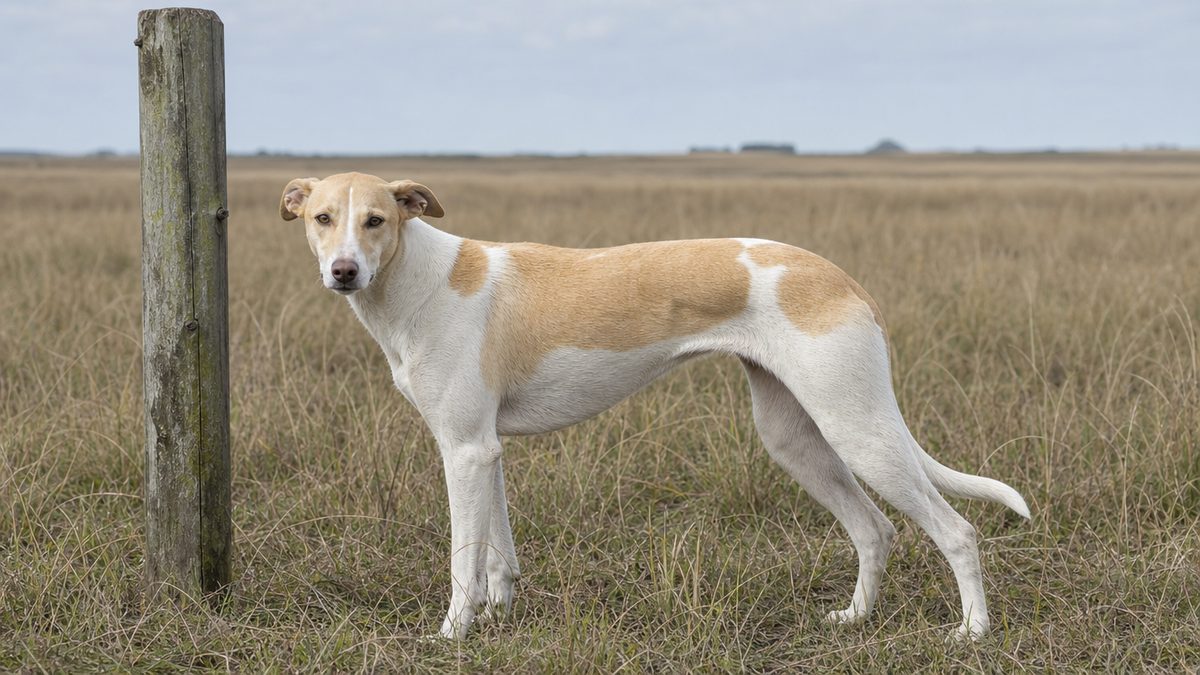
Two framing points before the clauses. This is a medium-sized dog and readers consistently overestimate it, because the word deerhound pulls the Scottish breed to mind and that one starts, at its FCI male minimum of 76 cm, seventeen centimetres above this breed's ceiling. And it is an athletic running animal rather than a heavy trailing hound: the standard asks for a rectangular dog of strong appearance adequate to its function, with ribs of discreet arching for aerodynamics and a gait that is fluent with ample strides, and the Brazilian magazine source Wikipedia relies on adds slender without seeming very thin and physiologically built for speed.
| Field | What the standard says |
|---|---|
| Utilization | Caca, rastro e presa: hunting, trailing and seizing |
| Working trial | Nao regulamentada, not regulated |
| Height | 47 to 59 cm for females AND males, with 1 cm tolerance either way |
| Weight | Not given; height and weight only proportional to form and function |
| General appearance | Rustic, medium build, RECTANGULAR, with squareness undesirable as unsuited to its function |
| Coat | Short, straight, dense and harsh, with no undercoat |
| Colour | White through to leonine yellow, solid or patched, white collar and chest and foot markings permitted |
| Ears | Entire, pointed, laterally set, carried in rose and erect when alert |
| Eyes | Almond, hazel in any shade, greenish admitted; blue eyes undesirable |
| Tail | Entire, medium set, not beyond the top of the hocks, carried low |
| Rear dewclaws | Single or double, desirable |
Two clauses no other standard in this batch contains
The first is about scars. Under FALTAS the standard states that body scars, due to the dog's function, must not be penalised. The second is the dewclaw clause, which calls single or double rear dewclaws desirable rather than merely permissible. Both are the marks of a standard written by people who hunt the dog rather than show it.
The coat colour clause is the identifying feature. A ground running from white to a leonine yellow, described as dark bay, either solid or carrying a patch of one of those colours, with a white collar and white on the chest and feet allowed. There is no black, no brindle and no saddle anywhere in it.
Wikipedia cites the wrong standard, and the mechanism is now identifiable
English Wikipedia cites padrao-raca_226.pdf as this breed's CBKC standard. That file returns HTTP 200 and serves the Pyrenean Mountain Dog. The real standard is padrao-raca_9.pdf.
This site has already recorded Wikipedia citing the wrong CBKC file twice, for the Dogue Brasileiro and the Ovelheiro Gaucho. This is a third instance, and having three lets the mechanism be identified rather than merely noted.
| Breed | data-idcbkc | value | File Wikipedia cites | What that file actually serves |
|---|---|---|---|---|
| Veadeiro Pampeano | 9 | 226 | 226 | Cao da Montanha dos Pireneus, the Pyrenean Mountain Dog |
| Ovelheiro Gaucho | 1 | 223 | 223 | Cao das Montanhas do Atlas, the Aidi |
| Dogue Brasileiro | 2 | 221 | 221 | Shar Pei |
| Veadeiro Nacional | 29 | 297 | not cited | Correctly serves the Veadeiro Nacional, NR29 |
In all three recorded cases the cited file number is exactly the breed's `value` attribute, while the actual standard file is keyed on `data-idcbkc`. That is a single systematic attribute confusion rather than three independent mistakes, and it predicts the error for any Brazilian breed whose article was written the same way.
A wrong file that 404s is harmless. A wrong file that returns HTTP 200 with a real, complete, correctly formatted breed standard is not, because nothing about the response warns you. A reader following Wikipedia's citation for this breed lands on a genuine CBKC document about a 70 to 82 cm French livestock guardian and has no reason to doubt it.
How to get the right file, in three steps
- Fetch CBKC's breed index and read the `data-idcbkc` attribute for the breed you want out of its own markup, rather than assembling a number from anywhere else.
- Build the path as `padrao-raca_<data-idcbkc>.pdf` and fetch the bytes, checking the magic bytes are %PDF rather than trusting the status code.
- Read the breed name printed inside the document before taking a single figure from it, because that is the only check that catches a wrong file that resolves.
Doing that returns padrao-raca_9.pdf, 73,357 bytes, five pages, whose first page prints Padrao Oficial da Raca VEADEIRO PAMPEANO with GRUPO 11 and Padrao CBKC NR07 beneath it. That is the document this page is built on.
A malformed Roman numeral in the standard's only historical sentence
The breed's entire recorded history is one sentence, and that sentence dates the breed to the early 'seculo IXX', which is not a valid Roman numeral.
CBKC Padrao NR07's BREVE RESUMO HISTORICO reads in full: 'Presente no Brasil, constatadamente, desde o inicio do seculo IXX. E encontrado em diversas regioes geograficas do Brasil, principalmente no Rio Grande do Sul.'; Present in Brazil, demonstrably, since the beginning of the IXX century, found in several geographic regions of Brazil, principally in Rio Grande do Sul.
Roman numerals build by placing a smaller value before a larger one to subtract, and only in defined pairs. IXX has no valid reading. The intended value is plainly XIX, the nineteenth century, since that is the only century that makes sense of a breed described as demonstrably present since its beginning. But the standard as published contains a typo in the only sentence it devotes to the breed's origin.
That is worth recording for two reasons. The first is simply accuracy: this page quotes the standard as printed and states the intended reading separately, rather than silently correcting a primary document. The second is that automated readers do not correct it. A pipeline parsing century values out of breed standards will either fail on IXX or produce nothing, and this is exactly the class of defect that propagates when nobody opens the original.
What the sentence does and does not establish
It establishes presence in Brazil from the early nineteenth century, principally in Rio Grande do Sul, and it names no foreign ancestor at all. There is no Portuguese Podengo in it, no Ibizan Hound, and certainly no Indian breed. Every origin theory attached to this dog in English comes from Brazilian magazine articles rather than from the standard, and the standard is the document the registry actually maintains.
The same document that gives one sentence to history gives detailed clauses to the ears, the eyes, the bite, the dewclaws, the tail carriage and the treatment of working scars. That imbalance is itself informative. This is a standard written to judge a working dog in a ring, not to make a historical case, and reading it as history is reading it against its purpose.
The Rajapalayam claim, and the paragraph that carries no citation
The only English text connecting this Brazilian breed to India is a Wikipedia paragraph asserting similarities with the Rajapalayam, and it is the single uncited prose paragraph in an article with 24 reference tags.
This matters more on this site than on most, because Bonbeno is written for Indian readers and the Rajapalayam is one of India's best-known native breeds. If a genuine link existed it would be the most interesting thing about this dog for an Indian audience. So it was checked properly rather than repeated.
Wikipedia's Pampas Deerhound article states that there are some similarities between the Pampas Deerhound and the Rajapalayam dog native to that region in India, that Brazil was previously a colony of Portugal, that India had regions under Portuguese dominance for centuries, and that these formed part of major maritime trade routes connecting the continents, thus explaining the presence of a variation of this dog breed in Brazil. Checked against the raw wikitext through the MediaWiki API at revision 1312024332: that paragraph carries ZERO ref tags.
The rest of the article is cited throughout. It carries 24 reference tags, drawing on Brazilian magazine sources and the CBKC standard, and the paragraphs immediately before and after the India passage both carry named references. The India paragraph is the exception.
The argument is a syllogism rather than evidence
- Brazil was a Portuguese colony. True.
- Parts of India were under Portuguese control for centuries. True.
- Both lay on Portuguese maritime routes. True.
- Therefore a variation of this dog breed is present in Brazil. Does not follow.
Three true premises about shipping do not establish that two dogs are related. The same argument would connect any Brazilian animal to any Goan one. What would establish a link is a genetic study, a documented importation, or a Brazilian source naming an Indian ancestor, and none of those exists.
What the primary sources actually say
The CBKC standard's history names only presence in Brazil since the early nineteenth century and no foreign ancestor. The Brazilian origin theories reported in the article's cited sources involve Iberian podengo-type dogs brought by Portuguese colonists, or a native South American origin, and neither routes through India. One more thing a reader comparing the two Wikipedia articles should know: the Rajapalayam article's hunting paragraph, describing a relentless pursuer that brings its prey down and back to the handler, corners what it cannot bring down, and hunts alone, in pairs, in a pack or with its owner, follows the Pampas Deerhound article's hunting paragraph almost sentence for sentence. Part of the resemblance between the two breeds on Wikipedia is a resemblance between two paragraphs rather than between two dogs.
The two breeds do look somewhat alike. Both are lean, short-coated, light-framed hunting dogs, and the Rajapalayam is often white while this breed's colour range runs from white to fawn. Convergent build in two hot-country hunting dogs is not evidence of shared ancestry, and this page reports the resemblance while declining the causal claim. Anyone finding a genuine source for it should be taken seriously; nobody has produced one yet.
Breed recognition, and the sibling that made it to the FCI
Breed recognition for this dog stops at Brazil's national border, and a breed from the same CBKC group crossed that border in August 2025, which shows the route exists and that this one has not taken it.
The FCI's definitive register was enumerated record by record on 9 September 2026, probing every number from 1 to 400 and reading back each page's own title rather than assembling a URL from a breed name. No record's title contains VEADEIR or PAMPA. The provisional register holds no Veadeiro entry either.
The register does hold a DEERHOUND at record 164, and it is the Scottish breed. So a search for deerhound in the FCI register returns a result, and that result is not this dog. An absence proved against a register that returns nothing for anything is worthless; this one is proved against a register that returns the right answer for a similar query.
| Breed | FCI status | Record |
|---|---|---|
| Fila Brasileiro | Definitive | 225 |
| Rastreador Brasileiro | Definitive | 275 |
| Terrier Brasileiro | Definitive | 341 |
| Buldogue Campeiro | Provisional since 6 August 2025 | 374 |
| Veadeiro Pampeano | Absent from both registers | none |
| Veadeiro Nacional | Absent from both registers | none |
The fourth row is the one that gives the fifth its meaning. The Buldogue Campeiro is a CBKC Grupo 11 breed that reached FCI provisional recognition as standard 374 on 6 August 2025. Same national register, same non-FCI group, and it moved. So Grupo 11 is not a dead end, and the Veadeiro Pampeano's absence reflects the state of its own file rather than a closed door.
What Brazilian recognition actually gives a buyer
A published standard, a national studbook entry and a judging framework. What it does not give is an FCI pedigree, and that matters for an Indian reader specifically. India is a full FCI member represented by the Kennel Club of India, so the KCI issues pedigrees against FCI nomenclature. A breed absent from FCI nomenclature has no Indian pedigree route, whatever its national standing in Brazil.
The CBKC is not Brazil's only cynological body. SOBRACI also recognises both deerhound breeds and treats the Veadeiro Pampeano and the Veadeiro Nacional as distinct from one another. Where two national bodies hold a breed, saying which one you mean is the difference between a checkable claim and a vague one, and the standard this page is built on is the CBKC's.
Pampas Deerhound price in India
No Pampas Deerhound price in india exists, and no Indian listing offering the breed was found on a live search with a passing control.
The organic results for 'pampas deerhound' on Google India were Wikipedia, an encyclopedia aggregator, a breed-video channel, a hound blog, Wikimedia Commons, Wikidata, two stock-photo libraries and Pinterest. Not one is a listing, and most of the dog results are about the Scottish Deerhound rather than this breed.
Two separate barriers, and both are absolute
The first is the pedigree route. India is an FCI member through the Kennel Club of India, and this breed sits outside FCI nomenclature entirely. So even a lawfully imported dog could not be papered here in the ordinary way.
The second is import law. DGFT Trade Notice 22/2022-23 of 19 December 2022 places dogs under ITC(HS) 01061900 as Restricted, permitting import only for a pet dog with a valid pet book in the importer's name, for an R&D organisation with a CPCSEA recommendation, or for Defence and Police use.
Policy Condition (8) reads: 'Import of commercial dogs for breeding or any other commercial activities other than the purposes mentioned above is not permitted.' Paragraph 6 adds that 'any applications for trading/breeding purposes, or applications made on behalf of some another person/entity shall be duly rejected';. An import authorisation for a personal pet covers one owner's own dog and creates no breeding stock.
How to test any rupee figure you are shown
- Divide it by 84.38 and by 74 and see whether it lands on a round dollar or euro amount, which is the signature of a converted foreign price.
- Ask whether the quotient is a price a real seller would print, since a quotient like 6,875 is nobody's asking price.
- Check the host country of the figure, because a Brazilian source quoting R$ is quoting reais and the currency symbol is one character from Rs.
- Confirm the listing is for a live animal rather than a print, a mug or a stock photograph, which is a documented contamination route on this site.
Bonbeno publishes no price. What is real and checkable is the cost of keeping a dog of this size in India, and that follows.
What a medium hunting dog costs to keep in India
The cost of ownership for a 47 to 59 cm hunting dog in India runs roughly Rs 4,500 to Rs 9,000 a month once food, parasite control, vaccination and routine care are counted.
The standard gives no weight, so the band has to be inferred from height and build. A slender, long-legged dog of 47 to 59 cm in working condition sits around 18 to 25 kg, which places it inside the commonest Indian parasite-product dose band and makes it materially less expensive to keep than any 60 cm-plus hound.
| Item | Published figure | Source and caveat |
|---|---|---|
| Anti-rabies vaccination | Rs 699 | Vetic clinic list price, national page |
| 9-in-1 DHPPiL | Rs 899 | Vetic clinic list price |
| Kennel cough | Rs 1,349 | Vetic clinic list price |
| Tick and flea plus worming, monthly | about Rs 1,103 | NexGard Spectra 15-30 kg, 3 tablets Rs 3,308 |
| Delhi pet dog registration | Rs 500 new, Rs 500 renewal | MCD, dogs only, late fee Rs 100 a month |
| Chennai pet licence | Rs 50 | Greater Chennai Corporation |
Read the Vetic prices as one chain's list prices rather than a market average, since that chain quotes different course prices on different city pages on the same day. The NexGard band fits this breed across its whole size range.
Greater Chennai Corporation's six municipal veterinary clinics provide treatment and anti-rabies vaccination free of cost, and its pet licence is Rs 50. For a Chennai reader that is a far more affordable baseline than any private rate card. Delhi's MCD charges Rs 500 to register a pet dog and the same to renew.
Grooming costs effectively nothing for this breed, which is unusual. A short, straight, dense, harsh coat with no undercoat needs a rubber mitt and no professional attention at all, so the entire grooming line that a long-coated breed would carry simply does not exist here.
Suitability for the Indian climate
This breed has the best Indian heat prospects of any dog in this six-breed batch. Porto Alegre's February wet-bulb peak of 21.62 C sits below Bengaluru's May peak of 21.86 C.
The pampas are flat, which means NASA POWER handles them well, and the elevation checks confirm it before any figure is used.
Bage in Rio Grande do Sul, in the breed's heartland, returns a cell elevation of 161.4 m against a real ground elevation of 207 m, an error of -45.60 m. Porto Alegre returns 37.68 m against 15 m, an error of +22.68 m. Both are well inside tolerance, and the reason is the same as for the English Fens elsewhere in this batch: grassland has no terrain for the model to flatten.
| Place | Annual mean C | Warmest month | Coolest month | Annual RH % |
|---|---|---|---|---|
| Bage, Rio Grande do Sul | 17.40 | JAN 23.59 | JUL 11.05 | 80.31 |
| Porto Alegre | 19.32 | FEB 24.63 | JUL 13.57 | 81.82 |
| Bengaluru | 23.74 | APR 28.37 | DEC 20.22 | 67.94 |
| Pune | 23.86 | APR 28.93 | DEC 19.62 | 66.80 |
| Delhi | 25.60 | JUN 35.88 | JAN 13.61 | 45.56 |
| Kolkata | 25.81 | MAY 31.53 | JAN 17.31 | 73.93 |
| Mumbai | 26.77 | MAY 31.19 | JAN 23.19 | 67.39 |
| Chennai | 27.95 | MAY 31.51 | JAN 24.09 | 72.39 |
The pampas are subtropical rather than temperate, and that is the whole difference from the European breeds this site usually assesses. Porto Alegre's warmest month at 24.63 C is only 3.74 degrees below Bengaluru's, and its annual relative humidity of 81.82 percent is well above any Indian city's. A dog from this climate arrives in the Deccan already accustomed to warm, humid air.
The wet-bulb comparison, which is the one that decides
| Place | Peak month | Peak wet bulb C | Against Porto Alegre |
|---|---|---|---|
| Bage, Rio Grande do Sul | JAN | 20.10 | -1.52 |
| Porto Alegre | FEB | 21.62 | - |
| Bengaluru | MAY | 21.86 | +0.24 |
| Pune | JUN | 22.97 | +1.35 |
| Hyderabad | JUN | 23.35 | +1.73 |
| Mumbai | JUN | 25.77 | +4.15 |
| Chennai | MAY | 26.11 | +4.49 |
| Delhi | JUL | 26.50 | +4.88 |
| Kolkata | JUN | 27.09 | +5.47 |
Bengaluru's peak evaporative load is 0.24 C above this breed's homeland peak. That is the closest match this site has recorded between an imported breed's homeland and an Indian city, and it means the honest verdict for the Deccan is workable rather than hostile. The short harsh coat with no undercoat helps further, since there is no insulating layer to trap heat.
Mumbai, Chennai, Delhi and Kolkata run four to five degrees of wet bulb above the pampas peak, which is outside anything the homeland produces in any month. And Hall 2020 found that of 879 heat-related illness events with a recorded trigger, 652, being 74.2 percent, were exertional rather than environmental. A dog that copes with the ambient climate can still overheat doing the job it was bred for, and this breed's job, as the Brazilian sources describe it, is tracking prey for up to two daysWikipedia, Pampas Deerhound.
One last framing point, because it is easy to overstate. Calling this breed heat-tolerant is accurate relative to every other dog in this batch and misleading if read as heat-proof. It evolved in a subtropical grassland with a real winter, where Porto Alegre's coolest month averages 13.57 C, so it is a dog adapted to warm humid summers rather than to year-round tropical heat. The Deccan verdict is workable; the coastal verdict is not.
Temperament and household fit
The standard describes a dog obedient to its owner that carries out its task out of sight of that owner, which is the definition of an independent hunting animal.
CBKC NR07's temperament clause is unusually informative for a short document. It describes a dog obedient to its owner, an outstanding hunter that executes its task out of the sight of its owner or handler, reserved with strangers but permitting approach without showing fear or aggression, and easy-going with children. Excessive aggression is to be penalised.
Read the second and third clauses together
A dog that works out of sight and is reserved with strangers is a working animal with judgement, not a guard dog and not a companion breed. Reserved but not fearful and not aggressive is a precise formulation and a demanding one, and it describes a temperament that needs socialising rather than protecting.
- Choose another breed if you live in a flat, because a dog built to range open grassland for two days has nowhere to put that.
- Choose another breed if you want reliable off-lead freedom in an unfenced space, because this breed's prey drive is its entire purpose.
- Choose another breed if you cannot fence, since a sighthound-built dog on open ground is gone before a recall lands.
- Consider one only with land, secure fencing, and something for the dog to track.
Brazilian sources consistently describe this breed as quiet in demeanour, patient and calm with active children, and very attached to its owners, with a vocal repertoire reserved for work rather than for the house. For a hunting breed that is an unusually good household profile, and it is the reason the breed is kept as a companion in Brazil as well as worked.
None of this makes it an Indian city dog. A rustic working animal with a two-day tracking range and a strong prey drive in a country full of free-roaming animals is a management problem wherever it is kept, and the mismatch is with the environment rather than with the temperament.
Training approach and what this breed resists
Train a Veadeiro Pampeano for containment and recall first, because the standard describes a dog that works out of sight of its handler and recall training against live game is the limiting factor.
The standard's own wording sets the problem. A dog described as obedient to its owner and as executing its task out of that owner's sight is not disobedient; it is doing what it was selected to do. That makes it moderately trainable for handling and poor at staying close.
- Build recall on a long line through the first year, and never let the dog rehearse a successful chase.
- Fence before you need to, because a lean long-legged dog on open ground is out of range in seconds.
- Give the nose and the eyes a legal daily outlet, since a tracking breed with no work finds its own.
- Socialise early to Indian street conditions, cattle, crowds, traffic and other dogs, at a distance the dog can handle.
- Keep a long-line default in unfenced ground for life, since honest management beats an obedience claim you cannot cash.
This is a breed selected to pursue deer for up to two days and to seize furred game. India's free-roaming cattle, goats, pigs and street dogs present that dog with targets constantly, and a chase that ends in livestock damage is a legal and financial problem as well as a welfare one. Plan containment before the first incident rather than after it.
The standard says excessive aggression must be penalised, and reserved-but-approachable is what it asks for. Harsh handling on a reserved dog produces fearfulness rather than compliance, and a dominance framework does nothing for an animal whose motivation is prey. Exercise the drive properly and the handling holds.
Daily exercise requirement, and what happens without it
A Veadeiro Pampeano needs at least ninety minutes of real work daily, because its standard describes a dog that works out of sight of its handler and the Brazilian sources describe one that can follow prey without a break even if it takes two days.
The working description sets the scale, and it is a large scale. Brazilian sources describe a relentless pursuer that is not intimidated by obstacles, follows a trail without pause, and hunts alone, in pairs, in packs or with its owner. The standard adds a gait that should be fluent with ample strides.
| City | Usable hours, Apr to Jun | Practical plan |
|---|---|---|
| Bengaluru, Pune | 05:30 to 08:30 and after 18:30 | Two sessions of 45 minutes; the widest usable window in India for this breed |
| Hyderabad | 05:30 to 08:00 and after 19:00 | Two sessions, afternoon given up |
| Delhi, Ahmedabad | 05:00 to 07:00 and after 20:30 | Dawn session only in the worst weeks, indoors midday |
| Chennai, Mumbai, Kolkata | 05:00 to 07:00 and after 20:00 | Short sessions, water always, no midday movement |
The first row is genuinely wider than it would be for any other breed in this batch, and that follows directly from the wet-bulb match rather than from any softening of the requirement.
Give it distance and tracking, not repetition
- Free-run in a securely fenced space daily, because this build needs to extend rather than to trot.
- Lay long drag trails rather than short ones, since the breed's own description is of sustained tracking.
- Vary terrain where possible, because the standard describes a dog undeterred by obstacles.
- Rotate the route, since a solved trail stops being work.
Escaping first, then digging and destructive chewing. A dog bred to range does not become calm when confined, it becomes an escape problem. That matters more here than for the treeing and trailing breeds elsewhere in this batch, because a sighthound-built dog that gets out covers ground fast.
Grooming and coat care in Indian humidity
Groom a Veadeiro Pampeano in five minutes a week, because the standard gives a short, straight, dense, harsh coat with no undercoat and rose-carried ears that ventilate better than any drop ear in this batch.
The coat clause is four adjectives and one absence: short, straight, dense and harsh, with no undercoat. Brazilian sources add that the coat is odourless. A rubber mitt once a week is the entire routine, and there is nothing to strip, trim or clip.
An undercoat is an insulating layer, and it is what makes northern breeds suffer in Indian heat regardless of how short the guard coat looks. This breed has none by standard, which means the coat does not trap warm air against the skin. Combined with the wet-bulb match, it is the second reason this dog's Indian heat prospects are the best in this batch.
The ears are the best design here
The standard sets the ears as entire, pointed, laterally set, carried in rose and erect when alert. A rose ear folds back and leaves the canal substantially open, and an erect ear opens it completely. Compare that with the French and Swiss hounds elsewhere in this batch, whose ears reach the end of the muzzle and lie flat over the canal. The monsoon ear-infection risk for this breed is materially lower, and an ear infection is correspondingly less likely to be the first veterinary bill.
- Check both ears fortnightly rather than weekly, which is enough for an open ear.
- Dry the canal after swimming or heavy rain, because even a good design fails if water sits in it.
- Use a cleaner your vet recommends, and stop if the dog flinches.
- See your nearby vet at the first head shake or odour.
Ticks and a pale coat
A white to pale fawn coat makes ticks easier to see than a black one, which is a small real advantage given the Indian burden. A West Bengal series of 584 dogs screened at veterinary clinics found Babesia gibsoni in 76.54 percent and two or more pathogens in 72.9 percent of the 584 dogs screened, and the Indian tick-borne disease load is the risk this breed's coat helps most with. A Kerala series of 120 dogs found Babesia in 66.7 percent, peaking pre-monsoon between March and May. Both sampled clinic caseloads rather than the street.
White and pale fawn dogs sunburn, particularly on the nose, ear edges and any thinly haired belly. The standard permits a flesh-coloured nose, and an unpigmented nose in Indian sun burns readily. Shade and timing are the defences, and a vet-recommended barrier product on an unpigmented nose is worth asking about.
Health issues, screening and what is actually known
No breed-specific health data exists for the Veadeiro Pampeano, and the search that proves it turns up three separate homonyms, one of which is a national park.
Every name form returns zero on-breed. 'Pampas Deerhound', 'Veadeiro Pampeano', 'Veadeiro' and 'Brazilian deerhound' each returned 0 in title or abstract, against controls of 126 and 141 in the same session.
| Query | Records | What they actually are |
|---|---|---|
| 'Veadeiro'[tiab] | 0 | The singular is not in PubMed's index at all |
| 'Veadeiros'[tiab] | 18 | Chapada dos Veadeiros, a Brazilian national park. All 18 also match Chapada |
| 'Veadeiro Pampeano', unquoted | 29 | A REWRITE. PubMed searched Pampeano alone and reported Veadeiro as a phrase not found |
| 'Pampeano'[tiab] | 10 | The Pampeano Formation and Pampeano aquifer, Argentine geology |
| 'Pampas deer' and Ozotoceros bezoarticus | 63 | The wild cervid the breed is named for hunting |
| 'deerhound'[tiab] union plural | 26 | The Scottish Deerhound, 18 of them named as such |
Unquoted, 'Veadeiro Pampeano' returns 29 records, and PubMed produced that count by discarding Veadeiro entirely and searching Pampeano alone. Read the query translation line PubMed actually ran before treating any count as coverage. This is the same failure this site has recorded for Cane Toccatore at 12,199 and Schweizer Laufhund at 6,354.
The registers agree
The Orthopedic Foundation for Animals holds no code for this breed under any name, read from OFA's own markup across 482 breed entries with LABRADOR, BULLDOG and BEAGLE passing as controls. The fragment DEERHOUND returns only SDH, the Scottish Deerhound. OFA's own threshold explains what an absence means: 'For hips, each breed must have at least 100 evaluations in the database. For all other databases, there must be at least 50.';
What the standard itself requires
Nothing. CBKC NR07 sets no health test at any level, and its only health-adjacent provision is that any dog showing any sign of physical or behavioural anomaly must be disqualified. It does penalise missing incisors, canines or molars and penalises prognathism in either direction, which are conformational rather than clinical checks.
Three risks transfer from shape and climate rather than from breed data. A moderately deep-chested running dog carries the conformational risk factor for gastric dilatation-volvulus, so feeding practice matters. A pale, sometimes unpigmented nose burns in Indian sun. And any dog worked hard in heat carries the exertional risk Hall 2020 quantified. Ask a seller to screen the parents under any scheme available, and consult your nearby vet.
Life expectancy, and why this page gives no number
No published life expectancy figure for the Veadeiro Pampeano rests on data, and this page publishes none rather than repeating an aggregator's estimate.
The breed is not among the 155 purebred breeds in the largest UK longevity study's supplementary tables, and no Brazilian cohort study models it. Its own standard gives no lifespan, which is normal for a breed standard and worth stating because aggregators present lifespan figures as though standards contained them.
| Register | Result | Control that passed |
|---|---|---|
| CBKC | Standard NR07, Grupo 11 | The document's own printed heading |
| FCI definitive register, 1 to 400 | Absent | Deerhound at 164, Rastreador Brasileiro at 275 |
| FCI provisional register | Absent | Buldogue Campeiro 374, Karaman 378 |
| OFA breed-code list, 482 entries | No code | LABRADOR 109, BULLDOG 170, BEAGLE 61 |
| OFA published statistics tables | No row | Same session, same dump |
| PubMed, four name forms | Zero on-breed | Labrador hip dysplasia 126, Jack Russell Terrier 141 |
| McMillan 2024 longevity tables | Not among the 155 purebreds | The study's own breed list |
The temptation on this page is to give the Veadeiro Pampeano the Scottish Deerhound's lifespan, since the names are similar and one of them has data. That would be worse than useless, because the two are different sizes, different builds and different continents. A breed with no cohort should say so, and this page says so rather than borrowing once.
That absence is the single most decision-relevant fact here. A breed with no data is a breed where the buyer carries the risk, and for a dog with a national standard but no international register and no published screening, that risk sits entirely with whoever brings the puppy home.
Feeding a medium hunting dog in India
Feed a Veadeiro Pampeano to a body condition score, because CBKC NR07 gives no weight at all and says only that height and weight should be proportional to form and function.
The standard's TAMANHO / PESO clause is explicit about giving no number: height and weight proportional to form and function, with the height range following. So no registry figure exists to feed against, and the condition score is the instrument.
- Feel the ribs with flat fingers and expect to find them under a thin cover, without pressing.
- Look down at the standing dog and expect a visible waist behind the ribs.
- Look from the side and expect an abdominal tuck, which this standard calls a slightly greyhound-like underline.
- Weigh monthly on the same scale and record it, because a trend beats a single reading.
The standard describes a rectangular dog of strong appearance adequate to its function, with a slightly greyhound-like underline, and the Brazilian magazine source Wikipedia relies on describes it as slender without seeming very thin and physiologically built for speed, so the target is lean rather than light. A dog of this build at 47 to 59 cm sits roughly 18 to 25 kg in condition and eats about 250 to 320 grams of a good dry food daily.
The chest shape still matters
The standard asks for a chest that is deep and broad, to house lungs that enable the dog's function, with ribs of discreet arching for better aerodynamics and respiratory function. A deep chest is the recognised conformational risk factor for gastric dilatation-volvulus, which is a surgical emergency rather than an upset stomach.
Split the daily ration into two or three meals, avoid hard work for an hour either side of a meal, and slow a fast eater with a maze bowl. Unproductive retching, a distended abdomen and restlessness together are a same-hour emergency, and the number to call is your nearby vet.
Month by month through the first year
Plan a Veadeiro Pampeano's first year around fencing and the socialisation window, because a running breed that learns to leave a compound is very hard to un-teach.
This timeline is generic medium-hunting-dog guidance honestly labelled, because no breed-specific developmental data exists. Generic guidance named as generic beats breed-specific guidance invented.
| Age | Priority | What to do |
|---|---|---|
| 8 to 12 weeks | Vaccination and habituation | Complete the core course with your vet; begin surface, sound and handling exposure indoors |
| 12 to 16 weeks | Socialisation window | Short daily outings in cool hours; cattle, goats, crowds, traffic and other dogs at a workable distance |
| 4 to 6 months | Recall foundation | Long-line work only; never rehearse a chase; begin tracking games |
| 6 to 9 months | Fencing | Secure the boundary before the dog tests it; register the dog with your municipality |
| 9 to 12 months | Distance, slowly | Build free-running distance in cool hours in a secure space; extend trails |
| 12 months onward | Adult workload | Ninety minutes daily; recall proofing continues for life |
Its first Indian summer is a materially smaller risk than for any other breed in this batch, because the homeland's evaporative load already matches Bengaluru's. Indian law still names young animals among the categories that must not be kept in outdoor facilities without a veterinarian's written approval, and that clause applies regardless of how well the breed handles heat.
Register the dog when your municipality requires it. Delhi charges Rs 500 for a new pet dog registration and Rs 500 to renew, with a late fee of Rs 100 a month, and Greater Chennai Corporation charges Rs 50 for a pet licenceGreater Chennai Corporation.
Where the breed standard and Indian law agree, for once
CBKC NR07 requires entire ears, an entire tail and desirable rear dewclaws, and Indian law prohibits cropping, docking and de-clawing. This is the rare case where a foreign standard and Indian law want the same dog.
Most pages in this cluster document a collision. This one documents an alignment, and it is worth stating because it is unusual enough that a reader should know it can happen.
| Feature | CBKC NR07 requires | Indian law requires |
|---|---|---|
| Ears | Integras, entire | No ear cropping, Second Schedule Part II para 6(8) |
| Tail | Integra, entire, carried low | No tail docking, same clause |
| Rear dewclaws | Single or double, desirable | No de-clawing, same clause |
| Bite | Prognathism in either direction penalised | Overshot and undershot jaw named in Part III para 8(10) |
| Appearance | Any physical or behavioural anomaly disqualifies | No change of appearance by artificial means, para 6(8) |
Most working-breed standards on this site either permit dewclaw removal or say nothing. CBKC NR07 says single or double rear dewclaws are desirable, while Indian law's paragraph 6(8) forbids de-clawing outright. A breeder following this standard in India is doing what the law requires anyway, which is the opposite of the position an American cur breeder would be in.
The clause that still applies
Second Schedule Part IV paragraph 21(1) bars keeping in outdoor facilities, without an attending veterinary practitioner's written approval, dogs not accustomed to the temperatures prevalent in the area, breeds that cannot tolerate them, and sick, infirm, aged or young animals. That applies to any dog and is not softened by this breed's favourable heat profile.
And paragraph 6(3) prohibits in-breeding, defined as breeding between relatives of the second to fourth grade within the first four generations, and incest breeding. That is worth noting for a breed whose own Brazilian history describes characteristics kept stable through an inbreeding programme among dogs showing desirable hunting traits. A practice described in the breed's own history would be unlawful if carried out in India today.
Head to head against the breeds it is confused with, and the ones you can get
The Pampas Deerhound is confused with a Scottish breed twice its size, and the Indian dogs that genuinely resemble it are available in Tamil Nadu and Karnataka.
| Breed | Height | Coat | Register | Indian availability |
|---|---|---|---|---|
| Pampas Deerhound | 47 to 59 cm | Short, harsh, no undercoat | CBKC NR07, Grupo 11 | None found |
| Veadeiro Nacional | See NR29 | See NR29 | CBKC NR29, Grupo 11 | None found |
| Scottish Deerhound | At least 76 cm for males and 71 cm for females, no maximum | Harsh, rough, wiry | FCI 164 | Very scarce |
| Rajapalayam | About 65 to 75 cm | Short, fine | KCI recognised | Regional, Tamil Nadu |
| Chippiparai | About 61 cm, dogs 63 and bitches 56 | Short, fine | KCI recognised | Regional, Tamil Nadu |
The Scottish Deerhound row is the confusion. Its FCI male minimum of 76 cm sits seventeen centimetres above this breed's ceiling, it carries a rough wiry coat of 8 to 10 cm rather than a short harsh one, and it belongs to a different register on a different continentFederation Cynologique Internationale. Google's own People Also Ask box for this breed answers with Scottish Deerhound material, so the confusion is not a fringe error.
The Indian comparison the Wikipedia paragraph should have made
If a reader wants a lean, short-coated, hot-country hunting dog with a living population and a real register, India has two. The Chippiparai is the closer match on size at about 61 cm, and the Rajapalayam is the breed Wikipedia actually names, standing taller at about 65 to 75 cmWikipedia, Rajapalayam dog. Both are obtainable in India and neither requires an import that would be refused.
Wikipedia's uncited paragraph suggests the Pampas Deerhound and the Rajapalayam are historically connected. The practical point for an Indian reader is simpler and better evidenced: the Rajapalayam is here, it is recognised, and it does the same job in this climate. Whatever the history turns out to be, the dog worth having in India is the Indian one.
One further comparison worth making inside Brazil. The Rastreador Brasileiro holds FCI record 275 and the Campeiro Bulldog reached FCI provisional status in August 2025, while this breed sits in Grupo 11 with neither. Three Brazilian breeds, three different positions on the same ladder.
What readers get wrong about the Pampas Deerhound
The commonest mistake is reading about a completely different dog, because almost every deerhound result on the Indian search is Scottish.
- Reading Scottish Deerhound material. That breed stands at least 76 cm for males and 71 cm for females, with no maximum, and is rough-coated; this one is 47 to 59 cm and harsh-coated.
- Following Wikipedia's standard link. It cites padrao-raca_226.pdf, which serves the Pyrenean Mountain Dog.
- Repeating the Rajapalayam claim as fact. It is the only uncited prose paragraph in a 24-reference article.
- Confusing it with the Veadeiro Nacional. Those are two separate CBKC standards, NR07 and NR29.
- Quoting a weight. CBKC NR07 gives none at all.
- Reading an unquoted PubMed count as literature. 'Veadeiro Pampeano' unquoted returns 29 for a search that never ran.
- Assuming Grupo 11 means unrecognised. It means recognised by the CBKC and not by the FCI, which the group's own name says.
The mistake this page is most keen to prevent
Treating a favourable heat verdict as permission. This breed has the best Indian climate prospects in its cluster and it still cannot be obtained lawfully, so the practical answer is unchanged. A reader who takes the wet-bulb match as encouragement to pursue an import is being encouraged by the wrong half of the page.
Hall 2020 found 74.2 percent of triggered heat-related illness events were exertional rather than environmental. A dog its Brazilian sources describe as tracking prey for up to two days is exactly the animal that overheats doing its job in a climate it otherwise tolerates. Signs to act on are heavy unrelenting panting, a dog that will not rise, brick-red or very pale gums, vomiting, wobbliness or collapse. Move to shade, wet with cool rather than ice-cold water, and reach your nearby vet at once.
One research mistake worth naming. A breed with a real national standard looks like a breed with real data behind it, and it is not. The CBKC maintains a standard and requires no health test, and no register anywhere publishes screening statistics for this dog. A standard is a description of what a dog should look like. It is not evidence about what that dog's health is.
Adoption and responsible sourcing
Adopt rather than pursue this breed in India, because no lawful route exists and the Indian dogs that most closely resemble it are recognised, available and native.
Nobody in India can sell you a Veadeiro Pampeano lawfully. DGFT Trade Notice 22/2022-23 permits importing a dog only as a pet with a valid pet book in the importer's name, for R&D with a CPCSEA recommendation, or for Defence and Police use, and states that applications for trading or breeding purposes shall be duly rejected. And because the FCI does not hold the breed, no Kennel Club of India pedigree route exists for it either.
What to do if this dog appeals to you
- Look at a Chippiparai, which matches this breed closely on build, coat, size and function and lives in the climate already.
- Look at a Rajapalayam, the Indian breed Wikipedia names in connection with this one, which is recognised and obtainable.
- Consider an Indian Pariah Dog, which is heat-adapted, robust, free and available in every Indian city.
- Ask a municipal shelter for a lean, high-drive young dog, since that build is common in Indian shelters and hard to place.
To verify any claim made under this name, read CBKC's own breed index, take the `data-idcbkc` attribute for the Veadeiro Pampeano, which is 9, and fetch padrao-raca_9.pdf. Then read the breed name printed inside the document. A seller citing any other file number, including 226, is citing a standard for a different breed.
If you are outside India
The route runs through Brazilian breeders working with the CBKC standard, and the breed is kept as a working hunting dog in Rio Grande do Sul rather than as a show animal. Expect microchip-based identification to feature, since Brazilian sources describe specimens conforming to the standard being identified through microchips as part of establishing bloodlines toward eventual international recognition.
Bonbeno does not recommend breeders, link puppy listings or quote any price as an offer. This page reports what registries and governments publish, and for an Indian reader the conclusion is that this is a breed to read about and an Indian sighthound to bring home.
What the pages ranking in India actually tell you
The Indian search results for this breed are dominated by a Scottish dog, and the one page that is genuinely about the Brazilian breed cites a standard for a French one.
| Source | What it says | What the primary document says |
|---|---|---|
| Wikipedia | Cites padrao-raca_226.pdf as the CBKC standard | That file serves the Pyrenean Mountain Dog |
| Wikipedia | Links the breed to the Rajapalayam via Portuguese trade | The paragraph carries no citation at all |
| Wikipedia | CBKC recognition in 2000 | The standard itself is dated 17 December 2009, updated 2015 |
| Google People Also Ask | Answers Deerhound questions with Scottish material | A different breed, at least 76 cm for males under FCI 164 |
| rocadog | 47 to 59 cm | Correct, and it is the only ranking page that matches the standard |
| Every ranking page | No mention of Grupo 11 | The standard's own classification line names it |
| Every ranking page | No heat assessment | The homeland wet-bulb peak is below Bengaluru's |
| Every ranking page | No mention of the Buldogue Campeiro precedent | A Grupo 11 breed reached FCI provisional status in August 2025 |
The first two rows are the page's reason to exist. A citation that resolves to a real, complete, correctly formatted standard for the wrong breed is worse than a broken link, because nothing about it warns a reader. And an uncited paragraph making a claim about India, in an otherwise well-referenced article, is exactly the kind of statement that gets repeated until it becomes received.
What the People Also Ask box shows
Google India returned four questions and all four are answerable, which is a good yield. Two are about the Scottish Deerhound, which is the entity confusion in plain sight. One asks about the animals of the Pampas, which is directly relevant since the breed is named for the grassland. And one asks about the pahadi dog, an Indian question on a Brazilian search, which is a reminder of who is reading.
Google printed 'About 105 results' for this query and 'About 192 results' for the Labrador control in the same session. A printed result count measures nothing about demand and this page draws no conclusion from one. What evidences a thin Indian market is composition, being zero listings and a results page mostly about a different breed, against a passing control.
The gap this page fills is one PDF nobody opened, located by reading a registry's own markup rather than by trusting a footnote, and one paragraph nobody checked, tested against the raw wikitext rather than against the rendered page.
Pampas Deerhound questions people actually ask
Do Deerhounds make good pets?
Google answers this question with Scottish Deerhound material, and that is the confusion this whole search suffers from. The Scottish Deerhound is a rough-coated sighthound standing at least 76 cm for males and 71 cm for females under FCI 164, which describes it as gentle and friendly. The Pampas Deerhound is a different animal on a different continent, standing 47 to 59 cm with a short harsh coat; its own standard describes a dog that works out of sight of its owner, and Brazilian sources describe it tracking prey for up to two days.
What is the name of the pahadi dog?
The Himalayan hill dogs usually called pahadi are the Gaddi Kutta of Himachal Pradesh and the Bhotia or Himalayan Sheepdog, both livestock guardians rather than hunting dogs. Google returned this on a Brazilian breed search, and it is worth answering because the only English claim ever made about this breed and India concerns a different Indian dog entirely, the Rajapalayam of Tamil Nadu.
What types of animals can be found in the Pampas?
The pampas grasslands of Brazil, Uruguay and Argentina hold the pampas deer, the maned wolf, the Geoffroy's cat, the greater rhea, armadillos and capybara. The pampas deer, Ozotoceros bezoarticus, is the animal this breed is named for hunting, and it has far more scientific literature than the dog does, returning 63 PubMed records against the breed's zero.
Are Deerhounds bigger than greyhounds?
The Scottish Deerhound is bigger than a Greyhound. FCI 164 sets the Deerhound's minimum at 76 cm for males and 71 cm for females, while FCI 158 gives the Greyhound an ideal height of 71 to 76 cm for males and 68 to 71 cm for femalesFederation Cynologique Internationale. The Pampas Deerhound is smaller than both, at 47 to 59 cm under its own Brazilian standard. So the answer flips completely depending on which deerhound is meant, and on this search Google means the Scottish one while the query names the Brazilian one.
Is the Pampas Deerhound recognised by any kennel club?
Yes, by the Confederacao Brasileira de Cinofilia, which holds it as standard NR07 in Grupo 11. That group is one the CBKC itself labels Racas Nao Reconhecidas pela FCI, meaning Breeds Not Recognised by the FCI, so the register is explicit that this is a national recognition rather than an international one. The FCI holds no record for the breed in either its definitive or its provisional register.
How big is a Pampas Deerhound?
CBKC standard NR07 gives one range for both sexes, 47 to 59 cm at the withers, with 1 cm of tolerance up or down. That single-range approach is unusual, since most standards split the sexes. The standard gives no weight at all, saying only that height and weight should be proportional to form and function, so any weight figure you read for this breed comes from somewhere other than the standard.
Is the Pampas Deerhound related to the Rajapalayam?
No source supports it. English Wikipedia carries a paragraph asserting similarities between the two and explaining them through Portuguese colonial trade routes, and that paragraph carries no citation at all in an article with 24 reference tags. The Brazilian standard's own history says only that the breed has been present in Brazil since the early nineteenth century and names no foreign ancestor.
How much does a Pampas Deerhound cost in India?
No Indian price exists and none can form. No Indian listing offers the breed, the FCI does not hold it so no Indian pedigree route exists through the Kennel Club of India, and DGFT Trade Notice 22/2022-23 makes any import application for breeding or trading purposes one that shall be duly rejected. Any rupee figure quoted under this name is invented rather than observed.
Can a Pampas Deerhound handle the Indian climate?
Better than almost any imported breed, and no lawful route exists to bring one here. Porto Alegre's February wet-bulb peak of 21.62 C sits slightly BELOW Bengaluru's May peak of 21.86 C, so the evaporative load the breed evolved under is effectively the Deccan load. Its short harsh coat with no undercoat helps further. Chennai, Mumbai and Kolkata remain four to five degrees of wet bulb beyond anything the pampas produces.
What is the difference between the Pampas Deerhound and the National Deerhound?
They are two separate Brazilian breeds with adjacent standards. The CBKC holds the Veadeiro Pampeano as NR07 and the Veadeiro Nacional, the National Deer Hunter, as NR29, both in Grupo 11. The names are similar enough that English sources merge them routinely, and the two standards are different documents describing different dogs. Wikipedia correctly notes the Brazilian registries treat them as distinct.
What health tests should a Pampas Deerhound have?
No breed-specific screening scheme exists anywhere. The breed holds no OFA code, appears in no OFA statistics table, and returns zero PubMed records against passing controls. Its own standard requires no health test, listing only the disqualification of any dog showing physical or behavioural anomaly. Ask a breeder for the parents' hip and eye results under any scheme available, and consult your nearby vet about what is worth testing.
How long does a Pampas Deerhound live?
No published life expectancy figure rests on data. The breed is not among the 155 purebred breeds in the largest UK longevity study's supplementary tables, and no Brazilian cohort study models it. Figures circulating on aggregator pages have no cohort behind them. Bonbeno publishes none rather than repeating one, which is the same answer we give for every breed with no cohort behind it.
Compare with similar breeds
Pampas Deerhound sits in 1 Bonbeno group. Each one compares it directly against the breeds it is genuinely an alternative to, on the same figures.