
Breed profile
Patagonian Sheepdog: The Last Victorian Collie
A working landrace in Chilean Patagonia that no registry holds, which genomics has identified as the closest living relative of the herding dogs of Victorian Britain, and whose entire scientific literature is invisible to an exact-phrase search.
Quick answer
The Patagonian Sheepdog is a working herding landrace of Chilean Patagonia, called the Barbucho or Ovejero Magallánico locally. Its own definitive genomic study states that it is not recognised by any formal dog breed registry, and Bonbeno files it as a type. Genomic analysis of 159 dogs places it as the closest living representative of the common ancestor of modern UK herding breeds.
This page reports published research and Indian veterinary literature for general information. It is not a diagnosis and not a treatment plan for your dog. Heat injury and tick-borne disease in particular need hands-on examination, so consult your nearby vet before acting on anything here.
Patagonian Sheepdog traits, rated for Indian conditions
What the Patagonian Sheepdog is
The Patagonian Sheepdog is an unregistered working herding landrace of Chilean and Argentine Patagonia, known locally as the Barbucho or Ovejero Magallánico, and its own definitive genomic study states that it is not recognised by any formal dog breed registry.
Two papers define what is known about this dog, and between them they do something unusual: they answer the registry question, the origin question and the working question with evidence rather than tradition.
The 2022 study in *PLoS Genetics* is the genomic one. It analysed 159 Patagonian sheepdogs against 1,514 dogs representing 175 established breeds, using 150,069 SNPs from an Illumina CanineHD array carrying 173,662 potentially informative markers, genotyped at the National Human Genome Research Institute. The 2019 paper in *Diversity* is the historical one, and it is the source of nearly every concrete working detail on this page.
Where the dogs came from, and where they still are
The 159 dogs sampled came from three provinces of the southern Chilean regions of Magallanes and Antarctica, namely Magallanes, Tierra del Fuego and Última Esperanza, with 101 dogs; four provinces of the northern Aysén region, Coyhaique, Aysén, General Carrera and Capitán Prat, with 51; and Chubut province in Argentina, with 7. Those three numbers sum to 159, which is the kind of check worth doing on any figure taken from a paper.
Sampled dogs were unrelated to at least three generations within a sampling location, based on owner knowledge, and the two Chilean groups are separated by ice fields and natural reserves, which is why the population does not cluster as a single unit.
Appearance, from the sources that describe it
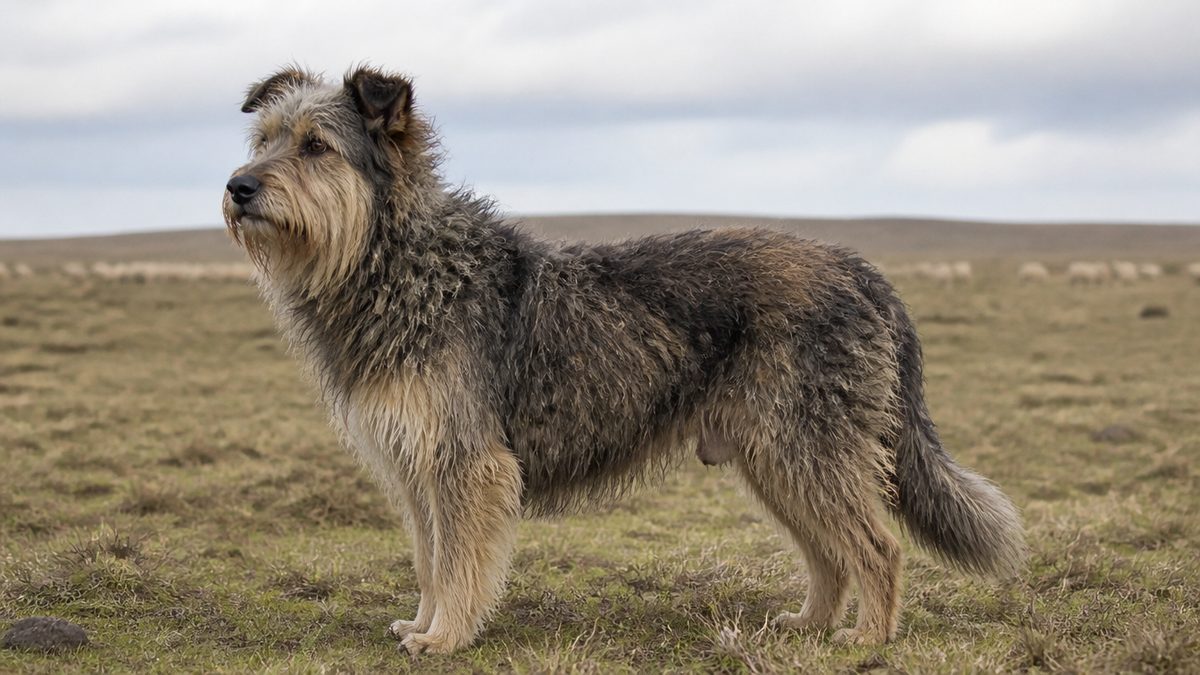
This is a medium-sized dog with a long thick coat that protects it from Patagonian weather, and a shaggy bearded face which is where the local name Barbucho comes from. Because the breed has been selected purely for working ability with no show selection at all, coat colours and markings vary considerably rather than conforming to a type.
One detail from the 2019 paper tells you how much coat there is: long-haired dogs were frequently sheared in the summer along with the sheep. A dog that gets shorn with the flock is carrying a serious amount of wool.
| Question | Answer | Source |
|---|---|---|
| Is it in a registry? | No, in any registry, anywhere | Its own 2022 genomic paper, verbatim |
| Where did it come from? | British working dogs brought by Scottish settlers, 1877 to 1910 | 2019 historical paper |
| What is it closest to? | Modern UK herding breeds; the closest living representative of their common ancestor | 2022 genomic paper |
| How inbred is it? | Mean coefficient 0.03, range -0.04 to 0.27 | 2022 genomic paper |
| What can one dog do? | Control a flock of 200 to 300 sheep | 2019 historical paper |
| What is its lifespan? | Unknown. No study has measured it | Absent from McMillan 2024 Table S5 |
| What health screening exists? | None | Absent from the OFA breed list entirely |
| What does it cost in India? | Nothing, because there are none | Control-proven Indian market check |
Patagonian Sheepdog is the English name. Barbucho and Ovejero Magallánico are the local ones. Searching the literature under the Spanish name is worse than useless, because PubMed silently rewrites it and returns 266 unrelated records. Searching under the English name in quotes returns zero. Only the unquoted English name works.
The 2022 result, which is genuinely remarkable
Genomic analysis places the Patagonian Sheepdog as the closest living representative of the common ancestor of modern UK herding breeds, having remained distinct from and unaltered by other modern breeds.
That is a strong claim and the paper earns it with an unusual piece of historical timing. British herding dogs in the mid-1800s had no formal breed structure at all. The paper documents this directly: in 1875 two broad types of sheepdog existed, rough-coated and smooth-coated, and publications dated between 1885 and 1890 describe three British varieties, the Scottish collie or rough-haired sheepdog, the smooth-haired sheepdog, and the old English short-tailed sheepdog.
It is not until the late 1800s that official breed clubs were formed to produce standardised dogs. The Patagonian ancestors left Britain between 1877 and 1910, which is exactly the window before and during that standardisation. They took the pre-breed population with them and then sat in geographic isolation for over 130 years while Britain reorganised its herding dogs into registered breeds.
The inbreeding figure, and why it matters
Analysing all 159 dogs as a single group, inbreeding coefficients ranged from -0.04 to 0.27 with a mean of 0.03, while the highest value observed across the comparison set was 0.45, in the Collie. Three sub-populations were also analysed separately and returned -0.02, 0.02 and 0.03.
| Population | Mean inbreeding coefficient |
|---|---|
| Collie, the highest in the comparison set | 0.45 |
| Patagonian Sheepdog, all 159 dogs | 0.03 |
| Patagonian Sheepdog, sub-population range | -0.02 to 0.03 |
A landrace with no studbook, no standard and no registry came out with an inbreeding coefficient an order of magnitude below one of the registered breeds it descends from. The admixture models tell the same story from the other side, showing a greater degree of diversity and genetic heterogeneity within this very small population than in Western European herding breeds.
That is worth stating carefully rather than turning into a slogan. It does not prove that registries harm dogs, and the two populations differ in far more than their paperwork. What it does show is that genetic diversity and registration are separate axes, and that assuming an isolated working population must be inbred gets this case exactly backwards.
What the phylogeny actually found
All 159 individuals were assigned to the previously defined UK rural breed clade, but they did not cluster as a single population. That mirrors the human migration history: sheep and shepherds arrived in waves into two regions separated by ice fields, and the dogs record that arrival pattern in their genomes.
Both Barrios papers name the Old Grey Welsh among the breeds likely to have contributed, and the 2022 paper illustrates it with a photograph of one, noting that these regional varieties disappeared from the UK at the end of the nineteenth century through industrialisation and changes in trade and transportation. Bonbeno has a page on that extinct dog. The Patagonian Sheepdog is, in part, what happened to it after it left.
Bonbeno's two-condition test, applied to a working landrace
To count as a breed on this site an animal needs a written breed standard and a studbook. The Patagonian Sheepdog has neither, so the verdict is type, and the deciding document is its own 2022 genomic paper.
The unusual feature of this case is that the negative verdict comes from the breed's own scientific champions rather than from an outside sceptic. The people who spent years sampling these dogs wrote the sentence that files them as a landrace.
| Condition | Verdict | Evidence |
|---|---|---|
| A written breed standard | None exists | No registry, club or author has published points, a height range or a weight range. The 2019 paper records that when the ancestors arrived, dog breed standards had not yet been defined and the dogs were simply known as Working Collies or Shepherd Working Dogs |
| A studbook | None exists | Absent from the FCI register across records 1 to 400 with four controls returning, from the Royal Kennel Club Breeds A to Z read with anchors kept and ten controls returning, and from the OFA breed list |
| Does the population define itself? | Yes, locally and deliberately | The 2022 paper describes it as recognised locally as a distinct, purpose-bred dog variety |
| Is reproduction controlled? | Yes, by function | Selection has been on working ability rather than appearance, which is why colours and markings vary widely while working style does not |
| Is the population genetically distinct? | Yes, and measured | All 159 individuals assigned to the UK rural breed clade, distinct from and unaltered by other modern breeds |
| Formal verdict | Type | A landrace: a locally recognised, purpose-bred working population with no standard and no register, exactly as its own literature describes it |
What was considered and rejected
- Breed was rejected on both conditions. There is no standard and no studbook anywhere in the world.
- Breed in formation was rejected, and the distinction from the Sardinian case is instructive. A breed in formation has a standard and a register with recognition in progress. Here no national body has started anything, and neither Chile nor Argentina has published a standard.
- Register without standard was rejected. That verdict fits a body that will register a dog while stating no standard exists. No body registers this dog at all.
- Brand was rejected. Barbucho is a descriptive local nickname meaning bearded, owned by nobody.
Why the verdict does not diminish the dog
Filing this population as a type is a statement about documents, not about quality. This is a working landrace with a published genome study, a documented arrival window, a measured inbreeding coefficient lower than the registered breeds it descends from, and a specific quantified working capacity. Most registered breeds cannot match that evidence base.
The honest framing is the one the paper itself uses: this is what a landrace population looks like, and landraces are not failed breeds. They are a different thing that the registry system was not built to describe.
It is the closest living representative of the common ancestor of the modern UK herding breeds, according to the only genomic study ever conducted on it. That is a claim no registered herding breed can make, and it is true precisely because nobody ever wrote a standard for it.
The search problem, which is worse here than for any breed on this site
Every exact-phrase search for this breed returns zero, including a Title search for a paper whose title begins with the breed's name, and PubMed issues no warning on any of them.
This section is here because the research failure is genuinely instructive, and because a reader who understands it can check everything above independently.
| Query | Records | What it means |
|---|---|---|
| "Patagonian Sheepdog"[tiab] | 0 | False zero. No warning issued |
| "Patagonian Sheepdog"[Title] | 0 | False zero, for a paper whose title starts with those words |
| "Patagonian Sheepdogs"[tiab] | 0 | Plural form, same result |
| "Patagonian shepherd"[tiab] | 0 | Alternative English name |
| "Patagonian dog"[tiab] | 0 | Broader form |
| "Patagonian Collie"[tiab] | 0 | Another circulating name |
| "Ovejero Patagonico"[tiab] | 0 | Native name, quoted |
| "Ovejero Magallanico" | 266 | Silently rewritten to ovejero[All Fields]. All 266 unrelated |
| Patagonian sheepdog, unquoted | 1 | The paper. This is the only query that works |
| Patagonian[tiab] AND sheepdog[tiab] | 1 | The same paper, confirming the first result |
Why this is the dangerous kind of zero
This project has recorded exact-phrase false zeros before, and they usually announce themselves: PubMed returns a quotedphrasesnotfound warning telling you the phrase was not matched in its index. Here no warning was issued on any of the eight zeros. A researcher running the obvious query, in the obvious form, with the obvious quotes, gets a silent, confident, unqualified zero for a breed that has a paper in *PLoS Genetics*.
The rescue is trivial once you know to try it. Drop the quotes. Unquoted, the same words return the paper immediately, and the AND form confirms it.
The second half of the literature is not in PubMed at all
Even a researcher who recovers the 2022 paper finds only half the story, because the 2019 historical paper appeared in *Diversity*, which PubMed does not index. Searching Barrios as an author with Patagonian as a term returns exactly one record, the 2022 paper. Everything concrete about working capacity, the 1890s price and the Old Grey Welsh contribution lives in the paper PubMed cannot see.
The third failure, which is the search engine's
Google India returned its rate-limit interstitial, reading 'Verifying your request', at HTTP 200 on two separate attempts at the bare query shape. Two hundred and a page title are not a document, and an automated pipeline reading only the status code would have recorded a successful fetch of nothing.
Never report an exact-phrase zero without an unquoted retry, and never assume a database warning will tell you when the phrase index failed. On this breed, eight silent zeros stood between a researcher and the entire published literature, and one pair of dropped quote marks recovered it.
Registry status, checked in four places with controls
No register anywhere holds the Patagonian Sheepdog, and Bonbeno verified that in four independent instruments with in-document controls passing in each rather than reasoning from a single empty search The Royal Kennel Club, Breeds A to Z.
The breed's own 2022 paper says it plainly, and this section exists to check the claim independently rather than to take it on trust, because an absence is a strong claim and this site makes it often.
| Instrument | How it was read | Controls that returned | Patagonian Sheepdog |
|---|---|---|---|
| FCI nomenclature | Records 1 to 400 probed by trailing integer, each page's own title read back; all 400 answered | 122 Labrador Retriever, 218 Chihuahueño, 234 Xoloitzcuintle, 355 Tornjak | Absent |
| Royal Kennel Club Breeds A to Z | HTTP 200, 90,775 characters, anchors deliberately kept | Border Collie, Whippet, Chihuahua, Dalmatian, Retriever (Labrador) and five more | Absent |
| OFA statistics dump | 2,208,793 characters, 12,047 table rows, searched case-insensitively | Labrador 109 rows, Bulldog 170, Beagle 61 | Zero rows for PATAGON |
| McMillan 2024 Table S5 | 345 rows parsed namespace-aware from the source docx | Labrador Retriever, Great Pyrenees, Whippet | No row |
That last instrument deserves a word, because it is the one that distinguishes an excluded breed from an unconsidered one. McMillan and colleagues' supplementary Table S5 lists breeds the study considered and rejected as well as those it analysed, so a breed with a row and an N flag was weighed and set aside. This breed has no row at all, which means it was never in the frame of a UK primary-care dataset, which is exactly what you would expect of a landrace population that has never left South America in numbers.
Two traps that would have manufactured a false absence
The first is anchor stripping. On a search-results page, excluding anchor tags halves the payload harmlessly, but on an alphabetical breed index the breed names are the anchors, so excluding them returns HTTP 200, the correct page title and an empty list. The Royal Kennel Club index here was read with anchors kept, which is why ten controls came back.
The second is silent query rewriting. Searching PubMed for the quoted native name 'Ovejero Magallanico' returns 266 records, which looks like a substantial literature until you read the query translation line and find PubMed collapsed the phrase to ovejero as an all-fields term. None of the 266 concerns this dog. A count is not a reading, and a large number for an obscure breed is evidence of a rewrite rather than of a literature.
What the Kennel Club of India can tell you
Nothing, and the reason is worth stating. The Kennel Club of India publishes no breed list at all, so a query there returns zero for this breed and zero for every control breed too, which is a broken instrument rather than a finding. What is checkable is that India is a full FCI member represented by the KCI, so Indian pedigrees are issued against FCI nomenclature, and the FCI holds no Patagonian Sheepdog.
Because a single empty search proves nothing, and because each of these four could fail in a different way. Together, with controls returning in every one, they make the absence a finding rather than a failed query. That method is the transferable part of this page.
History, with a contemporary quotation and a price
Sheep farming in Chilean Patagonia began with 300 sheep from the Falkland Islands, and the dogs that came with the Scottish shepherds between 1877 and 1910 became this population Barrios N, Fuenzalida A, Gómez M, Heuser C.
The history here is unusually well documented for a landrace, because it is recent, colonial and commercial, which means it generated paperwork.
The 2019 paper quotes a contemporary description of the system these dogs worked in, and it is worth reading in full because it does more work than any summary: 'one shepherd is used for every 2000 sheep, when they are in the open field. This sheepherder is almost always a Scotsman; he has a herd of six horses and two dogs at his service. Dogs are indispensable. They replace the service of man. They are of English breed and admirably trained. A good dog, taught, costs three to five pounds sterling';.
The only price this breed has ever had
That last clause is the single price figure in this dog's entire recorded history, and the paper contextualises it: a sheepdog at three to five pounds sterling in the 1890s against a work horse at an estimated average of ten pounds, which the authors convert to £1,270.00 or 1,680 US dollars in current terms.
Bonbeno reports that conversion as the authors', and does not extend it into rupees. A Victorian price converted twice, once across a century and once across a currency, would be an arithmetic result rather than an observation of anything.
What the figure does tell you is real, though. A trained working dog was worth between a third and half of a working horse, in a region where the economics ran on wool. These were expensive, valued, deliberately selected animals, which is exactly why a coherent population formed at all.
Why the ancestors are extinct at home
The regional varieties that contributed disappeared from the UK at the end of the nineteenth century as a result of industrialisation and changes in trade and transportation patterns. Among those named as likely contributors is the Old Grey Welsh and other historic UK herding dogs with similar aptitudes for sheep herding.
So the sequence is: an unstandardised British working population exports part of itself to Patagonia, Britain then standardises what remains into registered breeds and loses the regional varieties, and the exported fragment sits in isolation for 130 years. The Old Welsh Grey Sheepdog page covers the half that stayed behind.
The 2019 paper records that in recent years many livestock operations in the Aysén region have shifted from sheep to cattle production, and that the Patagonian Sheepdog has adapted successfully, which the authors mark as a personal observation rather than a measurement. A landrace that changes stock species without changing dogs is doing something a specialised breed would struggle with.
Patagonian Sheepdog price in india, and what the search returns instead
No Indian price exists for this dog because no Indian dog exists, and the only two rupee figures attached to the name in India are a print-on-demand book and a digital download.
The check was run through an instrument proved in the same session: a control query for Labrador Retriever puppies in India returned eight genuine Indian listings with real rupee ranges from named Indian sellers. The tool works.
Asked for this breed, it returned no live-animal listing anywhere in India. What came back instead falls into three groups.
- Two Indian merchandise items. An Amazon.in print-on-demand title, 'Raising a Patagonian Sheepdog: The Complete Handbook On How To Raising And Caring For Patagonian Sheepdog', and an Etsy digital download at Rs 289 which is a 655-breed silhouette pack that merely lists the name among 654 others.
- Genuine coverage. Forbes, ScienceDaily and the PLOS article itself, all reporting the 2022 genomics rather than selling anything.
- One overseas breeder advertisement. A Colorado listing offering puppies from what it calls the 'legendary and extremely rare Ovejero Magallenico, also known as the Bearded Patagonian Sheepdog', with the native name misspelled.
That last item is the only place in the entire result set where anyone is offering a dog, and it is on another continent with no pedigree available, because no registry issues one.
The 'Raising a Patagonian Sheepdog' handbook, and why it is a warning
A complete handbook on raising a breed for which no standard exists, no lifespan has been measured, no screening data has ever been collected and no temperament study has been published is, necessarily, generated rather than researched. Bonbeno has not read it and makes no claim about its contents. What can be said from this page's own research is that the material such a book would need does not exist in the published record.
That genre is worth recognising generally. Print-on-demand breed handbooks now exist for almost every rare breed name, they rank on Amazon in every country including India, and their existence is evidence of a name's search demand rather than of a breed's documentation.
Why no market forms
The mechanism is simple and it is the same one that keeps this dog genetically diverse. There is no registry, so there is no pedigree, so there is no export trade, so the population stays in Patagonia doing the work it was selected for. An unregistered landrace is commercially invisible almost by definition.
Ask which register holds the breed, and listen carefully to the answer, because the correct answer is none and any other answer is false. Then ask where the parents are. A dog sold in India as a Patagonian Sheepdog has no document that could confirm it is one, which makes the claim unfalsifiable and the purchase a matter of trust alone.
Monthly cost of ownership for a working dog this size in India
A medium working dog costs roughly Rs 5,000 to Rs 9,000 a month to keep properly in an Indian metro, built from named published prices rather than from a template.
No purchase price exists for this breed, but the Indian running costs are real and apply to any medium working dog, so they are worth setting out for a reader whose interest in this breed ends, realistically, in owning a different one.
| Item | Published price | Source |
|---|---|---|
| Anti-rabies vaccine, single | Rs 699 | Vetic clinic price list |
| 9-in-1 DHPPiL | Rs 899 | Vetic clinic price list |
| Kennel cough | Rs 1,349 | Vetic clinic price list |
| Bath, Delhi | from Rs 934 | Vetic grooming, Delhi |
| Haircut, Delhi | from Rs 1,359 | Vetic grooming, Delhi |
| Monthly parasite cover, 15 to 30 kg | Rs 1,103 | Supertails NexGard Spectra listing |
| Boarding, 24 hours, Bengaluru | Rs 899 | PawSpace Bengaluru |
| Consultation | Rs 500 to 1,000 | VOSD, counted as one data point |
| Delhi municipal dog registration | Rs 500 | MCD Delhi portal |
| Chennai pet licence | Rs 50 | Greater Chennai Corporation |
| Microchipping, Chennai | Rs 1,250 | SKS Veterinary Hospital |
Two caveats travel with that table. VOSD's consultation and vaccination ranges are published byte-identically by a large general insurer, so two organisations agreeing to the rupee on two separate quantities is evidence of copying rather than corroboration, and this page counts them once. And the Vetic figures are promotional floors from a single chain that quotes different course prices on different city pages.
Where a long-coated working dog costs more
- Grooming. The haircut line at Rs 1,359 applies here in a way it does not for a smooth-coated dog, and a coat this heavy may need it more than once a season in an Indian city.
- Boarding. Rs 899 for 24 hours in Bengaluru is the published rate, and a high-drive working dog often needs a facility with exercise provision rather than kennelling alone.
- Parasite control. Non-negotiable in India at around Rs 1,103 a month, and more important for a dog that spends time in long grass than for one that walks pavements.
- Microchipping. About Rs 1,250 at a named Chennai clinic, and worth more on a dog with the range instinct this population has.
The Chennai free option is worth naming again because so few breed pages carry it: the Greater Chennai Corporation runs six municipal pet clinics providing all treatment and anti-rabies vaccination free of cost, and issued 9,115 licences in 2024 against a Rs 50 fee. Delhi charges Rs 500 to register and Rs 500 to renew, with a Rs 100 monthly late fee, and reports 71 of 1,006 applications rejected this financial year.
Municipal fees rarely move; retail prices move within weeks. Re-price anything you intend to budget on, and treat the registration rows as the reliable ones.
Suitability for the Indian climate, and this is the clearest no on the site
Punta Arenas runs an annual mean of 6.34 C with its hottest month averaging 9.89 C, against Delhi's June mean of 35.88 C, so the gap between this breed's homeland and Indian conditions is the widest this site has measured.
Every point below was queried by explicit latitude and longitude with the grid-cell elevation NASA POWER returns echoed against the real elevation, because POWER returns a cell rather than a point and the second Patagonian point in this table shows exactly why that check matters.
| Place | Cell elevation vs real | Annual mean | Annual humidity | Hottest month | Peak wet bulb |
|---|---|---|---|---|---|
| Punta Arenas, Magallanes | 41.35 m vs ~34 m, +7 m | 6.34 C | 82.08 percent | February, 9.89 C | February, 7.62 C |
| Coyhaique, Aysén | 833.59 m vs ~302 m, +532 m | 4.78 C | 84.93 percent | February, 10.51 C | February, 7.90 C |
| Bengaluru | 841.72 m vs ~920 m, -78 m | 23.74 C | 67.84 percent | April, 28.37 C | May, 21.86 C |
| Pune | 635.99 m vs ~560 m, +76 m | 23.86 C | 66.68 percent | April, 28.93 C | June, 22.97 C |
| Delhi | 206.37 m vs ~216 m, -10 m | 25.57 C | 45.51 percent | June, 35.88 C | July, 26.50 C |
| Chennai | 48.95 m vs ~6 m, +43 m | 27.94 C | 72.39 percent | May, 31.51 C | May, 26.11 C |
| Kolkata | 7.35 m vs ~9 m, -2 m | 25.80 C | 73.84 percent | May, 31.53 C | June, 27.09 C |
Read the Coyhaique row with its warning attached and this page will not quietly publish it as a town figure. POWER put that cell 532 m above the real town, because the grid square is averaging the Andean terrain around it. Punta Arenas, at plus 7 m, is the usable Patagonian point and the one this page's conclusions rest on.
The humidity finding, which cuts against the obvious argument
Punta Arenas runs 82.08 percent annual relative humidity and Coyhaique 84.93 percent, both higher than any Indian metro in the table, including Kolkata at 73.84 percent. So the reflex claim that Indian humidity would finish a Patagonian dog is simply wrong. This dog comes from a genuinely damp place.
What it does not come from is heat, and the wet-bulb column is where the two combine. Punta Arenas peaks at a wet bulb of 7.62 C. Kolkata peaks at 27.09 C. That is a gap of nearly twenty degrees in the measure that actually describes the thermal load an animal has to shed.
Weight and coat, which compound it
Hall and colleagues found that dogs at or above their breed and sex mean bodyweight carried an odds ratio of 1.42 for heat-related illness, with exertion rather than vehicle confinement the dominant trigger across 395 confirmed events in 905,543 dogs. A long-coated working dog with a five-out-of-five exercise requirement, in a Delhi June, is that finding's worst case.
The comparison the same table offers is useful though. The Border Collie, the closest registered relative, carries an odds ratio of 1.08 against the Labrador comparator, which is not significantly raised. Herding dogs of this build are not intrinsically heat-fragile. This one's problem is the coat and the origin, not the body plan.
Second Schedule Part IV paragraph 21(1) of the Dog Breeding and Marketing Rules 2017 bars keeping in outdoor facilities, without the attending veterinary practitioner's written approval, dogs not accustomed to local temperatures and breeds that cannot tolerate them, and its named example is long-haired breeds in high temperature locations. A shorn-in-summer Patagonian working coat in an Indian June is precisely the animal that clause describes.
Temperament, which is documented as work rather than as character
No formal temperament assessment of this population exists, and what the literature describes is a docile, biddable working dog with enormous stamina that maintains a moderately wide distance from stock and does not bite it.
The 2019 paper is the only source with real behavioural content, and it describes working behaviour observed in the field rather than a temperament rated on a scale. That is the more useful kind of description and it is worth taking on its own terms.
During herding the Patagonian sheepdog shows little physical wearing and maintains a moderately wide distance from the sheep. It is described as docile and submissive while managing large flocks, following human commands easily, and known for not biting the livestock. It barks while working to keep the flock in order, functioning as an active guardian and driver.
The adjectives that circulate about this dog in English are hardy, intelligent and energetic, and all three are fair readings of that working description rather than measurements. A dog that works long days in sub-Antarctic weather is hardy in any ordinary sense. A dog taking individual commands at distance in a group of up to five is intelligent in the sense that matters for a working animal. And a dog keeping pace with mounted herders across open country is energetic to a degree that few Indian households could absorb. This page uses those three words deliberately and marks them as inferences from observed work.
The comparison the paper draws, and why it matters
That working style is explicitly contrasted with the Border Collie's crouch position, lying ventrally flat on the ground facing the sheep. This dog works upright, at a distance, using voice. The Collie works low, close, and by eye.
Two herding dogs with a shared nineteenth-century ancestry have developed opposite working styles, one under a hundred and thirty years of selection for a specific Patagonian job and the other under a hundred and thirty years of selection in British trials. That divergence is a real finding about what selection does, and it is the sort of thing that is only visible because one of the two populations was never standardised.
What is not known
Everything a household buyer would want. There is no data on behaviour with children, no data on stranger reactivity in a domestic setting, no data on separation behaviour, no data on noise sensitivity. Any page giving you those numbers for this breed has generated them, because the only behavioural observations published concern dogs working stock on open Patagonian country.
A dog described as docile, submissive, easily commanded and reliably non-biting toward livestock is unlikely to be a difficult or aggressive animal. That is a reasonable reading of the working description, and this page offers it as an inference rather than as a measurement, which is the difference between this page and the ones that rate it four out of five for friendliness.
Training, and the most specific working fact in this breed's literature
This is a highly trainable working dog, and the sharpest evidence for it is that shepherds cap the working group at five dogs because more than five disrupt the command orders.
That detail deserves unpacking, because it is unusually informative. A shepherd on horseback is issuing commands to a group of dogs working a flock of hundreds of sheep across open country. The limit on group size is not the dogs' willingness or stamina. It is the command channel: past five dogs, the instructions stop being unambiguous.
That tells you these dogs are taking individual direction at distance, in noise, under working conditions, which is a high bar. It also tells you they have been selected for exactly that, since a dog that could not do it would not have been bred from.
What one dog is expected to do
One working Patagonian sheepdog is sufficient to control a flock of 200 to 300 sheep. These dogs work long days, cover long distances, and have the stamina to keep pace with mounted herders. Selection has been entirely on working ability, with no show ring anywhere in the population's history.
What this means for anyone who owns a herding dog in India
The transferable lesson is not about this breed. It is that a dog selected for a job needs the job or a substitute for it, and the substitute has to be cognitively demanding rather than merely tiring.
- Train short, frequent sessions with genuine problem-solving rather than long repetitive drills, which a working dog finds boring rather than difficult.
- Herd something, even if it is a ball, a flirt pole or a treibball ball, because the motor pattern itself is what the dog needs to express.
- Socialise broadly and early, since a dog bred to work alongside one person on empty country meets more people in an Indian week than in a Patagonian year.
- Protect the dog's off switch by teaching settling deliberately, because working lines rarely learn it on their own.
The Indian timing problem applies here as everywhere. The socialisation window overlaps the vaccination course, whose per-vaccine prices run from Rs 699 for anti-rabies to Rs 1,349 for kennel cough at one national chain. Plan controlled exposure with your nearby vet rather than waiting for full cover in silence.
Four out of five, and the note says why: this is a dog selected purely on working ability for over a century with no show selection at all, which is the cleanest possible selection pressure for biddability at distance. It is not a rating of how easy the dog is to live with in a flat, which nobody has measured.
Daily exercise requirement, which is the maximum this site gives
A Patagonian Sheepdog needs working-level daily exercise, well beyond two walks, and its own literature describes dogs covering long distances alongside horseback herders for long working days.
This is the trait rated five out of five on this page and it is the single clearest reason the breed does not fit Indian urban life. A dog whose baseline is a working day on open country cannot be satisfied by forty minutes on a pavement, and a frustrated herding dog is a genuinely difficult animal to live with.
In Indian conditions the requirement collides directly with the climate, and the collision is what makes this combination unworkable rather than merely demanding.
| City | Hardest month | Mean that month | Peak wet bulb |
|---|---|---|---|
| Delhi | June | 35.88 C | 26.50 C in July |
| Ahmedabad | May | 35.06 C | 26.11 C in June |
| Hyderabad | May | 33.30 C | 23.35 C in June |
| Kolkata | May | 31.53 C | 27.09 C in June |
| Chennai | May | 31.51 C | 26.11 C in May |
| Mumbai | May | 31.19 C | 25.77 C in June |
| Pune | April | 28.93 C | 22.97 C in June |
| Bengaluru | April | 28.37 C | 21.86 C in May |
Delhi peaks in June rather than May, and Bengaluru and Pune peak in April and are coolest in December, which catches out advice built around a single national hot month. For a working-drive dog the practical consequence is that from March to June the only usable hours are before sunrise and after dark, in every one of those cities, and that is not enough time for a dog with this requirement.
The risk this creates
Hall and colleagues found exertion rather than vehicle confinement to be the dominant trigger of heat-related illness across 395 confirmed events, and dogs at or above their breed and sex mean bodyweight carried an odds ratio of 1.42. An owner trying to meet a working dog's exercise requirement in an Indian summer is being pushed, by the dog's own needs, toward the exact behaviour that study identifies as dangerous.
That is the honest structural problem, and it is why this page's recommendation is not simply that the breed would be uncomfortable. Owner and dog would be in conflict every day from March to June, and the resolution is usually that the dog gets less exercise than it needs or more heat than it can take.
Move the work to dawn and after dark, use scent work and problem-solving indoors during the hot hours, and check every surface with the back of your hand before the dog's feet touch it. Mental work genuinely substitutes for physical work in herding breeds far better than it does in most types, and that is the most useful thing this page can tell an Indian owner of any collie-type dog.
Grooming a working coat that gets shorn with the sheep
The Patagonian Sheepdog carries a long thick weatherproof coat that historically was sheared in summer alongside the flock, which tells you both how much coat there is and how the people who kept it managed the heat.
That shearing detail is the most practical grooming fact in the literature. Long-haired dogs were frequently sheared in the summer along with the sheep. Shepherds with shears already in hand, at the one time of year the coat became a liability, did the obvious thing.
It is also a caution rather than a licence. Clipping a double-textured working coat short is not automatically the right answer in Indian conditions, because the coat provides insulation against solar gain as well as against cold, and a clipped dog in direct Indian sun can be worse off. Discuss it with your nearby vet before removing a working coat rather than assuming a Patagonian summer and an Indian one call for the same intervention.
| Task | Frequency | Indian note |
|---|---|---|
| Brushing through to the skin | Twice weekly minimum, daily in moult | The beard and the trousers mat first and are easiest to miss |
| Bathing | Every 6 to 8 weeks, from Rs 934 at a Delhi salon | Over-bathing strips a weatherproof coat of the oils that make it weatherproof |
| Drying | Always thoroughly, never air-dry | A dense double coat left damp in an Indian August holds moisture at the skin for hours |
| Clipping | Only on veterinary advice | The historical precedent is summer shearing, but Patagonian sun and Indian sun are different problems |
| Ear checks | Weekly, and after every soaking | Ear problems cluster in the monsoon months on Indian pages for nearly every coated breed |
| Full skin and tick check | Weekly, by hand | This is the point of the session in India |
The Delhi price list gives bathing from Rs 934, complete bath and styling from Rs 1,869 and a haircut from Rs 1,359. For a coat this heavy the haircut line is a real recurring cost rather than an optional one.
The care advice that does not transfer
Guidance written for Patagonia assumes a place with an annual mean of 6.34 C and 82 percent humidity, where air-drying a coat is slow but harmless and where the coat is doing useful work eleven months of the year. In Chennai at 27.94 C annual, neither assumption holds. Ask what climate a care instruction assumes before you follow it.
Work through the beard, behind the ears, in the armpits, in the groin and around the tail base by hand every week. In a country where one Indian series found 72.9 percent of 584 screened dogs carrying two or more tick-borne pathogens, that is the highest-value twenty minutes in a coated dog's week.
Health and life expectancy, where the record is empty and honest
No lifespan study, no screening data and no clinical literature exist for the Patagonian Sheepdog, and this page will not borrow a Border Collie's numbers to fill the gap Orthopedic Foundation for Animals breed….
Say the absences precisely, because a vague absence is worth nothing and a specific one is worth a great deal. The honest summary is that this breed's known health issues are an empty set, and that an empty set of known health issues is not the same as an absence of health issues.
- Screen results: none exist. The OFA holds no entry for the breed in its list and returns zero rows for Patagon in its 12,047-row statistics dump, while controls in that same dump returned 109 rows for the Labrador, 170 for the Bulldog and 61 for the Beagle.
- Life expectancy: unmeasured. McMillan and colleagues' Table S5 lists 345 breeds including many the study considered and excluded, with controls present for the Labrador Retriever, Great Pyrenees and Whippet. No row carries the name Patagonian, so the breed was never in that study's frame.
- Clinical literature: none. The two published papers are a genomic study and a historical review. Neither reports disease prevalence, and no case report has ever named the breed.
The OFA absence is unsurprising rather than alarming, and its own threshold explains why: a breed needs at least 100 hip evaluations, and at least 50 for every other database, before it appears at all. An unregistered working population in Chilean Patagonia has not been sending radiographs to Missouri.
What the genomics implies, stated as an implication
The one health-relevant finding is indirect. A mean inbreeding coefficient of 0.03 across 159 dogs, against 0.45 in the Collie, means this population carries far less homozygosity than the registered breeds it descends from. Low inbreeding is generally associated with lower expression of recessive disease, so the reasonable expectation is a genetically robust population.
That is an expectation and not a measurement, and this page marks it as one. Nobody has tested disease prevalence in these dogs.
One thing worth knowing for any collie-type dog
Herding breeds of British origin carry the MDR1 drug-sensitivity variant at meaningful frequencies, and it changes anaesthetic and antiparasitic safety. Redondo and colleagues, analysing 55,019 anaesthetics, found that MDR1-associated breeds did not differ from the benchmark in mortality either crude or adjusted, with an adjusted relative risk of 1.14 and a confidence interval from 0.61 to 2.14. That is reassuring about outcomes and it does not remove the need to test an individual dog, since the variant affects drug choice rather than only survival.
No study has tested MDR1 frequency in this population. Given its documented descent from UK herding dogs, an owner of any collie-type dog should discuss MDR1 testing with their nearby vet before any anaesthetic or high-dose ivermectin exposure.
As generated. Twelve to fifteen years is the default range breed-page templates emit for a medium dog, and it appears on several pages about this one. No study has measured it, and a range with no source is not a finding. Consult your nearby vet about any individual dog rather than a breed average that does not exist.
The Indian health risks that would actually apply
Tick-borne disease is what an Indian owner of any working dog should plan for first, and published Indian series report it at levels that overseas guidance does not prepare owners for Venugopal V, Deepa PM, Muhasin Asaf VN.
Nothing in this section is breed-specific, and for a dog with no clinical literature that is the honest way round: the risks that would actually shape this dog's life in India are Indian rather than genetic.
| Study | Where | Dogs tested | Finding |
|---|---|---|---|
| Shil et al. 2026 | West Bengal | 584 | Babesia gibsoni 76.54 percent, Anaplasma 55.75 percent, 72.9 percent of the 584 screened carrying two or more pathogens |
| Venugopal et al. 2026 | Kerala | 120 | Babesia in 80 of 120 tested, Ehrlichia canis 5.0 percent, peak before the monsoon in March to May |
| Chakraborty et al. 2024 | Odisha | 178 | Ehrlichia canis in 56 of 178, 31.46 percent; 75 percent of infected dogs over 20 kg; 79 percent had a tick history |
The framing caveat is mandatory. These studies sampled clinically suspected dogs or clinic caseloads rather than random populations, so the correct reading is 'among dogs tested at veterinary clinics';. A figure of 76.54 percent is not any individual dog's risk.
Two details matter for a working dog specifically. The Kerala series found infection peaking before the monsoon rather than during it, which inverts what most Indian owners assume about tick season. And the Odisha series found 75 percent of Ehrlichia-infected dogs were over 20 kg, with 79 percent having a tick history, which describes larger dogs spending time outdoors in vegetation.
That is exactly this dog's profile, which is why monthly parasite cover at around Rs 1,103 would be the single highest-value line in its Indian budget.
Heat injury, which the law also recognises
Second Schedule Part IV paragraph 21(1) of the Dog Breeding and Marketing Rules 2017 bars keeping in outdoor facilities, without the attending veterinary practitioner's written approval, dogs not accustomed to local temperatures and breeds that cannot tolerate them, naming long-haired breeds in high temperature locations. This is the statutory hook, and for this breed it would be difficult to argue the clause did not apply.
Daily hand checks along the ears, between the toes, under the collar, in the beard and around the tail base. On a long-coated dog they take longer and matter more, because a tick in a working coat is invisible until it is engorged.
Feeding a working dog in India
Feed to body condition and to actual workload, because no breed weight range has ever been published for this dog and a working herding dog's requirement swings enormously with the season.
There is no standard, so there is no published weight range, so there is no chart to feed toward. Sources describe a dog of medium stature and nothing more precise. Feed the animal rather than the label.
The workload point is real for this population. These are dogs described as covering long distances and working long days, and a dog doing that needs materially more than the same dog resting through an Indian summer.
Life stages
- Puppy, to six months. Three to four meals daily on a complete growth food, with condition checked weekly by hand rather than by eye, because a heavy coat hides both thinness and fat.
- Adolescent, six to twelve months. Two meals. Working-type dogs put on muscle late and a lean adolescent is usually correct.
- Adult. Two meals, adjusted hard by season and workload. Expect a noticeable drop in intake from March to June in most Indian cities.
- Senior. Two meals with protein maintained, and an annual joint and mobility conversation with your nearby vet.
A monthly rupee figure is arithmetic rather than a quoted price, since it depends on the grams per day the pack specifies for the dog's actual weight. Verify grams per day against the pack before you budget, and re-price the bag, because Indian retail food listings move quickly while municipal fees do not.
One thing not to buy
A joint supplement bought to prevent hip dysplasia. The OFA states plainly that hip dysplasia is a polygenic inherited disease, that a high-calorie diet during rapid growth may exacerbate changes in hips that are already dysplastic but will not create hip dysplasia, and that there is no evidence in the scientific literature that supplements such as vitamin C prevent it.
Multiple bowls, changed twice daily, offered before and after every session. For a long-coated working dog in an Indian summer this does more than any dietary choice, and it costs nothing.
Month by month through the first year
A working herding puppy's first year is dominated by socialisation breadth and by protecting growing joints from a drive that outruns the skeleton.
| Age | Priority | Indian note |
|---|---|---|
| 8 to 10 weeks | Home, vaccination course begins, deworming | Anti-rabies Rs 699, 9-in-1 Rs 899 at one national chain |
| 10 to 16 weeks | Socialisation breadth is the whole job | Carried, controlled exposure; discuss timing with your vet rather than waiting in silence |
| 4 to 6 months | Monthly parasite cover begins; lead manners; settling | About Rs 1,103 per month in the 15 to 30 kg band |
| 6 to 12 months | Impulse control and an off switch, taught deliberately | Avoid repetitive high-impact exercise on hard Indian surfaces |
| 9 to 12 months | Municipal registration and microchipping | Delhi Rs 500, Chennai Rs 50, microchip about Rs 1,250 |
| 12 to 18 months | Herding drive matures; give it an outlet | Move all real work to dawn and after dark from March to June |
| 18 months | Skeletal maturity; full workload | Any hip radiographs are worth taking after 24 months |
The two decisions that shape a working dog
The first is socialisation breadth. A dog descended from stock bred to work with one person on empty country will meet more novelty in a single Indian week than its ancestors met in a season, and the window to make that ordinary closes early.
The second is exercise restraint during growth, which is counter-intuitive because the puppy wants more. Repetitive high-impact work on hard ground before eighteen months is how a working dog buys orthopaedic problems, and for this population there is no screening scheme that would have warned you about the parents.
What a responsible source shows you, if one ever existed
- Verify the mother on the premises with the litter, and watch her working if the seller claims working lines.
- Screen what can be screened locally: hip radiographs read by your own vet, and MDR1 testing for any collie-type dog, since no registry certificate exists for this population.
- Compare the puppy against its littermates rather than against a chart, because a landrace is variable by design.
- Adopt the position that no pedigree can exist, which is correct rather than suspicious, and judge the source on what it does show you.
Rule 8(1)(a) of India's Dog Breeding and Marketing Rules 2017 provides that pups less than eight weeks in age are not sold. A seller offering a younger puppy of any breed is breaking it, and it is the one number every Indian buyer should carry.
Head to head against the herding breeds buyers cross-shop
Anyone reading about this dog is comparing it against the Border Collie and other collie-type breeds, and the differences are in paperwork, working style and genetic diversity rather than in ancestry.
| Population | Registry | Working style | Mean inbreeding | Available in India |
|---|---|---|---|---|
| Patagonian Sheepdog | None, anywhere | Upright, wide distance, uses voice, does not bite stock | 0.03 | No |
| Border Collie | Fully registered in every major body | Crouch position, close, works by eye | Not given in this study | Yes |
| Collie | Fully registered | Not compared in this study | 0.45, the highest in the comparison set | Yes |
| Old Welsh Grey Sheepdog | None. Extinct in Britain | Named as a likely contributor to the Patagonian population | Not measurable | No |
The Border Collie is the comparison the literature itself draws, and the working-style contrast is the interesting half: two populations from a shared nineteenth-century base, one selected in British trials and one on Patagonian estancias, arriving at opposite methods of moving sheep.
The Collie row is the uncomfortable one. A registered breed with a full studbook carries a mean inbreeding coefficient of 0.45 while an unregistered landrace with no paperwork at all carries 0.03. That is not an argument against registries, but it is an argument against assuming registration and genetic health travel together.
The comparison with the other landraces on this site
The Sardinian Shepherd Dog is the instructive neighbour, because it is the same kind of animal one step further along: an unregistered working landrace that has acquired a published standard and an open national register, with recognition in progress. The Small Međimurje Dog is a step further still, nationally recognised and in a state conservation programme. This dog has none of that, and it also has the best genome study of the three.
What an Indian reader should take from the comparison
If a working herding dog is genuinely what you need in India, the Border Collie is available, screened, studied and papered, and the practical case for it over an unobtainable Chilean landrace is overwhelming. The honest caveat is that everything this page says about exercise requirement and Indian summers applies to a Border Collie too, and rather more people discover that after buying one than before.
A landrace that nobody registered turned out to be the closest living relative of the dogs Victorian Britain herded with, and to be less inbred than the breeds Britain made out of them. That is worth knowing whichever dog you end up with, because it is a real argument about how populations are managed rather than a fact about one rare breed.
Mistakes made about this breed
Six errors recur, and three of them are research failures rather than facts about the dog.
- Reporting that the breed has no scientific literature, on the strength of an exact-phrase search that silently returned zero with no warning.
- Missing half the literature, because the 2019 historical paper is in Diversity and PubMed does not index it.
- Quoting a lifespan of twelve to fifteen years. No study has measured it and that range is a template default.
- Assuming an isolated landrace must be inbred, when its measured mean coefficient is 0.03 against 0.45 in the Collie.
- Claiming Indian humidity would be the problem, when Punta Arenas runs 82.08 percent annual humidity against Kolkata's 73.84 percent. Heat is the problem, not damp.
- Treating a print-on-demand handbook or an Etsy silhouette pack as evidence that the breed has an Indian presence.
The seventh mistake, which is the search engine's
Reading a Google rate-limit interstitial as a result. The bare query shape returned 'Verifying your request' at HTTP 200 twice on 10 September 2026. Status code 200 plus a correct page title is not a document, and a pipeline that checks only the status would have recorded a successful retrieval of nothing at all.
How to check everything on this page yourself
- Verify the registry absence by searching the FCI's own register by number rather than by name, and confirming a control breed returns in the same fetch.
- Compare the quoted and unquoted PubMed searches, which is a ten-second demonstration of the whole problem.
- Screen the two Barrios papers directly, one on PubMed and one on MDPI, since between them they are the entire literature.
- Herd your own conclusions carefully: everything in this page's care sections is transferred from working observations or from Indian data, never from a temperament study of this breed, because none exists.
Give you a weight range, a lifespan, a litter size, a shedding rating or a good-with-children score. Every one of those appears on other pages about this dog and none of them has a source. An empty cell honestly marked is worth more than a filled one that was generated.
Adoption and responsible sourcing
Nothing can be adopted or bought in India, and the responsible position on a working landrace with no registry is to leave the population doing its job Indian market check run 10 September 2026….
This population exists because it works. It has been maintained for over 130 years by shepherds selecting for ability, and its unusual genetic diversity is a direct consequence of never having been closed into a studbook. Extracting individuals into a pet market is the mechanism by which that would change.
If what you want is a working herding dog in India
- Adopt from an Indian shelter and assess the individual dog's drive directly, because herding-type mixes are common and drive is visible in an adult.
- Verify vaccination and deworming records in writing before the dog comes home.
- Register with your municipality: Rs 500 in Delhi, Rs 50 in Chennai, plus microchipping at about Rs 1,250 at a named Chennai clinic.
- Protect the dog from the climate by building the routine before the dog arrives, not after the first hot week.
Boarding is worth checking before you commit rather than after. A Bengaluru operator publishes an hourly rate to four hours at Rs 599, daycare to ten hours at Rs 799 and an overnight stay to 24 hours at Rs 899, and a high-drive dog needs a facility that exercises rather than merely kennels.
The legal floor
Pups under eight weeks may not be sold in India under Rule 8(1)(a), and outdoor housing of a breed that cannot tolerate local temperatures requires the attending veterinary practitioner's written approval under Second Schedule Part IV paragraph 21(1). For a long-coated Patagonian working dog in an Indian summer, that second clause would be difficult to satisfy honestly.
What this page is for
Nobody in India will own this dog. What the page offers instead is the clearest demonstration on this site of three things: that an exact-phrase search can hide an entire literature without warning, that a breed's own scientists can be the ones to file it as a landrace, and that registration and genetic health are separate axes.
The dogs Victorian Britain herded with are extinct in Britain, and the closest living thing to them is a shaggy unregistered dog working sheep at the bottom of Chile, which is less inbred than the pedigree breeds Britain made from the same stock. That is a true story with a genome study behind it, and it needed no invented price to be worth reading.
Patagonian Sheepdog questions, answered from the evidence
What is the temperament of a Patagonian Sheepdog?
No formal temperament assessment exists, and what is documented is working behaviour rather than household character. The 2019 historical paper describes a dog with great stamina that keeps pace with horseback herders, works long days over long distances, and responds to command orders precisely enough that using more than five dogs together causes confusion rather than control. It also notes that as Aysén operations shifted to cattle, the dogs adapted successfully.
What is the kindest dog ever?
No breed is, and Bonbeno will not name one. Temperament varies far more within any breed than between breeds, and a dog's early socialisation and handling predict its behaviour better than its label. For this breed specifically the question cannot even be attempted, because no temperament study of the population has ever been published. What is documented is working aptitude, not kindness.
What is the best sheepdog in the world?
There is no measured answer, but the 2022 genomic study makes an unusual claim about this one. It concludes that the Patagonian sheepdog is the closest living representative of the common ancestor of modern UK herding breeds, having remained distinct from and unaltered by other modern breeds. That is a statement about ancestry rather than about ability, and it is the most interesting thing anyone has said about a working sheepdog in years.
What are the disadvantages of the Dogo Argentino breed?
This question appeared in the same result box and concerns a different South American breed, so it is answered briefly and honestly: Bonbeno has not researched the Dogo Argentino for this page and will not summarise a breed it has not examined. What can be said is that the Dogo Argentino is a large hunting and guardian breed, whereas the Patagonian Sheepdog is a medium herding dog, and the two have nothing in common beyond a continent.
Is the Patagonian Sheepdog a recognised breed?
No, and its own definitive study says so in those terms: while recognised locally as a distinct, purpose-bred dog variety, the Patagonian sheepdog is not recognised by any formal dog breed registry, as is often the case with landrace breeds worldwide. Bonbeno checked independently and found it absent from the FCI register across records 1 to 400, from the Royal Kennel Club Breeds A to Z and from the OFA breed list, with controls passing on each.
What is the Patagonian Sheepdog price in india?
None exists. A control-proven Indian search returned no live-animal listing anywhere in the country. The only two rupee-denominated Indian results were an Amazon.in print-on-demand handbook about raising the breed and an Etsy digital download, a 655-breed silhouette pack at Rs 289 that merely lists the name. Both are merchandise. Bonbeno converts no foreign figure into rupees.
Where does the Patagonian Sheepdog come from?
From working dogs brought by Scottish settlers who came to Chilean Patagonia to develop sheep farming, most likely between 1877 and 1910, following the initial arrival of 300 sheep from the Falkland Islands to the Magallanes region. Among the breeds likely to have contributed are the Old Grey Welsh and other historic UK herding dogs, all of which disappeared from Britain at the end of the nineteenth century with industrialisation and changing trade.
Is the Patagonian Sheepdog inbred?
Strikingly little, and the number is published. Across all 159 dogs the inbreeding coefficients ranged from -0.04 to 0.27 with a mean of 0.03, while the highest value observed in the comparison set was 0.45 in the Collie. An unregistered landrace with no studbook came out an order of magnitude below one of the registered breeds it descends from, which is a real argument about what closed registers do.
Could a Patagonian Sheepdog live in India?
Realistically no, and the climate figures are not close. Punta Arenas runs an annual mean of 6.34 C and its hottest month, February, averages 9.89 C, while Delhi averages 35.88 C in June and Chennai peaks at a wet bulb of 26.11 C in May. That is a twenty-six degree gap between the homeland's warmest month and one Indian city's hottest. Add a long weatherproof coat and a working exercise requirement and the answer does not improve.
Why does searching for this breed return nothing?
Because the exact-phrase index does not hold the two-word name. Searched as "Patagonian Sheepdog"[tiab] PubMed returns zero, and "Patagonian Sheepdog"[Title] also returns zero, for a paper whose title begins with exactly those words, and no quotedphrasesnotfound warning is issued on either. Dropping the quotes returns the paper. Half the literature is not in PubMed at all, because the 2019 historical paper appeared in Diversity, which PubMed does not index.
How many sheep can one Patagonian Sheepdog handle?
Between 200 and 300, according to the 2019 paper, which also records that a maximum of five dogs are used together because larger numbers disrupt the command orders and produce confusion rather than control. That is an unusually specific piece of working data for a breed with no registry, and it comes from researchers who worked with the herders directly.
What health screening exists for this breed?
None at all. The Orthopedic Foundation for Animals holds no entry for the breed in its list and returns zero rows for Patagon in its statistics dump, while controls in that same dump returned 109 rows for the Labrador. That is unsurprising rather than alarming: the OFA requires at least 100 hip evaluations, and 50 for every other database, before a breed appears, and an unregistered Chilean working population has not submitted them. Consult your nearby vet about screening any individual dog.
Compare with similar breeds
Patagonian Sheepdog sits in 2 Bonbeno groups. Each one compares it directly against the breeds it is genuinely an alternative to, on the same figures.