
Breed profile
Sardinian Shepherd Dog: The Cane Fonnese Examined
An endangered Sardinian guardian with a better research literature than most recognised breeds, an Italian register entry that prints an FCI number the FCI has never issued, and immune data that matters more to an Indian reader than to a European one.
Quick answer
The Sardinian Shepherd Dog, or Cane Fonnese, is an indigenous Sardinian guardian standing 56 to 60 cm in males and 52 to 56 cm in females. ENCI admits it to the Registro Supplementare Aperto with recognition procedures started, and prints 'Codice FCI 902' on its record, but the FCI has never issued that number and holds no such breed. Bonbeno files it as a breed in formation.
This page reports published veterinary research for general information, including seroprevalence and immune data from Sardinian field studies. It is not a diagnosis and not a treatment plan for your dog. Vector-borne disease in particular needs hands-on examination and laboratory testing, so consult your nearby vet before acting on anything here.
Cane Fonnese traits, rated for Indian conditions
What the Sardinian Shepherd Dog is
The Sardinian Shepherd Dog, called the Cane Fonnese in Italy, is an indigenous Sardinian livestock and property guardian standing 56 to 60 cm in males, admitted to ENCI's open supplementary register with recognition procedures under way, and absent from the FCI Ente Nazionale della Cinofilia Italiana.
Start with the Italian register, because the English-language pages describe this dog from a distance and the Italian ones describe it from inside the system that holds it. ENCI's own breed record states, in one sentence, exactly what the breed's status is: 'Razza ammessa al RSA (Registro Supplementare Aperto) per la quale sono state avviate le procedure di riconoscimento', a breed admitted to the Open Supplementary Register for which recognition procedures have been started.
That is a precise and unusual status, and it is the whole story of this page. There is a standard. There is a register. The register is open rather than closed, and the recognition is in progress rather than granted.
Appearance and measurements, from ENCI's own standard
The standard was retrieved as a PDF at 1,264,322 bytes and extracted directly, giving 8 pages and 15,069 characters of real text. It describes a dog of medium build whose conformation is mesomorphic and whose trunk slightly exceeds the height at withers.
| Measurement | Males | Females |
|---|---|---|
| Height at withers | 56 to 60 cm | 52 to 56 cm |
| Weight | 29 to 35 kg | 25 to 30 kg |
| Body length | 5 to 10 percent longer than the height at withers | Same |
| Head length | About 38 percent of the height at withers | Same |
| Chest circumference at the elbows | 25 percent above the height at withers | Same |
| Croup slope | About 15 degrees from horizontal | Same |
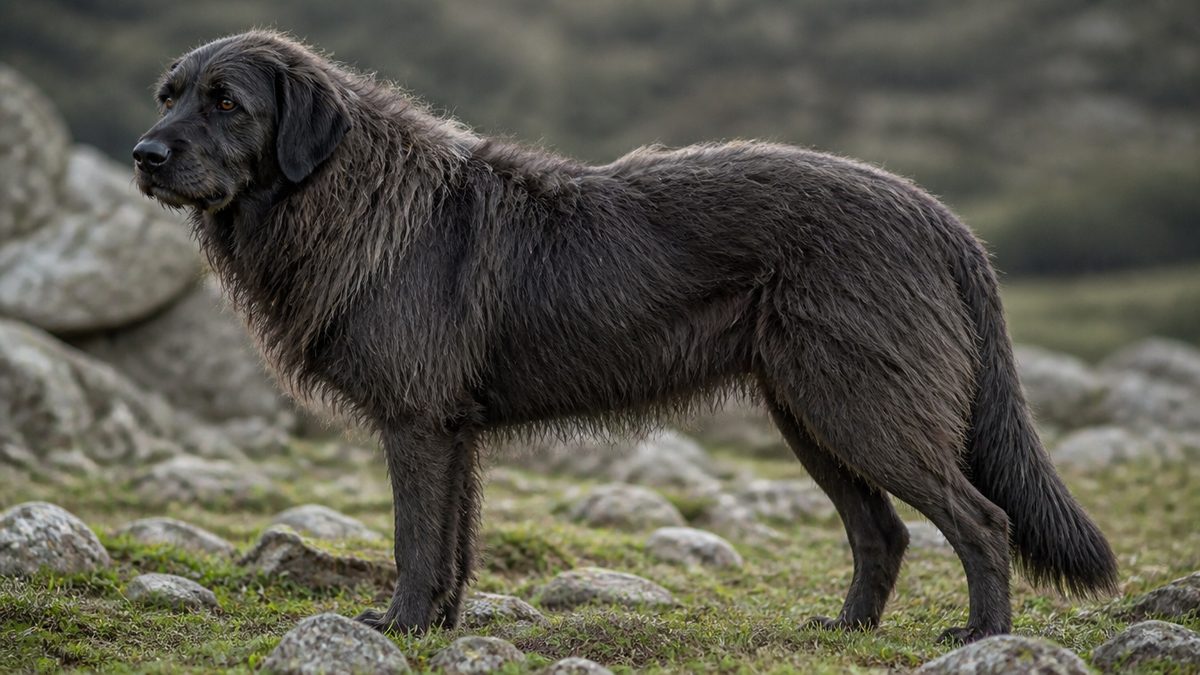
On coat and colour the standard names black, ash in its various shades, and honey, and notes that the last two may also be brindled and are considered the oldest. Males carry a mane at the neck. The coat is a rustic working one rather than a show coat, and coat texture along with colour turned out to be one of the few features significantly associated with all three evaluation scores in the 2023 genomic study, which makes coat texture a genuine marker of type here rather than a cosmetic detail. The standard's fault list includes lack of substance, excess weight, weak or dipped topline, erect ears, white at the extremities and a heavy gait.
The neck is described as vigorous, solid and muscular, of medium length, about a third of the height at withers and free of dewlap, while the croup is robust and muscular with a slope of about 15 degrees. The eyes are the feature Italian writers return to: amber, set almost frontally, and described in the register as deep, authoritative, proud and searching, giving an alert and slightly sad expression that is treated as an element of breed typicality ENCI, STANDARD DI RAZZA DEL CANE FONNESE.
Note what a working standard prioritises. The faults are about function and type, not about cosmetic detail, and one of them is the absence of P1, a first premolar, which tells you the standard cares about complete dentition in a way that a guardian's bite would justify.
What the dog is for
The standard gives the utilisation as a guard and custody dog for flocks and herds, and ENCI's own record is blunt about the temperament this produces. It describes a strong sense of territory, an expression that is penetrating and unfriendly, and a dog fundamentally hostile toward strangers but totally deferential to its owner. It adds that outside its own boundaries the Fonnese almost always loses that aggression, which is a genuinely useful observation about a territorial guardian.
Sardinian Shepherd Dog is the English name and it returns nothing in the clinical literature. Fonni's Dog is the name the researchers use and it returns five records. If you take one practical thing from this page, take that: search a rare breed under the name its own country's scientists use.
History, and how old the claims about it really are
The Cane Fonnese's history is described by ENCI as reaching back to the neolithic, while the checkable documentary record runs to depictions from at least the mid-nineteenth century, and those two statements should not be given equal weight Sardinian Shepherd Dog.
ENCI's record opens its history section with a strong claim: a breed as ancient as Sardinian civilisation, with archaeological finds said to demonstrate its presence from the neolithic, around 6000 BC. It goes on to say that in its veins runs the blood of generations of dogs used to guard the flock and the property rather than to drive sheep, and that this is the origin of the breed's strong sense of territory.
The historical section of that standard is credited to Dr.ssa Raffaella Cocco, who is also an author on four of the six on-breed research papers this page cites, which is worth knowing when weighing the account: it is written by a working scientist rather than by a marketing department.
English-language sources are more conservative. Wikipedia describes an ancient landrace breed of Sardinian dog used as a herding, catching and livestock guardian dog, and states that although there are depictions dating back to at least the mid-nineteenth century, it is not recognised by the FCI. Google India's knowledge panel reproduces that same pairing, an ancient landrace and an absent FCI recognition, which is where most readers will first meet the breed.
Grading the antiquity claim
Bonbeno separates the two. Depictions from the mid-nineteenth century are a checkable documentary record of a recognisable regional type. A neolithic presence is an inference from archaeological material about dogs in Sardinia generally, and no source consulted for this page links a specific 6000 BC find to this specific population.
The genomics is the more useful evidence and it says something more modest but firmer. Dreger and colleagues place the Fonni's Dog spatially with other Mediterranean breeds and note that within the context of dog breeds existing in Italy 130 years ago, it had a noteworthy though limited appeal that it retains today. That is a real historical statement with a date attached.
The other names, which the standard lists
The standard records that the dog of Fonni is also known as the mastino fonnese and the pastore fonnese, is called *cani fonnesu antigu* in the pastoral world, *spinone fonnese* by hunters, and *cani sardu antigu* by the elderly across the island's villages. Five working names for one dog, and none of them is the English name this page is titled with.
That matters for anyone checking the record. The Royal Kennel Club's Breeds A to Z, read on 10 September 2026 with ten in-document controls returning, holds neither Fonni nor Sardinian Shepherd under any spelling. So the breed is absent from the British register too, checked properly rather than assumed.
Almost every landrace page on the internet opens with an antiquity claim, because antiquity sells. The useful question is which document dates the claim. Here the honest answer is that the type is documented from the mid-1800s, the genomic work places it among Mediterranean breeds present in Italy 130 years ago, and everything earlier is inference.
The 902 problem, and why it is worth an entire section
ENCI prints 'Codice FCI 902' on its Cane Fonnese record and links that number to fci.be, where it returns HTTP 200 and serves the FCI's generic index, while the highest number the FCI has ever issued is 378 The 'Download da FCI' link printed… Bonbeno's own enumeration of the FCI….
This is the single most misleading artefact any reader of this breed will meet, and it is produced by an official body acting in good faith rather than by a content farm.
Here is exactly what ENCI's record contains. A field reading 'Codice FCI' with the value 902. A group line reading 'Gruppo 2 - CANI DI TIPO PINSCHER E SCHNAUZER - MOLOSSOIDI E CANI BOVARI SVIZZERI' and a section line reading 'Sezione 2 - MOLOSSOIDI'. Internal links that pass the parameter idRazzaFci=902. And a download row labelled 'Download da FCI' pointing at fci.be.
Everything in that list is FCI vocabulary. None of it is an FCI grant.
Following the link, which is the part nobody does
Bonbeno followed it. The link ENCI builds resolves to fci.be/en/nomenclature/CANE FONNESE-902.html, and fetching it directly returns HTTP 200 at 100,955 bytes with the document's own title reading 'FCI Breeds Nomenclature'. That is the FCI's generic index page. There is no 404, no error, no redirect notice and nothing whatsoever to tell a reader that the breed record they expected does not exist.
The mechanism is known and it is worth understanding, because it generalises. The FCI's nomenclature server resolves on the trailing integer in the URL and discards the name in front of it. Ask for a number the FCI does not hold and it falls back to the index rather than erroring.
| Check | Method | Result |
|---|---|---|
| Is 902 an FCI number? | Records 1 to 400 probed by trailing integer, each page's own title read back; all 400 answered | 378 is the highest number returning a distinct breed record. 379 upward return the generic index. 902 is 524 above the ceiling |
| Does the FCI hold this breed under any name? | Same sweep, searched for Fonni, Fonnese and Sardinian | Absent, with controls returning 343 Cane Corso Italiano, 194 Bergamasco, 201 Maremmano, 199 Cirneco dell'Etna and 165 Spinone Italiano |
| Does ENCI's own standard claim an FCI number? | The standard PDF extracted with pypdf | Its header field reads 'F.C.I. - STANDARD NO' with nothing after it. The field is blank |
The self-refutation, inside one organisation
That last row is the finding that settles it. ENCI's web record asserts 'Codice FCI 902'. ENCI's own standard PDF for the same breed leaves the FCI standard number blank. Two documents from one body, published on one website, disagree about whether this breed has an FCI number, and the one that is closest to the breed says it does not.
There is a further tell in the register, and it is a helpful one. ENCI publishes a page of Razze Italiane listing the 18 native Italian breeds it recognises. Cane Corso, Bergamasco, Maremmano, Cirneco dell'Etna, Spinone Italiano, Volpino Italiano and even the Spino degli Iblei are all on it. The Cane Fonnese is not. ENCI itself, on its own site, does not count this breed among its recognised native breeds.
An FCI group or number printed by anyone other than the FCI is that body's own filing, not a grant. National registries use FCI vocabulary because it is the shared language of judging, and a reader cannot tell a filing from a grant by looking at the row. Open the FCI's own register, probe by number, read the title the page returns, and confirm a control breed came back in the same fetch.
Bonbeno's two-condition test, applied to the Cane Fonnese
To count as a breed on this site an animal needs a written breed standard and a studbook. The Cane Fonnese has both, and both are provisional, so the verdict is breed in formation and the deciding document is ENCI's own record.
This is the rarer outcome. Most rare breeds this site examines fail one condition outright. This one satisfies both in substance while the paperwork is still in progress, which is exactly what the third verdict exists for.
| Condition | Verdict | Evidence |
|---|---|---|
| A written breed standard | Yes, and published | ENCI serves STANDARD DI RAZZA DEL CANE FONNESE as an 8-page PDF with a real text layer, giving heights, weights, proportions, a colour list and graded fault lists. Its own FCI standard number field is blank |
| A studbook | Yes, and open rather than closed | ENCI's record states the breed is admitted to the Registro Supplementare Aperto, the open supplementary register, which is the rung Italy uses for native populations being recovered as breeds |
| Has recognition been granted? | No. It is in progress | The same record says recognition procedures have been started, in ENCI's own words: 'per la quale sono state avviate le procedure di riconoscimento' |
| Is it FCI recognised? | No | Absent from the FCI register across records 1 to 400 with five Italian control breeds returning. The 902 on ENCI's record is above the FCI's ceiling of 378 |
| Is it on ENCI's own list of recognised Italian breeds? | No | ENCI's Razze Italiane page names 18 breeds and this is not among them, while the Spino degli Iblei, which sits one rung higher in the Italian system, is |
| Is the population genetically distinct? | Yes, and measured | Cortellari and colleagues genotyped 30 dogs on a 230K SNP chip against 379 dogs of 24 breeds and found a unique genetic signature, concluding the breed is confirmed as well distinguished |
| Formal verdict | Breed in formation | A standard and a register both exist, the register is open, the national body has started but not completed recognition, and the FCI holds nothing |
The verdicts that were considered and rejected
- Breed was rejected, narrowly. Italy's own body has not completed recognition and does not list the dog among its recognised native breeds, so calling it a breed outright would overstate a position ENCI itself has not taken.
- Type was rejected, and this is the important rejection. A type has no standard and no register. This dog has both, plus a 230K SNP study confirming a distinct genetic signature. Filing it as a type would understate it badly.
- Register without standard was rejected, because the standard exists and is downloadable.
- Brand was rejected. No trademark, no owner, no certification protocol. It is a place name attached to a working population.
Why the distinction is not pedantry
It changes what a buyer should ask for. A breed in formation has paperwork that is real but incomplete, so a puppy's registration will be an RSA entry rather than a full pedigree, and that is normal rather than a warning sign. A reader who expects an FCI pedigree for this dog will be told none exists, and could reasonably conclude they are being deceived, when in fact they are looking at a register doing exactly what an open supplementary register is for.
Italy's genealogical book runs three registers, and the Registro Supplementare Aperto is the open one, created for native populations in the process of being recovered as breeds. An open register admits founding stock that has no registered ancestry, which is the only way a landrace can ever become a registered breed. It is the mechanism working, not a loophole.
What the genome says, and why it flatters this dog
Two genomic studies have examined the Fonni's Dog, and both found a distinct population with less inbreeding than the registered Mediterranean breeds around it Cortellari M, Bionda A, Cocco R, Sechi S.
The foundational work is Dreger and colleagues in *Genetics* in 2016. They analysed 28 dog breeds originating around the Mediterranean, using whole-genome sequences from 13 dogs and about 170,000 genome-wide single nucleotide variants from 155 dogs. The framing is unusual and worth quoting: the Fonni's Dog, they write, has not been subjected to an intensive system of artificial selection, but has developed alongside the human population of Sardinia, influenced by geographic isolation and unregulated selection based on its environmental adaptation and aptitude for owner-desired behaviours.
The inbreeding result, which is the surprise
Across the 28 Mediterranean breeds the mean inbreeding coefficient was 0.22, with a maximum within-breed mean of 0.39 in the Pharaoh Hound and a minimum of 0.03 in the Mastino Abruzzese. The Fonni's Dog ranged from 0.01 to 0.30 with a breed mean of 0.13.
| Breed or group | Mean inbreeding coefficient |
|---|---|
| Pharaoh Hound, the highest in the study | 0.39 |
| Mean across all 28 breeds | 0.22 |
| Fonni's Dog | 0.13 |
| Mastino Abruzzese, the lowest in the study | 0.03 |
An unregistered landrace came in nine points below the average of the registered breeds it was compared against. The authors' own conclusion is measured, that the Fonni's Dog presented homozygosity and inbreeding values within the range expressed by other Mediterranean dog breeds, and this page will not overstate it. But it is a useful corrective to the assumption that an isolated island population must be heavily inbred.
The 2023 study, and a finding about judging
Cortellari and colleagues went further and asked a question few breed studies ask: does the show ring recognise what the genome recognises. Thirty Fonni's dogs were ranked both for general accordance with breed typicality and against the provisional standard by official judges, then genotyped on a 230K SNP BeadChip and compared with 379 dogs of 24 breeds.
The genomic score correlated with the typicality score at rho 0.69, p below 0.0001, while the judges' score correlated at rho 0.63, p equal to 0.0004, and the judges' score showed little variability among the dogs included. Hair texture and colour were significantly associated in all three scores. Their conclusion is that the breed is confirmed as well distinguished despite being selected mainly for work ability, and that the evaluation criteria used at expositions could be improved to increase variability and include elements typical of the breed.
That is a rare and honest finding: the genome and the ring broadly agree, and the ring is the blunter instrument.
Cortellari and colleagues open by stating that the number of new registrations to the breeding book has slumped and that the breed risks being lost forever, and they end by saying recovery would be possible only with a shared vision between the Italian kennel club and breeders. That is a population in trouble, described in those terms by the people who measured it.
Why this breed is unusually hard to look up, in three named ways
Three separate mechanisms hide this breed from an ordinary search, and each one would independently produce a confident false conclusion about it Google India search for the question form… Indian market check run 10 September 2026….
This section exists because the research problems on this breed are more instructive than most of the breed facts, and because a reader who understands them can check everything above without taking Bonbeno's word for any of it.
One: the English name returns nothing in the literature
Searched in PubMed with the query translation line read back on every attempt, the results split cleanly by which name you use.
| Query | PubMed records |
|---|---|
| "Fonni's Dog"[tiab] | 5 |
| "Fonni's Dogs"[tiab] | 4 |
| "Fonni Dog"[tiab] | 1 |
| "Fonni"[tiab] | 7 |
| "Cane Fonnese"[tiab] | 0 |
| "Sardinian Shepherd Dog"[tiab] | 0 |
| "Sardinian Shepherd Dogs"[tiab] | 0 |
| "Sardinian dog"[tiab] | 0 |
| "Sardinian dogs"[tiab] | 0 |
A writer using the English name this page is titled with would conclude the breed has no clinical literature at all. It has seven records. The singular and plural forms differ too, at five against four, which is the phrase index refusing to stem plurals, so both have to be run and unioned.
One of the seven is a homonym and it is worth naming so nobody counts it twice. PMID 9836102 is about primary lactase deficiency and past malarial endemicity in Sardinia, and it matches on Fonni the town rather than Fonni the dog. Six on-breed records remain.
Two: Google corrects the breed's name to an adjective
Asked the informational question 'is the fonni's dog a good family dog' with Indian settings, Google returned about 167 results under a 'These are results for' correction banner, and its own AI panel is headed 'AI Mode reply for is the fonni's dog a good family dog' while answering a question about goofy or funny dogs and recommending Labradors, Beagles and Boxers.
The spellchecker read Fonni's as funny. That is a homonym created by the search engine rather than existing in the world, and it means the most natural question form a buyer would type returns an answer about a different subject entirely, with no indication that the breed was never searched.
Three: the English name matches a far commoner breed
Asked for Indian prices, the engine matched on the token 'Shepherd Dog' and returned German Shepherd and Anatolian Shepherd listings for five of eight results. The name that returns nothing in the literature returns somebody else's dog in the marketplace.
For any rare breed, enumerate every name it has, in every language, singular and plural, and run all of them. Read the query translation line your database prints back. Prove the instrument with a control in the same session. And when a search engine offers a spelling correction, check what it corrected before reading the answer.
Sardinian Shepherd Dog price in india, which does not exist
No Indian price for a Cane Fonnese could be sourced, and the only rupee figure attached to the breed's own name in India is a downloadable Etsy poster.
The search was run through an instrument proved in the same session: a control query for Labrador Retriever puppies in India returned eight genuine Indian listings carrying real rupee ranges from named Indian sellers. The tool works.
Asked for this breed, it returned eight results with the following composition, which is the finding.
- Five results about a different breed. German Shepherd sellers and one Anatolian Shepherd summary, matched on the token 'Shepherd Dog'. Indian prices quoted in those results ran from Rs 18,000 to Rs 80,000 for German Shepherds, none of which describes this dog.
- One merchandise listing. An Etsy item titled 'Funny Sardinian Shepherd Dog Print Definition Wall Art Poster', a digital download. This is the only purchasable thing in India carrying the breed's name.
- Two reference pages. A stock-photo library and one breed encyclopedia entry, neither offering an animal.
Bonbeno publishes no rupee figure for this breed and converts nothing. A foreign asking price divided by an exchange rate is arithmetic rather than an observation of an Indian market, and there is no Indian market here to observe.
Why no supply chain could form
Two facts explain it together. The breed is endangered in its own homeland, with registrations into the Italian breeding book slumping to the point where researchers describe it as at risk of being lost forever. And it holds no FCI number, so no FCI-nomenclature pedigree can be issued for it, which is the route Indian pedigrees run through as a full FCI member country.
A breed that is scarce at home and unpapered abroad does not develop an export market. That is not a gap in this page. It is the answer.
A German Shepherd price with a different label, or a converted euro figure, or an invention. All three have been observed on this project for other rare breeds. Ask which register holds the dog, what number is on its papers, and where the parents are, before any number is discussed.
Monthly cost of ownership for a 30 kg guardian in India
A 29 to 35 kg dog costs roughly Rs 6,000 to Rs 12,000 a month to keep properly in an Indian metro, and every figure below comes from a named published Indian source.
There is no purchase price for this breed, but the running costs are real and they scale with weight, which the standard puts at 29 to 35 kg for males and 25 to 30 kg for females. Those are the numbers to budget against.
| Item | Published price | Source |
|---|---|---|
| Anti-rabies vaccine, single | Rs 699 | Vetic clinic price list |
| 9-in-1 DHPPiL | Rs 899 | Vetic clinic price list |
| Kennel cough | Rs 1,349 | Vetic clinic price list |
| Bath, Delhi | from Rs 934 | Vetic grooming, Delhi |
| Complete bath and styling, Delhi | from Rs 1,869 | Vetic grooming, Delhi |
| Monthly parasite cover, 15 to 30 kg | Rs 1,103 | Supertails NexGard Spectra listing |
| Boarding, 24 hours, Bengaluru | Rs 899 | PawSpace Bengaluru |
| Consultation | Rs 500 to 1,000 | VOSD, counted as one data point |
| Delhi municipal dog registration | Rs 500 | MCD Delhi portal |
| Chennai pet licence | Rs 50 | Greater Chennai Corporation |
| Microchipping, Chennai | Rs 1,250 | SKS Veterinary Hospital |
Two caveats travel with that table. The VOSD consultation and vaccination ranges are published byte-identically by a large general insurer, so two organisations agreeing to the rupee on two separate quantities is evidence of copying rather than corroboration and this page counts them once. And the Vetic figures are promotional floors from a single chain that quotes different course prices on different city pages, so record which city page a figure came from.
Where a guardian this size costs more than the table suggests
- Food dominates and scales with weight. A 30 kg working-type dog eats roughly three times what a 10 kg companion eats, and this is the line that turns a Rs 6,000 month into a Rs 12,000 one.
- Boarding costs the same per night for most Indian facilities but many will not take a territorial guardian at all, which narrows your options rather than raising the price.
- Fencing is a real capital cost that no breed page budgets. A dog selected to defend a boundary needs a boundary it cannot cross.
- Third-party risk is the one to think about hardest, and it is not a rupee figure. A dog whose own standard describes it as fundamentally hostile toward strangers is a liability question in a country of shared compounds and open gates.
The free option is worth naming here as elsewhere. The Greater Chennai Corporation runs six municipal pet clinics providing all treatment and anti-rabies vaccination free of cost, and issued 9,115 licences in 2024 against a Rs 50 fee. Delhi charges Rs 500 to register and Rs 500 to renew, with a Rs 100 monthly late fee, and its portal reports 71 of 1,006 applications rejected this financial year.
Municipal fees rarely move. Retail prices move within weeks, and this project has watched a single Indian food listing change what it sold within days. Treat the registration rows as reliable and re-price everything else before you budget on it.
Suitability for the Indian climate, with the homeland measured
Sardinia's interior is genuinely hot in summer at a July mean of 24.87 C, so this breed is not a cold-climate dog, and the Indian constraint is humidity and wet-bulb load rather than temperature alone.
Most European guardian breeds fail an Indian climate section on temperature. This one is more interesting, because its homeland is warm, and the honest analysis has to work harder.
Every point below was queried by explicit latitude and longitude with the grid-cell elevation NASA POWER returns echoed against the real elevation, because POWER returns a cell and not a point.
| Place | Cell elevation vs real | Annual mean | Annual humidity | Hottest month | Peak wet bulb |
|---|---|---|---|---|---|
| Fonni, Sardinian interior | 558.47 m vs ~1,000 m, -442 m | 14.78 C | 71.33 percent | July, 24.81 C | August, 18.19 C |
| Nuoro, Sardinia | 491.07 m vs ~549 m, -58 m | 14.94 C | 71.32 percent | July, 24.87 C | August, 18.38 C |
| Cagliari, coastal Sardinia | 55.11 m vs ~4 m, +51 m | 18.16 C | 75.85 percent | August, 25.89 C | August, 21.70 C |
| Bengaluru | 841.72 m vs ~920 m, -78 m | 23.74 C | 67.84 percent | April, 28.37 C | May, 21.86 C |
| Pune | 635.99 m vs ~560 m, +76 m | 23.86 C | 66.68 percent | April, 28.93 C | June, 22.97 C |
| Delhi | 206.37 m vs ~216 m, -10 m | 25.57 C | 45.51 percent | June, 35.88 C | July, 26.50 C |
| Chennai | 48.95 m vs ~6 m, +43 m | 27.94 C | 72.39 percent | May, 31.51 C | May, 26.11 C |
| Kolkata | 7.35 m vs ~9 m, -2 m | 25.80 C | 73.84 percent | May, 31.53 C | June, 27.09 C |
The Fonni cell must be read with its warning attached and this page will not quietly publish it. POWER put the cell 442 m below the town's real elevation of about 1,000 m, because the grid square is averaging the surrounding Sardinian uplands rather than the village. Nuoro, 25 km away and at a similar elevation, comes back within 58 m and returns almost identical figures, so Nuoro is the usable point and Fonni's numbers should be read as an upland valley rather than as the village itself.
What the comparison actually shows
Sardinia's interior peaks at a July mean of 24.87 C with a period extreme of 40.83 C, which is a hot dry summer by any standard. So the reflex objection, that a European mountain guardian cannot cope with Indian heat, is too crude. Bengaluru at 23.74 C annual and a peak wet bulb of 21.86 C sits below Cagliari's 21.70 C by a margin of nothing at all, and Pune at 22.97 C is barely above it.
The gap opens on humidity and on the wet bulb. Chennai's May peak of 26.11 C and Kolkata's June peak of 27.09 C are more than four degrees of wet bulb beyond anything Sardinia produces, and that is the load a dense working coat has to shed. Delhi's June mean of 35.88 C is eleven degrees above Nuoro's July.
The weight problem, which compounds it
Hall and colleagues found that dogs at or above their breed and sex mean bodyweight carried an odds ratio of 1.42 for heat-related illness, and dogs over 50 kg an odds ratio of 3.42. A male Cane Fonnese at 35 kg is not in the over-50 band, but it is a large dog and the mechanism is the same: more mass, less surface area per kilogram, slower heat loss.
Second Schedule Part IV paragraph 21(1) of the Dog Breeding and Marketing Rules 2017 bars keeping in outdoor facilities, without the attending veterinary practitioner's written approval, dogs that are not accustomed to local temperatures and breeds that cannot tolerate them, naming long-haired breeds in high temperature locations as its example. A shaggy Sardinian guardian kept outdoors on an Indian farm is exactly the case that clause was written about.
Temperament and household fit, in the register's own words
ENCI describes the Cane Fonnese as naturally territorial and a guardian, with a marked sense of danger, fundamentally hostile toward strangers and totally deferential to its owner, and that description is a specification rather than a warning.
Very few registries write about a breed this bluntly, and the bluntness is a service. ENCI's record states that the Fonnese has a strong sense of territory and of what it must defend from outside attack, that its characteristic aggression is tied to that rather than being unmotivated, and, revealingly, that outside its own boundaries the dog almost always loses that aggression.
That last clause matters practically. It describes a boundary guardian rather than a generally aggressive dog, which is a different animal to live with and a different animal to manage.
What the record says about the bond
It is a faithful dog, ENCI writes, and one that will give its life for its owner and forms an extremely strong bond. And then the sentence a prospective owner should read twice: for that reason it is not an animal for everyone, and it needs a person who knows how to manage it and to whom it can refer.
The standard adds the required expression in the same register: penetrating, not friendly, conforming to the personality of a dog naturally territorial and a guardian. Judges are being told to reward reserve.
Behaviour under working conditions, which has been studied
Cocco and colleagues published an in-depth look at Fonni's dog behaviour under different outdoor conditions in 2024. That such a study exists at all for an unregistered landrace says something about how seriously the Sardinian veterinary faculty takes this population, and it is more behavioural work than many FCI breeds have.
Who this dog suits in India, and who it does not
- Suits a rural or peri-urban property with a real boundary, an owner with guardian-breed experience, and a household that does not receive constant visitors.
- Does not suit a flat, a shared compound, a household with frequent deliveries and domestic staff coming and going, or a first-time owner.
- Does not suit anyone who wants a dog that greets people, because reserve toward strangers is written into the standard as a required quality.
In most Indian living situations this would be the wrong dog, and the reason is the temperament rather than the climate. A dog specified as fundamentally hostile toward strangers, kept where strangers are constant and gates are open, is a bad outcome waiting for an occasion. Bonbeno rates apartment suitability one out of five for exactly that reason.
Training approach, and what a guardian resists
To train a Cane Fonnese, earn its deference first and give it a role, because ENCI's own record says the breed needs a person it can refer to and that if it does not work it must have adequate physical activity to keep its innate balance.
Guardian breeds are trained differently from herding and gundog breeds, and the difference is not about intelligence. A dog selected to assess a threat and act on its own judgement will always weigh an instruction against what it can see. That is the job.
The register describes a dog with a widespread reputation for great intuitive capacity, faithful to its rustic origins, that must be treated as a true companion on which one can always rely. Read as training advice, that is a relationship model rather than a drill model.
Four things that work with a territorial guardian
- Socialise relentlessly and early, far beyond what a biddable breed needs, because the default setting is suspicion and the window to broaden it is short.
- Guard the dog's ability to retreat. A guardian with an escape route makes fewer decisions it cannot take back.
- Train a reliable recall and a reliable place command above everything else, since those two are what let you interrupt a decision before it becomes an incident.
- Protect visitors by managing the environment rather than by relying on obedience, which means gates, doors and a plan rather than a sit-stay.
The Indian complication nobody writes about
Indian households run on people arriving. Domestic help, deliveries, meter readers, guests without notice. A breed whose own register describes it as fundamentally hostile toward strangers meets more strangers per week in an Indian compound than it would in a Sardinian upland pasture, and it meets them at the boundary it was bred to defend.
That is a management problem rather than a training problem, and pretending otherwise is how guardian breeds end up rehomed. The realistic answer is a household structure that keeps the dog away from the gate, not a training programme that removes the instinct.
Timing socialisation against the vaccination course
The socialisation window overlaps the vaccination course, and per-vaccine Indian prices run from Rs 699 for anti-rabies to Rs 1,349 for kennel cough at one national chain. For a guardian breed the behavioural cost of waiting is higher than for almost any other type, so plan controlled, carried exposure and discuss the schedule with your nearby vet rather than deciding alone.
The boundary sense. ENCI notes that outside its own territory the Fonnese almost always loses its aggression, which means the behaviour is contextual rather than general. Training that tries to suppress the guarding instinct usually produces an unpredictable dog rather than a friendly one. Manage where the dog is instead.
Daily exercise requirement, and what happens without it
A working Cane Fonnese needs 90 minutes or more of real daily activity, and ENCI's own record states that if it does not work it must carry out adequate physical activity to preserve its innate balance.
That sentence is the exercise section, written by the register. A guardian's day in Sardinia is not a walk; it is hours of patrolling a boundary at low intensity, punctuated by decisions. Replacing that with two twenty-minute street walks does not work and the dog will tell you so.
| City | Hardest month | Mean that month | Peak wet bulb |
|---|---|---|---|
| Delhi | June | 35.88 C | 26.50 C in July |
| Ahmedabad | May | 35.06 C | 26.11 C in June |
| Hyderabad | May | 33.30 C | 23.35 C in June |
| Kolkata | May | 31.53 C | 27.09 C in June |
| Chennai | May | 31.51 C | 26.11 C in May |
| Mumbai | May | 31.19 C | 25.77 C in June |
| Pune | April | 28.93 C | 22.97 C in June |
| Bengaluru | April | 28.37 C | 21.86 C in May |
Delhi peaks in June rather than May, and Bengaluru and Pune peak in April and are coolest in December, which catches out advice written around a single national hot month. For a 30 kg coated dog the practical rule in every one of those cities is that between March and June the work happens before sunrise and after dark, and the middle of the day is for lying down in shade with moving air.
Why exertion is the risk to plan around
Hall and colleagues confirmed 395 heat-related illness events across 905,543 UK dogs and found bodyweight at or above the breed and sex mean carried an odds ratio of 1.42, rising to 3.42 over 50 kg. Exertion rather than a hot vehicle was the dominant trigger. A guardian breed given a long working walk at the wrong hour in an Indian summer is the exact scenario.
What under-exercise looks like in this breed
Not hyperactivity. A frustrated guardian typically becomes more reactive at the boundary rather than more energetic indoors, which means the visible symptom is barking and charging at the gate rather than chewing furniture. Owners often read that as the breed being aggressive when it is the breed being unemployed.
Scent work, long slow lead walks at cool hours, and a defined patrollable area the dog is responsible for. Guardian breeds respond far better to a job with a boundary than to games designed for retrievers.
Grooming and coat care in Indian humidity
The Cane Fonnese carries a rustic working coat that needs weekly attention rather than daily, and the Indian complication is drying it rather than brushing it.
The standard describes the coat rather than prescribing a grooming schedule, which is normal for a working breed. It names black, ash in its various shades, and honey as the colours, notes that the last two may be brindled and are considered the oldest, and records that males form a mane at the neck. White at the extremities is a serious fault.
A rustic double-textured coat on a livestock guardian is built to shed rain and hold warmth on an exposed Sardinian upland. It is not built for a Kolkata June at 73.84 percent annual humidity with a wet-bulb peak of 27.09 C.
| Task | Frequency | Indian note |
|---|---|---|
| Brushing through to the skin | Twice weekly, daily during moult | The mane on a male mats first and is easiest to miss |
| Bathing | Every 6 to 8 weeks, from Rs 934 at a Delhi salon | Over-bathing a working coat strips it; under-drying it is worse |
| Drying | Always thoroughly, never air-dry | A dense coat left damp in an Indian August holds moisture at the skin for hours |
| Ear checks | Weekly, and after every soaking | Ear problems cluster in the monsoon months on Indian pages for nearly every coated breed |
| Nail and pad checks | Fortnightly | A patrolling dog on hard Indian ground wears nails unevenly |
| Full skin inspection | Weekly, by hand | This is also the tick check, which for India is the point |
The Delhi price list gives bathing from Rs 934, complete bath and styling from Rs 1,869 and a haircut from Rs 1,359. Do not clip this coat short for the Indian summer without veterinary advice: a double-textured working coat also functions as insulation against solar gain, and removing it can make a dog hotter rather than cooler.
Where overseas care advice does not transfer
Guidance written for a Mediterranean or northern European climate routinely says to towel a working dog and let it dry naturally in air. In Sardinia, at 71 percent humidity in a dry summer, that is sound. In Mumbai in August at around 90 percent relative humidity it leaves a dense coat damp against the skin for hours. Ask what climate a care instruction assumes before following it.
Do the weekly brush-through as a hands-on tick check, working through the mane, behind the ears, in the armpits and around the tail base. In a country where one Indian series found 72.9 percent of 584 screened dogs carrying two or more tick-borne pathogens, that is the highest-value twenty minutes in the week.
Health, screening and life expectancy
No breed-specific lifespan and no orthopaedic screening data exist for the Cane Fonnese, and what does exist is unusually good field health data from 190 dogs living in rural Sardinian conditions.
Take the absences first and state them precisely. The Orthopedic Foundation for Animals holds no entry for this breed in its breed list and returns zero rows for both Sardinian and Fonni in its statistics dump, while controls in the same dump returned 109 rows for the Labrador, 170 for the Bulldog and 61 for the Beagle Orthopedic Foundation for Animals breed…. So there is no hip figure, no elbow figure and no patella figure.
The OFA's own publication threshold explains why an absence is unsurprising rather than alarming: a breed needs at least 100 hip evaluations, and at least 50 for every other database, before it appears at all. A breed whose registrations at home have slumped will not have submitted 100 radiographs to an American registry.
On lifespan, McMillan and colleagues' supplementary Table S5 lists 345 breeds including many the study considered and excluded, with controls present for the Labrador Retriever, Great Pyrenees and Whippet. No row carries the name Fonni or Sardinian McMillan KM, Bielby J, Williams CL. The breed was never in that study's frame, so no median exists and none is borrowed here.
What does exist, and it is better than a screening row
Cocco and colleagues examined 190 Fonni's dogs in rural conditions and measured seroprevalence for the pathogens endemic to the region, alongside haematological and biochemical profiles.
| Pathogen | Seropositive |
|---|---|
| Rickettsia species | 65.0 percent |
| Ehrlichia canis | 41.3 percent |
| Anaplasma phagocytophilum | 28.7 percent |
| Bartonella species | 18.9 percent |
| Leishmania infantum | 5.6 percent |
| Toxoplasma gondii | 5.6 percent |
Two findings from that paper are worth carrying. Co-seropositivity with several pathogens did not change the haematological parameters measured, while age did affect many of them. And individual pathogens moved specific markers: Rickettsia decreased creatine phosphokinase activity, creatinine and glucose and increased phosphorus, while Leishmania infantum seropositivity decreased CPK and increased aspartate aminotransferase activity.
Note the framing this deserves. These are working dogs living outdoors in an endemic Mediterranean region, so the figures describe exposure in that setting rather than a breed predisposition. A Fonnese kept indoors in Milan would not show these rates, and neither would one in Bengaluru.
There is no OFA row to ask for, so ask instead for what the breed's own literature measures: a serological panel appropriate to where the dog has lived, and hip radiographs taken and read by your own vet rather than a registry certificate that does not exist for this breed. Consult your nearby vet about which tests are worth doing for a large guardian in your Indian city.
The one finding on this breed that matters most in India
A 2026 study compared Fonni dogs against German Shepherd Dogs under endemic vector-borne exposure and found significantly different cytokine profiles, which is directly relevant in a country with heavy tick-borne disease pressure and a German Shepherd in every second compound Shil S, Chini DS, Mukherjee.
This is the section that justifies an Indian page on a Sardinian breed, and it rests on a paper published in *Parasites and Vectors* that no breed page anywhere has connected to India.
Martínez-Sáez and colleagues studied 59 clinically healthy dogs, Fonni dogs and German Shepherd Dogs, living in areas where Leishmania infantum is endemic. Serum was tested for antibodies against Anaplasma phagocytophilum, Ehrlichia canis, Leptospira species, Leishmania infantum and Rickettsia species, and the concentrations of eleven cytokines and growth factors were measured by a multiplex bead-based immunoassay.
The result: Fonni dogs showed significantly higher serum concentrations of IL-10, NGF-beta, IFN-gamma, TNF-alpha and VEGF-alpha than the German Shepherds. Dogs seropositive for Leishmania infantum and Rickettsia showed increased IL-10, NGF-beta and TNF-alpha, and age influenced cytokine expression.
Why an Indian reader should care about a Sardinian immunology paper
Because the comparison breed is the one India actually owns, and the exposure being studied is the one India actually has.
| Where | Study | Dogs | Headline |
|---|---|---|---|
| Sardinia | Cocco et al. 2025 | 190 | Rickettsia 65.0 percent, Ehrlichia canis 41.3 percent, Anaplasma 28.7 percent |
| West Bengal | Shil et al. 2026 | 584 | Babesia gibsoni 76.54 percent, Anaplasma 55.75 percent, 72.9 percent carrying two or more pathogens |
| Kerala | Venugopal et al. 2026 | 120 | Babesia in 80 of 120 tested, Ehrlichia canis 5.0 percent, peak before the monsoon |
| Odisha | Chakraborty et al. 2024 | 178 | Ehrlichia canis in 56 of 178, 31.46 percent; 75 percent of infected dogs over 20 kg |
The mandatory framing caveat applies to every Indian row there: these studies sampled clinically suspected dogs or clinic caseloads rather than random populations, so the correct reading is 'among dogs tested at veterinary clinics';. The Sardinian study sampled working dogs in rural conditions, which is a different design again.
What survives the caveats is the shape. Both places have heavy endemic vector-borne exposure of overlapping pathogen genera, and one paper has now compared a native adapted population against the German Shepherd inside that pressure. The Odisha finding that 75 percent of Ehrlichia-infected dogs were over 20 kg makes the comparison sharper still, because both breeds in the Sardinian study are large.
What this does not license
It does not license importing a Cane Fonnese to India for disease resistance, and this page says so explicitly. The study measured cytokine concentrations in clinically healthy dogs, not clinical outcomes, not survival and not protection. The authors frame it as a possible model of adaptation under long-term endemic exposure, and a possible model is not a recommendation.
What it does license is a better question at the vet's table. If breed-associated immune regulation under vector-borne exposure is real, it belongs in how Indian owners of large breeds think about prophylaxis, and monthly cover at around Rs 1,103 remains the intervention with evidence behind it. Consult your nearby vet.
A rare Italian landrace has been used as a natural experiment in immune adaptation to vector-borne disease, with the world's most popular working breed as the comparator. That is genuinely interesting, it is genuinely relevant to India, and it is genuinely preliminary. All three of those are true at once.
Feeding a 30 kg working guardian in India
Feed to body condition against the standard's 29 to 35 kg for males and 25 to 30 kg for females, in two meals, and let intake fall through the hot months rather than holding it constant.
This breed has a published weight range, which many rare breeds do not, so the feeding target is unusually concrete. The standard also lists excess weight among its faults, which tells you the breed is meant to be lean and hard rather than heavy.
Life stages
- Puppy, to six months. Three to four meals daily on a large-breed growth food. Large-breed formulations matter here because calcium and growth rate interact in big dogs.
- Adolescent, six to eighteen months. Two meals. Guardian breeds mature slowly and a dog that looks adult at ten months is not skeletally finished.
- Adult. Two meals, adjusted seasonally. Expect intake to fall noticeably from March to June in most Indian cities.
- Senior. Two meals with protein maintained, and an annual conversation with your nearby vet about joints in a large working dog.
Food is the line that dominates a large dog's Indian budget, and a monthly figure is arithmetic rather than a quoted price: it depends on the grams per day the pack specifies for the dog's actual weight. Verify grams per day against the pack, and re-price the bag before you budget, because Indian retail food listings move quickly.
One thing not to buy
A joint supplement bought to prevent hip dysplasia. The OFA states plainly that hip dysplasia is a polygenic inherited disease, that a high-calorie diet during rapid growth may exacerbate changes in hips that are already dysplastic but will not create hip dysplasia, and that there is no evidence in the scientific literature that supplements such as vitamin C prevent it. Feed a growing large-breed puppy moderately instead, which is free.
A 30 kg coated dog in an Indian summer needs constant water in more than one place and a shaded, ventilated spot that is not sun-warmed stone. Those two provisions do more for this breed between March and June than any food choice.
Month by month through the first year
A guardian-breed puppy's first year is dominated by socialisation, because the temperament ENCI describes is the one you are shaping, and by slow controlled growth in a large-breed dog.
| Age | Priority | Indian note |
|---|---|---|
| 8 to 10 weeks | Home, vaccination course begins, deworming | Anti-rabies Rs 699, 9-in-1 Rs 899 at one national chain |
| 10 to 16 weeks | Socialisation is the whole job | Carried, controlled exposure; discuss timing with your vet rather than waiting for full cover |
| 4 to 6 months | Monthly parasite cover begins; lead manners | About Rs 1,103 per month in the 15 to 30 kg band |
| 6 to 12 months | Boundary training and recall become the priorities | Growth is slow; avoid forced exercise on hard surfaces |
| 9 to 12 months | Municipal registration and microchipping | Delhi Rs 500, Chennai Rs 50, microchip about Rs 1,250 |
| 12 to 18 months | Guarding behaviour emerges properly | This is when management structure matters most, not training intensity |
| 18 to 24 months | Skeletal maturity; full working exercise | Any hip radiographs are worth taking after 24 months |
The two decisions that shape this dog
The first is how much socialisation happens before sixteen weeks. For a breed whose register describes it as fundamentally hostile toward strangers, that window is the difference between a discriminating guardian and an indiscriminate one.
The second is exercise load during growth. A large slow-maturing dog worked hard on hard ground before eighteen months is buying orthopaedic problems that no screening scheme exists to have warned you about in this breed.
What a responsible source shows you
- Verify the mother on the premises with the litter, and watch how she behaves with the person handling her.
- Screen what can be screened: ask for hip radiographs read by a vet, since no registry certificate exists for this breed.
- Compare the puppy against its littermates rather than against a chart, because the RSA population is variable by design.
- Adopt the position that paperwork will be an RSA entry rather than a full pedigree, which is correct for a breed in formation and not a warning sign.
Rule 8(1)(a) of India's Dog Breeding and Marketing Rules 2017 provides that pups less than eight weeks in age are not sold. That is a Rule rather than a Second Schedule paragraph, and it applies whatever the breed. A seller offering a younger puppy of any breed is breaking it.
Head to head against the guardians buyers cross-shop
Anyone considering a Cane Fonnese is comparing it against the Maremmano-Abruzzese, the Tornjak and the Cane Corso, and the four differ most on paperwork rather than on temperament.
| Breed | FCI status | Register | Size | Screening data |
|---|---|---|---|---|
| Cane Fonnese | Not held. ENCI prints 902, which is above the FCI ceiling of 378 | ENCI Registro Supplementare Aperto, recognition in progress | Males 56 to 60 cm, 29 to 35 kg | No OFA row |
| Maremmano-Abruzzese | FCI 201, definitive | Full ENCI register | Larger | OFA holds the breed |
| Tornjak | FCI 355, definitive since 2017 | Full national register | Large | OFA holds the breed |
| Cane Corso | FCI 343, definitive | Full ENCI register | Large | OFA holds the breed |
The three comparators all completed the journey this breed has started. The Tornjak is the closest analogue in timing, since FCI 355 was granted relatively recently, which shows that a Balkan working landrace can reach definitive FCI status within living memory.
Comparison with the other unregistered landraces on this site
This breed sits at the top of that group rather than the bottom. The Patagonian Sheepdog has a genomic study and no standard and no register at all. The Small Međimurje Dog has a national standard and a national register and no FCI number, which is close to this breed's position, and it also sits in a state conservation programme. The Cane di Oropa is the other Italian 900-series case on this site and shows the milder form of the same numbering trap.
What the Cane Fonnese has that none of those has is a research literature: seven PubMed records, a whole-genome study, a 230K SNP study, a behavioural study and two immunology papers. For a dog with no FCI number that is remarkable.
The Indian comparison that actually applies
Against the German Shepherd, which is what an Indian buyer would otherwise get. The German Shepherd is available, papered, screened and studied, and it is also the comparator that came out with lower IL-10, NGF-beta, IFN-gamma, TNF-alpha and VEGF-alpha under endemic vector-borne exposure in the one study that compared them. That is one preliminary immunological difference against overwhelming practical availability, and availability wins.
If you want a livestock guardian in India, look at breeds you can actually verify, and look hardest at Indian guardian types that are already adapted to the climate and already here. Importing an endangered Sardinian landrace with no FCI pedigree route is not a realistic plan, and it would take dogs from a population that researchers describe as at risk of being lost forever.
Mistakes made about this breed
Six errors recur, and four of them come from trusting a number printed by a body that did not issue it.
- Reporting the breed as FCI-recognised because ENCI prints 'Codice FCI 902'. The FCI's highest number in use is 378.
- Following ENCI's 'Download da FCI' link and taking the HTTP 200 as confirmation. It serves the FCI's generic index, with no error of any kind.
- Concluding the breed has no scientific literature because the English name returns zero in PubMed. It has seven records under Fonni's Dog.
- Reading Google's answer to 'is the fonni's dog a good family dog' without noticing the spelling correction to funny.
- Quoting a German Shepherd price as this breed's Indian price, which is what the search results invite.
- Filing the breed as a type. It has a published standard and an open national register, which is more than a type has.
The seventh mistake, which is the subtlest
Assuming an unregistered landrace must be inbred. Dreger and colleagues measured a mean inbreeding coefficient of 0.13 against a 28-breed Mediterranean mean of 0.22, so this population is less inbred than the registered breeds it was compared with. Registration and genetic health are not the same axis, and this breed is the demonstration.
How to verify everything on this page in ten minutes
- Verify the FCI ceiling by opening any fci.be nomenclature URL and changing the trailing number to 902, then reading the title the page returns.
- Compare ENCI's web record against ENCI's own standard PDF and look at the F.C.I. STANDARD field on the latter.
- Screen PubMed under Fonni's Dog rather than Sardinian Shepherd Dog, and run the plural too.
- Groom your own search habits by running a control breed through the identical query every time, which is the only thing that separates a finding from a broken tool.
A national registry needs internal codes and uses the shared vocabulary of judging to express them. The 900-series is ENCI's own numbering for breeds in its supplementary registers, and the confusion comes from the label 'Codice FCI' rather than from any intent to mislead. The lesson is about readers, not about ENCI.
Adoption and responsible sourcing
There is nothing to adopt or buy in India, and the responsible position on an endangered landrace is to leave the population where it is Indian market check run 10 September 2026….
This is the rare case where Bonbeno's advice is not merely that a breed is unavailable but that seeking it would be actively unhelpful. Researchers describe a population whose registrations have slumped to the point of risking permanent loss, and whose recovery depends on a shared effort between the Italian kennel club and Sardinian breeders. Exporting individuals to a country with no breeding programme, no register and an unsuitable climate does not help that.
What to do instead if the guardian role is the need
- Adopt an Indian dog suited to guarding a property, from a shelter, and assess the individual rather than the label.
- Verify temperament by meeting the dog repeatedly at the boundary you want guarded, since boundary behaviour is contextual.
- Protect everyone by building the management structure first, which means gates, signage and a plan for visitors, before the dog arrives.
- Register the dog with your municipality: Rs 500 in Delhi, Rs 50 in Chennai, and microchip it at about Rs 1,250 in Chennai.
Budget boarding before you need it, and check availability before you commit, because many Indian facilities decline territorial guardians outright. A Bengaluru operator publishes an hourly rate to four hours at Rs 599, daycare to ten hours at Rs 799 and an overnight stay to 24 hours at Rs 899.
Plan parasite control around the local season rather than a generic calendar. The Kerala series found canine haemoprotozoan infection peaking before the monsoon, in March to May, rather than during it, which is the opposite of what most Indian owners assume.
The legal floor applies whatever you choose. Pups under eight weeks may not be sold in India, and outdoor housing of a breed that cannot tolerate local temperatures requires the attending veterinary practitioner's written approval under Second Schedule Part IV paragraph 21(1). For a heavy-coated guardian in an Indian summer that clause is not theoretical.
What this page is for
Nobody in India is going to buy a Cane Fonnese. What this page offers instead is a worked example of how to test a breed claim when a registry, a standard and a research literature all disagree with each other, and a piece of genuinely useful Indian health context that arrived from an unexpected direction.
A breed with no FCI number turned out to have a whole-genome study, a 230K SNP study, a behavioural study, a 190-dog seroprevalence survey and a head-to-head immunology comparison against the German Shepherd. Recognition and evidence are different things, and this dog is the clearest demonstration of that on the site.
Sardinian Shepherd Dog questions, answered from documents
Are Saint Bernards allowed in India?
Yes. No Indian law in force today bans owning any dog breed, including the Saint Bernard, and the same is true of the Cane Fonnese. What Indian law does regulate is housing: Second Schedule Part IV paragraph 21(1) of the Dog Breeding and Marketing Rules 2017 bars keeping in outdoor facilities, without a veterinary practitioner's written approval, dogs not accustomed to local temperatures and breeds that cannot tolerate them, naming long-haired breeds in high temperature locations. That clause reaches a heavy-coated guardian squarely.
Which dog is RS 5000?
No breed has a price, and a figure that low in India almost always describes an unregistered dog from a high-volume seller rather than a breed. It is worth answering because this question is the generic Indian price cluster that Google injects across many breed searches, and it appeared on this breed's result page instead of anything about the Cane Fonnese. For this breed the honest answer is that no Indian price exists at any figure.
What dog is worth $2 million dollars?
Bonbeno could not source that figure to any transaction and does not repeat it. It is the second half of the generic price cluster Google returned instead of questions about this breed. What can be said with evidence is that the Cane Fonnese has no market price anywhere, because it is an endangered working landrace whose registrations into the Italian breeding book have slumped to the point where researchers describe it as at risk of being lost forever.
Is the Sardinian Shepherd Dog recognised by the FCI?
No, and the confusion is manufactured by ENCI's own record. That record prints 'Codice FCI 902' and hyperlinks it to fci.be, where the link returns HTTP 200 and serves the FCI's generic nomenclature index rather than any breed page. The FCI's highest number in use is 378, established by probing records 1 to 400 with controls returning Cane Corso 343 and Bergamasco 194. A 900-series number is an ENCI filing, not an FCI grant.
What is the Cane Fonnese size and weight?
ENCI's own breed standard gives a height at withers of 56 to 60 cm for males and 52 to 56 cm for females, with weights of 29 to 35 kg for males and 25 to 30 kg for females. The body is 5 to 10 percent longer than the height at withers, and the chest circumference measured at the elbows exceeds the height at withers by 25 percent. Those figures come from the standard PDF itself, extracted directly rather than from any summary.
Is the Sardinian Shepherd Dog good with strangers?
No, and its own standard says so in unusually direct language. The ENCI record describes the required expression as penetrating and unfriendly, conforming to a dog that is naturally territorial and a guardian, endowed with a marked sense of danger, fundamentally hostile toward strangers but totally deferential to its owner. That is a working specification rather than a temperament flaw, and it is why this page rates apartment suitability at one out of five.
Is this breed inbred?
Less than you would expect, and the number is published. Dreger and colleagues calculated a mean inbreeding coefficient of 0.13 for the Fonni's Dog, with a range from 0.01 to 0.30, against a mean of 0.22 across the 28 Mediterranean breeds studied, a maximum breed mean of 0.39 in the Pharaoh Hound and a minimum of 0.03 in the Mastino Abruzzese. An unregistered landrace came out below the average of the registered breeds around it.
What health data exists for the Cane Fonnese?
More than for many recognised breeds, and it is field data rather than screening data. Cocco and colleagues examined 190 Fonni's dogs in rural conditions and found seropositivity of 65.0 percent for Rickettsia species, 41.3 percent for Ehrlichia canis, 28.7 percent for Anaplasma phagocytophilum, 18.9 percent for Bartonella species, and 5.6 percent each for Leishmania infantum and Toxoplasma gondii. No OFA screening rows exist, because the breed is absent from the OFA entirely.
Why does this breed matter to an Indian reader at all?
Because of one 2026 paper that nobody has connected to India. Martínez-Sáez and colleagues compared 59 clinically healthy Fonni dogs and German Shepherd Dogs living in areas where Leishmania infantum is endemic, and found the Fonni dogs carried significantly higher serum IL-10, NGF-beta, IFN-gamma, TNF-alpha and VEGF-alpha. The German Shepherd is India's most popular large breed and India has heavy vector-borne disease pressure, so a head-to-head immune comparison between the two is directly relevant here.
What is the Sardinian Shepherd Dog price in india?
None exists. A control-proven search returned no Indian listing for the breed under either of its names. Five of the eight results were about the German Shepherd or the Anatolian Shepherd, matched on the token 'Shepherd Dog', and the only rupee-priced item carrying this breed's actual name was an Etsy digital poster. Bonbeno converts no foreign figure into rupees, because a converted asking price is arithmetic rather than an Indian observation.
Could a Cane Fonnese live in an Indian city?
Badly, and for two separate reasons that compound. It is a territorial guardian whose standard specifies hostility toward strangers, which is a poor fit for shared Indian buildings and stairwells. And it carries a dense rustic coat from a Mediterranean climate that is dry in summer, against Kolkata's June wet bulb of 27.09 C and Chennai's May peak of 26.11 C. A rural property with land is the only Indian setting where the question is even reasonable.
Is the Cane Fonnese endangered?
Yes, and researchers say so in those words. Cortellari and colleagues open by stating that in recent years the number of new registrations to the breeding book has slumped and the breed risks being lost forever. Their study genotyped 30 Fonni's dogs on a 230K SNP BeadChip against 379 dogs of 24 breeds and concluded that recovery would be possible only with a shared vision between the Italian kennel club and breeders.
Compare with similar breeds
Sardinian Shepherd Dog sits in 1 Bonbeno group. Each one compares it directly against the breeds it is genuinely an alternative to, on the same figures.