
Breed profile
Continental Toy Spaniel (Papillon and Phalene): India Guide
One breed, two ear varieties and at least three different names on the paperwork. Here is what an Indian buyer actually meets.
Quick answer
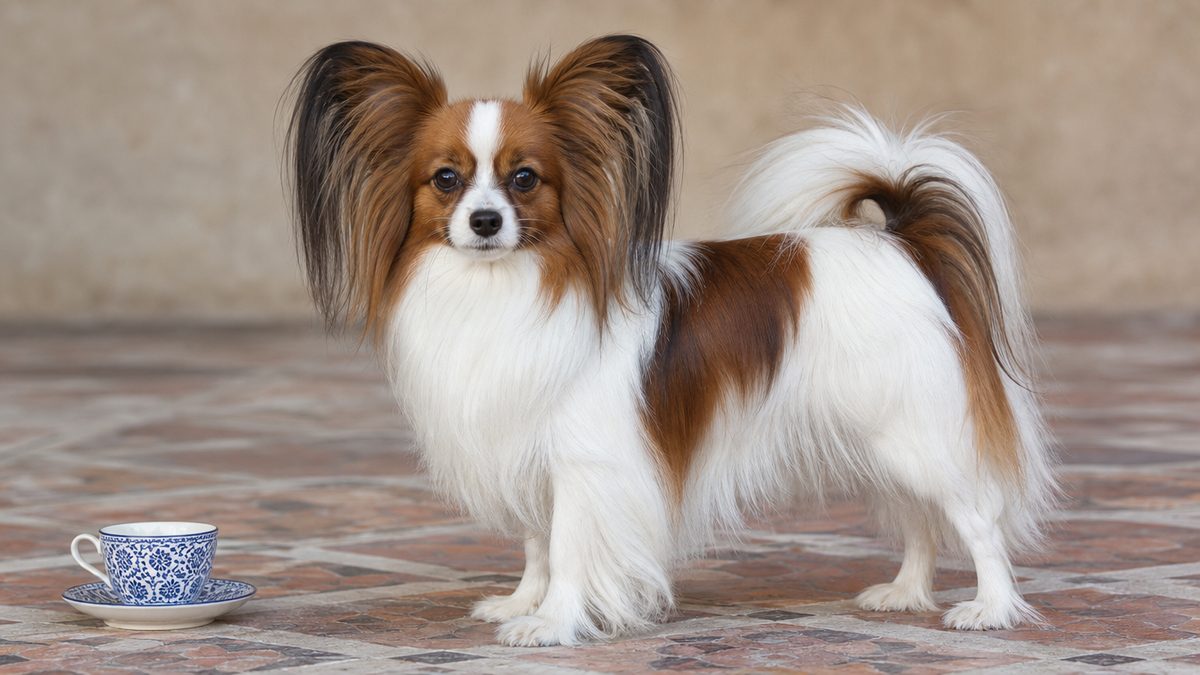
The Continental Toy Spaniel is one breed with two ear varieties, the erect-eared Papillon and the drop-eared Phalene. The FCI registers both under standard 77 and awards each variety its own CACIB, so India, whose Kennel Club of India is an FCI full member, follows that nomenclature. The AKC instead registers a single breed called the Papillon and treats the Phalene as a drop-ear type inside it. Adults stand about 28 cm and weigh 1.5 to 5 kg.
This page is editorial reference, not veterinary advice. A dog of 1.5 to 5 kg has very little physiological reserve, so a problem that a large dog tolerates for a day can become an emergency here in hours. Consult a registered veterinarian before acting on any health, feeding, dental, breeding or exercise decision on this page, and seek emergency veterinary care immediately if a Continental Toy Spaniel collapses, has a seizure, refuses food for more than one meal as a young puppy, develops a suddenly non-weight-bearing hind limb, or shows pale gums, laboured breathing or a rectal temperature above 40 degrees Celsius.
Continental Toy Spaniel at a glance
What the Continental Toy Spaniel is
The Continental Toy Spaniel is a small European companion dog of about 28 cm at the withers and 1.5 to 5 kg, registered by the Federation Cynologique Internationale as standard 77 in Group 9, Companion and Toy Dogs. It comes in two ear varieties: the erect-eared Papillon and the drop-eared Phalene.
The FCI accepted the breed on a definitive basis on 1 January 1954, publishes its official valid standard dated 17 September 1990, and gives the country of origin as Belgium and France. The English title on the standard itself is CONTINENTAL TOY SPANIEL, translating the authentic French EPAGNEUL NAIN CONTINENTAL, which literally means continental dwarf spaniel. That is the name on the FCI document, and it is worth knowing before a seller tells you a Phalene is a different animal.
What the standard actually describes
Two adjectives from the registers are worth keeping. The AKC standard opens by calling the Papillon 'a small, friendly, elegant toy dog of fine-boned structure, light, dainty and of lively action';, and the AKC's breed page insists the dog is tougher than that reads, describing 'a toy dog of singular beauty and upbeat athleticism' that is 'truly a doggy dog, blessed with a hardy constitution';. Dainty in build and hardy in constitution is an accurate summary, and it is why this breed competes in agility rather than sitting on a cushion.
The standard calls for a 'small de luxe Toy spaniel, of a normal and harmonious build, with long hair, moderately long muzzle shorter than the skull, lively personality, graceful yet robust, proud carriage with an easy and elegant gait';. Height at the withers is 'About 28 cm'. Weight is set in two categories: under 2.5 kg for dogs and bitches, and 2.5 to 4.5 kg for dogs with 2.5 to 5 kg for bitches, over an absolute minimum weight of 1.5 kg. So a fully grown, entirely correct example of this breed can weigh less than a two-litre bottle of water.
| Item | What the document says |
|---|---|
| FCI standard number | 77, Group 9 Companion and Toy Dogs, Section 9 Continental Toy Spaniels |
| Recognised definitively | 1 January 1954 |
| Official valid standard published | 17 September 1990; English translation 6 April 1998 |
| Country of origin | Belgium, France |
| Height at withers | About 28 cm |
| Weight | Under 2.5 kg, or 2.5 to 4.5 kg (dogs) and 2.5 to 5 kg (bitches); minimum 1.5 kg |
| Coat | Abundant, glossy, wavy, silky, without undercoat |
| Colour | All colours on a white ground; white dominant on body and legs |
| Varieties | Papillon with erect ears, Phalene with drooping ears; both eligible for the CACIB |
The coat, and why it matters in India
The coat is single. The standard says it is 'without undercoat', abundant, glossy and wavy, 'not soft but slightly resistant to the touch, with silky reflections', short on the face and the front of the legs, longer on the neck to form a ruff and jabot, with ear fringes, feathering behind the forelegs, culottes on the thighs and a plumed tail. Certain dogs in good coat carry hair 7.5 cm long at the withers and 15 cm fringes on the tail. A single long-haired coat behaves very differently from a plush double coat in Indian heat, and the grooming section on this page treats that as the practical centre of coat care rather than as trivia.
The head is fine, with a muzzle shorter than the skull, a black nose, dark almond eyes and pigmented eyelids. On teeth the standard is unusually brief. Jaws and teeth are 'Quite strong, closing well and normally', and there is no requirement for a specific number of teeth at all, which becomes a real problem later on this page when Indian breeding law is applied. Among eliminating faults the standard names 'Excessive prognathism, overshot or undershot to the point where the incisors do not touch anymore';.
Papillon or Phalene: exactly how each register handles it
One breed, two varieties under the FCI; one breed, one drop-ear type under the AKC; and one breed with the drop ear mentioned only in a characteristics paragraph under the Royal Kennel Club. All three registers agree it is a single breed. They disagree on the name and on whether the two ear types compete separately.
The FCI position is the most formal, and the one India follows. The nomenclature entry for breed 77 carries a Varieties table listing 'a) Papillon - with erect ears' and 'b) Phalene - with drooping ears', with each marked as eligible for the CACIB, the international beauty champion certificate. That is not a footnote. A variety with its own CACIB competes as its own unit at an FCI show, so at a KCI championship show under FCI rules a Papillon and a Phalene are judged to one standard and can each take a CACIB on the day.
The AKC runs it differently. The AKC registers a breed called the Papillon, recognised in 1915, in the Toy Group. Its official standard folds the drop ear into the ear clause: '(1) Ears of the erect type are carried obliquely and move like the spread wings of a butterfly... (2) Ears of the drop type, known as the Phalene, are similar to the erect type, but are carried drooping and must be completely down';. There is no separate Phalene breed, no separate variety classification and no separate ring. The AKC's own breed page describes the arrangement from the outside, saying 'In Europe, the drop-eared variety of Papillon is called Phalene, and it competes with equality in the ring against the erect-eared type';.
The Royal Kennel Club in the United Kingdom is closer to the AKC than to the FCI. Its breed standard is headed simply Papillon, sits in the Toy group, and mentions the drop ear once, in the Characteristics paragraph: 'When the ears are completely dropped this type is known as the Phalene (Moth)';. The Ears clause itself describes only the erect carriage, at approximately 45 degrees to the head.
The breed's own American parent club has published both readings, and one of them is wrong. Its FAQ states that 'In some European countries, the name Papillon (French for butterfly) is reserved for this erect-eared dog, while the earlier variety, the drop-eared Phalene (night moth) is regarded as a separate breed. In the U.S. and U.K., however, the two are considered varieties of the same breed, and are shown together';. The FCI's own nomenclature contradicts the first half of that: a dog with drop ears is a variety of breed 77, not a separate breed. The club's own Phalene article gets it right, saying 'In Continental Europe the Papillon (erect ear) is one variety of the breed known as The Continental Toy Spaniel (Epagneul Nain Continental)', and that under FCI rules the Phalene variety 'is judged as a separate variety from the Papillon, each variety having its own set of CAC's and CACIB's';. Separate variety, same breed. The distinction is the whole point.
| Register | Breed name on the document | Status of the drop ear | Group |
|---|---|---|---|
| FCI (and therefore the KCI) | Continental Toy Spaniel / Epagneul Nain Continental, standard 77 | A named variety, Phalene, with its own CACIB | Group 9, Companion and Toy Dogs |
| American Kennel Club | Papillon | An ear type inside the breed, named Phalene in the standard | Toy Group |
| Royal Kennel Club (UK) | Papillon | Named once in Characteristics as the Phalene (Moth) | Toy |
Why the split has a measurable cost
The naming disagreement stops being academic the moment anyone quotes a lifespan. McMillan 2024, the largest UK longevity study, drew on 584,734 dogs including 284,734 deceased from 18 organisations. Its supplementary Table S3 gives the Papillon a median survival of 14.5 years, 95 percent confidence interval 14.1 to 14.9, on 427 deaths, with a hazard ratio of 0.57 against a crossbred reference of 12.0 years. Its Table S5 lists Phalene as a separate breed and flags it as not included in the survival analysis, with no median, no interval and no deaths. The phrase Continental Toy Spaniel appears nowhere in the paper.
Every page that promises a drop-eared Phalene puppy a 14.5-year life is quoting a figure measured on 427 erect-eared dogs registered as Papillons, because the Phalene has no published lifespan at all. Under FCI rules they are one breed and the number probably does transfer. Under the dataset that produced the number, they were not, and it does not.
Which name you will actually meet in India, and what the paperwork says
In India you will meet this dog as the Papillon, almost never as the Continental Toy Spaniel and effectively never as the Phalene. The pedigree, if there is one, follows FCI nomenclature, because the Kennel Club of India is an FCI full member.
Start with the registry chain, because it settles the recognition question that these pages usually fudge. The FCI members register lists India as a Full member, represented by the Kennel Club of India at Nr 28, AA Block, First Street, Anna Nagar, Chennai. Full membership means the KCI issues pedigrees against FCI nomenclature, so a KCI pedigree for this dog descends from FCI standard 77 rather than from an AKC breed entry. There is no separate Indian breed standard for it and there does not need to be one.
What buyers type is a different matter. Google's autocomplete for India on 27 August 2026 returns 'papillon dog price in india', 'papillon dog price in indian rupees', 'papillon dog india' and a string of city variants for Patna, Kolkata, Delhi, Punjab, Kerala and Bangalore. It also returns 'continental toy spaniel vs papillon', 'continental toy spaniel phalene' and 'phalene dog vs papillon', which is a small population of people who have met the formal name and want to know whether they are looking at the same animal. They are.
The four names, and where each one is correct
- Continental Toy Spaniel: the English name on the FCI standard, correct for the breed as a whole.
- Epagneul Nain Continental: the authentic French name, the one FCI treats as official.
- Papillon: correct for the erect-eared variety under FCI rules, and correct for the whole breed under AKC and Royal Kennel Club rules.
- Phalene: correct for the drop-eared variety, an FCI variety and an AKC ear type.
The practical instruction is short. If a seller in India calls it a Papillon, that is normal usage and not a warning sign. If a seller says a Phalene is a rarer, separate and therefore costlier breed, that is a sales claim the FCI nomenclature contradicts on its own face, because both varieties sit under one standard number and one set of weights.
What a KCI pedigree does and does not prove
A pedigree proves parentage was recorded. It does not prove health screening, because no Indian registry publishes screening results for this breed and the 2017 breeding Rules mandate no patella or eye scheme by name. Across the entire gazette, the words patella, luxation, dental and tooth appear zero times. The one health obligation that does bite is the genetic-defect clause discussed later on this page, and even that is a testing duty on the breeder rather than a published register you can search.
So treat 'KCI registered' as a claim to verify, in the way you would verify any document. Two of the Indian pages currently ranking for this breed advertise KCI registration in their metadata while displaying no dog of this breed at all Puppiezo, 'Papillon Dog Price - Buy…. The registration claim and the inventory are written by different systems, and only one of them is checkable from your phone.
Auditing the three standards against each other, line by line
The three standards disagree on weight, on colour and on dewclaws, and two of those disagreements matter to an Indian owner. Reading them side by side is the fastest way to tell whether a seller is quoting a real document or a blog.
| Clause | FCI standard 77 | AKC Papillon standard | Royal Kennel Club |
|---|---|---|---|
| Height | About 28 cm | 8 to 11 inches; fault over 11, disqualification over 12 | 20 to 28 cm (8 to 11 ins) |
| Weight | Under 2.5 kg, or 2.5 to 4.5 / 5 kg; minimum 1.5 kg | 'Weight is in proportion to height'; no figure | No weight given |
| Bite | 'Quite strong, closing well and normally' | 'Teeth must meet in a scissors bite' | 'Perfect regular, and complete scissor bite' |
| Colour | All colours on a white ground | Parti-colour or white with patches of any colour | White with patches of any colour except liver |
| Hind dewclaws | 'Undesirable... Their removal is therefore advisable' | 'Dewclaws, if any, must be removed from hind legs' | Not mentioned |
| Mixed ear carriage | 'This mixed form of ear carriage is a serious fault' | Fault: 'one ear up, or ears partly down' | Not mentioned |
The weight disagreement is the one a buyer feels
The FCI gives numbers and the AKC does not. FCI standard 77 sets a floor of 1.5 kg and a ceiling of 5 kg for bitches. The AKC standard declines to give a weight at all, saying only that 'Weight is in proportion to height';, while the AKC's consumer breed page separately advertises 5 to 10 pounds, roughly 2.3 to 4.5 kg. Indian seller pages then reproduce a third figure, 3 to 5 kg, on both of the listing sites checked here Puppiezo, 'Papillon Dog Price - Buy…. None of those is wrong exactly, but only one of them is a standard, and a 1.6 kg adult is inside the FCI standard while sitting below every Indian seller's stated range.
The liver disagreement
Liver is permitted by the FCI and unacceptable in the United Kingdom. The FCI says 'All colours are admitted on a coat with a white background';. The Royal Kennel Club says 'White with patches, which may be any colour except liver', and adds in bold that 'Any other colour or combination of colours unacceptable';. Under FCI rules, which is what a KCI pedigree follows, a liver-and-white dog is showable. This is a genuine conflict between two live documents and neither is a typo.
The dewclaw clause collides with Indian law
Here the imported advice does not transfer, and following it in India would be an offence. The FCI standard treats hind dewclaws as a beauty fault and says 'Their removal is therefore advisable';. The AKC standard goes further and makes it mandatory: 'Dewclaws, if any, must be removed from hind legs';. Indian law says the opposite. Second Schedule Part II paragraph 6(8) of the Prevention of Cruelty to Animals (Dog Breeding and Marketing) Rules, 2017 forbids 'any other kind of mutilation of any body part of the pup and any change of appearance by artificial means';.
An Indian breeder who removes hind dewclaws to satisfy a foreign standard is altering appearance by artificial means, which paragraph 6(8) forbids. The dog then shows under FCI rules carrying a beauty fault the standard calls undesirable. That is an uncomfortable outcome, and it is the correct one, because the standard is guidance and the Rules are law.
Origin: a dwarf spaniel that split on an ear
The breed originates in France and Belgium and is the older drop-eared dog first, with the erect ear appearing later and eventually giving the whole breed its popular name. The FCI records both countries jointly as the country of origin.
The FCI nomenclature entry gives the country of origin as 'BELGIUM, FRANCE', which is unusual and deliberate; most standards name one country. The authentic language of the standard is French and the official name is Epagneul Nain Continental, the continental dwarf spaniel. The AKC's own breed history notes that 'The Papillon was known previously as the dwarf spaniel';, which is the same name in English.
The word papillon is French for butterfly, and the butterfly ears it names belong to one variety rather than to the whole breed. The Royal Kennel Club standard makes the derivation explicit: 'The name Papillon is derived from the shape and position of the ears. When erect they are carried obliquely like the spread wings of a butterfly, hence the name';. Phalene is French for moth, and the Royal Kennel Club spells that out too, calling the dropped-ear type 'the Phalene (Moth)';. Butterfly wings up, moth wings down. It is a naming scheme built entirely on one anatomical feature, which is exactly why the registers ended up disagreeing about how much weight to put on it.
The standard still polices the boundary between the varieties
The FCI standard treats the two ear types as things that must stay distinct. On ear carriage it says that 'Cross-breeding of the two varieties often produces semi-erect ears, with drooping tip; this mixed form of ear carriage is a serious fault';. The AKC standard reaches the same place with a lighter word, listing 'one ear up, or ears partly down' among its faults. So both documents accept that the two varieties interbreed, and both penalise the intermediate result. That is a strong hint that they were never two gene pools, only two show classes.
The genetics agrees. When Finnish researchers mapped the progressive retinal atrophy mutation in this breed, they assembled and reported their cohort as 'Papillons and Phalenes' together throughout, from the 6 affected and 14 control dogs in the mapping stage to the 145-dog confirmation cohort. A causal mutation that segregates across both ear types in one cohort is a population-level statement that the FCI's single-breed treatment reflects biology.
Recognition dates worth knowing
The AKC recognised the Papillon as a breed in 1915, and the Papillon Club of America did not fully represent it inside the AKC until 1935. The FCI accepted the breed definitively on 1 January 1954 and its current official standard dates from 17 September 1990, with the English translation issued on 6 April 1998. The AKC's current standard was approved on 10 June 1991 and took effect on 31 July 1991. The Royal Kennel Club's Papillon standard page records a last update of April 2025. Those four dates explain a good deal of the disagreement above: they were written decades apart, in three languages, for three different show systems.
Price in India: there is almost nothing to price
There is no working Indian market price for a Continental Toy Spaniel, because there is almost no Indian supply. Across every page ranking in India for this breed on 27 August 2026, exactly one live listing carried a number, and that number was Rs 2,50,000.
Say the supply position first, because it drives everything else. India's largest pet listing site publishes a Papillon page that prints '3 Result Found' and then shows a Shiba Inu in Bhubaneswar, a Border Collie in Pune and a French Bulldog in Hyderabad under the heading 'Similar breeds at other locations';. Its own most-popular sidebar counts 650 Shih Tzus, 549 Siberian Huskies, 487 Golden Retrievers, 454 Labradors, 412 German Shepherds and 136 Pomeranians, and does not count this breed at all. A second large Indian seller's Papillon page lists no Papillon either. India's most-read dog price guide covers 40 breeds and does not include this one.
The one live number, and what happens when you test it
Asia Pets carries a single Papillon listing at Rs 2,50,000, with the location given as 'India, All India' and the vaccination field reading 'No';. Test that figure. Rs 2,50,000 divided by 84.38, the rate at which converted Indian price lists have repeatedly been caught, gives 2,962.79 dollars, which is not round. Divided by 74.00 it gives 3,378.38, which is not round either. Divided by 80.00 it gives exactly 3,125.
Any rupee figure ending in three zeros divides cleanly at 80 by construction, because 1,000 divided by 80 is 12.5. And 3,125 dollars is not a number a seller prints. So the arithmetic points the other way: Rs 2,50,000 looks rupee-native, a figure someone typed rather than converted. That does not make it a market rate. It makes it one person's asking price on a listing whose stated location is the whole country.
What the breed costs where it is actually sold
Overseas prices are the only real price series that exists for this breed, and they sit far below Rs 2,50,000. A UK breed page gives GBP 510 to GBP 690, with 'An average of GBP 690 asked for a dog registered with the Kennel Club'. An Irish guide puts a pedigree puppy from a professional breeder at EUR 1,000 to EUR 1,500, and an adult from a shelter at about EUR 250. Those are the numbers to hold in mind when an Indian seller quotes two and a half lakh for a dog with no verifiable local breeding population behind it.
| Source | Figure | What it actually is |
|---|---|---|
| Asia Pets (India) | Rs 2,50,000 | One live listing, location 'India, All India', vaccinated 'No' |
| PetHouse (India) | Rs 74,000 average, Rs 37,000 to Rs 1,40,600 | A converted US price list, see the audit below |
| Mr n Mrs Pet (India) | No price shown | Papillon page carries no Papillon; prices sit behind a sign-up wall |
| Puppiezo (India) | No price shown | Papillon page carries no Papillon; the carousel prices other breeds |
| Supertails (India) | Not listed | 40-breed price guide that omits this breed entirely |
| Wamiz (UK) | GBP 510 to GBP 690 | Published breed range; GBP 690 average for a KC-registered dog |
| Zoomalia (Ireland) | EUR 1,000 to EUR 1,500 | Pedigree puppy from a professional breeder |
Bonbeno does not broker puppy sales and does not publish breeder listings. The figures above are reported so an Indian buyer can see the spread and the sourcing behind each one, rather than being handed a single averaged number that no document supports.
The Rs 74,000 Papillon price is a US dollar figure in rupee clothing
The one Indian page that does give this breed an average price gives it Rs 74,000, and Rs 74,000 divided by 74.00 is exactly 1,000 US dollars. Every figure on the row divides cleanly at the same rate, nineteen unrelated breeds carry the identical average, and the only rows that refuse to divide are the four Indian breeds somebody typed in by hand.
The row reads 'Papillon | Rs 74,000 | Rs 37,000-Rs 1,40,600';. Do the division and the whole thing collapses into round dollars.
| Printed rupee figure | Divided by 74.00 | Divided by 84.38 |
|---|---|---|
| Rs 74,000 average | USD 1,000 exactly | USD 877.00, not round |
| Rs 37,000 low | USD 500 exactly | USD 438.49, not round |
| Rs 1,40,600 high | USD 1,900 exactly | USD 1,666.27, not round |
The nineteen breeds that share one price
Rs 74,000 is not this breed's price. It is the price of nineteen breeds on that table at once: Akita, American Eskimo Dog, Belgian Malinois, Chesapeake Bay Retriever, Chinese Shar Pei, Doberman Pinscher, English Cocker Spaniel, Golden Retriever, Great Dane, Jack Russell Terrier, Norwegian Elkhound, Papillon, Pointer, Puggle, Saint Bernard, Shiba Inu, Soft Coated Wheaten Terrier, Standard Poodle and the Westie. A market that prices a 2 kg Papillon and a 70 kg Great Dane identically is not a market. It is one number, USD 1,000, applied to a column.
The four rows that give the game away
The exceptions prove the mechanism. Four rows on that table refuse to divide at 74.00, and all four are Indian breeds: the Indian Pariah Dog at 'Free (Adoption)', the 'Rajapayam Dog' at Rs 15,000, the Indian Spitz at Rs 15,000 and the 'Carvan Hound' at Rs 11,000. Rs 15,000 divided by 74 is 202.70, and Rs 11,000 is 148.65. Neither is a dollar figure anyone would print. Those four rows were typed by a person who knew Indian prices; the other hundred and fifty were converted.
The Carvan Hound's range is printed as 'Rs 8,ooo-Rs 12,000', with two lower-case letter o's where the zeros belong. A script converting a dollar column does not produce that. A human typing a local breed into a converted table does. Bonbeno has now confirmed this signature independently on this table, and it is the clearest single proof of a converted price list found on this project.
What to do with the number
Treat Rs 74,000 as what it is, a US average price for a Papillon converted at 74 rupees to the dollar and reprinted without the conversion being disclosed. It is not evidence of an Indian market and it is not a negotiating anchor. If a seller quotes you something near it, ask what the number is based on, and if the answer is 'that is the market rate', ask which market. The same test costs you one division on a phone calculator and it works on every rupee price table you will ever be shown.
What an Indian Papillon listing page actually contains
Open the Indian pages ranking for this breed and you find other breeds. Both of the largest sellers' Papillon pages display animals that are not Papillons, and one of them displays the exact price carousel this site has now catalogued on eleven separate breed pages.
Puppiezo's Papillon page is the clearest case. Under 'Other Available Pets' it shows Fizey, a Maltipoo at Rs 98,999; Kuzo, a Poodle at Rs 92,599; Dugu, a Poodle at Rs 92,599; Kazuka, a Cane Corso at Rs 94,999; Doir, a Goldendoodle at Rs 1,20,000; Samy, a Maltipoo at Rs 98,999; Tugi, a Rottweiler at Rs 76,499; and Yoki, a Doxiepoo at Rs 98,999. Not one Papillon.
Bonbeno has now recorded the identical Rs 98,999 figure, attached to the same recurring animals, on eleven different breed pages of this one site, including pages for breeds it does not stock at all. The two Maltipoos here are named Fizey and Samy and the Doxiepoo is Yoki, exactly as recorded on its Komondor, Basenji, Rat Terrier and Great Dane pages. Rs 98,999 divides to 1,173.25 dollars at 84.38, so it is not even a converted figure. It is a rupee-native charm price attached to whatever puppy is in stock. Never accept it as any breed's price.
Where a listing contradicts its own page
Asia Pets prints 'Vaccinated: No' on its single Papillon listing. A few hundred pixels below, the same page promises 'Up-to-date vaccinations and deworming from certified vets', 'Every pet is fully examined by a qualified vet before delivery to ensure good health', and a 'Breed Certificate' with 'Authentic breed documentation and health records provided';. Both statements sit on one URL. The listing field is entered per animal and the promises are template text, which is exactly why the field is the more informative of the two.
The news article that never mentions the breed
A Times of India feature headlined 'Goldendoodle to Papillon: Exotic trophy pets that are in demand' ranks in India for this breed. Read it and the Papillon appears twice: in that headline, and in one image caption reading 'Giant Schauzer and Papillon';. It is never discussed in the body and carries no rupee figure. The article's only prices are a Caucasian Shepherd 'priced at Rs20 crore' and a dealer's 'The prices start from 2 lakh for such dogs', which in context is about the Giant Schnauzer. Anyone quoting two lakh as a Papillon price from this article has read the headline and not the article.
Specification cards that disagree with the standard
The Indian spec cards match neither FCI standard 77 nor each other. Asia Pets gives weight 3 to 5 kg and height 20 to 28 cm, which is the Royal Kennel Club's height range rather than the FCI's 'About 28 cm'; FCI-Standard N deg 77. Puppiezo gives height 8 to 11 inches, weight 3 to 5 kg, life expectancy 13 to 17 years and origin 'France', where the FCI records Belgium and France jointly. Neither Indian card mentions the 1.5 kg minimum weight, and neither mentions the Phalene at all.
Overseas pages contradict themselves too. One UK breed page states a life expectancy 'between 13 and 15 years' in its data panel and 'Life expectancy is estimated at 14 years' in its health text, and dates recognition to 'the CFI approved the standard in 1937', misspelling the FCI and giving a year the FCI's own register contradicts Federation Cynologique Internationale. An Irish guide gives a third version, 'officially recognised in 1905 and the current standard dates from 1954';. Three ranking pages, three recognition dates, and only one register.
Cost of ownership in India, bounded honestly
No published Indian study prices the ownership of this breed, so this section gives the cost structure and names the line items that genuinely differ for a 1.5 to 5 kg dog. Food is close to trivial at this size. Dentistry and anaesthesia are not.
Start with what is not knowable. There is no Indian cost-of-ownership dataset for this breed, no Indian insurance claims table for it, and no Indian veterinary fee index that separates a 2 kg dog from a 20 kg one. The only published monthly figure this research found anywhere is a UK page's 'Around GBP 20 /month will be necessary to support a dog of this size';, which is a British estimate for British costs and must not be converted into a rupee promise. Anyone who hands you a confident monthly cost in rupees for this breed has invented it, and the honest answer is that the monthly cost of a 3 kg dog is dominated by whether it needs dentistry that year.
The line items that actually change with size
| Line item | Direction size pushes it | Why |
|---|---|---|
| Food | Strongly down | One European guide puts the daily ration at 60 to 100 g of dry food, split across two or three meals |
| Routine vaccination and deworming | Flat | Priced per visit rather than per kilogram |
| Dentistry under anaesthesia | Strongly up | Persistent deciduous teeth run at 15.0 percent in the under-6.5 kg band against 7.0 percent overall |
| Periodontal treatment | Strongly up | Dogs under 10 kg carry 3.07 times the adjusted odds of periodontal disease of dogs of 30 to under 40 kg |
| Breed DNA screening | Flat, one-off | Two breed-specific tests exist and both are single costs tied to a breeding decision |
| Grooming | Up in labour, not in product | A single long coat with fringes and culottes needs brushing two to three times a week, for fourteen years |
| Orthopaedic surgery risk | Lower than the toy-breed reputation suggests | OFA grades 3.3 percent of 3,254 of these dogs abnormal on patella, against 3.5 percent across all breeds |
The food line is the one place small size saves real money. A European guide puts the daily portion at 60 to 100 g of a small-breed dry food in two or three meals. At that rate a premium small-breed kibble lasts a Continental Toy Spaniel roughly ten times longer than it lasts a Labrador, which is worth saying plainly because it is the strongest financial argument this breed has in an Indian household.
Why dentistry is the honest headline cost
Dentistry is the item that separates this breed's budget from a mid-size dog's, and it is measurable twice over. In 2,841,032 US dogs seen across five years, persistent deciduous teeth affected 15.0 percent of the extra-small band under 6.5 kg, against 7.0 percent across all 60 breeds and under 1 percent in every band above 15 kg, and the Papillon is one of the ten breeds that band is built on. Separately, in a random sample of 22,333 UK dogs, dogs weighing under 10 kg carried 3.07 times the adjusted odds of a periodontal disease diagnosis compared with dogs of 30 to under 40 kg, 95 percent confidence interval 2.57 to 3.67. Budget for one dental procedure in the first year and be pleased if you do not need it.
What to actually put money aside for
- A dental check at five to seven months, when the adult canines are erupting and a persistent deciduous canine is still easy to see.
- The two breed DNA tests, once, before any breeding decision Raj K, Berman L, Green P, Sanchez-Masian D.
- An annual eye examination, because the breed's own progressive retinal atrophy has an average diagnosis age of 4.3 years and is invisible before it.
- A soft harness and a carrier, because a collar on a 2 kg neck is a poor idea and this dog travels well in a bag.
- Non-slip runners for polished floors, which cost a few hundred rupees and are the cheapest orthopaedic insurance available.
Insurance is the one place this breed's numbers help you. A median survival of 14.5 years means a long premium-paying horizon and a long window for an age-related claim, so read the upper age limit on any Indian policy before you buy it rather than after.
What Indian breeding law says about a dog this small
Indian law makes one demand of this breed that its own breed standard does not: a breeding dog must have been tested for genetic defects including 'two or more missing teeth'. For a toy breed whose FCI standard sets no dentition requirement at all, that is a specific and awkward obligation.
The instrument is the Prevention of Cruelty to Animals (Dog Breeding and Marketing) Rules, 2017, gazetted as G.S.R. 496(E) on 23 May 2017. Second Schedule Part III paragraph 8(10) reads, verbatim: 'The dogs shall have been tested for genetic defects, including hip dysplasia, progressive retinal atrophy, night blindness, hypothyroidism, entropion, ectropion, overshot, undershot jaw (when incisors do not touch or mesh), wry mouth, two or more missing teeth, unilateral cryptorchid or full cryptorchid males';. The word is 'including', so the list is illustrative rather than closed, and a defect is not outside the clause merely because it is unlisted.
This is Second Schedule Part III paragraph 8(10). It is NOT 'Rule 8(10)'. The Rules contain a separate Rule 8, headed Conditions for sale, whose sub-clause 8(1)(a) genuinely does say 'pups less than eight weeks in age are not sold'. Two different provisions share the numeral 8, and writing 'Rule 8(10)' sends anyone who checks to the wrong place. The same applies to the breeding clauses: they are Second Schedule Part II paragraph 6(3), 6(8) and 6(9), never 'Rule 6(3)'.
Why the missing-teeth clause bites this breed
Two of the defects named in paragraph 8(10) land squarely on a toy breed's known weak points, and the first of them has no counterpart in the standard. FCI standard 77 says only that jaws and teeth are 'Quite strong, closing well and normally', and sets no requirement for a number of teeth anywhere in the document. So an Indian breeder must test for something the breed standard never describes, in a size class where missing and retained teeth are documented at high rates: 15.0 percent persistent deciduous teeth in the under-6.5 kg band, and 89.1 percent of retained teeth being canines in dogs of 3 kg or less in one small-breed dentition study.
The jaw limb is the opposite case, where the two documents agree almost word for word. The FCI standard's eliminating faults include 'Excessive prognathism, overshot or undershot to the point where the incisors do not touch anymore';; the gazette names 'undershot jaw (when incisors do not touch or mesh)';. A dog that fails the standard on that point also fails the clause, which makes compliance and correct type point the same way for once.
Paragraph 8(10) also names progressive retinal atrophy by name. That is not generic language here. A specific CNGB1 frameshift causing PRA was identified in this exact population and a DNA test for it exists, so an Indian breeder of Continental Toy Spaniels has a cheap and definitive route to compliance on that limb and no excuse for skipping it.
What the Rules do not require, and why that matters
Across the whole 14-page gazette the words 'patella', 'luxation', 'dental' and 'tooth' appear zero times; 'teeth' appears once and 'retinal' once, both inside paragraph 8(10). Indian law therefore mandates no patella grading scheme and no dental examination beyond the missing-teeth and jaw items. If a seller tells you their dogs are 'legally required' to be patella tested in India, that claim has no basis in this instrument, whatever the Papillon Club of America requires of its own members.
Breeding relationships and appearance
Second Schedule Part II paragraph 6(3) prohibits two mating techniques by name. In breeding covers 'breeding between relatives of the 2nd to 4th grade in straight or side line within the first four generations e.g. uncle to niece, nephew to aunt, cousin to cousin, grandparents to grandchildren', and incest breeding covers 'mating between parents and children or between brother and sister';. In a breed with a very small Indian population that is a live constraint rather than a formality, and it is the right question to put to a breeder offering two litters from related stock.
Paragraph 6(8) forbids 'tail docking, ear cropping de-barking, de-clawing, branding, dyeing, injecting substances to enhance visual appeal' and 'any other kind of mutilation of any body part of the pup and any change of appearance by artificial means';. Paragraph 6(9) adds that 'Breeding to create new breeds of dogs or unusual looks shall be strictly prohibited';. Between them those clauses answer the dewclaw question raised earlier on this page, and they also answer the market for a deliberately undersized teacup version of this breed: breeding for an unusual look is prohibited outright.
Health, lifespan and what is actually measured in this breed
The Continental Toy Spaniel is a long-lived breed with two breed-specific recessive mutations that both have DNA tests, and a knee record better than its size class implies. The published evidence sits almost entirely under the name Papillon.
Lifespan first, because it is the strongest number this breed has. McMillan 2024 pooled 584,734 UK dogs, including 284,734 deceased, from 18 organisations spanning breed registries, insurers, veterinary corporations and rehoming charities. Its Table S3 gives the Papillon a median survival of 14.5 years, 95 percent confidence interval 14.1 to 14.9, on 427 deaths, with a hazard ratio of 0.57 (0.52 to 0.63) against a crossbred reference median of 12.0 years on 72,445 deaths. A hazard ratio of 0.57 means a little over half the risk of early death of the crossbred population.
Table S3 gives the sample as 1,115 and Table S6 gives 1,114, which is 687 alive plus 427 deceased. The death count is identical in both, so the median rests on 427 deaths whichever N you take. Build the sentence on the deaths, not on the N, and do not quietly pick one.
What has been measured, and what has not
| Item | Figure | Denominator | Source type |
|---|---|---|---|
| Median lifespan | 14.5 years (95% CI 14.1-14.9) | 427 deaths | Peer-reviewed, UK |
| Patella abnormal | 3.3% | 3,254 OFA evaluations | Voluntary register, US |
| Hips dysplastic | 1.6% | 124 OFA evaluations | Voluntary register, US |
| Eyes abnormal (summary) | 3.4% | 4,382 OFA evaluations | Voluntary register, US |
| PRA CNGB1 carriers | 17.2% | 145 Papillons and Phalenes | Peer-reviewed, Finland |
| NAD PLA2G6 carriers | 17.5% | 660 Papillons | Peer-reviewed, North America and Europe |
| Anything measured in India | None found | Not applicable | No Indian data exists |
There is no Indian dataset of any kind for this breed. No Indian prevalence study, no Indian screening register, no Indian insurance table. Everything above is UK, US or European, which is a real limitation and is stated here rather than hidden. Where a figure comes from a voluntary register such as OFA, remember what that register is: results submitted by owners and breeders who chose to submit them, so it under-counts the dogs whose results were poor.
Conditions this breed does not appear to carry
Two absences are worth publishing because they cut against the toy-dog stereotype. The Papillon appears zero times in the largest UK study of patellar luxation, which modelled 210,824 dogs and named eleven predisposed breeds including the Pomeranian, Chihuahua, Yorkshire Terrier and French Bulldog. It also appears zero times in the largest UK study of periodontal disease in dogs, which sampled 22,333 animals. Neither absence proves the breed is unaffected; both mean it was not common enough in a UK primary-care population to be modelled separately. That is what an absence means, and this page will not stretch it further.
OFA's basic cardiac database records 791 Papillon evaluations at 99.9 percent normal, its congenital cardiac database 1,650 at 99.5 percent normal, and its advanced cardiac database 270 at 94.8 percent normal with 2.6 percent abnormal. Those are reassuring numbers on decent denominators, and they are the reason the Papillon Club of America allows a cardiac examination to satisfy its health elective.
Patellar luxation: the toy-breed assumption does not hold here
Patellar luxation is the condition every seller mentions for a toy dog, and on the largest voluntary dataset the Continental Toy Spaniel sits slightly below the all-breed average for it. That is an unusual finding and it deserves the caveats that come with it.
The mechanism first. Patellar luxation is the kneecap slipping out of its groove in the femur, most often medially in small dogs, and it is graded 1 to 4 by how easily and how permanently it displaces. In 210,824 English dogs under primary veterinary care, 1.30 percent carried a patellar luxation diagnosis, 95 percent confidence interval 1.21 to 1.39. Of 751 incident cases, 293 (39.0 percent) were managed medically, 99 (13.2 percent) had surgery and 28 (3.7 percent) were referred. So most diagnosed dogs are managed rather than operated on.
Where this breed sits on OFA's patella database
OFA holds 3,254 patella evaluations on this breed and grades 3.3 percent of them abnormal, split 2.3 percent grade 1, 0.8 percent grade 2 and 0.1 percent grade 3. The all-breed figure across 225,469 evaluations is 3.5 percent. The breed ranks 63rd rather than near the top, and the top is a long way above: the Pomeranian at 29.1 percent of 3,500 evaluations and the Yorkshire Terrier at 17.0 percent of 3,178.
O'Neill 2016 quoted OFA as ranking the Pomeranian and Yorkshire Terrier the two worst breeds at 37.2 percent and 24.1 percent of submissions. Read on 27 August 2026 the same database gives 29.1 percent and 17.0 percent. Both are correct for their date. Always publish the denominator and the date beside a percentage from a live register, because it moves as evaluations are added.
The caveat that matters most
OFA is voluntary and self-selected, and that cuts one way. A breeder whose dog grades badly is under no obligation to publish the result, so a voluntary register systematically under-reports abnormality. Against that, 3,254 evaluations is a large number for a breed this uncommon, and the comparison across breeds is like for like because every breed in the table is self-selected the same way. The safe reading is that this breed is not one of the worst toy breeds for knees, not that it is free of the problem.
The risk factor an Indian buyer can control
One finding from the English study transfers directly. Dogs below their own breed and sex mean bodyweight carried 1.4 times the odds of a patellar luxation diagnosis, 95 percent confidence interval 1.2 to 1.6. In a breed whose standard already permits an adult under 2.5 kg, and in a market where Indian search demand includes 'small papillon dog price in india', that is a direct argument against buying the smallest puppy on offer.
Two other risk factors from the same model are worth knowing without over-reading them. Females carried 1.3 times the odds (1.1 to 1.5) and neutered dogs 2.4 times the odds (1.8 to 3.2). The neutering association in an observational study of this kind is not proof of cause; owners of dogs with orthopaedic problems are also more likely to have them examined and neutered. Discuss neutering timing with your veterinarian on the individual dog rather than on this odds ratio.
What to do about it in an Indian home
Screening is available and the breed's own parent club requires it. The Papillon Club of America's CHIC scheme requires an OFA patellar luxation certificate at a minimum age of one year, alongside a CAER eye examination and permanent identification. Indian law requires no patella scheme at all, so this is a question you have to ask a breeder rather than one the paperwork answers for you. At home, the practical measures are non-slip flooring on the routes the dog uses, keeping the dog lean, and discouraging repeated jumping down from furniture.
Teeth: the health problem most likely to cost you money
Dental disease is the most probable veterinary expense in a Continental Toy Spaniel's life, and the two mechanisms are size-driven rather than breed-driven. Persistent baby teeth in the first year, then periodontal disease across the next fourteen.
Persistent deciduous teeth come first, usually between four and seven months. In 2,841,032 dogs seen at US veterinary hospitals over five years, persistent deciduous teeth affected 7.0 percent overall across 60 breeds, and 15.0 percent of the extra-small band under 6.5 kg, against 6.1 percent in small, 3.4 percent in medium-small and under 1 percent in every band above 15 kg. The Papillon is one of the ten breeds that extra-small band is built from. So the size class this breed sits in carries roughly double the all-breed rate and more than fifteen times the rate of dogs over 15 kg.
What retention actually looks like at 3 kg
A dedicated study of a comparable toy breed shows how severe it gets at the bottom of the weight range. In 61 Yorkshire Terriers from 14 litters, 42 dogs (69 percent) had one or more persistent deciduous teeth, with individual dogs carrying between 1 and 22 of them. Canines were the tooth most often retained, at 89.1 percent in dogs of 3 kg or less against 12.0 percent in dogs over 5 kg, and the lighter dogs were more likely to need surgical extraction by a veterinarian. That is a Yorkshire Terrier study and not a Continental Toy Spaniel study, and it is quoted here as evidence about very small dogs rather than about this breed.
When a deciduous canine stays put and the adult canine erupts beside it, food packs between the two and the adult tooth is pushed out of position. The fix is extraction under general anaesthesia, and it gets harder the longer the root has to fuse. Have the mouth checked at five to seven months rather than at the annual vaccination, and ask your veterinarian specifically about the upper and lower canines.
Then periodontal disease, for the next fourteen years
The second mechanism runs for the rest of the dog's life. In a random sample of 22,333 UK dogs drawn from 905,554 under care at 784 clinics, 2,797 dogs were diagnosed with periodontal disease in a single year, a one-year period prevalence of 12.52 percent, 95 percent confidence interval 12.09 to 12.97. Bodyweight was the dominant factor: dogs under 10 kg carried 3.07 times the adjusted odds of dogs weighing 30 to under 40 kg, 95 percent confidence interval 2.57 to 3.67, and affected dogs had a median adult bodyweight of 10.33 kg against 14.90 kg in unaffected dogs.
Breed odds in the same model reached 3.97 for the Toy Poodle, 2.16 for the Yorkshire Terrier and 2.09 for the Chihuahua, all against crossbred dogs. This breed does not appear in the paper at all, which means it was not numerous enough in the UK sample to model, not that it escapes the size effect its 1.5 to 5 kg weight puts it in.
The routine that actually works
- Brush the teeth. A European breed guide recommends brushing two to three times a week; daily is better and this dog is small enough to hold in one hand while you do it.
- Start brushing in the first month at home, before the adult teeth arrive, so the handling is boring by the time it matters.
- Book a dental check at five to seven months and name persistent deciduous teeth when you book it.
- Feed to a lean body condition, because dental and orthopaedic risk both rise with weight in a dog this size.
- Ask the breeder how many teeth each parent has, since Indian law requires breeding dogs to have been tested for 'two or more missing teeth';.
Eyes: a breed-specific PRA with a DNA test, and a conflict inside OFA's own data
This breed has its own progressive retinal atrophy, caused by a CNGB1 frameshift mutation, inherited recessively, with an average age at diagnosis of 4.3 years and a DNA test that settles the question before a dog is ever bred.
Finnish researchers mapped the mutation in a cohort described throughout as Papillons and Phalenes together. A genome-wide association and linkage study on 6 affected and 14 healthy dogs found a 1.9 Mb homozygous region on canine chromosome 2, and exome sequencing of a trio identified a 1-bp deletion followed by a 6-bp insertion in CNGB1, causing a frameshift and a premature stop codon. The mutation was then confirmed in a larger cohort of 145 Papillons and Phalenes with a carrier frequency of 17.2 percent and a Fisher exact P of 1.4 x 10 to the minus 8.
It is breed-specific in the strict sense. The mutation was absent from 334 healthy dogs of 10 other breeds and from 121 PRA-affected dogs of 44 other breeds. The Royal Kennel Club describes the same mutation on its DNA testing page as Pap-PRA1 and states that 'This disease is unique to the Papillon and is described as an autosomal recessive condition';.
What an owner will notice, and when
The first sign is difficulty in dim light. PRA destroys rod photoreceptors first and cones later, so night vision degrades before day vision, and the clinical signs reported in the affected dogs were tapetal hyper-reflectivity and vascular attenuation on examination. The average age at PRA diagnosis in that cohort was 4.3 years. A puppy examined at eight weeks tells you nothing about this, which is exactly why the DNA test matters more than the puppy check.
The screening picture has changed since the test arrived. OFA's progressive retinal atrophy DNA results hold 309 evaluations on this breed at 95.1 percent normal, 4.9 percent carrier and 0.0 percent affected. That is far below the 17.2 percent carrier frequency in the Finnish research cohort. Publish the disagreement rather than averaging it: the research cohort was assembled around affected families before a test existed, while the OFA figure is post-test breeder screening in a population already being selected. Both are real; neither is a population prevalence.
A conflict inside OFA's own eye data
OFA's summary eye table and its detail rows do not agree, and the arithmetic proves it. The summary gives 4,382 eye evaluations at 96.5 percent normal and 3.4 percent abnormal. The detail tables, on 4,377 examinations, record only 3,497 as NORMAL, which is 79.9 percent, and list individual findings that each exceed the summary's 3.4 percent abnormal: persistent pupillary membranes iris to iris in 183 dogs (4.2 percent), cataract of unknown significance in 181 (4.1 percent) and 'other suspected as not-inherited' in 173 (4.0 percent).
If 3.4 percent of these dogs are abnormal, no single finding can appear in 4.2 percent of them. The two tables are therefore measuring different things, and neither should be quoted as 'the' rate of eye disease in this breed. Both figures are printed here with their denominators so a reader can see the inconsistency rather than inherit one side of it.
Generalised retinal atrophy itself appears on the CAER examination in 18 of 4,377 dogs, 0.4 percent. That is consistent with a recessive disease that has been under DNA-guided selection for over a decade, and it is another reason to ask for the parents' DNA results rather than for an eye certificate alone.
Neuroaxonal dystrophy: the reason this breed has a DNA test at all
Neuroaxonal dystrophy is a fatal, rapidly progressive neurodegenerative disease of puppies that was first reported in this breed in 1995 and traced to a PLA2G6 mutation in 2015. It is recessive, it has a DNA test, and 17.5 percent of 660 screened dogs were carriers.
The disease was originally described in a litter of Papillon puppies in 1995, and a causative missense variant in PLA2G6 was identified in three affected puppies in Japan and published in 2017. The clinical picture is unforgiving. Signs appear in infancy, progress rapidly, and 'because clinical signs are rapid and progressive, natural death occurs at a few months of age if not preceded by humane euthanasia';.
The carrier survey, with its denominator
The PennGen laboratory screened 660 Papillons from North America and Europe between October 2015 and December 2017, using a TaqMan assay for the PLA2G6 variant XM_022424454.1:c.1579G>A. Results: 17.5 percent of the 660 were heterozygous carriers, giving a variant allele frequency of 0.092, and only three puppies were homozygous, one each from the USA, Canada and Europe, all three clinically affected. Archived samples from puppies clinically diagnosed before 2015 were all homozygous for the variant.
Frequency then fell as breeders used the test. Data gathered between 2017 and 2019 from at least ten other laboratories and the Papillon Club of America's Health Committee gave a variant allele frequency of 0.047, roughly half the initial figure. The authors are explicit that all these surveys are biased samples, and equally explicit about the conclusion: 'screening of Papillons intended for breeding is still recommended to avoid inadvertent production of puppies with infantile NAD';.
A second, much lower figure, and why both are printed here
OFA's neuroaxonal dystrophy DNA database gives a different picture. It holds 230 evaluations on this breed at 98.7 percent normal, 1.3 percent carrier and 0.0 percent affected, ranking it second of the four breeds listed, behind the Miniature American and Miniature Australian Shepherd at 8.0 percent carrier and ahead of the Rottweiler at 5.4 percent and the Lagotto Romagnolo at 4.4 percent. Across all breeds in that table, 1,397 evaluations return 4.9 percent carriers.
The 17.5 percent figure is a research survey of samples sent to one laboratory in the first two years the test existed, when breeders with suspicion in their lines were the ones testing. The 1.3 percent figure is a voluntary public register of results breeders chose to publish, years later, in a population already being selected. Bonbeno publishes both with their denominators rather than averaging them into a single misleading number.
What this means for an Indian buyer
The practical instruction is short and it does not depend on which carrier figure is right. Neuroaxonal dystrophy is recessive, so a puppy is only affected when both parents carry the variant, and a single DNA test on each parent removes the risk entirely. Ask for both certificates by laboratory name and date. A carrier bred to a clear dog produces no affected puppies, so a carrier parent is not by itself a reason to walk away; a breeder who cannot tell you either parent's status is.
Note what the Royal Kennel Club does with this. It lists the NAD-PLA2G6 DNA test under Best Practice for the breed rather than Good Practice, alongside a von Willebrand's disease test and BVA eye testing, with the PRA DNA test in the Good Practice tier. That tiering is a judgement about how common each problem is, not a statement that the NAD test is optional in a line where a carrier is known.
The screening a Continental Toy Spaniel should actually have
Four screens cover this breed properly: an eye examination, a patella certificate, and the two breed-specific DNA tests. Only two of them are required by the breed's own parent club, which is worth knowing before you accept a health guarantee.
The Papillon Club of America runs the breed's CHIC requirements, and they are more specific than most Indian sellers' paperwork. To receive a CHIC number a dog must have permanent identification by microchip or tattoo, a CAER eye examination with screening recommended every two years and no minimum age, and an OFA patellar luxation certificate at a minimum age of one year. Then one health elective, chosen from an OFA basic cardiac examination, an OFA advanced cardiac examination, a PRA1 DNA test registered with OFA, or an NAD DNA test registered with OFA.
Both of this breed's DNA tests sit in the elective tier, and a cardiac examination satisfies the same requirement. A dog can hold a CHIC number without either DNA test having been done. Bonbeno's view, stated plainly, is that the two DNA tests are the more informative screens for a buyer, because each identifies a fatal or blinding recessive disease that a single test resolves for life Ahonen SJ, Arumilli M. Ask for them by name regardless of what a CHIC number implies.
| Screen | What it catches | Parent club status | Royal Kennel Club status |
|---|---|---|---|
| CAER eye examination | Visible eye disease, every two years | Required for CHIC | Best practice, BVA/KC/ISDS Eye Scheme |
| OFA patella certificate | Luxating kneecap, minimum age one year | Required for CHIC | Not listed as a breed scheme |
| PRA1 (CNGB1) DNA test | Carrier status for the breed's own PRA | Elective | Good practice |
| NAD (PLA2G6) DNA test | Carrier status for infantile neuroaxonal dystrophy | Elective | Best practice |
| vWD1 DNA test | Von Willebrand's disease type 1 | Not in the CHIC list | Best practice |
The Royal Kennel Club's own breed page tiers the same tests differently, putting the PRA DNA test and genetic diversity under Good Practice, and the NAD-PLA2G6 DNA test, a von Willebrand's disease type 1 DNA test and BVA eye testing under Best Practice. OFA's von Willebrand's database holds 186 evaluations on this breed at 96.2 percent normal and 3.8 percent carrier, with no affected dogs, and its Factor VII deficiency database holds 155 evaluations at 93.5 percent normal, 5.2 percent carrier and 1.3 percent abnormal.
How to ask for this in India
None of these schemes exists as an Indian institution, so an Indian buyer is asking for foreign certificates or foreign laboratory reports rather than for a KCI document. That is a real friction and it is worth naming. A breeder who has imported or tested stock will have PDF certificates with a laboratory name, a sample date and a registration number, and will send them without being pushed. A breeder who says the tests are unnecessary because the dogs 'look healthy' has told you the tests were not done, since both diseases are invisible in a healthy-looking carrier Ahonen SJ, Arumilli M.
Indian law adds one obligation and no scheme. Second Schedule Part III paragraph 8(10) requires that breeding dogs 'shall have been tested for genetic defects, including... progressive retinal atrophy' among others. For this breed that clause has a precise, cheap answer in the form of the CNGB1 test, so a breeder claiming compliance without it is claiming something the available technology contradicts.
Heat, humidity and Indian cities: what a 3 kg single-coated dog actually faces
The Continental Toy Spaniel handles Indian heat better than its European origin and its long coat suggest, because bodyweight is the strongest measured risk factor for heat-related illness in dogs and this breed sits in the lowest-risk band. The coat has no undercoat, which helps. Ground temperature, not air temperature, is the real hazard.
Start with the origin gap, because it is genuine. NASA POWER climatology, queried by explicit latitude and longitude, gives Paris an annual mean 2 m air temperature of 10.93 degrees Celsius and Brussels 10.40, against Chennai at 27.95, Mumbai at 26.77, Hyderabad at 26.10, Kolkata at 25.81, Delhi at 25.60, Pune at 23.86 and Bengaluru at 23.74. This breed evolved in a climate roughly 15 degrees cooler on average than the Indian cities where it will be kept.
| Place | Annual mean (C) | May mean (C) | May climatological max (C) | July mean relative humidity |
|---|---|---|---|---|
| Paris (origin) | 10.93 | 13.78 | 30.09 | 71.65% |
| Brussels (origin) | 10.40 | 13.39 | 29.13 | 74.98% |
| Bengaluru | 23.74 | 26.97 | 39.88 | 76.76% |
| Pune | 23.86 | 28.80 | 43.07 | 89.09% |
| Delhi | 25.60 | 35.05 | 48.08 | 62.72% |
| Kolkata | 25.81 | 31.53 | 46.81 | 86.95% |
| Hyderabad | 26.10 | 33.30 | 45.00 | 73.99% |
| Mumbai | 26.77 | 31.19 | 44.85 | 89.56% |
| Chennai | 27.95 | 31.51 | 42.70 | 67.47% |
Why the size of this dog works in its favour
Bodyweight is the risk factor the evidence keeps returning to, and it points the right way here. In UK dogs under primary veterinary care, every bodyweight band above 10 kg carried significantly higher odds of heat-related illness than dogs under 10 kg, and dogs over 50 kg carried 3.42 times the odds, 95 percent confidence interval 1.54 to 7.57. In the companion paper on exertional heat-related illness, the 10 to under 20 kg band alone carried 2.52 times the odds of dogs under 10 kg. A 3 kg dog is inside the reference category, which is the lowest-risk group in both models, so this is a more heat-tolerant breed than its European origin and its long coat lead Indian buyers to expect.
The Papillon is not among the breeds either paper modelled, so no breed-specific odds ratio exists for it and none is being invented here. The transferable finding is the bodyweight one, and it says a small dog is at lower risk than a large one, not that a small dog is safe. Hall also found that dogs at or above their own breed and sex mean bodyweight carried 1.42 times the odds (1.12 to 1.80), which applies to a heavy example of any breed.
The coat is an advantage, not a liability
The single coat helps in humidity. FCI standard 77 describes the coat as 'without undercoat', abundant, glossy and wavy, and an air-permeable single coat traps far less warm humid air against the skin than a plush double coat does. An Irish guide puts the practical consequence plainly: the breed 'has no undercoat, which limits shedding compared to other breeds', with a seasonal moult in spring and autumn. Never shave this coat to cool the dog. Removing it removes the shading layer over the skin and exposes a pale-skinned dog to sun.
Ground temperature is the hazard this breed actually has
Height is where the size advantage reverses. A dog standing about 28 cm at the withers has its chest, belly and face within a foot of a surface that in Delhi reaches a climatological May maximum air temperature of 48.08 degrees Celsius, with pavement running well above ambient. Paw pads make contact first. The European advice reproduced on the ranking pages, 'take walks early in the morning and late in the evening and give him fresh water regularly';, is correct and simply needs to be treated as a rule rather than as a summer suggestion in Delhi, Kolkata, Hyderabad or Ahmedabad.
City by city, in practice
- Bengaluru and Pune: workable year round on ordinary walk timings, at annual means of 23.74 and 23.86 degrees.
- Mumbai and Chennai: manageable, with the constraint being humidity for the coat and ears rather than heat for the dog, at July relative humidity of 89.56 and 67.47 percent.
- Delhi, Kolkata, Hyderabad: dawn and dusk only from April to June, when May means reach 35.05, 31.53 and 33.30 degrees.
- Any city, any month: test the pavement with the back of your hand for five seconds before the dog's feet touch it.
The Indian city risks nobody prices for a 3 kg dog
A dog of 1.5 to 5 kg faces three Indian urban hazards that a Labrador does not: free-roaming dogs, leopards in parts of Mumbai, and polished floors. A fourth, raptor predation, is widely rumoured and is not documented, and this page says so rather than repeating it.
Free-roaming dogs are the daily risk and they need no citation to be visible on an Indian street. What does need saying is the size arithmetic. A dog that the FCI standard permits to weigh 1.5 kg cannot be recalled out of a confrontation, cannot be picked up quickly if it is on a long lead, and cannot absorb a single bite to the chest. The practical answers are a short lead rather than a retractable one, a harness rather than a collar, and a route chosen for its dog density rather than its scenery.
Leopards, in specific parts of one city
In Mumbai this is measured rather than anecdotal, and the finding is stark. A camera-trap and scat study of Sanjay Gandhi National Park and Tungareshwar Wildlife Sanctuary found that 'Domestic dogs were found to be the highest contributors to leopard's diet', with domestic dog biomass at 32.01 percent in Sanjay Gandhi National Park and 66.76 percent in Tungareshwar. That rests on 97 leopard scats from the park collected in 2015, with domestic dog present in 27 of them, and 23 scats from Tungareshwar in 2016, at an estimated leopard density of 26.34 plus or minus 4.96 per 100 square kilometres. A separate modelling paper puts dog biomass in the same population at approximately 42 percent, a mean of two earlier diet studies with a range of 25 to 58 percent.
This is a north Mumbai and Thane fact, not an all-India one. If you live near the Sanjay Gandhi National Park boundary, in Aarey, Goregaon, Borivali, Powai or Thane, a small dog should not be outside unsupervised after dark, and a terrace or compound is not a substitute for supervision. Elsewhere in India this risk does not apply and should not be used to frighten anyone.
Kites: what is documented and what is not
Delhi's black kites are genuinely aggressive and genuinely studied, and the study is about people rather than pets. Over four years of fieldwork in Delhi, the percentage of attacking kite pairs averaged 25.5 percent with a range of 18.0 to 37.7, and attacking individuals were present at 36 of 113 territories, or 31.9 percent. Physical attacks were predicted by unhygienic waste management, ritual feeding of kites, human density and, notably for a flat-dweller, 'presence of a balcony near the nest';. Kites dive-bombed at high speed and struck at the head.
Now the honest part. The word 'dog' appears zero times in that paper, and this research found no published Indian case series of a raptor taking a pet dog. So Bonbeno claims neither that it happens nor that it does not. What is documented is that in Delhi a balcony near a kite nest predicts attacks on humans, which is a good enough reason not to leave a 2 kg dog alone on a high balcony in a kite-dense neighbourhood, without any need to invent a statistic to support it.
Floors, furniture and stairs
Polished granite, marble and vitrified tile are the default in urban Indian homes and they give a hare-footed, fine-boned dog almost no grip. No Indian study measures flooring against canine orthopaedic injury, and none is being cited here as if it did. The reasoning is mechanical rather than epidemiological: a fall from a sofa is a long fall for a dog 28 cm tall, and a slipping hind leg on a smooth floor is the movement that stresses a stifle. Runners along the dog's usual routes, a ramp or step at the sofa, and short nails are cheap and reversible.
The nail point comes from the standard itself, which lists 'Nails not touching the ground' among its faults. Overgrown nails change how the foot loads, and on a slick floor they act like studs on ice. Check them monthly.
Apartment living, which this breed is genuinely good at
Apartment living suits this dog. A UK breed page notes that 'Living in an apartment works for him', that he 'presents very little predatory instinct', that he is 'not the loudest' though he will announce someone at the door, and that 'This small dog can easily fit into a carrying bag' for public transport. The one caveat on the same page matters in an Indian building: the alerting bark 'needs to be controlled, especially for those who live in apartments';. Train a quiet cue early, because a shared wall makes a small dog's bark everyone's problem.
Temperament and who should not buy one
The Continental Toy Spaniel is an alert, friendly, intelligent companion dog that is far more robust in character than its size suggests, and it does badly with long hours alone. Buy one if someone is home most of the day; do not buy one as an ornament.
The standards agree on the character, which is unusual. FCI standard 77 calls for a 'lively personality... graceful yet robust, proud carriage' and eliminates dogs that are 'Aggressive or overly shy';. The Royal Kennel Club standard asks for 'Lively, intelligent, friendly, with no aggression; always alert';. The AKC standard asks for 'Happy, alert and friendly. Neither shy nor aggressive';. Three documents, three show systems, one temperament.
The attachment problem, stated plainly
This breed is intensely affectionate towards its own household and does not cope with being left. A UK breed page describes a dog 'very close to his social group' that 'constantly needs affection and can therefore be somewhat intrusive', adding that 'What is important to him is to stay with his master, therefore he does not like to be alone. However, he can accept it if he is accustomed to it from an early age and if the absences are not too long';. An Irish guide says the same thing from the other side: 'The Papillon Spaniel needs attention and does not like to be left alone for too long';.
In an Indian two-earner household with a nine to seven working day plus commuting, that is the single most important line on this page. A dog left alone for ten hours will not simply be sad; it will develop the behaviour that gets small dogs rehomed. Solve it before the puppy arrives, with a person at home, a walker who actually comes, or a different breed.
With children, other dogs and cats
It is good with children who have been taught the rules, and the rules are the operative part. One breed page recommends the dog for children while warning to 'be careful that the children do not consider the dog a toy. Ground rules must be put in place to respect these small dogs';. At 1.5 to 5 kg a dropped dog is an injured dog, so a household with a toddler and no supervision plan should choose a sturdier breed.
With other dogs it is better than its size suggests, and the mistake owners make is over-protection. The same page is blunt about it: 'Not so fragile as his size suggests, he can interact without problem with larger dogs. Be careful not to limit his interaction with other dogs. This is often what the owners of small dogs do but it is a serious mistake that leads to serious communication problems between peers';. Socialise this dog properly with dogs of all sizes; do not carry it past every dog it meets. With cats it does well when introduced correctly, and it has very little predatory drive.
Who should not buy one
- Anyone out of the house ten hours a day with no arrangement for the dog.
- Anyone who wants a guard dog. A UK page puts it exactly right: 'the Papillon is not a good watchdog, since his modest size is unlikely to strike fear into the heart of an intruder';.
- Anyone unwilling to brush a long coat two to three times a week for fourteen years.
- Anyone who wants a dog that can be left loose on an Indian street or an unfenced terrace.
- Anyone buying for the ears rather than for the dog underneath them.
Training: a genuinely trainable dog with one specific failure mode
This is one of the most trainable toy breeds and it learns fast on reward-based methods, but it is sensitive to harshness and it will not train itself. The failure mode is not stubbornness; it is an owner who never starts because the dog is small enough to pick up.
The trainability is real and it is described consistently. A UK breed page says the breed 'is very easy to educate because he cooperates with his master if the latter has a consistent and gentle attitude', that 'Since he is keen, he quickly understands what is expected of him', and warns that 'Brutality is not suitable for this dog as he tends to be quite sensitive';. The AKC describes the breed as excelling in agility and being 'consistent winners' at that sport.
The failure mode, and it is the owner's
The same page names the trap directly: 'Pay attention all the same because his beautiful natural abilities should not imply a relaxed education. It must be started as soon as the Papillon puppy arrives at home so that he does not learn any bad habits';. A small dog can be lifted out of every situation it fails, so nothing ever gets trained, and by two years old the dog cannot be handled by a vet or a groomer. That is not a breed trait. It is a consequence of being portable.
A realistic first-year training timeline
| Age | Priority | Why it matters here |
|---|---|---|
| 8 to 12 weeks | Handling: mouth, feet, ears | You will be brushing teeth for fourteen years and checking a persistent canine at six months |
| 8 to 16 weeks | Socialisation with dogs of all sizes | Small-dog owners under-socialise, and it shows up as reactivity later |
| 10 to 16 weeks | Being alone in short doses | The breed does not tolerate long absences; build the tolerance before you need it |
| 12 weeks onward | Recall, on a long line | A 2 kg dog off-lead near free-roaming dogs is not a recoverable situation |
| 4 to 6 months | A quiet cue | The alerting bark is an apartment problem before it is a training problem |
| 6 months onward | Harness and carrier acceptance | A collar on this neck is a poor idea and the dog travels in a bag |
What works and what does not
Reward-based training works and food is not always the strongest reward here. One breed page notes 'This little dog is not a big eater. In fact, small treats can motivate him during training sessions but the joy of play can be just as motivating';. Use very small food rewards, because a 3 kg dog on a training session of thirty treats has eaten a meaningful fraction of its 60 to 100 g daily ration. Cut the day's food to match, or train with play.
Harshness does not work and this is the one point on which the sources are unanimous rather than merely agreeing. A sensitive dog that shuts down under pressure learns nothing, and the FCI standard treats 'Aggressive or overly shy' as an eliminating fault, which is a written acknowledgement that this breed's temperament can be damaged. Keep sessions to five minutes, three times a day, and stop while the dog still wants more.
Give it a job. The breed is described as adapting to 'dog dancing, tracking, learning tricks, agility';, and an intelligent toy dog with nothing to do invents work. In an Indian apartment, five minutes of scent games on a rainy monsoon evening does more for this dog than a longer walk would.
Exercise: 30 to 60 minutes, split, and taken at the right hour
A Continental Toy Spaniel needs 30 to 60 minutes of activity a day, split into two or three outings, plus indoor mental work. In an Indian summer that time moves to dawn and dusk rather than shrinking.
The published requirement is modest and consistent. An Indian seller's own spec card gives an exercise routine of '30 minutes to 1 hour daily' at a moderate energy level. A UK breed page describes a dog that 'enjoys walks and games but can also be calm indoors', and notes that 'Despite his fragile appearance, the Papillon is always eager for an excursion';. This is not a low-energy dog in the way a Bulldog is; it is a small dog whose energy fits into a small time.
How to split it in an Indian day
- Morning, before the ground heats: 20 to 30 minutes of walking at the dog's own pace.
- Midday, indoors: 5 minutes of scent work, a food puzzle or trick training.
- Evening, after the pavement has cooled: 20 to 30 minutes, with sniffing time rather than pace.
- Twice a week: something that uses the brain harder, such as a short agility or trick session.
Sniffing counts. A walk in which a small dog investigates thirty smells tires it more than the same distance covered briskly, and it is the version of exercise available in a hot city where distance is limited by ground temperature.
What happens without it
Weight is the visible consequence and it is preventable. One breed page states the position clearly: 'Only when one neglects his needs for expending energy does he begin to gain weight. Otherwise, he is not greedy or gluttonous, so there is no reason for this dog to become overweight';. That matters more than usual here because weight sits on both of this breed's measurable risks: heavier dogs relative to their breed mean carried 1.42 times the odds of heat-related illness, and bodyweight is the dominant factor in periodontal disease odds in dogs of this size class.
The behavioural consequence arrives sooner than the weight. An under-exercised intelligent toy dog barks, follows, demands and escalates, which in an Indian flat becomes a neighbour problem within weeks. The breed is described as one that 'does not bark excessively but can be a good guardian by alerting if necessary';, and that balance holds only in a dog whose day has something in it.
Jumping, stairs and the things to limit
Limit repeated jumping down rather than exercise itself. There is no Indian or international study measuring furniture jumping against patellar luxation in this breed, and none is being invented here. The reasoning is the same mechanical one that applies to floors: a 28 cm dog landing repeatedly from a 45 cm sofa loads a stifle that OFA grades abnormal in 3.3 percent of 3,254 evaluations. A step or ramp costs almost nothing and removes the repetition.
Puppies need less than adults, not more. Keep the first six months to short, frequent, low-impact outings, and let the structured exercise build after the growth plates close. Ask your veterinarian about timing for the individual dog rather than following a fixed rule from a page written for a larger breed.
Grooming a single long coat in Indian humidity
Brush this coat two to three times a week, concentrate on the four places it mats, and treat ear care as a monsoon job rather than a monthly one. The European advice transfers on brushing frequency and does not transfer on bathing intervals.
Know what the coat is before you decide how to handle it. FCI standard 77 describes an abundant, glossy, wavy coat 'without undercoat', not soft but slightly resistant to the touch, short on the face and the front of the legs, of medium length on the body, longer on the neck to form a ruff and jabot, with fringes at the ears and behind the forelegs, culottes on the thighs and a plume on the tail, reaching 7.5 cm at the withers and 15 cm on the tail in a dog in good coat.
The four places it mats, and they are all fringes
- Behind and inside the ears, where the fringe is longest and the skin is warmest.
- The culottes on the back of the thighs, where the dog sits on the hair.
- The chest frill and jabot, which collects everything the dog walks under.
- Between the toes, where the standard describes tufts that extend beyond the foot.
Work those four areas with a fine comb rather than a slicker brush, because a slicker skates over the top of a forming mat and leaves it intact underneath. Twenty minutes, two to three times a week, is the published recommendation and it is realistic. One UK page recommends daily brushing instead and states the breed 'only moults once a year';, while an Irish guide says it 'does have a seasonal moult, usually in spring and autumn' and recommends brushing two to three times a week. Two ranking pages, two different moult patterns. This page publishes the disagreement rather than picking one, and the practical answer, brush more when more hair comes out, does not depend on which is right.
Bathing advice that does not transfer to India
The European bathing interval is written for a European climate. An Irish guide advises 'One bath every 2 to 3 months is usually enough, unless it gets dirty'. In a Chennai or Mumbai summer, where July relative humidity runs at 67.47 and 89.56 percent respectively, and where a dog walks on dusty pavement twice a day, a two to three month interval leaves a long single coat holding grit against the skin. Bathe when the coat needs it and dry the dog properly afterwards, which is the part that actually matters.
Overseas grooming guidance frequently tells owners to towel a dog and let it air dry. That is written for a dry temperate climate. In an Indian monsoon a damp single coat against skin, and damp ear canals under a long fringe or a drop ear, is the condition ear and skin infections need. Dry the dog to the skin with a towel and a cool dryer, dry the ear fringes specifically, and keep water out of the canal at bath time.
Ears, and why the Phalene needs more of this than the Papillon
Ear care is the one place where the ear variety changes the routine. A UK page notes that the ears must be monitored and cleaned regularly, 'especially the drooping ears of the Phalene';, and an Irish guide recommends checking and cleaning weekly with a suitable solution. A dropped ear over a warm canal in 89 percent July humidity is a different management problem from an erect ear that is open to the air, and it is the single practical consequence of ear variety that this page can point to.
The rest of the routine
Nails monthly, because FCI standard 77 lists 'Nails not touching the ground' as a fault and overgrown nails change how a small foot loads on a slick Indian floor. Eyes cleaned gently with a damp cotton pad to prevent tear staining on a white face. Teeth two to three times a week at minimum, for the reasons set out in the dental section. Professional grooming every two to three months is optional for a pet and useful if the culottes are beating you.
One thing not to do: do not clip this coat short in summer. It has no undercoat to remove, so clipping takes away the layer that shades the skin and gives you nothing back in cooling.
Feeding a 1.5 to 5 kg dog in India
A Continental Toy Spaniel eats roughly 60 to 100 g of dry food a day, split across two or three meals, and that small ration is what makes treat management the central feeding problem rather than food cost.
The published guidance is specific for once. An Irish breed guide recommends 'high-quality dry food suitable for small dogs, in 2 to 3 meals per day' with 'The daily portion is about 60 to 100 g depending on its weight and activity', low in fat to avoid excess weight. That is the whole ration, and it is the number every other feeding decision has to fit inside.
Why the small ration is the problem, not the saving
Treats are a large fraction of a tiny ration. Thirty small training treats can represent a meaningful share of 60 to 100 g, so a dog trained enthusiastically with food and fed its normal meals is being overfed without anyone noticing. Weigh the day's food in the morning and take training rewards out of that bowl. A UK page suggests the alternative directly: the breed 'is not a big eater' and 'the joy of play can be just as motivating' as treats.
Weight control is not cosmetic on this breed. Dogs at or above their breed and sex mean bodyweight carried 1.42 times the odds of heat-related illness in UK primary-care data, and bodyweight is the dominant risk factor for periodontal disease in dogs of this size class. Both of this breed's most likely medical problems track weight.
Life stage, in an Indian household
| Stage | Meals per day | What to watch |
|---|---|---|
| 8 to 16 weeks | 4 | Blood sugar. A toy puppy with a tiny stomach and no fat reserve should not go long between meals |
| 4 to 8 months | 3 | The mouth. Adult teeth are erupting and a persistent deciduous canine changes how the dog chews |
| 8 months to 8 years | 2 to 3 | Body condition, checked by feel over the ribs rather than by the number on a bag |
| 8 years onward | 2 to 3 | Dental comfort and any drop in appetite, which in a 3 kg dog becomes weight loss fast |
A puppy of this breed can weigh under a kilogram at eight weeks, given an adult minimum weight of 1.5 kg in the standard. Very small puppies have limited glycogen reserve, so a puppy that refuses more than one meal, becomes wobbly, or seems suddenly quiet needs a veterinarian the same day rather than the next morning. This is one of the specific reasons the disclaimer at the top of this page exists.
Availability in India
Small-breed and toy-breed dry foods are widely available in Indian metros and online, so this is not a breed where you have to import a diet. The practical constraints are kibble size, which should be small enough for a fine muzzle described by the standard as 'fine, pointed';, and storage, because a 3 kg dog takes months to finish a large bag and dry food goes stale and rancid in Indian heat and humidity. Buy the smallest pack you can rather than the best value per kilogram, and keep it sealed and cool.
Never feed the foods one Indian seller page correctly lists as off limits, which include grapes, onions and excess salt and sugar. On a 3 kg dog the dose that matters is far smaller than on a Labrador, which is the general principle worth carrying: everything toxic is more toxic per bite here.
Month by month through the first year
The first year of a Continental Toy Spaniel has three fixed appointments that matter more than the rest: socialisation before sixteen weeks, a dental check between five and seven months, and confirmation of the parents' DNA results before you ever pay.
| Age | What is happening | What you do |
|---|---|---|
| Before purchase | Nothing yet, and this is the highest-leverage moment | Get both parents' PRA1 and NAD DNA certificates by laboratory and date |
| 8 weeks | Legal minimum age for sale in India | Rule 8(1)(a): 'pups less than eight weeks in age are not sold'. Confirm the microchip number |
| 8 to 12 weeks | Vaccination series, fear period begins | Handling practice on mouth, feet and ears every day. Four small meals |
| 12 to 16 weeks | Socialisation window closing | Meet dogs of every size, safely. Do not carry the puppy past them |
| 4 to 5 months | Deciduous teeth start to shed | Look in the mouth weekly. Note any adult tooth erupting beside a baby tooth |
| 5 to 7 months | Adult canines erupting | Book a dental check and name persistent deciduous teeth when booking |
| 6 to 8 months | Sexual maturity in females | Discuss neutering timing with your vet on this individual dog, not on a rule |
| 8 to 12 months | Coat lengthening, fringes appearing | Move to the full brushing routine before the culottes exist, not after |
| 12 months | Eligible for an OFA patella certificate | If the dog will be bred, this is the earliest the certificate can be issued |
Before eight weeks: the only part that is law
Rule 8(1)(a) of the 2017 Rules states that 'pups less than eight weeks in age are not sold', and Rule 8(1)(e) requires that each pup sold is micro-chipped with a complete record of treatment and vaccination maintained. Those two are checkable at the point of sale, unlike almost everything else on this page. A seller offering a six-week-old puppy is offering an illegal transaction, and the answer is to leave rather than to negotiate.
The socialisation window is short and it does not reopen
Between roughly eight and sixteen weeks is when this dog decides what is normal. The specific risk for a toy breed is the one a UK breed page names directly: owners of small dogs limit interaction with other dogs, 'a serious mistake that leads to serious communication problems between peers';. In India that instinct is stronger, because the dogs on the street genuinely are a risk. The resolution is controlled introductions to known, vaccinated, friendly dogs indoors and in secure spaces, not avoidance.
Growth, and what the standard implies about it
Expect a small adult and do not push growth to get a larger one. The standard's weight categories are under 2.5 kg, and 2.5 to 4.5 kg for dogs with 2.5 to 5 kg for bitches, over a minimum of 1.5 kg. A puppy that will mature at 2 kg is not underfed and a puppy that will mature at 4.5 kg is not overfed; both are inside the standard. Judge by body condition over the ribs rather than by a target weight.
One European guide records litters of 2 to 5 puppies, sexual maturity at around 6 to 8 months in the female, and gestation of about 63 days. Those numbers matter mostly for spotting a claim that does not fit: a seller advertising a litter of nine from this breed is describing something the published litter size does not support.
The dental check between five and seven months. It costs a consultation, it catches persistent deciduous teeth while extraction is still simple, and it sets up the tooth-brushing habit that has to run for fourteen more years in a breed whose size class carries 15.0 percent persistent deciduous teeth and 3.07 times the periodontal odds of a mid-size dog.
Continental Toy Spaniel against the toy breeds Indian buyers actually cross-shop
Against the toy breeds sold beside it in India, the Continental Toy Spaniel wins on two measured numbers and loses on availability. It lives longer than every popular toy breed except the Shiba Inu and Tibetan Spaniel, and its knees test better than the all-breed average, which is not what a buyer is usually told about a toy dog.
Two independent datasets let this be checked rather than asserted. The first is McMillan 2024, which pooled 584,734 UK dogs including 284,734 deceased from 18 organisations and published a median survival per breed. The second is the Orthopedic Foundation for Animals patella database, which holds 225,469 evaluations across all breeds and reports the share graded abnormal. Neither is a perfect population sample. OFA is voluntary and breeder-submitted, so it skews towards dogs whose owners expected a clean result, and McMillan's data come from UK registries, insurers and charities rather than India. Read them as the best available comparison, not as Indian prevalence.
| Breed | OFA patella evaluations | Graded abnormal | Median lifespan (McMillan 2024) | Deaths behind that median |
|---|---|---|---|---|
| Continental Toy Spaniel (Papillon) | 3,254 | 3.3% | 14.5 years | 427 |
| Yorkshire Terrier | 3,178 | 17.0% | 13.3 years | 9,509 |
| Maltese | 1,878 | 4.8% | 13.1 years | 666 |
| Shih Tzu | 3,379 | 2.2% | 12.8 years | 5,894 |
| Pomeranian | 3,500 | 29.1% | 12.2 years | 1,170 |
| Chihuahua | 5,494 | 6.4% | 11.8 years | 3,848 |
| Pug | 2,075 | 5.6% | 11.6 years | 2,782 |
| All breeds / crossbred reference | 225,469 | 3.5% | 12.0 years | 72,445 |
Read the patella column first, because it contradicts the standard sales line. The Pomeranian is OFA's worst breed for patellar luxation at 29.1 percent of 3,500 evaluations, and the Yorkshire Terrier is fourth at 17.0 percent of 3,178. The Papillon sits 63rd at 3.3 percent of 3,254, marginally below the 3.5 percent all-breed figure. On a dataset with more than three thousand of these dogs in it, this toy breed is not one of the bad knees. If a seller tells you every small dog gets a slipping kneecap, that is a generalisation the numbers do not support for this breed.
Where it loses
Availability is the losing column, and it is not close. A buyer in Delhi, Mumbai, Bengaluru or Chennai can find a Pomeranian, a Shih Tzu or a Chihuahua within a week. India's largest listing site shows 650 Shih Tzus and 136 Pomeranians on its own sidebar and not one Papillon. That gap is the whole practical difference between these breeds in India, and it is why the price section on this page is about verification rather than about bargaining.
The second loss is coat labour. The Chihuahua in smooth coat needs almost no brushing. This breed carries a long, silky, single coat with a chest frill, ear fringes and culottes on the hind legs, all of which mat behind the ears and in the culottes in a humid Indian monsoon. Budget twenty minutes of brushing three times a week for fourteen years, not for one.
Papillon against Phalene, on the same page
The one comparison every other page skips is between the two varieties of this single breed. They are not two breeds under FCI rules, they carry the same standard, the same weights and the same colour rules, and the only written difference is the ear. What differs is the evidence base. McMillan's supplementary tables list Phalene as its own breed and mark it as not included in the survival analysis, with no median, no confidence interval and no death count, while the Papillon row carries 427 deaths. So the 14.5-year figure attaches to the erect-eared dog. Anyone quoting it for a drop-eared puppy is extrapolating, and should say so.
Choose on the dog in front of you, not on the ear. Ask for the same DNA results either way, because the CNGB1 progressive retinal atrophy mutation was mapped in a cohort described by its authors as Papillons and Phalenes together, so the genetic risk does not stop at the ear carriage.
What Indian buyers get wrong about this breed
The five costly mistakes with a Continental Toy Spaniel in India are buying a white one, buying the smallest one, keeping it on polished floors, skipping the two DNA tests, and treating a single coat as a coat that does not shed. Each has a source behind it and each is avoidable before you pay.
1. Chasing an all-white dog
An all-white dog is a disqualification, not a rare colour. Google's own India autocomplete returns 'papillon dog white colour', 'white papillon dog price in india' and 'papillon dog images white' as live suggestions, so buyers are actively hunting one. The AKC standard disqualifies 'An all-white dog or a dog with no white', and requires that colour cover both ears front and back and extend without interruption from the ears over both eyes. The FCI standard is written the same way round: all colours are admitted on a white ground, white must dominate on body and legs, and dominant white on the head is a fault. A seller charging a premium for a white one is charging you extra for a fault.
2. Asking for the smallest in the litter
Buy the smallest and you buy measured risk. The FCI standard sets a minimum weight of 1.5 kg and describes two weight categories, under 2.5 kg and 2.5 to 4.5 or 5 kg, so a very small adult is inside the standard rather than a defect. The risk is elsewhere. In 210,824 English dogs, animals below their own breed and sex mean bodyweight carried 1.4 times the odds of a patellar luxation diagnosis, 95 percent confidence interval 1.2 to 1.6. And in 2,841,032 US dogs, persistent deciduous teeth ran at 15.0 percent in the under-6.5 kg band against 7.0 percent overall. Smaller is not better here; it is simply smaller, with a documented cost.
3. Polished granite and vitrified tile
Indian flooring is the environmental factor nobody prices in. Most urban Indian homes are finished in polished granite, marble or vitrified tile, which give a 2 kg dog with hare-shaped feet almost no purchase. No published Indian study measures flooring against orthopaedic injury in dogs, and this page will not pretend one exists. What is measurable is that this breed is fine-boned by standard, with legs described as straight, firm and fine, and that a fall from a sofa is a real fracture mechanism at this weight. Run cheap cotton dhurries along the routes the dog actually uses, and keep the nails short, because the standard itself flags 'nails not touching the ground' as a fault.
4. Skipping the two DNA tests that exist
Two breed-specific DNA tests exist and both are cheap relative to the dog. The CNGB1 frameshift causing progressive retinal atrophy was found at a 17.2 percent carrier frequency in a cohort of 145 Papillons and Phalenes, with an average age at diagnosis of 4.3 years. The PLA2G6 variant causing neuroaxonal dystrophy was found in 17.5 percent of 660 Papillons screened in North America and Europe between 2015 and 2017. Both are recessive, so two carriers bred together produce affected puppies. Ask for the parents' certificates by name and lab, not for a verbal assurance.
5. Believing a single coat does not shed
This coat sheds, and one Indian seller says so on the same page that sells the breed as low-maintenance. Puppiezo's Papillon spec card prints 'Shedding: Yes';. The FCI standard describes a coat 'without undercoat', abundant, glossy and wavy, which changes the character of the shedding rather than removing it. No undercoat means less seasonal blowing and less felted hair in the fan, not a dog that leaves nothing on a dark sofa.
Paying a Papillon premium for a dog that is not one. Both of the largest Indian pages ranking for this breed carry no Papillon at all. One prints '3 Result Found' and then shows a Shiba Inu, a Border Collie and a French Bulldog; the other shows two Maltipoos, two Poodles, a Cane Corso, a Goldendoodle, a Rottweiler and a Doxiepoo. Before any money moves, see the dam and sire, and see the KCI paperwork.
Adoption, lawful sourcing and the questions that actually screen a seller
Sourcing a Continental Toy Spaniel in India means verifying paperwork rather than comparing prices, because there is almost no supply to compare. Start with rescue, then with a KCI-registered breeder you can visit, and treat import as effectively closed to a private buyer.
Adoption first, because the arithmetic favours it. India has no breed rescue for this breed, and a Continental Toy Spaniel almost never appears in a metro shelter, so the realistic adoption route is a general small-dog rescue rather than a breed-specific waiting list. Adopt an adult small dog instead and you get something a listing site cannot sell you, a temperament already known at eighteen months. Buyers who adopt rather than order also sidestep every verification problem set out on this page. If your requirement is a small, alert, trainable indoor companion rather than this specific breed, a rescue small dog meets it in a week and costs a sterilisation fee.
The lawful supply routes, and the one that is closed
Import is closed to a private buyer wanting a puppy to breed or sell. DGFT Trade Notice 22/2022-23 places dogs under ITC(HS) 01061900 as a Restricted import and permits entry for exactly three purposes: a pet dog with a valid pet book and records in the importer's own name, research by an R&D organisation with a CPCSEA recommendation, and Defence or Police use. Policy Condition 8 states that 'Import of commercial dogs for breeding or any other commercial activities other than the purposes mentioned above is not permitted', and paragraph 6 adds that any application 'for trading/breeding purposes, or applications made on behalf of some another person/ entity shall be duly rejected';. Entry is limited to the airports and seaports of Delhi, Mumbai, Chennai, Hyderabad, Bengaluru and Kolkata and, since October 2024, Kochi airport Department of Animal Husbandry…. The full route is set out in how to import a dog to India.
That leaves a domestic KCI-registered litter. The Kennel Club of India is the FCI's full member for India, listed at Anna Nagar, Chennai, so a genuine pedigree here is issued against FCI nomenclature. Ask which name is printed on the papers, because under that nomenclature the breed is the Continental Toy Spaniel and the ear type is a variety within it.
Eight questions that separate a breeder from a shop
- Show me the dam. A seller who cannot produce the mother on the premises is a reseller, whatever the website says.
- Show me the CNGB1 progressive retinal atrophy certificate for both parents, with the laboratory name and the date.
- Show me the PLA2G6 neuroaxonal dystrophy certificate for both parents, and tell me whether either is a carrier.
- Show me the puppy's date of birth, because Rule 8(1)(a) of the 2017 Rules says 'pups less than eight weeks in age are not sold'.
- Show me the microchip number, which Rule 8(1)(e) requires on every pup sold.
- Tell me how the parents are related, because Second Schedule Part II paragraph 6(3) prohibits both in breeding within four generations and mating between parents and children or brother and sister.
- Tell me the adult weights of both parents against the standard's 1.5 kg minimum and 5 kg ceiling.
- Tell me how many teeth the parents have, because Second Schedule Part III paragraph 8(10) names 'two or more missing teeth' as a genetic defect a breeding dog must have been tested for.
One Indian seller's replacement guarantee reads: 'If your pet perishes because of any health concern (covered under our vet-approved conditions) arises within the guarantee period and is confirmed by a licensed vet, we'll happily offer a replacement';. A guarantee that promises a replacement animal rather than a veterinary standard is a stock-control policy. Another site's single Papillon listing prints 'Vaccinated: No' on the listing while the same page promises 'Up-to-date vaccinations and deworming from certified vets' a few hundred pixels lower. Read the listing and the promise together; they are frequently written by different people.
Bonbeno does not broker puppy sales, does not publish breeder listings and takes no payment from sellers. Everything above is reported so that you can verify it yourself, which is the only form of consumer protection available in a market this thin.
Continental Toy Spaniel questions Indian buyers ask
Is the Continental Toy Spaniel the same as a Papillon?
Yes. The Continental Toy Spaniel is the English name on FCI standard 77, and the Papillon is its erect-eared variety. Under AKC and Royal Kennel Club rules the whole breed is simply called the Papillon, which is why the two names describe the same dog.
What is the difference between a Papillon and a Phalene?
The ear, and nothing else in the standard. The FCI lists Papillon as the erect-eared variety and Phalene as the drooping-eared variety of one breed, with identical size, weight and colour rules. Crossing the two often produces semi-erect ears, which the standard calls a serious fault.
What is the papillon dog price in india?
There is no reliable Indian market price, because there is almost no Indian supply. One live listing was found at Rs 2,50,000. The Rs 74,000 figure printed on Indian price tables is exactly USD 1,000 converted at 74.00 and is shared by nineteen unrelated breeds.
Is a Papillon available in India at all?
Barely. India's largest pet listing site publishes a Papillon page that shows a Shiba Inu, a Border Collie and a French Bulldog instead. A second large seller's Papillon page lists no Papillon either, and India's most-read 40-breed dog price guide omits the breed entirely.
What is the papillon dog age limit in india?
Indian law sets a minimum sale age, not an upper limit. Rule 8(1)(a) of the Dog Breeding and Marketing Rules 2017 states that pups less than eight weeks in age are not sold. There is no legal maximum age for owning or keeping the breed.
Can I buy a white Papillon?
You should not pay a premium for one. An all-white dog, or a dog with no white, is a disqualification under the AKC standard, and the FCI standard treats dominant white on the head as a fault. Colour must cover both ears and extend over both eyes.
How long do Papillons live?
A median of 14.5 years, with a 95 percent confidence interval of 14.1 to 14.9, measured on 427 deaths in a UK dataset of 584,734 dogs. That is well above the crossbred reference of 12.0 years and above almost every popular toy breed.
Do Papillons get luxating patella like other toy breeds?
Less than most of them. On OFA's patella database this breed is graded abnormal in 3.3 percent of 3,254 evaluations, marginally below the 3.5 percent all-breed figure, while the Pomeranian runs at 29.1 percent and the Yorkshire Terrier at 17.0 percent.
What DNA tests does a Papillon need?
Two. The CNGB1 test for the breed's own progressive retinal atrophy, found at a 17.2 percent carrier frequency in a cohort of 145 dogs, and the PLA2G6 test for infantile neuroaxonal dystrophy, found in 17.5 percent of 660 screened dogs.
Do Papillons shed?
Yes, and one Indian seller prints Shedding: Yes on the same page that sells the breed. The coat has no undercoat, which limits the volume compared with a double-coated breed, but a seasonal moult still happens and daily hair still lands on furniture.
Can a Papillon handle Indian heat?
Better than its European origin suggests. Bodyweight is the strongest measured risk factor for canine heat-related illness and this breed sits inside the lowest-risk band under 10 kg. Walk at dawn and dusk in summer and test the pavement before the dog walks on it.
Is a Papillon good for an apartment in India?
Yes, and it is one of the better toy breeds for it. The dog is quiet, clean, fits in a carrier for public transport and needs 30 to 60 minutes a day. Train a quiet cue early, because the alerting bark carries through shared walls.
Can I import a Papillon into India?
Only as your own pet. DGFT Trade Notice 22/2022-23 makes dogs a Restricted import allowed for a pet with a valid pet book in the importer's own name, R&D with CPCSEA recommendation, or Defence and Police use. Trading or breeding applications shall be duly rejected.
Do Papillons have dental problems?
Their size class does, heavily. Persistent deciduous teeth affect 15.0 percent of dogs under 6.5 kg against 7.0 percent overall, and dogs under 10 kg carry 3.07 times the adjusted odds of periodontal disease of dogs weighing 30 to under 40 kg.
Are papillons good dogs?
Yes, for a household where someone is home most of the day. Three standards agree on the character: FCI standard 77 asks for a lively personality and eliminates aggressive or overly shy dogs, the Royal Kennel Club asks for lively, intelligent, friendly, with no aggression, and the AKC for happy, alert and friendly. It suits apartments, is good with children taught the rules, is not a watchdog, and does badly left alone for long hours.
What is a toy spaniel called?
On the FCI standard this toy spaniel is called the Continental Toy Spaniel, the English title translating the official French name Epagneul Nain Continental, meaning continental dwarf spaniel. The AKC and the Royal Kennel Club call the whole breed the Papillon, French for butterfly, after its erect ears, and the drop-eared variety is the Phalene, French for moth. The English Toy Spaniel is a different breed that this page does not cover.
Compare with similar breeds
Continental Toy Spaniel sits in 2 Bonbeno groups. Each one compares it directly against the breeds it is genuinely an alternative to, on the same figures.