
Breed profile
Russkiy Toy: Price in India, Patella Risk and Heat
A 2.3 kg Russian companion dog rebuilt from pedigree-less stock in the 1950s, with no clinical literature anywhere in PubMed and one hard screening number that nobody quotes.
Quick answer
No verifiable Russkiy Toy price in India exists, and the way Google India fails on the query is the finding: the only rupee figures its shopping module returns for this breed are for plush husky toys, Soviet nesting dolls and one porcelain figurine at Rs 6,940, because the breed's own name contains the word toy.
This page reports published veterinary research, registry screening datasets and Indian price data. It is not a diagnosis and it is not a treatment plan. A hind leg that skips or is carried for a few strides, a soft spot on the skull that has not closed by nine months, weakness or collapse in a very small puppy, and any laboured breathing are all reasons to be seen. Consult your nearby vet before acting on anything here, and before starting or stopping any medicine.
Russkiy Toy at a glance
What a Russkiy Toy is
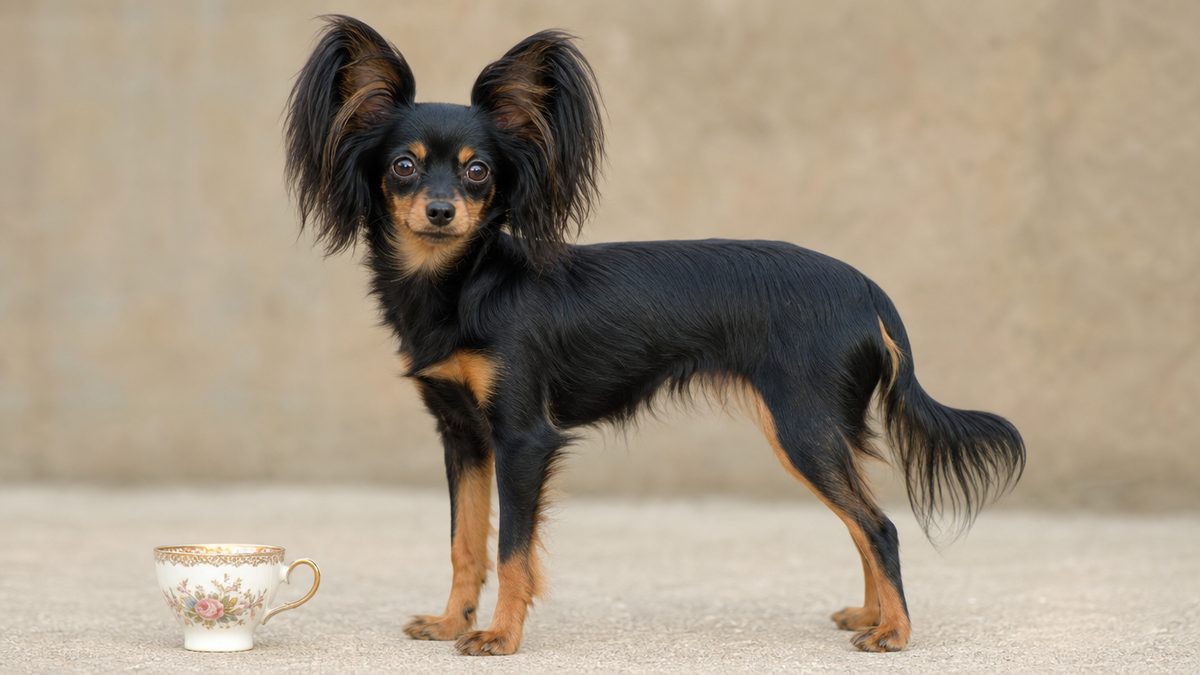
The Russkiy Toy is a very small, elegant, long-legged Russian companion dog held by the FCI as standard 352, definitive since 7 November 2017, standing 22 to 27 cm and weighing up to 3 kg in smooth-haired and long-haired varieties.
The general appearance clause is short and precise: a small, elegant long-legged dog, with fine bone and lean muscles, very harmonic and of good proportions, with sexual dimorphism only slightly defined. Body length equals height at withers, height at elbows is only slightly more than half the height at withers, the chest reaches the elbows, and the muzzle is shorter than the skull. Long in the leg is the phrase to hold on to, because it is the single feature that separates this breed from the small dogs it is confused with.
A breed rebuilt from dogs without papers
The FCI standard's history is unusually candid, and it is worth quoting because it explains the breed's genetics. At the beginning of the twentieth century the English Toy Terrier was one of the most popular toy dogs in Russia. Between 1920 and 1950 the breeding of pure toy terriers was almost stopped and the number of dogs fell to a critical level. Only in the mid-fifties did Russian breeders begin the revival, and the standard states plainly that practically all dogs which were used for breeding had no pedigrees, and many of them were not pure blood.
The long-coated variety has a precise birth date. On 12 October 1958, two smooth-haired dogs, one of which had slightly longer hair, produced a male with spectacular fringes on the ears and limbs. The decision was taken to keep the feature, the male was mated to a female who also had slightly long hair, and the variety followed, originally called the Moscow Longhaired Toy Terrier. A Moscow breeder, Yevgueniya Fominichna Zharova, is named in the standard as having played an important role in creating it.
This breed has been through at least four names, and the search results still split across them. The FCI and the UKC and the Canadian Kennel Club say Russkiy Toy. The American Kennel Club, Wikipedia and Purina say Russian Toy. Commercial sellers say Russian Toy Terrier, the retired name of the smooth variety. And the long variety was once the Moscow Longhaired Toy Terrier. If you are researching this dog, search all four.
One breed or two, depending on the register
The FCI holds one breed with two varieties, smooth-haired and longhaired, both carrying CACIB. Dogs Australia's own breed listing of 18 March 2026 carries two separate entries in Group 1 Toys: Russian Toy (Smooth) and Russian Toy (Long). Neither body is wrong. They are different filings of the same animals, and it is a clean example of the variety-versus-breed question that recurs across registries.
| Body | Name used | Group | One breed or two |
|---|---|---|---|
| FCI | Russkiy Toy | Group 9, Section 9 | One breed, two varieties |
| Dogs Australia | Russian Toy (Smooth) and (Long) | Group 1 Toys | Two entries |
| American Kennel Club | Russian Toy | Toy Group | One |
| United Kennel Club | Russkiy Toy | Companion Dog Group | One, two coat clauses |
| Canadian Kennel Club | Russkiy Toy / Petit chien russe | Toy Dogs | One |
The Kennel Club also holds the breed, which is confirmed from an unexpected direction: McMillan's 2024 supplementary table records its Kennel Club group as Toy. The United Kennel Club files it in the Companion Dog Group with a full standard carrying separate smooth-coated and long-haired clauses. United Kennel Club
Size, tightly bounded
Height at withers is 22 to 27 cm for dogs and females alike, and weight is up to 3 kg, with a preferable height of 25 cm and a preferable weight of 2.3 kg. Height below 22 cm or above 27 cm is a fault. Size over 29 cm or under 18 cm is disqualifying, as is weight of more than 3 kg or less than 1.5 kg. Those are unusually hard limits, and they matter to a buyer: a dog sold as a Russkiy Toy at 4 kg is outside the standard by a margin the standard itself calls disqualifying.
Russkiy Toy price in India, and what Google actually returns
No verifiable Russkiy Toy price in India exists, and the way the search fails is more informative than any figure would be: the breed's own name resolves Google India's shopping module to stuffed toys.
This site documents merchandise listings being mistaken for breed prices as a recurring contamination mechanism. This breed is the clearest case yet found, and the reason is structural rather than accidental. The breed's name contains the word toy.
A Google India pull for russkiy toy dog on 9 September 2026, with a Labrador control passing on the same endpoint in the same session, returned a Popular products module. Every item in it was merchandise.
| Item | Price | What it is |
|---|---|---|
| Webby Plush Husky Dog Stuffed Animal | Rs 348 | A soft toy of a different breed |
| Adorable Realistic Husky Dog Stuffed Animal | Rs 208 | A soft toy of a different breed |
| 20 cm Soviet plastic collectible toy dog, USSR | Rs 14,887 | A vintage plastic figurine, pre-owned |
| Russian Russkiy Toy Terrier Dog Lomonosov Porcelain Collectible Figurine | Rs 6,940 | The only item that names the breed, and it is porcelain |
| Dog Russian greyhound (borzoi) plush Realistic toy | Rs 50,810.20 | A soft toy of a different breed |
| Russian Nesting Doggie Dolls, set of 7 | Rs 4,684 | Matryoshka dolls |
Not one live animal appeared in the module. The single item that names the breed correctly is a Lomonosov porcelain figurine at Rs 6,940, and the most expensive item is a Borzoi plush toy at Rs 50,810.20. An automated system harvesting rupee figures from this page would produce a breed price band of roughly Rs 208 to Rs 50,810, and every number in it would be for an inanimate object.
The lesson generalises past this breed. Before quoting any rupee figure as a breed price, confirm that the listing is for a live animal. Here the confusion is baked into the breed's name, so the failure is systematic rather than occasional, and it will keep happening to every automated summary that reads this query.
The structural reason no Indian price exists
India's import policy for pet dogs is restricted and permitted only with a DGFT authorisation. The permitted purposes are research with a CPCSEA recommendation, internal security by the Defence and Police forces, a certified therapy or emotional support dog, and a dog that has been with its owner for at least two years arriving on transfer of residence. The guidance then states that dogs for commercial purposes like breeding, as a gift or other purposes are not allowed to be imported, and that new born puppies of less than 7 months are not to be allowed.
Import runs through seven ports only, the airports and seaports of Delhi, Mumbai, Chennai, Hyderabad, Bengaluru and Kolkata and, since October 2024, Kochi airport, under ITC(HS) code 01061900, with an advance NOC from the Animal Quarantine and Certification Station required seven days before travel. The foreign figures circulating for this breed, which run from roughly a thousand to three and a half thousand US dollars depending on the seller, are overseas asking prices, and this page converts none of them into rupees. The full route is set out in how to import a dog to India.
The one Indian rupee band, and why it fails the test
One Indian template page does print a figure, and Google's own AI answer now quotes it. Happy Pet Care lists the Russian Toy at Rs 30,000 to Rs 60,000, and on a re-pull of the Indian results page on 17 September 2026 Google's AI Mode answered the question What is a Russian Toy dog's price? with exactly that band. Google India search results page… Run the tests this site applies to every Indian price. Rs 30,000 divides to 355.53 at 84.38 and to 405.41 at 74, and Rs 60,000 divides to 711.07 and 810.81, so neither end is a dollar figure and this is not a converted US list. Both ends divide cleanly only at a flat 80, to 375 and 750, and any figure ending in three zeros does that by construction. The stronger tell is the running-cost block beneath the band. The page's monthly figures of Rs 2,200 and Rs 3,750 are the sum of three preset lines, Rs 1,200 to 1,800, Rs 300 to 750 and Rs 700 to 1,200, and the identical totals and lines print on the same site's Chihuahua, Pug and Beagle pages. A page whose care costs are a constant shared with unrelated breeds is a template, and its buying band is a template band rather than an observed Indian price. This page therefore treats Rs 30,000 to 60,000 as a figure to explain, not a price to report.
The word Terriers, and why it reaches this breed
CBIC Instruction 05/2024-Customs of 14 March 2024 reproduces a Department of Animal Husbandry and Dairying letter naming breeds prohibited for import. Its entries include four bare words the instrument never defines: Mastiffs (boerbulls), Terriers, Wolf dogs and Canario. Reasoning from the absence of a proper name would clear this breed, because Russkiy Toy is not on the list. That reasoning is wrong here, and the evidence sits in the breed's own documents.
- The smooth variety's former name was the Russian Toy Terrier, and commercial sellers still use it.
- The FCI standard's own history calls the founding population toy terriers, using the phrase toy terrier five times in its historical summary, and names the English Toy Terrier as the ancestor.
- The long variety was the Moscow Longhaired Toy Terrier.
- Google's own People also ask box, on the query this page is written for, asks whether Russian Toy terriers are good pets.
A bare undefined word in a customs instruction reaches what it plainly reaches, and an officer applying it has no reason to prefer the FCI's current name over the name on the seller's invoice. This page therefore states that the word Terriers reaches this breed on its face under the name most commonly used to sell it, rather than clearing it because a proper name is absent. The wider legal position is separate and settled: the Karnataka High Court quashed the circular on 10 April 2024 and the Delhi High Court set it aside that month, so no Indian law in force today bans owning, breeding or selling any breed it named.
Cost of ownership for a 2.3 kg dog in India
The cost of ownership for this breed is dominated by two things that are not monthly: an orthopaedic problem the register says is common, and dental care that a small jaw makes inevitable.
No Indian breed page carries a monthly cost table for this dog, so there is no template constant to inherit and no fabricated figure to correct. What follows is Indian retail and municipal pricing that names its supplier, sized to a dog of about 2.3 kg.
- Core vaccination, per shot. Anti-rabies Rs 699, puppy DP Rs 849, 9-in-1 DHPPiL Rs 899, canine corona Rs 899 and kennel cough Rs 1,349 at one national clinic chain. These are promotional starting prices, and the same chain quotes different course totals on different city pages, so note which city quoted you.
- Deworming. Drontal Plus is Rs 754 for six tablets against an MRP of Rs 838, which is Rs 125.67 a tablet dosed at one per 10 kg. A 2.3 kg dog takes roughly a quarter tablet, about Rs 31 of product per dose, and splitting accurately at that size is a job for your vet.
- Grooming. The smooth variety needs essentially nothing beyond a weekly rubber mitt. The long-haired variety needs the ear fringes, leg feathering and tail combed, and the standard disqualifies a trimmed coat in both varieties, so a salon clip is not an option.
- Municipal registration. Rs 500 in Delhi for a new registration and Rs 500 to renew, with a Rs 100 monthly late fee. Rs 50 in Chennai, where the corporation issued 9,115 licences in 2024 and runs six pet clinics giving treatment and anti-rabies vaccination free of cost.
The two costs that are not monthly
The first is the knee. OFA's patella table puts this breed at 9.0 percent abnormal on 134 evaluations, which is 2.6 times the all-breed rate. Surgical correction of a luxating patella is a real and not-uncommon cost for a breed with that profile, and it is the single most predictable large veterinary bill this breed generates.
The second is the mouth. Toy breeds carry a full-size dental formula in a very small jaw, and the standard's disqualification list bars a dog missing more than two incisors in either jaw or any canine at all, while a level bite extending to the whole incisor row is also disqualifying. Dental disease is the most predictable recurring health cost in a dog this size, and daily brushing at home is the cheapest intervention available.
Greater Chennai Corporation's six municipal pet clinics provide all treatment and anti-rabies vaccination free of cost, and the corporation issued 9,115 pet licences in 2024. For a Chennai household that removes the largest scheduled veterinary line above entirely, and it is a more useful fact for an Indian reader than any imported breed price.
Heat tolerance: Moscow against three Indian cities
The Russkiy Toy comes from the coldest homeland on any European breed page on this site, and the gap to an Indian city is the widest in this batch at nearly twenty-four degrees of annual mean.
The homeland point is Moscow, queried by explicit latitude and longitude. NASA POWER returned a cell elevation of 184.06 m against a real city elevation near 156 m, an error of about 28 m, so the cell describes the city rather than a grid artefact.
| Place | Annual mean C | Annual RH % | Hottest month | Coolest month | Peak wet bulb C |
|---|---|---|---|---|---|
| Moscow | 4.28 | 87.53 | Jul 18.98 | Jan minus 10.65 | 16.58 (Jul) |
| Bengaluru | 23.74 | 67.94 | Apr 28.37 | Dec 20.22 | 21.86 (May) |
| Delhi | 25.60 | 45.56 | Jun 35.88 | Jan 13.61 | 26.50 (Jul) |
| Chennai | 27.95 | 72.39 | May 31.51 | Jan 24.09 | 26.11 (May) |
Moscow's annual mean is 4.28 C. Chennai's is 27.95 C. That is a gap of 23.67 degrees, the largest on any breed page in this batch. Moscow's hottest month, July, averages 18.98 C, which is more than five degrees below Chennai's coolest month. Delhi's June, at 35.88 C, is more than thirty degrees above Moscow's January. Bengaluru at 23.74 C annual mean is the least hostile major Indian city for this breed.
Humidity is not the problem, which is worth saying clearly
Moscow runs 87.53 percent annual relative humidity, higher than every Indian city measured for this page and higher than Chennai's 72.39 percent by fifteen points. The idea that a Russian breed will struggle with Indian dampness is simply not supported by the numbers. What it has never met is dampness at thirty degrees, which is why the wet bulb column matters: Moscow peaks at 16.58 C, Delhi at 26.50 C.
Two things about very small dogs and heat
The first works in the breed's favour. A small body has a large surface area relative to its mass, so it sheds heat efficiently, and the smooth variety carries no undercoat at all by requirement of the standard, which removes the insulation problem that troubles most European breeds in India.
The second works against it, and it is the one owners underestimate. A 2.3 kg animal holds a very small absolute volume of body water. The same panting that costs a large dog a modest fraction of its reserve costs this one a large fraction, so dehydration arrives sooner in a toy breed, not later. Water, not coat, is the limiting factor here.
- Carry water on every outing from March to June, including short ones. At 2.3 kg this is not fussiness.
- Walk before sunrise and after dark through the Indian summer, and judge by ground temperature rather than air temperature.
- Test the ground with the back of your hand. A dog 25 cm tall lives entirely inside the superheated layer above hot tarmac.
- Watch the gums. Tacky rather than wet gums, and panting that does not settle within five minutes in shade, are the two field signs that matter.
- Treat cooling as a health measure in Delhi, Chennai, Mumbai or Ahmedabad, and remember the monsoon is humid rather than cool.
India's Dog Breeding and Marketing Rules 2017, Second Schedule Part IV paragraph 21(1), bar keeping dogs in outdoor facilities without the attending veterinary practitioner's written approval where they are not accustomed to local temperatures, where the breed cannot tolerate the temperatures prevalent in the area, or where the animal is sick, infirm, aged or young. A 2.3 kg dog from a city that averages minus 10.65 C in January falls squarely inside the first two limbs.
Temperament and household fit
The Russkiy Toy is an active, cheerful, curious companion strongly attached to its owner, and the standard is explicit that it should be neither cowardly nor aggressive.
The behaviour clause is one sentence and every word in it is doing work: active, very cheerful, neither cowardly nor aggressive; always curious of the outer world, strongly devoted to its owner. Timid behaviour is listed as a fault and both aggression and excessive shyness are disqualifying, which tells you the breed's custodians treat the nervous toy dog stereotype as a defect rather than as breed type.
The Canadian Kennel Club adds a practical note from the owner's side, describing a breed originally developed as a ratter and watchdog that is alert and active and can be very vocal and protective of its owners. Those two descriptions are consistent: a confident, alert little dog that reports things.
Who this breed suits
- Apartment households, for whom a 25 cm dog with modest exercise needs and a light coat is close to ideal on paper.
- Adults and older children who understand that this dog is easily injured by ordinary domestic events.
- Owners who want a dog that travels, since at 2.3 kg it fits a carrier that goes almost anywhere.
- People who will socialise deliberately, because a confident standard does not produce a confident dog on its own.
Who should look elsewhere
- Households with toddlers. A 2.3 kg dog and a small child are a mutual injury risk and no training changes the physics.
- Homes with large boisterous dogs, where a play accident becomes a fracture.
- Anyone sensitive to barking in a shared-wall flat, given an alert watchdog history.
- Owners without reliable indoor cooling in Delhi, Chennai, Mumbai or Ahmedabad.
Almost every serious problem reported by owners of breeds this size traces to physics rather than character. Being stepped on, jumping down from furniture, being caught in a door and being injured by a larger dog at play are the realistic risks, and every one of them is preventable by managing the environment rather than the dog.
Training a toy breed properly
To train a Russkiy Toy, use ordinary reward-based methods and change only the physical setting, because the standard describes a willing, curious dog and the real constraints at this size are ergonomic.
Nothing in the temperament makes this breed hard to train. What makes toy dogs look untrained is that a badly behaved 2.3 kg animal can simply be picked up and carried away from the problem, so the problem never gets solved. Train this dog as you would train a 20 kg one, on the floor, with food, in short sessions.
Four priorities for the first year
- Teach the dog to ask to be lifted rather than to jump down. Repetitive jumping off furniture is the everyday load that matters for a breed with this patella profile. Provide steps or a ramp to the sofa and the bed.
- Housetrain with an indoor option. A very small bladder plus a lift ride to street level is a losing combination in an Indian high-rise. An indoor tray during the first year prevents more accidents than any correction.
- Socialise early and on the ground. Lifts, watchmen, traffic noise, monsoon rain, other small dogs, all in short pleasant doses before four months, and always with the puppy walking rather than being carried.
- Build handling tolerance for the mouth and the hind legs. These are the two things a vet will need to examine repeatedly in this breed. A dog that lies calmly on its side for a patella check gets better medicine for fifteen years.
Barking deserves a realistic plan rather than a ban. A watchdog history plus an apartment corridor produces alarm barking, and punishing it tends to raise anxiety in an alert dog. Teach an alternative behaviour that ends the alarm, reward the dog for stopping rather than for silence, and manage the triggers by controlling what the dog can see and hear from its resting place.
The commonest handling error with a breed this size is that it never walks. A dog that is always carried does not build the muscle that stabilises small joints, which matters more here than in most breeds given the patella figures, and it does not learn to cope with the world. Let it walk, on its own feet, every day.
How much exercise a Russkiy Toy needs
A Russkiy Toy needs about 30 to 45 minutes of activity a day split across several short outings, plus daily mental work, and in India the binding constraint is heat rather than stamina.
The gait clause describes what a sound dog of this breed looks like moving: easy, straightforward, light, energetic, moderately reaching, with a straight topline and no noticeable change in it when moving, the head proudly held high and the tail carried high enough. That is an active dog rather than a lap ornament, and it should be exercised as one.
Several short outings beat one long one at this size. A dog 25 cm tall covers far less ground per stride, so a walk that feels brief to the handler is substantial for the dog, and small joints do better with variety than with duration.
- Two or three short walks a day, all outside the heat, on a harness rather than a collar given the fine neck.
- Scentwork and food puzzles indoors, which tire a curious dog faster than distance and cost nothing.
- Controlled play with dogs of similar size only. This is a safety rule, not a socialisation preference.
- Avoid repetitive jumping, which is the specific load this breed's knees do not need.
OFA records 9.0 percent of evaluated Russkiy Toys as patella-abnormal, 2.6 times the all-breed rate and 12th worst of 176 breeds. That is not a reason to avoid exercise, which builds the muscle that stabilises the joint. It is a reason to avoid the specific loads that hurt it: jumping down from height, slippery flooring and rough play with larger dogs. If you see a hind leg skip or be carried for a few strides, see your nearby vet rather than waiting.
Grooming both coat varieties
Groom a smooth Russkiy Toy with a rubber mitt once a week and a long-haired one by combing the ear fringes, feathering and tail, and never clip either, because a trimmed coat is a disqualifying fault in both varieties.
Each coat variety needs a genuinely different routine, and the standard defines both precisely. The smooth-haired variety has short, close-lying, shiny hair, without undercoat or bald patches. The long-haired variety has body and neck hair of 3 to 5 cm, straight or slightly wavy and close-lying, with short hair on the head and the front of the limbs, distinct feathers on the rear of the limbs and the tail, and ears covered with thick long hair forming a fringe which in adult dogs should completely hide the outer edges and tips of the ears.
That ear fringe is the part that needs attention. It is long, fine and sits over a mobile erect ear, so it tangles at the base and collects debris. Comb it through twice a week from the base outwards, and check underneath it for dirt and parasites at the same time.
What matters more than the coat
- Brush the teeth daily. A full dental formula in a very small jaw is the most predictable long-term health cost in this breed, and the standard's disqualification list treats missing teeth seriously.
- Trim nails every two to three weeks. A 2.3 kg dog does not wear nails down, and overlong nails change foot angle and load the small joints wrongly, which matters given the patella picture.
- Check the skin weekly in daylight. The standard disqualifies numerous bald patches, over 25 percent, in smooth-haired dogs, which makes coat condition a genuine health signal.
- Feel the top of the skull. An open fontanel in a dog over nine months is a disqualifying fault in this breed and a finding to raise with a vet.
- Check for ticks by hand, weekly, even on an indoor smooth-coated dog. The Indian burden is set out in the health section.
A short close coat dries fast, which removes most of the monsoon skin risk that troubles coated breeds. What it does not remove is chill: a 2.3 kg dog wet in an air-conditioned room loses heat quickly. Dry the dog properly before returning it to cooled air, and bath no more often than the coat actually needs.
Health: one hard number, and a literature that does not exist
The Russkiy Toy has no clinical veterinary literature in PubMed under any of its names, and exactly one substantial screening figure, which is the patella rate and which almost nobody quotes.
Begin with what was searched, because an unproven absence is not evidence. The quoted phrase Russian Toy in title or abstract returns zero records. So does Russkiy Toy. So does Russian Toy Terrier. All three come back with PubMed's own quotedphrasesnotfound warning attached, which means the phrase is not in the index rather than that the search failed. Controls run in the same session returned 126 for Labrador retriever hip dysplasia and 31 for a comparably rare European breed, so the instrument was demonstrably healthy.
Dropping the quotation marks, which is what recovered two case reports for the neighbouring Prague Ratter, does not help here. The unquoted query returns a single record, and it is a Russian-language morphology study of parapatellar cartilages in canids, covering the Caucasian shepherd dog, Central Asian shepherd dog, poodle, the toy Terrier at n=13, Yorkshire Terrier, Steppenwolf and foxes.
That study is tantalisingly close to the point, because parapatellar cartilage structure is directly relevant to the one health problem this breed demonstrably has. But its English abstract says only the toy Terrier, without stating which breed is meant, and in Russian usage that phrase can denote this breed or the English Toy Terrier. Attributing it would be a guess, so this page names it, describes it, and declines to attribute it.
The patella figure, which is the finding
OFA holds the breed under code RT. Its patella table records 134 evaluations at 91.0 percent normal and 9.0 percent abnormal, which places the breed 12th worst of 176 breeds. The row closes arithmetically: grade 1 at 8.2 percent, grade 2 at 0.0 and grade 3 at 0.7 sum to 8.9 against a printed 9.0.
| Breed | Rank | Evaluations | Abnormal % |
|---|---|---|---|
| Pomeranian | 1 | 3,519 | 29.0 |
| Skye Terrier | 2 | 70 | 21.4 |
| Australian Terrier | 3 | 546 | 17.4 |
| Yorkshire Terrier | 4 | 3,181 | 16.9 |
| Russkiy Toy | 12 | 134 | 9.0 |
| Bulldog | 28 | 3,714 | 5.7 |
| ALL BREEDS | 226,105 | 3.5 |
Nine percent is 2.6 times the all-breed rate of 3.5 percent. That is the single most useful health fact available about this breed, it is free to read, and no ranking page mentions it. The condition being measured is patellar luxation, in which the kneecap slips out of its groove, and grade 1 accounts for 8.2 of those 9.0 points, meaning most affected dogs in the register are at the mildest end. It has practical consequences for how the dog is exercised and housed, which the exercise section sets out. This breed is also physically fragile in a way that compounds it: a fragile, fine-boned dog with a shallow patellar groove is a dog whose knees do not forgive a slippery floor.
The eyes, and OFA contradicting itself
OFA's eye records for this breed show the summary-versus-detail contradiction that appears across many breeds, and both halves belong on the page. The summary line reports 95.4 percent normal across 326 evaluations, ranking the breed 109th of 240 and therefore unremarkable. The detail rows, on the same denominator of 326, record 234 normal, which is 71.8 percent, a gap of 23.6 points.
The named findings behind that gap are mostly developmental remnants rather than progressive disease. Persistent pupillary membranes, lens pigment foci without strands, appear in 32 of 326 dogs at 9.8 percent, and iris-to-iris persistent pupillary membranes in 25 of 326 at 7.7 percent. Vitreous degeneration with syneresis appears in 11 of 326 at 3.4 percent, and generalised retinal atrophy in 5 of 326 at 1.5 percent. Neither the summary nor the detail figure should be quoted alone as the breed's eye rate.
The heart record is short and good: 92 basic cardiac evaluations at 100.0 percent normal, against an all-breed 99.7 percent. There is no OFA hip row, because the breed has not reached the 100-evaluation threshold OFA requires for hips.
What the standard itself flags
With no literature to draw on, the standard's disqualification list is the nearest available proxy for a breed health list, because it records what the breed's custodians selected against.
- Open fontanel in dogs over 9 months is a disqualifying fault. A persistent soft spot on the skull is associated with hydrocephalus risk in toy breeds and is a finding to raise with a vet, not a quirk. The neighbouring Prague Ratter standard is stricter still, disqualifying an open fontanel at any age.
- Tongue visible constantly when the mouth is closed is disqualifying, which is a proxy for jaw and dentition problems in a very short muzzle.
- Absence of any canine, or of more than 2 incisors in either jaw, is disqualifying, and missing one or two incisors is a fault. India's Dog Breeding and Marketing Rules 2017, Second Schedule Part III paragraph 8(10), separately require breeding dogs to have been tested for genetic defects including two or more missing teeth and wry mouth.
- Numerous bald patches, more than 25 percent, in smooth-haired dogs is disqualifying, which makes coat condition a health signal rather than a cosmetic one.
- Weight of more than 3 kg or less than 1.5 kg is disqualifying, which is a welfare boundary as much as a show one: dogs bred below 1.5 kg are the teacup end of the market and carry disproportionate risk.
Life expectancy, and why this page gives none
There is no study-grade figure. McMillan 2024 lists the breed as Russian Toy in its supplementary Table S5 and flags it N for inclusion in the survival analysis, so it was considered and excluded and has no median, confidence interval or hazard ratio in that dataset. McMillan KM, Bielby J, Williams CL The 12 to 14 year figure on aggregator pages carries no denominator and no cohort. Wikipedia carries a Health section and a separate American Kennel Club history section, which is more structure than most sources give the breed, but neither supplies a sourced lifespan. American Kennel Club
The Indian risk that has nothing to do with the breed
Tick-borne disease is what a Russkiy Toy in India would actually meet. A West Bengal study of 584 dogs screened at veterinary clinics detected Babesia gibsoni in 76.54 percent, with 72.9 percent of those 584 carrying two or more pathogens. A Kerala study of 120 dogs found Babesia in 80 of them, peaking before the monsoon between March and May. Both sampled clinic caseloads and clinically suspected animals rather than random populations, so these are not general prevalence figures. In a 2.3 kg dog the anaemia these organisms cause has far less margin to work in than in a large dog, which makes year-round prevention proportionally more important, not less.
Feeding a 2.3 kg dog without getting it wrong
Feed a Russkiy Toy little and often, weigh the food on a kitchen scale rather than scooping it, and watch body condition weekly, because at this size a few grams a day is a large proportional error.
The standard's weight limits make this concrete. Preferable weight is 2.3 kg, the ceiling is 3 kg and more than 3 kg is a disqualifying fault, as is less than 1.5 kg. The gap between a dog at the preferred weight and one at the disqualifying ceiling is 700 grams, which is about thirty percent of the dog. There is very little room for error.
Weigh the food. A measuring cup is accurate to perhaps five grams, which is trivial for a Labrador and roughly a tenth of this dog's daily ration. Weigh the dog weekly for the first year, then monthly, on the same kitchen scale, and adjust in small steps.
Two size-specific risks
- Hypoglycaemia in puppies. Very small puppies have limited glycogen reserves and can crash if a meal is missed, particularly when travelling, stressed or unwell. Feed four times a day until at least four months. Weakness, wobbliness or collapse in a toy puppy is an emergency, not something to sleep on.
- Overfeeding by kindness. A dog eating perhaps 60 grams a day gains proportionally from every scrap. A biscuit that is trivial for a medium dog is a meaningful share of this one's intake, and extra weight loads knees that this breed's register says are already its weak point.
Assess by feel. You should feel the ribs easily under a thin covering, see a waist from above and a clear tuck from the side. On a long-haired dog use your hands rather than your eyes, because 3 to 5 cm of coat conceals both gain and loss. In an Indian summer watch water intake as closely as food, and take any sustained increase in drinking to your nearby vet rather than simply refilling more often.
A soft diet alone accelerates dental disease, which in a jaw this small is the most predictable long-term cost the breed carries. Ask your vet what food texture and what dental routine suit your dog, and start it while the puppy still accepts having its mouth opened rather than after the first extraction.
The first year, month by month
The first year with a Russkiy Toy is about keeping a 2 kg animal safe, keeping its blood sugar up, and getting socialisation and handling done before four months.
- Months 0 to 2. With the breeder. Indian law sets the floor at eight weeks: Rule 8(1)(a) of the 2017 Rules provides that pups less than eight weeks in age are not sold. For an imported dog the DGFT floor is far higher, at seven months.
- Month 2. Home. Four meals a day. Vaccination begins, with anti-rabies around Rs 699 and multivalent shots in the Rs 849 to Rs 899 band at one national chain. Ask the vet to check and record the fontanel now, so there is a baseline to compare against at nine months.
- Months 2 to 4. The socialisation window, and the most valuable eight weeks of the year. Lifts, watchmen, traffic, monsoon rain, other small dogs, all in short pleasant doses, with the puppy on the ground rather than in your arms.
- Month 3 to 4. Deworming on your vet's schedule, roughly a quarter tablet at this weight. Register with your municipality: Rs 500 in Delhi, Rs 50 in Chennai. Greater Chennai Corporation veterinary…
- Months 4 to 6. Teething. Count the adult teeth as they arrive and tell your vet what is missing, because the standard treats missing incisors and canines seriously and Indian law names two or more missing teeth as a defect to be tested for.
- Months 4 to 12. Watch the hind legs continuously. A skip, a hop or a leg carried for a few strides before normal gait resumes is the classic luxating patella presentation, and it is the thing most worth catching early in this breed.
- Months 6 to 12. Adolescence, and the age at which a confident young dog starts launching off furniture. Steps and ramps go in now, not after the first injury.
- Month 9. Check the fontanel. An open fontanel in a dog over nine months is a disqualifying fault in the standard and worth a veterinary conversation rather than being ignored.
- Month 12 onwards. Adult. Two meals a day, daily tooth brushing, monthly weighing, and a patella check at every routine visit for the rest of the dog's life.
Almost everything on this list is about physics and husbandry rather than about the dog's character. The standard describes an active, very cheerful animal, neither cowardly nor aggressive, always curious and strongly devoted to its owner, and nothing in that makes the first year difficult. The 2.3 kg is what requires the care.
Russkiy Toy against the toys it is confused with
Google's own People also ask box asks whether this breed is a Chihuahua, so this table answers the question from the standards rather than from opinion, and adds the two breeds it is most often cross-shopped against.
| Russkiy Toy | Prazsky Krysarik | Chihuahua | Miniature Pinscher | |
|---|---|---|---|---|
| Height | 22 to 27 cm, preferable 25 | 21 to 23 cm, tolerance 1 cm | Judged on weight, not height | Taller than either |
| Weight | Up to 3 kg, preferable 2.3 | About 2.60 kg optimal | Judged by weight | Considerably heavier |
| Leg length | Explicitly long-legged | Square and compact | Compact | Long-legged |
| Skull | High, slightly rounded forehead | Rounded, not wider than long | Apple dome | Narrow wedge |
| Open fontanel | Disqualifying over 9 months | Disqualifying at any age | Common and tolerated | Not typical |
| OFA patella abnormal | 9.0% of 134 | No published row | Not compared here | Not compared here |
| FCI status | Definitive since 2017 | Provisional since 2019 | Definitive | Definitive |
The clearest discriminator against the Chihuahua is the leg. This standard calls the dog long-legged, disqualifies short-legged dogs, and specifies twice that the height at elbows is only slightly more than half the height at withers, producing a light, leggy, square outline. The Chihuahua is not built that way, and its apple dome is absent from this standard entirely.
The comparison that matters in India
None of the European toys above is realistically obtainable in India. The Chihuahua is, and it is what a buyer asking for a very small dog will actually be shown. The honest framing is therefore not which of these breeds is better but whether a two to three kilogram dog suits your household at all, in a climate where a small body dehydrates quickly and in homes where the floor is a busy place.
Of the four breeds above, only the Russkiy Toy has a published OFA patella row at all, at 134 evaluations. That is not because its knees are worse than the others' but because enough owners have screened it for the register to publish. A breed with a visible bad number is often better documented than a breed with no number, and this page would rather report a real 9.0 percent than an absent one.
Mistakes owners make with this breed
Most avoidable harm to a Russkiy Toy comes from treating it as a small dog rather than a very small one, and most misinformation about it comes from its own name.
- Letting the dog jump down from furniture. With 9.0 percent of evaluated dogs patella-abnormal, this is the specific everyday load that matters. Provide steps or a ramp.
- Missing meals in a young puppy. Hypoglycaemia in a toy puppy presents as weakness or collapse and is an emergency. Four meals a day until at least four months.
- Clipping or trimming the coat. A trimmed coat is a disqualifying fault in both varieties, and there is nothing about either coat that requires clipping in the first place.
- Skipping tick prevention because the dog is indoors and smooth-coated. Indian clinic studies report very high haemoprotozoan burdens and a 2.3 kg dog has little margin for anaemia.
- Buying a teacup. The standard disqualifies a dog under 1.5 kg, and dogs bred deliberately below that are being bred outside their own breed's welfare boundary.
Two errors that come from search results
The first is reading rupee figures off the search page. For this breed the shopping module returns plush huskies, nesting dolls and a porcelain figurine, and every rupee amount attached to the query is for an object rather than an animal. The second is assuming the breed is well studied because it is FCI-recognised and widely registered. It is not: three name forms return zero PubMed records each, against working controls in the same session.
The 2017 Rules, Second Schedule Part II paragraph 6(3), prohibit in-breeding within four generations and incest breeding, naming uncle to niece, nephew to aunt, cousin to cousin and grandparent to grandchild. Paragraph 6(8) forbids tail docking, which this breed's own FCI standard expressly permits with 2 to 4 vertebrae left. Paragraph 6(9) prohibits breeding to create new breeds or unusual looks, which is worth knowing given how this breed's long-haired variety was created.
Adopt, verify and source responsibly
There is no lawful commercial route to a Russkiy Toy in India, so the honest options are bringing your own dog in on transfer of residence or choosing a different very small dog.
The DGFT position settles sourcing. Import of pet dogs is restricted and requires an authorisation, dogs for commercial purposes like breeding, as a gift or other purposes are not allowed to be imported, and new born puppies of less than 7 months are not allowed at all. The only route without an authorisation is the customs baggage route, for up to two pets, for a person transferring residence permanently to India after two years of continuous stay abroad.
If you are bringing your own dog to India
- Confirm the two-year rule applies to you, otherwise a DGFT authorisation is required.
- Start at least two months before travel. The application goes to the Department of Animal Husbandry, Dairying and Fisheries for an NOC, then to the Exim Facilitation Committee, which meets monthly.
- Get the advance NOC from the AQCS at your port of entry seven days before travel, relaxable to three days in specific circumstances.
- Plan on one of seven ports: Delhi, Mumbai, Chennai, Hyderabad, Bengaluru, Kolkata or, since October 2024, Kochi.
- Carry the pet book, vaccination certificate and official veterinarian's health certificate, and expect quarantine where required.
- Bring the patella grades and the fontanel record. For a breed no Indian vet will have seen, and for which no literature exists, a written screening history is worth more than any pedigree.
If you are choosing rather than importing
There is no Indian population of this breed to rescue from, and pretending otherwise would waste a reader's time. What is available is the dog the standard actually describes: an active, cheerful, curious small companion that fits an apartment, needs little grooming and attaches strongly to one household. Indian small-dog rescues rehome dogs matching every word of that, already adapted to the climate that is this breed's main problem.
- Verify any claimed pedigree against the issuing registry's own records. The Canadian Kennel Club, the United Kennel Club, the American Kennel Club and Dogs Australia all hold the breed and all publish their own records.
- Ask about the patellae specifically, by grade and by date, for both parents. This is the one number that exists for the breed and there is no excuse for a breeder not having it.
- Ask whether the fontanel closed, and by what age.
- Check the weight against the standard. A dog above 3 kg or below 1.5 kg is outside its own breed's disqualifying limits.
- Register with your municipality. Rs 500 in Delhi, Rs 50 in Chennai. Greater Chennai Corporation veterinary…
We report published prices and registry documents as editorial content. We do not recommend breeders, link puppy listings or quote a live price as an offer. For this breed we publish no price in any currency, because the only Indian rupee figures in existence are for porcelain and plush, and converting a foreign asking price would be arithmetic rather than reporting.
Russkiy Toy questions people actually ask
How much do Russian Toy dogs cost?
There is no verifiable Indian figure. The one rupee band in circulation, Rs 30,000 to 60,000 on Happy Pet Care, fails the 84.38 and 74 exchange-rate tests and sits above running costs that are the same preset lines the site prints for the Chihuahua, Pug and Beagle, so it is a template figure. The rest are US dollar asking prices from overseas breeders, and this page converts none of them. What Google India's shopping module returned for the query on 9 September 2026 was plush husky toys, Soviet nesting dolls and a porcelain figurine at Rs 6,940, with no live animal in it.
Are Russian Toy terriers good pets?
Note the wording of the question, because Google is using the breed's retired name. As pets they suit apartment households well: the FCI standard describes an active, very cheerful dog, neither cowardly nor aggressive, always curious of the outer world and strongly devoted to its owner. The difficulty is husbandry rather than character, because a 2.3 kg dog is easily injured.
Is a Russian Toy dog a Chihuahua?
No. The clearest difference is leg length and head shape. The Russkiy Toy is explicitly a long-legged dog whose height at elbows is only slightly more than half its height at withers, with a lean pointed muzzle and a slightly rounded but not domed forehead. The Chihuahua's apple dome and short muzzle are absent from this standard entirely.
How long do Russian Toy dogs live?
No study-grade figure exists. McMillan 2024, the largest recent analysis of dog longevity, lists the breed as Russian Toy in its supplementary tables and flags it N for inclusion in the survival analysis, so it has no median, no confidence interval and no hazard ratio there. The 12 to 14 year figures on aggregator pages carry no denominator.
What is the Russkiy Toy price in India?
There is none that survives checking. India's import policy for dogs is restricted, and dogs for commercial purposes like breeding or as a gift are not allowed to be imported, so no domestic supply chain and therefore no market price can form. The only rupee amounts search attaches to the breed are for merchandise.
What health problems does the Russkiy Toy have?
The one hard number is the kneecap. OFA records 134 patella evaluations at 9.0 percent abnormal, which places the breed 12th worst of 176 breeds in that table against an all-breeds rate of 3.5 percent. That is 2.6 times the all-breed rate, and it is the single most useful screening figure available for the breed.
Is there any veterinary research on this breed?
Effectively none. The quoted phrases Russian Toy, Russkiy Toy and Russian Toy Terrier each return zero PubMed records, all three with the database's own phrase-not-found warning, while controls in the same session returned 126 and 31. The only unquoted hit is a Russian-language morphology paper that does not say which toy terrier breed it studied.
What is the difference between the smooth and long-haired Russkiy Toy?
Coat only, in FCI terms. The smooth variety has short, close-lying, shiny hair without undercoat, and the long-haired has 3 to 5 cm of straight or slightly wavy hair with distinct feathering and an ear fringe that in an adult should completely hide the outer edges and tips of the ears. The FCI holds them as one breed with two varieties.
Is the Russkiy Toy one breed or two?
It depends which register you read, and this is a genuine disagreement. The FCI holds one breed, number 352, with two varieties both carrying CACIB. Dogs Australia's own breed listing of 18 March 2026 carries two separate entries in Group 1 Toys, Russian Toy (Smooth) and Russian Toy (Long). Neither position is wrong; they are different filings.
Can a Russkiy Toy live in Indian heat?
Only indoors with cooling, and the gap is the largest on any European breed page on this site. Moscow's annual mean is 4.28 C against Chennai's 27.95 C, a difference of 23.67 degrees, and Moscow's coolest month averages minus 10.65 C. The smooth coat helps; a 2.3 kg body with almost no water reserve does not.
Does India's 2024 dog circular apply to the Russkiy Toy?
On its face the undefined word Terriers in that list reaches this breed under the name most sellers use. The smooth variety was formerly the Russian Toy Terrier, the FCI standard's own history repeatedly calls the founding population toy terriers, Google's own People also ask box calls it a Russian Toy terrier, and the instrument defines the word nowhere.
Is tail docking of the Russkiy Toy allowed in India?
No, even though the breed standard permits it. FCI 352 states that a docked tail is permitted with 2 to 4 vertebrae left. India's Dog Breeding and Marketing Rules 2017, Second Schedule Part II paragraph 6(8), state that there shall be no tail docking, ear cropping, de-barking or de-clawing, and that any change of appearance by artificial means is strictly forbidden.
Compare with similar breeds
Russkiy Toy sits in 2 Bonbeno groups. Each one compares it directly against the breeds it is genuinely an alternative to, on the same figures.