
Dog breed profile
Cretan Hound in India: Price, Heat Tolerance and Health
Crete's hare-hunting hound, recognised by the Kennel Club of Greece but absent from both FCI registers, sold on a 4,000-year story no published genetics supports, and thermally worse suited to India than India's own sighthounds.
Quick answer
The Cretan Hound price in India cannot be stated honestly, because no verified Indian listing for the breed exists and no lawful supply route into India exists either. The breed is recognised nationally by the Kennel Club of Greece and by Germany's VDH, but it appears in neither the FCI definitive nomenclature nor the FCI provisional register, so no FCI pedigree route runs through the Kennel Club of India.
This guide is general information for Indian pet owners and is not a diagnosis. Always consult a registered veterinarian near you before acting on anything you read here, and treat any sudden change in your dog's condition as urgent.
Cretan Hound at a glance for India
What the Cretan Hound is
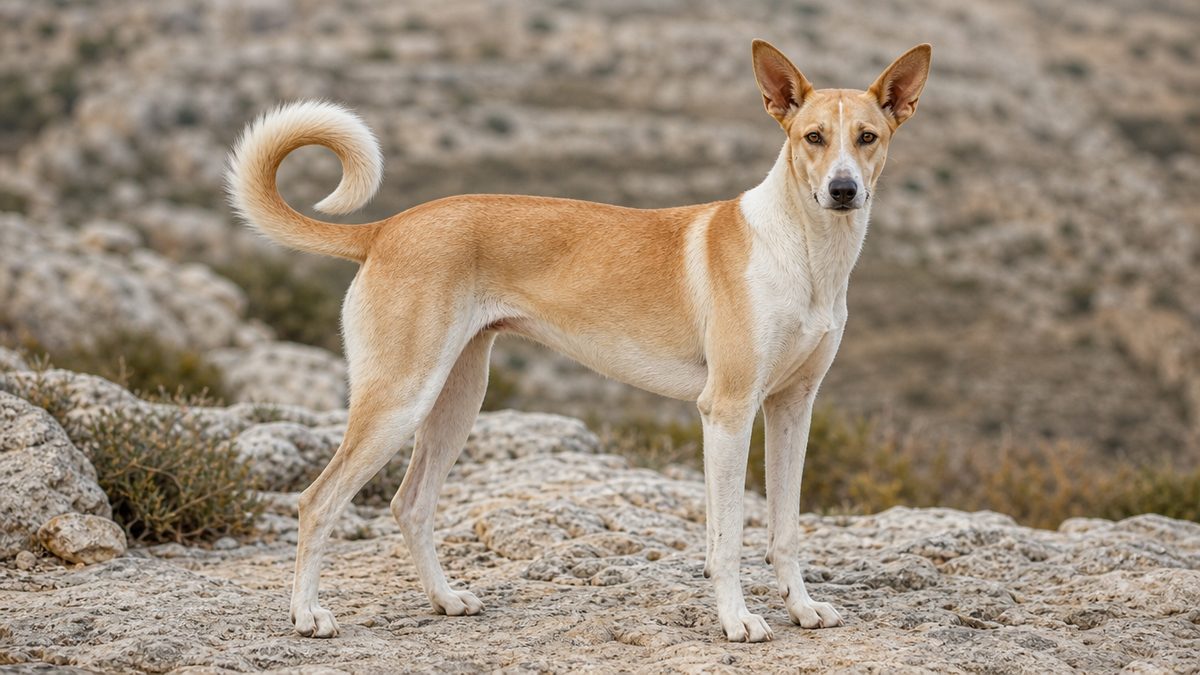
The Cretan Hound, or Kritikos Lagonikos, is a medium-sized primitive-type hunting dog from the Greek island of Crete, bred to find and course hare across broken rock using scent and sight together. It is not a pure sighthound, and the difference decides how the dog behaves in a city.
Its own breed standard, published in Greek by the Kennel Club of Greece and in English by the Cretan Hound Club, describes a "Primitive type hound of medium size, slim, athletic, fast. Short coated, with long legs, rectangular body, wedge-shaped head, curled tail", used "from centuries for the hunting of small and medium sized game, mostly for hare";. Hare hunting is the whole point of the animal, and every other trait on this page follows from it.
Two directories describe the build in the same way, and the description is a good one: a slender dog "somewhere between a scenthound and a sighthound in body", light on oval rather than cat-like feet and strong in loin, specially adapted for swift reflexes and high speed over dangerous, rocky terrain Dog Breed Info Center.
Size and weight
Males stand 54 to 58 cm at the withers and females 52 to 56 cm, both with a tolerance of plus or minus 2 cm, and weights run 16 to 22 kg for males and 14 to 20 kg for females. Wikipedia prints a wider height span of 52 to 60 cm for males and 50 to 58 cm for females, which is the standard's range with the tolerance folded in rather than a separate measurement. Read the range and its tolerance separately, because the folded version appears in no document.
For an Indian frame of reference, that is a dog roughly the size of a large Indian Pariah Dog and considerably smaller than a Mudhol Hound. It is a medium dog that looks bigger than it weighs, because there is almost no fat on it.
| Measure | Male | Female |
|---|---|---|
| Height at withers | 54 to 58 cm | 52 to 56 cm |
| Height tolerance | plus or minus 2 cm | plus or minus 2 cm |
| Weight | 16 to 22 kg | 14 to 20 kg |
| Body hair length | 1.5 to 2.5 cm | 1.5 to 2.5 cm |
The three points that identify the breed
- The tail. Set at middle height, reaching almost to the hocks, wide at the base and tapering, carried upwards in a curve, half circle or ring over the back with a moderate hook at the end, and let straight down at rest. Nothing in the sighthound group carries a tail like that.
- The ears. V-shaped and slightly rounded at the tip, medium sized, wide at the base, set high and slightly to the side, with thin highly mobile skin, carried lively half-erect or erect, and folded back against the neck into rose ears when the dog chooses. Cropping is forbidden by the standard itself.
- The coat. Smooth, hard, totally straight and dense, very short and fine on the head, ears and lower body, slightly longer on the crest of the neck, the back and the tail, and between 1.5 cm and 2.5 cm on the body. Any colour from white to black, and any combination of them, is correct.
That last point is unusual and worth pausing on. Most breed standards spend a paragraph restricting colour. This one permits every colour there is, which is what a standard written around a working landrace looks like rather than one written around a show type. Wikipedia lists the observed range as pure white, cream, sandy, fawn, grey, black or brindle, bi-coloured or tri-coloured.
How it moves, and why that matters in a flat
Movement is "light, effortless, fast and gracious stride with smooth steps, without crossing of the legs", and the standard specifically notes a tendency to switch quickly from an elastic springy trot at low speed into a fast gallop, "having great ease to change directions";. That is a description of a dog built to turn on rock at speed. In a Bengaluru apartment it reads as a dog that goes from asleep to full gallop in one second and takes a corner off the sofa.
Kritikos Lagonikos is the standard name. You will also meet Kritikos Ichnilatis, the older Greek name meaning Cretan tracker, Kressa Kyon, and simply Cretan Hound. Note that Kritikos Ichnilatis and Ellinikos Ichnilatis are different dogs: the second is the Hellenic Hound, which is FCI standard 214 and a genuinely recognised Greek scenthound.
History and origins, separated into what is documented and what is claimed
The documented history of the Cretan Hound as a registered breed begins in 2003 and the claimed history begins before 3200 BCE. Both appear on the same pages, usually without a line between them, so this section draws the line.
What the breed's own documents claim
The standard's historical note is short and specific. It calls the Cretan Hound an "Ancient Dog, originating from Crete Island", whose origin "is testified by a large number of artworks representation found in prehistoric settlements of Crete before the Minoan culture (3.200-1700 B.C.)", and states that sealing stones, ceramic and metallic utensils, ornamental objects, sculptures and frescoes of continuous historic periods "give unchanged the figure of the Cretan Hound", naming the Museum of Heraklion. The Greek text on the Kennel Club of Greece site says the same thing in the same order.
The standard adds one further historical claim about the dog's work: "In ancient times he was considered to be excellent at hunting deer, wild boar and bear". Modern use is narrower. The utilisation line names small and medium game "and mostly for hare", which is what the dogs actually do on Crete now.
What the secondary sources add, and how thin it is
The 4,000-year and oldest-in-Europe framing comes from a very small evidence base. Wikipedia states that the breed "is also considered to be the oldest European dog breed dating to perhaps before 3200 BCE and Neolithic times", sourcing it to Grano's 2020 morphological and osteological comparison of the Cretan and Karpathian hounds, and carries a maintenance banner asking for additional citations that has stood since July 2007 Grano M. The Cretan hound…. Its oldest reference is Robert Pashley's Travels in Crete of 1837.
National Purebred Dog Day puts it as "Many experts consider the Cretan to be the oldest European dog breed because its recorded history is believed to extend beyond 4,000 years";. Note the construction: many experts consider, is believed to extend. Those are the grammatical marks of a claim being passed along rather than checked. Animalia repeats the same sentence about 3200 BCE almost verbatim.
The documented timeline, which is entirely modern
Every date below comes from the breed's own institutions and can be checked.
| Date | Event | Source |
|---|---|---|
| 2003 | First breed standard written, in Greek and English, by Maria Ginala, for recognition of the breed in Greece by the KOE | Breed standard |
| 10 June 2013 | Application filed with the KOE to create the Friends of the Cretan Hound Club | OKLA |
| Nov 2014 | Club constitution approved after lodging with the Heraklion court of first instance | OKLA |
| Dec 2014 | Collection of genetic material begins for a breed study | OKLA |
| 1 Jan 2015 | VDH national recognition in Germany takes effect, breed assigned to the DWZRV | VDH |
| July 2015 | First recognition show for Cretan Hounds, Gouves, Heraklion | OKLA |
| Sept 2018 | Work completed on drafting the FCI-format standard | OKLA |
| 16 Jan 2019 | New standard published by OKLA with the KOE and the FCI standards commission | Breed standard |
| June 2023 | Ninth recognition and morphology show, 22 dogs assessed for recognition | OKLA |
| Aug 2023 | A Cretan Hound competes at the World Dog Show in Geneva | OKLA |
That is a twenty-three year record, and eleven of those years belong to a club that is still enrolling founder dogs. Nothing in it is discreditable. A landrace being carefully converted into a registered breed by the people who hunt with it is a good story, and it is a truer one than the myth.
Why the myth exists at all
A tall, lean, prick-eared, ring-tailed hunting dog is the shape that recurs wherever people course hare on hot rocky ground. Sicily has the Cirneco dell'Etna, Malta the Kelb tal-Fenek, Ibiza the Podenco Ibicenco, the Canaries the Podenco Canario, Portugal the Podengo, and Egypt its Baladi street dogs. Every one of them attracts the same pharaonic origin story, and in the two cases that have been tested by genomics the story failed. The convergence is real. The descent is what is unproven.
Wikipedia's external links point at Ovid's Metamorphoses, where Actaeon is torn apart by his own hounds, at Xenophon's Cynegeticus, and at the phrase "the hound of Crete" in Shakespeare's Henry V. Those are genuine references to Cretan hunting dogs in classical and early modern literature. They establish that Crete was famous for hounds. They cannot establish that today's registered breed descends from those hounds, and the same three quotations appear on almost every page ranking for this breed.
Which registers actually recognise the Cretan Hound
The Cretan Hound is recognised nationally by the Kennel Club of Greece and by Germany's VDH, and by the FCI in neither of the two ways the FCI recognises anything. It is absent from the definitive nomenclature and absent from the provisional register, so the honest answer is neither, not provisional.
Bonbeno read both FCI registers directly rather than repeating the ranking pages, because the FCI keeps two lists and a breed can sit on one without the other.
| Register | Status | What the document itself shows |
|---|---|---|
| FCI definitive nomenclature | Absent | The alphabetical listing for K runs from KAI to KUVASZ with no KRITIKOS LAGONIKOS, and the C listing runs from CA DE BESTIAR to CURLY COATED RETRIEVER with no CRETAN HOUND Federation Cynologique Internationale |
| FCI provisional register | Absent | The register holds 21 breeds, the highest numbered 378, and its newest entries are dated 11 February 2026. No Greek breed appears on it at all |
| Kennel Club of Greece (KOE) | Recognised | The breed has its own standard page in KOE's Greek Breeds register, headed Kritikos Lagonikos, origin Greece, island of Crete |
| VDH, Germany | Recognised nationally | The VDH board nationally recognised the Kritikos Lagonikos with the Podenco Andaluz, Taigan and Silken Windsprite, shows permitted from 1 January 2015 |
| American Kennel Club | Not recognised | Google India's AI Overview says the breed is "not recognized by the American Kennel Club (AKC) due to its tiny population outside of Greece"; |
The detail every ranking page misses
The breed standard on the Kennel Club of Greece's own site prints an FCI classification while leaving the FCI's own key field blank. It gives Group 5, Subgroup 7, with working trial, and the field directly above it, the date of publication of the official valid standard, is empty. A breed with an FCI number has both filled in and a standard PDF at a numbered FCI address. This one has the aspiration written into the template and no number behind it.
The English text of the same standard explains why. It was written in 2003 by Maria Ginala, a recognised judge for the breed, "basically for the recognation of the breed in Greece by the K.O.E.", and a new standard was published in January 2019 by the Cretan Hound Club Crete (OKLA) in collaboration with the KOE and the standard commission of the FCI. Working with the FCI standards commission is how a breed prepares an application. It is not recognition.
One independent source states the sequence outright. National Purebred Dog Day records that after the Cretan Hound was recognised by the Kennel Club of Greece in March 2003 "the club applied for recognition by the FCI", that until that happens a Greek team of the SAVE Foundation looks after the breed in a conservation project for endangered breeds, and that "to our knowledge, the only other country which currently recognizes the breed is Germany";. Applied for, not granted, is the correct description, and it matches what both registers show.
The register is being built right now, dog by dog
The most useful thing about this breed's paperwork is that you can watch it being created. The Cretan Hound Club, OKLA, applied to the KOE on 10 June 2013 and had its constitution approved in November 2014. It then began holding recognition shows at which individual dogs are assessed and admitted to the breed: the first was in July 2015 at Gouves, and by the ninth, in June 2023, 22 dogs were assessed for recognition in a single event. Another recognition and morphology show is scheduled for 6 September 2026 in Ierapetra.
Read that against the antiquity claim and the tension is obvious. A breed whose studbook has been closed since the Minoans does not need to admit 22 previously unregistered dogs in one afternoon in 2023. A living landrace is being converted into a registered breed inside the last decade, which is a better story than the myth and far more useful to a buyer.
FCI nomenclature addresses resolve on the trailing number, not the breed name, so a plausible-looking URL can serve a complete and correct page for a different dog. There is also a live decoy at fci.be/en/nomenclature/breeds-recognised-on-a-provisional-basis-2.html that returns HTTP 200 and an English Setter page. The real provisional register sits at /nomenclature/provisoire.aspx, and the copy we read carries the 11 February 2026 update dates, which is how we know it is current rather than cached.
What this means for an Indian buyer, precisely
India is a full FCI member represented by the Kennel Club of India in Chennai, and the KCI issues pedigrees against FCI nomenclature. A breed with no FCI number therefore has no Indian pedigree route, whatever paperwork a seller shows you. State the limit honestly: the KCI publishes no breed list at all, so a search of its site returns nothing for this breed and nothing for any control breed either. That is a broken instrument, not a finding, which is why the FCI registers are the ones to read.
One consequence matters if you intend to show. FCI provisionally recognised breeds are still "not eligible for the CACIB until they are recognised on a definitive basis";. A Cretan Hound holds neither status, so it holds neither entitlement.
What the genetics do and do not support
No published genomic study covers the Cretan Hound. That single sentence is the honest state of the evidence, and it means the 4,000-year claim rests on an unpublished club-reported result rather than on anything a reviewer has seen.
Bonbeno checked this the cheap, decisive way. The standard reference work on this exact question is Perini and colleagues 2023, which set out to test whether the Mediterranean hound-like breeds "share a common ancient ancestral origin", sampling 272 genetically unrelated dogs across eight indigenous populations: four Spanish Podencos, the Podengo Portugues, the Maltese Kelb tal-Fenek, the Egyptian Baladi street dog and the Cirneco dell'Etna, with 29 German Shepherds as an outgroup. Across the whole 170,000-character full text of that paper the words Cretan, Crete and Kritikos appear zero times. The island next door to every one of those breeds was simply not sampled.
PubMed tells the same story once you read the query translation rather than the count. The exact phrase Cretan Hound returns one record in the entire database. The exact phrase Kritikos Lagonikos returns 493, and every one of them is noise: PubMed reports "Quoted phrase not found" and collapses the search to the single term kritikos, which is a common Greek surname. A Labrador Retriever plus hip dysplasia control run in the same session returned a sane 52, so the tool was working and only the query had been rewritten.
The claim being made, and where it comes from
The 4,000-year claim traces to one unpublished study, and its own summary refutes it. The Cretan Hound breed site describes work begun in 2005 by the Friends of the Cretan Hound club (OFKA) with the Molecular Systematics Laboratory of the University of Heraklion and the Natural History Museum of Crete, using mitochondrial cytochrome b from 49 Cretan dogs, seven comparison dogs of other breeds living on Crete, and 10 samples recovered from Minoan-era dog bones excavated at Palaikastro.
Three of its four reported conclusions are ordinary. The fourth is not.
- The sampled Cretan dogs were genetically uniform, which is what an island population normally looks like.
- No genetic difference was found from the Minoan-era dogs, from which the club concludes the breed is at least 4,000 years old.
- The Cretan dog differed from other breeds by 0.3 percent, against 0 to 0.05 percent among those other breeds.
- The Cretan dog differed from the wolf by 2.8 to 3.1 percent, against 0.02 to 0.05 percent for every other domestic dog tested, from which the club concludes that the Cretan dog evidently does not descend from the wolf as is assumed for other breeds.
Stop at that fourth point. It asserts that one Greek hunting dog is roughly sixty times more genetically distant from the wolf than every other dog on earth, which would mean it is not a dog. No peer-reviewed publication reports anything of the kind, the study does not appear in the literature under any name we could find, and a result that extraordinary would not have sat inside a club website for twenty years. Bonbeno does not repeat the 4,000-year figure as a fact, and neither should any page selling you a puppy.
The genetic data that does exist, and what it measures
One commercial dataset exists and it is worth knowing about, provided you read what it was built to do. After the VDH recognised the breed in early 2015, the German sighthound association DWZRV entered it into a Mars breed-reference panel of 321 markers. Samples came from 77 dogs, 10 of them living in Germany but Crete-born and the rest supplied by OKLA, and 46 were submitted anonymously to the laboratory.
The reported result is that the Kritikoi formed a tight, clearly delimited cluster, that a few outliers carried small admixture from other breeds including the Cirneco dell'Etna, and that the cluster sits near the other Mediterranean Group 5 hounds, particularly the Cirneco and the Kelb tal-Fenek, with a looser proximity to the Basenji and Canaan Dog. That establishes exactly one thing, that the breed as it exists today is genetically coherent and distinguishable. It says nothing about age. A reference panel is built to tell a mixed-breed test which dog is which, not to date a lineage.
The breed club itself reports confusion caused by mixed-breed DNA results naming the Kritikos Lagonikos for dogs with no Cretan connection. When a laboratory finds a breed it cannot match, because that breed is not in the reference set, it names a genetically close breed instead. So a Romanian street dog's test may list the Cretan Hound as a possible ancestor purely as a stand-in for an unknown breed. If a DNA test is the only evidence that your Indian dog is part Cretan Hound, it is not evidence.
The relatives already had this story tested, and it failed
The Cretan Hound's nearest analogues have had this exact antiquity story dismantled by genomics, which is the strongest evidence available on a breed nobody has sampled. When two closely comparable island hounds fail the test, the burden shifts to whoever claims the third one passes.
Parker and colleagues 2004 genotyped 96 microsatellite loci in 414 dogs across 85 breeds and found that among-breed variation accounted for more than 27 percent of total genetic variation, correctly assigning 99 percent of individual dogs to their breed. Their finding on the two most famous ancient Mediterranean hounds deserves quoting in full.
"It is notable that several breeds commonly believed to be of ancient origin, such as the Pharaoh Hound and Ibizan Hound, are not included in this group. These are often thought to be the oldest of all dog breeds, descending directly from the ancient Egyptian dogs drawn on tomb walls more than 5000 years ago. Our results indicate, however, that these two breeds have been recreated in more recent times from combinations of other breeds. Thus, although their appearance matches the ancient Egyptian sight hounds, their genomes do not.";
Both of those breeds have exactly what the Cretan Hound has: an island, a short lean hound with erect ears, an unbroken-looking iconographic record, and a national club that dates the type to antiquity. Both failed. That is not proof the Cretan Hound would fail too, and Bonbeno does not claim it. It is the reason no honest page should assert the opposite either.
Perini 2023 adds a quieter blow to the island-breed picture
Maternal lineages in these dogs are shared across the Mediterranean rather than sealed off island by island. Across all eight sampled populations Perini and colleagues found only four mitochondrial haplotypes, with an overall haplotype diversity of 0.744, and their analysis of molecular variance attributed 98.54 percent of the variation to differences within populations and only 1.46 percent to differences between them, giving a fixation index of 0.01455.
Read that plainly. Among the very breeds whose separateness the antiquity story depends on, fewer than two parts in a hundred of maternal genetic variation actually distinguishes one from another. The most divergent population in the whole study was the Maltese Kelb tal-Fenek, at pairwise fixation values of 0.104 to 0.176, and even the authors flagged that this finding needed verification with further breeds "geographically and phenotypically close to Kelb tal-Fenek, that were not considered in this study". Crete is one of the places that sentence is pointing at.
What the archaeology can and cannot settle
Bone evidence establishes that a hare-hunting dog type existed on these islands, not that a modern breed descends from it unchanged. Grano's 2020 comparison of the Cretan and Karpathian hounds worked from old dog bones found on Karpathos with features compatible with a hunting dog, and concluded that the Karpathos dog is an endemic breed of Karpathos "well differentiated from its Cretan congener";. That is a morphological and osteological argument about two living island populations, and it is a real contribution. It is not a molecular date.
The breed standard's own historical note claims more than that, stating that seal stones, ceramic and metallic utensils, ornamental objects, sculptures and frescoes of continuous historic periods "give unchanged the figure of the Cretan Hound". Unchanged figure is an art-historical observation. A tall, lean, prick-eared, ring-tailed hunting dog is a shape that recurs wherever people hunt hare on hot rocky ground, which is why Sicily, Malta, Ibiza, the Canaries, Portugal and Egypt all have one.
The primitive-type hound of the eastern Mediterranean is probably an old kind of dog, and Crete's iconographic record is genuine and sits in the Heraklion museum. The registered breed called Kritikos Lagonikos is a twenty-first century construction, standardised in 2003, restandardised in January 2019, and still admitting founder dogs at recognition shows in 2023 Omilos Kritikou Lagonikou (OKLA). Both statements are true at once. Collapsing them into unchanged for 4,000 years is where the error, and the sales pitch, happens.
Cretan Hound price in India: there is no market to quote
No Cretan Hound price in India can be quoted honestly, because no verified Indian listing for the breed exists and no lawful route to create one exists either. That is the answer, and it is more useful than a made-up range.
Bonbeno ran the India-restricted searches a buyer would run. The query "cretan hound price in india" returned no Indian seller for this breed at all. What came back instead was an American breed-care page publishing a dollar food-cost estimate, a Slovak blog listing ten facts, a German puppy-search service, and, at position seven, an Indian article about the price of twenty Indian breeds that does not mention the Cretan Hound HonestDog, Buy Cretan Hound Puppies. When the price query for a breed returns other breeds' prices, there is no market.
That absence is worth more to an Indian reader than any number, so here is why it exists and what it means.
Two independent facts close the supply chain
- No FCI number, so no Indian pedigree. The breed appears in neither the FCI definitive nomenclature nor the FCI provisional register. The Kennel Club of India registers against FCI nomenclature, so there is no paper an Indian breeder could ever issue.
- Import for breeding is refused by name. DGFT Trade Notice No. 22/2022-23 of 19 December 2022 places live dogs under ITC(HS) 01061900 as Restricted and states that "any applications for trading/breeding purposes, or applications made on behalf of some another person/ entity shall be duly rejected".
Between them those two mean no lawful Indian breeding population can form. A breed with no pedigree route and no import route has no price, and anyone quoting one is quoting something else.
What a rupee figure attached to this breed would actually be
Indian listing sites generate a page for every breed name whether or not they stock it, and this project has repeatedly caught the same three mechanisms behind those numbers. Check any figure you are shown against all three before believing it.
- A converted American price list. Divide the rupee figure by 84.38, then by 74, then by 80. A figure that lands on a round dollar amount at any of those rates is a US price run through an exchange rate, not an Indian quote. The 84.38 test is the strong one, because any rupee figure ending in three zeros divides cleanly at 80 by construction.
- A house charm price attached to whatever puppy is in stock. Rs 98,999 has now been found on ten separate pages of one Indian listing site, attached to two Maltipoos and a Doxiepoo, and printed on pages for breeds that site does not stock at all.
- A different dog entirely. An Indian seller offering a lean prick-eared hound as a Cretan Hound is far more likely to be offering an Indian Pariah Dog, a Chippiparai cross, or a Mudhol Hound cross. Ask which register issued the pedigree before you ask the price.
What the breed costs where it exists
Even in Europe, published prices are vague. The one puppy-search service ranking for this breed states only that the price of a Cretan Hound puppy from a reputable breeder "varies in price depending on pedigree, health testing, and the breeder", without a figure. On Crete itself the dogs move largely inside the hunting community rather than through a retail market, which is consistent with the club running recognition shows to enrol founder dogs rather than a studbook full of registered litters.
Google India's AI Overview tells searchers that "only an estimated few hundred purebred dogs exist worldwide" and that local breeders "rarely sell purebred dogs to outsiders";. Neither figure carries a source. The nearest thing to a countable number Bonbeno found is the club's own record that 22 dogs were assessed for recognition at its ninth show in June 2023. Treat the few hundred as an unverified estimate, not a census.
If a lean short-coated hound at a real Indian price is what you want, the published Indian ranges are Rs 3,000 to Rs 15,000 for a Mudhol Hound, Rs 4,000 to Rs 15,000 for a Chippiparai and Rs 3,000 to Rs 12,000 for a Kanni, with an adopted Indie between nothing and Rs 3,000. Those are real dogs at real prices with real paperwork, which is three more things than a Cretan Hound in India has.
Cost of ownership in India, bounded honestly
Budget roughly Rs 6,000 to Rs 10,000 a month to keep a medium-sized short-coated hound in an Indian city, and treat any breed-specific Cretan Hound cost figure as unavailable. No Indian cost data exists for this breed, so what follows is the medium-breed structure with the two lines this dog genuinely changes.
One Indian retailer publishes a line-by-line monthly cost table by size band, current to March 2026. The medium-breed column is the right one for a 16 to 22 kg hound.
| Line item | Medium breed, per month | Where a Cretan Hound differs |
|---|---|---|
| Dry or wet food | Rs 2,500 to Rs 4,000 | No difference. A lean 16 to 22 kg dog sits mid-band |
| Routine vet visits | Rs 800 to Rs 1,500 | Higher in year one, see below |
| Vaccinations | Rs 1,500 per year | Do not economise here, see the parvovirus section |
| Grooming | Rs 800 to Rs 1,500 | Close to zero. Nothing needs a professional groomer |
| Training, over six months | Rs 2,000 to Rs 5,000 | Higher. Recall and impulse work take longer |
| Treats and toys | Rs 500 to Rs 1,000 | No difference |
| Flea, tick and deworming | Rs 400 to Rs 700 | Higher. A short coat is not tick protection |
| Estimated monthly total | Rs 6,000 to Rs 10,000 | Roughly Rs 6,000 to Rs 11,000 allowing for the above |
The same source disagrees with itself, so read the spread
That article gives three different upper bounds for monthly upkeep in one piece. Its summary box says Rs 3,000 to Rs 18,000, its opening paragraph says the average monthly maintenance cost varies between Rs 3,000 and Rs 11,000, and its own table tops out at Rs 20,000 for a giant breed. Bonbeno publishes that disagreement rather than picking one. The figure to plan against is the size-banded table row, because it is the only one built line by line.
The same source puts the first-year total, including purchase, vaccinations, food, training and supplies, at Rs 80,000 to Rs 2,00,000, and notes that prices in Mumbai and Delhi run 15 to 30 percent above other cities.
A cross-check on the food line
One American breed page publishes a Cretan Hound food cost of 1.50 to 1.90 dollars a day, or 39 to 52 dollars a month. Converted at 84.38 that is Rs 3,291 to Rs 4,388, which lands just above the Indian medium-breed food row of Rs 2,500 to Rs 4,000. Two independent sources agreeing within a few hundred rupees is a reason to trust the number. It is also a reminder to run the division the other way: if an Indian page ever quotes you a Cretan Hound cost that divides cleanly into round dollars at 84.38, 74 or 80, it is a converted American figure and not an Indian one.
Two lines this breed genuinely raises
- Parasite control, not grooming. A short coat makes ticks easier to find and does nothing to stop them attaching. India carries real tick-borne disease pressure, and a hound spending ninety minutes a day on the ground meets more of it than a lap dog. Budget for year-round prevention rather than seasonal.
- Veterinary access for a breed nobody has seen. No Indian vet has a Cretan Hound caseload, and there is no breed-specific screening scheme anywhere in the world. Expect to bring your own information to appointments, and expect the sighthound thyroid caveat in the health section to come up at least once.
If the dog has to be imported at all, the purchase price is the small number. A DGFT import authorisation where one is required, quarantine at the port, airline transport of a live animal, and the two-month lead time the trade notice itself recommends are the real costs. And a dog imported for breeding cannot be imported at all, because those applications "shall be duly rejected";. Anyone quoting you a simple rupee price for a Cretan Hound in India has not priced the only lawful route to getting one here.
Heat tolerance in India, tested against the actual climate of Crete
The Cretan Hound's heat tolerance is real but narrower than it is sold as, because Crete is warm and humid rather than hot and dry. Bonbeno queried NASA POWER by explicit latitude and longitude for three points on Crete and eleven Indian locations, and the result inverts the usual story.
Start with the claim. The breed is sold everywhere as a rock-country hound from a hot dry Greek island. Crete is rainless in summer and it is rocky. It is not evaporatively dry, because it is a narrow island in a warm sea, and a dog does not cool itself by evaporating water into a rain gauge.
Why wet bulb, and not temperature, is the number that matters
A dog cannot sweat to cool itself. It pants, evaporating water from its airways, so the lowest temperature evaporation can reach is the wet bulb temperature. The gap between air temperature and wet bulb is the dog's evaporative headroom, and it is the only heat figure on a breed page that predicts anything. Two cities at the same temperature can be a comfortable walk and a medical emergency, and the wet bulb is what separates them.
What Crete is actually like
NASA POWER, queried at 35.34N 25.14E for Heraklion, gives a hottest month of August averaging 26.2 C air temperature at 69.6 percent relative humidity, with a wet bulb of 23.1 C. That is only 3.1 C of evaporative headroom. July is barely better at 25.9 C and a 22.6 C wet bulb. Ierapetra on the dry south coast, at 35.01N 25.74E, is the most favourable point on the island at 26.7 C, 63.9 percent humidity and 3.9 C of headroom in August, and Chania in the west sits between them at 3.3 C. The island's annual mean wet bulb is 16.3 to 16.5 C.
For scale, the Cirneco dell'Etna's home range on the Sicilian volcano runs 27.3 C at 50.8 percent humidity in August, giving 6.4 C of headroom. The Sicilian hound's summer is hotter and roughly twice as evaporatively generous as the Cretan hound's. So within the Mediterranean primitive hounds, this is not the dry-heat specialist.
| Location | Month | Air temp C | Wet bulb C | Headroom C | RH % |
|---|---|---|---|---|---|
| Heraklion, Crete 35.34N 25.14E | August | 26.2 | 23.1 | 3.1 | 70 |
| Ierapetra, Crete 35.01N 25.74E | August | 26.7 | 22.8 | 3.9 | 64 |
| Etna slopes, Sicily 37.66N 14.83E | August | 27.3 | 20.9 | 6.4 | 51 |
| Delhi 28.61N 77.21E | May | 35.1 | 21.9 | 13.2 | 23 |
| Jodhpur 26.24N 73.02E | April | 31.2 | 17.8 | 13.4 | 22 |
| Ahmedabad 23.02N 72.57E | March | 28.1 | 15.5 | 12.7 | 24 |
| Mudhol, Karnataka 16.33N 75.28E | March | 28.8 | 18.7 | 10.1 | 34 |
| Hyderabad 17.38N 78.49E | March | 28.7 | 19.4 | 9.3 | 37 |
| Bengaluru 12.97N 77.59E | March | 26.8 | 18.6 | 8.1 | 44 |
| Chennai 13.08N 80.27E | May | 31.5 | 27.4 | 4.2 | 65 |
| Tirunelveli 8.71N 77.76E | April | 28.6 | 25.2 | 3.4 | 71 |
| Mumbai 19.08N 72.88E | August | 26.1 | 25.2 | 0.9 | 90 |
| Kolkata 22.57N 88.36E | August | 28.2 | 27.2 | 1.0 | 89 |
| Pune 18.52N 73.86E | August | 23.3 | 22.5 | 0.8 | 91 |
Three findings fall out of that table
- Dry-season north and west India is easier than Crete, not harder. Delhi in May offers 13.2 C of headroom at 23 percent humidity and Jodhpur in April offers 13.4 C at 22 percent, both roughly four times Heraklion's best month, at air temperatures 5 to 9 C higher. A short-coated, long-muzzled, 16 to 22 kg hound copes with an arid Rajasthan afternoon in shade with water better than most imports.
- Monsoon and coastal India is far harder than anything Crete produces. Mumbai in August gives 0.9 C of headroom at 90 percent humidity, Pune 0.8 C at 91 percent and Kolkata 1.0 C at 89 percent. Mumbai's August air temperature is 26.1 C, a tenth of a degree cooler than Heraklion's August, and it is dangerous where Heraklion is not, because there is nowhere for the water to go.
- Even Delhi flips inside eight weeks. Delhi's headroom collapses from 13.2 C in May to 4.5 C in July and 2.7 C in August, when its wet bulb reaches 27.1 C. The dry-heat advantage this breed genuinely has expires the week the monsoon arrives.
The annual mean wet bulb is 24.9 C in Chennai, 23.6 C in Tirunelveli, 22.9 C in Kolkata and 22.7 C in Mumbai. Every one of those yearly averages is at or above the wet bulb of the single hottest month Crete records, which is 23.1 C at Heraklion. In those four places an ordinary day is thermally at least as hard on this breed as the worst month its home island has ever averaged.
NASA POWER's grid cannot resolve Crete's mountains. Our Ierapetra and Lasithi Plateau queries, 30 km apart and separated by roughly 800 m of elevation, returned identical values because both fall inside the same grid cell. Crete's uplands are certainly cooler and drier than these coastal figures, and a hound hunting at 800 m in September meets something better than the table shows. The Indian comparison still holds, because every Indian figure comes from the same instrument at the same resolution.
Managing an Indian summer with a warm-humid hound
Manage this breed by humidity rather than by the thermometer, because the thermometer will call a Mumbai monsoon morning mild and the dog's physiology will disagree. Purina India puts "excessive humidity" on its own list of factors that increase heat stroke risk, alongside lack of water, enclosed space, obesity, intense exercise, old age and lack of acclimatisation.
Watch the breathing, not the clock
A published study of dogs walked in a hot sunny tropical region measured what radiant heat actually does to a dog in real time. Across 135 walks, with black-globe temperature ranging from 19 to 50 C, walking when black-globe temperature exceeded 35 C produced substantial increases against walks below 30 C: hair-coat temperature up 20.5 C, skin temperature up 7.2 C, respiratory rate rising from roughly 47 to 374 breaths a minute, and water intake up 215 mL. Rectal temperature stayed inside a narrow 38 to 39 C band throughout, which is the point. The dogs held their core temperature by working their respiratory systems extremely hard.
The authors summarised the responses into a thermal stress index and concluded that "walking dogs when TSI exceeds 170 should be approached with caution, particularly during prolonged or repeated exposure, as panting appears to become less effective beyond this threshold";. Note the study's size honestly: five mixed-breed dogs, not a breed cohort, so the mechanism transfers and the exact numbers should not be read as this breed's own.
The usable version for an owner without instruments is simple. A dog whose panting has gone rapid and shallow, and will not settle within a couple of minutes in shade, has passed the point where the walk should have ended.
Recognising heat stroke, and the first ten minutes
Purina India lists the warning signs as severe panting, difficulty breathing, severe salivating, vomiting, diarrhoea, a raised temperature of 40.5 C or above, blood in the urine, nose bleeds, and ultimately collapse and coma. It also warns that a dog can develop heat stroke in as little as 30 minutes of vigorous exercise in hot weather, whatever coat it has.
The published first-aid sequence has two steps that people reliably get wrong.
- Move the dog out of the heat into shade or air conditioning.
- Spray or sponge with cool, not cold, water, making sure it reaches the skin rather than running off the coat, and wet the belly and inside the legs thoroughly.
- Use a fan, which is the step most Indian households already have and forget.
- Do not plunge the dog into cold water or an ice bath, because that prevents the core temperature coming down.
- Stop cooling at 39.4 C, or you risk tipping the dog into hypothermia.
- Go to a veterinarian regardless, because heat stroke in dogs can be fatal.
Purina India records that when the outside temperature is 26 C, the inside of a car reaches 32 C in five minutes and 43 C in 25 minutes. An Indian April afternoon does not start at 26 C. Never leave this dog, or any dog, in a parked car in India, with or without a window cracked.
Where this breed genuinely helps itself, and where it does not
Three real advantages come with the build. There is no undercoat named in the standard to trap heat against the skin, the muzzle is long and wedge-shaped, giving a large evaporative surface, and at 16 to 22 kg the dog has a favourable surface-to-mass ratio. Those matter. They are worth having in a Jodhpur April and they are worth almost nothing in a Kolkata August, because the constraint there is not the dog's anatomy, it is that the air is already close to saturated.
Set the breed's own baseline against the risk factors Purina India names. Crete's hottest month averages 69.6 percent relative humidity, so this dog is not naive to humid heat the way an Alaskan Malamute is. It is simply not the desert specialist the marketing implies, and the last item on Purina's list, lack of acclimatisation, is the one that catches an imported dog in its first Indian summer whatever breed it is.
Cool the dog by the wet bulb, not the thermometer. If the air temperature and the wet bulb are within about 2 C of each other, evaporation has almost nowhere to go, and that is true whether the reading is 23 C in Pune or 28 C in Kolkata. On those days, shade and a fan beat a walk, and scent games indoors beat both.
Temperament, and who should not get one
The Cretan Hound is soft at home and unreachable in pursuit, and its own breed standard states both in the same paragraph. Every honest assessment of household fit starts by accepting that those two things are not in tension for the dog, only for the owner.
The Kennel Club of Greece describes the breed as "Smart, noble, dashing in hunting, persistent, brave, and with endurance. Mild, obedient, excellent companion and much attached with family", adding that it "can be reserved with the strangers but never aggressive";. Aggressive or overly shy dogs are a disqualifying fault, so a nervy or sharp Cretan Hound is a badly bred one, not a typical one.
The hunting half of the same paragraph is where an Indian city owner should slow down. The dog "searches using all senses following scent by ground and air, flushes out the game and pursuits rushing with exceptional agility", giving tongue sharply and at rather low volume when it sights the quarry. That is a complete hunting sequence, not a chase reflex, and it runs whether or not you are ready.
What that means in an Indian household
- Quiet indoors, explosive outdoors. A satisfied hound sleeps most of the day, then goes from asleep to fully alert in a second. The standard's note about switching instantly from trot to gallop with great ease of direction change describes what that looks like in a 900 square foot flat.
- A strong prey drive around India's free-ranging animals. Street cats, chickens, goats and community dogs are all live triggers. This is the single biggest practical difference between owning this breed in a Cretan village and owning it in Pune.
- Reserved with visitors, never a guard dog. Reserved but never aggressive means the dog will withdraw rather than confront. If you want a deterrent, this is the wrong breed and a Mudhol Hound is not much better; look at an Indian guarding breed instead.
- Deeply attached to its people. Much attached with family in the standard's phrasing translates to a dog that follows you between rooms and does poorly left alone all day. Households where nobody is home from 9 to 7 should not take one.
Answering what Indians actually ask
Google India's People Also Ask box for this breed carries four questions, and three of them are about temperament, which tells you what prospective owners actually want to know. The short answers follow.
- Are Cretan Hounds good family pets? Yes, in the right household. The standard calls the breed mild, obedient, an excellent companion and much attached with family. The qualifier is exercise, not tolerance.
- Are Cretan Hounds intelligent dogs? Yes, and the standard's first word for the breed is smart. Independent hunting intelligence is not the same as biddability, which is why the training section below rates it low.
- What is the Cretan Hound's temperament? Mild and obedient at home, reserved with strangers, never aggressive, and dashing, persistent and brave in the field.
Who should not get one
- Anyone who wants an off-lead park dog. A hound that hunts by ground scent, air scent and sight simultaneously will leave, and Indian traffic gives you no second chance.
- First-time owners in a high-rise with no time. The exercise requirement is the highest rating Bonbeno gives on this page and it is not negotiable by breed size.
- Anyone who wants a guard dog. The standard rules out the temperament outright.
- Anyone buying for the story. If the reason you want this dog is that it is 4,000 years old and rare, read the genetics section again and then look at an Indian hound you can actually verify.
A household with a securely fenced compound or reliable access to open ground, someone home for much of the day, and an owner who runs, cycles or hikes and wants a dog that comes along. In that home this is a clean, quiet, affectionate, low-maintenance dog that will socialise well with children and sleep through the afternoon.
Training a hound that hunts by every sense at once
To train a Cretan Hound, accept that recall in the presence of prey is not achievable and build everything else around that. The breed is obedient at home and unreachable in pursuit, so the training plan is management first and obedience second.
The standard describes the working sequence precisely: the dog searches with all its senses, follows scent by ground and by air, flushes the game out, then pursues it rushing with exceptional agility. A Greyhound only starts at the pursuit stage, which is why a Greyhound can be walked past a cat that is sitting still. A Cretan Hound will have found the cat before you do.
A realistic Indian timeline
| Age | Focus | Realistic outcome |
|---|---|---|
| 8 to 16 weeks | Socialisation to Indian street noise, autos, cattle, crowds and the building lift | Confident in traffic and around strangers |
| 4 to 6 months | Lead manners, a long-line recall, crate and settle work | Walks without pulling on a harness |
| 6 to 12 months | Impulse control around cats, chickens and community dogs, on a long line only | Will disengage at distance, not at close range |
| 12 to 24 months | Scent games, tracking, lure coursing where available, structured running | A tired dog that lives calmly indoors |
| 2 years onward | Maintenance and fitness | Off-lead only inside a fully fenced area |
What works
- Reward-based work in short sessions. The breed is described as smart and obedient, and it is neither stubborn nor hard. Corrections make an already reserved dog withdraw.
- Scent games instead of drills. The dog's natural job is searching. Ten minutes of finding hidden food in a flat tires it more than thirty minutes of heel work.
- A long line for the first two years. A fifteen metre line lets you practise recall honestly, which means practising it when the dog is wrong and can be reeled in rather than rehearsing failure.
- Structured running. A hound with somewhere to gallop safely is a hound that listens. Where no safe ground exists, a flirt pole in a compound is the closest usable substitute.
What does not work
Three approaches fail reliably with this breed and all three are common in Indian training advice.
- Off-lead recall training in an open Indian public space. There is no version of this that ends well the first time a street cat runs. Manage the environment instead of testing the dog.
- Shock or prong collars to suppress prey drive. These suppress the visible chase, not the drive, and on a soft, reserved breed the side effects land on the relationship. The standard's own disqualifying fault list already names overly shy dogs.
- Treating exercise as a substitute for training, or training as a substitute for exercise. This breed needs both, and a bored fit dog and a tired untrained dog are equally difficult to live with.
Community dogs are the practical constraint on where you can walk a hound like this in most Indian cities, and a dog that flushes and pursues will start conflicts a lead cannot finish. Walk at low-traffic hours, keep a short lead in the last fifty metres to your gate, and map a route rather than improvising one. This has nothing to do with aggression, which the standard rules out, and everything to do with a pursuit sequence firing in the wrong place.
The Kennel Club of Greece classifies this breed as Group 5, Section 7, with working trial, so a working qualification is part of the intended assessment on Crete. India has no equivalent trial for this breed, and no lure-coursing infrastructure in most cities, so the honest substitute for an Indian owner is long structured running plus scent work rather than any formal test.
Exercise: what the dog actually needs in an Indian week
Budget at least ninety minutes a day for an adult Cretan Hound, split so that the hard work lands before sunrise and after dark for most of the Indian year. The requirement is set by the job the breed was selected for, not by its 16 to 22 kg body weight.
The standard describes a dog with endurance that searches, flushes and pursues over rocky ground, and the movement note names a habit of switching from an elastic trot at low speed into a fast gallop with great ease of direction change. That is a working animal's brief. A dog built to do that for hours does not become satisfied by two short lead walks.
The weekly shape that works in India
| Element | Frequency | Duration | Why |
|---|---|---|---|
| Pre-sunrise lead walk | Daily | 40 to 60 min | The coolest window of the day in every Indian city |
| Post-sunset lead walk | Daily | 30 to 45 min | Second cool window, and the calmer one for street dogs |
| Free gallop in a fenced space | 2 to 3 times a week | 15 to 20 min | Nothing else discharges a sighthound-type dog |
| Scent work indoors | Daily | 10 to 15 min | Uses the half of the job a walk never touches |
| Long outing on open ground | Weekly | 90 min or more | Fitness, and the only real substitute for hunting |
Total that and you get roughly nine to eleven hours a week. If that number is not available in your life, this is the wrong breed and the guide is not going to pretend otherwise.
What happens without it
- Destruction inside the home, which for a hound usually means doors, skirting and anything at nose height on a table.
- Fence and gate escapes, because a bored hound with a working nose will investigate the perimeter until it finds the gap.
- Barking and pacing in the evening, in a breed that is otherwise quiet, which is the most reliable early sign an owner has under-exercised the dog.
- Weight gain that is hard to see, because the standard's outline is lean and a slightly fat Cretan Hound still looks slim next to a Labrador.
How Indian heat changes the plan, month by month
- October to February, everywhere. Full routine. Build fitness now, do the long outings now, and socialise a young dog now.
- March to June, dry-heat cities. Delhi, Jaipur, Jodhpur, Ahmedabad, Nagpur and Hyderabad have 9 to 13 C of evaporative headroom in these months, so the dog copes well in shade with water. The binding constraint is ground surface temperature, not air temperature. Hold your palm on the pavement for five seconds before every walk.
- June to September, monsoon and coast. Mumbai, Pune and Kolkata bottom out at 0.9, 0.8 and 1.0 C of headroom in August, and Chennai at 2.3 C in September. Cut duration hard, move what you can indoors, and substitute scent work for distance. This is the season in which the breed's dry-heat advantage does not exist at all.
- Year round. Constant fresh water, a cool hard floor or a raised bed in shade, and a fan available during the worst hours.
Do not run a Cretan Hound puppy on hard ground or take it on distance work before the growth plates close, which for a medium hound is around twelve to fourteen months. Free play on soft ground, short frequent walks and scent games give a young dog everything it needs. A hound that gallops on Indian concrete at six months is buying joint trouble it will carry for a decade, and this is the single commonest way owners damage a breed that is otherwise structurally sound.
Grooming in Indian humidity, which is the easiest part of this dog
To groom a Cretan Hound in India, brush it once a week and check its skin twice a week, and that is close to the whole job. The coat is the lowest-maintenance on this site, and Indian humidity has almost nothing to work with.
The standard sets the coat as "Smooth, hard, totally straight, dense, very short and thin at the head, ears and lower part of the body, slightly longer at the crest of the neck, the rear and the tail", with body length between 1.5 cm and 2.5 cm, longer on the tail. Coat under 1.5 cm or over 2.5 cm is a severe fault, which is unusual and tells you the length is functional rather than cosmetic. The skin is "Thin, quite tight, durable, without wrinkles and looseness, with good pigmentation";.
No undercoat is named anywhere in the standard. That matters in India for two opposite reasons: there is no dense underlayer trapping heat against the skin, and there is no dense underlayer to mat in monsoon damp. It also means the dog has almost no insulation against a Delhi January night or a Bengaluru air-conditioned room.
The weekly routine
- A rubber curry brush or grooming mitt, once a week. Five minutes. It lifts dead hair and spreads skin oils, and it is the moment you find ticks.
- A tick and skin check, twice a week. Run your hands over the ears, between the toes, in the armpits and along the groin. Thin, tight, short-coated skin makes this easy and makes a problem visible early.
- Nails every three to four weeks. The standard describes strong pads with curved and strong nails on big oval feet. A dog exercising on Indian pavements often wears them down naturally, and one exercising on grass does not.
- Ears dried after every bath and every swim. Half-erect and erect ears ventilate well, which is an advantage this breed genuinely has over a spaniel. Dry them anyway.
- Baths only when actually dirty. Once every six to eight weeks is plenty. Over-bathing a thin-skinned dog in Indian summer strips the coat and irritates the skin.
Where overseas grooming advice does not transfer to India
European and American breed-care pages written for short-coated hounds routinely say to towel the dog and let it air dry. That instruction is written for a dry temperate climate. In an Indian monsoon, ambient relative humidity in Mumbai, Pune and Kolkata sits around 89 to 91 percent through August, so air drying is not drying, it is leaving a damp dog damp. Towel the dog properly, dry the ears, and use a fan.
The same applies to seasonal coat advice. This breed has no blowing coat, so any page telling you to expect a heavy twice-yearly shed is describing a double-coated breed and not this one.
Ear disease, and an Indian disagreement worth knowing about
Erect ears are a real advantage here. A Guwahati series of 5,312 dogs found otitis externa in 112, and among those cases pendulous-eared dogs accounted for 65.19 percent against 34.81 percent with erect ears, a significant difference. This breed's high-set half-erect or erect ears ventilate, which is one fewer thing to manage than in a spaniel.
Indian sources disagree on when ear disease peaks, and this page reports the disagreement rather than picking a side. The Guwahati series peaked in the monsoon, with 47 of its 112 cases falling in June to September. A twelve-month series from Durg in Chhattisgarh found the opposite, with 41.18 percent of its 51 cases in summer against 33.33 percent in the rainy season. The two studies also bin their seasons differently, Durg counting March to June as summer and Guwahati counting June to September as monsoon, so June sits on opposite sides of the line. The practical instruction is the same either way: check and dry the ears year-round, not seasonally.
The one grooming decision Indian law makes for you
Never let anyone crop the ears. The standard states plainly that cropping is forbidden, and Second Schedule Part II paragraph 6(8) of the Prevention of Cruelty to Animals (Dog Breeding and Marketing) Rules, 2017 provides that there "shall be no tail docking, ear cropping de-barking, de-clawing, branding, dyeing, injecting substances to enhance visual appeal" and that "any change of appearance by artificial means is strictly forbidden";. Note that this is a Second Schedule paragraph, not a Rule, so cite it that way if you ever need to.
The standard accepts every colour from white to black, and a pure white or cream Cretan Hound carries thin, short-coated, lightly pigmented skin under an Indian sun. Watch the nose, ear tips and the sparsely coated belly for burning, keep a white dog out of direct midday sun, and raise any persistent crusting or non-healing sore on those sites with your vet rather than treating it at home. The standard's own preference for dark pigmentation on the nose, eyelids and lips, and its severe fault for depigmentation, points at the same underlying issue.
Health: one paper in the world, and what that means
Exactly one peer-reviewed paper exists on the Cretan Hound's health, and it is a parvovirus case series in five related puppies. Everything else written about this breed's health is estimate, breed-community observation or transfer from other breeds, and this page says so rather than filling the gap.
How that was established, and why the number matters
Bonbeno searched PubMed by exact phrase and read the query translation rather than the result count. "Cretan Hound" returns one record. "Kritikos Lagonikos" returns 493, and all 493 are irrelevant, because PubMed reports "Quoted phrase not found" and silently rewrites the search to the single term kritikos, a common Greek surname. A Labrador Retriever plus hip dysplasia control run in the same session returned 52, so the database was working and only the query had been rewritten.
That distinction matters because a page that trusted the 493 would report this as a well-studied breed. It is the opposite. One paper is the entire literature.
What no source can tell you about this breed
- No hip or elbow screening data. No orthopaedic register publishes statistics for this breed, and the KOE standard sets no screening requirement.
- No lifespan study. Published figures of 12 to 15 years and around 14 years are estimates. The breed does not appear in the large veterinary mortality datasets.
- No inherited-disease prevalence figures of any kind. Not for eyes, not for heart, not for joints.
- No breed health survey. No club has published one in Greece, Germany or anywhere else.
Where a page cannot cite a figure it should say so rather than borrowing a Greyhound's. Bonbeno says so three times above deliberately.
The absence is measurable, not just assumed. A large-scale UK survey covering 43,005 dogs across 192 Kennel Club registered breeds recorded zero Cirneco dell'Etna, 19 Ibizan Hounds and 20 Pharaoh Hounds. The Cretan Hound is not a registered breed there at all, so it could not appear even if dogs existed. That is what a breed outside every major register looks like in the data.
The one thing the standard does screen for
The breed's own breed standard carries a short health-relevant fault list, and two of its items line up with Indian law. Severe faults are severe depigmentation of the nose, eyelids and lips, albinism, coat outside 1.5 to 2.5 cm, and an overshot or undershot bite. Disqualifying faults are aggressive or overly shy dogs, any dog clearly showing physical or behavioural abnormalities, untypical specimens, overshot or undershot bites over 2 mm, and dewclaws. The closing note adds that "only functionally and clinically healthy dogs, with breed typical conformation, should be used for breeding";.
Set that against Second Schedule Part III paragraph 8(10) of the Prevention of Cruelty to Animals (Dog Breeding and Marketing) Rules, 2017, which requires that breeding dogs "shall have been tested for genetic defects, including hip dysplasia, progressive retinal atrophy, night blindness, hypothyroidism, entropion, ectropion, overshot, undershot jaw (when incisors do not touch or mesh), wry mouth, two or more missing teeth, unilateral cryptorchid or full cryptorchid males";. The word is including, so the list is illustrative, not closed. Note the numbering: this is a Second Schedule paragraph, not Rule 8, which is a different provision headed Conditions for sale.
Indian law mandates a hypothyroidism test on breeding dogs, and sighthound-type dogs are the one group in which a low thyroid reading is the normal finding. In 46 healthy young pretraining Greyhounds, total T4 was below the non-breed-specific reference range in 42 of them, 91.3 percent, and 16 were at or below the assay's limit of detection, while every dog's TSH sat within the reference range, and the authors concluded neither total nor free T4 can reliably be used to investigate hypothyroidism in the breed. A review adds that thyroid hormone does not rise after exogenous TSH in adult Greyhounds, which points to a breed characteristic rather than disease. Wisdom Panel classifies the Kritikos Lagonikos in the Sighthound group. Do not let a single low T4 put this dog on lifelong medication. Ask for free T4 and TSH, and ask the vet to interpret against sighthound expectations. Say the limit out loud too: every one of those studies used running sighthounds, and none included a Mediterranean primitive-type hound.
The Indian risks that are real regardless of breed
Three things will affect a hound in India far more than anything inherited: tick-borne disease, heat, and canine parvovirus. Heat is covered in its own two sections above, and the next two sections take parvovirus and parasites in turn.
Bring three things to the first appointment. A year-round tick and flea plan rather than a seasonal one. A note that this is a sighthound-type dog, so thyroid, haematology and anaesthetic protocols may need adjusting from standard reference intervals. And a plan for the full core vaccination course with no gaps, for the reason set out in the next section.
Parvovirus: the breed's only paper, and India's biggest puppy risk
Vaccinate a Cretan Hound puppy on schedule and keep it off shared ground until the course is finished, because the one thing published about this breed's health and the commonest killer of Indian puppies are the same disease. That coincidence is the single most useful fact this page carries.
What the breed's one paper found
Schaudien and colleagues, working between Hannover and the Aristotle University of Thessaloniki, reported "evidence of parvovirus infection and replication in the brains of five 6-week-old Cretan hound puppies suffering from a puppy shaker syndrome and leukoencephalopathy", noting that although the puppies belonged to two different litters they were closely related, "tracing back two generations to the same sire";. Sequencing revealed canine parvovirus type 2 stretches, in brain tissue rather than gut.
The paper's account of the breeding behind it is blunt, and it is the part an Indian buyer should read twice: "Efforts from the local breeders to establish the desired phenotypic characteristics of the breed resulted in an intensive inbreeding, using a limited number of dams and sires. The parents of these two litters, although different, were closely related, had repeatedly produced affected puppies in the past, and were clinically normal";. The authors conclude that an association of parvovirus with the leukoencephalopathy "seems likely, possibly facilitated by a genetic predisposition due to the mode of inbreeding in this particular dog breed";.
Two details make it worse and more useful. Parvovirus was found in all five brains "regardless of prior parvovirus enteritis or vaccination", and neurological signs began at three weeks of age, before the parvovirus vaccination given at five to six weeks, which the authors read as arguing for perinatal or intrauterine infection. Note one honest wrinkle: the abstract reports five puppies while the methods describe two litters of four and two, so the paper's own counts do not reconcile cleanly. Bonbeno quotes the abstract's figure and flags the discrepancy rather than smoothing it.
What parvovirus does in India
India carries heavy parvovirus pressure, and the published Indian figures are far higher than most owners assume.
| Study | Where and when | Positivity | Age pattern |
|---|---|---|---|
| Singh et al. 2021 | North India, Jul 2019 to Feb 2020, 118 rectal swabs | 28% by PCR (33 of 118), 70% by nested PCR (83 of 118) | 73.49% of positives were dogs below 3.5 months |
| Behera et al. 2015 | Bhubaneswar, Odisha, Dec 2012 to Mar 2013 | 40.85% by PCR (29 of 71) | 41.37% of positives aged 3 to 6 months |
| Naveenkumar et al. 2025 | Madras Veterinary College, Chennai, eight years | 69.75% (4,258 of 6,105 suspected cases) | Peaks in winter and in July |
Those denominators differ, so read them carefully rather than averaging them. Singh's 118 and Behera's 71 are dogs already showing gastroenteritis, and Naveenkumar's 6,105 are suspected cases at a referral hospital. None is a population prevalence. What they agree on is direction: where an Indian puppy presents with bloody diarrhoea, parvovirus is the leading answer.
In the North India series, 24.10 percent of the parvovirus-positive samples came from vaccinated dogs. Read that correctly. It means breakthrough happens, usually through incomplete courses, maternal antibody interference or timing, and it means the course must be completed properly rather than abandoned. It does not mean vaccination is pointless, and 75.90 percent of those positives were unvaccinated dogs.
The variant question, which changes over time
Indian CPV-2 variant distribution is shifting and no single answer holds nationally. The North India samples formed a clade with CPV-2a isolates, while a Mizoram study covering January 2014 to May 2022 found 103 of 202 dogs positive, and of 83 sequenced isolates reported CPV-2c in 63.85 percent, CPV-2a in 26.5 percent and CPV-2b in 8.43 percent, describing CPV-2c as emerging. Publish that disagreement rather than picking one. It matters clinically because rapid antigen kits and vaccines are designed against a moving target.
Complete the full core vaccination course with no gaps, keep an unvaccinated puppy off shared ground, pavements and dog parks until two weeks after the final dose, and treat any bloody diarrhoea in a puppy under six months as an emergency the same day. This is the single highest-value paragraph on this page for anyone who actually ends up with one of these dogs.
Ticks, leishmaniasis and the heat-risk claim nobody checks
Tick-borne disease is the largest ongoing health risk to a hound kept in India, and it dwarfs anything this breed inherits. A Tamil Nadu study found 229 of 230 dogs examined, 99.6 percent, infested by ticks, with a mean intensity of 5.65.
What Indian ticks are carrying
In that same Tamil Nadu cohort, 67.8 percent of dogs, 156 of 230, were positive for at least one vector-borne pathogen. Hepatozoon canis was the most prevalent at 37.8 percent, followed by Anaplasma platys at 22.6 percent, Ehrlichia canis at 16.1 percent, Babesia vogeli at 10 percent, and Anaplasma phagocytophilum and Babesia gibsoni at 0.4 percent each. A separate countrywide serological study of 510 samples found 293, or 57.5 percent, positive for canine monocytic ehrlichiosis by ELISA, with 45 samples, 8.8 percent, positive for Ehrlichia canis by PCR.
A short-coated dog makes ticks easier to see. It does not make them less likely to attach, and a hound spending ninety minutes a day on Indian ground meets more of them than a house dog. Year-round prevention beats seasonal prevention here, and a twice-weekly hands-on check of the ears, toes, armpits and groin is the routine that actually finds them.
Leishmaniasis, which travels with the dog rather than meeting it here
This is the one imported-disease question that genuinely applies to a dog coming from Crete. Canine leishmaniosis is endemic across the Mediterranean basin, and a countrywide Greek serological study of 1,265 dogs in 2020 found 13.8 percent seropositive to Leishmania infantum, with a 95 percent confidence interval of 12.0 to 15.8 percent. On Crete specifically that study sampled 73 dogs and found 7 seropositive, 9.6 percent, split as 2 of 18 in Chania, 2 of 20 in Heraklion, 2 of 15 in Rethymno and 1 of 20 in Lasithi. An earlier Crete-focused paper put island seroprevalence at 30 to 40 percent, describing it as among the highest reported in Europe, and stated that canine infection is confirmed throughout the island. Bonbeno publishes both figures rather than averaging them, because they used different assays and different decades.
Mediterranean canine leishmaniosis and Indian kala-azar are different systems. The Mediterranean disease is Leishmania infantum, zoonotic, with the dog as primary reservoir. Indian visceral leishmaniasis is Leishmania donovani and classically anthroponotic, and a survey of 1,220 animals across seven endemic Bihar districts found antibodies in 31 of 867 goats and none in the three dogs tested, concluding that goats are the potential animal reservoir. Recent Bihar work does show Indian dogs can be infected and infectious to sand flies, at 12 percent, 9 of 73, so the question is unresolved rather than settled either way. The practical point is narrow and real: screen an imported Cretan dog for L. infantum, and do not tell an Indian reader this breed brings leishmaniasis to India.
The nearest relative may be unusually resistant
One published study offers a genuinely relevant clue. A 2022 investigation of Ibizan Hounds, an FCI Group 5 Section 7 primitive-type hunting dog from a leishmaniasis-endemic Mediterranean island, found none of the 28 Ibizan Hounds tested was seropositive, against a regional prevalence of 4.7 percent and breed seroprevalences of 42.9 percent in the Dobermann and 39.1 percent in the Boxer, and reported that 81 percent of Ibizan Hounds showed a cellular immune response against 48 percent of other dogs. The authors conclude the breed "seems to present resistance against L. infantum infection". Whether a Cretan Hound shares that is unknown, because nobody has tested one.
The heat-risk claim that does not survive checking
Two claims about short coats and heat circulate widely and neither is supported. The first says a short-coated dog runs hotter. That traces to an infrared thermography study of 50 dogs which found short-coated animals had the highest body surface temperature at 31.77 C against 28.14 C in long-coated dogs, but it was measured indoors at 23 C, out of direct sunlight, at rest, and the authors found no significant correlation between surface temperature and rectal temperature. Higher surface temperature is heat leaving the body, not heat trapped in it.
The second is the temptation to attach a heat-illness odds ratio to this breed. Hall and colleagues studied 905,543 UK dogs and identified 395 confirmed heat-related illness events, an incidence of 0.04 percent with a case fatality rate of 14.18 percent. Their model included breeds with at least five cases or at least 5,000 dogs, and no Mediterranean primitive-type hound appears in it at all. A Cretan Hound would have fallen into the other purebred category, odds ratio 1.28, confidence interval 0.76 to 2.14, not significant, and the paper's dolichocephalic category as a whole came out at 1.08, also not significant. The authors also state plainly that coat type could not be retrieved from the records, so the study says nothing about short coats either way.
Feeding a lean hound in India, by life stage
Feed a Cretan Hound to the outline its own standard describes, not to a weight chart. The standard calls for a tucked-up underline "but not exaggerated", slightly visible tops of the iliac bones and moderate rather than heavy muscle definition, which is a written body condition target and a better guide than any bag's feeding table.
The body condition target, in plain terms
You should feel the ribs easily with a flat hand and see the last one or two in good light, see a clear waist from above and a clear tuck-up from the side, and just make out the points of the hip bones. A Cretan Hound at correct weight looks slightly underfed to an Indian eye trained on Labradors. That is normal for the type and it is what the standard asks for.
The commonest error runs the other way. A slightly overweight dog of this breed still looks slim beside a Golden Retriever, so body condition slips quietly. Weigh the dog monthly on the same scale and record it. A trend of half a kilogram a month is invisible in the mirror and obvious on paper.
Life-stage amounts and what to buy in India
| Stage | Meals a day | What matters most |
|---|---|---|
| 8 to 16 weeks | 4 | A complete puppy food for medium breeds. Do not free-feed |
| 4 to 6 months | 3 | Steady growth, not fast growth. Keep the puppy lean |
| 6 to 12 months | 2 to 3 | Transition to adult food around 10 to 12 months |
| 1 to 7 years | 2 | Fixed portions, adjusted by monthly weight, not by appetite |
| 7 years onward | 2 | Slightly lower calories, same protein, watch dental health |
Indian availability is not a constraint at this size. Complete dry foods for medium breeds are stocked nationally, and one Indian retailer's own medium-breed food budget of Rs 2,500 to Rs 4,000 a month is consistent with an American estimate for this specific breed of 39 to 52 dollars, which converts to Rs 3,291 to Rs 4,388 at 84.38 Wag!, Cretan Hound dog breed facts….
Three rules that matter more in India than elsewhere
- Never feed within an hour either side of hard exercise. A deep-chested hound with a visible tuck-up sits in the body shape associated with gastric dilatation and volvulus. Feed after the dog has fully settled from a walk, and split the day's food into two meals rather than one.
- Increase water, not food, in the hot months. A panting dog loses water fast. One study of dogs walking in hot sunny tropical conditions measured water intake rising by 215 mL once black-globe temperature in the sun passed 35 C. Carry water on every summer walk.
- Do not free-feed in an Indian kitchen. Left-down food attracts ants and rodents in most Indian homes, and it removes the only reliable early signal you have that the dog is unwell, which is a skipped meal.
What the ranking pages get wrong here
Two claims recur on pages about primitive hounds and neither survives contact with the standard. The first is that the breed needs a raw or ancestral diet because it is ancient. Nothing in the standard, and nothing in any published study on this breed, supports that, and the antiquity premise is itself unsupported. The second is a specific daily gram figure for the breed, which no source can honestly give, because feeding amount depends on the individual dog's weight, age, neuter status and workload rather than on its breed name.
The standard requires strong jaws with complete normal dentition and a scissor bite, accepts a level bite, and makes overshot or undershot bites a severe fault, with more than 2 mm disqualifying. Complete dentition is not just a show requirement, it is what lets a dog handle food normally into old age. Check the mouth monthly and raise any missing or broken teeth with your vet, because Second Schedule Part III paragraph 8(10) of the 2017 Rules also names "two or more missing teeth" among the genetic defects a breeding dog must have been tested for.
The first year, month by month
Plan a Cretan Hound puppy's first year around three things: the vaccination course, the socialisation window, and keeping a fast-growing hound off hard ground. In India the vaccination course is the one with the highest stakes, for reasons the health sections below set out.
| Age | Health | Behaviour and training | Exercise |
|---|---|---|---|
| 8 to 10 weeks | Home after the lawful minimum age. Rule 8(1)(a) of the 2017 Rules requires that pups under eight weeks are not sold | Settle, house training, handling every part of the body daily | Free play indoors only |
| 10 to 12 weeks | Core vaccination course under way. Keep off shared ground until it finishes | Sounds of the Indian street from a carried position, not on the ground | Short garden or terrace play |
| 3 to 4 months | Course completed, first deworming cycle established, tick prevention started | Lead introduction, crate, alone-time in short doses | Two 15 minute walks on soft ground |
| 4 to 6 months | Teething. Check the bite as adult teeth arrive | Recall on a long line only. Begin cat and livestock desensitisation at distance | Two 20 to 25 minute walks |
| 6 to 9 months | Neutering discussion with your vet. There is no breed-specific evidence, so decide on the individual | Adolescent regression is normal. Hold the routine, do not escalate corrections | Two 30 minute walks, still no distance running |
| 9 to 12 months | Adult food transition around 10 to 12 months. Annual vaccination due | Impulse control around triggers. Scent work daily | Two 30 to 40 minute walks plus free gallop in a fenced area |
| 12 to 14 months | Growth plates closing. Ask your vet before starting distance work | Consolidate. This is when a well-raised hound becomes easy | Build gradually towards the adult 90 minutes a day |
The socialisation window is the one you cannot redo
Between roughly three and sixteen weeks a puppy forms its permanent view of what is normal, and in India that list is long: autorickshaws, temple bells, construction noise, cattle, crowds, the building lift, the security guard, monsoon thunder and community dogs. A dog that meets all of it calmly before four months is a dog that walks calmly through an Indian city for the next twelve years.
Work around the vaccination gap rather than skipping either. Carry the puppy where the ground is shared, and do the exposure from your arms, in a bag or in a car with the window down. Socialise on sound, sight and smell first, then on ground contact once the course is complete.
What is specific to this breed
- The prey sequence appears early. A Cretan Hound puppy that stalks a lizard at fourteen weeks is not being naughty, it is running the behaviour the standard describes. Redirect onto a toy rather than punishing it.
- Ear carriage moves. The standard permits lively half-erect or erect ears, and a growing puppy's ears will do several things before settling. Never let anyone tape, glue or crop them, which the standard forbids and Indian law prohibits.
- Check the hind dewclaws early and leave them alone. They are a disqualifying fault in the standard and removing one is a mutilation under Second Schedule Part II paragraph 6(8) Prevention of Cruelty to Animals.
- Keep the puppy visibly lean. The correct outline is a tucked-up underline with slightly visible hip points, and a fat hound puppy loads growing joints for no benefit.
Distance running, stair repetitions and long walks on tarmac before the growth plates close, around twelve to fourteen months in a medium hound, are the commonest avoidable injury in this type of dog. Free play on grass or sand where the puppy sets its own pace is safe. A forced pace on hard ground is not. Where you have no soft ground at all, keep sessions short and frequent rather than long.
Published life expectancy figures for this breed are estimates, not measurements. Wisdom Panel gives 12 to 15 years, reviewed by a veterinarian in September 2020 and sourced to the breed standard site and one directory, and a breed facts page gives around 14 years. No lifespan study covers the Cretan Hound, and the breed is absent from the large mortality datasets, so treat 12 to 15 years as a reasonable planning range for a medium hound rather than a breed finding.
Cretan Hound compared with the sighthounds India already has
Compare the Cretan Hound against India's own sighthounds rather than against European breeds, because the Indian hounds are the only ones you can actually buy, register and find local veterinary experience for. On the axis this breed is sold on, heat, at least two Indian hounds beat it outright.
The table sets the Cretan Hound beside four Indian hounds and its nearest Mediterranean relative. The heat column is the evaporative headroom in the hottest month at each breed's home range, which is the gap between air temperature and wet bulb temperature, taken from NASA POWER by explicit latitude and longitude. Prices are what one Indian retailer's 2026 price list publishes, not offers.
| Breed | Home range | Hottest month headroom | Register route in India | Published Indian price |
|---|---|---|---|---|
| Cretan Hound | Heraklion, Crete | 3.1 C in August | None. No FCI number, so no KCI pedigree | No verified listing exists |
| Mudhol Hound | Mudhol, Karnataka | 9.0 C in April | Indian breed, no FCI standard | Rs 3,000 to Rs 15,000 |
| Rampur Greyhound | Rampur, Uttar Pradesh | 9.2 C in June | Indian breed, no FCI standard | Not listed in this table |
| Chippiparai | Tirunelveli, Tamil Nadu | 3.4 C in April | Indian breed, no FCI standard | Rs 4,000 to Rs 15,000 |
| Kanni | Tirunelveli, Tamil Nadu | 3.4 C in April | Indian breed, no FCI standard | Rs 3,000 to Rs 12,000 |
| Cirneco dell'Etna | Etna slopes, Sicily | 6.4 C in August | FCI 199, so a KCI route exists | No verified listing exists |
The heat column inverts the story the breed is sold on
Read the third column again. The Cretan Hound's home island gives 3.1 C of evaporative headroom in its hottest month, while Mudhol in Karnataka gives 9.0 C in April and Rampur in Uttar Pradesh gives 9.2 C in June. India's own arid-country sighthounds were selected under a drier and far more evaporatively generous heat than the Cretan Hound ever was. Even the Cirneco dell'Etna, from a genuinely dry Sicilian upland, gets 6.4 C, roughly double Crete's.
Only Tirunelveli, the home range of the Chippiparai and the Kanni, resembles Crete thermally, at 3.4 C of headroom in April. Even there the wet bulb sits at 25.2 C against Heraklion's 23.1 C, so the two Tamil hounds carry 2.1 C more heat load in their own hardest month than the Cretan Hound carries in its.
What each of those breeds actually gives an Indian buyer
- Mudhol Hound, for an Indian sighthound you can actually find. Its published Indian range is Rs 3,000 to Rs 15,000, and the same retailer notes that registered dogs can reach Rs 1,00,000.
- Chippiparai or Kanni, if the Cretan Hound's lean short-coated build is the appeal. Both are Tamil Nadu hounds of similar type, evolved in exactly the humid coastal heat that will actually hit a dog in Chennai or Kochi.
- Rampur Greyhound, for a large plains hound in a dry north Indian city. Its home range in June is the most evaporatively generous line on the table.
- Indian Pariah Dog, if the real requirement is a hardy, low-maintenance, heat-tolerant dog rather than a rare name. Adopting an Indie costs between nothing and Rs 3,000.
Where the Cretan Hound genuinely wins
Two Cretan Hound advantages are real and worth naming. The tail is the breed's signature and nothing else on the table carries it: set at middle height, reaching almost to the hocks, wide at the base and tapering, carried upwards in a curve, half circle or ring over the back with a moderate hook at the end. That is the curled tail of a primitive-type dog, not a sighthound's low sabre.
The hunting method is the other. The Kennel Club of Greece standard describes a dog that searches using all its senses, follows scent by ground and by air, flushes the game out, then pursues it with exceptional agility, giving tongue sharply and at rather low volume on sighting the quarry. A Greyhound does not do the first half of that at all, which is why the breed is best described as a scent-and-sight hunter rather than a pure sighthound.
A Mudhol Hound has a published Indian price, a body of Indian veterinary experience behind it, and a home range with three times the evaporative headroom of Crete. A Cretan Hound has no verified Indian price, no lawful import route for breeding, no FCI pedigree, one peer-reviewed paper in the entire literature, and a home climate tighter than Mudhol's. If what you want is a lean athletic hound for Indian heat, the Indian breeds are not the compromise here. They are the better answer.
What Indian buyers get wrong about the Cretan Hound
The commonest mistake is believing the dog you were offered is a Cretan Hound at all. Every other error on this list follows from taking the sales story at face value, so start by treating the name itself as an unverified claim.
1. Accepting the breed name without a pedigree that can exist
No Indian seller can produce a valid Cretan Hound pedigree, because the paperwork chain does not exist. The Kennel Club of India issues pedigrees against FCI nomenclature, and the Cretan Hound is in neither the FCI definitive nomenclature nor the FCI provisional register Federation Cynologique Internationale. A Greek KOE export pedigree is a real document, but it is a national one, and it does not convert into an Indian registration. Ask which register the paper comes from before you ask the price.
2. Buying the 4,000-year story
Antiquity is what this breed is sold on, and it is the part with the least evidence behind it. Google India's own AI Overview tells searchers the breed has "a history dating back over 4,000 years" and that only "a few hundred purebred dogs exist worldwide";. Neither figure traces to a published study. The two breeds with the closest version of this story, the Pharaoh Hound and the Ibizan Hound, were shown by Parker and colleagues in 2004 to have "been recreated in more recent times from combinations of other breeds";. A breed's history is a poor reason to buy a dog and an excellent way to sell one.
3. Assuming a Mediterranean dog will handle Indian heat
Crete is not the dry furnace Indian buyers picture. Heraklion's hottest month averages 26.2 C at 69.6 percent relative humidity, giving a wet bulb of 23.1 C and only 3.1 C of evaporative headroom. That is warm-humid, not arid. An owner who reasons "hot island, so it will cope with Nagpur in May" has the physiology backwards, and an owner who reasons "desert dog, so the Mumbai monsoon is nothing" has it backwards in the other direction.
4. Treating a low thyroid result as a disease
Lean, deep-chested hounds run lower resting thyroid hormone than other breeds, so a single low total T4 on a primitive hound is a finding to interpret, not a diagnosis to treat. Ask your vet to interpret the result against sighthound expectations and to repeat it with free T4 and TSH before starting lifelong medication. The point matters in India specifically, because Second Schedule Part III paragraph 8(10) of the 2017 Rules lists hypothyroidism among the genetic defects a breeding dog must have been tested for, and a breeder reading a normal sighthound value as abnormal will cull the wrong dog.
5. Letting a hunting hound off-lead because it is affectionate at home
The standard's own description settles this. The breed is "Mild, obedient, excellent companion and much attached with family" and, in the same paragraph, "dashing in hunting, persistent, brave", searching by scent on ground and air, flushing game and pursuing it "rushing with exceptional agility";. Both halves are true simultaneously. A dog that is soft in the living room is not therefore recallable beside an Indian highway with a stray cat on the verge.
6. Copying the ear or tail to the standard
Never let anyone alter this dog's ears or tail, whatever a standard says. The Greek standard itself forbids ear cropping outright, and Indian law goes further: Second Schedule Part II paragraph 6(8) of the Prevention of Cruelty to Animals (Dog Breeding and Marketing) Rules, 2017 states that there "shall be no tail docking, ear cropping de-barking, de-clawing, branding, dyeing, injecting substances to enhance visual appeal" and that "any change of appearance by artificial means is strictly forbidden";.
The Cretan Hound standard makes hind dewclaws a disqualifying fault and calls them highly undesirable. That creates a direct collision in India. Removing a dewclaw to satisfy the standard is a mutilation, and paragraph 6(8) forbids "any other kind of mutilation of any body part of the pup" and "any change of appearance by artificial means";. In India the lawful response to a dewclaw is to leave it alone and not breed from the dog, never to cut it off for the show ring.
7. Skipping the puppy vaccination course because the breed is hardy
Hardiness is not immunity, and this breed's only entry in the world's veterinary literature is a warning about exactly that. Five related Cretan Hound puppies at six weeks old developed a leukoencephalopathy in which canine parvovirus type 2 antigen, DNA, mRNA and replicative intermediates were found across multiple brain regions. Vaccinate on schedule and keep an unvaccinated puppy off shared ground until the course is finished.
Adoption and responsible sourcing, when the breed is not here
Adopt rather than search for this breed in India, because there is nothing to source. No lawful supply chain into India exists for a Cretan Hound, and the dogs that Indian sellers offer under the name are something else. What follows is what to do instead, and what to check if you are determined to try anyway.
Why no supply chain can form
Two independent facts close the route, and each would be enough on its own.
- No FCI number means no Indian pedigree. The Kennel Club of India registers against FCI nomenclature. The Cretan Hound is absent from the FCI alphabetical nomenclature under both C and K and absent from the FCI provisional register, whose 21 entries were last updated on 11 February 2026.
- Import for breeding is refused by name. DGFT Trade Notice No. 22/2022-23 of 19 December 2022 classifies live dogs under ITC(HS) 01061900 as Restricted, permits import only for a pet dog with a valid pet book in the importer's name, for research organisations with CPCSEA recommendation, or for internal security by the Defence and Police forces, and states that "any applications for trading/breeding purposes, or applications made on behalf of some another person/ entity shall be duly rejected".
Between them those two mean an Indian breeding population cannot be built lawfully. That is not a gap in this guide. It is the answer.
The one lawful route, and who it applies to
A person moving to India may bring their own dog, under conditions. Trade Notice 22/2022-23 allows import as passenger baggage without a DGFT authorisation only for people transferring residence to India after two years of continuous stay abroad, limited to cats and dogs and to two animals, with a DGFT import authorisation required if the stay abroad was under two years, if the pet does not travel as baggage, or if the pet cannot come under the baggage rules. Documents named for a permanent import are a vaccination book, pet passport or pet book, a certificate for emotional support, and the pet's passport, and the notice advises starting the process at least two months before travel.
Entry points are limited. The 2022 notice permits import only through the airports and seaports of Delhi, Mumbai, Chennai, Hyderabad, Bangalore and Kolkata. A later gazette notification, S.O. 4396(E) of 10 October 2024, added Cochin International Airport, Kochi, for pet dogs and cats moving under the baggage rules, under the Chennai quarantine station's jurisdiction. So the correct current answer is seven, not the six the trade notice prints.
What to adopt instead
Four Indian options give you most of what draws people to this breed, and all four are available.
- An Indian Pariah Dog from a shelter, for a lean, short-coated, genuinely heat-tolerant dog. Published Indian cost is between nothing and Rs 3,000.
- A Mudhol Hound, for the sighthound outline and drive, at a published Rs 3,000 to Rs 15,000.
- A Chippiparai or Kanni, for a hound of similar size and coat that evolved in humid Tamil Nadu rather than on a Greek island.
- A retired racing or coursing hound, where a local rescue has one, for the same quiet-indoors, explosive-outdoors temperament.
If you are offered a Cretan Hound in India anyway
Run these five checks before any money moves, in this order.
- Ask which register issued the pedigree. A KCI pedigree for this breed cannot exist. A Greek KOE document can, and should name Kritikos Lagonikos and the Omilos Kritikou Lagonikou.
- Ask for the import authorisation or the transfer-of-residence paperwork. If the dog entered India lawfully, one of those exists. If neither does, walk away.
- Check the tail. The standard's tail is carried up in a curve, half circle or ring over the back with a moderate hook. A low straight tail is a different dog.
- Check the ears are natural. Cropping is forbidden by the standard and by Second Schedule Part II paragraph 6(8) of the 2017 Rules.
- Check the age against Indian law. Rule 8(1)(a) of the 2017 Rules requires that "pups less than eight weeks in age are not sold". Note that this is a genuine Rule, unlike the Second Schedule paragraphs cited above.
Bonbeno does not broker puppy sales and does not recommend breeders. We report published prices as editorial content. On this breed our practical advice is simple: adopt an Indian hound, because the dog you want is already here, is cheaper, is legal to own without paperwork gymnastics, and in two of the four cases evolved under harder heat than Crete has ever produced.
Cretan Hound questions Indians actually search
Are Cretan hounds rare?
Yes, the Cretan Hound is rare, and in India it is effectively absent. Google India's AI Overview states that only a few hundred purebred dogs exist worldwide, but that figure carries no source. The nearest countable number Bonbeno found is the breed club's own record of 22 dogs assessed at its ninth recognition show in June 2023.
Are Cretan Hounds good family pets?
Yes, in a household that can meet the exercise load. The Kennel Club of Greece standard describes the breed as mild, obedient, an excellent companion and much attached with family, reserved with strangers but never aggressive. The limit is ninety minutes of daily exercise, not tolerance of people.
Are Cretan Hounds intelligent dogs?
Yes. The breed standard's first word for the Cretan Hound is smart, and it adds noble, persistent, brave and enduring. That intelligence is the independent hunting kind, so it does not translate into easy off-lead recall near prey, which is where Indian owners get caught out.
What is the Cretan Hound's temperament?
Mild and obedient at home, reserved with strangers, never aggressive, and dashing, persistent and brave in the field. The standard describes a dog that searches with all its senses, follows scent by ground and air, flushes game out and pursues it with exceptional agility, then settles quietly indoors.
What is the Cretan Hound price in India?
No Cretan Hound price in India can be quoted honestly, because no verified Indian listing exists. Import for trading or breeding purposes is refused outright under DGFT Trade Notice 22/2022-23, and the breed has no FCI number, so no Kennel Club of India pedigree route exists either.
Is the Cretan Hound recognised by the FCI?
No. Bonbeno read both FCI registers on 27 August 2026. The breed is absent from the definitive nomenclature under both C and K, and absent from the provisional register, whose 21 entries were last updated on 11 February 2026. It is recognised nationally by the Kennel Club of Greece and by Germany's VDH.
Is the Cretan Hound really 4,000 years old?
No published genomic study supports that. The 4,000-year claim rests on an unpublished club-reported mitochondrial study, and the two nearest analogues, the Pharaoh Hound and Ibizan Hound, were shown by Parker et al. in 2004 to have been recreated in recent times from combinations of other breeds.
Can a Cretan Hound handle Indian heat?
Partly. NASA POWER gives Crete's hottest month as 26.2 C at 69.6 percent humidity, a wet bulb of 23.1 C and only 3.1 C of evaporative headroom. That is warm-humid rather than arid, so the breed handles a dry Delhi or Jodhpur April well and a Mumbai or Kolkata August poorly.
How long do Cretan Hounds live?
Published estimates run 12 to 15 years, with one breed page giving around 14. No lifespan study covers this breed and it is absent from the large mortality datasets, so treat those as planning ranges for a medium hound rather than measured breed figures.
How much exercise does a Cretan Hound need?
Budget at least ninety minutes a day for an adult, split before sunrise and after dark for most of the Indian year, plus a free gallop in a fenced space two or three times a week and daily scent work. The breed was selected to search, flush and pursue hare across broken rock.
Does the Cretan Hound have any known health problems?
Only one is documented. A 2010 paper in the Journal of Clinical Microbiology found canine parvovirus type 2 in the brains of five six-week-old Cretan Hound puppies with a puppy shaker syndrome and leukoencephalopathy, and linked it to intensive inbreeding in the breed. No screening scheme or prevalence data exists.
Can I import a Cretan Hound into India?
Only as your own pet, not to breed from. DGFT Trade Notice 22/2022-23 permits a pet dog with a valid pet book in the importer's name, R and D use with CPSEA recommendation, or Defence and Police use, and states that applications for trading or breeding purposes shall be duly rejected.
Is ear cropping allowed on a Cretan Hound in India?
No. The breed standard itself states that cropping is forbidden, and Second Schedule Part II paragraph 6(8) of the Prevention of Cruelty to Animals (Dog Breeding and Marketing) Rules, 2017 provides that there shall be no tail docking, ear cropping, de-barking or de-clawing, and that any change of appearance by artificial means is strictly forbidden.
Which Indian breed is closest to a Cretan Hound?
The Chippiparai and the Kanni are the closest in size, coat and function, and their Tamil Nadu home range is the only Indian climate that resembles Crete thermally, at 3.4 C of evaporative headroom in April against Heraklion's 3.1 C in August. Both are available at Rs 3,000 to Rs 15,000.
Compare with similar breeds
Cretan Hound sits in 1 Bonbeno group. Each one compares it directly against the breeds it is genuinely an alternative to, on the same figures.