
Breed profile
Corsican Dog (Cursinu): The Complete India Guide
Recognised by France's Societe Centrale Canine since July 2003 and by the FCI not at all, with 153 studbook registrations in 2025, a breed club that publishes every hip grade by name, and a search result in India that returns a different dog entirely.
Quick answer
The Corsican Dog, or Cursinu, is a medium French primitive breed recognised by the Societe Centrale Canine under national standard 901 and not recognised by the FCI on either its definitive or its provisional register. It has no Indian market and no lawful import route for sale. Bonbeno rates heat tolerance 2 of 5, because its standard disqualifies a short coat and interior Corsica averages 16.0 C across the year against Delhi's 25.6 C.
This guide is general information for Indian pet owners and is not a diagnosis. Consult a registered veterinarian near you before acting on anything you read here, and treat heat stroke, collapse or any sudden change in your dog's condition as an emergency.
Corsican Dog at a glance
What the Corsican Dog is, in the words of the register that holds it
The Corsican Dog is a medium, square-built, lupoid-headed working dog from the island of Corsica, known in Corsican as u Cursinu, recognised by the Societe Centrale Canine in July 2003 and filed under French national standard number 901 Club du Cursinu, Presentation. Records…. Its own standard describes a rustic, robust, well balanced country dog of medium proportions, characterised by a short neck.
The measurable physical characteristics, taken from the standard itself
| Point | What the standard says |
|---|---|
| Height, females | 46 to 55 cm at the withers, tolerance included |
| Height, males | 46 to 58 cm at the withers, tolerance included |
| Typical adult height | About 56 to 57 cm for males, 53 to 54 cm for females |
| Weight | No figure. The breed record prints NP, not provided |
| Head | Lupoid model of P. Megnin, skull almost flat |
| Skull width at zygomatic arches | About 10 cm in females, 11 cm in males |
| Muzzle length | About half the head length, 47 percent on average |
| Stop | Slight, forming an angle of 150 to 160 degrees |
| Ears | Triangular, drop or semi-pricked, never erect |
| Tail | Undocked, thick, curled over the back in action |
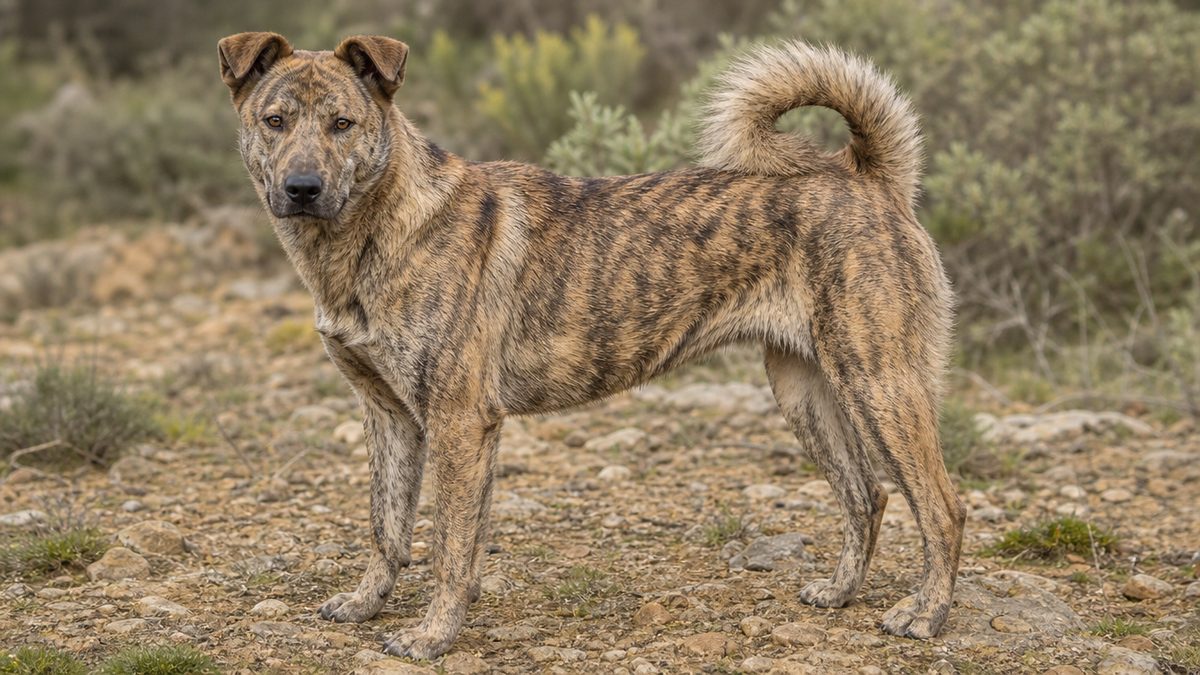
| Coat | Well furnished, short 2 to 5 cm or medium long to 8 cm |
| Colour | Usually fawn brindle, all shades of fawn |
The Societe Centrale Canine and the Club du Cursinu also publish a 12-page illustrated English edition of the standard, with judge Jean-Dominique Rossi commenting clause by clause, which is the document to read if you want the physical characteristics annotated rather than listed.
Two of those rows do real work later on this page. The standard publishes no weight at all, which is why any figure you meet online for this breed traces to a secondary source rather than a register. And the coat is not optional decoration: short hair is one of only four disqualifying faults, alongside an aggressive or overly shy temperament, a molossoid head, and absence of tail.
How it looks, and the Corsican words for it
Picture a brindled, medium village dog with a wolf-shaped head, folded triangular ears, a thick plumed tail carried curled over the back, and hare feet. The eyes are oval, very slightly oblique, hazel to dark brown, set at an axio-oculo-palpebral angle of about 70 degrees rather than frontally as in a Boxer. The nose is wide and black, and in light-coated dogs the iris must stay dark and the nose black.
The Corsican colour vocabulary survives in the breed's own literature. Brindle is *turcatu*, black and tan is *filicatu*, and sand masked with black is *spanu masceratu*. Judge Jean-Dominique Rossi notes that the Corsicans kept mainly the brindle and the other colours almost disappeared, that the very light fawn dogs with dilute brindling once called grey brindle have become rare, and that black and tan is reappearing with selection.
What it was bred to do
The Corsican Dog was selected for versatility rather than for one job, and its standard says so in the utilisation clause: originally a sheepdog and still usable as one, also used for locating and herding free-range pigs and cattle, with the decline of agro-pastoral activity pushing it towards hunting boar, fox and hare. The Societe Centrale Canine calls that double function of hunting and guarding, with stock work added where needed, the historical basis of its use.
The breed answers to Cursinu, chien corse and Corsican Dog. Judge and breeder Pierre Benedetti records that *cursinu* began as an adjective meaning simply of Corsica, and that the dog was traditionally called *cane curs* in the north of the island and *ghjacaru* in the south, a word linguists have traced to the Latin *jaculus*. None of those names is Cane Corso, which is an unrelated Italian molosser.
Recognised by France, not by the FCI: what that actually means
The Corsican Dog is recognised by the Societe Centrale Canine and is not recognised by the Federation Cynologique Internationale, either definitively or provisionally. Bonbeno established that from the registers themselves on 27 August 2026 rather than from a breed directory, because a directory will tell you a breed is rare without telling you what paperwork the buyer will actually be handed.
What each register says, read directly
- Societe Centrale Canine: yes. The SCC publishes a breed record for the Cursinu under national standard number 901, files it in Group 5, and lists an affiliated breed club. Official recognition was obtained in July 2003.
- FCI definitive nomenclature: no. The FCI's definitive breeds listing under the letter C runs 44 entries, from Ca de Bestiar to Curly Coated Retriever. There is no Cursinu and no Corsican breed.
- FCI provisional register: no. The list of breeds recognised on a provisional basis carries 20 entries, none Corsican and none French. Its four most recent additions, standards 375 to 378, were entered on 11 February 2026.
That is a genuine, checkable status rather than an administrative gap. FCI Standing Orders Article 6 states that recognition of a new breed comprises two phases, provisional and definitive. The Cursinu has entered neither.
The three consequences a buyer can actually see
- The pedigree looks different. FCI Standing Orders Article 8 states that pedigrees issued to the dogs of breeds not recognised by the FCI cannot bear the FCI logo, or must carry the remark breed not recognised by the FCI. So a genuine Cursinu pedigree is an SCC document with a French LOF number and no FCI mark. An FCI logo on one is a warning sign, not a premium.
- Shows are open but the top title is not. The Societe Centrale Canine states that Cursini may take part in international shows and compete for the CAC, but not for the CACIB. That matches the FCI's own rule for provisional breeds, which are likewise CACIB-ineligible until definitive recognition.
- In India, it changes who can even register the dog. The FCI members register lists India as a full member, represented by the Kennel Club of India at Anna Nagar, Chennai. India's national club therefore issues pedigrees against FCI nomenclature, and a breed carrying no FCI number has no obvious Indian registration route at all. That is a far more practical obstacle than rarity.
Why it has not happened yet, and why the clock has already run out
The Societe Centrale Canine's own explanation is specific and it is dated. It states that FCI recognition may come, under FCI rules, 20 years after the first registration by the SCC. The Cursinu gained access to the LOF on a *livre d'attente*, a waiting book, from July 2003, recorded 68 registrations in its first LOF year of 2004, and was admitted definitively to the LOF in 2013 Societe Centrale Canine.
Count forward from any of those dates and the window has opened. Twenty years from 2003 is 2023; from the first LOF year, 2024. As of the registers read on 27 August 2026, the breed still appears on neither FCI list. Bonbeno reports that as an unexplained gap rather than guessing at a reason.
Professor Bernard Denis, writing for the FCI Scientific Commission, sets out three phases: national recognition maintained by the national kennel club for as long as it takes to satisfy the FCI's demographic criteria, then an application requiring a drafted breed standard, verification of the existence of 8 independent lines and an appreciation of health status, then an emerging phase. Denis is the same professor from the Ecole Nationale Veterinaire de Nantes who sat on the Cursinu's own zootechnical expertise Club du Cursinu, Presentation. Records….
Read the demographic criterion against the numbers and the difficulty is obvious. A breed producing 153 registrations a year worldwide, from a founding stock of a few dozen dogs concentrated in two strains, is working hard to demonstrate eight independent lines Societe Centrale Canine.
Guerini notes that the Cursinu standard gives height as a 10 cm range plus a tolerance, where long-fixed breeds allow 3 to 5 cm for the same measurement, and calls the standard still very broad and likely to tighten with time. The reason is deliberate: a tolerant standard is necessary for a small-population breed so that breeders are not discouraged and the majority of Cursini are not excluded from reproduction, and the studbook remains open. Judge Jean-Dominique Rossi says the same from the ring, that the standard is adapted to the still reduced size of the stock. A wide standard keeps genetic diversity in, and it also makes proving a distinct, fixed type to the FCI harder.
The recovery, with dates and counts rather than the word rare
The Corsican Dog was rebuilt from a few dozen surviving dogs between 1988 and 2013, and every step of that is documented with numbers. Its history and origins are unusually well recorded for a rare breed, so Bonbeno sets out the dated series below instead of calling the breed rare, because a buyer needs to know how narrow the founding stock was and how the population has moved since.
Why the dog nearly went
Corsican livestock farming collapsed and took the dog with it. The Societe Centrale Canine records the island's herd falling from 440,000 head in 1955 to 270,000 in 1978, with sheep dropping from 217,000 to 131,000 and goats, hit by brucellosis, from 145,000 to 46,000. Fewer graziers meant fewer working dogs, and from the mid-century many Corsican hunters switched to continental breeds instead.
Breeder and judge Pierre Benedetti puts the near miss plainly. Other breeds, German and Belgian shepherds among them, were introduced to Corsica in the 1960s and hybridised with the local stock, and in his words the few dozen dogs that were found and identified were perhaps the last ones.
The counts, in order
| Date | Figure | Source |
|---|---|---|
| 1984 | Franceschi survey finds a rural population with no morphological constant | SCC |
| 1989 | First census in southern Corsica, results on about 30 dogs, published by vet Michele Riera | SCC |
| Early 1992 | 277 dogs censused, 125 identified, measured and photographed; 108 births in 1991 | SCC |
| 1994 | 535 dogs censused, 219 identified, measured and photographed | Club du Cursinu |
| 2004 | 68 registrations, the first LOF year | SCC |
| 2010s onward | Over 100 registrations a year | SCC |
| 2024 | 168 LOF registrations | SCC LOF statistics |
| 2025 | 153 LOF registrations, 68 confirmed, 44 percent, down 9 percent | SCC LOF statistics |
Those figures come from three documents: the Societe Centrale Canine's breed history, the Club du Cursinu's own presentation, and the SCC's Statistiques LOF 2025, the official French studbook table Societe Centrale Canine. In that 2025 table the Cursinu sits in Group V between the Basenji at 195 registrations and the Swedish Vallhund at 133.
Registrations fell 9 percent year on year, from 168 to 153, and that is not a Cursinu problem: the whole of Group V fell 9 percent too, from 18,020 to 16,375. The confirmation rate is the row that stands out. Group V confirmed 2,974 of 16,375 registrations, about 18 percent, against the Cursinu's 44 percent. So this breed presents more than twice the average share of its puppies for adult examination. That is what an active conservation programme looks like inside a studbook.
How many Corsican Dogs actually exist, and where
Roughly 1,400 Corsican Dogs live on Corsica, on the only island-wide estimate anyone has published, and about 150 enter the French studbook each year. Those two numbers together are the honest scale of this breed, and an Indian reader should weigh any availability claim against them.
The only published island-wide population estimate for this breed comes from a French veterinary thesis, and Bonbeno could find no more recent one. Julien Guerini, in *Les chiens corses*, submitted for the Doctorat Veterinaire at the Ecole Nationale Veterinaire de Toulouse in 2006, estimated the Corsican population at close to 1,400 individuals.
He reached it two ways and the two agreed. Assuming three or four dogs per village across the 360 communes of Corsica gives 1,100 to 1,400, and his census returned a total of about 1,480. The earlier recognition campaign, run to support the application to the Societe Centrale Canine, had counted and identified close to 400 dogs, working with the Parc Naturel Regional de Corse, INRA, the University of Corte, which supplied canine population management software, and the Ecole Nationale Veterinaire de Nantes.
That estimate is from 2006 and nothing has replaced it, so treat it as an order of magnitude rather than a current count. What is current is the studbook: 153 registrations in 2025 and 168 in 2024. A population near 1,400 producing roughly 150 registered puppies a year is the arithmetic an Indian buyer should hold in mind when a listing claims local availability.
The institutions that did the work
Scientific interest arrived before cynophile interest. The Parc Naturel Regional de Corse, INRA's livestock development research laboratory at Corte, and the Universite de Corse Pascal Paoli were already studying insular domestic species when Paul Franceschi ran his 1984 survey of the island's rural dogs. The Foire de la chasse at Vero chose the Corsican dog as its debate topic in October 1988, the name Cursinu was proposed there and immediately agreed, and the Association de sauvegarde du chien corse was founded at the same fair on 27 October 1989 Club du Cursinu, Presentation. Records….
Two strains carried the breed through. The Squarcini brothers near Ajaccio had kept a line that proved precious, and the second came from Andre Ferrari, a customs officer who had had Corsican dogs since the 1970s.
The two primary sources give different dates for the same event. The Societe Centrale Canine puts the Altiani zootechnical expertise in October 2003, after recognition. The Club du Cursinu puts it in February 2003, before it. Both name Jacques Goubie and Professor Bernard Denis. Bonbeno reports both and picks neither.
Is the Corsican Dog an ancient breed? What the evidence supports
No genomic study of the Corsican Dog exists, so nobody can currently say how old the breed is in genetic terms. Bonbeno checked two literature databases with working controls before making that claim, because absence is a strong statement and island breeds attract more romance than most.
The literature search, including how it tried to mislead
PubMed returned zero records for Cursinu, with the phrase reported as not found. That zero is real, and the same session proves the tool was working: Labrador Retriever plus hip dysplasia returned 126 records and Bergamasco dog returned 13.
One query nearly produced the opposite answer. Searching Cursinu dog returned 404,358 records, which looks like a vast literature until you read the query-translation line. PubMed had discarded the word Cursinu entirely and searched dogs alone. Anyone quoting that count as coverage of this breed would be citing the whole canine literature by accident.
OpenAlex agreed. Corsican dog Cursinu genetic returned 0 works, against controls of 3,359 for livestock guardian dog and 90 for Bergamasco shepherd dog genetic in the same session. Two databases, both proven working, both zero.
What the breed's own registry says, which is more sceptical than the internet
The Societe Centrale Canine does not claim an unbroken ancient line, and its language is worth quoting because it is the opposite of the usual heritage marketing. Archaeozoological finds on Corsica include medium-sized dog skeletal fragments spanning the Middle Ages to the Renaissance, and the SCC states directly that this does not make them direct ancestors of the Cursinu, since no canine variety continues inside a genetic cocoon across the centuries.
The 1984 survey said the same thing about the living population. Paul Franceschi, working for the Parc Naturel Regional de Corse, reported that no morphological constant really emerged among the animals observed, that size and head varied a great deal, and that the only common criterion appeared to be the frequent brindle coat. He concluded that each region and village had formed appreciably different micro-populations, that there was therefore no single genetic heritage to preserve, and that forming a breed from that varied assembly would require a policy of controlled crosses.
The fifteenth-century skull, and what it does and does not prove
One measured artefact exists, and the veterinarian who measured it drew a deliberately narrow conclusion from it. Bonbeno keeps his framing rather than upgrading it, because a single skull is evidence of a type in a place at a time and nothing more.
Guerini measured a fifteenth-century Corsican dog skull and published the numbers: skull length 18.5 cm from the rostral end of the nasal bone to the occiput, muzzle 8.5 to 9 cm, zygomatic width estimated at 12 cm, and a stop angle of 160 to 170 degrees. He described it as the skull of a medium, eumetric dog with a straight to slightly convex profile, compatible with a Cursinu type.
His own conclusion is the model for how to handle this kind of evidence. These measurements, he wrote, in no way constitute formal proof of the racial identity of this skull, but they attest to the presence of a dog of Cursinu type in Corsica in the fifteenth century. Bonbeno reports it on exactly those terms.
Two of Guerini s measurements sit outside the current standard. The zygomatic width of about 12 cm exceeds the standard s 10 cm for females and 11 cm for males, and the stop angle of 160 to 170 degrees is flatter than the 150 to 160 degrees the standard specifies Societe Centrale Canine. A fifteenth-century Corsican dog was therefore broader-skulled and flatter-stopped than a Cursinu confirmed today. That is what selection since 2004 looks like, and it is the opposite of an unchanged breed.
Written documents and illustrations attest a Corsican dog since at least the sixteenth century, and the standard says exactly that and no more. The record is textual: the chronicler Pietro de Felce describes two varieties of hunting dog around 1500, and a 1465 act of allegiance by Giudicello da Gaggio to the Duke of Milan promises one Corsican dog a year. That is evidence of dogs on Corsica, not of continuity to the modern breed.
The honest reading
The Cursinu is best described as a modern breed built in the 1990s from an old regional population, which is what its own registry calls it. The Societe Centrale Canine frames the whole process as a textbook case of cynophile raciation: an ancestral regional population persisting through utilitarian use, heterogeneous but sharing some traits, which a group of users then decides to preserve and fix. Standard 901 dates from January 2004.
That is not a smaller claim than the romance, and Indian buyers should prefer it. A breed whose founders published their census counts, named their two founding strains and admitted the population was morphologically inconsistent has given you more to check than one asserting a thousand-year pedigree with nothing behind it. It also means the standard's own history section carries a caution the marketing copy drops: the SCC warns readers off the claim that Sampiero de Bastelica fielded a thousand Corsican war dogs, because it comes from a 1932 propaganda work by an irredentist author.
With no published genomic work on the breed, there is no peer-reviewed Cursinu mutation list to screen against. The Club du Cursinu does publish a register headed Tests ADN listing 96 dogs by name and owner, but the page states nothing about what those tests cover, so Bonbeno reports the list and not a purpose for it. Treat any seller offering a Cursinu genetic health panel with scepticism, and ask which mutations it tests and in which published paper they were described in this breed.
Corsican Dog price in India: there is no price, and here is the proof
The Corsican Dog has no price in India because it has no Indian market, no lawful commercial import route and, on the evidence below, not one verifiable listing. Bonbeno publishes no rupee range for this breed. Anything quoted to you as a Cursinu price in India is describing a different dog, and the search results show which one.
What an India-restricted search actually returns
Bonbeno ran the query corsican dog price in india cursinu puppy through Firecrawl with the location set to India on 27 August 2026. All ten organic results were about the Cane Corso: a Supertails price guide, three YouTube Cane Corso price videos, two Instagram pages, a Quora thread, a Mr n Mrs Pet listing page, a Delhi breeder site and a Tamil Nadu Cane Corso Facebook group. Not one concerned the Cursinu.
Google India has substituted the breed in its own People Also Ask box
Bonbeno captured a live Google India People Also Ask box for the head term corsican dog on 27 August 2026, at gl=in and hl=en. It carried four questions, and three of the four are about the Cane Corso. They read: What is the temperament of a Corsican dog? Are Cane Corsos legal to own in India? Which dog is 20 crore price in India? Is a Cane Corso a good pet?
Google appears to know about the collision and flags it in its own AI Overview for the query, which adds a parenthetical noting that people sometimes confuse the Corsican Cursinu with the Italian Cane Corso. The related-search refinements it offers include Corsican Mastiff dog, which is not a breed at all. Google also reported About 187 results for the head term, which is a very small index for a dog breed.
The Cane Corso appeared on the 12 March 2024 central circular listing 23 ferocious and dangerous breeds, later quashed by the Karnataka High Court on 10 April 2024. The Cursinu never appeared on that list. So the two breeds do not even share a legal history in India, and a buyer told that a Corsican dog is a restricted breed has been given the wrong breed s paperwork along with the wrong breed.
The head term behaves the same way. A search for corsican dog breed from India returned English Wikipedia's Corsican Dog article at position 1, then the Chewy Cane Corso care page at 2 and the American Kennel Club's Cane Corso breed page at 5. Two of the top five results for a French breed's name are pages about an Italian one.
The two names collide in English. Cane Corso translates informally as Corsican dog, and the FCI standard itself notes the etymological argument, deriving the name from the Latin *cohors* rather than from Corsica. The Societe Centrale Canine says the Corsica reading cannot be dismissed either. Whatever the etymology, an Indian seller who advertises a Corsican dog is almost certainly selling a 45 to 50 kg Italian molosser, not a 46 to 58 cm French primitive breed Societe Centrale Canine.
Why no supply chain can lawfully form
Two independent facts close the route, and neither depends on how many buyers want one.
- Import for sale is prohibited. DGFT Trade Notice 22/2022-23 classifies dogs under ITC(HS) 01061900 as Restricted and states that any applications for trading or breeding purposes, or applications made on behalf of some other person or entity, shall be duly rejected. Import is allowed only for a pet dog with a valid pet book in the importer's own name, for R&D with a CPCSEA recommendation, or for Defence and Police use, through seven named ports Department of Animal Husbandry….
- There is almost nothing to import. The Societe Centrale Canine's Statistiques LOF 2025 records 153 Cursinu registered in France in 2025, against 168 in 2024. That is the entire regulated world output for a year. Roughly half the breed's producers are in Corsica itself and the remainder are in mainland France, Belgium, the Netherlands, Germany, Italy and Spain.
The one honest number Bonbeno can give you
The only defensible figure for this breed is the French registration count, not a rupee band. 153 dogs entered the LOF in 2025 and 68 of them were confirmed as adults. For scale, the Staffordshire Bull Terrier took 8,694 registrations in the same table and the Berger Australien 14,609. The Cursinu is not a rare version of a common breed. It is a conservation population.
Bonbeno normally divides suspicious rupee figures by 84.38, 80, 74 and 66.67 to catch price lists that are converted American ones. That test cannot be run here, because no Indian page publishes a Cursinu price to test. Reporting the absence of a figure is the correct answer, and it is more useful than a converted one.
If a seller does quote you a Cursinu price, ask three questions before anything else. Which standard number, which studbook, and which port. The correct answers are Societe Centrale Canine standard 901, a French LOF number, and one of the six ports named in the DGFT notice Directorate General of Foreign Trade. DAHD added a seventh port, Cochin International Airport at Kochi, for pets arriving under the baggage rules in October 2024. A seller who cannot answer all three is not selling this breed. The full route is set out in how to import a dog to India.
Monthly cost of keeping a Corsican Dog in India
Budget a Corsican Dog as a medium dog with a furnished coat, because no breed-specific Indian cost data exists and the standard publishes no weight to build a food figure on. The components below are sourced to published Indian figures, and Bonbeno flags which ones it cannot bound for this breed.
The recurring cost, from published Indian figures
| Item | Published Indian figure | Source |
|---|---|---|
| Food, medium-sized dog | Rs 1,500 to Rs 4,000 a month | VOSD |
| Total monthly upkeep | Rs 3,000 to Rs 10,000 and beyond | VOSD |
| Annual responsible ownership | Rs 25,000 to Rs 80,000 | VOSD |
| Preventive care a year | Rs 5,000 to Rs 8,000 | VOSD |
| Vet consultation | Rs 500 to Rs 1,000 | VOSD |
| Annual vaccinations | Rs 1,500 to Rs 3,000 | VOSD |
| Full puppy vaccination course | Rs 3,000 to Rs 6,000 | Dog with Blog |
| Anti-rabies, per dose | Rs 300 to Rs 600 | Dog with Blog |
| Annual booster, DHPPi plus rabies | About Rs 1,000 to Rs 2,000 | Dog with Blog |
| Grooming session | Rs 300 to Rs 2,000 | VOSD |
| Professional dog walker | Rs 3,000 to Rs 6,000 a month | VOSD |
Those come from two Indian sources, the Voice of Stray Dogs cost guide and a vet-reviewed Indian vaccination schedule. Both are pet-sector publications rather than studies, so treat the bands as market reporting and confirm locally.
City changes the answer more than breed does
VOSD puts the geographic spread bluntly: a dog that costs Rs 4,000 a month to maintain in Pune may cost Rs 7,000 a month in South Delhi, because veterinary fees, grooming, boarding and training all run higher in Mumbai and Bengaluru than in tier 2 and tier 3 cities. For a 46 to 58 cm dog, that city premium is worth more rupees than any breed adjustment you could make.
Three line items this breed pushes up, and one it pushes down
- Up: tick prevention, all year. A survey of 525 dogs across four Indian cities found 261 of them, 49.7 percent, carrying at least one tick-borne pathogen, with Rhipicephalus or Haemaphysalis ticks on 278 dogs, 53 percent. A furnished coat of 2 to 5 cm, or up to 8 cm on the medium-long variety, gives ticks more to hide in than a smooth coat does. Budget monthly prevention, not seasonal.
- Up: brushing time, not salon fees. A short or medium-long coarse coat does not need clipping, so you are buying brushes and your own time rather than the Rs 300 to Rs 2,000 grooming sessions a clipped breed needs.
- Up: cooling. A fan or air conditioning during the worst hours is a running electricity cost for this breed in most Indian cities, for the reasons set out in the climate section below.
- Down: feeding. The Societe Centrale Canine's breed record says the Cursinu can be frugal and can be fed on adapted industrial food such as kibble. That points to the lower end of the Rs 1,500 to Rs 4,000 food band rather than the upper.
Keep an emergency fund. VOSD puts orthopaedic intervention after a road accident at Rs 30,000 to Rs 80,000 and foreign-body surgery from Rs 15,000 upwards, and an Indian vaccination guide prices a parvo hospital stay at Rs 15,000 to Rs 50,000 against a first-year vaccine bill of Rs 3,000 to Rs 6,000. For a hunting-bred dog that quarters 150 to 200 metres out and comes back, a road-traffic reserve is not theoretical.
What Bonbeno cannot cost for you
The acquisition cost is unquotable, because there is no lawful Indian purchase route and no verifiable Indian listing. Relocation costs, quarantine at the port of entry and the DGFT authorisation process are real expenses that vary by carrier and city, and Bonbeno publishes no figure for them because none is officially fixed. Get quotes in writing before you commit to anything.
Indian climate suitability: testing the Mediterranean assumption
The Corsican Dog is a temperate mountain breed, not a hot-weather one, and the climate data says so clearly. Bonbeno queried NASA POWER by explicit latitude and longitude for the breed's home range and for eight Indian cities, using 20-year monthly means from 2001 to 2020, because a place queried by coordinates cannot silently serve you a different city.
What Corsica is actually like, which is not what Mediterranean suggests
Interior Corsica at 42.31N 9.15E averages 16.0 C across the year, and its hottest month, August, averages 25.6 C air temperature at 54.0 percent relative humidity, with a wet bulb temperature of 20.2 C. Coastal Ajaccio at 41.93N 8.74E is almost identical, at 16.1 C annually and 25.2 C in August. Only two months of the year exceed 25 C.
That matters because the breed's own standard reads Corsica as cold, not hot. Short hair is a disqualifying fault, and judge Jean-Dominique Rossi gives the reason in one line: Corsica is a mountain country, the coat must be sufficiently protective, and it is an imperative. This is a breed required by its register to carry insulation.
Evaporative headroom, and why it is the number that matters
A dog cannot sweat to cool itself. It pants, evaporating water from its airways, and the wet bulb temperature is the lowest temperature evaporation can reach. The gap between air temperature and wet bulb is the dog's evaporative headroom. On interior Corsica in August that gap is 5.4 C.
| Location | Month | Air temp C | Wet bulb C | Headroom C | RH % |
|---|---|---|---|---|---|
| Interior Corsica 42.31N 9.15E, the breed's home | August | 25.6 | 20.2 | 5.4 | 54 |
| Ajaccio 41.93N 8.74E | August | 25.2 | 20.3 | 4.9 | 57 |
| Delhi 28.61N 77.21E | May | 35.1 | 21.9 | 13.2 | 23 |
| Delhi 28.61N 77.21E | August | 29.8 | 27.1 | 2.7 | 75 |
| Jodhpur 26.24N 73.02E | April | 31.2 | 17.8 | 13.4 | 22 |
| Jodhpur 26.24N 73.02E | July | 31.9 | 27.2 | 4.6 | 61 |
| Bengaluru 12.97N 77.59E | August | 23.3 | 21.1 | 2.2 | 79 |
| Hyderabad 17.38N 78.49E | September | 25.2 | 23.5 | 1.7 | 83 |
| Chennai 13.08N 80.27E | August | 29.0 | 26.1 | 2.9 | 72 |
| Kolkata 22.57N 88.36E | August | 28.2 | 27.2 | 1.0 | 89 |
| Pune 18.52N 73.86E | August | 23.3 | 22.5 | 0.8 | 91 |
| Mumbai 19.08N 72.88E | August | 26.1 | 25.2 | 0.9 | 90 |
Three findings, and one of them corrects a claim this site has made before
- The dry-heat claim is weaker here than for other Mediterranean breeds, and it should not be assumed. Interior Corsica in August runs 54 percent humidity with 5.4 C of headroom. That is a mild, moderately humid mountain summer. Bonbeno ran the same query for the Cirneco dell'Etna's home range at 37.66N 14.83E and got 27.3 C at 50.8 percent with 6.4 C of headroom in August. The Sicilian breed's ground is 1.7 C hotter and evaporatively a full degree more generous. The Cursinu was not selected on arid ground, and Bonbeno does not rate it as an arid-heat specialist.
- Corsica's worst month is cooler than an ordinary Indian year. The annual mean wet bulb is 24.9 C in Chennai, 22.9 C in Kolkata, 22.7 C in Mumbai and 21.0 C in Hyderabad. Every one of those yearly averages is higher than the wet bulb of the single hottest month Corsica averages, which is 20.2 C. In those four cities an ordinary day is thermally harder on this breed than the worst month it evolved under.
- The one genuinely favourable Indian window is the pre-monsoon north-west, and it is favourable for the wrong reason. Delhi in May offers 13.2 C of headroom at 23 percent humidity, and Jodhpur in April offers 13.4 C at 22 percent. Evaporation works beautifully there. But the air is 35.1 C and 31.2 C, which is 5.5 to 9.5 C above anything Corsica ever averages, and the coat the standard mandates is still on the dog.
Delhi's headroom collapses from 13.2 C in May to 4.5 C in July and 2.7 C in August, as its wet bulb climbs from 21.9 C to 27.7 C. Jodhpur runs the same course, 13.4 C of headroom in April down to 3.2 C in August. For four months a year the north-west is no better for this breed than the coast.
NASA POWER's grid smooths mountains. The reanalysis cell for the Shimla query reports an elevation of 898 m against the town's roughly 2,200 m, and the Ooty cell reports 785 m against roughly 2,240 m, so the modelled temperatures for Indian hill stations are too warm to use. Bonbeno therefore publishes no hill-station rating for this breed. If you live above 1,800 m the honest answer is that the model cannot tell you, and local observation should.
Managing an Indian summer with a mountain-coated dog
Manage this breed by humidity and by season rather than by the thermometer, because the thermometer will call a Mumbai monsoon morning mild at 26.1 C while offering the dog 0.9 C of evaporative headroom. Everything below follows from the wet-bulb figures in the previous section.
The seasonal routine, city by city
- November to February, everywhere. Normal routine. This is the window to build fitness, socialise a young dog and do real distance work. Delhi's December wet bulb of 8.2 C and January's 6.9 C sit inside Corsican winter range.
- March to June, dry-heat cities. Delhi, Jaipur, Jodhpur, Ahmedabad and Nagpur. Evaporation works well here, so a shaded dog with water copes, but the air is 31 to 35 C and ground surface temperature is the real hazard. Walk before sunrise and after dark, and press your palm to the pavement for five seconds first.
- June to September, monsoon and coast. Mumbai, Pune, Kolkata, Chennai, Kochi and Goa. This is the dangerous season for this breed despite mild-looking temperatures. Cut duration, move what can move indoors, and substitute scent and problem-solving work for distance.
- Year-round, everywhere. Constant fresh water, a cool hard floor or a raised bed in shade, and a fan or air conditioning available in the worst hours.
Why the coat cannot simply be clipped off
The Cursinu standard disqualifies short hair, and it does so for a functional reason rather than an aesthetic one Societe Centrale Canine. The coat is coarse, 2 to 5 cm on the short variety and up to 8 cm on the medium-long, and it is what the breed carries in a mountain winter. Clipping it does not convert a mountain jacket into a tropical one, and it removes sun protection from an animal already outside its climate.
Purina India lists excessive humidity and lack of acclimatisation as separate heat-stroke risk factors alongside obesity, intense exercise and old age, and names heavy-coated dogs as being at particular risk. A newly imported Cursinu meets three of those at once in its first Indian summer.
Heat stroke in a Corsican Dog: signs, first aid and thresholds
Treat heat stroke as an emergency and start cooling before you travel, because a dog can develop it in as little as 30 minutes of vigorous exercise in warm weather whatever coat it has. The sequence below is the published Indian one, and two of its steps are counter-intuitive enough that owners get them wrong.
Purina India lists the warning signs as severe panting, difficulty breathing, severe salivating, vomiting, diarrhoea, a raised temperature of 40.5 C or above, blood in the urine, nose bleeds, and ultimately collapse and coma. It also warns that a dog can develop heat stroke in as little as 30 minutes of vigorous exercise in warm weather, whatever coat it has.
- Move the dog out of the heat into shade or air conditioning.
- Spray or sponge with cool, not cold, water, making sure it reaches the skin rather than running off the coat, and wet the belly and inside the legs thoroughly. On a 5 cm coarse coat this takes longer than you expect.
- Use a fan, the step most Indian households have available and forget.
- Do not plunge the dog into cold water or an ice bath, because that prevents core temperature coming down.
- Stop cooling at 39.4 C, or you risk tipping the dog into hypothermia.
- Go to a veterinarian regardless, because heat stroke in dogs can be fatal.
Purina India records that at an outside temperature of 26 C, a car interior reaches 32 C in five minutes and 43 C in 25 minutes. An Indian April afternoon does not start at 26 C. Never leave this dog, or any dog, in a parked car in India, window cracked or not.
Watch the breathing, not the clock
A published study of dogs walking in a hot, sunny tropical region measured what heat load does in real time. Across 135 walks at black-globe temperatures from 19 to 50 C, walking above 35 C black globe raised hair-coat temperature by 20.5 C, skin temperature by 7.2 C, respiratory rate from about 47 to 374 breaths a minute, and water intake by 215 mL, while rectal temperature held inside a narrow 38 to 39 C band. The core stayed steady because the respiratory system was working extremely hard.
The authors concluded that walking dogs beyond a thermal stress index of 170 should be approached with caution, particularly during prolonged or repeated exposure, because panting appears to become less effective past that point. Without instruments the usable version is simple. A dog whose panting has gone rapid and shallow and will not settle within a couple of minutes in shade has passed the point where the walk should have ended.
Hall and colleagues examined 905,543 UK dogs under primary veterinary care in 2016, found 395 confirmed heat-related illness events, an incidence of 0.04 percent and an event fatality rate of 14.18 percent. The Cursinu does not appear in a UK primary-care dataset, so there is no breed-specific figure to borrow and Bonbeno publishes none. Two of the study's risk factors transfer to any dog: higher bodyweight relative to the breed and sex mean, and being over two years of age. The brachycephalic factor does not apply, because the standard specifies a lupoid head with a muzzle about 47 percent of head length. The over-50 kg factor cannot be assessed at all, because the standard publishes no weight.
Temperament and household fit for an Indian home
The Corsican Dog is a calm, reserved, strongly bonded guard dog that is wary of strangers and quiet indoors. Its own standard calls it docile, loyal and very attached to its master, a very proud dog wary of strangers, intelligent, calm and well balanced, capable of adapting to many different situations, and quiet at home while very energetic and lively in action.
What the registry adds beyond the standard
The Societe Centrale Canine's character note fills in the texture. It describes a dog with a great deal of personality that is nonetheless docile and very endearing, calm, rather cold in manner, fairly independent, and at the same time sensitive, very intuitive and observant, attached to its family with a strong protective instinct, particularly towards young children.
Its guarding style is specific and unusually useful in a dense Indian neighbourhood. The SCC calls it an efficient guardian but not talkative, barking to good purpose, that does not let strangers in, and that when its owner is present is civil while remaining reserved, with strangers being fairly indifferent to it. The historical record goes further: Paul Franceschi's 1984 survey found that on guard duty it growls rather than barks, and that bandits hiding in the maquis preferred it to any other breed for exactly that reason.
An aggressive or overly shy dog is one of only four disqualifying faults in this standard. Judge Jean-Dominique Rossi adds that the character has partly softened and that aggressive subjects are hardly seen any more. For a guard breed with a reputation built on ferocity towards outsiders, that is a real selection decision recorded in a public document.
The apartment question, where the breed's own registry contradicts itself
Two Societe Centrale Canine documents give different answers, and Bonbeno publishes both rather than picking one.
- The character article reports a split among the breed's own people. For some, apartment life is not necessarily incompatible with the Cursinu, provided the owner has time for it and is genuinely sporty. For others, even though it makes a very good daily companion, it is an outdoor dog that has no place in a flat.
- The SCC breed record is more positive. It states that this pastoral and essentially rural dog had no vocation to live in a city, but that with the demographic collapse of its original space it is now also found in urban settings, and that it adapts very well there provided it gets exercise resembling its former physical activity.
Read together, the honest answer for India is conditional. A Cursinu can live in a Bengaluru or Pune flat with an owner who exercises it seriously in the cool hours. It cannot live in one with two adults out at work all day, because the exercise condition is the whole of the permission.
Who should not get one in India
- Households in high-humidity cities without climate control. Mumbai, Kolkata, Pune and Chennai offer this coated mountain breed between 0.8 and 2.9 C of evaporative headroom in August.
- Anyone who wants a dog that greets visitors. Reserved indifference towards strangers is the breed's documented normal, not a training failure.
- First-time owners buying on looks. The SCC breed record states plainly that this dog needs an owner with character who can give it real physical exercise.
- Anyone who cannot supervise around small animals. It is a boar hunter that also works fox and hare, and it attacks or holds quarry.
The SCC reports that relations between dogs pass without particular difficulty, that the hierarchy is clear and that fights are rare. It also protects flocks, chiefly against foxes, which remain a threat to Corsican lambs and kids, and for that job the breed must be placed with the animals from a very young age as with every other protection breed.
Training a Corsican Dog, and the contradiction in its own paperwork
Train a Corsican Dog with consistency rather than force, because its registry describes it as neither stubborn nor rebellious and says very good obedience is obtainable. Two Societe Centrale Canine documents then disagree about how hard the job is, and an Indian buyer should know that before starting.
The disagreement, stated plainly
- The character article says it is easy. The Cursinu is neither stubborn nor rebellious, educates without difficulty, and very good obedience can be obtained from it. Recall in particular poses no problem, because on a walk it does not much like getting far from its owners, and it listens with the same flexibility as a sheepdog.
- The breed record says it is not. The same registry's official breed page states that the Cursinu demands more attention in training than other breeds, and that it needs an owner with character who can provide it with some physical exercise.
Bonbeno does not average those. The reconcilable reading is that recall and biddability come easily while general handling of an independent guard breed does not, but that is an interpretation and it is labelled as one. Assume the harder version and be pleasantly surprised.
What the breed was selected to do without instruction
Two behaviours arrive without teaching and both are useful. Recall is close to self-installing, because the breed hunts at what the SCC calls *au petit pied*, quartering an area of 150 to 200 metres around its handler, going out to search and coming back naturally when it finds nothing, making many round trips. And the standard records that users appreciate its spontaneous return to the place of release.
Guarding likewise arrives on its own. The founders found that aptitude already fixed in the founding stock: every dog recovered was in use, at guarding, with stock or at hunting, and all had very good character.
The socialisation window, and why India makes it harder
Socialise hard and early, because the two ends of this breed's temperament range are both disqualifying. Aggressive and overly shy are named together as one disqualifying fault, and a reserved, humidity-stressed guard breed meeting an Indian street for the first time at eight months is being set up to fail at one end or the other.
The Indian socialisation list is longer than the French one. It includes domestic staff who enter daily, delivery riders, building security guards, cattle and free-roaming dogs at close range, autorickshaw and horn noise, and festival firecrackers. Do that work between November and February, because those are the months when this breed can be outdoors comfortably in most Indian cities.
The one formal test the breed has, and the one it does not
The Club du Cursinu ran its first Test d'Aptitudes Naturelles in March 2017. It checks the dog's sociability and puts it in front of a range of situations relating to hunting and to livestock. There are still no working trials for the breed, and the standard files it as without working trial.
Judge Jean-Dominique Rossi makes the point in his own commentary: even though the breed is not subject to a working trial in the nomenclature, it is a working dog, so correct limbs, angulations and musculature matter a great deal in judging. Train and condition it as a working animal, not as a companion that happens to be athletic.
Beyond guarding and hunting, a few Cursinu have shown they can work in truffle hunting, in tracking and in blood trailing. Scent work is the most transferable of those to an Indian city, because it can be done indoors, at night, and in short sessions, which is exactly what the climate section says you will be forced into for four months of the year.
Daily exercise requirement, and what an Indian summer does to it
Plan on one to two hours of real work a day for an adult Corsican Dog, because its own standard says it is capable of coursing for a relatively short span of time, one or two hours, and describes it as quiet at home but very energetic and lively in action. That is the requirement. Indian heat is what stops you meeting it for four months of the year.
What the working pattern actually looks like
This is not a straight-line endurance dog. Its gallop is short, jerky and bouncy, suited to rough terrain such as scrubland, and in the field it quarters an area of 150 to 200 metres around its handler, going out to search and returning naturally, making many round trips Societe Centrale Canine. It works alone or in a small pack of two to four dogs, is used as a game-flusher rather than a running hound, and gives tongue only on sight rather than on the trail.
Translate that and the exercise it wants is interval work over varied ground rather than a steady road walk. A dog built to sprint, cast, stop, cast again and come back is under-served by 45 minutes on a leash along a Bengaluru main road, however long the distance adds up to.
A workable Indian week, by season
| Season | Outdoor time | What to do instead of distance |
|---|---|---|
| November to February | Full 60 to 120 minutes, split | Build fitness, long hikes, recall work |
| March to May, dry north-west | 45 to 75 minutes, pre-dawn and after dark | Check ground temperature first, carry water |
| March to May, south and coast | 30 to 45 minutes, dark hours only | Scent work, food puzzles, obedience |
| June to September, monsoon | 20 to 30 minutes, dark hours only | Indoor scent games, tracking, short sessions |
| October | Rebuild gradually | Return to distance over two to three weeks |
The seasonal cut is not caution for its own sake. Mumbai in August offers 0.9 C of evaporative headroom, Pune 0.8 C and Kolkata 1.0 C. A dog working hard in those conditions is relying on panting that has almost nowhere to send the heat.
A hunting-bred dog does not monitor its own temperature. The published tropical walking study recorded respiratory rate rising from about 47 to 374 breaths a minute once black-globe temperature passed 35 C, while rectal temperature stayed inside 38 to 39 C. The dog looked fine on the inside because the outside was working flat out. Stop the session on the breathing, not on the distance.
What happens without it
An under-exercised Cursinu is a guard breed with unspent drive in a flat, which is the combination the SCC's own people were arguing about when they split over apartment living. The registry's condition is explicit: apartment life is workable only where the owner has time for the dog and is genuinely sporty. Remove the exercise and you have removed the condition.
It is genuinely quiet in the house. The standard says quiet when at home and the character article calls it tranquil and not fidgety indoors, deploying all its energy outside Societe Centrale Canine. A dog that switches off completely between sessions is far easier to keep in an Indian flat than one that paces, provided the sessions actually happen.
One practical note on surfaces. The standard specifies a hare foot with tight toes and hard dark pads, developed on Corsican rock and scrub. Indian tar and concrete in April hold heat long after the air has cooled, so the palm test on the pavement matters more for this breed than for a dog bred on soft ground.
Grooming a coarse mountain coat in Indian humidity
Groom a Corsican Dog by brushing and by tick control, never by clipping, because short hair is a disqualifying fault in its standard and the coat is functional insulation rather than decoration. The workload is low in hours and high in vigilance, which is the opposite of most imported breeds sold in India.
What the coat is, exactly
The standard calls for hair that is well furnished, short or medium length, with feathering present in some dogs. Judge Jean-Dominique Rossi gives the measurements and the current concerns: the coat is coarse and a little rough to the touch but currently tends to be too silky, the short coat is genetically dominant and runs 2 to 5 cm maximum, and the medium-long coat must not exceed 8 cm and these days tends to get a little too long.
So there are two coat lengths in one breed, and the second is uncommon enough that Rossi notes the public does not identify a medium-long dog as a Cursinu at first sight. Long hair prevents confirmation altogether.
The weekly routine in an Indian household
- Brush twice a week on the short coat, three to four times on the medium-long. A coarse 2 to 5 cm coat with fringes at the thighs and a plumed tail traps debris rather than matting Societe Centrale Canine.
- Run a tick check every single day in tick season, and every other day the rest of the year. A four-city Indian survey found ticks of the genus Rhipicephalus or Haemaphysalis on 278 of 525 dogs examined, 53 percent. Work through the fringes, the plumed tail, the ear folds and between the toes.
- Check inside the ear after every wet walk. The ears are triangular and either drop or semi-pricked, so the canal sits under a fold rather than in open air. A folded ear in 90 percent August humidity in Mumbai or Pune does not dry on its own.
- Bathe only when actually dirty. There is no published Indian bathing guidance for this breed, so use the general rule: dry the ear folds and the thigh fringes thoroughly rather than leaving a coarse coat to air dry in monsoon air.
- Clip the nails, which are black. The standard specifies black nails, depigmented only where the toe is white, so the quick is not visible and short frequent trims beat occasional long ones.
The standard requires skin that adheres perfectly to the body, and Rossi states that the Cursinu must have no cutaneous laxity at all, on the head or the body Societe Centrale Canine. There are no face folds, no dewlap and no loose lip to trap moisture. In Indian humidity that removes a whole category of skin-fold problem that wrinkled breeds bring with them.
Why clipping is the wrong answer to Indian heat
Owners of coated breeds in India reach for the clippers every April, and for this breed that instinct is wrong twice over. The standard disqualifies short hair, and the published reason is functional: Corsica is a mountain country, the hair must be sufficiently protective, and Rossi calls it an imperative. A clipped Cursinu has lost sun protection without gaining evaporative capacity, because the constraint in Indian heat is wet-bulb temperature rather than insulation.
Manage the environment instead. Purina India names heavy-coated dogs, excessive humidity and lack of acclimatisation as three separate heat-stroke risk factors. You can change two of those three, by moving the dog indoors during the worst hours and by giving a new arrival a full cool season to acclimatise before its first Indian summer. You cannot change the coat.
This breed does not need a salon. Indian grooming sessions run Rs 300 to Rs 2,000 depending on breed and city, and a coarse undipped coat needs none of that. Spend the money on year-round tick prevention instead, which is the line item that actually protects this dog in India.
Health: the breed club's own hip data contradicts the no-problems line
The Corsican Dog is widely described as having no particular health problems, and its own breed club publishes hip screening results that do not support that description. Bonbeno counted the club's published register on 27 August 2026 and reports both the claim and the count, because a buyer deserves to see the disagreement rather than the tidier half of it.
What the two claims are
- The registry's summary. The Societe Centrale Canine's breed record states that the breed does not have any particular health problem.
- Wikipedia's version. The English article says there are no breed-specific health issues, sourced to a clubducursinu.com page that has been dead since at least 2011, on an article tagged as needing more citations since February 2023.
- The breed club's own numbers. The Club du Cursinu publishes a named, dog-by-dog hip dysplasia register graded on the FCI A to E scale.
The hip register, counted
| FCI grade | Meaning | Dogs | Share |
|---|---|---|---|
| A | No sign of dysplasia | 49 | 37.7% |
| B | Near normal hip joints | 44 | 33.8% |
| C | Mild dysplasia | 21 | 16.2% |
| D | Moderate dysplasia | 11 | 8.5% |
| E | Severe dysplasia | 5 | 3.8% |
| A or B, breeding-clear | 93 | 71.5% | |
| C, D or E, dysplastic | 37 | 28.5% |
Where a dog's two hips were graded differently, Bonbeno took the worse of the two, which is the conservative reading. Twelve of the 130 dogs carried mismatched left and right grades. The grade definitions on the club's page are the standard FCI ones, with grade A requiring a Norberg-Olsson angle of about 105 degrees or more and grade E showing obvious subluxation or luxation with an angle below 90 degrees.
This is not a random sample of the breed. The club applies the screening protocol from cotation 2 upwards and for all champion title registrations, with Professor Genevois as the official reader and results forwarded to the Societe Centrale Canine for their database. So these are dogs on the breeding and showing track, the population you would expect to be better than average. Nearly three in ten of them graded C or worse.
How to read that as a buyer
Do not convert 28.5 percent into a prevalence figure for the breed. A voluntary club register is not an epidemiological study, the total of 130 dogs is small, and live registers move as entries are added. What the number does establish is narrower and still decisive: hip dysplasia occurs in this breed at rates the club itself considered worth screening for, and the no-particular-problems line is not a statement about hips.
That the club built the protocol at all is the strongest signal here. A breed genuinely free of orthopaedic concern does not agree a screening scheme with its national kennel club, appoint an official reader and publish every result by name.
Second Schedule Part III paragraph 8(10) of the Dog Breeding and Marketing Rules 2017 states that dogs shall have been tested for genetic defects, including hip dysplasia, progressive retinal atrophy, night blindness, hypothyroidism, entropion, ectropion, overshot, undershot jaw when incisors do not touch or mesh, wry mouth, two or more missing teeth, unilateral cryptorchid or full cryptorchid males. Any Indian breeder of any breed owes you that testing, and for this breed the hip item is the one with published evidence behind it.
One practical instruction follows. Ask for both parents' hip grades by name, and check the names against the club's public register rather than accepting a photograph of a radiograph. That is a verification route almost no breed offers, and it is worth using.
Lifespan, and the Indian disease pressure nobody has studied in this breed
Bonbeno publishes no lifespan figure for the Corsican Dog, because no study of the breed exists and borrowing another breed's number would be an invention with a citation attached. Everything below is either measured in this breed or measured in Indian dogs generally, and each sentence says which.
Why there is no lifespan number
Two literature databases return nothing for this breed. PubMed gives zero records for Cursinu, against working controls of 126 for Labrador Retriever plus hip dysplasia and 13 for Bergamasco dog in the same session. OpenAlex gives zero for Corsican dog Cursinu genetic, against controls of 3,359 for livestock guardian dog and 90 for Bergamasco shepherd dog genetic.
So there is no cohort study, no mortality dataset and no breed lifespan estimate with evidence behind it. Numbers circulating on breed directories for this dog are not traceable to anything, and Bonbeno will not repeat them. The honest position is that a well-kept medium working dog's lifespan is the only reasonable expectation, and that the breed's own registry has published nothing to sharpen it.
If a page gives you a confident lifespan range for the Cursinu, ask where it came from. On this breed the honest answer is almost always another breed's figure, or the same untraceable range copied between directories. English Wikipedia does not even attempt one, and its two health references are dead links archived in 2011.
The Indian risk that is measured, and it is not inherited
Tick-borne disease is the dominant health threat to any dog in India and it is quantified. A survey using PCR across four Indian cities found 261 of 525 dogs, 49.7 percent, infected with at least one tick-borne pathogen. The breakdown matters because the treatments differ.
| Pathogen | Prevalence |
|---|---|
| Hepatozoon canis | 30.0% |
| Ehrlichia canis | 20.6% |
| Mycoplasma haemocanis | 12.2% |
| Anaplasma platys | 6.5% |
| Babesia vogeli | 5.5% |
| Babesia gibsoni | 0.2% |
| Any pathogen | 49.7% |
| Ticks found on the dog | 53% |
Co-infection with more than one pathogen occurred in 39 percent of cases, and the authors conclude that Indian veterinary practitioners should be aware that finding one such pathogen raises the potential for multiple infections, which may need different clinical management. For a dog wearing a 2 to 5 cm coarse coat with thigh fringes and a plumed tail, that is the single most useful health fact on this page.
What to screen and monitor, given no breed data
- Hips, before breeding and once as a young adult. The club's own register grades 37 of 130 dogs at C, D or E, and Indian law names hip dysplasia in the mandatory genetic-defect list.
- Eyes, because the law names them and the standard does not exclude them. Paragraph 8(10) lists progressive retinal atrophy, night blindness, entropion and ectropion. The standard's requirement of tight, well-pigmented lids with no cutaneous laxity works in the dog's favour here.
- Tick prevention, monthly and year-round, given 53 percent tick carriage in the Indian survey.
- Body condition, because it is a transferable heat risk. Higher bodyweight relative to the breed and sex mean was a significant risk factor for heat-related illness across 905,543 UK dogs.
- Core vaccination on the Indian schedule, with the full puppy course landing at or after 16 weeks and an annual booster afterwards.
Bonbeno searched the full 14-page gazette text of the Dog Breeding and Marketing Rules 2017. The words patella and BAER appear zero times, and deaf appears zero times. So there is no Indian patella-grading requirement and no mandatory hearing test for any breed, and a seller claiming either as a legal requirement is mistaken.
The breed standard against Indian law, clause by clause
The Corsican Dog standard and Indian breeding law agree on almost everything, which is unusual and worth stating. Bonbeno extracted the 14-page gazette text of the Prevention of Cruelty to Animals (Dog Breeding and Marketing) Rules 2017, G.S.R. 496(E), and searched it directly rather than relying on a summary. The clauses below are quoted from that extraction.
Where the standard and the law point the same way
| Procedure | Cursinu standard | Indian law |
|---|---|---|
| Tail docking | Tail is undocked; absence of tail disqualifies | Prohibited, Second Schedule Part II para 6(8) |
| Ear cropping | Drop or semi-pricked; erect ears block confirmation | Prohibited, Second Schedule Part II para 6(8) |
| Dewclaw removal | Dewclaws are common and are not a fault | De-clawing prohibited, Second Schedule Part II para 6(8) |
| De-barking | Breed already barks to good purpose | Prohibited, Second Schedule Part II para 6(8) |
Paragraph 6(8) reads, verbatim: "There shall be no tail docking, ear cropping, de-barking, de-clawing, branding, dyeing, injecting substances to enhance visual appeal, performing a surgery or procedure to camouflage or hide any defect or infirmity or any other kind of mutilation of any body part of the pup and any change of appearance by artificial means is strictly forbidden";.
That alignment is genuinely rare on this site. Many imported standards describe a cropped ear or a docked tail and leave an Indian buyer choosing between the standard and the law. This one describes a natural dog throughout: an undocked tail carried curled over the back, drop or semi-pricked ears set to the side, and hind dewclaws that are simply frequent.
Corsican tradition selected for dewclaws rather than against them. Paul Franceschi's 1984 survey recorded hind dewclaws among the population's characteristic traits and noted that, traditionally, subjects without them were eliminated. An Indian breeder who removes them is therefore breaking Indian law and departing from the breed's own history at the same time.
Where the law bites hardest on a tiny founding population
Second Schedule Part II paragraph 6(3) prohibits two named mating techniques and defines both. It reads: "The following two mating techniques are not permitted and are prohibited under these rules, namely: (i) in breeding, mating between dogs that are related, which means that at least one ancestor of either is present on the side of both sire and dam and in breeding is breeding between relatives of the 2nd to 4th grade in straight or side line within the first four generations e.g. uncle to niece, nephew to aunt, cousin to cousin, grandparents to grandchildren; (ii) incest breeding, mating between parents and children or between brother and sister, i.e. 1st grade relatives".
Paragraph 6(2) permits only out breeding, the mating of dogs not at all related, and line breeding, mating between dogs marginally related where the dogs are chosen for their special attributes to obtain certain types.
Now set that against the breed's history. The founding stock was a few dozen dogs, and two strains carried it: the Squarcini brothers' line near Ajaccio and Andre Ferrari's. World output is 153 registrations a year. A conservation population that narrow is exactly the situation in which a breeder is tempted by close matings, and Indian law removes that option outright, back four generations.
Second Schedule Part II also states that no female dog shall be exploited to produce litters in two consecutive breeding seasons, that only one litter shall be produced in one year, that no female shall give birth to more than five litters in her lifetime, that females shall not be mated after the age of eight years, and that no male shall be used for breeding before his eighteenth month. Rule 8(1)(a) separately requires that pups less than eight weeks in age are not sold.
One clause with nothing to catch, and why that is itself informative
Second Schedule Part II paragraph 6(9) states in a single sentence: "Breeding to create new breeds of dogs or unusual looks shall be strictly prohibited";. Nothing in the Cursinu standard asks for an unusual look. It describes a functional dog of medium proportions with clear lines and, in Jean-Dominique Rossi's phrase, the sober elegance of a very functional morphology. A breed whose own judge writes that sentence has little exposure to paragraph 6(9).
Feeding a Corsican Dog in India, and why no gram figure exists
Feed a Corsican Dog to body condition rather than to a chart, because its standard publishes no weight and therefore no daily ration can be calculated from a breed figure. The Societe Centrale Canine's one feeding note is short and useful: the Cursinu can be frugal, and can be fed on adapted industrial foods such as kibble.
Body condition is the instrument, not the bowl
Use the standard's own outline as your target silhouette. It calls for a body that fits into a square, a straight and tight topline, short flanks, and an underline that is curved or tucked up but never whippety Societe Centrale Canine. A dog whose underline has flattened out or whose topline has softened is carrying weight, whatever the bag says.
That is not only cosmetic. Higher bodyweight relative to the breed and sex mean was one of the significant risk factors for heat-related illness identified across 905,543 UK dogs under primary veterinary care, alongside being over two years of age. In a climate that already gives this breed 0.8 to 2.9 C of evaporative headroom in the monsoon months, a heavy dog is spending margin it does not have.
Life stages, and the one Indian rule that overrides all of them
- Weeks 8 to 16. Four meals a day dropping to three. This period runs alongside the vaccination course, which starts at 6 to 8 weeks and must have its final dose at or after 16 weeks. Change food and change environment at different times, not together.
- Four to twelve months. Three meals dropping to two. This is a working breed with a jerky, bouncy gallop over rough terrain, so growth-appropriate mineral balance matters more than volume.
- Adult. Two meals a day, held to the square outline above. The frugality note means many Cursinu need less than an equivalent-height retriever.
- Senior. Two meals with the ration cut as activity falls, and body condition checked monthly rather than by eye once a year.
Rule 8(1)(a) of the Dog Breeding and Marketing Rules 2017 requires that pups less than eight weeks in age are not sold. That is a Rule in the main body of the instrument, not a Schedule paragraph, and it is the one clause on this page an Indian buyer can enforce most easily. A pup offered at six weeks is being offered unlawfully.
Water, and the Indian correction
Water intake is a heat variable in India, not a background detail. The published tropical walking study recorded water intake rising by 215 mL on walks above 35 C black-globe temperature compared with walks below 30 C, for dogs walking only 12 minutes. Scale that to a working session and the requirement is obvious. Carry water on every walk from March to October, and keep a bowl available indoors at all times.
What Bonbeno will not give you
There is no published feeding trial, no breed-specific energy requirement and no calorie chart for this breed, and there is no lifespan figure to anchor a senior transition to OpenAlex works search. Any page presenting a Cursinu daily gram figure has derived it from an assumed weight the standard does not contain.
Indian food costs for a medium-sized dog run Rs 1,500 to Rs 4,000 a month. The frugality note in the SCC breed record points to the lower half of that band. For comparison, the INDog Project describes the Indian Pariah Dog as a very modest eater that will rarely overeat, which is the same trait in a dog you can adopt for nothing.
Month by month through a Corsican Dog's first year in India
Plan the first year around two calendars at once: the vaccination course, and the Indian cool season. A Cursinu puppy arriving in March has its socialisation window inside the hottest months of the Indian year, and that is a scheduling problem you can solve before the dog exists.
| Age | What happens | What you do |
|---|---|---|
| 0 to 8 weeks | With the breeder. Sale below eight weeks is unlawful in India | Verify the LOF number, both parents' hip grades and the whelping date |
| 6 to 8 weeks | First DHPPi dose | Confirm the schedule with your own vet before collection |
| 8 to 10 weeks | Home. Neophobia has not yet closed | Handle ears, feet and tail daily. Keep off unknown ground |
| 9 to 11 weeks | Second DHPPi booster | Start short indoor scent games |
| 12 to 14 weeks | Third booster and first anti-rabies | Begin controlled introductions to staff and visitors |
| 14 to 16 weeks | Final puppy booster; course complete | Wait about a week, then start outdoor socialisation |
| 4 to 6 months | Guarding instinct begins to show | Reward alert-and-settle, not alert-and-escalate |
| 6 to 9 months | Adolescent testing. Recall gets worse before better | Long line, cool hours only, no forced distance work |
| 9 to 12 months | Adult coat and outline arrive | Book a hip radiograph plan with your vet |
| 12 months | Confirmation age approaches in France | Assess against the standard honestly, not hopefully |
The vaccination schedule this timeline runs on
The Indian core schedule starts at 6 to 8 weeks and repeats every three to four weeks until at least 16 weeks, with an anti-rabies dose from around 12 weeks, then an annual booster. The final dose must land at or after 16 weeks whatever came before it, because a mother's fading antibodies can quietly block an earlier shot from taking, and an unfinished pup should stay off unknown ground until about a week after that last booster.
The full puppy course runs about Rs 3,000 to Rs 6,000 across all visits, with a single anti-rabies shot at Rs 300 to Rs 600 and a consultation or injection charge of roughly Rs 300 to Rs 800 on top.
The socialisation window and the Indian summer collide. A puppy collected in February finishes its vaccination course in April and gets a usable outdoor window only in the dry-heat cities, at dawn and after dark. A puppy collected in September finishes in November and has three full cool months of safe outdoor socialisation ahead of it. For a coated mountain breed that is not a minor preference, it is the difference between a socialised adult and an under-exposed one.
Three things specific to this breed in the first year
- Do not panic about the coat length. Both the short coat at 2 to 5 cm and the medium-long coat up to 8 cm are correct, and the medium-long is uncommon enough that the public does not identify it as a Cursinu at first sight. A juvenile that looks shaggier than the photographs is not necessarily a cross.
- Watch the ear carriage settle, and do nothing about it. The standard accepts drop ears and semi-pricked ears broken in a V or folded in a rose, and Jean-Dominique Rossi states there is no preference to be had among the different carriages. Erect ears prevent confirmation, but taping is not a lawful remedy in India in any case.
- Leave the hind dewclaws alone. They are frequent in this breed and are not a fault, and removing them is prohibited under Second Schedule Part II paragraph 6(8) Prevention of Cruelty to Animals.
Half the dogs in an Indian four-city survey carried a tick-borne pathogen and 53 percent were carrying ticks when examined. Build the daily fringe-and-toe check into the puppy handling routine from week eight, so that by six months the dog stands for it without argument.
Corsican Dog against the breeds an Indian buyer actually meets
Compare the Corsican Dog against the Cane Corso first, because in India that is the breed the query returns. A Firecrawl search restricted to India for the phrase corsican dog price in india cursinu puppy returned ten results and every single one was about the Cane Corso Firecrawl web search restricted to India. The two breeds are not close relatives, not the same size, and not in the same FCI group.
Corsican Dog against Cane Corso, the breed India confuses it with
| Point | Corsican Dog (Cursinu) | Cane Corso Italiano |
|---|---|---|
| Standard | Societe Centrale Canine national standard 901 | FCI-Standard 343, published 25.09.2023 |
| FCI status | Not recognised, definitively or provisionally | Definitively recognised |
| Group | Group 5, spitz and primitive types | Group 2, molossian mastiff type |
| Height, males | 46 to 58 cm | 64 to 68 cm |
| Published weight | None. The standard gives no figure | 45 to 50 kg for males |
| Head | Lupoid, wolf-shaped, molossoid head disqualifies | Large and typically molossoid |
| Coat | Well furnished, short or medium long | Short with a slight undercoat |
| Working trial | Without working trial | With working trial |
| Available in India | No verifiable supply | Widely advertised |
Read the head row again, because it settles the confusion on its own. A molossoid head is a disqualifying fault in the Corsican Dog and the defining feature of the Cane Corso. A dog that looks like a Cane Corso cannot be a Cursinu, by the Cursinu standard's own text.
The names are a genuine puzzle rather than a simple error, and the two registries disagree about it. The FCI standard derives Cane Corso from the Latin *cohors*, meaning protector or guardian of the farmyard. The Societe Centrale Canine calls that the most widespread modern explanation but not the only one, notes that *corso* is simply the Italian word for Corsican, that old Italian thesauri describe the cane corso as a dog of Corsica, and that the poet Giovanni dell'Anguillara wrote around 1554 of the *cane di Corsica* as a powerful hunting dog. Bonbeno publishes both readings rather than choosing one.
Corsican Dog against the Indian Pariah Dog, the breed that actually does the job here
The Indian Pariah Dog is the functional twin of the Cursinu and it is the comparison that should decide most Indian purchases. Both are medium, square-built, primitive-type village dogs selected for guarding and versatility rather than for one specialised task. The INDog Project's published standard gives males 20 to 25 inches at the withers, roughly 51 to 64 cm, at 20 to 30 kg, and females 18 to 23 inches at 15 to 25 kg. That overlaps the Cursinu's 46 to 58 cm almost exactly.
Three differences matter and two of them run against the import.
- Coat mandate runs the opposite way. The Cursinu standard disqualifies short hair, because judge Jean-Dominique Rossi states that Corsica is a mountain country and the coat must be sufficiently protective. The INDog standard calls for a short double coat and records that the breed does not stand cold very well. One breed is required to carry insulation; the other is required not to.
- Brindle flips from signature to fault. Fawn brindle is the Cursinu's commonest and most characteristic colour. Brindle is listed as a fault in the INDog standard.
- Lifespan evidence and cost run the Indie's way. The INDog Project reports average life expectancy over 15 years under good care and says genetic ailments such as hip dysplasia are extremely rare, while the Cursinu breed club's own screening register grades 37 of 130 dogs at C, D or E. An Indie also costs nothing to adopt.
If the appeal is specifically an island working dog, compare the Cirneco dell'Etna as well. It is FCI-recognised as standard 199, so its pedigree carries the FCI logo, and its fine short coat suits Indian dry heat far better than the Cursinu's protective jacket Societe Centrale Canine. The trade-off is size and drive: the Cirneco is a small sighthound-type rabbit hunter, not a guard.
Eight mistakes Indian buyers make with the Corsican Dog
The commonest mistake with the Corsican Dog in India is buying a different dog entirely. The other seven below come from applying an imported template to a breed whose own registry documents say something different. Each one is checkable against a source you can open yourself.
- Accepting a Cane Corso sold as a Corsican dog. Every one of the ten India-restricted search results for corsican dog price in india cursinu puppy was a Cane Corso page. Check the head. A molossoid head is a disqualifying fault in the Cursinu standard and the defining feature of the Cane Corso.
- Quoting the 25 kg weight. English Wikipedia's infobox gives approximately 25 kg, sourced to two dead clubducursinu.com links archived in 2011, on an article carrying a needs-more-citations tag since February 2023. The Societe Centrale Canine breed record prints the weight field as NP, not provided, and the standard gives height only Societe Centrale Canine. Bonbeno publishes no weight for this breed.
- Reading Mediterranean as heat-proof. Corsica's interior at 42.31N 9.15E averages 16.0 C across the year and 25.6 C in its hottest month. Delhi's annual mean is 25.6 C, which equals Corsica's single warmest month. This is a temperate mountain breed, not a desert one.
- Clipping the coat to cool the dog down. The Cursinu standard disqualifies short hair, and its published commentary gives the reason: Corsica is a mountain country and the coat must be sufficiently protective. Clipping does not convert a mountain jacket into a tropical one, and Purina India lists heavy-coated dogs and lack of acclimatisation as separate heat-stroke risk factors. Manage the environment instead.
- Removing the dewclaws. The standard records that dewclaws are common on the hindquarters, and the Corsican tradition described by the Societe Centrale Canine went the other way entirely, culling dogs that lacked them. In India, Second Schedule Part II paragraph 6(8) of the Dog Breeding and Marketing Rules 2017 states that there shall be no tail docking, ear cropping, de-barking, de-clawing, branding, dyeing, injecting substances to enhance visual appeal, performing a surgery or procedure to camouflage or hide any defect or infirmity or any other kind of mutilation of any body part of the pup, and that any change of appearance by artificial means is strictly forbidden.
- Buying it as a herding dog. English Wikipedia says the breed has been used as a sheepdog and to herd cattle. The Societe Centrale Canine is blunter and more recent: driving stock is not, in principle, among its attributions, and its job with a flock is protection against foxes. It guards; it does not gather.
- Expecting a scent hound's performance. The Cursinu is a game-flusher rather than a running hound. It works alone or in a small pack of two to four, quarters within 150 to 200 metres of its handler, and does not give tongue on the trail, only on sight. An Indian buyer expecting a Anglo-Francais de Petite Venerie style pack hound has bought the wrong animal.
- Accepting any pedigree that shows the FCI logo. FCI Standing Orders Article 8 states that pedigrees issued to dogs of breeds not recognised by the FCI cannot bear the FCI logo, or must carry the remark breed not recognised by the FCI. An FCI logo on a Cursinu pedigree is not a premium feature. It is a reason to stop.
Ask the seller for the standard number and the studbook. The correct answers are Societe Centrale Canine national standard 901 and a French LOF registration number. Any answer containing an FCI standard number is describing a different breed, because the FCI has issued no standard for this one Federation Cynologique Internationale.
Sourcing a Corsican Dog, and the adoption route that works instead
To source a Corsican Dog lawfully from India you relocate with one, because there is no commercial import route. Directorate General of Foreign Trade Trade Notice 22/2022-23 places dogs under ITC(HS) 01061900 as Restricted, and states plainly that any applications for trading or breeding purposes, or applications made on behalf of some other person or entity, shall be duly rejected.
What the import rules actually permit
Policy Condition 7 of that notice allows import of dogs for exactly three purposes: a pet dog with a valid pet book and relevant records in the name of the importer, dogs imported by research organisations with a CPCSEA recommendation, and dogs for internal security by the Defence and Police Force. Import is allowed only through the airports and seaports of Delhi, Mumbai, Chennai, Hyderabad, Bengaluru and Kolkata and, since October 2024, Kochi airport Department of Animal Husbandry….
For a family, only the first route exists, and it is narrow. Permanent import as passenger baggage without a DGFT authorisation is open only to a person transferring residence to India after two years of continuous stay abroad, for up to two pets. Shorter stays, more than two animals, or cargo shipment all require a DGFT authorisation, and the notice advises starting the application at least two months before travel.
About half the breed's producers are in Corsica itself, and the rest are scattered across mainland France, Belgium, the Netherlands, Germany, Italy and Spain. With 153 French studbook registrations in 2025 for the entire world supply, an Indian advertisement offering Cursinu puppies is describing something else.
Verifying a genuine Cursinu, if you are buying in France
- Ask for the LOF number and the issuing body. A real pedigree names the Societe Centrale Canine and a Livre des Origines Francais number.
- Expect no FCI logo, and be reassured by its absence. FCI Standing Orders Article 8 requires that pedigrees for breeds the FCI does not recognise either omit the FCI logo or carry the remark breed not recognised by the FCI.
- Ask whether the dog is confirmed. French confirmation is a separate adult examination, and it is not automatic: of 153 Cursinu registered in 2025, 68 were confirmed, a rate of 44 percent.
- Ask for the hip grade and who read it. The Club du Cursinu runs a hip dysplasia screening protocol with the Societe Centrale Canine's agreement, applied from cotation 2 upwards and for every champion title registration, with Professor Genevois as the official reader.
- Ask for the parents' entries in the club register. The club publishes the graded dogs by name, so a claimed A hip is checkable against a public list rather than a photograph.
What Indian law requires of any breeder here
Rule 8(1)(a) of the Dog Breeding and Marketing Rules 2017 requires that pups less than eight weeks in age are not sold. Second Schedule Part III paragraph 8(10) states that dogs shall have been tested for genetic defects, including hip dysplasia, progressive retinal atrophy, night blindness, hypothyroidism, entropion, ectropion, overshot, undershot jaw when incisors do not touch or mesh, wry mouth, two or more missing teeth, unilateral cryptorchid or full cryptorchid males. The word is including, so the list is illustrative rather than closed.
The adoption route that is actually open to you
Adopt an Indian Pariah Dog if what attracts you is a medium, square, alert, brindle-capable primitive dog that guards its household and asks little. The supply is not scarce and it is measured properly: a peer-reviewed mark-resight study in Punjab alone estimated between 519,000 and 1,569,000 stray dogs statewide depending on method, with medians of 33 per village and 65 per ward.
The Indie also wins on the two things the Cursinu cannot deliver here. Its short double coat and tropical adaptation are documented by the INDog Project, which reports average life expectancy over 15 years under good care and calls genetic ailments such as hip dysplasia extremely rare. Against that, the Cursinu's own club grades 28.5 percent of its 130 screened dogs at C or worse.
Support the breed where it lives. The Parc Naturel Regional de Corse funded the original census, and ran a promotion programme called L'orma di Cursinu, the footprint, between 2007 and 2013, tying the breed to sustainable pastoralism and the transmission of ancestral know-how. A breed with 153 annual registrations is conserved in Corsica, not in Chennai.
Corsican Dog: questions Indian buyers actually ask
What is the temperament of a Corsican dog?
The Corsican Dog is docile, loyal and very attached to its master, a very proud dog wary of strangers, intelligent, calm and well balanced, and capable of adapting to many different situations. Its own registry adds that it is rather cold in manner, fairly independent, sensitive and observant, quiet indoors and very energetic outdoors, with a strong protective instinct towards young children. An aggressive or overly shy dog is a disqualifying fault under the breed standard.
Are Cane Corsos legal to own in India?
Yes. The 12 March 2024 central circular that listed the Cane Corso among 23 ferocious and dangerous breeds was quashed by the Karnataka High Court on 10 April 2024, with Justice M. Nagaprasanna holding that the Central government could not impose a blanket breed ban by circular in the absence of any such power under the Prevention of Cruelty to Animals Act 1960 or the Animal Birth Control Rules. Local municipal restrictions still apply in some cities. Note that the Corsican Dog, or Cursinu, never appeared on that list at all.
Is a Cane Corso a good pet?
That question is about a different breed from the one this page covers, and Google shows it for corsican dog because the names collide in English. The Cane Corso is an Italian molossoid of 64 to 68 cm and 45 to 50 kg in Group 2, filed with a working trial. The Corsican Dog is a French primitive breed of 46 to 58 cm in Group 5, and a molossoid head is a disqualifying fault in its standard. Read our Cane Corso guide for that breed's Indian prices, lifespan and law.
Which dog is 20 crore price in India?
No verifiable primary source records any dog sold in India for Rs 20 crore, and Bonbeno publishes no such figure. The claim circulates on social media and in aggregator price lists, none of which name a buyer, a seller, a date or a transaction record. Treat it the way you would treat any unattributed rupee figure for a dog, including the Corsican Dog prices Indian pages quote for a breed that had 153 registrations worldwide in 2025.
Is the Corsican Dog recognised by the FCI?
No. Bonbeno read both FCI registers on 27 August 2026. The definitive nomenclature listing under the letter C runs 44 breeds and contains no Cursinu and no Corsican breed. The list of breeds recognised on a provisional basis carries 20 entries, whose four newest additions were entered on 11 February 2026, and none is Corsican. The breed is recognised nationally by the Societe Centrale Canine under standard 901.
What does it mean that a breed is recognised nationally but not by the FCI?
In practice it changes the pedigree, the titles and the paperwork. FCI Standing Orders Article 8 states that pedigrees issued to the dogs of breeds not recognised by the FCI cannot bear the FCI logo, or must carry the remark breed not recognised by the FCI. The Societe Centrale Canine adds that Cursini can take part in international shows and compete for the CAC but not the CACIB, and FCI recognition may come 20 years after the first SCC registration.
What is the Corsican Dog price in India?
There is none, and Bonbeno publishes no rupee figure. An India-restricted search for corsican dog price in india cursinu puppy returned ten results and every one was about the Cane Corso. Import for trading or breeding purposes is prohibited under DGFT Trade Notice 22/2022-23, which states such applications shall be duly rejected, and world output is 153 French studbook registrations a year.
How much does a Corsican Dog weigh?
The breed standard publishes no weight at all, and the Societe Centrale Canine's breed record prints the weight field as NP, not provided. English Wikipedia's infobox gives approximately 25 kg, sourced to two dead clubducursinu.com links archived in 2011 on an article tagged as needing more citations since February 2023. Bonbeno therefore publishes no weight for this breed and gives height only, 46 to 58 cm for males and 46 to 55 cm for females.
Can a Corsican Dog handle Indian heat?
Poorly, and worse than the Mediterranean label implies. NASA POWER data queried by latitude and longitude gives interior Corsica an annual mean of 16.0 C and a hottest month of 25.6 C at 54 percent humidity, with 5.4 C of evaporative headroom. Chennai, Kolkata, Mumbai and Hyderabad all have annual mean wet bulbs higher than Corsica's hottest month. The standard also disqualifies a short coat, so the insulation cannot be bred or clipped away.
Does the Corsican Dog have health problems?
Its registry says no particular health problem, and its breed club publishes hip screening results that complicate that. Bonbeno counted the Club du Cursinu's public register on 27 August 2026 and found 130 named dogs graded on the FCI A to E scale, of which 49 were A, 44 B, 21 C, 11 D and 5 E. That is 37 dogs, 28.5 percent, at C or worse, in a sample drawn from breeding and champion-track dogs rather than from the general population.
How long does a Corsican Dog live?
Nobody knows, and Bonbeno will not borrow another breed's figure. PubMed returns zero records for Cursinu against working controls of 126 for Labrador Retriever plus hip dysplasia and 13 for Bergamasco dog in the same session. OpenAlex returns zero for Corsican dog Cursinu genetic against controls of 3,359 and 90. There is no cohort study, no mortality dataset and no evidenced lifespan estimate for this breed.
Is the Corsican Dog an ancient breed?
Written sources attest Corsican dogs since at least the sixteenth century, and the modern breed was built in the 1990s. The Societe Centrale Canine states directly that medieval and Renaissance skeletal fragments do not make those dogs direct ancestors of the Cursinu, because no canine variety continues inside a genetic cocoon across the centuries. Paul Franceschi's 1984 survey found no morphological constant in the living population and concluded there was no single genetic heritage to preserve.
Can I import a Corsican Dog into India?
Only as your own pet when you relocate. DGFT Trade Notice 22/2022-23 places dogs under ITC(HS) 01061900 as Restricted and permits import only for a pet dog with a valid pet book in the importer's name, for research with a CPCSEA recommendation, or for Defence and Police use, through the airports and seaports of Delhi, Mumbai, Chennai, Hyderabad, Bangalore and Kolkata. DAHD added a seventh port, Cochin International Airport at Kochi, for pets arriving under the baggage rules in October 2024. Applications for trading or breeding purposes shall be duly rejected.
Is the Corsican Dog the same as the Cane Corso?
No, and confusing them is the single commonest error in India. The Cane Corso is FCI-Standard 343, Group 2, an Italian molossian mastiff of 64 to 68 cm and 45 to 50 kg, whose name the FCI derives from the Latin cohors meaning guardian of the farmyard. The Corsican Dog is a French Group 5 primitive breed of 46 to 58 cm with a lupoid head, and a molossoid head is one of only four disqualifying faults in its standard.
Compare with similar breeds
Corsican Dog sits in 1 Bonbeno group. Each one compares it directly against the breeds it is genuinely an alternative to, on the same figures.