
Extinct breed
Paisley Terrier: The Scottish Show Breed That Passed Its Coat On and Then Vanished
It is the rare extinct dog that passes Bonbeno's breed test outright. The Paisley had a written standard with a scale of points and a Kennel Club Stud Book class, and it still went. Here is what the documents say, when it actually ended, and which living dog an Indian reader is being pointed at instead.
Quick answer
No Paisley Terrier price in India exists, because the breed is extinct and has been for roughly ninety years. The Paisley, also called the Clydesdale Terrier, was a silky-coated Scottish show terrier that the Kennel Club classified in its Stud Book in 1888 and that no registry anywhere holds today. It is usually described as the ancestor of the Yorkshire Terrier, and the Yorkshire Terrier is the living dog an Indian buyer can actually get.
This guide summarises nineteenth and early twentieth century kennel club and breed club documents, peer-reviewed veterinary literature on the two living breeds this one sits between, Indian import and breeding law, published Indian care costs and satellite climate data, as general information for Indian pet owners. It is not a diagnosis and it is not treatment advice. Consult your nearby vet before acting on anything you read here, and treat collapse, laboured breathing that will not settle, or jaundice with vomiting as an emergency rather than something to read about.
Paisley Terrier at a glance
What a Paisley Terrier was, and why this one passes the breed test
The Paisley Terrier was a small prick-eared Scottish show terrier with a floor-length silky coat, bred in the Clyde valley from soft-coated Skye Terriers, given a written breed standard by its own club and a classification in the Kennel Club Stud Book in 1888, and extinct by about the end of the 1930s.
Most of the extinct dogs on this site fail Bonbeno's breed test. They were jobs, or types, or regional populations that nobody ever wrote down. This one is different, and the difference is the reason the page exists. The Paisley had both documents a breed needs, and it still ended.
The dog was also called the Clydesdale Terrier, and the two names are the same animal under two geographies. Paisley is a town in Renfrewshire beside Glasgow where most of the breeding was done; Clydesdale is the valley of the River Clyde that contains both. The Skye Terrier Club of America's own research essay records that the Paisley name came first, after the town, and that the name was changed to Clydesdale in the 1880s for the wider region. Rawdon Lee, writing in 1894, said the matter of nomenclature rested between the two, "although the name Clydesdale appears to have the preference";.
Where it came from, in the words of people who watched it happen
The breed was made out of the Skye Terrier by selecting for a fault. Skye Terriers are hard-coated, and a soft-coated puppy is a reject; the Clyde valley fanciers took the rejects and bred them together. D. J. Thomson Gray set this out in 1891 and Lee quoted him in full three years later: a soft-coated pup "a good breeder, as a matter of course, would reject; but how many do really reject them, if they are good in other points? They perhaps do not breed from them, but they do not hesitate to sell them, and thus increase the difficulty by giving good pedigrees to such dogs.";
Lee's own view of how the variety was made is the same: "the variety was made by the Glasgow and other Scottish dog fanciers crossing the softer-coated, lighter-coloured prick-eared Skye terriers with each other until they bred fairly truly and produced the Skye terriers in an altered form." That is a description of a closed gene pool being assembled out of one parent breed's culls, which is exactly how a nineteenth-century show breed was normally made.
This whole breed exists because of a single line in a rival standard. The Skye Terrier's coat had to be hard. Soft-coated Skyes kept winning in Skye classes because their coats looked spectacular, hard-coat exhibitors objected in the newspapers, and the ruling that followed pushed the silky dogs out into a class of their own. Lee's phrasing is that it was "re-decided that a Skye terrier should have a hard coat, and animals of the Glasgow fancy, with silvery, soft jackets, ought to be constituted a variety of themselves". A breed was created by a judging decision about coat texture.
What it was for
It was a companion and a show dog, and its own contemporaries said so without embarrassment. Lee: "The Clydesdale or Paisley terrier, though he can kill rats, and maybe other vermin, is essentially a pet dog, and is usually kept as such."; Leighton went further in 1910 and recorded the registry consequence: "unlike other Scotch terriers he is classified as non-sporting."; For a Scottish terrier of that era that is an unusual filing, and it tells you what the breed had become.
That matters for an Indian reader for one specific reason. Almost every small Scottish terrier sold in India today was originally a working animal, and its behaviour still reflects that. This one was not. It was bred for a coat, judged on a coat, and kept indoors to protect the coat, which makes it the closest thing the nineteenth century produced to a modern apartment dog and also the reason it could not survive a change in fashion.
The four documents this page rests on, and what each can and cannot settle
Four sources carry almost everything that is knowable about this breed, and naming them individually matters because they disagree with each other in useful ways.
A page about an extinct breed is only as good as the documents behind it, so here they are with their limits stated. Every figure below was read from the scan rather than from a summary of it, and the in-document control counts are given so a reader can repeat the check.
| Source | Date | What it settles | Control counts in the same file |
|---|---|---|---|
| Rawdon B. Lee, The Terriers, Chapter XIV | 1894 | The Kennel Club Stud Book classification of 1888, the two clubs, and the Clydesdale Club's own written standard with its scale of points | Clydesdale 29, Paisley 41, Skye 150, Dandie 138 |
| Robert Leighton, Dogs and All About Them, Chapter XLI | 1910 | The Skye Terrier Club of Scotland's written description, the non-sporting classification, and the fact that only one living dog then held a championship | Clydesdale 12, Skye 40, Yorkshire 32 |
| Edward C. Ash, Dogs: Their History and Development, volume 2 | 1927 | How far the breed had fallen by the 1920s, and Walsh's account of the Yorkshire Terrier's ancestry | Clydesdale 1, Paisley 4, against Skye 123 and Yorkshire 60 |
| Skye Terrier Club of America, Larry D. Harvey, Part 2 | 2025 | The parent club's own dating of extinction and the 1902 to 1946 life of the Skye and Clydesdale Terrier Club | A numbered source list naming Gray 1891, Jaquet 1905 and Leighton 1910 and 1922 |
What none of them can do
None of these four sources gives a registration series, a population count, a last-litter date or a single health observation. That absence is not a gap in the research; it is what the record actually contains. Nineteenth-century breed writing describes what a dog should look like and who was winning with it, and it does not count animals.
Two of the four also have a declared interest. Lee and Leighton were writing inside the dog fancy for readers inside the dog fancy, and Gray, whom Lee quotes at length, was writing about a breed he admired. Their descriptions of temperament are advertising copy from a distance of 130 years and should be read that way, while their descriptions of clubs, dates and standards are the kind of institutional fact those writers had no reason to get wrong.
Several pages ranking for this breed give it a height, a weight, a lifespan and a list of health problems. There is no source for any of that. A lifespan figure for a breed that has been gone since the 1930s, published beside a 'find a puppy' button, is generated text rather than a record. Where this page gives a figure it names the document and the page it came from, and where no figure exists it says so.
Bonbeno's two-condition test, applied to a breed that actually passes it
To count as a breed on this site an animal needs two documents: a written breed standard and a studbook. The Paisley Terrier has both, in print, with dates, which makes it one of very few extinct dogs on this site that ends the test with a clean verdict of breed.
The test is worth running properly here because the answer is not the usual one. On most extinct pages the interesting finding is that the animal was never a breed at all: the turnspit was a job description, the tesem is an Egyptian word. Here the documents exist, they are dated, and they name the bodies that issued them.
| Condition | Verdict | Evidence, with the document named |
|---|---|---|
| A written breed standard | MET, twice over | The Clydesdale Club's own description and points, reproduced in full in Lee 1894 Chapter XIV, running from Head through Ears, Neck, Body, Coat, Colour, Tail, Legs and Feet to Style and General Appearance. A second, shorter description issued by the Skye Terrier Club of Scotland is reproduced in Leighton 1910 |
| A scale of points | MET | Lee 1894 prints the Clydesdale Club's scale: Head and ears 15, Neck 10, Coat 20, Tail 10, Body 15, Colour 10, Legs and feet 5, Style and general appearance 15. Grand total 100, and the arithmetic closes |
| A stud book | MET | "The Kennel Club gave the variety classification in their Stud Book in 1888", Lee 1894, page 328. Classes had been provided at leading Scottish shows a year or two earlier, and at the Jubilee show at Barn Elms in 1887 |
| A parent club | MET, twice | The Clydesdale Terrier Club was established in 1887 and ceased after a few years; the Paisley Terrier Club replaced it. The Kennel Club later registered a Skye and Clydesdale Terrier Club in 1902 |
| Contemporary classification | Non-sporting | Leighton 1910: "unlike other Scotch terriers he is classified as non-sporting". The breed was filed as a companion, not as a working terrier |
| Verdict | BREED | Both conditions are satisfied by named bodies on dated documents. This is a breed that ended, not a type that was never one |
Why that verdict is worth the trouble
The verdict changes what the reader should conclude from the extinction. A type that fades has simply gone out of use. A breed that ends had a standard somebody wrote, a register somebody kept, a club somebody paid subscriptions to, and a scale of points somebody argued about, and all of that was allowed to stop. The Paisley did not drift out of existence. It was out-competed inside the show system that created it, by the Yorkshire Terrier, and the institution outlived the animal by years.
The nearest comparison on this site is the English Water Spaniel, which also had a written standard and a Kennel Club Stud Book presence and also died out. The contrast is the turnspit dog, which had neither at any point in five centuries. Reading the three together is the fastest way to see what the test is actually measuring.
A reader could reasonably object that the Kennel Club gave the Paisley a classification rather than a full separate breed register, and that the two written standards disagree with each other about colour, which is not what a settled breed looks like. Both objections are fair and both are stated on this page rather than smoothed over. The verdict still stands, because the test asks whether the two documents existed, not whether the breed was uncontested. Almost no breed is uncontested in its first twenty years.
Two written standards survive, and they contradict each other about colour
Two breed standards for this dog are in print and they do not agree. The Clydesdale Club permits colours ranging from dark blue to light fawn, while the Skye Terrier Club of Scotland's text says the blue must on no account be intermingled with any fawn hairs.
This is the single most useful thing the documents contain and no ranking page mentions it. Here are both, quoted rather than paraphrased.
The Clydesdale Club's colour clause, from Lee 1894
"Colour. The colours range from dark blue to light fawn, but those most to be desired are the various shades of blue, dark blue for preference, but without any approach to blackness or sootiness. The colour of the head should be a beautiful silvery blue, which gets darker on the ears; the back various shades of dark blue, inclining to silver on the lower parts of the body and legs. The tail is generally the same shade or a little darker than the back."
The Skye Terrier Club of Scotland's colour clause, from Leighton 1910
"Colour. A level, bright steel blue, extending from the back of the head to the root of the tail, and on no account intermingled with any fawn, light or dark hairs. The head, legs, and feet should be a clear, bright, golden tan, free from grey, sooty, or dark hairs. The tail should be very dark blue or black."
Read them side by side and the disagreement is total. One document permits fawn as an acceptable extreme of the range; the other bars fawn hairs outright and requires golden tan on the head and legs, which is the Yorkshire Terrier's colour pattern. Sixteen years separate them. In that time the breed's own clubs moved from a broad blue-to-fawn tolerance to a two-colour pattern that looks like a Yorkshire Terrier laid out on a Skye Terrier's frame.
| Clause | Clydesdale Club, via Lee 1894 | Skye Terrier Club of Scotland, via Leighton 1910 |
|---|---|---|
| Coat | "very long, perfectly straight, and free from any trace of curl or waviness; very glossy and silky in texture (not linty), and should be without any of the pily undercoat found in the Skye terrier" | "As long and straight as possible, free from all trace of curl or waviness, very glossy and silky in texture, with an entire absence of undercoat" |
| Colour | Dark blue to light fawn, dark blue preferred | Level bright steel blue, no fawn hairs at all, golden tan head and legs, tail very dark blue or black |
| Ears | "as small as possible, set on high, and carried perfectly erect", heavily fringed | "heavily fringed erect ears" |
| General appearance | "a long, low dog, having a rather large head in proportion to its size, and with a coat which looks like silk or spun glass" | "A long, low, level dog ... a long coat like the finest silk or spun glass, which hangs quite straight and evenly down each side, from a parting extending from the nose to the root of the tail" |
| Constitution | "has not the delicate constitution which makes the Yorkshire, Maltese, and others only fit for indoors" | Not addressed |
Two different clubs, sixteen years apart, independently describe this coat as looking like silk or spun glass. That phrase is the most vivid surviving description of the animal and it is also a warning. Spun glass is straight, heavy, and has no loft. A coat like that lies flat against the skin instead of trapping an insulating layer of air, which is precisely why the heat tolerance rating on this page sits at the floor.
The Yorkshire Terrier descent claim, graded by who actually makes it
Three named writers say the Yorkshire Terrier descends from the Paisley, all three hedge it, and none of them cites a pedigree. That is the honest state of the claim that every ranking page prints as settled fact.
Google's own knowledge panel for this breed says it "was the progenitor of today's Yorkshire Terrier", copied from Wikipedia, and every page in the top ten repeats it. The claim is probably right. It is also, in every source that makes it, explicitly an inference.
| Author | Date | What they actually wrote | Hedge |
|---|---|---|---|
| Rawdon B. Lee | 1894 | "To my idea it is much more likely that the Yorkshire terriers were produced from the Paisleys or Clydesdales" | "To my idea", and in the same paragraph he says of the opposite story that "no proof has been produced when such crosses took place or who made them" |
| Robert Leighton | 1910 | "a cross with the Clydesdale, which was then assuming a fixed type, would bring the variety yet nearer to the ideal" | Conditional. He is reconstructing what breeders would have done, not reporting what they did |
| J. H. Walsh, quoted by Ash | 1927 | The Yorkshire's "warp and woof of him seems to have been" the Paisley terrier and "the common long-coated black-and-tan, of uncertain breeding", with Maltese blood suggested too | "seems to have been", and Ash states plainly that Walsh "was not sure how the Yorkshire terrier had been made" |
What the Paisley is specifically credited with contributing
Walsh is the most concrete of the three and he names two things rather than a general ancestry. The Paisley gave the Yorkshire Terrier the length of its coat, which was the whole point of the breed, and it gave the Yorkshire a long back, which the Yorkshire's own breeders did not want. Ash records that "a long back was objected to and considered a fault by many breeders";. A contribution that includes an unwanted fault is a stronger signal than one that includes only virtues, because nobody invents an inherited flaw to flatter a pedigree.
Walsh also calls the Paisley "an admitted mongrel", which is worth stating rather than hiding. It is a hostile description from a rival camp, and it sits directly against Lee's account of a variety bred true out of one parent stock. Both are on the record and this page prints both.
The direction of travel is contested too
Lee opens his chapter by rejecting the story that ran the other way. "It has been said that this terrier was originally a cross between the ordinary Skye terrier and the Yorkshire terrier, but, although it is of quite modern origin, no proof has been produced when such crosses took place or who made them."; His supporting evidence is a stud book fact rather than an opinion: in the first volume of the Kennel Club Stud Book, published in 1874, Yorkshire Terriers were classified as "Broken-haired Scotch or Yorkshire terriers", a Scottish filing that was only later changed.
A modern canine phylogeny built from genome data could in principle place the Yorkshire Terrier's ancestry, but it cannot reach a breed with no living representatives and no archived DNA. There is no museum specimen of a Paisley Terrier that this page could point a reader to, no preserved tissue, and no sequenced individual. So the question is not open pending research. It is closed by the absence of material, and the three hedged nineteenth-century accounts are the best evidence that will ever exist.
For a reader in India the practical consequence is simple and worth stating plainly. The Yorkshire Terrier you can buy in Pune or Kolkata carries this breed's coat, in a smaller and more manageable form, and carries it for the same reason: somebody in the nineteenth century judged dogs on hair length and the dogs obliged.
When the Paisley Terrier actually went extinct, dated from the documents
No last registration for this breed is retrievable, so the honest answer is a documented range: still clubbed and shown in 1894, down to one living champion in 1910, reduced to a single passing mention by 1927, and dated to the end of the 1930s by the Skye Terrier Club of America.
An extinction date is a claim about the world and it needs evidence with dates on it. What follows is a decline that can be tracked across four documents rather than a round number asserted once.
| Date | What the record shows | Source |
|---|---|---|
| 1887 | The Clydesdale Terrier Club is established. Classes are given at the Jubilee show at Barn Elms, but "the encouragement the committee received was evidently not sufficient" | Lee 1894 |
| 1888 | The Kennel Club gives the variety a classification in its Stud Book | Lee 1894 |
| by 1894 | The Clydesdale Terrier Club has already ceased to exist. Its replacement, the Paisley Terrier Club, "still survives, though in a somewhat somnolent condition". Lee writes that he "should not care to prognosticate a favourable future for the variety" | Lee 1894 |
| 1902 | The Kennel Club registers a Skye and Clydesdale Terrier Club | Skye Terrier Club of America, citing Jaquet 1905 |
| 1910 | "There are never more than two or three at most exhibited south of the Tweed, even when classes are provided at the big shows and championships offered." Exactly one living dog holds a championship: Sir Claud Alexander's Wee Wattie | Leighton 1910 |
| 1927 | In a two-volume standard survey of every British breed, Clydesdale appears once and Paisley four times, against Skye 123 and Yorkshire 60. There is no chapter | Ash 1927 |
| end of the 1930s | "By the end of the 1930s, the Clydesdale terrier was extinct" | Skye Terrier Club of America, 2025 |
| 1946 | The Skye and Clydesdale Terrier Club merges with the Skye Terrier Association to form the Skye Terrier Club, the institution outliving the animal | Skye Terrier Club of America, citing the Skye Terrier Club constitution |
The 1910 line is the most useful single datum
One champion is a population statement disguised as a show note. Leighton was not writing about rarity; he was listing notable dogs, and he could name only one. Put beside his observation that two or three at most were shown south of the Tweed even when championships were offered, it describes a breed whose entire competitive population in England could be counted on one hand while the standard, the club and the classification all still formally existed.
That is what a rare show breed looks like about twenty-five years before it disappears, and it is the reason this page does not accept a single asserted extinction year. The animal was already functionally gone from the show bench in 1910 and its club was still being administered in 1946.
A last Kennel Club registration would settle the date and this page could not obtain one. The Kennel Club Stud Book volumes covering the relevant years are not available in a machine-readable form that could be searched here, and the Royal Kennel Club's public site does not publish a retired-breeds register. So the range above is what the retrievable record supports. Anyone with access to the Stud Book series could close this question in an afternoon, and if you do, the answer would be worth publishing.
Lee, in 1894, effectively wrote the breed's obituary while it was alive, and he named the mechanism. He judged that a breeder could not sell a Paisley for more than fifteen or twenty pounds while an equally good Scottish terrier "would be worth double the money", and concluded that the fanciers needed "a clever and influential man to boom him, a wealthy individual to buy a few choice specimens at exorbitant prices, and a few puffs in the newspapers";. Nobody did any of that. The Yorkshire Terrier got it instead.
What a Paisley Terrier looked like, from the clauses rather than from an illustration
A Paisley Terrier was a long, low, prick-eared dog of about 8 kg carrying a dead-straight silky coat to the ground, parted from the nose to the root of the tail, steel blue over the back with a clear golden tan head, legs and feet.
The two surviving standards agree on shape even where they disagree on colour, so the outline below is safe. Where a figure is contested this section says which document gives which number rather than averaging them.
- Body. Long, deep in chest, well ribbed up, with a perfectly level back and no slope from loin to shoulder. Lee adds his own observation that the Paisley "is not so low on the legs, nor proportionately so long in the back as the Skye terrier", which is the single most useful sentence for telling the two apart in a picture.
- Ears. Small, set high, and carried perfectly erect, heavily fringed with hair hanging down the sides of the head. Erect ears are the fastest way to distinguish this breed from a Yorkshire Terrier, and Lee makes the contrast explicitly: "The Yorkshire terrier is a drop-eared dog; the Clydesdales are all prick-eared."
- Coat. Very long, dead straight, glossy, silky, and with no undercoat at all. Both standards say so and both compare it to silk or spun glass.
- Colour. Contested. Steel blue back with golden tan head, legs and feet in the Scottish club's text; a wider dark-blue-to-light-fawn range in the Clydesdale Club's.
- Head. Slightly domed, very narrow between the ears, widening towards the eyes, with a deep powerful muzzle and a nose that "must be always black". Eyes large, round, wide apart, in various shades of brown.
- Tail. Perfectly straight, not too long, carried almost level with the back, nicely fringed. There is no docking clause in either standard, which matters in India for reasons the law section below sets out.
The size question, where two figures circulate and one is better sourced
Leighton in 1910 wrote that of all the Scottish dogs the Clydesdale "is perhaps the smallest; his weight seldom exceeding 18 lb", about 8.2 kg. The Skye Terrier Club of America's essay cites a later Leighton book, the 1922 Complete Book of the Dog, giving 7 inches and 12 pounds. Those are the same author twelve years apart, and they do not reconcile: 18 lb and 12 lb are different dogs.
This page publishes both and follows neither, because the 1910 figure was read here directly from the scan while the 1922 figure was read from a secondary citation of it. A weight of roughly 5.5 to 8 kg covers both accounts, and that is as precise as the record honestly gets.
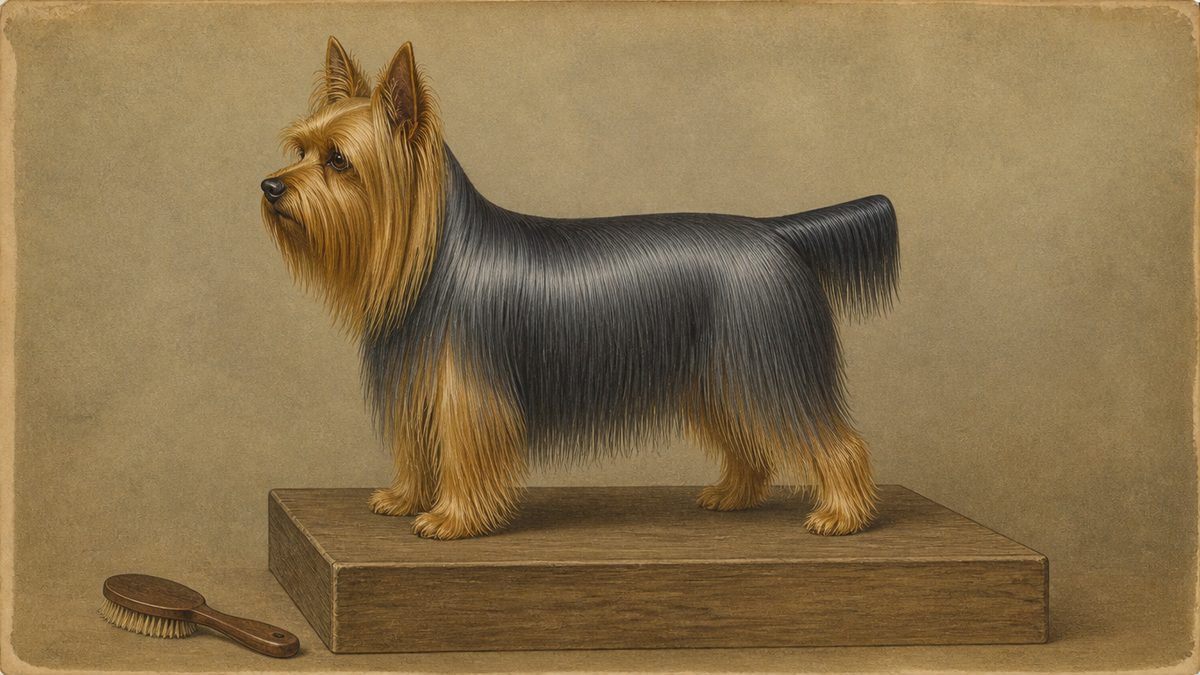
Nineteenth-century exhibitors stood these dogs on a low wooden box so the full length of the coat could hang clear of the ground and be seen. The Skye Terrier Club of America records the practice directly. It is the detail that explains the breed better than any measurement: an animal whose entire competitive value was a curtain of hair that had to be lifted off the floor to be judged.
Registry recognition today: none anywhere, checked with controls
No kennel club on earth holds the Paisley or Clydesdale Terrier today, and three registers were read in full with in-document controls to establish that rather than assumed.
An absence is a strong claim, so each row below carries a control that returned in the same document and in the same session. A reader can repeat every check by opening the same index and searching for the same control words.
| Register | Breed found? | Controls that returned in the same document |
|---|---|---|
| The Royal Kennel Club, complete Breeds A to Z | No. Clydesdale 0, Paisley 0 | Skye, Yorkshire, Silky, Dandie, Cairn, Labrador, Beagle, Bulldog and King Charles all present |
| FCI nomenclature, letter C index | No. The index holds 44 entries | Cairn Terrier 4 and Cesky Terier 246 present in the same index |
| FCI nomenclature, letter P index | No. The index holds 27 entries | Parson Russell Terrier 339 and Pekingese 207 present in the same index |
| United Kennel Club, all nine groups in one page | No, in none of the nine | Terrier group of 45 entries including the Skye's and the Yorkshire's relatives; Bloodlines Listing Service Group of 10 |
A retrieval warning worth carrying away
The Royal Kennel Club's Breeds A to Z was fetched twice in this session and the first fetch was worthless. Excluding anchor tags to reduce the page size emptied the breed list, because the index is a list of links, and the Labrador control returned zero on that fetch while the page still returned HTTP 200 with the correct title. Anyone reading an absence off that first fetch would have got the right answer for entirely the wrong reason, and would have got a false absence on any breed the register does hold. The second fetch, with anchors kept, returned every control.
What this means for the Kennel Club of India
There is no Indian pedigree route for this breed and there never can be one. India is a full member of the Federation Cynologique Internationale, represented by the Kennel Club of India at Anna Nagar, Chennai. An Indian pedigree is therefore issued against FCI nomenclature, and FCI nomenclature holds no Paisley Terrier under P and no Clydesdale Terrier under C. That is not a criticism of the Kennel Club of India. It is the mechanical consequence of a name no international register holds.
This breed is unrecognised today, and the word is doing precise work. Unlike most extinct dogs on this site, it is not a breed that never reached a registry. It reached one, held a Kennel Club Stud Book classification from 1888, and lost it when the dogs ran out. A registry class is an event with a date attached rather than a permanent property, and this breed's own history is the clearest demonstration of that on the site.
Paisley Terrier price in India: there is none, and here is what the search actually returns
No Paisley Terrier price in india exists, because no Paisley Terrier exists. The breed has been gone for roughly ninety years, and the Indian search for it returns a Google answer priced in US dollars for a different living breed.
Start with the finding rather than the disclaimer. Google India, asked about this breed on 10 September 2026, answered with the price of Australian Silky Terriers in United States dollars. The People also ask module's first question was "How expensive are silky terriers?", and the answer beneath it quoted 1,200 to 2,800 dollars from American breeder listings, 150 to 400 dollars for adoption, and 5,000 dollars or more for show-quality dogs, sourced to US puppy marketplaces.
Brave Search, run in the same session with country set to IN, produced a different picture again: twenty genuine on-breed results and no question module at all, while its own Labrador control did return one. Two engines, one session, and they disagree about whether Indian searchers ask anything about this breed.
Three separate things are wrong with Google's answer as a response to an Indian question, and they are worth separating because each is a different failure.
- It is a different breed. The Australian Silky Terrier is a living Australian breed developed from Yorkshire and Australian Terrier crosses. The Paisley Terrier is a nineteenth-century Scottish show breed that is extinct. They share a nickname and nothing else.
- It is a different currency. Every figure in that answer is in dollars, presented on an Indian search with the India footer showing. No conversion is offered and none should be attempted, because converting an American breeder's asking price into rupees produces a number that describes no Indian transaction at all.
- It is a different market. Those are US marketplace listings. An Indian buyer cannot transact on any of them for a dog, because India's import policy does not permit importing a dog for trade or breeding.
The historical price, which is the only real one this breed ever had
One genuine price for this breed does exist, and it is 130 years old. Rawdon Lee, arguing in 1894 that the variety had no commercial future, wrote that a breeder could not sell a Paisley terrier "for more than 15 or 20 pounds, when they can, with less difficulty, breed an equally good Scottish terrier that would be worth double the money". That is a market observation from inside the trade, and it is also the extinction mechanism stated plainly: the dog was worth half what its competitor was worth.
This page does not convert that figure into modern rupees. A currency conversion across 130 years, two currencies and a decimalisation is arithmetic that looks precise and means nothing.
Walk away, and not because the price is high. There is no dog to sell. Any Indian listing under this name is either a Yorkshire Terrier, a long-coated crossbreed, or an auto-generated page that exists identically for several hundred breed names. The tell is that no pedigree can accompany it: the Kennel Club of India issues pedigrees against FCI nomenclature, and the FCI holds nothing under either of this breed's two names. Ask to see the registration document before you discuss money, and the conversation will end there.
What an Indian buyer is actually being offered instead
The Yorkshire Terrier, in almost every case. It is freely available in India, it is the breed every source names as this one's descendant, and it carries a shorter and more manageable version of the same silky coat. Bonbeno's Yorkshire Terrier page carries the current Indian price picture and the source disagreements behind it, and it is the right page to read before spending money.
Monthly cost of ownership in India for a long-coated dog of this size
A 5 to 8 kg dog with a long single coat costs roughly Rs 4,500 to Rs 9,000 a month to keep properly in an Indian metro, and grooming rather than food is what moves that number.
The arithmetic is worth doing even for a dog you cannot buy, because it is the real answer to the question that brought most readers here. Every figure below was read from the seller's or the municipality's own page and the URL is in the citation. Retail prices move, so re-check any row before you budget on it.
| Item | Published price | Notes |
|---|---|---|
| Royal Canin Mini Adult dry food, 8 kg | Rs 5,861, MRP Rs 6,660 | Rs 73 per 100 g at this pack size |
| The same food, 800 g pack | Rs 810, MRP Rs 880 | Rs 101 per 100 g, a 38 percent unit-price penalty for buying small |
| Anti-rabies vaccine | Rs 699 | Vetic clinic list price, per dose |
| 9-in-1 DHPPiL | Rs 899 | Vetic clinic list price, per dose |
| Kennel cough | Rs 1,349 | Vetic clinic list price, per dose |
| Deworming, Drontal Plus | Rs 125.67 per tablet | One tablet per 10 kg, so a single tablet covers this size |
| Professional grooming, haircut | from Rs 1,359 | Vetic Delhi. For this coat, every 4 to 6 weeks rather than occasionally |
| Professional bath and styling | from Rs 1,869 | Vetic Delhi |
| Boarding, 24 hours | Rs 899 | PawSpace Bengaluru overnight rate |
| Delhi MCD pet dog registration | Rs 500 | Renewal also Rs 500, late fee Rs 100 a month |
| Chennai GCC pet licence | Rs 50 | Six municipal clinics also give treatment and anti-rabies vaccination free |
| Microchipping, Chennai | Rs 1,250 | SKS Veterinary Hospital's own transacted price |
Food is the row people budget for and it is not the row that decides the monthly cost. At Rs 73 per 100 g, every 100 g a feeding chart specifies costs about Rs 2,190 a month, so a small dog's food bill is genuinely modest. Professional grooming at Rs 1,359 to Rs 1,869 a visit, every four to six weeks, runs to Rs 1,200 to Rs 1,900 a month on its own and is the single largest recurring line for any long-coated dog in India.
Two one-off costs sit outside the monthly cost and are worth planning for separately. Boarding in Bengaluru runs Rs 599 for up to four hours, Rs 799 for daycare to ten hours and Rs 899 for an overnight stay to 24 hours at one operator's published rates, which matters if you travel. Microchipping in Chennai, where the corporation's mandate is live, costs Rs 1,250 at one clinic's own transacted price. Deworming adds Rs 125.67 a tablet at one tablet per 10 kg.
Buy the same food in an 800 g bag and you pay Rs 101 per 100 g; buy it in an 8 kg bag and you pay Rs 73. That is 38 percent more for the small pack, on an identical product from the same seller on the same day. Small-dog owners buy small bags because the dog is small, which is exactly backwards. Buy the largest pack the dog will finish inside its shelf life, and store it sealed and cool, which the manufacturer's own storage line requires.
Two municipal facts worth more than any private rate card
Greater Chennai Corporation's six pet clinics provide treatment and anti-rabies vaccination free of cost, and the corporation issued 9,115 pet licences in 2024 at Rs 50 each. Delhi's MCD has issued 18,958 pet dog certificates since 2021 at Rs 500. For a reader comparing cities, a free municipal rabies route is a larger practical saving than any discount on kibble, and neither figure is a price that will move next quarter.
Could a Paisley Terrier handle the Indian climate? The heat tolerance answer
Bonbeno rates the Paisley Terrier 1 of 5 for heat tolerance, and the rating is an inference from origin climate and coat structure rather than a measurement, because no measurement of this breed was ever taken. India's coolest large city in its coolest month is more than ten degrees warmer than the breed's home town in its warmest.
NASA POWER was queried by explicit latitude and longitude for Paisley in Renfrewshire, 55.8456 north and 4.4239 west, rather than by a place-name slug, because a slug can silently serve another town's document.
The Paisley query returned a cell elevation of 193.50 m against a town centre that sits close to 12 m on the White Cart Water. That is an error of about 180 m, and the reason is the Gleniffer Braes immediately south of the town, which rise past 350 m and sit inside the same grid square. A separate query for Glasgow, 14 km away, returned a BYTE-IDENTICAL series to the decimal, which means the two towns share one cell and cannot be used to check each other. Both readings describe the same square of west-central Scotland, and that is close enough for the comparison this section makes, but a reader should know the figure is a cell rather than a street.
| Place | Cell elevation | Annual mean C | Annual RH % | Warmest month | Peak wet bulb C |
|---|---|---|---|---|---|
| Paisley, Renfrewshire | 193.50 m vs about 12 m | 7.88 | 90.07 | Jul 13.85 | 12.24 (Jul) |
| Bengaluru | 841.72 m vs 920 m | 23.74 | 67.94 | Apr 28.37 | 21.86 (May) |
| Mumbai | 97.15 m | 26.77 | 67.39 | May 31.19 | 25.77 (Jun) |
| Delhi | 206.37 m vs 216 m | 25.60 | 45.56 | Jun 35.88 | 26.50 (Jul) |
| Chennai | 48.95 m vs about 6 m | 27.95 | 72.39 | May 31.51 | 26.11 (May) |
| Kolkata | 7.35 m | 25.81 | 73.93 | May 31.53 | 27.09 (Jun) |
The gap, stated as one number
Paisley's warmest month averages 13.85 C. Chennai's coolest month averages 24.09 C. The difference is 10.24 degrees, and it runs in the direction that matters: the coolest month an Indian coastal city offers is more than ten degrees hotter than the hottest month this breed's home town ever managed. There is no Indian season this dog would have recognised.
Bengaluru is the best case and it is still not close. Its annual mean of 23.74 C is 15.86 degrees above Paisley's, and its April average of 28.37 C is more than double Paisley's July. For a heat-sensitive breed with a floor-length coat and no undercoat, the practical reading is that no Indian city would have been comfortable and the hill stations are the only places worth discussing.
- Judge the month by its wet bulb, not its temperature. Kolkata's June wet bulb of 27.09 C is the highest figure in the table above, and Kolkata is not the hottest city in it.
- Walk before sunrise and after dark from March to June in any plains city, and test the pavement with the back of your hand before the dog's feet touch it.
- Watch a long coat for what it hides. A dense hanging coat conceals both the skin underneath and the outline of a dog that is losing condition in heat.
- Treat the monsoon as a skin season rather than a cool one, because humidity rises while temperature barely falls.
India's Dog Breeding and Marketing Rules 2017, Second Schedule Part IV paragraph 21(1), bar keeping dogs in outdoor facilities without the attending veterinary practitioner's written approval where the animals are not accustomed to local temperatures, and the clause names "long-haired breeds in high temperature locations" explicitly. For this coat that clause is not an abstraction. It describes the exact animal.
Humidity, wet bulb, and the assumption this breed disproves
Indian humidity is not what would have troubled a Paisley Terrier, and saying so is a correction rather than a hedge. Paisley in Renfrewshire runs 90.07 percent annual relative humidity, which is higher than Mumbai, Chennai or Kolkata. What decides is heat, and heat combined with humidity.
The reflex on a page like this is to warn that Indian damp will overwhelm a British dog. The measurement says the opposite, and this breed produces the clearest example of it anywhere on this site.
| Place | Annual RH % | Annual mean C |
|---|---|---|
| Paisley, Renfrewshire | 90.07 | 7.88 |
| Kolkata | 73.93 | 25.81 |
| Chennai | 72.39 | 27.95 |
| Bengaluru | 67.94 | 23.74 |
| Mumbai | 67.39 | 26.77 |
| Delhi | 45.56 | 25.60 |
Paisley is 16.14 percentage points more humid than Kolkata, which is the dampest Indian city in the table, and almost twice as humid as Delhi. It is 22.68 points more humid than Mumbai, a city Indian owners routinely describe as oppressively damp. A dog bred in the Clyde valley came out of some of the wettest air in Europe. Damp is its native condition.
Wet bulb is where the two places actually separate
A wet bulb temperature combines heat and humidity into the single number that decides whether an animal can shed heat by evaporation at all. Computed with the Stull method from NASA POWER's own air temperature and relative humidity, the gap is enormous.
| Place | Peak wet bulb C | Month | Gap from Paisley |
|---|---|---|---|
| Paisley, Renfrewshire | 12.24 | July | baseline |
| Bengaluru | 21.86 | May | +9.62 |
| Mumbai | 25.77 | June | +13.53 |
| Chennai | 26.11 | May | +13.87 |
| Delhi | 26.50 | July | +14.26 |
| Kolkata | 27.09 | June | +14.85 |
Kolkata's peak wet bulb sits 14.85 degrees above Paisley's, and even Bengaluru, the mildest Indian city on this site, is 9.62 degrees above it. That is the honest statement of the problem, and it is a statement about heat load rather than about damp air.
Both surviving standards for this breed insist on a coat with an entire absence of undercoat. A double coat is often defended in hot climates on the grounds that it traps an insulating layer of air, and whatever the merits of that argument it does not apply here, because there is no undercoat to trap anything. What this breed carried was a long, heavy, dead-straight curtain lying flat against the skin, which impedes airflow at the skin surface without providing insulation. That is the worst of both arrangements, and it is the reason the heat tolerance rating on this page is 1 rather than 2.
For a living long-coated small dog in an Indian metro the reusable advice is the same one Indian owners of Maltese, Shih Tzu and Yorkshire Terriers already need: keep the coat clean and dry to the skin, get the dog dry after every bath rather than letting it air dry, and treat a dog that is panting in shade and not settling within five minutes as an emergency rather than as a hot afternoon. Consult your nearby vet before changing anything about how a heat-sensitive dog is exercised in an Indian summer.
Temperament: what the record says, and who was saying it
Every surviving description of this breed's temperament was written by people promoting it, so read them as breed-club copy rather than as observation. What they consistently describe is a good-natured indoor companion rather than a working terrier.
D. J. Thomson Gray, quoted at length by Lee in 1894, is the fullest account: "In character and disposition, the Paisley terrier resembles the Skye, being good-natured, intelligent, and lively. They make excellent house pets, and those who desire something more substantial than a toy will find in the elegant shape and pleasing outline of the Paisley terrier something to please them. They are not delicate, but require a good amount of attention in washing, combing, and brushing, to keep them in good order.";
The Clydesdale Club's own standard makes the same claim as a point of merit, and it names its rivals while doing it. The breed "has not the delicate constitution which makes the Yorkshire, Maltese, and others only fit for indoors";. That is a marketing sentence inside a breed standard, aimed squarely at the two breeds this one was competing against, and it should be read with that in mind.
What is actually usable from this
Two things, and they are worth separating from the sales copy around them.
- The breed was selected for tolerance of handling, not for work. A dog whose coat needs daily combing, whose feet were bagged in wash-leather to stop it scratching, and whose hair was tied back over its eyes had to accept a great deal of interference. Dogs that objected did not win and were not bred from.
- The terrier drive was never removed, only unused. Lee is explicit that the dog "can kill rats, and maybe other vermin" while being kept as a pet. A hundred and thirty years later the Yorkshire Terrier still surprises Indian owners with exactly this, and the surprise is a failure of expectation rather than of the dog.
It is tempting to read Gray's description across onto the Yorkshire Terrier or the Australian Silky Terrier, because they are this breed's nearest living relatives. Do not. Temperament is not inherited as a block, a hundred and thirty years of separate selection sits in between, and no behavioural study of the Paisley Terrier exists to compare against. Read the living breed's own page for the living breed's behaviour.
Training: what this breed was actually taught, and what transfers
Training a Paisley Terrier meant teaching one thing above all others, which was to stand still and be handled, and that is the only part of its training record that transfers usefully to a small long-coated dog in India today.
There is no training manual for this breed and there never was one. What the record contains is a description of what the dogs had to put up with, and it amounts to a specification.
Lee records three practices in one paragraph. The coat needed "repeated combing and brushing"; "at times the feet of the Paisleys are covered with wash-leather coverings in order that they do not wear away the hair therefrom, and to prevent them unduly scratching and spoiling their coats"; and "I have likewise seen the hair of the Paisley terrier tied back over the eyes". A dog that accepts covered feet, a tied topknot and daily combing has been trained to a standard most modern pet dogs never reach.
The three things worth copying, for a living dog
- Train handling before you need it. Teach a puppy to lie on its side and have every part of the coat lifted and combed, in short sessions, from the week it comes home. Grooming a dog that has never been taught to accept it is the commonest reason an Indian owner ends up shaving a long coat off entirely.
- Train the feet separately. Nail trimming and paw handling are refused far more often than body brushing, and a dog that will not give its feet costs money at every grooming visit.
- Train a settled stand. Two minutes standing still on a raised surface is the single most useful behaviour for any dog that will be groomed professionally, and it is what the show box taught these dogs by force.
The wash-leather foot coverings Lee describes were used to protect a show coat and they are not a practice to copy. Covering a dog's feet for cosmetic reasons restricts a normal behaviour and would sit uncomfortably beside the Prevention of Cruelty to Animals (Dog Breeding and Marketing) Rules 2017, whose Second Schedule Part II paragraph 6(8) forbids any change of appearance by artificial means. Teach the dog to tolerate handling instead of restraining it.
Exercise: a small terrier's real requirement in an Indian city
A dog of this size and build needs two short walks a day plus indoor activity, and in an Indian summer the constraint is the time of day rather than the distance.
No exercise record exists for this breed, and inventing one would be dishonest. What the documents do establish is body plan: a long, low, long-bodied dog under about 8 kg that was kept indoors and shown, not worked. That is the profile of an animal with real energy and short legs.
For a living small terrier in India the workable pattern is short and frequent rather than long and occasional.
- Two walks of 20 to 30 minutes, before sunrise and after dark from March to June in any plains city.
- Indoor scentwork or a food-puzzle session daily. A terrier that cannot use its nose finds something else to do, and in a flat that is usually barking.
- No stairs as exercise for a long-backed dog. Repeated stair descent loads the spine of a long, low dog in a way flat walking does not.
- Stop for the day if the dog is panting in shade and not settling within five minutes. Exertional heat illness is the commonest form in dogs, not the hot-car form.
Hall and colleagues, working across 905,543 UK dogs under primary veterinary care in 2016, found that of the 879 heat-related illness events with a recorded trigger, 652 were exertional, which is 74.2 percent. The same team's companion paper reports that dogs at or above their breed and sex mean bodyweight carried 1.42 times the odds of heat-related illness. Neither paper models this breed, which did not exist when the data was collected, so the transferable claims are the two general ones and nothing more.
Most heat emergencies in dogs happen during exercise, not in parked cars. That inverts the warning Indian owners usually hear. A morning walk pushed thirty minutes later into a Chennai May is a more realistic risk than a car, and it is entirely under the owner's control.
Grooming a floor-length coat with no undercoat, in Indian humidity
This coat is the highest grooming load of any breed in this batch, and the reason is structural: a dead-straight silky coat with no undercoat reaches the floor, mats against itself, and traps moisture at the skin in a way no amount of brushing at the surface can fix.
The period record is unusually explicit here, and it is the strongest evidence this page has about daily life with the animal.
Both standards specify the coat as long, dead straight, glossy, silky and with an entire absence of undercoat, parted from the nose to the root of the tail. Lee records that owners comb and brush it repeatedly, tie the hair back over the eyes, and bag the feet to stop the dog damaging its own coat. That is a full-time maintenance job, and Lee names it as the reason the breed failed commercially: "the trouble to keep the coat in good order will always be a bar to them as ordinary house dogs";.
What that coat does in an Indian monsoon
Three problems compound, and they are the same three that Indian owners of Maltese, Shih Tzu and long-coated Yorkshire Terriers already meet.
- A single coat dries slowly and lies flat. With no undercoat to lift it, a wet coat stays against the skin. Skin that stays damp for hours is where monsoon skin disease starts.
- Floor length collects everything. A coat that touches the ground picks up water, mud and organic matter on every walk, which in an Indian monsoon means the dog carries the street home in its coat.
- Mats form under the surface first. A silky coat mats at the skin while the top still looks glossy, which is why owners are surprised when a groomer says the only option left is to clip.
| Task | Frequency | Why it matters here |
|---|---|---|
| Line brushing to the skin, not surface brushing | Daily | Mats form under the surface, so a brush that only touches the top of the coat achieves nothing |
| Comb through with a metal comb after brushing | Daily | The comb is the test. If it will not pass to the skin, the brush did not do its job |
| Dry to the skin after every bath and every wet walk | Every time | Never air dry a single coat in Indian humidity. Towel, then a cool dryer, then comb |
| Trim the coat off the floor | Every 4 to 6 weeks | A trimmed working length is not a failure. It is what makes the coat survivable in a monsoon |
| Check the skin under the coat in daylight | Weekly | Ticks, hot spots and lesions are invisible under a long coat until they are advanced |
| Professional groom | Every 4 to 6 weeks | Rs 1,359 for a haircut and Rs 1,869 for a full bath and styling at Vetic Delhi list prices |
The usual Indian warning is never to clip a double coat, because clipping wrecks the undercoat's insulating structure. This coat has no undercoat, so that objection does not apply to it or to its living descendants. Clipping a Yorkshire Terrier or a Maltese to a short working length in an Indian summer removes a genuine burden and costs the dog nothing structural. Ask your nearby vet or a groomer who knows the coat type before assuming a rule written for a Siberian Husky applies to a silky terrier.
Health and life expectancy: nothing is known, and that is said three times
No health data of any kind exists for the Paisley Terrier. There is no life expectancy figure, no screening scheme, no breed health survey and no genetic work, and that absence was established with controls rather than assumed.
This is the section where content farms invent things, so here is exactly what was searched and exactly what came back.
| Query | Records | Query translation PubMed actually ran |
|---|---|---|
| "Paisley Terrier"[tiab] | 0 | "Paisley"[All Fields] AND "Terrier"[Title/Abstract] |
| "Paisley Terriers"[tiab] | 0 | "Paisley"[All Fields] AND "Terriers"[Title/Abstract] |
| "Clydesdale Terrier"[tiab] | 0 | ("clydesdale"[All Fields] OR "clydesdales"[All Fields]) AND "Terrier"[Title/Abstract] |
| "Clydesdale Terriers"[tiab] | 0 | same, plural |
| "Yorkshire Terrier"[tiab], control | 312 | "yorkshire terrier"[Title/Abstract] |
| "Skye Terrier"[tiab], control | 8 | "skye terrier"[Title/Abstract] |
Singular and plural were both run, because the tiab field does not stem plurals and a single-form query can lose half a breed's literature. No query was silently rewritten into an author search, and no quotedphrasesnotfound warning fired. Both controls returned in the same session. The zero is real.
So this page publishes no lifespan, no disease list and no screening advice for the Paisley Terrier itself. Anything you read elsewhere under those headings is generated.
What the two living breeds on either side of it do carry
The useful health issues are the ones a reader can act on, and they belong to the breeds this one sits between.
| Breed | Finding | Study |
|---|---|---|
| Yorkshire Terrier | Median age at death 13.56 years across 464 deaths, from a UK primary-care population of 28,032 dogs. Periodontal disease diagnosed in 21.10 percent of a reviewed sample of 3,308. Median adult bodyweight 5.06 kg | O'Neill 2025, VetCompass |
| Yorkshire Terrier | Commonest disorder groups causing death were brain disorders at 9.79 percent and kidney disorders at 8.73 percent | O'Neill 2025 |
| Skye Terrier | Copper-associated hepatitis described as a distinct disease entity in nine related dogs, with hepatic copper of 801 to 2,257 micrograms per gram | Haywood 1988 |
| Skye Terrier | First reported successful management of Skye terrier hepatopathy, in a one-year-old bitch with acquired portosystemic shunts | McGrotty 2003 |
| Skye Terrier | Of 112 dogs across three chondrodysplastic breeds, the Skye had the most carpal valgus, the most lateral radial head subluxation and the largest prevalence of moderate and severe elbow incongruity | Lappalainen 2022 |
The Skye Terrier's record is the more sobering half and it is worth reading in the original. Haywood and colleagues examined the livers of nine related Skye terriers and found hepatic copper of 801 to 2,257 micrograms per gram, concluding that "Skye terrier hepatitis is a distinct disease entity". Fifteen years later McGrotty and colleagues published what they described as the first successful management of Skye terrier hepatopathy, in a one-year-old neutered bitch presenting with anorexia, vomiting, seizures and ascites and carrying multiple acquired portosystemic shunts. Separately, Lappalainen and colleagues measured 224 front limbs across 112 dogs of three chondrodysplastic breeds and found the Skye terrier had the most carpal valgus, the most lateral radial head subluxation and the largest prevalence of moderate and severe elbow incongruity of the three.
The Yorkshire Terrier's numbers are the ones an Indian reader can act on today, because that is the dog available here. A median age at death of 13.56 years is high, and it supports the paper's own conclusion that the breed has robust overall health. Periodontal disease at 21.10 percent of a reviewed sample of 3,308 dogs is the finding to plan around, and it is preventable rather than genetic in most dogs: daily tooth brushing from puppyhood is the single highest-value habit for any small breed. The same study puts median adult bodyweight at 5.06 kg and names brain disorders at 9.79 percent and kidney disorders at 8.73 percent as the commonest disorder groups causing death.
It is tempting to assume that a breed made out of Skye Terriers inherited Skye terrier hepatopathy and the Skye's front-limb deformity. There is no evidence either way, the Paisley was selected away from the Skye's build for decades, and copper storage disease is a specific inherited defect rather than a general property of related dogs. Naming what is unknown is more useful than filling it in. Consult your nearby vet about any liver or limb concern in a living dog rather than reasoning from a nineteenth-century pedigree.
The two Indian health risks a small long-coated dog would actually face
Two risks dominate for a small dog living in India, and neither is inherited: tick-borne disease and exertional heat illness. A long coat makes the first harder to detect and the second harder to survive.
Tick-borne disease is the largest documented threat to a dog in India and it is under-appreciated by owners who came for a breed page. Four Indian studies, all molecular rather than microscopic, give the scale.
| State | Dogs screened | Finding |
|---|---|---|
| West Bengal | 584 | Babesia gibsoni in 76.54 percent; Anaplasma in 55.75 percent; 72.9 percent of the 584 screened carried two or more pathogens |
| Kerala | 120 | Babesia in 66.7 percent, 80 of 120; Ehrlichia canis in 5.0 percent; peak in the pre-monsoon months of March to May |
| Odisha | 178 | Ehrlichia canis in 31.46 percent, 56 of 178; 79 percent of infected dogs had a tick history |
Every one of these studies sampled dogs presented at veterinary clinics or clinically suspected animals, not a random population of Indian dogs. So 76.54 percent is the proportion among dogs tested at clinics, and it is materially misleading without that qualifier. What the figures do establish beyond argument is that these pathogens are common and often present together in Indian dogs sick enough to be tested, which is the reason tick control is not optional here.
The Kerala series is the most useful of the three for timing, because it reports a peak in the pre-monsoon months of March to May rather than in the monsoon itself, which is when most Indian owners start thinking about parasites. The Odisha series is the most useful for behaviour: 79 percent of infected dogs had a recorded tick history, which is a reminder that the exposure is visible and preventable rather than mysterious. The West Bengal series is the one that establishes co-infection, with 72.9 percent of the 584 dogs screened carrying two or more pathogens.
For a long-coated dog the practical problem is detection. A tick on a smooth-coated dog is visible; a tick under a floor-length silky coat is not, and the weekly skin check in the grooming section above is the only thing standing between an owner and a missed attachment. Combine that with a year-round preventive your vet chooses for your city, and deworm on a schedule rather than when you remember: Drontal Plus is dosed at one tablet per 10 kg of bodyweight, so a small dog needs a single tablet, at Rs 125.67 a tablet.
Heat illness, and the form that actually kills
The second risk is exertional and it is the owner's decision rather than the dog's. Of 879 UK heat-related illness events with a recorded trigger, 652 were exertional, 113 environmental and 46 vehicular confinement. The vehicular form is the one owners fear and it is the smallest category of the three.
In an Indian city that means the morning walk is the intervention. Move it earlier, shorten it in May, carry water, and stop when the dog stops. A small dog carries a small absolute water reserve and stands with its whole body inside the superheated layer of air just above hot pavement, which is a worse position than a tall dog occupies.
Vaccination is the third leg and it is cheap relative to the risk. At Vetic's published list prices an anti-rabies dose is Rs 699 and a 9-in-1 DHPPiL is Rs 899, while Greater Chennai Corporation's six municipal clinics give anti-rabies vaccination free of cost. Consult your nearby vet on the schedule your city and your dog's history actually need.
Feeding a 5 to 8 kg dog in India, and the pack-size trap
Feed a small dog to a body condition score rather than to a chart, and buy the largest pack it will finish inside the shelf life, because small-breed food carries a 38 percent unit-price penalty in small bags.
Nobody can tell you what a Paisley Terrier ate, because no feeding record for the breed exists. What follows is what a living dog of that size costs to feed properly in India, priced from a seller's own page on 10 September 2026.
| Pack | Price | MRP | Per 100 g |
|---|---|---|---|
| 800 g | Rs 810 | Rs 880 | Rs 101 |
| 2 kg | Rs 1,883 | Rs 2,140 | Rs 94 |
| 4 kg | Rs 3,388 | Rs 3,850 | Rs 84 |
| 8 kg | Rs 5,861 | Rs 6,660 | Rs 73 |
| 16 kg, 2 x 8 kg | Rs 11,722 | Rs 13,320 | Rs 73 |
The 800 g bag costs 38 percent more per 100 g than the 8 kg bag, for an identical product from the same seller on the same day. Small-dog owners buy small bags because the dog is small, and that instinct is expensive. Buy the biggest pack the dog will finish inside its shelf life and store it sealed, cool and dry, which the manufacturer's own storage instruction requires.
None of those figures divides cleanly by 84.38, 80 or 74, so this is a rupee-native price list rather than a converted American one. Worth knowing, because Indian breed pages routinely publish dollar prices with the symbol swapped.
How to turn a per-100-gram price into a monthly cost
The arithmetic is simple and it belongs to the reader rather than to this page, because the grams depend on the individual dog. At Rs 73 per 100 g, every 100 g a day costs about Rs 2,190 a month. Read the feeding chart on the pack for your dog's weight, then multiply. This page does not publish a grams-per-day figure because it did not obtain the chart, and a monthly cost built on a guessed feeding rate is a guess with a decimal point.
- Feed to body condition, not to the bag. You should feel ribs easily under a thin layer of fat and see a waist from above. On a long-coated dog you must feel for this, because the coat hides the outline completely.
- Split into two meals for an adult, three for a puppy, and never one large meal.
- Do not free-feed in monsoon humidity. Food spoils faster than owners expect, and free-feeding hides the appetite change that is often the first sign a dog is unwell.
- Check where the food was made. This product's own label gives country of origin France, manufacture in South Africa, and import and marketing by Royal Canin India Private Limited in Mumbai, which is worth knowing when a seller claims a bag is locally produced.
The first year, month by month, and why this timeline is not about a Paisley
No month-by-month timeline for a Paisley Terrier puppy can be honest, because no source describes one. What follows is the first year of a small long-coated puppy in India, anchored on the dates Indian law and Indian veterinary practice actually set.
Everything below is dated from an Indian instrument or an Indian price list rather than from a breed history, which is why it is usable and the breed's own record is not.
| Age | What happens | Where the date comes from |
|---|---|---|
| Under 8 weeks | The puppy may not lawfully be sold. Rule 8(1)(a) of the Dog Breeding and Marketing Rules 2017 provides that pups less than eight weeks in age are not sold | Indian gazette, Rules 1 to 13 |
| 8 to 10 weeks | Home. Begin daily handling: lie the puppy on its side, lift and comb sections of coat, handle every foot. Two minutes at a time | |
| 8 to 16 weeks | Core vaccination course. Vetic's published per-dose prices are Rs 849 for puppy DP, Rs 899 for 9-in-1 DHPPiL and Rs 699 for anti-rabies | Vetic clinic list, read 10 September 2026 |
| 3 to 4 months | Register the dog with the municipality. Delhi MCD charges Rs 500, Greater Chennai Corporation Rs 50 | The municipalities' own pages |
| 3 to 4 months | Microchip if your city requires it. Chennai's mandate is live and a clinic's own transacted price is Rs 1,250 | SKS Veterinary Hospital, Chennai |
| 4 to 6 months | First professional grooming visit, before the coat is long enough to matter. The point is the experience, not the haircut | |
| 6 months | Adult coat begins to come through on a long-coated breed, and matting rates rise sharply. Move from brushing to line brushing plus a comb check | |
| 6 to 12 months | Begin daily tooth brushing if you have not already. Periodontal disease reaches 21.10 percent in UK Yorkshire Terriers under primary care, and it is the most preventable common disorder in small breeds | O'Neill 2025 |
| 12 months | Full adult grooming cycle: every 4 to 6 weeks at Rs 1,359 upward for a haircut, plus daily home work |
Rule 8(1)(a) is a Rule of the 2017 Rules rather than a Second Schedule paragraph, and it is genuinely enforceable. A seller offering a six-week-old puppy is breaking it. That single question, asked before any other, filters out a large share of bad Indian sellers, and it works on any breed.
Indian law: the coat, the creation of breeds, and why no import authorisation exists
Three Indian provisions reach this breed's story directly. Import policy makes any dog a Restricted import, the 2017 Rules prohibit breeding to create new breeds or unusual looks, and the same Rules bar keeping a long-coated dog outdoors in the heat without written veterinary approval.
There is no import route, and the reason is not this breed
Dogs enter India under ITC(HS) 01061900 as a Restricted import, and the Directorate General of Foreign Trade's own guidance limits entry to six named ports and routes anything outside the personal pet allowance through the Exim Facilitation Committee. DAHD added a seventh port, Cochin International Airport at Kochi, for pets arriving under the baggage rules in October 2024. Directorate General of Foreign Trade An import authorisation for a commercial or breeding consignment is not something an ordinary buyer can obtain, and for this breed the question never arises, because there is nothing anywhere to import. Recording it matters anyway: it is the reason no Indian supply chain for a rare foreign breed can form even when the animals do exist. The full route is set out in how to import a dog to India.
Recreating this breed would be unlawful in India
This is the provision that reaches a page like this most directly, and it catches every revival project. Second Schedule Part II paragraph 6(9) of the Prevention of Cruelty to Animals (Dog Breeding and Marketing) Rules, 2017 reads: "Breeding to create new breeds of dogs or unusual looks shall be strictly prohibited."; Several pages ranking for this breed suggest it could be recreated from the Skye Terrier and the Yorkshire Terrier because both survive. In India, a deliberate programme to reconstruct an extinct breed is a programme to create a breed, and the text does not carve out an exception for historical reconstruction.
Paragraph 6(3) of the same Part prohibits two named mating techniques: in-breeding, defined as breeding between relatives of the second to fourth grade within the first four generations, and incest breeding between parents and children or brother and sister. Any reconstruction from a handful of founders would need exactly those matings, which is a second and independent bar.
| Provision | What it says | Why it applies here |
|---|---|---|
| Rule 8(1)(a) | Pups less than eight weeks in age are not sold | The one enforceable date any Indian puppy buyer can check |
| Second Schedule Part II para 6(3) | In-breeding within four generations and incest breeding are prohibited | Any revival from few founders requires the matings this bars |
| Second Schedule Part II para 6(8) | No tail docking, ear cropping, de-barking, de-clawing, branding, dyeing, and no change of appearance by artificial means | Reaches the wash-leather foot coverings and the tied topknot the period record describes |
| Second Schedule Part II para 6(9) | Breeding to create new breeds of dogs or unusual looks is strictly prohibited | Reaches any attempt to recreate this breed |
| Second Schedule Part III para 8(10) | Breeding dogs must have been tested for named genetic defects, the list opening with the word including | The list is illustrative, so an unlisted defect is not outside the clause |
| Second Schedule Part IV para 21(1) | Bars outdoor housing without written veterinary approval for dogs not accustomed to local temperatures and for breeds that cannot tolerate them, naming long-haired breeds in high temperature locations | Names this coat type explicitly |
The 2017 Rules run 1 to 13 and stop there. Everything numbered above 13 is a Second Schedule paragraph, not a Rule, and the Schedule's paragraphs run continuously 1 to 30 across four Parts. So "Rule 21" does not exist and appears zero times in the gazette; the outdoor-housing clause is Second Schedule Part IV paragraph 21(1). A reader who looks up the wrong citation concludes the provision is invented, which is worse than not citing it.
Enforcement is a separate question from what the text says, and this page does not claim these provisions are actively policed. What they do is settle what is lawful, which is what a reader deciding whether to fund a revival project actually needs to know.
Head to head: what an Indian buyer can actually get instead
Nobody can sell you a Paisley Terrier, so the useful comparison is between the living small silky-coated breeds available in India and the two Scottish breeds this one was made from and beside.
Compare these on coat load and size rather than on looks, because coat load is what decides whether the dog is livable in an Indian flat and looks are what sells the wrong one.
| Breed | Available in India | Coat | What the record says |
|---|---|---|---|
| Paisley Terrier | No, extinct since about the 1930s | Floor-length, dead straight, silky, no undercoat | Two written standards, a Kennel Club Stud Book class from 1888, zero health data |
| Yorkshire Terrier | Yes, widely | Long, fine, silky, single, usually kept clipped | Median age at death 13.56 years, median adult bodyweight 5.06 kg, periodontal disease 21.10 percent |
| Australian Silky Terrier | Yes, uncommonly | Silky, single, shorter than a Yorkshire's show coat | The breed Google's own answer priced when asked about the Paisley |
| Skye Terrier | Very rarely | Long, hard outer coat over a woolly undercoat | Copper-associated hepatopathy described as a distinct disease entity; the most carpal valgus of three chondrodysplastic breeds studied |
| Maltese | Yes | Long, straight, silky, single, no undercoat | The closest living match for this coat's grooming burden |
| Dandie Dinmont Terrier | Very rarely | Crisp and soft mixed, pepper or mustard | The breed nineteenth-century writers rumoured had been crossed in, on no evidence |
The honest recommendation
If the Paisley Terrier's coat is what attracted you, look at the Maltese and the Yorkshire Terrier, and read their grooming sections before their price sections. Both carry the same single silky coat in a smaller package, both are genuinely available in India, and both have a real Indian price and a real Indian grooming bill you can plan for. The Yorkshire Terrier additionally has a large modern veterinary literature, which the Paisley never will.
If what attracted you was the history rather than the dog, the pages worth reading next are the English Water Spaniel, another British breed that had a written standard and a Kennel Club presence and still died out, and the Turnspit Dog, which had neither and reaches the opposite verdict on the same test.
Size, and only in the direction the Victorians cared about. Leighton records the Clydesdale at seldom over 18 lb, roughly 8.2 kg, against a modern UK Yorkshire Terrier median adult bodyweight of 5.06 kg. The Clydesdale Club's own standard boasts that the breed "has not the delicate constitution which makes the Yorkshire, Maltese, and others only fit for indoors". Whether that was true is unknowable now, but it does tell you the Paisley was pitched as the sturdy alternative to the toy breeds, which is the opposite of how extinct show breeds are usually remembered.
What Indian readers get wrong about the Paisley Terrier, in order of cost
Seven mistakes recur, ordered here by what each one costs the person making it rather than by how often it appears.
- Paying money for one. The most expensive mistake available. There is no dog. Any Indian listing under this name is a different animal, and no pedigree can accompany it because no register holds the name.
- Taking Google's price as an answer. Asked about this breed on an Indian search, Google returned Australian Silky Terrier prices in US dollars from American breeder listings. That answer is wrong about the breed, the currency and the market at once, and it looks authoritative.
- Reading the Yorkshire descent claim as settled. Three writers make it, all three hedge it, none cites a pedigree, and no genetic test is possible because no material survives. It is the best available account, not a fact.
- Assuming it was only a variety of Skye Terrier. It had its own club, its own written breed standard with a 100-point scale, and a Kennel Club Stud Book classification from 1888. On this site's test that is a breed.
- Assuming Indian humidity is the problem. Paisley runs 90.07 percent annual relative humidity against Kolkata's 73.93. This was a wet-climate dog. Heat is the problem, and wet bulb is how to measure it.
- Budgeting for food and not for grooming. For any long single coat in India, professional grooming at Rs 1,359 to Rs 1,869 a visit every four to six weeks is the largest recurring line, and the monthly cost of food for a small dog is the smaller half of the bill.
- Believing a lifespan figure you find for this breed. PubMed holds zero records under either name, with Yorkshire Terrier at 312 as a control. Any life expectancy quoted for the Paisley Terrier was generated, not measured.
The Royal Kennel Club's Breeds A to Z was fetched once with anchor tags stripped to keep the page small, and it came back at HTTP 200 with the correct title and an empty breed list. Every control returned zero, including Labrador. Reported without the control, that fetch would have produced a confident and worthless absence claim. A failing control is never a finding, and it is worth stating on the page rather than only in a notebook.
Adoption: what to do instead, and how to verify whatever you are offered
You cannot adopt a Paisley Terrier, so the useful advice is what to do with the interest that brought you here, and for an Indian reader that starts at a shelter rather than at a breeder.
Small long-coated dogs reach Indian shelters constantly, and they reach them for a reason that is directly relevant to this page: the coat. Owners buy a Maltese or a Yorkshire Terrier for its appearance, discover what a single silky coat costs to maintain in a monsoon climate, and surrender the dog matted. A person who has read the grooming section above is exactly the person who should adopt one.
Where to look
- Municipal and NGO shelters in your own city first. Greater Chennai Corporation runs six pet clinics that provide treatment and anti-rabies vaccination free of cost, which materially lowers the cost of taking on an unknown adult dog in that city.
- Breed-specific rescue groups, which in India usually operate through city networks rather than national organisations.
- Foster-to-adopt arrangements, which are the only honest way to find out whether you can actually keep up with a long coat before you commit for fifteen years.
How to verify a seller, if you buy a living breed instead
Four checks, in this order, and the first one ends most bad conversations.
- Ask the puppy's date of birth and do the arithmetic. Rule 8(1)(a) of the 2017 Rules provides that pups under eight weeks are not sold. A seller who will not give a date, or gives one that makes the puppy six weeks old, has answered your question.
- Ask to see the registration document, and read the breed name printed on it. The Kennel Club of India issues pedigrees against FCI nomenclature. If the paperwork names a breed the FCI does not hold, the document does not mean what the seller says it means.
- Ask to see the mother, in the place the puppies live. A seller who meets you at a third location is showing you a puppy, not a breeding operation.
- Verify the health claims against a document rather than a sentence. Ask which tests were done, by which laboratory, on which parent, and on what date. Second Schedule Part III paragraph 8(10) requires breeding dogs to have been tested for named genetic defects, and the list opens with the word including, so it is illustrative rather than closed.
The town has not forgotten the dog even though the dog is gone. Paisley Heritage, a heritage body in Renfrewshire, published a piece on the breed in September 2024 describing it as Scotland's extinct showdog, which is a reminder that a breed's history can outlive its gene pool by a century.
The Paisley Terrier is not a cautionary tale about neglect. It had everything a Victorian breed was supposed to need: a club, a written standard, a scale of points, a Kennel Club classification and a town that was proud of it. What it did not have was a coat anybody could keep up with, and a market that would pay for the trouble. Lee saw that in 1894 and said so. The lesson for an Indian buyer in 2026 is the same one, and it is about grooming rather than about pedigree: choose the coat you can actually maintain in your own climate, and the rest of the decision gets easier.
Paisley Terrier: the questions people actually ask
How expensive are silky terriers?
Google returns this question when an Indian reader asks about the Paisley Terrier, and the two breeds are not the same, so answer the question that was asked and then the one that was meant. The Australian Silky Terrier is a living breed and is bought and sold in India. The Paisley Terrier is extinct and has no price anywhere on earth. Note also what Google's own answer did with the question: it priced the Silky Terrier in US dollars, on an Indian search, from American breeder listings.
Who is Paisley the dog?
Paisley is far commoner as a pet's given name than as a breed name, which is why Google asks this. The breed name comes from Paisley in Renfrewshire, the Scottish town near Glasgow where most of the breeding was done, and the same dog was also called the Clydesdale Terrier after the valley of the River Clyde. If you met a dog called Paisley today it is a name, not a breed.
Is terrier a good dog breed?
Terrier is a group rather than a breed, and the group holds 45 entries at the United Kennel Club alone, from the Airedale to the Wire Fox Terrier. Asking whether a terrier is a good dog is like asking whether a hound is. What is true across the group is that most terriers were bred to work independently against vermin, which shows up as persistence and noise rather than as disobedience.
Is a Patterdale terrier a good family dog?
The Patterdale Terrier is a different breed entirely and shares nothing with the Paisley except the first two letters of its name. It is a hard-coated working terrier from the English fells with a high prey drive, and it is a demanding pet rather than an easy one. The Paisley was the opposite: a soft-coated show and companion dog that its own breed club described as a house pet.
Was the Paisley Terrier a real breed or just a variety of Skye Terrier?
It was a breed on the test this site applies, and the evidence is documentary rather than a matter of opinion. Two written standards survive in print, one from the Clydesdale Club with a 100-point scale and one from the Skye Terrier Club of Scotland, and the Kennel Club gave the variety a classification in its Stud Book in 1888. A written standard plus a register is the whole test, and it is satisfied.
When did the Paisley Terrier go extinct?
No last registration is retrievable, so the honest answer is a documented range rather than a year. The breed was still clubbed and shown in 1894, still standing on the show bench in 1910 with exactly one living champion, reduced to a single passing mention in Ash's two-volume 1927 survey, and dated by the Skye Terrier Club of America to the end of the 1930s. The Skye and Clydesdale Terrier Club survived as an institution until 1946, long after the dogs did.
Is the Yorkshire Terrier really descended from the Paisley Terrier?
Three named nineteenth and early twentieth century writers say so and all three hedge it, and not one of them cites a pedigree. Lee 1894 offers it as his own inference and says plainly that no proof has been produced. Leighton 1910 phrases it as what a Clydesdale cross would have done. Walsh, quoted by Ash in 1927, says he was not sure how the Yorkshire terrier had been made. Treat it as the strongest available account rather than as a settled fact.
What is a Paisley Terrier price in India?
There is none, and no Indian seller can honestly quote one, because the breed has been extinct for roughly ninety years. Any rupee figure attached to this name describes a different dog. The Indian search itself demonstrates the problem: Google's own answer for this query prices the Australian Silky Terrier in US dollars from American breeder listings.
Could a Paisley Terrier have lived in India?
Badly, and the reason is heat rather than damp. Paisley in Renfrewshire runs 90.07 percent annual relative humidity, which is higher than Mumbai, Chennai or Kolkata, so this was never a dry-climate dog. Its warmest month averages 13.85 C against Chennai's coolest month at 24.09 C, and a floor-length coat with no undercoat is the worst possible arrangement for shedding heat.
What did a Paisley Terrier look like?
It was a long, low, prick-eared dog under about 8 kg with a dead-straight silky coat that reached the ground and parted from the nose to the root of the tail, steel blue over the back with a clear golden tan head, legs and feet. The Skye Terrier Club of Scotland's own text describes the coat as being like the finest silk or spun glass, with an entire absence of undercoat.
Is there any health data for the Paisley Terrier?
None at all. PubMed returns zero records for Paisley Terrier and zero for Clydesdale Terrier, in both singular and plural forms, with Yorkshire Terrier at 312 and Skye Terrier at 8 as same-session controls. No screening scheme, no lifespan study and no breed health survey exists, because the breed predates all of them and then ended.
Can I get a Paisley Terrier pedigree in India?
No, and there is no route by which one could exist. India is a full member of the Federation Cynologique Internationale represented by the Kennel Club of India in Chennai, so an Indian pedigree is issued against FCI nomenclature, and the FCI holds no Paisley or Clydesdale Terrier under either letter C or letter P. Any paperwork offered with this name is for a different dog.
Which living dog should I look at instead?
The Yorkshire Terrier, which is freely available in India and which every source names as this breed's descendant. UK primary-care data on 28,032 Yorkshire Terriers gives a median adult bodyweight of 5.06 kg and a median age at death of 13.56 years, with periodontal disease diagnosed in 21.10 percent of a reviewed sample, so plan for daily tooth brushing rather than for a fragile dog.
Was the Paisley Terrier bred from a Dandie Dinmont cross?
It was rumoured and never evidenced, and the person who recorded the rumour dismissed it. D. J. Thomson Gray, quoted at length by Lee in 1894, wrote that it had been asserted the Paisley terrier was the result of a Dandie-Skye cross but that he had seen no evidence to support the statement, and that in his opinion no cross was required at all.
Compare with similar breeds
Paisley Terrier sits in 2 Bonbeno groups. Each one compares it directly against the breeds it is genuinely an alternative to, on the same figures.