
Extinct breed
Tweed Water Spaniel: The Border Dog Inside Every Golden Retriever
It has no standard, no studbook, no photograph and no reliable eyewitness, and it is nonetheless the reason the most popular imported breed in India looks the way it does. Here is what the 1868 kennel record actually says, and what three Indian price pages say about the dog you can actually buy.
Quick answer
The Tweed Water Spaniel is extinct and cannot be bought in India or anywhere else. It was a liver-coloured curly-coated water dog of the River Tweed basin on the England and Scotland border, and in 1868 a Tweed Spaniel bitch named Belle was mated to a yellow retriever named Nous at Guisachan, producing the four bitches every Golden Retriever descends from. No registry ever held it. The living dog an Indian buyer can get instead is the Golden Retriever.
This guide summarises nineteenth-century sporting literature, kennel club and registry documents, peer-reviewed veterinary research, Indian import and breeding law, published Indian care costs and satellite climate data as general information for Indian pet owners. It is not a diagnosis and it is not treatment advice. Consult a registered veterinarian near you before acting on anything you read here, and treat heat collapse, laboured panting that will not settle in shade, or a sudden lameness in a growing large-breed puppy as reasons to call a clinic rather than to read more.
Tweed Water Spaniel trait ratings, and what each one rests on
What the Tweed Water Spaniel was, and why it still matters in India
The Tweed Water Spaniel was a liver-coloured curly-coated water dog of the River Tweed basin, extinct since the nineteenth century, and it matters to an Indian reader for one reason: a bitch of this breed is the female half of the 1868 mating that founded the Golden Retriever.
That is the whole case for reading about an animal nobody can buy. The Golden Retriever is among the most-bought imported breeds in India, and three Indian price pages read on one day quote it anywhere between Rs 20,000 and more than Rs 1,50,000 PawSpace, Dog Price List in India Wrapinfur, Dog Price List in India 2026. The dog those pages are selling has a documented parent that no longer exists, and the documentation is unusually good.
The American Kennel Club states the descent in its own words. Dudley Marjoribanks, the first Lord Tweedmouth, "kept scrupulous records of breedings effected to create an ideal gundog for use at his Guisachan estate in the Highlands, Inverness-shire, Scotland", and "he crossed his Yellow Retriever with a breed that is now extinct, the Tweed Water Spaniel. Irish Setter and Bloodhound were also added to the mix". That is a national registry naming an extinct breed as a founder, which is rarer than it sounds.
Where it lived, and why the map is not the map Wikipedia prints
The dogs belonged to the River Tweed basin on the border between England and Scotland, and Ria Horter's survey of vanished breeds puts it plainly: they "lived almost exclusively in the border region between England and Scotland, the Tweed basin". The two place names attached to the breed sit on opposite banks. Norham is in Northumberland, in England. Ladykirk, which gives the breed its second name, is in Berwickshire, in Scotland. Wikipedia's infobox gives the country as England, and that is a simplification of a dog that lived on both sides of a river that is itself the border.
Three names, one dog
- Tweed Water Spaniel, the form the registries and encyclopedias use today.
- Tweed Spaniel, the form the nineteenth-century sources actually use, including the 1882 technical description.
- Ladykirk Spaniel, after the small town on the Tweed, and the form that ties the dog to a specific place rather than to a river system.
This breed is gone, it cannot be bought at any price, and no photograph of it exists. What it left behind is a living breed that India buys in large numbers, and the useful thing this page can do is get the history right and then tell you what the descendant actually costs and what it is actually screened for.
The four documents that describe it, and what each one is worth
Four sources carry almost everything known about this breed, and they were all opened for this page rather than quoted from each other. They disagree about what the animal even was.
| Source | Date | What it says the dog was | Worth |
|---|---|---|---|
| Richard Lawrence, The Complete Farrier and British Sportsman | 1816 | Water-dogs at the Tweed mouth strengthened by an experimental Newfoundland cross | A contemporary observation, and the earliest of the four. Read in full in the Internet Archive scan |
| J. S. Skidmore, in Dalziel's British Dogs, Chapter XXIX | 1882 | One of three strains or varieties of the Irish Water Spaniel | The only technical physical description by someone who owned one. Read in full at pages 149 to 150 |
| Stonehenge, The Dog, and de la Blanchere, Les Chiennes de Chasse | 1864 and 1875 | A small type of retriever | Reported by Horter. Both are period authorities and both disagree with Skidmore |
| Ria Horter, Vanished Dog Breeds Part 1 | about 2010 | A local water spaniel of the Tweed basin whose appearance cannot be established | The best modern survey, and the only source honest enough to report that it failed |
The sentence that should govern everything else written about this breed
Horter, having gone looking, reports: "In spite of investigations I have not been able to trace a true depiction or a reliable eye witness." She then adds, about the engraving usually printed as a Tweed Spaniel, that "according to tradition, this engraving should be of a Tweed Spaniel". According to tradition. That is the evidentiary base for every picture of this dog you will ever see.
The colour claim needs the same care. Horter records that the coat "was liver coloured and curly, but liver coloured should be interpreted widely. In those days sandy, fawn and brownish were also used to describe liver-coloured dogs". So a nineteenth-century writer calling a dog liver was covering a colour range, not naming a shade.
A breed with four sources gets a shorter appearance section than a breed with forty, and padding it to match would mean inventing. What this page can do instead is open all four, print where they disagree, and say which one is closest to the animal. That is worth more than a longer page built on one paraphrase.
The most-quoted description of this breed is attributed to the wrong man
Wikipedia attributes the Tweed Water Spaniel's physical description and its bloodhound speculation to Hugh Dalziel. The passage was written by J. S. Skidmore, in a chapter bylined to him, and it does not describe a separate breed at all.
Dalziel's *British Dogs* is a compilation. Its title page reads "By HUGH DALZIEL, Corsincon, assisted by eminent fanciers", and individual chapters carry individual bylines: the Norfolk Spaniel chapter immediately before this one is "By Corsincon", which is Dalziel's own pen name, while Chapter XXIX, The Irish Water Spaniel, is "By J. S. Skidmore". The Tweed passage is inside Skidmore's chapter.
Here is what Skidmore actually wrote, at pages 149 and 150 of the 1882 edition, which are the page numbers Wikipedia gives:
"When I first commenced to keep Irish water spaniels, many years ago, there were three strains, or rather varieties, one was known as the Tweed spaniel, having its origin in the neighbourhood of the river of that name. They were very light liver colour, so close in curl as to give me the idea that they had originally been a cross from a smooth-haired dog; they were long in tail, ears heavy in flesh and hard like a hound's, but only slightly feathered, fore legs feathered behind, hind legs smooth, head conical, lips more pendulous than M'Carthy's strain."
The part that changes the verdict, not just the byline
Skidmore is not describing a breed. He is listing three strains, or rather varieties, of the Irish Water Spaniel, and the Tweed spaniel is one of them; the other two are the North and the McCarthy strains, which he goes on to describe in the same paragraph. His comparison point is M'Carthy's strain, the founding Irish Water Spaniel line. So the single best physical description of this animal treats it as a regional variety of a living breed, and that is a substantive finding rather than a citation quibble.
The bloodhound remark is about one bitch
Wikipedia says instances of liver-coloured offspring tan below the knees "were noted" and that the author speculated this "may have been due to Bloodhound ancestry in one of the parents of the litters". Skidmore's own sentence is narrower and better: "The one I owned, which was considered to be one of the best of them, I bred from twice, and in each litter several of the puppies were liver and tan, being tanned from the knees downward and under the tail. I came to the conclusion that she, at any rate, had been crossed with the bloodhound."
She, at any rate. The man who owned the dog limited his inference to that dog, and the encyclopedia generalised it into a claim about the breed's parentage. That is the commonest way a hedge disappears.
Wikipedia dates the book to 1897 and gives pages 149 to 150. The 1882 edition was read here and the passage is at exactly those pages. Whether the 1897 reissue repaginated is not established, so this page reports the edition it read rather than accusing anybody of a wrong date.
The 1816 quotation, and the word that goes missing
Wikipedia quotes Richard Lawrence's 1816 sentence about the Newfoundland cross and drops one word from it. The word is experimental, and it is the difference between a practice and an attempt.
The Internet Archive scan of the 1816 edition runs to about 1,994,000 characters and carries a real text layer, so the passage can be read rather than trusted. It says:
"Along the rocky shores and dreadful declivities beyond the junction of the Tweed with the sea of Berwick, water-dogs have derived an addition of strength, from the experimental introduction of a cross with the Newfoundland dog, which has rendered them completely adequate to the arduous difficulties and diurnal perils in which they are systematically engaged."
Wikipedia's version reads "from the introduction of a cross with the Newfoundland dog". One adjective, and the sense moves. Lawrence is describing something people were trying on that coast, not a settled foundation cross, and a reader building an ancestry argument on the shorter version is building on a firmer claim than the source makes.
Which Newfoundland he meant
Almost certainly not the giant breed that carries the name today. Modern writers read Lawrence's Newfoundland dog as the St John's water dog, the smaller working dog of the same island, which is itself extinct and which also stands behind the Labrador Retriever. That reading is a modern inference rather than something Lawrence says, and it should be labelled as one.
What the passage does establish
Two things, and they are both useful. First, that working water dogs at the Tweed mouth were a recognised local population in 1816, half a century before Guisachan. Second, that the people keeping them were salmon netters and cliff fowlers, not sportsmen: Lawrence's cliffs are the ones "so favorable to the propagation of soland geese, sea-gulls, and wild fowl of every description". This was a commercial working dog on a hard coast, which is a different animal from a gentleman's gundog and explains the toughness Lord Tweedmouth was buying into.
A secondary source that quotes accurately can still quote incompletely, and a dropped adjective is the hardest kind of transcription error to notice because nothing looks wrong. Open the original for any sentence you intend to build an argument on.
Bonbeno's two-condition test: a real dog that was never a registered breed
To count as a breed on this site an animal needs a written breed standard and a studbook. The Tweed Water Spaniel had neither, and unlike some extinct dogs it never came close, because it died before British breed registration existed.
| Condition | Verdict | Evidence |
|---|---|---|
| A written breed standard | Never existed | No registry, breed club or author has published points, a height range or a weight range for it. The nearest thing is Skidmore's paragraph, and that describes a variety of another breed |
| A studbook | One private book, not a register | Lord Tweedmouth kept a studbook recording his own dogs and their origins, but that is a private kennel record for one estate, not an open register anyone could enter |
| Contemporary classification | Contested | A variety of the Irish Water Spaniel in 1882, a small type of retriever in 1864 and 1875, an east-coast water spaniel in a third account |
| Registry recognition | None, ever | Absent from the Royal Kennel Club Breeds A to Z, the AKC index, the FCI letter T index and the FCI provisional register, each read with in-document controls |
The verdict, and why it is not the same as the turnspit's
The Tweed Water Spaniel is a local type that ran out of time. It is not the same case as the turnspit dog, which was a job description that several unrelated dogs satisfied at once. This was a real regional population with a place, a colour, a coat and a job, whose people knew it by name and bought and sold it, and which simply had no register to enter when registers arrived.
That distinction matters for how a reader should treat descent claims. A type can genuinely found a breed, and this one demonstrably did, because Lord Tweedmouth wrote the mating down. What it cannot do is supply a pedigree, and there is no sense in which a modern dog can be part Tweed Water Spaniel in any documented proportion.
The private studbook is the interesting half
Two sources describe it and they disagree by five years. Horter says "from 1835 to 1890 Lord Tweedmouth kept a studbook in which he recorded not only the names of his dogs, but also their origins". The American Kennel Club says "for the 50 years between 1840 and 1890". Both cannot be right about the start year, and neither is obviously more authoritative, so this page prints both rather than picking one.
Horter adds a second document: "There is another document, dating after 1884 and written in his Lordship's own hand, in which Sir Dudley had noted down the litters of Belle and Tweed". A hand-written litter record for a named Tweed Spaniel bitch is as close to a pedigree as this breed ever came.
No pedigree can exist under this name, so paperwork offered with a Tweed Water Spaniel is either empty or for a different dog. If you are buying a Golden Retriever instead, the paperwork question is real and answerable: ask which registry issued it, and check the breed name against the FCI or Royal Kennel Club index yourself.
The 1868 mating, named dog by named dog
One mating in 1868 at Guisachan in Inverness-shire produced four yellow bitches, and every Golden Retriever alive descends from it. The Tweed Water Spaniel is the dam's side of it.
The record is unusually specific for a nineteenth-century kennel, and the names survive.
| Dog | What it was | Detail |
|---|---|---|
| Nous | A yellow wavy-coated retriever | The sire of the founding litter. Yellow was unusual, because retrievers of the period were generally black |
| Belle | A Ladykirk or Tweed Spaniel | The dam. Given to Lord Tweedmouth as a present by a relative, David Robertson, a Member of Parliament |
| The 1868 litter | Four yellow puppies | All of them bitches. Named as Ada, Crocus, Primrose and Cowslip |
| Tweed, the first | A Tweed Spaniel in the kennels from 1863 | Never used for breeding |
| Tweed, the second | A namesake, mentioned in 1873 | Bred to Cowslip, from the founding litter |
| Total crosses | Two or three | The Tweed Spaniel and the yellow retrievers were crossed only that often |
Why so few crosses matter more than the number suggests
Two or three matings is a very narrow founding event. It means the Tweed Water Spaniel's contribution to the modern Golden Retriever entered through a handful of individual animals in a single decade, and it means the sentence a reader should carry away is not that Goldens are part Tweed Spaniel in some proportion. It is that a specific bitch called Belle, from a specific river, is in the pedigree of every Golden Retriever in every Indian home.
The theory that gets this backwards
One published account holds that the Tweed Water Spaniel was named after Lord Tweedmouth because it was developed on his estate, and was simply the original name for what became the Golden Retriever. Three things contradict that. The breed is named for the river, and Ladykirk is a town on it. Lawrence describes the Tweed-mouth water dogs in 1816, five years before Lord Tweedmouth was born and forty-five before he took the title. And Guisachan is in Inverness-shire, two hundred kilometres from the Tweed.
Lord Tweedmouth's stated aim in making the cross was a dog that could find and retrieve game from great distances and out of water. FCI Standard 111 still opens the Golden Retriever's temperament clause with the word biddable and lists natural working ability. That is a genuine line from a lost Border water dog to a breed sold in Indian cities today.
The Curly-Coated Retriever claim, tested against the registries
The Tweed Water Spaniel is widely listed among the Curly-Coated Retriever's founding breeds, and that claim does not appear in either registry document that would carry it.
Wikipedia's Legacy section names Poodles, Wetterhouns, Barbets, Irish Water Spaniels, Flat-coated Retrievers, the St John's water dog, the Large Rough Water Dog and the Tweed Water Spaniel as contributors to the Curly-Coated Retriever, and sources the whole list to a magazine feature.
So it was checked where it would show up.
| Document | Mentions of Tweed | What that means |
|---|---|---|
| AKC Golden Retriever breed history | 11 | The registry states the descent in its own words and names the breed as extinct |
| AKC Curly-Coated Retriever breed history | 0 | A controlled absence, because the same field on the same site returns hits for the Golden |
| FCI Standard 111, Golden Retriever | 0 | But the standard carries no history section at all, so its silence proves nothing |
| FCI Standard 110, Curly Coated Retriever | 0 | Same. No history section, so again the silence is not evidence |
How to read that table, because it is easy to over-read
The two FCI rows are not evidence against the Curly claim. Neither standard has a BRIEF HISTORICAL SUMMARY section, so neither mentions any ancestor of any kind, and a document that says nothing about history cannot be quoted as denying a history. That distinction gets lost constantly in breed writing and it is worth stating.
The AKC row is evidence, and it is the only real evidence here. The Curly-Coated Retriever page's history field exists, is readable, and contains no Tweed. The identical search on the Golden Retriever page in the same session returns eleven hits, which proves the instrument works American Kennel Club. So the honest verdict is that the Golden Retriever descent is registry-stated and the Curly-Coated descent is club and magazine tradition that no registry repeats.
A breed club's tradition can be true and unrecorded, and the Curly-Coated Retriever's own enthusiast literature has carried this ancestry for a long time. What can be said is which claim a registry will stand behind, and only one of them is.
When it disappeared, and why no source will give you a year
No source dates the extinction of the Tweed Water Spaniel, and this page will not invent one. The documents place living dogs from 1816 to at least the 1870s and then stop.
| Date | Source | What it records |
|---|---|---|
| 1816 | Lawrence, The Complete Farrier and British Sportsman | Water-dogs at the Tweed mouth, strengthened by an experimental Newfoundland cross |
| 1833 | A sporting magazine, cited by Wikipedia but not opened for this page | Norham long famous for a water spaniel invariably brown |
| 1863 | Lord Tweedmouth's kennel record, via Horter | A Tweed Spaniel named Tweed in the kennels, never bred |
| 1864 and 1875 | Stonehenge, The Dog, and de la Blanchere, Les Chiennes de Chasse | Both describe the breed as a small type of retriever, in the present tense |
| 1868 | Lord Tweedmouth's kennel record | Belle, a Tweed Spaniel bitch, mated to Nous |
| 1873 | Lord Tweedmouth's kennel record, via Horter | A second Tweed mentioned, and bred to Cowslip |
| 1882 | Skidmore, in Dalziel's British Dogs | Written in the past tense: 'when I first commenced to keep Irish water spaniels, many years ago, there were three strains' |
| No date | Horter's own verdict | 'Historians agree that the Tweed Spaniel is now extinct' |
The 1882 tense change is the closest thing to a date
Skidmore is writing in 1882 about a period he places many years ago, and he uses the past tense throughout: there were three strains, they were very light liver colour. Two paragraphs later he switches to the present tense for the Irish strains that survived: "In Ireland, too, there exists two totally distinct varieties, which are now known as the North and the McCarthy strains". One writer, one paragraph, two tenses, and the Tweed is in the past one. That is the firmest dating signal this breed produces and no ranking page has used it.
Why the extinction has no clean edge
Because the dogs were absorbed rather than lost. Horter's general observation about vanished breeds applies exactly here: "the disappearance of some members of a group with the same characteristics does not happen overnight ... some simply disappeared; others live on as the foundation of one or more purebred dogs of today". A local working population that stops being bred as itself and starts being bred into something else does not have a last specimen. It has a last mention.
The 1833 sporting magazine line about Norham is quoted here as Wikipedia cites it, and that volume was not opened for this page. It is marked in the table so a reader can see which row is second-hand. Everything else in the table comes from a document that was read directly.
What it looked like, and the one detail that is a real accuracy test
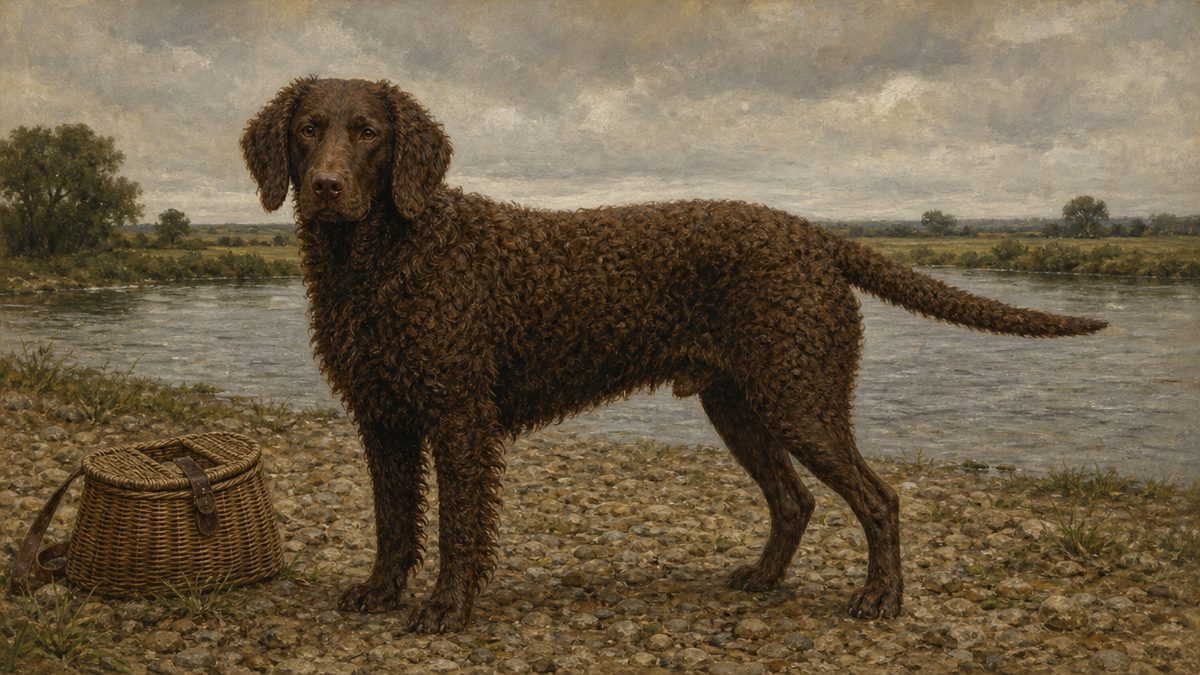
The Tweed Water Spaniel was a medium-sized liver-brown dog with a close curly coat, a long tail, a conical head and heavy hound-like drop ears, and the single most checkable detail in the whole description is that its forelegs were feathered and its hind legs were not.
That comes from the one person on record who owned one and described it. Skidmore's list, in order: very light liver colour, so close in curl that he suspected an ancestral smooth-coated cross, long in tail, ears heavy in flesh and hard like a hound's, but only slightly feathered, fore legs feathered behind, hind legs smooth, head conical, and lips more pendulous than the founding Irish strain.
| Feature | Tweed Water Spaniel, per Skidmore 1882 | Irish Water Spaniel | Curly Coated Retriever |
|---|---|---|---|
| Coat colour | Very light liver, and liver covered sandy, fawn and brownish in period usage | Liver | Black or liver |
| Curl | Close in curl over the body | Tight ringlets with a smooth face and rat tail | Small tight crisp curls all over |
| Tail | Long | Smooth rat tail, the breed's signature | Carried straight, feathered |
| Ears | Heavy in flesh, hard like a hound's, only slightly feathered | Long, lobular, deeply fringed with soft hair | Rather small, lying close |
| Legs | Fore legs feathered behind, hind legs smooth | Feathered | Curls on the legs |
| Head | Conical, lips more pendulous than the McCarthy strain | Domed with a topknot | Wedge-shaped |
Why the feathering detail is the useful one
Because it is asymmetric, specific and useless as a guess. Anyone inventing a description of a curly water dog produces feathering everywhere or nowhere. Fore legs feathered behind and hind legs smooth is the kind of detail somebody writes down because they were looking at the animal, and it is the single best test of whether an image or a description of this breed came from the source or from imagination.
The two things no source gives
No height and no weight. Not one of the four sources publishes a measurement, and the two period authorities who describe overall type say only that it was "a small type of Retriever". If you meet a spec card giving this breed a height range in centimetres, that range has no document behind it, and the rest of that card should be read the same way.
The engraving reproduced as a Tweed Spaniel is captioned by its best modern source as 'according to tradition' being one, and that source could trace no true depiction at all. Bonbeno's own hero image for this page is a reconstruction from the written description and is labelled as one, which is the only honest way to illustrate an animal nobody photographed.
Registry recognition today: none anywhere, checked with controls
No kennel club has ever recognised the Tweed Water Spaniel, and four registers were read in full with in-document controls rather than assumed.
| Register | Tweed found? | Controls that returned in the same document |
|---|---|---|
| The Royal Kennel Club, complete Breeds A to Z | No, zero hits | Labrador, Beagle, Harrier, Foxhound, Bloodhound 3, Corgi 2, Otterhound, Whippet, Greyhound 2, Terrier 62 |
| American Kennel Club, full breed index | No, zero hits | Labrador 2, Beagle 2, Harrier 2, Foxhound 6, Corgi 4, Otterhound 2, Whippet 2, Greyhound 7, Terrier 93 |
| FCI nomenclature, letter T index in English | No. The whole index holds ten breeds | Tibetan Terrier, Tornjak and Tosa present in the same index |
| FCI breeds recognised on a provisional basis | No. Twenty entries, none of them this | The newest four entries are dated 2/11/2026, which is 11 February 2026 |
The one registry document that does name it
The American Kennel Club's Golden Retriever history names the Tweed Water Spaniel directly, as an extinct breed used in the founding crosses. That is the correct way to record a breed like this: not as a member of the register, but as a named extinct ancestor inside the history of a breed that is. It is also the only registry text anywhere that says the name out loud.
What that means for the Kennel Club of India
India is a full member of the FCI, represented by the Kennel Club of India in Chennai, and the KCI issues pedigrees against FCI nomenclature. There is no FCI number for the Tweed Water Spaniel and there never will be, so no KCI pedigree can exist for it. What a KCI pedigree can name is the Golden Retriever, FCI 111, and that is what an Indian buyer should be checking.
The FCI page at Nomenclature/Default.aspx reads like the definitive register and served the twenty-entry provisional list instead when fetched without JavaScript. Anyone reading an absence off that page is reading it off the wrong document, and the tell is that a Labrador control returns zero on it.
Tweed Water Spaniel price in India: there is none, and the search proves it
No Tweed Water Spaniel price exists anywhere, because no Tweed Water Spaniel exists. What the Indian price query actually returns is a Golden Retriever price page, four generic price lists and a piece of merchandise.
The result set was pulled from Yahoo India on 9 September 2026 for tweed water spaniel price in india, which returned About 16,900 search results. Here is what those results actually are.
| Position | Result | What it is |
|---|---|---|
| 1 | goodfurs.in, Golden Retriever Price in India (2026), KCI Certified Puppies | A price page for a different, living breed. Its own history section names the Tweed Water Spaniel |
| 2 | aruanipetstop.in, Dog Breeds in India with Price | A generic price list |
| 3 | wrapinfur.com, Dog Price List in India 2026 | A generic price list |
| 4 | supertails.com, Dog Price List in India 2026 | A generic price list |
| 5 | pawspace.in, Dog Price in India 2026 | A generic price list |
| 6 | amazon.in, Tweed Water Spaniel 20 Milestone Challenges | Merchandise. A product carrying the breed name, not an animal |
| 7 | priceinindia.website | A price-comparison shell with no breed content |
The control, because a search result is only evidence when the instrument is proved
The query labrador retriever price in india was run through the same endpoint in the same session and returned ten genuine Indian Labrador price pages under About 16,200 search results. So the fetch works, the India geo works, and the Tweed result set is a real reading of what India's search index holds rather than a substitution.
The merchandise result is the one to understand
A product listing carrying a breed name looks exactly like price data to a scraper and to a reader skimming a results page. This project has recorded the same pattern before, where the only rupee figure attached to an extinct British breed anywhere in India was the price of a downloadable poster. Before quoting any rupee figure for a rare breed, confirm the listing is for a live animal. On this query, none of them is.
You are being sold something else, and on this breed the likeliest something else is a curly-coated crossbred or a liver-coloured field-bred spaniel. No registry anywhere issues a pedigree under this name. That check takes ten seconds and it is completely unambiguous.
What the living descendant actually costs in India, from three sources on one day
Three Indian sources read on 9 September 2026 give the Golden Retriever at Rs 20,000 to Rs 60,000, Rs 20,000 to Rs 90,000 and Rs 30,000 to more than Rs 1,50,000. The ceiling disagreement is ninety thousand rupees, and that spread is the most useful thing on this page for a buyer.
This is the section an Indian reader came for, even if they arrived by way of an extinct spaniel.
| Source | General range | Monthly cost given | Notes |
|---|---|---|---|
| wrapinfur.com | Rs 20,000 to Rs 60,000 | Rs 5,000 to Rs 9,000 | Also prints a 10 to 12 year lifespan and a Labrador band of Rs 15,000 to Rs 50,000 |
| goodfurs.in | Rs 20,000 to Rs 90,000 | Rs 500 to Rs 6,500 | Publishes city bands. Mumbai Rs 35,000 to Rs 1,00,000, Bangalore Rs 25,000 to Rs 95,000, Hyderabad Rs 18,000 to Rs 85,000 |
| pawspace.in | Rs 30,000 to Rs 1,50,000 and above | Rs 8,000 to Rs 20,000 | Also prints the Indian Pariah Dog at Rs 0 to Rs 5,000 in the same table |
The figures were tested for a disguised foreign price, and they pass
Indian breed pages routinely publish a dollar price run through one exchange rate, so every figure above was divided by 84.38, by 74 and by 80. None divides cleanly at 84.38 or 74. At a flat 80 the quotients are 250, 750, 375, 1,125 and 1,875, and the flat-80 test is structurally weak because any rupee figure ending in three zeros divides cleanly by 80 by construction. Quotients of 1,875 and 1,125 are not prices a shop would print. So these are rupee-native figures, disagreeing with each other in rupees, which is a different and more honest problem than a converted list.
What is actually driving the ninety thousand rupee gap
- Registration. A KCI-registered puppy with pedigree documentation sits at the top of every band, and an unregistered pet-quality puppy sits at the bottom. The document is most of the price.
- City. The one source that publishes city bands puts Mumbai highest and Hyderabad lowest, with a Rs 15,000 gap at the floor between them.
- Who is publishing. A site that also brokers or advertises puppy sales has a commercial reason to quote a wide band with a low entry point, and a site quoting Rs 20,000 for a metro Golden Retriever is describing an undocumented litter.
- What is not driving it. Health screening. None of the three sources ties price to a hip or elbow score, which is the thing that should be driving it.
A study of 1,686 pedigree Golden Retrievers in Brazil reports hip dysplasia prevalence in the breed of up to 19.6 percent, and finds that the genetic trend in hip scores has been stable since 1975 under ordinary phenotypic selection. A price band that does not mention hip screening is not describing the thing that will cost you most.
Monthly cost of ownership in India for a 25 to 34 kg retriever
A retriever of this size costs roughly Rs 5,000 to Rs 12,000 a month to keep properly in an Indian metro once food, parasite control, grooming and a share of annual veterinary care are counted, and the published Indian estimates for the same dog range from Rs 500 to Rs 20,000, which tells you how loosely the word cost is used.
Start with the disagreement, because it is instructive. Of the three Indian sources that publish a monthly figure for this size of dog, one says Rs 500 to Rs 6,500, one says Rs 5,000 to Rs 9,000 and one says Rs 8,000 to Rs 20,000 Wrapinfur, Dog Price List in India 2026 PawSpace, Dog Price List in India. A floor of Rs 500 a month for a 30 kg dog is not a cost estimate, it is a marketing figure.
| Line | Published figure | Source | Monthly equivalent |
|---|---|---|---|
| Core vaccination, per dose | Anti-rabies Rs 699, 9-in-1 DHPPiL Rs 899, puppy DP Rs 849, kennel cough Rs 1,349 | Vetic clinic price list | Roughly Rs 150 to Rs 300 amortised over a year |
| Tick, flea and worm control | NexGard Spectra 15 to 30 kg, 3 tablets Rs 3,308 | Supertails | About Rs 1,103 a month, and this weight band is the right one for this dog |
| Deworming, if dosed separately | Drontal Plus 6 tablets Rs 754, one tablet per 10 kg of bodyweight | Supertails | About Rs 377 per treatment for a 30 kg dog |
| Grooming | Bathing from Rs 934, complete bath and styling from Rs 1,869 | Vetic Delhi | Rs 900 to Rs 1,900 monthly if done professionally |
| Municipal registration | Delhi Rs 500 new and Rs 500 renewal, Chennai Rs 50 | MCD Delhi, Greater Chennai Corporation | Rs 4 to Rs 42 a month |
| Food | Not quoted here on purpose | See note below | The largest single line, and the one that goes stale fastest |
Why no monthly food figure appears above
Because Indian retail food prices move fast enough that a number published here would be wrong within weeks, and this project has already watched a headline large-breed bag price change under it inside days. The durable part is the arithmetic rather than the price: take grams per day from the pack for a 30 kg dog, multiply by thirty, divide by the pack weight, multiply by today's price. Do it at the point of purchase.
The spread on one identical vaccine, which is actionable
The same 9-in-1 vaccine is Rs 899 at a private clinic chain and Rs 600 at a Goa government veterinary hospital inclusive of the certificate, while a vet-at-home service prices it from Rs 1,999 plus a Rs 699 visit fee. That is a 3.3 times spread on one drug, and it tells an Indian owner that the price is a function of the delivery model rather than of the medicine.
Greater Chennai Corporation runs six municipal pet clinics that provide treatment and anti-rabies vaccination free of cost, and its pet licence is Rs 50 against Delhi's Rs 500. The corporation issued 9,115 licences in 2024. In Chennai the public route is the default rather than a compromise.
Could a Tweed Water Spaniel handle the Indian climate? The heat tolerance answer
Bonbeno rates this breed 1 of 5 for heat tolerance, and the rating is an inference from origin climate rather than a measurement, because nothing about this dog was measured. India's mildest coastal month is 9.38 degrees hotter than the hottest month its home estuary produces.
Two Border points were queried from NASA POWER by explicit latitude and longitude, with the grid-cell elevation echoed back and checked, because POWER returns a cell rather than a point.
Berwick-upon-Tweed, at the river mouth, returned a cell elevation of 26.15 m against a real town elevation near 20 m, an error of about 6 metres. That is the most accurate cell in this whole batch of six breeds and it makes Berwick the baseline. Norham, the village an 1833 sporting magazine called long famous for a brown water spaniel, returned 101.95 m against a real 30 m, an error of about 72 metres, so that cell is reading higher ground than the river haugh and is reported as such.
| Place | Cell elevation | Coolest month | Hottest month | Annual mean |
|---|---|---|---|---|
| Berwick-upon-Tweed | 26.15 m | 5.44 (Feb) | 14.71 (Aug) | 9.69 |
| Norham, Northumberland | 101.95 m | 4.02 (Feb) | 14.70 (Jul) | 8.87 |
| Chennai | 48.95 m | 24.09 (Jan) | 31.51 (May) | 27.95 |
| Delhi | 206.37 m | 13.61 (Jan) | 35.88 (Jun) | 25.60 |
| Mumbai | 97.15 m | 23.19 (Jan) | 31.19 (May) | 26.77 |
| Bengaluru | 841.72 m | 20.22 (Dec) | 28.37 (Apr) | 23.74 |
The comparison that settles it
Berwick's hottest month averages 14.71 C. Chennai's coolest month averages 24.09 C. India's mildest large coastal city, at its gentlest, is 9.38 degrees hotter than the warmest month the dog's home estuary produces. Delhi's June mean of 35.88 C is more than twenty-one degrees above it.
A small detail that shows the data is real
Berwick peaks in August, not July, and Norham eight miles inland peaks in July. That is the maritime lag: the sea warms slowly and holds heat, so a coastal point runs a month behind an inland one. It is the kind of thing a copied table never gets right, and it is a cheap way to check whether a climate column was measured or assembled.
The same climatology returns a T2M_MAX of 21.10 C for Berwick and 48.79 C for Delhi. Those are period extremes, the single hottest values recorded across twenty years, not average daily highs. Quoting them as routine afternoons overstates ordinary heat by eight to ten degrees, and it is a mistake this project has made and now checks for.
Humidity, wet bulb, and why the damp-air argument is the wrong one
Indian humidity is not what would have troubled a Border water dog, because the Tweed estuary is wetter than every Indian city in this comparison. What decides is heat and humidity together, which is what a wet-bulb temperature measures.
The instinct to write that Indian humidity would finish a British water dog is a reasoning error, and this project has made it before. Berwick-upon-Tweed runs 85.75 percent mean annual relative humidity and Norham 87.49 percent. Chennai runs 72.39 percent, Mumbai 67.39 and Bengaluru 67.94 NASA POWER 2001-2020 climatology…. On damp air alone, the dog's home coast wins comfortably.
So the honest instrument is wet bulb, which combines the two into the number that governs whether an animal can shed heat by evaporation at all. Every figure below is computed by the Stull method from POWER's own T2M and RH2M for 2001 to 2020, and the method is named because two different wet-bulb sources are in use across this site and they disagree by up to 1.24 degrees.
| Place | Annual mean wet bulb | Peak wet-bulb month | Peak value |
|---|---|---|---|
| Berwick-upon-Tweed | 8.19 | August | 13.12 |
| Norham, Northumberland | 7.56 | July | 12.89 |
| Delhi | 17.80 | July | 26.50 |
| Chennai | 24.04 | May | 26.11 |
| Mumbai | 22.20 | June | 25.77 |
| Bengaluru | 19.48 | May | 21.86 |
Read the gap, not the individual numbers
Delhi's peak wet bulb is 26.50 C and Berwick's is 13.12 C. That is a gap of over thirteen degrees in the variable that governs evaporative cooling, and it is wider than the air-temperature comparison suggests because Delhi's July is both hot and wet. A dog that copes with a dry Delhi May can be in trouble in a wetter Delhi July at a lower air temperature.
What the UK veterinary data says about which dogs actually collapse
The largest study of canine heat-related illness comes from the breed's own country. Hall and colleagues, working with 905,543 UK dogs under primary veterinary care in 2016, recorded 1,259 events from 1,222 dogs; of the 879 events with a recorded trigger, 652 were exertional, which is the 74.2 percent the paper prints, against 113 environmental and 46 from vehicular confinement.
The companion paper in *Scientific Reports*, a different paper with a different case definition, models breeds against the Labrador Retriever and gives the Golden Retriever odds of 2.65 (1.40 to 5.01). That is the living descendant, significantly above a Labrador in a temperate country. In India it is the number that should govern when you walk the dog.
Wet-bulb figures above about 35 C sit at the outer edge of anything ever recorded on Earth. A page showing a wet-bulb column in the high thirties has fed a period maximum into the formula instead of a mean, and every conclusion in that section is wrong. Nothing above exceeds 26.50.
Temperament: one word survives, and it is the right one
Almost nothing is recorded about how a Tweed Water Spaniel behaved, and the one trait that survives in the record is the one Lord Tweedmouth was buying: biddability in a retrieving dog.
Wikipedia says the breed was known for intelligence, courage and sporting ability, and sources that to a coffee-table breed book rather than to a period account. There is no period behavioural description of these dogs at all, and the best modern survey could trace no reliable eyewitness. So this page will not give you a temperament score for the animal itself.
What can be said, from the purpose rather than the dog
Horter records the aim of the Guisachan cross plainly: "there was a reason to breed the Tweed Spaniel to Sir Dudley's yellow Retrievers. The aim was to breed a dog that could find and retrieve game from great distances and out of water." That is a specification, and it implies three things about the dogs being crossed in: they marked and remembered a fall, they entered cold water without being made to, and they gave the bird up at the end.
The continuity to the living breed is documented on both ends. FCI Standard 111 opens the Golden Retriever's temperament clause with the word biddable, and lists intelligence and natural working ability. A single word travelling from a nineteenth-century estate specification into a current international breed standard is about as much behavioural continuity as any extinct dog can claim.
What an Indian household should take from that
Biddable is not the same as easy. A biddable retriever wants a job and will invent one if you do not supply it, and the commonest complaint about Golden Retrievers in Indian apartments is not aggression or noise, it is a bored adolescent dog dismantling the house between eight and eighteen months. The historical record and the modern standard agree on what this line of dog is for, and it is not ornament.
All three questions an answer engine returns for this breed treat it as a living pet: is it good with children, is it friendly with other dogs, how much grooming does it need. Not one asks whether it exists. That is the clearest possible demonstration that a search index will happily sell you care advice for an animal that has been gone for a century and a half.
Training: the one quality the whole record agrees on, and where it went
Nobody can train a Tweed Water Spaniel, because none has existed for well over a century. What the record does establish is why Lord Tweedmouth wanted the dog in the first place, and that quality is the single thing that survived the breed into the dog an Indian reader can actually buy.
Biddability is the reason the 1868 cross happened at all. Lord Tweedmouth was assembling a gundog that would find and bring back shot game over rough ground and cold water, and he kept written records of the breedings for fifty years while he did it. A dog that will not take direction is useless for that job, so the trait was being selected for deliberately, generation by generation, in a private kennel. That is the closest thing to a training record this breed has, and it is indirect.
The descendant carries it forward in writing. FCI Standard 111 opens the Golden Retriever's temperament clause with kindly, friendly and confident, and files the breed in Group 8 with a working trial attached, which means the registry expects the dog to be trained to a standard and tested on it. A working-trial qualification is not a personality description. It is a claim that the breed can be taught a job and examined on it.
What this means for an Indian owner who wants to train the living breed
Start the training before the heat does. An Indian retriever puppy has two usable windows a day for most of the year, roughly before eight in the morning and after six in the evening, and a training session that runs into the middle of a Chennai afternoon is a heat-risk session rather than a productive one. Hall and colleagues found that 652 of the 879 UK heat-related illness events with a recorded trigger were exertional, which is 74.2 percent, and exertional means the dog was doing something rather than being left somewhere. Training is doing something.
Indian law also fixes when the work can begin. Rule 8(1)(a) of the Prevention of Cruelty to Animals (Dog Breeding and Marketing) Rules, 2017 requires that pups less than eight weeks in age are not sold, so a lawfully obtained puppy arrives at eight weeks or later and the household socialisation window opens there rather than at six. A seller offering a six-week-old retriever puppy is offering an unlawful sale, and the readiness of that seller to break one rule is information about the rest of the operation.
The claim to be careful with
Trainability is a breed-level tendency and not a guarantee about one animal. No behavioural study of the Tweed Water Spaniel exists, no survey of it was ever run, and PubMed returns zero records for every name form the breed has, against controls of 24, 30, 128 and 126 in the same session. So the honest statement is that the historical record shows the trait was selected for, the modern registry standard still describes it, and neither of those is a measurement.
Aggregator profiles of this breed print trainability scores out of five, alongside energy and friendliness scores, for an animal nobody has observed since the nineteenth century. Those numbers are generated by a template that expects a living breed in the row. A rating with no observation behind it is not a low-confidence rating, it is not a rating at all.
Exercise: what a Border water dog actually did, and what that costs in an Indian city
A Tweed Water Spaniel worked a cold northern estuary in water, which is the highest-effort job in the gundog world and the least transferable to India. The exercise requirement of the living descendant is roughly two real outings a day, and the Indian constraint on it is temperature rather than distance.
The dogs worked where the Tweed meets the sea. Lawrence's 1816 account places water dogs along the rocky shores and dreadful declivities beyond the junction of the Tweed with the sea at Berwick, engaged in what he calls arduous difficulties and diurnal perils. Strip the period prose and what is left is a dog that entered cold moving water repeatedly, daily, as a job. A dog bred to swim in an estuary at nine degrees is a dog built to make heat, not to shed it.
The temperature gap is the whole argument. Berwick-upon-Tweed averages 9.69 C across the year and 14.71 C in its warmest month, from a NASA POWER cell whose elevation came back at 26.15 m against a real town elevation near 20 m, so the cell is genuinely reading the town. Chennai's coolest month averages 24.09 C. India's mildest coastal month is 9.38 degrees hotter than the hottest month this dog's home country produces, and that gap does not close anywhere in the plains.
The two-outing rule, and the hours that make it safe
Two outings a day, both outside the heat, is the working answer for a large retriever in India. That means roughly 45 to 60 minutes of real activity split across an early-morning and a late-evening session, with the middle of the day spent indoors. The rule is not about the dog being lazy. Hall and colleagues modelled heat-related illness against the Labrador Retriever as the comparator and put the Golden Retriever at odds of 2.65, with a confidence interval of 1.40 to 5.01, which clears one and is therefore a real elevation rather than noise. A breed already carrying 2.65 times a Labrador's odds does not need an afternoon walk.
Swimming is the exercise that transfers best and the one Indian cities supply least. A retriever that can swim will take more work at a lower thermal cost than the same dog walking, because the water carries the heat away. Most Indian apartment dwellers have no access to safe water, so the realistic substitute is retrieving games on grass at either end of the day, in shade, with water available throughout.
What happens without it
An under-exercised large retriever in an Indian flat becomes destructive first and overweight second, and the second one matters more. Bodyweight at or above the breed and sex mean carried odds of 1.42 for heat-related illness in the Scientific Reports cohort, and dogs over 50 kg carried odds of 3.42. So the exercise a household skips in April is paid for in May, through a heavier dog with a worse thermal margin.
Run the back of your hand along the pavement for five seconds before an evening walk. If you cannot hold it there, the dog cannot stand on it. Indian tarmac holds heat for hours after the air has cooled, and paw burns are the commonest avoidable summer injury in a city retriever.
Grooming a close curly liver coat in Indian humidity, and the ears that decide it
The Tweed Water Spaniel's coat was close and curly and liver-coloured, which is the single worst coat description to read on an Indian breed page, because a curl that traps water against skin is a curl that traps humidity against skin. No grooming account of the breed survives, so everything below is stated as an inference from the coat description and from the living breeds that carry the same coat.
The 1882 technical description is the closest thing to a coat standard this dog ever had, and it was not written about a breed. Skidmore files the Tweed spaniel as one of three strains or varieties of the Irish Water Spaniel and describes the forelegs as feathered behind with the hind legs smooth, which is an unusually specific detail and the best accuracy test available for any picture claiming to show this animal. Wikipedia attributes that passage to Hugh Dalziel; Dalziel edited the volume and Skidmore wrote the chapter.
A working water dog's coat is waterproof by construction, and waterproof is the problem in India. The oils and the tight curl that keep an estuary out also keep a Mumbai monsoon in, so the coat dries from the outside while the skin underneath stays damp. That is the condition that produces hot spots and pyoderma in Indian retriever populations, and it is why the grooming answer here is drying rather than trimming.
The three things that actually matter, in order
- Dry the dog properly, and never air dry. Overseas breed clubs routinely tell owners to towel a water dog and let it air dry, which is correct in a northern climate and wrong in an Indian one. Towel to damp, then finish with a cool-setting dryer or a fan, and pay particular attention to the armpits, the groin and behind the ears.
- Dry inside the ears every single time. A drop-eared dog with a curly coat has no airflow into the canal, and water left there is the commonest route to otitis externa in Indian gundogs. Plug the ears before a bath, and dry them after a swim as carefully as after a wash.
- Brush to the skin, not across the top. A close curly coat mats at the base while the surface still looks tidy, so a brush that only touches the outer curl reports a coat that is fine when it is not.
What grooming a dog of this coat type costs in India
Budget roughly Rs 900 to Rs 1,900 a session at a chain clinic, before add-ons. Vetic's Delhi price list gives bathing from Rs 934, a haircut from Rs 1,359, complete bath and styling from Rs 1,869 and add-ons from Rs 99. Those are one chain's promotional floors on one city page rather than a market average, and the same chain quotes different prices on different city pages on the same day, so treat the figure as a starting point and price your own neighbourhood. A monsoon-season dog of this coat type realistically needs a professional session every four to six weeks and home drying after every wetting in between.
Shaving a water dog's coat removes the layer that reflects sun and disrupts the way air moves against the skin, and the regrowth on a curly coat frequently comes back patchy. A dog that is hot needs shade, water and a changed schedule, not a clipper. Consult a registered veterinarian near you before making any coat decision for a heat problem.
Health issues and life expectancy: nothing is known, and here is what replaced it
No health data exists for the Tweed Water Spaniel, in any form, and that has to be said three times rather than filled in once. There is no studbook to count deaths in, no breed health survey, no screening scheme and no lifespan study, and PubMed returns zero records under every name form the breed has. Every health issue described below belongs to the living dog an Indian reader can actually buy.
The zero is controlled, which is what makes it worth printing. The query '"Tweed Water Spaniel"[tiab]' returns 0, '"Tweed Spaniel"[tiab]' returns 0 and 'Tweed[tiab] AND spaniel[tiab]' returns 0, all three with clean unrewritten translation lines, while four controls run in the same session returned 24, 30, 128 and 126 records. One name form does produce a number: '"Ladykirk Spaniel"' returns 1,468 records, and that is PubMed silently collapsing the phrase to spaniel across all fields. A four-figure count on a breed nobody has studied is a rewrite, not a literature.
There is no gene pool to study, and that is the actual finding
The breed did not merely die out, it was absorbed. Its gene pool was folded into the retrievers being assembled in the same decades, which is why the AKC can name the Tweed Water Spaniel in the Golden Retriever's own history while no register ever held the Tweed itself. A closed population that ends leaves records behind it. A local stock that gets bred into something else leaves its inheritance inside another breed's studbook, where it can no longer be measured separately. That is the situation here, and it is the reason a health section for this animal has to point somewhere else.
The living breed's two documented risks, with the numbers
Hip dysplasia is the headline, and it has a recent number from a comparable market. Jardim and colleagues, working on Brazilian kennel data published in Veterinary Sciences in August 2025, describe a reported hip dysplasia prevalence in the Golden Retriever of up to 19.6 percent, and estimate heritability for hip score at 0.15 with a posterior standard deviation of 0.08 across a pedigree sample of 1,686 dogs of which 951 were phenotyped. The finding an Indian buyer should read twice is the last one: the genetic trend in hip scores has been stable since 1975 under simple phenotypic selection. Decades of choosing the better-looking hip has not moved the breed.
Heat is the second, and India makes it the first. The Golden Retriever sits at odds of 2.65 for heat-related illness against a Labrador comparator, with an interval of 1.40 to 5.01, and 74.2 percent of the UK events with a recorded trigger were exertional rather than environmental. Both papers describe a British climate. Neither modelled an Indian one, so the numbers are a floor rather than an estimate.
Tick-borne disease, which no overseas breed page will mention
Tick-borne disease is the Indian risk that does not appear in any British or American health survey, and the Indian numbers are large. A survey of 584 dogs in West Bengal found Babesia gibsoni in 76.54 percent and Anaplasma in 55.75 percent of the dogs screened, with 72.9 percent of those 584 screened carrying two or more pathogens. A Kerala survey of 120 dogs found Babesia in 80 of the 120 screened, which is 66.7 percent, with Ehrlichia canis at 5.0 percent and a pre-monsoon March to May peak. Both sampled dogs presented at veterinary clinics rather than a random population, so read them as the burden among dogs tested at clinics and not as a national prevalence.
A long feathered coat on a dog that works in undergrowth is a tick collector, which is why parasite control is a fixed monthly line rather than a seasonal one. NexGard Spectra for a 15 to 30 kg dog runs about Rs 1,103 a month at Supertails' listed price of Rs 3,308 for three tablets, and it covers the tick and flea role and the roundworm and hookworm role in the same tablet. Drontal Plus is the separate deworming route at Rs 125.67 a tablet, dosed one tablet per 10 kg.
Pale gums, dark urine, a fever that comes and goes, or sudden lethargy after a tick season are the signs that send a dog to a clinic the same day, not to a search engine. Babesiosis and ehrlichiosis are treatable and both get worse quickly. Consult a registered veterinarian near you rather than acting on any figure on this page.
Feeding a large retriever in India, and the growth mistake that costs a hip
Feed a large-breed retriever puppy on a large-breed growth diet, measured rather than free-fed, and keep it lean through the first year. That is the one feeding instruction with a mechanism behind it on this page, because growth rate is the part of hip dysplasia an owner controls after the puppy is bought.
Nothing is known about what a Tweed Water Spaniel ate. The dogs belonged to salmon netters and wildfowlers on a nineteenth-century Border estuary and no feeding account of them survives, so this section, like the three before it, describes the living breed. What is worth saying about the historical animal is that it was a working dog in constant cold water, which is a high-energy life, and that nothing about that energy budget transfers to a dog lying under a fan in Hyderabad.
The three rules that matter for a large-breed puppy in India
- Choose a large-breed growth formula, not an all-breeds one. The calcium and energy density are the reason, and a large-breed puppy fed a generic puppy food grows faster than its skeleton can carry.
- Measure every meal against the pack's chart, and adjust for the dog rather than the chart. Body condition is the instrument. You want to feel the ribs easily under a thin cover without seeing them.
- Split the day's ration across two or three meals rather than one. A deep-chested large breed fed one large meal is the classic bloat presentation, and an Indian household eating late often feeds the dog late with it.
Keeping a growing retriever lean is the intervention with the best evidence behind it. The Brazilian pedigree study makes the point from the other direction: hip scores in the breed have not improved genetically since 1975 under phenotypic selection, with heritability at 0.15. A heritability of 0.15 means most of the variation in the outcome is not genetic, which is exactly why growth rate, body weight and exercise load in the first year are where an owner's leverage sits.
What it costs, and where the Indian figures disagree
Indian monthly running-cost figures for this size of dog disagree by a factor of four, and the disagreement is the useful part. PawSpace gives a Golden Retriever monthly cost of Rs 8,000 to Rs 20,000, Wrapinfur gives Rs 5,000 to Rs 9,000 and GoodFurs gives monthly expenses of Rs 500 to Rs 6,500. A floor of Rs 500 a month is not a feeding budget for a 30 kg dog on any food sold in India, and a page printing it is filling a template field rather than costing an animal. Build your own figure from the food you can actually buy in your city and add the parasite and vaccination lines separately.
Weigh the puppy every fortnight for the first year and write it down. A growth curve is the cheapest diagnostic tool an Indian owner has, it costs nothing at a clinic that has a scale in reception, and it is the only way to catch a puppy growing too fast while there is still time to slow it.
The first year month by month, and why this timeline is not about a Tweed Water Spaniel
This timeline describes a Golden Retriever puppy in an Indian city, because no Tweed Water Spaniel puppy has been born since the nineteenth century and no account of one survives. It is printed here because it is what a reader searching this breed name is actually about to need.
The legal start point is eight weeks. Rule 8(1)(a) of the 2017 Rules requires that pups less than eight weeks in age are not sold, so month two is where a lawfully obtained puppy joins the household.
| Age | What happens | The Indian constraint |
|---|---|---|
| 8 to 10 weeks | Puppy legally leaves the breeder. Core vaccination course begins | Anti-rabies runs Rs 699 and the 9-in-1 DHPPiL Rs 899 at one national chain's listed floors. Municipal clinics in Chennai give treatment and anti-rabies free |
| 10 to 16 weeks | Socialisation window. Meet people, surfaces, traffic noise, other vaccinated dogs | Do it at 7am and after dusk. A socialisation walk at noon in April is a heat exposure, not a socialisation walk |
| 4 to 6 months | Lead manners, recall, name response. Deworming continues | Drontal Plus at Rs 125.67 a tablet, one per 10 kg. Start monthly tick and flea cover before the first monsoon |
| 6 to 9 months | Fastest skeletal growth. Adolescent testing of every rule | Keep it lean and keep it off stairs and hard-surface running. This is the window where growth rate and hips interact |
| 9 to 12 months | Switch toward adult food. Adult coat comes in | The first full Indian summer. Expect the dog to need a shorter schedule than the books written for Britain assume |
| 12 months | Municipal registration and the first annual booster | Delhi MCD registration is Rs 500 with a Rs 100 a month late fee. Greater Chennai Corporation licences a pet at Rs 50 |
The two months that decide the next ten years
Months six to nine carry the most risk and the least visible feedback. Skeletal growth is fastest, the dog looks robust, and the damage from over-exercise or over-feeding in that window does not present until the dog is two or three. The Brazilian hip study is the reason to take this seriously: with heritability at 0.15 and no genetic improvement in the breed's hip scores since 1975, the environmental half of the equation is where the outcome is actually decided.
Registration is the month-twelve job most Indian owners skip. Delhi's Municipal Corporation charges Rs 500 for a new pet dog registration and Rs 500 to renew, with a late fee of Rs 100 a month, and its own counter records 18,958 certificates issued since 2021. Greater Chennai Corporation licenses a pet at Rs 50, issued 9,115 licences in 2024, and runs six municipal pet clinics that provide treatment and anti-rabies vaccination free of cost. A free rabies vaccination from a municipal clinic is the best-value line item available to an Indian dog owner and almost no breed page mentions it.
None of it is a Tweed Water Spaniel timeline. If you came here for the extinct breed, the honest answer is that no growth data, no litter record beyond the 1868 mating and no puppy account of any kind survives. This page prints a Golden Retriever timeline and labels it as one rather than generating a plausible-looking table for an animal nobody has raised in six generations.
Head to head: what an Indian buyer is actually being offered instead
Nobody can sell you a Tweed Water Spaniel, so the useful comparison is between the living retrievers and water spaniels available in India and the two breeds this dog is claimed to have founded. One of those two claims survives a check and the other does not.
| Dog | Available in India? | Registry standard? | Link to the Tweed | The question that should decide it |
|---|---|---|---|---|
| Tweed Water Spaniel | No. Extinct, no population anywhere | None, ever, in any register | It is the Tweed | Unanswerable. Zero papers, no studbook, no reliable eyewitness |
| Golden Retriever | Yes, very widely | FCI Standard 111, plus RKC and AKC standards | Named in the AKC's own Golden Retriever history. The strongest descent claim in this table | Hip score of both parents, and whether the seller will show you them |
| Curly Coated Retriever | Rare in India | FCI Standard 110, plus RKC and AKC standards | Widely claimed and unsupported. Tweed appears zero times in the AKC's Curly history and zero times in FCI 110 | Availability. A breed this rare in India usually arrives through an unlawful import route |
| Irish Water Spaniel | Very rare in India | FCI standard, and RKC and AKC standards | The 1882 source files the Tweed as a strain of this breed rather than as a breed of its own | The same coat problem in the same humidity, on a dog even harder to find a groomer for |
| Labrador Retriever | Yes, the most widely available retriever in India | FCI Standard 122, plus RKC and AKC standards | None claimed | It is the comparator in the heat study, so its odds are the baseline everything else is measured against |
| Flat Coated Retriever | Rare in India | FCI standard, plus RKC and AKC standards | Shares the same nineteenth-century retriever assembly, not the Tweed specifically | Cancer rates in the breed, which is a different conversation from hips |
| Indian pariah dog | Yes, free, this week, in every Indian city | ICAR-NBAGR registered breed | None claimed | Nothing on this page applies to it. Heat-adapted, short-coated, and outside the entire problem |
How to read that table
The Tweed row exists to be crossed out, and the Curly Coated row exists to be corrected. The Curly claim is repeated on breed-club pages and encyclopedias, and it fails a controlled check: the string Tweed appears zero times in the American Kennel Club's own Curly-Coated Retriever history and zero times in FCI Standard 110, while the same search on the same site's Golden Retriever page returns eleven hits in the same session. A zero next to an eleven from the same instrument is a controlled absence rather than a failed search. Neither FCI standard carries a historical summary section at all, which is worth knowing before reading anything into their silence.
The last column is the one that should drive a purchase, and it is the one no ranking page prints. The Tweed link is a story. A hip score is a document, and a seller who cannot produce one for both parents is telling you something.
The word for what the Tweed Water Spaniel was
Unrecognised is the accurate word, and unlisted is not. The Royal Kennel Club's complete Breeds A to Z returns zero for tweed against ten in-document controls, the American Kennel Club's complete breeds index returns zero against nine controls, the FCI letter T index holds ten breeds and none of them is this one, and the FCI's provisional register holds twenty entries and none of them is this one either. Four registers, four controlled absences. This was a local Scottish and Northumbrian working stock that was absorbed before breed registration reached it, and calling it unrecognised states a fact about the registers rather than a grievance about them.
Ask to see the hip scores of both parents and the date the puppy was born. If the answer to the first is a shrug and the answer to the second puts the puppy under eight weeks, you have learned everything you need without discussing bloodlines at all.
What Indian readers get wrong about the Tweed Water Spaniel, in order of cost
Eight mistakes recur on this breed, and they are ordered here by what each one costs the person making it rather than by how often it appears.
- Paying for one. There is no Tweed Water Spaniel at any price, anywhere. The first organic result for the Indian price query is a Golden Retriever price page, followed by four generic Indian dog price lists and an Amazon listing for a notebook. Any seller quoting a rupee figure under this name is selling a different animal.
- Buying a Golden Retriever in April. The breed carries odds of 2.65 for heat-related illness against a Labrador comparator, and a puppy arriving at the start of an Indian summer meets its worst conditions during its least robust months. Time the purchase for October if you can time it at all.
- Believing the Curly Coated Retriever descent claim. Tweed appears zero times in the AKC's Curly history and zero times in FCI 110, against eleven hits on the same site's Golden page.
- Attributing the 1882 description to Hugh Dalziel. J. S. Skidmore wrote Chapter XXIX; Dalziel edited the volume and bylined his own contributions Corsincon. More importantly, Skidmore does not treat the Tweed as a separate breed at all.
- Quoting the Lawrence sentence without the word experimental. The 1816 text says water dogs gained strength from the experimental introduction of a cross with the Newfoundland dog, and dropping that one word turns an attempt into an established practice.
- Printing a lifespan, a height or a weight for this breed. None was ever published, there is no standard to take them from, and every spec card carrying those fields generated them.
- Shaving a retriever's coat for the Indian summer. It removes the layer that reflects sun, disrupts airflow at the skin and frequently grows back patchy on a curly coat.
- Treating an overseas breed club's care advice as climate-neutral. Guidance written for a Border estuary tells you to towel the dog and let it air dry, which in an Indian monsoon is how a drop-eared dog gets otitis.
The best secondary source on this breed states that in spite of investigations no true depiction and no reliable eyewitness could be traced. It would have been easy to reconstruct an appearance from the four surviving descriptions and present it as settled. The descriptions disagree with each other, and the honest page prints the disagreement and labels its own hero image as a reconstruction.
Adoption and responsible sourcing: what to do instead, and what the law allows
You cannot adopt a Tweed Water Spaniel and you cannot import one, so the practical question is what an Indian household should do with the interest that brought it here. Adopt a retriever or a retriever cross from an Indian rescue, or adopt an Indian pariah dog, and buy from a breeder only after the two checks below.
Indian rescues carry surrendered retrievers constantly, and they carry them for a reason that is relevant to this page. A large, biddable, high-energy dog bought on impulse in a hot city is one of the commonest surrenders in Indian metros, so the same breed this page routes readers toward is already sitting in shelters in every city named on it. An adult dog from a rescue also removes the entire growth-rate gamble described in the feeding section, because the hips have already finished forming and can be assessed as they are.
Why importing is not an option, stated from the instrument
No import authorisation exists for this purpose, and that is a legal fact rather than a practical difficulty. Dogs enter India under ITC(HS) 01061900, classified Restricted, and DGFT Trade Notice 22/2022-23 states in Policy Condition 8 that import of commercial dogs for breeding or any other commercial activities is not permitted, with paragraph 6 adding that any applications for trading or breeding purposes shall be duly rejected. Entry is limited to seven ports, at Delhi, Mumbai, Chennai, Hyderabad, Bengaluru, Kolkata and, since October 2024, Kochi. An extinct breed has no exporting population in any case, so the import question is doubly closed, but the notice is the document to cite rather than the absence of listings. The full route is set out in how to import a dog to India.
The two checks to run on any Indian breeder
- Confirm the puppy is at least eight weeks old. Rule 8(1)(a) of the 2017 Rules requires that pups less than eight weeks in age are not sold, and a seller offering younger is breaking the rule in front of you.
- Ask how the parents are related. Second Schedule Part II paragraph 6(3) of the same Rules prohibits in breeding, defined as breeding between relatives of the second to fourth grade within the first four generations, and prohibits incest breeding between parents and children or brother and sister. A breeder who cannot answer the question does not have the pedigree to answer it with.
Register the dog once it is home. Delhi's Municipal Corporation charges Rs 500 for a new pet dog registration, and Greater Chennai Corporation licenses a pet at Rs 50 and runs six municipal clinics that give treatment and anti-rabies vaccination free of cost. Registration is cheap, it is the legal position in both cities, and in Chennai it opens a free vaccination route that no private clinic can match.
What this breed's ending is actually for
The Tweed Water Spaniel is worth a page because of how completely it vanished. A working stock on the Scottish and English border, valuable enough that a peer crossed it into his own kennel and kept records for fifty years, left no standard, no studbook, no photograph and no reliable eyewitness. What survived is inside another breed. That is the argument for writing down what a local population is while it still exists, and it is the argument for taking the Indian pariah dog seriously as a breed rather than as a default.
If the Tweed Water Spaniel brought you here, the dog to look at is a rescue retriever or an Indian pariah dog, in that order, and the Golden Retriever from a breeder who will show you hip scores in third place. None of those three is what you searched for, and one of them is the right answer for almost every Indian household reading this.
Tweed Water Spaniel: the questions people actually ask
Is the Tweed Water Spaniel good with children?
Nobody can answer that, because the breed has been extinct since the nineteenth century and no behavioural account of it survives at all. The question is worth printing exactly as an answer engine asked it, because it shows what happens when a search index treats an extinct animal as a living pet. If you want the living answer, the Golden Retriever it helped found is the breed to read about.
Is the Tweed Water Spaniel friendly with other dogs?
There is no record of it either way. The best secondary source on the breed states plainly that after investigation no true depiction and no reliable eyewitness could be traced, and no period writer describes how these dogs behaved with other dogs. Any friendliness rating you find on a spec card for this animal was generated rather than observed.
How much grooming does the Tweed Water Spaniel need?
The coat was close, curly and liver-coloured, which is the heaviest-maintenance coat type for Indian humidity, but no grooming account of the breed exists. For the living dog behind the question, budget bathing from Rs 934 and a full bath and styling from Rs 1,869 at an Indian clinic chain, and treat the ears as the real monthly job.
Is the Golden Retriever descended from the Tweed Water Spaniel?
Yes, and this is one of the few descent claims in dog history a registry states in its own words. The American Kennel Club's Golden Retriever history says Lord Tweedmouth crossed his Yellow Retriever with a breed that is now extinct, the Tweed Water Spaniel, adding Irish Setter and Bloodhound. The founding mating was Nous to Belle in 1868.
What did a Tweed Water Spaniel look like?
Liver-coloured, curly, medium sized, with a long tail, a conical head and heavy hound-like drop ears, and one specific detail worth knowing: forelegs feathered behind and hind legs smooth. That description comes from an 1882 chapter by a breeder who owned one. No photograph and no verified painting of the breed exists.
When did the Tweed Water Spaniel become extinct?
No year can be given, and no source gives one. The dogs are described in the present tense in the 1830s, two were in Lord Tweedmouth's kennels between 1863 and the 1870s, and by the time breed registration and studbooks arrived in Britain there was nothing left to register. Historians agree the breed is extinct and none of them dates it.
Was the Tweed Water Spaniel a separate breed or a variety of the Irish Water Spaniel?
The sources genuinely disagree, and that is the honest answer. The 1882 technical description files it as one of three strains or varieties of the Irish Water Spaniel. Stonehenge in 1864 and de la Blanchere in 1875 both call it a small type of retriever. A third account derives it from east-coast water spaniels around Yarmouth.
Can you buy a Tweed Water Spaniel in India?
No, and the Indian search result for that query is itself the proof. The first organic result for the price query is a Golden Retriever price page, followed by four generic Indian dog price lists and an Amazon product listing. No listing for a dog of this breed appears anywhere, because there is no dog of this breed anywhere.
How much does a Golden Retriever cost in India?
Three Indian sources read on the same day give Rs 20,000 to Rs 60,000, Rs 20,000 to Rs 90,000 and Rs 30,000 to Rs 1,50,000 and above. That is a ninety thousand rupee disagreement about the ceiling, and it is the single most useful thing to know before you shop, because it means no quoted figure is a market rate on its own.
Did the Tweed Water Spaniel help create the Curly-Coated Retriever?
That claim is widely repeated and it does not survive a check. The string Tweed appears zero times in the American Kennel Club's own Curly-Coated Retriever history and zero times in FCI Standard 110, while the same search on the same site's Golden Retriever page returns eleven hits, which makes this a controlled absence rather than a failed search.
Where did the Tweed Water Spaniel come from?
The River Tweed basin on the border between England and Scotland, and the two place names attached to it sit on opposite sides of that border: Norham in Northumberland and Ladykirk in Berwickshire. Wikipedia's infobox gives the country as England, which is a simplification of a dog that lived on both banks.
Was the Tweed Water Spaniel crossed with a Newfoundland?
One 1816 source says water dogs at the Tweed mouth gained strength from the experimental introduction of a cross with the Newfoundland dog. The word experimental is in the original and is dropped in the version usually quoted, and modern writers read Newfoundland here as the St John's water dog rather than the giant breed of that name today.
What is the life expectancy of a Tweed Water Spaniel?
Unknown and unknowable. There is no studbook to count deaths in, no health survey and no lifespan study, and PubMed returns zero papers under every name form against working controls. One Indian price list prints 10 to 12 years for the Golden Retriever, which is a figure about a different living breed.
Would a Tweed Water Spaniel have coped with the Indian climate?
No, and the numbers are decisive. Berwick-upon-Tweed's warmest month averages 14.71 C. Chennai's coolest month averages 24.09 C, so India's mildest coastal month is 9.38 degrees hotter than the hottest month the dog's home estuary produces. A close oily curl on a working water dog makes that worse rather than better.
Why did the Tweed Water Spaniel go extinct?
The Tweed Water Spaniel went extinct because it was bred into other dogs rather than bred on as itself. It was a local working stock on the River Tweed with no standard and no studbook to hold it together, and the retriever breeds being assembled in the same decades absorbed it. No year can be given for the end, because no register existed to record one.
What was the Tweed Water Spaniel used for?
It retrieved shot game and worked water on the River Tweed estuary, for salmon netters and wildfowlers on the Scottish and English border. Lawrence's 1816 account describes water dogs there working the rocky shores beyond the junction of the Tweed with the sea at Berwick. Lord Tweedmouth then used the breed as gundog foundation stock in 1868.
What is the calmest breed of spaniel?
No spaniel is calm by Indian apartment standards, and the question is worth answering because it is what Google asks next to this extinct breed. Among spaniels available in India the Cavalier King Charles Spaniel is the least demanding on exercise, while the water spaniels including the Irish are the most demanding. A calm adult from a rescue is a surer route to a calm dog than any breed choice.
Are Irish water spaniels rare?
Yes, the Irish Water Spaniel is rare, and in India it is close to unobtainable. It holds full FCI, Royal Kennel Club and American Kennel Club standards, so it is a recognised breed rather than a lost one, which is exactly the contrast with the Tweed Water Spaniel. The 1882 technical description filed the Tweed as one of three strains of the Irish rather than as a breed of its own.
Compare with similar breeds
Tweed Water Spaniel sits in 3 Bonbeno groups. Each one compares it directly against the breeds it is genuinely an alternative to, on the same figures.