
Breed profile
Moscow Water Dog: the extinct Soviet breed, checked
A Red Star kennel experiment that failed certification and was absorbed back into the Newfoundland population. The English internet says it bit drowning swimmers. That sentence has one source, and this page opens it.
Quick answer
The Moscow Water Dog is an extinct breed. Russian sources say it was developed from the Newfoundland at the Red Star kennel from the late 1940s, failed certification as a breed group, and was bred on as a Newfoundland until it dissolved into that population. The famous English claim that it bit drowning swimmers traces to a single 2001 show report quoting one unsourced person, and no Russian account repeats it. No Moscow Water Dog exists anywhere, at any price in india or elsewhere.
This page is general information for Indian pet owners, not veterinary advice, and the breed it describes no longer exists. Where it gives health guidance, that guidance is about the large black double-coated dogs an Indian reader may actually meet, and it does not diagnose, treat or replace an examination. If a dog in your care is distressed, overheating, collapsing or simply not itself, call a registered veterinarian immediately.
Moscow Water Dog: what the record supports, and what it does not
What the Moscow Water Dog was
The Moscow Water Dog was a Soviet service-dog breed group developed from the Newfoundland at the Red Star kennel between the 1940s and the 1980s, and it is an extinct breed that no international cynological organisation ever recognised.
Its Russian name is Московский водолаз, Moskovskiy vodolaz. The word vodolaz means a diver, and in Russian it is also the everyday nickname for the Newfoundland itself, which is the first thing to understand about this dog: Russian speakers calling a Newfoundland a vodolaz are not talking about this breed, and Russian Wikipedia opens with a disambiguation note saying exactly that.
Why the Soviet state built it
The programme existed because the war had emptied the country of working dogs. To supply the armed forces with guard dogs, a decision was taken to rebuild the population and develop new specialised service breeds able to work in a cold climate, and the work began in the late 1940s at the breeding kennel of the Central Military School of Working Dogs, the Red Star. The available material was thin: scarce domestic breeding stock plus several dogs brought out of Germany after the war as reparations.
The stated goal is worth quoting, because it explains everything that followed. The kennel wanted dogs that were tall, physically strong, злобных, which translates as fierce or aggressive, and well coated. Aggression was not an accident of the programme. It was in the brief.
Note what that brief does not say. It does not mention water rescue at all. The Russian sources describe a batch of new guard-service breeds being developed together, and the same kennel's work in this period is remembered by the Russian breed clubs for the guarding breeds it produced rather than for any lifesaving programme. The water-rescue framing that every English page opens with comes from the breed's name and from the Newfoundland's reputation, not from a documented Soviet objective. The breed remains unrecognised by every registry to this day, so no standard-setting body ever wrote down what it was for either.
Every English page presents this breed as a water-rescue project that went wrong because the dogs turned out aggressive. The Russian source says the kennel was deliberately selecting FOR aggression, in a batch of new breeds intended for guard service. That does not prove the biting story false, but it does mean the usual framing of a gentle rescue dog that unexpectedly became dangerous is not what the Russian record describes.
What it was crossed from, where the sources disagree
Four accounts name four different crosses, and this page publishes all of them rather than averaging. This is the single most contested fact about the breed.
| Source | Type of source | Cross named |
|---|---|---|
| Blokhin, Kinologiya | Russian university textbook | Newfoundland plus German Shepherd |
| Russian Wikipedia | Encyclopedia, citing print books | Newfoundland males on German Shepherd bitches first, then Caucasian Shepherd blood added, giving a coarser and more powerful type that was preferred |
| English Wikipedia | Encyclopedia, tags on the article | Newfoundland, Caucasian Shepherd Dog and East European Shepherd |
| Our Dogs, 2001 | Show report | Caucasian Owtcharka and Newfoundland only, with no German Shepherd at all |
| Dog Breed Info Center | Breed database | Newfoundland and Caucasian Ovtcharka |
| PetGuide | Breed database | Newfoundland, Caucasian Shepherd Dog and East European Shepherd |
One of those disagreements is only a naming problem
The German Shepherd and East European Shepherd versions may describe the same dogs. The East European Shepherd was created in the USSR from German Shepherds imported between 1924 and 1936, crossed with local dogs of the desired phenotype, and its first standard was approved only in 1955. The Moscow Water Dog crossing began in the late 1940s. So at the moment the cross was made there was no East European Shepherd to use, and calling the sire line by that name is an anachronism rather than a contradiction.
The Caucasian Shepherd question is a genuine disagreement, though. Blokhin's textbook lists the cross as Newfoundland plus German Shepherd and stops there; Russian Wikipedia adds Caucasian blood as a later infusion; the English sources put the Caucasian Shepherd in from the start. Those are different claims about sequence, and nobody has published the breeding records that would settle it.
What it looked like
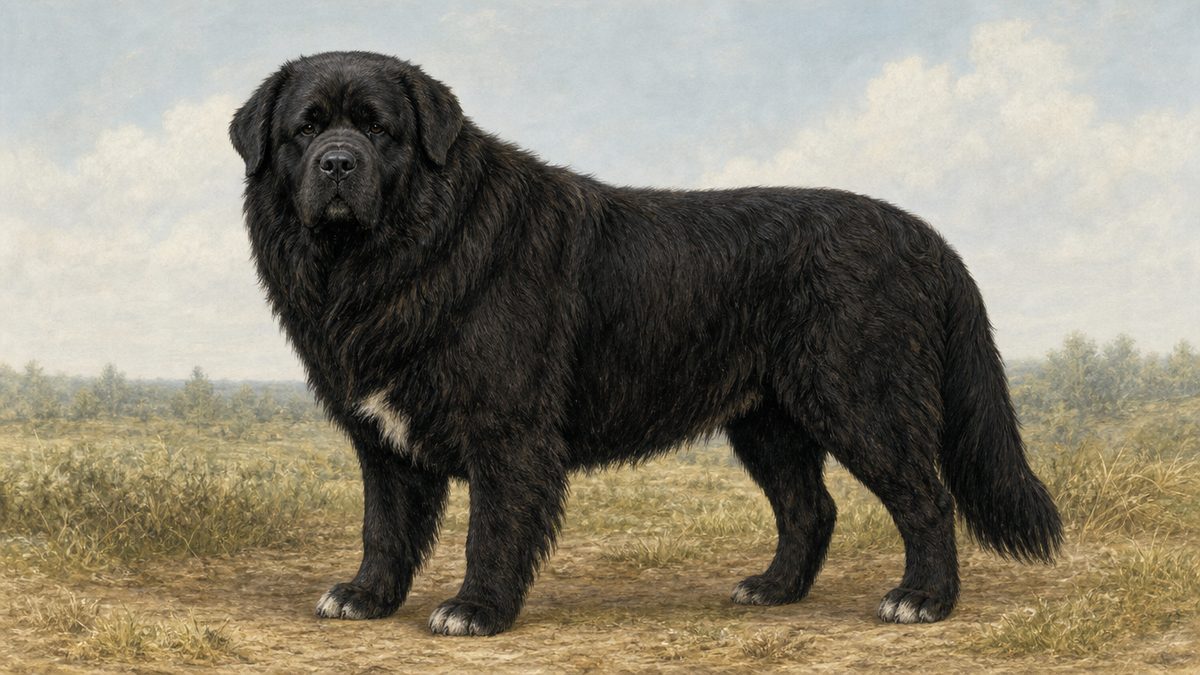
Russian sources give a consistent picture. The dog was strong and hardy, similar in appearance to a Newfoundland but with a plainer, heavier head and a coarser coat. It had a slightly elongated body of coarse constitution with powerful bone and strongly developed muscle, a broad massive skull, a short blunt muzzle and drop triangular ears. The coat was long, straight or slightly wavy, black or black with a reddish sheen, with small white patches permitted on the chest and paws. Males were required to stand not below 66 cm and females not below 63 cm.
One English source contradicts that flatly. Dog Breed Info Center says the breed resembled the Landseer Newfoundland, with the same coat pattern except that the Landseer's black is replaced by brown. A Landseer is a predominantly white dog with dark markings. The Russian description is of a black dog with small white patches. Those cannot both be right, and the Russian version is the better sourced, which is why the illustration brief for this page follows it.
The most important thing the Russian record says about the appearance is that there was never much of one to record: clear exterior standards were never fixed, and the total number of dogs was small. Every precise measurement you will find online for this breed was produced by a page that needed to fill a field.
Did the Moscow Water Dog bite drowning swimmers? Tracing the claim
The claim that Moscow Water Dogs attacked drowning people instead of rescuing them traces to exactly one document, a British dog-newspaper show report published on 15 May 2001, which quotes a person named only as O Krasnovskaya and gives no source for the quotation.
This is the most repeated sentence in the English-language dog internet about any Soviet breed, and following it back takes about twenty minutes. Here is what is at the end of it.
The original sentence, in full
Juliette Cunliffe was reporting the official UK launch of the Russian Black Terrier, a symposium held at Wentworth Castle near Barnsley on 22 April 2001. In the section on the Black Russian Terrier's ancestry she writes that another major ancestor was the Moscow Diver, and then says this:
"This was a new one on me, so in case I hadn't absorbed everything on the day, I sought out a little more information when I got home and found that in Russia an attempt was made to develop this breed, using the Caucasian Owtcharka and Newfoundland. However, in the words of O Krasnovskaya, 'That was not a good idea as [they] were not willing to save drowning people, but mostly were looking to bite them so this breed was never developed'."
Read what that actually is. It is a journalist saying the breed was new to her, that she looked it up at home after the event, and that she is passing on a quotation from someone she names but does not source. It is not testimony from the symposium, it is not a Russian archive, and it is not the author's own finding.
The article contradicts itself two paragraphs apart
The same passage calls the Moscow Diver another major ancestor of the Black Russian Terrier, and then quotes Krasnovskaya saying this breed was never developed. A breed cannot be a major ancestor of a successful breed and simultaneously never have been developed. One of those two statements is wrong, and the Russian record supports the first: the dogs existed, were shown publicly in 1955, and fed into the Black Russian Terrier Wikipedia (English), Moscow Water Dog.
The rest of Cunliffe's report checks out. Its Black Russian Terrier dates, a first standard published in Russia in 1958 in The Instruction for training and using military dogs, the breed declared a breed in 1981 with the standard confirmed by Russia's Ministry of Agriculture, and FCI recognition during the 1980s, all match the Russian textbook, which gives 1981 for recognition and 1984 at the international assembly in Mexico City for the FCI. This was competent reporting. The water dog sentence is the one aside in it that was researched afterwards and passed on second hand.
How one aside became a fact
| Stage | What it says | What was added or lost |
|---|---|---|
| Our Dogs, 15 May 2001 | Quotes O Krasnovskaya: they "were not willing to save drowning people, but mostly were looking to bite them"; | Attributed, hedged, and found by the author after the event |
| English Wikipedia | States in its own voice that "the breeding program was discontinued as the dogs would attack drowning victims instead of saving them"; | The attribution to Krasnovskaya is dropped and a CAUSE is asserted. The article itself tags the reference unreliable |
| PetGuide, 6 June 2018 | "the dog also had an aggressive nature and was more inclined to bite drowning victims than to rescue them. As such, the Russian Navy scrapped the breeding program"; | A RUSSIAN NAVY appears that exists in no Russian source, plus a lifespan, a height, a weight and a temperament |
| Content aggregators | "Rather than gently retrieving struggling swimmers, they often bit them" | Attribution gone entirely; the claim is now background knowledge |
The Russian Navy is the clearest invention in that chain. The words Red Star appear zero times on the PetGuide page, and the words German Shepherd appear zero times, while every Russian account names the Central Military School of Working Dogs and its Red Star breeding kennel, an army establishment acting on a Ministry of Defence order. A navy was added because a water-rescue story wants one.
What the Russian sources give as the reason instead
A Russian university cynology textbook states the reason in one sentence, and it is administrative. Listing the service breeds of the 1980s, Blokhin writes that the Moscow Water Dog also belonged among them, but it did not pass certification as a breed group and came to be bred as a Newfoundland in GOLS, the city society of dog breeding amateurs.
Russian Wikipedia gives the same shape with more detail: practical use of the Moscow Water Dogs proved inexpedient; in guard service the breed was inferior to the Black Russian Terrier, which had itself been bred using vodolaz sires; breeding work was discontinued; and the dogs were used in breeding within the Moscow City Society of Dog Lovers as Newfoundlands, gradually dissolving into the imported Newfoundland population.
Neither Russian source mentions swimmers, biting, rescues or a navy. That absence is not proof the anecdote is false. It is proof that the two accounts are independent of each other, and that the dramatic one rests on a single unsourced quotation while the dull one rests on a textbook.
What Bonbeno concludes, and what it does not
- Established: the breed existed, was shown in 1955, failed breed-group certification, and was absorbed into the Newfoundland population Wikipedia (Russian), Moskovskiy vodolaz.
- Established: the kennel was selecting for fierce dogs, by the Russian sources' own account.
- Asserted, by one person, once: that the dogs bit drowning people. Bonbeno cannot show this is false and does not claim to.
- Invented downstream: the Russian Navy, the lifespan, the height, the weight, and the temperament labels.
- Never established by anyone: that the biting was the reason the programme ended. That causal link appears first in an encyclopedia entry, not in the source it cites.
The honest way to state it is that the Moscow Water Dog failed as a breed for documented administrative reasons, and that a colourful explanation circulating in English is attributed to one unsourced remark and should be repeated only with that attribution attached.
One further caution about the shape of this whole question. Because the breed is undocumented in every sense that matters, with no standard, no registry and no studbook, there is no archive anyone can go to in order to settle it. That cuts against the anecdote and against any confident rebuttal of it equally. What can be established is where the English claim came from, which is what this section has done, and what the Russian sources say instead, which is what the next sections build on.
Moscow Water Dog price in India: there is none
There is no Moscow Water Dog price in india, or anywhere else, because the breed is extinct and no living animal of it exists to sell.
That is the complete answer to the commercial question, and this page will not soften it. What is worth spending words on instead is what a listing using this name would actually be, and why the number-shaped things you will find online exist at all.
Why price fields appear on pages about a dog that does not exist
Breed databases are templates. When a template has a height field, a weight field, a lifespan field and a temperament field, something has to go in them, and on an extinct breed with no fixed standard there is nothing to put. Two of the ranking pages resolve this in opposite ways, and the comparison is instructive.
| Field | Dog Breed Info Center | PetGuide |
|---|---|---|
| Height | -- (blank) | 26 to 30 inches |
| Weight | -- (blank) | Over 100 lb |
| Lifespan | -- (blank) | 8 to 12 years |
| Temperament | -- (blank) | Aggressive, dominant, independent |
| Health problems | -- (blank) | A written section |
| Exercise | -- (blank) | Moderate requirements |
| Grooming | -- (blank) | A written section |
| Recognition | -- (blank) | Recognized Clubs section |
| Colour | Like a Landseer Newfoundland, black replaced by brown | Not specified in the fast facts |
Dog Breed Info Center leaves nine fields blank, and that is the honest output. It has no data, so it prints no data, and it hedges what little it does say with the phrase is said to be. PetGuide fills every field, for a dog that has not existed since the 1980s and whose exterior standards were never fixed in the first place.
PetGuide then writes care guidance in the conditional: were the Moscow Water Dog still in existence, he would require a high-quality dog food formulated for large and giant breeds; it is likely that he was very difficult to train; it is possible that he also had a tendency toward independence and dominance. The grammar is honest about the speculation. The fast-facts box at the top of the same page is not, because it prints 8 to 12 years as a lifespan with no hedge at all.
Ask where a number could possibly have come from. A lifespan figure requires a population of dogs whose deaths someone recorded. For this breed, no registry ever existed, no standard was fixed, the numbers were small, and no veterinary literature names it. So a printed lifespan for the Moscow Water Dog cannot have a source, whatever confidence it is printed with. The same reasoning applies to its height, its weight and its temperament.
What an Indian listing using this name would be
If a seller in India offers you a Moscow Water Dog, the possibilities are short and none of them is the breed. In rough order of likelihood: a Newfoundland, which is the living breed the name is closest to and which Russian speakers also call a vodolaz; a large black crossbreed of unknown ancestry; a Newfoundland cross; or an outright fabrication with no dog behind it at all.
The Newfoundland possibility is the one worth taking seriously, because it is not really a deception so much as a naming collision. The Moscow Water Dogs were literally bred on as Newfoundlands and disappeared into that population. A Russian speaker describing a Newfoundland as a vodolaz is using the ordinary word.
How thin the search evidence is, and how that was tested
Searching for this breed from India is itself unreliable, so the instrument was checked before anything was read off it. A Bing India query for moscow water dog extinct returned About 50 results and ten Reddit landing pages, none about a dog. In the same session the control query for labrador retriever price in india returned About 29,300 results and ten genuine Indian pricing pages, so the engine was working. A second instrument disqualified itself with a CAPTCHA.
So this page claims no Indian absence from a result count. It rests on something firmer: the breed is extinct by the account of the Russian textbook and encyclopedia alike, which makes the Indian market question moot rather than merely unmeasured.
The one number an Indian reader should carry away
If a giant black double-coated dog is genuinely what you want, the relevant Indian figure is not a purchase price at all. It is that VOSD puts the monthly cost of ownership for a dog kept properly in India at Rs 3,000 to Rs 10,000, with large working breeds at the top of that range and food alone exceeding Rs 5,000 a month. That number is real, published, Indian, and applies to the living dog you would actually end up with.
What a dog of this type actually costs in India
Budget Rs 3,000 to Rs 10,000 a month for any dog kept properly in India, and plan for the top of that range for a giant black double-coated dog, because VOSD puts food alone for large working breeds above Rs 5,000 a month.
The breed is extinct, so nothing here is a cost of keeping a Moscow Water Dog. It is the cost of keeping the living dog a reader who searched this name is realistically choosing between, which is a Newfoundland or a large black crossbreed, and the figures are published Indian ones rather than estimates.
| Item | Published Indian range | Source |
|---|---|---|
| Monthly total, dog kept well | Rs 3,000 to Rs 10,000 | VOSD |
| Food, large and working breeds | Rs 5,000 or more per month | VOSD |
| Veterinary consultation | Rs 500 to Rs 1,000 per visit | VOSD |
| Annual vaccinations | Rs 1,500 to Rs 3,000 | VOSD |
| Preventive care done properly | Rs 5,000 to Rs 8,000 per year | VOSD |
| Full puppy vaccination course | Rs 3,000 to Rs 6,000 across all visits | Dog With Blog |
| Single anti-rabies dose | Rs 300 to Rs 600 | Dog With Blog |
| DHPPi or 7-in-1 per dose | Rs 500 to Rs 1,200 | Dog With Blog |
| Annual booster, DHPPi plus rabies | Rs 1,000 to Rs 2,000 | Dog With Blog |
| Grooming, large long-haired dog, full session | Up to Rs 2,000 | VOSD |
| Boarding per day | Rs 500 to Rs 2,000 | VOSD |
| Basic training course | Rs 5,000 to Rs 15,000 | VOSD |
| Dental cleaning under anaesthesia | Rs 3,000 to Rs 8,000 | VOSD |
| Hospitalisation, one to three days | Rs 8,000 to Rs 30,000 | VOSD |
| Lifetime, 10 to 15 years | Rs 3 lakh to Rs 10 lakh or more | VOSD |
The lines a giant coat inflates
Two costs on that table behave differently for this kind of dog. Grooming rises, because a dense long double coat in Indian humidity needs professional de-shedding and thorough drying that a short-coated dog does not, and VOSD's ceiling of Rs 2,000 a session is the planning figure rather than its Rs 300 floor. Everything dosed by bodyweight rises too, because anaesthesia, parasite prevention and most medication are priced partly on volume.
VOSD makes the general point directly: large breeds eat more, need larger doses and face higher surgical costs, and their food bill alone can be double or triple a smaller breed's, while veterinary fees in Mumbai and Bangalore run considerably higher than in tier two and tier three cities.
The benchmark worth knowing
VOSD's own operating number is the most useful figure on this page, because it comes from an organisation paying real bills at scale. Across more than 1,800 dogs on a seven-acre facility as of January 2026, with over 100 staff including 20 dedicated caregivers, its average upkeep runs over Rs 5,000 per dog per month. A single household with one giant dog does not beat a figure achieved with bulk purchasing and in-house veterinary capacity.
For a 50 kg-plus long-coated dog in an Indian metro, plan Rs 8,000 to Rs 12,000 a month in ordinary months and hold at least Rs 50,000 in reserve for the year something goes wrong. That is Bonbeno taking the top of VOSD's published Indian ranges because of the dog's size and coat, and it is labelled an estimate rather than a measurement.
Why this matters more for a breed people romanticise
A reader arrives at this page because of a story about Soviet rescue dogs. Stories are a bad basis for a fifteen-year financial commitment, and VOSD describes exactly how that ends: a manageable first year, climbing costs by year two, an unprepared-for medical emergency by year three, then skipped vaccinations, poor diet, no vet visits, and in the worst cases surrender or abandonment. It names financial unpreparedness as one of the leading drivers of dog abandonment in India.
The breed you came looking for cannot cost you anything, because it does not exist. The dog you might buy instead can cost you a great deal, and deciding that on the strength of an anecdote that turns out to have one unsourced sentence behind it is the specific mistake this page exists to prevent.
Heat tolerance: why this dog was never going to work in India
A massive black long-coated dog selected for cold water has the lowest heat tolerance of any type this site covers, and the arithmetic is public: Moscow's annual mean is 4.28 degrees Celsius against Chennai's 27.95, a gap of 23.67 degrees.
Every figure below was queried from NASA POWER by explicit latitude and longitude, and each grid cell's reported elevation is printed beside it so you can see the model was standing in the right place. That check is not decorative: for Shimla the same API returns a cell elevation of 897.65 m for a town near 2,200 m, and for Manali 3,984.73 m for a town near 2,050 m, errors of 1,302 m and 1,935 m in opposite directions.
The homeland baseline, checked first
Moscow at 55.7558 N, 37.6173 E returns a cell elevation of 184.06 m against a real city elevation near 156 m, out by 28 m. A plains cell describing a plains city, so the baseline holds. Its annual mean is 4.28 degrees, its warmest month is July at a 19.0 degree mean, and its coldest is January at minus 10.7.
| Place | Cell elevation | Annual mean | Warmest month mean | Wettest-month humidity |
|---|---|---|---|---|
| Moscow | 184.06 m | 4.28 C | 19.0 C (July) | 80.2 percent (July) |
| Delhi | 206.37 m | 25.6 C | 35.9 C (June) | 74.9 percent (August) |
| Mumbai | 97.15 m | 26.77 C | 31.2 C (May) | 90.4 percent (August) |
| Chennai | 48.95 m | 27.95 C | 31.5 C (May) | 82.3 percent (November) |
| Bengaluru | 841.72 m | 23.74 C | 28.4 C (April) | 81.0 percent (October) |
| Pune | 635.99 m | 23.86 C | 28.9 C (April) | 90.8 percent (August) |
| Kolkata | 7.35 m | 25.81 C | 31.5 C (May) | 89.3 percent (September) |
Moscow's warmest month, July at a 19.0 degree mean, is COOLER than Bengaluru's coolest month, December at 20.2 degrees. Bengaluru is the mildest large city in this table. A breed developed for a place whose summer never reaches India's mildest metro's winter is not a breed with an Indian answer.
Colour is the part nobody mentions
This dog was black, or black with a reddish sheen, by the Russian description. That matters in India in a way it does not in Moscow. A black coat absorbs markedly more solar radiation than a light one, so a black giant in Chennai at a 31.5 degree May mean is running a heat load that the air temperature alone understates. Owners of black-coated dogs in India learn this on the first walk of April.
The monsoon humidity half compounds it. Pune reaches a mean relative humidity of 90.8 percent in August and Mumbai 90.4, against Moscow's July figure of 80.2. A dog cools itself by evaporating water from its airways, and at 90 percent humidity that mechanism is close to saturated. A humid 28 degrees is harder on a giant double-coated dog than a dry 35.
The evidence on what heat does to dogs this size
In a UK cohort of 905,543 dogs under primary veterinary care in 2016, dogs over 50 kg had 3.42 times the odds of heat-related illness, with a 95 percent confidence interval of 1.54 to 7.57, and dogs at or above their breed and sex mean bodyweight had 1.42 times the odds, interval 1.12 to 1.80. In the companion paper on the same cohort, 652 of the 879 events with a recorded trigger, 74.2 percent, were exertional rather than environmental or from being shut in a vehicle.
Neither paper studied this breed, which did not exist when the data were collected, and both studied the United Kingdom rather than India. What transfers is the bodyweight finding, because it is about mass, and the trigger finding, because it is about activity. Both are floors on the Indian risk rather than ceilings, since the UK is far cooler than any city in the table above.
What Indian law says about a long-coated dog in the heat
The 2017 Rules address this situation directly, and in language that reads as though drafted for exactly this kind of animal. Second Schedule Part IV paragraph 21(1) bars keeping in outdoor facilities, without the attending veterinary practitioner's written approval, dogs not accustomed to the temperatures prevalent in the area, and dog breeds that cannot tolerate the temperatures prevalent in the area or region in question, such as long-haired breeds in high temperature locations.
Paragraph 15 of the same Part adds that the temperature within indoor housing shall be ambient and comfortable depending on the breeds of dogs housed inside, and such as provides for their health and well-being. For a long-haired black giant in most Indian cities, meeting that standard means cooling the space, not merely providing shade.
There is a quiet irony in this section. The Moscow Water Dog was bred to work in cold water because the Soviet Union needed dogs that could handle its climate. India needs the opposite animal, and no amount of admiration for the story changes the physics.
Temperament: what can be said, and what is invented
Nothing reliable is known about the Moscow Water Dog's temperament as individual dogs experienced it, because no standard was fixed, no club assessed the breed and nobody alive has met one.
That is an uncomfortable answer for a breed page, and it is the correct one. What the record does support is narrower and more interesting than the temperament labels circulating online.
The one thing the record actually establishes
The kennel was selecting for aggression on purpose. Russian Wikipedia states the aim was to obtain dogs that were tall, physically strong, злобных, meaning fierce or vicious, and with a good coat. These were guard dogs being built for the armed forces, not therapy animals that unexpectedly went wrong.
That single sourced sentence does more work than every temperament label online, because it explains both the programme's design and why an aggression story about it sounds plausible. It does not, however, tell you how any individual dog behaved, and it certainly does not establish the biting claim, which the previous section traces to one unsourced remark.
What the ranking pages assert instead
PetGuide prints a temperament of aggressive, dominant, independent and a Best Suited For field reading not recommended, then adds that it is likely he was very difficult to train, that it is possible he had a tendency toward independence and dominance, and that this breed would have required an experienced dog owner and a firm hand in leadership and authority. The conditional grammar in the body concedes that all of it is inference; the fast-facts box at the top does not.
Dog Breed Info Center prints a Temperament heading and then two dashes. Between the two approaches, the blank is the accurate one.
Assigning aggressive and dominant to a breed nobody can assess is not a harmless bit of colour. Dominance framing produces confrontational handling advice, and that advice gets applied by readers to the living dogs in front of them, which for anyone searching this name is most often a Newfoundland or a large black crossbreed. A fabricated label on an extinct dog becomes real training advice for a real one.
What is fair to infer, labelled as inference
- Guarding drive was selected for, so the dogs plausibly carried more of it than a Newfoundland. Sourced to the programme's stated aim.
- They were not better guards than the Black Russian Terrier. Russian Wikipedia says the vodolaz was inferior to it in guard service, which is a comparative judgement someone at the time actually made.
- They were adequate enough as pets to be absorbed. The dogs were bred on within a city dog-lovers' society as Newfoundlands and dissolved into that population. Animals nobody could live with do not get quietly folded into a companion breed.
- Nothing supports a specific behaviour toward people in water. That claim has one source and no corroboration.
The fourth point deserves emphasis because the third undercuts the popular story more than any argument this page could make. If these dogs had been notorious for attacking swimmers, folding them into the pet Newfoundland population of Moscow would have been a strange decision, and no source records anyone objecting to it.
The temperament question a reader should actually be asking
If you arrived here because a big calm water-loving family guardian appeals to you, that is a real want and it has living answers. The Newfoundland, which holds FCI standard 50 and which this breed was built from and folded back into, is the direct one. The tradeoff is honest: you get a famously gentle temperament and you take on the same coat, the same size and the same Indian heat problem the climate section sets out.
You will still need to socialise any giant dog hard and early in India, because size converts a mild wariness into a management problem. That is true of the living breeds and it would have been truer of a dog selected for fierceness, which is one more reason the extinction of this particular experiment is not something to mourn.
Training: what the record supports for a dog of this type
No training account of the Moscow Water Dog survives, so this section covers the giant black double-coated dog an Indian reader will actually be handling, and it labels every inference as one.
The Russian record contains exactly one operational judgement about these dogs at work: in guard service they were inferior to the Black Russian Terrier. That is a comparison made by people who used both, and it is the only performance assessment of the breed anyone has published.
What that one judgement implies
The Black Russian Terrier was the programme's success and was bred using vodolaz sires Wikipedia (English), Moscow Water Dog. So the Soviet kennel had two related lines and preferred the terrier for the job both were meant to do. Whether the water dog lost on trainability, on drive, on coat management or simply on consistency, nobody wrote down. Pages that tell you it was very difficult to train are inferring from a temperament label they themselves invented.
Training a giant black-coated dog in India, which is the real question
- Front-load everything before the weight arrives. Recall, loose-lead walking and a settle should be solid by five months, because a 50 kg adolescent renegotiates every rule you did not fix early.
- Socialise on the specific Indian triggers. Delivery riders, autos, cattle, festival drums, firecrackers and building-site noise, all before roughly sixteen weeks.
- Train handling daily. Ears, feet, mouth, tail and coat. A giant long-coated dog that resists grooming is a dog that will be sedated for it, at Indian anaesthesia prices.
- Condition a muzzle early. Not because the dog is dangerous, but because it makes veterinary care fast and safe, and Indian clinics see very few giants.
- Move sessions to the cool hours. A dog cannot learn while it is overheating, and for most of India that means dawn and after dark, as the exercise section sets out.
Budget for help
VOSD puts a basic Indian training course at Rs 5,000 to Rs 15,000 and a behaviourist assessment and programme at Rs 3,000 to Rs 10,000. For a giant dog in a country where few trainers have handled one, that is the line least worth economising on. VOSD also notes that a dog left alone for ten to twelve hours a day becomes anxious, destructive and unhappy, which for a giant is a household-scale problem rather than a chewed shoe.
If you are handling a Newfoundland or a large black crossbreed, take your training approach from that dog, not from a page about the Moscow Water Dog. The firm hand and leadership language on the ranking pages is written about an animal nobody has assessed, and applying dominance-framed handling to a soft-natured giant is how a willing dog learns to avoid you.
The legal frame in India
Nothing in Indian law restricts training a large dog, and no breed on this page is banned. The 2017 Rules do bind anyone breeding or selling, and they include a provision worth knowing when a seller offers you a young puppy for early training: Rule 8(1)(a) requires that pups less than eight weeks in age are not sold. Taking a puppy earlier costs you the litter learning that makes an adult giant manageable, and it is a breach.
One more provision belongs here because it touches appearance rather than behaviour. Second Schedule Part II paragraph 6(8) forbids tail docking, ear cropping, de-barking, de-clawing and any change of appearance by artificial means. Whatever the Red Star kennels did in the 1940s, none of it is lawful practice in India now, and a seller offering a cropped or docked dog is showing you how they operate.
Exercise needs, and why the timing matters more than the distance
For a giant black double-coated dog in India, plan 45 to 60 minutes of low-intensity work split across the two coolest hours of the day, because exertional heat is what actually harms dogs this size.
No exercise figure exists for the Moscow Water Dog and none is invented here. PetGuide asserts moderate exercise requirements for the extinct breed on the reasoning that a rescue dog would not need much, which is a guess dressed as a specification. What follows applies to the living giant an Indian reader is actually walking.
The evidence, and its limits
Exertional heat, not distance, is the danger. Among 905,543 UK dogs under primary veterinary care in 2016, 652 of the 879 heat-related illness events with a recorded trigger, 74.2 percent, were exertional, against 113 environmental and 46 from vehicular confinement. The paper's title says it plainly: dogs do not die just in hot cars.
Size multiplies it. In the companion paper on the same cohort, dogs over 50 kg carried 3.42 times the odds of heat-related illness, confidence interval 1.54 to 7.57, and dogs at or above their breed and sex mean bodyweight carried 1.42 times the odds, interval 1.12 to 1.80. Russian sources put Moscow Water Dog males at not below 66 cm, which is a dog comfortably inside that band, and a Newfoundland certainly is.
Hall 2020 modelled UK dogs in a UK climate and studied neither this breed nor any Indian population. What transfers is the bodyweight finding, which is about mass rather than breed, and the trigger split, which is about activity. Both are floors on the Indian risk, not ceilings, because the United Kingdom is far cooler than every city in the climate table above.
The Indian walking window, by city
| City | Hardest months | Practical window | The limiting factor |
|---|---|---|---|
| Chennai | March to September | Before 06:00, after 21:00 | Annual mean 27.95 C, no cool season |
| Mumbai | March to November | Before 06:30, after 21:00 | August humidity 90.4 percent |
| Delhi | April to September | Before 06:00, after 21:30 | June mean 35.9 C |
| Kolkata | March to October | Before 06:00, after 21:00 | May mean 31.5 C |
| Pune | March to June | Before 06:30, after 20:30 | August humidity 90.8 percent |
| Bengaluru | March to May | Before 07:00, after 20:00 | Mildest option, April mean 28.4 C |
Water, which is the part this breed's story invites
Swimming is genuinely the best exercise for a heavy-coated giant in a hot country, because the water carries the joint load and removes the heat at the same time. It also carries Indian-specific risks that a page about a Soviet water dog ought to name rather than romanticise.
- Dry the ears thoroughly after every swim. Drop-eared giants in a humid climate develop ear disease from trapped water faster than owners expect.
- Dry to the skin, not just the surface. A dense undercoat that stays wet in August is a hot moist layer against the skin, which is where Indian coat problems start.
- Check the water. Urban Indian lakes and tanks carry leptospirosis risk, and lepto is in the standard Indian vaccination course at Rs 500 to Rs 1,200 per DHPPi dose.
- Never assume a heavy dog can swim. Coat and bone that suit cold water still tire an unfit dog quickly, and a giant in difficulty cannot be lifted out.
What under-exercise does
A giant that is not worked becomes heavy and stiff rather than hyperactive, and weight gain compounds every heat risk on this page, because Hall's 1.42 odds ratio is measured against the breed and sex mean. A dog carrying extra weight moves itself into a higher-risk group without changing breed. In April and May, replace one walk with indoor scent work rather than skipping the day: a giant tires as well from twenty minutes of nose work as from a kilometre of pavement.
Grooming a coarse double coat in Indian humidity
To groom a coat of this type in India, brush the undercoat out two or three times a week year round, dry the dog to the skin after every wash and every soaking, and never shave it.
The Russian description of the Moscow Water Dog's coat is short and specific: long, straight or slightly wavy, black or black with a reddish sheen, small white patches permitted on chest and paws, and notably coarse, coarser than a Newfoundland's. That last word is the only grooming-relevant detail anyone recorded, and it cuts both ways: a coarser guard coat sheds water better and mats slightly less, but it sits over the same insulating undercoat.
Why overseas coat advice does not transfer
Care guidance for northern double-coated breeds is written for northern conditions, where towel-drying and letting the dog air dry is adequate. In an Indian August it is not. Pune reaches a mean relative humidity of 90.8 percent and Mumbai 90.4; a dense undercoat left damp in that air stays damp, and a warm wet layer held against the skin is the origin of most Indian coat and ear problems. Raise the brushing frequency here rather than lowering it.
| Task | Frequency in India | Why |
|---|---|---|
| Undercoat rake to the skin | 2 to 3 times weekly, daily in shedding pushes | A slicker skims the guard hair and leaves the packed undercoat |
| Full dry after any wetting | Every time, without exception | Air drying is a temperate-climate instruction |
| Ear check and dry | After every bath and swim | Drop ears plus 90 percent humidity is the commonest failure |
| Tick and skin inspection | Every brushing session | A dense dark coat hides both until they are established |
| Professional de-shed and dry | Every 4 to 6 weeks in humid months | Up to Rs 2,000 per session for a large long-haired dog |
| Nail trim | Every 2 to 3 weeks | Giant bodyweight on overlong nails damages feet quickly |
Never shave it
Shaving a double coat does not cool the dog. The undercoat insulates in both directions and the guard hair is the sun barrier over skin that has never been exposed. Removing it leaves the dog no better at losing heat, exposes it to direct radiation, and on a heavy-coated breed the guard coat frequently returns patchy. On a black dog in India, removing the sun barrier is the specific worst version of this mistake.
Move the walks instead. The exercise section gives the windows city by city, and shifting the day costs nothing while shaving costs the coat.
Ticks, which are the real Indian grooming issue
A long, dark, coarse coat is among the hardest surfaces in India to inspect. Build the check into the brushing rather than treating it as a separate job: ear margins and inside the ear, between the toes, armpits, groin, under any neck ruff and the feathering behind the legs. On a short-coated dog you would see a tick. On this coat you have to go looking, every session, with your hands rather than your eyes.
The Soviet brief for this programme explicitly wanted dogs with a good coat, because they were to work in cold conditions from a country that has plenty of them. Coat quality was a selection criterion, not an accident. That is worth remembering when a seller in India describes any heavy-coated import as low maintenance: the coat was engineered for a climate that does almost none of the work Indian humidity does.
What it costs
VOSD puts a basic Indian grooming wash at Rs 300 and a full session for a large long-haired breed at up to Rs 2,000. Budget the top of that range through the humid months and do the weekly maintenance yourself. The professional visit is for the deep de-shed and the thorough dry, which are the two things hardest to do properly at home on a giant, and not for the routine brushing, which no schedule can outsource.
Health issues, and why this page prints no lifespan
No veterinary literature names the Moscow Water Dog, no registry ever collected screening data on it, and no lifespan figure for it can have a source, so this section gives transferable evidence about size and coat and says so at every step.
The literature search, and why its zero is trustworthy
Eight name forms were run in PubMed and none is indexed as a phrase. Moscow Water Dog, Moscow Water Dogs, Moscow Diver, Moscow Retriever, Moskovsky vodolaz, Moskovskii vodolaz, Moscow Newfoundland and the Cyrillic form. Every Latin-script query triggered the quoted-phrase-not-found warning and was silently broadened; Moskovsky vodolaz collapsed to moskovsky alone and returned 225 records about Russian institutions.
Opening the records settles it. Behind the twenty hits for Moscow Water Dog sit the Global Burden of Disease 2023 mortality analysis, an inorganic chemistry paper titled Ammonium Polyuranates: Old Dog, New Structural Tricks, a Kyrgyz echinococcosis screening study and a paper on classifying dog faeces in images. Not one concerns the breed.
The control passed cleanly in the same session: the phrase Newfoundland dog returned 23 records with no rewrite warning at all, which proves the phrase index works when a phrase is actually in it. Saint Bernard with dog returned 72 and Labrador retriever with hip dysplasia returned 126.
The Cyrillic query returned zero WITH AN EMPTY QUERY TRANSLATION LINE, meaning PubMed did not run it rather than running it and finding nothing. That zero proves nothing and is not counted as evidence here. The finding rests on the seven Latin-script forms whose translations PubMed did print.
What this page will not print
It will not print a lifespan. PetGuide gives 8 to 12 years for a breed that ceased to exist in the 1980s and whose exterior standards were never fixed; Dog Breed Info Center leaves the field blank, which is right. The large UK studies that could have supplied a figure, Teng 2022 on life tables and McMillan 2024 on breed longevity, cover many breeds and never covered this one. Borrowing a Newfoundland median and attaching it here would be fabrication with a citation on it.
It will not print screening percentages either. No OFA-style registry ever held this breed, and a screening rate requires a population somebody evaluated.
What genuinely transfers to the living dog
| Risk | Evidence | Why it transfers |
|---|---|---|
| Heat-related illness | Dogs over 50 kg carried 3.42 times the odds, CI 1.54 to 7.57 | About bodyweight, not about breed |
| Exertional heatstroke specifically | 652 of 879 triggered events, 74.2 percent, were exertional | About activity and heat |
| Weight above the breed mean | 1.42 times the odds, CI 1.12 to 1.80 | Applies to any dog above its own breed and sex mean |
| Hip dysplasia | Named in Indian law among the genetic defects breeding dogs must be tested for | A statutory expectation for any dog bred in India |
| Gastric dilatation and volvulus | A deep-chested giant risk | Follows from conformation, and no breed-specific rate exists |
| Ear disease | Drop ears plus 90 percent August humidity in Pune and Mumbai | Anatomy plus climate, not breed research |
What Indian law requires of anyone breeding a giant
Hip dysplasia screening is a statutory expectation in India, not a courtesy. Second Schedule Part III paragraph 8(10) of the 2017 Rules states that dogs shall have been tested for genetic defects, including hip dysplasia, progressive retinal atrophy, night blindness, hypothyroidism, entropion, ectropion, overshot, undershot jaw when incisors do not touch or mesh, wry mouth, two or more missing teeth, and unilateral or full cryptorchid males. The word is including, so the list is illustrative rather than closed.
If you are buying any giant dog in India, ask for that testing on both parents in writing. A breeder who cannot produce it has not met a legal requirement, and that tells you what to expect of everything else they say.
The health lesson this breed actually teaches
It is a lesson about evidence rather than about disease. A dog that existed for perhaps forty years, in small numbers, with no fixed standard and no registry, has left behind an internet full of confident health figures. Every one of them was generated to fill a template field. When a page gives you a precise number for something nobody could have measured, the number is not the finding. The willingness to print it is.
Feeding a giant of this type through an Indian year
To feed a giant black-coated dog in India, use a large or giant-breed growth diet for the first two years, weigh the food rather than scooping it, and judge the dog by body condition rather than by a bag chart.
No feeding record exists for the Moscow Water Dog, and PetGuide's guidance for it is written in the conditional: were the breed still in existence, he would require a high-quality dog food formulated for large and giant breeds. That happens to be sound advice for the living dog, and it is worth separating from the invented parts of the same page.
The rule that matters most in year one
Grow a giant puppy slowly. A dog whose adult males stood at not below 66 cm, and a Newfoundland certainly, spends eighteen to twenty-four months building a skeleton. Pushing calories or calcium through that window produces joint disease no adult diet corrects. Large and giant-breed growth formulas exist precisely to control calcium and energy density, and the correct puppy is a lean one: ribs findable under a light cover, which on this coat means using your hands rather than your eyes.
How much, and how to check
Weigh the food. A measuring cup varies by more than 20 percent with how it is filled, and on a giant that error compounds into kilograms across a year. Weigh the dog monthly on the same scale and write it down. VOSD's Indian consultation range of Rs 500 to Rs 1,000 makes a quarterly weight check at a clinic affordable if you have no scale at home.
| Stage | Approach | Indian specifics |
|---|---|---|
| 8 weeks to 6 months | Large or giant-breed growth diet, 3 to 4 meals daily | Wet food spoils fast in an Indian kitchen; do not leave it down |
| 6 to 18 months | Same growth diet, 2 to 3 meals, lean condition held | Appetite drops through the hot months; do not force it back up |
| 18 months to 2 years | Transition to adult, 2 meals | Reassess in October when appetite returns after the monsoon |
| Adult | 2 meals daily, never one large meal | Food for a large working breed exceeds Rs 5,000 a month |
| Senior, from about 7 | Reduced energy, joint support, more frequent weighing | Dental work costs Rs 3,000 to Rs 8,000 under anaesthesia |
Two meals, never one
Split the ration into at least two meals with an hour of quiet either side. A deep-chested giant is the classic gastric dilatation and volvulus shape, and no breed-specific rate exists for any dog on this page, so treat the conformation as the reason rather than reaching for a statistic that was never collected.
A dog that is restless and drooling, with a swelling belly, retching without producing anything, is a surgical emergency measured in hours. Find out now which clinic near you performs emergency abdominal surgery at night and what it costs, because VOSD puts an Indian hospitalisation of one to three days at Rs 8,000 to Rs 30,000 before surgery is added. That is not a call to make while searching for a clinic.
Water and heat, which change the feeding day in India
A heavy-coated dog eats less in the hot months and drinks far more, and both are normal. What is not normal is a giant that goes off food and is also lethargic, because in April and May that combination is more likely to be heat than fussiness. The exercise section covers why: 74.2 percent of triggered heat-illness events in a 905,543-dog cohort were exertional, and a dog that has been walked too late in the morning shows it at the food bowl.
Move the main meal to the evening in summer, keep water available in more than one place, and never exercise within an hour either side of feeding.
The Indian supply question
True giant-breed growth diets are the thinnest part of the Indian pet food shelf. Large-breed lines are widely stocked; giant-specific ones often are not, and outside the metros you may be choosing between ordering online and using a large-breed formula. Settle that before the puppy arrives, because switching a giant puppy's food abruptly at four months to whatever a shop happens to have is worse than picking a slightly imperfect diet and staying on it.
The first year with a giant puppy in India
No Moscow Water Dog puppy has existed for forty years, so this timeline is written for the giant black-coated puppy a reader who searched this name will actually raise, anchored to Indian law, Indian vaccination costs and the Indian calendar.
Nobody published growth data for this breed, and this page will not invent a chart for it. What follows is giant-breed practice plus the Indian specifics, labelled as guidance rather than as a measurement of any breed.
| Age | What is happening | What you do |
|---|---|---|
| 0 to 8 weeks | With the litter. Rule 8(1)(a) forbids sale below eight weeks | Refuse an earlier puppy, whatever reason is offered |
| 8 to 10 weeks | Home. Vaccination begins; the full course runs Rs 3,000 to Rs 6,000 | Name, routine, daily handling of ears, feet and coat |
| 10 to 12 weeks | Second DHPPi, at Rs 500 to Rs 1,200 a dose | Carry the puppy out to see traffic and strangers before it can walk there |
| 12 to 16 weeks | Third DHPPi and rabies; cover completes around 16 to 18 weeks | Delivery riders, autos, cattle, drums, children. The month that decides the adult |
| 4 to 6 months | Fast frame growth, teething, joints still soft | Loose-lead work while you still outweigh the dog; keep impact low |
| 6 to 9 months | Adolescence. Coat thickens and the first real shed arrives | Start the brushing habit properly; book the training course |
| 9 to 12 months | Near adult height, far from adult weight or mind | Proof recall under distraction; discuss sterilisation timing with your vet |
| 12 to 24 months | Slow filling out; giants mature late | Hold lean condition; the joints are still finishing |
The two Indian seasons to plan around
A puppy's first hot season and first monsoon do more damage than anything else in year one. A giant puppy reaching four months in April in Delhi, where the June mean is 35.9 degrees, cannot be outside between roughly 07:00 and 21:00, and that is precisely the window in which it should be meeting the world. The socialisation you lose there does not come back.
The monsoon costs you the coat and the ears. A growing dense undercoat repeatedly soaked and never dried to the skin is where the first skin and ear infections start, and in a puppy those become a lasting resistance to being handled that outlasts the infection itself.
If you can choose the timing, take a puppy that will be twelve to sixteen weeks old during your city's cool months. In Delhi and Kolkata that means arriving in late autumn; in Bengaluru and Pune the window is wider, because both spend eight months of twelve at a mean between 10 and 24 degrees.
What Indian law gives you at the point of purchase
Rule 8 of the 2017 Rules is headed Conditions for sale. Rule 8(1)(a) requires that pups less than eight weeks in age are not sold, and 8(1)(b) that dogs over six months are not sold without first being sterilised unless sold to another licensed breeder. Second Schedule Part III paragraph 8(9) adds that all pups shall be vaccinated, starting at seven to eight weeks and usually completed by eighteen weeks, and paragraph 8(3) that individual health records shall be maintained for all animals above eight weeks.
Those are dated, checkable obligations and they double as a seller test. Ask to see them. A breeder who cannot show an eight-week date, a vaccination record matching paragraph 8(9) and the genetic-defect testing paragraph 8(10) requires is failing statutory duties rather than being disorganised.
Anyone who arrives at a Moscow Water Dog page and ends up with a puppy is bringing home a different dog: a Newfoundland, a Newfoundland cross, or a large black crossbreed. That is a good outcome, not a compromise, and it means the schedule above should follow the animal in front of you rather than any breed chart. Weigh it monthly, let its own growth set the pace, and verify every claim the seller made against the clauses listed here.
The Red Star breeds compared, and what to get instead
The Moscow Water Dog is the only one of the Red Star kennel's four post-war breeds that left nothing behind under its own name, and comparing the four is the clearest way to see why.
A Russian university textbook lists the programme's crosses in one sentence, and it is the single most useful line anyone has written about these dogs: the groups were Moscow Water Dog (Newfoundland plus German Shepherd), Moscow Great Dane (Great Dane plus German Shepherd), Brudasty Hound (Airedale Terrier plus Russian Hound) and Moscow Watchdog (St Bernard plus Caucasian Shepherd plus Russian Piebald Hound).
| Breed group | Cross, per the Russian textbook | Outcome |
|---|---|---|
| Black Russian Terrier | Giant Schnauzer on Airedale, Rottweiler and Newfoundland lines, with vodolaz sires in later stages Wikipedia (English), Moscow Water Dog | Recognised as a breed in 1981, then by the FCI at the Mexico City assembly in 1984 |
| Moscow Watchdog | St Bernard, Caucasian Shepherd and Russian Piebald Hound Russian Kynological Federation | Living Russian national breed, still absent from the FCI register |
| Moscow Water Dog | Newfoundland plus German Shepherd | Failed breed-group certification; bred on as Newfoundlands and absorbed |
| Moscow Great Dane | Great Dane plus German Shepherd | No surviving breed |
| Brudasty Hound | Airedale Terrier plus Russian Hound | No surviving breed |
Two of the five survive, and both survivors were guarding breeds. The water dog was the only one built around a working role that was not guarding, and Russian Wikipedia records that in guard service it lost to the Black Russian Terrier, which is the comparison the kennel itself made.
Why the terrier won and the vodolaz did not
The textbook is unsentimental about it. Crossing the Giant Schnauzer with the Airedale, the Rottweiler and the Newfoundland produced very interesting black dogs with furnishings and a rough coat, which were grouped together and provisionally called black terriers; in 1981 they were recognised as a breed and the first standard was approved. The water dogs, by contrast, never got a fixed exterior standard at all, and a breed group without a standard cannot be certified.
That is the mechanical answer to why one Soviet experiment became an international breed and another vanished, and it has nothing to do with swimmers.
What to get instead, if the idea appealed
| If what appealed was | Consider | The Indian tradeoff |
|---|---|---|
| The water-rescue giant itself | Newfoundland, FCI standard 50 | Same coat, same size, same heat problem set out in the climate section |
| The Soviet programme story | Black Russian Terrier | The one that succeeded, with a real standard and real records behind it |
| A Russian guarding giant | Moscow Watchdog | Living but not FCI recognised, and with no verified Indian supply |
| A heavy mountain guardian | Caucasian Shepherd Dog, FCI standard 328 | Genuinely available in India, and markedly more suspicious of strangers |
| The alpine rescue archetype | St. Bernard | Real Indian supply and a real literature, same giant heat arithmetic |
| A Newfoundland-descended giant with data behind it | Leonberger | Long coat, giant size, and published longevity figures |
| A heavy-coated cold-climate family giant | Bernese Mountain Dog | Same coat management problem, well documented health risks |
The Newfoundland is not merely the closest living alternative. It is literally what the surviving Moscow Water Dogs were bred on as, within the Moscow city dog society, until the two populations became one. Anyone who wanted this breed and buys a Newfoundland is, in the most defensible sense available, getting the thing that is left of it.
The remaining honest point is the Indian one. Every alternative in that table is a giant with a heavy coat, and the climate section applies to all of them without exception. The best answer for most Indian households drawn to this story is not a giant at all, and the adoption section says what that looks like.
Common mistakes people make about this breed
The commonest mistake with the Moscow Water Dog is repeating a single unsourced sentence as established history, and every other error on this list follows from taking one page's confidence as evidence.
1. Stating the biting story as the reason the programme ended
It is attributed to one person, quoted once, in a 2001 show report whose author says she looked the breed up at home afterwards. English Wikipedia converts it into a causal claim in its own voice and simultaneously tags the reference unreliable. The Russian academic account gives an administrative reason instead, that the breed failed certification as a breed group. Repeat the story if you like, but repeat the attribution with it.
2. Believing the Russian Navy developed it
PetGuide says the breed was commissioned by the Russian government and developed by the Russian Navy, and that the Navy scrapped the breeding programme. No Russian source mentions a navy. Every one names the Central Military School of Working Dogs and its Red Star kennel, an army establishment Blokhin G.I. and others, Kinologiya. The words Red Star appear zero times on that page.
3. Quoting a lifespan, height or weight
Russian sources record that clear exterior standards were never fixed and the total number of dogs was small. A lifespan requires a recorded population; a breed standard requires a club that wrote one. Neither existed. So the 8 to 12 years, 26 to 30 inches and over 100 lb printed as fast facts cannot have sources, and the competing page's nine blank fields are the honest rendering of the same absence.
4. Taking the colour on trust
The English and Russian descriptions of this dog's colour flatly contradict each other. Dog Breed Info Center says it resembled a Landseer Newfoundland, the same pattern with brown replacing black, which describes a predominantly white dog. Russian Wikipedia says black, or black with a reddish sheen, with only small white patches permitted on the chest and paws. Both cannot be right, and any illustration you find online was drawn from one of them without acknowledging the other.
It is the cheapest available test of how these pages were written. Colour is the single easiest attribute to get right if anyone has actually consulted a source, and a flat contradiction between two ranking pages on that point tells you that at least one of them is reconstructing the dog rather than reporting it. Apply the same test to any extinct-breed page you read.
5. Confusing the vodolaz with the Newfoundland
In Russian, водолаз is the ordinary word for a diver and the everyday nickname for the Newfoundland. Russian Wikipedia opens the article with a disambiguation note saying exactly that. So a Russian text calling a dog a vodolaz is usually talking about a Newfoundland, and an English writer treating every such mention as a reference to this breed will manufacture a history that never happened. The confusion runs the other way too, since the surviving Moscow Water Dogs were deliberately bred on as Newfoundlands.
6. Confusing it with the Moscow Watchdog
Two different dogs, same kennel, same decade, and the names are one word apart in English. The watchdog is a living guarding breed from St Bernard, Caucasian Shepherd and Russian Piebald Hound; the water dog is extinct and was built on the Newfoundland. Neither is FCI recognised, which is one of the few things they genuinely share.
7. Looking for one to buy
There are none. Any Indian listing under this name is offering a different animal, and the price section sets out which. The wider version of this mistake is treating an extinct breed as merely rare: rare breeds have breeders, waiting lists and prices, and this one has a certification failure and an absorption into another population.
8. Assuming an absence of Indian search results means anything
It does not, on its own. A Bing India query for this breed returned ten Reddit landing pages under About 50 results, which looks like a thin market and is actually a broken query, since the Labrador control in the same session returned ten genuine Indian pages. The reason to believe there is no Indian supply is that the breed is extinct by the Russian record, not that a search engine came back empty.
Adoption: what to do if you came here looking for this dog
You cannot adopt a Moscow Water Dog, because the breed is extinct and no living animal of it exists anywhere in the world. What you can do is decide what you were actually looking for, and this section is about that.
That is the plain answer, and it belongs at the top rather than buried behind care advice for an animal nobody can obtain. There is no rescue, no waiting list, no breeder and no shelter dog of this breed. There will not be one.
What you were probably actually looking for
Most people arrive at this page from one of four wants, and each has a real answer.
- A big gentle water-loving family giant. The Newfoundland is the living version, it holds FCI standard 50, and it is what the surviving Moscow Water Dogs were bred on as until the populations merged.
- The Soviet dog-breeding story. Read the Black Russian Terrier and the Moscow Watchdog pages. Both breeds exist, both have documented histories, and neither needs an invented anecdote to be interesting.
- A big black dog that will guard the house. Almost every Indian city shelter has large dark-coated guarding-type dogs, temperament already known, climate already adapted.
- Just curiosity about extinct breeds. Nothing to buy. The section above on tracing the anecdote is the part worth keeping.
Why adoption is the strong recommendation here specifically
India has an estimated 62 million stray dogs, many without access to basic medical care. Among them, in every metro, are exactly the large heavy-coated dogs that a reader drawn to this breed is imagining. VOSD puts Indian adoption at around Rs 2,000 against up to Rs 1,50,000 or more for a pedigreed puppy, and makes the point that the purchase price tells you very little about what comes next.
For a giant specifically, adoption solves the two hardest problems at once. You see the adult temperament rather than predicting it, which matters most in the breeds where a wrong prediction weighs 55 kg. And you get an animal already living in the climate, which for a heavy-coated dog is the single thing money cannot buy.
If you buy a giant instead, verify these things
Verify documents against the law rather than against a seller's word. The 2017 Rules give dated, checkable obligations.
| Ask for | Provision | What a refusal tells you |
|---|---|---|
| Proof the pup is at least eight weeks old | Rule 8(1)(a), Conditions for sale | A statutory breach, not a formality |
| Genetic-defect testing on both parents, including hip dysplasia | Second Schedule Part III para 8(10) | A legal requirement has not been met |
| Vaccination record starting at seven to eight weeks | Second Schedule Part III para 8(9) | Either no record exists or it was written today |
| Individual health records for the pup | Second Schedule Part III para 8(3) | Records were never kept |
| Confirmation of no docking, cropping or de-clawing | Second Schedule Part II para 6(8) | Cosmetic alteration is forbidden outright in India |
| The parents, seen in person, in their housing | Part IV housing standards, paras 10 to 30 | The strongest single signal on this list |
On registration papers, plainly
India is a member country of the FCI, so pedigrees issued here run against FCI nomenclature. The Newfoundland is on that register as standard 50 and can be papered properly. No Moscow breed of any kind appears on it Federation Cynologique Internationale. Any certificate offered in India for a Moscow Water Dog is therefore not an FCI-nomenclature pedigree, and since the breed is extinct, it is not a pedigree for a living breed at all.
It is a very good test case. If a page will print a lifespan, a height, a weight and a temperament for a dog that has not existed since the 1980s and never had a standard, that page will print anything. Check how your usual breed sources handle this breed, and you will learn something about how they handle every other one. That is worth more to an Indian buyer than any figure on this page.
Before you commit to any giant
Read the cost section again, then read VOSD's account of what happens when the budget was wrong: a manageable first year, climbing costs by year two, an unprepared-for medical emergency by year three, then skipped vaccinations, poor diet, no vet visits, and in the worst cases surrender or abandonment. VOSD names financial unpreparedness as one of the leading drivers of dog abandonment in India.
A giant, heavy-coated, heat-vulnerable dog acquired because of a story is the highest-risk version of that. The breed in the story cannot be bought, which is, in its way, the kindest fact on this page.
Moscow Water Dog: the questions people actually arrive with
Is the Moscow Water Dog extinct?
Yes. Russian sources describe it as a factory breed of service dogs worked on from the 1940s to the 1980s that was never recognised by any international cynological organisation, and the dogs were eventually absorbed into the imported Newfoundland population.
Did Moscow Water Dogs really bite drowning people?
Nobody has shown that they did. The claim traces to a single sentence in a 2001 British show report, quoting a person identified only as O Krasnovskaya with no source given, and the article's author says she looked the breed up at home after the event.
Why did the Moscow Water Dog go extinct?
The Russian academic account gives a duller reason than the English one. A university cynology textbook states the breed did not pass certification as a breed group and came to be bred as a Newfoundland in the Moscow city society instead.
What breeds was the Moscow Water Dog made from?
Sources disagree and this page publishes the disagreement. A Russian textbook says Newfoundland with German Shepherd, Russian Wikipedia adds Caucasian Shepherd blood afterwards, English Wikipedia says Newfoundland, Caucasian Shepherd and East European Shepherd, and the 2001 article names only Caucasian Owtcharka and Newfoundland.
What did the Moscow Water Dog look like?
Russian sources describe a strong, hardy dog resembling a Newfoundland but with a plainer, heavier head and coarser coat, black or black with a reddish sheen, small white patches allowed on chest and paws, males from 66 cm and females from 63 cm.
Was the Moscow Water Dog recognised by the FCI?
No, and neither is any Moscow breed. The FCI nomenclature index for the letter M lists eleven breeds and none of them is a Moscow anything, while its parent breed the Newfoundland sits on the same register as standard 50.
Can I buy a Moscow Water Dog in India?
No. The breed does not exist anywhere, so there is no Moscow Water Dog price in india or in any other country. Any Indian listing using the name is selling a different dog, most plausibly a Newfoundland or a large black crossbreed.
How long did a Moscow Water Dog live?
No reliable figure exists and this page publishes none. One ranking page prints 8 to 12 years for an extinct breed with no source, and the large UK longevity studies that do exist never covered it.
Is the Moscow Water Dog the same as the Moscow Watchdog?
No, though both came from the Red Star kennel in the same period. The watchdog is a living guarding breed built on the Caucasian Shepherd, St Bernard and Russian Piebald Hound, and it is still bred in Russia today.
What happened to the Moscow Water Dog's descendants?
Two things. Some were bred on as Newfoundlands within the Moscow city dog society and dissolved into the imported Newfoundland population, and the line also contributed to the Black Russian Terrier during that breed's later development.
Was the Moscow Water Dog developed by the Russian Navy?
No source supports that. A ranking English page credits the Russian Navy, while every Russian account names the Central Military School of Working Dogs and its Red Star kennel, an army establishment working to a Ministry of Defence order.
What should I get instead if this breed appealed to me?
A Newfoundland is the living dog closest to what was being attempted, and it holds FCI standard 50. If the appeal was the Soviet programme itself, the Black Russian Terrier and the Moscow Watchdog both survive and both have real records behind them.
How intelligent was the Moscow Water Dog?
Nobody recorded it. No training account of the breed survives, no standard was fixed, no club assessed it and nobody alive has met one. The Soviet kennel kept two related lines and preferred the Black Russian Terrier, which was bred using vodolaz sires, for the guard job both were meant to do; whether the water dog lost on trainability, on drive, on coat or on consistency, nobody wrote down. Pages that call it very difficult to train are inferring from a temperament label they themselves invented.
What is the Russian water dog?
Two things share the name. In Russian, vodolaz means a diver and is the everyday nickname for the Newfoundland itself, so a Russian speaker calling a dog a vodolaz is usually describing a Newfoundland. The Moscow Water Dog, Moskovskiy vodolaz, was a separate Soviet service-dog breed group developed from the Newfoundland at the Red Star kennel between the 1940s and the 1980s, never recognised by any international cynological organisation, and now extinct after failing certification and dissolving into the Newfoundland population.
Compare with similar breeds
Moscow Water Dog sits in 2 Bonbeno groups. Each one compares it directly against the breeds it is genuinely an alternative to, on the same figures.