
Vulnerable native breed
Smooth Collie in India: Price, Rarity and the Highest MDR1 Frequency of Any Breed
Fifty-six puppies were registered in its home country last year. Two European genetic surveys put its drug-sensitivity mutation higher than any other breed's. And the three Indian pages ranking for its price have between them never seen one.
Quick answer
The Smooth Collie has no verifiable price in India, because no page checked carries an observed sale and the figures published are size-bucket defaults. It is the same dog as the Rough Collie under a short coat, a Kennel Club vulnerable native breed at 56 registrations in 2025, and it carries the highest measured MDR1 drug-sensitivity frequency of any breed surveyed.
This guide summarises breed-standard documents, kennel-club registration data, peer-reviewed veterinary genetics, Indian animal-welfare law and satellite climate data as general information for Indian dog owners. It is not a diagnosis and it is not treatment advice. Consult a registered veterinarian near you before acting on anything here, and treat collapse, laboured panting, vomiting or a sudden change in gum colour as an emergency. The drug-sensitivity section is the one to read first: tell any veterinarian treating your dog that it is a Collie before consent is given for anaesthesia, worming or sedation, because on the published frequencies this breed is more likely than any other to carry the MDR1 deletion.
Smooth Collie at a glance
What the Smooth Collie is, and why the answer changes by registry
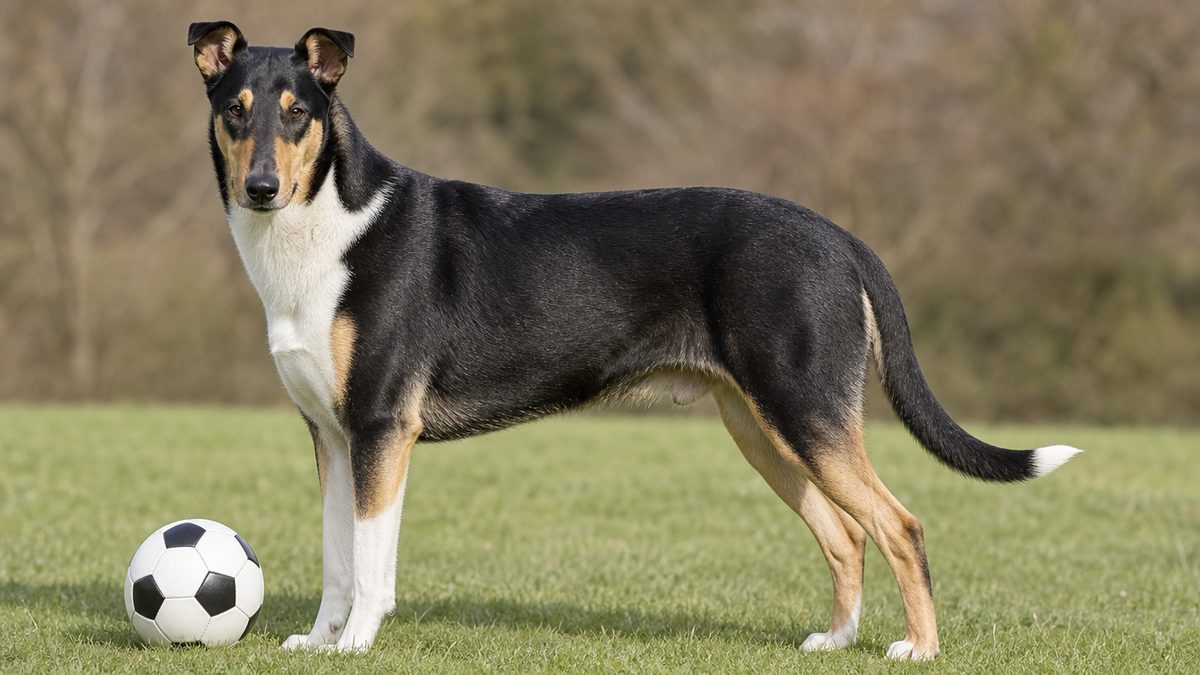
The Smooth Collie is a short-coated British herding breed standing 56 to 61 cm at the withers in males and weighing 20.5 to 29.5 kg, and it is a separate breed at two of the three registries that hold it and a coat variety at the third.
Under the coat this is the same animal as a Rough Collie. The registries disagree about whether that makes it the same breed, and the disagreement is documented rather than theoretical.
The Federation Cynologique Internationale lists COLLIE SMOOTH at standard number 296 and COLLIE ROUGH at 156, as two separate entries on its letter C index, with Cane Corso Italiano and Clumber Spaniel present on the same page as controls. The Royal Kennel Club publishes two separate breed standards, both last updated 1 April 2025, and the word variety appears zero times in either. A fourth document settles it from the other direction: the FCI publishes a register of breed varieties that may lawfully be crossed, and the string COLLIE appears in it zero times, against 28 occurrences of CANICHE and 13 of DACHSHUND as in-document controls. Presence in that register presupposes one breed, and this pair is absent from it. The American Kennel Club publishes one document, the Official Standard of the Collie, approved 10 May 1977, whose final paragraph reads that the Smooth variety of Collie is judged by the same Standard as the Rough variety, except that references to the quantity and distribution of the coat do not apply.
The breed standard, and an asymmetry worth noticing
FCI Standard 296 was published on 15 September 2021 against a valid standard date of 27 July 2021, which makes it nine years newer than the Rough Collie's, and the two documents are not mirror images. The Smooth's standard gives a weight range and the Rough's does not. FCI 296 sets height at 56 to 61 cm for males and 51 to 56 cm for females, with weight of 20.5 to 29.5 kg and 18 to 25 kg respectively. FCI 156 gives the identical heights and no weight at all.
There is a second asymmetry and it runs the other way. FCI 296 has no history section. The document goes from the classification block straight into General Appearance, with no Brief Historical Summary, while the Rough Collie's standard carries one that opens by saying the rough and the smooth Collie is the same with the exception of coat length. The registry's only written account of this breed's origin sits inside the other breed's document.
| Registry | How it files the Smooth | Standard reference | Conservation status |
|---|---|---|---|
| FCI | Separate breed | Standard 296, Group 1 Section 1, without working trial | Not applicable |
| Royal Kennel Club | Separate breed, register closed to the Rough since 1994 | Collie (Smooth), Pastoral | Vulnerable native breed |
| American Kennel Club | Smooth variety of the Collie | Official Standard of the Collie, 1977 | Not applicable |
| Kennel Club of India | Follows FCI nomenclature as a full FCI member | FCI 296 | No published Indian figure |
An American source writing about the Collie is usually writing about both coats at once. A British or European source writing about the Collie (Smooth) is writing about a specific, separately registered, currently vulnerable population of about fifty-six puppies a year. Numbers taken from one and applied to the other will be wrong by an order of magnitude, and that is exactly what has happened to the lifespan figure discussed in the health section.
Appearance, in the standard's own words
The coat is the whole difference and the standard is precise about it: short, flat, top coat of harsh texture, with a very dense undercoat, not trimmed or clipped. That last clause matters more than it looks, because it rules out the summer clip that Indian groomers reach for on any dog that looks warm. Colour is limited to three, sable and white, tricolour and blue merle, with white markings not to extend behind the withers or above the hock, and all white or predominantly white described as most undesirable.
The head is a well blunted clean wedge, smooth in outline, with the top of the skull and the top of the muzzle in two parallel straight lines divided by a slight but perceptible stop, and the ears are moderately large, wider at the base, carried semi-erect with approximately two-thirds standing and the top third tipping forward below the horizontal. Every one of those points is shared with the Rough Collie's standard almost word for word, which is the clearest evidence in the documents themselves that one dog is being described twice.
Registration statistics: what a vulnerable native breed actually looks like
The Smooth Collie is a Royal Kennel Club vulnerable native breed on 56 registrations in 2025, and the ten-year series shows why that classification is not a formality.
The Kennel Club's threshold is simple: a native breed with 300 or fewer annual registrations is vulnerable, and one between 300 and 450 is at watch. The Smooth Collie has been below 100 for the whole of the last decade and dipped to 29 in 2024, its lowest figure in the series.
| Year | Smooth Collie | Rough Collie | Shetland Sheepdog | Pastoral group total |
|---|---|---|---|---|
| 2016 | 89 | 668 | 875 | 14,245 |
| 2018 | 77 | 687 | 794 | 13,758 |
| 2020 | 72 | 516 | 640 | 13,109 |
| 2021 | 90 | 667 | 768 | 16,046 |
| 2022 | 44 | 499 | 649 | 14,356 |
| 2023 | 45 | 431 | 682 | 12,221 |
| 2024 | 29 | 453 | 529 | 10,442 |
| 2025 | 56 | 345 | 562 | 9,263 |
Two independent Kennel Club documents agree on every one of those Smooth Collie cells: the ten-year comparative table for the Pastoral group and the club's separate ten-year vulnerable breed statistics print the same decade. The quarterly file agrees too, and its 2025 quarters, 19, 19, 4 and 14, sum exactly to the printed 56. Three club documents reconciling to the dog is worth stating, because the Kennel Club's web tables and its PDFs have been found to disagree elsewhere.
The 2024 dip and the 2025 recovery
Read the last three years and the picture is a very small population moving on very small numbers. Forty-five in 2023, twenty-nine in 2024, fifty-six in 2025 is a fall of 36 per cent followed by a rise of 93 per cent, and neither movement means much on a base that size. The 2026 quarters make the point sharper still: four registrations in the first quarter and seven in the second, against 98 and 54 for the Rough Collie. A breed producing eleven puppies in a half year in its country of origin is one whose entire global gene pool passes through a few dozen litters.
The Kennel Club's own vulnerable breed document places Collie (Smooth) in its VULNERABLE block and Collie (Rough) in its AT WATCH block, on the same page of the same file. That is the cleanest single piece of evidence that this registry treats them as two breeds: no register can put one breed into two conservation categories at once.
For an Indian reader the practical consequence is availability rather than conservation. A breed producing fewer than a hundred puppies a year in Britain, with no lawful commercial import route into India, is not a breed you will find here. That is not a gap in this page's research; it is the finding, and the price section below sets out what the Indian pages offering one are actually selling.
Smooth Collie price in India, and why every published figure is a default
No Indian page checked carries an observed Smooth Collie transaction, and the one price band on offer, Rs 12,000 to Rs 50,000, is a size-bucket default that the same site prints for two other breeds.
Three Indian pages reachable for this term were fetched and read from raw markup on 9 September 2026. None of them has seen this dog.
| Page | HTTP | What it publishes | What the page also shows |
|---|---|---|---|
| PetBuy, Smooth Collie | 200 | Typical price in India Rs 12,000 to Rs 50,000 | Live Avg blank, Listings 0 in the same box |
| Asia Pets, Collie Puppies for Sale in India, Best Price | 200 | No rupee figure anywhere on the page | Zero occurrences of the words Smooth Collie, and a claim that every dog listed is available right now at their actual asking price |
| Tailsbuddy, smooth-collie-price-in-india-for-sale | 200 | Nothing | An empty title element and 351 characters of site chrome. A soft 404 that a status check passes |
Proving the price is a template, not an observation
PetBuy's band can be tested rather than assumed, by pulling other breeds from the same site and comparing the rows to the rupee. Six were fetched in the same session and the result is unambiguous.
| Breed page | Row label printed | Typical price in India | Lifespan printed |
|---|---|---|---|
| Smooth Collie | Large Size Dog Breed | Rs 12,000 to Rs 50,000 | 10 to 13 years |
| Rough Collie | Large Size Dog Breed | Rs 12,000 to Rs 50,000 | 9 to 12 years |
| Bearded Collie | Large Size Dog Breed | Rs 12,000 to Rs 50,000 | 11 to 14 years |
| Shetland Sheepdog | Medium Size Dog Breed | Rs 8,000 to Rs 35,000 | 10 to 13 years |
| Border Collie | Medium Size Herding United Kingdom | Rs 25,000 to Rs 70,000 | 12 to 15 years |
| Great Dane | Giant Size Working Germany | Rs 30,000 to Rs 90,000 | 7 to 10 years |
| Pug | Small Size Toy China | Rs 6,000 to Rs 22,000 | 12 to 15 years |
The tell is in the second column, and the Rough Collie page is the cleanest comparison because it is the same site describing the nearest possible relative at the same figure to the rupee. Every row that prints a real breed group and a country of origin gets its own price band. Every row whose label collapses to the placeholder Dog Breed, with no group and no country, gets a flat band keyed to the size bucket alone: Rs 12,000 to Rs 50,000 for all three large ones and Rs 8,000 to Rs 35,000 for the medium one. The lifespan column varies per breed on the same rows, so this is a partially populated database emitting a default where the price field is empty, not a whole page copied.
This is PetBuy's mechanism, established on seven of its own pages, and it should not be generalised into a law about Indian breed sites. Other Indian sites have been shown to assemble cost rows from independent per-line presets that cut across size labels entirely, which is a different mechanism producing a similar-looking defect. The reusable lesson is narrower and more useful: when a site prints a price, look at whether the same row's non-price fields are populated, because an empty row emits defaults in the same confident register as a real one.
Running the conversion tests anyway
Indian pages routinely publish a US dollar figure run through one exchange rate. Rs 12,000 and Rs 50,000 were divided by 84.38, 80, 74, 66.67 and 92.5. Neither divides cleanly at 84.38 or at 74. Both divide cleanly at 80, which proves nothing, because 1,000 divided by 80 is 12.5 and any figure ending in three zeros passes that test by construction. These are rupee-native numbers. They are simply not observations of this breed.
The honest conclusion is that there is no Smooth Collie price in India to report, and this page reports none. What is genuinely affordable and genuinely knowable is the cost of keeping one, which the next section sets out from named Indian rate cards.
Monthly cost of keeping a Smooth Collie in India
A 25 kg Smooth Collie costs roughly Rs 5,500 to Rs 10,000 a month in an Indian metro, which is lower than a Rough Collie mainly because professional grooming drops out of the budget.
Every line below comes from a named Indian rate card read on 9 September 2026 rather than from a breed template, and the vaccination prices were re-read the same day against an earlier reading a week before, unchanged.
| Line | Rate read | Per month | Source |
|---|---|---|---|
| Annual booster vaccination | From Rs 3,199 (list Rs 3,806) | Rs 267 | Vetic national page |
| Anti-rabies, single | Rs 699 | Rs 58 | Vetic national page |
| Nine-in-one DHPPiL, single | Rs 899 | Included in the course | Vetic national page |
| Monthly tick, flea and worm cover | Rs 3,308 for three NexGard Spectra 15 to 30 kg tablets | Rs 1,103 | Supertails listing |
| Deworming, tablet route | Rs 754 for six Drontal Plus, one per 10 kg | Rs 251 to Rs 377 per dose | Supertails listing |
| Grooming, bath only | From Rs 934 | Rs 234 at monthly | Vetic Delhi |
| Boarding, per 24 hours | Rs 899 | Varies | PawSpace Bengaluru |
| Municipal registration | Rs 500 Delhi, Rs 50 Chennai | Rs 42 or Rs 4 | MCD and GCC |
Two of those lines come from named operators rather than from a breed template: the boarding tariff of Rs 899 per 24 hours is PawSpace Bengaluru's own published overnight rate, and the deworming line is priced from a Supertails listing for Drontal Plus at Rs 754 for six tablets dosed one per 10 kg, which is Rs 251 to Rs 377 per dose for a 20 to 30 kg dog. Compare that grooming line with the Rough Collie's. A Rough Collie needs a complete bath and styling service, listed from Rs 1,869, at roughly fortnightly intervals through a humid summer. A Smooth Collie needs a bath, listed from Rs 934, at roughly monthly. That single difference is worth about Rs 700 a month, and more importantly it is worth several hours a week of owner time.
The municipal route changes the arithmetic
Greater Chennai Corporation licenses pet animals at Rs 50, issued 9,115 licences in 2024, and runs six pet clinics that provide treatment and anti-rabies vaccination free of cost. The Municipal Corporation of Delhi charges Rs 500 to register a pet dog, the same at renewal, with a Rs 100 per month late fee, and has issued 18,958 pet dog certificates since 2021. A Chennai owner using municipal clinics and a Delhi owner using a private chain are not paying comparable amounts, and no breed page in India mentions the difference.
Vetic quotes different package prices on different city pages on the same day while its individual per-vaccine prices stay identical across those pages. Record which city page a figure came from, and never read a difference between two of its city pages as a price change over time. The per-vaccine prices are the stable layer worth quoting.
Food is arithmetic rather than a quote. A 25 kg dog eats roughly 300 to 390 grams of dry food a day depending on activity and body condition score, so a monthly food figure is a calculation from the pack you actually buy. Do that multiplication yourself, because premium large-breed kibble on Indian retail has moved by more than a fifth on the same product page within a fortnight, and any page giving you a flat monthly food number without a weight and a gram figure has not done it.
Heat tolerance: better than the Rough Collie, still a northern dog
The Smooth Collie handles Indian heat measurably better than the Rough Collie and still badly in absolute terms, because a short flat coat over a very dense undercoat is less insulation than a full stand-off coat but is still a double coat built for a Scottish July.
Every figure below was pulled from NASA POWER by explicit latitude and longitude on 9 September 2026, with the model's returned cell elevation echoed against each town's published elevation, because a grid cell that has flattened the terrain describes a place that is not there.
| Point | Cell elevation against real | Annual mean | Warmest month | Coolest month | Peak monthly wet bulb |
|---|---|---|---|---|---|
| Perth, Scotland | 145 m against 20 m, plus 125 m | 7.96 C | July, 14.09 C | January, 2.84 C | 12.36 C in July |
| Glasgow | 194 m against 40 m, plus 154 m | 7.88 C | July, 13.85 C | February, 2.86 C | 12.24 C in July |
| Chennai | 49 m against 6 m, plus 43 m | 27.95 C | May, 31.51 C | January, 24.09 C | 26.11 C in May |
| Kolkata | 7 m against 9 m, minus 2 m | 25.81 C | May, 31.53 C | January, 17.31 C | 27.09 C in June |
| Delhi | 206 m against 216 m, minus 10 m | 25.60 C | June, 35.88 C | January, 13.61 C | 26.50 C in July |
| Bengaluru | 842 m against 920 m, minus 78 m | 23.74 C | April, 28.37 C | December, 20.22 C | 21.86 C in May |
| Pune | 636 m against 560 m, plus 76 m | 23.86 C | April, 28.93 C | December, 19.62 C | 22.97 C in June |
The Indian plains cells are accurate to within about 80 metres and describe the towns named. The two Scottish cells are not, sitting 125 and 154 metres above the real towns, which at roughly 6.5 C per 1,000 metres makes them about 0.8 to 1.0 C too cold. Correcting for that puts Perthshire's July near 15 C, which is what the real record shows, and the correction landing on the observed value is what confirms the diagnosis rather than merely asserting it. The comparison in this section therefore runs in the direction that makes its own argument harder.
The humidity claim, corrected
Indian pages about northern breeds warn about humidity almost reflexively, and for a collie that warning is wrong. Scotland is more humid than any Indian metro on an annual mean: Glasgow runs 90.07 per cent and Perth 89.13, against Kolkata 73.93, Chennai 72.39, Bengaluru 67.94, Mumbai 67.39, Pune 66.80 and Delhi 45.56. Damp air is the climate this coat evolved in. What it never met is damp air at thirty degrees, and the measure that combines the two is wet bulb temperature, where the gap runs from 12.24 C in Glasgow to 27.09 C in Kolkata.
Where the shorter coat genuinely helps
- Drying after rain or a bath. A short flat coat dries in a fraction of the time a mane and frill take, which removes the main monsoon route into hot spots and skin disease.
- Finding ticks. A hand run down a Smooth Collie finds an attached tick. On a Rough Collie it does not, because there is a soft layer between hand and skin.
- Radiant load in shade. Less coat mass means less stored heat to shed once the dog is out of the sun, which matters most for the evening walk.
- Owner compliance. The honest advantage is behavioural. Owners actually do a weekly brush; many do not do twice-weekly line brushing, and a neglected Rough Collie coat becomes a health problem while a neglected Smooth Collie coat becomes a mess.
Second Schedule Part IV paragraph 21(1) of the Dog Breeding and Marketing Rules 2017 bars keeping in outdoor facilities, without the attending veterinary practitioner's written approval, dogs not accustomed to local temperatures and breeds that cannot tolerate them. The clause names long-haired breeds in high temperature locations as its example, and a Smooth Collie is not long-haired, but the first limb of the clause reaches it squarely: this is a dog from a climate whose warmest month is 14 degrees, and it is not accustomed to Indian temperatures.
Hall and colleagues' study of 905,543 United Kingdom dogs found an overall heat-related illness incidence of 0.04 per cent with a case fatality rate of 14.18 per cent, and named breed, higher bodyweight relative to the breed and sex mean, and age over two as risk factors. The Collie was not separately modelled and falls in the study's other purebred category, so no breed-specific odds ratio exists. What transfers is the bodyweight finding, and it is actionable: keeping this dog lean is a cooling measure.
Temperament and household fit
The Smooth Collie's temperament is the Rough Collie's temperament, because it is the same dog: intelligent, alert, active, friendly with children and other dogs, sensitive to tone, and vocal.
FCI 296 opens its general appearance with a dog appearing gifted with intelligence, alertness and activity, standing with dignity governed by perfect anatomical formation and giving the appearance of working capability. The Rough Collie's standard adds the sentence about being a great companion dog, friendly, happy and active, good with children and other dogs, and since both documents describe one animal there is no reason to read a difference into the omission.
Owners who have kept both consistently report the same three things, and none of them is about coat. The dog wants to be in the room. It reads tone rather than volume. And it talks.
The three traits that decide whether this works in an Indian flat
- Vocal. Selected to move stock at a distance and to be heard. In a shared building with a lift lobby this generates complaints within weeks unless an alternative behaviour is trained from week one.
- Motion-reactive. Herding response fires at cyclists, delivery riders and running children. It is not aggression, it does not become aggression, and it is still unsafe beside Indian two-wheeler traffic.
- Separation-sensitive. Nine hours alone in an empty flat is the wrong home, and no amount of morning exercise fixes it.
Who should look for one, and who should not
The household this breed suits is one that wanted a Rough Collie and looked honestly at the grooming. Everything people like about the Rough Collie's character is here, and the daily coat burden is not. In an Indian climate that is a real argument, and it is the reason this page treats the Smooth Collie as the better of the two collies for this country rather than as a consolation prize.
The household it does not suit is the one that cannot answer the availability question. Wanting a Smooth Collie in India and being able to find one are different problems, and the second one is not solved by paying more. A buyer who is offered a Smooth Collie quickly and cheaply should be more suspicious, not less.
An Indian search for this breed returns mostly Border Collie pages, and a seller under pressure to supply a Smooth Collie has an obvious substitute to hand. The two are different breeds with different standards and opposite drug-sensitivity profiles. Ask for the parents, ask for the registration, and look at the ears and the head shape rather than at the coat length, because coat length is the one feature the two breeds share.
Training, and the socialisation window in an Indian city
To train a Smooth Collie, use voice, timing and reward rather than pressure, and treat the noise work as the first priority rather than the last, because a vocal herding breed in an Indian apartment gets three months of goodwill and no more.
This is a highly trainable breed and the failure mode is not defiance. Under correction-heavy handling a sensitive collie stops offering behaviour altogether, which owners read as stubbornness and answer with more pressure. Reward-based training is the method this breed was selected to respond to rather than a stylistic preference.
- Settle on a mat, from week one. The foundation of everything else in a flat.
- A quiet cue attached to an alternative behaviour. Train go to your mat on the doorbell rather than training against the bark.
- Recall away from motion, practised against a jogger, a cyclist and a rolling ball in that order.
- Loose-lead walking on narrow Indian pavements with parked two-wheelers and street dogs, which is a safety skill rather than a nicety.
- Handling tolerance, so that ear checks, tick checks and nail trims are routine rather than a wrestle.
The socialisation window against the vaccination schedule
The socialisation window closes at roughly twelve to fourteen weeks and in India it collides with the puppy vaccination course. Vetic prices a puppy course from Rs 6,499 against a struck-through Rs 8,111, built from individual vaccines including the puppy DP at Rs 849 and the nine-in-one at Rs 899, across several visits. Waiting for full cover costs the window; ignoring the schedule risks parvovirus, which is not theoretical in an Indian city.
Carried exposure is the answer. Socialise the puppy from your arms rather than from the pavement: take it out to see traffic and hear horns, and arrange meetings with vaccinated adult dogs in private spaces rather than in parks. A puppy you socialise before the course finishes meets the world at the age the world still looks negotiable. Introduce lifts, marble floors, ceiling fans, pressure cookers and a generator starting, because those are the stimuli an Indian dog actually meets and a collie that has met none of them at fourteen weeks will react to all of them at fourteen months.
Sit, down and a hand target inside two weeks. A settle that holds through a doorbell by about week ten of training. Reliable recall in a fenced space by four months. Off-lead recall in an unfenced Indian street, for most owners, never, and that is a property of a herding breed rather than a training failure.
One method warning carries over from the Rough Collie and applies with more force here. Do not use an aversive collar. The combination of a soft temperament and a breed whose entire population passes through a handful of litters a year means that behavioural damage done to one of these dogs is not recoverable at the population level either.
Daily exercise, and the Indian timing problem
A Smooth Collie needs about sixty to ninety minutes of activity a day split across two sessions, and from March to October in the Indian plains both sessions have to fall outside daylight.
The Royal Kennel Club's own breed record for the Smooth Collie gives up to one hour per day as the exercise requirement, which is a fair floor for a companion dog and not a working figure. A dog kept at the low end needs the shortfall taken up in mental work rather than in more walking.
The constraint is the clock, not the dog. Delhi's mean June temperature is 35.88 C, Chennai's mean May temperature is 31.51 C with a peak monthly wet bulb of 26.11 C, and Kolkata's June wet bulb reaches 27.09 C. None of those is a walking climate for a double-coated northern breed, whatever the coat length.
- Test the pavement with the back of your hand. Five seconds is the threshold. Short-coated does not mean tough-footed.
- Carry water on every walk and offer it before the dog looks like it needs it.
- Split rather than skip. Two twenty-minute walks in cool air beat one forty-minute walk in warm air.
- Swap distance for scent work in the hot months. Ten minutes of nosework indoors tires a collie more than a slow kilometre.
- Avoid the seven o'clock evening walk in May, which is the single worst habitual decision Indian owners of northern breeds make.
What under-exercise looks like
In a collie it rarely looks like destruction. It shows up first as increased barking at household noise, then as shadow chasing, light chasing or spinning, then as pacing. Those behaviours are self-reinforcing and get harder to interrupt the longer they run, which is why the answer is more structured activity rather than more correction.
The useful counterintuitive fact is that mental work substitutes for physical work in this breed better than in most. A food puzzle, a fifteen-minute training session, a scatter feed across a rug and a short shaping game will take the edge off a dog that cannot be walked because it is 34 degrees at nine in the evening. Across an Indian summer that is the difference between a settled dog and a frantic one.
Do not add distance to a growing collie on the theory that a tired puppy is a good puppy. Forced repetitive exercise on hard surfaces before the growth plates close loads a joint that is still forming, and hip dysplasia is one of the conditions Indian law names in its mandatory genetic-defect testing clause for breeding dogs. Free play on soft ground, short lead walks and a great deal of sleep are the correct first-year programme.
Grooming a short-coated collie in Indian humidity
Groom a Smooth Collie with a weekly brush and a seasonal deshed, never a clip, because the standard specifies a coat that is not trimmed or clipped and the very dense undercoat still blows twice a year.
The grooming load here is the breed's clearest practical advantage in India and it is worth being precise about what changes and what does not. What changes is matting: a short flat coat does not felt behind the ears, does not tangle in the frill and does not need a rake to open up, because there is nothing to open. What does not change is shedding: FCI 296 specifies a very dense undercoat, and a dense undercoat sheds on the same schedule whatever length of guard hair sits over it.
- Brush weekly with a rubber curry or a short-bristle brush, which lifts dead undercoat that a slicker slides over on a flat coat.
- Deshed at the coat blow with an undercoat tool, twice a year in a temperate climate and less predictably in India, where the photoperiod and temperature cues the coat cycle relies on are different.
- Bathe monthly at most unless a vet advises otherwise, and dry the dog properly afterwards rather than letting it air dry.
- Check ears weekly through the monsoon, because a hair-lined canal that stays damp is the commonest route into otitis externa.
- Never clip. The standard says not trimmed or clipped, and on a double coat a clip removes the still-air layer that slows heat gain and exposes thin skin to tropical sun.
British and American breed guidance routinely tells owners to towel a collie and let it air dry. That is sound in a Scottish July at 14 C and unsound in a Mumbai August at 26.1 C and around 90 per cent monthly humidity, where a dense undercoat may stay damp for hours. Dry actively, and check the skin under the neck and behind the elbows afterwards.
What it costs in India
Vetic's Delhi grooming page lists bathing from Rs 934, a haircut from Rs 1,359, complete bath and styling from Rs 1,869 and add-ons from Rs 99. For this coat the correct service is the bath, and the haircut line is one you should never buy. Monthly at Rs 934 is about Rs 234 a month spread across the year, against roughly Rs 935 a month for a Rough Collie on a fortnightly bath and styling schedule.
Ask a groomer one question before booking: what would you do with a double-coated dog in June. If the answer is a clip, find another groomer. A salon whose default for any warm-looking dog is a number-four blade all over will hand you back an animal that is hotter, more sunburnt and permanently worse-coated than the one you dropped off, and on this breed the damage is easier to do because the coat looks short enough to take it.
Health issues: the highest MDR1 frequency of any breed measured
The Smooth Collie's defining health issue is a drug sensitivity, and two independent European surveys put its MDR1 mutant allele frequency higher than any other breed's, above the Rough Collie in both.
The mechanism is a four base pair deletion in the canine MDR1 gene, also called ABCB1, producing a frameshift that prematurely terminates P-glycoprotein synthesis. P-glycoprotein is an integral part of the blood-brain barrier and functions as a drug transport pump, moving substrate drugs out of the brain and back into the blood. Dogs homozygous for the deletion display the ivermectin-sensitive phenotype, while heterozygotes and normal homozygotes do not.
It is one old mutation, not a breed-specific accident. Neff and colleagues found the same allele segregating in nine breeds, including two sighthounds not expected to share collie ancestry, and concluded that every dog carrying it descends from a single dog living in Great Britain before the genetic isolation of breeds by registry around 1873.
| Breed | European survey, 4,729 dogs, 2012 to 2014 | Italy, 811 dogs, 32 breeds | United States laboratory table |
|---|---|---|---|
| Smooth Collie | 58.5 per cent, highest of nine | 75 per cent, highest of nine | Not separated from the Rough |
| Rough Collie | 48.3 per cent | 66 per cent | Collie, 70 per cent, coats merged |
| Australian Shepherd | 35 per cent | present | 50 per cent |
| Shetland Sheepdog | 30.3 per cent | present | 15 per cent |
| Silken Windhound | 28.1 per cent | not sampled | 30 per cent |
| White Swiss Shepherd | 16.2 per cent | present | not listed |
| Border Collie | 0 per cent | present | under 5 per cent |
Read the top row twice. In the larger of the two surveys, covering 4,729 genotyped individuals across multiple European countries, the Smooth Collie had the highest observed mutant allele frequency of any breed in the study, and the Italian survey five years later put it higher still at 75 per cent. The third column is worth a caution of its own: the American laboratory that publishes it does not separate the two coats, filing both under Collie at 70 per cent, and its own prose on the same page says approximately three of every four collies in the United States carry the mutant gene, which is 75 per cent. Both figures sit on one page and this guide quotes both rather than choosing. A registry that calls the Rough and the Smooth one breed is calling one population with 48.3 per cent and another with 58.5 per cent the same thing, which is a measurable difference between two groups the American Kennel Club judges under a single standard.
Tell the veterinarian, before consent is given for anything: this is a Smooth Collie and it is likely to carry the MDR1 deletion. That should prompt a check of the current MDR1 substrate list before high-dose ivermectin, before sedation, before anaesthesia and before some antidiarrhoeal and anticancer drugs. Carry the genotype if you have it, and if you do not, ask for the test and treat the dog as affected until the result arrives. Consult a registered veterinarian near you rather than acting on a website, including this one.
Collie eye anomaly
Collie eye anomaly is a congenital malformation of the choroid caused by a 7.8 kilobase deletion in intron 4 of the NHEJ1 gene, which Parker and colleagues showed cosegregates with the condition across four breeds of one group, concluding the primary mutation arose as a single disease allele in a common ancestor of herding breeds. The published frequency data for Rough Collies is very high, at 81.3 per cent affected homozygotes in an Italian sample of sixteen and an 83.3 per cent mutated allele frequency in a Thai sample.
Neither of those studies sampled Smooth Collies at all, and this page publishes no Smooth Collie figure for that reason. Given that the two coats shared a register until 1994 and that the mutation predates both, the sensible working assumption is that the risk is comparable to the Rough Collie's, and the correct action is to test rather than to infer. The Kennel Club lists a DNA test for collie eye anomaly and choroidal hypoplasia among the health tests for this breed, alongside tests for degenerative myelopathy, MDR1 and progressive retinal atrophy rcd2, plus eye testing under the joint British Veterinary Association, Kennel Club and International Sheep Dog Society eye scheme and hip testing under the hip dysplasia scheme International Sheep Dog Society.
Lifespan, and why no Smooth Collie figure exists
There is no published breed-specific median lifespan for the Smooth Collie. McMillan and colleagues, in the largest United Kingdom companion-dog longevity study, carry a single row named Collie whose phylogeny reclassification column reads, verbatim, Collie (Rough) Collie (Smooth). The two were merged. That row gives a median survival of 13.3 years, 95 per cent confidence interval 13.3 to 13.6, on 1,104 deaths, with a hazard ratio of 0.72 (0.68 to 0.76) against the crossbred group. It covers both coats and it is the only defensible figure to quote.
PetBuy's 10 to 13 years for the Smooth Collie is unsourced and sits below the measured confidence interval at both ends. For context from the same supplementary table, the Shetland Sheepdog sits at 13.4 years on 793 deaths and the Border Collie at 13.1 on 7,969, so the collie group as a whole is long-lived and the differences within it are small.
What Indian law requires a breeder to have tested
Second Schedule Part III paragraph 8(10) of the Dog Breeding and Marketing Rules 2017 requires that dogs shall have been tested for genetic defects, including hip dysplasia, progressive retinal atrophy, night blindness, hypothyroidism, entropion, ectropion, overshot, undershot jaw, wry mouth, two or more missing teeth and cryptorchidism. The word is including, so the list is illustrative and a breeder cannot argue that collie eye anomaly falls outside it merely because it is unnamed. The words collie, merle, deaf and BAER each appear zero times in the whole gazette, which means India has no rule on merle-to-merle breeding and no hearing test requirement.
The Indian health picture: ticks, ears and heat
An Indian Smooth Collie faces three environmental risks its homeland does not present in the same degree, and the short coat helps materially with two of them.
Tick-borne haemoparasites are the largest of the three. In West Bengal a screening study of 584 dogs found *Babesia gibsoni* in 76.54 per cent and *Anaplasma* in 55.75 per cent, with 72.9 per cent of the 584 dogs screened carrying two or more pathogens. In Kerala, of 120 dogs presented at veterinary clinics, *Babesia* was found in 66.7 per cent and *Ehrlichia canis* in 5.0 per cent, with a pre-monsoon peak from March to May.
Both studies sampled clinically suspected dogs or clinic caseloads rather than random household populations, so the honest phrasing is among dogs tested at veterinary clinics. A vaccinated house dog on year-round prevention is not facing a 76 per cent risk. What the studies do establish is that the pathogens are widespread across Indian states and that prevention is not optional here in the way it can be in Britain.
The short coat helps here in a way that is easy to underrate. A hand run down a Smooth Collie finds an attached tick; the same check on a Rough Collie finds a layer of undercoat. That does not replace systemic prevention at roughly Rs 1,103 a month for a 15 to 30 kg dog, but it turns a daily check from a ritual into an actual inspection.
Ears and skin through the monsoon
Otitis externa in a dog with hair-lined ear canals is a monsoon problem in India rather than a year-round one, and the mechanism is straightforward: water gets in during a bath or a wet walk, the canal stays warm and damp, and the ear becomes a culture. Plug the ears before bathing, dry the canal afterwards, and check weekly through July and August.
Hot spots follow the same logic on the body, and the short coat cuts the risk sharply because the skin dries. Where a Rough Collie owner is checking under a frill and behind elbows for damp warm coat, a Smooth Collie owner can usually see the skin. Treat any sudden localised scratching in the monsoon as a moisture problem first and a parasite problem second.
Heat, and the emergency to recognise
Hall and colleagues found an event fatality rate of 14.18 per cent for heat-related illness in United Kingdom dogs, which is roughly one in seven of the dogs that developed it. Their companion paper on the same cohort found that exertional illness, not hot cars, accounted for 652 of the 879 events with a recorded trigger, or 74.2 per cent. The danger for an Indian owner is the walk, not the parked car.
- Recognise it. Frantic panting that does not settle in shade, brick-red or very pale gums, unsteadiness, vomiting or diarrhoea, and a dog that stops responding to its name.
- Cool first, then travel. Wet the dog thoroughly with tap-temperature water including the belly and inner thighs, and move air over it. Not ice water, and not a wet towel left on the dog.
- Call ahead and say the words heat stroke rather than describing symptoms.
- Do not wait to see if it improves, because the fatality figure above is measured on dogs that reached veterinary care.
Feeding a Smooth Collie in India
Feed a Smooth Collie to a body condition score of 4 or 5 out of 9 rather than to a number on a packet, because higher bodyweight relative to the breed and sex mean is one of the few heat-illness risk factors an owner controls directly.
That is the study's finding rather than general advice. Hall and colleagues identified higher bodyweight relative to the breed and sex mean as a significant risk factor for heat-related illness in a multivariable model of 905,543 dogs, alongside breed and age over two years. On a northern double-coated dog in a hot country, keeping the animal lean is a cooling intervention.
Body condition scoring is genuinely easier on this breed than on a Rough Collie, and that is worth using. You can see the waist and the abdominal tuck rather than having to find them by hand, and you should still confirm by hand: ribs easily felt under a thin layer of tissue, a visible waist behind the ribs from above, and a tuck from the side.
| Stage | Age | Meals per day | What to prioritise |
|---|---|---|---|
| Settling in | 8 to 12 weeks | 4 | Continue the breeder's diet for two weeks. Indian law prohibits sale below eight weeks, so a younger pup is an illegal sale |
| Fast growth | 3 to 6 months | 3 | A large-breed puppy formulation with controlled calcium; do not supplement calcium separately |
| Slow growth | 6 to 12 months | 2 to 3 | Hold condition lean through the growth-plate period |
| Adult | 1 to 7 years | 2 | Roughly 300 to 390 g of dry food a day for a 25 kg dog, adjusted to condition |
| Senior | 7 years onward | 2 | Lower calorie density, maintain protein, reassess condition monthly |
Move the main meal to the coolest part of the day and leave at least an hour between eating and exercise. FCI 296 describes a deep chest of fair breadth behind the shoulders, and a deep-chested dog eating a large meal and then moving is the classic gastric dilatation and volvulus setup. Refresh the water bowl rather than topping it up, because a bowl standing all day in a Chennai May grows a biofilm.
On availability, large-breed dry food is easy to buy in Indian metros and the real constraints are price volatility and storage. Buy a bag you will finish inside about six weeks and keep it sealed and cool, because a large bag in a humid coastal kitchen goes rancid faster than most owners expect. And ignore coat supplements: there is no evidence any of them improves a coat that is brushed and fed properly, and most of the Indian market for them is sold on a promise to stop shedding, which this breed will not do.
The first year, month by month
A Smooth Collie puppy's first year runs on three clocks that do not align: the socialisation window closing near fourteen weeks, the vaccination course running to about four months, and the growth plates closing between twelve and eighteen months.
| Age | What is happening | What you do |
|---|---|---|
| 8 to 10 weeks | Legal minimum age for sale in India | Register with a vet in week one. Start the vaccination course. Begin carried socialisation immediately |
| 10 to 14 weeks | Socialisation window closing | Controlled exposure to lifts, horns, marble floors, ceiling fans, generators and calm vaccinated adult dogs. The highest-value fortnight of the dog's life |
| 3 to 4 months | Course completing, adult teeth arriving | Finish the course. Start handling tolerance work: ears, feet, teeth, tail |
| 4 to 6 months | Coat still soft and puppyish | Establish the weekly brush now, and get the dog used to a rubber curry before the adult coat arrives |
| 6 to 9 months | Adolescence; recall degrades; motion-reactivity emerges | Re-train recall as if from scratch. Do not add distance or hard-surface running |
| 9 to 12 months | Adult coat and the first real shed | Introduce the undercoat tool. Book one professional bath so the dog learns the dryer young |
| 12 months onward | Growth plates closing | Build duration gradually and keep every session inside the cool hours |
Two decisions to make before the puppy arrives
First, settle the MDR1 status. On this breed's published frequencies that is not a precaution, it is the single highest-value few thousand rupees you will spend, and it needs to happen before the first sedation, the first surgery or the first antiparasitic. A dog that is neutered before anyone thought to ask has taken an avoidable risk.
Second, decide where the dog will be cool through the four worst months, and set the habit from week one. If the honest answer is a balcony and a fan, this is the wrong breed, and Indian animal-welfare law reaches the same conclusion for dogs not accustomed to local temperatures.
Vaccination course from about Rs 6,499 at a private chain, or substantially less through a municipal clinic where one exists. Monthly parasite cover from about Rs 1,103. Municipal registration Rs 500 in Delhi or Rs 50 in Chennai. Neutering, a crate, a rubber curry brush and an undercoat tool, and a first-year food budget on top. For this breed the purchase price is the least predictable line and the least important one.
The pleasant surprise for owners coming from a Rough Collie is how little the coat changes across the first year. The adult coat arrives without arriving, and the routine you set at four months is the routine you keep. That is the whole practical case for this breed in India, and it is why its rarity is a genuine loss rather than a curiosity.
Smooth Collie against the breeds Indian buyers cross-shop
Indian buyers looking at a Smooth Collie are usually also looking at a Rough Collie, a Border Collie or a Shetland Sheepdog, and the differences that matter here are availability, grooming load and drug sensitivity.
| Smooth Collie | Rough Collie | Shetland Sheepdog | Border Collie | |
|---|---|---|---|---|
| Registry height, males | 56 to 61 cm (FCI 296) | 56 to 61 cm (FCI 156) | Ideal 37 cm (FCI 88) | Around 53 cm |
| Weight in the standard | 20.5 to 29.5 kg | Not given | Not given | Not given in the FCI text |
| Coat | Short, flat, harsh, very dense undercoat | Long, dense, stand-off, mane and frill | Long, harsh, abundant mane and frill | Two coat types |
| Kennel Club registrations 2025 | 56 | 345 | 562 | 1,292 |
| Kennel Club conservation band | Vulnerable | At watch | Neither | Neither |
| MDR1 mutant allele, European survey | 58.5 per cent | 48.3 per cent | 30.3 per cent | 0 per cent |
| Grooming load in Indian humidity | Low | High | High | Moderate |
| Realistically available in India | No | Occasionally | Yes | Yes |
| McMillan 2024 median lifespan | Merged into the Collie row, 13.3 years | Merged into the same row | 13.4 years, 793 deaths | 13.1 years, 7,969 deaths |
The two rows that decide most Indian purchases are the last two before lifespan. On grooming the Smooth Collie is the best of the four in an Indian climate. On availability it is the worst, and there is no way to buy your way past that.
Which one to choose
- Choose the Shetland Sheepdog if you want a collie-shaped dog you can actually find in India. It is roughly two thirds the height at an ideal 37 cm, it is available, and it carries a lower MDR1 frequency at 30.3 per cent. Expect more barking, not less, and a full coat to groom.
- Choose the Rough Collie if the coat is the reason you wanted the breed and you can commit to twice-weekly line brushing and active drying through the monsoon.
- Choose the Border Collie only if you can meet a genuinely higher work requirement. Its advantage on this page is the health column: a zero per cent MDR1 mutant allele frequency in a 4,729-dog European survey against the Smooth Collie's 58.5 per cent.
- Choose an Indian shelter dog if the honest answer to the cooling question is a fan. That is not a rhetorical flourish; it is the most common reason these placements fail.
An Indian search for this breed returns mostly Border Collie pages, and a seller who cannot supply a Smooth Collie has an obvious substitute standing next to them. Look at height and head shape rather than at coat length: a Border Collie is around 53 cm with a shorter, broader skull and a different ear set, and it will not have the Collie's long parallel-planed wedge head.
What Indian owners and buyers actually get wrong
Five mistakes account for most Smooth Collie problems in India, and the first of them happens before anyone has seen a dog.
- Believing a published Indian price. The one band on offer is a size-bucket default that the same site prints for three unrelated large breeds beside a live listing counter reading zero. A price is a record of a transaction, and no Indian page checked has one.
- Accepting a Border Collie as a Smooth Collie. The search results push buyers there, the sizes are close enough to argue about, and the health profiles are opposite. Check the head and the registration, not the coat.
- Skipping the MDR1 test because the dog looks healthy. The mutation has no outward sign. It shows up the first time the dog is given a substrate drug, which is usually the first sedation.
- Clipping the coat in summer. The standard says not trimmed or clipped, and on a double coat a clip removes the still-air layer that slows heat gain and exposes thin skin to tropical sun. A short coat looks like it can take a clip. It cannot.
- Treating the barking as a phase. In a shared Indian building a vocal herding breed generates complaints long before it generates a training plan.
The mistake the Indian pages are making
One error deserves naming because it is structural rather than careless. Two of the three Indian pages ranking for this breed are not pages about the breed at all. Tailsbuddy serves HTTP 200, an empty title element and 351 characters of chrome at a URL that promises a Smooth Collie price. Asia Pets ranks a page headed Best Price that contains zero rupee figures and zero occurrences of the words Smooth Collie, while asserting that every dog listed is available right now at their actual asking price.
Neither of those is lying about a number, which is what makes them harder to catch than a fabricated price. They are pages generated for a search term that no dog was ever attached to. Reading the status code alone passes both of them, and reading the title passes one. Only reading the body catches them.
Do not breed merle to merle and be careful buying a merle puppy from a seller who cannot name the colour of both parents. Two merle parents can produce double merle offspring at high risk of deafness and eye defects. The words merle, deaf and BAER each appear zero times in the Dog Breeding and Marketing Rules 2017, so Indian law offers no protection here and the buyer's own diligence is the only control that exists.
Adoption, responsible sourcing and how to verify a seller
Adopt rather than buy wherever you can, and where you buy, verify four documents rather than a website, because a breed producing eleven puppies in a half year in its country of origin is one where most Indian listings cannot be what they claim.
Begin with the availability arithmetic, because it decides everything else. The Royal Kennel Club registered 56 Smooth Collie puppies in 2025 and 11 in the first half of 2026. India has no lawful commercial import route: the Directorate General of Foreign Trade's own FAQ states that import of pets is Restricted and permitted only with a DGFT authorisation, for research organisations with a CPCSEA recommendation, for internal security use, or for a genuine relocating owner bringing their own pet, through the airports and seaports of Delhi, Mumbai, Chennai, Hyderabad, Bangalore and Kolkata. DAHD added a seventh port, Cochin International Airport at Kochi, for pets arriving under the baggage rules in October 2024. The full route is set out in how to import a dog to India.
Put those two facts together and the conclusion is unavoidable. Nobody is lawfully importing this breed into India to sell it, and its home register produces too few puppies to supply a second market anyway. An Indian seller offering a Smooth Collie on short notice is offering something else, and the something else is most often a Border Collie or a short-coated crossbreed.
The adoption route
- Ask shelters for the shape, not the breed. A short-coated, medium-large, biddable herding-type dog is a real thing in Indian shelters. A registered Smooth Collie is not.
- Take the adult. A four-year-old whose temperament you can observe is a lower-risk decision than a puppy whose parents you have not met.
- Budget for the MDR1 test anyway. A dog of unknown collie-type ancestry needs it more than a registered one, not less, because the allele travels with the whole lineage.
- Register the dog. Delhi charges Rs 500, Chennai Rs 50, and registration is what makes a lost dog findable.
How to verify a breeder, in four documents
Bonbeno does not recommend breeders and does not link listings. What follows is a checklist you apply yourself.
- Both parents' MDR1 genotypes, on a laboratory report carrying the dogs' identities, not a verbal assurance. On this breed that is the first document, not the third.
- Both parents' collie eye anomaly status, by NHEJ1 DNA test or an eye examination under the joint British Veterinary Association, Kennel Club and International Sheep Dog Society scheme, the last of which requires its own registered dogs to have passed defined eye scheme requirements before a litter can be registered.
- A pedigree you can read. India is a full FCI member represented by the Kennel Club of India, so a KCI registered pedigree for this dog is a pedigree in FCI 296, the Smooth Collie, and not in FCI 156.
- The pup's age. Rule 8(1)(a) of the Dog Breeding and Marketing Rules 2017 prohibits the sale of pups less than eight weeks old, and a seller offering a six-week-old puppy is breaking the law in front of you.
A breeder who has done the work produces the MDR1 genotypes before you ask, can say which registry's standard their stock is bred to, and asks more questions about your cooling arrangements than you ask them. A seller who answers the MDR1 question with reassurance rather than with paper has told you what you needed to know, and a seller who has never heard of it has told you more.
Smooth Collie questions Indian buyers actually ask
What is the price of a Smooth Collie in India?
No Indian page checked carries an observed Smooth Collie transaction, so there is no reliable Indian price. PetBuy publishes a typical band of Rs 12,000 to Rs 50,000 beside its own live listing counter reading zero, and prints the identical band on its Rough Collie and Bearded Collie pages, which makes it a size-bucket default rather than an observation. Treat any quoted figure as unverified until you see a real dog.
Is a Collie a good house dog?
Yes on temperament, and the standard is unusually direct about it. FCI 296 describes a dog gifted with intelligence, alertness and activity, and the breed shares the Rough Collie's friendly disposition with no trace of nervousness or aggressiveness. The qualifications are heat, noise and separation, in that order, and none of them is fixed by the shorter coat.
How do I buy a healthy Smooth Collie in India?
Start by accepting that you probably cannot, then verify anything offered against three documents: both parents' MDR1 genotypes, both parents' collie eye anomaly status, and the pup's age, since Indian law prohibits the sale of pups under eight weeks. The MDR1 test matters more for this breed than for almost any other dog, because the Smooth Collie carries the highest measured frequency of the mutation of any breed surveyed.
Is the Smooth Collie a separate breed from the Rough Collie?
At the Royal Kennel Club and the FCI, yes, and at the American Kennel Club, no. The FCI holds two standard numbers, 156 and 296. The Kennel Club publishes two standards, allocated Smooth Collies their own challenge certificates in 1979, and closed interbreeding between the two in 1994. The AKC publishes one Official Standard of the Collie in which the Smooth is described as a variety.
Which is better for Indian heat, the Smooth Collie or the Rough Collie?
The Smooth, and by a real margin rather than a marginal one, but neither is a hot-climate dog. A short, flat coat over a dense undercoat carries less insulation and dries far faster after a monsoon bath, which removes the single biggest daily management burden. The homeland climate and the wet bulb arithmetic are identical for both, because it is the same dog underneath.
Are Smooth Collies rare?
It is rare because the show world took the Rough and left the Smooth behind, and the numbers show it. The Royal Kennel Club recorded 56 Smooth Collie registrations in 2025 against 345 Rough Collies, and only 29 in 2024, which is why the Smooth sits in the club's vulnerable native breed list while the Rough sits in the at watch band of the same document.
What drugs are dangerous for a Smooth Collie?
High-dose ivermectin is the classic case and the mechanism is a four base pair deletion in the MDR1 gene that truncates P-glycoprotein at the blood-brain barrier. The Smooth Collie carries the mutant allele at 58.5 per cent in a 4,729-dog European survey and 75 per cent in an Italian one, both higher than the Rough Collie. Assume your dog is affected until a genotype says otherwise and tell every vet before any sedation, anaesthesia or antiparasitic.
How long does a Smooth Collie live?
No breed-specific published median exists, because the largest United Kingdom longevity study merged the two coats into a single Collie row. That row gives a median of 13.3 years with a 95 per cent confidence interval of 13.3 to 13.6 on 1,104 deaths, and it covers Rough and Smooth Collies together. PetBuy's 10 to 13 years is not sourced to anything.
How much does a Smooth Collie cost to keep in India each month?
Budget roughly Rs 5,500 to Rs 10,000 a month for a 25 kg dog, which is lower than the Rough Collie mainly because professional grooming drops out. Vetic lists an annual booster from Rs 3,199 and anti-rabies at Rs 699, and monthly parasite cover for a 15 to 30 kg dog works out near Rs 1,103. Cooling, not coat care, is the line that varies most by city.
Does a Smooth Collie shed less than a Rough Collie?
It sheds a similar volume of undercoat and makes far less mess doing it. The FCI standard specifies a very dense undercoat under the short flat top coat, so the seasonal blow is comparable, but short shed hair does not mat, does not tangle behind the ears and does not need a rake to remove. Weekly brushing handles what twice-weekly line brushing handles on a Rough.
Can I import a Smooth Collie into India?
Not to buy one. Indian import policy for dogs is Restricted and permitted only with a Directorate General of Foreign Trade authorisation, for research organisations with a CPCSEA recommendation, for internal security use, or for a genuine relocating owner bringing their own pet, through the airports and seaports of Delhi, Mumbai, Chennai, Hyderabad, Bengaluru and Kolkata and, since October 2024, Kochi airport.
Is a Smooth Collie the same as a Border Collie?
No, and the confusion is visible in Indian search results, where a query for smooth collie returns mostly Border Collie pages. They are different breeds with different standards, different sizes and opposite health profiles: the Border Collie showed a zero per cent MDR1 mutant allele frequency in a 4,729-dog European survey against the Smooth Collie's 58.5 per cent.
Are Smooth Collies high maintenance?
On the coat, no; on the vet file, yes. The FCI standard specifies a short, flat top coat of harsh texture over a very dense undercoat, not trimmed or clipped, so the seasonal blow is comparable to a Rough Collie's but short shed hair does not mat or tangle, weekly brushing handles it, and a monthly bath listed from Rs 934 replaces the Rough's fortnightly bath and styling from Rs 1,869, which is worth about Rs 700 a month and several hours a week. The maintenance that does not drop out is medical: the breed carries the MDR1 mutant allele at 58.5 per cent in a 4,729-dog European survey, the highest of any breed surveyed, so every vet must be told before any sedation, anaesthesia or antiparasitic, and cooling rather than coat care is the cost line that varies most by Indian city.
Is a Collie a smart dog?
Yes, by its own standard's wording. FCI 296 describes the Smooth Collie as a dog gifted with intelligence, alertness and activity, sharing the Rough Collie's friendly disposition with no trace of nervousness or aggressiveness. The practical consequences follow from those three words: a herding breed that is intelligent and alert notices everything, which is where the noise qualification on this page comes from, and one that is active needs work to do, which is where the separation qualification comes from. Neither is fixed by the shorter coat, and neither is a fault in the dog; they are the standard being accurate.
Compare with similar breeds
Smooth Collie sits in 2 Bonbeno groups. Each one compares it directly against the breeds it is genuinely an alternative to, on the same figures.