
Breed profile
Can de Chira: The Complete India Guide
Aragon's sheep-turning mountain dog, named in a minority language for the job it did: fewer than 400 registered anywhere, no kennel club on earth recognises it, and its home valleys are cooler in July than Bengaluru is in December.
Quick answer
The Can de Chira is Aragon's native sheep-herding dog, 42 to 47 cm and 16 to 20 kg in the male, black with white or grey markings, loyal and biddable, often naturally bobtailed and carrying double hind dewclaws. No kennel club recognises it. Published counts run from under 80 to 388. No price in India exists because no lawful supply does, and heat tolerance rates 2 of 5, since its home valleys average 18.12 C in July against Bengaluru's 20.22 C in December.
This page summarises published breed-standard text, government gazettes, registry records, funded research programmes and peer-reviewed veterinary literature for general information. It is not a diagnosis and it is not treatment advice. Consult a registered veterinarian about your own dog before acting on anything here, and treat collapse, unsteadiness, vomiting during exertion, sudden eye cloudiness or a tongue that turns dusky in heat as an emergency.
Can de Chira at a glance
What the Can de Chira actually is
The Can de Chira is a medium-sized black herding dog from the mountains of Alto Aragon in north-eastern Spain, standing 42 to 47 cm and weighing 16 to 20 kg in the male, and it is not a recognised breed anywhere in the world. Spain files it as an ethnic group. The Federation Cynologique Internationale does not list it. Fewer than 400 dogs carry the name on any register, and the count that the Aragonese government itself published in 2025 was under 80.
Its home is the Pyrenean valleys of the province of Huesca, and specifically the comarcas of Sobrarbe and Ribagorza. The 2009 Ministry field guide names the villages where the best animals were found: Broto, Fiscal, Laspuna and Bielsa in Sobrarbe, and Montanuy, Benabarre, Graus, Vilas del Turbon and Foradada del Toscar in Ribagorza. The English Wikipedia stub gives the same two comarcas and adds that the type was formerly spread across the province and used by shepherds in Navarre, Occitanie and Catalonia as well.
This is a working herding dog and not a guarding one, and the distinction is the reason the breed exists as a separate thing at all. In the Aragonese Pyrenees two dogs travelled with the flocks and did opposite jobs. The Mastin del Pirineo, a large molosser, guarded stock against wolves and bears. The Can de Chira moved it. The breeders association makes the contrast explicitly, noting that the mastiff's sheer size gives away its defensive purpose. If you want the guarding half of that pair, that is a different dog entirely and it is a recognised breed with its own club under the Gobierno de Aragon.
What the dog looks like
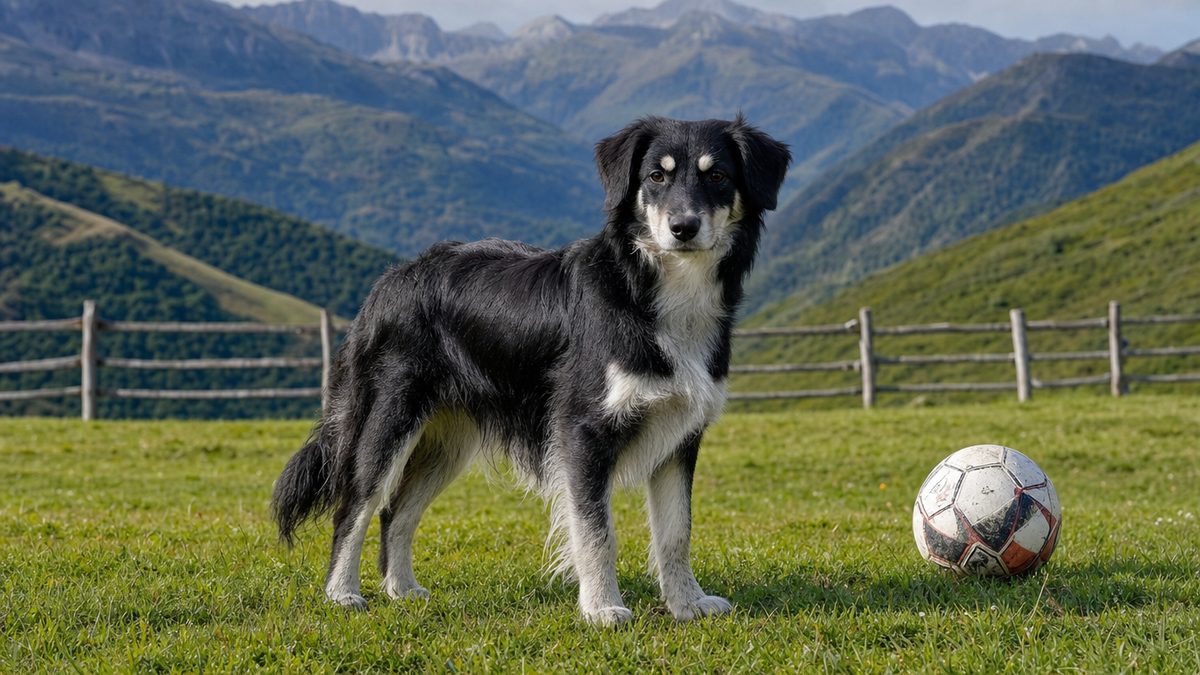
It is a wolf-like, agile, medium-sized dog with a small wedge-shaped head and a squarish body. The working standard describes a mediolinear, eumetric animal with a flat skull, a straight muzzle, a moderately marked stop, medium-high set ears that fall forward over the face when the dog is attentive, and dark, slightly almond eyes. The coat is semi-long, longer on the belly, breeches, forelegs and neck, shorter on the head and body, and black with depigmentation to light grey or white on the face, muzzle and extremities.
Two round light spots above the eyes are the type marker, and the breed's own people call the dogs that carry them cuatro ojos, four eyes. The standard lists those two clear grey or white round patches over the eyes as typical. Mucous membranes, nose, eyelids and palate are black. That black palate is worth knowing, because it is one of the few features a buyer can check in ten seconds and the Ministry description records it alongside the double dewclaw as characteristic.
The two features nobody mentions
A high proportion of these dogs are born with a short or half-length tail, and the Ministry text calls that abundant rather than occasional. Its exact phrasing is that animals called curtos, whose tail at birth appears atrophied or semi-atrophied, are characteristic and abundant, and that in this breed neither the tail, where present, nor the ears are usually amputated. That matters for an Indian reader for a reason covered later on this page: docking and cropping are strictly forbidden under Second Schedule Part II paragraph 6(8) of India's 2017 Rules, and this is one of the rare European breeds whose own government description says the practice is not used anyway.
The second feature is dewclaws. The standard asks for single or double dewclaws on the front legs and double dewclaws on the hind legs. A double dewclaw on the hind leg is a Pyrenean trait shared with the region's mastiff and mountain dogs, and it is required rather than tolerated. Anyone who removed them to tidy a puppy up would be altering an animal's appearance by artificial means, which the same Indian paragraph 6(8) forbids.
Where the name comes from
Can de Chira is Aragonese and means, literally, dog for turning or bringing back the stock. The Ministry chapter gives that translation directly, and the breeders association gives the same reading as perro que gira o voltea el rebano, the dog that turns or wheels the flock Asociacion Can de Chira, candechira.org. The word chira belongs to the fabla aragonesa, the Aragonese language, which was the everyday speech of these valleys until recently. So the name is not a place, not a founder and not a colour. It is a job description in a minority language.
A rustic, hardy, medium-sized Aragonese sheep-moving dog, black with white or grey markings and two light spots over the eyes, often naturally bobtailed, with double hind dewclaws, unrecognised by every kennel club on earth, and with no lawful route into India.
The breed standard in numbers, and who wrote it
The physical characteristics of the Can de Chira come from a standard that has no legal status, because no government has ever adopted one. What exists is a description written in 2008 by the man who founded the recovery programme, published in a 2009 Ministry field guide and reproduced word for word by the breeders association and by the Real Sociedad Canina de Espana. Every figure below traces to that one text.
| Measure | Male | Female |
|---|---|---|
| Height at the withers | 42 to 47 cm | 38 to 43 cm |
| Weight | 16 to 20 kg | 12 to 16 kg |
| Face to skull proportion | About 4 to 5 | About 4 to 5 |
| Coat | Semi-long, black with grey or white depigmentation | Same |
| Bite | Complete dentition, scissor bite | Same |
| Front dewclaws | Single or double | Single or double |
| Hind dewclaws | Double | Double |
The height and weight figures have never varied across any source that publishes them, which is unusual and worth saying plainly. The Ministry guide, the association website and the Real Sociedad Canina de Espana entry all print 42 to 47 cm and 16 to 20 kg for males and 38 to 43 cm and 12 to 16 kg for females Asociacion Can de Chira, candechira.org Real Sociedad Canina de Espana. The English Wikipedia infobox carries the same numbers. Where the ranking pages go wrong is by flattening them. RocaDog gives a single 38 to 47 cm and 12 to 20 kg band, which erases the sexual dimorphism the standard is describing, while OC Pets, ranking fifth in India, simply mirrors the Wikipedia infobox under the two headings Overview and Quick facts. Four of the top five English results for this breed ultimately restate one stub.
What the standard permits rather than requires
The tail clause is the most permissive line in the document and the most misreported. It admits long tails, carried in a sabre curve when the dog is working, and it equally admits curtos, animals with short or half-length tails from birth. Both are correct. A natural bobtail is not a fault and not a docking. GoofyTails describes the breed as having a bushy tail carried naturally, which is true of some dogs and simply absent in others, and the page gives no hint that the alternative exists.
Who wrote it, and why that matters
The most-cited description of this breed was written by its own promoter. The 2009 Ministry chapter is credited to Ricardo Azon Pardo, Rafael Escar Tabuena and Rosa Avellanet Torres, with Azon also credited as the photographer. The same chapter reports that the authors have set up a small nucleus of the breed at the Torre de Justo kennel in Huesca, from which they intend to distribute quality animals to interested graziers and enthusiasts. Ladridos later identified Azon as the true promoter of the recovery, the man who collected the founding dogs in a comarca of northern Huesca, set up a breeding nucleus and defined the standard in 2008.
None of that makes the description wrong. It does mean the description is not independent of its subject, and no page currently ranking mentions it. When you read that this is a distinct type with characteristic markings, you are reading the founder's account of the population he assembled. The 2025 to 2028 operational group exists in part to replace that account, because its first objective is to draft the standard prototype and define a representative base population before any genetic work begins.
In December 2024 the Aragonese agriculture minister told the Cortes that the association had supplied part of the documentation needed to recognise the breed, including a genetic study, but that this had to be completed with further genetic studies and with the official prototype of the breed. In other words, the document everyone quotes as the breed standard is not the one the state would accept as one.
The century every page gets wrong, and the document that caused it
Every English page ranking for this breed says its antiquity is confirmed by pastoral photographs from the early nineteenth century, and that is impossible. Photography did not exist in a usable form until 1839. The claim can be traced to a single government document that contradicts itself two pages apart, and tracing it is the cheapest way to show how thin the sourcing on this breed really is.
The daguerreotype was first shown to members of the French Academie des Sciences on 7 January 1839, and the process was explained publicly on 19 August 1839. Nicephore Niepce had achieved what the Metropolitan Museum of Art calls primitive but real results as early as 1826, and by his death in 1833 the partners still had no practical, reliable process. Fewer than twenty-five securely attributed photographs by Daguerre survive at all. There were no photographers in the Aragonese Pyrenees in the early nineteenth century, and no photographs of shepherds with their dogs.
Where the error entered
The 2009 Ministry field guide prints both dates, on facing pages, in the same chapter, under the same three authors. Its introduction on page 521 says some of those shepherd dogs corresponded to the type now called Can de Chira, as confirmed by photographs of the early twentieth century. Its section 2, Origin and history, on page 522, says the ancient existence of these dogs is attested by their appearance in pastoral photographs of the early nineteenth century. Both sentences are in the PDF that the Ministry still publishes. Only one of them can be true, and it is the first.
| Source | Date given | Possible |
|---|---|---|
| Ministry field guide, page 521 introduction | Early twentieth century | Yes |
| Ministry field guide, page 522 history | Early nineteenth century | No |
| Asociacion Can de Chira website | Early nineteenth century | No |
| Real Sociedad Canina de Espana breed record | Early nineteenth century | No |
| RocaDog, ranking third in India | Early nineteenth century | No |
| Cortes de Aragon motion, January 2023 | Early nineteenth century | No |
| English Wikipedia | Early twentieth century | Yes |
The pattern is clean. Everyone who quoted the club quoted the impossible date, and the only English page that got it right is the Wikipedia stub, which happened to cite the correct sentence Asociacion Can de Chira, candechira.org Real Sociedad Canina de Espana RocaDog, Can de Chira Dog Breed Miguel Pele, Aragon inicia los pasos para…. That includes an official parliamentary motion. The proposicion no de ley tabled at the Mesa de las Cortes de Aragon on 23 January 2023, signed by the spokespeople of the Socialist, Popular, Ciudadanos, Podemos, Chunta Aragonesista, Vox and Mixed groups, reproduced the nineteenth-century sentence as its historical justification for recognising the breed.
The date is trivial in itself. What it demonstrates is not. A claim that is physically impossible travelled from one contradictory government paragraph into a breed club, a national kennel society, several commercial breed pages and a unanimous parliamentary motion, without anyone checking it against the invention of photography. Everything else you read about this breed comes down the same pipe, which is why this page cites documents rather than pages.
The correct claim is still a good one. Photographs of Aragonese shepherds with dogs of this type do exist from the early twentieth century, and the Wikipedia article carries a historic image showing a Can de Chira beside a mastiff, which is exactly the working pair the breed's people describe. A century of photographic evidence is ample for a landrace. Nobody needed to claim two.
Who recognises the Can de Chira, checked register by register
No kennel club or government anywhere recognises the Can de Chira as a breed, and this section establishes that from each register in turn rather than from any page's summary. Wikipedia's statement that it is not recognised by any major kennel club is correct but not useful. What a reader needs is which body says what, and what the gap is between the current status and recognition.
| Register | Status of the Can de Chira | Checked in |
|---|---|---|
| Federation Cynologique Internationale | Absent from the nomenclature | Alphabetical index for C, 44 breeds |
| Real Decreto 558/2001, Spanish state annex | Absent, 0 hits in 73 pages | Consolidated BOE text, 33 breeds listed |
| ARCA register of breeders associations | No association recognised | Official CANINA listing |
| Real Sociedad Canina de Espana | Ethnic group, not a breed | Razas Espanolas index |
| RSCE vulnerable Spanish breeds list | Absent | List in force to 30 April 2027 |
| Gobierno de Aragon | Application never formally submitted | Diario de Sesiones, December 2024 |
The FCI does not list it
The Can de Chira does not appear in the FCI nomenclature. Its alphabetical index for the letter C carries 44 breeds, running from Ca de Bestiar through Curly Coated Retriever, and there is no Can de Chira among them. That index does carry Spanish entries, Ca de Bestiar at number 321, so the absence is a real absence rather than an index that omits Spain. Nor is there a Perro Pastor Altoaragones anywhere in the system under its Spanish name.
Spain's own state annex does not list it either
The Spanish state maintains its list of national dog breeds in the annex to Real Decreto 558/2001, and the Can de Chira is not on it. The consolidated text runs to 73 pages and names 33 Spanish canine breeds, from Alano Espanol through Villano de las Encartaciones. Searching the whole document for the string Chira returns zero hits, while Palleiro returns four, including a full printed prototipo racial for the Galician farm dog. The same decree gives the Minister power to add new canine breeds to the annex after a report from the Comision Nacional de Zootecnia, which is the door the Aragonese effort is trying to open.
The register of officially recognised canine breeders associations under that decree tells the same story. The ARCA listing published by the Ministry of Agriculture names the clubs entitled to keep studbooks for Spanish breeds, and it contains no Can de Chira entry. Aragon's single listing is the Club Mastin del Pirineo de Espana, for the Mastin del Pirineo, under the Gobierno de Aragon. So the breed's neighbour and working partner has a recognised breed club in the same region, and it does not.
What the Real Sociedad Canina de Espana actually did
Spain's national kennel club admitted the Can de Chira as an ethnic group in the summer of 2022, which is a real step and is not breed recognition. On the RSCE's own Razas Espanolas index the breed appears under Grupos Etnicos Caninos alongside the Carea Castellano-Manchego, Podenco Orito Espanol, Lobito Herreno, Dogo Espanol, Ratonero Palmero, Presa Navarro and Pastor del Osu. It does not appear in any of the FCI-group sections of recognised Spanish breeds, and it does not appear in the separate Otras razas list of breeds in recovery, which covers Galicia's four, the Ca Rater Mallorqui, the Podenco Paternino, the Villano de las Encartaciones and the Perro de Agua del Cantabrico.
It is also absent from the RSCE's vulnerable-breeds list. That single-page document, in force from 1 May 2026 to 30 April 2027, names 21 Spanish breeds ranging from the Gos d'Atura Catala to the Majorero. A breed on that list gets a concession: from 1 August 2026 to 31 July 2028 its animals may enter the Registro de Razas Caninas on an initial registration without a DNA test. A grupo etnico is not eligible, because it is not a raza.
What an ethnic group is, and what it takes to stop being one
An ethnic group is Spain's formal holding category for a dog population that looks like a breed and is not yet one, and the Can de Chira has been in it since summer 2022. The Real Sociedad Canina de Espana defines it as a canine population sharing its own physical and functional traits, fixed by functional selection over the years within a given geographical area. The key clause is the one that follows.
The RSCE's regulation adds that these are dogs of relative purity which are often mixed to a greater or lesser degree with other breeds performing the same or similar work, and that they therefore present a wide range of characteristics, on which selection work must be demanding in some cases and lax in others so as not to lose genetic variability, especially where the stock is not large. That is a candid description and it should shape how a buyer reads any claim of purity for this breed.
The 50-dog threshold
To be admitted as an ethnic group at all, a candidate population must be able to concentrate a minimum of 50 specimens, which are then assessed and registered by judges appointed by the RSCE's Spanish Breeds Commission. Those first 50 registrations are free and are carried out at a place and date the RSCE sets with the club. Because these dogs mostly work in the field, the regulation allows registration and confirmation to happen on farms as well as at shows, using RSCE judges and club members ratified by the RSCE who need not even be RSCE members themselves.
The dogs go into a dedicated register. The Registro de Grupos Etnicos Caninos, or RGEC, is separate from the Libro de Origenes Espanol and from the Registro de Razas Caninas, and its registration and litter fees are set independently of both. This is the single most practical fact in this section. A Can de Chira with papers has RGEC papers, which are a Spanish record of an ethnic group, not an FCI-transferable pedigree.
The two routes out
There are exactly two ways for an ethnic group to become a raza, and the Aragonese deputy who raised the question in the Cortes quoted both correctly. One is guided recognition and development under the ethnic-groups regulation, which requires a significant number of specimens with three recognised generations. The other is prior recognition by the competent regional authority, in this case the Gobierno de Aragon, and by the Ministry of Agriculture, Fisheries and Food. The Can de Chira campaign is pursuing the second.
The regulation spells out what the second route costs in paperwork. An ethnic group may apply for breed recognition once it meets every requirement of its region and the Ministry, and the application goes to the UEECA, the Union of Spanish Animal Science Bodies, documenting eight headings: origins and history, morphological characterisation, census and distribution, breed organisation, genetic characterisation, genetic studies, reproduction, and an improvement and conservation programme. Set that list beside the six objectives of the 2025 to 2028 operational group and they map onto each other almost line for line.
The RSCE's own commentary on ethnic groups says something the breed's supporters do not. It argues that talk of recovering a breed is misconceived, because in the modern sense such a breed never existed, and concludes that it is not a matter of recovering a raza but of selecting an ethnic group in order to create one. The association's homepage slogan is Recuperamos el perro pastor aragones, we are recovering the Aragonese shepherd dog. Spain's national kennel club is politely saying that is the wrong verb.
Why recognition would not bring endangered status
Even successful recognition would not make the Can de Chira an officially endangered breed, and this is the least-known fact about the campaign. Asked in the Cortes what Aragon would do to recognise the dog, the agriculture minister answered that if it were recognised as a breed, it would not be as a threatened breed, because the ministry does not currently extend that classification beyond livestock breeds, and that the dogs would therefore have no access to the aid available for breeds in danger of extinction. Recognition here buys a studbook and a standard. It does not buy a subsidy.
The population census, and why five sources give five numbers
Five figures have been published for the size of this population in sixteen years and no source reconciles them, so this page sets them side by side instead. They run from about 50 to 388, they do not rise monotonically, and the two most recent conflict outright: a club figure of 388 in February 2023 and a Gobierno de Aragon figure of fewer than 80 in September 2025. Understanding why is more useful than picking one.
| Date | Figure | Source | What it counted |
|---|---|---|---|
| 2009 | About 50 | Ministry field guide | Animals located by the authors in Pyrenean comarcas |
| Summer 2021 | About 100 | Asociacion Can de Chira | The club's own census |
| 24 November 2021 | 367 | RIACA, via the RSCE record | Dogs listed as active in Aragon's animal database |
| February 2023 | 388 | Club president Rafael Alfranca | Dogs registered with the Colegio de Veterinarios |
| September 2025 | Fewer than 80 | Gobierno de Aragon | Recognised specimens |
The 2009 count is the tightest defined. The Ministry chapter says that some 50 specimens are currently located across various Pyrenean comarcas of Huesca, with the highest-quality animals concentrated in Sobrarbe and Ribagorza. That is a field count of animals the authors had personally traced, and the same chapter calls the situation very critical, citing the advanced age of the best animals and their dispersion, which made pure matings hard for their owners to arrange.
The 2021 figures contradict each other by a factor of 3.67
The association published two counts for the same year that differ more than threefold. Its record on the RSCE site states that as at 24 November 2021, Aragon's RIACA database showed 367 active Canes de Chira. Its president told Ladridos in February 2023 that the census had gone from roughly 100 animals in the summer of 2021 to 388. Both numbers come from the same organisation, about the same twelve months, and 367 divided by 100 is 3.67. Neither statement acknowledges the other.
The likeliest explanation is that they measure different things, and the wording supports it. A RIACA entry is a microchip record in a regional companion-animal register, where the breed field is whatever the registering vet or owner wrote down. A club census is a count of dogs the club has actually seen. If a third of the animals labelled Can de Chira in a government database are black-and-white farm dogs of no particular type, the two figures stop contradicting each other and start explaining each other.
Why 2025 says fewer than 80
The Gobierno de Aragon's own 2025 announcement uses a narrower word, and that word is doing the work. The Direccion General de Desarrollo Rural described the Can de Chira as having fewer than 80 recognised specimens at present, at grave risk of disappearing because of ignorance about its genetic and health situation and the absence of any conservation plan, and stated that despite its functionality, rusticity and historic role in herding, the population has not yet been systematically characterised. Recognised specimens is not the same as registered animals. It means dogs assessed as meeting the type.
The club's founder said the same thing in different words. Asked about progress, Ricardo Azon told Ladridos that there was still a lot of dog with morphological defects to correct, that breeding lacked rigour, and that what was needed was a committed group of breeders to refine and improve the population. Read alongside the government's figure, that is not a contradiction. It is the gap between 388 dogs carrying the label and fewer than 80 that a judge would confirm.
Quote the range, never a single figure, and always say what was being counted. Any page that tells you there are 388 Can de Chira in the world, or 80, is choosing one measurement and hiding the other four. On the widest reading this population has never exceeded 400 animals in a single Spanish region, and on the strictest reading it is under 80. Both statements are true and they are about different things.
What is genuinely known about this population's genetics
Almost nothing is known about the genetics of the Can de Chira, and that is a documented finding rather than a research gap on this page. A 107,365 euro European and Spanish operational group began work in 2025 precisely because the population's genetic and health situation is unknown, and its results are not due until 2028. Anything you read today about this dog's genetic distinctness is an assertion, not a measurement.
The project is real, funded and public. The Direccion General de Desarrollo Rural of the Gobierno de Aragon approved the Grupo Operativo Can de Chira, with an assigned budget of 107,365.00 euro and a subvention of 85,892.64 euro, which is 80.0 percent of that budget and is itself funded 80 percent by the European Agricultural Fund for Rural Development and 20 percent by the Ministry of Agriculture, Fisheries and Food. It runs from 2025 to 2028, is coordinated by ARAPARDA with Oviaragon, the Asociacion Can de Chira, breeder Lorena Pardo Cobos and the Universidad de Zaragoza, and CITA research director Jorge Hugo Calvo takes part in the characterisation work.
What the project will actually measure
The genetic work uses 30 microsatellite markers recommended for the dog by the FAO and the International Society of Animal Genetics, applied to a sex-balanced sample drawn from different Aragonese localities, with blood sent to the LAGENBIO biochemical genetics laboratory at the Zaragoza veterinary faculty. From those markers the team will estimate total and effective allele numbers, observed and expected heterozygosity, the fixation index, kinship, the F-statistics FIS, FIT and FST, mean allelic richness and Hardy-Weinberg equilibrium, and will test for hidden subpopulation structure.
A second strand compares the Can de Chira against neighbouring breeds to test whether it is distinct at all. Blood will be collected from Border Collie, Pastor Vasco, Perro de Agua, Carea Leones, Gos d'Atura and Pastor Australiano, the same 30 markers run on each, genetic distances calculated and phylogenetic trees built, with Bayesian models assessing overall structure. The project describes proving significant genetic difference from nearby breeds as a fundamental requirement for recognition as a native breed.
The genomic strand, and the one named disease
The third strand is the first genomic study ever done on this population, and it exists because of a recurring eye condition. The proposal states that it incorporates genomic studies for the first time, including SNP analysis, identification of runs of homozygosity, and association with recurrent pathologies such as persistence of the hyaloid artery, or PHA. High-density SNP arrays will be genotyped on affected dogs and healthy controls from several breeds, chromosomal regions associated with PHA identified, allele frequencies of previously known disease mutations checked, and individual SNP findings validated.
Runs of homozygosity are the right thing to measure in a population this small, and there is a clear precedent for what they show. Sequencing nine museum German Shepherd genomes from 1906 to 1993 found genome-wide heterozygosity falling significantly after the Second World War, coinciding with a rise in both the frequency of runs of homozygosity and genetic load, and detected repeated bottlenecks tied to the use of popular sires across the twentieth century. A recovery founded on a handful of dogs collected by one breeder is the same mechanism at a smaller scale.
How far behind this puts the breed
Neighbouring countries finished this work years ago, which is a fair measure of where the Can de Chira stands. A 2026 study characterised the genomic diversity and population structure of 10 Portuguese native breeds using whole-genome sequencing of 46 unrelated dogs at 9 to 16 times coverage, merged with public genomes and downsampled to a 170,000-marker canine array alongside 1,770 dogs from 211 breeds. It found low to moderate inbreeding across the Portuguese breeds, geographical isolation in the Castro Laboreiro Watchdog, and a severe demographic bottleneck in the Portuguese Water Dog. Aragon is starting in 2025 with 30 microsatellites on one population.
The reason this is happening in 2025 rather than earlier is money. In the Cortes de Aragon in December 2024 the questioner stated that the Universidad de Zaragoza had applied for support to carry out the required genetic study and that the application was rejected, and that this was the specific obstacle holding up recognition. The agriculture minister replied that the problem was probably where the deputy indicated and undertook to contact the association and try to speed the process up.
So the genetic diversity of the Can de Chira is currently unmeasured, its gene pool size is unknown, and the only hereditary condition anyone has named in it is persistent hyaloid artery. Any page telling you this breed is genetically robust, or that it is a distinct ancient lineage, is telling you something the funded scientists have not yet been able to establish.
Price in India: there is no price, and here is the proof
No price in India exists for a Can de Chira, because no lawful supply of one exists. There is no Indian breeder, no Indian listing, no verified example of the breed in the country, and no legal route to import breeding stock. The only rupee figure an India-located search attaches to this breed's name is an embroidered hat. This section shows the searches, the controls and the law rather than asserting the conclusion.
A Firecrawl search for the breed name plus puppy price India buy for sale, run with an India location on 26 August 2026, returned ten results and not one Indian seller, breeder, kennel, listing or price. What it returned was an Etsy listing for a Can de Chira embroidered dad hat, two more Etsy listings of the same hat in other currencies, two Scribd uploads of other breeds' Google search pages, a Facebook post from an Iowa hound association sponsor list, an Instagram page about a different dog, and a Quora thread about Roman hunting dogs.
The control proves the search worked
The same tool, in the same session, with the same India location, returned a full Indian puppy marketplace for a Labrador Retriever. The first result alone carries a city-by-city price table for Hyderabad, Bangalore, Delhi, Chennai, Lucknow, Mumbai, Jaipur and Pune, with quality bands running from roughly Rs 30,000 for basic through Rs 60,000 to Rs 90,000 for KCI-registered to Rs 90,000 to Rs 1,20,000 for a champion bloodline. Other results on that same page included breeder sites, a trade-listing portal and individual sellers with phone numbers.
That contrast is the finding. A search that surfaces eight Indian cities of Labrador prices and zero Can de Chira sellers is not a broken search, it is an accurate picture of the Indian market for this breed. This page draws no conclusion from a zero it could not explain, and the control is why.
The only rupee figure, and what it is attached to
The single Indian price for anything called Can de Chira is Rs 1,501 for a hat, reduced from Rs 2,145. Both figures are a converted dollar price, and you can check it in a calculator. Rs 2,145 divided by 73.97 is 29.00 US dollars to the nearest cent, and Rs 2,145 less 30 percent is Rs 1,501.50, which is the sale price rounded down, so what you are looking at is a 29 dollar hat at 30 percent off. Etsy converts openly, so nothing is being hidden here, but the arithmetic is worth practising on an honest example before you meet a dishonest one.
That test matters because Indian breed-price pages routinely publish converted dollar lists as local market rates. Run any rupee price you are shown through 84.38, then 80, then 74, and see whether it lands on a round dollar figure a seller would actually print. Treat a match at 84.38 as strong evidence, and treat a match at 80 cautiously, because any rupee figure ending in three zeros divides cleanly at 80 by construction.
Why no price can form
Two facts together make an Indian price impossible rather than merely absent. First, India classifies dogs as a Restricted import under ITC (HS) 01061900, and Policy Condition 7 permits entry only for a pet dog with a valid pet book in the importer's own name, for research organisations with a CPCSEA recommendation, or for internal security by the Defence and Police forces. Policy Condition 8 states that import of commercial dogs for breeding or any other commercial activity is not permitted. Second, the breed has no studbook anywhere, so there is no pedigree to import even if the trade were allowed.
If you are ever quoted a rupee price for a Can de Chira puppy in India, the dog is not a Can de Chira. There is no verified example of the breed in the country, no import route for breeding stock, and no register a seller could show you. The likeliest realities are a Border Collie cross, a black-and-white local dog, or an auto-generated shell page that exists identically for every breed name. GoofyTails, the Indian retailer ranking ninth for this term, is at least honest about this in one respect: its Can de Chira page carries no price and no product at all.
The only lawful way a Can de Chira reaches India
One route exists and it is narrow: you must already own the dog, and you must be moving to India yourself. India treats dogs as a Restricted import, and the guidelines that govern it were issued as Directorate General of Foreign Trade Trade Notice 22/2022-23. Reading them properly is the difference between a plan and a fantasy, so this section quotes the operative conditions rather than paraphrasing them.
The tariff line is explicit. Under ITC (HS) 01061900, Mammals, other, the import policy is Restricted, subject to Policy Condition 6 of the chapter. Policy Condition 7 then limits dog imports to three purposes: a pet dog with a valid pet book and relevant records or documents in the name of the importer; dogs imported by research and development organisations with the recommendation of the Committee for the Purpose of Control and Supervision of Experiments on Animals; and dogs for internal security by the Defence and Police forces. Policy Condition 8 adds that import of commercial dogs for breeding or any other commercial activity beyond those purposes is not permitted.
| Question | What the notice says |
|---|---|
| Can I import to breed or trade? | Applications for trading or breeding purposes shall be duly rejected |
| Can I import on someone else's behalf? | Applications made on behalf of another person or entity shall be duly rejected |
| Which ports? | Delhi, Mumbai, Chennai, Hyderabad, Bangalore and Kolkata only; DAHD added Kochi for pets arriving under the baggage rules in October 2024 |
| How many pets without a DGFT authorisation? | Up to two, and only when transferring residence after two years abroad |
| How far in advance should I apply? | At least two months before the travel date |
| What documents? | Vaccination book, pet passport or pet book, emotional support certificate, pet passport |
| What else is needed? | An advance No Objection Certificate from the AQCS regional or quarantine officer |
The clause that ends most plans
Paragraph 6 of the notice is the one to read twice. It states that any applications for trading or breeding purposes, or applications made on behalf of some another person or entity, shall be duly rejected. Note the second half. An Indian buyer cannot ask a Spanish owner to import the dog for them, and an Indian agent cannot import on a client's behalf. The pet book has to be in the importer's own name under Policy Condition 7, which means the person on the paperwork is the person who already owned the dog abroad.
Entry is also geographically limited. Paragraph 7 allows import of pet animals only through the airports and seaports of Delhi, Mumbai, Chennai, Hyderabad, Bangalore and Kolkata, and adds that where required the animals shall be quarantined at the government quarantine station of that port for a stipulated period. DAHD added a seventh port, Cochin International Airport at Kochi, for pets arriving under the baggage rules in October 2024. Paragraph 8 requires an advance No Objection Certificate from the regional or quarantine officer of the Animal Quarantine and Certification Service, obtained after submitting a copy of the DGFT import licence and a health certificate. The full route is set out in how to import a dog to India.
The baggage exemption, and its limits
One narrow exemption avoids the DGFT authorisation entirely. Permanent import as passenger baggage without DGFT authorisation is allowed only to persons transferring their residence to India after two years of continuous stay abroad, only for cats and dogs, and only up to two animals. Beyond two pets, or where the continuous stay abroad was shorter, an import authorisation is required and the application must first go to the Department of Animal Husbandry and Dairying for examination with justifications and supporting documents.
Applicants are advised to start at least two months before travelling. In practice that is the realistic minimum for a European move, because the Spanish side needs a rabies titre and an EU health certificate, and the Indian side needs the NOC before the animal boards.
Why even the lawful route rarely produces this dog
The narrow route that does exist assumes you already own the dog, and owning one is the hard part. The Asociacion Can de Chira places animals within a recovery programme, demand has historically exceeded the number of puppies born, and the club's registration work runs through Spanish confirmation events Real Sociedad Canina de Espana. A prospective owner in India who cannot present the dog to an RSCE-appointed judge is, from the programme's point of view, removing an animal from a population that has fewer than 400 registered members.
The only documented international movement of a dog under this name went the other way and was a rescue. A male mixed breed Can de Chira, born around Monzon or Huesca in December 2021, was picked up off the street at about four months old with other dogs of the same age, kept at a shelter in Monzon, and then imported to Switzerland, where it turned out to be carrying Europe's first apparently praziquantel-resistant Dipylidium caninum. That is what cross-border movement of this breed actually looks like.
Cost of ownership, honestly bounded
No verified Can de Chira has been kept in India, so no Indian cost of ownership for this breed has ever been recorded, and this section will not invent one. What it can do is give the cost structure for a 16 to 20 kg double-coated working dog in an Indian city, flag the three line items this particular dog would inflate, and be explicit about which figures are breed-specific and which are not.
Start with what is genuinely knowable. Body weight drives food, most parasiticide dosing and much of the medication cost, and the Ministry standard puts an adult male at 16 to 20 kg and a female at 12 to 16 kg. That is a mid-sized dog, roughly Border Collie scale, so a household budgeting for one should budget as for a Border Collie and then add the three line items below.
The three costs this dog would raise
- Cooling. A double-coated mountain dog in an Indian plains city needs air conditioning or at minimum a controlled indoor space through the hot months, which is an electricity cost rather than a pet cost and is the largest single item nobody budgets for.
- Eye screening. Persistent hyaloid artery is the one hereditary condition named in connection with this population, and no screening scheme exists, so any owner would be paying an ophthalmologist privately rather than following a breed protocol.
- Parasite control. Tick-borne disease pressure in India is heavy and year-round in much of the country, and a dog with no local exposure history starts from zero acquired resistance.
- Import and quarantine. Where the lawful route applies at all, it carries a DGFT process, an AQCS No Objection Certificate and possible quarantine at one of seven ports, none of which is free Department of Animal Husbandry….
What this page will not give you
It will not give you a monthly rupee total, because that number would be fabricated. Every element of a credible cost model for a breed rests on observed data from owners of that breed in that country, and there are no Indian owners of this breed to observe. Publishing a tidy Rs 8,000 a month figure would look authoritative and mean nothing. The Indian retail page ranking ninth for this term takes the same approach by accident, since it prints no price and no products for the breed at all.
What a reader can do instead is take the cost model from a breed of similar size and coat that genuinely is kept in India, and adjust. Our Border Collie guide and Australian Shepherd guide both carry India-specific cost sections built on figures we could source. A 42 to 47 cm, 16 to 20 kg, semi-long-coated herding dog will sit close to either, with the cooling line item higher because this dog's ancestors never met an Indian summer.
One cost that is genuinely lower
Grooming is the cheapest part of keeping this dog and the standard explains why. The coat is semi-long rather than long, shorter on the head and body and longer only on the belly, breeches, forelegs and neck, with no described trimming, stripping or shaping. There is no show clip to maintain, because there is no show ring. A brush, a comb and a slicker cover it, and an owner who learns to groom the undercoat out at home will spend nothing on a salon.
This breed's true cost in India is not measurable in rupees per month. It is the cost of an import you almost certainly cannot make lawfully, plus a lifetime of managing a cold-climate coat in a hot country, plus veterinary decisions taken without any breed-specific evidence to guide them. That is the real budget, and it is the reason this page keeps steering readers towards dogs that are actually here.
Heat tolerance: the gap is temperature, not humidity
The Can de Chira rates 2 out of 5 for heat tolerance in India, and the reason is a single comparison. The warmest month in its home valleys averages 18.12 C. The coolest month in Bengaluru, the mildest big Indian city, averages 20.22 C. This dog's hottest month is 2.10 C cooler than India's mildest metropolitan month, which means there is no season anywhere on the Indian plains that resembles its normal summer.
Those figures come from NASA POWER MERRA-2 monthly climatology, queried by explicit latitude and longitude rather than by place name, which removes the commonest way climate data gets attached to the wrong location. The grid cell covering the Sobrarbe valleys, queried at longitude 0.066 and latitude 42.441, returns an annual mean of 8.64 C, a July mean of 18.12 C, a January mean of 0.57 C, an annual relative humidity of 71.88 percent and a mean cell elevation of 1,323.9 m. Querying Broto, one of the villages the Ministry names, returns the same cell and the same numbers.
| Location | Annual mean | Warmest month | Coolest month |
|---|---|---|---|
| Sobrarbe valleys, Huesca | 8.64 | 18.12 (July) | 0.57 (January) |
| Benabarre, Ribagorza | 13.60 | 24.20 (July) | 4.40 (January) |
| Huesca city | 13.75 | 24.16 (July) | 4.71 (January) |
| Bengaluru | 23.74 | 28.37 (April) | 20.22 (December) |
| Pune | 23.86 | 28.93 (April) | 19.62 (December) |
| Delhi | 25.60 | 35.88 (June) | 13.61 (January) |
| Mumbai | 26.77 | 31.19 (May) | 23.19 (January) |
| Chennai | 27.95 | 31.51 (May) | 24.09 (January) |
Reading the table
Chennai's annual mean of 27.95 C is 9.83 C above the warmest month the breed's home valleys ever average. Delhi's June mean of 35.88 C is 17.76 C above it, which is roughly the difference between a Sobrarbe July and a Sobrarbe January. Even Bengaluru at 841.72 m, the coolest large Indian city in this set, never drops to a month this dog would consider warm. Those are monthly means, not peaks, so the daily maxima behind them are considerably higher.
The two Aragonese comarcas differ from each other more than most pages allow. Ribagorza, queried at Benabarre, sits in a lower cell at 625.1 m and runs an annual 13.60 C with a July mean of 24.20 C, which is 6.08 C warmer than Sobrarbe in July. So the breed's range already spans a fair thermal gradient. What it does not span is anything above about 24 C as a monthly average, and half of India sits above that for most of the year.
Why humidity is not the story here
The home range is already humid, so Indian humidity alone would not trouble this dog. The Sobrarbe cell records 71.88 percent annual relative humidity with a November peak of 80.28 percent. Bengaluru's annual figure is 67.94 percent and Mumbai's is 67.39 percent, both lower than Sobrarbe's. This matches what we found on the Can de Palleiro page for the other end of northern Spain, and it is worth stating plainly because Indian breed pages reflexively blame humidity for every imported dog's problems.
Humidity does matter at the extremes and in one specific way. Mumbai reaches 90.36 percent relative humidity in August and Pune reaches 90.80 percent, well above anything the home range sees, and high humidity blocks evaporative cooling from panting, which is a dog's main thermoregulatory route. So the correct statement is that the temperature is the barrier and the monsoon humidity removes the safety margin.
A rating of 2 means the dog can be kept safely in India only with active management, and only in specific places. It is not a 1, because the coat is semi-long rather than a heavy arctic double coat and the dog is 16 to 20 kg rather than 40, so it is not in the same category as a Saint Bernard. It is not a 3, because there is no Indian metro whose coolest month is as cool as its warmest NASA POWER Climatology API.
One practical point from the evidence on cooling. If this dog does overheat, cool it with water rather than with alcohol on the paw pads. A randomised cross-over study of 12 working dogs at the Penn Vet Working Dog Center, run to a core temperature of 40.6 C or to multiple signs of heat stress, found that both partial water immersion and isopropyl alcohol cooled dogs better than no intervention, that water immersion cooled them more efficiently than alcohol, and that the alcohol application raised heart rate more than either alternative.
City by city: where in India this dog could actually live
Three kinds of Indian location suit this dog and one does not, and the sorting rule is elevation rather than latitude. Hill stations above roughly 1,500 m come closest to the home range, the Deccan plateau cities are workable with air conditioning, and the coastal and northern plains cities are not. The figures below come from the same NASA POWER queries, each returning its own coordinates and grid-cell elevation.
Best fit: the high Himalaya and the eastern hills
The NASA cell covering Gangtok's coordinates returns an annual mean of 7.45 C with a July peak of 13.60 C, which is genuinely cooler than Sobrarbe. That cell reports an elevation of 3,239.61 m against the town's roughly 1,650 m, so it is describing the ridges above Gangtok rather than the town itself, and the honest reading is that the high Sikkim and Himalayan valleys offer a genuine thermal match while the towns in them are warmer than the grid suggests. Anyone considering this dog in India should be thinking about places like that, not about Bengaluru.
Shimla shows the same limitation from the other side, and it is worth naming because it stops a reader trusting a single number. The cell for Shimla's coordinates reports an elevation of 897.65 m against the town's roughly 2,200 m, and returns an annual mean of 21.15 C with a June peak of 30.25 C. That is the valley below Shimla, not the ridge Shimla sits on. Coarse-grid climatology cannot resolve a hill station, and this page would rather say so than publish a number it knows is describing the wrong altitude.
Workable with management: Bengaluru and Pune
Bengaluru and Pune are the only large Indian cities where this dog would not be under thermal stress for most of the year. Bengaluru averages 23.74 C annually with an April peak of 28.37 C, and Pune averages 23.86 C with an April peak of 28.93 C. Both sit on the Deccan plateau at real elevation, Bengaluru's cell at 841.72 m and Pune's at 635.99 m. A semi-long-coated 18 kg dog can live there with indoor daytime housing through March to May, early-morning and late-evening exercise, and reliable shade and water.
Both still run monsoon humidity above 80 percent, with Pune peaking at 90.80 percent in August and Bengaluru at 81.01 percent in October. That is the window in which the coat needs the most attention and the ears need checking, and it is covered in the grooming section.
Not recommended: Chennai, Mumbai and Delhi
Chennai is the hardest of the three and the numbers are unambiguous. Its annual mean of 27.95 C exceeds the warmest month in the breed's home valleys by 9.83 C, and its coolest month, January at 24.09 C, is still 5.97 C above that same Sobrarbe July. There is no cool season for this dog in Chennai, only a slightly less hot one. Mumbai is barely different, at 26.77 C annually with a January floor of 23.19 C and August humidity at 90.36 percent.
Delhi fails differently and arguably worse. Its annual mean of 25.60 C looks moderate, but that average conceals a January of 13.61 C and a June of 35.88 C. A 22 C annual swing is not a mild climate, it is two hostile climates alternating, and the June figure is a monthly mean rather than a peak. A mountain dog would find the Delhi winter comfortable and the Delhi summer dangerous, and would spend a third of the year indoors.
| City | Annual mean above Sobrarbe | Coolest month vs Sobrarbe's warmest month |
|---|---|---|
| Gangtok cell | -1.19 | -18.32 |
| Bengaluru | +15.10 | +2.10 |
| Pune | +15.22 | +1.50 |
| Shimla cell | +12.51 | -7.34 |
| Delhi | +16.96 | -4.51 |
| Mumbai | +18.13 | +5.07 |
| Chennai | +19.31 | +5.97 |
A positive number in the right-hand column means the city never gets as cool as the breed's warmest month, so the dog would face conditions warmer than its normal summer all year round. That is true of Bengaluru, Pune, Mumbai and Chennai. Delhi and the two hill cells go negative only because they have a genuine winter, not because they are cooler overall.
Temperament, and how little of it has been measured
The Can de Chira is described everywhere as good-natured, loyal, submissive to its owner, obedient, disciplined and intensely interested in livestock from a few weeks of age, and that description comes from one paragraph written once and copied ever since. No behavioural study of this population exists. That matters, because the sibling Galician farm dog does have one, and the contrast shows what a measured temperament looks like against an asserted one.
The source paragraph is short and it has not changed in seventeen years. The Ministry field guide states that these dogs have good character, are faithful and submissive with their owner, are good workers, obedient and disciplined, and show great interest in livestock from a few weeks of life, and that they are valued today for work with both cattle and sheep. The association reproduces it verbatim and adds that they handle sheep without needing to bite them, and that some owners use them for obedience and agility given their intelligence and speed Real Sociedad Canina de Espana.
What the working style implies for a household
A dog bred to move stock without gripping is a dog that works by pressure and position rather than by teeth, and that shapes household behaviour in predictable ways. Expect eye contact, circling, blocking doorways, gathering children and moving them, and frustration when there is nothing to organise. This is the collie-type pattern rather than the heeler pattern, and it is generally easier to live with, because a dog that does not bite stock does not usually nip ankles either.
It is also a dog selected for handler focus rather than independence. Submissive with its owner is the phrase the sources use, and combined with obedient and disciplined it describes a biddable, trainable animal rather than a livestock guardian's aloof self-direction. That is the opposite of the Mastin del Pirineo it worked beside, and it is the reason the two dogs were never interchangeable.
Who should not consider this dog
- Apartment households on the Indian plains, because the exercise requirement and the heat load compound each other rather than cancelling out.
- First-time owners, because there is no breed-specific evidence base to fall back on when something goes wrong.
- Anyone who wants a guard dog, because this is a herding dog and the guarding role in its home region belonged to a different breed entirely.
- Anyone buying on appearance, because a black-and-white semi-long-coated dog with two light spots over the eyes is not a rare Spanish breed simply because it looks like one.
What a measured temperament looks like, for comparison
The honest way to show the size of this gap is to point at a breed that closed it. Galicia's farm dog has a published behavioural study: 377 dogs assessed at a veterinary teaching hospital using standardised instruments, producing numbers rather than adjectives. The Can de Chira has nothing equivalent, and the 2025 to 2028 operational group does not propose to produce one either, since its objectives cover morphology, genetics, genomics and dissemination but not behaviour. Our Can de Palleiro page carries what the Galician data actually found.
So the correct position on temperament is that the descriptions are plausible, consistent with the working role, and untested. A century of Aragonese graziers choosing dogs that moved sheep calmly is real selection pressure and it would be perverse to dismiss it. It is simply not the same thing as a measurement, and a page that presents one as the other is doing the reader no favours.
Interest in stock appearing within weeks of birth is the single behavioural claim that recurs in independent phrasings across the Ministry chapter, the association and the RSCE record, and it is the kind of trait a working shepherd would notice and select for hardest Real Sociedad Canina de Espana. Treat that one as well founded and treat the rest as description.
Training a dog selected for biddability, in Indian conditions
To train a Can de Chira, work with the biddability the breed was selected for and against the heat it was not. Every source that describes this dog calls it obedient, disciplined and a good worker, and the club notes owners using them successfully for obedience and agility circuits. The Indian complication is not the dog's willingness. It is that the hours when a mountain dog can work outdoors in most of India are early morning and late evening.
What works
Short, frequent, reward-based sessions suit a dog bred to take direction at distance. The working role rewards a dog that reads a handler's position and responds without being told twice, which in a household translates into fast acquisition of recalls, stays and place work. Use food and movement as rewards rather than pressure, because a dog described as submissive with its owner will shut down under correction faster than an independent breed would.
Socialise early and broadly, because the environment this dog was built for contains sheep, cattle, mountain paths and very few people. An Indian city contains autorickshaws, construction noise, street dogs, cattle in traffic and crowds. Those are not equivalent stimuli, and a puppy that meets them between eight and sixteen weeks copes with them as an adult in a way that a puppy kept indoors does not.
What this breed resists
It resists boredom rather than authority, which is the collie-type failure mode. A herding dog with a job it cannot do will find one, and the substitutes are shadow-chasing, fence-running, obsessive ball fixation and herding whatever moves, which in an Indian home means children, two-wheelers and the domestic help. The countermeasure is not more obedience training. It is giving the dog a real task with a beginning and an end, twice a day.
It also resists working in heat, and a handler who reads that as stubbornness will hurt the dog. A dog refusing to move at 2pm in May is exercising judgement its owner should be exercising. The threshold used in the Penn Vet cooling study was a core temperature of 40.6 C or multiple visible signs of heat stress, reached in twelve minutes of recall work by fit working dogs. Twelve minutes is not long, and those were dogs conditioned for the work.
A realistic Indian training timeline
| Age | Focus | Indian adjustment |
|---|---|---|
| 8 to 16 weeks | Socialisation, name, recall, handling | Indoor and shaded sessions only, before 8am and after 6pm |
| 4 to 6 months | Loose lead, place, impulse control | Introduce traffic and street noise in cool hours |
| 6 to 12 months | Off-lead recall, stays at distance, scent games | Move most work indoors from March to June |
| 12 to 18 months | Real tasks, agility foundations, stock work if available | Full workload only in the cool season or in the hills |
Nose work is the honest substitute for stock work
Scent work is the one activity that satisfies a herding dog indoors, in air conditioning, at any hour, and it is what an Indian owner should default to. Hide food, hide toys, build a formal find-and-indicate game, and run it as a session with a start and a finish. It burns mental energy at a rate walking does not, it costs nothing, and it removes the pressure to exercise a mountain dog outdoors in May. Nothing in the breed literature says this dog is unusually scent-driven, so treat it as a general working-dog recommendation rather than a breed claim.
Nothing in India's 2017 Rules restricts training methods, but the Second Schedule does forbid de-barking outright, along with tail docking, ear cropping, de-clawing, branding, dyeing and any other mutilation or change of appearance by artificial means, under Part II paragraph 6(8). If a trainer proposes a surgical solution to a barking problem, they are proposing something strictly forbidden.
Exercise: the requirement is real, the timing is the problem
Plan on 90 minutes of real work a day for an adult Can de Chira, split into at least two sessions, and accept that in most of India both of those sessions have to happen outside daylight hours for four months of the year. This is a dog bred to accompany transhumant flocks up to high summer pasture, and the association describes valley communities driving flocks of 40 to 400 animals to the mountain each summer, with around 30,000 head gathering at Goriz in Ordesa alone.
That is the workload the breed was shaped by, and the club states it plainly as the reason mountain families valued good guide dogs. A dog descended from animals that walked flocks to 2,000 m and back is not satisfied by a slow lead walk around a colony. It needs distance, variation and something to think about, and the standard's own description of a fluid, well-balanced, agile mover with a lively intelligent expression is describing an animal built for ground coverage.
What 90 minutes should contain
- Thirty to forty minutes of continuous movement, ideally off lead in a secure space, at first light.
- Twenty minutes of structured work in the evening, meaning recalls, directional sends, or agility foundations rather than more walking.
- Twenty to thirty minutes of indoor scent or problem-solving work, which can happen in air conditioning at any hour.
- One longer outing a week in cool conditions, which for a plains-based owner usually means a weekend trip rather than a daily habit.
The heat arithmetic that changes the schedule
In Delhi the June monthly mean is 35.88 C and in Chennai the May mean is 31.51 C, which means that for a substantial part of the year the ambient temperature is at or above canine core-adjacent levels for much of the day. A fit working dog in the Penn Vet study reached a core temperature of 40.6 C, or showed multiple signs of heat stress, after ten minutes of repeated 25 m recalls. Those dogs were conditioned and were not in an Indian summer. Scale accordingly.
The practical rule is to move the workload rather than reduce it. A dog exercised at 5.30am and 8pm gets its 90 minutes; a dog walked at 11am gets heat stress and still has unspent energy. In Bengaluru and Pune the usable window is wider through most of the year, since even the April peaks sit near 28 to 29 C, but March to May still needs the early and late pattern.
What happens without it
An under-exercised herding dog does not become calm, it becomes inventive. The predictable outcomes are compulsive circling, shadow and light chasing, destructive chewing, barking at movement outside the gate, and herding the household, which with a dog selected to move stock without biting usually means blocking and shepherding rather than nipping. None of these are breed faults. They are the breed working with nothing to work on.
Physical output alone does not satisfy a dog bred to make decisions about where a flock goes. A treadmill session tires the body and leaves the mind idle, which is why scent work and directional training belong in the daily total rather than as extras. Exercise this dog's judgement, not only its legs.
One honest caveat about the figure
The 90-minute figure is a working-dog norm rather than a breed-specific measurement, and this page will not pretend otherwise. No study has established an exercise requirement for the Can de Chira, because no study of this population's physiology exists at all. What is documented is the historic workload, the standard's description of a fluid agile mover, and the club's report that owners run these dogs in agility circuits. The 90 minutes is inference from those, clearly labelled as such.
Grooming a semi-long coat through an Indian monsoon
Groom this coat twice a week in the dry season and every second day through the monsoon, and dry the dog properly rather than letting it air dry. The Can de Chira carries a semi-long coat, longer on the belly, breeches, forelegs and neck and shorter on the head and body, with no trimming or shaping described anywhere in the standard. That makes it a low-skill, high-frequency coat, and Indian humidity is what turns frequency into a rule.
The standard's coat description is brief and useful. It calls for semi-long hair, longest on the lower belly, breeches, forelegs and neck, shorter on head and trunk, black with depigmentation to light grey or even white on the face, muzzle and distal areas, with the two typical round light spots over the eyes Ricardo Azon Pardo. There is no mention of stripping, clipping, sculpting or a show trim, which reflects a working landrace rather than a show breed.
The air-dry instruction does not transfer
Overseas breed advice routinely says to towel a working dog and let it dry naturally, and that instruction assumes a climate India does not have. The breed's home range runs 71.88 percent annual relative humidity but at an annual mean of 8.64 C. Mumbai in August runs 90.36 percent and Pune 90.80 percent, at monthly means above 23 C. Warm plus wet plus a dense semi-long coat is the combination that produces hot spots and ear disease, so dry the dog to the skin with a towel and a dryer on a cool setting.
Pay particular attention to the areas the standard says are longest. The lower belly, the breeches and the neck hold water, and those are exactly where a wet dog develops moist dermatitis in a humid Indian August. Part the coat and check the skin rather than judging by the surface.
A workable Indian grooming schedule
| Season | Brushing | Bathing | Extra checks |
|---|---|---|---|
| Cool, November to February | Twice a week | Every 6 to 8 weeks | Routine nail and ear check |
| Hot dry, March to May | Twice a week | Every 4 to 6 weeks | Watch for undercoat trapping heat |
| Monsoon, June to September | Every second day | Only when needed, dried fully | Ears, belly, breeches, between toes |
| Post-monsoon, October | Every second day | Every 4 weeks | Skin check for lingering damp areas |
Never shave it
Shaving a double-coated dog does not cool it and can permanently damage the coat's regrowth. The undercoat insulates against heat as well as cold, and removing it exposes skin that has never been exposed to Indian sun. The correct hot-weather intervention is to strip the dead undercoat out with an undercoat rake so air moves through the coat, and to manage the environment rather than the hair. If the dog is overheating, cool it with partial water immersion, which outperformed isopropyl alcohol on the paw pads in a randomised trial.
Ears, and why the ear carriage matters
This dog's ears fall forward over the face when it is attentive, which means the canal is covered rather than open. A covered canal in a humid climate holds moisture, and that is the standard setup for otitis externa. Plug the ears before bathing, dry them afterwards, and check them weekly through the monsoon. A dog shaking its head, tilting it, or resisting having the ear touched needs a veterinarian rather than a home remedy.
There is no clip to maintain, no professional grooming schedule, no colour to protect and no show standard to meet, because there is no show ring for an unrecognised ethnic group. A brush, a comb, an undercoat rake and a cool dryer cover the entire requirement. This is one area where an unrecognised breed genuinely costs an owner less than a recognised one.
Health: one named condition, no lifespan, and no screening scheme
One hereditary condition has ever been named in the Can de Chira, and it is persistent hyaloid artery. No life expectancy has been measured, no screening programme exists, no breed health survey has been run, and the breed appears in no health register anywhere. This section states what is documented, states clearly what is not, and refuses to fill the gap with figures borrowed from other breeds.
Persistent hyaloid artery, the one named risk
The Aragonese operational group's funding proposal names persistence of the hyaloid artery as a recurrent pathology in this population, and building a genomic study around it is one of the project's six objectives. Specifically, the project will identify affected animals, take a clinical diagnosis and family history, genotype affected dogs and healthy controls of several breeds on high-density SNP arrays, look for chromosomal regions associated with PHA, and validate the findings on individual markers. That is not a passing mention. It is the reason the genomic strand exists.
The hyaloid artery supplies the developing lens in the foetus and should regress before or shortly after birth. When it persists, remnants remain in the vitreous and can be seen on ophthalmic examination, sometimes with no clinical effect and sometimes with associated lens or vitreous abnormalities. The condition and its relatives appear in the veterinary literature as case reports rather than as breed prevalence studies, including a documented persistent hyaloid artery in a Basset Hound and ocular complications of persistent hyperplastic primary vitreous in three dogs.
There is independent corroboration that the breed's own people were worried about eyes. The association's record on the Real Sociedad Canina de Espana site, written before the operational group existed, states that two veterinary ophthalmology specialists wished to collaborate with the association to carry out an ocular study of the breed. A club seeking eye specialists and a funded project targeting an eye condition are two independent signals pointing the same way.
What is not known, stated three times because it matters
- No life expectancy has been measured for this population. The 2009 Ministry chapter gives none, and no cohort or mortality study exists.
- No hip or elbow screening data exists. The breed has no studbook, no screening scheme and no entry in any orthopaedic register.
- No breed health survey has been conducted. The Gobierno de Aragon's own 2025 statement is that the population's genetic and health situation is unknown and that it has not yet been systematically characterised.
The GoofyTails page ranking ninth in India prints a life expectancy of 12 to 15 years and lists hip dysplasia, joint injuries and eye disorders classed as rare. That sequence is exactly backwards. Eye disease is the one thing anyone has flagged, and hip dysplasia is a generic filler for which this breed has no data whatsoever. Do not carry either figure into a veterinary conversation as though it described your dog.
Why the OFA tables cannot help here, and the check that proves it
The Orthopedic Foundation for Animals holds no usable figure for this breed and could not, on its own published threshold. OFA states that breeds are not included in its statistics tables until a minimum number of individuals have been evaluated, and that for hips each breed must have at least 100 evaluations in the database. On the widest published count this population has around 388 registered animals in one Spanish region, with no screening scheme to send radiographs anywhere.
This page also reports its own retrieval honestly. Two attempts were made on 26 August 2026 to read OFA's disease statistics tables. A direct fetch returned 49,168 characters containing the string Searching Database, Please wait and zero occurrences of LABRADOR, BERGAMASCO or any data-regcode attribute, and a Labrador control returning zero is impossible, so that retrieval proved nothing. A second attempt through a stealth proxy with a 15 second render wait returned the same placeholder and no table rows at all. No OFA figure is published here, and the absence of one is reported as a retrieval failure rather than as evidence.
What the standard itself asks for
The working standard does contain two health-adjacent requirements a buyer can check. It asks for white, healthy teeth, complete dentition and a scissor bite, and for black mucous membranes, nose, palate and eyelids. Complete dentition is a real screening item rather than cosmetic detail, and India's own law treats it as one: Second Schedule Part III paragraph 8(10) of the 2017 Rules requires dogs to have been tested for genetic defects including two or more missing teeth and overshot or undershot jaw, alongside hip dysplasia, progressive retinal atrophy, night blindness, hypothyroidism, entropion, ectropion, wry mouth and cryptorchidism.
India's mandatory genetic-defect list includes progressive retinal atrophy, night blindness, entropion and ectropion. The one hereditary condition named in the Can de Chira is an eye condition. So Indian law already requires eye testing that this population has never had done, in a country the breed has never reached. That is a strange sentence to write and it is accurate Plataforma AKIS, Ministerio de Agricultura.
The Indian disease pressure this population has never met
A dog from a cold Pyrenean valley arrives in India with no acquired immunity to the tick-borne and flea-borne diseases that dominate Indian canine practice, and there is no breed-specific evidence to guide its treatment. This section gives the Indian figures a new owner would actually need, and closes with the one documented case of a Can de Chira meeting a parasite, which happened in Switzerland and did not go well.
Tick-borne disease is the dominant Indian threat
Canine monocytic ehrlichiosis is common enough in south India to show double-digit prevalence among suspected cases. A cross-sectional study of 442 clinically suspected dogs presented to 90 veterinary dispensaries across Andhra Pradesh detected Ehrlichia canis in 37 of 442 dogs by Giemsa-stained blood smear, or 8.37 percent, and in 51 of 442 by PCR, or 11.54 percent. Both fractions divide out correctly. Female dogs, mongrels, kennel dogs and dogs with tick infestation had significantly higher odds of infection, and dogs with a history of tick control had lower odds.
North India shows the same pattern across a wider pathogen set. A multiplex PCR survey of 719 blood samples in Punjab found Babesia gibsoni in 8.9 percent, Hepatozoon canis in 5.1 percent, Ehrlichia canis in 2.6 percent and Babesia vogeli in 1.1 percent, with concurrent infections in a further small fraction. Microscopy alone found far less, at 5.0 percent, 1.0 percent, 1.4 percent and 0.1 percent respectively, which is the practical lesson: a negative blood smear is not a negative result.
| Pathogen | Microscopy | PCR | Study |
|---|---|---|---|
| Ehrlichia canis | 8.37% | 11.54% | Andhra Pradesh, 442 suspected dogs |
| Babesia gibsoni | 5.0% | 8.9% | Punjab, 719 samples |
| Hepatozoon canis | 1.0% | 5.1% | Punjab, 719 samples |
| Ehrlichia canis | 1.4% | 2.6% | Punjab, 719 samples |
| Babesia vogeli | 0.1% | 1.1% | Punjab, 719 samples |
The practical instruction from both studies is the same and it is cheap. Keep a dog on year-round tick control, because the Andhra Pradesh analysis found that a history of tick-control measures significantly lowered the odds of infection. Screen by PCR rather than by smear where a dog is unwell and the smear is clean.
The tapeworm this breed already has a case report for
The single peer-reviewed paper in the world's biomedical literature that names the Can de Chira is a parasitology case report, and it is worth reading before importing anything. A male mixed breed Can de Chira, born around Monzon or Huesca in December 2021 and picked up off the street at about four months, was imported to Switzerland and shed Dipylidium caninum proglottids chronically despite repeated praziquantel treatment. Epsiprantel also failed. Shedding stopped only after oral mebendazole at 86.2 mg per kg for five consecutive days, and the dog stayed negative through ten months of follow-up.
That was the first reported apparent praziquantel and epsiprantel resistance in Dipylidium caninum in Europe, and the authors note that treatment was extremely challenging because of the limited availability of effective alternatives. Dipylidium is the flea tapeworm, so it is a disease of flea control rather than of diet, and it is present in India. A preprint surveillance study of 729 canine faecal samples from urban and suburban Mumbai found Dipylidium caninum in 8.77 percent of dogs, second only to hookworm at 28.80 percent, with an overall gastrointestinal parasite prevalence of 43.62 percent.
That Mumbai study has not been peer reviewed yet and this page flags it as a preprint rather than presenting it as settled. Its more reassuring finding is worth recording alongside the Swiss case: faecal egg count reduction testing showed 100 percent efficacy, and no anthelmintic resistance was detected in canine hookworms in the Mumbai region, though the authors recommend periodic surveillance to keep it that way.
How to use this if you do import one
- Screen for tick-borne pathogens by PCR at intake and again at three months, rather than relying on a blood smear.
- Run year-round tick and flea control from the day of arrival, because flea control is also the control for Dipylidium.
- Tell your veterinarian about the Swiss praziquantel case if proglottid shedding recurs after treatment, because the alternative protocol is documented.
- Have the eyes examined by an ophthalmologist at intake, since persistent hyaloid artery is the one named hereditary risk and no breed screening exists.
A single Swiss case report about one shelter dog says nothing about whether this breed is prone to anthelmintic-resistant tapeworm, and this page is not claiming that it does. It is included because it is the only peer-reviewed record naming the breed at all, because it documents what cross-border movement of these dogs actually looks like, and because the resistant parasite in it is common in India Sathe P, Naringrekar R.
Feeding: judge the dog, not the bag
Feed a Can de Chira to body condition rather than to a chart, because no breed-specific feeding guidance for this population exists and none is likely to before 2028. What is known is the adult weight range, 16 to 20 kg for a male and 12 to 16 kg for a female, and that is enough to work from. Everything else on this page about feeding is general canine nutrition applied to a mid-sized working dog in a hot country, and it is labelled as such.
The weight range is the one anchor and it is consistent across every source that publishes it Asociacion Can de Chira, candechira.org Wikipedia, Can de Chira, English edition. A dog of 16 to 20 kg in light-to-moderate work sits in the same feeding band as a Border Collie, which means any reputable complete food formulated for medium adult dogs will cover it. The variable that actually moves the number is workload, and this dog's workload in India is dictated by the weather rather than by the dog.
Body condition scoring beats any bag guideline
Learn to read the dog with your hands and eyes rather than trusting a feeding table. You should feel the ribs easily under a thin fat cover without pressing, see a waist behind the ribs when looking down, and see an abdominal tuck from the side. On the standard nine-point body condition scale, that is a 4 or 5. A dog at 7 or above is carrying weight it will struggle to lose in an Indian summer, because the exercise window that would burn it off is exactly the window the heat closes.
Weigh monthly and adjust by roughly 10 percent at a time. Sudden large changes in ration destabilise stools and tell you nothing, whereas a 10 percent change held for four weeks and re-weighed gives a clean answer.
Life-stage feeding, in outline
| Stage | Meals per day | Focus |
|---|---|---|
| 8 to 16 weeks | 4 | Growth food for medium breeds, steady weight gain, no supplementation |
| 4 to 6 months | 3 | Same food, watch for rapid growth spurts |
| 6 to 12 months | 2 to 3 | Begin transition planning, keep the dog lean through growth |
| 12 to 18 months | 2 | Move to adult food, match ration to real workload |
| Adult | 2 | Feed to body condition, more in the cool season, less in May |
| Senior | 2 | Reduce calories, keep protein adequate, monitor weight monthly |
Split the day's ration across two meals rather than one for an adult, and keep the larger meal away from the exercise session. A deep-chested medium dog does not carry the bloat risk of a Great Dane, but feeding immediately before or after hard work is a poor habit regardless of breed.
Water, heat and appetite
Appetite drops in Indian heat and that is normal rather than alarming, provided the dog is drinking and holding weight. Expect a smaller intake through April and May and a larger one from November, and let the body condition score rather than the bowl decide whether to intervene. Offer water in more than one place, refresh it several times a day in summer, and be aware that a dog cooled by water immersion after exertion has been shown to recover more efficiently than one treated with alcohol on the paw pads.
Availability in India
Nothing about this breed requires a specialist diet, which makes the Indian food market a non-issue. Medium-breed adult and puppy formulations from the major brands sold in India cover a 16 to 20 kg working dog comfortably. There is no breed-specific formulation for the Can de Chira and there should not be, since no nutritional research on the population exists. Treat any product marketed as formulated for this breed as marketing.
Because persistent hyaloid artery is the one hereditary condition named in this population, owners sometimes ask about eye supplements. PHA is a developmental vascular remnant, not a nutritional deficiency, so no supplement addresses it. Spend the money on an ophthalmic examination instead, and discuss any supplement with your veterinarian before starting it.
One last general point on feeding a dog with an unmeasured genetic background. A population of a few hundred animals with no studbook carries an unknown load of recessive variants, and diet does not modify that. Feeding well produces a lean, well-muscled dog, which is worth doing for its own sake. It does not compensate for a gene pool nobody has measured yet.
The first eighteen months, month by month
A Can de Chira puppy timeline in India would run like any medium working breed's, with two differences that matter: the socialisation window has to be worked around the heat, and there is no breed-specific developmental data to check progress against. The schedule below is a general medium-breed timeline adapted to Indian conditions and to Indian law, and every breed-specific claim in it is flagged.
Birth to eight weeks, with the legal line
No puppy may lawfully be sold in India before eight weeks of age. Rule 8(1)(a) of the Prevention of Cruelty to Animals (Dog Breeding and Marketing) Rules 2017 states that every breeder shall ensure that pups less than eight weeks in age are not sold. The same rules require litter records, individual health records for all animals above eight weeks or once weaned, and a consultant veterinary practitioner available to the establishment. A seller offering a six-week puppy is breaking the law before the transaction starts.
Vaccination timing is set out in the same schedule. Part III paragraph 8(9) states that all pups shall be vaccinated, that this can start at seven to eight weeks of age, and that the course is usually completed at eighteen weeks. Follow your veterinarian's protocol for your region rather than a generic schedule, because local disease pressure varies.
Eight to sixteen weeks: the window that decides the adult
This is the period that determines whether an Indian city is a normal environment or a frightening one. Introduce traffic, two-wheelers, crowds, cattle, street dogs at a safe distance, lifts, tiled floors, umbrellas and rain, all in short positive sessions in the cool hours. Handle the feet, ears and mouth daily, since this dog will need weekly ear checks through the monsoon and lifelong grooming. Interest in livestock reportedly appears within weeks of birth in this breed, so if there is stock available, controlled exposure belongs here.
| Age | Physical | Behavioural | Indian adjustment |
|---|---|---|---|
| 8 to 12 weeks | Rapid growth, 4 meals | Core socialisation window | All outdoor work before 8am or after 6pm |
| 3 to 4 months | Teething begins | Bite inhibition, name, recall | Provide safe chews, keep sessions indoors in summer |
| 4 to 6 months | Adult teeth in, 3 meals | Loose lead, impulse control | First monsoon, start weekly ear checks |
| 6 to 9 months | Growth slows, coat thickens | Adolescent testing, recall degrades | Do not force outdoor work in heat |
| 9 to 12 months | Near adult height | Rebuild recall, start real tasks | Full coat now, undercoat rake weekly |
| 12 to 18 months | Fills out to adult weight | Mature focus, agility foundations | First full hot season as an adult |
Four to twelve months
Expect the recall to fall apart somewhere between six and nine months and expect to rebuild it. That is adolescence rather than a breed fault, and it is the point at which most owners of biddable breeds conclude they were wrong about biddability. Keep sessions short, keep the reward rate high, and do not chase the dog. Growth is close to complete in height by twelve months and the dog fills out to its adult 16 to 20 kg over the following six.
Keep the puppy lean through this whole period. A growing medium dog carrying extra weight loads developing joints, and there is no hip screening data for this breed to tell you what its baseline risk is. Leanness is the intervention available to an owner, and it costs nothing.
Twelve to eighteen months
Full workload waits until eighteen months, and Indian law happens to agree for breeding purposes. Second Schedule Part II paragraph 5(2) requires that only normal, healthy, mature female dogs that have reached their eighteenth month shall be bred, certified healthy by a veterinary practitioner at least ten days before mating, and paragraph 5(7) sets the same eighteen-month floor for males. Those clauses are about breeding rather than exercise, but eighteen months is a sensible marker for both.
No developmental study of the Can de Chira exists, so no growth curve, no breed-specific milestone and no size-at-age chart for this population has ever been published. The timeline above is a medium-breed template with Indian legal and climatic adjustments, and the only breed-specific elements in it are the adult weight range and the early interest in stock. Any page presenting a detailed Can de Chira growth chart has made it up.
Head to head against the dogs an Indian buyer would actually consider
Against the dogs an Indian buyer can actually get, the Can de Chira loses on every practical axis except one: nobody else offers a 16 to 20 kg black-and-white herding dog with a natural bobtail and double dewclaws. That is a collector's distinction, not a household advantage. The comparison below is not hypothetical. The 2025 to 2028 Aragonese operational group named the exact breeds it will genotype alongside the Can de Chira to test whether it is genetically distinct at all, and four of the six are sold in India today.
The reference panel matters because it tells you who the scientists themselves think this dog resembles. The project will collect blood from Border Collie, Pastor Vasco, Perro de Agua, Carea Leones, Gos d'Atura and Pastor Australiano and run the same 30 microsatellite markers on all of them. If the Can de Chira does not separate cleanly from that panel, it does not become a raza. So the honest framing for a buyer is that the question of whether this is a distinct breed is open, funded, and will not be answered before 2028.
| Breed | Male height | Male weight | Available in India | Recognised as a breed |
|---|---|---|---|---|
| Can de Chira | 42-47 cm | 16-20 kg | No verified example | No, an ethnic group only |
| Border Collie | Roughly 53 cm | Roughly 14-20 kg | Yes, widely bred | Yes, FCI 297 |
| Australian Shepherd | Roughly 51-58 cm | Roughly 18-29 kg | Yes, growing | Yes, FCI 342 |
| German Shepherd | 60-65 cm | 30-40 kg | Yes, the default | Yes, FCI 166 |
| Indian Pariah Dog | Roughly 46-64 cm | Roughly 15-30 kg | Yes, free to adopt | Not by the FCI |
| Can de Palleiro | 59-65 cm | 30-38 kg | No verified example | By Galicia, not the FCI |
Against the Border Collie
The Border Collie beats it on availability, on evidence and on price transparency, and loses on almost nothing an Indian household would notice. Both are medium-sized, semi-long-coated, black-and-white herding dogs bred to move stock by eye and body rather than by biting. RocaDog, ranking third for this breed, says outright that the Can de Chira coat resembles a Border Collie's. The difference is that a Border Collie in India comes with a published price band, an accessible pedigree, a century of health screening data and thousands of owners you can ask. The Can de Chira comes with none of those. Read our Border Collie guide before you decide the rarer dog is the better one.
Against the Indian Pariah Dog
The Indian Pariah Dog wins outright on climate, and it is not close. The Can de Chira was fixed in valleys whose warmest month averages 18.12 C, while the Indian Pariah Dog was shaped by the Indian summer itself. A pariah is free to adopt, needs no import authorisation, carries no gene pool bottleneck and is already hardy against the local parasite load. If what attracts you to the Can de Chira is a rustic, agile, medium-sized working dog with an unfussy coat, the Indian Pariah Dog is the same animal with better paperwork and a better thermostat.
Against its own reference panel
Two of the six comparison breeds have their own Bonbeno pages, and both are further along the recognition road than the Can de Chira. The Catalan Sheepdog sits in the FCI nomenclature as Gos d'Atura Catala, one of only two Spanish entries in Group 1 Section 1. The Basque Shepherd Dog appears in the Real Decreto 558/2001 annex under both its varieties, Iletsua and Gorbeiakoa. The Can de Chira appears in neither document. The Carea Leones is the closest parallel of all, because it is also filed by the Real Sociedad Canina de Espana as an ethnic group still working towards breed status.
This breed does one thing its rivals do not. Aragonese graziers value it because it moves sheep without gripping them, and the government description records that interest in stock appears from a few weeks of age. If you run livestock in a cool Indian hill district and you want a dog that works stock without mouthing them, that trait is real. Everything else on this page argues you will not lawfully get one.
Against the Can de Palleiro
Galicia's farm dog is the closer administrative comparison and it shows what recognition actually buys. The Can de Palleiro has a published legal standard, a studbook created by regional order, a place in the state annex of Spanish canine breeds and a breed club with a four-year funding agreement. The Can de Chira has a working standard on a club website, no studbook, no place in that annex and a research grant that has to produce the standard first. Two Spanish farm dogs, both scarce, twenty-five years apart in administrative age.
Mistakes Indian readers actually make with this breed
The commonest mistake is treating a search result as a supply chain. Every English page ranking for this breed reads like a shopping guide, complete with height, weight, temperament and grooming advice, and none of them says that no lawful route exists to acquire one in India. The mistakes below follow from that single framing error, and each one is checkable against a document rather than an opinion.
1. Believing the life expectancy figure
Nobody has measured how long a Can de Chira lives, so no life expectancy figure for this breed is real. GoofyTails, an Indian retailer ranking ninth for the term, prints 12 to 15 years. That figure appears in no government document, no breed club statement and no study. The 2009 Ministry chapter gives no lifespan at all, and the 2025 operational group's founding premise is that the population has not been systematically characterised. Treat any published number as a house default until a cohort study exists.
2. Repeating the nineteenth-century photograph claim
Photographs of Pyrenean shepherds and their dogs cannot date from the early nineteenth century, because photography did not exist then. The daguerreotype was first shown to the Academie des Sciences on 7 January 1839 and the process was published on 19 August 1839, with Niepce's earlier attempts producing primitive results from 1826. The claim survives because the 2009 Ministry chapter contradicts itself, dating the photographs to the early twentieth century on page 521 and the early nineteenth on page 522. The breeders association, the Real Sociedad Canina de Espana, RocaDog and the 2023 Cortes de Aragon motion all copied the impossible one Real Sociedad Canina de Espana RocaDog, Can de Chira Dog Breed Miguel Pele, Aragon inicia los pasos para….
3. Reading ethnic group as a synonym for breed
An ethnic group is a stage in a process, not a rank of breed. The Real Sociedad Canina de Espana files the Can de Chira under Grupos Etnicos Caninos alongside seven other populations, and registers those dogs in the Registro de Grupos Etnicos Caninos rather than in the Libro de Origenes. Its own regulation says an aspirant needs a minimum of 50 specimens assessed by designated judges simply to be admitted as an ethnic group, and that becoming a raza requires a full dossier submitted to the UEECA. A dog in the RGEC does not hold an FCI-transferable pedigree.
4. Assuming a rare breed is a healthy breed
Rarity is a genetic risk factor, not a health claim. A population of a few hundred dogs with no studbook cannot avoid mating relatives, and the consequences are measurable. Sequencing nine museum German Shepherd genomes spanning 1906 to 1993 showed heterozygosity falling significantly after the Second World War, with runs of homozygosity and genetic load rising, driven by repeated bottlenecks around popular sires. The Can de Chira recovery started from dogs one man collected in northern Huesca. That is a founder event by definition.
5. Planning to import a pair and breed them
India's import policy rejects this plan explicitly rather than merely discouraging it. Trade Notice 22/2022-23 states that any applications for trading or breeding purposes, or applications made on behalf of some another person or entity, shall be duly rejected, and Policy Condition 8 says import of commercial dogs for breeding or any other commercial activities is not permitted. Even if two dogs arrived lawfully as pets, breeding their offspring together would run into Second Schedule Part II paragraph 6(3) of the 2017 Rules, which prohibits in breeding within the first four generations.
6. Trusting a rupee figure attached to the name
The only rupee price an India-located search returns for this breed is an embroidered hat. Etsy lists a Can de Chira dad hat at Rs 1,501 against an original Rs 2,145. Divide the original by 73.97 and you get 29.00 US dollars to the nearest cent, and Rs 2,145 less 30 percent is Rs 1,501.50, which is the sale price rounded down, so both figures are a dollar price and a 30 percent discount wearing rupees. That arithmetic is worth learning, because Indian breed pages routinely publish converted dollar figures as local prices. Run any rupee figure you are shown through 84.38, 80 and 74 before you believe it.
If an Indian seller offers you a Can de Chira, you are being offered something else. The single peer-reviewed record naming this breed anywhere describes a mixed breed Can de Chira picked up off the street near Monzon at four months old, which is what the label means even in Spain. In India, with no verified example and no import route for breeding stock, a black-and-white semi-long-coated dog under this name is a Border Collie cross, a local dog, or an invention. Ask to see the pet book, the DGFT import authorisation and the six-port quarantine paperwork. Nobody will have them.
8. Shaving the coat for the Indian summer
Shaving a double-coated dog removes its insulation against heat as well as cold and does not cool it. Better to groom the undercoat out, keep the dog indoors between 11am and 4pm, and cool it with water rather than clippers. A randomised cross-over trial in 12 working dogs found partial water immersion cooled dogs more efficiently than isopropyl alcohol on the paw pads, and that the alcohol raised heart rate, suggesting the application itself is stressful.
Adoption, and the honest answer to wanting this dog
To adopt a Can de Chira in India, the honest answer is that you cannot, and the useful answer is that what you actually want is available free. The traits that draw people to this dog are a medium-sized rustic frame, a weatherproof coat, real working intelligence and an unbought look. Every one of those is sitting in an Indian shelter right now. The rest of this section covers what to do if you are in Spain, what to do if you are in India, and how to verify any dog you are shown.
If you are in Spain or Europe
Contact the Asociacion Can de Chira directly rather than searching for a seller. The association is based at calle San Salvador 8, 22001 Huesca, is a named beneficiary of the 2025 to 2028 operational group, and runs a contact form whose options are literally to become a member, to adopt, or general enquiries. Demand has historically exceeded supply. Ladridos reported that requests for puppies outran the number born, which is what you would expect from a population the club then put at 388 animals across an entire autonomous community.
Expect to be assessed rather than sold to. The Real Sociedad Canina de Espana's ethnic-group regulation asks clubs to define and follow a breeding plan and stresses the importance of registering litters when the number of usable adults is small. A club operating that way places dogs where they will be registered and, ideally, worked. A buyer in another country who cannot bring the dog to a confirmation event is a poor fit for that plan, and a serious club will say so.
If you are in India
Adopt an Indian dog and stop looking for this one. The traits are transferable and the paperwork is not. A community dog or shelter mix gives you the same medium-sized, hardy, agile animal without an import authorisation, without quarantine at one of seven ports, and without the risk of paying for a mislabelled crossbreed Department of Animal Husbandry…. Start with your city's municipal shelter, then the established rescues, then a veterinary clinic's notice board. Our Indian Pariah Dog guide covers what to expect from the type.
If you specifically want a herding dog that works stock, adopt or buy an established herding breed rather than waiting on a population that has not been genetically characterised yet. A Border Collie or an Australian Shepherd will do the job, and both carry decades of screening data the Can de Chira does not have. If you want the Indian equivalent of a native pastoral dog, the Himalayan Sheepdog and the Bakharwal are the domestic parallels, and both are adapted to the climate you actually live in.
How to verify any dog you are offered under this name
- Ask for the pet book in the importer's own name, because Policy Condition 7 permits a pet dog to enter India only with a valid pet book and relevant records in that name.
- Ask for the DGFT import authorisation, or proof the owner transferred residence to India after two years of continuous stay abroad, which is the only route that skips it.
- Ask which of the seven permitted ports the dog entered through, because entry is allowed only via Delhi, Mumbai, Chennai, Hyderabad, Bengaluru, Kolkata and, since October 2024, Kochi Department of Animal Husbandry….
- Ask for the RGEC registration number, because the Real Sociedad Canina de Espana registers these dogs in the Registro de Grupos Etnicos Caninos and not in the Libro de Origenes.
- Ask for the parents' eye examination, because persistent hyaloid artery is the one hereditary condition named in connection with this population.
- Walk away if any of the five is missing, and report the seller to the state Animal Welfare Board if they claim to breed the dog commercially.
Spain's recovery effort exists to keep a working population alive in the valleys that shaped it. Exporting individual dogs to a country 7,000 km away, into a climate whose coolest metro month is warmer than the home range's warmest, removes animals from a gene pool that has fewer than 400 registered members and cannot spare them. Wanting a rare dog and helping a rare dog survive point in opposite directions here.
What Indian law expects of anyone who does breed dogs
Anyone breeding dogs for sale in India must register the establishment with the State Animal Welfare Board, and the rules that follow are strict. Pups under eight weeks may not be sold under Rule 8(1)(a), dogs over six months may not be sold without first being sterilised unless the buyer is another licensed breeder, tail docking and ear cropping are strictly forbidden under Second Schedule Part II paragraph 6(8), and breeding to create new breeds or unusual looks is prohibited under paragraph 6(9). That last clause is worth sitting with. The Real Sociedad Canina de Espana states plainly that the work ahead is not to recover a breed but to select an ethnic group in order to create one. Doing that in India would be prohibited by paragraph 6(9), whatever it is called in Spain.
Can de Chira: questions Indian readers actually ask
What is the Can de Chira price in India?
No Can de Chira price in India exists, because no lawful supply exists. An India-located search for the breed name plus puppy price returned no Indian seller, breeder or listing of any kind, and the only rupee figure attached to the name was an embroidered hat at Rs 1,501. The same search tool in the same session returned a full Indian puppy marketplace for a Labrador Retriever, so the search was working.
Is the Can de Chira a recognised breed?
No, the Can de Chira is not a recognised breed anywhere. The Federation Cynologique Internationale does not list it, and the consolidated Real Decreto 558/2001 that names 33 Spanish canine breeds does not contain the word Chira once across 73 pages. Spain's national kennel club classifies it as a canine ethnic group, which is a formal stage before breed status rather than a kind of breed.
How many Can de Chira are there?
Published counts range from fewer than 80 to 388 and no source reconciles them. The Gobierno de Aragon said fewer than 80 recognised specimens in September 2025, the breed club said 388 registered with the veterinary college in February 2023, Aragon's RIACA database showed 367 active in November 2021, and the Ministry field guide located about 50 in 2009. Always quote the range and say what was counted.
Where does the Can de Chira come from?
The Can de Chira comes from Alto Aragon in north-eastern Spain, specifically the Pyrenean comarcas of Sobrarbe and Ribagorza in the province of Huesca. The Ministry field guide names Broto, Fiscal, Laspuna and Bielsa in Sobrarbe, and Montanuy, Benabarre, Graus, Vilas del Turbon and Foradada del Toscar in Ribagorza, as the districts holding the best animals.
What does Can de Chira mean?
Can de Chira is Aragonese and means, literally, dog for turning or bringing back the stock. The word chira belongs to the fabla aragonesa, the Aragonese language spoken in these valleys, and the name distinguished this herding dog from the Mastin del Pirineo, the large mastiff that guarded the same flocks against wolves and bears rather than moving them.
How long do Can de Chira live?
Nobody knows, because no life expectancy for this population has ever been measured. The 2009 Ministry chapter gives no lifespan, no cohort or mortality study exists, and the Gobierno de Aragon stated in 2025 that the population has not been systematically characterised. An Indian retail page prints 12 to 15 years, and that figure rests on nothing.
Is the Can de Chira good for Indian weather?
No, not on the Indian plains. The valleys that shaped this dog average 18.12 C in their warmest month, which is 2.10 C cooler than December in Bengaluru, India's mildest large city. Chennai's annual mean of 27.95 C exceeds the breed's warmest month by 9.83 C. Heat tolerance rates 2 out of 5, and only high hill districts offer a genuine thermal match.
Can I import a Can de Chira to India?
Only if you already own the dog and are moving to India yourself. India classifies dogs as a Restricted import, and DGFT Trade Notice 22/2022-23 permits entry only for a pet dog with a valid pet book in the importer's own name, for research with a CPCSEA recommendation, or for Defence and Police use. Applications for trading or breeding, or made on behalf of another person, shall be duly rejected.
What health problems does the Can de Chira have?
One hereditary condition has ever been named in this population, persistent hyaloid artery, and the 2025 to 2028 Aragonese research project includes a genomic strand built specifically around it. Beyond that, no breed health survey exists, no hip or elbow screening data exists, and no orthopaedic register carries the breed. Any list of typical problems you read for this dog has been assembled from generic templates.
Is the Can de Chira the same as a Border Collie?
No, but they are close enough that the difference is being tested scientifically. The Aragonese project will genotype Can de Chira alongside Border Collie, Pastor Vasco, Perro de Agua, Carea Leones, Gos d'Atura and Pastor Australiano on 30 shared markers, precisely to establish whether the Can de Chira is genetically distinct from them. That answer is not expected before 2028.
Is the Can de Chira a Galician breed?
No, the Can de Chira is Aragonese and not Galician, and the confusion is common because Spain has a second rare farm dog whose name also starts with Can. The Can de Palleiro is the Galician one, recognised by the Xunta de Galicia and present in the Spanish state annex. The Can de Chira comes from the opposite corner of Spain, in the Aragonese Pyrenees.
Does the Can de Chira have a docked tail?
No, and this is one of the few European breeds whose own government description says so. The Ministry field guide records that animals called curtos, whose tail at birth appears atrophied or semi-atrophied, are characteristic and abundant, and that in this breed neither the tail nor the ears are usually amputated. A short tail here is a natural bobtail, not a docking, which matters because docking is strictly forbidden in India.
Can de Chira puppy price in India for sale?
There is no Can de Chira puppy for sale in India at any price, and anyone offering one is offering something else. No verified example of the breed exists in the country, there is no lawful route to import breeding stock, and there is no studbook anywhere in the world against which a seller could register a puppy. Ask for the pet book, the DGFT import authorisation and the port of entry.
Why do pages say the Can de Chira appears in photographs from the early 1800s?
Because a government field guide contradicts itself and everyone copied the wrong sentence. Its page 521 dates the confirming photographs to the early twentieth century and its page 522 dates them to the early nineteenth. Photography did not exist then: the daguerreotype was first shown in January 1839 and published in August 1839, with Niepce achieving only primitive results from 1826.
What is a canine ethnic group in Spain?
An ethnic group is a canine population sharing its own physical and functional traits, fixed by functional selection over the years within a given geographical area, and it is a formal stage before breed recognition. Spain's kennel club adds that such dogs are of relative purity and often mixed with other breeds doing similar work. A candidate needs 50 assessed specimens simply to be admitted.
Compare with similar breeds
Can de Chira sits in 2 Bonbeno groups. Each one compares it directly against the breeds it is genuinely an alternative to, on the same figures.