
Breed profile
Ca de Conills: A Racial Grouping, Not a Breed
Balearic law files this Menorcan rabbit dog beside a duck, six pigeons, a pig and a cow, in a catalogue of populations that might one day become breeds. Here is what that means, and what an Indian reader should conclude.
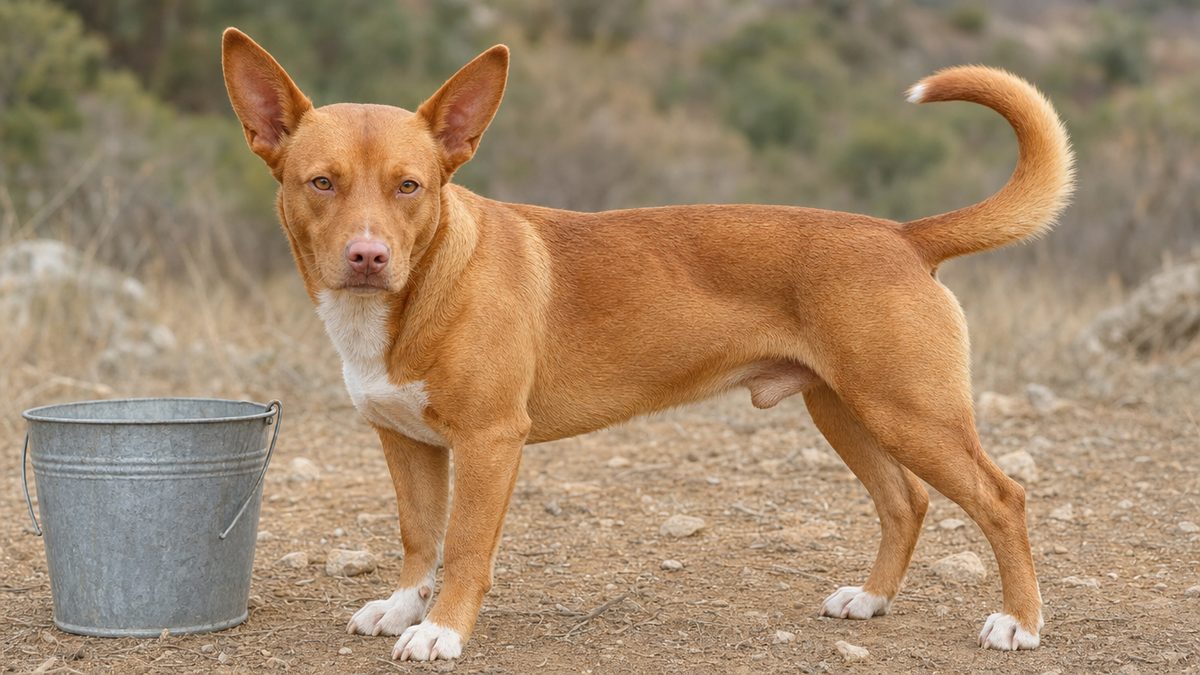
Quick answer
Ca de Conills is not a breed. Balearic Decret 5/2007 catalogues this Menorcan rabbit dog as an agrupacio racial, a racial grouping, defined in law as a population susceptible of being considered as a breed. It has no written standard, no FCI number, and no entry in the Spanish kennel club index or the Spanish national breeders' register, so no Indian pedigree can exist for it and no lawful Indian supply chain can form.
This guide is general information for Indian pet owners and is not a diagnosis. Consult a registered veterinarian near you before acting on anything you read here, ask which parasite prevention suits your district rather than relying on a national average, and treat collapse, disorientation, pale gums or laboured breathing after exercise in hot weather as an emergency rather than something to watch.
Ca de Conills at a glance
What the Ca de Conills is, and why the law does not call it a breed
The Ca de Conills is not a breed. Balearic law records it as an agrupacio racial, a racial grouping, which Decret 5/2007 defines as a population that is merely susceptible of being considered as a breed, and the Menorcan rabbit dog is the only dog anywhere in that catalogue.
Start with the document that settles it. The annex to Decret 5/2007, de 2 de febrer, the decree that creates the Cataleg d'agrupacions racials dels animals domestics autoctons de les Illes Balears, lists under the class of mammals, order of carnivores, family of canids, exactly one entry: ca de conills de Menorca. Not Mallorca. Menorca, printed in the law itself.
Article 2(a) of that decree gives the definition every English page about this dog leaves out. An agrupacio racial autoctona of the Balearic Islands is a poblacio susceptible de ser considerada com a raca, a population susceptible of being considered as a breed, whose most remote known origin lies in the islands and which is named in the annex. Susceptible of being considered. Not considered. The category exists precisely to hold populations that have not cleared the bar.
The decree's preamble says why in one sentence, and it is the most important sentence on this page. These are groups of domestic animals with a certain uniformity of visible characters that they transmit to their offspring, even though they do not present scientifically demonstrated characteristics of homogeneity significant enough for them to be considered autochthonous breeds. The Balearic Government wrote that about its own animals, in its own gazette, in 2007. Nobody has had to argue it since.
Six Balearic dogs, five labels and one exception
The Balearic Government's own autochthonous breeds portal, run by SEMILLA, prints the distinction on a single page. Its Especie Canina listing shows six populations. The Ca de Bestiar, the Ca de Bou, the Ca Me Mallorqui, the Ca Eivissenc and the Ca Rater Mallorqui each carry the label Razas Autoctonas Caninas. The Ca de Conills de Menorca carries the label Agrupaciones Raciales, and its situation reads En inicio de recuperacion, at the start of recovery. Five of one thing and one of another, on one screen, from the government that owns both categories.
IRFAP, the Balearic agrifood research institute, files the same animal under register code RRAA3101 with the category Agrupacions Racials, species canine, scope autonomic rather than national, and origin Menorca. Its own description states that the breeders' association is still preparing the working document it will submit, with the rest of the required paperwork, in order to apply for recognition as a breed. That application has not been granted, because it has not yet been made.
What the animal actually is
Functionally, the Ca de Conills is Menorca's rabbit dog, and a rustic one. The Balearic Government describes it as very rustic in appearance, agile and fast, with a great natural instinct for seeking rabbits, helped by scent, sight and hearing. IRFAP adds that its hunting attitude rests on scent, always assisted by hearing and sight, that it bays the moment it picks up a trail, and that it is specialised in hunting a barres, always in a group.
Its origins page is blunter than any breed guide would be. Among the dogs of the islands it is the least known even to enthusiasts; it appears to be a very old local population within the group of Mediterranean dogs of pharaonic origin, selected functionally for rabbit hunting; and to this day it still has no officially defined prototype. A prototype is what the Balearic system calls a standard. There is not one.
Nobody can sell you a registered Ca de Conills, because no registry issues that pedigree. The Federation Cynologique Internationale does not list it, the Spanish kennel club does not list it, and the Spanish national breeders' register does not list it. The only body that records it at all is the Government of the Balearic Islands, and what it records is a racial grouping of roughly three hundred dogs on one island. Anyone in India offering you one is not offering you what they say they are.
What an agrupacio racial actually is, in Balearic law
An agrupacio racial is a legal holding pen for a population that might one day become a breed, created by Decret 5/2007 so that such populations can be conserved and given a written prototype before anyone calls them a breed.
The decree does three things and each of them tells you something. Article 1 establishes the catalogue, fixes the minimum contents of the prototype regulations, and regulates the official recognition of the bodies that promote, conserve, breed and improve these populations. It was made under article 10.10 of the Balearic Statute of Autonomy, the islands' exclusive competence over agriculture and livestock, and the island councils of Menorca and of Eivissa and Formentera were consulted before it was passed.
Its preamble draws the line that matters. Decret 64/1998 already regulated the genealogical books of the Balearic races autoctones, the recognised breeds, which are included among Spanish autochthonous breeds in the annex to Real Decreto 1682/1997 updating the official catalogue of Spanish livestock breeds. Decret 5/2007 was written for the animals that did not qualify for that. Two catalogues, two tiers, one government.
The company the Ca de Conills keeps in that annex
The annex is short and it is worth reading in full, because it puts this dog in a category no breed guide would ever place it in. It contains thirteen entries. Under birds: the Mallorcan duck; six pigeons, the colom borino, colom de casta grossa, colom d'escampadissa, colom de pinta, colom nas de xot and colom gavatxut; and two turkeys, the indiot mallorqui and the gall dindi de Menorca. Under mammals: the ca de conills de Menorca, the Ibizan country rabbit, the black pig of Formentera and Eivissa, and the vaca de la reina.
So Balearic law does not file this animal beside the Ca de Bou or the Ca Me Mallorqui. It files it beside a duck, six pigeons, a pig and a cow. It is the only dog in the catalogue. And in a detail that reads like a joke but is not, the same annex also contains the conill pages d'Eivissa, the Ibizan country rabbit, so the dog and its quarry occupy the same legal list.
What the decree requires before a grouping gets a prototype
Article 3 sets out what a reglamentacio for a racial grouping must contain, approved by an order of the regional agriculture minister on the proposal of the Directorate General of Agriculture. It must include the prototype, meaning the definition of the grouping, its varieties if any, and its morphological characteristics broken down into head, trunk, limbs, skin, coat, size, weight and other; plus character and behaviour; eliminating faults; morphological qualification with scales, aspects and weighting; genealogical registers; animal registers; and rules for admission and qualification of animals.
That list is a complete description of what a breed standard is. The Ca de Conills has none of it. The decree's annex has been updated twice since 2007, by an order of 9 May 2014 creating the reglamentacio for the black pig of Formentera and Eivissa, and by an order of 28 September 2020 creating and regulating the racial grouping of the vaca de la reina and its genealogical book. A pig and a cow have had their orders written. The dog has not.
| Tier | What it means | Creating document | Balearic dogs in it |
|---|---|---|---|
| Raca autoctona | A recognised breed with a genealogical book | Decret 64/1998, feeding into the Spanish official catalogue via RD 1682/1997 | Ca de Bestiar, Ca de Bou, Ca Me Mallorqui, Ca Eivissenc, Ca Rater Mallorqui |
| Agrupacio racial | A population susceptible of being considered as a breed, catalogued so it can be conserved | Decret 5/2007, annex | Ca de Conills de Menorca, and no other dog |
Indian buyers are sold on paperwork more than on dogs, and the word raca appears all over the Balearic Government's own prose about this animal, including on pages that in the same breath say it has no prototype. The category, not the prose, is the legal fact. When you read a Spanish or Catalan page about this dog, look for the word agrupacio, and look at which of the two catalogues the page is describing.
Two kennel clubs checked, both with controls, and one absence
The Ca de Conills appears in neither the international breed nomenclature nor the Spanish kennel club index, and that absence is proved rather than assumed, because in both lists at least one of its five Balearic siblings is printed where it should be.
An absence is only worth printing if the search that found it works. Each check below was run in the same session, on the live document, with a control chosen so that a broken or wrong page would show up immediately.
Check one, the FCI nomenclature
The Federation Cynologique Internationale's alphabetical index of recognised breeds beginning with C runs from CA DE BESTIAR straight to CAIRN TERRIER. The control is the position itself: CA DE CONILLS would sit between those two entries, and CA DE BESTIAR, FCI number 321, is printed exactly where the alphabet says it should be. The same list carries CIRNECO DELL'ETNA at number 199, a Mediterranean warren hound of the same functional type, so the FCI plainly does register dogs of this kind. It simply has not registered this one.
That matters directly for an Indian reader. The Kennel Club of India is a full member of the FCI, listed at Nr 28, AA Block, First Street, Anna Nagar, Chennai. A full member registers FCI-recognised breeds. With no FCI number, no Indian pedigree can exist for this dog, whatever a seller shows you.
Check two, the Spanish kennel club
The Real Sociedad Canina de Espana's Razas Espanolas index, last modified 6 August 2026, lists Spanish breeds across nine numbered groups plus a Grupo 11 for breeds not recognised by the FCI, a separate Grupos Etnicos shelf, and an Otras razas list of breeds in a phase of recovery. Five Balearic controls appear on that one page. The Ca de Bestiar sits in Grupo 1, the Dogo Mallorqui or Ca de Bou in Grupo 2, the Podenco Ibicenco or Ca Eivissenc in Grupo 5, the Ca Me Mallorqui in Grupo 11, and the Ca Rater Mallorqui under Otras razas, filed as BALEARES.
The Ca de Conills appears in none of the four zones. Not in a numbered group, not in Grupo 11, not among the eight Grupos Etnicos, and not in the Otras razas recovery list where its Mallorcan sibling sits. When five of six Balearic dogs are printed on a page and the sixth is not, the page is working and the absence is real.
Check three, the Spanish national breeders' register
The Ministry of Agriculture, Fisheries and Food maintains, through its ARCA system, the official list of pure-breed dog breeders' organisations recognised under Real Decreto 558/2001, updated 6 October 2025. Five Balearic entries appear on it, each with the Govern de les Illes Balears as competent authority, covering the Ca de Bestiar, the Ca de Bou, the Ca Eivissenc, the Ca Me and the Ca Rater. There is no Ca de Conills entry, and no Menorcan association on the list at all.
One caveat belongs on that check, and we print it rather than hiding it. The ARCA file is a scanned register whose text layer is poor, mangling several contact fields and even some breed names. It is used here only to answer the question a mangled scan can still answer, which is whether the distinctive string Conills appears anywhere on the three pages. It does not, while all five sibling breeds and their island authority are legible.
Three more registers checked, and the door that stays open
The Spanish national breed catalogue, the national breeders' register and the peer-reviewed literature all omit the Ca de Conills while listing five Balearic siblings, and the national catalogue has grown from fifteen breeds to thirty-three without ever admitting it.
Check four, the Spanish national breed catalogue
The founding national instrument is Real Decreto 558/2001, published in the state gazette of 14 June 2001, whose annex lists the Spanish canine breeds together with their racial prototypes. The consolidated text, last updated on 27 July 2020, carries thirty-three entries, and five of them are Balearic: Ca de Bestiar, Ca de Bou, Ca Eivissenc, Ca Me Mallorqui and Ca Rater Mallorqui.
That annex is the strongest control on this page, because it has been amended repeatedly and it grew. The version published in 2001 listed fifteen breeds, and did not include either the Ca Me Mallorqui or the Ca Rater Mallorqui. Both were added later, along with sixteen others, by a series of ministerial orders running to 2020. So the door is open, eighteen more entries have been added since 2001, and two of those were Balearic dogs. The Ca de Conills has not come through it.
A machine search of the consolidated text finds the string Conills exactly zero times. The single near-match is the word Enconillarse inside the Spanish prototype for the Ca Eivissenc, which describes packs refusing to hunt after taking some thousands of rabbits, and which is built on the same Catalan word for rabbit.
Check five, the peer-reviewed literature
A 2022 microsatellite study of eighteen dog breeds prints the registry status of each in its own Table 1, and it is the cleanest single line of evidence available. CA DE CONILLS DE MENORCA, acronym CON, 112 samples, FCI NR, RSCE NR, where NR is defined on the table as Not recognised. The controls sit in the same column: CA DE BESTIAR reads 1 and 1, CA BOU reads 2 and 2, and PODENCO IBICENCO reads 5 and 5.
| Population | FCI | RSCE | RD 558/2001 annex and breeders' register | Balearic status |
|---|---|---|---|---|
| Ca de Bestiar | Group 1, number 321 | Grupo 1 | Listed | Raza autoctona canina |
| Ca de Bou | Group 2, number 249 | Grupo 2 | Listed | Raza autoctona canina |
| Ca Eivissenc (Podenco Ibicenco) | Group 5, number 89 | Grupo 5 | Listed | Raza autoctona canina |
| Ca Me Mallorqui | Not recognised | Grupo 11 | Listed | Raza autoctona canina |
| Ca Rater Mallorqui | Not recognised | Otras razas | Listed | Raza autoctona canina |
| Ca de Conills de Menorca | Not listed | Not listed | Not listed | Agrupacio racial under Decret 5/2007 |
The claim we were asked to test was that this animal is Menorcan rather than Mallorcan, that it is a racial grouping rather than a breed, and that it is absent from the RSCE index while its siblings are listed. All three check out against primary documents. One correction: the RSCE index has moved since our Ca de Bou page described it, and the Ca Me Mallorqui now sits in Grupo 11 rather than under Otras razas, so a page citing the 2022 study alone would be a rung out of date on that breed.
What would have to happen for the Ca de Conills to become a breed
Turning this racial grouping into a recognised breed needs a written prototype, a closed genealogical book, three generations of verified inheritance and a scientific dossier submitted to a national commission, and the Ca de Conills has completed none of those steps.
The Spanish kennel club publishes the clearest explanation of the gap, in an essay by Carlos Salas Melero printed on the same index page that omits this dog. A grupo etnico, it says, is a canine population whose members share their own physical and functional traits, fixed by functional selection over the years, within a given geographical area. Can such groups be called a breed? Colloquially, popularly, and even within the sphere of some administrations, that has been and is done. That sentence is doing a lot of work, and it is aimed at exactly the kind of usage found on Balearic government pages that call this animal a raca while also saying it has no prototype.
The essay then sets out what converting an ethnic group into a modern breed actually requires: specific selection work by breeders, agreed around a common project which is the racial standard; individuals registered generation after generation in a book of origins; and a notable level of homogenisation and stability in both phenotype and genotype. That genetic stability requires that for at least three generations the inheritance of the desired characters constituting racial typicity can be verified. Its metaphor is worth repeating: ethnic groups are rough precious stones, and a breed is what emerges after planned cleaning, cutting and polishing.
The dossier a national commission would require
The Balearic autochthonous breeds portal hosts the actual procedure, the operating rules of the national Comision de Coordinacion para la Conservacion, Mejora y Fomento de las Razas Ganaderas together with its Annex I, the application for inclusion of a breed in the Catalogo Oficial de Razas de Ganado de Espana. Any member of the commission may propose a breed, must present and defend it in person in a maximum of fifteen minutes, and the application must be backed by a reasoned report from a scientific entity or research centre with experience in ethnozootechnics, genetics and animal reproduction.
For an autochthonous breed the dossier must contain, at minimum, fourteen items, and reading them against this population is instructive.
- Name the breed, and set out its historical and geographic origin, the territorial evolution of its distribution, its cultural importance, any previous official recognitions, and its recent history over the last thirty years.
- Describe the morphology, with photographs of both sexes at different ages and of each variety, including the racial standard. This is the item the Ca de Conills cannot supply, because the Balearic Government's own page says no official prototype is yet defined.
- Compare it with related breeds, morphologically and productively, wherever such breeds exist. The obvious comparator is the Podenco Ibicenco, and a 2022 study could not cleanly separate the two populations.
- Report censuses and their trend by sex and age where possible, the number of breeders, and their territorial distribution.
- Supply a genetic characterisation and technical studies of effective population size, genetic variability and inbreeding, unless the number of specimens makes that impossible.
- Show an association of breeders, a conservation programme with its results, and any germplasm bank.
The route its sibling actually walked
The Ca Rater Mallorqui shows what the finished process looks like, and the dates are published in the peer-reviewed literature. It was officially recognised by Real Decreto 558/2001 on 25 May 2001. Its breed standard was published in the official journal of the Balearic Islands on 28 December 2002. Management of the breed registry was entrusted to its club by resolution on 21 November 2002. On 10 March 2004 the Ministry of Agriculture, Fisheries and Food officially recognised the breed and the standard was published in the state gazette.
Four documents over three years, in that order, ending with a standard in the national gazette. The Ca de Conills is at step zero of that sequence: its association is still preparing the working document it intends to submit in order to apply for recognition as a breed.
On 5 July 2026, at the placa des Pins in Ciutadella, the association held the first Balearic morphological contest ever staged for this population, judged by Jose Manuel Alanzor, a senior veterinary technician at IRFAP. A morphological contest is how a population starts generating the qualification data a prototype needs. It is a real first step, and it is a first step, in 2026, for a population that Balearic law has catalogued since February 2007.
The Ibizan Hound relationship, stated precisely rather than loosely
The Ca de Conills is not a small Ibizan Hound. Genetics cannot cleanly separate the two populations, but the Ibizan Hound's own FCI standard already claims Menorca as part of its origin area, and a typical Ca de Conills measured against that standard would carry disqualifying faults.
Three separate documents have to be read together here, and each of them says something the others do not.
One, the FCI standard already claims the island
FCI-Standard No. 89 for the Podenco Ibicenco, English translation dated 04.02.2000 against an official standard published 26.05.1982, opens its historical summary by stating that the breed originates in the Balearic Islands of Majorca, Ibiza, Minorca and Formentera, where it is known by the original name Ca Eivissec. The FCI therefore already treats Menorca as Ibizan Hound country. Any claim that Menorca has a separate warren hound has to explain what the difference is, and the Balearic Government has not yet written that explanation down.
The functional descriptions are close to interchangeable. FCI-89 says the Podenco Ibicenco is mainly used for hunting rabbits without guns, by day and at night, and that thanks to his particularly good scenting ability, coupled with hearing, he uses these more than sight. The Balearic Government says the Ca de Conills has a great natural instinct for seeking rabbits, helped by scent, sight and hearing. FCI-89 describes a pack that surrounds located game and barks only when it sees or hears it; IRFAP describes a dog that bays the moment it picks up the trail and is specialised in group hunting a barres.
Two, the genetics cannot pull them apart
A 2022 microsatellite study analysed 112 Ca de Conills against 49 Podenco Ibicenco and four other Balearic populations. Its factorial correspondence analysis, whose first three axes explained 72.03 percent of total genetic differentiation, found that the Podenco Ibicenco and Ca de Conills were difficult to divide in all the axes considered, while the separation of Ca Rater, Ca Me, Ca de Bou and Ca de Bestiar from each other was remarkable. Bayesian clustering agreed: among the podencos, the Ibicenco was rather different from the rest and shared some similarities with the Ca de Conills.
The authors' own conclusion is careful. They confirmed that the Balearic breeds had remained pure and without crossbreeding, even though two breeds, Ca de Conills and Podenco Ibicenco, show a closer genetic relationship because they share the same distribution area. Shared distribution is their explanation; nobody has yet published a study designed to test whether the Menorcan population is a distinct entity or a local strain.
Three, the standard would fail the dog
Now measure one against the other, which no page anywhere appears to have done. FCI-89 sets heights of 66 to 72 cm for dogs and 60 to 67 cm for bitches. The Ca de Conills working document recognises two sizes, medium at 53 to 63 cm and small at 43 to 53 cm. Almost the entire Menorcan population sits below the Ibizan Hound's minimum for a bitch.
| Feature | Ca de Conills as described by the Balearic Government | FCI-89 for the Podenco Ibicenco | Verdict under FCI-89 |
|---|---|---|---|
| Height | 53 to 63 cm medium, 43 to 53 cm small | 66 to 72 cm dogs, 60 to 67 cm bitches | Below the minimum |
| Head | Broad, proportionate to body, often unbalanced in favour of the head in small dogs | Long and fine, cone cut off near its base, dolichocephalic | Head short and broad is a severe fault |
| Croup | Broad | Strongly sloping, and croup broad is listed under disqualifying faults | Disqualifying |
| Ear set | Generally low, large in proportion to the head | Centre of the ear set on is level with the eyes | Drop ears are a severe fault |
| Nose and lips | Pink, except in black-coated dogs which have them black | Nose leather flesh colour; brown pigment or black spots on the nose leather disqualify | Disqualifying in the black-coated minority |
| Limbs, small type | Short and often deviated | Vertical and symmetric; feet turned out and crossing in movement are severe faults | Severe fault |
| Coat colour | Red-orange with white most common, then brown and tan, then red-orange; black rare | White and red preferred, or entirely white or red; fawn only in exceptional specimens | Brown and tan and black fall outside |
The comparison is not a criticism of the Menorcan dog. It is the point. A very old local population selected on whether it finds rabbits, fundamentally according to the needs of the hunter and never against a drawing, will not match somebody else's drawing. That is what an unstandardised population looks like, and it is exactly why the law calls it a grouping.
If somebody offers you an Ibizan Hound and shows you a 50 cm dog with a broad head and a broad croup, you are not being shown a small Ibizan Hound. If somebody offers you a Ca de Conills and shows you FCI papers, the papers are for a different breed or they are not real. The two animals overlap genetically and diverge completely on paper, and the paper is what a sale is built on.
No breed standard exists, and the government's own two descriptions disagree
The Ca de Conills has no official prototype, and the clearest proof is that the Balearic Government publishes two descriptions of the same animal that contradict each other on head shape, ear set and coat colour.
The Balearic Government states the position itself. Its origins page says that, despite the esteem Menorcan hunters have for these animals, to this day it still has no officially defined prototype. Wikipedia reaches the same conclusion in three words: there is no breed standard. What follows is what fills the vacuum.
Description A, the government's own characteristics page
The caib.es page headed Caracteristiques mes destacades describes animals with a broad head proportionate to the body, a proportion frequently unbalanced in favour of the head in the smaller specimens; a straight muzzle profile; small oblique eyes with a light amber iris, except in black or black-and-white dogs which have dark eyes; thin pink lips, nose and palate, again except in black-coated dogs; good dentition and a scissor bite; and mobile ears held erect and forward at attention, back or folded at rest, generally low-set and large in proportion to the head.
It continues with a body longer than tall, more noticeably so in small dogs whose short legs give a clear height-to-length disproportion; a flat ribcage; a straight strong dorsolumbar line; a broad croup; limbs strong and long in medium-sized animals but short and often deviated in the small ones; almost hare feet with light pads and strong light nails; and a thick tail of medium length, dropped at rest and arched above the horizontal at attention.
Description B, the association's working document
IRFAP publishes a different description, drawn from the working document the breeders' association is preparing for its recognition application. There the head is small in relation to the body, not too long, triangular, with a straight to sub-convex profile, marked orbital arches, small oblique eyes and thin tight lips. The ears are long and fine, hairless inside, very mobile and almost always erect facing forward. The trunk is rather longiline with marked withers and a deep chest, the neck is muscular and slightly arched along its upper line, the limbs are strong, thick-boned and well muscled, and the body is muscled especially over the loin and croup. The Balearic Government's SEMILLA record for this population is candid about where it sits: its resources panel links the racial-grouping catalogue, Real Decreto 558/2001 on pure-breed dogs, the 2019 zootechnical rules and a document titled simply the procedure for recognising a breed.
On colour the two documents diverge outright. IRFAP gives light chocolate, described as orange, and dark chocolate, described as brown; some dogs are a single colour and others are patched with white, but never predominantly white, with patches only on the chest and toes. The caib.es page gives red-orange patched with white as the commonest coat, followed by brown and tan and then plain red-orange, and records black and black-patched coats as totally in the minority. One document lists black among the colours that exist. The other does not mention it.
| Feature | caib.es, Caracteristiques mes destacades | IRFAP, association working document |
|---|---|---|
| Head | Broad, proportionate to body | Small in relation to body, triangular |
| Head profile | Muzzle profile straight | Straight to sub-convex |
| Ear set | Generally low-set, large in proportion to the head | Long and fine, very mobile, almost always erect and forward |
| Coat length | Short at 2 cm and fine, to rough at 5 cm | Fine and short to rough or hard and medium, sometimes both types on one dog |
| Colours | Red-orange with white, brown and tan, red-orange; black and black-patched a small minority | Light chocolate (orange) and dark chocolate (brown), white patches only on chest and toes |
| Sizes | Not stated as fixed categories | Two, medium 53 to 63 cm and small 43 to 53 cm |
Three sources, three different size schemes
Size is where the disagreement becomes impossible to paper over. IRFAP recognises two sizes, medium at 53 to 63 cm and small at 43 to 53 cm. Wikipedia, following the 2009 Spanish field guide to autochthonous breeds, describes three sub-breeds at roughly 30 cm, 40 to 50 cm and 60 to 70 cm, and says groups of all three sizes are used together, each doing the job it suits. The only editorial page ranking in India says the majority are medium to small with larger and taller examples as well, and attributes the variation to the lack of a defined prototype and to selection according to the needs of the hunter.
Those three schemes cannot all be right, and no arbiter exists to choose between them, because the arbiter is the prototype that has not been written. Never quote a Ca de Conills height as though it were settled. Quote the source with the number.
The genetic evidence, audited against itself
Two peer-reviewed studies have genotyped the Ca de Conills, and both report the genetic signature of a population that is not yet standardised: a significant excess of homozygotes in one, and deviation from Hardy-Weinberg equilibrium at ten of twenty-one markers in the other.
This is the one subject on which the Ca de Conills is unusually well documented, because Menorcan hunters gave the University of Cordoba's laboratory more samples than any other Balearic population supplied.
Study one, eighteen breeds compared
The 2022 microsatellite study genotyped 112 Ca de Conills, the largest sample of any of the eighteen breeds in the paper, ahead of the Ca de Bestiar at 106 and the Kerry Blue Terrier at 80. Its Table 2 gives, for the CON row, a mean of 7.20 alleles, an effective number of alleles of 4.7, allelic richness of 3.73, expected heterozygosity of 0.712 and observed heterozygosity of 0.686, with FIS of 0.26097 and a 95 percent confidence interval of 0.09149 to 0.34834.
That is the highest inbreeding coefficient in the entire table, and because the interval excludes zero it is statistically significant. The paper's own prose confirms it: only Ca de Bestiar, Ca de Conills, Podenco Valenciano and Jack Russell Terrier had a significant excess of homozygotes, and the rest of the breeds, including the Ca Rater Mallorqui, appear to be in Hardy-Weinberg equilibrium.
Divide the same row's own heterozygosity columns and you get a different answer. Expected 0.712 against observed 0.686 works out at 0.037, not 0.261. Multilocus fixation indices are estimated locus by locus rather than from column means, so the two need not match exactly, but a sevenfold gap is worth flagging. We therefore quote 0.26097 as the paper's own multilocus estimate, not as something derivable from the printed He and Ho, and we note that the four breeds the text names as significant are exactly the four whose confidence intervals exclude zero, so the column is correctly aligned with the breeds.
Study two, the marker panel study
A 2023 paper by the same Balearic and Cordoban team examined the marker panels used across, in its own words, the five breeds and breed agroupation autochthonous to the Balearic archipelago. Its Table I gives the Ca de Conills 21 microsatellites, an average of 6.60 alleles across a range of 4 to 10, highest heterozygosity at AHTh121 of 0.857 and lowest at REN247M23 of 0.477, an observed heterozygosity range of 0.415 to 0.806, all markers highly informative except REN247M23, an average FIS of 0.048, and the remark moderate genetic diversity.
The column that matters is the one nobody quotes. Deviations from Hardy-Weinberg equilibrium: ten markers. The Ca de Bestiar shows five, the Ca Rater four, the Ca Me none, and the Ca de Bou and Podenco Ibicenco rows carry no entry at all. Ten out of twenty-one is double the next highest count in the table.
| Population | Markers | Mean alleles | Deviations from HWE | Average FIS | Paper's remark |
|---|---|---|---|---|---|
| Ca de Bestiar | 21 | 7.05 | 5 markers | 0.021 | High genetic diversity |
| Ca de Bou | 21 | 5.05 | none listed | 0.081 | Low genetic diversity |
| Podenco Ibicenco | 21 | 5.75 | none listed | 0.200 | Moderate genetic diversity |
| Ca Rater | 33 | 6.61 | 4 markers | 0.044 | Moderate genetic diversity |
| Ca Me | 21 | 6.50 | none | 0.038 | Moderate genetic diversity |
| Ca de Conills | 21 | 6.60 | 10 markers | 0.048 | Moderate genetic diversity |
The two studies disagree, and we publish the disagreement
One paper puts the Ca de Conills FIS at 0.26097 and calls the excess of homozygotes significant. The other puts it at 0.048 and calls the population's diversity moderate. Different panels, different sample sets and different estimators will do that, and neither paper reconciles the two. What both agree on is direction: the Ca de Conills is the Balearic population furthest from random mating, on whichever measure you take.
That is not a scandal. It is what an unstandardised working population looks like. When breeding decisions are made hunter by hunter, in valleys, around a few good workers, the result is internal substructure, and internal substructure reads as an excess of homozygotes whether or not any individual dog is inbred. The six Balearic populations together give an FST of 0.131, meaning roughly 13 percent of total genetic variation lies between breeds and 87 percent between individuals.
How many Ca de Conills exist, and why three numbers are in circulation
Three different counts are published for this population, 316 in a 2024 journal paper, about 400 claimed by the breeders' association in July 2026, and 31 dogs actually presented at the first morphological contest, and no source reconciles them.
The peer-reviewed figure comes from a 2024 study of the studbooks of the six Balearic dog populations. It records the Ca de Conills at a census of 316, and sets that beside Ca de Bou 243, Ca de Bestiar 507, Ca Me Mallorqui 654, Ca Eivissenc 1,037 and Ca Rater Mallorqui 2,119. So the Menorcan rabbit dog is the second smallest recorded Balearic canine population, ahead only of the Ca de Bou.
The association's own figure, given to the Menorcan press at the first contest in July 2026, is about 400 censused. Two years and roughly eighty dogs apart, from two different kinds of source, and the smaller number is the one that went through peer review.
The number that actually turned up
The most useful figure is the smallest. At the I Concurs Morfologic Balear del Ca de Conills de Menorca, held at the placa des Pins in Ciutadella on 5 July 2026, thirty-one dogs were entered, which the paper called a good result to start with given the association has only around 400 on its books. Cages were set up for every entered animal, and the judge was Jose Manuel Alanzor, a senior veterinary technician at IRFAP, with Agueda Laura Pons, head of livestock production at the same institute, also present.
The competition ran in four categories, for dogs of 9 to 24 months and for older animals, males and females separately, and the breed champion was a bitch named Calma. Thirty-one dogs out of a census of three to four hundred is under ten percent of the population, at the first event of its kind, which is a realistic picture of how early this project is.
A discrepancy inside one article
The same Menorcan report contradicts itself in a way worth recording. Its standfirst says about fifty specimens took part, while its body text says thirty-one. The Balearic public broadcaster, reporting the same event, also says about fifty. We follow the body text over the standfirst, because the body text is the one that carries the specific number and the surrounding context, and we print both rather than quietly choosing.
| Figure | What it counts | Source | Date |
|---|---|---|---|
| 316 | Studbook census used in a peer-reviewed comparison of six Balearic populations | Animals 14(4):639 | 2024 |
| About 400 | Dogs on the breeders' association's books, as reported to the press | Menorca Es Diari | July 2026 |
| 31 | Dogs actually entered at the first Balearic morphological contest | Menorca Es Diari | July 2026 |
| About 50 | Participants, per the same article's standfirst and per IB3 | Menorca Es Diari and IB3 | July 2026 |
The Balearic Government's own page adds the caveat that makes all four numbers soft. The number of animals typified as belonging to this population is not well defined, because of its variability, though it is not numerous, and the first job to be done, before the crossbreeding that has already begun does more damage, is to draw up the racial prototype. You cannot count members of a population whose membership criteria have not been written.
A population census is the fourth item on the national commission's list of what a recognition dossier must contain, and it must show censuses and their trend by sex and age where possible, the number of breeders, and their territorial distribution. Three conflicting figures and no age or sex breakdown is not yet that dossier.
Origins: a very old population that a rabbit disease nearly ended
The Ca de Conills is described by the Balearic Government as a very old local population within the Mediterranean group of dogs of pharaonic origin, selected functionally for rabbit hunting, and its decline is tied to the arrival of myxomatosis in the islands in 1952.
The origins page is honest about how little is known. Of all the dogs of the Balearic Islands, this is the one least known even to enthusiasts. From the data that exists, it appears to be a very old local population, part of the group of Mediterranean dogs of pharaonic origin, functionally selected for hunting the rabbit. That phrase, pharaonic origin, is the standard Spanish description of the warren hound family which includes the Podenco Ibicenco, the Podenco Canario and the Cirneco dell'Etna, and the FCI's own Ibizan Hound standard puts the same idea more grandly, saying illustrations of such dogs are found in the graves of the Pharaohs.
What the dogs were for
The job was rabbits, and it was done without guns. Until the middle of the twentieth century the Menorcan dogs were used extensively for rabbit hunting, without firearms, and often on a large scale. IRFAP describes the surviving method: an animal that works on scent, always helped by hearing and sight, that bays the moment it locates a trail so its handler knows it is coursing a rabbit, and that is specialised in hunting a barres, always in a group. It calls the dog rustic, adapted to any terrain, and at its best in hard and dense cover.
That is how the size variation is used rather than tolerated. Groups of all three sizes work together, each carrying out the task to which it is best suited. A small dog goes into cover a 60 cm dog cannot enter; a large one covers ground. A pack of mixed sizes is a tool, not a failure of selection, and it is one reason nobody in Menorca has been in a hurry to write a single height range.
1952, and what a virus did to a dog
When myxomatosis reached the Balearic Islands in 1952, rabbit numbers fell, rabbit hunting became less common, and the number of these dogs fell with it. That figure comes from the 2009 Spanish field guide to autochthonous breeds, as reported by Wikipedia; Bonbeno has not opened the printed guide itself and says so rather than implying otherwise.
The threat did not end there. In the twenty-first century the population is at risk both from changes in the wild rabbit population and from the consequences of imports to the islands of warren hounds of other Mediterranean breeds. The Balearic Government's own warning is sharper still: the first job to be done, before the crossbreeding that has already started does more damage, is to draw up the racial prototype. A population with no written definition cannot tell an outcross from a member.
The word that keeps causing trouble
Conills is Catalan for rabbits, and that single fact explains a great deal about how this dog is discoverable. Search the name from India and the tenth organic result is a machine-translated page about California meat rabbits, because the phrase carries almost no dog-related search demand in the country. It also explains the name's shape: this is not a dog named after a place or a founder, it is a dog named after what it catches.
The one conventional editorial page ranking for this term in India is titled The Mallorcan Ca de Conills. Read it beside the Balearic Government's own Caracters generals page and the body text is an almost word-for-word English translation of it, including the sentence about the lack of a defined prototype for this grouping and the line about most specimens being medium to small. What the translation changed was the island. A Menorcan population became Mallorcan somewhere between the two pages, and that error has been live since March 2009.
Ca de Conills price in india: there is none, and here is the proof
No Ca de Conills price in india exists, because no Indian seller lists the animal, no registry can issue papers for it, and Indian import law forbids the only route by which a breeding population could arrive.
Bonbeno searched Indian listings for this animal and found none. That is a strong claim, so it was tested the way absences on this site are always tested, with a control run in the same tool and the same session.
- The subject search returned no Indian for-sale listing of any kind. The results were an English encyclopedia entry, two Spanish research-repository pages, an Instagram reel from the Balearic breeds account and a Facebook post, with no marketplace, breeder or classified page anywhere in the set.
- The control search, for a Labrador Retriever puppy price in India, returned ten dense Indian commercial results in the same session, including a national listing site with a city-by-city price table and a breed guide quoting a range.
- Verdict. The search apparatus works for Indian puppy listings. The absence is therefore about the animal, not about the query.
What the control shows about Indian pricing generally
The control is worth a second look, because it shows how unreliable Indian published prices are even for the commonest breed in the country. One national listing site puts a Labrador Retriever at INR 30,000 to INR 1,20,000 and above, split into basic quality at 30,000 to 60,000, KCI registered at 60,000 to 90,000 and champion bloodline at 90,000 to 1,20,000. A large Indian pet retailer's breed guide puts the same dog at between INR 8,000 and INR 70,000. The floors differ by nearly four times.
We ran the two currency checks this site runs on every suspicious Indian price band. None of those Labrador figures divides cleanly by 84.38 or by 74, so they are rupee-native numbers rather than a converted American price list. That is a useful result: it means the wild spread is genuine Indian market noise, not an artefact of somebody running dollars through a spreadsheet. Where a Ca de Conills price ever does appear on an Indian page, run the same two divisions before believing it.
Why no lawful supply chain can form
Three separate facts close the route, and any one of them would be enough.
- No pedigree can exist. The Kennel Club of India is a full FCI member, and the FCI does not recognise this population. There is no document for an Indian seller to produce.
- No commercial import is permitted. Dogs sit under ITC(HS) 01061900 as a Restricted import, and Policy Condition (8) states that import of commercial dogs for breeding or any other commercial activity is not permitted.
- No breeding stock can be created here. Second Schedule Part II paragraph 6(9) of India's Dog Breeding and Marketing Rules 2017 prohibits breeding to create new breeds of dogs or unusual looks. Standardising a racial grouping is, by definition, creating a breed.
Add those together and a Menorcan rabbit dog cannot lawfully become an Indian commercial breed. The only lawful route in is a single pet dog travelling with its owner, which the next section sets out in full.
Ask two questions and stop. Which registry issued the paperwork, and what number is on it. There is no correct answer to either, because no registry on earth issues a Ca de Conills pedigree. What is far more likely to be in front of you is a red-and-white podenco-type dog of unknown ancestry, an Indian pariah dog with the right colouring, or a photograph taken in Menorca. Bonbeno has repeatedly found Indian listing carousels recycling the same oddly specific rupee charm prices, such as Rs 98,999, across whichever puppy happens to be in stock. We checked the national listing page used as this page's control and found no such figure on it, so we report the pattern as a thing to watch for rather than as something we saw here.
Importing a Ca de Conills into India: the exact rule, and what it forbids
India allows a dog in only as a pet with a valid pet book in the importer's own name, for research with CPCSEA backing, or for Defence and Police use, and DGFT Trade Notice 22/2022-23 states that applications made for trading or breeding purposes shall be duly rejected.
The operative document is Trade Notice No. 22/2022-23, issued by the Directorate General of Foreign Trade on 19 December 2022 and addressed to all international airlines, all Indian embassies and consulates abroad, and pet owners concerned. It sets out the import policy for ITC(HS) 01061900, mammals other, whose import policy reads Restricted, subject to Policy Condition 6 of the chapter.
Policy Condition (7) permits import of dogs for three purposes only.
- A pet dog with a valid pet book and relevant records or documents in the name of the importer.
- Dogs imported by R&D organisations for conducting research, with the recommendation of the CPCSEA.
- Dogs for internal security by the Defence and Police Force.
Policy Condition (8) closes the door on everything else: import of commercial dogs for breeding or any other commercial activity other than the purposes above is not permitted. Paragraph 6 repeats it in plainer language, stating that any applications for trading or breeding purposes, or applications made on behalf of some other person or entity, shall be duly rejected.
The one lawful route, step by step
If you are an Indian resident who has been living in Menorca and is moving home with a dog, the route exists and it is narrow.
- Up to two pets may come as passenger baggage without a DGFT authorisation, but only for a person transferring residence to India after two years of continuous stay abroad, and only cats and dogs qualify under the baggage rules.
- A DGFT authorisation is required if the stay abroad was under two years, if the pet is not travelling as passenger baggage, or if the pet cannot be imported under the baggage rules.
- More than two pets always requires a DGFT authorisation, and the application goes to the Department of Animal Husbandry and Dairying for examination against the justifications and supporting documents.
- Apply against form ANF-2M, using your own Importer Exporter Code or the permanent IEC number IIHIE0153E for persons importing goods for personal use.
- Start at least two months before travel, which is the notice period the Trade Notice itself advises.
- Obtain an advance No Objection Certificate from the Regional or Quarantine Officer of the entry port, seven days before travel and relaxable to three days, after submitting the DGFT licence and a health certificate from a veterinarian in the exporting country, with all prescribed disease testing done there and the reports travelling with the animal.
Entry is limited to the airports and seaports of Delhi, Mumbai, Chennai, Hyderabad, Bengaluru and Kolkata and, since October 2024, Kochi airport, and where required the animal is quarantined at the government quarantine station of that port for a stipulated period. If you land anywhere else, the dog does not. The full route is set out in how to import a dog to India.
A single returning family can lawfully bring one Ca de Conills to Chennai. Nobody can lawfully bring six to start breeding them. That is why an absent breed stays absent: the rule does not merely make a supply chain expensive, it makes it impossible, and it does so before any question of demand, price or suitability arises. Anyone who tells you they can arrange a breeding import is describing an application the Trade Notice says shall be duly rejected.
What a dog of this type would cost to keep in India, honestly bounded
No Indian cost figure exists for the Ca de Conills, so this section prices the animal by its measurable attributes rather than by its name, and says plainly which of those numbers are estimates and which are not.
Bonbeno will not invent a monthly figure. What can be done honestly is to fix the inputs that actually drive cost, which are bodyweight, coat, activity level and disease exposure, and to state where each input comes from.
The inputs that are documented
- Size. Two documented size bands, medium at 53 to 63 cm and small at 43 to 53 cm, with a third scheme in the field-guide literature running from about 30 cm to 70 cm. A dog at either end of that range is a different feeding bill.
- Coat. Short at about 2 cm and fine, through to rough and about 5 cm, with both types sometimes on the same animal. A short-coated dog is cheap to groom, which is one genuine saving.
- Activity. A hunting animal selected to work in hard, dense cover, in groups, on scent. That is a high daily energy requirement, not a balcony dog.
- Disease exposure. In an Indian survey of 525 dogs, 53 percent carried ticks and 49.7 percent were PCR positive for at least one tick-borne pathogen. A dog that works in scrub is at the wrong end of that distribution.
What is genuinely unknown, and stays unknown
Four cost lines cannot be estimated for this animal at all, and no responsible page should pretend otherwise. There is no purchase price, because nothing is sold. There is no insurance category, because Indian insurers price by recognised breed. There is no breed-specific screening protocol, because no parent club has published one. And there is no published lifespan, because no study of this population's longevity exists.
That last point deserves emphasis, since sibling pages on this site have had to make it too. The two peer-reviewed papers that examine the Ca de Conills examine its genetics and its registry, not its health. Neither reports a single clinical outcome. Anybody quoting you a Ca de Conills life expectancy has taken it from a related breed or from nowhere.
| Cost line | What drives it here | Confidence |
|---|---|---|
| Purchase | No lawful Indian supply exists at any price | Documented |
| Food | Bodyweight and a working-dog activity level; the size range is disputed across sources | Partly documented |
| Grooming | Short to medium harsh coat, no clipping, no professional trim needed | Documented |
| Tick and flea prevention | Year-round in most of India, and non-negotiable for a scrub-working dog | Documented |
| Routine veterinary care | Standard for a medium active dog; nothing breed-specific is published | Estimate |
| Inherited-disease screening | No parent club protocol exists for this population | Not available |
| Insurance | Indian insurers price by recognised breed; this one has no category | Not available |
Budget as you would for a medium, short-coated, highly active dog at the 43 to 63 cm heights the association document records, with high parasite exposure, and treat every figure you see attached to the name Ca de Conills as unsourced until it names a document. No published weight exists for this population, so we do not print one. The one cost that is certain is the one nobody mentions: a dog with no registry has no resale, no stud value and no show career, so the whole of its economics is the cost of keeping it well.
Menorca against India: the comparison is not the one you expect
Menorca is a humid place that is never hot, and that combination is what an Indian owner has to plan around, because the island's warmest month averages 25.47 C while Chennai's annual mean is 27.95 C and Delhi's June mean is 35.88 C.
Every figure below comes from the NASA POWER climatology service, queried by explicit latitude and longitude rather than by place name, over the twenty-year period January 2001 to December 2020. Queried coordinates and returned coordinates are printed together so the reader can check that the right place answered.
| Location | Returned coordinates and elevation | Coolest month mean | Warmest month mean | Annual mean | Annual max | Annual mean humidity |
|---|---|---|---|---|---|---|
| Mao, Menorca | 39.889 N, 4.266 E, 5.13 m | 12.29 C (Feb) | 25.47 C (Aug) | 18.34 C | 30.49 C | 77.05 percent |
| Chennai | 13.083 N, 80.271 E, 48.95 m | 24.09 C (Jan) | 31.51 C (May) | 27.95 C | 42.70 C | 72.39 percent |
| Delhi | 28.614 N, 77.209 E, 206.37 m | 13.61 C (Jan) | 35.88 C (Jun) | 25.60 C | 48.79 C | 45.56 percent |
| Pune | 18.520 N, 73.857 E, 635.99 m | 19.62 C (Dec) | 28.93 C (Apr) | 23.86 C | 43.20 C | 66.80 percent |
Three numbers that settle the heat question
Chennai's annual mean is 2.48 C above Menorca's hottest month. A dog bred on an island whose August averages 25.47 C would find Chennai's average year, 27.95 C, warmer than the hottest four weeks it was selected in. Only Chennai's January, at 24.09 C, dips below the Menorcan August at all.
Delhi's June is 10.41 C above Menorca's August, at 35.88 C against 25.47 C, and Delhi's annual maximum of 48.79 C sits 18.30 C above Menorca's 30.49 C. Delhi is not a hotter version of Menorca. It is a different climate that happens to share a January.
Pune's monsoon is the closest match in India, and it is the wettest trap. Pune in August averages 23.30 C, which is 2.17 C cooler than Menorca in August, so the thermal fit looks excellent. Then read the humidity: 90.80 percent against Menorca's 73.70 percent, a gap of 17.1 points, with 16.61 mm of rain per day against Menorca's July figure of 0.55 mm. That is thirty times the daily rainfall.
The counter-intuitive part
Menorca is the most humid of the four locations on an annual mean, at 77.05 percent, ahead of Chennai at 72.39, Pune at 66.80 and Delhi at 45.56. A Mediterranean island is a wet-aired place. So the thing an Indian owner has to manage is not humidity as such; the dog's ancestors have always lived in damp air. It is heat, and specifically heat at humidity, since evaporative cooling by panting works less well as the air fills up.
Menorca also has its rain in the wrong season for an Indian instinct. Its wettest month is November at 2.83 mm per day, and its driest is July at 0.55. So the Menorcan hunting dog's working season is dry and mild, while the Indian equivalent, the cool-season months, are exactly when Chennai gets its heaviest rain, at 9.73 mm per day in November.
This is a lean, dolichocephalic, short-coated working dog, which is the best-shaped animal in this encyclopedia for shedding heat, and it still cannot be called heat-tolerant for Indian conditions. Its shape helps and its origin does not. Rate it moderate, plan the day around the clock rather than the thermometer, and read the next section before you take one anywhere warm.
Managing a working rabbit hound through an Indian summer
Exercise timing matters more than anything else for this type of dog, because in the largest study of its kind exertional heat-related illness accounted for 74.2 percent of canine heat-illness events, far ahead of hot cars at 5.2 percent.
The evidence here is unusually clear and it points away from where public campaigning points. Reviewing the records of 905,543 dogs under UK primary veterinary care in 2016, researchers identified 1,259 heat-related illness events in 1,222 dogs. Exertional heat-related illness was the predominant trigger at 74.2 percent of the 879 events where a cause was recorded, followed by environmental at 12.9 percent and vehicular confinement at 5.2 percent. The authors' conclusion is the title of the paper: dogs do not die just in hot cars.
Read the risk factors and the profile is uncomfortably close to this animal. Young male dogs had greater odds of exertional heat-related illness, while older dogs and dogs with respiratory compromise had the greatest odds of the environmental kind. A Ca de Conills, if one existed in India, would be a young intact male working animal with a high drive to run in cover. That is the exact demographic the paper flags.
The companion study, on the same 905,543-dog population, found 395 confirmed heat-related illness events in 2016, an incidence of 0.04 percent with a 95 percent confidence interval of 0.04 to 0.05 percent, and an event fatality rate of 14.18 percent, confidence interval 11.08 to 17.96. Roughly one in seven affected dogs died. Its named breed risk factors were Chow Chow, Bulldog and French Bulldog, alongside brachycephalic skull shape, higher bodyweight relative to the breed mean, being over two years of age and weighing over 50 kg.
What the shape buys you, and what it does not
None of those anatomical risk factors applies here. A warren-hound-type dog is dolichocephalic with an open airway, lean, and well under 50 kg. It is close to the best-designed dog in this encyclopedia for shedding heat. What it is not is acclimatised, and the two studies above were conducted in the United Kingdom, where the summer a British dog faces is milder than a Menorcan one, let alone a Chennai one. Treat the percentages as direction and mechanism, not as an Indian incidence rate. No comparable Indian dataset exists.
A working timetable for Indian conditions
- Run the dog before sunrise. In Chennai, where the annual mean already exceeds Menorca's hottest month, the only reliably safe exercise window in April, May and June is the hour before dawn.
- Cap hard exercise by the clock, not by the dog. A scent-driven hound will keep working past the point where it should stop, which is precisely what exertional heat illness means.
- Watch for the listed signs. Excessive or continuous panting that does not settle after exercise stops, collapse, stiffness or reluctance to move, hypersalivation, vomiting or diarrhoea, ataxia or seizures are the clinical signs used to define a case in the UK study. Any of them after exertion in heat is an emergency, not an observation.
- Cool actively, then travel. Wet the coat and get air moving over it. A short coat is an advantage here and should never be clipped, since the hair still shades the skin.
- Plan around Delhi's June and Pune's monsoon differently. Delhi's problem is dry extreme heat, at a 48.79 C annual maximum. Pune's is warm air at 90.80 percent humidity, where panting works badly even at 23 C.
Short coats do not mat, do not hold monsoon damp against the skin for days, and dry in minutes. That removes a whole category of Indian grooming problem that afflicts double-coated and long-coated imports. The trade is that a short coat gives no protection against direct midday sun on a pale, lightly pigmented skin, and the Balearic description of pink lips, nose and palate in most of these dogs is a description of an animal that sunburns.
Temperament: what the documents say, and the large blank where a standard should be
No published temperament description exists for the Ca de Conills, because character and behaviour is one of the seven items Balearic law requires a racial prototype to contain and no prototype has been written for this population.
Article 3 of Decret 5/2007 lists what a reglamentacio must include for any catalogued grouping, and the second item, immediately after the morphological prototype, is caracter i comportament, character and behaviour. That document does not exist for the Ca de Conills. So when an English-language page tells you this dog is affectionate with children or good with cats, ask which document it read, because the document the law asks for has not been produced.
What can honestly be said
Three functional statements are on the record and all of them are about work rather than the sofa.
- It is scent-led, not sight-led. Its hunting attitude is founded on smell, always assisted by hearing and sight. A dog whose nose leads will follow the nose, and a scent-led dog off-lead in an Indian city is a dog that leaves.
- It is vocal by design. It bays the moment it has located a trail, which tells the handler a rabbit is being coursed. That is a working feature and an apartment problem, and nothing in the record suggests it can be trained out.
- It works in a group. It is specialised in hunting a barres, always in a group, and Menorcan packs mix all the size types so each does the job it suits.
What the closest documented relative's standard adds
Because no Ca de Conills standard exists, the nearest published behavioural description of a Balearic warren hound is the one in FCI-Standard No. 89 for the Podenco Ibicenco, and it is unusually frank for a breed standard. It records that, with certain exceptions, only bitches are used to form a pack, or at most a pack with one male, because males do not work together during a hunt and are quarrelsome. It describes an expression that shows intelligence but also fear and mistrust. And it notes a peculiarity the Spanish call enconillarse: after a pack has caught several thousand rabbits, some dogs will refuse to hunt again until they have had a considerable rest.
None of that is a description of a biddable companion breed, and it should not be read across to the Menorcan dog as though it were the same animal. It is the best-evidenced neighbour, and it is a caution.
Who this type of dog suits in India, and who it does not
- Suits a household with real outdoor space, a secure boundary above head height, an early-morning routine and tolerance for a vocal dog.
- Suits an owner who wants a working scent dog and will give it a job, since sniffing games and tracking are the closest legal substitute for rabbit hunting in an Indian city.
- Does not suit a small flat, because a baying hound is a neighbour dispute waiting to happen.
- Does not suit a home with rabbits, guinea pigs, poultry or free-roaming cats, since the whole selection history of this population points one way.
- Does not suit a first-time owner who wants predictability, because the single most honest thing on this page is that nobody has written down what this animal is like.
An unstandardised population has unstandardised temperament, and the variation is wider than in a breed with a hundred-year studbook. Two dogs from the same Menorcan valley can differ more than two Labradors from different continents. If you ever do meet one, judge the individual dog in front of you and do not let any page, including this one, tell you what it will be like.
Training a scent-led hound in an Indian city
To train this type of dog in India, work with the nose instead of against it: build a recall that pays better than a scent trail, accept that a baying hound will bay, and start the lead work indoors before the first walk.
The training problem is set by the job description, which is all anybody has. This is an animal selected to locate rabbits by scent in hard, dense cover, in a group, and to give tongue when it finds one. Every training difficulty follows from that sentence, and so does every training solution.
Four things that work with a nose dog
- Pay the recall more than the trail pays. A scent-driven dog is not disobeying when it fails to come back; it is being paid better by the environment. High-value food, delivered fast, every single time, for the first two years.
- Give the nose a legal job. Scatter feeding in grass, find-the-toy games indoors, and simple tracking on a long line satisfy the same drive that a rabbit satisfies, and a satisfied nose dog is a calmer dog.
- Train the lead before the street. Indoor loose-lead work, then a quiet corridor, then a compound, then the road. An Indian street is a scent storm and it is the worst possible classroom.
- Teach a settle on a mat. Duration calm is the skill a working hound is least likely to acquire on its own, and it is the one that makes the dog liveable indoors.
Two things that will not work
Do not expect to train the baying out. The bay is the working signal the dog was selected for, and asking a Ca de Conills type not to bay on scent is asking it not to be what it is. Manage the trigger instead, by reducing uncontrolled scent exposure and by giving the dog somewhere to be that is not a window overlooking a street.
Do not use aversive methods on a suspicious dog. The nearest documented relative's standard describes an expression showing intelligence but also fear and mistrust. Punishment-based handling of a wary primitive-type dog produces avoidance rather than compliance, and there is no reason to think the Menorcan population is different.
One legal trap in the advice you will read
Overseas hunting-dog training guidance sometimes recommends procedures that Indian law prohibits outright. Second Schedule Part II paragraph 6(8) of the Prevention of Cruelty to Animals (Dog Breeding and Marketing) Rules 2017 states that there shall be no tail docking, ear cropping, de-barking, de-clawing, branding, dyeing, injecting substances to enhance visual appeal, surgery to camouflage a defect, any other kind of mutilation of any body part of the pup, or any change of appearance by artificial means, and that all of this is strictly forbidden.
De-barking is on that list, and it is the procedure an exasperated owner of a baying hound is most likely to be offered. It is illegal in India. If a training establishment or a clinic proposes it, that is the end of the conversation and the beginning of a complaint.
Expect eight to twelve weeks to a reliable indoor settle, six months to a lead-walk you enjoy, and eighteen months to two years before a recall holds against a live scent trail, if it ever does. Plan the fence rather than the recall. That timeline is drawn from general scent-hound practice rather than from any published study of this population, because no such study exists.
Exercise: the requirement is high, and the timing is the whole problem
A dog selected to work rabbits in dense cover, in packs, needs one to two hours of real activity daily, and in most Indian cities that has to happen before sunrise because exertional heat illness is the dominant trigger of canine heatstroke.
Start from the job. The Balearic register describes an animal that is rustic, adapts to any terrain, stands out when working in hard and thick places, and is specialised in group hunting. Menorcan hunting also traditionally happened without guns and, until the middle of the last century, on a large scale. That is a lot of ground covered by a dog with a nose down.
Nobody has published a daily exercise requirement for this population, because nobody has published a standard for it. What can be said is what the function implies and what the physiology forbids.
The daily shape
- Sixty to ninety minutes of real movement, split across two sessions, for a fit adult of the medium size band at 53 to 63 cm.
- At least a third of it as scent work, because a nose dog that has not used its nose is not exercised, whatever the step count says.
- Long-line freedom rather than off-lead freedom, unless the space is genuinely enclosed. This is a dog that follows a trail out of the world.
- Nothing hard between 10 am and 5 pm from March to June in Chennai and Delhi, where means run at 31.51 C and 35.88 C in the peak month.
- Short sessions and full drying in the Pune monsoon, where August air sits at 90.80 percent humidity and evaporative cooling barely works.
Why the clock beats the thermometer
In the largest primary-care study of the subject, exertional heat-related illness made up 74.2 percent of the canine heat-illness events with a recorded trigger, against 12.9 percent environmental and 5.2 percent vehicular, and young male dogs carried the greatest odds of the exertional kind. A working hound will not self-limit. Its handler has to.
The related study on the same population found an event fatality rate of 14.18 percent, with a confidence interval of 11.08 to 17.96 percent. Roughly one heat-illness event in seven ended in death, in the United Kingdom, at British temperatures. Both figures are British, and neither is an Indian incidence rate, but the mechanism travels.
What happens without enough exercise
An under-exercised scent hound is not a lazy dog. It is a loud one. Expect baying at street noise, destructive chewing, fence testing and escape attempts, all of which are the same drive pointed at the wrong target. In an Indian apartment those behaviours become neighbour complaints quickly, and neighbour complaints are how dogs get surrendered.
For a dog of this type, budget for a boundary before you budget for anything else. It should be head height or more, dug in or slabbed at the base, and have no gap a 43 cm dog can flatten itself through. A recall is a training goal. A fence is a fact.
Grooming: the easiest coat in the encyclopedia, and one Indian complication
Grooming a Ca de Conills type is a weekly brush and nothing else, because the coat runs from about 2 cm and fine to about 5 cm and harsh, but the pink skin the Balearic description records needs sun management in India.
Two documents describe the coat and they agree on the broad picture while differing on the detail. The Balearic Government records thick skin and hair varying from short at 2 cm and fine, to harsh and of medium length at 5 cm. The association's working document adds that the skin is thick and without folds but loose from the body, and that the coat varies from fine and short to rough or hard and medium in length, with the different types sometimes appearing at once on the same animal.
That last clause is worth pausing on. A single dog can carry both coat types simultaneously. In a standardised breed that would be a fault to be bred out. Here it is simply what the population does, and it is another reminder of what a missing prototype leaves behind.
The weekly routine
- Brush once a week with a rubber curry or a short-bristle brush. There is no undercoat to strip and no risk of matting.
- Bathe rarely, four to six times a year, and only with a dog shampoo. Frequent bathing on thin skin in Indian humidity causes more problems than it solves.
- Dry the ears every time. The ears are described as clean of hair on the inside and large in proportion to the head, which means an open canal that takes water easily. Plug them before a bath and dry them afterwards.
- Check the feet weekly. The register describes almost hare feet with long toes held close together, light pads and strong light nails. Long-toed feet pick up grass seeds and thorns, and pale nails split visibly.
- Never clip the coat. Short hair still shades skin. Clipping a short-coated dog in India increases sunburn risk and does not cool it.
The pigment problem
The Balearic description is specific about colour of skin as well as coat. Lips are thin and pink, as are the nose and palate, except in black-coated or black-and-white dogs which have those parts black. Pink nose leather and pink lips on a dog spending hours outdoors in Indian sun is a sunburn and, over years, a solar dermatitis risk. The commonest coat, red-orange patched with white, comes with the most exposed pink.
Manage it the same way you would for any pale-nosed dog. Keep the dog out of direct midday sun, provide dense shade rather than a tin roof, and ask a veterinarian about a dog-safe sunblock for the nose bridge if the dog is outdoors at all in April and May. Do not use human sunscreens containing zinc oxide.
Where overseas grooming advice does not transfer
General warren-hound guidance written for the Mediterranean assumes a dog that towels off in dry, breezy air. Menorca's driest month gets 0.55 mm of rain a day and its air, though humid at 73.70 percent in August, is moving over open sea. Pune in August is a different proposition at 90.80 percent humidity and 16.61 mm of rain a day. A dog left to air-dry in that will stay damp for hours, and damp skin folds and damp ear canals are where Indian monsoon skin problems start. Towel and air-dry actively, then check the ears.
A short harsh coat costs almost nothing to maintain and needs no professional groomer. Set against the double coats and long coats that dominate Indian imports, that is a real advantage of this type of dog, and it is the only line on the cost table where it clearly wins.
Health: what is genuinely known, which is almost nothing
No health data exists for the Ca de Conills. No lifespan study, no screening scheme, no registry statistics and no parent-club protocol have been published, and the only measured facts about this population concern its genetics rather than its diseases.
This section is short on figures on purpose. Two peer-reviewed papers examine this population, and both examine genetics and registry structure, not clinical outcomes. Neither reports a single disease incidence, a single mortality figure or a single age at death. A third paper studies the studbooks of the six Balearic populations and reports censuses and registry categories, again with no health outcome.
The orthopaedic registry, checked with controls
The Orthopedic Foundation for Animals publishes statistics tables covering roughly 215 separate databases in one page. Bonbeno retrieved that page in full, saved it and searched it. CONILL returns zero matches, in either case. PODENCO returns zero. MALLOR returns zero. BESTIAR returns zero.
Four controls prove the search worked and the page loaded. LABRADOR returns 109 matches, IBIZAN returns 50, PHARAOH returns 31 and CIRNECO returns 13. So OFA does hold tables for three Mediterranean warren hounds of exactly this type, and holds none for any Balearic dog at all, including the FCI-recognised Ca de Bou and Ca de Bestiar. A US screening registry is fed by US evaluations, and a Menorcan hunting population of a few hundred dogs has never generated any.
The OFA dump's 215 tables all carry the same generic header, Breed, Rank, Evaluations, Normal, Equivocal or Carrier, and Abnormal, with no disease name attached in the retrieved markdown. We could therefore see that the Ibizan Hound appears in fifty rows but could not reliably say which disease any given row reports. Rather than guess, we publish no OFA percentage for any breed on this page. A mislabelled screening number would be worse than no number.
The one health-relevant thing that has been measured
Both genetic studies point the same way on mating structure. One reports a Ca de Conills FIS of 0.26097 with a confidence interval of 0.09149 to 0.34834, and names the population as one of only four in eighteen with a significant excess of homozygotes. The other records deviation from Hardy-Weinberg equilibrium at ten of twenty-one markers, double the next highest count among the six Balearic populations.
An excess of homozygotes is a general risk signal for recessive disease, because recessive conditions appear when an animal inherits the same variant twice. That is a statement about population structure, not a diagnosis, and neither paper draws a clinical conclusion from it. What it does mean is that anyone breeding from this population without pedigree records is working blind on exactly the risk the numbers flag.
What Indian law would require if this dog were bred here
India's Dog Breeding and Marketing Rules 2017 set a mandatory testing list that applies to every registered breeder. Second Schedule Part III paragraph 8(10) requires that dogs shall have been tested for genetic defects including hip dysplasia, progressive retinal atrophy, night blindness, hypothyroidism, entropion, ectropion, overshot and undershot jaw, wry mouth, two or more missing teeth, and unilateral or full cryptorchidism.
Two of those bear directly on the documented description of this dog. Both Balearic descriptions record a scissor bite as the population's normal dentition, and overshot or undershot jaw is on the Indian mandatory list. And a hunting dog's eyes matter, so progressive retinal atrophy and night blindness screening would be non-negotiable for any lawful Indian breeding, which is academic since paragraph 6(9) of the same schedule prohibits breeding to create new breeds in the first place.
Bonbeno publishes no lifespan for the Ca de Conills, because none has been measured. We publish no screening prevalence, because none has been collected. If you find a page giving this dog a tidy twelve-to-fourteen-year life expectancy, look for the citation; it will either be absent or point at a different breed. An honest blank is more useful than a borrowed number.
The Indian health risk that actually applies: ticks and what they carry
A scrub-working scent hound in India faces tick-borne disease as its dominant health risk, and in the largest Indian survey of its kind 53 percent of dogs carried ticks and 49.7 percent tested positive for at least one tick-borne pathogen.
Since no breed-specific health data exists, the useful thing a page can do is describe the risks that follow from what this dog does. It works in hard, dense cover, on the ground, using its nose. In India that is a description of maximal tick exposure.
A survey of 525 dogs across Delhi, Mumbai, Sikkim and Ladakh, using both microscopy and PCR, found that 278 dogs, 53 percent, were infested with ticks on visual inspection, and that 261 of 525, 49.7 percent with a confidence interval of 45.4 to 54.1, were PCR positive for one or more canine tick-borne pathogen.
| Pathogen | Overall prevalence | 95 percent confidence interval |
|---|---|---|
| Hepatozoon canis | 30.0 percent | 26.0 to 34.0 |
| Ehrlichia canis | 20.6 percent | 17.2 to 24.3 |
| Mycoplasma haemocanis | 12.2 percent | 9.5 to 15.3 |
| Anaplasma platys | 6.5 percent | 4.5 to 8.9 |
| Babesia vogeli | 5.5 percent | 3.7 to 7.8 |
| Babesia gibsoni | 0.2 percent | 0.01 to 1.06 |
Three further findings from the same study matter to an owner. Concurrent infection with more than one pathogen occurred in 39 percent of cases, so finding one pathogen raises the odds of a second. Dogs infested with ticks were 3.3 times more likely, confidence interval 2.2 to 4.8, to be PCR positive than dogs without ticks. And infected dogs had a lower packed cell volume, averaging 29.7 percent against 35.8 percent in uninfected dogs.
Geography changes the picture completely
City-level figures from the same survey show how much location matters. Tick infestation ran at 80 percent in Mumbai and 75.3 percent in Delhi, against 17 percent in Sikkim and 11 percent in Ladakh. Ehrlichia canis reached 39.5 percent of Delhi dogs and 27.2 percent of Mumbai dogs, and was not detected at all in Sikkim or Ladakh. Rhipicephalus was the dominant tick genus in Mumbai, Delhi and Ladakh, and Haemaphysalis in Sikkim.
That study sampled 77 percent strays and 23 percent shelter dogs, not owned pets on year-round parasite prevention. A well-kept house dog on a modern acaricide faces a much lower risk than 49.7 percent. What the figures establish is the pathogen pool your dog would be walking through, not your dog's own odds.
The practical protocol
- Use a veterinary-prescribed tick preventive year-round, not seasonally. In Mumbai and Delhi the tick burden does not take a holiday.
- Check the dog by hand after every walk in vegetation, paying attention to ear margins, between the toes and under the tail, which are the places a coat check misses.
- Ask for a PCR panel rather than a blood smear if the dog is lethargic, pale or has an unexplained fever. In the Indian survey, microscopy found gamonts in only 2.3 percent of the same blood samples that PCR read as nearly 50 percent positive.
- Treat pale gums as urgent. Infected dogs in the survey averaged a packed cell volume of 29.7 percent, which is anaemia.
- Do not medicate on a hunch. This page is general information, and a registered veterinarian near you is the person who should choose the drug and the dose.
Feeding by life stage, sized to a working hound rather than to a name
Feed a Ca de Conills type by measured bodyweight and body condition rather than by any published breed figure, because no feeding guidance exists for this population and the documented size range spans from about 43 cm to about 70 cm at the withers.
The reason there is no breed feeding chart is the same reason there is no breed anything: the Balearic Government's own pages record that this grouping has no defined prototype, which is why its morphology varies so much. A feeding chart needs a target weight, and a target weight needs a standard.
So the practical approach is to feed the dog in front of you. Two documented size bands exist in the association's working paper, medium at 53 to 63 cm and small at 43 to 53 cm, and the field-guide literature describes a third scheme running from about 30 cm to 70 cm. Those imply adult weights that differ by a factor of three, and no single ration covers them.
The legal anchors in India
Two dates in an Indian puppy's life are fixed by law rather than by preference, and both bear on feeding.
- Eight weeks is the earliest lawful sale. Rule 8(1)(a) of the Prevention of Cruelty to Animals (Dog Breeding and Marketing) Rules 2017 requires every breeder to ensure that pups less than eight weeks in age are not sold. A pup offered younger is being offered unlawfully, and it will also be weaning badly.
- Vaccination runs from about seven or eight weeks to about eighteen weeks. Second Schedule Part III paragraph 8(9) states that all pups shall be vaccinated, which can start at the age of seven to eight weeks and is usually completed at the age of eighteen weeks. Growth feeding and the vaccination course overlap almost exactly, and a pup that is off its food during that window needs a veterinarian rather than a change of brand.
Stage by stage
- Eight weeks to four months. Four meals a day of a complete growth diet. Weigh weekly. A lean, leggy warren-hound-type puppy is meant to look lean, and overfeeding a fast-growing hound is the surest way to damage joints you cannot screen for.
- Four to eight months. Three meals a day. This is where Indian owners most often overfeed, because a rangy adolescent looks underfed to eyes trained on Labradors.
- Eight to eighteen months. Two meals a day, moving onto adult food. Feed to a body condition where the last two ribs are easy to feel and the waist is visible from above.
- Adult. Two meals a day, adjusted seasonally. A working scent hound eats more in the cool months when it can actually be exercised and less in April to June when exercise is restricted by heat.
- Senior. No breed-specific age threshold exists, because no lifespan has ever been measured for this population. Let the individual dog's joints and weight set the timing, and take veterinary advice.
Indian availability and the water question
Nothing about this dog requires an imported food. Any complete Indian growth or adult diet appropriate to the dog's size works, and the money is better spent on parasite prevention than on a premium bag, given that a tick-borne pathogen was found in 49.7 percent of dogs in the largest Indian survey.
Water matters more than food in this climate. A dog whose ancestors were selected where August averages 25.47 C and now lives where the annual mean is 27.95 C has a permanently higher water requirement than the breed guidance written for its home island assumes. Multiple bowls, refreshed twice daily, in shade.
Do not free-feed a scent hound. A dog whose entire selection history is about finding food by smell will eat what is available, and obesity in a working-shaped dog is both a joint problem and, per the UK heat-illness data, a heat problem, since higher bodyweight relative to the breed mean was a significant risk factor for heat-related illness.
The first year, month by month
Plan the first year of a warren-hound-type puppy in India around three fixed points: the eight-week legal floor on sale, the vaccination course that finishes near eighteen weeks, and the summer months when outdoor training simply stops.
Nothing here is breed-specific, because nothing breed-specific has ever been published for this population. What follows combines the Indian legal timings, which are exact, with general development for a medium active hound, which is not.
| Age | What is happening | What you do |
|---|---|---|
| Under 8 weeks | Still with the litter. Sale below this age is prohibited | Do not accept a pup. Walk away from the seller |
| 8 to 12 weeks | Vaccination course begins, from about seven or eight weeks | Four meals daily, indoor socialisation, handling of ears and feet, start the mat settle |
| 3 to 4 months | Fear periods and rapid growth | Carry-and-watch outings for city sounds, no forced greetings, keep sessions short |
| 4 to 5 months | Vaccination usually completed near eighteen weeks | First real walks, always on lead, always before 8 am from March to June |
| 5 to 7 months | Adolescent independence, recall collapses | Long line becomes permanent equipment. Pay the recall generously every time |
| 7 to 9 months | Baying on scent emerges properly | Manage triggers, do not punish. Build scent games as a legal outlet |
| 9 to 12 months | Adult height nearly reached, adult sense not | Move to two meals, keep impact exercise moderate, hold off long runs |
| 12 to 18 months | Physical maturity | Increase distance gradually. Females must not be bred before eighteen months in any case |
The summer that stops everything
Build the year backwards from the heat. In Chennai the mean temperature exceeds 28 C for seven months of the year and peaks at 31.51 C in May, in Delhi the June mean is 35.88 C, and in Pune the August humidity is 90.80 percent. A puppy that arrives in February gets three good training months before the shutters come down. A puppy that arrives in April does not.
That is not a small planning point. The socialisation window closes whether or not the weather cooperates, and a puppy whose first four months of outdoor exposure were cancelled by heat is an adolescent with gaps. If the choice is available, take a puppy in the cool season.
What Indian law says about the breeder you buy from
Beyond the eight-week rule, the 2017 Rules set requirements that a genuine breeder will meet and a backyard seller will not. Only normal, healthy, mature female dogs that have reached their eighteenth month may be bred, certified healthy by a veterinary practitioner at least ten days before mating; no female may be exploited for litters in two consecutive breeding seasons; only one litter per year is permitted, and artificial insemination and rape stands are prohibited; no female may produce more than five litters in her lifetime; and no female may be mated after the age of eight years.
Ask to see the dam, and ask her age and her litter number. A breeder who cannot tell you both is not keeping the records the Rules require, and for a population with a documented excess of homozygotes, breeding without records is precisely the wrong thing to do.
Head to head: the warren hounds you can actually get, and the one you cannot
Five Mediterranean warren hounds hold FCI numbers and can therefore reach India as documented pets, and the Ca de Conills is the one that cannot, because it has no number, no standard and no registry.
The useful comparison for an Indian reader is not about ear set. It is about what you can lawfully obtain, verify and register. Every FCI number below was read off the federation's own alphabetical nomenclature, and every OFA figure is a count of rows in the federation-independent screening dump retrieved for this page.
| Population | FCI number | Appears in OFA statistics | Can hold a Kennel Club of India pedigree | Where it is documented |
|---|---|---|---|---|
| Ca de Conills de Menorca | None | No, zero rows | No | Balearic racial-grouping catalogue only |
| Podenco Ibicenco (Ca Eivissenc) | 89, Group 5 Section 7 | Yes, 50 rows | Yes | FCI standard published 26.05.1982 |
| Pharaoh Hound | 248 | Yes, 31 rows | Yes | FCI standard |
| Cirneco dell'Etna | 199 | Yes, 13 rows | Yes | FCI standard |
| Portuguese Podengo | 94 | Yes, 38 rows | Yes | FCI standard |
| Podenco Canario | 329 | No, zero rows | Yes | FCI standard |
Read the first row against the rest. Every other dog on that table has a number that travels, a standard a judge can measure against and, in four cases out of five, a screening database with real evaluations behind it. The Ca de Conills has none of those things, and that is not a subtle difference in prestige; it is the difference between a dog you can verify and a dog you cannot.
The Balearic comparison, which is more interesting
Set against its own five siblings, the Ca de Conills is the outlier on every axis except one, and the exception is worth noticing.
| Population | Island | Balearic category | Census | Samples in the 2022 genetic study | FIS in that study |
|---|---|---|---|---|---|
| Ca Rater Mallorqui | Mallorca | Raza autoctona canina | 2,119 | 79 | 0.00953 |
| Ca Eivissenc | Eivissa and Formentera | Raza autoctona canina | 1,037 | 49 | 0.19955 |
| Ca Me Mallorqui | Mallorca | Raza autoctona canina | 654 | 80 | -0.00095 |
| Ca de Bestiar | Mallorca | Raza autoctona canina | 507 | 106 | 0.12109 |
| Ca de Conills | Menorca | Agrupacio racial | 316 | 112 | 0.26097 |
| Ca de Bou | Mallorca | Raza autoctona canina | 243 | 83 | 0.00804 |
The exception is the sample column. With the second smallest census of the six, the Ca de Conills supplied the largest sample to the 2022 microsatellite study, 112 dogs against the Ca de Bestiar's 106 and the Ca de Bou's 83 Alanzor Puente, Pons Barro, Gonzalez Ariza. Menorcan owners supplied more material to that study than any other Balearic population did. What has not been done is the paperwork.
What an Indian buyer should look at instead
If what appeals is a lean, hardy, scent-and-sight hunting dog suited to a hot country, India already has several, they are legally obtainable, and none of them needs an import licence. The Rajapalayam, the Chippiparai, the Kanni, the Mudhol Hound and the Rampur Greyhound are all Indian hunting types bred in Indian heat by people who live in it.
The OFA dump we searched contains no Indian breed either. RAJAPALAYAM, MUDHOL, CHIPPIPARAI, KANNI and RAMPUR all return zero rows. So the absence of screening data is not a Menorcan problem, it is a problem shared by every regionally bred working dog outside the Anglo-American show world, and it is a reason to ask an Indian breeder for individual veterinary evidence rather than for a registry statistic that does not exist for their dogs either.
Eight mistakes Indian readers make with this animal, and seven happen before any dog exists
Almost every error around the Ca de Conills is an error of paperwork or geography rather than of dog care, because the animal is not present in India and the mistakes are therefore made while reading rather than while owning.
- Calling it Mallorcan. The law prints ca de conills de Menorca in its own annex, the register records the origin as Menorca, and the 2022 study calls it Ca de Conills de Menorca throughout. The only editorial page ranking in India nonetheless calls it Mallorcan in its headline.
- Calling it a breed. It is an agrupacio racial, defined in law as a population susceptible of being considered as a breed, and the Balearic Government's own characteristics page calls it aquesta agrupacio, this grouping.
- Quoting a height as if it were settled. Three published schemes exist, two sizes in the association document, three in the field-guide literature, and a vague medium-to-small on the government page Govern de les Illes Balears. Quote the source with the number or do not quote a number.
- Treating it as a small Ibizan Hound. Measured against FCI-Standard 89, a typical Ca de Conills carries at least one disqualifying fault, most obviously the broad croup Govern de les Illes Balears. Genetically the two are hard to separate; on paper they are not the same animal at all.
- Believing a pedigree. No registry on earth issues one. The FCI does not list the population, the Spanish kennel club does not list it, and the Spanish national breeders' register does not list it. Any document you are shown is for a different dog or is not real.
- Planning a breeding import. DGFT Trade Notice 22/2022-23 states that applications for trading or breeding purposes shall be duly rejected, and permits entry only through six named ports. DAHD added a seventh port, Cochin International Airport at Kochi, for pets arriving under the baggage rules in October 2024.
- Assuming a lean short-coated dog is heat-proof. Its shape helps. Its origin does not. Menorca's warmest month averages 25.47 C, which is below Chennai's annual mean of 27.95 C and more than ten degrees below Delhi's June.
- Repeating a lifespan figure. None has ever been measured for this population, and the two papers that study it study genetics, not health.
The one mistake that would happen with a real dog
If a returning family did bring one to India lawfully as a pet, the predictable error is exercising it in the middle of the day because it looks built for heat. In the largest study of canine heat-related illness, exertional heat illness made up 74.2 percent of events and young male dogs carried the greatest odds of it. A scent hound will not stop on its own. Its handler stops it, before sunrise, by the clock.
First, ask what island it says the dog comes from; if the answer is Mallorca, you are reading a translation error that has been live since March 2009. Second, ask which registry issued the papers; there is no correct answer, so any confident answer tells you what you are dealing with. Those two questions settle it faster than any amount of reading about ear set.
What the ranking pages cover, and the six things none of them does
The India-locale result set for this term contains four Balearic government pages, two videos, a Facebook post, a page about California rabbits and exactly one conventional editorial article, and none of the ten opens the decree that decides the animal's legal status.
The search result set itself is a finding. Pulled on 24 August 2026 with India as the locale, the top results were Wikipedia, an IB3 television segment, one magazine article, the Balearic Government's own breed pages, a Facebook video, the SEMILLA portal, an IB3 news report, the IRFAP register record, a Menorcan newspaper report, and a machine-translated Catalan page about California meat rabbits, which is what a search engine returns when a phrase has almost no dog-related demand in a country.
What the best of them do get right
Wikipedia is the strongest page in the set and deserves credit. Its infobox says not recognised in Spanish legislation, its body says there is no breed standard, and it correctly names the population as an agrupacio racial recognised by the Government of the Balearic Islands and not by the RSCE, the FCI or the national government of Spain. It also carries the 2024 census of 316 and the 1952 myxomatosis date.
The government pages are primary and honest. They say the population has no officially defined prototype, that the lack of a defined prototype for this grouping is why the morphology varies so much, and that the number of animals is not well defined because of that variability.
The six things nobody does
- Nobody quotes Decret 5/2007. No page in the set opens the decree, prints Article 2(a), or gives the reader the phrase poblacio susceptible de ser considerada com a raca, which is the entire legal answer.
- Nobody quotes the preamble. The decree admits in its own opening that these populations do not present scientifically demonstrated homogeneity significant enough to be considered breeds. That sentence appears on no ranking page.
- Nobody reads the annex. The Ca de Conills is the only dog in a catalogue of thirteen populations that otherwise holds six pigeons, two turkeys, a duck, a rabbit, a pig and a cow.
- Nobody runs the absence checks with controls. Four registers were checked for this page, each with a control drawn from the same document, and no ranking page does any of it Ministerio de Agricultura Aguilera Garcia, Canales Vergara.
- Nobody carries the genetics. A 112-dog sample with the highest inbreeding coefficient of eighteen breeds, and a twenty-one-marker panel deviating from Hardy-Weinberg equilibrium at ten loci, appear on no page written for a general reader Alanzor Puente, Pons Barro, Gonzalez Ariza.
- Nobody compares the government's two descriptions. One says the head is broad, the other says it is small and triangular; one records black coats, the other does not mention them. That contradiction is the best available evidence that no standard exists.
And nothing at all is written for India
No page in the set mentions DGFT Trade Notice 22/2022-23, the permitted ports, the prohibition on breeding imports, India's own Dog Breeding and Marketing Rules, Indian tick-borne disease prevalence, or what a Menorcan August looks like beside a Chennai May G.S.R. 496(E), Prevention of Cruelty… Abd Rani, Irwin, Gatne, Coleman NASA POWER Climatology API v2.9.7. That is the gap this page exists to fill.
Bonbeno's Ca de Bou page describes the RSCE index as it stood when that page was built, with the Ca Me Mallorqui already promoted into Grupo 11. Our own retrieval on 24 August 2026 confirms that promotion and confirms the Ca de Conills is absent from every zone of the index. Where the sibling page and this one could have diverged, they did not, and we checked rather than assumed.
Adoption and responsible sourcing when the breed does not exist here
The right move for an Indian reader who admires the Ca de Conills is to adopt a dog that already needs a home in India, because no lawful route exists to acquire this population and the qualities that attract people to it are common in Indian street and hunting dogs.
Take the honest position first. There is nothing to source. No Indian breeder has this animal, no registry can paper it, and the only lawful import route is a single pet travelling with an owner who has lived abroad for two years. Any offer to the contrary is a description of something else.
What people actually want when they want this dog
Read the descriptions and the appeal is clear. A rustic animal that adapts to any terrain, that excels in hard and thick country, that hunts by nose with hearing and sight behind it, that is fast and agile, and that has never been bred for a show ring Govern de les Illes Balears. Every one of those qualities is available in India without an import licence.
- The Indian pariah dog is the closest functional match available for free. Short-coated, lean, heat-adapted, scent-capable, and already in every Indian city in numbers.
- South Indian hunting hounds such as the Rajapalayam, Chippiparai and Kanni were selected in the climate you actually live in.
- The Mudhol Hound and Rampur Greyhound cover the sighthound end of the same brief.
- Rescue lurcher types. Indian shelters routinely hold lean hound-crossed dogs of exactly this build, and shelters can tell you the individual dog's temperament, which is more than any Ca de Conills page can do.
How to verify any Indian seller, whatever the breed on the card
The 2017 Rules give you a checklist that works on every seller in the country.
- Ask the pup's age in weeks. Below eight weeks the sale is prohibited under Rule 8(1)(a).
- Ask to meet the dam on the premises where the pup was born, and ask her age and how many litters she has had. Not after eight years old, no more than five litters, one litter a year, and not in consecutive seasons.
- Ask for the veterinary certificate issued at least ten days before the mating, which the Rules require for both parents.
- Ask about the genetic-defect testing named in Second Schedule Part III paragraph 8(10), including hip dysplasia, progressive retinal atrophy, night blindness and hypothyroidism.
- Walk away from anyone offering docking, cropping or de-barking. All three are strictly forbidden under Second Schedule Part II paragraph 6(8), and an establishment that offers them is telling you what else it does.
- Report a breeding establishment you believe is unregistered to your State Animal Welfare Board rather than arguing with the seller.
How to help the actual population
If the interest is in the Menorcan dog itself rather than in owning one, the useful thing is not to buy. It is to point people at the association that is trying to get the prototype written, the Associacio de Criadors i Conservadors de Ca de Conills de Menorca, based in Ferreries in central Menorca and named in the acknowledgements of both peer-reviewed studies Alanzor Puente, Pons Barro, Gonzalez Ariza. A population of roughly three hundred dogs is helped by documentation, not by demand.
Bonbeno does not broker puppy sales, take breeder commissions or accept payment for placement in any breed guide. On a page about a dog that cannot lawfully be bought in India, that independence costs us nothing and is worth stating anyway, because pages that do take commissions have an obvious reason to describe an absent breed as available.
Ca de Conills: the questions the documents actually raise
Is the Ca de Conills a real breed?
No. It is an agrupacio racial, a racial grouping, catalogued by the Government of the Balearic Islands under Decret 5/2007, which defines the category as a population susceptible of being considered as a breed. The decree's own preamble says such populations do not present scientifically demonstrated homogeneity significant enough to be considered breeds.
Is the Ca de Conills from Mallorca or Menorca?
Menorca. The decree's annex prints ca de conills de Menorca, the IRFAP register records the origin as Menorca, and the peer-reviewed literature calls it Ca de Conills de Menorca throughout. The Mallorcan label comes from one English magazine page published in 2009 that translated the Balearic Government's text and changed the island.
Does the Ca de Conills have a breed standard?
No. The Balearic Government's own origins page states that to this day the population still has no officially defined prototype, and its characteristics page attributes the wide morphological variation directly to the lack of a defined prototype for this grouping. Wikipedia reaches the same conclusion in three words: there is no breed standard.
Is the Ca de Conills the same as an Ibizan Hound?
Not the same, but genetically very close. A 2022 microsatellite study found the two populations difficult to divide on every axis of its factorial correspondence analysis, while the other four Balearic breeds separated clearly. On paper they diverge completely, because a typical Ca de Conills carries faults that FCI-Standard 89 treats as disqualifying, including a broad croup.
How big is a Ca de Conills?
Three different answers are published and none can be called correct. The breeders' association document recognises two sizes, medium at 53 to 63 cm and small at 43 to 53 cm. The 2009 Spanish field guide describes three sub-breeds at about 30 cm, 40 to 50 cm and 60 to 70 cm. Quote the source with the number.
How many Ca de Conills are there?
A 2024 study of Balearic studbooks records a census of 316, the second smallest of the six Balearic canine populations. The breeders' association told the Menorcan press in July 2026 that it has about 400 on its books. Thirty-one dogs were actually entered at the first morphological contest.
Is the Ca de Conills recognised by the FCI or the Kennel Club of India?
By neither. The FCI nomenclature runs straight from Ca de Bestiar to Cairn Terrier with no entry between them, and the Kennel Club of India is a full FCI member, so it registers FCI-recognised breeds. With no FCI number there is no Indian pedigree, whatever paperwork a seller produces.
How much does a Ca de Conills cost in India?
There is no price, because there are no Indian listings. A control search for a Labrador Retriever puppy in the same session returned ten dense Indian commercial results, so the search works and the absence is real. Any rupee figure attached to this name is invented or belongs to a different dog.
Can I import a Ca de Conills to India?
Only as a pet travelling with you. Dogs are a Restricted import, permitted for a pet with a valid pet book in the importer's own name, for research with CPCSEA backing, or for Defence and Police use. Applications made for trading or breeding purposes shall be duly rejected, and entry is limited to seven named ports.
Can a Ca de Conills handle Indian heat?
Partly. Its lean, short-coated, long-muzzled build is close to ideal for shedding heat, but its origin is not: Menorca's warmest month averages 25.47 C while Chennai's annual mean is 27.95 C and Delhi's June mean is 35.88 C. Exercise before sunrise and treat the clock as the safety limit.
What health problems does the Ca de Conills have?
Nobody knows, and that is the honest answer. No lifespan study, no screening scheme and no registry statistics exist for this population, and it returns zero rows in the OFA statistics tables where the Ibizan Hound, Pharaoh Hound and Cirneco dell'Etna all appear. What is measured is a significant excess of homozygotes.
Is the Ca de Conills good with children?
No published temperament description exists, so anyone answering that question confidently is guessing. Balearic law requires a racial prototype to document character and behaviour, and no prototype has been written for this grouping. What is documented is a vocal, scent-led pack hunting dog with a very high prey drive.
What does agrupacio racial mean?
It is a Balearic legal category for a population that might one day become a breed. Article 2(a) of Decret 5/2007 defines it as a population susceptible of being considered as a breed whose most remote known origin lies in the islands and which is named in the decree's annex. It is a real status and a lower one.
Could the Ca de Conills become a recognised breed?
Yes, and the route is published. Breed recognition requires a written racial prototype, a genealogical book, three generations of verified inheritance and a dossier backed by a scientific report, submitted to the national commission that maintains the official Spanish catalogue. The association is still preparing the working document it intends to submit.
Why is this dog called Ca de Conills?
Because conills is Catalan for rabbits, and this is a dog named after what it catches rather than after a place or a founder. That also explains why searching the name from India returns a machine-translated page about California meat rabbits at position ten: the phrase carries almost no dog-related search demand in the country.
Compare with similar breeds
Ca de Conills sits in 1 Bonbeno group. Each one compares it directly against the breeds it is genuinely an alternative to, on the same figures.