
Breed profile
Olde English Bulldogge: the healthier bulldog claim, tested
A modern American breed created from 1971 to rebuild the Georgian bull-baiting dog, marketed as the healthier alternative to the English Bulldog, and measured here against the two registers that can actually test that claim.
Quick answer
The Olde English Bulldogge is a modern American breed, begun by David Leavitt in Pennsylvania in 1971 and recognised by the United Kennel Club on 1 January 2014. On Bonbeno's two-condition test it is a breed, because three written standards and four registers exist. Its central marketing claim is not supported: it ranks first of all breeds for hip dysplasia on the OFA register at 73.3 percent, and no published airway study has ever included it.
This page is general information for Indian pet owners and is not veterinary advice. It cannot diagnose, treat or replace an in-person examination. Any short-faced dog showing noisy breathing at rest, blue or grey gums, collapse, or laboured panting that does not settle within minutes of reaching shade needs a registered veterinarian immediately, and every screening, breeding, feeding and surgical decision described here should be discussed with your own vet before you act on it.
Olde English Bulldogge at a glance
What the Olde English Bulldogge is, and the claim this page tests
The Olde English Bulldogge is a modern American breed created from 1971 onward to recreate the appearance of the early nineteenth-century bull baiting dog, and the United Kennel Club recognised it on 1 January 2014 in the Guardian Dog Group. It exists because somebody decided the English Bulldog had been ruined, and it is sold on that premise. This page takes the premise seriously enough to test it against the two registers that can, and the answer is not the one the marketing gives.
The claim is explicit in the breed's own documents, which is what makes it testable. The UKC standard's history section states that selective breeding for appearance "severely compromised the health and lifespan of this once agile, athletic and happy breed", and that the revival of a healthy dog "with the longevity to live well into its teens is a primary goal". The IOEBA standard goes further and asserts the outcome as fact: the Olde English Bulldogge "is devoid of all breathing issues" and is "of very good health, males are free breeders and females are free whelpers";.
"Devoid of all breathing issues" is not a description of a breeding aim; it is an assertion about a living population. No published study has ever measured airway function in this breed. The Cambridge team's February 2026 paper graded 898 dogs across fourteen brachycephalic breeds against the same scheme used for Pugs, French Bulldogs and Bulldogs, and the word Bulldogge appears in it zero times. A claim of that strength with no measurement behind it is the single most important thing an Indian buyer should know before paying for one.
What the dog physically is
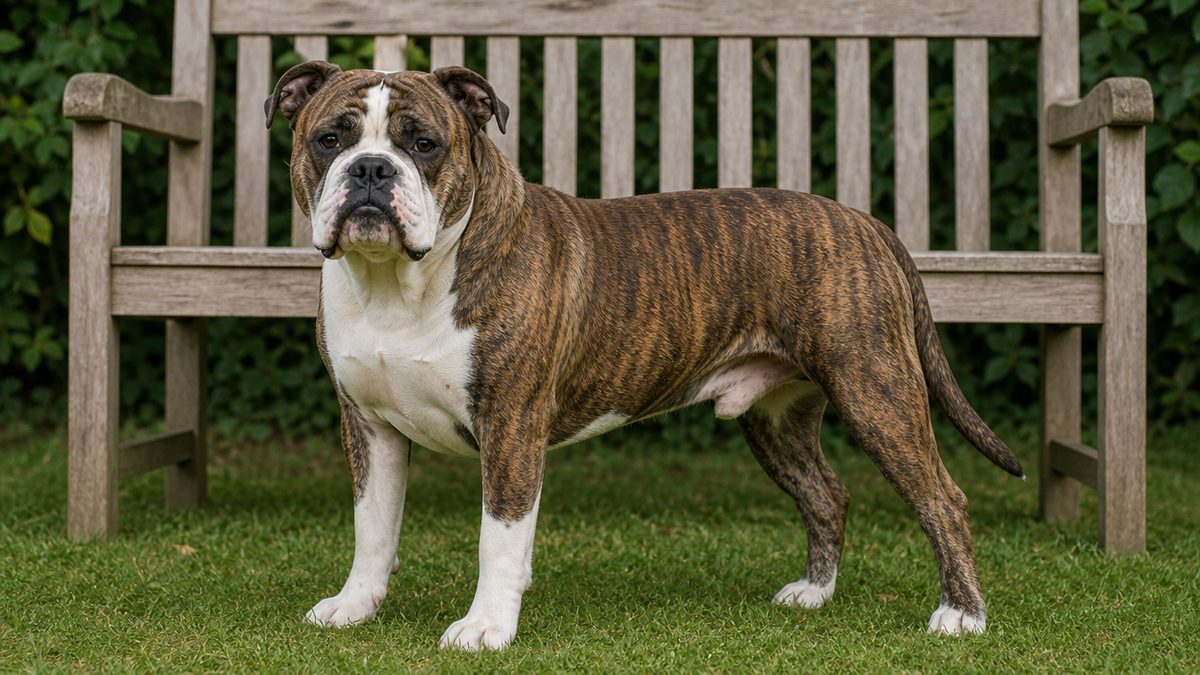
Expect a muscular, medium-sized dog of 17 to 20 inches and 60 to 80 pounds for a male, which is roughly 43 to 51 cm and 27 to 36 kg. Bitches are 16 to 19 inches and 50 to 70 pounds. The UKC describes it as "a muscular, medium sized dog of great strength, and possessed of fluid, agile movement", well balanced and proportioned "while appearing capable of performing without any breathing restrictions in either heat or in cold";.
That last phrase is worth marking, because it recurs. The standard asks for a dog that appears capable of performing without breathing restrictions. It does not ask for a measurement, it does not name a test, and it sets no numerical floor on the muzzle. This page returns to that gap in detail, because it is where the breed's stated aim and its written rules come apart.
The body is slightly rectangular in profile rather than square, with a wide deep chest, a distinct tuck between ribs and hindquarters, a dip behind the withers and a slight roach over the loin. The hind legs appear slightly longer than the forelegs, and the legs are straight and of medium bone. Taken together those describe a genuinely different silhouette from the modern English Bulldog: taller, longer in the leg, less wide, and built to move.
The coat is short, close and of medium density, in brindle or solid colours with or without white. Blue, and black with rust, mahogany or tan trim, are disqualifications, as is albinism. That matters commercially, because rare-colour marketing is how bull-type breeds get priced upward, and in this breed the two colours most often marketed as rare are the two the standard throws out.
Ears are rose, button or tulip, with rose preferred, and the tail is the feature that separates this breed most sharply from its ancestor's descendants. A full tail is preferred, described as a crank or pump handle tail reaching approximately to the hock, and a screw tail, a kinked tail and a natural bob tail are all disqualifications. The screw tail is the English Bulldog's signature and it is associated with vertebral malformation, so writing it out is a real health decision rather than a cosmetic one.
Who created it, from what, and by which method
David Leavitt of Coatesville, Pennsylvania began the project in 1971, and the method he used came from cattle breeding rather than from dogs. He modelled his programme on a livestock line breeding scheme developed by Nathan Fechimer, a professor in the Department of Dairy Science at Ohio State University, in order to reach a dog that would breed true quickly. The UKC's own history names the same scheme and the same institution.
Two independent sources agreeing on the name Fechimer is worth stating, because breed origin stories are where invented detail usually enters. Wikipedia gives the full name and department; the UKC standard, written by the recognising registry, gives "a linebreeding scheme developed by Dr. Fechimer of Ohio State";. Bonbeno found no source naming anybody else, and no source giving a different institution.
The foundation crosses, where the sources disagree
The usual formula is one-half Bulldog, one-sixth American Bulldog, one-sixth Bullmastiff and one-sixth other breeds. That last sixth is where accounts diverge, and Bonbeno prints the disagreement rather than resolving it. Wikipedia, citing Semencic's 1984 *The World of Fighting Dogs*, leaves it as "other breeds". The IOEBA's own history is more specific, stating that the foundation of most of today's Olde English Bulldogges traces back to "English Bulldogs, American Bulldogs, APBTs" and others, naming the American Pit Bull Terrier directly.
| Component | Share | Named by |
|---|---|---|
| Bulldog | One half | Both sources agree |
| American Bulldog | One sixth | Both sources agree |
| Bullmastiff | One sixth | Wikipedia, citing Semencic 1984 |
| American Pit Bull Terrier | Part of the remaining sixth | IOEBA's own history names it. Wikipedia says only other breeds |
Why the ambiguity matters in India specifically. Any account that includes the American Pit Bull Terrier attaches the breed to a name that has been the subject of Indian regulatory attention, and an Indian buyer deserves to know that the breed's own parent registry names that ancestry while the encyclopaedia entry does not. Bonbeno takes no position on which account is complete, because neither source shows its working and the original 1970s breeding records are not public.
The chain of custody, which is unusually well documented
The registry history is traceable year by year, and that is rare for a breed this young. Leavitt formed the Olde English Bulldogge Association to maintain the studbook. In 1993 he stopped breeding and handed the OEBA registry and his own breeding stock to Working Dog Inc, run by Michael Walz of Pennsylvania. The Olde English Bulldogge Kennel Club was formed in 2001, and in 2005 Leavitt was involved in merging the OEBA registry into the OEBKC's.
Leavitt then separated his own line from the breed he had started. In 2004 he named his dogs Leavitt Bulldogs and founded the Leavitt Bulldog Association the following year, specifically to distinguish his line from other breeders' Olde English Bulldogges. The UKC now recognises dogs registered with the Leavitt Bulldog Association, the OEBKC and the Olde Bulldogge Club Europe as Olde English Bulldogges. So the founder's own dogs and the breed named after his project are, formally, two overlapping populations under one UKC heading.
The route into UKC recognition ran through a commercial intermediary. The breed was enrolled with the Canine Developmental Health and Performance Registry, a privately held business in Kalamazoo, Michigan, in August 2008, in order to be evaluated for UKC recognition as a purebred. CDHPR had been working with the UKC under an agreement to develop breeding plans intended to produce improved breeds eligible for UKC registration. The UKC announced recognition in 2013, effective 1 January 2014.
Is the Olde English Bulldogge a breed? Tested against Bonbeno's own rule
The Olde English Bulldogge is a breed on Bonbeno's own two-condition test, and it passes more clearly than most contested dogs this site has assessed. Bonbeno maintains a page for dog types that are not breeds, and the rule that page applies is that a breed has a written standard and a studbook behind it, so a puppy can be measured against a document. This breed has three standards and four registers, and one of the registers belongs to a national kennel club.
Condition one, a written breed standard: passes three times over. The United Kennel Club publishes a full conformation standard with thirteen named disqualifications, revised 2 April 2018. The International Olde English Bulldogge Association publishes a separate standard with its own disqualifying faults. The National Kennel Club publishes a third under the spelling Old English Bulldogge. Three documents is more than most FCI breeds have, and the fact that they disagree with each other is a separate problem this page audits in detail.
Condition two, a studbook: passes. The UKC registers the breed and operates a single-registration route for dogs already registered with the OEBKC, the Leavitt Bulldog Association and the Olde Bulldogge Club Europe. The IOEBA runs its own register with litter registration, single dog registration, kennel name registration, transfer of ownership and purchasable pedigrees. A buyer can hold a puppy against a document and check its parents, which is exactly what the test asks.
| Population | Written standard | Register | Verdict |
|---|---|---|---|
| Olde English Bulldogge | Yes, three | Yes, UKC plus three clubs | Is a breed, clearly |
| Koolie | Yes, club-published | Yes, three Australian bodies | Is a breed, narrowly |
| Old English Bulldog | No, never written | No, never kept | Not a breed. A historical type |
| Halls Heeler | No | No | Not a breed. A historical type |
| Kuchi | No | No | Not a breed |
This is the Koolie case rather than the Halls Heeler case, and by a wider margin. The Koolie passes on club documents alone with no national kennel club agreeing. This breed passes with a national registry, the United Kennel Club, which is the second-oldest all-breed registry in the United States, filing it in a named group with a dated recognition. Its extinct namesake fails both conditions and sits with the Halls Heeler.
Bonbeno's test asks whether a document exists to measure a puppy against. It asks nothing about welfare, and this page is the clearest illustration of why the two must stay separate. The Olde English Bulldogge passes the breed test comfortably and then ranks first of all breeds for hip dysplasia on the OFA register. A verdict of "is a breed" is a statement about paperwork, not an endorsement.
What the breed does not have is FCI or AKC recognition, and both absences were checked with controls. It is absent from the FCI's definitive register under O, where the index runs Ogar Polski, Old English Sheepdog and Otterhound, and under B, where the bulldog family is Boston Terrier, Bouledogue Francais, Buldogue Campeiro, Bull Terrier, Bulldog and Bullmastiff. It is absent from the twenty-one-entry provisional list, which does contain two other modern bulldogs. And it is absent from the American Kennel Club breed index, which carries American Bulldog, Bulldog, Bullmastiff and French Bulldog. Every check had a working control in the same document.
Three standards, one breed, and they contradict each other
Three organisations publish a conformation standard for this dog, and they disagree on size, on the tail, on the ears and on how the muzzle is measured at all. That is not a pedantic observation. A standard is the only thing a buyer can hold a puppy against, and when three documents describe three different animals under nearly the same name, the protection a standard is supposed to give largely evaporates. No page ranking for this term prints them side by side.
| Feature | UKC, the recognition standard | IOEBA | National Kennel Club |
|---|---|---|---|
| Name used | Olde English Bulldogge | Olde English Bulldogge | Old English Bulldogge |
| Male height | 17 to 20 inches | 18 to 20 inches | 17 inches and up, no ceiling |
| Male weight | 60 to 80 pounds | 65 to 85 pounds | 60 pounds and up, no ceiling |
| Female height | 16 to 19 inches | 17 to 19 inches | 16 inches and up, no ceiling |
| Muzzle rule | A ratio: nose to stop not more than one third of nose to occiput | Absolute inches: no longer than 3, no shorter than 1.5 | Not specified in the published text |
| Screw tail | Disqualification | Acceptable | Not specified |
| Docked tail | Acceptable but not preferred | Acceptable | Not specified |
| Pricked ears | Not listed among the accepted rose, button or tulip | Serious fault | Not specified |
| Long coat | Fringe, feather or curl is a fault | Permitted, with preference to short | Not specified |
| Oversize dogs | Balance never sacrificed for size | No penalty if well proportioned | No ceiling exists to exceed |
The screw tail row is the one with a health consequence, and the two standards take opposite positions. The UKC makes a screw tail, a kinked tail and a natural bob tail disqualifications. The IOEBA states that "a pump handle tail that naturally reaches the hock is preferred, screwed short or a docked tails are acceptable";. A screw tail is the visible expression of malformed caudal vertebrae, the trait most associated with the English Bulldog's spinal problems, and it is exactly what a breed created to fix the English Bulldog would want to exclude. One of its two main registries excludes it and the other permits it.
The National Kennel Club standard sets floors with no ceilings: males 60 pounds and up, 17 inches and up. The IOEBA adds that height and weight above the standard carry no penalty as long as the dog is well proportioned. In a breed already ranked first for hip dysplasia, two of the three documents contain no effective upper limit on the load those hips carry. If you are buying, ask the seller which standard the dog was bred to, in writing, and then read that document yourself.
Where all three agree, which is also informative
All three require an undershot bite and a large, broad head, and both detailed standards disqualify a wry jaw. All three describe a friendly, confident temperament, and both detailed standards make aggression or extreme shyness a disqualification. On the things that make the dog look like the historic animal, the documents agree. On the things that would constrain how far the look can be pushed, they diverge.
One more disagreement worth flagging, because it is about the founder's own line. The UKC recognises dogs registered with the Leavitt Bulldog Association as Olde English Bulldogges, yet Leavitt named that line separately in 2004 precisely to distinguish his dogs from other breeders';. A buyer told a puppy is "a Leavitt" is being told something real about its line and nothing at all about which standard it was bred to.
The muzzle rule: a ceiling with no floor, worked out from the standard's own words
The UKC standard caps how long this breed's muzzle may be and never says how short it may get, and that single asymmetry is the most consequential sentence in the document. The clause reads: "Distance from the tip of the nose to the stop does not exceed one-third of the distance from the tip of the nose to the occiput";. Read it carefully. It is a maximum. A dog with almost no muzzle at all satisfies it perfectly.
Convert that into the measure veterinary research actually uses and the position becomes clear. The craniofacial ratio divides muzzle length by cranial length, and it was established as a conformational risk measure for airway disease by Packer and colleagues in 2015. The Cambridge team treats a ratio below 0.3 as extremely brachycephalic and 0.3 to 0.5 as moderately brachycephalic.
The arithmetic, so you can check it
- Call the muzzle M, meaning nose to stop, and the cranium C, meaning stop to occiput. Nose to occiput is then M plus C.
- The standard requires M is not more than one third of (M plus C).
- Multiply out: 3M is not more than M plus C, so 2M is not more than C.
- Divide: M divided by C is not more than 0.5. That is the craniofacial ratio, and 0.5 is its ceiling under this standard.
- The standard sets no lower bound, so any ratio from 0.5 down to nearly zero complies.
So a dog bred exactly to the most generous reading of the UKC standard is, at best, moderately brachycephalic, sitting on the upper boundary of the band the Cambridge team defines. A dog bred to the tightest reading is extremely brachycephalic and still fully compliant. The standard permits the entire brachycephalic range and forbids nothing at the short end.
The Cambridge paper measures cranial length circumferentially, over the curve of the skull rather than in a straight line, while the UKC's clause is a straight nose-to-occiput distance. A circumferential cranial length is longer than a straight one, so a ratio computed the paper's way would come out lower than the 0.5 derived above, not higher. The derivation therefore understates the problem rather than overstating it, and 0.5 should be read as a generous upper bound rather than a precise figure. Bonbeno has not measured a single dog of this breed and does not claim to have.
The other two standards measure it differently, and one of them does set a floor
The IOEBA does set a minimum, and it does it in absolute inches. Its standard makes a muzzle longer than 3 inches a disqualifying fault and states that the muzzle "should be no shorter than 1½"";. That is a genuine floor, and it is the only floor any of the three documents contains. But an absolute measurement applied across a breed spanning 16 to 20 inches at the withers means a small bitch and a large dog are held to the same 1.5 inch minimum, so the constraint tightens or loosens depending on the size of the animal it is applied to. The National Kennel Club's published text specifies no muzzle rule at all.
Compare that with the Swiss project aimed at the same problem. Bonbeno's Continental Bulldog page reports, from FCI standard 369, that a nose ridge under one quarter of head length is a disqualifying fault, which is a floor expressed as a proportion of the dog rather than in inches. Bonbeno has not opened FCI 369 for this page and flags that the comparison rests on the sibling page's reading rather than on a fresh extraction here. The structural point stands either way: one recreation project wrote a minimum muzzle into its standard as a disqualification, and the standard that actually governs UKC registration of this breed wrote a maximum instead.
Health: the breed ranks first of all breeds for hip dysplasia
On the Orthopedic Foundation for Animals hips table, the Olde English Bulldogge is rank 1 of every breed OFA publishes, with 73.3 percent of 318 evaluations dysplastic and only 24.2 percent normal. That places it above the Pug at 72.7 percent and above the English Bulldog at 70.9 percent, which is the breed this one was created to improve on. Against 14.2 percent across all breeds and 1,713,098 evaluations, it is roughly five times the general rate.
| Breed | Rank | Evaluations | Normal % | Dysplastic % | Severe % |
|---|---|---|---|---|---|
| Olde English Bulldogge | 1 | 318 | 24.2 | 73.3 | 7.5 |
| Pug | 2 | 1,282 | 25.7 | 72.7 | 5.1 |
| Bulldog | 3 | 1,660 | 26.9 | 70.9 | 12.0 |
| Brussels Griffon | 4 | 227 | 38.8 | 58.1 | 6.6 |
| Dogue de Bordeaux | 5 | 1,014 | 39.9 | 57.2 | 6.5 |
| Alapaha Bulldog | 6 | 101 | 41.6 | 53.5 | 9.9 |
| American Bulldog | 23 | 2,504 | 61.0 | 34.7 | 2.6 |
| French Bulldog | 25 | 5,157 | 64.9 | 33.1 | 2.3 |
| Labrador Retriever | 121 | 324,852 | 87.5 | 11.3 | 0.8 |
| All breeds | 1,713,098 | 84.3 | 14.2 | 0.8 |
Read the caveats before you read the rank, because they matter and they cut both ways. 318 evaluations is a real dataset, comfortably above OFA's own 100-evaluation threshold for publishing a hip row, but it is a fifth of the Bulldog's 1,660 and a rounding error against the Labrador's 324,852. It is also self-selected: these are dogs whose owners chose to submit radiographs, which can bias a rate up if only worried owners submit, or down if only confident breeders do. Nobody can say which dominates, so this is the best figure available rather than the true breed rate.
The breed rows add up. This breed's normal components, 1.3 excellent plus 14.8 good plus 8.2 fair, give 24.3 against a printed 24.2, and its dysplastic components, 41.2 mild plus 24.5 moderate plus 7.5 severe, give 73.2 against a printed 73.3. Both are rounding, and the same holds for the Bulldog and Pug rows. The ALL BREEDS summary row does not add up: it prints 84.3 percent normal with excellent at 14.6 and good and fair both at 0.0, components that cannot sum to the whole. So the 14.2 percent all-breed comparator should be read as indicative, while the per-breed rows can be used as printed.
Elbows go the other way, and the page prints that too
On elbows the breed genuinely does better than the English Bulldog. It ranks 6th at 35.0 percent abnormal across 214 evaluations, against the Bulldog at rank 2 with 40.2 percent across 1,058. Both sit far above the all-breed 12.0 percent and the Labrador's 9.9 percent, so neither is good in absolute terms, but the direction is the reverse of the hip result. A page that printed only the hips table would be selecting evidence, and a page that printed only the elbows table would be doing the same thing in the other direction.
What the two tables together actually support is narrow and worth stating precisely. On the largest skeletal datasets available, this breed is worse than the English Bulldog on hips and better on elbows, and both breeds are far worse than the general dog population on both. That is the evidenced position. It is not the position either the breed's standards or its sellers describe.
The eye tables, and why neither number should be quoted alone
OFA's eye data for this breed contradicts itself by 28.5 percentage points, and a reader needs both halves. The summary line reports 96.8 percent normal across 63 evaluations. The per-diagnosis detail rows, on the same denominator of 63, record 43 normal, which is 68.3 percent. Bonbeno prints both, shows the arithmetic, and quotes neither as the rate.
| Finding | Affected dogs | Percent |
|---|---|---|
| Normal | 43 | 68.3 |
| Distichiasis | 12 | 19.0 |
| Entropion | 3 | 4.8 |
| Retinal dysplasia, folds | 2 | 3.2 |
| Other, suspected as not inherited | 2 | 3.2 |
| Uveal cyst, single | 1 | 1.6 |
| Persistent pupillary membranes, iris to iris | 1 | 1.6 |
| Persistent pupillary membranes, iris to lens | 1 | 1.6 |
| Retinal dysplasia, geographic | 1 | 1.6 |
The detail rows sum to 66 findings across 63 dogs, which is consistent rather than contradictory, because a single dog can carry more than one diagnosis. What is not consistent is the summary line, which cannot report 96.8 percent normal on a denominator where 20 of 63 dogs carry a recorded abnormality. This gap is a known property of OFA's eye tables across many breeds rather than a peculiarity of this one, and 28.5 points is within the range Bonbeno has documented elsewhere on the site.
Distichiasis at 19.0 percent is the standout: extra eyelashes growing from the meibomian glands and rubbing the cornea. Nearly one in five tested dogs carried it. Entropion at 4.8 percent matters for a different reason: it is named by name in Indian breeding law as a genetic defect that a breeding dog must have been tested for. Both are conditions an ophthalmologist finds in minutes and an owner may never notice until the dog is squinting.
The sample of 63 is small and that limits what can be concluded, but it is the only eye data this breed has, and it is more than the zero it has on airway function. Ask any Indian seller for an ophthalmologist's certificate on both parents naming distichiasis and entropion specifically, rather than a general statement that the eyes are clear.
Two other OFA tables exist for the breed and both look reassuring, with the same caveat about sample size. Patella evaluations record 2.0 percent abnormal across 99 dogs, and basic cardiac records 100.0 percent normal across 50. Fifty cardiac evaluations is a thin dataset and a clean result on it should not be read as a guarantee, only as an absence of an obvious problem in the dogs that were tested.
The breathing claim: nobody has ever measured it
No published study has measured brachycephalic airway function in the Olde English Bulldogge, and Bonbeno checked the obvious place directly rather than assuming. The Cambridge team's February 2026 paper graded 898 dogs across fourteen brachycephalic breeds using the respiratory function grading scheme, and the string Bulldogge appears in it zero times. The breed is not among the fourteen and not among the three it compared against.
The fourteen breeds it did cover were the Affenpinscher, Boston Terrier, Boxer, Cavalier King Charles Spaniel, Chihuahua, Dogue de Bordeaux, Griffon Bruxellois, Japanese Chin, King Charles Spaniel, Maltese, Pekingese, Pomeranian, Shih Tzu and Staffordshire Bull Terrier. The three comparators, the Pug, French Bulldog and Bulldog, came from the earlier whole-body plethysmography work. Seventeen brachycephalic breeds have now been graded, and this one is in neither group.
Being left out of both studies has a practical consequence, not just an academic one. Brachycephalic airway disease is graded in the United Kingdom through a scheme built on the Cambridge work, and a scheme only covers the breeds it has been validated for. An owner of a Pug, a French Bulldog or a Bulldog can have the dog graded against published breed data. An owner of this breed cannot, anywhere in the world, because no baseline distribution exists to grade against.
The IOEBA standard states the Olde English Bulldogge "is devoid of all breathing issues and is capable of enjoying outdoor activity without concern except in extreme heat or cold";. The UKC standard asks for a dog "appearing capable of performing without any breathing restrictions in either heat or in cold";, which is more carefully worded and still describes an appearance rather than a measurement. Neither rests on data, because no data exists. Bonbeno is not asserting the opposite either: the honest position is that the breed's airway is unmeasured, and an unmeasured airway in a short-faced dog is a risk to be managed rather than a problem that has been ruled out.
What is known about the mechanism, and how much it explains
Three factors were significantly correlated with airway disease across the whole 898-dog population: higher body condition score, nostril stenosis, and lower craniofacial ratio. Together they classified 79 percent of dogs correctly, and body condition alone carried an odds ratio of 1.8 with a 95 percent confidence interval of 1.3 to 2.6. Craniofacial ratio on its own accounted for only about 16 percent of the variance in whether a dog made audible upper-airway noise.
That 16 percent figure is the most useful number on this page for a buyer, and it cuts in both directions. It means a short muzzle raises risk without determining the outcome, so this breed's longer muzzle relative to an English Bulldog is a genuine advantage that cannot be assumed to be decisive. It also means you cannot look at a puppy's face and conclude it will breathe well. The paper notes exactly this, observing that some extremely flat-faced breeds, such as the King Charles Spaniel at a mean craniofacial ratio of 0.05, had lower rates of disease than their conformation predicted.
The one thing the standards do get right on the airway is the nostrils. Nostril stenosis was one of the three significant factors, and the UKC standard requires nostrils that are "wide, with a line running vertically between nostrils" and makes slit nostrils a serious fault. That is a written rule against a measured risk factor, and it is the strongest health provision in the document. When you look at a puppy, look up the nose first.
In the absence of a grading scheme for this breed, make your own baseline. Listen to the dog at rest in a quiet room, then walk it briskly for three to five minutes in cool weather and listen again. Record it. The Kennel Club scheme the Cambridge work supports uses a three-minute brisk walk with a stethoscope before and after, and while an owner cannot replicate the grading, an owner can absolutely notice when this year's recording sounds worse than last year's.
Indian law and a breed created on purpose in 1971
Indian breeding law contains a clause that speaks directly to breeds invented this recently, and it is one sentence long. Second Schedule Part II paragraph 6(9) of the Prevention of Cruelty to Animals (Dog Breeding and Marketing) Rules 2017 reads, verbatim from Bonbeno's own extraction of the Animal Welfare Board gazette: "Breeding to create new breeds of dogs or unusual looks shall be strictly prohibited";. This breed is, by its own account, the product of exactly that activity.
Paragraph 6(9) governs breeding conduct in India, not ownership, and not a breed's existence elsewhere. Owning an Olde English Bulldogge in India is not prohibited by it, and this page does not claim otherwise. What the clause plainly does reach is somebody in India running a programme to create a new breed or an unusual look. A 1971 American project is outside Indian jurisdiction; an Indian breeder replicating that project in 2026 is not. Bonbeno states the clause and its scope, and leaves the application to a lawyer.
The second clause bites harder and it is a straightforward buyer test. Paragraph 6(8) reads: "There shall be no tail docking, ear cropping, de-barking, de-clawing, branding, dyeing, injecting substances to enhance visual appeal, performing a surgery or procedure to camouflage or hide any defect or infirmity or any other kind of mutilation of any body part of the pup and any change of appearance by artificial means is strictly forbidden".
The UKC standard says a docked tail is "acceptable, but not preferred", and the IOEBA says docked tails are acceptable Olde English Bulldogge. The UKC adds an explicit note that docking and cropping remain a personal choice in America while acknowledging they are forbidden in some countries, and states that no dog in a UKC event shall be penalised for a full tail or natural ears. That is a registry handling the conflict well. But an Indian buyer reading the standard alone would come away thinking a docked tail is normal, and in India a docked dog has been altered in breach of 6(8).
The undershot jaw collision
Both standards require an undershot bite, and Indian law names the undershot jaw as a genetic defect requiring a test. Paragraph 8(10) of Part III requires that breeding dogs "shall have been tested for genetic defects, including hip dysplasia, progressive retinal atrophy, night blindness, hypothyroidism, entropion, ectropion, overshot, undershot jaw (when incisors do not touch or mesh), wry mouth, two or more missing teeth, unilateral cryptorchid or full cryptorchid males". The UKC requires that the bite "is undershot or reverse scissors";, and the IOEBA makes a scissor or even bite a disqualifying fault.
Three of the defects named in that one clause are documented in this breed. Hip dysplasia is the first item and this breed ranks first of all breeds for it. Entropion is named and appears in 3 of 63 tested dogs. The undershot jaw is named and is mandatory under both standards. The word "including"; makes the list illustrative rather than closed, so a defect being absent from it does not put it outside the requirement.
Two absences in the Rules, checked and confirmed
There is no patella-testing requirement and no dental requirement anywhere in the Rules. Bonbeno searched the full gazette text and confirmed both absences, and the only dentition hook is the "two or more missing teeth" phrase inside 8(10) itself. That matters here because the breed's OFA patella row looks good at 2.0 percent abnormal across 99 dogs, and an Indian buyer might reasonably assume Indian law requires that test. It does not. Rule 8(1)(a), in the main body of the Rules rather than the Schedule, does require that pups under eight weeks are not sold, and that is the clearest single legal test to apply to any Indian seller.
Olde English Bulldogge price in India: no page prints one
No Indian page Bonbeno opened prints a rupee figure for this breed, and that absence was established by opening the pages rather than by reading a search snippet. The largest Indian listing site maintains a dedicated Olde English Bulldogge page and quotes no price anywhere on it. Every price on that page sits behind a View Price link that leads to a sign-up form. There is no published Indian market rate for this breed to report, and Bonbeno will not manufacture one.
What that page contains instead is worth describing exactly. It prints "3 Result Found", promises "healthy, purebred KCI-certified Olde English Bulldogge Puppies in India" and "verified Olde English Bulldogge dog breeders near you", and then displays three animals under a heading reading Similar breeds at other locations: a Cavalier King Charles Spaniel in Chennai, a Newfoundland in Jaipur and a French Bulldog in Chennai. Not one is a bulldogge of any kind, and one of the three is not even a bull-type dog.
India is an FCI member, which means the Kennel Club of India issues pedigrees against FCI nomenclature. This breed appears nowhere in the FCI's definitive register: not under O, where the index runs Ogar Polski, Old English Sheepdog and Otterhound, and not under B, where the bulldog family is Boston Terrier, Bouledogue Francais, Buldogue Campeiro, Bull Terrier, Bulldog and Bullmastiff. It is not on the twenty-one-entry provisional list either, which does carry the Continental Bulldog and the Buldogue Campeiro. There is no FCI nomenclature slot for this breed, so there is no KCI pedigree that could certify one. If a seller offers you KCI papers for an Olde English Bulldogge, that is the end of the conversation.
What you will actually be sold under this name
In practice an Indian search for this breed converges on the English Bulldog, and its published Indian prices disagree by a factor of twelve. BARF India gives Rs 25,000 to Rs 80,000. Mr n Mrs Pet gives INR 1,20,000 to INR 3,00,000+. The floor of the second band sits fifty percent above the ceiling of the first, and both pages rank for Indian bulldog queries.
| Source and band | At 84.38 | At 74 | At flat 80 | Verdict |
|---|---|---|---|---|
| Mr n Mrs Pet, Rs 1,20,000 | 1,422.13 | 1,621.62 | 1,500 exactly | Only the weak test matches, quotient plausible |
| Mr n Mrs Pet, Rs 2,00,000 | 2,370.23 | 2,702.70 | 2,500 exactly | Same pattern |
| Mr n Mrs Pet, Rs 3,00,000 | 3,555.35 | 4,054.05 | 3,750 exactly | Same pattern |
| BARF India, Rs 25,000 | 296.28 | 337.84 | 312.50 | No plausible quotient. Reads as rupee-native |
| BARF India, Rs 80,000 | 948.09 | 1,081.08 | 1,000 | Mixed. One plausible quotient out of three |
Bonbeno reports that as suggestive and unproven. The higher band fails the strong 84.38 test and the 74 test, and matches only at a flat 80, where the quotients 1,500, 2,500 and 3,750 are prices a US seller would plausibly print. But the 80 test is structurally weak, because figures ending in three zeros divide cleanly at 80 by construction. Bonbeno does not assert that this band is a converted dollar list. It records that it behaves like one and that the evidence falls short.
Mr n Mrs Pet prints an identical INR 1,20,000 to INR 3,00,000 band for Hyderabad, Bangalore, Delhi, Chennai, Lucknow, Mumbai, Jaipur and Pune. Eight cities, different rents, different vet costs, different breeder densities, one number. Treat a city-invariant price as a content template rather than as an observation of what dogs sell for anywhere in particular.
Bonbeno reports no breed price, and that is the correct outcome rather than a gap. Inventing an Indian figure for a breed with no Indian listings, or converting an American one into rupees, is exactly the fabrication this site exists to catch other people doing.
What one actually costs to keep in India, per month
Budget Rs 5,000 to Rs 13,000 a month for a 27 to 36 kg short-faced dog in an Indian metro, and treat the first year as the expensive one. No purchase price can be quoted, but running costs are real, published and checkable, and they are the figures that decide whether an owner copes. This section uses Indian sources throughout.
Vaccination is the one line with published Indian per-dose figures. Heads Up For Tails prints a summary table giving DHPP at 800 INR per dose, rabies at 350, leptospirosis at 150, Bordetella at 200, canine influenza at 800 and Lyme at 700. Its puppy schedule runs seven appointments between day 30 and day 120, which is where the first-year spike sits.
The article's body text gives kennel cough at 600 INR where its own summary table gives Bordetella at 200, and gives influenza at 220 in the body against 800 in the table. Two of six line items disagree with themselves on one page, by factors of three and 3.6. Bonbeno prints the table figures above and names the discrepancy rather than silently picking the convenient one. The practical lesson is to get a written quote from your own clinic rather than budgeting from any single published figure.
| Line item | Typical monthly cost | Why it is what it is |
|---|---|---|
| Food | Rs 3,000 to Rs 6,000 | Scales with weight. A lean dog costs less to feed and much less to treat |
| Routine vet and preventives | Rs 900 to Rs 2,000 | Deworming, tick and flea control, one consultation |
| Vaccination, spread over the year | Rs 250 to Rs 500 | Built from the per-dose table above |
| Fold, face and skin consumables | Rs 300 to Rs 700 | Less than an English Bulldog, more than a smooth-faced dog |
| Grooming and nails | Rs 400 to Rs 1,200 | Trivial coat, real nail work on a heavy dog kept on tile |
| Cooling attributable to the dog | Rs 900 to Rs 2,800 | The line nobody budgets and the one that decides survival in May |
| Orthopaedic and airway contingency | Rs 1,500 to Rs 3,000 | Set aside monthly. This breed leads the OFA hip table |
The contingency row is larger here than on Bonbeno's other bull-breed pages, and the hip table is why. A dog drawn from a population where 73.3 percent of tested animals were dysplastic is materially more likely than average to need orthopaedic assessment, pain management or surgery in its lifetime. Bonbeno found no verifiable published Indian surgical pricing for hip procedures and therefore quotes none, but an owner who has not thought about the possibility is an owner who will be making the decision under financial pressure.
Adoption removes the purchase price and changes none of these lines. That is worth holding on to. The gap between a cheap dog and an expensive one is a single payment. The gap between a short-faced dog and a full-muzzled one is every May and June for the next decade, plus a screening burden that begins before you buy and never really ends.
Heat tolerance: Pennsylvania is 16 C cooler than Chennai
Bonbeno rates this breed 1 of 5 for heat tolerance, and states plainly that the rating is an inference rather than a measurement, because no heat study has ever included it. NASA POWER's cell covering Coatesville, Pennsylvania, where the breed was created, returns an annual mean 2 m temperature of 11.84 C at a reported cell elevation of 105.27 m. The Chennai cell returns 27.95 C at 48.95 m. That is a gap of 16.11 C in annual mean.
| Place | Cell elevation vs real | Annual mean | Hottest month maximum | Annual mean humidity |
|---|---|---|---|---|
| Coatesville, Pennsylvania | 105.27 m vs about 168 m, -63 m | 11.84 C | 40.39 C in July | 78.49 percent |
| Birmingham, England | 103.17 m vs about 140 m, -37 m | 9.56 C | 31.97 C in July | 86.74 percent |
| Chennai | 48.95 m vs about 6 m, +43 m | 27.95 C | 42.70 C in May | 72.39 percent |
| Delhi | 206.37 m vs about 216 m, -10 m | 25.60 C | 48.79 C in June | 45.56 percent |
| Mumbai | 97.15 m vs about 14 m, +83 m | 26.77 C | 44.91 C in April | 67.39 percent |
| Kolkata | 7.35 m vs about 9 m, -2 m | 25.81 C | 46.81 C in May | 73.93 percent |
| Hyderabad | 494.59 m vs about 542 m, -47 m | 26.10 C | 45.00 C in May | 60.30 percent |
| Bengaluru | 841.72 m vs about 920 m, -78 m | 23.74 C | 40.38 C in April | 67.94 percent |
NASA POWER returns a grid cell, not a point, and in hilly terrain a cell's mean elevation can miss the town under it by more than a kilometre, which would corrupt any temperature taken from it. Every point above is a lowland or plateau location and every elevation error is under 100 m, the largest being Mumbai at +83 m. The homeland point was checked the same way, because a wrong origin baseline breaks a comparison just as badly as a wrong Indian one. None of these cells needed a lapse-rate correction.
The Coatesville figure has a wrinkle worth noticing
Coatesville's July maximum of 40.39 C is only 2.31 C below Chennai's May maximum of 42.70 C, which looks like an argument that the breed's homeland gets nearly as hot as India. It is not, and the annual mean explains why. Pennsylvania reaches 40 C briefly and then falls to a February minimum of −21.91 C. Chennai never falls below a January mean minimum of 17.24 C. A dog bred in a place with a real winter is a dog whose lineage has never been selected for continuous heat, and a peak temperature that lasts a fortnight is a different problem from an annual mean 16 C higher.
Every dog in this family is heat-sensitive, and India's humid coast is harder on them than its dry north. A humid 35 C afternoon in Chennai at 72.39 percent annual mean humidity, or Kolkata at 73.93 percent, loads a short-faced dog more than a hotter, drier Delhi afternoon at 45.56 percent, because cooling depends on evaporation from the tongue and airway and saturated air will not accept the moisture.
On the mechanism, the UK primary-care data is the best evidence available. Hall and colleagues found that exertional heat-related illness was the predominant trigger, at 652 of the 879 events with a recorded trigger, or 74.2 percent, against 12.9 percent environmental and 5.2 percent from vehicular confinement. The companion paper, on the same cohort with a narrower case definition and 395 confirmed events, gives a case fatality of 14.18 percent. Those are two different papers and are frequently conflated; Bonbeno names which is which and transfers no odds ratio onto this breed, because it appears in neither model.
Temperament: the part of the project that clearly worked
The temperament aim was the clearest success of this breeding project, and both standards say so in enforceable language. The UKC calls the disposition "confident, friendly and alert", requires an animated and expressive dog in and out of the ring, makes shyness in a mature dog a fault, and makes viciousness or extreme shyness a disqualification. The IOEBA calls it outgoing and happy and makes unprovoked human aggression a disqualifying fault.
Two registries independently writing aggression out of a breed descended from a baiting dog is a meaningful signal. A disqualification is not advice; it removes the dog from competition and, in practice, from a serious breeding programme. Compare that with what the ancestor was selected for. The 1833 description of the bull baiting dog calls it "the most ferocious and unrelenting of the canine tribe" and records that going for a bull's legs rather than its head was treated as evidence of impure breeding. The stated goal in 1971 was the historic look with a much less aggressive temperament, and the standards were written to enforce exactly that.
Expect a people-focused, affectionate, low-drive companion dog that wants to be in the room with you. The IOEBA describes a watchful nature at home while disqualifying aggression toward people, which is the profile of a dog that notices a stranger and then does nothing about it. That is a good fit for an Indian flat with regular deliveries, provided the socialisation work is done early.
Who should not get one
- Anyone who cannot keep one room genuinely cool from March to June every year, because that is not a comfort question for this dog.
- Anyone buying it as a guard dog. Both standards disqualify the temperament that would make it one, and a 30 kg dog that greets everybody is a liability dressed as security.
- Anyone who wants a running or hiking partner. The airway is unmeasured and the conformation is brachycephalic, and Indian heat removes the margin for error entirely.
- Anyone who needs a predictable adult size, because the three standards disagree and two of them contain no upper limit at all.
- First-time owners on a tight budget, given a screening burden that starts before purchase and an orthopaedic risk profile that leads the OFA table.
The one behavioural caution that is real is stubbornness rather than aggression. These are dogs that understand a request and decline it, which is a training problem and not a temperament problem. It is also easily confused, in an Indian summer, with a dog that has simply stopped being able to cope with the heat, and that confusion is dangerous. A dog that refuses on a cool morning is being stubborn. A dog that refuses at 3 pm in May is telling you something else.
Training: short sessions, cool hours, food payment
To train this breed successfully in India, run short sessions in the cool hours, pay in food weighed out of the daily ration, and stop on any change in breathing rather than on any sign of tiredness. The breed is genuinely trainable, which both standards imply and every owner account confirms, and the limiting factor in India is temperature rather than temperament.
Five things that work, in order
- Split into five-minute blocks. Three short blocks across a day beat one twenty-minute block, and they let you stop before the dog overheats rather than after.
- Pay in food taken out of the meal, never added to it. Body condition carried an odds ratio of 1.8 for airway disease across the fourteen-breed study population, so treat calories as a health variable.
- Teach a settle on a mat first. A dog that can be sent to a cool spot on cue is a dog you can manage through an Indian afternoon.
- Build face-handling tolerance from week one. Fold checks, eye checks and, in this breed particularly, distichiasis monitoring happen for life, and a 30 kg dog that objects is a genuine problem.
- Socialise deliberately to lifts, stairwells, watchmen and delivery riders, which are the Indian apartment realities that decide whether a friendly standard produces a friendly adult.
Use a well-fitted harness rather than a collar for lead work. A dog that pulls into a collar compresses an airway that may already be compromised, and in a breed whose airway has never been measured there is no reason to take that risk for convenience. This is not a training preference; it is the same logic as the nostril requirement in the standard.
Stop the moment the breathing sound changes, not when the dog stops working. A short-faced dog making a new noise at rest, or showing blue or grey gums, is not tired, and continuing turns a training session into a veterinary emergency. Exertional heat illness was the predominant trigger in the UK data at 74.2 percent of events with a recorded cause, which means the commonest route into trouble is an owner doing something with the dog.
Realistic timelines. Expect a reliable sit and a settle within two to three weeks of daily short sessions, house training broadly solid by four to five months, and recall to take considerably longer, because a companion breed has less intrinsic reason to return at speed than a working one. None of that is unusual. What is specific to India is that from March to June you will be training indoors, and planning for that in advance beats discovering it in April.
Exercise: built to look athletic, limited by an unmeasured airway
Give this breed two short walks a day, timed for the cool hours, and treat the marketing about athleticism as a description of its shape rather than a licence for its workload. The UKC standard describes fluid, agile movement and a dog capable of performing without breathing restriction, and no study has ever tested whether the population delivers that. In India, the gap between the claim and the evidence is where dogs get hurt.
| Season | Morning | Evening | Hard limit |
|---|---|---|---|
| Winter, December to February | 25 to 35 minutes | 25 to 35 minutes | The only season with real headroom |
| Pre-monsoon heat, March to June | 15 to 20 minutes before 7 am | 15 to 20 minutes after 8 pm | Nothing at all between 10 am and 6 pm |
| Monsoon, June to September | 15 to 25 minutes | 15 to 25 minutes | Humidity sets the limit, not temperature. Dry the folds after every wet walk |
| Post-monsoon, October to November | 20 to 30 minutes | 20 to 30 minutes | The most forgiving window in most Indian cities |
Do not bank a missed morning walk into a longer evening one. Capacity here is set by an airway nobody has graded, not by a daily minutes target, and two moderate outings are safer than one long one in every season. When outdoor exercise is genuinely unsafe for a week, substitute scent games and short training sessions in a cooled room, which tire a dog mentally without loading the airway.
Higher body condition score was one of only three factors significantly correlated with airway disease across the whole 898-dog population, at an odds ratio of 1.8 with a 95 percent confidence interval of 1.3 to 2.6, and Hall's model found raised odds of heat illness for dogs at or above their breed and sex mean bodyweight. Weight is the lever with evidence behind it. Running a heavy short-faced dog harder in an Indian summer is the single most dangerous response available, and it is the commonest one.
Weight matters twice over in this breed, because of the hips. A dog carrying extra kilograms on a skeleton drawn from a population where 73.3 percent of tested animals were dysplastic is loading joints that are already the worst-scoring in OFA's table. Keeping the dog lean is simultaneously the airway intervention, the heat intervention and the orthopaedic intervention, which is unusual and worth exploiting.
A practical test for whether a walk was too much: the dog should stop panting within about ten minutes of coming into a cool room and settling. Still working at fifteen means the walk was too long, too fast or too warm. Still working at thirty is a veterinary call.
Grooming: a five-minute coat and a face that needs drying daily
To groom this breed in India, brush the coat weekly and clean and then thoroughly dry every facial fold daily. The coat is close to no work: short, close and of medium density, with fringe, feather or curl treated as a fault. The face is the job, and Indian monsoon humidity is what makes it a job rather than a nicety.
This breed is less wrinkled than an English Bulldog and that is deliberate. The UKC standard makes excessive wrinkle a serious fault, which is a real welfare provision and one of the clearest ways the recreation differs from the breed it was modelled against. Less wrinkled is not wrinkle-free, though, and the IOEBA standard still describes a muzzle with moderate wrinkling.
The daily routine, about four minutes
- Open each fold and look at the skin before touching it. A red or weeping fold needs a vet, not a wipe.
- Clean with a plain damp cloth or a vet-recommended wipe, avoiding anything perfumed, because fragrance inside a closed fold is an irritant.
- Dry completely with a dry cloth or a cool hairdryer on the lowest setting held well back. This is the step that decides whether the routine works.
- Check the nose area, the lip folds, the tail set and the vulval or prepuce fold, which owners routinely miss.
- Look at the eyes while you are there, because distichiasis appeared in 12 of 63 tested dogs and squinting or excess tearing is the first sign.
Breed-club grooming guidance written for a temperate climate routinely says to wipe the folds and let them air dry. At Chennai's 72.39 percent or Kolkata's 73.93 percent annual mean humidity, a wiped fold does not air dry, and you have added moisture to a warm enclosed space without removing it. Drying is the step, not the wiping, and through the monsoon do it twice daily rather than once.
Never shave the coat to keep the dog cool. A short close coat is a barrier against solar radiation as well as an insulator, and removing it in an Indian summer exposes skin to direct sun and leaves the dog hotter. If a groomer offers a summer clip, decline it.
Nails, ears and teeth complete the list. A heavy dog kept on tile and lift floors does not wear its nails down, so plan a trim every three to four weeks. Look at ears weekly and clean only when they need it. And note that Indian law prompts you toward none of this: Bonbeno searched the full 2017 Rules and confirmed there is no dental requirement and no patella requirement anywhere in them. That absence is a reason to plan the work yourself, not a reason to skip it.
Feeding: the one lever with a published odds ratio attached
Feed two measured meals a day, weigh the food rather than scooping it, and keep the dog visibly lean. In this breed that is not general advice, it is the intervention that acts on the airway, the heat risk and the hips simultaneously, and it is the only one an owner controls completely.
The evidence is direct and comes from two independent datasets. Higher body condition score was one of only three factors significantly correlated with airway disease across the 898-dog fourteen-breed population, at an odds ratio of 1.8. Separately, Hall's model found raised odds of heat-related illness for dogs at or above the mean bodyweight for their breed and sex. Two studies, two different outcomes, one direction.
| Stage | Meals per day | What matters most |
|---|---|---|
| 8 to 16 weeks | 4 | Small frequent meals. Never free-feed, and never push growth |
| 4 to 6 months | 3 | Slow steady growth. Rapid growth loads developing joints in the breed that leads the OFA hip table |
| 6 to 12 months | 2 to 3 | Transition to adult food on your vet's timing, not a bag's |
| 1 to 7 years | 2 | Weigh the ration. Treats come out of it, never on top |
| 7 years and older | 2 | Cut calories before the dog gains, and watch for the first summer where recovery takes longer |
Run your palms flat down the dog's sides. You should feel the ribs easily under a thin layer without pressing. From above, a waist behind the ribs. From the side, a belly that tucks up, which the UKC standard asks for as a distinct tuck between ribs and hindquarters. If you have to press to find ribs, the dog is carrying weight it cannot afford, and in this breed that is a breathing problem, a heat problem and a joint problem at once.
Growth rate is the first-year priority. Nobody can promise that controlled growth prevents dysplasia in an individual dog, but pushing a heavy-boned puppy from the worst-scoring breed in the hip table to grow fast is the clearest thing an owner can do wrong. Feed to a lean condition through the whole first year and accept an extra two months of filling out.
Feed around the heat, not through it. In Indian summer move the morning meal earlier and the evening meal later so the dog is not digesting through the hottest hours, and avoid exercise for an hour either side of a meal, which is standard advice for a deep-chested dog and costs nothing to follow. On brands, portion control beats product choice every time, and any feeding claim on a seller's page should be checked with your own vet, because those are the same pages printing one price for eight cities.
Month by month through the first year
Plan the first year around two calendars: the vaccination schedule and the month the puppy will be four to eight months old in. A puppy hitting its growth spurt in a Chennai May needs a different plan from one hitting it in a Delhi December, and no overseas breed guide will tell you that.
| Age | Health milestone | The Indian task nobody mentions |
|---|---|---|
| Day 30 to 45 | Puppy DP, then DHPPIL | Still with the litter. Rule 8(1)(a) bars sale below eight weeks |
| 8 to 10 weeks | Home. Deworming continues | Set up one cool room now, and decide where the dog sleeps in May before May |
| Day 60 to 75 | Canine corona, DHPPIL booster | Begin daily fold and face handling so it is boring by the time it matters |
| Day 90 | Anti-rabies, about 350 INR per dose | First socialisation outings, cool hours only |
| 4 to 5 months | Adult teeth arriving | Weigh monthly. This is where overfeeding starts and it never shows as a problem until later |
| Day 120 | Kennel cough and rabies booster | First full summer if winter-born. Halve outdoor time and do not negotiate |
| 6 to 9 months | Growth slowing, neutering discussion | Ask your vet about timing relative to joint maturity, not just convenience |
| 9 to 12 months | Adult food transition | Record the adult breathing sound at rest and after a short cool-weather walk |
| 12 months | Annual boosters begin | Get hip and elbow assessment discussed with your vet, and file the parents' reports |
Two of those rows carry more weight than the rest. The eight-week rule is Indian law: Rule 8(1)(a) requires that pups less than eight weeks in age are not sold, and it sits in the main body of the Rules rather than the Second Schedule. It is the single clearest legal test a buyer can apply to a seller, and it is checkable on the doorstep.
The breathing baseline at nine to twelve months is the one specific to this breed. No respiratory grading scheme covers the Olde English Bulldogge, so an owner's own recording is the only baseline that will ever exist for that dog. Record it at rest and after a brisk five-minute walk in cool weather, keep the file, and repeat it every year. Airway disease progresses, and the commonest reason it is caught late is that nobody remembers what normal sounded like.
A puppy that is four to seven months old during an Indian April to June is in the worst combination available: high growth, high energy, low judgement and an airway still developing. This is the window where owners over-exercise a keen puppy and it goes wrong. Halve outdoor time through those months and add indoor mental work instead. A restless puppy is a solvable problem.
On growth, slow is the whole instruction. This breed leads OFA's hip table, and while nobody can promise controlled growth prevents dysplasia in any individual, pushing a heavy-boned puppy to grow fast is unambiguously the wrong direction. Feed to a lean body condition for the whole first year.
Head to head against the breeds it is cross-shopped with
An Indian buyer looking at this breed is usually choosing between four bull-type dogs, and the useful comparison is not on looks. It is on whether the breed can be bought here, what its skeleton scores, and whether anybody has measured its airway. On that basis the table below is uncomfortable reading for the breed this page is about.
| Olde English Bulldogge | Bulldog | American Bulldog | Staffordshire Bull Terrier | |
|---|---|---|---|---|
| Obtainable in India | No verified listing found | Yes, widely | Yes | Yes |
| Published Indian price | None printed on any page found | Rs 25,000 to Rs 3,00,000+ across sources | Listed | Listed |
| FCI recognition | None | Yes, standard 149 | None | Yes |
| AKC recognition | None | Yes | None | Yes |
| OFA hips, dysplastic | 73.3 percent of 318, rank 1 | 70.9 percent of 1,660, rank 3 | 34.7 percent of 2,504, rank 23 | Not compared here |
| OFA elbows, abnormal | 35.0 percent of 214, rank 6 | 40.2 percent of 1,058, rank 2 | 19.8 percent of 783, rank 22 | Not compared here |
| Airway ever graded in a study | No | Yes, via plethysmography | No | Yes, 120 dogs |
| Published lifespan from a cohort | None. Only a club's 10 to 14 year claim | Yes, from UK life tables | None found | Yes |
| PubMed records for the name | Zero | 162 for English Bulldog | Not counted here | Not counted here |
| Bonbeno heat tolerance | 1 of 5, inferred | 1 of 5 | Not rated here | 3 of 5 |
The American Bulldog row is the one that should stop a buyer. It is one of this breed's own named foundation crosses, and it sits at 34.7 percent dysplastic against this breed's 73.3 percent, on a sample eight times larger. Whatever the 1971 programme selected for, it did not carry the American Bulldog's hips forward.
On lifespan the asymmetry is stark. The English Bulldog has a life expectancy derived from UK national life tables built on primary-care records and a place in the largest UK longevity study. This breed has neither. The 10 to 14 year figure repeated across the internet comes from the IOEBA standard, which is a breed club's claim about its own breed. Bonbeno reports it as exactly that and attaches no confidence to it.
Bonbeno's Continental Bulldog page states that 10.9 percent of English Bulldogs grade BOAS-free, citing the Cambridge fourteen-breed study, and that figure is correct. An earlier revision of this page called it an error, so the reason it looks like one is worth printing. The paper's abstract reports that the Pekingese and Japanese Chin had the highest rates of disease, with only 10.9 percent and 17.4 percent being Grade 0, so the same percentage appears twice in one paper for two different breeds. The Bulldog is not one of the fourteen breeds graded. Its number is one of three comparators the results section carries in from the earlier plethysmography work and prints as Pugs 7 percent, French Bulldogs 10 percent and Bulldogs 10.9 percent. An identical percentage for two breeds in two different studies is a coincidence, not a conflation.
The literature column deserves one line of working, because a zero is a strong claim. The exact phrase for this breed returns zero PubMed records in title or abstract, and so does the single word Bulldogge. Two controls passed in the same session: the phrase English Bulldog returned 162 records, and a bulldog-plus-brachycephalic search returned 115. So the absence is a property of the breed's literature, not of a broken search.
The mistakes buyers and writers make with this breed
Six errors account for most of what is wrong on pages about this breed, and an Indian buyer can avoid all six in about fifteen minutes. They are ordered by how much they cost.
- Believing the healthier bulldog claim without checking a register. On OFA hips this breed ranks first of all breeds at 73.3 percent dysplastic, above the English Bulldog it was created to improve on at 70.9.
- Repeating "devoid of all breathing issues" as a finding. It is a sentence in a breed standard, and no airway study has ever included the breed.
- Accepting a KCI pedigree claim. India is an FCI member and the breed has no FCI nomenclature slot, so the certificate being offered cannot exist.
- Assuming one standard governs. Three exist, they disagree on size, tail, ears and muzzle measurement, and two of them set no upper size limit at all.
- Confusing it with the extinct Old English Bulldog. One letter and one e apart, about 140 years and an ocean between the animals.
- Quoting the 10 to 14 year lifespan as data. It is a breed club's claim and no cohort study has ever produced a figure for this breed.
Three mistakes specific to India
Buying in November and meeting May unprepared. Indian bull-breed purchases cluster in the cool months, when a short-faced puppy looks entirely comfortable. The real test arrives five or six months later, in a Chennai May at 42.70 C or a Delhi June at 48.79 C. Decide before you buy whether you can keep one room cool for four months a year, every year, for a decade.
Treating the fold routine as grooming rather than medicine. In Indian monsoon humidity a damp fold becomes a clinical problem within days, and the overseas instruction to wipe and let it air dry does not work at 72 to 74 percent annual mean humidity.
Four India-located searches for this breed's name were substituted at HTTP 200 with correct page titles and plausible result counts: the plain breed name returned ten golf-course pages under "About 50 results";, a price query returned Mexico City restaurant listings, and a health query returned Spanish-language cold-room insulation pages. A Labrador control in the same session returned genuine Indian pages, so the engine was working and the breed queries were the problem. If your own search for this breed looks strange, it is not just you.
The fifteen-minute check before you pay anybody. Ask three questions in writing: which breed exactly, spelled out; which registry issued the pedigree, named; and what screening the parents have, with the reports attached rather than described. Then open that registry's own breed list and look for the breed yourself, and read the standard it publishes. Commercial breed profiles are a starting point rather than an authority, including well-known ones.
Adoption and responsible sourcing
Adopt rather than buy where you can, and where you cannot, verify three documents before any money moves. This breed has no verified Indian supply route, so an Indian reader wanting one is either importing, buying something mislabelled, or choosing a different dog. All three deserve honest treatment.
If you want this specific breed
Accept that no verified Indian source was found, and treat any Indian listing with suspicion until it survives the checks. The one dedicated Indian page Bonbeno opened offered three dogs, none of which was a bulldogge, and claimed a KCI certification that cannot exist. That is not a reason to conclude the breed is absent from India altogether; it is a reason to insist that a seller prove which registry issued the papers and to check that registry's own list before believing it.
If you want a healthier bull-type dog
The Staffordshire Bull Terrier has the best published airway evidence of any bull breed, with 120 dogs assessed in the Cambridge study, at least half grading free of respiratory signs and at least 75 percent clinically unaffected. It is obtainable in India and Bonbeno rates it 3 of 5 for heat rather than 1. If the appeal of this breed is the athletic bull-type dog rather than the specific head, that is the evidence-backed answer.
If you want a hardy dog for Indian conditions
Adopt an Indian pariah dog. It costs nothing, it is available in every Indian city today, it has a full-length muzzle, it carries no screening backlog, and it evolved in the climate you will keep it in. On every measure used on this page it is the better answer, and the only reason it is not the obvious one is that nobody advertises it.
You can hear an adult breathe before you commit. Sit with the dog, listen at rest, walk it five minutes in cool weather and listen again. In a breed with no grading scheme and no published airway data, that five-minute test tells you more than any pedigree. Bull-type dogs reach Indian shelters regularly, often surrendered by owners who underestimated the heat or the cost, which are precisely the two things this page has been about.
Whatever you choose, apply the law as buyer information. Refuse any pup under eight weeks under Rule 8(1)(a). Refuse a cropped or docked dog, because Second Schedule Part II paragraph 6(8) forbids tail docking, ear cropping, de-barking, de-clawing and "any change of appearance by artificial means", and a seller willing to breach that has told you something about the rest of their practice. And know that paragraph 6(9) prohibits breeding to create new breeds of dogs or unusual looks in India, which is worth understanding before commissioning anybody to produce a novel bulldog here.
One last note on the outcross argument, because it is the breed's strongest card and it is routinely overstated. A 2016 genetic assessment found the English Bulldog too inbred to be returned to health from within, and the researchers named this breed as "a viable candidate" for the infusion of new bloodlines. That is a proposal to use this breed as breeding stock to repair another one, made on genetic-diversity grounds. It is not a finding that this breed is healthy, and the hip table is the reason the distinction matters.
Olde English Bulldogge questions, answered from the registers
Is the Olde English Bulldogge a healthy breed?
Not on the one large dataset that exists. On the Orthopedic Foundation for Animals hips table it ranks first of all breeds at 73.3 percent dysplastic across 318 evaluations, above the Pug at 72.7 percent and the English Bulldog at 70.9 percent, against 14.2 percent across all breeds. On elbows it does better than the Bulldog, at 35.0 percent abnormal against 40.2.
Does the Olde English Bulldogge have breathing problems?
Nobody knows, and that is the honest answer. No published study has measured airway function in this breed. The Cambridge study of February 2026 graded 898 dogs across fourteen brachycephalic breeds and this one is not among them, nor among the three it compared against. The word Bulldogge appears zero times in that paper.
Is the Olde English Bulldogge a real breed?
Yes, on Bonbeno's two-condition test, and it passes clearly. Three organisations publish a written conformation standard for it and four run registers, including the United Kennel Club, which recognised it on 1 January 2014 and files it in the Guardian Dog Group. No FCI member country recognises it, which is a different and narrower question.
How much do Olde English Bulldogs cost?
No Indian page Bonbeno opened prints a rupee figure for this breed. The largest Indian listing site's page for it shows three animals, a Cavalier King Charles Spaniel, a Newfoundland and a French Bulldog, and quotes no price at all. Every price on that page sits behind a sign-up form.
Is the Olde English Bulldogge the same as the Old English Bulldog?
No. The Old English Bulldog is the extinct English bull baiting dog, gone since roughly the mid-nineteenth century. The Olde English Bulldogge is a living American breed begun in 1971 to recreate its appearance. One letter and one e separate the names, and about 140 years separate the animals.
Is the Olde English Bulldogge recognised by the AKC or the FCI?
No to both. It is absent from the American Kennel Club breed index, which lists American Bulldog, Bulldog, Bullmastiff and French Bulldog. It is absent from the FCI definitive register under both O and B and from the 21-entry provisional list. Only the United Kennel Club and three breed clubs recognise it.
Can you get a KCI registered Olde English Bulldogge in India?
No, and any listing offering one is describing something that cannot exist. India is an FCI member, so the Kennel Club of India issues pedigrees against FCI nomenclature, and this breed has no FCI nomenclature slot at all. Checking that takes two minutes and is the cheapest fraud test on this page.
How long do Olde English Bulldogges live?
No lifespan from a real cohort has ever been published for this breed. The 10 to 14 year figure repeated everywhere comes from the IOEBA breed standard, which is a breed club's claim about its own breed rather than a measurement. Compare that with the English Bulldog, which has a lifespan derived from UK national life tables.
How big do old English bulldogges get?
It depends which standard you read, and they disagree. The UKC gives males 60 to 80 pounds and 17 to 20 inches. The IOEBA gives males 65 to 85 pounds and 18 to 20 inches. The National Kennel Club gives males 60 pounds and up and 17 inches and up, with no ceiling at all.
Was the Olde English Bulldogge recommended by scientists?
It was named as an outcross candidate, which is a narrower claim than it sounds. A 2016 genetic assessment found the English Bulldog too inbred to be returned to health from within, and the researchers named this breed as a viable candidate to introduce new bloodlines. That is a proposal about genetic diversity, not a finding that this breed is healthy.
Is the Olde English Bulldogge good in Indian heat?
No, and Bonbeno rates it 1 of 5. It is a short-faced dog with an undershot jaw and a standard that caps muzzle length without setting a floor, and the Pennsylvania cell it was created in runs an annual mean of 11.84 C against Chennai's 27.95 C. No heat study has ever included the breed, so the rating is an inference from conformation.
Which breeds went into the Olde English Bulldogge?
The foundation is usually given as one-half Bulldog, one-sixth American Bulldog, one-sixth Bullmastiff and one-sixth other breeds. Sources disagree on that last sixth: Wikipedia leaves it as other breeds, while the IOEBA names American Pit Bull Terriers directly in its own history. Bonbeno prints both rather than picking one.
Is the Olde English Bulldogge a good family dog?
On temperament, yes, and it is the part of the project that clearly worked. The UKC standard calls the disposition confident, friendly and alert, makes shyness a fault and viciousness or extreme shyness a disqualification, and the IOEBA calls it outgoing and happy and disqualifies unprovoked human aggression. The real behavioural caution is stubbornness rather than aggression. The reasons not to buy one for an Indian family are physical: first of all breeds for hip dysplasia on OFA at 73.3 percent, an unmeasured airway, and a heat rating of 1 of 5.
What are the key differences between an English Bulldog and an Olde English Bulldogge?
Four, from the registers. Origin: the Bulldogge is an American breed begun by David Leavitt in 1971 as one-half Bulldog, one-sixth American Bulldog, one-sixth Bullmastiff and one-sixth other breeds, recognised by the UKC in 2014 and by no FCI member. Build: taller, longer in the leg, less wide, with a full crank tail preferred and the screw tail disqualified by the UKC. Health: worse than the Bulldog on hips at 73.3 against 70.9 percent, better on elbows at 35.0 against 40.2. Airway: measured in the Bulldog, never measured in the Bulldogge.
Compare with similar breeds
Olde English Bulldogge sits in 1 Bonbeno group. Each one compares it directly against the breeds it is genuinely an alternative to, on the same figures.