
Breed profile
Gaucho Sheepdog (Ovelheiro Gaucho): The India Guide
What CBKC standard NR05 actually says, why both Wikipedias cite a Moroccan breed's standard instead, the Brazilian MDR1 study that changes which worming drugs are safe, and what a Pampas dog faces in an Indian summer.
Quick answer
The Gaucho Sheepdog, or Ovelheiro Gaucho, is a Brazilian herding breed from the pampas of Rio Grande do Sul, recognised by the Confederacao Brasileira de Cinofilia under standard NR05 dated 28 August 2000 and filed in CBKC Group 11 as not recognised by the FCI. It stands 55 to 65 cm in both sexes. No Gaucho Sheepdog is offered for sale in India, and a Brazilian study found the MDR1 drug-sensitivity mutation in the breed.
This guide is general information for Indian pet owners and is not a diagnosis. Always consult a registered veterinarian near you before acting on anything you read here, and treat any sudden change in your dog's condition as urgent. The drug-sensitivity section below is especially important to discuss with your own vet before any treatment.
Gaucho Sheepdog trait ratings for Indian conditions
What the Gaucho Sheepdog is, from the standard rather than from the internet
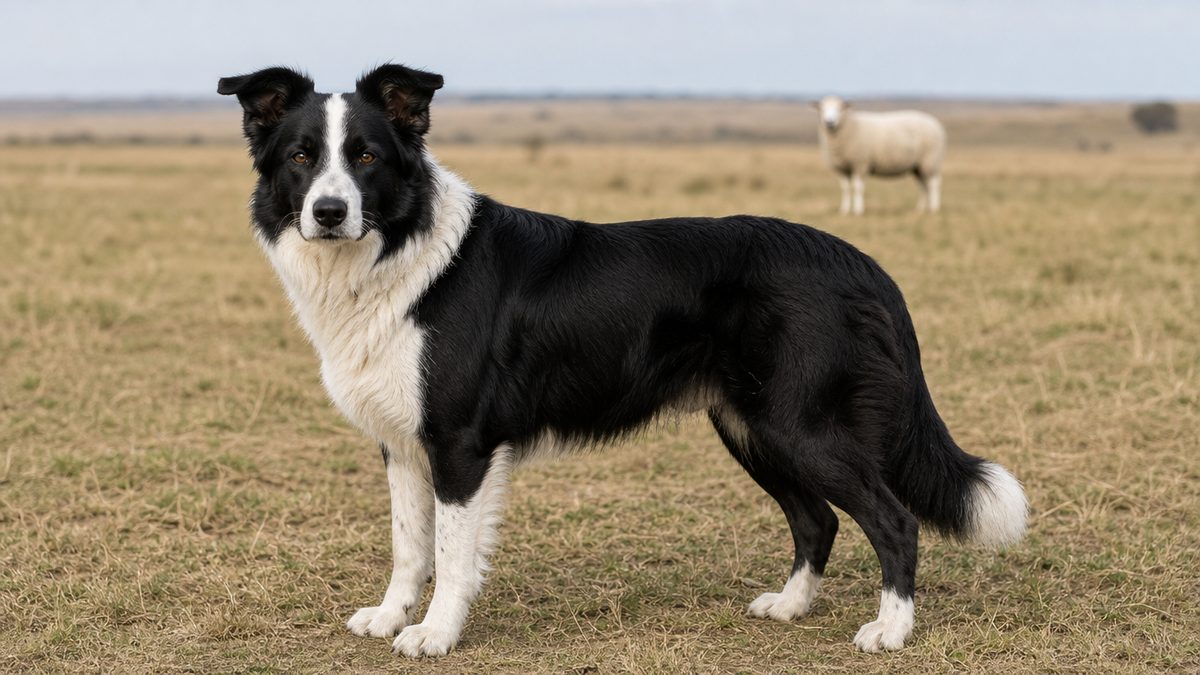
The Gaucho Sheepdog is a medium-sized Brazilian herding dog of 55 to 65 cm at the withers in both sexes, bred on the pampas of Rio Grande do Sul to move and hold sheep and cattle, and recognised nationally by the Confederacao Brasileira de Cinofilia under standard NR05 of 28 August 2000.
Everything in this section comes from CBKC Padrao NR05, which Bonbeno downloaded and identified by reading the breed name printed inside the document. The standard runs to six pages, gives its country of origin as Brazil, its utilisation as pastoreio, meaning herding, and its working trial status as not regulated. Its listed collaborators include Telmo Souza Lima Filho, the cynologist Brazilian breeders credit with the first studies toward recognition of the breed Ovelheiro Gaucho (Canil Santa Terezinha.
The measurements, exactly as printed
| Point | What NR05 says |
|---|---|
| Height | 55 to 65 cm, males and females, one range for both sexes |
| Weight | Not stated anywhere in the document |
| Life expectancy | Not stated anywhere in the document |
| Coat | Medium and abundant, adapted to weather and to changes of climate, sparser at elbows and hocks |
| Colour | All colours are admitted |
| Head | Medium, triangular seen from above, skull to muzzle 1:1, moderate stop |
| Ears | High set, triangular, erect, semi-erect or pendant in button form |
| Eyes | Almond, preferably dark; in merles one eye of two colours or one eye of each colour |
| Tail | Thick at the root, high set, carried low, may curl at the tip; may lift above the topline when working |
| Feet | Hare feet, with strong digits |
| General appearance | Medium size and structure, coat not very long, great endurance, agility and rusticity |
English Wikipedia's infobox gives a weight of 20 to 35 kg and cites the CBKC standard for it. The Portuguese article adds a life expectancy of 13 to 15 years. An Indian retailer's page splits the height by sex and puts females at 50 to 60 cm and 18 to 30 kg. NR05 contains no weight, no lifespan, and no separate female height. Those three figures have no source in the breed's own standard, and the female range sits five centimetres below the standard's floor.
Where the breed came from, with the parts that are actually agreed
Three independent accounts converge on the same shape, which is unusual for a landrace. European settlers brought collie-type dogs to the sheep and cattle ranches of Rio Grande do Sul, those dogs bred with the dogs already there, and gaucho farmhands selected hard for herding ability rather than looks Rorem L., Ovelheiro Gaucho Wikipedia in Portuguese, Ovelheiro-gaucho. Border Collies arrived later, in the 1950s, and contributed. The Portuguese account adds that they came with an Australian merino sheep import to Uruguaiana and then to Pelotas.
The disagreement is about what else went in. The Brazilian breeders' association ACOG names the Cao da Serra da Estrela from Portugal and the Scotch Collie from England and Scotland as the historic ancestors. Portuguese Wikipedia carries two hypotheses, one naming Border Collie and Rough Collie, the other naming Rough Collie, Cao da Serra da Estrela and, from the 1920s, the German Shepherd, crossed in deliberately so the dogs would stand up to cattle and not be killed by other dogs. The Border Collie Museum treats the Estrela input as possible rather than established.
Type still varies, and that is documented rather than denied
Both English herding sources record the same split: sheep farmers tend to prefer a Border Collie-like dog and cattle ranchers a taller dog closer to the Rough Collie, with the general tendency somewhere between the two Rorem L., Ovelheiro Gaucho. Brazilian breeders describe the breed as still in formation, alongside the Pastor da Mantiqueira and the Buldogue Campeiro, with a deliberately broad standard as a result. Abroad, the type has begun to be described as a Southern Brazilian Type Collie.
The state of Rio Grande do Sul settled the cultural question in 2020. Lei No 15.531 of 22 September 2020 added article 33-A to the state's animal protection law, declaring the Cachorro Ovelheiro Gaucho the animal-symbol of the state and recognising it as cultural and genetic heritage, as natural heritage bearing reference to the identity, action and memory of Rio-Grandense society. That is a real legal status, and it is a state cultural designation rather than a cynological one.
Is the Gaucho Sheepdog a recognised breed? Checked register by register
The Gaucho Sheepdog holds national recognition from the Confederacao Brasileira de Cinofilia and holds no FCI standard number, and the CBKC's own standard settles it in one printed line.
Recognition claims about Brazilian breeds are made constantly and evidenced rarely, so Bonbeno opened the registers rather than the articles. Each check below carries a control that proves the query worked.
The CBKC recognises it, and says exactly what that means
CLASSIFICACAO CBKC: Grupo 11 - Racas Nao Reconhecidas pela FCI. In English: CBKC classification, Group 11, Breeds Not Recognised by the FCI. The same document prints PAIS DE ORIGEM: Brasil, NOME NO PAIS DE ORIGEM: Ovelheiro Gaucho, and DATA DE PUBLICACAO DO PADRAO OFICIAL VALIDO: 28.08.2000.
The CBKC's website organises the breed the same way, and its wording has softened. Its Group 11 filter now carries the heading Racas reconhecidas so pela CBKC, breeds recognised only by the CBKC, while the tab that reaches it still reads FCI: Nao reconhecidas. Both phrasings are the CBKC's own. Bonbeno reports both rather than picking the friendlier one.
Group 11 held 19 breeds on 31 August 2026, of which seven are Brazilian: Buldogue Serrano, Dogue Brasileiro, Monster Bull, Ovelheiro Gaucho, Pastor da Mantiqueira, Veadeiro Nacional and Veadeiro Pampeano. The Ovelheiro Gaucho row prints its date as 28/08/2000 and its FCI number field as blank, which is the tell: the column is headed Padrao FCI No and every Group 11 breed leaves it empty.
The FCI does not, on either register
| Register checked | Entries seen | Control present | Gaucho Sheepdog |
|---|---|---|---|
| Definitive nomenclature, letter O, for Ovelheiro | 3 breeds | Old English Sheepdog 16, Otterhound 294 | Absent |
| Definitive nomenclature, letter G, for Gaucho | 24 breeds | Golden Retriever 111, Gos d'Atura Catala 87 | Absent |
| Breeds recognised on a provisional basis | 20 breeds | Buldogue Campeiro 374, admitted 6 August 2025 | Absent |
The letter O check is the one that matters, because the FCI files a breed under the name used in its country of origin. Buldogue Campeiro sits on the provisional register under its Portuguese name, which proves the register does carry Portuguese names and that an absence is not a filing artefact FCI breeds nomenclature FCI breeds nomenclature.
There is a second Brazilian layer, and it is not the CBKC
Recognition here is not two-state. The Associacao dos Criadores de Ovelheiro Gaucho, ACOG, maintains its own registrations, and the 2021 university study of the breed drew its 25 blood samples from dogs registered by ACOG rather than by the CBKC. Brazilian breeders also refer publicly to a padrao ACOG as distinct from the CBKC document. So a Brazilian dog of this breed may carry a CBKC pedigree, an ACOG registration, or both, and only the CBKC one belongs to an FCI-affiliated body.
What this means for an Indian owner
It means there is no pedigree route into India. India is a full FCI member represented by the Kennel Club of India from Chennai, so Indian pedigrees are issued against FCI nomenclature, and a breed with no FCI number has nothing for an Indian kennel club registration to reference. A Brazilian dog's CBKC or ACOG paperwork does not convert.
CBKC-recognised is not FCI-recognised, even though the CBKC is itself an FCI member. English Wikipedia states the position correctly, that the breed is not recognized by the FCI but has been recognized by the CBKC. Indian and international pages that compress this into recognised by the Brazilian Kennel Club, therefore an internationally recognised breed, are describing a registry reality that does not exist.
Indian law and this breed: the merle gap, and the closed import route
Indian law does not restrict the Gaucho Sheepdog in any way, closes the route by which one could be brought here to breed or sell, and leaves one specific gap that matters for this breed more than for most, because the Rules never mention deafness.
Start with what does not apply. The Union circular of 12 March 2024 that asked states to stop licensing the sale, breeding and keeping of certain breeds does not name this one, and in any case the Karnataka High Court quashed it on 10 April 2024 and the Delhi High Court set it aside on 16 April 2024 The Indian Express. No Indian law in force today bans owning, breeding or selling any dog breed. Karnataka left the door open to a properly consulted rules amendment, so a settled all-clear would also be wrong.
The genetic-defect clause, and the word that is missing from it
Second Schedule Part III para 8(10) of the Prevention of Cruelty to Animals (Dog Breeding and Marketing) Rules 2017 requires that breeding dogs have been tested for genetic defects, including hip dysplasia, progressive retinal atrophy, night blindness, hypothyroidism, entropion, ectropion, overshot, undershot jaw when incisors do not touch or mesh, wry mouth, two or more missing teeth, and unilateral or full cryptorchid males. The word including makes that list illustrative rather than closed.
Bonbeno extracted the gazette text of G.S.R. 496(E) and counted. Deaf, BAER and patella each occur zero times. So Indian law imposes no hearing-test requirement on any breeding dog. For a breed whose own standard admits merle and admits odd eyes, and where merle-to-merle breeding is the recognised route to congenital deafness, that absence is the single most consequential thing the Rules do not say. Never write that Indian law mandates a BAER test, because it does not.
The neighbouring paragraph is worth knowing too. Second Schedule Part II para 6(9) reads, in full, that breeding to create new breeds of dogs or unusual looks shall be strictly prohibited. Breeding merle to merle for the colour, in a breed where all colours are already admitted, is precisely a breeding programme aimed at an unusual look.
The clause that never bites for this breed, and one that does
Second Schedule Part II para 6(8) forbids tail docking, ear cropping, de-barking, de-clawing, branding, dyeing, injecting substances to enhance visual appeal, and any change of appearance by artificial means. Nothing in NR05 calls for cropping or docking, so unlike many working breeds this one has no traditional mutilation to defend. The standard describes natural ears in three permitted forms and a natural low-carried tail.
Rule 8(1)(a), a genuine Rule rather than a Schedule paragraph, requires every breeder to ensure that pups less than eight weeks in age are not sold. That one applies to any Indian litter of any breed.
Import: legal for a personal pet, closed for trade
DGFT Trade Notice 22/2022-23 classifies mammals under ITC(HS) 01061900 as Restricted. Policy Condition (7) allows the import of dogs only for a pet dog with a valid pet book and records in the importer's own name, for R and D organisations with a CPCSEA recommendation, or for internal security by the Defence and Police Force. Policy Condition (8) states that import of commercial dogs for breeding or any other commercial activity is not permitted, and paragraph 6 of the notice states that applications for trading or breeding purposes shall be duly rejected.
Import of pet animals is allowed only through the airports and seaports of Delhi, Mumbai, Chennai, Hyderabad, Bengaluru and Kolkata and, since October 2024, Kochi airport, with quarantine at the government station of that port where required Department of Animal Husbandry…. The personal pet route under baggage runs separately, through the Animal Quarantine and Certification Service. So these import rules leave exactly one lawful path for a Gaucho Sheepdog to reach India, which is a person relocating with a dog they already own. The full route is set out in how to import a dog to India.
For most imported breeds the DGFT restriction is an inconvenience that a domestic breeding population routes around. Here there is no domestic population to route around, because the breed has never been imported at scale, so the notice is the whole story rather than a footnote to it.
Gaucho Sheepdog price in India: there is no Indian market at all
No Gaucho Sheepdog is offered for sale in India, so this breed has no Indian price, and the two Indian-facing pages that rank for it sell no dog at all.
That claim was tested three ways on 31 August 2026, each with a control that returned a result in the same session, so a zero here means absence rather than a failed query.
| Test | Gaucho Sheepdog | Control |
|---|---|---|
| Puppy marketplace URL, same site, same pattern | mrnmrspet.com/dogs/gaucho-sheepdog-puppies-for-sale redirects to a 404 page; the ovelheiro-gaucho variant does the same | The Border Collie and Caucasian Shepherd URLs on the same site serve full price tables |
| Google India autocomplete, question-form prefixes | Empty completion list for 'is gaucho sheepdog', 'are gaucho sheepdogs', 'gaucho sheepdog price', 'how big is a gaucho sheepdog' | The same endpoint returned ten completions for an unrelated breed prefix and ten Portuguese completions for 'ovelheiro gaucho' |
| India-located web search, ten results | Zero Indian sellers. One Indian pet-supplies page, one Gulf clinic library page, a Brazil-linked US collie society, and content farms | The control breed returned Indian marketplaces with rupee tables |
The two Indian-facing results, and what they actually are
GoofyTails, an Indian pet-supplies retailer, publishes a Gaucho Sheepdog breed page. It is a content page bolted onto a product search that returns Showing -1 Results and then We're sorry, there are no results. It sells no dog, and no product is attached to the breed. Its breed content is competent in tone and wrong in three specifics: it splits the height by sex and gives females 50 to 60 cm and 18 to 30 kg, gives males 20 to 35 kg, and gives a life expectancy of 12 to 15 years, none of which appears in CBKC NR05, and it never names the CBKC at all.
Creatures.com, which ranks on the same page, is the more instructive result. It publishes Gaucho Sheepdogs for Sale, a Gaucho Sheepdog Herdbook, Gaucho Sheepdog Profiles, Gaucho Sheepdog Breeders and Gaucho Sheepdog Tools as section headings. Bonbeno has previously documented the same site running a herdbook, breeder directory and gestation calculator for a breed it states plainly is extinct. Cite it as evidence of fabricated marketplace furniture, never for a fact about this breed.
There is one real supply route, and it is not to India
The Scottish Collie Preservation Society, a United States body, lists a partnership kennel in Brazil, Canil Santa Terezinha, and states that Ovelheiro Gaucho puppies are available for shipping. That is the only concrete international route Bonbeno could verify, and it runs Brazil to the United States. It is not an Indian route, and it does not create one, because a dog imported into India for breeding or sale would be refused under DGFT Trade Notice 22/2022-23.
Bonbeno could invent an Indian price for this breed by converting a Brazilian one, and it would rank. It would also be false. Every Indian price band this site has audited for an unavailable breed has turned out to be a converted dollar list, a stripped currency symbol, or a rupee-native number nobody would print, and the honest answer for a breed with no Indian sellers is that there is no Indian price. If a seller quotes you one, that quote is the finding, not the figure.
The practical consequence for an Indian buyer is short. There is no Indian breeder, no Indian pedigree route because the FCI carries no number for the breed, and no lawful commercial import. Anything offered to you in India under this name is a different dog, most plausibly a Border Collie cross, and the sensible response is to ask which register issued the pedigree and to read the breed name printed on it.
Heat tolerance: a humid homeland that is still seven degrees cooler
The Gaucho Sheepdog rates 2 of 5 for heat tolerance in India, because the pampas it comes from are as humid as coastal India but far cooler, so the coat is built for damp rather than for heat.
Bonbeno queried NASA POWER by explicit latitude and longitude, never by place name, because climate sites asked for one city will silently serve another. Bage in southern Rio Grande do Sul was queried at 31.3314 S, 54.1069 W and Porto Alegre at 30.0346 S, 51.2177 W, with Indian cities at their own coordinates. Figures are 2001 to 2020 monthly means.
| Location | Annual mean air temp | Annual mean RH | Peak monthly wet-bulb | Coldest month mean |
|---|---|---|---|---|
| Bage, RS, Brazil (31.33 S, 54.11 W) | 17.4 C | 80.3 % | 20.1 C in January | 11.1 C in July |
| Porto Alegre, RS, Brazil (30.03 S, 51.22 W) | 19.3 C | 81.8 % | 21.6 C in January | 13.6 C in July |
| Bengaluru (12.97 N, 77.59 E) | 23.7 C | 67.9 % | 21.9 C in May | 20.2 C in December |
| Pune (18.52 N, 73.86 E) | 23.9 C | 66.8 % | 23.0 C in June | 19.6 C in December |
| Mumbai (19.08 N, 72.88 E) | 26.8 C | 67.4 % | 25.8 C in June | 23.2 C in January |
| Chennai (13.08 N, 80.27 E) | 27.9 C | 72.4 % | 26.1 C in May | 24.1 C in January |
| Kolkata (22.57 N, 88.36 E) | 25.8 C | 73.9 % | 27.1 C in June | 17.3 C in January |
The humidity column is the surprise. Bage runs at 80.3 percent annual mean relative humidity and Porto Alegre at 81.8 percent, both higher than Chennai's 72.4 and Kolkata's 73.9. So this is not a dry-climate dog meeting Indian humidity for the first time. It is a humid-climate dog meeting Indian heat for the first time, which is a different problem and a slightly more manageable one.
Wet-bulb temperature is the number that combines both, and it is what governs whether a panting dog can shed heat. Bage peaks at 20.1 C and Porto Alegre at 21.6 C in January, the southern summer. Kolkata peaks at 27.1 C, seven degrees higher. Chennai reaches 26.1 C and Mumbai 25.8 C. Bengaluru at 21.9 C is within 0.3 degrees of Porto Alegre's peak, which makes it the one large Indian city whose hottest month resembles this breed's home summer.
The Brazilian kennel whose site publishes the breed's myth list illustrates its coat argument with two photographs and captions them precisely: one dog in minus 5 C in Maine in the United States, and another in 40 C at Osorio in Rio Grande do Sul. Their argument is that the double coat insulates in both directions, which is why NR05 specifies a coat adapted to weather and to changes of climate. A 40 C air temperature in a coastal Rio Grande do Sul summer is a real, if anecdotal, demonstration that individual dogs of this breed cope with high air temperature.
What the heat-illness evidence supports for a 20 to 35 kg dog
Hall, Carter and O'Neill studied 905,543 UK dogs under primary veterinary care in 2016 and recorded 395 confirmed heat-related illness events, with a case fatality rate of 14.18 percent, 95 percent CI 11.08 to 17.96. The transferable factor here is bodyweight relative to the breed mean: dogs at or above their own breed and sex mean carried 1.42 times the odds of heat-related illness, 95 percent CI 1.12 to 1.80. Those figures are from Hall 2020 in *Scientific Reports*, 10:9128. The over-50-kg band does not apply to this breed at any weight.
The same authors published a second 2020 paper on the same cohort in *Animals*, 10(8):1324, with a different case definition: 1,259 events from 1,222 dogs, and an odds ratio of 1.30, 95 percent CI 1.09 to 1.55, for bodyweight at or above the breed mean in exertional heat illness. Both are right. Name which paper you mean, never a bare Hall 2020.
The *Animals* paper carries the finding that decides an Indian owner's routine. Of the 879 heat-illness events with a trigger recorded, 652, or 74.2 percent, were exertional rather than environmental or vehicular. For a herding breed with real drive, that is the whole warning: this dog will keep working past the point where it should stop, and in India the work has to be scheduled around the heat rather than the heat around the work.
Health: the drug-sensitivity finding that changes Indian worming
The most useful of this breed's health issues is a Brazilian genetics result rather than a joint score: a study of 25 ACOG-registered dogs found the MDR1 mutant allele at a frequency of 26 percent, and that drug sensitivity changes which anti-parasitic and anti-diarrhoeal drugs are safe.
Cunha and colleagues at the Universidade Federal de Pelotas sent blood from 25 registered Ovelheiro Gauchos to the molecular diagnostics laboratory at UNESP Botucatu and genotyped them by PCR. They report an allele frequency of 26 percent, 95 percent confidence interval 12.9 to 45.6 percent, with no homozygous mutant animals found, and describe the results as the first for the breed. They conclude that because the frequency is still low and no homozygotes were found, breeders can select mutation-free sires and dams and eliminate the allele from the population.
Read the sample size with the number. Twenty-five dogs is small and the confidence interval is wide, from 12.9 to 45.6 percent, so the point estimate is a signal rather than a settled prevalence. What it does establish is that the allele is present in the breed, which is what a veterinarian needs to know before reaching for a syringe.
Why this matters more in India than in Brazil
MDR1, also called ABCB1, codes a transporter that keeps certain drugs out of the brain. Dogs carrying the mutation can become very ill or die on medicines that are routine for other dogs. Two of those are everywhere in Indian practice.
| Drug | What the list says |
|---|---|
| Loperamide (Imodium) | At doses used to treat diarrhoea this drug will cause neurological toxicity in dogs with the MDR1 mutation, and should be avoided in all dogs with the mutation |
| Ivermectin | Heartgard Plus is safe at label doses; for OTHER formulations of ivermectin, dosing advice must be sought |
| Milbemycin, moxidectin, selamectin | Safe at label doses in the named branded products, per the manufacturers and the FDA |
| Afoxolaner, fluralaner, lotilaner, sarolaner | Tested by the manufacturers, no adverse effects observed |
| Acepromazine, butorphanol, maropitant, ondansetron, apomorphine | Dosing advice needed rather than a flat ban |
| Vincristine, vinblastine, doxorubicin, vinorelbine | Chemotherapy agents, dosing advice needed |
First, loperamide is sold over the counter in India as a human antidiarrhoeal and is given to dogs by owners without a prescription. In an MDR1-carrier that is a neurotoxic dose. Second, ivermectin in India is used well beyond heartworm prevention, including at high off-label doses for sarcoptic mange, and the safety finding covers label-dose branded heartworm products only. If you ever own a dog of this breed or of collie ancestry in India, tell your veterinarian about MDR1 before treatment, not after.
How the breed compares on this allele
WSU's own breed table gives approximate frequencies of Collie 70 percent, Australian Shepherd 50 percent, Shetland Sheepdog 15 percent, English Shepherd 15 percent, German Shepherd 10 percent and Border Collie under 5 percent. On its face the Brazilian 26 percent sits well above the Border Collie the breed most resembles. Treat that comparison as indicative only: WSU labels its column approximate frequency without stating whether it counts alleles or dogs, while Cunha reports an allele frequency, and those are different measures Cunha FR, Garcia EN, Silva EF. The safe conclusion is that this is a collie-derived breed in which the allele has been demonstrated, and that a Border Collie's low figure cannot be borrowed for it.
What no source knows about this breed
Bonbeno proved the following absences with controls in the same session. PubMed returns zero records for Ovelheiro Gaucho, zero for Gaucho Sheepdog and zero for Pastor Gaucho dog, against controls of 126 records for Labrador Retriever hip dysplasia, 80 for livestock guardian dog and 7 for Fila Brasileiro. The OFA's published statistics tables, pulled in full at 2.2 million characters, contain no row for this breed, against a control of 109 hits for Labrador. McMillan's 155-breed UK longevity study does not include it.
So there is no published hip score, no eye-registry figure and no lifespan estimate for the Gaucho Sheepdog anywhere. Screen hips and eyes before breeding regardless, which Second Schedule Part III para 8(10) independently requires in India for hip dysplasia among other defects, and treat any confident life expectancy figure you read for this breed as unsourced.
Merle, deafness, and the gap between the standard and Indian law
Merle is admitted by the breed standard, carries a measured deafness risk only when two merles are bred together, and is the one health question Indian law leaves entirely unaddressed.
NR05 admits all colours and describes the merle coat explicitly, allowing partial depigmentation of the nose and either one eye of two colours or one eye of each colour. Brazilian breeders are open about the consequence, writing that the merle gene is widely linked to skin, vision and hearing problems, that affected merles have compromised herding performance as a result, and that healthy merles can work normally.
The measured risk sits with doubling the gene rather than with carrying it. Strain and colleagues BAER-tested 153 privately owned merle dogs of several breeds and both sexes.
| Genotype | Unilaterally deaf | Bilaterally deaf |
|---|---|---|
| All merles | 4.6 % | 4.6 % |
| Single merle (Mm) | 2.7 % | 0.9 % |
| Double merle (MM) | 10 % | 15 % |
Dogs homozygous for the merle allele were significantly more likely to be deaf than heterozygotes, and there was no significant association with eye colour or with sex. That last point is worth holding on to, because the odd-eyed dog the standard describes is not thereby a higher risk. The risk is created by the mating, and it is invisible in the parents.
Across all fourteen pages of the gazette text of the Dog Breeding and Marketing Rules 2017, deaf appears zero times and BAER appears zero times. The genetic-defect clause at Second Schedule Part III para 8(10) names hip dysplasia, progressive retinal atrophy, night blindness, hypothyroidism, entropion, ectropion, jaw defects, missing teeth and cryptorchidism, and no auditory test at all. For a breed whose standard admits merle, that is the gap. An Indian breeder can comply fully with the Rules and still produce a bilaterally deaf litter.
The other thing Indian law says that bears on colour breeding
Second Schedule Part II para 6(9) reads, in full, that breeding to create new breeds of dogs or unusual looks shall be strictly prohibited. Breeding two merles together in a breed where every colour is already admitted has no purpose except the colour, which puts it squarely inside that sentence. Brazilian breeders make a related point from the other direction, warning that exotic-colour lines are proportionally the least able to demonstrate competitive morphological quality.
The practical rule, in one line
- Never breed merle to merle. One merle parent at most, always.
- BAER-test any merle puppy before it goes to a home, even though no Indian rule requires it.
- Ask the breeder for both parents' colours in writing, because a cryptic merle can look solid.
- Treat a merle-to-merle litter advertised as rare or exclusive as a warning, not a premium.
- Remember that a deaf dog can live a good life, and that the point of the rule is to avoid producing avoidable deafness, not to write off a dog that has it.
Bonbeno found no Indian study of merle-associated deafness, and no Indian breeder of this breed to ask. The Strain figures are the best evidence available and they come from a mixed-breed merle population rather than from Gaucho Sheepdogs specifically. That limitation is stated here rather than hidden, because the alternative is to quote a breed-specific number nobody has measured.
Temperament: a docile worker that is not a guard dog, whatever you have read
The Gaucho Sheepdog is a docile, biddable herding dog that adapts easily to commands, is not aggressive with stock, and is friendly with the people it lives with, and it is not a guarding breed at all.
CBKC NR05 gives the whole temperament clause in two sentences: easy adaptation to obeying commands, without being aggressive toward the flock, and docile and friendly with the people it lives with. That is a short clause and an unusually candid one, because it makes no claim about protection at all.
The English-language herding literature agrees and adds detail. The breed is described as an excellent working dog, courageous, intelligent, biddable and hardy, and is also active in agility competition. Portuguese Wikipedia adds the practical nuance an owner will actually experience: it is not an aggressive dog, but it is very good as an alarm dog, because it barks at any strange noise while rarely attacking the intruder.
A Brazilian breeder site lists the belief that Ovelheiros are great guard dogs as myth number two, and answers it in cynological terms: guarding calls for physical presence and a ferocity drive, generally in molossoid types from FCI group 2, while Ovelheiros are herding dogs of the collie type in group 1. The most they do is bark an alarm when something strange approaches their territory. It states plainly that hunting, racing, combat, rescue, scent work, pointing and guarding are not this breed's functions, and that selecting for them is a disservice to the breed. The CBKC standard, by contrast, does list guarding sheep from other animals and from unknown dogs and people among the breed's functions. Bonbeno publishes both positions.
Two claims the standard makes that Brazilian breeders reject
This is the most interesting disagreement on the breed, and no English page carries it. NR05's historical summary states that a good Ovelheiro comfortably replaces three men and that a farmhand without a dog is worth half a farmhand, and that it is very common for the dogs to do the whole job alone, dispensing with the farmhand's company.
The breeder site treats both as myths. On replacing three men it answers, from more than fifty years in traditional livestock farming, that comparing a person to an animal is inconceivable and that the relationship is mutual complementation rather than competitive parity. On working unaccompanied it makes a sharper argument: the standard's own temperament clause says the dog adapts easily to obeying commands, so a dog working with nobody present to give commands is an incongruity, and no herding breed behaves that way. It adds that nineteenth-century estancias were measured in sesmarias of roughly 6,500 hectares, more than six thousand football fields, which no dog could patrol unsupervised.
The moderate version, from an independent English herding source, is probably the true one: a shepherd or herdsman and two or three dogs can handle a flock of sheep or a herd of cattle. Note the shepherd is in that sentence.
Who this breed suits, and who it does not
- Suits a farm, a smallholding or a genuinely active rural household with daily work for the dog.
- Suits an owner who wants a sensitive, trainable dog and will provide structured mental work rather than only exercise.
- Does not suit anyone buying a guard dog. Every authority on the breed says the same thing, and buying it for protection produces a barking dog that will not act.
- Does not suit an Indian apartment. A herding breed with real drive and no stock will find work, and the work it finds is chasing.
- Does not suit a household with young children and no plan for the herding instinct, because circling and heel-nipping is the breed's job description, not a fault.
Brazilian breeders also settle a smaller question that follows from the standard. The belief that the breed shows marked sexual dimorphism is rejected: large females and small males are not rare, and no dog breed shows the sex-exclusive colours or ornaments that biology means by marked dimorphism. That is consistent with NR05 giving one height range, 55 to 65 cm, for both sexes.
Training: an easy dog to teach and an easy dog to spoil
Train a Gaucho Sheepdog with short, structured, reward-based sessions from eight weeks, because the standard's own words for the breed are easy adaptation to obeying commands, and a dog that learns that fast learns the wrong things equally fast.
The breed's trainability is the least disputed thing about it. NR05 opens its temperament clause with easy adaptation to obeying commands. Portuguese Wikipedia calls it intelligent, quick to adapt and quick to learn commands. The herding literature calls it biddable and notes it competes in agility. Nothing in the record describes resistance, stubbornness or handler-independence.
That creates the opposite problem from a guardian breed. A biddable agile dog with no job will invent one, and in an Indian household the job it invents is usually chasing: children, scooters, cats, or the community dogs outside the gate.
The plan that fits this breed
- Weeks 8 to 16, socialise deliberately. Introduce traffic, autorickshaws, delivery riders, livestock if you have access, and calm adult dogs, at a rate the puppy stays relaxed at. A herding breed that meets scooters late will chase them for life.
- Months 3 to 6, build an interrupt. A reliable stop or recall matters more here than any obedience routine, because it is the only tool that works mid-chase.
- Months 4 to 12, give the instinct a legal outlet. Structured retrieves, scent games, treibball or formal herding where available. The herding instinct is not trainable away and does not need to be.
- Throughout, keep sessions short. Ten focused minutes twice a day beats an hour. This breed saturates, then starts freelancing.
- Never let chasing be rewarding once. A single successful chase of a scooter builds a habit that months of work then has to undo.
The Indian-specific training problem nobody writes about
India's free-roaming community dog population is the hardest environment a herding breed can be asked to work in. A dog selected for centuries to move animals by pressure and eye will read a street dog as stock, and a street dog will not read it that way. The consequence is a fight the herding dog did not intend to start. Practise passing dogs at distance long before you need to, and treat the long line as standard equipment rather than a training phase.
Brazilian breeders reject the idea that a show standard and a work standard exist separately for this breed, or for any breed, noting that a standard is a single set of guidelines and that breeders may specialise toward exposition or toward function but the document does not split. The practical translation for a new owner is that there is no working line whose bad manners are excusable and no show line whose lack of drive is normal. There is one breed and one standard.
One more thing worth knowing before buying on looks. The belief that a beautiful head predicts a good body is listed among the breed's myths, with the observation that many dogs have excellent heads and mediocre structure and the reverse is equally common. In a breed still in formation, structure is what determines whether the dog can do the job for a decade.
Exercise: a working requirement, on an Indian clock
A Gaucho Sheepdog needs 60 to 90 minutes of real activity a day plus daily mental work, and in India all of it has to happen before sunrise or after dark.
This is a working breed with genuine stamina. NR05 describes great locomotion potential with wide and fluent strides and lists endurance, agility and rusticity among its general qualities, calling for a rustic dog rather than a refined one. Portuguese Wikipedia calls it very resistant and agile, which is what makes it ideal for herding activities. This is not a breed that will settle on a balcony.
Why the clock matters more than the quantity
The heat-illness evidence is unambiguous about where the risk sits. In the *Animals* paper by Hall, Carter and O'Neill, 652 of the 879 events with a recorded trigger, or 74.2 percent, were exertional, against 113 environmental and 46 vehicular. A dog that overheats is overwhelmingly a dog that was working or being walked. For a breed that will keep going past its own limit, that is the entire management problem.
| City | Peak month wet-bulb | Hot-season window |
|---|---|---|
| Kolkata | 27.1 C in June | Before 05:30 and after 21:00, and keep it short |
| Chennai | 26.1 C in May | Before 05:30 and after 21:00, year round |
| Mumbai | 25.8 C in June | Before 06:00 and after 21:00 |
| Pune | 23.0 C in June | Before 06:30 and after 20:00 |
| Bengaluru | 21.9 C in May | Before 06:30 and after 20:00, and the closest Indian match to the breed's home summer |
| Bage, Rio Grande do Sul | 20.1 C in January | The homeland baseline, for comparison |
Heatstroke is a medical emergency and the outcome depends on how fast core temperature comes down. Watch for frantic panting, bright red gums, thick sticky saliva, staggering, vomiting or collapse. Move the dog into shade, pour or hose cool, not iced, water over the whole body including belly and armpits, get air moving over the wet coat, and drive to a veterinarian while cooling continues. In a working breed the warning signs arrive late, because the dog will keep going.
What to actually do with the dog each day
- Two sessions of 30 to 45 minutes, at the hours above, on a flat route.
- One mental block of 10 to 15 minutes, daily. Scent work, a puzzle feeder, or a shaped behaviour. This is not optional for a herding breed.
- A secure fenced space the dog can move in freely during cool hours. A herding dog patrols too, just faster than a guardian does.
- Structured retrieves or treibball instead of unstructured chasing, so the instinct has somewhere legal to go.
- No forced running, cycling or long fetch sessions in Indian heat, ever. Those are exactly the exertional events the data counts.
Bigger is not better here either, and the breed's own people say so. Brazilian breeders write that they know of no morphofunctional benefit in an Ovelheiro over 60 cm at the withers or over 30 kg, and that large ones tend to be slow, lazy or low on initiative, usually because of heavy bone, obesity, or both. A dog kept lean at the middle of the standard's 55 to 65 cm range will work longer and cope with Indian heat better than one pushed to the top of it.
Grooming a weather-resistant coat in Indian humidity
Groom a Gaucho Sheepdog by raking the undercoat out twice a week and drying it to the skin after every wetting, because the standard specifies a coat built for weather rather than for heat and the undercoat is the part that traps moisture.
NR05 describes the coat in one sentence that does a lot of work: it must be adapted to bad weather and to changes of climate, with medium and abundant hair, thinner at the elbows and hocks. It does not use the word undercoat, and that omission has caused an argument inside the breed.
The undercoat question, settled by the people who bred them
Brazilian breeders call the belief that Ovelheiros should not have an undercoat the biggest myth of all. Their argument is that every herding breed in FCI group 1 has undercoat written into its standard, that 100 percent of Ovelheiros carry it in varying density, and that the claim is corroborated by Telmo Souza Lima Filho, the cynologist who ran the first studies toward recognition and took part in homologating the official standard in December 2000. He is named as a collaborator on the standard document itself.
The mechanism they give is the one that matters in India. A dense double coat of paired follicles, guard hair plus undercoat, insulates in both directions, which is what makes the dog adapted to weather exactly as the standard requires, across a region with wide seasonal swings. They illustrate it with a dog photographed at minus 5 C in Maine and another at 40 C in Osorio, Rio Grande do Sul.
The same source notes that a bitch shedding heavily after weaning a litter is the clearest demonstration that undercoat is present, that males and spayed females moult more slowly and gradually, and that the moult correlates more with the endocrine system than with the calendar, so it can occur in winter. In India, where seasonal cues are weaker than in southern Brazil, expect the moult to arrive on the dog's schedule rather than on yours.
The Indian routine
- Undercoat rake twice weekly, daily through a moult. Packed dead undercoat is what turns humidity into a hot spot.
- Dry to the skin after every bath, swim or downpour. Towel, then forced air, then check under the coat with your fingers before you stop.
- Dry the ears every time, with a vet-approved drying solution rather than cotton buds. The standard permits pendant button ears, and a folded ear over a wet canal is the classic setup for otitis.
- Check elbows and hocks weekly. The standard notes the coat is thinner there, which makes those the first places a callus or a lesion shows.
- Tick check daily by hand, not by eye. A medium abundant coat hides an attached tick completely.
Ear disease is the Indian condition to plan for
A study of 281 dogs in and around Durg district, Chhattisgarh, found 51 cases of otitis externa and distributed them across the year as 21 in summer, 17 in the rainy season and 13 in winter. The paper prints those as 41.18, 33.33 and 25.49 percent, and the arithmetic reproduces exactly against a denominator of 51 cases, so read them as the share of cases falling in each season rather than as prevalence within each season. Other Indian series report the monsoon as the peak instead. The peak month is contested; the elevated risk from roughly March to October is not.
Parasite pressure is continuous rather than seasonal. A national survey of canine tick-borne disease in India found Hepatozoon canis, Ehrlichia canis and Babesia species circulating in the Indian dog population, which is why a coat this dense needs a year-round tick programme. Choose the product with the MDR1 finding in mind: afoxolaner, fluralaner, lotilaner and sarolaner were all tested by their manufacturers with no adverse effects in dogs carrying the mutation.
Feeding: keep it lean, and read the drug list before the deworming schedule
Feed a Gaucho Sheepdog to hold a lean working condition in the middle of its size range, because the breed's own people say nothing above 30 kg helps, and Indian heat punishes every extra kilogram.
There is no breed-specific feeding study for the Gaucho Sheepdog, so this section works from body condition and from the two evidence sources that do apply.
The target is condition, not weight
Score the dog by hand every fortnight. You should feel the ribs under a thin fat cover without pressing, see a waist from above and a tuck from the side. The heat evidence explains why this beats a target number: dogs at or above their own breed and sex mean bodyweight carried 1.42 times the odds of heat-related illness, 95 percent CI 1.12 to 1.80, in Hall 2020 in *Scientific Reports*. Being heavy for your own breed is a heat risk in itself.
The breed's own community sets the same target from the working side. Brazilian breeders write that they know of no morphofunctional benefit above 60 cm at the withers or 30 kg, that oversized dogs tend to be slow and low on initiative, and that what matters is proportion and a body condition close to the ideal, neither over nor under. They also observe that a puppy's size in the litter reflects its ability to nurse rather than the quality of its phenotype, which is a useful corrective for anyone choosing the biggest pup.
Practical feeding in an Indian household
- Split adult meals in two, morning and night, and feed the larger one at the cooler end of the day.
- Rest an hour either side of a meal. No walk, no herding game, no car journey.
- Use a growth diet formulated for medium breeds, not a giant-breed formula and not an adult food, through the first year.
- Weigh the food. A scoop is not a measure, and a 25 kg working dog carrying three extra kilograms in Chennai is carrying them in May as well as in December.
- Fresh water in more than one place, refreshed twice daily. A dog that pants for a living drinks accordingly.
This is a feeding-adjacent decision Indian owners make monthly. Heartworm and deworming products are chosen by price and availability in India, and for a collie-derived breed the choice needs the drug-sensitivity list in front of you. Ivermectin at label doses in branded heartworm prevention was tested safe, and other ivermectin formulations were not; milbemycin, moxidectin and selamectin were tested safe at label doses in the named products. A Brazilian study found the MDR1 mutant allele in this breed at 26 percent, 95 percent CI 12.9 to 45.6. Get the dog genotyped if you can, and until you do, treat it as a possible carrier.
On availability there is no Indian supply problem. Medium-breed and working-dog diets are stocked across Indian metros, and the herding breeds this dog resembles are common enough that no specialist product is needed. The scarce thing is not the food. It is the dog.
What a working herding dog costs to keep in India each month
The monthly cost of ownership for a 20 to 35 kg herding dog in India is dominated by three lines that most first-time owners underestimate: parasite control, cooling, and the enrichment that stops a bored working dog destroying things.
Bonbeno publishes no rupee monthly total for this breed, because no Indian owner cohort exists to survey and any figure would be invented rather than measured. What can be given honestly is the cost structure, and the two lines that are specific to this dog rather than to dogs in general.
The line that is unique to this breed
Genotyping for MDR1 is a one-time cost and it is the highest-value money an owner of a collie-derived dog can spend in India. Washington State University's laboratory, which discovered the mutation, offers the test, and knowing the result changes the drug choices a veterinarian makes for the rest of the dog's life. The alternative is to treat every dose of every anti-parasitic as an unknown. For a breed with a demonstrated 26 percent allele frequency in its home population, that is not a theoretical saving.
The lines an Indian owner pays that a Rio Grande do Sul farmer does not
- Year-round tick and flea control. The Indian survey that found Hepatozoon canis, Ehrlichia canis and Babesia circulating in the dog population is the reason this is a twelve-month line rather than a seasonal one.
- Cooling through the hot months. Not for comfort. A double-coated working dog in a Chennai May where the wet-bulb peaks at 26.1 C needs somewhere to shed heat.
- Enrichment. Puzzle feeders, scent kits, training classes. For a herding breed this is a cost of ownership, not a luxury, because the alternative cost is your furniture.
- Secure fencing. A dog with this drive and no boundary becomes a dog chasing traffic, and that is the single most expensive outcome on this list.
- Ear care consumables. A drying solution used after every wetting through the monsoon, given the Indian otitis picture.
The cost nobody can price, because nobody has measured it
There is no lifespan figure for this breed from any register or study. It is absent from the OFA's published statistics tables, from McMillan's 155-breed UK longevity study and from PubMed entirely, each verified with a working control McMillan KM et al. PubMed search, Ovelheiro Gaucho and Gaucho…. The 12 to 15 and 13 to 15 year figures that circulate come from an Indian retail page and from Wikipedia's infobox, and neither appears in CBKC NR05 CBKC, Padrao Oficial da Raca Ovelheiro….
A medium-sized, moderately built working breed with no extreme conformation would ordinarily be expected to do well on longevity. That expectation is reasonable and it is not evidence, so this page states it as an expectation and prints no number.
The first year, month by month
Plan a Gaucho Sheepdog's first year around three fixed points: the socialisation window that closes at sixteen weeks, an MDR1 genotype taken as early as your vet will run it, and the herding drive that switches on between four and eight months.
Nothing in this timeline is breed-specific published research, because none exists for this breed. It is built from the standard, from the drug-sensitivity finding, and from what Indian conditions demand.
Months 0 to 3
The puppy stays with its litter to at least eight weeks, which Indian law requires: Rule 8(1)(a) of the Dog Breeding and Marketing Rules 2017 obliges every breeder to ensure that pups less than eight weeks in age are not sold. Get the MDR1 genotype run in this window if you can, because the first deworming and the first parasite preventive both fall inside it, and the result changes which products are safe Cunha FR, Garcia EN, Silva EF. Feed three to four times a day. Start climate conditioning now, meaning the puppy learns where the cool room is before it needs it.
Months 3 to 6, the window that does not reopen
Socialisation is the whole job of this quarter, and for a herding breed in an Indian city the priority list is specific: traffic, two-wheelers, autorickshaws, delivery riders, cattle if you can reach them, and calm adult dogs at distance. A dog that meets scooters after sixteen weeks will chase them. Keep exercise to free movement on soft ground and skip stairs and jumping, because no hip screening data exists for this breed and Second Schedule Part III para 8(10) makes hip dysplasia testing a legal requirement before any future breeding anyway.
Months 4 to 8, the instinct arrives
The herding drive typically appears in this window and it arrives without an invitation. It looks like circling, staring, and heel-nipping at moving feet, and it is the breed doing its job on the only stock available. Do not punish it. Redirect it into a structured outlet on the same day it appears, because the behaviour will attach to whatever it practises on first.
Months 6 to 12
Drop to two meals a day and hold the dog lean. Adolescence in a biddable breed looks like sudden selective deafness, and the answer is shorter sessions and higher-value rewards rather than more pressure. This is also when the coat comes in properly, and the first Indian moult surprises owners who were told this is not a heavy-shedding breed. Brazilian breeders are clear that every dog of this breed carries undercoat, in varying density.
Months 12 to 18
Move to an adult diet. Structured exercise can build now, still on the pre-dawn and post-dusk clock. If breeding is ever in view, this is when hip and eye screening happen, and if the dog is merle, when you decide firmly that it will never be bred to another merle, given that double merles ran 10 percent unilaterally and 15 percent bilaterally deaf in BAER testing.
A puppy born in September meets its first real heat at eight months, close to adult size, with a coat that has just come in. Have the cooling arrangement working before March. For scale, the breed's home summer peaks at a wet-bulb of 20.1 C in Bage, while Chennai peaks at 26.1 C and Kolkata at 27.1 C.
Gaucho Sheepdog compared with the herding breeds Indian buyers can actually get
Against every herding breed an Indian buyer can realistically obtain, the Gaucho Sheepdog loses on availability and paperwork before temperament is discussed, and its one genuine advantage over the alternatives is that it is not a Border Collie.
The useful comparison is not which dog herds better. It is which dog you can lawfully obtain, register, and keep sane through an Indian summer.
| Breed | FCI status | Sold in India | Homeland peak wet-bulb | MDR1 frequency |
|---|---|---|---|---|
| Gaucho Sheepdog | No FCI number, on either register | No listings found, with controls | 20.1 C, Bage RS | 26 percent allele frequency in 25 dogs, wide CI |
| Border Collie | FCI 297, definitive | Yes, an established Indian market | British, cool and damp | Under 5 percent |
| German Shepherd | FCI 166, definitive | Yes, the largest Indian working-breed market | Continental European | 10 percent |
| Australian Shepherd | FCI 342, definitive | Occasionally | North American | 50 percent |
| Indian Pariah Dog | No FCI number, indigenous landrace | Free to adopt, everywhere | Indian, fully adapted | Not measured |
The MDR1 column is the one that repays reading. WSU's approximate frequencies put the Border Collie under 5 percent and the Australian Shepherd at 50 percent, while the only measurement for the Gaucho Sheepdog is an allele frequency of 26 percent in 25 dogs with a confidence interval from 12.9 to 45.6 percent. Those are not the same statistic and must not be lined up as though they were, but they do establish that this breed cannot borrow the Border Collie's reassuring number just because it looks like one.
Gaucho Sheepdog against the Border Collie, on the points that differ
- Size. NR05 gives 55 to 65 cm for both sexes. Herding sources place the Ovelheiro as bigger than a Border Collie and a little smaller than a Rough Collie Wikipedia in Portuguese, Ovelheiro-gaucho.
- Working style. Both English herding sources note it moves differently from a Border Collie when working, alongside or behind the flock rather than in the Border Collie's crouching outrun.
- Intensity. The eye and obsessive focus that make a Border Collie difficult in a pet home are not part of this breed's description. NR05 gives docile and friendly with the people it lives with.
- Paperwork. The Border Collie has an FCI number, so the Kennel Club of India, a full FCI member, has nomenclature to register it against. This breed has none.
- Availability. One is in every Indian metro. The other returns a 404 on the same marketplace.
The comparison Bonbeno would actually make
If the appeal is a rare and distinctive herding dog, the honest answer is that it is not obtainable in India by any lawful route, and that is the finding rather than a gap in this guide. If the appeal is a bright, biddable herding dog with real drive, read the Border Collie guide and the German Shepherd guide, both of which are obtainable with real pedigrees. If the appeal is a hardy, alert, medium-sized dog that is already adapted to Indian heat and free to adopt, the Indian Pariah Dog is the better answer to the same question and always has been.
One more Brazilian breed is worth a glance for context on how national recognition works here. Bonbeno's Dogue Brasileiro guide covers a breed filed in the same CBKC Group 11 under the same classification line, and the Fila Brasileiro guide covers one that does hold an FCI number. Reading the three together shows exactly what the Group 11 label does and does not buy.
Nine mistakes people make with this breed
The commonest mistake with the Gaucho Sheepdog is quoting its breed standard without reading it, because the document almost everyone links is the standard for a Moroccan mountain dog.
- Citing the wrong standard. Both English and Portuguese Wikipedia give the breed's CBKC standard as cbkc.org/application/views/docs/padroes/padrao-raca_223.pdf. That URL returns HTTP 200 and serves the complete CBKC standard for the Cao das Montanhas do Atlas, the Moroccan Aidi. The real document is padrao-raca_1.pdf, CBKC NR05.
- Repeating a weight the standard does not contain. English Wikipedia prints 20 to 35 kg and attributes it to that CBKC reference. NR05 states no weight at all.
- Repeating a female height the standard does not contain. An Indian retail page gives females as 50 to 60 cm and 18 to 30 kg. NR05 gives one range for both sexes, 55 to 65 cm, and its floor is five centimetres above that page's.
- Buying it as a guard dog. Brazilian breeders list this as a myth and answer it in cynological terms: this is a group 1 herding dog, and the most it does is bark an alarm.
- Believing the dog works unsupervised. NR05's history section says the dogs commonly do the whole job alone; the breed community calls that an incongruity with the standard's own obedience clause and notes that no herding breed behaves that way.
- Breeding merle to merle. In BAER testing, double merles ran 10 percent unilaterally and 15 percent bilaterally deaf against 2.7 and 0.9 percent for single merles. Indian law will not stop you: deaf and BAER each appear zero times in the Dog Breeding and Marketing Rules 2017.
- Giving loperamide for diarrhoea. It is over the counter in India and, in a dog with the MDR1 mutation, causes neurological toxicity at the doses used to treat diarrhoea. This breed has a demonstrated MDR1 allele frequency of 26 percent.
- Buying the biggest puppy. Brazilian breeders write that a pup's size in the litter reflects its ability to nurse rather than its phenotype, and that they know of no functional benefit above 60 cm or 30 kg.
- Trusting a page that sells what nobody sells. One ranking result publishes a Gaucho Sheepdog herdbook, a breeder directory, a profiles section and dogs for sale for a breed with no verifiable market outside Brazil. Treat that furniture as a signal about the page, not about the breed.
The CBKC's Group 11 page carries a download button for each breed with the target filename in its own markup. Reading it out of the markup rather than guessing gives padrao-raca_1.pdf for the Ovelheiro Gaucho. Downloading that file and reading the first page shows OVELHEIRO GAUCHO, Padrao CBKC NR05, and NOME NO PAIS DE ORIGEM: Ovelheiro Gaucho. Doing the same to padrao-raca_223.pdf shows CAO DAS MONTANHAS DO ATLAS. The whole check takes two minutes and nobody currently ranking has done it.
One error this page deliberately does not make. It would be easy to treat the CBKC standard as unreliable because Brazilian breeders contradict two of its historical claims. That is the wrong conclusion. NR05 is the breed's official standard, its measurements are the ones any judge uses, and the passages under dispute are its breed history prose rather than its specifications. The playbook that applies to FCI standards applies here too: a standard is a primary source for what the registry says, and its measurement clauses are far more reliable than its history clauses.
Adoption and responsible sourcing: what to do instead
Adopt rather than import, because no lawful route exists to bring a Gaucho Sheepdog into India for breeding or sale, and the working herding temperament people want from this breed is available in India today.
Take the legal position first, because it closes almost every option people ask about. DGFT Trade Notice 22/2022-23 makes mammals Restricted under ITC(HS) 01061900 and permits import of dogs only for a pet dog with a valid pet book in the importer's own name, for research organisations with a CPCSEA recommendation, or for Defence and Police use, and it states that applications for trading or breeding purposes shall be duly rejected. Policy Condition (8) adds that commercial import for breeding or any other commercial activity is not permitted.
So there is one lawful path and it is not a supply chain: a person who already owns a Gaucho Sheepdog abroad, relocating to India, importing their own pet under their own name through one of the seven named ports of Delhi, Mumbai, Chennai, Hyderabad, Bengaluru, Kolkata and, since October 2024, Kochi, with quarantine where required Animal Quarantine and Certification… Department of Animal Husbandry….
What to ask anyone in India who claims to have one
- Which register issued the pedigree, and what breed name is printed on it? Verify the document rather than the claim. A genuine Brazilian dog carries a CBKC or an ACOG paper naming the Ovelheiro Gaucho, and neither converts into an Indian registration.
- If the answer is KCI, which FCI number? There is none for this breed on either FCI register, so any Indian registration is for something else.
- Where did the parents enter India, and under whose name? A breeding import is unlawful, so a coherent answer is unlikely.
- Has the dog been genotyped for MDR1, and what was the result? This is the question a real breeder of a collie-derived breed will expect.
- Is the puppy at least eight weeks old, with proof? Rule 8(1)(a) requires it.
The adoption route that delivers what buyers actually want
Nearly everyone drawn to this breed wants four things: an alert medium-sized dog, real intelligence, low grooming fuss and genuine working stamina. India's free-ranging dog population supplies three of those as standard and the fourth is a matter of selecting an individual rather than a breed. Every metro has shelters and municipal adoption programmes with energetic, alert young adults who are already heat-adapted, already parasite-exposed and already the right size, and an adult shows you its actual response to traffic, children and other dogs on day one rather than in a year.
Herding trials and treibball are small but real in India, and they take any dog with drive. A shelter adult with a chase habit is a better candidate for that than a puppy of an unobtainable breed, and it comes with no import question, no pedigree question and no MDR1 unknown. If you do end up with a collie-derived dog by any route, genotype it before the first parasite treatment.
If your interest is in the breed itself rather than in owning one, the most useful thing an Indian reader can do is repeat the correct facts. The breed has a real national standard, CBKC NR05 of 28 August 2000, a real state-level legal status as the animal-symbol and cultural and genetic heritage of Rio Grande do Sul under Lei 15.531 of 22 September 2020, and no FCI number. It also has a documented drug-sensitivity finding that its own country published and that nobody outside Brazil has repeated. Those four facts are more useful to the breed than any of the folklore currently ranking above them.
Gaucho Sheepdog questions people actually search
ovelheiro gaucho preço
In Brazil the breed is sold through CBKC and ACOG breeders and prices are quoted in reais rather than rupees. In India there is no price, because no Gaucho Sheepdog is offered for sale here, which three controlled tests confirmed on 31 August 2026 including a marketplace URL that returns a 404 while the Border Collie URL on the same site serves a full price table.
ovelheiro gaucho valor
Bonbeno publishes no value for this breed in India and will not convert a Brazilian one, because a converted foreign price presented as an Indian price is the exact contamination this site exists to catch. The only verifiable international route found was a United States collie society listing a partner kennel in Brazil, which is not an Indian route.
ovelheiro gaucho merle
Merle is admitted by the CBKC standard, which allows partial nose depigmentation and either one eye of two colours or one eye of each colour. The risk is in breeding merle to merle: BAER testing found double merles 10 percent unilaterally and 15 percent bilaterally deaf, against 2.7 and 0.9 percent for single merles.
ovelheiro gaucho filhote
Brazilian breeders warn against choosing the biggest puppy, noting that size in the litter reflects the pup's ability to nurse rather than its phenotype, and that they know of no functional benefit in a dog above 60 cm or 30 kg. Ask instead for the MDR1 genotype and for both parents' colours in writing.
ovelheiro gaucho tricolor
Tricolour is one of the common patterns and the CBKC standard admits all colours without preference. Brazilian breeders note that black dogs form one of the largest shares of the population, which is why black ones appear to dominate the working stock, and add that this is not evidence that black dogs work better.
ovelheiro gaucho branco
Predominantly white dogs, called tobiano in Brazil, are within the standard because all colours are admitted. Brazilian breeders record fulvo, tricolour, tobiano and merle among the working patterns and state that none of them is evidence of higher or lower functional performance on its own.
is gaucho dog friendly
Yes, with its own people. The CBKC standard describes the breed as docile and friendly with the people it lives with and as not aggressive toward the flock. Portuguese sources add that it is a good alarm dog that barks at any strange noise but rarely attacks an intruder.
brazilian gaucho sheepdog
Brazilian Sheepdog and Brazilian collie are both used as English names for the Ovelheiro Gaucho, and the breed community abroad has begun using Southern Brazilian Type Collie. All refer to the same breed, recognised by the CBKC under standard NR05 and filed in its Group 11 as not recognised by the FCI.
what does gaucho mean
Gaucho is the term for the horsemen and cattle workers of the southern South American grasslands, and in Brazil it also means a person from Rio Grande do Sul. The breed's name, Ovelheiro Gaucho, translates roughly as the gaucho's sheep dog, and the standard opens by calling it the dog of the gaucho.
Is the Gaucho Sheepdog recognised by the FCI?
No. It is absent from the FCI definitive register under both G and O and from the provisional register, each checked with a control breed present to prove the page loaded. The CBKC's own standard prints the classification line Grupo 11, Racas Nao Reconhecidas pela FCI, breeds not recognised by the FCI.
How big is a Gaucho Sheepdog?
CBKC standard NR05 gives 55 to 65 cm at the withers for males and females alike, one range for both sexes, and states no weight at all. The 20 to 35 kg figure that circulates online, and the separate smaller female range some Indian pages print, appear in no CBKC document.
Can a Gaucho Sheepdog live in India?
Physically it could cope better than most imported breeds, because its homeland is genuinely humid at around 80 percent annual mean relative humidity, higher than Chennai. The problem is heat rather than damp: the pampas peak at a 20.1 degree wet-bulb against 27.1 in Kolkata, and Bengaluru at 21.9 is the closest Indian match.
What is MDR1 and why does it matter for this breed?
MDR1, also called ABCB1, is a gene whose mutation lets certain drugs cross into the brain and cause neurological toxicity. A Brazilian university study found the mutant allele in this breed at 26 percent frequency in 25 dogs, so loperamide should be avoided and non-label ivermectin formulations need veterinary dosing advice.
Is the Gaucho Sheepdog a good guard dog?
No, and its own breeders say so. A Brazilian breed site lists the belief as a myth, explaining that guarding calls for a molossoid physique and a ferocity drive from FCI group 2, while this is a group 1 herding dog whose only guarding behaviour is barking an alarm at something approaching its territory.
Compare with similar breeds
Gaucho Sheepdog sits in 2 Bonbeno groups. Each one compares it directly against the breeds it is genuinely an alternative to, on the same figures.