
Dog civics guide
Feeding community dogs in India: what the ABC Rules, the AWBI and the Supreme Court allow
The legal detail behind the stray-dog guide: Rule 20 of the ABC Rules 2023 clause by clause, paragraph 33 of the Supreme Court's order of 22 August 2025 and what its judgment of 19 May 2026 keeps in force, the AWBI's guidelines from 2015 to the Colony Animal Caretaker letter of 1 March 2026, the steps to get authorised and to fix a spot, what a feeder may not do, and what to feed, answered from veterinary sources with an Indian price.
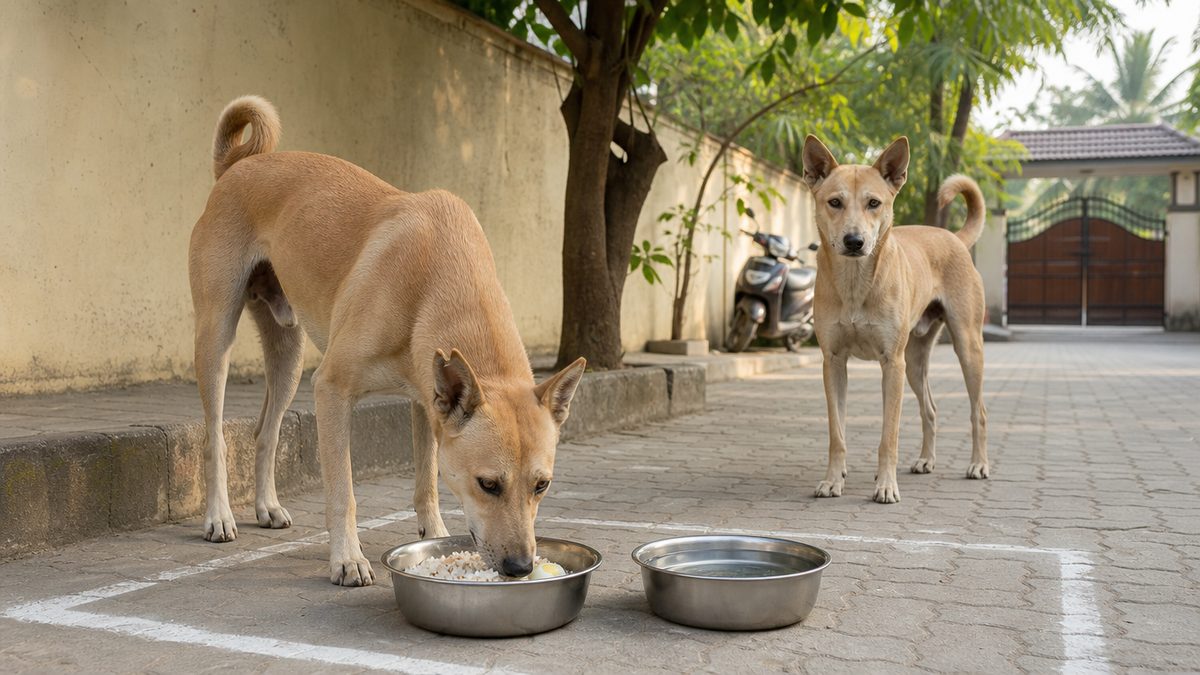
Quick answer
Feeding stray dogs in India is legal at a designated feeding spot. Rule 20 of the Animal Birth Control Rules 2023 makes the RWA, apartment owners' association or local body responsible for arranging feeding at agreed spots and times, with no littering; the Supreme Court's order of 22 August 2025, kept in force by its judgment of 19 May 2026, adds a feeding space in every ward and bars feeding on streets. A feeder gets authorised as a Colony Animal Caretaker through the district veterinary officer, takes a dispute to the Rule 20(2) committee, and feeds a complete diet or rice and roti with egg.
Is it legal to feed street dogs in India?
Yes, it is legal to feed street dogs in India at a designated feeding spot: Rule 20 of the Animal Birth Control Rules 2023 makes the resident welfare association, the apartment owners' association or the local body's representative responsible for arranging the feeding of community animals at agreed spots and times, and the Supreme Court's order of 22 August 2025, kept in force by its judgment of 19 May 2026, requires a dedicated feeding space in every municipal ward and bars feeding on the streets Supreme Court of India.
Feeding is not illegal; feeding anywhere is. Three conditions attach to the lawful act. The spot is one the RWA, AOA or local body has designated 'far from children play areas, entry and exit points, staircase', the time is one 'least frequented by children and senior citizen', and the feeder leaves no litter behind (Rule 20(1)(i) to (iii)). Since 22 August 2025 a fourth condition applies everywhere in the country, because the three-judge bench extended the case to every State and Union Territory that day: 'Under no condition shall the feeding of stray dogs on the streets be permitted', and a person feeding on the street is 'liable to be proceeded against under the relevant legal framework' (paragraph 33(d)). The Rules are a statutory instrument, notified as G.S.R. 193(E) on 10 March 2023 under section 38 of the Prevention of Cruelty to Animals Act, 1960, in supersession of the 2001 Rules; the orders bind every authority named in them, and the judgment of 19 May 2026 directs 'strict and faithful compliance' with the 22 August and 7 November 2025 orders at paragraph 109. The wider picture, the census count, the bite figures and the ABC procedure, is on the stray dogs in India guide; this page holds the feeding law in full.
| Document | Date | What it says about feeding | Status on 18 September 2026 |
|---|---|---|---|
| AWBI revised guidelines on pet and street dogs (advisory under section 9(k)) | 26 February 2015 | 'There is no law that prohibits the feeding of street animals'; care-givers to avoid play areas, walks and crowded places, keep no litter, keep sterilisation and vaccination records | Advisory; annexed to the 2026 caretaker letter as a condition; overtaken on street feeding by the 2025 order |
| Delhi High Court, Dr Maya D. Chablani v. Radha Mittal | 24 June 2021 | Community dogs 'have the right to food and citizens have the right to feed community dogs'; feeding at areas designated by the AWBI with the RWA; the SHO keeps the peace | A Delhi judgment; reported stayed on 4 March 2022 and the stay vacated on 19 May 2022; predates the Rules and the orders |
| AWBI advisory No. 6-2/2020-21/PCA | 3 March 2021 | Identify a 'sufficient number of feeding spots' in every town, village, RWA and institution in every district; police to prevent harassment at the designated spot | Advisory to Chief Secretaries, Directors General of Police and municipal corporations |
| Animal Birth Control Rules 2023, Rule 20 | 10 March 2023 | RWA, AOA or local body arranges feeding; spots and times agreed; no littering; a seven-member committee; one appeal to the State Board | Statutory; in force |
| Supreme Court order, paragraph 33 | 22 August 2025 | Dedicated feeding spaces in each municipal ward with notice boards; no feeding on streets; a helpline for violations; prosecution for obstruction; adoption through the municipal body | In force; case extended to every State and Union Territory |
| Supreme Court order, directions 25(A) to (J) | 7 November 2025 | Dogs removed from schools, hospitals, sports complexes, bus stands and railway stations and not re-released there; waste systems 'to eliminate food sources that attract animals'; the AWBI to issue an SOP | In force; reaffirmed 19 May 2026 |
| AWBI Standard Operating Procedure | 27 November 2025 | 'Feeding of dogs must only take place at the designated feedings spots'; food vendors within 100 metres of an institutional area keep closed bins and feed no dogs; a feeding chart by body weight | Upheld 19 May 2026; binding on every authority under direction 108(C) |
| AWBI letter No. AC-02025/1/2026-AWBI on Colony Animal Caretakers | 1 March 2026 | The district veterinary officer authorises caretakers within one month; nine duties and three prohibitions; quarterly reports or the authorisation lapses | In force |
| Supreme Court judgment, 2026 INSC 506 | 19 May 2026 | Keeps the 2025 orders; campus feeding groups must file a liability affidavit (paragraph 74); every State reports its ward feeding spaces (item 26); High Courts monitor | Governs today; next Supreme Court listing 17 November 2026 |
Where the ranking pages and the documents differ
The page that ranks first for this query is a Thai study, not an Indian rule: 137 of 168 residents interviewed in Songkhla in January 2021 reported a problem from stray dogs, garbage scavenging was the commonest problem at 62.5 percent, and feeding was associated with problems at an odds ratio of 3.94 (95 percent confidence interval 1.26 to 17.41); its line that feeding 'is also prohibited by law' is about Thailand. VOSD's guide of 22 September 2020 answers 'Is feeding stray dogs illegal?' with 'No one has the authority to stop you from feeding stray dogs, within or outside your society', which was the AWBI's 2015 position and is not the position after 22 August 2025. The Times of India opinion piece of 16 January 2026 quotes Rule 20(1) word for word and the Delhi High Court's 2021 line, and does not mention the 22 August or 7 November 2025 orders at all; it also prints 21,95,122 dog bites for 2024 'according to media reports', where the Ministry's own table, tabled in the Lok Sabha on 1 April 2025, reads 37,15,713, with Maharashtra (4,85,345), Tamil Nadu (4,80,427), Gujarat (3,92,837) and Karnataka (3,61,494) at the top of the table and Delhi at 25,210 Lok Sabha, Unstarred Question No. 4870. Where a report and a document differ, this page follows the document and says so.
Feeding is lawful at the designated spot and unlawful on the street. The same paragraph of the 22 August 2025 order that bars street feeding creates the ward feeding spaces where feeding continues, and it gives its reason: 'untoward incidents caused by unregulated feeding of stray dogs' and the difficulty the practice 'creates for the common man walking on the streets';. A headline that says the Court banned feeding is wrong; so is a post that says nobody can stop you.
What Rule 20 of the ABC Rules 2023 says, clause by clause
Rule 20 of the Animal Birth Control Rules 2023, headed 'Feeding of Community Animals', puts the duty to arrange feeding on the Resident Welfare Association, the Apartment Owner Association or the local body's representative, attaches four conditions, and creates a seven-member Animal Welfare Committee whose decision on the feeding point is final, with one appeal to the State Animal Welfare Board.
Four definitions carry the rule. A 'community animal' is 'any animal born in a Community for which no ownership has been claimed by any individual or an Organisation' (Rule 2(1)(j)); the 'Animal Welfare Committee' is the committee 'for resolution of the community dog feeding' (Rule 2(1)(e)); street dogs are 'community owned Indian dogs or abandoned pedigreed dogs which are homeless, living on the street or within a gated campus' (Rule 7(2)); and the local authority, not the feeder, is 'responsible for deworming, immunisation and sterilisation' of street animals (Rule 8(2)). Rule 20(1) then says the RWA, AOA or local body's representative 'shall' make the 'necessary arrangement for feeding of community animals residing in the premises or that area', involving the resident 'who feeds those animals or intends to feed those animals and provides care to street animals as a compassionate gesture', and shall ensure the four things listed below.
- Designated feed spots 'which are mutually agreed upon, keeping in mind the number of dog population and their respective territories', placed 'far from children play areas, entry and exit points, staircase or in an area which is likely to be least frequented by children and senior citizen' (Rule 20(1)(i)).
- A designated feeding time 'depending on the movement of children, senior citizens, sports which is likely to be least frequented by children and senior citizen' (Rule 20(1)(ii)).
- No littering. The 'designated feeder shall ensure that there is no littering at the feeding location or violation of guidelines framed by' the RWA, the AOA or the area (Rule 20(1)(iii)).
- A place in the ABC programme. 'Designated feeders are allowed to volunteer for the vaccination, catching and release of dogs to assist with the Animal Birth Control Program' (Rule 20(1)(iv)). The programme that sterilises, vaccinates and returns them is on the dog sterilisation guide.
Rule 20(2) applies 'where there is any conflict between the Resident Welfare Association or Apartment Owner Association and the animal caregivers or other residents'. The committee has seven members, the Chief Veterinary Officer or a representative, a representative of the jurisdictional police, one of the district SPCA or the State Board, one of a recognised ABC organisation, a veterinary officer deputed by the local authority, the complainant, and a representative of the RWA, AOA or local body, and its decision 'shall be the final decision with regard to the fixing of the feeding point'; it 'may also nominate person from amongst the designated Colony Care Taker by the Board to feed those animals in that area';. Rule 20(3) gives 'any local authority or animal welfare organisation or any feeder Resident Welfare Association or Apartment Owner Association or Local Body aggrieved' one appeal to the State Board, whose decision 'shall be the final decision for feeding of animals in that area';. Two other rules matter to a feeder: Rule 22 makes any local rule or bye-law 'more irksome to the animal than those contained in these rules' 'of no effect', while a gentler one prevails, and Rule 18(6) says 'any violation under these rules shall be deemed to be an offence under the Act';.
It names no fee, no form, no fine for a feeder, and no time limit for an RWA to designate a spot. It does not say what happens where there is no RWA at all beyond naming the local body's representative, and it does not say how a Colony Care Taker is 'designated by the Board'. The AWBI's letter of 1 March 2026 fills the form and the designation gap; nothing yet fills the time limit.
What the Supreme Court's orders of 2025 and the judgment of 19 May 2026 add
The Supreme Court added five feeding directions on 22 August 2025, in paragraph 33(d) to (h) of its order in Suo Motu Writ Petition (Civil) No. 5 of 2025, and its judgment of 19 May 2026 (2026 INSC 506) keeps them in force through paragraph 109, upholds the AWBI's SOP that confines feeding to designated spots, and makes every State report its ward feeding spaces under item 26 of the compliance format Supreme Court of India.
| Date | What the Court did | What it said on feeding | What it means for a feeder |
|---|---|---|---|
| 28 July 2025 | Two judges take suo motu cognisance of a Times of India report on a six-year-old's death from rabies in Delhi | Nothing yet | Origin of the case |
| 11 August 2025 (2025 INSC 977) | Five NCR cities told to pick up stray dogs from all localities and never release them; 'any resistance' to catching to be 'viewed strictly', with contempt | No feeding direction | The no-release direction has been in abeyance since 22 August 2025; the bar on obstructing a catching team has not |
| 22 August 2025 (2025 INSC 1018) | Three judges restore release to the same area; paragraph 33(d) feeding spaces per ward and no street feeding; (e) a helpline for violations; (f) prosecution for obstruction; (g) deposits of Rs 25,000 by each individual and Rs 2,00,000 by each NGO that had approached the Court; (h) adoption through the municipal body; case extended to all States | Feed only at the designated space | The order that governs feeding everywhere in India |
| 7 November 2025 (2025 INSC 1357) | Schools, hospitals, sports complexes, bus stands and railway stations fenced; dogs inside removed after sterilisation and vaccination and not re-released there; the AWBI to issue an SOP in four weeks | 'Proper waste-management systems shall be implemented to eliminate food sources that attract animals' | No feeding inside those premises |
| 27 November 2025 | The AWBI circulates the SOP | 'Feeding of dogs must only take place at the designated feedings spots' | Binding on every authority under direction 108(C) of the judgment |
| 19 May 2026 (2026 INSC 506) | Judgment: the SOP upheld (paragraph 85); campus feeding groups must file a liability affidavit (paragraph 74); each State decides extension to other public spaces (108(D)); High Courts monitor; compliance affidavits due 7 August 2026 | Feeding spaces per ward reported as item 26 of the compliance format | Ask the municipal body what it reported under item 26 |
| 17 November 2026 | Next Supreme Court listing, for the High Courts' first consolidated reports | None yet | The next date on which the rules can change |
Paragraph 33(d) is the feeding direction in full. Municipal authorities 'shall forthwith commence an exercise for creating dedicated feeding spaces for the stray dogs in each municipal ward', sized to 'the population and concentration of stray dogs in the particular municipal ward', with 'gantries/notice boards' saying that stray dogs 'shall only be fed in such areas';. Paragraph 33(e) requires 'a dedicated helpline number for reporting incidents of violation', on which 'appropriate measures shall be taken against the individuals/NGOs concerned'; 33(f) makes anyone obstructing a public servant acting under the order 'liable to face prosecution for obstructing the public servant acting in discharge of official duty'; and 33(h) lets 'the desirous animal lover/s' apply to the municipal body to adopt a tagged dog, on the condition that 'the adopted stray dogs do not return to the streets', the route the adopting a dog in India guide describes. The bench also wrote that the 11 August direction never to release treated dogs 'seems to be too harsh' and that Rule 11(19) 'clearly provides' for release to the same locality, which is why a feeder still sees the same ear-notched dogs come back.
What the judgment of 19 May 2026 holds about feeders
The judgment asks feeders a question and answers it for one group. At paragraph 71 the Court asks whether those who 'claim to care for or exercise control over stray dogs in a given locality, would be willing to accept tortious liability in respect of any injury, harm or damage caused by such dogs'; at paragraph 74 it makes that mandatory for any feeding group on an educational campus, 'by filing an affidavit to this effect with the Head of the Institution concerned, failing which no such activity of maintaining or feeding stray dogs shall be permitted within the institutional premises', with NALSAR University of Law, Hyderabad, as the model (paragraph 73). Outside institutions the answer is still Rule 20: counsel asked for removal to extend to 'public parks, gated housing societies and residential complexes' (paragraphs 35 and 37), and the Court instead told each State to 'take an informed and reasoned decision regarding the extension of the directions issued by this Court to other public spaces characterised by high footfall and public utility' (108(D)). The SOP's reach into religious places, parks, tourist sites and recreational areas was challenged and upheld: 'all interlocutory applications challenging the validity of the said SOPs stand dismissed' (paragraph 85).
One numbering slip is worth knowing, because a feeder who quotes the wrong paragraph loses an argument at the gate. In the 11 August 2025 order as published, the five operative directions sit under a paragraph numbered 11, the second paragraph 11 in the document, and the contempt warning under 12; the 22 August order quotes the same text as paragraphs 12 and 13 Supreme Court of India. Quote the words, not the number.
The 22 August 2025 order does not ban feeding; it bans feeding on streets and orders feeding spaces. The 19 May 2026 judgment does not order every dog into a shelter; it confines no-release to institutional and restricted-access premises and leaves housing societies to the Rules and to each State's reasoned decision. Where a news report and the order differ, the order governs, and every quotation on this page is from the order's own text.
What the AWBI's guidelines say, from 2015 to the SOP of 2025
The Animal Welfare Board of India has issued four documents a feeder can rely on, the revised guidelines of 26 February 2015, the feeding-spots advisory of 3 March 2021, the Standard Operating Procedure of 27 November 2025 and the Colony Animal Caretaker letter of 1 March 2026, and the 2015 guidelines are still annexed to the 2026 letter as a condition of authorisation Animal Welfare Board of India Animal Welfare Board of India.
The revised guidelines of 26 February 2015
The 2015 guidelines are an advisory under section 9(k) of the PCA Act, signed by the Board's then Chairman, Maj. Gen. (Retd.) Dr R.M. Kharb, on the letterhead of its then office at Thiruvanmiyur, Chennai, in place of the circular of 20 February 2014. For care-givers of street dogs they say four things: participate in the dogs' 'sterilization, and yearly vaccination too'; do 'not feed street dogs close to residences not their own' and avoid feeding 'immediately adjacent to areas in which children play, or people take walks, or that are otherwise crowded'; feed in no 'manner that contributes to littering' and 'clean up feeding sites after feeding is over'; and keep 'the sterilization and vaccination status of the dogs they are feeding and caring for, updated and readily accessible', sharing it with the RWA. For RWAs the street-dog part opens with 'Beating and driving away street dogs, is NOT ALLOWED; animal birth control and release back into same locality/territory, is ALLOWED', and its third heading, 'Street dog feeding, whether inside or outside community premises and gated complexes', reads: 'There is no law that prohibits the feeding of street animals. Citizens who choose to do so are in fact performing a duty cast upon them by the Constitution of India, of showing compassion to all living creatures. Courts have upheld street dog feeding since the same reduces human-animal conflict and suspicion, and facilitates animal birth control (by making dog catching easier)';. It adds that cruelty is an offence under section 11 of the PCA Act and sections 428 and 429 of the Indian Penal Code as numbered in 2015, and that 'attempts to interfere with, or harass persons who choose to look after and feed community dogs, maybe tantamount to the very grave offence of criminal intimidation'.
Two things about that document. First, its 'no law prohibits' sentence and the Supreme Court's 'under no condition shall the feeding of stray dogs on the streets be permitted' cannot both describe today; the order of 22 August 2025 governs, and the guideline's spot, time and cleanliness conditions survive because the 2026 caretaker letter makes 'implementation of the AWBI Guidelines dated 26.02.2015' a duty of every authorised caretaker Animal Welfare Board of India. Second, the Board's PDF is an image scan that extracts to 114 characters through pypdf; every quotation above was read from the scanned pages themselves.
The Delhi High Court judgment of 24 June 2021 and the advisory of 3 March 2021
The Delhi High Court judgment that feeders cite is Dr Maya D. Chablani v. Radha Mittal, decided by Justice J.R. Midha on 24 June 2021. Paragraph 126 holds that 'Community dogs (stray/street dogs) have the right to food and citizens have the right to feed community dogs but in exercising this right, care and caution should be taken to ensure that it does not impinge upon the rights of others'; paragraph 127 puts feeding 'at areas designated by the AWBI in consultation with Resident Welfare Associations or Municipal Corporation', one area per pack because 'every community dog is a territorial being'; paragraph 128 directs 'all law enforcement authorities' to ensure 'no harassment or hindrance is caused to the person feeding street dog at the designated feeding spot'; and paragraph 137 makes 'peace and harmony' at the spot 'the duty of the SHO concerned';. A news report of 19 May 2022 says a three-judge bench vacated the stay placed on the judgment in March 2022 and disposed of the challenge by Humane Foundation for People and Animals; no Supreme Court order in that matter was opened for this page, so that history is reported, not verified. The judgment predates Rule 20 and the 2025 orders, which now carry its designated-spot idea in binding form.
The Board's advisory of 3 March 2021 (No. 6-2/2020-21/PCA), sent to the Chief Secretary and the Commissioner of Police of Delhi and copied to every Chief Secretary, Director General of Police and municipal corporation, records that feeders 'are being harassed by their neighbours, RWAs and others' and that 'the local police is not taking cognizance of such events', and asks every State to 'identify sufficient number of feeding spots for stray dogs in every town, villages, RWA and other institute etc. in each and every District' and its police to 'ensure that no harassment or hindrance is caused to the person feeding street dog at the designated feeding spot';.
The Standard Operating Procedure of 27 November 2025
The SOP is the Board's answer to direction 25(J) of the 7 November 2025 order, circulated under File No. AC-02017/22/2025-AWBI over the signature of Dr Muthukumarasamy B., Joint Secretary and Chairman, and its scope is institutional premises. Four of its clauses reach a feeder anywhere. Clause 2(v)(a) requires 'food operators/ vendors selling food in and around 100 meters' of an institutional area to keep 'closed waste disposal pits/ bins' and to 'ensure that no dogs are fed near or around their food stall'; clause 2(v)(c) says citizens 'should also be made aware that feeding of dogs must only take place at the designated feedings spots'; clause 2(vi)(a) asks local authorities to teach 'the importance of waste management and responsible feeding'; and clause 2(iv)(h) gives the Board's general rule for quantity, 'Dogs eat around 2-3% of their body weight per day', counting all food whether dry, wet or homemade, with a chart that puts a 20 kg dog at 400 to 600 grams a day. Its hygiene practice at 2(iv)(i), written for shelters, is the checklist the feeding section below uses: the same quiet place, clean bowls, water at all times, leftovers removed after 20 to 25 minutes, any new diet mixed in over 5 to 7 days. The PDF is a 13-page scan that extracts to 251 characters, so the clauses were read from page images; the judgment's summary at paragraph 78 matches what the pages say.
How to get authorised as a Colony Animal Caretaker
To get authorised as a Colony Animal Caretaker, apply to the district's Chief Veterinary Officer, Deputy Director or District Animal Husbandry Officer on the form annexed to the AWBI's letter No. AC-02025/1/2026-AWBI of 1 March 2026, which requires a decision within one month and gives one appeal to the State Animal Welfare Board.
The letter records that the Board, at its 55th Annual General Meeting on 19 December 2025, 'agreed to delegate the powers for nomination and authorization of CACTs to the field-level authorities of the State Governments', because caretakers 'play an important role in voluntarily undertaking feeding, basic medical care and general oversight of street animals in their respective localities'. Until then Rule 20(2) spoke of a caretaker 'designated by the Board'; since March 2026 the district authorises caretakers and the Board sets the terms. The six steps are listed below.
- Be the feeder of a community animal at an agreed spot. The Rules define the animal (Rule 2(1)(j)) and the spot (Rule 20(1)(i)); the letter is for a person who already feeds, or 'intends to feed', within a locality, not a licence to start feeding anywhere.
- Fill Annexure I, the application form. It asks, in capital letters, for name, father's name, date of birth, complete address with PIN code, mobile or WhatsApp number, email, Aadhaar number with a self-attested copy, a self-attested copy of one of a voter ID, driving licence, passport or PAN card as address and photo proof, a photograph and a signature.
- Submit it to the district officer. The Chief Veterinary Officer, Deputy Director or District Animal Husbandry Officer 'may issue the letter of authorization as CACT, based on the local requirement and after due examination of the applications', 'shall take a decision on the application within one month of its submission', and 'in cases where there is no such requirement' may reject it 'keeping in view the directions of the Hon'ble Supreme Court regarding restrictions on feeding in public places'.
- Appeal if refused, or if the month passes with no decision. The appeal lies 'before the Member Secretary, State Animal Welfare Board or the Director/Commissioner, Animal Husbandry Department of the respective State/UT, who shall dispose of the appeal preferably within one month after a summary enquiry', and that decision 'shall be final'.
- Read the bilingual letter before you accept it. Annexure II authorises you 'as Colony Animal Caretaker of community animals, providing food and medical care and attention to them', records that in doing so you perform 'the Fundamental Duty cast upon all citizens of India by Article 51A(g) of the Constitution of India to show Compassion to living creatures', and binds you to the nine duties and three prohibitions in the table below.
- File the quarterly report. The caretaker 'has to mandatorily provide quarterly (three-monthly) reports to the State Animal Welfare Board as to specific compliance against the abovementioned functions, failing which, the authorization stands cancelled' (paragraph 5).
| Clause | What it requires | What it traces to |
|---|---|---|
| 2(i) | Feeding inside a housing society 'at a designated place away from the main building' | Rule 20(1)(i), the designated spot |
| 2(ii) | In a public garden, 'a certain corner in the garden away from walking/jogging trail' | The 2015 guideline against feeding where people take walks |
| 2(iii) | 'Use steel or aluminum bowls to feed dogs, pick the bowls after feeding and clean them' | Rule 20(1)(iii), no littering |
| 2(iv) and 2(v) | Clean the area 'if they have strewn food around'; 'use a scooper to pick up stools/faeces and dispose it in a garbage collection receptacle' | Rule 20(1)(iii) |
| 2(vi) | 'Always feed the dogs at the same site and same time' | Rule 20(1)(ii), the designated time |
| 2(vii) | Assist the district administration in providing 'adequate food, water, shelter and the necessary veterinary assistance and protection' | Rule 8(2), the local authority's duty |
| 2(viii) | 'Aid and assist in the enforcement of the Animal Birth Control Rules, 2023' at an ABC centre run by a recognised organisation | Rule 20(1)(iv), the feeder as volunteer |
| 2(ix) | 'Ensure implementation of the AWBI Guidelines dated 26.02.2015' | The 2015 guidelines, annexed as Annexure III |
| 3(i) | No food or water 'on staircase landings or outside doors/gates' | Rule 20(1)(i), staircases and exits |
| 3(ii) | No feeding 'on newspapers, plastic packets or on the ground directly' | Rule 20(1)(iii) |
| 3(iii) | No feeding 'on or near ground level water storage tanks or even septic tanks', because 'there is danger of dogs and puppies falling inside the tanks and contaminating it' | New in the letter |
| 4 | The letter 'may not be considered as an authorization for conducting search, seizure or raids' | Law enforcement agencies only |
| 5 | Quarterly reports to the State Board, 'failing which, the authorization stands cancelled' | New in the letter |
It gives you a signed document, in Hindi and English, that names Article 51A(g) and the Rules, to show an RWA, a security guard or a police officer, and it makes you a person the Rule 20(2) committee may nominate to feed. It does not give you a right to feed on the street, to enter premises, to keep a dog from an ABC pick-up, or to search or raid. No fee appears anywhere in the letter Ministry of Fisheries.
How a designated feeding spot is fixed, and what to do when the RWA objects
A designated feeding spot is fixed by mutual agreement between the RWA, AOA or local body's representative and the residents who feed, under Rule 20(1)(i) of the ABC Rules 2023, and a dispute goes to the seven-member Animal Welfare Committee under Rule 20(2), whose decision on the feeding point is final subject to one appeal to the State Animal Welfare Board under Rule 20(3).
Five steps fix a spot that survives an objection.
- Count the dogs and map their territories. Rule 20(1)(i) fixes spots 'keeping in mind the number of dog population and their respective territories', and the Delhi High Court's paragraph 127 says each pack 'ideally has different designated areas for feeding even if that means designating multiple areas in a locality'; High Court of Delhi.
- Choose the place by the exclusions. Far from play areas, entry and exit points and staircases (Rule 20(1)(i)); inside a society 'away from the main building', in a park 'away from walking/jogging trail' (caretaker letter 2(i) and 2(ii)); never on landings, outside gates, or near water or septic tanks (3(i) and 3(iii)).
- Fix the time by the same test. When children and senior citizens are least about (Rule 20(1)(ii)), and then 'always feed the dogs at the same site and same time' (letter 2(vi)); the SOP's rule of removing leftovers after 20 to 25 minutes keeps the spot clean between feeds Animal Welfare Board of India.
- Get it written down. Ask the RWA or AOA to minute the agreed spot and time, keep the sterilisation and vaccination status of each dog 'updated and readily accessible' as the 2015 guideline asks, and share it with the RWA; a notched, vaccinated pack is the strongest argument a feeder has. The Government's own evidence that the programme works is Bengaluru's, where the Bruhat Bengaluru Mahanagara Palike's surveys of 2019 and 2023 found a 10 percent fall in the street dog population and a 20 percent rise in neutering. The annual rabies booster a caretaker should arrange is on the dog vaccination schedule.
- Outside a society, use the ward space. Municipal authorities were told to create 'dedicated feeding spaces for the stray dogs in each municipal ward' marked by 'gantries/notice boards' (paragraph 33(d)), and every State had to report 'creation of dedicated feeding spaces for stray dogs in each municipal ward' as item 26 of its compliance affidavit to the High Court by 7 August 2026; ask the ward office where its spaces are and what it reported Supreme Court of India.
When the RWA objects
- Put the Rules in front of the RWA. Rule 20(1) makes the arrangement the RWA's duty, not its option; Rule 22 makes a bye-law harsher than the Rules 'of no effect'; and the 2015 guidelines, which the Board still annexes, say driving away street dogs 'is NOT ALLOWED' and, in their pet-dog part, that a general body 'cannot adopt an illegality' 'even by a complete majority'; Animal Welfare Board of India.
- Ask the local authority to convene the Rule 20(2) committee. Write to the Chief Veterinary Officer or the municipal veterinary officer naming the conflict; the committee of seven includes the police, the district SPCA or State Board, a recognised ABC organisation, the complainant and the RWA, and its decision 'shall be the final decision with regard to the fixing of the feeding point'.
- Accept the committee's spot, or appeal once. Any feeder, RWA, local authority or organisation 'aggrieved' may appeal to the State Board under Rule 20(3); that decision is final for feeding in that area.
- Carry the caretaker letter. It names Article 51A(g) and the Rules and lists the conditions you keep; an RWA that objects to a caretaker who keeps them is objecting to the Board's own terms.
- Do not settle it on the street. A feeder who moves the bowls to the road to avoid the RWA has moved from a protected spot to the one place the Supreme Court has barred.
The police, in both directions
The police sit on both sides of this rule. On the feeder's side, the AWBI's 2021 advisory asked every Director General of Police to ensure 'no harassment or hindrance' at the designated spot, the Delhi High Court made the SHO responsible for 'peace and harmony' there, and the 2015 guidelines say harassment of feeders 'maybe tantamount to the very grave offence of criminal intimidation' and that cruelty to a dog is an offence under section 11 of the PCA Act High Court of Delhi Animal Welfare Board of India. On the other side, the 22 August 2025 order requires a helpline 'for reporting incidents of violation' with 'appropriate measures' against 'the individuals/NGOs concerned', makes street feeders 'liable to be proceeded against', and makes anyone who obstructs a public servant 'liable to face prosecution';. A feeder at a designated spot who keeps the conditions is the person the advisory protects; a feeder on the road, or one who stands between a catching team and a dog, is the person the order names.
Not the RWA alone, and not yet the Supreme Court. Counsel asked the Court to bring 'gated housing societies and residential complexes' under the removal directions; the judgment left that to 'an informed and reasoned decision' by each State (direction 108(D)). Until a State takes that decision, a dog inside a society is a community animal under Rule 7(2), the RWA's duty is the feeding arrangement under Rule 20, and the only lawful way to move it is adoption through the municipal body Ministry of Fisheries Supreme Court of India.
What a feeder may not do
A feeder may not feed on a street, feed outside the designated spot and time, leave food or litter behind, feed inside a school, hospital or other institutional premises without the liability affidavit the Supreme Court requires, obstruct an authorised catching team, or use a caretaker letter for a search or a raid Supreme Court of India Ministry of Fisheries Animal Welfare Board of India.
The nine prohibitions below each name their source.
- Feed on a street, road or public place that is not a designated space. 'Under no condition shall the feeding of stray dogs on the streets be permitted' (22 August 2025, paragraph 33(d)); the SOP repeats that feeding 'must only take place at the designated feedings spots'; Animal Welfare Board of India.
- Feed outside the agreed spot or time inside a society. Rule 20(1)(i) and (ii) fix both; a caretaker must 'always feed the dogs at the same site and same time' (letter 2(vi)).
- Leave litter, newspaper, plastic or food on bare ground. Rule 20(1)(iii) bars littering; the letter bars feeding 'on newspapers, plastic packets or on the ground directly' and requires steel or aluminium bowls picked up and cleaned after feeding (2(iii) and 3(ii)).
- Keep food or water on staircase landings, outside doors or gates, or near water or septic tanks. Letter 3(i) and 3(iii).
- Feed inside an educational campus without the affidavit, or inside a hospital, sports complex, bus stand or railway station at all. Paragraph 74 of the judgment bars 'maintaining or feeding stray dogs' on a campus unless the group has filed an affidavit accepting tortious liability with the head of the institution; direction 25(E) of 7 November 2025 removes dogs from the other premises and bars their re-release there; the SOP bars feeding 'near or around' a food stall within 100 metres of such an area Supreme Court of India Animal Welfare Board of India.
- Obstruct or resist a catching team or any public servant acting under the orders. 'Any resistance offered by any individual or organizations' was to be 'viewed strictly' with contempt on 11 August 2025, and the 22 August order makes the violator 'liable to face prosecution for obstructing the public servant acting in discharge of official duty' (33(f)) Supreme Court of India.
- Move a dog yourself, or hand it to someone who will. Rule 11(19) requires release 'at the same place or locality from where they were captured'; the only lawful removal is adoption through the municipal body, which tags the dog and holds the adopter responsible that it does 'not return to the streets' (33(h)) Supreme Court of India.
- Use the caretaker letter as authority to search, seize or raid. Paragraph 4 of the letter says it 'may not be considered as an authorization for conducting search, seizure or raids as the same can only be done by law enforcement agencies of the respective State Government';.
- Skip the quarterly report, or ignore a bite. The authorisation 'stands cancelled' without the three-monthly report (letter, paragraph 5); a bite by a dog you feed goes to the local authority's helpline under Rule 16, which records it, shares it 'promptly' with the Government hospital and keeps the dog under observation for ten days Ministry of Fisheries.
What follows a breach is in the same documents: proceedings 'under the relevant legal framework' for street feeding and prosecution for obstruction (22 August 2025), cancellation of the caretaker authorisation (letter, paragraph 5), a committee decision that moves the spot (Rule 20(2)), and, under Rule 18(6), the deeming of 'any violation under these rules' as an offence under the Act Animal Welfare Board of India Ministry of Fisheries. The 22 August order's exception to release, dogs 'infected with rabies or suspected to be infected with rabies, and those that display aggressive behaviour', is the one case in which a dog a feeder knows can lawfully be kept away. This page takes no side on whether the balance is right; it records where the line is drawn and by which document.
What to feed community dogs: the nutrition questions, answered from veterinary sources
The best thing to feed a community dog is a complete and balanced dog food, which for a 20 kg dog means about 275 grams of dry food a day at Rs 45 to Rs 54 by the one Indian price opened for this page, and the safe home alternative is plain cooked rice or roti with a cooked protein and no onion, garlic, salt, spice or bones Merck Veterinary Manual U.S. Food and Drug Administration.
Three veterinary figures set the frame. A healthy adult dog of 20 kg needs 790 to 993 kilocalories a day, a 15 kg dog 640 to 800 and a 25 kg dog 940 to 1,174, on the WSAVA's chart built from the 2006 NRC maintenance requirement, and most Indian pariah dogs sit inside that band. An adult dog 'requires a minimum of 18% protein as dry matter or 45 grams per 1,000 kcal ME' under the AAFCO profiles, and 'both dogs and cats can digest properly cooked starches, such as those from grains, with > 90% efficiency', while dietary carbohydrate is 'not considered' an essential nutrient for an adult dog. Treats and table food 'should make up no more than 10% of a dog's daily calorie intake', and foods labelled 'complementary' or 'intermittent' belong inside the same 10 percent, which is why a food labelled complete and balanced is the reference and rice or roti is the supplement, not the reverse World Small Animal Veterinary Association. The one ranking page that gets the food list broadly right, Stray Dog Solidarity Alliance's post of 9 September 2025, cites no source and gives no quantity; the table below names both, and the hygiene and safety rules at the bowl come from the Board's own SOP Animal Welfare Board of India.
| Food | Verdict | Why | Source |
|---|---|---|---|
| Plain cooked rice | Fine as the carbohydrate base, not a meal on its own | Cooked grain starch is digested at over 90 percent; rice carries almost no protein toward the 18 percent minimum | Merck Veterinary Manual |
| Roti or chapati, plain | Fine occasionally, torn small, cooled | Wheat is a cooked cereal starch; a roti carries little protein and adds calories fast | Merck Veterinary Manual |
| Boiled egg, cooked chicken or fish, boneless | Good, as the protein | Supplies the protein a rice or roti base lacks; bones can lodge in the oesophagus, stomach or intestines | WSAVA; FDA U.S. Food and Drug Administration |
| Cooked or raw bones | Never | 'Bones (cooked and raw) can be very dangerous and cause significant damage if chewed and/or ingested by dogs' | WSAVA |
| Parle-G or other plain sweet biscuits | Not toxic; an occasional treat inside the 10 percent | Per 100 g: 454 kcal, 25.5 g of sugars, 13 g of fat, 6.9 g of protein, 0.74 g of salt; no chocolate and no xylitol on the label | Open Food Facts label transcription |
| Leftover sabzi, dal or curry with onion-garlic tadka | Avoid | Onion and garlic cause Heinz body haemolytic anaemia, with signs 'several days' after eating; garlic is 3 to 5 times more toxic than onion; powders and pastes are the worst forms | Merck Veterinary Manual |
| Salty, fried or spicy snacks | Avoid | Salt and 'fatty foods' are on the FDA's list of edible dangers | FDA |
| Chocolate, sweets or gum with xylitol, grapes and raisins (kishmish), tea, coffee, alcohol | Never | All are on the WSAVA's toxic-ingredient list and the FDA's edible-danger list | WSAVA; FDA U.S. Food and Drug Administration |
| Raw meat or raw eggs | Avoid | 'Unprocessed, raw animal-based treats' are 'a risk of pathogen transmission' | WSAVA |
| Water | Always, in a clean bowl | 'Keep water available at all times (24x7)'; wash bowls daily | AWBI SOP |
Can I feed Parle-G to stray dogs?
Parle-G is not poisonous to a dog, and it is not a meal. The pack label, as transcribed on Open Food Facts for the 45 g pack, lists refined wheat flour (maida) 68 percent, sugar, refined palm oil, invert sugar syrup, iodised salt, raising agents, milk solids, a flour treatment agent, an emulsifier and vanilla flavour, and gives 454 kcal, 25.5 g of sugars, 13 g of fat, 6.9 g of protein and 0.74 g of salt per 100 g. Nothing on that list is on the FDA's or the WSAVA's toxic lists; the problem is arithmetic. A 45 g pack is about 204 kcal, which is 20 to 26 percent of a 20 kg dog's daily need and double the WSAVA's 10 percent treat ceiling of roughly 79 to 99 kcal, and the biscuit's 6.9 percent protein is well under the 18 percent an adult dog's diet must carry Merck Veterinary Manual. One or two biscuits to win a frightened dog's trust for a catch or a vaccination is what the 2015 guideline's 'making dog catching easier' looks like in practice; a daily pack is sugar in place of food.
Can I give roti to street dogs?
Yes, a plain roti is safe for a healthy adult dog, and it is not enough on its own. Wheat is a cooked cereal starch that a dog digests at over 90 percent efficiency, so the roti is not the problem the internet makes it; the gap is protein, because grain alone does not reach the 18 percent dry-matter minimum, and the excess is calories, because carbohydrate is a non-essential nutrient that still counts toward the day's 790 to 993 kcal for a 20 kg dog World Small Animal Veterinary Association. Tear it small, serve it cool, add a cooked egg or meat, and keep ghee, butter, salt and the onion from the sabzi off it: the Merck manual records clinical signs in dogs after 15 to 30 g of raw onion per kg of body weight, which is 300 to 600 g in one sitting for a 20 kg dog, with garlic 3 to 5 times as toxic and the damage to red cells showing 'several days' later.
The cheapest complete diet, with an Indian price
A 20 kg bag of Pedigree Adult Chicken and Vegetables dry food was listed on Amazon.in at Rs 3,264 on 18 September 2026, against a printed M.R.P. of Rs 3,900 'inclusive of all taxes', sold by ETrade Online with the price displayed for delivery to Mumbai 400001, which is Rs 16.32 per 100 g at the sale price and Rs 19.50 at M.R.P.. Pedigree India's own feeding guide puts a 20 kg dog at 898 kcal and 275 g of dry food a day (255 g at 18 kg, 315 g at 24 kg), which makes a day's complete diet Rs 45 at the sale price and Rs 54 at M.R.P., a bag last about 73 days for one dog, and a month cost Rs 1,350 to Rs 1,610 per dog Amazon.in, Pedigree Adult Dry Dog Food. The exchange test passes: Rs 3,264 is USD 38.68 at 84.38 and USD 44.11 at 74, and Rs 3,900 is USD 46.22 and USD 52.70, so neither figure is a converted dollar list. It is one product, one retailer and one date; cheaper Indian brands exist and none was opened for this page, and the WSAVA's four questions for any brand are whether it employs a qualified nutritionist, who formulates the diet, what quality control it runs and whether the label says 'complete';. The AWBI's rule of 2 to 3 percent of body weight a day, 400 to 600 g for a 20 kg dog, counts dry, wet and homemade food together, so a rice-and-egg feeder uses the Board's grams and a kibble feeder the pack's.
Think beyond feeding. A community dog that is thin, pregnant, nursing, injured or off its food needs a veterinarian, not a bigger bowl; the SOP's own rule is to change any diet 'gradually over 5-7 days' and to remove leftovers after 20 to 25 minutes 'to prevent spread of any diseases', a rule a feeder in the monsoon or in a humid coastal city has the most reason to keep, and the Board's caretaker letter puts 'the necessary veterinary assistance' among a caretaker's duties Animal Welfare Board of India. Nothing on this page replaces that visit; your nearby vet decides for the dog in front of you. The rabies booster the dog needs every year is on the dog vaccination schedule, and the sterilisation route is on the dog sterilisation guide.
Common questions about feeding community dogs in India
Is it legal to feed stray dogs in India?
Yes, at a designated feeding spot. Rule 20(1) of the ABC Rules 2023 makes the RWA, apartment owners' association or local body responsible for arranging feeding at mutually agreed spots and times, away from play areas, gates and staircases, with no littering. The Supreme Court's order of 22 August 2025, kept in force by its judgment of 19 May 2026, adds a dedicated feeding space in every municipal ward and says 'under no condition shall the feeding of stray dogs on the streets be permitted'.
What can I safely feed stray dogs?
A complete and balanced dog food is the safe answer, about 275 g of dry food a day for a 20 kg dog by Pedigree India's guide. At home, plain cooked rice or a plain roti as the base, a boiled egg or boneless cooked chicken as the protein, and clean water in a steel bowl. Keep out onion, garlic, salt, spice, fried food, chocolate, grapes, raisins, xylitol sweets, tea, coffee and bones; the FDA and the WSAVA list every one of them.
Can I give roti to street dogs?
Yes, a plain roti is safe for a healthy adult dog: dogs digest properly cooked grain starch at over 90 percent efficiency, by the Merck Veterinary Manual. It is not a meal on its own, because an adult dog needs at least 18 percent protein as dry matter and a roti carries little. Tear it small, serve it cool, add an egg or cooked meat, and leave off ghee, salt and any onion or garlic from the sabzi.
Can I feed parle g to stray dogs?
Parle-G is not toxic to dogs; its label lists refined wheat flour, sugar, palm oil, invert syrup, salt, raising agents and milk solids, with no chocolate and no xylitol. It is 454 kcal and 25.5 g of sugar per 100 g, so a 45 g pack is about 204 kcal, 20 to 26 percent of a 20 kg dog's day and double the WSAVA's 10 percent treat limit. One or two biscuits to earn trust is fine; a pack a day is sugar in place of food.
What is the best thing to feed stray dogs?
The best thing to feed a stray dog is a food labelled complete and balanced, fed by the pack's grams: Pedigree India's guide gives a 20 kg dog 898 kcal and 275 g of dry food a day, which cost Rs 45 at Amazon.in's price of Rs 3,264 for 20 kg on 18 September 2026. Where kibble is out of reach, cooked rice or roti with egg or boneless meat, and water, covers the essentials; the AWBI's SOP counts all food at 2 to 3 percent of body weight a day.
Can an RWA stop me from feeding community dogs?
An RWA can fix where and when, not whether. Rule 20(1) of the ABC Rules 2023 makes the RWA responsible for arranging feeding at agreed spots and times; a conflict goes to the seven-member Animal Welfare Committee under Rule 20(2), whose decision on the feeding point is final, with one appeal to the State Animal Welfare Board under Rule 20(3). Rule 22 makes any society bye-law harsher than the Rules of no effect, and the AWBI's 2015 guidelines say driving street dogs away is not allowed.
Can the police act against someone feeding stray dogs?
Yes, in two directions. Under the Supreme Court's order of 22 August 2025 a person feeding on the street is liable to be proceeded against, each municipal body keeps a helpline for violations, and obstructing a catching team is prosecutable. At a designated spot the AWBI's advisory of 3 March 2021 asks every police force to ensure no harassment or hindrance to the feeder, and the Delhi High Court made the SHO responsible for peace at the spot.