
Dog health guide
Dog sterilisation in India: age, cost, recovery and the ABC programme for community dogs
Two readers, one surgery. The owner deciding when to spay or neuter gets the 2019 AAHA rule and the UC Davis breed numbers with their denominators, the surgery step by step, counted complication rates and dated Indian prices. The resident who wants a lane's dogs done gets the clauses of the ABC Rules 2023 and the AWBI Handbook that fix who may operate, the ear notch, the four-day stay and the release, and where the two documents disagree.
Quick answer
Dog sterilisation in India is done at 5 to 6 months for a dog finishing under 20 kg and at 9 to 15 months for larger dogs, costs Rs 300 to 400 at a government polyclinic and Rs 6,000 to 20,000 privately, and needs 7 to 14 days of rest. A community dog is sterilised free at the local authority's ABC centre under the Animal Birth Control Rules 2023, kept four days, ear-notched, vaccinated and released to the same spot. Your nearby vet sets the age.
This guide is general information for Indian pet owners and is not a diagnosis. Always consult a registered veterinarian near you before acting on anything you read here, and treat any sudden change in your pet's condition as urgent.
What dog sterilisation means: spaying, neutering and castration
Dog sterilisation is surgery under general anaesthesia that removes the organs a dog breeds with: the ovaries and uterus in a female (spaying, or ovariohysterectomy) and both testicles in a male (castration, the usual meaning of neutering). In India the same surgery runs on two tracks, a pet dog at a clinic paid for by its owner, and a street dog at an Animal Birth Control centre paid for by the local authority under the Animal Birth Control Rules, 2023.
The words overlap, so the table below fixes them. 'Neuter' covers either sex in American veterinary writing and males only in most Indian clinics; 'sterilisation' and the Hindi 'nasbandi' cover both. A vasectomy or an ovary-sparing hysterectomy stops breeding and keeps the hormones, and neither is offered by the ABC programme Animal Welfare Board of India.
| Procedure | What is removed | What it stops | Where it is done in India |
|---|---|---|---|
| Ovariohysterectomy (spay) | Both ovaries, the uterine horns and the uterus | Heat cycles, pregnancy, pyometra, most of the hormone-driven behaviour | Pet clinics and every ABC centre; the AWBI Handbook makes it the only accepted female surgery for street dogs |
| Ovariectomy | Both ovaries only | The same as a spay in effect; the empty uterus stays | Some private clinics; not accepted for ABC surgery because a uterine remnant can still develop stump pyometra |
| Orchiectomy (castration, 'neuter') | Both testicles, through one pre-scrotal incision | Sperm, testosterone-driven roaming, marking and mounting | Pet clinics and every ABC centre |
| Vasectomy | A length of each vas deferens | Fertility only; hormones and behaviour unchanged | Rare; ask a referral hospital |
| Hysterectomy (ovary-sparing spay) | The uterus and part of the tubes | Pregnancy and pyometra; heat behaviour continues | Rare; ask a referral hospital |
| Chemical castration (GnRH implant) | Nothing; a hormone implant suppresses the testes for months | Fertility and testosterone for the life of the implant | The AVMA says nonsurgical methods are not routinely available; not part of the Indian ABC standard |
For a street dog the AWBI's Handbook is explicit: 'complete ovariohysterectomy must be performed rather than tubectomy or ovariectomy', because a left-behind ovary brings the dog back into heat and a left-behind uterine stump can fill with pus; for a male, both testicles come out through a single pre-scrotal incision. A pet owner may choose an ovariectomy or a laparoscopic spay where a clinic offers it; the AVMA lists ovariectomy as an option whose 'impact is similar to ovariohysterectomy';. Your nearby vet decides which suits your dog.
This page is the medicine and the procedure. The count of street dogs, the Supreme Court's orders in date order, feeding rules and what a resident welfare association may do are on the stray dogs in India page, and this page does not repeat them.
Is sterilisation good for dogs? The benefits, with their denominators
Sterilisation is good for most dogs on the measures that have been counted: in 40,139 dogs whose cause of death was recorded in the Veterinary Medical Database, sterilised males lived 13.8 percent longer and sterilised females 26.3 percent longer than intact dogs, with a mean age at death of 9.4 years against 7.9. The same study is the one that keeps the answer honest, because sterilised dogs died less often of infectious disease and more often of cancer. The health benefits below each carry a number, and two myths, one litter first and prostate protection, are dealt with where they arise.
Pyometra, the female benefit that is not in dispute
Pyometra, a pus-filled uterus, is the strongest single reason to spay a bitch that will not be bred. In a Swedish insurance database of over 200,000 dogs, 1,803 bitches under ten had a pyometra claim in 1995 and 1,754 in 1996, a 12-month risk of 2.0 percent, and 23 to 24 percent of intact bitches had experienced it by age ten, 10 to 54 percent by breed. A later study of over 260,000 female dogs in the same database put pyometra at 19 percent by age ten and mammary tumours at 13 percent, with the Rottweiler in the top ten at 65 percent for one or both; the Rottweiler page carries the bone-cancer side of the same timing decision. A spay removes the uterus, so the risk goes to zero unless a stump is left behind.
Mammary tumours, where the evidence is weaker than the ranking pages say
The mammary tumour benefit is real but its size is contested, and both figures belong on the page. The 2019 AAHA guideline repeats the classic finding that mammary neoplasia occurs in 8 percent of bitches allowed one heat before spaying and 26 percent after two, against an osteosarcoma incidence of 0.2 percent, and uses it to argue for spaying small breeds before the first heat. A 2012 systematic review of 13 studies on the same question judged nine to carry a high risk of bias, found one study with an association and two with none, and concluded that the evidence 'is judged to be weak' and 'not a sound basis for firm recommendations';. In Hart's 35-breed data the mammary counts are small and mixed, 1 percent of intact Labrador females against 2 percent spayed late, 8 against 5 in Rottweilers. Read that as 'early spaying probably lowers a real risk, and nobody has measured by how much'.
The male benefits, and one claim to drop
Castration removes the testicles and with them testicular cancer, and it reduces the risk of benign prostatic enlargement, roaming and urine marking. It does not protect against prostate cancer. The AAHA guideline lists prostate cancer among the tumours for which 'sterilized dogs are at higher risk than intact dogs', alongside osteosarcoma, haemangiosarcoma, transitional cell carcinoma and mast cell tumours.
iAdopt's 2021 guide, which ranks seventh in India for this query, says that 'over 85% of male dogs with cancer are likely to be diagnosed with prostate cancer' and that castration 'will bring down the chances of getting prostate cancer';. Neither sentence carries a source. The AAHA guideline, citing a population study of neutering status and canine prostate cancer, puts the risk the other way. Castrate a male for the testicular, prostatic-enlargement and behavioural reasons, never for prostate cancer.
Removing the ovaries ends heat cycles; removing the testicles reduces roaming and marking, and the AVMA says 'reduces', not 'ends';. Weight is the cost. 'Most, but not all, studies in dogs identify a risk for obesity among sterilized individuals', greatest in the two years after surgery, and spayed females carry a higher lifetime risk of urinary incontinence. The Labrador Retriever page carries the weight-after-neutering figure for the breed that shows it most.
When to sterilise a dog: the age by breed size, with the study numbers
To time a dog's sterilisation, use the 2019 AAHA rule of thumb first: a dog expected to weigh under 20 kg (45 lb) as an adult is sterilised at 5 to 6 months, a male expected to weigh more waits until growth stops at 9 to 15 months, and a large female is decided case by case between 5 and 15 months. Then check your breed against the 35-breed UC Davis study, because the risk that the AAHA rule is protecting against, joint disease after early neutering, is 2 to 4 times higher in some breeds and absent in others.
| Dog | Castration | Ovariohysterectomy | Why |
|---|---|---|---|
| Small breed, under 20 kg (45 lb) projected adult weight | 6 months | 5 to 6 months, before the first heat | No measured joint risk from early surgery; earlier spaying is the mammary and unwanted-litter benefit |
| Large breed, 20 kg (45 lb) and over | Wait until growth stops, about 9 to 15 months | 5 to 15 months, 'use clinical discretion' | Later surgery is associated with less orthopaedic disease, some cancers and urinary incontinence; earlier surgery with less mammary neoplasia |
The AAHA authors add a caution the ranking pages skip: 'much of the spay-neuter literature documents association but not cause and effect', and findings from one breed may not apply to all. That is why the breed table matters. The UC Davis group followed dogs seen at its hospital from 2000 to 2015 for three joint disorders (hip dysplasia, cranial cruciate tear, elbow dysplasia) and four cancers, by sex and by age at neutering.
| Breed (dogs in study) | Joint disorders, intact | Joint disorders, neutered under 6 months | Cancers followed, intact | Cancers, neutered early | Suggested age (the study's words) |
|---|---|---|---|---|---|
| Labrador Retriever (1,933) | 6% males, 6% females | 13% males; 11 to 12% females spayed under 12 months | 8% males, 6% females | No evident increase at any age | Males beyond 6 months; females beyond a year |
| Golden Retriever (1,247) | 5% males, 4% females | 25% males, 18% females | 15% males, 5% females | 19% males; 11 to 17% females, raised at every spay age | Males beyond a year; females left intact or spayed at one year, then watched for cancers |
| German Shepherd Dog (1,257) | 6% males, 5% females | 19% males, 20% females; urinary incontinence up to 9% in early-spayed females | 3% males, 2% females | No appreciable increase | Both sexes beyond 2 years |
| Rottweiler (854) | 8% males, 16% females | 10% males (22% at 6 to 11 months); 43% females | 16% males, 11% females | Not increased by neutering at any age | Males beyond a year; females beyond 6 months |
| Chihuahua (1,037) | No noteworthy occurrence | No noteworthy occurrence | Under 5% | No evident increase | Owner's choice of age |
The Golden Retriever row is where the two benefits pull hardest against each other, and the Rottweiler female row, 43 percent with a joint disorder when spayed under six months against 16 percent intact, mainly cruciate tears, is the most striking number in the study. The Golden Retriever and German Shepherd pages carry the growth-plate side of the same question.
What the timing means for an Indie
For an Indian pariah dog the same group's companion paper on 3,139 mixed-breed dogs sorted by adult weight is the right reference, and the cut-off it found is 20 kg. Dogs under 10 kg (739 cases) and 10 to 19 kg (546 cases) showed no increase in joint disorders or cancers with neutering at any age; in the 20 to 29 kg class (992 cases) joint disorders rose from 3 to 5 percent in early-neutered males and from 4 to 10 to 12 percent in females spayed under 12 months, with no increase beyond 12 months; in the 30 to 39 kg (604) and over-40 kg (258) classes they rose from 8 to 17 and from 9 to 28 percent in males neutered under six months. An Indian pariah dog has no breed standard weight, so weigh the pup at its vet visits and let your vet estimate the adult weight: sterilise at 5 to 6 months if the dog will finish under 20 kg, wait until 12 months if it will finish heavier. A community dog gets no such choice, because Rule 11(9) of the ABC Rules bars capture under six months, and the AWBI Handbook repeats that the dog 'is over six months in age' before surgery Animal Welfare Board of India.
Two more facts settle common clinic arguments. There is 'no known benefit to delaying the spay procedure until a female dog or cat has gone through their first heat cycle';. And a dog can be sterilised at any adult age; the age limits in the studies are about when the risks change, never about when the surgery stops being possible. Your nearby vet, who has weighed and examined the dog, decides the date.
How to sterilise a dog: what happens on the day, step by step
To sterilise a dog, a veterinarian examines it, fasts it for about 12 hours, puts it under general anaesthesia, removes the ovaries and uterus through a flank or midline incision or the testicles through a pre-scrotal one, closes the wound, and keeps the dog under supervision while the anaesthetic wears off. The AWBI Handbook sets out what the surgery involves for street dogs in more detail than any pet-clinic page does, and the steps are the same surgery.
- Pre-surgical check. Temperature, respiration, pulse, mucous membrane colour, lymph nodes, chest auscultation, a look for injuries and mange, and abdominal palpation 'to rule out pregnancy'; only after all are normal is the dog 'ready for surgery'. A private clinic adds a pre-anaesthetic blood panel, which Vetic prices at Rs 800 to Rs 2,500.
- Fast the dog. Rule 11(14) requires street dogs to be kept 'for twelve hours before surgery, without food or water', and the Handbook says 12 hours without food 'to reduce the dogs' risk of vomiting and pulmonary aspiration', with a shorter fast for weak dogs and puppies Animal Welfare Board of India. Follow your own clinic's instruction on water; it will be shorter than the Rule.
- Sedate, then anaesthetise. The Handbook requires pre-medication, pre-emptive analgesia such as meloxicam 'before painful stimuli', and states that 'all sterilization surgeries for street dogs must only be done only under General Anesthesia', with Ringer's lactate running intravenously throughout. Its three listed protocols are combinations of xylazine or triflupromazine with atropine and thiopentone, ketamine with diazepam, or isoflurane by endotracheal tube.
- Prepare the site. The surgical site is widely shaved, cleaned with chlorhexidine from the centre outwards 'and NEVER back into the center', then disinfected with three sprays of surgical spirit a minute apart and a final povidone iodine. A fresh sterile pack is used for every animal, green drapes for females and blue for males so packs cannot be confused.
- Open, remove, close. For a female the Handbook describes two approaches: a right flank incision about 4 cm behind the last rib, which it calls 'the ideal and preferred method for spaying' in an ABC setting but heads 'not recommended for pyometra cases', and a ventral midline incision through the linea alba. Both ovaries and the whole uterus come out, using triple-clamp ligation of each vessel. For a male, both testicles are drawn through one pre-scrotal incision, the cord is double-ligated and the dead space closed. Private clinics more often use the midline, and some offer a laparoscopic spay; the choice 'is at the discretion of the veterinary surgeon';.
- Mark the dog, if it is a street dog. A 'V' notch is cut on the right ear under anaesthesia, with an electric cauteriser; the two arms of the V are 20 to 25 percent of the ear's length and 'no other shapes such as U are acceptable'. Pet dogs are not notched.
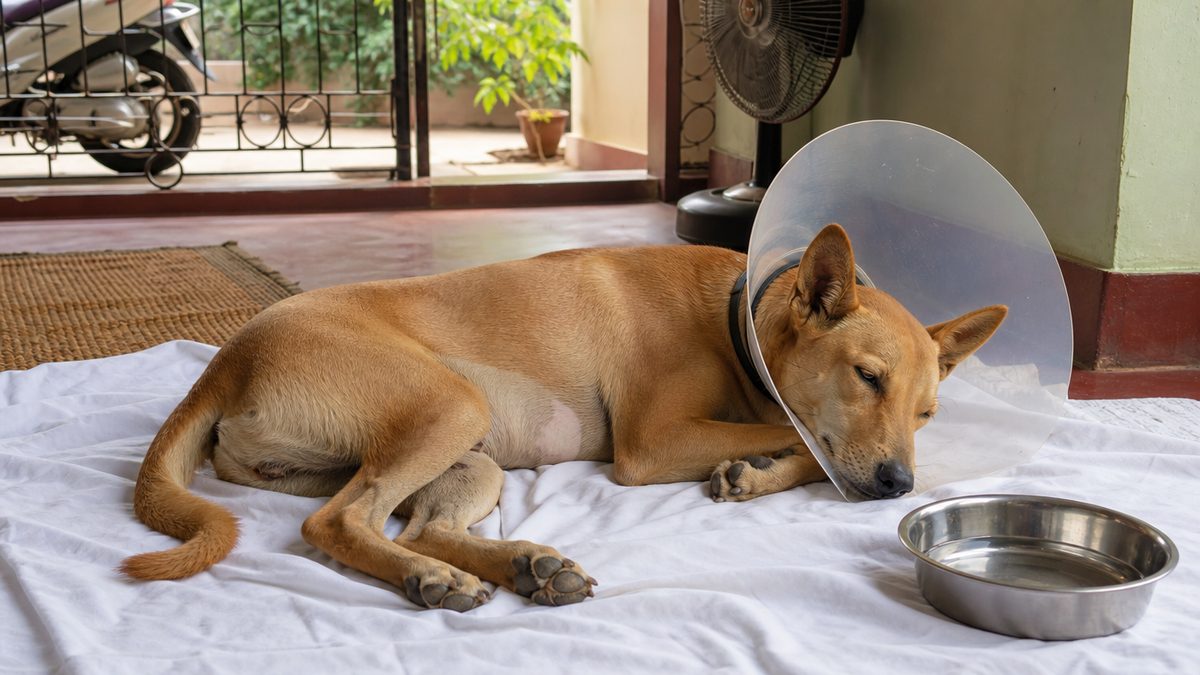
- Recover under supervision. The dog is kept warm and dry, given water once awake, and watched 'round the clock' by a veterinary surgeon; an Elizabethan collar goes on if it worries the wound. At a private clinic you usually drop the dog in the morning and collect it the same evening.
- Pain relief and antibiotics. Analgesia 'is required for all patients undergoing neutering'; the Handbook lists opioids, alpha-2 agonists, NSAIDs and local anaesthetics and recommends meloxicam by injection straight after surgery. Antibiotics are a case-by-case decision, and 'for sterilization surgery done under suitable conditions of asepsis, the use of antibiotics may not be necessary';.
The anaesthetic risk has one number worth holding onto: across 98,036 dogs anaesthetised or sedated at 117 UK practices, 0.17 percent (1 in 601) died within 48 hours, 0.05 percent (1 in 1,849) among healthy dogs, and nearly half of those deaths came after the procedure rather than during it, which is why the recovery hours matter as much as the surgery. No Indian equivalent has been published; the ABC Rules' monthly return of 'post-operative complications and mortality against the surgeries conducted by each veterinarian' is the closest thing India has.
The Handbook's general consideration for ABC centres reads: 'No surgeries shall be conducted below 10°C, and between 10°C-18°C, hourly hypothermia monitoring must be performed for at least four days post-surgery. Operation theatres must maintain a minimum of 20°C';. It has no upper limit, but it tells centres to release dogs 'during the early morning hours' and to postpone release 'in the event of severely inclement weather';. For a pet, that translates to booking a summer surgery for an early slot and keeping the recovering dog in the coolest room you have.
Complications and side effects: the rates, and whether spay or neuter is safer
Complications after dog sterilisation are common but mostly minor: at five Ontario private practices, 351 canine spays and 295 castrations produced recorded post-operative complication rates of 4 to 35 percent for spays and 0 to 32 percent for castrations by practice, major complications (infection, abscess, wound breakdown) in 1 to 4 percent, spays accounting for 90 percent of the major ones, and no deaths. Castration is the safer surgery; the anaesthetic risk is the same for both.
Spaying is abdominal surgery and castration is not, and every counted series shows the gap. At a UK teaching hospital 142 bitches spayed by final-year students had complications during surgery in 6.3 percent (nine cases of bleeding from the ovarian arteries), after surgery in 14.1 percent (four bleeds, 12 inflamed wounds), and in total in 20.6 percent. In the Ontario series the most frequent spay complication was 'excessive patient attention to, or dermatitis at, the surgery site', followed by abscess and seroma; for castration it was licking the site, scrotal haematoma or swelling, and a granulomatous reaction at the suture, which tells you that most of what gets counted is a red, licked or lumpy wound rather than an emergency.
| What was measured | Rate | Dogs | Where and when |
|---|---|---|---|
| Any recorded post-operative complication, spay | 4% to 35% by practice | 351 spays | 5 Ontario private practices, 1996 |
| Any recorded post-operative complication, castration | 0% to 32% by practice | 295 castrations | 5 Ontario private practices, 1996 |
| Major surgical-site complication, either surgery | 1% to 4% | 646 dogs | Same series; spays were 90% of the major ones |
| Deaths, either surgery | None reported | 646 dogs | Same series |
| Any complication, spay by final-year students | 20.6% (6.3% during, 14.1% after) | 142 bitches | University of Liverpool, 2002 to 2004 |
| Anaesthetic or sedation death within 48 hours, all dogs | 0.17%, 1 in 601 | 98,036 dogs | 117 UK practices, 2002 to 2004 |
| Anaesthetic death, healthy dogs (ASA 1 to 2) | 0.05%, 1 in 1,849 | Subset of the above | CEPSAF |
| Urinary incontinence after spaying, German Shepherd | up to 9% in females spayed under 12 months | 298 spayed females | UC Davis, 2000 to 2015 |
The complications that belong to the surgery itself
Four complications belong to the surgery itself, and the Handbook names each with its cause: bleeding from the ovarian vessels when the suspensory ligament is broken rather than stretched, heavier in a bitch in heat 'due to the effects of oestrogen on the clotting cascade'; recurrent heat from a fragment of ovary left behind; stump pyometra from a piece of uterus left behind; and, in the male, scrotal haematoma or swelling, 'common especially in larger dogs' and worse if the dog licks. A bitch can be spayed while in heat, but a clinic that asks you to wait three weeks is trading a small delay for less bleeding.
The long-term side effects sit in the timing section above: obesity, urinary incontinence in spayed females and, in some large breeds, the joint disorders and cancers associated with early neutering Hart BL, Hart LA, Thigpen AP. None is a reason to skip the surgery for a small dog or a dog that will otherwise breed; each is a reason to pick the age with your vet rather than accept a clinic's default of six months for every breed.
Recovery and home care: how many days, and what to watch in Indian heat
A castrated dog recovers in about 7 to 10 days and a spayed bitch in 10 to 14, the ranges an Indian clinic chain and a UK charity both publish, and the surgical wound needs the same three things for that whole period: no licking, no jumping and no bathing Animal Welfare Board of India. For a street dog the law fixes the supervised part of that recovery at a minimum of four days in the centre before release.
The first evening is the anaesthetic wearing off. Expect a sleepy, unsteady dog with a poor appetite for a day, and offer water and a light meal only once it is fully awake; the AWBI Handbook's rule for its own centres is that recovering dogs 'need to be kept warm and dry' and get 'access to drinking water' once awake. From the second day the job is the wound, which heals from the inside out over the same 10 to 14 days. Check it morning and evening for redness spreading beyond the line, swelling, discharge or a gap between the edges, and keep the cone on; the Handbook allows 'buckets' or Elizabethan collars 'where dogs are irritated and causing self trauma to wound sites';. Nylon skin sutures, which the Handbook recommends, are removed at the recheck your vet sets; an intradermal closure, which it also describes, is buried and stays.
- Rest for the full period. Leash-only toilet breaks, no stairs, no sofa, no play with other dogs for 10 to 14 days; the Ontario series found that most recorded complications were wound problems that rest and a cone prevent.
- Keep the wound dry. No bath until the clinic clears it, and in humid monsoon weather towel the belly after every walk. The Handbook requires 'the surgical wound and ear notch wound' of a street dog to be 'cleaned and dressed regularly'.
- Feed less, not more. A sterilised dog's energy need falls and its obesity risk is 'greatest in the 2 yr following surgical sterilization', so hold the weight you had before surgery rather than letting it drift.
- Book the recheck. A wound check at day 3 to 5 and suture removal at day 10 to 14, or whatever your clinic sets. The Ontario practice that logged every recheck found complications in 35 percent of spays; the practice that did not enter normal recheck visits recorded 4 percent, which is the follow-up, not the dogs.
Heat, cold and the calendar
Indian summer is the aftercare problem the foreign pages do not have. A dog under a cone, on restricted exercise, in a room at 35°C is a dog that pants, drinks and worries the wound; the heat safety for dogs in India page sets out the wet-bulb thresholds by city, and the practical answer is to book the coolest month your vet allows, take an early-morning slot, and keep the recovering dog in the coolest room with a fan on the floor rather than on the dog. The AWBI's own centres release dogs 'during the early morning hours' and postpone release in 'severely inclement weather';. Winter has an explicit rule: no ABC surgery below 10°C, and hourly hypothermia checks for four days between 10°C and 18°C, because 'hypothermia is a severe problem in anaesthetized animals'. A north Indian January morning meets that threshold; ask a pet clinic how it warms the recovery cage.
Every counted series puts licking and self-trauma at the top of the complication list, ahead of bleeding and infection: 'excessive patient attention to the surgery site' was the most common complication for canine spays at the Ontario practices, and scrotal swelling after castration 'may be further exacerbated by the dog licking at the area'; Animal Welfare Board of India. A dog that reopens an abdominal wound on day four needs a second anaesthetic and a second closure. Keep the collar on for the full period, including at night and including for a dog that 'never licks'. If the wound gapes, bleeds, smells or the dog stops eating after day two, go to your nearby vet the same day; the Blue Cross Society of Pune's own recovery table calls wound reopening 'emergency vet visit' and discharge or pus 'visit the vet immediately';.
Behaviour settles gradually, not overnight; the AVMA's wording is that castration 'reduces' breeding instinct and marking. A community dog's temperament does not change either; sterilisation stops breeding, and the vaccination it comes with is what protects people.
What dog sterilisation costs in India: government rate cards against private clinic bands
Dog sterilisation in India costs anything from Rs 300 for a castration and Rs 400 for an ovariohysterectomy at a government referral polyclinic, plus tax, to Rs 6,000 to Rs 15,000 at a private clinic and Rs 8,000 to Rs 20,000 or more at a multispeciality pet hospital, and nothing at all for a street dog under the ABC programme Ministry of Fisheries. The spread is fifty-fold, so where you go matters more than what the surgery is.
| Source | Castration | Spay (ovariohysterectomy) | What else it lists | Date and place |
|---|---|---|---|---|
| ICAR-IVRI Referral Veterinary Polyclinic, pets column | Rs 300 plus tax | Rs 400 plus tax | Registration Rs 50 (Rs 150 after 12:30 pm, Rs 300 after 5 pm and holidays); CBC Rs 250; pyometra treatment Rs 300; laparoscopic surgery Rs 600 | With effect from July 2022, Izatnagar, Bareilly |
| UT Chandigarh Animal Husbandry, government veterinary institutions | Rs 20 (species not stated) | Not listed; 'major operation fee' Rs 100 | Outdoor ticket for pets Rs 30; anti-rabies vaccination Rs 30 | Rate book live on 18 September 2026, undated, Chandigarh |
| Vetic pet clinics, national bands by clinic type | Rs 2,500 to Rs 8,000 | Rs 6,000 to Rs 15,000 at private clinics; Rs 8,000 to Rs 20,000 or more at multispeciality hospitals | Government and NGO clinics Rs 500 to Rs 2,000; pre-surgery blood tests Rs 800 to Rs 2,500; medicines, cone and follow-ups Rs 1,000 to Rs 3,000 extra | 13 April 2026, updated 20 April 2026; no city breakdown |
| Blue Cross Society of Pune | Free for street dogs; pets not sterilised | Free for street dogs; pets not sterilised | Anti-rabies and 9-in-1 vaccination included for every street dog it sterilises; five-day stay | 9 May 2026, Pune |
| Any ABC centre, community dog | No fee to the resident | No fee to the resident | Rule 10(2): the local authority reimburses the organisation; Rs 5,000 is the organisation's one-time recognition fee to the Board, not a charge per dog | G.S.R. 193(E), 10 March 2023 |
Every rupee figure above passes the exchange-rate test this site runs on Indian prices: Rs 300, Rs 400, Rs 6,000, Rs 15,000 and Rs 20,000 divided by 84.38 give 3.56, 4.74, 71.1, 177.8 and 237.0, and divided by 74 give 4.05, 5.41, 81.1, 202.7 and 270.3, none of them a round dollar figure. These are rupee-native prices. The US chain on the same results page prints USD 250 to 600 for a dog, which at 84.38 would read Rs 21,000 to Rs 50,600, and no Indian page here copied it.
What the private price buys, and what it does not
The IVRI figure is the surgeon's fee at a teaching hospital; its own page prices registration, a blood count and a pyometra work-up separately, so a spay with those is closer to Rs 1,000 than Rs 400, still a tenth of the private floor. A private package usually bundles the pre-anaesthetic check, anaesthesia, the surgery and immediate post-operative care, and at some chains follow-up consultations and basic medicines; Vetic's page says many clinics now price a standard package rather than charging by sex, and to confirm what the quote includes before booking. The seven items to have written on the quote are listed below.
- Anaesthetic. General anaesthesia, with the drug protocol named; the ABC standard for a street dog is general anaesthesia only, never sedation alone.
- Fluids. Whether an intravenous line runs through the surgery; the Handbook requires Ringer's lactate throughout for a street dog.
- Blood tests. Which ones and at what price; Vetic's band is Rs 800 to Rs 2,500.
- Pain relief. A pre-emptive analgesic before the incision and a take-home course; analgesia 'is required for all patients undergoing neutering'.
- The stay. Same-day discharge or an overnight cage, and who watches the dog in the hours after surgery, when nearly half of anaesthetic deaths occur.
- Aftercare. The cone, medicines and follow-up visits, which Vetic prices at Rs 1,000 to Rs 3,000 on top.
- Suture removal. Whether the recheck and removal are in the package or billed as a consultation.
Three things do not pay for it. Indian pet insurance treats spaying and castration as routine care and excludes them; the pet insurance in India page quotes each policy's clause. The ABC programme does not sterilise pet dogs: 'BCS does not sterilise pet dogs';. And a group that charges residents per community dog is a private service; without a Certificate of Project Recognition it is outside Rule 3(3), under which 'no local authority or organisation shall undertake, conduct or organise animal birth control program for street dogs';.
A government veterinary college hospital, the municipal pet clinics that Greater Chennai Corporation lists at six locations, and an NGO clinic's subsidised pet rate are the three places to ask before a private hospital. What you give up at the cheapest end is the recovery cage and the overnight stay; what you must not give up anywhere is general anaesthesia, a sterile pack per dog and pain relief, the Handbook's minimums for a street dog and the floor for yours.
Getting a community dog sterilised under the ABC Rules 2023: who may do it, and to what standard
To get a community dog sterilised, a resident asks the local authority's Animal Birth Control centre or Animal Complaint Cell for a pick-up, because Rule 8(2) makes 'the local authority' responsible for 'deworming, immunisation and sterilisation' of street animals and Rule 3(3) forbids anyone without an AWBI Certificate of Project Recognition from doing the surgery. The resident pays nothing, the dog comes back to the same street with a notched right ear, and every step in between is written down in the Rules and the Board's Handbook.
Who is allowed to operate
An ABC surgery is lawful only inside a recognised project. The local authority may run the programme 'through their own veterinary officers' or engage an Animal Welfare Organisation, and 'under both conditions' a Certificate of Project Recognition from the Board 'shall be mandatory', one application per centre with a non-refundable fee of Rs 5,000. The application carries the Veterinary Council registration of every vet on the project, and at least one of them must have 'conducted at least two thousand Animal Birth Control Surgeries anywhere in India'; the surgery itself 'must be performed by a Veterinarian under the close supervision of the Jurisdictional Veterinary Officers of the local authority in a well-equipped Operation Theatre';. The Supreme Court's judgment of 19 May 2026 adds 'at least one fully functional Animal Birth Control Centre in each district' and strict compliance with the Board's Standard Operating Procedures.
| Step | The Rule | The Handbook's standard | What a resident can check |
|---|---|---|---|
| Capture | 11(5): 'humane methods such as net catching or hand catching'; 'tongs or wires' are 'strictly prohibited'. 11(3): banners or public notices before a drive | Catchers trained; a representative of the local authority or AWO present | Nets and notices, not wire loops; each catcher carries an identity card under 11(2) |
| Who is taken | 11(9): no dog under six months; no mother until her litter is two months old | The dog 'is over six months in age, is not pregnant' and is treated first if sick or in mange | Pups and nursing mothers stay on the street |
| Identification | 11(8): a numbered collar on arrival, matched to the capture record | A clinical record sheet travels with the dog from prep room to theatre | The collar number is how the dog gets back to your lane |
| Before surgery | 11(14): quarantine kennels 'for twelve hours before surgery, without food or water'; males and females housed separately | Full pre-surgical examination; abdominal palpation to rule out pregnancy | A dog operated on the day it is caught has not been fasted |
| The surgery | 11(15): by a veterinarian, in an operation theatre, per the Module | General anaesthesia only; complete ovariohysterectomy for females, pre-scrotal castration for males; a fresh sterile pack per dog; pre-emptive analgesia | Ask which vet operated; Rule 13 requires the name, registration number and monthly count for each |
| The mark | 11(16): 'a V shaped notch shall be made on the right ear'; branding 'shall not be permitted' | Cut with an electric cauteriser under anaesthesia; each arm of the V is 20 to 25 percent of the ear's length; no U shapes; the notch is dressed daily | A left-ear notch or a U is not the ABC standard |
| After surgery | 11(17): kept in kennels 'for at least four days after the Sterilisation for post-operative care', fed twice a day | 'At least 3 days and nights' under veterinary supervision; kept warm and dry; analgesia for every dog | The Rule's four days governs; see the disagreement below |
| Rabies vaccine | Sterilisation and immunisation together, 11(3) and 11(8) | Anti-rabies vaccine 'on the day of release', by the intramuscular route; deworming on the day of capture | The dog comes back vaccinated; the annual booster follows the vaccination schedule |
| Release | 11(19): 'at the same place or locality from where they were captured', date, time and place recorded, a representative present | Early morning; not on a main road; into the care of a caretaker where present; postponed in severe weather | A dog released elsewhere is a breach you can report |
| Records | 12: capture area, date, squad, tag number, release date and place, feeding, treatment, mortality, organ inspection, 30 days of CCTV | A post mortem on every dog that dies at the centre | Ask the Local ABC Monitoring Committee, which Rule 10(3) says meets monthly |
| Proof of surgery | 17: removed organs kept in 10 percent formaldehyde, counted by a team that excludes the operating organisation, then destroyed on video | Feedback from the post-operative vet to the operating vet on every complication | The organ count is the audit the Supreme Court relied on in the Mandla case |
Where the Rules and the Handbook disagree, and which governs
The post-operative stay is written two ways. Rule 11(17) says 'at least four days after the Sterilisation'; the Handbook says 'at least 3 days and nights after successful surgery';. The Rule governs, because Rule 11(20) makes the Handbook the Board's Standard Operating Procedure issued under the Rules and not above them, and the Handbook's own winter protocol asks for four days of hypothermia checks, which is the Rule's number Animal Welfare Board of India. The Blue Cross Society of Pune, in Maharashtra, runs a five-day programme, admission on day one and release on day five, which satisfies both. A centre that releases on day two or three is below the Rule.
The route in one city, and what the Government says the programme achieves
Greater Chennai Corporation, in Tamil Nadu, runs five ABC centres, at BRLC, Lloyds Road, Kannammapet, Meenambakkam and Sholinganallur, with 16 dog vehicles and five catchers per zone, catches dogs on public complaints and at hotspots, and reports 19,640 street dogs caught in 2023 and 20,296 in 2024, each sterilised, vaccinated and released 'to the same area from where they are caught'; its complaint number is 1913. Mumbai is the Handbook's own proof that the programme works when it is run: a 2014 survey commissioned by the Municipal Corporation of Greater Mumbai found over 75 percent of the city's roughly 95,000 street dogs already sterilised, and an RTI reply dated 2 March 2015 recorded human rabies deaths in the city falling from 45 to 63 a year, when dogs were killed, to one a year in 2011, 2012 and 2013 and none in 2014, after the ABC programme began in 1994. Other cities' helplines and the AWBI's list of recognised projects are on the stray dogs in India page. The route for a resident has five steps.
- Look at the right ear. A V notch means the dog is done; an unnotched adult, or a notch on the left ear or shaped like a U, is a dog to report.
- Call the local authority, not an NGO. Rule 8(2) puts the duty on the municipal corporation or council; give the lane, the number of dogs and how many are unnotched, and note the date. In Chennai the number is 1913 Greater Chennai Corporation.
- Expect notice, nets and identity cards. Banners before the drive, net or hand catching, and a card on every catcher are Rule 11(2), 11(3) and 11(5); pups under six months and nursing mothers are left.
- Expect the dog back after at least four days. Fasted 12 hours, operated under general anaesthesia by a registered vet, notched, kept four days, dewormed on arrival and vaccinated against rabies on the day of release Animal Welfare Board of India.
- Expect release at the same spot, and ask for the record. Rule 11(19) fixes the place; Rule 12 requires the capture and release record, and the Local ABC Monitoring Committee under Rule 10(3) is where a resident asks to see it.
The Government's own assessment is more modest than the ranking pages. Asked in the Lok Sabha on 1 April 2025, the Ministry answered that it 'has not conducted a formal assessment' of the programme, that 'its effectiveness varies across different regions due to implementation challenges', and cited one local result: Bruhat Bengaluru Mahanagara Palike's surveys of 2019 and 2023 in Karnataka found 'a 10% reduction in the street dog population' while 'the neutering percentage increased by 20%';. The Supreme Court, citing a Madhya Pradesh report of 795 dog reproductive organs stockpiled to raise fake bills, told municipal authorities to carry out 'rigorous and comprehensive due diligence' before contracting any NGO and found the ABC framework 'largely deficient in its execution across several jurisdictions';. Rule 17's organ count exists for exactly that reason; a resident who wants proof a lane's dogs were done asks the monitoring committee for it, not the NGO.
Common questions about sterilising a dog in India
Is sterilization good for dogs?
Yes, sterilisation is good for most dogs on the measures that have been counted. In 40,139 dogs with a recorded cause of death, sterilised males lived 13.8 percent longer and sterilised females 26.3 percent longer than intact dogs, dying less often of infectious disease and more often of cancer. Spaying also removes the 19 to 24 percent lifetime risk of pyometra an intact bitch carries by age ten. The exceptions are large breeds neutered early, where joint disorders rise, so the age is the decision, and your nearby vet makes it for your dog.
At what age should a dog be neutered?
A dog expected to weigh under 20 kg (45 lb) as an adult is neutered at 5 to 6 months; a male expected to weigh more waits until growth stops, about 9 to 15 months, and a large female is decided between 5 and 15 months, under the 2019 AAHA guideline. Breed changes the answer: the UC Davis data suggest beyond a year for a male Labrador, Golden Retriever or Rottweiler, beyond two years for a German Shepherd of either sex, and any age for a Chihuahua. A community dog is never taken under six months, by Rule 11(9).
Does neutering remove balls?
Yes. Neutering a male dog is castration, and both testicles are removed through a single incision made just in front of the scrotum; the empty scrotum is left in place unless it has to be removed to stop bleeding, which is why a recently castrated dog can still look entire. The AVMA calls the surgery orchiectomy. A vasectomy, which cuts the sperm duct and leaves the testicles and their hormones in place, is the alternative for an owner who wants only fertility stopped, and it is rarely offered in India.
Which is safer, spay or neuter?
Neutering a male is the safer surgery. Spaying is abdominal surgery and castration is not, and at five Ontario practices that followed 351 spays and 295 castrations, major surgical complications ran at 1 to 4 percent overall, spays accounted for 90 percent of them, and no dog died. The anaesthetic risk is the same for both: 0.05 percent, one in 1,849, in healthy dogs across 98,036 UK cases. Both surgeries are safe enough that the age you choose matters more to the dog's health than which sex it is.
How much does it cost to sterilize a dog?
In India a government referral polyclinic charges Rs 300 plus tax for a castration and Rs 400 plus tax for a spay (IVRI, Bareilly, rates from July 2022), a private clinic Rs 6,000 to Rs 15,000, a multispeciality pet hospital Rs 8,000 to Rs 20,000 or more, and government or NGO clinics Rs 500 to Rs 2,000, all from the institutions' own pages in 2026. A street dog is sterilised free at the local authority's ABC centre. Add Rs 800 to Rs 2,500 for pre-surgery blood tests at a private clinic.
How can I sterilize my dog?
Book a pre-surgical examination with your nearby vet, agree the age from the dog's expected adult weight and breed, fast the dog for the hours the clinic sets (the ABC standard is 12 hours without food), and drop it off in the morning for surgery under general anaesthesia; most pets go home the same evening with pain relief and a cone. Rest the dog on a leash for 7 to 14 days and keep the wound dry. For a community dog, call the local authority's ABC centre or complaint line instead; a resident cannot lawfully arrange the surgery privately without a recognised project.
How much does spaying a dog cost in India?
Spaying a pet dog in India costs Rs 400 plus tax at the ICAR-IVRI referral polyclinic in Bareilly (rates from July 2022), Rs 500 to Rs 2,000 at subsidised government or NGO clinics, Rs 6,000 to Rs 15,000 at a private clinic and Rs 8,000 to Rs 20,000 or more at a multispeciality hospital, per the price guide a national clinic chain published in April 2026. Blood tests add Rs 800 to Rs 2,500 and medicines, cone and follow-ups Rs 1,000 to Rs 3,000. A street dog's spay under the ABC programme costs the resident nothing.
Will my dog gain weight after being sterilised?
Most dogs will unless the food is cut. The 2019 AAHA guideline says 'most, but not all, studies in dogs identify a risk for obesity among sterilized individuals', greatest in the two years after surgery, because the hormones that drove activity and appetite are gone. Weigh the dog on the day of surgery, hold that weight through the first year with a smaller ration and the same walks, and ask your vet to set the amount rather than the packet.