
Dog festival guide
Firecracker fear in dogs: what the evidence supports before, during and after the night
Owners spot the trembling and miss the rest. Almost half of dogs show at least one fear sign to noise, yet only a quarter of owners call their dog fearful, and fewer than a third ever ask a professional.
Quick answer
How to calm dogs during firecrackers comes down to four things. Build one enclosed safe room the dog has already chosen, close the windows and curtains to muffle the bang, run steady sound masking from a radio or calming music, and stay in the room yourself. Walk early in daylight before the noise starts and keep the dog leashed. Start two to three weeks ahead with gradual desensitisation and counter-conditioning, and speak to a veterinary surgeon early if your dog has bolted, injured itself or refused food in past seasons.
This guide is general information for Indian pet owners and is not a diagnosis. Always consult a registered veterinarian near you before acting on anything you read here, and treat any sudden change in your pet's condition as urgent.
How common firecracker fear actually is
Roughly one dog in five shows strong fear of fireworks, and fireworks rank as the single most feared noise in every large survey that has measured it. Noise aversion is the term the clinical literature uses, and firecrackers sit at the top of its list.
A Norwegian web survey of 5,257 dogs across 17 breeds found that 21.17 percent (1,076 of 5,082 answering that item) showed strong or very strong fear during fireworks. Gunshots came second at 14.4 percent, thunderstorms third at 10.14 percent and heavy traffic a distant fourth at 2.85 percent. A Finnish study of 3,284 dogs across 192 breeds put overall noise sensitivity higher, at 39.2 percent, with a median age at onset of 2 years and a range from 8 weeks to 10 years in the 407 dogs whose owners could date it.
The figures differ because the questions differ, and that is worth knowing rather than averaging away. A UK study asked the same owners twice. In the combined population of 4,280, 25 percent said yes when asked directly whether their dog was fearful of noises. But among the 383 owners taken through a structured interview about specific behaviours, almost half reported at least one behavioural sign typical of fear.
That gap is the most useful finding in the literature for an owner reading this in October. Many people watch a dog pant, pace and hide through an evening of firecracker noise and do not file it under fear at all. The authors put it plainly: owners may recognise the behaviour without interpreting it as an altered subjective state in their dog.
| Study | Dogs | Headline finding | Worth noting |
|---|---|---|---|
| Blackwell and colleagues, UK, 2013 | 4,280 combined (3,897 postal, 383 interviewed) | 25 percent of owners called their dog fearful of noises, but almost half of those interviewed in detail reported at least one fear sign | The same owners gave two different answers depending on how the question was asked |
| Storengen and Lingaas, Norway, 2015 | 5,257 across 17 breeds | 21.17 percent showed strong or very strong fear during fireworks | Fireworks ranked first of four noise types, ahead of gunshots, thunder and traffic |
| Tiira, Sulkama and Lohi, Finland, 2016 | 3,284 across 192 breeds | 39.2 percent showed noise sensitivity, median onset 2 years | The widest breed coverage of the three, and the only one to date onset |
Whichever survey you take, firecracker fear is not a rare problem affecting a few unusually nervous dogs. It is somewhere between a fifth and two fifths of all dogs, and the owners of those dogs mostly do not call it fear.
Where the two best studies disagree
The Norwegian and UK teams reached opposite conclusions on one point, and neither has been overturned. Storengen and Lingaas found that the dogs most fearful of noise had higher odds of separation-related behaviour, fear in novel situations, and needing longer to settle after a stressful event. Blackwell and colleagues found the reverse for loud noises specifically: responses to fireworks, gunshots and thunder co-occurred with each other but did not commonly co-occur with separation-related behaviour, while responses to quieter noises such as traffic and television did.
Their reading is that fear of a very salient noise may reflect specific exposure and experience, whereas fear of a less salient one may reflect a generally fearful personality. For a dog that is frightened only when crackers go off, that is mildly reassuring. It does not mean the fear is minor, and it does not mean it will fade on its own, because risk rises with age in both studies.
What the fear looks like, including the signs owners miss
Read body language rather than waiting for an obvious panic, because the quiet signs are the ones that go unrecorded and the loud ones arrive late.
Dogs with noise sensitivity show restlessness, shaking and trembling, pacing, an increased startle response, raised vigilance, hiding, panting, drooling, destructiveness, defecation, urination, vocalisation, withdrawal, self-mutilation, loss of appetite, freezing, vomiting and owner-seeking. A dog does not need to produce all of these, and the dog that quietly goes rigid behind a sofa is as frightened as the one that barks.
- Easy to spot: the dog will tremble, bolt for a door, pace from room to room, or drool onto the floor.
- Easy to miss: refusing a favourite food, yawning repeatedly, flattened ears, a tucked tail, turning away from the window, or simply going very still.
- Easy to misread: a dog that climbs onto your lap is seeking safety, and a dog that hides under a bed has found it. Neither is being naughty.
- Worth logging: what the dog did last Diwali, and at what hour it started. A written note beats memory when you describe it to a vet.
Senior dogs deserve a closer look. Both large surveys found fear rising with age, so a dog that coped at three may not cope at nine Blackwell, Bradshaw and Casey. Stiff joints, reduced hearing and failing sight change how an older dog experiences a sudden bang, and a senior dog that panics can injure itself trying to escape. Our senior dog care guide covers the wider picture.
Female and neutered dogs carried higher odds in the Norwegian data, at an odds ratio of 1.3 for females and 1.73 for neutered dogs against intact ones. Treat that as a population-level signal rather than a prediction about your dog.
How loud a cracker is, and why the legal limit is not the answer
India caps a single firecracker at 125 dB(AI) or 145 dB(C) peak measured 4 metres from the point of bursting, which is a product test and not a description of what a dog in a third-floor flat hears.
The Central Pollution Control Board and the environment ministry prohibit the manufacture, sale or use of firecrackers breaching 125 dB(AI) or 145 dB(C)pk at 4 metres, and crackers are tested each year by authorised laboratories including the CSIR-National Physical Laboratory in New Delhi. For joined firecrackers, the laris strung together in a series, the limit drops by 5 log10(N) dB, where N is the number of crackers joined.
Three things follow, and none of them appear on the pages that currently rank for this question.
- The ceiling is per cracker, measured once, at a fixed distance, in a test. A street with forty people setting off crackers for three hours produces a different exposure from the one the certificate describes.
- The frequency matters as much as the level. Measurements of Indian crackers found peak sound levels at 4 kHz and 5 kHz, which sits in the range where canine hearing is most sensitive and where noise-induced hearing damage shows up first in people.
- Distance helps less than people assume. Summarising earlier work by Liao and colleagues on inner-ear damage, the same paper notes that most firecrackers tested still exceeded 110 dB sound pressure level at 6 metres.
Green crackers change the air more than the noise. They were developed to cut particulate emissions by at least 30 percent, and the Supreme Court recorded NEERI's position that reductions range up to 80 percent while brightness and shelf life are maintained. Noise is a separate question. In the one published Indian study of green-cracker noise, flower pot crackers of both commercial and green types measured below 90 dB(AI), with C-weighted peaks under 100 dB(C)pk, so the category covers a wide range rather than being quiet by definition.
Two official figures that do not line up
The Animal Welfare Board of India states in its Deepavali advisory that firecracker explosions can exceed 150 decibels, and that animals, whose hearing is more sensitive than ours, suffer trembling, whimpering and frantic attempts to find safety as a result. That sits oddly beside a legal ceiling of 125 dB(AI) at 4 metres.
The two are not strictly contradictory, because the AWBI advisory gives no measurement distance and no weighting while the legal limit specifies both. They are measuring different things, and the honest position is that the advisory's figure cannot be compared directly with the standard. We have published both rather than picking the one that makes the better sentence.
The practical reading for a dog owner is simple. Impulsive noise is the problem, you cannot predict which neighbour will produce it, and your job is to reduce what reaches the dog rather than to rely on anyone complying with a decibel ceiling.
What to do in the two to three weeks before
Start before the season, because desensitisation and counter-conditioning take weeks and neither works on the night itself.
Desensitisation means exposing the dog to a recording of firecracker noise at a volume so low it produces no reaction, then raising it by small steps across many short sessions. Counter-conditioning means pairing each of those quiet sounds with something the dog values, usually food, so the sound comes to predict good things. The RSPCA sets out exactly this sequence, playing firework audio, increasing the volume incrementally, and giving treats after each noise, and publishes a structured sound-therapy pack rather than leaving owners to improvise.
Two rules decide whether it works. Never raise the volume while the dog is still reacting at the current one, and stop the session before the dog is tired of it. A dog that is made fearful during training has learned the opposite of what you intended, which is why a gradual pace matters more than the number of sessions.
The jobs that are not training
- Check identification now. A collar tag with a working phone number is the thing that gets a bolted dog home, and a microchip is the backup when the collar comes off. See our guide to pet microchipping in India.
- Photograph your dog this week, from the side and the front, in good light. A current photograph is what a lost-dog post needs.
- Build the safe room early so the dog can acclimatise to it as an ordinary place to sleep, not a room it is shut into for the first time on the loudest night of the year.
- Book the vet appointment before the queue forms, if your dog has a history of panic.
Tell your neighbours, and tell them early. A short, friendly message explaining that you have a noise-phobic dog and asking that crackers not be set off directly outside your gate succeeds more often than people expect. Where a housing society is involved, our guide to pets in apartments in India covers how these conversations usually run.
Building a safe room the dog actually chooses
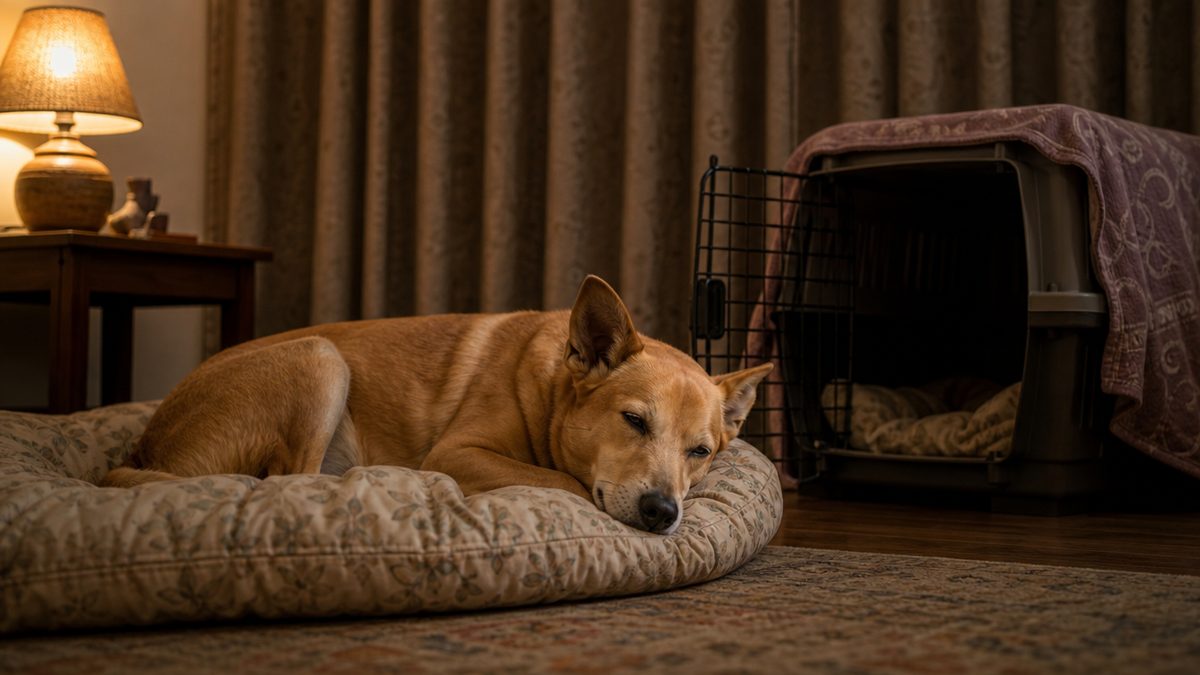
Give the dog one enclosed room it has already chosen for itself, then make that room quieter and darker rather than inventing a new space on the night.
RSPCA NSW advises giving the animal access to wherever it already wants to hide, which may be a bathroom, a bedroom or an open cupboard, and setting up covered crates and similar hiding places that provide comfort. Watch where your dog goes when a pressure cooker whistles or a door slams. That is the room. An interior room with the fewest exterior walls is better again, because every wall between the dog and the street is attenuation you do not have to create.
- Close windows and curtains. Heavy curtains muffle the bang and block the flash, and the flash matters because light and sound arrive together.
- Add soft mass. Blankets, a mattress against the window-facing wall, carpets and cushions absorb sound where bare tile and concrete reflect it.
- Run sound masking. Leave a television, a radio, calming music or a steady fan running from before the noise starts, which is more effective than switching it on once the dog is already frightened.
- Cover the crate if your dog uses one, leaving the door open. An enclosed den the dog can leave is safety; a shut door is a trap.
- Put water, the usual bed and familiar toys in the room, and leave the dog's own smell on the bedding by not washing it that week.
Pheromones and calming products belong in the room days early rather than on the evening itself. Synthetic pheromone diffusers in the resting area are recommended by RSPCA NSW to encourage a sense of calm. Treat the rest of the calming-product shelf with more caution, because an unfamiliar supplement introduced on the night is one more unknown on the worst possible evening to be running an experiment.
Walk the dog early, in daylight, before the noise starts, and keep the dog leashed even if it is normally reliable off-lead. Dogs have been known to damage property or themselves in frantic attempts to escape noise, jumping or digging under fences. A dog that has never run from you will run from a cracker, and a leash is the difference between a fright and a search.
On the night itself
Stay with the dog, keep the evening predictable, and let the dog decide how much contact it wants.
Be at home if you can. RSPCA NSW advises staying with the pet and keeping it secured indoors, or arranging for a friend, family member or pet sitter to be there if the animal finds the night particularly difficult. A dog left alone through hours of firecracker noise has nothing to orient to.
Feed earlier than usual, and do not be alarmed by a refused meal. Loss of appetite is a documented sign of noise fear rather than a separate problem. Offer a stuffed chew or a long-lasting treat in the safe room instead, which gives a frightened dog something to do with its mouth and pairs the room with something good.
Distraction and toys work when they are already in place, not when they are produced as a rescue. Put the chew and two or three familiar toys in the room during the afternoon, while the dog is still relaxed enough to take an interest. A toy pushed at a dog that has already started to tremble is ignored, and a novel toy is simply one more unfamiliar thing in a frightening evening.
Keep the gate and the front door closed, and tell everyone in the house why. Most Diwali escapes happen through a door opened for a guest.
Comforting a frightened dog does not reinforce the fear
This is the single most repeated piece of bad advice in the category, and the welfare bodies are explicit against it. RSPCA NSW's Chief Veterinarian Liz Arnott states that if a pet is frightened it is important to let them seek comfort as they choose, and that where the dog wants to be with you it is appropriate to provide calm reassurance rather than ignoring their stress.
Fear is an emotional state, not a trick the dog is performing for attention, so reassuring a frightened dog does not teach it to be more frightened. What does matter is your own manner. Sit, speak normally, and carry on with something ordinary. A dog reads a tense, hovering human as confirmation that something is wrong.
When to involve a vet, and what medication can and cannot do
Talk to a veterinary surgeon well before the season if your dog has bolted, injured itself, destroyed furniture or refused food in a previous year, because the useful options are prescription-only and need trialling in advance.
Fewer than a third of owners in the UK study sought professional advice about their dog's response to noises, and a New Zealand survey cited in the Norwegian paper found only 15.8 percent of owners of firework-fearful dogs sought professional treatment. Severe noise fear is a treatable clinical problem and it is being left untreated at scale.
A veterinary surgeon can prescribe anxiolytic medication for noise events, assess whether pain is making the fear worse, which is common in older dogs, and refer to a behaviourist where the case needs a full programme rather than a prescription. Bring your written notes from last season to that appointment; the specifics of what the dog did, and when, are what the consultation turns on.
- Ask for the medication in time to trial a dose on a quiet day. You want to know how your individual dog responds before the night it matters.
- Ask specifically whether a drug reduces anxiety or only sedates. A dog that is physically slowed but still frightened is not better off, and this distinction is worth raising directly.
- Ask about timing. Several options are given before the noise begins rather than once the dog is already panicking.
- Do not give human medication, and do not give another dog's prescription US Food and Drug Administration. Dose and drug choice depend on the individual animal.
Do not give human medication, do not reuse another dog's prescription, and do not buy a sedative over a counter on the strength of a forum post US Food and Drug Administration. Dose and drug choice depend on the individual animal, its age, its weight and what else is going on with it.
Bonbeno does not recommend a specific drug or dose. That is a veterinary decision made on the individual dog, and this page publishes under the medical disclaimer for that reason.
Four things not to do
Avoid the four interventions that make a phobic dog worse, each of which still appears in Indian festival advice every year.
- Do not punish the fear. Scolding a dog for trembling, hiding or soiling indoors adds a second thing to be afraid of and teaches the dog to conceal the signs you need to read.
- Do not force exposure. Taking a frightened dog out to watch the crackers so it gets used to them is flooding, and it is the opposite of the gradual process described above.
- Do not tie or shut a panicking dog in. A dog trying to escape noise can injure itself badly against a closed door or a short tether. The safe room works because the dog can enter and leave it.
- Do not leave the dog on a balcony, terrace or in a yard. Falls and escapes both happen, and a dog in open air gets the full impulsive noise with nothing between it and the street.
One more, specific to India. Do not let children hold the dog while crackers are being lit nearby. A frightened dog that is restrained and cannot escape is the classic bite scenario, and the bite will be blamed on the dog.
Finally, treat earplugs and tight wraps as unproven rather than harmful. Some owners report that snug body wraps help; the evidence base is thin, and nothing in this category substitutes for an enclosed, muffled room and a calm person in it.
What Indian law actually says, and what it does not
India regulates firecrackers in two separate layers, a product noise ceiling that applies nationally and time windows that are set by order and vary by season and by place.
The product ceiling is the stable part. Manufacture, sale or use of a firecracker breaching 125 dB(AI) or 145 dB(C)pk at 4 metres is prohibited, with the reduction of 5 log10(N) dB for joined crackers. Violations of the Noise Pollution (Regulation and Control) Rules, 2000 attract compensation from an individual or household ranging from 1,000 rupees to 1 lakh rupees depending on the situation.
The timing is the part that gets misreported. The widely repeated line that crackers are legal in India only from 8 pm to 10 pm is not a permanent national rule. It comes from Supreme Court orders that are made in specific proceedings, for specific areas, and renewed or varied season by season.
In its order of 15 October 2025 in M.C. Mehta v. Union of India, the Court permitted the sale of NEERI-listed green crackers in the National Capital Region from 18 to 20 October 2025 only, and directed that use of firecrackers be confined to 6:00 am to 7:00 am and 8:00 pm to 10:00 pm on the two days, being the day before Diwali and Diwali day. The same order barred series crackers, barium-containing crackers, e-commerce sale, and entry of firecrackers into the NCR from outside.
Note what that is and is not. It is an NCR direction with dates attached, not a standing nationwide permission. Separately, the acoustics literature records the time limits applied on various occasions as Diwali 8:00 pm to 10:00 pm, Gurpurab 4:00 am to 5:00 am and 9:00 pm to 10:00 pm, and New Year and Christmas 11:55 pm to 12:30 am. Check what your own state and district have ordered for the current year rather than assuming last year's window carries over.
The Animal Welfare Board of India records that tying firecrackers to animals causes severe injury or death and is punishable under the Prevention of Cruelty to Animals Act, 1960, and asks that such incidents be reported immediately to the police or to animal welfare organisations. Report it. Do not film it and move on.
For an owner, the honest summary is that the law limits how loud one cracker may be and when crackers may be set off, and that enforcement of both is uneven. Plan for the noise you will actually get.
The season is longer than one night
Plan for weeks rather than an evening, because the firecracker calendar runs from Ganesh Chaturthi to Sankranti and peaks in a different month depending on which city you live in.
Diwali is the loudest night across most of India and it is nowhere near the only one. Ganesh Chaturthi fills Mumbai and Pune with processions and immersion days. Durga Puja does the same through Kolkata. Dussehra and Navratri add their own evenings across Gujarat and Maharashtra, Christmas and New Year close the year in Goa, Kerala and the north-east, and Pongal and Sankranti open the next one across Tamil Nadu, Karnataka, Telangana and Ahmedabad's kite-flying week. Wedding season lays fireworks over all of it, on dates no public calendar carries.
A dog does not tell these occasions apart. What it learns across a long season is that unpredictable bangs now happen without warning, which is how one bad night turns into a standing noise aversion. Both large surveys found fear increasing with age rather than fading Blackwell, Bradshaw and Casey, and a season that repeats every year is a plausible part of why.
Why the noise does not stop at 10 pm
The Noise Pollution (Regulation and Control) Rules, 2000 bar loudspeakers and public address systems at night, between 10:00 pm and 6:00 am, except inside closed premises. The rules then carve out an exception that matters to anyone with a frightened dog. A State Government may permit loudspeakers between 10:00 pm and midnight on cultural or religious festive occasions, for a total not exceeding fifteen days in a calendar year.
So the legally quiet night you might be counting on can be suspended on up to fifteen days a year, and those are precisely the days when crackers are going off as well. Plan for the noise to run past midnight during festival weeks in Delhi, Mumbai, Bengaluru, Chennai, Hyderabad, Kolkata, Pune and Ahmedabad alike.
An area of not less than 100 metres around hospitals, educational institutions and courts may be declared a silence zone, and a resident may complain to the designated authority when noise exceeds the standard for the zone by 10 dB(A) or more. If you live inside one, you have a route that most owners never use.
Humidity and the monsoon shape the practical side. In the southern and western metros the heaviest cracker nights arrive after the rains have finished, when a flat that has been ventilated for months has to be shut up again for the evening. Work out now which windows you will close and whether the room stays bearable with them shut, because discovering that on the night leaves you choosing between noise and heat.
The dogs with no safe room
Community dogs face the same noise with none of the shelter, and a few deliberate acts during the season make a measurable difference.
A free-ranging dog cannot close a curtain. It responds to firecracker noise by running, and a dog running blind through traffic at night is the outcome. Dogs that normally hold a territory may be found streets away, which is also why community feeders lose track of familiar animals in the week after Diwali.
- Leave a gate, stairwell or covered parking area open where you can, so dogs that shelter on your street have somewhere enclosed to go.
- Feed earlier in the day during the season, before the noise starts, rather than after dark. Our guide to feeding community dogs in India covers the wider practice.
- Check under and inside parked cars before starting the engine, every time, for the whole week. Frightened dogs and cats get into wheel arches and engine bays.
- Put out clean drinking water. The AWBI asks specifically that people provide safe, quiet places for pets and strays along with access to clean drinking water, to help them cope with the stress of the season.
- Keep the number of a local vet and a rescue group on your phone before you need it, not after.
Do not try to physically catch a panicking street dog you do not know. A terrified animal will bite, and a bite turns into a rabies exposure question and often into a complaint against the dog. Call people who do this for a living. Our guide to free-ranging dogs in India sets out the law and the civic position.
Cats are in the same position and are harder to help, because a frightened cat hides rather than runs and will not come out for a stranger. If you have an indoor cat, the same enclosed, muffled, darkened room applies.
Common questions
How to protect dogs during Diwali?
Protect a dog during Diwali by walking it early in daylight before the noise starts, keeping it leashed outdoors, and setting up one enclosed safe room with closed windows, drawn curtains, soft furnishings and steady background sound. Stay in the room with the dog, keep doors and gates shut, and check that the collar tag and microchip details are current.
What should I do if my dog is scared of fireworks?
Take the dog to its safe room, sit with it, and let it choose how much contact it wants. Do not scold it, do not drag it out to face the noise, and do not shut it behind a closed door, because a panicking dog can injure itself trying to escape. Keep your own manner ordinary and calm. If the dog has bolted, self-injured or refused food in past seasons, book a veterinary appointment before the next festival rather than after it.
What is the 3-3-3 rule for dog anxiety?
There is no 3-3-3 rule for dog anxiety. The 3-3-3 rule describes how a newly adopted dog settles into a home, roughly three days to decompress, three weeks to learn the routine and three months to feel secure. It is not a treatment for noise fear and applying it to a firecracker-phobic dog will not help. Noise fear needs gradual desensitisation and counter-conditioning started weeks ahead, and veterinary advice where the dog panics.
Does comforting my dog make the fear worse?
No. Comforting a frightened dog does not reinforce the fear. RSPCA NSW's Chief Veterinarian advises letting a frightened pet seek comfort as it chooses, and says that where the dog wants to be with you it is appropriate to give calm reassurance rather than ignore its stress. Keep your own manner relaxed and ordinary, because a tense, hovering human confirms to the dog that something is wrong.
Should I sedate my dog for Diwali?
Ask a veterinary surgeon, well before the season, and never medicate a dog yourself. Useful options are prescription-only and should be trialled on a quiet day first so you know how your dog responds. Ask specifically whether a drug reduces anxiety or only sedates, because a dog that is physically slowed while still frightened is no better off. Fewer than a third of owners of noise-fearful dogs ever seek professional advice.
Are firecrackers legal in India only between 8 pm and 10 pm?
Not as a permanent national rule. A single firecracker may not exceed 125 dB(AI) or 145 dB(C) peak at 4 metres anywhere in India. Time windows come from court orders made for specific areas and seasons. The Supreme Court's order of 15 October 2025 confined use in the National Capital Region to 6 am to 7 am and 8 pm to 10 pm on the day before Diwali and on Diwali day. Check your own state's order for the current year.
At what age do dogs become scared of fireworks?
Noise sensitivity most often begins around two years of age, but the range is wide. In a Finnish study of 3,284 dogs, owners who could date the onset reported a median of 2 years with a range from 8 weeks to 10 years. Fear also tends to increase with age, so a dog that coped in earlier years can begin reacting later in life.