
Dog and cat travel guide
IATA approved dog crate in India: IATA approves no crate, and the standard airlines actually enforce
Eight of the nine results on page one of Google India for this phrase are selling a crate on it. The organisation the phrase names says in the very document those sellers point at that it certifies nothing, and warns readers about offerings that claim otherwise.
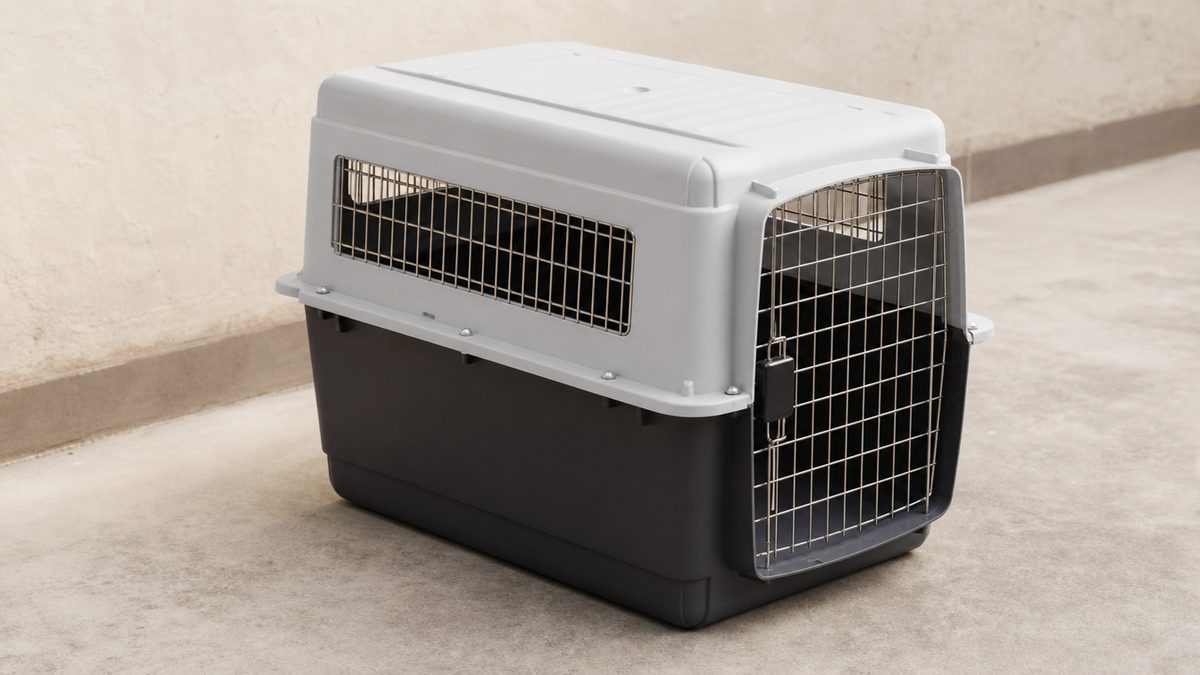
Quick answer
IATA approved dog crate India is a retail phrase, not a certification. IATA states that it does not certify, approve, endorse or sell any pet container manufacturer, brand, make or model. It publishes Container Requirement 1 of the Live Animals Regulations, and your airline's check-in staff judge your crate against it. Measure your dog, apply the formula to get internal dimensions, and check your own carrier's cabin size cap before you buy.
This guide is general information for Indian pet owners and is not a diagnosis. Always consult a registered veterinarian near you before acting on anything you read here, and treat any sudden change in your pet's condition as urgent.
What IATA approved actually means
IATA approved means nothing, because IATA approves no crate. The International Air Transport Association writes this into the first page of the container requirement itself, and it goes further than a disclaimer: it tells readers to watch for sellers who claim the opposite.
The sentence sits at the top of Container Requirement 1, above the specification. IATA states that its activities are limited to developing standards for the acceptance, packing and handling of live animals by air, and then: 'IATA does not certify, approve, endorse, or sell any particular pet container manufacturer, brand, make, or model.' The same paragraph adds that IATA does not endorse any pet transport or relocation service either, and closes with a warning, 'Readers should pay attention to fraudulent offerings that claim the opposite';.
A second IATA document repeats it in different words, so this is not a stray line. The guidance written for passengers flying with a dog or cat in the cabin says IATA 'does not certify, approve, sell or otherwise endorse any commercial dog or cat travel / shipping container as being compliant with standards in the Live Animals Regulations. It does provide standards for dog and cat travel / shipping containers in Container Requirement 1';.
So there is no certificate, no register, no inspection body and no stamp. There is a published specification, and a person at a check-in desk who decides whether your box meets it.
Who actually decides, in three layers
IATA itself draws the line between publishing and enforcing. Its Live Animals page states that 'It is the role of governments to set and enforce the rules concerning the transportation of live animals. IATA, however, publishes the Live Animals Regulations, which all IATA members are expected to adhere to';. The current edition took effect on 1 January 2026.
In India those layers resolve as follows, and no page in the search results sets them out.
- The regulator sets a rule by reference. Aeronautical Information Circular 9/1985, issued under rule 24-C of the Aircraft Rules, 1937, defines a container for carriage by air and states that 'The design of the containers shall conform with the IATA/1ST specification or any other approved specification'. Read the last five words. Indian law points at IATA without making IATA the only answer.
- The quarantine service inspects the animal, not the box. The Animal Quarantine and Certification Services list of requirements for exporting a dog or cat out of India runs to ten items, covering the animal for examination, the fit-to-fly certificate, the microchip certificate, vaccination details, the owner's passport and ticket, the airway bill and two photographs. It specifies no container at all.
- The airline enforces. CR1 is explicit about who holds the pen: 'Check-in staff are responsible for ensuring the container meets the IATA LAR requirements. Should the container not meet the minimum standards, the animal must not be accepted for travel'.
On a Google India pull for 'iata approved dog crate india' on 22 October 2026, eight of the nine organic results were selling crates on the phrase and the ninth was IATA's own Traveler's Pet Corner. One Indian retailer lists 'IATA-certified crate' as a product feature, and another seller advertises an 'IATA Accredited Pet Travel Cage';. IATA certifies and accredits no crate. That does not make any of those crates bad. It means the label on the box is not evidence, and you have to read the specification yourself.
This matters in money as well as in words. A crate is a rupee purchase of real size: the same Indian retailer prices its range from Rs 12,000 for a 20-inch box to Rs 38,000 for a 48-inch one, reduced from Rs 45,000, which is ₹12,000 to ₹38,000 of equipment bought on an unverifiable label. At those numbers, buying on the word approved is an expensive way to find out at a counter in Mumbai or Delhi that the box is wrong.
Which container requirement applies to a dog or a cat
Container Requirement 1 applies to domestic dogs and domestic cats, and it is the only container requirement either species normally needs. CR1 sits in the IATA Live Animals Regulations, 52nd edition, in effect from 1 January 2026, and names its scope on its own first page as 'Cat (domestic)' and 'Dog (domestic)'; International Air Transport Association.
CR1 is eight pages. It covers construction principles, materials, size, the rules for crating animals together, sides, floor, roof, door, ventilation, spacers, handles, forklift spacers, bedding, labelling, preparation before dispatch, feeding and watering, and loading. Everything a seller means by 'IATA crate' is in those eight pages, and so is the sentence saying no crate is IATA approved.
One line in CR1 is worth holding on to before you compare products. 'The illustrations shown in this Container Requirement are examples only. Containers that conform to the principle of written standards for the species but look slightly different will still be considered compliant with IATA minimum standards';. A crate does not have to look like the picture. It has to do what the text says.
The in-cabin container is CR1 with four things removed
A cabin carrier is not a separate standard. CR1 carries a sub-heading, Container Requirement In-Cabin, which says the container 'must meet the general requirements of Container Requirement 1, except that' the construction does not have to be rigid, spacers are not required, water and food containers are not required, and the rule that one end be welded wire mesh does not apply to soft side or cloth bags. It then adds that the container 'must nevertheless be clearly marked with a Live Animal label and the label must not block any of the ventilation openings';.
Four relaxations, and nothing else. The size test, the ventilation area, the escape-proof and leak-proof requirements and the labelling all survive into the cabin. A soft-sided bag is permitted; a soft-sided bag that fails the size test is not.
No Indian state or operator variation is filed against CR1
CR1 prints two lists of exceptions on its first page. State variations are filed by Switzerland, Great Britain, Hong Kong, New Zealand, South Africa, Zimbabwe, the European Union and the United States, with separate exceptions noted for Australia and New Zealand. Operator variations are filed by seventeen carriers, among them Air Canada, Air France, Cathay Pacific, Emirates, KLM, Lufthansa, Philippine Airlines and Qantas.
India appears in neither list, and no Indian carrier appears among the operators. The practical reading is that nothing in CR1 is modified for India by India, so the baseline text is the baseline text here. What Indian carriers do instead is set their own caps on top of it, which is a different thing and is covered further down this page.
A separate container requirement, CR82, covers reinforced metal containers that some carriers demand for particular breeds. A ranking relocation agency reports that under an addendum to LAR 52, Lufthansa, Austrian Airlines and Turkish Cargo list specific breeds for a reinforced wooden crate or for CR82. We have not opened that addendum, so treat the detail as that agency's reading rather than as read at source. What matters for India is that this is an operator-by-operator requirement, no Indian carrier has filed one, and for a dog or cat on an Indian sector the requirement is CR1.
The specification, part by part
Read CR1 as nine checkable parts: materials, openings, sides, floor, roof, door, ventilation, spacers and labelling. Each has a number or a test attached, and an acceptance agent works through them in order.
The table below is CR1's own text condensed. Where a figure differs between dogs and cats, both are given, because the cat numbers are tighter and a crate sold for a small dog can fail for a large cat on the opening size alone.
| Part | What CR1 requires | Dog | Cat |
|---|---|---|---|
| Materials | Fiberglass, metal, rigid plastics, welded wire mesh, solid wood or plywood. A container made entirely of wire mesh must not be used. Wood for international transport must comply with IPPC standards. | Same | Same |
| Openings | All openings nose and paw proof, no larger than the figures given, and smaller where needed to stay nose and paw proof. | 25 x 25 mm | 19 x 19 mm |
| Welded wire mesh | Where mesh is used it must meet a minimum thickness and be fixed so the animal cannot dislodge it. A second layer is allowed if both layers meet the minimum. | 2.5 mm or thicker | 2.0 mm or thicker |
| Sides | Solid with the prescribed ventilation. Plastic halves securely bolted together, and plastic clips must not be the only fasteners. | Wood or plywood 12 mm minimum | Wood or plywood 6 mm minimum |
| Floor | Solid and leak-proof, with absorbent bedding suitable for the species. | Same | Same |
| Roof | Solid, though ventilation openings and mesh are allowed across the whole surface if the roof stays strong. | Wood or plywood 12 mm minimum | Wood or plywood 12 mm minimum |
| Door | Forms the whole of one end, sliding or hinged, of a thickness the animal cannot bend or distort. Locking pins engage the container by at least 1.6 cm. Plastic doors permitted if hinges and locking pins are metal. | Same | Same |
| Ventilation | At least 16 percent of the total surface of the four sides, on all four sides, with side and back openings over the upper two-thirds. The whole of one end, which may be the door, must be welded wire mesh. | Same | Same |
| Spacers | Along both long sides and along the back, positioned to stop other freight blocking the ventilation. Forklift spacers at least 5 cm high once the loaded weight passes 60 kg. | Same | Same |
| Labelling | A green Live Animals label, mandatory. This Way Up labels on at least two opposite sides, mandatory. Marking the animal's name on the container is recommended. | Same | Same |
The door and locking pins deserve a second look before you buy, because that row is where a cheap crate gives itself away: a door that flexes under a shoulder, hinges moulded in plastic, or pins that seat a few millimetres into the shell rather than the 1.6 cm CR1 demands.
Two further items are easy to miss and both get crates refused. Wheels, if the container has them, 'must be removed or rendered inoperable';. And the water container must be 'open on the top surface allowing the animal unrestricted access', securely affixed inside, with 'outside access for filling that does not require the opening of the shipping container'; a bottle dispenser 'must not be used to replace open containers';.
The wheels rule is the one that catches Indian buyers, because wheels are sold here as a feature. One Indian retailer lists 'Detachable wheels for moving the crate easily through the airport and other transition hubs' among the key features of the crates it markets as IATA certified. Detachable is the operative word: fit them to cross the terminal, take them off before you hand the crate over.
Spacer bars, the part Indian pages leave out
Spacer bars are the raised rims along the long sides and the back of a hold crate, and they exist for one reason. CR1 says they 'must be provided along both long sides of the container. A spacer must also be provided along the back of the container', and that 'Spacer devices must be positioned to prevent other freight from blocking the ventilation';. A crate pushed flush against a pallet has no ventilation on that face, whatever its 16 percent says on paper.
India's own circular contains the same idea in older language, which is a useful cross-check that this is not a foreign nicety. AIC 9/1985 requires that a container placed in the cargo compartment 'must be located in such a manner as to assure that ventilation areas of the container are not obstructed';. Spacers are how a crate assures that for itself rather than relying on a loader.
The best editorial page ranking in India for this topic lists eight points for what makes a crate airline approved and spacers are not one of them. Spacers are also the single most common thing missing from a crate that otherwise looks right, because a moulded plastic shell without the rims looks identical in a product photograph.
That same guide says of the door, 'The door must be metal and must not open under pressure. All plastic doors are turned away';. CR1 says the reverse: 'Plastic containers: Doors made of plastic are permitted, provided that hinges and locking pins are made of metal of sufficient thickness';. The metal parts that matter are the hinges and the pins, not the whole door. An owner who read that line and returned a compliant crate lost money for nothing. CR1 does separately recommend adding removable fasteners such as cable ties at the four corners of the door frame on rigid plastic containers.
Sizing: the formula, and the arithmetic worked through
To size a crate, measure the animal standing, apply CR1's four-measurement formula, and treat the answer as internal dimensions. The formula is guidance. The test it approximates is mandatory, and the two are not the same thing.
CR1 separates them deliberately. Under a heading that reads 'Size (Mandatory performance requirements when selecting a shipping container)' it states: 'Each animal in the container must have enough space to stand, to sit erect, to lie in a natural position and to turn about normally while standing';. The arithmetic appears under a different heading, 'Guidance on Calculating Minimum Container Dimensions', and is introduced as a formula that 'may be useful. However, it may need to be adjusted to meet the mandatory performance requirements listed previously';.
So the four measurements get you close, and the animal standing inside settles it. Measuring your dog takes two minutes and a fabric tape, and it is the only step on this page that nobody else can do for you. Take all four with the animal standing naturally.
- A, length. Tip of the nose to the base or root of the tail. The tail is not included.
- B, elbow height. Ground to the elbow joint of the front leg.
- C, width. Across the shoulders, or the widest point of the body if that is wider.
- D, standing height. Ground to the top of the head or the ear tip, whichever is higher, with the animal standing naturally.
- Bedding. The thickness of the absorbent bedding you will put on the floor, which CR1 requires.
The formula then reads: container length equals A plus half of B, container width equals C multiplied by 2, and container height equals D plus bedding. Snub-nosed breeds require a container 10 percent larger. For two animals the width becomes C multiplied by 3, and for three animals C multiplied by 4, while length and height are calculated as for a single animal.
Internal against external, the mistake that costs you the crate
CR1 states it in one line: 'The calculated dimensions are internal container dimensions';. Indian sellers advertise external dimensions. One Indian retailer writes of its 48-inch crate that 'The exact dimensions of this crate are 48x36x34 inches (LxBxH)', with no note that these are outside measurements, and the leading Indian guide's size chart heads its column 'Typical external size';. Subtract the wall thickness, the door frame and the moulding before you compare.
Work an example. These measurements are illustrative, taken for a notional adult Labrador Retriever, and you must measure your own dog rather than copy them.
| Measurement | Labrador Retriever | Adult cat | Pug, snub-nosed |
|---|---|---|---|
| A, nose to tail base | 92 | 46 | 50 |
| B, ground to elbow | 32 | 14 | 18 |
| C, shoulder width | 26 | 15 | 24 |
| D, standing head height | 66 | 30 | 36 |
| Bedding | 3 | 2 | 3 |
| Length, A plus half of B | 92 + 16 = 108 | 46 + 7 = 53 | 50 + 9 = 59 |
| Width, C times 2 | 52 | 30 | 48 |
| Height, D plus bedding | 69 | 32 | 39 |
| Snub-nosed uplift, 10 percent | not applicable | not applicable | 65 x 53 x 43 |
| Minimum internal dimensions | 108 x 52 x 69 | 53 x 30 x 32 | 65 x 53 x 43 |
Now read those answers against what is sold. The leading Indian size chart puts 'Labrador, Golden Retriever, German Shepherd, Doberman' in its Size 5, a 40-inch crate of 102 x 69 x 76 cm external. Our example Labrador needs 108 cm of internal length. A crate 102 cm long on the outside cannot contain 108 cm on the inside, so that dog needs the next size up, and the breed row in the chart points the wrong way. The chart's own caveat says as much, that 'Breed and weight here are a guide, not the answer';, and the arithmetic is why.
Height and width are rarely the binding constraint on a dog. Length almost always is, because A plus half of B grows faster than people expect on a long-bodied animal. Measure A twice and take the larger number.
CR1 allows 'A maximum of two adult animals of comparable size up to 14 kg each, that are compatible in size and used to cohabiting' in one container, and requires animals over 14 kg to be crated individually. Weaned puppies or kittens may share if they are no older than six months, no more than 14 kg each, no more than three per container and used to cohabiting, and some national regulations require individual crating anyway unless the consignment is a litter over eight weeks travelling with its mother. IATA also cautions that animals sharing a household 'may become stressed and aggressive towards each other when traveling by air';.
Where Indian carriers diverge from the standard
Indian carriers diverge in two ways that change what you buy: they publish a hard maximum container size for the cabin, which CR1 does not, and at least one publishes a ventilation rule looser than CR1's. Read the carrier's number as a ceiling and CR1's formula as a floor, then check that your animal fits between them.
Air India's own policy page, read on 21 October 2026, states the cabin container rule in one sentence: 'A soft kennel of 17x10x9 inches [LxWxH] is allowed. It must be leak-proof, secured, ventilated on 3 sides, and without wheels';. For a pet of 10 to 32 kg travelling as checked baggage, the same page requires a 'Hard case carrier as per IATA container guidelines' and links directly to the CR1 document.
Three sides is the divergence. CR1 requires that 'Ventilation must be provided on all 4 sides of the container', and the in-cabin section of CR1 does not list four-side ventilation among the four things it relaxes. A three-side convention is not invented, though: the American Veterinary Medical Association describes hold crates as needing to be 'Adequately ventilated (on at least three sides for domestic flights or four for international flights)';, which is a domestic-flight convention rather than the IATA baseline. Buy four-side ventilation and you satisfy both.
Akasa Air publishes dimensions and no ventilation rule on the same page. Its 'Need to know' block states that 'Container size for cabin should not exceed 19" L x 12.6" W x 10" H', that 'Container size for check-in/cargo should not exceed 36" L x 28" W x 28" H', and that 'Your pet must remain inside their closed/zipped up container in the airport and for the entire flight';.
| Air India | Akasa Air | Example adult cat needs | Example Pug needs | |
|---|---|---|---|---|
| Cabin container maximum | 17 x 10 x 9 in | 19 x 12.6 x 10 in | ||
| Same, in centimetres | 43.2 x 25.4 x 22.9 | 48.3 x 32.0 x 25.4 | 53 x 30 x 32 | 65 x 53 x 43 |
| Length | 43.2 | 48.3 | 53, over both | 65, over both |
| Width | 25.4 | 32.0 | 30, clears Akasa only | 53, over both |
| Height | 22.9 | 25.4 | 32, over both | 43, over both |
| Ventilation required | 3 sides | not stated on the page | CR1 says 4 sides | CR1 says 4 sides |
| Construction | soft kennel, no wheels, leak-proof | closed or zipped for the whole flight |
That table carries the finding this page exists to make. A cabin ceiling of 17 x 10 x 9 inches is 43 x 25 x 23 cm, and the CR1 formula applied to an ordinary adult cat returns 53 x 30 x 32 cm. The two do not meet. The resolution is not that the carriers are in breach, because the mandatory test is behavioural rather than arithmetic: if the animal can stand, sit erect, lie naturally and turn around inside the bag, the bag passes. The resolution is that under-seat space is a hard physical limit, and a cabin cap this small means many animals have no cabin route at all on that carrier, whatever a seller tells you about a bag being approved.
The same arithmetic quietly closes a door that looks open. Air India permits brachycephalic breeds in the cabin on a vet's advice while barring them from the cargo compartment. Our example Pug needs 65 cm of internal length after the 10 percent uplift, against a 43 cm cabin ceiling. For an adult Pug that cabin permission is theoretical.
IATA's own guidance says the same thing in its own words: 'Individual carriers may have additional or more stringent policies to some of this guidance or components of CR1, so the individual carrier(s) being used for the journey should be consulted as part of planning the journey';. Which Indian airlines carry pets at all, in which compartment, at what weight and for what fee is a separate question, and our guide to flying with a dog or cat in India answers it from each carrier's own page. Settle the carrier first. Then buy the crate.
Snub-nosed breeds, and the 10 percent that is not the whole story
A snub-nosed dog or cat requires a container 10 percent larger in every dimension, and CR1 adds two handling rules on top of the size uplift. The extra space is the easy part; the heat and the stowage are where the risk sits.
CR1's size section states plainly that 'Snub-nosed breeds require 10% larger container';. Its loading section adds a warning: 'Snub-nosed dogs must be stowed as far away as practical from other loads to ensure they have the largest amount of air space available in the hold';. And IATA's traveller page states that 'Transport of snub nose dogs, such as boxers, pugs, bulldogs and Pekinese, in hot season is not recommended. These animals have difficulty in maintaining a normal body temperature in hot weather';.
The AVMA puts the same risk in owner-facing terms, noting that 'brachycephalic (short-nosed) pets like Pugs or Persians are more at risk than others of overheating or breathing problems during travel, especially air travel', and listing the one-size-larger rule among its crate requirements.
Air India's current page refuses them in the hold for the reason it gives: 'Snub-nosed or flat-faced breeds (brachycephalic) are not permitted in the cargo compartment due to the increased risk of respiratory issues and temperature sensitivity', and advises consulting a licensed veterinarian before travelling with one in the cabin.
Why a shortened airway makes a hot, confined, pressurised journey harder is a clinical question and this page does not answer it. Our condition page on brachycephalic obstructive airway syndrome covers the anatomy, the grading scheme and the Indian summer, and the honest starting point for a flat-faced animal is the veterinary consultation rather than the crate catalogue.
Applied to each dimension rather than to the volume, a 10 percent uplift raises the internal volume by about 33 percent. For our example Pug the plain formula gives 59 x 48 x 39 cm and the uplift gives 65 x 53 x 43 cm. That is often a whole size step in a retail range, and it is the step owners skip because the dog looks small.
Heat, humidity and the Indian apron
Ventilation area is a heat rule, not an air rule, and in India that is the dimension of the standard that bites hardest. A crate sits on an apron, in a ramp vehicle and in a holding area before it sees a hold, and in Chennai or Ahmedabad in May those are the hot parts of the journey. A mid-morning departure from Bengaluru or Pune in a humid pre-monsoon week does the same thing more quietly.
IATA's cabin guidance names a failure mode no Indian page mentions. 'Soft-sided containers may compress when inserted under the seat. Compression of the ventilation openings can result in reduced ventilation and heat buildup in the container leading to potential adverse consequences to the dog or cat contained therein';. A bag that measures 16 percent ventilation on a shop floor does not measure 16 percent squashed under a seat, and in a warm cabin that difference is the whole point of the number.
The operational guidelines IATA published for airlines in 2026 turn this into a boarding check. Gate agents 'should verify that both soft and rigid cabin containers comply with IATA LAR CR1', and containers must be 'secure, well-ventilated, appropriately sized, and capable of fitting entirely under the seat in front of the passenger, where under-seat stowage is permitted, without compromising space and ventilation';. The words 'without compromising ventilation' are doing real work. A bag that only fits when crushed does not fit.
Three practical consequences follow for an Indian departure.
- Buy a bag that fits the under-seat space uncompressed. Measure the space on your aircraft type if you can, and treat the carrier's published cabin maximum as the number ground staff will apply, not as a target to exceed slightly.
- Prefer a rigid frame or stiffened panels in a soft bag. The relaxation in CR1 is that the construction 'does not have to be rigid', which permits a soft bag; it does not promise that a floppy one keeps its vents open.
- Fly early or late in the hot months. The AVMA advises that 'During warm weather months, choose early morning or late evening flights, when the temperatures are generally not as hot. In colder months, choose afternoon flights'. In a humid pre-monsoon week in Mumbai or Kolkata that single choice does more than any crate feature.
The absorbent bedding CR1 requires has a second job in a humid climate. It must be absorbent and suitable for the species, and the cabin guidance adds that 'The traveling container must be able to contain any feces or urine produced by the dog or cat' and that 'The container must be clean and leak-proof and absorbent bedding must be provided';. A soaked pad in a closed bag in Chennai humidity is both a welfare problem and a refusal risk at a connection.
One more thing travels badly in heat and is easy to forget. IATA recommends that the shipper 'removes collars/vests/harnesses/clothing and electronic GPS trackers from animals prior to crating', and that where trackers are used 'they must fully comply with IATA Dangerous Goods Regulations and must be declared to the operator';. Air India's own advice agrees on the leash: 'Remove the leash before placing your pet in the container';. If your dog normally wears a coat, our guide on whether dogs need clothes in India is the place for that argument; it does not travel into the crate.
Acclimatising the animal to the crate
Acclimatise the animal to the exact crate it will fly in, starting weeks before the journey, because a crate first seen on travel day is a box the animal is trapped in. IATA calls this the responsibility owners most often overlook.
The wording is unusually direct for a trade body. 'Let it become familiar with the crate or kennel a few weeks or months before your planned departure. Purchase one in advance and get your animal used to being confined in it. Remember taking an animal out of its natural environment or surroundings is by definition stressful.' And then: 'Animals behave perfectly fine when accustomed to the kennel or crate they are transported in. As a responsible pet owner, this responsibility is often overlooked';.
IATA's cabin guidance repeats it for in-cabin animals: 'Dogs and cats should be introduced to the travel / shipping container to be used for in-cabin carriage well before the journey so that their stress in being confined in it during the journey is minimized';. The 2026 operational guidelines make it something the airline owes you, listing 'Provide guidance on acclimating pets to travel containers' as a recommendation to the carrier at the pre-arrival stage.
Air India is the Indian carrier that actually does this. Its page answers 'How can I help my pet stay calm during travel?' with 'Acclimatise your pet to the travel container a few weeks before departure by placing them inside for short periods and rewarding them with treats', and its pre-travel checklist includes 'Familiarise your pets with their travel bag or kennel';.
The AKC describes the same method and adds the part about the airport rather than the box: 'Introduce the carrier early, and use praise and treats to create a positive association with it. It can also help to expose your dog to busy, dog-friendly environments so they become more comfortable around crowds, noise, and unfamiliar activity';. The AVMA's version is to 'Take time to help your pet get used to the crate or carrier in which they will travel', noting that 'Placing a familiar toy or blanket in the carrier can help your pet feel more comfortable';.
A workable crate training sequence, assembled from those sources, runs as follows. Buy the crate first, not last.
- Place the crate in a room the animal already uses, door open or removed, and ask nothing of it for several days.
- Feed meals at the door, then inside, moving the bowl further in across sessions, and add the animal's own unwashed blanket.
- Close the door for seconds, then minutes, staying in the room, and open it during a calm moment rather than in response to a complaint.
- Extend to time alone, so the animal settles and sleeps in the crate without you present.
- Add motion and noise, with short car journeys in the crate, which teaches that it moves and then stops.
- Never use the crate as punishment, at any stage, because the association is the entire point of the exercise.
Do not start this in the last week. CR1's own preparation section, the AVMA and the AKC all treat familiarity as something built over weeks, and the airline has a reason to care: an animal that reads as distressed at the counter can be refused. For a cat the groundwork is the same but the carrier choice differs, and the controlled evidence behind carrier training for cats is set out in our guide to travelling with a cat in a car in India. A crate also does a different job in a vehicle, where the question is crash performance rather than ventilation area; that is covered in restraining a dog in a car.
If the animal will not settle in a crate after weeks of patient work, that is information rather than failure. Indian Railways takes dogs and cats under rules that do not require a CR1 container, and our guide to taking pets on trains in India sets out the classes and the booking.
Sedation: the honest answer is a strong one
Do not sedate an animal for a flight, unless a veterinary surgeon has decided it is necessary for a medical reason and has documented the drug, the dose, the time and the route. IATA, the AVMA and the AKC all say the same thing, and Indian carriers refuse a sedated animal outright.
IATA's position runs to several hundred words and is worth reading in its own terms rather than as a slogan. 'It has been a long standing practice of IATA and its constituent carriers to discourage the use of sedatives and tranquilizers in animals to be transported either as cargo or as cabin baggage due to the potential for adverse effects during transport. This view is endorsed by veterinary organizations such as the American Veterinary Medical Association';.
The mechanism it gives is specific. Tranquillising drugs lower blood pressure, 'this also occurs naturally at high altitudes', and the cabin is pressurised to 'the equivalent of approximately 8,000 ft', so 'The combination of altitude and drugs is potentially fatal in the old, chronically sick or stressed animals';. On the drug class most often used, IATA writes that animals given it 'often lose their righting ability and their sense of balance as a function of dose', and that depending on the dose 'they can lose the ability to position themselves and are susceptible to injury as well as obstruction of the airway due to abnormal postures';.
Then the part that answers the question owners actually ask, which is whether a sedative would at least stop the panic. IATA's answer is that it probably would not. 'It is not established, and probably is unlikely, that tricyclic antidepressants or other available psychotherapeutic agents will reliably alleviate the risk of panic attacks and destructive behavior while in transit', and heavy enough sedation to achieve it would mean judging a dose 'over a long and perhaps variable transit time in a varying transit environment and with little chance of re-dosing or adequate observation';.
The cabin guidance adds the welfare reason: 'There is considerable risk in sedating animals transported by air, as tranquillizers reduce the ability of the animals to respond to stress during transportation', and notes that 'Airlines may refuse to carry an animal that is sedated / tranquilized at their discretion';. The AVMA's instruction to owners is to 'Consult your veterinarian before giving your pet any tranquilizers or sedatives. These can increase the risk of heart or respiratory problems and generally are not allowed by airlines';, and the AKC repeats it almost word for word.
Indian carriers enforce it. Air India's own page lists among the conditions for refusing carriage 'If the pet is sedated or tranquilized or pregnant', and its calming advice ends with 'avoid using sedatives or tranquillisers';.
IATA's In-Cabin Live Animal Acceptance Checklist, the form a trained agent completes and signs, carries the question 'Has the owner confirmed the animal is not sedated?' as a tick box, under a footer reading 'IF ANY QUESTION IS ANSWERED WITH "NO", DO NOT ACCEPT THE SHIPMENT';. Where a veterinary surgeon has prescribed sedation for a medical reason, the paperwork is the route: CR1 requires that 'the name of the drug, the time and route of administration must be clearly marked on the container and a copy of the record must be attached to the documents';, and the operational guidelines name an IATA Record of Administration as the form for it. Bonbeno names no drug and no dose. That is a decision for the veterinary surgeon who has examined your animal, and this page publishes under the medical disclaimer for that reason.
A separate preparation list in CR1 is worth knowing because it rules some animals out before the crate question arises. Shipment of females in heat 'is not recommended'; females with suckling young and unweaned animals 'must not be accepted for carriage'; weaned puppies and kittens younger than eight weeks 'must not be shipped due to possible dehydration effects in air transportation'; dogs and cats 'should only be shipped during the first two thirds of pregnancy'; and they 'should not be shipped for seven days following giving birth';.
On feeding, CR1 is precise and most Indian pages are not. 'Feed the animal a light meal at least two hours before dispatch, provide a short drink and exercise the animal immediately before crating.' Animals 'do not normally require additional feeding during 12 hours following the time of dispatch', water must be provided if the journey exceeds 12 hours, and 'Animals must not fly within 2 hours after their meal';. Nausea on the way to the airport is a separate problem with a separate answer, covered in our guide to car sickness in dogs.
What happens at the counter, and why a crate is refused
Your crate is judged twice, once by check-in staff against an acceptance checklist and again by gate agents, and a failure at either point means the animal does not fly. Knowing the form they work from is the closest thing to a guarantee available, because no certificate exists.
The form is published. IATA's In-Cabin Live Animal Acceptance Checklist 'must be completed and signed by a trained agent', and its Container Compliance section asks, for cats and dogs, whether the animal 'can sit, stand, turn around and lie down in a natural position', whether the container 'has at least 16% ventilation of the four sides', whether it 'has ventilation on all four sides', whether it is 'leak and escape proof', whether it is 'clearly labelled with a live animal label' and whether it 'fully complies with IATA LAR standards';.
The general acceptance section before it asks whether the documentation is present, whether the animal 'is clean and does it appear to be fit to travel', whether the owner has confirmed the animal is not sedated, and whether documentation proves the animal is at least eight weeks old. Any answer of no means the shipment is not accepted.
The 2026 operational guidelines spell out the consequence twice. At check-in, 'if the animal appears unwell, distressed or displaying unacceptable behaviour, boarding must be denied', and 'Failure to meet these requirements must result in denied boarding'. At boarding, 'If a container is non-compliant or the pet appears distressed, boarding must be denied';.
Air India's refusal list is the same idea in a carrier's own words, naming 'reasons of safety or security, arising out of condition of the kennel/pet carrier', 'Non-compliance of the size of the kennel, or age of the pet', and 'Demonstration of offensive behaviour showing excessive signs of chewing or cage destruction at the time of lodgement';.
Why you book the pet directly with the airline
There is a mechanical reason, and it is not that agents are careless. IATA's operational guidelines require airlines to register a cabin pet with a Special Service Request code, 'SSR PETC, Pet in Cabin', under the IATA Reservations Handbook chapter on the carriage of animals, and then add that 'Airlines should notify passengers that not all travel agencies or metasearch providers support pet-in-cabin bookings. In such cases, passengers should be directed to contact the airline directly to add the service';. A fare site that cannot send a PETC cannot book your animal, whatever its checkout page implies.
The same document advises that reservations are 'generally mandatory at least 48-72 before departure';, which is where Air India's 48 hours and Akasa's 24 hours come from and where they differ.
Two airport realities round this off. Security screening varies, and 'in some jurisdictions, pets must be removed from their containers to facilitate the screening of the animal and container separately', so a collar and leash you can fit at the gate matters even though they come off before crating. And relief areas are not guaranteed: IATA notes that 'In many cases, airports may lack designated pet relief zones altogether' and advises researching each transit point in advance.
- Photograph the crate from four sides, the door and the rim fixings before you travel, so a disagreement at a counter is about an object rather than a memory.
- Write the animal's name on the container, which CR1 recommends, and attach your contact details, which the AVMA requires on its own list.
- Fix the green Live Animals label and This Way Up arrows on two opposite sides before you reach the airport, not at the desk.
- Carry spare absorbent bedding and spare cable ties, because both are consumed by a delay and neither is sold airside.
- Take the wheels off at the kerb, and keep the bolts.
The AVMA states it without hedging: 'Defective crates or carriers are the most common cause of escaped or injured animals during air travel';. That is the reason the specification is long and the reason an agent is entitled to refuse your box. For an export sector the animal is examined separately by the Animal Quarantine and Certification Services, which runs this service only at Bangalore, Chennai, Delhi, Kolkata, Mumbai and Hyderabad, wants the animal itself presented with the papers seven days before embarkation by appointment, and issues a certificate 'valid for 10 days from the date of issue / Examination in AQCS'; Air India, Travelling with Pets. The paperwork sequence for leaving the country is in our guide to taking your pet abroad from India.
What to check before you spend the money
Check the crate against CR1 and against your carrier's published ceiling, in that order, and ignore every claim of approval printed on the box or the listing. Bonbeno does not rank crate brands, because a verdict on a product needs first-hand testing we have not done.
What we can tell you is what the standard demands and what the Indian market gets wrong about it. The size conventions sold here are a retail invention, not an IATA classification: one Indian guide sells six sizes numbered 1 to 6 from 24 to 48 inches while an Indian retailer runs 20 to 48 inches on different dimensions, listing its 48-inch crate at 48 x 36 x 34 inches where the other chart's 48-inch is 122 x 81 x 89 cm, about 48 x 32 x 35 inches PetRelocation.IN. Two crates sold as the same size differ by roughly four inches on the width the C times 2 rule governs.
Measuring advice is thin in the same places. One Indian retailer's instructions tell buyers to measure floor to the top of the head, to include the ears if they are not erect, and to measure nose to rear. That is D and A. Without B you cannot compute the length and without C you cannot compute the width, so a buyer following those three steps has no way to apply the formula at all.
- Measure A, B, C and D with the animal standing, and note the bedding thickness.
- Compute length, width and height, add 10 percent to each if the animal is snub-nosed, and treat the result as internal.
- Read your carrier's published container maximum and confirm your computed internal figures fit inside it.
- Inspect the physical crate for four-side ventilation, bolted halves, metal hinges and pins, a door forming one whole end, spacers on both long sides and the back, a solid leak-proof floor and removable wheels.
- Put the animal in it on the floor at home and watch it stand, sit erect, turn around and lie down. That is the mandatory test, and it is the only one you can run yourself.
- Buy it weeks early, so the acclimatisation above has somewhere to happen.
If a crate fails step 3 rather than step 4, the problem is the route and not the box, and no purchase fixes it. A dog that cannot fit an Indian cabin ceiling and belongs to a breed barred from the hold has no air route on that carrier at all. Treat that as the answer rather than as an obstacle, and plan the journey some other way.
One page in the field states the central fact correctly. A relocation agency's crate page, ranking eighth on Google India for 'is iata crate mandatory for flight', carries the line 'IATA Never Certifies. No crate carries an IATA approval. Airline staff judge each crate against CR1 and can refuse it';. It is a good page and it is written for Vietnam, pricing against Vietnam Airlines and describing crate sizes as hard to find in Vietnam. The nearest thing to a correct answer available to an Indian searcher on this query is, at the time of writing, somebody else's country's guide.
Questions Indians ask Google about IATA crates
What is an IATA approved crate?
An IATA approved crate does not exist as a certified product. IATA states in Container Requirement 1 that it 'does not certify, approve, endorse, or sell any particular pet container manufacturer, brand, make, or model', and warns readers about offerings claiming otherwise. What exists is CR1, a published specification covering materials, ventilation, door, floor, spacers and labelling, which your airline's check-in staff apply to your crate at the counter.
What makes a dog crate airline approved?
A crate is accepted when it meets Container Requirement 1 and the airline's own limits. CR1 requires rigid materials for the hold, ventilation on all four sides covering at least 16 percent of their surface, openings no larger than 25 by 25 mm for dogs, a door forming one whole end with locking pins engaging at least 1.6 cm, bolted halves rather than plastic clips, a solid leak-proof floor with absorbent bedding, spacer bars, no working wheels, and a green Live Animals label.
What are the standard dimensions for an IATA dog crate?
There are none. IATA publishes no standard crate sizes and no size chart, only a formula applied to your own animal: internal length equals A plus half of B, internal width equals C times 2, and internal height equals D plus bedding, with 10 percent added for snub-nosed breeds. The numbered size ranges sold in India are retail conventions, and two Indian sellers' 48-inch crates differ by about four inches in width.
How to measure dog for air travel crate?
To measure a dog for an air travel crate, stand it naturally and take four measurements. A is nose tip to the base of the tail, excluding the tail. B is the ground to the elbow joint of the front leg. C is the width across the shoulders or the widest point. D is the ground to the top of the head or the ear tip, whichever is higher. Note the bedding thickness, then apply the formula and treat the result as internal dimensions.
What are the IATA cage requirements for dogs and cats?
Both species fall under Container Requirement 1, with tighter numbers for cats. Openings may be no larger than 25 by 25 mm for dogs and 19 by 19 mm for cats, welded wire mesh must be 2.5 mm or thicker for dogs and 2.0 mm for cats, and wooden sides must be 12 mm for dogs and 6 mm for cats, with a 12 mm roof for both. Ventilation, door, floor, spacer and labelling rules are identical for the two species.
What size crate for dog on plane?
The size your own measurements produce, capped by your airline's published maximum. Apply the CR1 formula for the internal minimum, then check it against the carrier: Air India publishes a cabin ceiling of 17 by 10 by 9 inches for a soft kennel, and Akasa Air publishes 19 by 12.6 by 10 inches, both read on the carriers' own pages on 21 October 2026. Where the formula exceeds the ceiling, that animal has no cabin route on that carrier.
Where can I find IATA-approved dog crates in India?
Nowhere, because no seller anywhere can supply an IATA-approved crate. Indian retailers and relocation agencies do sell crates built to the Container Requirement 1 specification, priced from roughly Rs 12,000 to Rs 38,000 at one retailer, but the words approved, certified and accredited in those listings carry no verification from IATA. Bonbeno does not rank crate brands. Check the physical crate against CR1 and against your carrier's ceiling instead.
Is Petmate crate IATA approved?
No crate from any manufacturer is IATA approved, including that one, because IATA states that it does not certify, approve, endorse or sell any particular pet container manufacturer, brand, make or model. Whether a given crate meets Container Requirement 1 is a question about its construction, which we have not tested and do not rank. Check it yourself against the ventilation, door, fastening, floor, spacer and labelling rules, then against your airline's size cap.