
Dog and cat travel guide
Taking a dog or cat on an Indian train: classes, booking, fares and the brake van
Every rule read from the railway's own documents: the IRCTC terms, the Southern and Eastern Railway releases, the Railway Board summary, the Coaching Tariff manuals and the live Scale-L chart, with the disagreements between them printed and priced.
Quick answer
Are pets allowed in train travel on Indian Railways? Yes, in two ways. A dog or cat travels in First AC or First Class when the 2-berth coupe or 4-berth cabin is booked in full under one PNR, with the animal booked as luggage after the first chart; or a dog travels in the brake van dog box while you hold a confirmed ticket on the same train. Every other class is closed to an adult animal, a basket puppy or kitten may ride in any class, and the fare is Scale-L luggage rate on 60 kg or 30 kg.
Which train classes allow a dog or cat, and on what condition
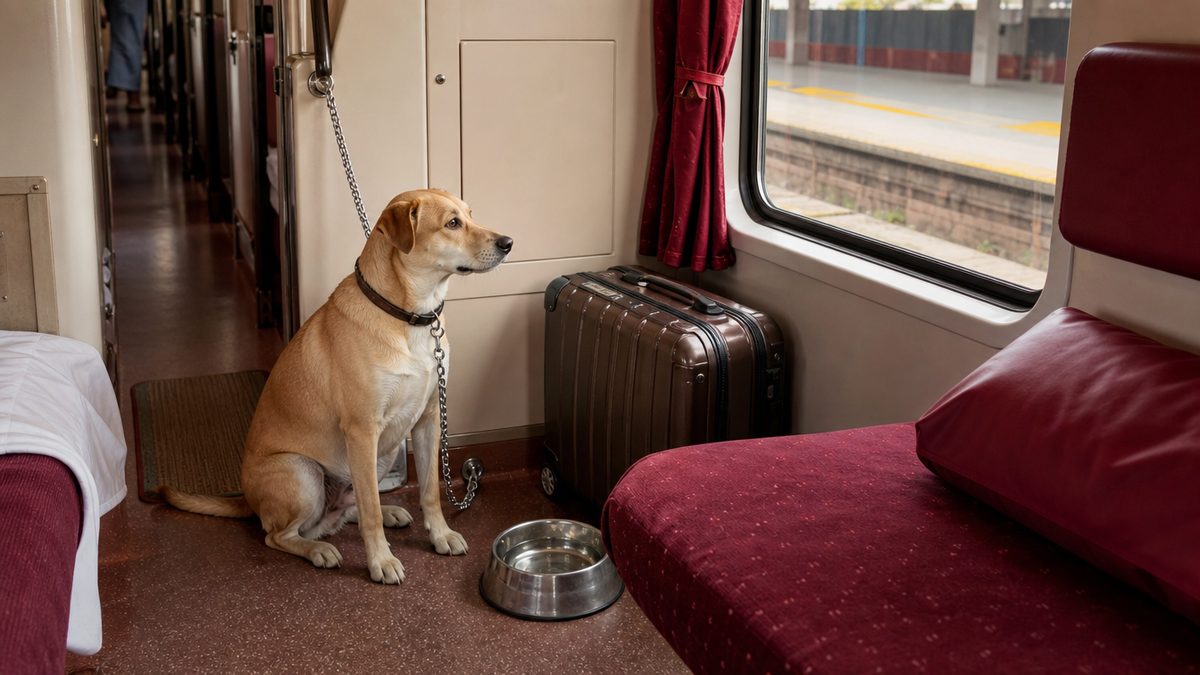
Two classes allow a dog or cat to travel with you on Indian Railways, First AC and First Class, and only when the whole 2-berth coupe or 4-berth cabin is booked under a single PNR; every other class is closed to an adult animal, with one exception for a puppy or kitten small enough to ride in a basket. The other route is the dog box in the brake van, which any passenger with a confirmed ticket on the same train can book.
IRCTC's own terms put the rule in one sentence: "Dogs/Cats accompanied by owners can be carried in First AC/First class only when entire 4 berth cabin or 2 berth coupe is allotted to a single PNR". Southern Railway's Know your Railway release of 2 November 2022, issued from its Chennai headquarters for a zone that covers Tamil Nadu and Kerala, says the same thing from the other side, that "passengers not in possession of AC-First Class/First Class Cabin/Coupe tickets are not permitted to carry their pet dogs along with them", that "only one dog will be allowed per Passenger Name Record (PNR)", and that "dogs are not allowed to be carried in AC2 tier, AC 3 tier, AC Chair Car, Sleeper Class and Second Class Compartments";. Eastern Railway repeated every one of those lines in its own release of 20 March 2023, so the rule is the same in Chennai and in Kolkata. The Railway Board's summary states the condition as exclusivity: a dog is permitted with the passenger "provided that the whole coupe (2 berther or 4 berther) is booked by the passenger or the group of passengers for his/their exclusive use".
| Class | Adult dog or cat with you? | Condition | Fare basis |
|---|---|---|---|
| First AC (1A) | Yes | Entire 2-berth coupe or 4-berth cabin under one PNR; one dog per PNR; fellow passengers may still object | Luggage rate on 60 kg |
| First Class (FC) | Yes | Same as First AC | Luggage rate on 60 kg |
| AC 2 tier (2A) | No | Dog box in the brake van only | Luggage rate on 30 kg |
| AC 3 tier (3A) | No | Named in the Southern Railway release; dog box only | Luggage rate on 30 kg |
| AC Chair Car (CC) | No | Dog box only, and chair-car trains usually carry none | Luggage rate on 30 kg |
| Sleeper (SL) and Second Class | No | Dog box in the brake van only | Luggage rate on 30 kg |
| Any class, puppy or kitten in a basket | Yes | Confirmed ticket, photo ID, vet certificate, station master's permission, co-passengers' consent | Luggage rate on 20 kg |
The basket exception for a puppy or kitten
A puppy or kitten small enough for a basket rides in any class. IRCTC's terms say "Puppies/kittens which can be carried in a basket can be carried by owners in any class after payment of usual booking charges";, and Southern Railway's release adds the conditions: a confirmed ticket, valid proof of identity, the veterinary fitness certificate with the vaccination cards, and the prescribed luggage charge. The tariff behind that sentence is IRCA Coaching Tariff No. 25 Part I Volume III Rule 415, which bars small birds and animals from air-conditioned classes and then makes the one exception, kittens and puppies, "allowed to carry on owner's risk in basket with the permission of station master as per prescribed freight charges in all classes", at a chargeable weight of 20 kg in a basket or cage and 40 kg loose, minimum Rs 30. South Central Railway's 2022 manual adds two words that matter on the day, "with consent of co-passengers", and the consequence: "If other passengers object they must be shifted to the brake van";.
The exception is about the basket, not the breed. A 12-week-old Labrador Retriever fits one; the 30-odd kg adult it becomes does not, and neither does an adult Beagle or an adult Indian Pariah Dog. Once the animal is out of the basket the only classes are First AC and First Class with the coupe or cabin booked in full.
Trains that have no place for a dog at all
The Railway Board's summary of the rules limits the facility to trains that have the accommodation: booking in First AC and First Class and in the brake van dog box "can be availed in all Mail/Express and in AC First Class in Rajdhani Trains"; "in Shatabdi trains, booking of dogs is not permitted as these trains do not have AC First Class and First Class compartments"; and "booking of dogs in dog boxes is not permitted in Rajdhani/Shatabdi trains as they do not have dog boxes";. A chair-car train is closed to a dog twice over, and the Vande Bharat section below applies the same test to the newest rakes.
The CRIS luggage rules say a First AC or First Class passenger "may take a dog into the compartment only with the concurrence of fellow passengers", and that "if fellow passengers subsequently object to the dog remaining in the compartment, it will be removed to the Guard's van, no refund being given";. Southern Railway prints the same removal rule. Booking the whole coupe under one PNR is what removes the objector, because there is nobody else in it; a single berth in a 4-berth cabin gives no pet rights at all.
How to book a dog or cat in a First AC or First Class coupe, step by step
To book a dog or cat in a First AC or First Class coupe, you reserve the whole coupe or cabin under one PNR first, wait for the first chart, and then book the animal as luggage against that PNR, either online through IRCTC's Dogs/Cats Booking link or at the station's luggage or parcel office. The animal's booking is a luggage ticket, not a passenger ticket, and the freight is not refundable.
IRCTC's user guide and the two zonal releases describe one procedure, with an online and a counter version of the last step. The steps are listed below.
- Reserve every berth of a 2-berth coupe or 4-berth cabin under one PNR, on IRCTC or at a PRS counter. Ask for the coupe or cabin allotment in writing: IRCTC says "the request for allotment of cabin/coupe against a PNR booked in First AC/First class can be made in the divisional railway manager office or General Manager office" and that "due consideration is given to such requests while allotting the cabin or coupe".
- Wait for the first chart. Online booking of a dog or cat "is allowed only after preparation of first chart and upto final chart is prepared". Until the chart confirms that the whole coupe is yours, there is nothing to book the animal against.
- Book online: irctc.co.in, TRAINS menu, Dogs/Cats Booking. The site redirects to the Railway's parcel portal at parcel.indianrail.gov.in/LTBook, where you log in with a mobile OTP, a captcha and an email address, enter the PNR, pass the eligibility check, select the number of animals, give one ID card's details and pay through the SBI gateway (UPI QR is one of the options). The confirmation page shows a luggage ticket number; the luggage ticket is emailed and a booking SMS is sent to your mobile.
- Or book at the counter. Bring the animal to the luggage or parcel office "at least 3 hours in advance of the departure of the train, whether the passenger holds PRS ticket or online ticket booked through IRCTC, upon confirmation of the allotment in AC-First/First Class Cabin/Coupe after charting".
- Submit the documents at booking, the veterinary fitness certificate and the vaccination cards (next section), and pay the prescribed charge at the luggage rate on a 60 kg chargeable weight (fare section).
- Keep the luggage ticket for the whole journey. The final chart "also shows the entry of booked pets against the passenger in the hand held device of the TTE", so the animal is on the chart, not only on your receipt.
One hour or three hours? Two railway documents disagree
The Railway Board's 2007 summary says "there is no provision of advance booking of dogs. They are booked at the counter, one hour before departure of the train", and for the dog box that "only one dog is booked per train on first-come-first served basis";. Southern Railway in November 2022 and Eastern Railway in March 2023 both say at least three hours, for the coupe and for the brake van alike. The general luggage rule sits at 30 minutes before departure. The zonal releases are the newer instruments and the ones a parcel clerk works from, so plan for three hours; the 2026 online route, which opens after the first chart, is the one that avoids the counter queue altogether.
IRCTC's terms are blunt: "No refund of the freight charges is admissible for luggage ticket booked for the Dogs/Cats upon PNR cancellation, and even in case of the train cancellation/ late running of the train";. Book the animal only once your own coupe is confirmed on the chart, and treat the luggage charge as spent.
The brake van dog box: booking, the chain and muzzle, and who feeds the dog
The brake van dog box is the route for any passenger without a First AC or First Class coupe: the dog travels in a dog box in the luggage-cum-brake van under the guard, you travel on a confirmed ticket on the same train, one dog goes in one box, and the railway makes you responsible for the dog's food and water for the whole journey.
Southern Railway describes the box as "the Dog-box available in luggage-cum-Brake Van (of conventional ICF coaches), under the supervision of the Train Manager (Guard) of the train", with "only one dog allowed in a dog-box at a time";. The Railway Board's summary adds that "in other trains one dog box is provided and only one dog is booked per train on first-come-first served basis", and that "dogs are locked in the dog boxes in the presence of the owner who is responsible for feeding of the dog enroute";. The procedure at the luggage office, assembled from the Southern Railway release and the Central Railway tariff manual, runs as follows.
- Hold a confirmed or reserved ticket for the same train and carry proof of identity. South Central Railway's manual puts the same condition as "owner must travel by the same train";, so there is no route for sending a dog ahead unaccompanied under these rules.
- Reach the luggage or parcel office at least 3 hours before departure with the dog.
- Fill in Forwarding Note Com 627 F and declare the dog's colour, breed and gender on it. If you want the railway's liability to exceed Rs 120 per dog, declare the value and pay the percentage charge; otherwise liability under section 103 of the Railways Act 1989 stays at Rs 120.
- Submit the veterinary fitness certificate and vaccination cards at the time of booking.
- Pay the luggage rate on a 30 kg chargeable weight, minimum Rs 30 per dog, plus the development charge. You receive the luggage ticket; the Guard's foil of the receipt is handed to the guard at the originating station and the passenger foil is shown to the guard at the destination.
- Chain and muzzle the dog before it boards. The owner "must ensure that the dog is properly chained with a mouth guard before the dog is boarded in the Brake Van and kept inside the dog box"; the tariff wants "collars and chains" and a label tied on the neck.
- Feed and water the dog yourself at halts. "It is the responsibility of the passenger to provide drinking water and food (biscuits etc) for the dog traveling in brake van".
Which trains actually carry a dog box, and the 2023 order that changed it
A dog box exists only where the coach design has one. Western Railway's note says "specially designed dog boxes are available in brake van for this purpose in some trains";, and the Railway Board's summary excludes Rajdhani and Shatabdi rakes outright because they have none. The conventional ICF luggage-cum-brake van (SLR) has the box that the zonal releases describe; the LHB trains that replaced ICF rakes on most long routes run with power cars instead, and for years many of those had no box at all. The box also has a size: "Large dogs which cannot be carried in the dog-box of a brake van will be carried in a special vehicle at the same rates and conditions as for horses";, and the Board's summary allows a horse box for more than one dog and up to 36, which is a route for a kennel's move rather than for a family's.
That is what the Railway Board's Mechanical Directorate in New Delhi fixed in 2022 and 2023, in three letters no ranking page has read. On 19 October 2022 the Board approved Rail Coach Factory's revised layout drawing LP90032 for the LHB power car (LWLRRM) "with the provision of Dog box of 900 mm height", and on 25 January 2023 it ordered that "no Power Car without provision of Dog Box should be turned out" from that date and that existing power cars be retro-fitted within two months. On 7 July 2023 it noted that "significant Nos. of last vehicles are running over Zonal Railways without provision of Dog Box" and set completion for September 2023; the annexure's total row reads 6,727 brake-van and power-car coaches held across the zones and 5,693 already fitted with a dog box as on 1 July 2023. Three days later a separate letter recorded that dog boxes "provided in SLR/power cars are not cleaned properly during primary/secondary/other terminal attention" and ordered depots to clean them at every attention. The practical reading is simple: an LHB train is now expected to have a box in its power car, a chair-car train has none, and the parcel office of the originating station is the only place that can confirm the box on your train before you plan around it.
The parcel rules give livestock six hours of free time at notified stations and then charge wharfage at Rs 10 per head per hour, with feeding expenses added, and say that "under any circumstances, livestock shall be removed from the Railway premises within 24 hours from the time of their arrival at destination, failing which they may be disposed off" under section 84(2) of the Railways Act 1989. You collect the dog from the guard on the platform with the passenger foil, so none of this should bite, but it is the rule that sits behind a dog nobody claims.
How much it costs: the luggage rate, the chargeable weight and a worked example
A dog on an Indian train costs the Scale-L luggage rate on a fixed chargeable weight, 60 kg for a dog in a First AC or First Class coupe and 30 kg for a dog in the brake van dog box, plus a 2 percent development charge and 5 percent GST, with a minimum of Rs 30 per dog; on the chart the parcel portal serves today that is Rs 65.91 for a 100 km coupe journey and Rs 555.12 for 2,000 km, with the dog box at half of each.
The weight is notional, and that is the fact behind every dog ticket in train price you will be quoted. The Railway Board's summary says "dog carried in dog box is charged at luggage rates applicable to the train at 30 kgs per pet dog" and "pet dogs can also be carried in AC first class and First Class at luggage rate for 60 kgs per dog";; South Eastern Railway prints the coupe charge as "the rate for 60 Kgs which is charged according to the type of train services";. Nobody weighs the animal. A 12 kg Beagle and a 35 kg Labrador Retriever pay for the same 60 kg in the coupe, and the same 30 kg in the box.
| Situation | Chargeable weight | Rate | Minimum |
|---|---|---|---|
| Dog or cat with you in a First AC or First Class coupe or cabin | 60 kg | Scale-L, plus 2 percent development charge and 5 percent GST | Rs 30 per dog |
| Dog in the brake van dog box | 30 kg | Scale-L, plus development charge | Rs 30 per dog |
| Seeing-eye dog with a blind passenger in First Class | 30 kg | Scale-L | Rs 30 |
| Puppy, kitten or cat in a basket or cage, any class | 20 kg per animal | Scale-L | Rs 30 |
| Small animal carried loose | 40 kg per animal | Scale-L | Rs 30 |
| Unbooked dog found in First AC or First Class | 60 kg | 6 times Scale-L for the entire distance | Rs 50 per dog |
| Unbooked dog found in any other class | 30 kg | 6 times Scale-L for the entire distance, and removal to the brake van | Rs 50 per dog |
The Scale-L chart, and which edition governs today
Scale-L is a table of rupees by distance slab and weight column, and three editions of it are live on official hosts. The Railway Board's PDF, a file titled Parcel Table 2006-07, prices the first cell (1 to 50 km, 1 to 10 kg) at Rs 4.73 and the 51 to 60 kg column of the same slab at Rs 28.35; the parcel portal's July 2007 page prices them at Rs 6.03 and Rs 36.15; the chart the portal serves today prices them at Rs 7.53 and Rs 45.18. The live chart is 1.59 times the 2006-07 table on every one of its 185 slabs, so the two older documents are superseded editions rather than errors, and the portal's chart is the one a parcel clerk's terminal prices from. The chart is linear across its columns: the 51 to 60 kg column is six times the 1 to 10 kg column, so the coupe dog at 60 kg pays exactly twice the dog box dog at 30 kg on every slab. The portal's own rules page records why luggage is dearer than parcels: Scale-L was "reintroduced" on 1 April 2006 for luggage in the brake van of the passenger's own train, at rates "80% higher than the revised rate under Scale-P";.
| Chargeable distance | Dog in coupe, 60 kg | Dog box, 30 kg | Basket animal, 20 kg |
|---|---|---|---|
| 100 km (slab 91 to 100) | Rs 61.54, about Rs 65.91 | Rs 30.77, about Rs 32.96 | Rs 20.52, about Rs 21.98 |
| 300 km (slab 291 to 300) | Rs 118.99, about Rs 127.44 | Rs 59.50, about Rs 63.72 | Rs 39.67, about Rs 42.48 |
| 500 km (slab 491 to 500) | Rs 166.54, about Rs 178.36 | Rs 83.27, about Rs 89.19 | Rs 55.52, about Rs 59.46 |
| 1,000 km (slab 976 to 1,000) | Rs 302.31, about Rs 323.78 | Rs 151.16, about Rs 161.89 | Rs 100.77, about Rs 107.93 |
| 1,400 km (slab 1,376 to 1,400) | Rs 403.86, about Rs 432.54 | Rs 201.93, about Rs 216.27 | Rs 134.62, about Rs 144.18 |
| 2,000 km (slab 1,976 to 2,000) | Rs 518.32, about Rs 555.12 | Rs 259.16, about Rs 277.56 | Rs 172.78, about Rs 185.05 |
| 3,000 km (slab 2,951 to 3,000) | Rs 677.54, about Rs 725.64 | Rs 338.77, about Rs 362.83 | Rs 225.85, about Rs 241.89 |
Read the table with your own ticket in hand: an Indian Railways ticket prints the chargeable distance in kilometres, and that number picks the slab. The animal's freight is small next to the coupe itself, which is the real cost of taking a dog in First AC. The Central Railway manual is the source for the two add-ons, "2% development charge is collected separately" and "5% GST levied on charges" for the coupe booking; the South Central Railway manual, from the zone's training institute at Moula Ali in Hyderabad, prints the brake van dog at "scale L + 25%" where Central Railway, the CRIS page and the Railway Board print plain Scale-L, which is a fourth reason to take the exact quote from the parcel office or the IRCTC payment screen rather than from any table, this one included.
The minimum charge and the penalty: three numbers in the documents
The minimum charge per dog is Rs 30 in the Railway Board summary, the Western Railway note, the South Eastern Railway page and both zonal training manuals, and Rs 10 on the CRIS luggage rules page, whose dog rules still cite section 77-A of the Indian Railway Act, the 1890 Act's numbering, and cap liability at Rs 30 per dog. The CRIS text is the oldest layer; the Rs 30 minimum and the Rs 120 liability of the 1989 Act are what the manuals teach and what the counter collects. The penalty for an unbooked dog is six times Scale-L for the entire distance in every document, but the floor differs: "subject to a minimum of Rs.30" in the Southern Railway, Eastern Railway and Western Railway releases, and Rs 50 in the CRIS rules, the Railway Board summary and both manuals. On a 1,000 km journey the floor is irrelevant either way: an unbooked dog in AC 3 tier is charged six times Rs 151.16, which is Rs 906.96, and then moved to the brake van, and an unbooked dog in a coupe six times Rs 302.31, which is Rs 1,813.86.
Three routes give the real number. The IRCTC flow shows the charge on the review screen before you pay through SBI; the parcel portal's Calculate Freight tool prices a Scale-L consignment by station pair and weight; and the parcel office quotes on your PNR. Take the quote from one of those and use the table above only to know whether the quote is in the right range.
Documents: the vet certificate, vaccination cards, ID and the forwarding note
The documents for a dog or cat on an Indian train are a veterinary fitness certificate issued 24 to 48 hours before the journey, the vaccination card, your confirmed ticket, your photo ID and, for the brake van, a forwarding note that declares the animal's breed, colour and sex; the certificate is submitted at booking, not on the platform.
Southern Railway's wording is the one to hand your vet: "Fitness certificate from a Veterinary Doctor citing that the dog is not suffering from any infectious/contagious diseases must be obtained 24-48 hrs before journey and must be mandatorily submitted along with vaccination cards at the time of booking";. Eastern Railway asks for something slightly different, a "Doctor's certificate clearly mentioning the breed, colour and gender of the pet dog", and calls it mandatory for the coupe, the basket and the brake van alike. The two releases do not contradict each other so much as describe two halves of one certificate, and the safe document does both jobs: it names the animal by breed, colour and sex, states that it is free of infectious and contagious disease, and is dated within 48 hours of departure. The full checklist is below.
- A confirmed ticket in your own name: First AC or First Class with the whole coupe or cabin under one PNR for the animal to travel with you, or a confirmed ticket in any class for the brake van. IRCTC checks the PNR's eligibility after the first chart, so a waitlisted PNR has nothing to book against.
- Valid proof of identity, which the counter asks for and the IRCTC flow records as one ID card's details.
- The veterinary fitness certificate, dated 24 to 48 hours before the journey, naming breed, colour and sex.
- The vaccination card, which the Southern Railway release requires alongside the certificate; the dog vaccination schedule for India and the cat vaccination schedule for India show what a current card looks like, and the rabies entry is the one a clerk looks for.
- For the brake van, Forwarding Note Com 627 F with the colour, breed and gender declared, and the value declared if you want liability above Rs 120 per dog.
- The luggage ticket once issued, with the Guard's foil handed over at the origin and the passenger foil kept for the destination.
- A collar with a label, a chain and a mouth guard for a brake van dog Central Railway, Zonal Railway Training…, and a closed basket or cage for a kitten, puppy or cat.
The certificate exists because the railway has no vet: whether your animal is fit to spend a night in a coupe or a day in a guard's van is a decision for the veterinarian near you who examines it in the 48 hours before departure, and a dog recovering from surgery or any animal with a fever is one that vet can and should refuse to certify. No railway document says a clerk will examine the animal, so the certificate is also your protection at the counter.
A certificate dated three days before departure fails the Southern Railway wording, and one written on the platform does not exist. Book the vet visit for the day before travel, ask for the breed, colour and sex on the letterhead, carry the vaccination card with it, and take photocopies, because the certificate is submitted at booking and the counter may keep it.
What a cat needs differently: a closed basket and the same coupe rule
A cat travels on an Indian train under the same coupe rule as a dog, First AC or First Class with the whole coupe or cabin under one PNR, and the difference is the container: a cat is booked as a basket animal at a 20 kg chargeable weight and stays in a closed basket or cage, because the tariff bars a loose small animal from every air-conditioned class and lets a fellow passenger send it to the brake van.
IRCTC's terms and its booking menu say "Dogs/Cats" throughout, and the Central Railway manual's first rule reads "Passenger can book a dog/cat along with them in AC First Class and First Class" with the coupe or compartment reserved Central Railway, Zonal Railway Training…. The zonal press releases, Southern, Eastern, South Eastern and Western, speak of dogs only, so a cat owner at a counter is relying on the IRCTC terms and the Coaching Tariff rather than on the poster behind the clerk; a printout of the IRCTC PDF's first page settles most conversations.
The tariff's small-animal rule is the one that governs the cat. South Central Railway's 2022 manual lists "puppies, cats, kittens, mongooses, ferrets, rabbits, monkeys, guinea-pigs and other small animals", requires that they "must be in baskets, hampers, cages", and allows them in the compartment "with the permission of the station master and with consent of co-passengers", adding that "if other passengers object they must be shifted to the brake van"; the minimum chargeable weight is "20 kgs per bird or animal" in a cage, basket or box and 40 kg when carried loose. The Central Railway manual prints the same 20 kg and 40 kg weights with a Rs 30 minimum. Inside a coupe you booked in full there is no co-passenger to object, which is why the coupe, not the basket exception in a lower class, is the cat's real route on a long journey.
What the closed basket rule means in practice is listed below.
- Use a carrier that latches, since the tariff's words are basket, hamper and cage and a loose cat is charged at 40 kg and can be moved to the brake van.
- Keep the carrier closed on the platform and in the corridor, and open it only inside a coupe whose door is shut.
- Carry a small litter tray and water for the coupe, because the railway supplies nothing for the animal.
- Bring the same certificate a dog needs, fitness within 24 to 48 hours and the vaccination card, and the cat vaccination schedule for India shows which entries should be on it.
- Keep a long-coated or flat-faced cat such as the Persian Cat in the coupe rather than the brake van in the hot months; the breed page covers its heat tolerance, and the van route gives you no way to help it between halts.
The 20 kg basket weight makes a cat the cheapest animal on the chart: Rs 21.98 for 100 km and Rs 107.93 for 1,000 km with the development charge and GST added, against Rs 65.91 and Rs 323.78 for a dog in the same coupe. The coupe itself, not the cat's freight, is what you are paying for.
Food, water, heat and what the railway will not do
The railway feeds and waters nothing: every document from the 2007 Railway Board summary to the 2023 Eastern Railway release makes the owner responsible for the dog's food and water for the whole journey, and in the brake van that means walking to the guard's van at halts with a bottle and a bowl, in whatever heat the month brings.
The wording does not vary across sixteen years. The Railway Board: the owner "is responsible for feeding of the dog enroute";. Southern Railway: "Passengers will be solely responsible for the safe carriage of dogs" and must "make their own arrangements for water and food for the dog during the journey";, a line the CRIS rules and the Eastern Railway release repeat Eastern Railway, Press Release. Nothing in any of them describes the dog box as air-conditioned, and the guard's compartment of an SLR or a power car is not passenger accommodation; a dog in the box spends the journey in a metal enclosure of 900 mm height with whatever water you last gave it.
That is the summer problem. The heat safety guide for dogs in India sets out the months and the hours of the day when a dog should not be exercised city by city, covering the dry heat of the plains and the humid coastal weeks around the monsoon, and the same calendar decides whether a brake van journey is reasonable at all: a day train across the plains between April and June puts the box through the hottest hours with no one beside it, while the coupe keeps the dog in the same air-conditioned space as you. If the coupe is unavailable in those months, the honest choices are a night train, a later date or the road, not the box. The journey checklist below is what the railway leaves to you.
- Walk the dog before booking it in, because the box is locked in your presence and stays locked.
- Pack more water than the journey needs, a bowl that does not tip, and dry food or biscuits, which is what the Southern Railway release itself names.
- Learn the scheduled halts from the timetable and go to the guard's van at each long one; feeding the dog in the brake van is your job at every stop.
- Keep the leash, chain and mouth guard on for every platform, since the mouth guard is a condition of boarding the van, not a suggestion.
- Do not sedate the animal without the vet who signed its fitness certificate agreeing to it; the certificate says the animal is fit to travel as it is.
- Collect the dog from the guard with the passenger foil at the destination and leave the premises with it promptly Indian Railways Parcel Services (CRIS).
Two neighbouring pages finish the picture. If the animal is arriving from abroad and continuing by train, the guide to importing a dog or cat to India covers the AQCS clearance that comes before any of this, and if the distance makes the train the wrong tool, the guide to flying with a dog or cat in India sets out the airlines' weight limits and fees for the same journey by air. A native dog such as the Indian Pariah Dog copes with an Indian summer better than most imports, and it still cannot pour its own water in a guard's van.
Train questions Indian pet owners actually search
Do Vande Bharat allow pets?
No. A Vande Bharat Express rake is AC Executive Class and AC Chair Car only, 2 and 14 coaches on the Nagpur to Indore train from 24 November 2025, so it has neither a First AC coupe to book in full nor a brake van dog box, and the Railway Board's rule for Shatabdi, no First AC and no dog box means no dog, applies to it. The Vande Bharat Sleeper's pet box, reported in April 2026, is an offline parcel-office booking and is not in any railway document opened for this guide.
How much does it cost to take a dog on a train?
The Scale-L luggage rate on 60 kg for a dog in a First AC or First Class coupe and on 30 kg in the brake van dog box, minimum Rs 30, plus a 2 percent development charge and 5 percent GST. On the parcel portal's live chart that is about Rs 65.91 for a 100 km coupe journey and Rs 323.78 for 1,000 km, and half of each for the dog box; the coupe you must book in full costs far more than the dog.
Can I bring my pet on Indian Railways trains?
Yes, in two ways. A dog or cat travels with you only in First AC or First Class when the entire 2-berth coupe or 4-berth cabin is allotted to a single PNR, booked as luggage after the first chart through IRCTC's Dogs/Cats Booking link or at the parcel office; or a dog travels in the brake van dog box while you hold a confirmed ticket on the same train. A puppy or kitten in a basket may ride in any class.
Are pets allowed in the 3rd AC train?
No. Southern Railway's release names the class: "Dogs are not allowed to be carried in AC2 tier, AC 3 tier, AC Chair Car, Sleeper Class and Second Class Compartments", and an unbooked dog found there is charged six times Scale-L for the whole distance and moved to the brake van. The only animal a 3AC passenger may keep with them is a puppy or kitten small enough for a basket, booked at 20 kg.
How much does it cost to transport a pet by train in India?
A pet is not sent as a parcel on its own: the South Central Railway manual's first brake van condition is that the owner must travel by the same train. Booked that way, a dog in the dog box is charged Scale-L on 30 kg, minimum Rs 30, which on the live chart is about Rs 32.96 for 100 km, Rs 161.89 for 1,000 km and Rs 277.56 for 2,000 km once the development charge and GST are added.
Can my dog sit on my lap on a train?
Only inside a First AC or First Class coupe or cabin that you have booked in full under one PNR, and even there the CRIS rules let fellow passengers object and have the dog removed to the guard's van without refund, which is why the full coupe matters. In every other class an adult dog cannot be in the compartment at all, and in the brake van it is chained inside a dog box, not on anyone's lap.
How do I book a dog ticket on IRCTC?
Book the whole coupe or cabin under one PNR first, then, after the first chart, open irctc.co.in, choose TRAINS and then Dogs/Cats Booking; the site sends you to the Railway parcel portal, where you log in with a mobile OTP and email, enter the PNR, pass the eligibility check, select the number of animals, give one ID card's details and pay through the SBI gateway. The luggage ticket is emailed and an SMS confirms it; the freight is not refundable.
Do I pay for my dog on a train?
Yes, always, as luggage rather than as a passenger. The Railway Board's summary charges a dog in the dog box at luggage rates on 30 kg and a dog in First AC or First Class at luggage rates on 60 kg, with the charges prepaid, and a dog found unbooked is charged six times the luggage rate for the entire distance. There is no free carriage for any pet in any class.
How do I book a pet ticket on IRCTC?
The same Dogs/Cats Booking submenu under TRAINS serves a cat as it does a dog: it works only for a dog or a cat, only against a First AC or First Class PNR that holds the whole coupe or cabin, and only between the first chart and the final chart. Any other animal, and any dog for the brake van, is booked at the station's luggage or parcel office at least three hours before departure.
What are the best ways to travel with a cat?
Book a First AC or First Class coupe or cabin in full under one PNR and keep the cat in a closed basket or cage, booked at the 20 kg chargeable weight for a small animal in a container. In a lower class the tariff lets a basket cat ride only with the station master's permission and the co-passengers' consent, and moves it to the brake van if anyone objects, so the coupe is the route that removes the objector.