
Dog and cat life guide
Pets for senior citizens in India: what the evidence supports, what it asks of an older body, and which animal actually fits
Pooled across 21 studies and 159,322 people, pet ownership moved depression risk by nothing at all. The physical findings are stronger in both directions: dog owners walk 22 minutes more a day, and pet-related fall injury rates climb steeply after 75.
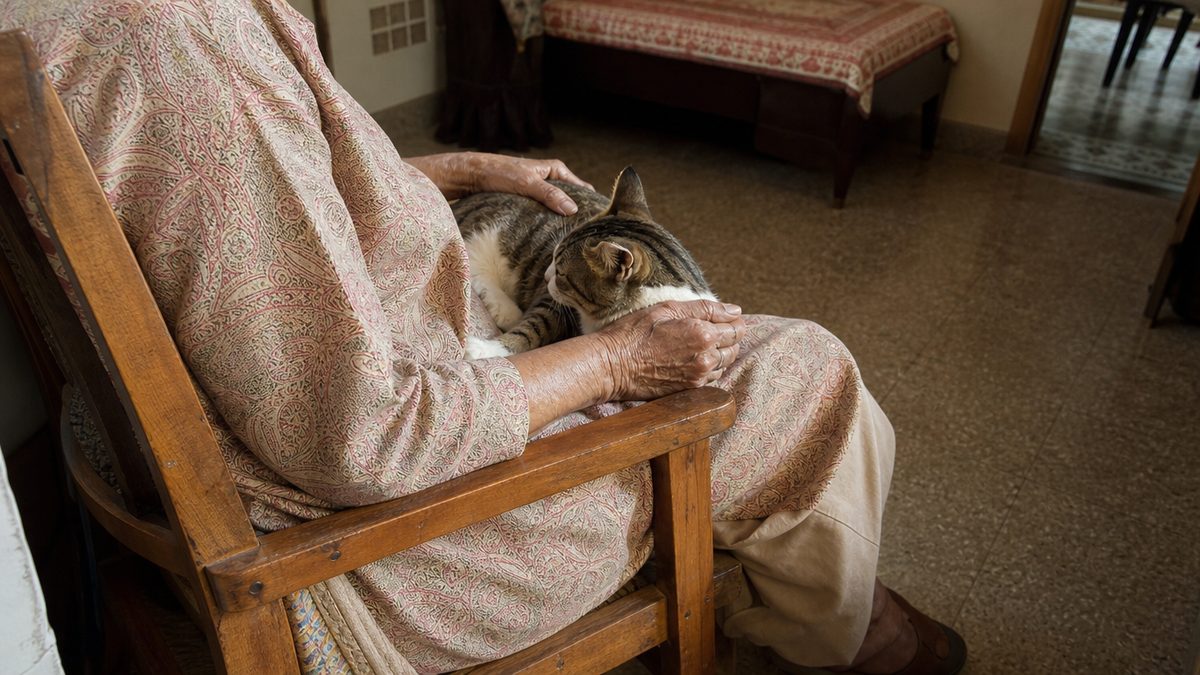
Quick answer
Pets for senior citizens in India work when the household decides who does the work, not when the animal arrives as a gift. The benefit evidence is weaker than it reads: pooled across 21 studies, pet ownership did not change depression risk at all. The physical findings are stronger in both directions. Dog owners walked 22 minutes more a day, and pet related fall injury rates in the United States peaked after 75.
This guide is general information for Indian pet owners and is not a diagnosis. Always consult a registered veterinarian near you before acting on anything you read here, and treat any sudden change in your pet's condition as urgent.
What the evidence on pets and older adults actually shows
The evidence shows a small and uneven mental health effect, a clearer physical activity effect, and almost nothing that survives a causal test. Companion animal research is one of the most over-reported literatures in health writing, so start with the numbers rather than the headlines.
Take the mental-health claim first, because it is the one every page selling you a puppy repeats. A 2025 systematic review and meta-analysis pooled 21 studies covering 159,322 participants and found that pet ownership was not associated with any significant change in depression risk, at an odds ratio of 1.03 with a confidence interval of 0.995 to 1.07. Broken down by species, cat ownership carried a modestly higher depression risk at 1.06 (1.02 to 1.09), and dog ownership showed no significant association at 0.93 (0.789 to 1.10).
Loneliness tells a similar story. A systematic review of 24 studies found that owning a pet was associated with lower social isolation among adults, but that on loneliness the studies conducted before the COVID-19 pandemic did not reveal an overall significant association, and that most studies found no difference between dogs, cats and other pets. Its own summary is the honest one: only a part of the studies detected a significant association at all.
The physical evidence is stronger and more specific. A year-long study that put activity monitors on 43 matched pairs of community-dwelling older adults found dog owners doing 22 minutes more walking a day, 95 percent confidence interval 12 to 34, and 2,760 more steps, 95 percent confidence interval 1,667 to 3,991, with the extra walking done at a moderate cadence. A Japanese cohort of 11,233 adults aged 65 and over, followed for about three and a half years and linked to long-term care insurance records, found current dog owners at an odds ratio of 0.54 for the onset of disability against people who had never owned a dog, confidence interval 0.37 to 0.79. In the same cohort, cat ownership had no effect on disability onset, and neither dog nor cat ownership significantly reduced all-cause mortality.
| Study | Who was studied | What it found | What it does not show |
|---|---|---|---|
| Pet ownership and depression, meta-analysis, 2025 | 159,322 people across 21 observational studies | No significant change in depression risk, odds ratio 1.03; cats 1.06, dogs 0.93 | Nothing about causation either way. Depression was mostly self-reported at a single time point |
| Pet ownership, loneliness and social isolation, review, 2022 | 24 observational studies, adults and children | Lower social isolation in adult samples; no overall significant loneliness effect before COVID-19 | That a pet reduces loneliness for a given person. Only part of the studies found any association |
| Dog ownership and free-living activity, 2017 | 43 matched pairs of older adults, activity monitors, one year | 22 more minutes walking and 2,760 more steps a day | That the dog caused it. People who choose dogs may already walk more |
| Dog and cat ownership and disability onset, 2022 | 11,233 Japanese adults aged 65+, 3.5 years | Dog owners at 0.54 odds of disability onset; no cat effect; no mortality effect | That an unwell person who gets a dog becomes well. Healthier people keep dogs for longer |
| Pet ownership, living alone and cognitive decline, 2023 | 7,945 adults aged 50 and over, mean age 66.3 | Slower verbal cognition decline among those living alone, 0.023 SD a year | A clinically meaningful effect. The authors call for further studies |
The cognition finding deserves its own sentence because it is the one most often inflated. A cohort of 7,945 adults aged 50 and over found pet ownership associated with slower decline in verbal memory and verbal fluency among people living alone, but not among those living with others, and the effect in the living-alone group was 0.023 standard deviations a year. That is a real finding and a very small one, and the authors end by saying further studies are needed to assess whether pet ownership slows cognitive decline in older adults living alone.
The most careful body to look at this said do not do it for the health benefit
The American Heart Association reviewed the cardiovascular evidence and graded its own conclusion. Pet ownership, particularly dog ownership, is probably associated with decreased cardiovascular disease risk, at Level of Evidence B, and may be reasonable for reduction in that risk, at Class IIb. The statement then adds a recommendation that almost nobody quotes. Pet adoption, rescue or purchase should not be done for the primary purpose of reducing cardiovascular risk, graded Class III at Level of Evidence C.
An animal does not treat loneliness, depression or any other condition, and nothing on this page is a reason to change a treatment. Anything clinical, including whether a particular person should take on an animal at all, is a decision for that person's own doctor. This page reports what the studies measured so a family can make the decision with the real numbers in front of it.
Read together, the useful summary for a family is narrow and worth having. Pet ownership is not a mood treatment with an effect size you can plan around. It is a daily structure that gets an older person up, out and walking, and the daily structure is where the measurable gains sit. That also tells you where the costs sit, which is the next three sections.
The risk nobody writes up: pet-related falls
Pet-related falls are the documented risk, they rise sharply with age, and no Indian page about companion animals and older people mentions them. The injury pattern in an older body is the part that matters, not the number of falls.
The one national estimate comes from the United States and it has a denominator. Analysing emergency department surveillance over 2001 to 2006, the Centers for Disease Control and Prevention put fall injuries associated with cats and dogs at an average of 86,629 a year, a rate of 29.7 per 100,000, with nearly 88 percent of them involving dogs and women 2.1 times more likely to be injured than men.
The age gradient is the finding. Injury rates associated with both dogs and cats increased with age, and the highest rates in the whole dataset were at 75 to 84 and at 85 and over, where the most common diagnosis was fracture. Among people who were hospitalised, 79.9 percent were admitted for fractures.
| Age group | Dogs | Cats | Dog-to-cat rate ratio |
|---|---|---|---|
| 45-54 | 29.0 | 4.2 | 6.9 |
| 55-64 | 31.1 | 4.4 | 7.1 |
| 65-74 | 43.2 | 4.1 | 10.5 |
| 75-84 | 59.5 | 9.1 | 6.5 |
| 85 and over | 58.4 | 12.0 | 4.9 |
Look at the cat column before you conclude anything. The cat rate is flat from 45 to 74 and then roughly triples, from 4.1 at 65 to 74 to 12.0 at 85 and over, while the dog rate plateaus. The rate ratio between the two animals therefore collapses from 10.5 at 65 to 74 down to 4.9 at 85 and over. The cat is a much safer animal for a person of 68 than for a person of 88.
The mechanism differs by species and it changes what you do about it. Among falls involving dogs, 31.3 percent were tripping over the dog, 21.2 percent were being pushed or pulled by it, 8.8 percent were falling over a pet item such as a bowl or a toy, and 26.0 percent happened while walking the dog. Among falls involving cats, 85.7 percent happened at home and 66.4 percent were tripping over the cat.
The walking injury is the one that takes independence
A separate analysis looked only at fractures in people aged 65 and over associated with walking a leashed dog, across US emergency departments from 2004 to 2017. It identified 32,624 cases, and the annual count rose from 1,671 in 2004 to 4,396 in 2017. Of those patients, 78.6 percent were women, the hip was the single most frequently fractured site at 17.3 percent, the upper extremity accounted for 52.1 percent overall, and 28.7 percent required hospital admission.
The authors are blunt about why the hip number matters, citing a one-year post-fracture mortality rate approaching 30 percent, and they write that for older adults, especially those living alone and with decreased bone mineral density, the risks associated with walking leashed dogs merit consideration. Their own suggested mitigations are obedience training so the dog does not lunge while leashed, and considering a smaller dog. The first of those is well supported by the push-and-pull data. The second is the part this page disagrees with, and the reason is in the section on choosing the animal.
Pet-related fall injury rates are more than double the all-age rate once a person passes 75, the commonest diagnosis is a fracture, and roughly one in six of the dog-walking fractures in people over 65 was a hip fracture Pirruccio, Yoon and Ahn. This is not an argument against an animal. It is the reason the lead, the floor and the feeding station are worth half an hour of planning.
What the Indian fall data adds
Indian data adds two things the American figures cannot: how often older Indians already fall, and which impairments drive it here. Both change what you adapt in the house.
Falls are not a rare event among older Indians before any animal is involved. Using the Longitudinal Ageing Study in India Wave 1, which covered 31,464 people aged 60 and over, 13 percent reported a major fall and about 14 percent reported injuries. Women reported more major falls than men, 14.4 percent against 10.7 percent, and 15.6 percent reported injuries.
There is real regional variation, which matters if you are reading this in one part of the country and applying advice written for another. The East, covering West Bengal and its neighbours, recorded the highest major-fall prevalence at 17.4 percent, the Central region followed at 14 percent, and the North-east recorded the lowest at 4.9 percent. The consequence is also measured. Older people reporting minor and major falls were 30 percent and 39 percent less likely to report higher quality of life, and those with injuries 35 percent less likely.
Vision is the modifiable driver that shows up most clearly in the Indian data. In the same LASI wave, about 34 percent of the older population had low vision, 30 percent of men and 38 percent of women, with blindness at 1.63 percent. The unadjusted odds of a fall were 1.16 times higher with low vision, 95 percent confidence interval 1.11 to 1.21, and 1.40 times higher with blindness, 1.17 to 1.67. In the adjusted model, frequent sleep problems carried 1.79 times the odds, rural residence 1.23 times, and being female 1.30 times.
The walk itself is a different thing in an Indian city
Interviews with 60 adults aged 50 and over in urban Bengaluru, in Karnataka, found their mobility shaped by the state of the built environment rather than by their own fitness. Participants described pavements encroached by vendors or parked cars, which forced them onto the road, roads dug up for repair and left incomplete for months, and inadequate street lighting that produced a fear of falls while walking or crossing. Older women also described chain snatching and phone thefts in their locality, and said the fear of it kept them from going out to walk.
None of that is about dogs, and all of it decides whether a dog is walkable by this person on this street. An older handler stepping off a broken footpath into traffic while a dog pulls is the specific sequence the push-and-pull figure describes. Walk the intended route yourself, at the hour it will actually be walked, before the animal arrives.
- Time the walk by daylight rather than by temperature alone. In humid coastal cities such as Chennai and Mumbai the comfortable hours are early morning and after dark, and after dark is the hour the Bengaluru participants named as frightening.
- Treat the monsoon as a separate plan, not a bad week. A wet marble or kota floor at the doorway is where a soaked dog and an older person meet, and it is the single most predictable slip point in an Indian flat.
- Check the lift, not the stairs. A flat above the ground floor becomes a stairwell with a dog on a lead every time the lift is out, which is a routine event in the high-rise stock of Delhi, Mumbai, Kolkata, Hyderabad, Ahmedabad and Pune.
- Fix the lighting on the last ten metres. The gate, the stairwell landing and the lobby are where an unlit step and an eager animal coincide.
- Get the eyes checked on the usual schedule. Low vision is the one fall risk factor in the Indian data that is often correctable.
Zoonotic infection when immunity is lower
Zoonotic infection risk rises with age and falls further with any treatment that suppresses immunity, which is a reason to change the handling rather than to refuse the animal. What counts as suppressed immunity is wider than most families assume.
The clearest statement of who is at higher risk comes from the US Centers for Disease Control and Prevention. Older adults are more likely to get sick from germs some animals, even household pets, can carry, and their illness may be more severe, because as people age their immune systems and organs do not recognise and clear harmful germs as well as they once did.
The immunosuppression list is the part worth reading twice. A weakened immune system can be caused by a genetic condition, an illness such as HIV, cancer or kidney disease, or a treatment such as an organ transplant or radiation therapy, and some medicines also weaken it, including steroids, cancer chemotherapy, and drugs used to treat autoimmune diseases such as rheumatoid arthritis or psoriasis. Rheumatoid arthritis is common in the age group this page is about, and a family that has never thought of a relative as immunocompromised may find that the medicine cabinet says otherwise.
The same guidance names the practical response rather than a ban. Adults 65 and over and people with weakened immune systems should be aware of the increased risk from high-risk animals, and these groups might consider other animals as pets or having someone else in the household care for the animal. It also names which animals it means by high-risk: reptiles and amphibians, backyard poultry, rodents including hamsters and guinea pigs, and exotic pets. A dog or a cat is not on that list.
Whether a specific older person with a specific diagnosis or prescription should live with an animal is a clinical judgement for their physician, who knows the treatment and the counts. Bonbeno publishes what the public health guidance says and stops there. Do not start, stop or change any medicine on the strength of this page, and do not rehome an animal on the strength of it either.
The scratch an older person does not mention
Three handling changes do most of the work, and none of them needs a diagnosis to justify. Wash hands with running water and soap after handling the animal, its food or its waste, which the same guidance calls especially important for people at higher risk. Hand the litter tray and the picking up of dog waste to someone else in the household where that is possible. And treat any break in the skin as something to be shown to a person, not wiped and forgotten, because an older person with thin skin, reduced sensation or a blood thinner often underestimates a scratch.
On bites specifically, India has a public health reason to be unsentimental. The National Rabies Control Programme records that rabies is endemic throughout the country, that human cases are reported from everywhere except the Andaman and Nicobar and Lakshadweep Islands, and that about 96 percent of the mortality and morbidity is associated with dog bites, with cats among the other reservoirs. A vaccinated household dog is a different risk from a bite of unknown origin, which is exactly why the household animal's own schedule is not optional. Our dog vaccination schedule in India sets out what is due and when, and rabies in dogs in India covers the disease itself.
Two household infections an older person is more exposed to are already covered elsewhere on this site rather than here, because they are conditions and not lifestyle questions. See ringworm in cats for the one that spreads skin to skin, and leptospirosis in dogs for the one that follows monsoon flooding into Indian cities. Human allergy to a pet is a separate subject again, with its own immunology and its own Indian testing picture, and it is covered in full in pet allergy in children.
Which animal, honestly
Which animal to choose is decided by the animal's training state and settledness, not by its size and not by its species. The usual advice, get a small dog, picks the wrong variable and gets a predictable number of people hurt.
Start from what actually injures older handlers. Being pushed or pulled by a dog accounted for 21.2 percent of dog-related falls, and tripping over the dog for 31.3 percent. A small dog reduces the first and increases the second, because a 5 kg animal that moves underfoot in a corridor is harder to see and harder to step around than a 30 kg animal that walks beside you. Size is a trade, not an improvement. Training state is an improvement, which is why the fracture study's own mitigation is obedience training so the dog does not lunge while leashed.
Age is the second real variable. A puppy asks for eighteen months of toilet training, chewing, nipping, broken sleep and lead training at exactly the stage of life when the handler's balance, grip and sleep are least able to absorb it, and it asks for a twelve to fifteen year commitment that the household must plan to outlast. An adult dog of known temperament, already house-trained and already lead-trained, delivers the walking benefit that the evidence actually measured without the eighteen months.
| Option | What it asks physically | What the evidence associates with it | Where it goes wrong |
|---|---|---|---|
| Adult dog, settled temperament, already lead-trained | Two walks a day, a secure lead, a bend to feed | The measured activity gain of 22 minutes and 2,760 steps a day, and the disability odds ratio of 0.54 | An untested lead temperament. Walk the dog yourself before committing |
| Puppy | Toilet training, night waking, chewing, lead training, 12-15 years | Nothing extra. No study measured a benefit specific to raising a puppy | The handler's grip and balance are tested hardest in the first year |
| Small reactive breed | Less pull force, more trip hazard underfoot, same walks | Nothing extra. Size was not recorded in the fall data at all | 31.3 percent of dog falls are tripping over the dog |
| Adult or older cat, indoor | A tray to clean, a bowl to fill, no walks | No disability or mortality effect in the 11,233-person cohort; a modestly higher depression odds ratio of 1.06 in the meta-analysis | Fall rate roughly triples from 65-74 to 85 and over, and 66.4 percent of cat falls are tripping over the cat |
| Kitten | Underfoot constantly, climbs, 15-20 years | Nothing extra | The one animal most likely to be between the feet on a staircase |
The dog-against-cat question has a cleaner answer than most pages give, and it runs in both directions. If the walking is genuinely going to happen, the dog is the animal with evidence behind it: the disability finding was specific to dogs and absent for cats in the same 11,233-person cohort, and the activity gain is the mechanism the authors propose. If the walking is not going to happen, a dog loses the one measured advantage and keeps the full fall exposure, and a settled indoor cat is the better fit despite the meta-analysis finding a modest increase in depression odds for cat owners.
The question that decides it, asked plainly
Ask who will walk this animal twice a day in August and in January, by name, and then ask that named person. If the answer is the older person themselves, the walking evidence applies and the fall evidence applies with it. If the answer is somebody else, you are choosing an animal for a household and the older person is the daytime company, which is a different and perfectly good reason, but it is not the reason the studies measured.
The matching process itself, what shelters ask, what the handover should include and what the first month looks like, is covered in how to adopt a dog in India and how to adopt a cat in India. Ask the shelter explicitly for an adult animal already walked on a loose lead, and take the walk test before you take the animal.
The Indian household: who actually does the work
In an Indian household the person who lives with the animal all day and the person who chose it are frequently not the same person, and that gap is where most of the trouble starts. Settle the division of labour out loud, before the animal arrives.
The demographic backdrop is official and it is moving fast. India's population aged 60 and over is projected to rise from 100 million in 2011 to 230 million by 2036, nearly one in seven Indians, with the southern states, Himachal Pradesh and Punjab already above average and Kerala's share projected to move from 13 percent in 2011 to 23 percent by 2036. The same release records that women account for 58 percent of the elderly population, of whom 54 percent are widows, and that the overall dependency ratio is 62 dependents per 100 working-age people. Tamil Nadu sits in the group of states ageing fastest.
Four arrangements account for most of the Indian cases, and each one fails in a different place.
- The multi-generational household where the older person is the default daytime carer. The dog was the children's idea, the walks are promised by people who leave at eight, and by the second month the grandmother is doing the midday let-out. Write down who does each walk, each feed and each vet trip, and put a name against the midday slot specifically.
- The grandparents left with the family dog after the children move cities or countries. This is a handover, not an arrangement, and it usually happens with no conversation at all. Treat it as a fresh decision: is this specific animal walkable by this specific person, and if not, what changes, the equipment, the walk, or the home.
- The older person living alone whose children are abroad. The animal is often the whole of the daily structure here, which is where the cognition study's only positive stratum sat, among people living alone. It is also the arrangement with nobody to notice a missed feed, so a daily check-in call that includes the animal is worth setting up.
- The household with domestic help who does the walking. This works and it is extremely common, and it is also completely undocumented: we could not find a single published Indian figure on who in a household actually walks the family dog. Put the arrangement in writing anyway, with the lead type, the route and the one instruction that matters, which is never to hand the lead back at the gate while the dog is pulling.
Loneliness is the reason most families give for the animal, and it is worth knowing how badly measured it is in India before leaning on it. A 2026 systematic review in the Indian Journal of Medical Research screened 894 papers, included 20, and found reported loneliness prevalence among older Indians ranging from 3.8 to 66.4 percent across 11 studies, and social isolation from 3.6 to 86.4 percent across four. The heterogeneity was so high, with I-squared at 99 percent, that a pooled estimate was not feasible at all, and the authors attribute it to different scales and different cut-offs.
That is not a reason to dismiss loneliness. It is a reason to stop quoting a single Indian loneliness percentage as though it were established, and to notice that the review's named risk factors are mostly structural: increasing age, poor socio-economic status, poor physical health, marital status, living conditions, strained relationships, elder abuse and disengagement from social activities. An animal addresses one of those directly and none of the rest.
The conversation to have before the animal arrives
Have it with everyone in the room, including the older person, and finish it with four names written down: who walks, who feeds, who takes the animal to the vet, and who takes the animal if the older person is admitted to hospital. The last one is the one people skip. Hospitalisation is far more likely in any given year than death, the animal needs feeding that evening, and no will is read in time to help. That whole layer, including what Indian law allows you to put in writing and what it does not, is covered in pet care after owner death in India. Read it once and leave the care sheet where it can be found.
A wedding, a hospital stay or a trip to a child abroad leaves the animal without its routine, and the right answer differs for dogs and cats and by the number of nights. That comparison, with the Indian costs and the evidence on what boarding does to each species, is in pet sitter vs boarding in India.
Arthritis, grip, vision and hearing: what to adapt
To adapt a home for an older person with an animal, change the four points where the two bodies physically meet: the lead, the feeding station, the tray, and the floor at the door. Everything else is secondary.
Start with the lead, because it is the only one of the four with a published injury signal attached. Being pushed or pulled accounted for 21.2 percent of dog-related falls and 26.0 percent of them happened while walking the dog. Our collar or harness for dogs page sets out the research in full; the conclusion an older handler needs from it is that a harness is the safer default for walking, that a back-clip harness does not reduce pulling while a front-clip one does, and that choke, prong and shock collars buy nothing.
- Use a fixed-length lead of about 1.2 to 1.5 metres. A retractable lead gives a dog a running start before the handler feels anything, which is the push-and-pull mechanism in its purest form.
- Wear the lead across the body on a waist or shoulder attachment rather than wrapped around a hand or wrist. A wrapped lead turns a lunge into a pulled shoulder or a fall with no free hand to break it.
- Hold a stick or use a walking aid in the other hand if one is already used indoors, and do not give that hand up to the lead.
- Never take the lead from someone else while the dog is already pulling. Have the dog sit, then exchange.
- Drop the walk rather than fight the weather. A skipped monsoon walk costs a dog some enrichment. A fall on wet tile costs a hip.
Grip, bending and the weight of the sack
Grip and bending are the two demands that go unnoticed until something tears. Raise the food and water bowls onto a stand so the feeding action happens at a comfortable height rather than at floor level, and keep the water bowl somewhere that does not need a crouch and a reach. Buy pet food in the smallest sack the household can afford to buy often, and stand the whole bag inside a waist-height bin with a lid that lifts rather than twists, so the heavy lift happens on delivery day and never again. Keep the bag rather than tipping the kibble out, because the bag is the barrier and carries the batch code the FDA asks for if the food is ever recalled.
For a cat, the tray is the single worst ergonomic object in the house: low, awkward, needing a twist and a scoop, and needing it daily. Choose a tray with a low entry so the cat can get in without a climb, place it where no step and no bending below knee height is involved for the person cleaning it, and keep the scoop on a long handle. The old cat's own tray needs, which are a different question about the animal's joints and not the person's, are covered in senior cat care in India.
Hearing and vision change the geometry of a shared room. A person who does not hear a dog approaching from behind turns into it; a person with low vision does not see a dark cat on a dark floor, and about 34 percent of older Indians have low vision. Two cheap fixes work. Put a bell on a cat's collar so it announces itself, and light the corridor and the stairwell to the same level as the rooms, because the transition is where the eye fails.
Traction is the last one, and it is worth separating from the version written for the dog. Our keeping a dog in a flat in India page covers slippery floors as a risk to the dog's joints. The human version is a different map: lay runners where the person turns, pivots and stops, which is beside the bed, at the kitchen entrance and along the approach to the door, not along the stretch where the dog runs. Keep a towel and a mat permanently at the entrance through the monsoon, and make drying the animal's paws a step that happens before it crosses the threshold rather than after.
This section is about the human body in the household. An older dog or cat with stiff joints has its own diagnosis, its own pain management and its own vet decisions, and none of it is a do-it-yourself matter. See arthritis in dogs and, for the wider picture of an ageing animal, senior dog care in India.
The long horizon, and the grief at the end of it
Match the animal's likely lifespan to the household's plan rather than to the older person's age, because the alternative is a decision made by default in a bad week. Grief is the other half of this, and it is real.
A puppy taken home by a 76-year-old is a commitment to roughly 2038, and nobody in that conversation usually says so out loud. An adult rescue dog of six, or a settled cat of eight, changes the arithmetic without changing what the person actually gets, which is company, a reason to get up and, if it is a dog and the walks happen, the measured activity gain. Age-matching is not a sad compromise. It is the version of this decision that does not end with an animal in a shelter.
Say the succession plan in one sentence and write it down. If the older person cannot keep this animal, it goes to this named person, who has agreed. The legal machinery behind that sentence, what an Indian will can and cannot do for an animal, why there is no pet trust here, and the first three days when somebody needs a key and the vet records, is set out in pet care after owner death in India. This page does not duplicate it and you should not try to improvise it.
On grief, two things are worth saying and no more. Losing a companion animal is a bereavement and not a lesser one, and an older person who has already lost a spouse and a peer group may be losing the last daily relationship in the house. Do not let anyone tell them it was only a pet, and do not rush the decision about another animal. What follows, including what Indian cremation and burial law actually allows and where to turn for support, is in when your pet dies in India.
Six questions to settle before the animal arrives
Settle these six before anybody visits a shelter, because each one is cheap to answer now and expensive to answer after a fall or a rehoming.
- Whose idea is this, and does the older person want an animal? An animal given as a surprise gift to a parent is a chore delivered with a bow. Ask directly, and accept a no.
- Who walks the dog, by name, at each time of day, in every month of the year? Write the name against the slot. If the midday slot has no name, the animal is not yet housed.
- Walk the specific animal on a lead before you commit. Five minutes on the actual pavement tells you more about the pull risk than any breed description, and the pull risk is 21.2 percent of dog-related falls.
- Ask the doctor, not the internet, if any member of the household takes steroids, chemotherapy, transplant medication or drugs for an autoimmune disease, all of which the CDC lists as weakening immunity.
- Walk the house looking down. Mark every place the person turns, every unlit step and every threshold that gets wet in the monsoon, and fix those before the animal arrives rather than after.
- Name who takes the animal if the older person is hospitalised, and tell that person. Then write the care sheet and leave it where it will be found, as pet care after owner death in India sets out.
Do not get an animal in order to fix a specific health problem. The most careful review of this question concluded that pet adoption, rescue or purchase should not be done for the primary purpose of reducing cardiovascular risk, and graded that Class III. The same logic covers loneliness, depression and memory. Get the animal because the household wants to live with it and can look after it.
What this page can show, and what it cannot
This page can show you what has been measured and where it was measured. It cannot tell you that a particular animal will suit a particular person, and four specific gaps are worth naming.
First, the fall data is American. The 86,629-a-year estimate, the age gradient and the dog-walking fracture series all come from US emergency department surveillance Pirruccio, Yoon and Ahn. We looked for an Indian equivalent and did not find one: the Indian fall literature we could read, including the LASI analyses used above, records falls among older adults without recording whether an animal was involved. Treat the mechanisms as transferable and the rates as foreign.
Second, almost none of the benefit evidence is causal. Every study cited here is observational, and the direction of the arrow is genuinely unclear: healthier and more mobile older people are more likely to keep a dog in the first place, which inflates every association in the dog's favour. The depression meta-analysis is explicit that depression was predominantly self-reported and often measured at a single time point.
Third, there is no Indian companion-animal cohort. The disability finding is Japanese, the activity finding is British, the cognition finding is from an English cohort, and the loneliness evidence is a mix of countries with India poorly represented. The Indian ageing data we do have is strong on falls, vision and household structure Press Information Bureau and silent on pets.
Fourth, we could not document who actually walks the family dog in an Indian household, which is the practical question this whole page turns on. No published survey appears to have asked whether it is the owner, a grandparent or domestic help. Until somebody measures it, the honest instruction is the one above: write the name down.
Common questions
What is the best pet for a senior citizen?
The best pet for a senior citizen is an adult animal of known, settled temperament rather than a particular species or size. If the walks will genuinely happen, a dog is the option with evidence behind it: a cohort of 11,233 Japanese adults over 65 found dog owners at 0.54 odds of disability onset, with no equivalent effect for cats. If the walks will not happen, a settled indoor cat fits better. Avoid a puppy or kitten unless the household can name who continues for fifteen years.
Should a 70 year old get a dog?
A 70 year old can get a dog, and the decision turns on who walks it and what it does on a lead rather than on the number 70. Dog ownership in older adults is associated with 22 more minutes of walking and 2,760 more steps a day, which is the main measured benefit. Against that, pet-related fall injury rates climb steeply after 75 and being pushed or pulled by a dog accounts for 21.2 percent of dog-related falls. Choose an adult dog that is already trained not to pull, and test it on a lead first.
Is 75 too old to have a dog?
No, 75 is not too old to have a dog, but it is the age at which the fall numbers change. Pet-related fall injury rates in US surveillance were 68.8 per 100,000 at ages 75 to 84 against 29.7 across all ages, the commonest diagnosis was fracture, and 17.3 percent of dog-walking fractures in people over 65 were hip fractures. Those are reasons to adapt the lead, the floor and the walk route, and to prefer an adult dog with a known lead temperament, rather than reasons to go without.
What is the best pet for an 80 year old?
For an 80 year old, choose the animal whose daily care the person can physically do without bending low, lifting heavy sacks or being pulled. An older settled cat usually fits that better than a dog, with one caveat worth knowing: cat-related fall injury rates roughly triple between ages 65 to 74 and 85 and over, and 66.4 percent of cat-related falls are tripping over the cat. A low-entry litter tray, a raised feeding station, a bell on the collar and well-lit floors address most of that.
Which dog is best for senior citizens?
The best dog for a senior citizen is an adult dog that already walks on a loose lead, whatever its breed or size. The popular advice to pick a small breed targets the wrong variable: small dogs reduce pull force but increase the trip hazard underfoot, and 31.3 percent of dog-related falls are tripping over the dog against 21.2 percent being pushed or pulled. Breed and size were not even recorded in that fall dataset. Test the specific dog on a lead on your own street before deciding.
Should immunocompromised patients have pets?
That is a decision for the person's own doctor, who knows the diagnosis and the treatment. What the public health guidance says is that people with weakened immune systems, including those on steroids, chemotherapy, transplant medication or drugs for autoimmune disease, face higher risk from animal-borne germs, and that they might consider other animals or have someone else in the household care for the animal. Dogs and cats are not on the CDC high-risk list; reptiles, amphibians, poultry and rodents are.
Who lives longer, cat owners or dog owners?
No good study shows that either cat owners or dog owners live longer because of the animal. In a cohort of 11,233 Japanese adults aged 65 and over followed for about three and a half years, the association of dog or cat ownership with all-cause mortality was not statistically significant for either species. Dog ownership was associated with lower disability onset in the same cohort, which is a different outcome from survival, and all of this is observational rather than causal.