
Cat adoption guide
How to adopt a cat in India: where to look, what it costs and the first month
Six Indian shelters and rescues read on one day, with the fee each prints, the house check each runs and the documents each asks for; the AWBI adoption protocol that never says the word cat; the first-year bill; the balcony-net rule with a 1,125-fall denominator behind it; and Rule 19 of the ABC Rules 2023.
Quick answer
How to adopt a cat in India: pick a shelter or rescue whose page you can open, meet the cat, pass the house check, submit a self-attested government ID and address proof, sign the adoption form and take the certificate. Cat Cafe Studio in Mumbai charges nothing and requires meshed windows, a netted balcony and an adopter over 24; Friendicoes, iAdopt, CUPA and People for Animals print no fee. Budget roughly Rs 4,000 to Rs 9,000 in year one for the vaccines and sterilisation a shelter has not done. Net the balcony first, because cats fall, and cite Rule 19 of the ABC Rules 2023 for colony cats.
Where to adopt a cat in India: the shelters and rescues we opened
Adopt a cat in India from a shelter or rescue whose own page you can open, because the six organisations in the table below publish their process and their conditions, and the two listing platforms that outrank them on Google India publish neither. Every row was read on 18 September 2026. A fee of Rs 0 means the page says adoption is free; 'not printed' means the page we opened carries no figure, which is not the same as free.
Cat Cafe Studio in Versova, Mumbai, is the clearest cat-only route in the country. It is the adoption implementation partner of The Feline Foundation, it houses senior, disabled and previously stray cats that the foundation rescued and rehabilitated, and its adoption page states twice that adoptions are free of charge. Meeting the cats costs Rs 250 for unlimited hours in a day, and that entry fee funds the cats rather than the adoption.
| Organisation and city | Fee or donation, as printed | Process | Documents and conditions |
|---|---|---|---|
| Cat Cafe Studio, adoption partner of The Feline Foundation, Versova, Mumbai | Rs 0, 'free of charge' (page modified 12 September 2026) | Two or more visits to meet the cats, the Adoption Manual, an interview and questionnaire with the adoption manager, then the adoption papers | Photocopy of address proof and a government ID; adopter over 24, or a parent or legal guardian signs; landlord's permission if renting; windows and balcony meshed; no kitten under 3 months; every cat already sterilised, vaccinated and dewormed |
| Friendicoes SECA, Delhi shelter and Gurgaon sanctuary cattery | Not printed; sterilisation of the adopted cat offered 'at a very nominal rate' | The team assesses each cat first and matches it to a home; a pre-adoption house visit with the whole family; counselling after adoption; a post-adoption house check | The house visit doubles as address verification; spaying or neutering of every adopted pet is mandatory; about 150 adoptions a year at a 95 percent success rate, by the page's own count |
| iAdopt, foster-based rescue, Chennai (12A and 80G registered) | Not printed | Browse on Instagram, fill the cat-specific form, get shortlisted, meet the cat at the foster's home, home check and handover, post-adoption follow-up | Application reviewed in 3 to 5 working days; home check plus final approval in 3 to 7 days; separate forms for dogs and cats; 700+ animals homed since 2020 |
| CUPA Second Chance Adoption Centre, Bengaluru | Not printed; passive adoption, sponsoring an animal that stays at the shelter, from Rs 3,000 a month | Google form, matching by the team, multiple in-person visits, mandatory pre-adoption checks, medical records handed over, the official adoption form | The process text is written for dogs and the centre's counter reads 4,861 dogs adopted; email a day before visiting, 11 am to 3 pm daily |
| People for Animals, head office, New Delhi | Not printed | Phone the head volunteer named on the page | Three cats listed on 18 September 2026, each marked sterilised with vaccination complete, aged 5 to 6 years |
| Animal Rescue and Care (ARC), Thakurpukur, Kolkata | Not printed | House check and legal paperwork | The adoption page offers healthy dogs and pups only; no cat was listed |
Blue Cross of India in Chennai ranked fourth for the India query, but its Adopt-Foster page returned HTTP 404 on 18 September 2026 and its home page returned a hosting-suspension notice on the same attempt, so it has no row here. Kolkata is the gap in the table: the shelter page we opened there offers dogs, and cat rehoming in the city runs through social media groups rather than a page that prints a process. Each organisation's sterilisation status rule is in the last column, because it is the one condition every compliant shelter shares.
Listing platforms are not adoption
The two pages that outrank every shelter for 'how to adopt a cat in india' are listing platforms, not rescues. The first is a board filtered by nine cities, Ahmedabad, Bangalore, Chennai, Delhi NCR, Hyderabad, Jaipur, Kolkata, Mumbai and Pune, where anyone can post a kitten through an 'Add Kitten for Adoption' button, and it publishes no process, no fee and no screening. The second promises free cat adoption in its title, charges a Rs 199 membership for six months to reach the people who listed the cats, disclaims any payment made outside the platform, and runs a pet-mating registry on the same site. Rs 199 divided by 84.38 is 2.36 and by 74 is 2.69, so it is a rupee-native price rather than a converted one. A platform can be where you find a rescuer or a foster, but the safeguards that make adoption adoption, the house check, the sterilisation condition and the adoption certificate, come from the organisation behind the cat, so ask who that is before you travel.
A shelter's fee, where one exists, pays for sterilisation, vaccination and paperwork you can verify on the day; the six organisations above either charge nothing or print no fee at all Friendicoes SECA, Delhi. Never pay a 'rehoming fee' to an individual who will not show you where the cat lives, will not name the organisation behind it, or wants the money before you have met the cat.
Is adopting a cat free in India, and what does the cat cost after that
Adopting a cat is free at the one cat-only shelter in the table that prints a fee, Cat Cafe Studio in Mumbai, and none of the other five organisations prints any fee at all, so the honest answer on 18 September 2026 is Rs 0 at the shelter door and roughly Rs 4,000 to Rs 9,000 in the first year for the vaccines and the sterilisation a shelter has not already done Supertails, 'Bangalore Pet Parenting 101. That first-year figure is arithmetic from the two price pages in the table below, not a package anyone quotes.
| Item | Figure | Source and date | Exchange-rate test, divided by 84.38 and by 74 |
|---|---|---|---|
| Adoption fee, Cat Cafe Studio, Mumbai | Rs 0 | Adoption page, modified 12 September 2026 | Not applicable |
| Entry to meet the cats, Cat Cafe Studio | Rs 250 a day | Home page | 2.96 and 3.38; rupee-native |
| Kitten vaccination course, three visits at days 60, 90 and 120 | From Rs 3,999 | Vetic national page | 47.39 and 54.04; not a converted figure |
| Adult annual booster, CRP plus anti-rabies | From Rs 1,899 | Vetic national page | 22.51 and 25.66; not a converted figure |
| Male cat neutering, Bengaluru | Rs 2,000 to Rs 3,500 | Supertails, vet byline, 13 January 2026 | 23.70 to 41.48 and 27.03 to 47.30; one retailer's range, not a rate card |
| Female cat spaying, Bengaluru | Rs 3,000 to Rs 5,000 | Same page | 35.55 to 59.26 and 40.54 to 67.57; same caveat |
| Sterilisation at The Feline Foundation, Mumbai | 'A small fee'; free inside its Andheri West TNR zones | Sterilisation page, modified 27 January 2026 | No figure printed |
| What the central scheme pays a shelter per cat sterilised | Up to Rs 600 | Lok Sabha written reply, 19 August 2025 | 7.11 and 8.11; a reimbursement ceiling, not your bill |
A bought pedigree kitten costs between 10 and 300 times the sterilisation bill. Our own breed pages record published Indian ranges of Rs 8,000 to Rs 3,00,000 for the Persian, Rs 20,000 to Rs 2,06,999 for the British Shorthair and Rs 15,000 to Rs 1,20,000 for the Siamese, each with the sources that disagree laid side by side. The adopted cat costs Rs 3,999 for the kitten course plus Rs 2,000 to Rs 5,000 for sterilisation if the shelter has not done it.
Two things the fee does not tell you. First, the Rs 600 per cat in the revised central scheme is what the state pays an SPCA or local body under the ABC Rules 2023, which explains why a charity can sterilise for a small fee; it is not a price list for owners. Second, the Rs 3,999 is a national 'starts at' floor; the cat vaccination schedule for India guide sets it against a Mumbai clinic page and government clinics, and the cat sterilisation in India guide does the same for the surgery. Your nearby vet's rate card is the number you will pay.
What the Rs 0 at Cat Cafe Studio already includes is listed below.
- Sterilisation, done before the cat is listed
- Vaccination, kept current while the cat waits
- Deworming, repeated on the cafe's schedule
- A clean bill of health from the cafe's vet before any cat goes up for adoption
The easiest way to adopt a cat: the process, step by step
The easiest way to adopt a cat in India is to pick one organisation from the table, meet its cats at the shelter or at a foster's home, and let its process run, because every shelter we opened follows the same seven steps in the same order, and the quickest of them, iAdopt in Chennai, publishes a timeline of 3 to 5 working days to review an application and 3 to 7 days for the home check and final approval. The seven steps, with the organisation that documents each, are set out below.
- Shortlist a cat on the organisation's own page or Instagram account, where iAdopt posts age, medical status and a personality note for each animal.
- Meet the cat, in a meet and greet at the shelter or at the foster's home. Cat Cafe Studio asks for a couple of visits before anyone applies, and CUPA schedules multiple in-person visits.
- Fill the application or questionnaire. iAdopt keeps separate forms for dogs and cats; Cat Cafe Studio pairs the questionnaire with an interview by senior staff.
- Pass the house check. Friendicoes visits the home with the whole family present and treats the visit as address verification; the AWBI protocol allows the house check to be done by video call.
- Submit documents, a government ID with a photograph and an address proof, both self-attested, with a passport-size photograph on the form, as the AWBI protocol specifies.
- Sign the adoption form, which the AWBI's own template calls a binding document that may be used in legal proceedings, and collect the adoption certificate stating the species and age of the animal.
- Visit the vet in the first week for the check-up, vaccination, parasite control and deworming the protocol makes the adopter's duty.
Documents to carry, before you apply
The AWBI protocol's document list, plus the two conditions the Mumbai shelter adds, is set out below Cat Cafe Studio, Versova, Mumbai.
- Government photo ID, a self-attested copy
- Address proof, a self-attested copy
- Passport-size photograph, affixed to the adoption form
- House-check consent, Annexure I of the protocol, signed
- Landlord's permission if you rent, which Cat Cafe Studio requires
- Proof that windows and balcony are meshed, which Cat Cafe Studio makes compulsory
Adoption is refused for fit, not for wealth. iAdopt says it does not score for property type or lifestyle prestige and looks instead for an honest picture of your schedule, a safe home and openness to guidance, and it explains every refusal and accepts re-applications when circumstances change. Friendicoes reports a 95 percent success rate from a deliberately strict screen and about 150 adoptions a year, and it keeps in touch after the handover to counsel the family through the first weeks. If a process feels slow, that is the design; iAdopt's line is that it places for fit, not speed. If you are weighing a cat against a dog, the adopting a dog in India guide walks the dog side of the same protocol.
What the AWBI adoption protocol says, and where cats sit outside it
The AWBI's Standard Protocol for Adoption of Community Animals, circulated by the Board's chairman to every Chief Secretary, Director General of Police, State Animal Welfare Board, District Magistrate and Municipal Commissioner on 17 May 2022, is the only national adoption procedure India has, and its operative text is written for dogs and pups from its first line.
The protocol sets five things. An adopter must be older than 18, of sound mind and able to provide nutrition, veterinary care and housing. Three documents go to the shelter or SPCA: the house-check form at Annexure I, a government photo ID with address proof, and the adoption form at Annexure II, signed on every page. The house check may run before or after adoption, by video call if need be. A mature animal must be spayed or neutered before adoption. The shelter then issues an adoption certificate stating species and age and keeps a record of every adoption for two years.
The word cat does not appear in the protocol. Its opening sentence defines community animals as 'dogs/pups', the undertaking on its adoption form speaks of 'this dog/puppy', and its house rules end with dogs being walked twice a day. Two lines still reach a cat directly. The form records 'Species of the pet', so an SPCA can issue a cat's adoption certificate on the same template, and rule V.1 orders that in apartments or houses with multiple floors 'the balconies and windows must be netted to avoid the risk of the pet escaping or falling', which is the most important sentence in the document for a cat. Where you adopt from the street, the protocol routes the paperwork through the municipal corporation, municipality, panchayat or district SPCA along with a medical check-up and vaccination, so a rescued street kitten can carry a certificate too.
| Requirement | AWBI protocol, 17 May 2022 | Cat Cafe Studio, Mumbai, 12 September 2026 | Friendicoes, Delhi |
|---|---|---|---|
| Minimum age of adopter | Older than 18 | Above 24, or a parent or legal guardian signs | Not printed |
| House check | Before or after adoption, video call allowed | Interview and questionnaire; no house visit printed | Before adoption with the whole family, and again after |
| Sterilisation | Mandatory before adoption if the animal is mature | Every cat already spayed or neutered | Mandatory for every adopted pet, at a nominal rate |
| Windows and balcony | Must be netted in a multi-floor building | Meshing compulsory before adoption | Indoor cats advocated; the sanctuary runs a cattery |
| Documents | Photo ID, address proof, photograph, house-check consent, adoption form | Copies of address proof and government ID, adoption papers | Not printed; the house visit verifies the address |
| Paper the adopter leaves with | Adoption certificate stating species and age | Signed adoption papers | Not printed |
| Youngest animal released | Not stated | 3 months | Not printed; puppies sterilised after 6 months |
The two ages disagree, and the shelter's wins at its own door. The AWBI protocol admits adopters older than 18; Cat Cafe Studio admits adopters above 24 or a parent or guardian who signs Cat Cafe Studio, Versova, Mumbai. The protocol is a circular to state and municipal officers rather than a rule under the Act, so an organisation is free to set the stricter bar, and the 24 governs at that cafe today. The protocol also asks the shelter to brief the family, with a veterinarian's guidance, on plants, chemicals, incense sticks and foods that are toxic to pets, which no Indian shelter page we opened repeats.
Keeping an adopted cat indoors in an Indian flat: mesh, nets and litter
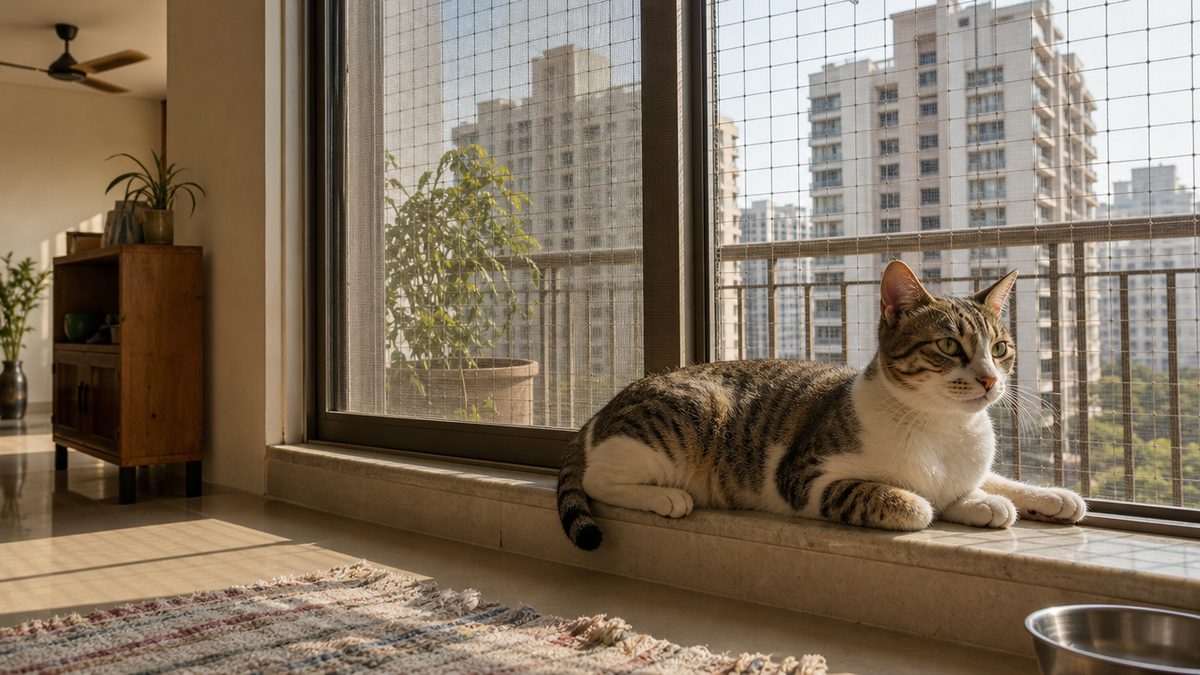
Keep an adopted cat indoors in an Indian flat with every window meshed and a balcony net fitted before the cat arrives, because the largest study of cats falling from buildings, 1,125 falls treated at one Berlin university clinic between 2004 and 2013, found that 296 of the 1,085 fallers with a recorded age (27.3 percent) were under 1 year old, that 867 of 1,125 (77 percent) fell in the warm months when windows stand open, and that 150 of 1,125 (13.3 percent) died or were euthanased.
Indian shelters and the AWBI already agree on this. Cat Cafe Studio makes meshed windows and balcony a compulsory adoption condition, the AWBI protocol makes netting balconies and windows the first rule of a pet-friendly house in a multi-floor building, and Friendicoes, whose Gurgaon sanctuary runs a cattery, argues for indoor cats on Indian grounds, traffic, dogs, hostile neighbours and the resident tomcat, and says the snapped spines and fractures from road accidents fill its own clinic Animal Welfare Board of India Friendicoes SECA.
The Berlin data explain why a net beats a ledge. Most falls happened from 8 to 15 metres, the second to fifth floor depending on the building, 74.2 percent of the cats landed on a hard surface, and 642 of the 1,034 falls with a recorded time (62.1 percent) happened in the evening or at night, when nobody is watching the window. Of the fallers, 47.2 percent broke a limb, 58.3 percent had chest trauma and 51.1 percent had jaw or tooth injuries; survival stayed above 80 percent up to 21 metres and dropped to about 60 percent beyond that, and 16 of the 1,125 (1.4 percent) were euthanased at the owner's request, mainly over treatment cost. Only 3.7 percent walked away uninjured. The authors add that studies from warmer climates report fewer falls in the hottest and most humid weeks, when air conditioning keeps windows shut, and that in tropical climates, where windows stay open all year, no seasonal peak has been observed at all, so a Mumbai or Chennai flat has no safe season. The pet insurance in India guide is worth reading before the fall rather than after it.
A cat that has never fallen is not a cat that will not fall. The Berlin series recorded a second fall in 1.4 percent of cases, the falls peaked in the evening and at night, and 96 in 100 fallers were injured Candela Andrade M, Slunsky P, Nerlich. Mesh every window and net the balcony on a fixed frame the cat cannot push out, and do it before day one, because the AWBI protocol makes it a condition of the home and Cat Cafe Studio makes it a condition of the adoption Cat Cafe Studio, Versova, Mumbai.
What indoor life costs the cat, and how to pay it back
International Cat Care, in an article updated 26 September 2025, calls neither choice right or wrong and lists the trade. Indoors, a cat is safer from road accidents, fights, dog attacks and infectious disease and may live longer; the price is monotony, and an indoor-only cat is more likely to become obese, to scratch furniture, spray or over-groom when bored, and to be stressed by neighbouring cats it can see but cannot chase off. ICC's answer is vertical space, daily play with varied toys and scratching posts spread through the home; the 2021 AAHA/AAFP guideline says an indoor-only lifestyle 'may increase risks of compromised welfare, illness, obesity, and behavior problems due to environmental limitations', so 'appropriate environmental enrichment is thus essential'. In an Indian flat, a meshed window seat and a netted balcony are the safe version of that access, and Friendicoes says a balcony or covered terrace is all its indoor cats need to bask.
The litter tray, by the guideline
AAHA calls it a litter box and Indian shops sell it as a litter tray; the 2021 guideline's rules for it are listed below.
- One tray per cat plus one more, in separate quiet spots that each leave the cat an escape route
- A tray at least one and a half times the cat's length from nose to tail tip, which rules out most shop trays; a large storage tub does the job
- Low edges for a kitten or a senior cat, so it can get in and out easily
- Scooped daily, washed with hot water rather than strong chemicals, and replaced regularly
- Unscented clumping litter for a cat with any urinary history
- No punishment and no carrying the cat to the tray; a cat toileting outside the tray sees the vet first, because a urinary blockage can kill
The first month with an adopted cat: the 3-3-3 rule, the vet and the vaccines
The first month with an adopted cat runs on the 3-3-3 rule that shelters hand to adopters, 3 days to decompress, 3 weeks to learn the routine and 3 months to start feeling at home, with the first vet visit inside the first week, because the AWBI protocol makes the check-up, vaccination, parasite control and deworming the adopter's duty. Prepare the home before day one, then follow the calendar below. Your nearby vet decides the timing for your cat; this page gives the guideline, not the prescription.
The 3-3-3 rule is a shelter handout, not a study, and it is useful for exactly that reason. Pasadena Humane's version, published 30 March 2023, says that in the first 3 days a cat may not eat or drink, may miss the litter tray, yowl, hide under furniture or refuse to play, with dilated pupils, ears back and a tucked tail as the stress signs; by 3 weeks it should be responding to routine cues, coming out more and, if adult, using the tray consistently; and by 3 months it should have adapted to the routine and be scratching, purring and kneading, with house soiling resolved in adults and older juveniles. If soiling persists at 3 months, the handout's order is a vet first and a trainer only once medical causes are ruled out.
| When | What to do | Why |
|---|---|---|
| Before day 1 | Mesh the windows, fit the balcony net, set out one tray per cat plus one, food, water and a hiding place | Falls peak in the first year of life and at night; the AWBI protocol makes netting a condition of the home |
| Days 1 to 3 | One quiet room, fixed feeding times, no visitors, no forcing contact | Decompression; refusing food and hiding are expected |
| Days 4 to 7 | First vet visit: check-up, vaccination card review, broad-spectrum deworming and flea treatment, resident pets treated the same day | Unknown history; the adopter's duty under the protocol |
| Weeks 2 to 3 | Open up the rest of the flat, keep the trays where they were, play daily with varied toys | Routine learning; ICC's two to three week settling window for a rehomed adult |
| Week 4 onward | Book sterilisation if the shelter has not done it, from 4 months of age; diarise the booster dates on the card | Mandatory at Friendicoes; ICC neuters from 4 months |
| Month 3 | Review: natural behaviours, tray use, weight; vet first if soiling persists | The 3-3-3 milestone |
The vet visit in week one is where an adopted cat's unknown history gets handled. The 2021 AAHA/AAFP guideline says that for kittens and newly adopted cats with an unknown history of medical care it is prudent to give prophylactic broad-spectrum treatment against intestinal parasites and fleas, and to treat resident cats and dogs at the same time because roundworm and fleas pass between them. The cat deworming schedule for India guide carries the products and intervals Indian clinics use. A shelter cat arrives with a vaccination card, so the vet continues the series rather than restarting it; the cat vaccination schedule for India guide sets out the trivalent doses, the rabies position and the 26-week dose clinics skip, and the cat sterilisation in India guide covers the surgery.
A kitten adds one clock. The AAHA guideline puts the sensitive socialisation window for people, other animals and new experiences at 2 to 3 weeks of age, possibly closing by 9 to 10 weeks, asks for 30 to 60 minutes a day of pleasant human contact, and says to let the kitten approach children and other pets on its own terms. The kitten care in India and bringing a kitten home guides carry the rest of the first eight weeks. For a rehomed adult, International Cat Care's advice is to wait two to three weeks before any outdoor access; in an Indian flat the netted balcony is the outdoors, and the two to three weeks is how long the cat needs before you open the rest of the home.
Community cats and the law: what the ABC Rules 2023 say about cats
The Animal Birth Control Rules 2023, notified as G.S.R. 193(E) on 10 March 2023, cover cats in one rule, Rule 19, which lets a recognised animal welfare organisation with cat training sterilise and immunise domestic or feral cats on the State Board's advice, makes the local authority pay for the infrastructure and expenses of a cat birth control programme, and forbids housing cats with dogs or letting them come into contact with dogs in any way.
Three more lines matter to anyone feeding a colony. Rule 2(j) defines a community animal as any animal born in a community for which no ownership has been claimed, wild animals excluded, so a colony cat is a community animal in law even though the rest of the text talks about dogs. Rule 19(3) requires post-operative care for cats in a place where they do not suffer from the sounds or smells of dogs, and Rule 19 points to 'Guidelines for Cat Sterilisation and Immunisation, published by the Board'. Those guidelines are not on the Board's Scheme Guidelines page, which listed one document, the recognition guidelines for AWOs and SPCAs, when we opened it on 18 September 2026.
The government's own summary of the Rules never mentions cats. The PIB release of 18 April 2023 describes the Rules entirely as a stray-dog instrument, sterilisation and immunisation of stray dogs by local bodies, the Supreme Court's bar on relocating dogs, and joint ABC and anti-rabies programmes. The gazette text governs, and the gazette text carries Rule 19, so a municipal officer who says ABC is for dogs is quoting the press release rather than the law. The Lok Sabha reply of 19 August 2025 then confirms that money follows the rule: the revised Scheme for Birth Control and Immunization of stray dogs and stray cats provisions up to Rs 800 per dog and Rs 600 per cat for SPCAs and local bodies running ABC programmes under the 2023 Rules.
Feeding is written around dogs. Rule 20 makes the resident welfare association or apartment owners' association responsible for arranging the feeding of community animals in its premises, for designating feeding spots away from children's play areas, entry and exit points and staircases, and for letting designated feeders volunteer in vaccination and catching, but every clause of it speaks of dog populations and dog territories. The dog side is covered in feeding community dogs in India and free-ranging dogs in India; for a cat colony the same Rule 20 is the one to cite, and Rule 2(j) is the line that makes it apply. What to ask your municipal corporation for, in the Rules' own words, is listed below.
- A cat birth control programme under Rule 19, with its infrastructure and expenses paid by the local authority
- A recognised animal welfare organisation with training and expertise in spay or neuter of cats to run it
- Cat housing separate from dogs, and post-operative care away from dog noise and smell, under Rule 19(2) and 19(3)
- Feeding spots designated by the RWA or apartment owners' association under Rule 20, away from play areas and staircases
In practice the cat programme that exists is run by a charity. The Feline Foundation sterilises 400 cats a month in Mumbai, keeps each cat four days in a post-operative ward, gives the rabies vaccine, deworming, pain relief and antibiotics with the surgery, and returns cats trapped in its Andheri West zones to the exact spot they came from. Its own estimate of Mumbai's stray cat population is over a million, with no count method published; it treats the fractures, maggot wounds and swallowed string that street life produces, and sends the senior and disabled cats that cannot go back to Cat Cafe Studio for adoption The Feline Foundation, Mumbai. A rescued colony cat is a community animal under Rule 2(j) until the adoption certificate says otherwise, which is one more reason to take the paperwork Animal Welfare Board of India.
Kitten or adult cat: the age rules that decide what you can take home
Take home a kitten only at 8 weeks or older, and from a shelter only at 3 months or older, because the Pet Shop Rules 2018 define kittens below eight weeks as un-weaned and forbid a pet shop from selling un-weaned or underage animals, and Cat Cafe Studio refuses to release any cat under 3 months because it cannot yet have finished its vaccines.
The 8-week line is a legal one for shops and a welfare one for everyone else. Rule 2(1)(p)(ii) of the Pet Shop Rules puts 'kittens and pups below eight weeks' among un-weaned animals, rule 7(15) says no pet shop shall sell un-weaned or underage animals, and rule 7(16) makes micro-chipping mandatory for puppies only, so a kitten carries no chip requirement and a shop that says otherwise is inventing one. A rescuer offering a 4-week-old kitten is not breaking the Pet Shop Rules, which bind shops, but the AAHA guideline says kittens learn toileting, food acceptance and substrate preferences from the queen and that the socialisation window may close by 9 to 10 weeks, so a kitten pulled early needs a foster who can do the queen's job.
An adult is the easier adoption on the evidence in this guide. Most cats at Cat Cafe Studio are senior or disabled cats that the cafe says are picked last, which is why the cafe exists, and People for Animals' three listed cats were 5 to 6 years old, sterilised and fully vaccinated. The AWBI protocol requires a mature animal to be sterilised before adoption, so an adult from a compliant shelter arrives with that bill already paid, while a kitten needs the surgery from 4 months International Cat Care. The 3-3-3 handout expects an adult to use the tray consistently by week three and gives a kitten longer. Whichever age you choose, verify three things on the day: the sterilisation status in writing, the vaccination card with dates, and the adoption certificate or signed papers with the species and age filled in Cat Cafe Studio, Versova, Mumbai.
Common questions about adopting a cat in India
Is adopting a cat free in India?
Yes at Cat Cafe Studio in Mumbai, whose adoption page says twice that adoptions are free of charge and whose cats arrive sterilised, vaccinated and dewormed; the other five shelters and rescues we opened, Friendicoes, iAdopt, CUPA, People for Animals and ARC Kolkata, print no adoption fee at all. Budget the first-year vet bill instead: a kitten vaccination course from Rs 3,999 and, if the shelter has not done it, sterilisation.
What is the 3-3-3 rule for cats?
The 3-3-3 rule is a shelter guideline for a newly adopted cat: 3 days to decompress, when it may hide, refuse food and miss the tray; 3 weeks to learn the routine, when an adult should be using the tray consistently; and 3 months to start feeling at home, scratching, purring and kneading. If house soiling persists at 3 months, see the vet before a trainer.
How much will a cat cost in India?
An adopted cat costs Rs 0 at Cat Cafe Studio and no printed fee at the other shelters we opened, then roughly Rs 4,000 to Rs 9,000 in year one on cited figures: a kitten vaccination course from Rs 3,999 at Vetic's national page and, if not already done, neutering at Rs 2,000 to Rs 3,500 or spaying at Rs 3,000 to Rs 5,000 on one Bengaluru retailer's range. A bought Persian, British Shorthair or Siamese runs Rs 8,000 to Rs 3,00,000 on our breed pages.
What is the easiest way to adopt a cat?
Pick one shelter or rescue whose page you can open, meet its cats, fill its form, pass its house check, hand over a self-attested government ID and address proof, sign the adoption form and take the certificate. iAdopt in Chennai reviews an application in 3 to 5 working days and completes the home check and approval in 3 to 7 days, the fastest published timeline we found.
What is the 3-3-3 rule for adopting a cat?
For the adopter it is a to-do list by phase: in the first 3 days give one quiet room, fixed feeding times and no forced contact; in the first 3 weeks keep the trays where they were, widen access slowly and play daily; by 3 months expect natural behaviours and resolved soiling, and book a vet check if not. It comes from shelter handouts, not a controlled study.
Do I have to sterilise a cat I adopt in India?
Yes in practice. The AWBI protocol of 17 May 2022 requires a mature animal to be spayed or neutered before adoption, Friendicoes makes sterilisation of every adopted pet mandatory and offers it at a nominal rate, and Cat Cafe Studio sterilises every cat before listing it. A kitten adopted before maturity is sterilised from 4 months, on your nearby vet's advice.
Can I adopt a cat if I live in a rented flat in India?
Yes, with the landlord's permission in hand, which Cat Cafe Studio in Mumbai makes a compulsory requirement, and with the windows meshed and the balcony netted, which the same shelter requires and the AWBI protocol orders for any multi-floor home. The adopter must be above 24 there, or a parent or legal guardian signs the papers.
Do the ABC Rules 2023 apply to cats?
Yes. Rule 19 of the Animal Birth Control Rules 2023 covers sterilisation and immunisation of domestic or feral cats by a recognised animal welfare organisation with cat training, paid for by the local authority, with cats never housed with or in contact with dogs. The PIB summary of the Rules mentions only dogs; the gazette text governs.