
Cat care guide
Kitten care in India: the first year
The first year with a kitten in an Indian flat, laid out by age band: 8 to 12 weeks, 3 to 6 months and 6 to 12 months, with the vaccine and deworming dates from WSAVA 2024 and International Cat Care, the 2021 AAHA/AAFP life-stage points for kittens, the five pillars of a cat-friendly home, the balcony-net rule with 1,125 falls behind it, litter and food prices read on 18 September 2026, and the Persian kitten's extra work.
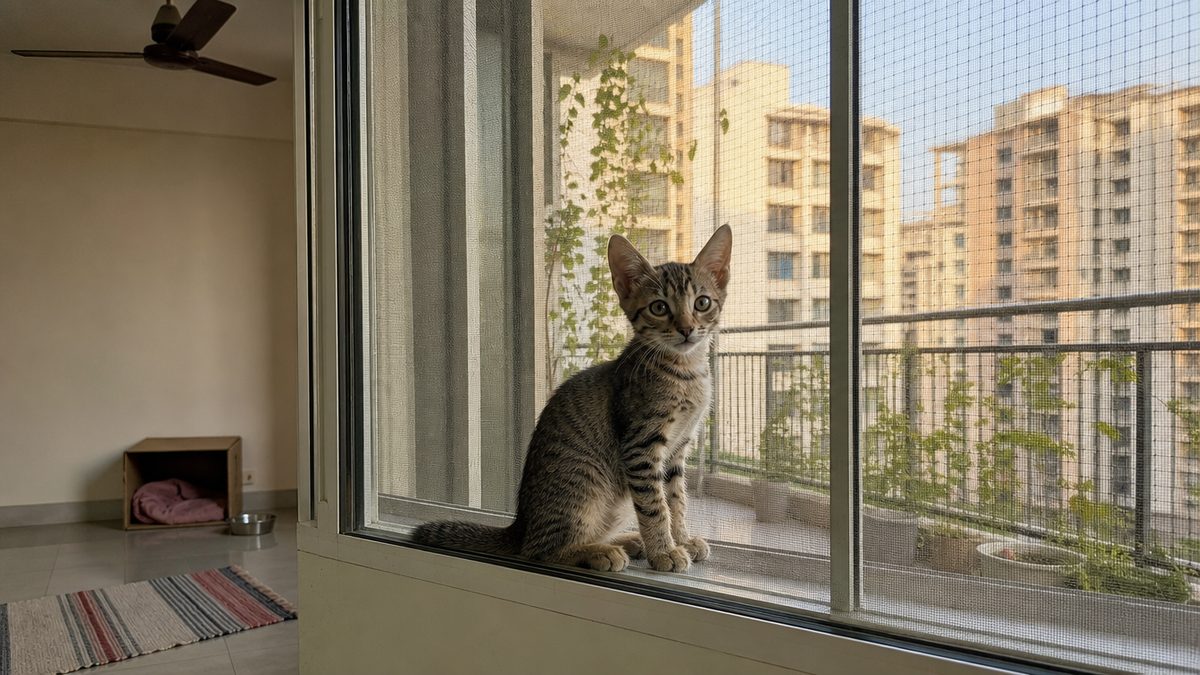
Quick answer
How to take care of a kitten in India: keep it indoors behind meshed windows and a netted balcony, feed a complete kitten food in 4 to 6 small meals a day, give the 3-in-1 vaccine from 6 to 8 weeks every 2 to 4 weeks to 16 weeks plus one at 26 weeks, deworm fortnightly to 8 weeks then monthly to 6 months, sterilise from 4 months, and socialise before the window closes at 9 to 10 weeks. Indian clinics book the kitten course from Rs 3,999, and kitten food costs Rs 30 to 71 a day.
This guide is general information for Indian pet owners and is not a diagnosis. Always consult a registered veterinarian near you before acting on anything you read here, and treat any sudden change in your pet's condition as urgent.
How to take care of a kitten in India: the first year in three age bands
To take care of a kitten in India through its first year, work to three age bands, 8 to 12 weeks, 3 to 6 months and 6 to 12 months, because that is how the vaccine series, the deworming calendar, the food chart and the socialisation window fall; the 2021 AAHA/AAFP feline life stage guideline defines the kitten stage as birth up to 1 year.
This page starts at 8 weeks, when a kitten is weaned onto kitten food; a younger, orphaned or bottle-fed kitten belongs on newborn kitten care in India, and the adoption route is on how to adopt a cat in India. Each band gets a table of what is due, with its guideline and the Indian price read on 18 September 2026; depth on any line sits in the cat vaccination schedule for India, the cat deworming schedule for India and cat neutering in India.
The three bands and what decides them
- 8 to 12 weeks: the first week home in one safe room, the first vet visit, the second and third 3-in-1 doses, worming moving from fortnightly to monthly, and the last fortnight of a socialisation window that may be closing by 9 to 10 weeks
- 3 to 6 months: the 16-week-or-older final kitten dose and the rabies dose under WSAVA 2024, monthly worming to 6 months under International Cat Care, sterilisation from 4 months, and the 26-week dose Indian packages leave out
- 6 to 12 months: worming by risk every 1 to 3 months, a ration that falls from 69 g to 51 g a day on Royal Canin's chart, weight watched after neutering, and the first annual examination at 1 year Royal Canin India Quimby J, Gowland S, Carney HC, DePorter T
Two AAHA/AAFP numbers explain the bands: a 10-week-old kitten needs about 200 kcal per kg of body weight a day, a 10-month-old 80, and the sensitive socialisation period begins at 2 to 3 weeks and may be closing by 9 to 10 weeks, so a kitten that comes home at 8 weeks has a fortnight of it left. The ISFM/AAFP environmental needs guideline puts the critical age at 2 to 7 weeks and asks for at least four handlers in short sessions totalling an hour a day. Kitten care in India follows the same guidelines as anywhere; the flat, the heat, the prices and the clinic calendar are what change.
Vetic's national kitten page says 'Do not socialise your kitten before all 3 vaccines and boosters are complete', which on its own schedule means day 120. The AAHA/AAFP guideline says the window may be closing by 9 to 10 weeks and asks for 30 to 60 minutes of pleasant human interaction a day from the start. Both are right about different things: keep an unvaccinated kitten away from unknown cats, and socialise it at home, with the people, sounds, carrier and handling it will meet for life, from the day it arrives. Your nearby vet decides what is safe for your kitten.
8 to 12 weeks: the first month home
From 8 to 12 weeks a kitten needs one quiet room, the food it ate before, 4 to 6 small meals a day, the second and third 3-in-1 doses, a worming dose at 8 weeks and again at 12, and gentle daily handling before the socialisation window closes International Cat Care Quimby J, Gowland S, Carney HC, DePorter T.
| Item | What is due | Source and Indian price |
|---|---|---|
| Vaccines due | 3-in-1 (panleukopenia, herpesvirus, calicivirus) started at 6 to 8 weeks and repeated every 2 to 4 weeks; Indian clinics book day 60 and day 90, with anti-rabies added at day 90 | WSAVA 2024; Vetic kitten package from Rs 3,999 (list Rs 5,065) for days 60, 90 and 120, with a free check-up each visit |
| Deworming due | Roundworm dose fortnightly from 3 to 8 weeks, then monthly; a kitten with fleas also needs a tapeworm product | International Cat Care; Feli D kitten suspension Rs 141 for 15 ml; Milpro kitten tablets (0.5 to 2 kg) Rs 763 for 2 |
| Food and frequency | Same food as the previous home for 1 to 2 weeks, then a complete kitten food; 4 to 6 small meals a day; 29 to 48 g a day of dry kitten food at 0.4 to 1 kg | International Cat Care; Royal Canin India chart; Rs 30 to 49 a day at Rs 2,059 per 2 kg |
| Litter and handling | Unscented clumping litter or the litter the kitten used before, in a low-sided tray; one tray per cat plus one; place the kitten in it on waking and after meals | AAHA/AAFP 2021 Table 2; International Cat Care; 5 kg unscented bentonite Rs 264 to Rs 319 |
| Socialisation | 30 to 60 minutes of pleasant human interaction a day; children, noises, the carrier and handling paired with food; hands are never toys | AAHA/AAFP 2021; window may close by 9 to 10 weeks |
| Vet visits | A first examination for murmur, hernia, cleft palate and teeth, with a stool check; the day 60 and day 90 vaccine visits | AAHA/AAFP 2021; Vetic package above |
| Spend for the band | Vaccine package Rs 3,999 (covers day 120 too), one kitten dewormer Rs 141 to Rs 763, 28 days of food Rs 840 to Rs 1,370, 5 kg litter Rs 264 to Rs 319 | Pages read 18 September 2026; the vet's consultation fee is on top |
The first week: one room, the carrier left open, nothing new
International Cat Care's advice is one quiet room for the first few weeks: food bowl on one side, litter tray in a corner opposite, water a few feet from the food, a padded washable bed away from all three, a scratching post, a few toys, the carrier left open as a retreat and a cardboard box on its side as a second den; windows stay securely closed, cables and breakables go, medicines are locked away, and nobody new meets the kitten in the first twenty-four hours. Feed the previous home's food for 1 to 2 weeks on the same litter, because a new home and a new diet in the same week is how a kitten gets diarrhoea; change food over 7 to 14 days. Bring the vaccination and parasite record and the weaning history to the first visit, because an orphaned or undersocialised kitten may carry behaviour problems the vet needs to know about.
The vaccine and worming dates in this band
WSAVA 2024 recommends the first trivalent kitten dose at 6 to 8 weeks, then a dose every 2 to 4 weeks until 16 weeks of age or older, or every 2 to 3 weeks to 20 weeks in high-risk settings. Vetic books the 3-in-1 (Tricat or Feligen) on day 60, the 3-in-1 plus anti-rabies on day 90 and both again on day 120, from Rs 3,999 with a free check-up at each visit. The two calendars agree in this band and part at the 26-week dose, covered in the next.
International Cat Care says to assume every kitten has Toxocara cati, because the roundworm passes through the queen's milk, and to treat fortnightly from 3 to 8 weeks, then monthly to 6 months, so a kitten arriving at 8 weeks with no record is dosed now and at 12 weeks. The AAHA/AAFP guideline asks for a broad-spectrum product covering intestinal worms and fleas for any kitten with an unknown history, with resident dogs and cats treated at the same time. Kitten-sized Indian products on the pages we opened were a pyrantel-febantel suspension at Rs 141 for 15 ml and Virbac's Milpro tablet (milbemycin oxime 4 mg with praziquantel 10 mg) for cats of 0.5 to 2 kg at Rs 763 for two; the product and the dose are the vet's call Supertails, Virbac Milpro Dewormer….
3 to 6 months: the last kitten doses, sterilisation and the teeth
From 3 to 6 months a kitten gets its final kitten 3-in-1 dose at 16 weeks or older and its rabies dose, a worming dose every month, sterilisation from 4 months, and a ration that climbs to 69 g of dry food a day before growth slows International Cat Care Royal Canin India.
| Item | What is due | Source and Indian price |
|---|---|---|
| Vaccines due | 3-in-1 doses continue every 2 to 4 weeks until 16 weeks or older; rabies is core in India, with local rules and the leaflet deciding the age; Indian clinics give the day 120 visit as the last kitten visit | WSAVA 2024; the day 120 visit is inside the Rs 3,999 package |
| Deworming due | Monthly to 6 months of age; add a flea-tapeworm product if the kitten has fleas | International Cat Care; Kiwof cat tablets Rs 437 for 10, dosed by weight |
| Food and frequency | 61 to 66 g a day at 3 to 4 months (1.3 to 2 kg), 67 to 69 g at 5 to 6 months (2.3 to 2.9 kg); at least five portions a day, some through puzzle feeders | Royal Canin India chart; International Cat Care; Rs 63 to 71 a day at Rs 2,059 per 2 kg |
| Litter and handling | Scoop daily, wash with hot water not chemicals; acclimate the kitten to the carrier, nail trims, brushing, mouth handling and pills, each paired with food | AAHA/AAFP 2021 Table 2 |
| Socialisation | Inter-cat play peaks at about 12 weeks, then object play takes over; teach 'come' with a treat; never hands or feet as toys | AAHA/AAFP 2021 |
| Vet visits | The day 120 vaccine visit; sterilisation from 4 months, with recovery before any supervised outdoor time | International Cat Care; cost and NGO routes in the cat neutering guide |
| Spend for the band | Food Rs 63 to 71 a day (Rs 5,800 to 6,500 for the 92 days), 3 monthly dewormer doses, sterilisation, litter | Pages read 18 September 2026 |
The 16-week dose, the rabies dose and the 26-week dose Indian packages skip
The most important kitten dose is the one at 16 weeks of age or older, because maternal antibody can block every earlier dose in some kittens, and WSAVA 2024 then asks for one more at 26 weeks or older rather than waiting for the annual visit; the AAHA/AAFP guideline says the same, revaccinate at 6 months to narrow the window of susceptibility Quimby J, Gowland S, Carney HC, DePorter T. Vetic's package ends on day 120 and restarts a year later, so the 26-week dose is a visit you ask for. For rabies, WSAVA's feline table says follow local regulations first and the leaflet if there are none, and calls the vaccine core wherever the disease is endemic, which India is; Vetic gives it at day 90 and day 120 Vetic Pet Clinic.
Sterilisation and the weight gain that follows it
International Cat Care says a kitten can be neutered from 4 months and, if it will ever go outside, only after it is vaccinated, sterilised and healed. Sterilisation means spaying for a female and castration for a male, and the AAHA/AAFP guideline flags what follows: neutering is associated with weight gain, so obesity prevention starts with kittens. The age argument and what Indian clinics and NGOs charge are on cat neutering in India; the cat in heat guide covers what happens if you wait.
Handling the kitten will thank you for at 10 years old
The AAHA/AAFP kitten column asks owners to acclimate the kitten now, with food, to handling, brushing, nail trimming, grooming and medication, to the carrier, the car and the clinic, and to mouth handling, because almost every cat needs a pill one day. It asks for a cue such as 'come' taught with positive reinforcement and forbids hands or feet as toys, because the cat that learns to hunt a hand keeps doing it at 5 kg; the ISFM/AAFP guideline adds that any toy with string or a swallowable part is put away after the session.
6 to 12 months: the 26-week dose, the falling ration and the first annual check
From 6 to 12 months a kitten needs the 26-week 3-in-1 dose, worming every 1 to 3 months by risk, a ration that falls from 64 g to 51 g of dry food a day as its energy need drops to 80 kcal per kg, and its first annual examination at 1 year International Cat Care Royal Canin India Quimby J, Gowland S, Carney HC, DePorter T.
| Item | What is due | Source and Indian price |
|---|---|---|
| Vaccines due | One 3-in-1 dose at 26 weeks or older; then the first annual visit at 1 year, when a low-risk indoor cat moves to a 3-year interval for the 3-in-1 and rabies follows local rules | WSAVA 2024; Vetic adult pair (3-in-1 plus anti-rabies) from Rs 1,899 |
| Deworming due | Every 1 to 3 months from 6 months, more often for a cat that hunts or goes out, with a product that covers tapeworm as well as roundworm | International Cat Care; Kiwof cat Rs 437 for 10 tablets |
| Food and frequency | 64 g a day at 7 months falling to 51 g at 12 months (3.1 to 4 kg); kitten food to 12 months, then a gradual switch to adult food; still several small meals | Royal Canin India chart; Rs 53 to 66 a day at Rs 2,059 per 2 kg |
| Litter and handling | A tray at least 1.5 times the cat's nose-to-tail length, which most shop trays are not; a large storage tub works; scooped daily | AAHA/AAFP 2021 |
| Socialisation | Daily play with rotated toys, food hidden or fed through puzzles, a perch with a view out of a meshed window | ISFM/AAFP 2013 five pillars; AAHA/AAFP 2021 |
| Vet visits | The 26-week visit; the first annual examination at about 1 year with weight, body condition and muscle condition recorded | WSAVA 2024; AAHA/AAFP 2021 |
| Spend for the band | Food Rs 53 to 66 a day (Rs 9,700 to 12,100 for the 183 days), 2 to 6 dewormer doses, the 26-week dose, litter, then the Rs 1,899 annual pair at 1 year | Pages read 18 September 2026 |
The ration falls in this band, which surprises owners who have raised it every month: Royal Canin India's chart peaks at 69 g a day at 5 months and gives 51 g at 12 months for a 3.1 to 4 kg cat, and behind that sit the AAHA/AAFP figures of 200 kcal per kg at 10 weeks against 80 at 10 months, with neutering adding to the reason. International Cat Care's rule is to weigh the dry food rather than fill the bowl, to divide the day's ration into at least five portions over 24 hours with timed and puzzle feeders, and to weigh the cat on baby scales, because dry food is energy-dense and the correct amount looks small.
WSAVA 2024 says the 26-week dose is not a substitute for the first annual health check at about 1 year, and the AAHA/AAFP guideline wants at least one examination a year with body weight, body condition and muscle condition recorded. On Vetic's menu the adult visit is a 3-in-1 plus anti-rabies pair from Rs 1,899; whether the 3-in-1 is then yearly or every 3 years for an indoor flat cat is argued out on the cat vaccination schedule for India page. Worming after 6 months is every 1 to 3 months by hunting and outdoor access, with a product that covers Dipylidium caninum in any cat that has had fleas; the praziquantel-pyrantel tablet Indian shops sell for that, Kiwof for cats, was Rs 437 for 10 on 18 September 2026 Supertails, Savavet Kiwof Cat Deworming….
Keeping a kitten in an Indian flat: nets, mesh, five pillars and the heat
A kitten in an Indian flat lives indoors behind meshed windows and a netted balcony, because the largest study of cats falling from buildings, 1,125 falls treated at one Berlin university clinic between 2004 and 2013, found that 296 of the 1,085 fallers with a recorded age (27.3 percent) were under 1 year old, that 867 of 1,125 (77 percent) fell in the warm months when windows stand open, and that 150 of 1,125 (13.3 percent) died or were euthanased.
India has no safe season: in Berlin, where flats have no air conditioning, falls peak in June, July and August; in hot climates the authors report fewer falls in the hottest, most humid weeks because air conditioning keeps windows shut; and in tropical climates, where windows stay open all year, no seasonal peak has been observed at all. Most falls were from 8 to 15 metres, 62.1 percent of those with a recorded time happened in the evening or at night, only 3.7 percent of the cats were uninjured, and 16 of 1,125 (1.4 percent) were euthanased at the owner's request, mainly over cost, which is the case for reading pet insurance in India before the fall Candela Andrade M, Slunsky P, Nerlich. Kitten-proofing an Indian home therefore starts at the balcony and the windows, before the cables, the plants and the washing machine, because a kitten fits through a grille gap an adult cat cannot.
The rule has a denominator: 27.3 percent of 1,085 fallers were under a year old, 77 percent of 1,125 falls happened with windows open for the heat, and 96 in 100 fallers were injured Candela Andrade M, Slunsky P, Nerlich. Fit fine mesh to every window that opens and a taut balcony net on a fixed frame, check the gaps at the grille, the AC sleeve and the drying-rack pulley, and do it before day one; International Cat Care's first rule for the kitten's room is that windows stay securely closed.
Indoor only, by the guideline: the trade and how to pay it back
International Cat Care calls neither choice right or wrong: indoors, a cat is safer from traffic, fights, dog attacks and infectious disease and may live longer, at the cost of monotony, obesity and stress from cats it can see but cannot chase off. The AAHA/AAFP guideline says an indoor-only lifestyle 'may increase risks of compromised welfare, illness, obesity, and behavior problems due to environmental limitations', so 'appropriate environmental enrichment is thus essential';. In a Mumbai, Delhi, Bengaluru, Chennai or Pune flat, indoor with a meshed window seat is the humane version of outdoor access, and the ISFM/AAFP environmental needs guideline gives the five pillars that turn a two-bedroom flat into a cat's territory; the pillars, with the kitten-specific line attached to each, are listed below.
- Provide a safe place: a hiding spot with a roof, such as a cardboard box on its side or the carrier left out, at least one per cat and, for a kitten, set low or reachable by a ramp
- Provide multiple, separated key resources: at least two feeding areas, two resting areas and two toileting areas, each away from the others, with food and water apart
- Provide opportunity for play and predatory behaviour: wand toys that swoop or run, food hidden or scattered, puzzle feeders sized for a kitten, toys rotated so they stay new, string put away after play
- Provide positive, consistent and predictable human contact: let the kitten start and end each interaction, stroke the head and cheeks, at least four different people in the 2-to-7-week window, an hour a day in short sessions
- Provide an environment that respects the cat's sense of smell: no scented litter or strong cleaners, bedding washed in rotation so some keeps the cat's scent, scratching posts where it can leave its own mark
Heat gets no separate section, because none of the four guidelines behind this page gives a kitten a heat rule; what the fall paper says about a Chennai or Hyderabad summer and a Mumbai or Kolkata monsoon is that falls cluster at night, when windows are opened for the breeze, and that the only climates where falls dip are the ones where air conditioning shuts the flat. A meshed window lets the breeze in and keeps the kitten in; a fan and shallow ceramic or glass water bowls in more than one room do the rest.
Litter training and litter types sold in India, with prices
Litter training a kitten in India takes an unscented clumping litter or the litter it used before, a low-sided tray in a quiet corner away from the food, one tray per cat plus one, and the kitten placed in it on waking and after meals; Indian shelves ran from Rs 264 for 5 kg of unscented bentonite to Rs 1,701 for 5.2 kg of plant fibre on 18 September 2026 International Cat Care Supertails, BearHugs Unscented Bentonite… Supertails, Cat's Best Unscented Original….
Cats are innately fastidious and drawn to sand-type substrates, and kittens learn the tray by copying the queen, so most arrive trained; if yours has not found it, place it there when it wakes, after meals and whenever it sniffs, scratches or starts to crouch International Cat Care. The AAHA/AAFP kitten column says to start with unscented clumping sand litter and/or the litter the kitten used before, and to offer a variety in separate trays so it can show a preference; a kitten that soils outside the tray is examined first, for congenital problems of the urinary or gut tract, parasites or infection, and is never scolded or carried to the tray as punishment.
| Type | Product and pack | Price (MRP) | Per kg or litre | Fits the guideline? |
|---|---|---|---|---|
| Bentonite clay, unscented, clumping | BearHugs, 5 kg | Rs 264 (Rs 399) | Rs 53 per kg | Yes: unscented, clumping, sand-like |
| Bentonite clay, unscented, clumping | Petcrux Eco Clump, 5 kg | Rs 319 (Rs 450) | Rs 64 per kg | Yes: same class, second data point |
| Indian brown sand, lavender scented, clumping | Scoopy, 2 x 5 kg | Rs 549 (Rs 1,600) | Rs 55 per kg | No: scented, which the ISFM guideline says to avoid |
| Tofu, unscented, clumping | Gishiki Health Pro, 2.5 kg (6 L) | Rs 973 (Rs 1,299) | Rs 389 per kg | Yes on scent; lighter and flushable per the seller |
| Plant fibre (wood), unscented, clumping | Cat's Best Original, 5.2 kg | Rs 1,701 (Rs 1,900) | Rs 327 per kg | Yes on scent; imported, the dearest per kg |
| Silica crystals, unscented, non-clumping | Petcrux Best Friend, 5 L | Rs 1,175 (Rs 1,175) | Rs 235 per litre | No for a kitten: non-clumping, and not sand-like |
Two guideline rules decide the choice, scent and clumping: the ISFM/AAFP guideline lists scented litter among the products that disrupt a cat's scent profile, and the AAHA/AAFP guideline names unscented clumping litter for kittens and any cat with a urinary history Quimby J, Gowland S, Carney HC, DePorter T. That rules out the cheapest Indian bentonite by the kilo, which is nearly always lavender scented, puts the two unscented bentonites at Rs 53 to 64 per kg at the top of the list, prices tofu and plant fibre at 5 to 7 times as much per kg, and leaves silica out for a kitten on both rules Supertails, Petcrux Eco Clump Bentonite… Supertails, Gishiki Health Pro Premium Tofu… Supertails, Cat's Best Unscented Original… Supertails, Petcrux Best Friend Unscented….
One Indian ranking page disagrees: PawVerse Social (June 2026) says to be cautious with clumping clay for very young kittens that may eat the litter, where the 2021 AAHA/AAFP table says start with unscented clumping sand litter Quimby J, Gowland S, Carney HC, DePorter T. The guideline governs for a kitten of 8 weeks and over that eats solid food; a kitten young enough to mouth its litter is a hand-rearing case, and your nearby vet decides for that animal. The tray should be at least one and a half times the cat's nose-to-tail length, which most shop trays are not, so a large storage tub with low edges does the job; scoop daily, wash with hot water rather than strong chemicals, and put a tray in each quiet place the kitten can reach.
Feeding your kitten: what to feed, how often, and the cost per day in India
Feed a kitten a complete food made for kittens, split into 4 to 6 small meals a day, and weigh the ration from the maker's own chart; on Royal Canin India's chart and the Rs 2,059 Supertails price for a 2 kg bag that is Rs 30 to 49 a day at 1 to 2 months, Rs 63 to 68 at 3 to 4 months, Rs 69 to 71 at 5 to 6 months and Rs 53 to 66 at 7 to 12 months Royal Canin India Supertails, Royal Canin Kitten Cat Dry….
A kitten is an obligate carnivore with a very high energy requirement, and the AAHA/AAFP guideline says kittens can be weaned onto commercially balanced kitten foods from 3 to 5 weeks, that food preferences set by the queen carry into adult life, and that a kitten should eat alone in a quiet spot. International Cat Care adds the label test: 'complete' contains everything the kitten needs, 'complementary' does not. AAHA and the AAFP do not advocate feeding any cat raw or unsterilised animal-origin food or treats, and home-cooked food for a cat is hard to balance, which is why the homemade cat food in India guide exists rather than a recipe here.
| Food and pack | Price (MRP) | Per 100 g | Grams a day on the maker's chart | Cost a day |
|---|---|---|---|---|
| Royal Canin Kitten, 2 kg | Rs 2,059 (Rs 2,340) | Rs 103 | 29 to 48 g at 1 to 2 months (0.4 to 1 kg) | Rs 30 to 49 |
| Royal Canin Kitten, 2 kg | Rs 2,059 (Rs 2,340) | Rs 103 | 61 to 66 g at 3 to 4 months (1.3 to 2 kg) | Rs 63 to 68 |
| Royal Canin Kitten, 2 kg | Rs 2,059 (Rs 2,340) | Rs 103 | 67 to 69 g at 5 to 6 months (2.3 to 2.9 kg) | Rs 69 to 71 |
| Royal Canin Kitten, 2 kg | Rs 2,059 (Rs 2,340) | Rs 103 | 51 to 64 g at 7 to 12 months (3.1 to 4 kg) | Rs 53 to 66 |
| Whiskas Kitten Ocean Fish, 3 kg | Rs 1,145 (Rs 1,180) | Rs 38 | Page gives no gram table; 'as per body weight', twice a day | Rs 23 to 25 if fed the 61 to 66 g above |
| Drools Kitten Ocean Fish, 3 kg | Rs 744 (Rs 800) | Rs 25 | No gram table on the pages we opened | Rs 15 to 16 if fed the 61 to 66 g above |
The Royal Canin lines are the maker's chart multiplied by the seller's price, so they are a real cost per day for that food Supertails, Royal Canin Kitten Cat Dry…. The Whiskas and Drools lines are not: their Indian pages give no grams-per-day table, Whiskas India says only 'as per the cat's body weight' and 'twice a day', and the last column applies Royal Canin's 3-to-4-month grams to their price as an illustration Supertails, Whiskas Ocean Fish Kitten Cat… Supertails, Drools Ocean Fish Kitten Cat…. That is also a disagreement on frequency: Whiskas India says twice a day, International Cat Care says at least five portions across 24 hours, and the AAHA/AAFP guideline wants small meals with some hidden or worked out of a puzzle feeder International Cat Care Quimby J, Gowland S, Carney HC, DePorter T. Each price was divided by 84.38 and by 74 before publication; none resolves to a round dollar figure at 84.38, and the nearest at 74 is Drools' Rs 744 (10.05), an Indian-made food with a printed Rs 800 MRP, which we read as coincidence.
Milk, water, bowls and the switch to adult food
Cow's milk causes diarrhoea in kittens; if you offer milk, use one made for cats. Water stands in more than one place, away from the food and the tray, in ceramic or glass rather than plastic. Royal Canin's kitten range is labelled for kittens up to 12 months, after which the change to adult food is gradual. Weigh the kitten weekly on baby scales in the first months, because the AAHA/AAFP guideline records body weight and body condition at every examination precisely because the kitten stage is where obesity is prevented International Cat Care.
How to take care of a Persian kitten, and what changes for a Bengal, Siamese, British Shorthair or Maine Coon
To take care of a Persian kitten, add daily combing of a long coat with a thick undercoat, daily cleaning of the eye corners and nose folds, a check of the bottom and tail underside, a kibble shaped for a flat jaw, and a PKD test result from the breeder; International Cat Care says many Persians cannot keep their own coat free of mats Royal Canin India.
The flat face is the reason for most of the extra work. In a CT study of 69 Persian cats against 10 domestic shorthairs, the part of the eyeball sitting outside the bony orbit averaged 39.9 percent in Persians against 9.9 percent, which is why the eyelids close less, the cornea is exposed and the tear ducts drain badly enough that the face is often wet and stained. International Cat Care lists the rest: small nostrils and a long soft palate that can add up to brachycephalic obstructive airway syndrome, teeth that do not align, skin folds prone to infection, and a coat that traps hair the cat swallows. A brachycephalic, flat-faced kitten in a humid Indian summer needs a closer eye on its breathing and a vet's view at the first visit on how severe its own face is.
Royal Canin's Persian Kitten formula is a small, rectangular, soft kibble for that jaw, with psyllium because breeders report the Persian kitten's digestion stays immature longer; its chart gives 40 to 51 g a day at 2 to 3 months for a kitten heading for 3 kg and 40 g by 12 months, and on Supertails it was Rs 2,596 for 2 kg against Rs 2,059 for the standard bag Supertails, Royal Canin Persian Kitten Dry… Supertails, Royal Canin Kitten Cat Dry…. Polycystic kidney disease was found in more than a third of Persian and Exotic cats when screening began in the 1990s, so ask the breeder for proof that the parents tested negative. The Persian cat page carries the Indian price spread, the grooming routine for Indian humidity and the disorder figures with their denominators.
The other four breeds Indian buyers ask about
Nothing in the vaccine, worming or food calendar changes with breed; what changes is which pillar to over-provide and what the vet discusses. For a Bengal kitten, an active climbing cat on its breed page, it is the third pillar, play and predatory outlet; for a Siamese kitten, vocal and people-focused, the fourth, predictable human contact. A British Shorthair kitten is the one to weigh most carefully after neutering, because the obesity warning lands hardest on a stocky, placid cat. A Maine Coon kitten is long-haired and large, and the standard kitten chart stops at a 4 kg cat, so its ration and adult-food switch are the vet's call against its own weight.
Dos and don'ts with a kitten, from the guidelines
The dos and don'ts with a kitten come from three documents, the 2021 AAHA/AAFP life stage guideline, the ISFM/AAFP environmental needs guideline and International Cat Care's settling-in advice, and each line below names its source Ellis SLH, Rodan I, Carney HC, Heath S International Cat Care.
Do
- Give the kitten one quiet room for the first weeks, with the carrier left open as its retreat
- Feed the previous home's food for 1 to 2 weeks and change any diet over 7 to 14 days
- Handle the kitten gently for 30 to 60 minutes a day, letting it approach on its own terms, and pair every new experience with food
- Introduce the carrier, the car, nail trims, brushing and mouth handling now, with treats, so they are ordinary at 5 years old
- Offer two of every resource, food, water, rest, tray and scratching post, in separate places
- Play with a wand toy every day and let the kitten catch it at the end
- Weigh the kitten, weigh the food, and record both at every vet visit Quimby J, Gowland S, Carney HC, DePorter T
- Mesh the windows and net the balcony before the kitten arrives Candela Andrade M, Slunsky P, Nerlich
Don't
- Don't use hands or feet as toys, because the cat learns that skin is prey
- Don't give cow's milk, which causes diarrhoea
- Don't scold a kitten for soiling or carry it to the tray as punishment; have it examined instead
- Don't leave string, elastic or wand toys out between play sessions
- Don't use scented litter, strong cleaners or scent diffusers around the kitten's resources
- Don't wake a sleeping kitten for play or coax a hiding one out; sit in the room and wait
- Don't let it out or among unknown cats until at least a week after the primary course ends, the most important dose of which is the one at 16 weeks or older, and don't confuse that with keeping it away from people Squires RA, Crawford C, Marcondes M
- Don't feed raw or unsterilised animal-origin food or treats, which AAHA and the AAFP do not advocate for any cat
The 3-3-3 rule that shelters print, 3 days to decompress, 3 weeks to learn the routine, 3 months to feel at home, is written for adopted cats rather than kittens; Pasadena Humane's sheet marks the litter-tray milestone as one for adults and older juveniles, and the Humane Society of the Pikes Peak Region calls the rule a guide rather than a timeline Humane Society of the Pikes Peak Region. Read it as the outer limit for a shy kitten, and treat hiding that persists past the first week as a reason to see the vet, because International Cat Care says a cat that will not eat or use the tray beyond the first twenty-four hours needs a veterinary call.
When to see the vet: the signs that end the wait
See the vet the same day if a kitten stops eating for 24 hours, has diarrhoea or vomiting, breathes with its mouth open, strains at the tray or soils outside it, has a runny nose or eyes, a dirty or sore area under the tail, a pot belly with a thin back, or has fallen from any height Quimby J, Gowland S, Carney HC, DePorter T International Cat Care Candela Andrade M, Slunsky P, Nerlich.
The AAHA/AAFP kitten examination looks for congenital problems, a heart murmur, a hernia, a cleft palate, teeth that do not meet, and for upper respiratory signs and parasites, with stools scored on a chart so that 'loose' means the same to both of you; any cat straining at the tray is seen at once, because a urinary blockage kills. International Cat Care's worm signs are weight loss, vomiting, diarrhoea, irritation around the anus and a failure to thrive, and rice-grain segments on the bedding mean tapeworm, which in a kitten means fleas too.
A fall is a vet visit even when the kitten walks, because in the Berlin series 96.3 percent of fallers were injured, 58.3 percent had chest trauma and 48.6 percent were in circulatory shock, and 78.8 percent of cats in shock survived against 94.1 percent of those without. In the first week home, International Cat Care's line is that a really anxious new cat may not eat or use the tray at all for the first twenty-four hours, and that if that carries on beyond that time you speak to your veterinary team. On every one of these signs the reader's nearby vet decides for their own animal; this page says when to make the call, not what the answer is.
Common questions about looking after a kitten in India
What is the 3-3-3 rule for kittens?
No shelter page we opened states a 3-3-3 rule for kittens. Pasadena Humane and the Humane Society of the Pikes Peak Region state it for adopted cats, 3 days to decompress, 3 weeks to learn the routine, 3 months to feel at home, and Pasadena marks the litter-tray milestone for adults and older juveniles only. For a kitten, International Cat Care's version is one quiet room for the first weeks.
Where should a kitten sleep at night?
In its safe room, in a padded washable bed with high sides against draughts, a low front and a thick lining, set in a quiet spot away from the food, water and litter tray, with the carrier left open nearby. International Cat Care says cats are most active at dawn and dusk but a kitten soon adjusts its sleep to a routine set from day one.
Can I leave my 10 week old kitten alone?
Yes, for the gap between meals in a kitten-proofed room; no guideline we opened gives an hour count. International Cat Care says a kitten this age needs 4 to 6 small meals a day and a room with windows closed and no string toys out, and the AAHA/AAFP guideline asks for 30 to 60 minutes of pleasant human interaction a day. A whole working day alone fits neither.
Where should a kitten sleep the first night?
In the one room it will live in for the first few weeks, in its bed or the open carrier it arrived in, with a piece of bedding from its previous home so that one smell is familiar. International Cat Care's rule for that night is no visitors, the litter tray and water already in the room, and the kitten left to settle in its own time.
How much does it cost to care for a cat in India?
From the pages read on 18 September 2026: the kitten vaccination course from Rs 3,999 at Vetic, kitten dewormers at Rs 141 to Rs 763 a pack, dry kitten food at Rs 30 to 71 a day on Royal Canin India's chart or Rs 15 to 25 on the cheapest Indian brands, unscented bentonite litter at Rs 264 to Rs 319 for 5 kg, plus sterilisation and consultation fees. Food is the largest line, roughly Rs 4,500 to Rs 20,000 from 8 weeks to a year.
Do and don'ts with kittens?
Do give one quiet room, the previous home's food, 30 to 60 minutes of gentle handling a day, two of every resource, daily wand play, weekly weighing and a netted balcony. Don't use hands as toys, give cow's milk, punish soiling, leave string out, use scented litter, wake a sleeping kitten, or let it out before its primary course ends. Each line comes from the guidance quoted above.
How do you take care of a Persian kitten?
The same vaccine, worming and food calendar as any kitten, plus daily combing of the long coat and undercoat, daily wiping of the eye corners and nose folds, a small soft kibble shaped for the flat jaw, and a PKD-negative result from the breeder. International Cat Care says many Persians cannot keep their own coat mat-free and that the flat face brings exposed eyes, poor tear drainage and narrow airways.