
Cat health guide
Cat deworming schedule for India: kittens, adult cats by lifestyle, dosage per kg and cost
The kitten weeks and the adult intervals from the three guidelines that disagree, the Indian leaflets that set the age floors and weight bands, the mg per kg behind one tablet per 4 kg, eight Indian prices run through the exchange-rate test, and the Indian studies that put a denominator on what a cat's worms do to the people in the house.
Quick answer
The cat deworming schedule for India runs from 3 weeks of age, every 2 weeks until 10 weeks, then monthly, under TroCCAP's tropical guideline; the Savavet Kiwof leaflet starts its tablet at 6 weeks and counts 6, 8, 10 and 12 weeks, then monthly to 6 months. Adults are dewormed on risk: ESCCAP puts an indoor cat at 1 to 2 doses a year and a roaming or hunting cat at 4 to 12, TroCCAP says monthly for free-roaming cats, and a child under 6 at home means monthly. The tablet is one per 4 kg, Rs 43.70 a dose; your nearby vet sets the group.
This guide is general information for Indian pet owners and is not a diagnosis. Always consult a registered veterinarian near you before acting on anything you read here, and treat any sudden change in your pet's condition as urgent.
Which worms cats in India actually carry
Cats in India carry four types of worms that matter for a deworming schedule: the roundworm Toxocara cati, the hookworms Ancylostoma tubaeforme and Ancylostoma ceylanicum, the flea tapeworm Dipylidium caninum and the rodent tapeworm Taenia taeniaeformis. The only Indian necropsy series we could open, 27 stray cats examined at Aizawl, Mizoram between 2005 and 2009, found worms in 23 of the 27 (85.2 percent): Taenia taeniaeformis in 19, Toxocara cati in 16, Dipylidium caninum in 11 and Ancylostoma tubaeforme in 2.
Toxocara cati is the worm the kitten schedule is built around. TroCCAP lists its routes as embryonated eggs, paratenic hosts such as rodents, and the transmammary route, with a pre-patent period of 3 to 10 weeks. International Cat Care draws the conclusion: because dormant larvae move to the queen's mammary glands and pass in her milk, it is safe to assume that every kitten will be infected with Toxocara cati. Kittens infected through milk may show cachexia, a pot belly, respiratory signs, diarrhoea and vomiting as early as 3 weeks, and heavy infections may cause intestinal blockage or intussusception, which are potentially fatal.
Hookworms are the tropical addition. Ancylostoma ceylanicum is found in the wet tropics of the Asia Pacific, China, India and Africa, larvae penetrate skin as well as being swallowed, and heavy infections in kittens cause anaemia, diarrhoea and weight loss and can be fatal. Its 2 to 4 week pre-patent period is why TroCCAP's outdoor-litter schedule starts a week earlier than its indoor one.
Two tapeworms arrive by two routes. Dipylidium caninum comes from a swallowed flea or louse, is patent in 2 to 4 weeks, and sheds cucumber-seed segments 10 to 12 mm long; TroCCAP says faecal flotation has very low sensitivity for it and is not the test. Taenia taeniaeformis comes from eating rodents, takes 34 to 80 days, and was the commonest worm in the Aizawl cats. International Cat Care's rule: if your cat has fleas, assume it also has Dipylidium caninum, and vice versa.
| Worm | How the cat gets it | Pre-patent period | Aizawl stray cats, n = 27 | Zoonotic |
|---|---|---|---|---|
| Toxocara cati (roundworm) | Queen's milk, embryonated eggs in soil, eating rodents | 3 to 10 weeks | 16 (59.3 percent) | Yes, larva migrans in people |
| Ancylostoma tubaeforme, A. ceylanicum (hookworms) | Larvae through skin or swallowed, eating rodents | 2 to 4 weeks | 2 (7.4 percent), A. tubaeforme | Yes, except Uncinaria |
| Dipylidium caninum (flea tapeworm) | Swallowing an infected flea or louse while grooming | 2 to 4 weeks | 11 (40.7 percent) | Yes, mostly children, rare |
| Taenia taeniaeformis (rodent tapeworm) | Eating infected rodents | 34 to 80 days | 19 (70.4 percent) | Yes, of minor significance |
The Aizawl series is stray cats, necropsied, in one hill city, a ceiling for what an unwormed hunting cat carries rather than an estimate for a flat cat in Mumbai; 13 of the 27 carried both tapeworm and roundworm. No published series of owned Indian cats with a denominator was found on this attempt.
The kitten deworming schedule: what three guidelines and two Indian leaflets say
The kitten deworming schedule for India starts at 3 weeks of age and repeats every 2 weeks until 10 weeks under TroCCAP's tropical guideline, then goes monthly to 6 months; the leaflet on the tablet most Indian shops sell says not under 6 weeks and starts its own count at 6, 8, 10 and 12 weeks. Both are real instructions and the gap between them is where an Indian kitten's first month of worm control is decided.
TroCCAP's wording is the one written for this climate: "Considering trans-mammary transmission and the pre-patent period of Toxocara cati, kittens need to be treated for ascarids at 3 weeks of age and fortnightly thereafter until 10 weeks of age. However, in scenarios where queens and their kittens are kept outdoors in potentially contaminated environments, kittens should be treated against hookworms starting at 2 weeks of age and then every 2 weeks until they are at least 10 weeks old. Nursing queens should be treated simultaneously with their litters." After that, "all cats should be treated monthly";.
ESCCAP's seventh edition (June 2025) agrees on the start and stops at weaning: kittens "for the first time at 3 weeks of age, then every 2 weeks until weaning", monthly to 6 months only "if there is an ongoing increased risk of infection (e.g. free roam)"; the lactating queen is dewormed at the kittens' first treatment, and one emodepside spot-on about seven days before the birth prevents the larvae reaching the milk. International Cat Care treats kittens fortnightly from 3 weeks to 8 weeks, then monthly to 6 months, adding a product active against Dipylidium caninum for any kitten with fleas.
| Source | First dose | Repeat | To 6 months | Nursing queen |
|---|---|---|---|---|
| TroCCAP feline guideline, tropics, 2019 | 3 weeks (2 weeks if the litter lives outdoors) | Every 2 weeks until 10 weeks | Monthly, all cats | Treated with the litter |
| ESCCAP GL1, 7th edition, June 2025 | 3 weeks | Every 2 weeks until weaning | Monthly only if free-roaming | Treated at the kittens' first dose; emodepside 7 days before birth |
| International Cat Care, updated September 2025 | 3 weeks | Fortnightly until 8 weeks | Monthly | Not specified |
| Savavet Kiwof for Cats leaflet | 6 weeks (not under 6 weeks) | 6, 8, 10 and 12 weeks | Monthly, then every 3 months | Treated concurrently with kittens |
| Virbac India, expert-advice page | 2 weeks | Monthly | Monthly until 6 months | Not specified |
| Vetic Pet Clinic, service page, 2026 | 3 weeks | 5, 7 and 9 weeks | Monthly from 3 to 6 months | Vet-guided |
The disagreement is about product, not biology. The Kiwof tablet is "not intended for use in kittens less than 6 weeks of age";, Virbac India's Milpro is safe from six weeks, and Zoetis India's Revolution starts at 8 weeks. A 3-week-old dewormed to TroCCAP's timing therefore needs a suspension dosed by the millilitre, which is why Vetic's vets give kittens oral liquids and adults tablets Vetic Pet Clinic. Which governs today: TroCCAP for the timing, since ESCCAP and ICatCare land on the same 3-week start; the leaflet for the product, because a tablet used under its stated age is off-label and TroCCAP puts responsibility for off-label use on the prescribing vet. Your nearby vet decides which product a kitten of that weight gets.
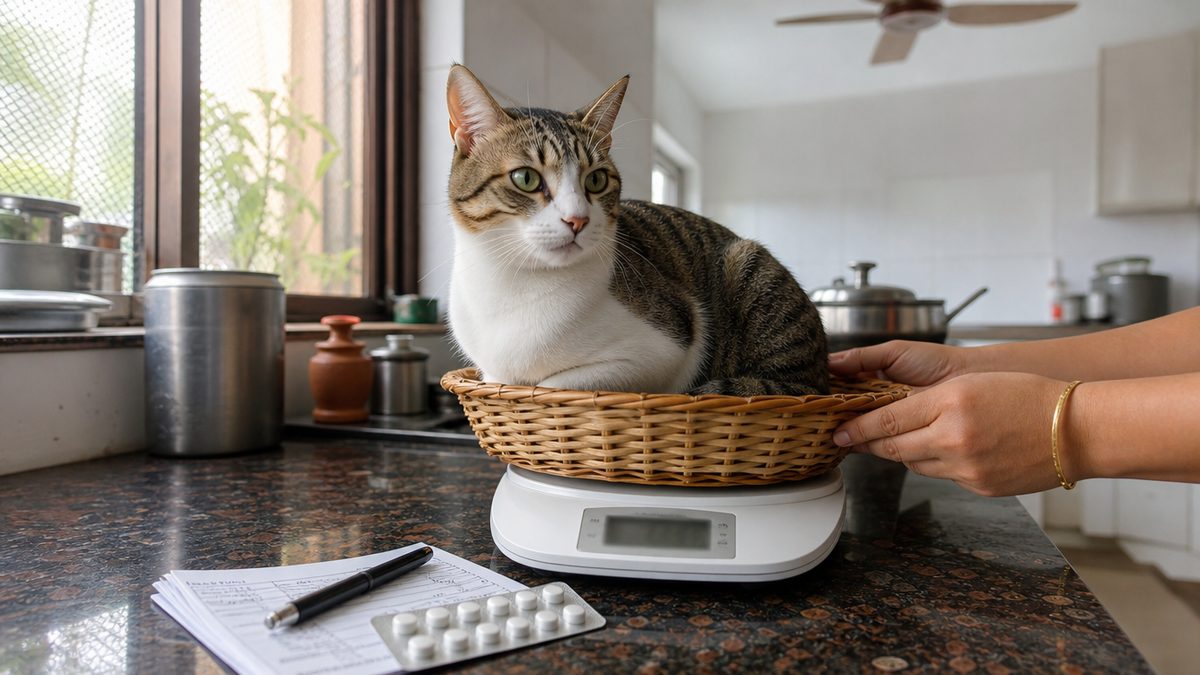
- Week 3: first dose, and the queen the same day. Weigh the kitten on a kitchen scale; a suspension is dosed per kilogram.
- Weeks 5, 7 and 9: repeat every 2 weeks. Move the start to week 2 if the litter was born outdoors, on a terrace or in a compound, for hookworm.
- Week 6 onwards: a tablet becomes an option. Kiwof and Milpro are licensed from 6 weeks; re-weigh before each dose because the band changes fast Virbac India, Milpro Dewormer for Cats.
- Weeks 10 to 26: monthly. TroCCAP says monthly for all cats after 10 weeks; ESCCAP says monthly to 6 months when the kitten roams; ICatCare says monthly to 6 months International Cat Care.
- Deworm before each vaccine visit. The cat vaccination schedule for India has clinics asking for a deworming date before the first trivalent dose, and Vetic's blog says a cat should always be dewormed before its yearly vaccination or any surgery.
A kitten picked up from the street or adopted from a shelter
A kitten of unknown age starts the schedule the day it arrives, at that day's weight, and the household's other cats are treated the same day, because "all cats residing in the same household should be treated for intestinal parasites at the same time";. A street litter is TroCCAP's outdoor scenario, so hookworm cover from the first dose matters, and the adopting a cat in India guide covers the first vet visit.
How often to deworm an adult cat in India, by where it lives
An adult cat in India is dewormed on its risk, not on the calendar: ESCCAP's 2025 scheme puts a cat that lives exclusively indoors at 1 to 2 treatments a year with faecal tests, and a cat that roams and may hunt at 4 to 12 a year against both roundworms and tapeworms, while TroCCAP's tropical guideline says free-roaming, outdoor and cattery cats should be dewormed monthly. The flat cat behind mesh and the community cat that sleeps on the stairwell are on different schedules, and the Indian pages that say "every 3 months" for both are quoting neither guideline.
ESCCAP defines the two groups by behaviour. Group A: "the cat lives exclusively indoors or only has access to a fenced-in patio or garden. The cat is unlikely to eat rodents or other prey", treated 1 to 2 times a year against intestinal nematodes, or faeces examined and treated according to findings. Group B: "the cat has unrestricted access to the outdoors and has direct contact with other cats. Hunting behaviour and the potential ingestion of rodents or other prey cannot be ruled out", treated 4 to 12 times a year against nematodes and 4 to 12 times a year against tapeworms. Two additions sit on top: cats that eat raw meat, eat prey or go hunting are tested or dewormed against tapeworms at least 4 times a year, and cats sharing a home with children under 5 to 6 years, immunocompromised or elderly people get planned monthly deworming or a monthly faecal sample.
TroCCAP is blunter because the climate is: "cats living in catteries, free roaming, outdoor cats are at a higher risk and should be dewormed monthly", and after the kitten course "all cats should be treated monthly";. International Cat Care sits between, treating adults over 6 months every 1 to 3 months by hunting behaviour and outdoor access, with a product covering both tapeworms and roundworms.
| How the cat lives | ESCCAP GL1, 2025 | TroCCAP, tropics, 2019 | Indian pages read 18 September 2026 |
|---|---|---|---|
| Indoor flat, mesh on every window, no other pets | Group A: 1 to 2 times a year, or faecal test and treat | Regular deworming; monthly is the stated rule after 10 weeks | Vetic: every 6 months; Virbac India: at least 4 times a year |
| Flat with an open balcony or window seat, occasional visitor cat | Group A unless it meets other cats; then B | Regular deworming; treat for Dipylidium if fleas appear | Virbac India: fleas can arrive on shoes and visitors, so indoor cats still need it |
| Terrace, stairwell or society compound access | Group B: 4 to 12 times a year, roundworm and tapeworm | Free-roaming: monthly | Vetic and the Supertails blog: every 3 months |
| Hunts, eats rodents or lizards, or is fed raw meat | Group B plus tapeworm cover at least 4 times a year | Monthly; do not allow hunting or raw meat | Virbac India: every 1 to 2 months |
| Community-fed cat that sleeps at home, or a multi-cat home with one roamer | Every cat in the home is treated on the roamer's schedule | All cats in the household treated at the same time; catteries monthly | Vetic: multi-pet households every 3 months |
| Any cat living with a child under 6, or an elderly or immunocompromised person | Monthly deworming or a monthly faecal sample | Owners educated on zoonotic risk; daily faeces removal | Not addressed as a schedule on any page opened |
The line no Indian page quotes
ESCCAP's footnote undercuts the universal quarterly advice: where risk cannot be assessed, deworm or test at least 4 times a year, and "studies have shown that 1 to 3 annual dewormings do not provide sufficient protection. Deworming every 3 months does not necessarily prevent patent infections";. Read against that, Vetic's "every 6 months" for an indoor adult is inside ESCCAP's Group A but below Virbac India's floor of four a year, and the quarterly schedule every Indian page prints for an outdoor cat is ESCCAP's minimum and a third of TroCCAP's Virbac India, How Often Should You Deworm… Supertails, Cat Deworming 101. Which governs today: for a hunting, semi-outdoor or community cat in India, TroCCAP's monthly rule; for a mesh-windowed flat cat, ESCCAP's Group A with a faecal test, unless a small child lives in the house, when both documents say monthly. Your nearby vet places your cat in a group; this page cannot.
One more rule applies to every adult: TroCCAP wants faecal tests "two times a year" to check the regime is working, on samples pooled over three consecutive days because shedding is intermittent.
What you can give a cat to deworm it: the actives, the mg per kg and the Indian packs
A cat in India is dewormed with one of five actives or pairs sold here: praziquantel with pyrantel as a tablet, milbemycin oxime with praziquantel as a tablet, selamectin as a spot-on, imidacloprid with moxidectin as a spot-on, and pyrantel with febantel or fenbendazole as a kitten suspension. TroCCAP gives the mg per kg and the Indian leaflets give the weight band per tablet or pipette, and the two agree once the arithmetic is done.
TroCCAP's Table 1 gives the doses: pyrantel embonate by mouth at 57.5 mg per kg (20 mg per kg as pyrantel base), praziquantel by mouth or injection at 5 to 10 mg per kg and topical at 8 mg per kg, emodepside topical at 3 mg per kg, milbemycin oxime by mouth at 2 mg per kg, selamectin topical at 6 mg per kg, moxidectin topical at 1 mg per kg, and fenbendazole by mouth at 50 mg per kg daily for 3 to 5 days. Its tick marks for which worm each drug clears did not survive text extraction, so coverage below is from each product's own leaflet or page.
Praziquantel plus pyrantel, the broad-spectrum deworming tablet most Indian shops sell. Savavet's leaflet gives Kiwof for Cats as 20 mg praziquantel and 230 mg pyrantel pamoate per tablet, dosed half a tablet up to 2 kg, one tablet over 2 kg to 4 kg, and one and a half over 4 kg to 6 kg. The arithmetic closes: one tablet for a 4 kg cat is 5 mg per kg of praziquantel and 57.5 mg per kg of pyrantel pamoate, TroCCAP's two rows. Drools' Invadeworm F prints the same 20 mg and 230 mg at one tablet per 4 kg. A cat over 6 kg, which a Maine Coon reaches, is beyond the last band, and that dose is the vet's to set.
Milbemycin oxime plus praziquantel, the tablet that also covers whipworm and heartworm. Virbac India lists Milpro for cats as a kitten tablet for 0.5 to 2 kg and an adult tablet for over 2 kg, scored, film-coated with a poultry-liver flavour the page calls highly palatable, safe from six weeks, and not interchangeable with the dog tablet. Indian retail pages give the strengths as 4 mg milbemycin with 10 mg praziquantel and 16 mg with 40 mg Supertails, Virbac Milpro Dewormer Tablets…; at TroCCAP's 2 mg per kg a 16 mg tablet is the dose for 8 kg and half a tablet for 4 kg, and the box leaflet's band governs.
Selamectin, the spot-on dewormer for a cat that will not take a tablet. Zoetis India's page gives Revolution as one tube a month on the skin in front of the shoulder blades, kittens from 8 weeks, mauve up to 2.5 kg and blue for 2.6 to 7.5 kg, for fleas, heartworm prevention, ear mites, and "treatment and control of roundworm (Toxocara cati) and intestinal hookworm (Ancylostoma tubaeforme) infections in cats". Tapeworm is not on that list; the Supertails listing for the same product says it kills tapeworms, and the manufacturer governs. Advocate, imidacloprid with moxidectin for cats over 4 kg, likewise lists roundworm, hookworm, lungworm, ear mites, fleas and heartworm and no tapeworm. A flea-bitten cat on either spot-on still needs praziquantel by mouth.
The kitten suspensions. A deworming syrup or suspension is dosed by the millilitre of body weight; the pyrantel pamoate and febantel suspension sold for kittens is 1 ml per kg on its listing. That listing also claims it removes tapeworms, which the pharmacology in the Savavet leaflet for the same two actives (pyrantel for hookworms and ascarids, febantel for nematodes including whipworms) does not support. Fenbendazole suspensions are TroCCAP's 50 mg per kg daily for 3 to 5 days, a course rather than a dose.
| Class and form | Worms on its own leaflet or page | Age floor | Indian example, pack and price | Divided by 84.38 and 74 |
|---|---|---|---|---|
| Praziquantel + pyrantel tablet | Roundworm, hookworm, tapeworm | 6 weeks (Kiwof leaflet) | Savavet Kiwof Cat, 10 tablets, Rs 437 (MRP Rs 445); Skyec Skyworm, 4 tablets, Rs 173 (MRP Rs 178); Drools Invadeworm F, 10 tablets, Rs 500 | 5.18 and 5.91; 2.05 and 2.34; 5.93 and 6.76 |
| Milbemycin oxime + praziquantel tablet | Roundworm, hookworm, whipworm, tapeworm; heartworm prevention monthly | 6 weeks (Virbac India) | Virbac Milpro cat over 2 kg, 4 tablets, Rs 1,274 (MRP Rs 1,300); kitten 0.5 to 2 kg, 2 tablets, Rs 763 (MRP Rs 778) | 15.10 and 17.22; 9.04 and 10.31 |
| Selamectin spot-on | Roundworm, hookworm, fleas, ear mites, heartworm prevention; no tapeworm | 8 weeks (Zoetis India) | Zoetis Revolution cat, 3 x 0.75 ml, Rs 2,472 (MRP Rs 2,522) | 29.30 and 33.41 |
| Imidacloprid + moxidectin spot-on | Roundworm, hookworm, lungworm, fleas, ear mites, heartworm prevention; no tapeworm | Per the box leaflet | Advocate for cats over 4 kg, 3 x 0.8 ml, Rs 2,830 (MRP Rs 2,888) | 33.54 and 38.24 |
| Pyrantel + febantel kitten suspension | Roundworm, hookworm (listing also claims tapeworm; unsupported) | Per the box leaflet | Areion Vet Feli D, 15 ml, Rs 141 | 1.67 and 1.91 |
| Fenbendazole suspension | Roundworm, hookworm, whipworm; 3 to 5 day course | Per the box leaflet | Skyec Fenever, 30 ml, Rs 184; Vetina Canworm, 30 ml, Rs 139 | 2.18 and 2.49; 1.65 and 1.88 |
None of the eight prices divides to a whole number of US dollars at 84.38 or at 74, so these are rupee-native shelf prices on the day, not quotes. Elanco's Drontal Cat has no Indian manufacturer page we could open (elanco.com/en-in returned a shell with a footer error on this attempt, and India is absent from Elanco's pet-portal country list) and is not in the Supertails cat collection, so it is not in the table.
Weigh the cat first
Dosage by weight is the whole discipline: weigh the cat before every dose, because every band above is a body weight band and a kitten crosses two of them between 6 and 16 weeks. Virbac India's instruction is to confirm the dose from the cat's weight; a kitchen scale takes a kitten, and for an adult you stand on a bathroom scale holding the cat and subtract. Savavet's safety margin: cats given 10 times the highest recommended dose showed vomiting and salivation without other adverse effects, a temporary loss of appetite and loose stools occur in some cats, the tablet is not used with piperazine compounds, and a vet is consulted before treating a pregnant animal.
Never put a dog product on or into a cat. Virbac India says its dog and cat Milpro tablets carry different doses, and TroCCAP's ectoparasite guideline states that highly concentrated synthetic pyrethroids (with the exception of flumethrin) or amidines are toxic for cats; the dog tick prevention guide explains why a permethrin spot-on on the household dog can kill the cat beside it. The same rule covers age and weight: no tablet under the leaflet's age floor, and no dose beyond its last band without a vet setting it.
Can you deworm a cat yourself in India, and when the vet decides
You can give a healthy adult cat its routine dewormer at home in India, with a weighed dose of a product licensed for its age and weight; the leaflet is written for a registered veterinary practitioner, the guidelines say the schedule is set on veterinary advice, and a kitten under the leaflet's age floor, a pregnant queen, or a cat that is vomiting, has diarrhoea or looks anaemic is the vet's call. That is a narrower yes than the shop pages give and a wider one than the foreign clinic pages give.
The documents disagree. Savavet's leaflet is headed "for the use of Registered Veterinary Practitioner, Hospital or Laboratory";. Supertails' collection answers "Can I deworm my cat at home without visiting a vet?" with "yes" for healthy cats above the minimum weight, while its own listings for Revolution, Advocate and Invadeworm F accept the order "based on the validity of your doctor's prescription"; Supertails, Drools Invadeworm F Dewormer…. ESCCAP says "deworming practices should always be on the advice of a veterinary professional";, and TroCCAP places responsibility for off-label use on the prescribing vet. The Supertails blog lists pumpkin seeds, coconut oil and apple cider vinegar as home remedies to use alongside medicine; no guideline lists any home remedy, and nothing in TroCCAP's dose table is a food. In practice an Indian owner buys the tablet over the counter and gives it at home; the guideline's condition is that a vet has put the cat in a risk group and set the interval.
- Weigh the cat that day and pick the band from the leaflet, not from memory of the last dose.
- Check the age floor: 6 weeks for Kiwof and Milpro, 8 weeks for Revolution; younger kittens get a suspension by the millilitre Zoetis India, Revolution.
- Give the tablet at the back of the tongue or in a small amount of food, or apply a spot-on to skin at the base of the neck and keep the cat from grooming it until dry.
- Treat every cat in the house the same day, TroCCAP's rule, and treat the dog on its own product.
- Record the date, product, tablet count and weight on the vaccination card, so the next band and the next due date are arithmetic.
- Wash your hands afterwards, the leaflet's user-safety line, and clean the litter tray daily for the next few days because expelled worms and eggs pass in the faeces.
Signs that the schedule has slipped, and the test that settles it
A cat with worms usually shows nothing until the burden is heavy; the signs that do appear are weight loss, vomiting, diarrhoea, irritation around the anus and failure to thrive, plus a pot belly, respiratory signs and the pale gums of hookworm anaemia in kittens. TroCCAP's rules for the test: flotation at a specific gravity of 1.18 to 1.20 finds most worms, shedding is intermittent so a sample pooled over three days raises the odds, flotation is not recommended for Dipylidium, and no eggs does not rule out Taenia, which sheds segments. ESCCAP adds a Dipylidium coproantigen test with significantly higher sensitivity. Signs may appear before eggs do, so history and signs guide treatment rather than a negative float.
When to stop and book the vet instead
- A kitten under the leaflet's age floor, or under 0.5 kg, needs a product and a millilitre dose chosen for it.
- A cat that is vomiting or has diarrhoea should not be dewormed right away, on Vetic's advice; the vet treats the cause first.
- A pregnant or lactating queen: the Kiwof leaflet says consult a vet before treating a pregnant animal for roundworms, and ESCCAP times the queen's emodepside dose to seven days before birth.
- A pot-bellied, anaemic or very thin kitten may need fluids, iron or a transfusion alongside the dewormer, which TroCCAP lists as supportive care.
- A cat over 6 kg, or one on another daily medicine, is outside the leaflet's bands or its interaction list (piperazine) and gets a vet-set dose.
What the visit costs is the figure this page could not source cleanly. Vetic, whose deworming page lists clinics in Delhi, Gurgaon, Noida, Ghaziabad, Faridabad, Hyderabad, Mumbai, Bengaluru, Pune, Kolkata and Chennai, prints that schedule with no price; its Koramangala, Bengaluru page prints consultations from Rs 799 and blood tests from Rs 200, and its home-visit page a Rs 299 offer against a Rs 799 list price Vetic Pet Clinic, Koramangala Vetic Pet Clinic. No clinic page we opened publishes a faecal flotation price or a deworming visit price, so none is quoted; Rs 799 divides to 9.47 at 84.38 and 10.80 at 74, so the figures are rupee-native.
What a year of cat deworming costs in India
A year of cat deworming in India costs between Rs 87 and Rs 524 in tablets for a 3 kg cat on praziquantel and pyrantel, depending on whether it gets ESCCAP's two indoor doses or TroCCAP's twelve, and between Rs 3,822 and Rs 9,888 if the same cat is on a monthly milbemycin tablet or a monthly selamectin spot-on. Those are sums of shelf prices read on 18 September 2026, not quotes, and the visit fee sits on top.
The unit prices are one Bengaluru, Karnataka retailer's on the day, with 30-minute delivery in Bengaluru, Delhi, Mumbai and Hyderabad on its collection page: Savavet Kiwof Cat at Rs 437 for 10 tablets is Rs 43.70 a tablet; Virbac Milpro for cats over 2 kg at Rs 1,274 for 4 tablets is Rs 318.50 a tablet; Zoetis Revolution for cats at Rs 2,472 for three 0.75 ml pipettes is Rs 824 a month; Advocate for cats over 4 kg at Rs 2,830 for three tubes is Rs 943.33 a month. A kitten's first doses come from a 15 ml suspension at Rs 141, dosed at 1 ml per kg, which covers a whole litter's first month.
| Schedule and its source | Doses a year | Kiwof Cat tablet | Milpro cat tablet | Revolution pipette |
|---|---|---|---|---|
| ESCCAP Group A, indoor cat | 2 | Rs 87 | Rs 637 | Rs 1,648 |
| ESCCAP minimum where risk is unclear; Virbac India; Vetic outdoor | 4 | Rs 175 | Rs 1,274 | Rs 3,296 |
| Vetic indoor adult | 2 | Rs 87 | Rs 637 | Rs 1,648 |
| TroCCAP, all cats after 10 weeks; ESCCAP Group B upper bound; child in the house | 12 | Rs 524 | Rs 3,822 | Rs 9,888 |
| Kitten year: 3 to 9 weeks on suspension, then monthly to 12 months | 4 suspension doses plus 9 tablets | Rs 141 plus Rs 393 | Rs 141 plus Rs 2,867 | Rs 141 plus 9 pipettes, Rs 7,416 |
Two things the table hides. A 5 kg cat is one and a half Kiwof tablets a dose, Rs 65.55, so monthly becomes Rs 787; and the spot-on rows buy flea and ear-mite control too, while still leaving the flea tapeworm to praziquantel Sava Vet (Savavet). The visit is the unpublished cost: no clinic page we opened prices a faecal flotation, so ESCCAP's Group A route of a twice-yearly test cannot be priced from a published page today.
For a kitten that arrives at 6 weeks and stays indoors: one Rs 141 suspension before it reaches a tablet band, then nine monthly Kiwof tablets to its first birthday at Rs 43.70 each, Rs 393, is Rs 534 in dewormer for the year, before consultations and before the cat vaccination schedule for India starts at the same visits Supertails, Areion Vet Feli D Kitten…. Year two on ESCCAP's indoor schedule is two tablets, Rs 87, plus two faecal tests at an unpublished price. None of it is insurable: pet insurance in India excludes routine care in every wording, and one insurer's clause names 'killing and controlling fleas and worms' outright.
Fleas, the flea tapeworm, and the dog's tick product
Fleas and the flea tapeworm are one problem, because Dipylidium caninum reaches a cat only through a swallowed flea or louse, so a cat with fleas is treated for tapeworm and a cat with tapeworm segments is treated for fleas; TroCCAP's rule is that "if fleas are present, cats should be treated for Dipylidium caninum", and ESCCAP adds one tapeworm treatment when a flea infestation is established. The flea product itself is where a cat in a dog-owning Indian home is most often hurt.
The life cycle explains the pairing: flea larvae eat the tapeworm's egg packets, the adult flea carries the larva, and the cat is infected when it swallows that flea while grooming, with the tapeworm patent 2 to 4 weeks later. Control is two-sided, "treating infected cats at 2 to 4 week intervals and using registered insecticides to keep them free of fleas and lice";; ESCCAP's treatment is praziquantel with flea and louse control, and it records single reports of anthelmintic resistance. International Cat Care wants a product active against Dipylidium in any kitten that has fleas, which rules out pyrantel alone.
The spot-on trap follows from the previous section: Revolution and Advocate clear fleas, roundworm and hookworm and leave tapeworm untouched, so a flea-infested cat on either still needs praziquantel by mouth, and Virbac India's own advice is to coordinate deworming with flea and tick prevention rather than treat them as one purchase Virbac India, How Often Should You Deworm….
- Treat the cat with a product licensed for cats. TroCCAP's ectoparasite guideline advises acaricides licensed for dogs and cats and states that highly concentrated synthetic pyrethroids (with the exception of flumethrin) or amidines are toxic for cats.
- Read the dog's tick pipette before it goes on. The dog tick prevention guide lists the permethrin, cypermethrin and amitraz products sold in India and the four rules for a house with both animals; a treated dog on shared bedding is a route of exposure for the cat.
- Give praziquantel the same week as the flea treatment, and again at 2 to 4 weeks while fleas persist, because a newly swallowed flea restarts the cycle.
- Treat every animal in the house on the same day, on its own species' product.
What your cat's worms can do to the people in the house
A cat's worms reach people in India by three routes with very different weights: Toxocara cati eggs from soil or a litter tray cause larva migrans, mostly in children, and it is the one that shows up in Indian hospital series; Dipylidium caninum needs a swallowed flea and has been reported in a handful of Indian children and one adult; and Echinococcus, the tapeworm behind hydatid disease, is a dog and fox parasite for which ESCCAP calls cats comparatively unsuitable hosts. Deworming the cat on schedule and washing hands after the litter tray are the two controls every guideline names.
Toxocara. Swallowed Toxocara cati eggs from soil "may produce covert, visceral or ocular larva migrans in humans. Children are most at risk", with larvae reaching liver, lungs, brain and eyes; most cases are self-limiting, but ocular migration can cost sight. The Indian numbers carry denominators. At PGIMER Chandigarh, 29 patients were Toxocara IgG positive with matching clinical features over 2013 to 2017; of the 14 with a full history, 13 were children under 15 and all had eosinophilia. In Punjab, 27 of 122 farmers and veterinary practitioners, 22.13 percent, carried Toxocara IgG. A 2021 meta-analysis of 14 Indian soil surveys found Toxocara eggs in 11.26 percent of public-place samples (95 percent CI 7.59 to 15.54), the surveys ranging from 2.11 to 31.0 percent. Those eggs come from dogs as well as cats, which is why the dog deworming schedule for India is this page's companion.
Dipylidium. Human dipylidiasis is rare, follows a swallowed flea, and is usually asymptomatic, with nocturnal irritability, anorexia and weight loss in some people. The Indian literature had reported it only in children until a 2020 report of a 50-year-old woman in Uttarakhand with a year of abdominal pain, cough and worm segments in her stool, cured with praziquantel.
Echinococcus. ESCCAP is specific: Echinococcus granulosus lives in dogs and other canids, cats "are comparatively unsuitable hosts for Echinococcus multilocularis and only rarely excrete eggs, and in this case, in small numbers", the risk cannot be definitively ruled out, and monthly treatment of a rodent-eating cat is the vet's call weighed against small children in the house. TroCCAP's feline guideline has no Echinococcus section at all. A household's hydatid risk is its dog.
| Parasite | Route to a person | Indian figure and its denominator | Household control |
|---|---|---|---|
| Toxocara cati | Swallowed eggs from soil, litter or unwashed hands | 13 of 14 PGIMER cases were children; 27 of 122 Punjab adults seropositive; eggs in 11.26 percent of soil samples across 14 surveys | Schedule kept; tray cleaned daily; hands washed; footwear outdoors |
| Dipylidium caninum | Swallowed infected flea | Rare; children in earlier reports, one adult in 2020 | Flea control on every animal; praziquantel for the cat |
| Echinococcus spp. | Eggs from a dog's faeces; cats rarely shed | No Indian feline figure; a canine parasite | Deworm the dog with praziquantel; the cat is a minor route |
ESCCAP's household rule is the schedule change: a cat "sharing homes with small children (below 5 to 6 years), immunocompromised or elderly individuals" gets planned deworming once a month or a monthly faecal sample, whatever its lifestyle. TroCCAP's hygiene list is hand washing, footwear outdoors, daily removal of cat faeces, a litter box cleaned daily with any bleach rinsed off, no raw meat and no hunting.
Deworm before the vaccine visit, and what changes for a Persian, a Bengal or a Maine Coon
Deworm a cat before its vaccination visit and before any surgery, which is Vetic's standing instruction and the reason the cat vaccination schedule for India starts with a deworming date; the breed changes nothing in the drug and two things in the schedule, the risk group the cat's habits put it in and the weight band its body puts it in. A Persian behind mesh and a Bengal with terrace time can be on schedules six doses a year apart.
The timing rule is simple: Vetic's vets say a cat should always be dewormed before its yearly vaccination or any surgery, and its service page prints the kitten deworming doses at 3, 5, 7 and 9 weeks, all before the first vaccine visit the same chain books at day 60 on the cat vaccination schedule for India Vetic Pet Clinic Vetic Pet Clinic. Bring the deworming date, product and weight to the vaccine visit so the card carries both series.
- Persian and other long coats. Tapeworm segments are found as rice grains on the hair around the anus and on the bed, so a long coat is where you look after grooming, and a cat that is mostly indoors is ESCCAP's Group A unless it meets other cats ESCCAP, Guideline 01.
- Bengal and any cat with terrace, balcony or compound time. Hunting behaviour that cannot be ruled out is the definition of Group B, 4 to 12 doses a year against roundworm and tapeworm, and TroCCAP's free-roaming rule is monthly Tropical Council for Companion Animal….
- Maine Coon and any cat over 6 kg. The Kiwof leaflet's bands stop at 6 kg, so the dose above that is set by the vet, and Milpro's adult tablet is scored for halving by weight Virbac India, Milpro Dewormer for Cats.
- Siamese and other small-framed adults. A 3 kg cat sits in the one-tablet band all its life, and a 5 kg cat is one and a half, so weigh rather than assume.
- Multi-cat homes and a community cat that comes indoors. Every cat is treated the same day on the roamer's schedule, and a new cat is dewormed on arrival before it meets the others.
The one exception to "the breed changes nothing in the drug" is the card a pedigree kitten arrives with: ask the breeder or shelter for the dates, product and weight of every dose already given, because ESCCAP's kitten interval is every 2 weeks from the last dose until weaning, so the next dose is counted from that date rather than from a fresh start on arrival.
Common questions about deworming a cat in India
Can I deworm my cat myself?
Yes, you can deworm a healthy adult cat yourself with a weighed dose of a product licensed for its age and weight, such as one praziquantel-pyrantel tablet per 4 kg. The leaflet is written for a registered veterinary practitioner and the schedule is set on a vet's advice, so a kitten under 6 weeks, a pregnant queen or a cat that is vomiting or has diarrhoea goes to the vet instead.
How many days do you deworm a cat?
One day: a praziquantel-pyrantel tablet, a milbemycin-praziquantel tablet or a selamectin spot-on is a single dose, and the schedule is the gap between those single doses, from 2 weeks in a young kitten to 1 to 6 months in an adult. The exception is fenbendazole, which TroCCAP doses at 50 mg per kg daily for 3 to 5 days.
How do I know if my cat needs deworming?
Usually you cannot tell by looking, because a cat shows signs only with a heavy burden; when signs come they are weight loss, vomiting, diarrhoea, irritation around the anus and failure to thrive, plus a pot belly in kittens and rice-grain tapeworm segments on the fur. That is why the guidelines deworm on risk and test faeces twice a year rather than waiting for symptoms.
What can I give my cat to deworm?
A tablet of praziquantel 20 mg with pyrantel pamoate 230 mg, dosed half a tablet up to 2 kg, one tablet from 2 to 4 kg and one and a half from 4 to 6 kg, from 6 weeks of age; a milbemycin oxime and praziquantel tablet from 6 weeks; or a selamectin spot-on from 8 weeks, which covers roundworm and hookworm but not tapeworm. Kittens under 6 weeks get a suspension dosed by the millilitre.
How often do you deworm a cat?
ESCCAP's 2025 scheme deworms a cat that lives exclusively indoors 1 to 2 times a year, or tests its faeces instead, and a cat that roams and may hunt 4 to 12 times a year against roundworms and tapeworms; TroCCAP's tropical guideline says free-roaming, outdoor and cattery cats monthly. A cat living with a child under 6 is dewormed monthly under ESCCAP whatever its lifestyle.
Can you deworm a cat without going to the vet?
In India you can buy the tablet over the counter and give it at home, and Supertails' collection page says so, though its own listings for the spot-ons and one tablet ask for a prescription. ESCCAP's condition is that deworming practices should always be on the advice of a veterinary professional, meaning a vet has placed the cat in a risk group and set the interval you then keep at home.
How soon can I touch my cat after deworming?
Straight away after a tablet; the leaflet's only precaution is that the person who gave it washes their hands afterwards. After a spot-on, Virbac India's instruction is to keep the cat from grooming the application site until it has dried and not to bathe it immediately, and Zoetis India says Revolution is waterproof two hours after application, so avoid the wet patch on the neck for that long.
How many times should I deworm a kitten?
About eight times by 6 months on TroCCAP's timing: at 3, 5, 7 and 9 weeks, then monthly from 10 weeks, with the nursing queen treated on the same days. The Savavet Kiwof leaflet, whose tablet is not for kittens under 6 weeks, counts seven: 6, 8, 10 and 12 weeks, then monthly to 6 months, then every 3 months. A kitten born outdoors starts at 2 weeks for hookworm.
Can a kitten survive without deworming?
Many do, but the guideline for the tropics is explicit about the ones that do not: heavy Toxocara cati infections in kittens may cause intestinal blockage or intussusception, which are potentially fatal, and hookworm infection may be fatal in kittens when large numbers of worms are present. Since Toxocara cati passes in the queen's milk, every kitten is assumed infected.
What is the recommended deworming routine for kittens?
Treat for roundworms fortnightly from 3 weeks of age until 8 weeks, then monthly to 6 months, with a product active against Dipylidium caninum added for any kitten that has fleas; that is International Cat Care's routine and TroCCAP's runs the fortnightly doses to 10 weeks. After 6 months the interval depends on whether the cat hunts or goes outdoors.
Which medicine is best for deworming cats?
No guideline names a best brand; TroCCAP recommends approved drugs and lists the actives by dose, and a routine cat dewormer needs praziquantel for tapeworms plus pyrantel or milbemycin for roundworms and hookworms, which the praziquantel-pyrantel and milbemycin-praziquantel tablets sold in India both supply. A selamectin or moxidectin spot-on leaves tapeworm out. Your vet picks for your cat.
What is the most recommended cat dewormer?
International Cat Care recommends a product effective against both tapeworms and roundworms for adult cats, rather than a brand, and says pet-shop products may not be the best for your cat, so ask your veterinary team, who know the worms in your area. On Indian shelves that description fits the praziquantel-pyrantel tablets and the milbemycin-praziquantel tablet; this page ranks none of them.
Do indoor cats need to be dewormed?
Yes. Virbac India's page says fleas carrying tapeworm larvae enter through visitors, clothing, shoes or other pets and parasite eggs arrive on footwear, so indoor cats still need routine deworming; ESCCAP puts an exclusively indoor cat at 1 to 2 treatments a year or twice-yearly faecal tests, and Vetic books indoor adults every 6 months. A child under 6 in the house raises that to monthly.
Is it safe to deworm a cat?
Yes at the leaflet dose: Savavet reports that cats given 10 times the highest recommended dose of its praziquantel-pyrantel tablet showed vomiting and salivation without other adverse effects, and that a temporary loss of appetite and loose stools occur in some cats. The leaflet's limits are no use under 6 weeks, not with piperazine compounds, and a vet's advice before treating a pregnant cat.
How do you know if your cat needs deworming?
You assume it does on a schedule, because the guidelines deworm by risk rather than by signs, which appear late; the check is a faecal flotation at a specific gravity of 1.18 to 1.20 twice a year, ideally on samples pooled over three consecutive days because shedding is intermittent. Rice-grain segments under the tail, a pot belly, pale gums or weight loss mean the schedule has already slipped.