
Breed profile
Bohemian Spotted Dog: The Complete India Guide
A Czech national breed built in a physiology laboratory, missing teeth by design, and coming from a city whose warmest month is cooler than Bengaluru's coldest.
Quick answer
The Bohemian Spotted Dog is a 45 to 53 cm Czech companion breed created in a Prague physiology laboratory in 1954 as Horák's laboratory dog, registered by CMKU in group N as a breed the FCI does not recognise. No Indian seller or price exists. Heat tolerance rates 2 out of 5, because Prague's warmest month averages 20.06 degrees, cooler than Bengaluru's coldest.
This page summarises published veterinary research, breed-club screening data and government texts for general information. It is not a diagnosis and it is not treatment advice. Consult a registered veterinarian about your own dog before acting on anything here, and treat collapse, unrelenting panting or a seizure lasting more than five minutes as an emergency.
Bohemian Spotted Dog at a glance
What the Bohemian Spotted Dog is, and what the Czech standard actually says
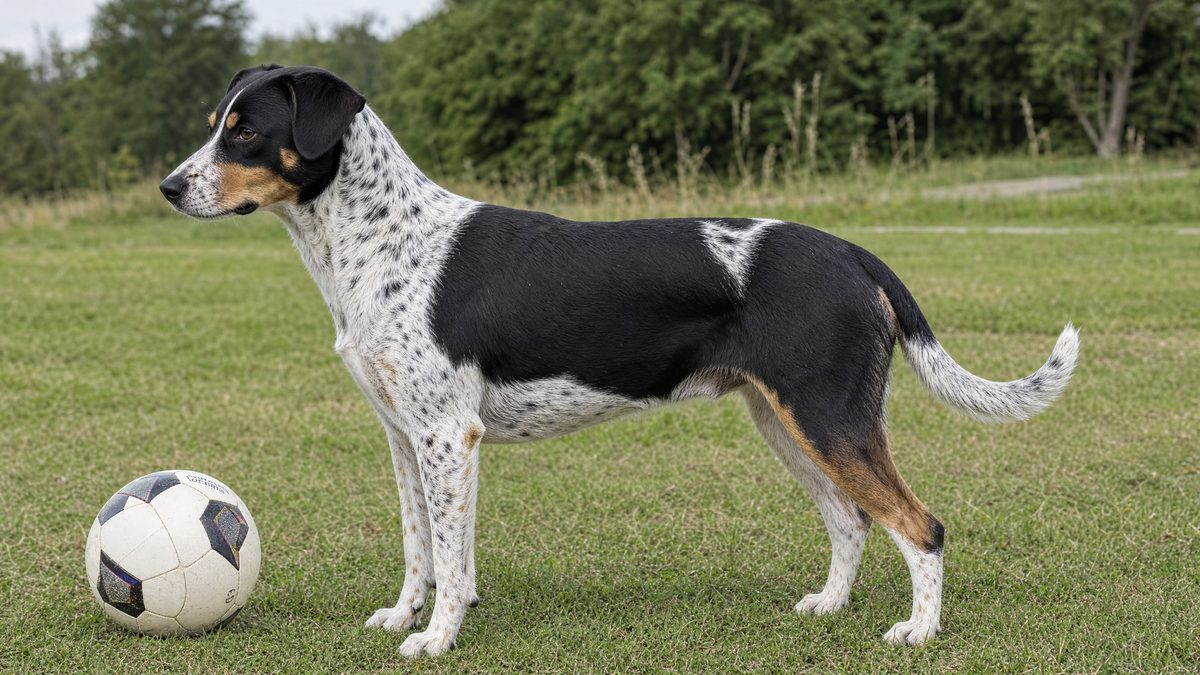
The Bohemian Spotted Dog is a medium-sized tricolour Czech dog of 43 to 53 cm, created in a Prague physiology laboratory in the 1950s and kept today as a companion, and its only official breed standard is a Czech-language document that the Czech kennel club CMKU has served since 1 January 2008.
Read the standard itself and the first line answers the question every English page fudges. The document opens "Číslo standardu: české národní plemeno neuznané FCI; plemennou knihu vede ČMKU, Česká Republika", which translates as "Standard number: Czech national breed not recognised by the FCI; the studbook is kept by CMKU, Czech Republic";. Under Use it says společenský pes, companion dog. Under history it records that the breed was created in the 1950s by František Horák for laboratory purposes.
Size is given precisely and the tolerance is unusually tight. Males stand 45 to 53 cm at the withers and females 43 to 51 cm, and a deviation of more than 2 cm above or below that range is a disqualifying fault rather than a penalty. Three proportion indices follow, and they are the part no English page reproduces: body length is 110 to 120 percent of the height at the withers, chest depth is 50 percent of the height at the withers, and head length is 40 percent of the height at the withers, which the standard also expresses as two fifths.
The standard gives no weight at all. That matters, because English pages print one anyway: one page ranking on Google India states 15 to 22 kg, or 33 to 48 pounds, with no source. Take the weight as an observation about the dogs people own, not as a standard requirement.
Coat, colour and the ticking rule
Two coat varieties exist and neither is preferred. The short coat is layered with an undercoat that shows most clearly in winter, slightly longer under the neck, on the back of the thighs and under the tail but still lying close to the body. The long coat is only slightly wavy, also carries an undercoat, and forms feathering on the front legs, trousers behind and a flag on the tail. A so-called transitional coat, meaning distinctly longer hair on the back of the thighs and under the tail of an otherwise short-coated dog, is explicitly not penalised. Both varieties therefore carry a double coat, and a missing undercoat is listed as a fault.
Colour is always tricolour in one of two equal types, black-yellow-white or brown-yellow-white. The black-yellow-white dog has a black nose and a dark eye, the brown-yellow-white dog a liver nose and a lighter eye. The ideal ratio between pigmented and unpigmented body area is 1:1. The white areas must be ticked, yellow within the yellow zones and black or brown within the dark zones, and while the size and density of the ticking do not matter, the ticked areas must not read as roan. Absence of the tricolour is a disqualifying fault.
| Item | What the standard states |
|---|---|
| Standard number | Czech national breed not recognised by the FCI, studbook kept by CMKU |
| Valid from | 1 January 2008, superseding the original standard published 1 January 1994 by František Horák |
| Country of origin | Czech Republic |
| Use | Companion dog |
| Notional FCI classification | Group IX companion breeds, section 10 Kromfohrländer |
| Height at withers | Males 45 to 53 cm, females 43 to 51 cm |
| Weight | Not specified anywhere in the document |
| Coat | Two equal varieties, short and long, both with undercoat |
| Colour | Always tricolour, black-yellow-white or brown-yellow-white, white areas ticked, ideal pigment to white ratio 1:1 |
| Ears | Folded forward, V-shaped, small, reaching the corner of the mouth when drawn forward |
| Tail | Not set high, tapering, reaching at least the hock, carried sabre-shaped, curl over the back permitted |
| Disqualifying faults | Overshot or undershot bite, missing incisor or canine, more than 2 cm outside the height range, absence of tricolour, coarse bearded coat, cryptorchidism, timidity, aggression, kinked or deformed tail |
One conflict is worth flagging before you use any figure. Radio Prague International, which sits at position three on the Google India results page, states that the dogs are "40 - 55 cm tall at the withers";. The standard says 45 to 53 and 43 to 51, and puts a hard 2 cm disqualification either side of that. The broadcaster's range is roughly the union of both sexes plus slack. Where a medium-sized figure matters to you, use the standard.
The Bohemian Shepherd, Czech Chodský pes, is a separate breed that the FCI does recognise, on a provisional basis, as number 364 since 29 April 2019. The Bohemian Spotted Dog is not on that list. If a page shows a long-coated black and tan herding dog, you are reading about the Shepherd.
Is the Bohemian Spotted Dog FCI recognised? No, and here is the paper trail
The Bohemian Spotted Dog is not recognised by the Fédération Cynologique Internationale, in any form, and the Czech kennel club says so in its own breed record by filing the breed in group N, FCI neuznaná plemena, meaning breeds the FCI does not recognise.
Start at CMKU, because CMKU keeps the studbook. Its breed record 405 prints "Originální název: Český strakatý pes", "Číslo FCI: 905" and "FCI skupina: N - FCI neuznaná plemena", links the standard document, assigns the breed to studbook workplace number 1, and names one member organisation, Spolek českého strakatého psa, z. s. Českomoravská kynologická unie. The club's own CMKU record gives it member number 1091 and an address in Prague 6.
That number 905 is worth a second look, because it is easy to misread as an FCI standard number. It is not one. The FCI's live nomenclature runs to breed 378, the Macedonian Shepherd Dog Karaman, provisionally recognised on 11 February 2026. A four-digit-adjacent 905 sits far outside that range, so it is CMKU's own internal identifier for a breed the FCI has never numbered.
The provisional list, read from the right document
The FCI keeps a separate register for breeds accepted on a provisional basis, and this site checks it by opening the list itself rather than searching a breed page. The page headed "Breeds recognised on a provisonal basis", FCI's own spelling, currently carries 21 breeds from the Australian Stumpy Tail Cattle Dog at 351 up to the Macedonian Shepherd Dog Karaman at 378. Three of those 21 come from the former Czechoslovakia: CHODSKÝ PES (364), the Bohemian Shepherd Dog, provisional since 29 April 2019; PRAZSKY KRYSARIK (363), the Prague Ratter, provisional the same day; and TATRANSKÝ DURIČ (377), the Tatra Hound, provisional since 11 February 2026. The Bohemian Spotted Dog is not among them. Its Czech neighbours got in and it did not.
The independent check agrees. The International Partnership for Dogs, which runs the DogWellNet breed database, records the Bohemian Spotted Dog with FCI Group "Not Recognized", AKC Group "Not Recognized" and TKC Group "Not Recognized", country of origin CZ. Radio Prague International puts the same point historically: the breed entered the Czech register of national breeds as Horák's Laboratory Dog in 1960 and under its present name in 1981, "but it has not yet been internationally recognised by the International Canine Federation".
One ranking page says the exact opposite, and its own Czech edition contradicts it
Brit, the pet-food brand whose breed catalogue holds position four on the Google India results page for this breed, files the Bohemian Spotted Dog under a breadcrumb reading "FCI Breeds provisionally accepted", at a URL path ending breeds-provisionally-accepted, and then prints in the body of the page "FCI: N - FCI recognized breeds.";. Both statements are wrong, and the second one is wrong in an interesting way. The same catalogue's Czech edition, linked from the English page's own country switcher, files the identical breed at a path reading fci-neuznana-plemena-psu, which is Czech for FCI unrecognised dog breeds. The English translation dropped the negative prefix and inverted the meaning of the category.
So the reader of the fourth-ranking English page is told the breed is provisionally accepted by the FCI and separately that it belongs to a group of FCI recognised breeds, when the source catalogue in Czech says it belongs to the group of breeds the FCI does not recognise, and the FCI's own provisional list does not contain it.
| Body | What its own record says |
|---|---|
| CMKU, Czech Republic | Registered national breed, internal number 905, FCI group N, FCI neuznaná plemena, studbook kept by CMKU |
| FCI, definitive list | Absent. No standard number, no group, no section |
| FCI, provisional list | Absent. The 21-breed provisional list runs 351 to 378 and does not contain it |
| AKC, United States | Not recognised, per the DogWellNet breed record |
| The Kennel Club, United Kingdom | Not recognised, per the DogWellNet breed record |
| Kennel Club of India | Cannot be answered from KCI's public site, which publishes no breed list. KCI is an FCI member organisation and the breed is outside FCI nomenclature |
A Bohemian Spotted Dog's papers are a CMKU national pedigree without an FCI logo, because the FCI logo is carried only by breeds it recognises definitively or provisionally. That paper is real and traceable inside the Czech studbook. It is not an internationally transferable FCI pedigree, and no Indian registry has a route to convert it into one.
The laboratory origin: one mating in 1954, and a brief written like a purchase order
The Bohemian Spotted Dog began as a laboratory dog designed to a written specification, when František Horák mated a bitch of unknown origin to a dog of unknown origin at the Institute of Physiology in Prague in 1954 and selected their descendants for temperament, fertility and cheapness to keep.
Horák was not a scientist, and the Czech Academy of Sciences says so in its own biographical dictionary. Born on 12 June 1909 at Žehuň near Poděbrady, the son of a valet in the Kinský household, he matriculated from a commercial academy in Hradec Králové in 1928, worked as a sawmill adjunct, then for a timber firm in Plzeň, then from 1940 to 1948 as an accountant for the Prague Ironworks Company, and from 1950 to 1952 as secretary of the Czechoslovak Terrier Club. In 1953 he joined the physiology department of the Biological Institute of the Czechoslovak Academy of Sciences at Prague-Dejvice as head of the experimental animals department, and from 1954 to 1974 he was chief zootechnician at the Institute of Physiology at Prague-Krč. The dictionary calls him "the most successful Czech amateur geneticist, the founder of Czech scientific cynology", and records that he died in Prague on 6 January 1997.
He is far better known for the other breed he made. After consulting the geneticist Bohumil Sekla, Horák crossed a Scottish Terrier bitch with a Sealyham dog in 1949 at his Lovu zdar kennel, and the resulting Cesky Terrier was recognised internationally in 1963, which the FCI records as definitive acceptance on 24 May 1963 as standard 246 in Group 3. One line in the same entry belongs on any honest page about the spotted dog: "Pro výzkumy Fyziologického ústavu se prováděly i odchyty zatoulaných psů", meaning that stray dogs were also caught for the Institute of Physiology's research. Building a purpose-bred colony was, among other things, an alternative to that.
The design brief is the part that makes this breed different from every other. CMKU's own standard records the goal as a uniform type of dog with emphasis on a calm, gentle temperament, high fertility, low maintenance, and suitable body structure, size and coat. Radio Prague adds low food consumption and ease of breeding to the list, and quotes breeder and veterinarian Vladimíra Tichá on what that meant in practice: "Mr. Horák was trying to create a dog that would be able to change owners often and that would let people do almost anything to it.";.
The founding pair, and the outcross nobody in English mentions
The standard describes the starting animals plainly. The initial pair was of unknown origin, a bitch resembling a German Shepherd and a dog resembling a smooth-haired Fox Terrier, and a German Shorthaired Pointer was crossed into their descendants at the third generation. Tichá is honest about how thin the paperwork is: "If you look at the Czech Spotted Dog, he's a bit of a riddle. We don't really know where he came from.";.
The Czech account is much more specific, and it names names. Horák mated two institute crossbreeds in 1954, the wolf-grey bitch Riga, weighing 25 kg, and a tricolour spotted dog Míša of roughly ten kilograms. Riga whelped nine puppies, of which two, a male and a female, were tricolour with ticked white areas, and they were named Míša 1 and Dáša 6. Mating those two produced a litter of nine tricolour ticked puppies in 1955. Those two names are the ones the 2020 pedigree analysis found at the top of the modern breed's ancestor list.
Which breeds actually went in, and which did not
This is where the English pages go wrong, and the Czech source settles it. A German Shorthaired Pointer called Alan was used early to improve the constitution of the breed, and he is the animal that brought the genes for brown coat colour into it, which is why the breed has a brown-yellow-white variety at all. Horák also carried out experimental crosses with a shepherd, a bull terrier and a pointer, but the offspring of those crosses did not enter further breeding. One English blog lists the same three breeds as if they were part of the foundation. They were tried and dropped.
One later outcross no English page carries at all. The CMKU standard states that after the studbook shrank, a shortage of breeding animals and high mutual relatedness led to the use of several individuals of unknown origin with an acceptable exterior and one Small Munsterlander, and Czech Radio adds a pointer to the list of gundogs used. So the modern gene pool contains a documented second gundog infusion, decades after Alan.
Every trait Horák selected for was a trait that made a dog easy for strangers to handle in a windowless building. That is why the modern breed is described as friendly, docile and non-aggressive rather than as a guard. An Indian family buying a first dog is, in effect, buying seventy years of selection against reactivity.
From laboratory register to near-extinction: the dates, including the ones that disagree
The breed was entered in a Czechoslovak register in 1960, shown in public for the first time in 1961, handed to private breeders in the early 1980s, and reduced to a handful of dogs by the early 1990s, and two of those dates are contested by sources of comparable authority.
The strain was officially registered under the name Horákův laboratorní pes, Horák's laboratory dog, in 1960. One account adds that a breeding standard was approved that year and the register entry was made with the Czechoslovak Small Animal Breeding Union. Until then the dogs were not shown to the public at all. Wikipedia dates the first public appearance to a dog show in 1961, Radio Prague places it at a 1961 national show in Prague-Chuchle, and National Purebred Dog Day gives an exact date, the National Working Dog Breeds Exhibition in Prague on 27 August 1961. The year is agreed. The venue is not.
The founding date is contested, and registry data settles it
The Academy of Sciences' own dictionary dates the creation differently. It states that Horák bred the special breed for study purposes "from two crossbreeds with a share of hunting dog" in 1956 to 1958, and that the institute sold off the breeding stock in 1983 for lack of funds, after which the breed almost died out and has been bred privately under the name Czech Spotted Dog since 1990. The club's account gives 1954, a handover in 1981 and a first private litter the same year.
Registry data settles the founding date. The peer-reviewed pedigree analysis of this breed used the studbook held by the KCHMPP rare-breeds club, and states that the data "contained 2010 registered dogs from 4 August 1954 until 28 September 2017";. The first record in the actual studbook is dated 4 August 1954, which is documentary evidence rather than recollection. Use 1954 for the founding and read 1956 to 1958 as the window in which the type became reproducible. The dispersal date stays genuinely contested at 1981 against 1983, and this page does not pick one.
| Date | Event | Source |
|---|---|---|
| 4 August 1954 | Riga whelps nine puppies, two of them tricolour and ticked, and the studbook's first record is dated that day | strakaci.cz and the peer-reviewed pedigree analysis |
| 4 April 1954 | The same first litter, dated four months earlier | Czech Wikipedia |
| 1955 | Míša 1 mated to Dáša 6 produces nine tricolour ticked puppies | strakaci.cz |
| 1956 to 1958 | Breed developed for study purposes, per the Academy of Sciences | Biografický slovník českých zemí |
| 1960 | Registered as Horákův laboratorní pes and the standard approved | CMKU standard, strakaci.cz |
| 27 August 1961 | First public showing, Prague-Chuchle, six dogs exhibited | strakaci.cz, National Purebred Dog Day |
| 1979 | Horák applies to move the breed into the Czech Breeders' Union records | strakaci.cz |
| 10 September 1981 | First litter born outside the Academy of Sciences | strakaci.cz, Czech Wikipedia |
| 1983 | Institute sold off the breeding stock for lack of funds | Biografický slovník českých zemí |
| Early 1990s | Six pedigreed dogs traced, or six in total, or eleven collected | Czech Wikipedia, Radio Prague, English Wikipedia |
| 10 March 1993 | Restoration litter A Prosmycký dvůr, dated 1994 by two other sources | Czech Wikipedia against Radio Prague |
| 1 January 1994 | Original breed standard published, authored by František Horák | CMKU standard |
| 1 January 2008 | Current standard takes effect | CMKU standard |
| 28 September 2017 | Last record in the analysed pedigree, 2,010 dogs in total | Peer-reviewed pedigree analysis |
One detail from the Czech record that no English page carries. During the 1960s, while the breed was still an institute animal that the public could barely see, strakáči appeared on screen in the trilogy Dýmky and in Obchod na korze. A dog nobody could buy was already in Czechoslovak cinemas.
The near-extinction, and the three different counts of what survived
The breed came out of the 1980s in single figures, and the published accounts of exactly how many dogs survived disagree with each other in ways worth showing, because the number is the whole reason the modern gene pool looks the way it does.
About forty breeding dogs existed in the colony when the institute let it go, and most of them died of old age while the paperwork moved Vaňourková Z. Historie plemene český…. What survived into private hands was very small, and the sources give three different counts. Radio Prague reports six dogs in the early 1990s, three males with documents proving their origin and three females whose documents had been lost, and dates the recovery litter to 1994. English Wikipedia says enthusiasts "collected 11 dogs all around the Czech Republic";, and the aggregator that copies it repeats the eleven.
Czech Wikipedia gives the most checkable version, because it names the animals. Six purebred dogs with pedigrees were traced: Car Voděradský háj, black-yellow-white short-coated, born 1986; the three siblings Artis, Adéla and Aran z Nadějného chovu, born 1987; the bitch Dejsi Voděradský háj, born 1986; and Argo Stříbřecký rybník, born 1989. One further dog and three bitches were either purebred without documentation or of entirely unknown origin, which makes ten animals in total, and it dates the restoration litter, A Prosmycký dvůr, to 10 March 1993 rather than 1994. Note that four of the six named pedigreed dogs are male, which does not match Radio Prague's three males and three females.
Six, ten and eleven are not the same rescue, and 1993 is not 1994. This page reports all of them rather than averaging. What every version agrees on is the scale: a breed rebuilt from single figures.
The pedigree analysis gives a third and harder number that is not a retelling of either. It found that the base population of the breed "consisted of only ten individuals (five females and five dogs), of which nine founders (without one female) genetically participated in the creation of the current reference population";. Ten animals at the base, nine of them contributing. That is the founding stock of an entire breed.
The 1980s are a documentary hole. Czech Radio, reporting the club's own position in September 2025, states that from the birth of the first litter in Dobruška in 1981 until 1990 the breeding of this breed is shrouded in mystery, because neither the register of kennels nor the studbooks survive, and the club's breeding adviser is publicly asking anyone who bred or showed these dogs in the 1980s to send photographs and show catalogues. Any page that gives you confident detail about that decade is filling a gap the breed's own club says is empty.
The epilepsy research: three papers, ten dogs, ninety-two seconds
The epilepsy research the Bohemian Spotted Dog was bred for produced at least three indexed papers, and the largest of them followed ten of Horák's laboratory dogs for six years, timed their grand-mal seizures at a mean of 92 seconds, and found that a person the dog trusted, simply standing in the room, could stop a seizure from starting.
Every page ranking for this breed says the dogs were studied for epilepsy, and several add a kidney transplant claim whose wording shifts from source to source. Radio Prague and its syndication partner say the breed was "one of the first animals in Czechoslovakia to receive a kidney transplant";, while Czech Wikipedia upgrades it to the first creature on which a kidney transplant was verified in Czechoslovakia. First and one of the first are different claims, and neither cites a paper. What nobody cites is the epilepsy work, and that work is findable.
The central one is Martínek and Dahme, published in Zentralblatt für Veterinärmedizin Reihe A in 1977 under the title "Spontanepilepsie bei Hunden: Langzeituntersuchungen an einer Gruppe genetisch verwandter Tiere", spontaneous epilepsy in dogs, long-term studies on a group of genetically related animals. Its English summary opens "Studies over a period of six years on epileptic dogs (N = 10, 6 male and 4 female) of special breeding (Horak's laboratory dogs)", which is the breed named in a veterinary journal by the name it carried in the laboratory.
What the 1977 paper actually reports
- Both mild and severe attacks occurred, and the mild ones came first. The summary states that mild attacks preceded major ones.
- Isolation was the trigger the researchers used. "The standard method of precipitating an attack is to transfer the dog to an empty experiment room."
- Company stopped it. The next sentence reads, with the journal's dashes rendered here as commas, "A supplementary step, having in the room a person in whom the dog has confidence, may prevent the attack."
- Seizures clustered in periods. Attacks occurred only within so-called periods of crisis and usually not more often than once every one to two weeks.
- Grand-mal attacks lasted 92 seconds on average, and recovery was usually rapid.
- Six brains were examined and were normal. Neurohistological study of six epileptic animals revealed no brain changes that could be considered causal, and also lacked the characteristic lesions that follow convulsions.
The authors' conclusion is the one that matters for anyone thinking about the modern breed. All of those observations, together with the family history of the affected dogs, "strengthen the view that the attacks represent a true (primary, genuine) epilepsy";. In the vocabulary the International Veterinary Epilepsy Task Force settled on in 2015, that is idiopathic epilepsy, meaning epilepsy with no identifiable structural cause and a presumed genetic basis.
The breed's creator co-authored the seizure work
Two earlier papers carry František Horák's own name. Martínek and Horák published "Development of so-called 'genuine' epileptic seizures in dogs during emotional excitement" in Physiologia Bohemoslovaca in 1970, indexed by the National Library of Medicine under absence epilepsy, tonic-clonic epilepsy, pedigree, social isolation, psychological stress and mastication. The following year the same pair published "Epilepsie bei Hunden vom ethologischen Standpunkt", epilepsy in dogs from the behavioural standpoint, indexed under animal disease models and housing. Read the two index sets together and the experimental design is visible: seizures in a pedigreed colony, provoked by isolation and emotional stress, studied as a behavioural phenomenon in a housed population.
One correction to the popular retelling. English pages say Horák worked under Professor Servít on epilepsy, and PubMed does hold 106 records under that author name, all on epilepsy. Not one of them is about dogs. A search for servit z[Author] AND dog* returns zero, and the Servít papers that name a species are indexed to cats, hedgehogs and rabbits National Library of Medicine, PubMed. The dog line of the laboratory's work was published by Martínek, with Horák beside him.
The 1977 result that a trusted person in the room could prevent a seizure is a fifty-year-old observation on ten dogs, so treat it as a hypothesis rather than a treatment. It is still the reason not to leave a seizure-prone dog alone in an empty room, and it fits what the same group had already published about isolation and emotional stress as triggers.
Finally, the absence. PubMed returns zero records for the search term Bohemian spotted dog, with the query translated to "Bohemian"[All Fields] AND "spotted"[All Fields] AND dog terms, and zero for Horákův laboratorní pes. In the same session the control search labrador retriever hip dysplasia returned 126 records, so the tool was working. There is no modern peer-reviewed literature on this breed at all. Everything above comes from the 1970s.
Missing teeth are written into the standard, and Indian law calls them a genetic defect
The Bohemian Spotted Dog standard states that missing teeth are characteristic of the breed, while India's Dog Breeding and Marketing Rules 2017 list two or more missing teeth among the genetic defects a breeding dog must have been tested for, and nobody appears to have noticed that the two documents point in opposite directions.
Take the standard first, in its own words. Under Jaws and teeth it reads "Pro plemeno je charakteristické chybění některých premolárů a molárů, což se nepokládá za vylučující vadu. Plnochrupost je předností.", which translates as "The absence of some premolars and molars is characteristic of the breed, and is not regarded as a disqualifying fault. Full dentition is an advantage.";. This is not a tolerated defect. It is a breed standard describing oligodontia as part of the type.
The standard is precise about where the line sits, and the line is further forward in the mouth than most readers assume. Missing incisors or canines are listed among the disqualifying faults, alongside an overshot or undershot bite and a markedly irregular bite, and an extra tooth is a penalised fault. So a dog may lack premolars and molars and still be a correct example of the breed, but a single missing canine disqualifies it.
That is not an accident of the show ring. One ranking page records, without a source, that the breed was studied for "heredity of missing teeth" alongside epilepsy and the heredity of the spotted coloration. Read next to the standard's dentition clause, the claim is at least coherent: a colony bred and recorded for decades is exactly where a heritable dental trait would be characterised.
How common is it? The club counted, and the answer is roughly one dog in four
The breed club publishes the census, and it is the single most useful number on this page. Of the 112 approved breeding males on the register at 31 December 2023, 81 had complete dentition (72.3 percent) and 31 did not (27.7 percent). Of the 97 approved breeding bitches, 78 were complete (80.4 percent) and 19 were not (19.6 percent). Both columns sum exactly to their totals, 81 plus 31 is 112 and 78 plus 19 is 97, so the arithmetic checks. Across the whole breeding register that is 50 incomplete mouths out of 209 dogs, 23.9 percent.
Those are dogs that passed the club's own breeding assessment, which requires a full set of correctly developed incisors and canines and a scissor bite but says nothing about premolars and molars. So the 23.9 percent is not a failure rate. It is what the breed looks like when the rule is applied as written.
The peer-reviewed pedigree paper reports the trait at a different level, describing "dental abnormalities in almost every seventh individual", which is roughly 14 percent, citing a Czech health-monitoring study. The club's own 2023 register puts it at 23.9 percent among breeding dogs. This page publishes both figures rather than choosing. They measure different populations, one an assessed breeding register and the other a broader health survey, and the honest reading is that somewhere between one dog in seven and one dog in four has an incomplete mouth.
Bite quality is measured in the same register and it is good. Of the 112 males, 107 had a correct scissor bite (95.5 percent), three a tight scissor bite, one an irregular scissor and one a level bite; of the 97 bitches, 87 were correct (89.7 percent), nine irregular and one tight. The breed's dental issue is missing teeth, not misaligned jaws.
Clinically, usually not. A dog missing a premolar or two chews normally and shows no pain. What changes is paperwork and buyer expectation: an Indian buyer who has read a generic dog-care page and counts 42 teeth will find fewer. Ask to see the parents' mouths, take a dated dental chart at one year of age, and treat a missing canine as the real red flag, because that one disqualifies under the standard.
Indian law calls two or more missing teeth a genetic defect. Nobody has noticed the collision
India's Dog Breeding and Marketing Rules 2017 name two or more missing teeth in the list of genetic defects every breeding dog must have been tested for, which puts the Indian rulebook directly at odds with a breed standard that calls missing premolars and molars characteristic.
The Prevention of Cruelty to Animals (Dog Breeding and Marketing) Rules 2017, notified as G.S.R. 496(E) on 23 May 2017, carry a Second Schedule whose Part III is headed HEALTH RELATED REQUIREMENTS. Paragraph 8 of that Part is Veterinary care, and sub-paragraph (10) reads in full: "The dogs shall have been tested for genetic defects, including hip dysplasia, progressive retinal atrophy, night blindness, hypothyroidism, entropion, ectropion, overshot, undershot jaw (when incisors do not touch or mesh), wry mouth, two or more missing teeth, unilateral cryptorchid or full cryptorchid males.";
Say which numbering you are quoting, because this document numbers clauses twice. There is a Rule 8, Conditions for sale, in the body of the Rules, and a separate paragraph 8 inside the Second Schedule, which is headed "[See rules 5(2) and 6]". The genetic-defect list is the Schedule's paragraph 8(10), not Rule 8.
Two things follow for an Indian reader. The Rules require testing, not exclusion, so a missing premolar does not by itself make a dog unlawful to own or sell. But any Indian breeder registered under these Rules who bred this breed would have to record, for every breeding dog, a genetic-defect test covering a trait the breed's own standard calls characteristic. And Second Schedule Part II paragraph 6(9) states that "Breeding to create new breeds of dogs or unusual looks shall be strictly prohibited";, which is an awkward fit for a breed created inside living memory to a written specification.
What the dentition data looks like in a breed that is actually screened
The Orthopedic Foundation for Animals runs a dentition database, and it shows how ordinary missing teeth are in some pedigree populations. The worst-affected breed in the table is the Manchester Terrier, with 142 evaluations and 46.5 percent abnormal, followed by the Alaskan Klee Kai at 126 evaluations and 46.0 percent and the Norwich Terrier at 105 evaluations and 45.7 percent. Horák's other breed appears too: the Cesky Terrier sits at rank 26 with 70 evaluations, 92.9 percent normal and 7.1 percent abnormal.
| Breed | Rank | Evaluations | Normal % | Abnormal % |
|---|---|---|---|---|
| Manchester Terrier | 1 | 142 | 53.5 | 46.5 |
| Alaskan Klee Kai | 2 | 126 | 54.0 | 46.0 |
| Shetland Sheepdog | 6 | 1,065 | 77.5 | 22.5 |
| Cesky Terrier | 26 | 70 | 92.9 | 7.1 |
| Icelandic Sheepdog | 15 | 50 | 88.0 | 12.0 |
| Bohemian Spotted Dog | absent | 0 | no data | no data |
The Icelandic Sheepdog row matters because it shows the floor: OFA lists a breed in this table on as few as 50 evaluations. A case-insensitive search of the complete statistics dump for BOHEMIAN, SPOTTED and STRAKAT returns zero rows in any of the roughly 1,289 tables, while the control search for LABRADOR returns 109 rows and CESKY returns 18 in the same retrieval. The breed is genuinely absent, not hidden by a broken query.
Record a genetic-defect test for every breeding dog covering a trait the breed's own standard calls characteristic, keep it on file for inspection, and be ready to explain to a State Board why roughly a quarter of the breeding register has an incomplete mouth. That is not an argument against the breed. It is an argument for reading paragraph 8(10) before importing one and calling yourself a breeder.
Bohemian Spotted Dog price in India: there is no price, and here is the proof
No Bohemian Spotted Dog price in india exists, because no Indian seller stocks the breed, and every channel tested returns nothing for it while returning real priced pages for a Labrador control run with the same tool in the same session.
An absence only counts as evidence if the search worked, so every test below is paired. A search restricted to India for the breed name plus the rupee sign returned an empty result array. The identical query shape run on labrador retriever returned ten results across tradeindia, shubhkennel, mrnmrspet, petsworld and others. A nine-domain sweep across the largest Indian pet-commerce sites returned nothing for the breed and ten results for the Labrador.
The control page publishes real numbers, which is what makes it a control. Mr n Mrs Pet states that "The average price of a Labrador Retriever puppy in India ranges between INR 30,000 to INR 1,20,000+", broken into basic quality at INR 30,000 to 60,000, KCI registered at INR 60,000 to 90,000 and champion bloodline at INR 90,000 to 1,20,000, with an eight-city table covering Hyderabad, Bangalore, Delhi, Chennai, Lucknow, Mumbai, Jaipur and Pune. The same site returns a 404 page for a Bohemian Spotted Dog URL, so the template exists and the breed does not.
Four Indian channels, four absences, four controls
| Channel | Bohemian Spotted Dog | Control run in the same session |
|---|---|---|
| Dogs India breed directory | Zero occurrences of bohemian, spotted or strakat anywhere on its Breed List, which carries roughly 171 entries | The Labrador Retriever page returns HTTP 200 with 15 live Puppies Available listings and 12 seller phone numbers |
| Supertails national price list | Zero occurrences of bohemian, spotted, strakat or czech in the Top 40 Breeds price table | Labrador Retriever ranks 1 in the same table at Rs 8,000 to Rs 80,000 |
| Royal Canin India breed pages | HTTP 404 for both bohemian-spotted-dog and cesky-strakaty-pes | The Weimaraner page returns HTTP 200 with the full breed template |
| Indian listing sites | 404 on Mr n Mrs Pet and on Puppiezo | Mr n Mrs Pet publishes a full Labrador price page and city table |
Dogs India is the sharpest of those tests, because it does carry breeds the Kennel Club of India does not register and labels them honestly, printing "Shih Poo (Exotic Breed Not Registerable under KCI)" in the middle of the same list. The Bohemian Spotted Dog is not even present as a flagged exotic. Supertails puts the same absence against a list that runs from the Labrador Retriever at number 1, priced Rs 8,000 to Rs 80,000, all the way to the adopted Indie or street dog at number 40, priced Rs 0 to Rs 3,000, taking in the Rajapalayam at 38 and the Mudhol Hound at 39.
One honest limitation. The Kennel Club of India publishes no breed list on its public website, which carries registration forms, a tariff sheet and blog scaffolding and little else. So this page does not claim KCI "does not list" the breed. What can be said is documented: KCI is an FCI member national canine organisation that registered 32,219 puppies in 2025 and 1,425,001 pure-bred dogs since its studbook began, across 80 member clubs, and the Bohemian Spotted Dog sits outside FCI nomenclature entirely.
Run both conversion tests anyway, so you can recognise a fake
This site divides any suspicious Indian price by 84.38 and by 74, because Indian pages routinely publish a US dollar figure run through a single exchange rate. There is nothing here to divide, which is the point, but the Labrador control shows the test working in the affirmative. Rs 30,000 is USD 355.53 at 84.38 and USD 405.41 at 74; Rs 1,20,000 is USD 1,422.14 and USD 1,621.62. None of the four is a round dollar amount, so that band was written in rupees by somebody in India rather than converted from an American list.
One Delhi listing site prints Rs 98,999 under a "Platinum" label inside an Other Available Pets carousel that is bolted to unrelated breed pages. The three animals carrying it are two Maltipoos, Fizey and Samy, and a Doxiepoo, Yoki. The same site's actual Maltipoo inventory on that page runs Rs 79,999 to Rs 89,999, a different band entirely. Rs 98,999 divides to USD 1,173.25 at 84.38 and USD 1,337.82 at 74, neither of them a round dollar figure, so it is not even a conversion. It is a rupee-native charm price and it belongs to no breed.
Google itself shows the demand and the vacuum in the same screen. Its People also search for block on the India results page offers "Bohemian spotted dog price", "Bohemian spotted dog puppy", "Bohemian spotted dog for sale" and "Bohemian spotted dog breeders";. People are plainly hunting for a puppy price and there is none to find. Follow any of them far enough and you land on pages like the Creatures.com species page, whose title tag promises "Breed Facts, Prices & Breeders" and whose body prints "No active listings yet", "No herdbook records yet", "No public profiles yet" and "No breeders found yet".
The only lawful routes into India, and the strange one this breed qualifies for
Two lawful routes bring a Bohemian Spotted Dog into India, a personal pet arriving with an owner who is transferring residence, and a research animal imported by an R&D organisation on the recommendation of the CPCSEA, and the second one is the clause a laboratory breed was, in a sense, designed for.
DGFT Trade Notice No. 22/2022-23, dated 19 December 2022, sets the tariff line first. Live dogs fall under ITC(HS) 01061900, "Mammals: Other", with an import policy of Restricted, subject to Policy Condition 6 of that chapter.
Policy Condition 7 then names the only three purposes for which a dog may enter: a pet dog with a valid pet book and relevant records in the name of the importer; dogs imported by R&D organisations for conducting research with the recommendation of the CPCSEA; and dogs for internal security by the Defence and Police forces. Policy Condition 8 closes the commercial door: "Import of commercial dogs for breeding or any other commercial activities other than the purposes mentioned above is not permitted." Paragraph 6 of the notice repeats it: applications for trading or breeding purposes, or made on behalf of another person or entity, "shall be duly rejected";.
That is why no Indian breeding population of this breed can lawfully form. An Indian breeder cannot import a founding pair, because importing dogs in order to breed from them is precisely the application the notice rejects.
The research clause, and what Indian law does with it
Read Policy Condition 7(ii) next to the breed's history and the coincidence is uncomfortable. The only non-pet, non-police route into India for any dog is import by a research and development organisation with a CPCSEA recommendation, and this is a breed created to be a research animal, registered in 1960 under the name Horák's laboratory dog.
Indian law addresses the other end of that transaction too. Rule 8 of the 2017 Rules, Conditions for sale, states at sub-rule (1)(c) that a breeder shall ensure that "dogs and pups are not sold for use in experiments, unless the purchaser is a breeder registered with the Committee for the Purpose of Control and Supervision of Experiments on Animals constituted under section 15 of the Act", with a proviso that any onward sale by that purchaser must also go to a CPCSEA-registered facility. So the laboratory route exists in Indian law, it is narrow, and it is licensed at both ends. It is not a way for a family to acquire a pet.
What a private import actually involves
- Establish the route. Up to two pets enter as passenger baggage without DGFT authorisation only for a person transferring residence to India after two years of continuous stay abroad. Authorisation is required if the stay was under two years, if the pet does not travel as baggage, or if more than two animals are involved.
- Start two months early. The notice advises owners to begin the import authorisation application at least two months before the travel date.
- File under ANF-2M. The application goes through the DGFT portal under Import Authorisation of Restricted Items, against the applicant's own Importer Exporter Code or the standing personal-use IEC IIHIE0153E.
- Carry the documents. A vaccination book, pet passport or pet book, a certificate for emotional support and the pet's passport are listed as mandatory for a permanent import.
- Enter through one of seven ports. Entry is allowed only through the airports and seaports of Delhi, Mumbai, Chennai, Hyderabad, Bengaluru and Kolkata and, since October 2024, Kochi airport, with quarantine at the government station where required Department of Animal Husbandry….
- Obtain the advance NOC. A No Objection Certificate from the Regional or Quarantine Officer of the AQCS must be obtained seven days before travel, relaxable to three days, after submitting the DGFT licence and the exporting country's veterinary health certificate, with all disease testing done in the exporting country.
Set that against the size of the source population and the arithmetic answers itself. The Czech Republic registered 42,060 puppies of all breeds in 2025 across 163 member clubs, and this breed is one small national club inside that total. Long-haul airfreight for a crated 20 kg dog, export testing, the AQCS process and the paperwork will exceed anything a Czech breeder charges for the puppy.
If you already own the dog and you are moving to India from Europe, this is a slow but ordinary process. If you are in India and want to buy one, there is no route that does not depend on somebody else's transfer of residence, and anyone offering you a puppy is describing an application the trade notice says will be rejected.
What a Bohemian Spotted Dog would cost to keep in India each month
No Indian cost survey exists for the Bohemian Spotted Dog, because no Indian population exists to survey, so this section prices the cost structure of what the dog physically is, a 43 to 53 cm double-coated medium dog, and names the source behind every line rather than inventing a monthly total.
Say the limitation first. Bonbeno found no Indian veterinary practice, retailer or owner survey publishing running costs for this breed, and the national forty-breed price list that ranks everything from the Labrador down to the adopted street dog does not contain it. A rupee-per-month total here would be invention. What can be priced honestly is the shape of the bill.
Two features of this breed drive the Indian cost more than anything else. It carries an undercoat in both coat varieties, which the standard treats as required rather than optional, and it comes from a climate roughly nineteen degrees cooler on annual average than Chennai. Cooling and coat care therefore sit above where an Indian owner would expect them for a dog of this size.
| Item | Frequency | What sets the cost, and the source |
|---|---|---|
| Food | Monthly | Body weight. A 43 to 53 cm dog is a medium feeding load, well below a Labrador and well above a terrier |
| Core vaccination and de-worming | Annual and quarterly | Indian law requires every dog to be provided the vaccinations and de-worming necessary for mental and physical well-being |
| Tick and flea prevention | Monthly, year round | A Punjab survey of 719 dogs found Babesia gibsoni in 8.9 percent by multiplex PCR, Hepatozoon canis in 5.1 percent, Ehrlichia canis in 2.6 percent and Babesia vogeli in 1.1 percent |
| Cooling | Seasonal, and near year-round in Chennai or Mumbai | Set by your city. Prague's annual mean is 8.92 degrees Celsius against 27.95 in Chennai |
| Grooming tools and undercoat work | Weekly at home, more in moult | Both coat varieties carry an undercoat and a missing undercoat is a fault |
| Dental checks | Annual | Missing premolars and molars are characteristic of the breed, so a baseline dental chart is worth having |
| Neurological reserve fund | Contingency | The founding colony carried familial epilepsy and modern screening data does not exist |
| Import, quarantine and AQCS | Once, if applicable | DGFT authorisation, seven permitted ports and an advance NOC Department of Animal Husbandry… |
The nearest honest Indian benchmark
Since no figures exist for this breed, the closest legitimate anchor is a medium to large Indian pedigree dog that India does sell. Mr n Mrs Pet publishes a Labrador Retriever band of INR 30,000 to INR 1,20,000 with an eight-city table, and splits it into basic quality, KCI registered and champion bloodline tiers, while Supertails ranks the Labrador first in its national list at Rs 8,000 to Rs 80,000. Those two published bands for the same breed disagree by a factor of more than three at the bottom end, which is a useful reminder that Indian purchase prices are soft even where a market genuinely exists.
For monthly running costs there is one published Indian band worth anchoring to. Supertails' national price guide puts monthly upkeep at Rs 3,000 to Rs 18,000 depending on breed size and grooming needs, and notes that city-wise prices vary by 15 to 30 percent. A 13 to 16 kg dog with a home-groomed coat sits in the lower half of that band, so budget in the region of Rs 5,000 to Rs 9,000 a month before cooling and before any joint or neurological problem appears.
Running costs scale with the animal, not the pedigree. A dog of this size eats less than a Labrador and more than a beagle, needs the same year-round parasite cover as any dog in India, and needs more cooling than a short-coated dog of the same weight because of the undercoat Singh H, Padmaja M, Thomas AM.
Put the first discretionary rupees into cooling and into a dental baseline, not into grooming services. A ceiling fan plus a tiled floor plus shade costs less than one emergency visit for heat-related illness, and a dated dental chart taken at one year of age turns a future "is a tooth missing?" argument into a two-minute comparison.
Heat tolerance: Prague's hottest month is cooler than Bengaluru's coldest
The Bohemian Spotted Dog rates 2 out of 5 for heat tolerance in India, because it is a double-coated dog from a city whose warmest month averages 20.06 degrees Celsius, which is cooler than the coldest month in Bengaluru, and its origin climate runs 19.03 degrees below Chennai's on annual average.
Every figure below comes from one source on one methodology, NASA POWER's 2001 to 2020 monthly climatology, queried by explicit latitude and longitude so that no place can be substituted for another. Each response echoes the coordinates and elevation it answered for, which is the internal check. The Prague query at 50.0755 N, 14.4378 E came back at longitude 14.438, latitude 50.075 and 353.91 m elevation; Bengaluru came back at 841.72 m and Pune at 635.99 m, both correct for those cities, so the points are right.
| City | Annual mean | Coldest month | Warmest month | Peak wet-bulb |
|---|---|---|---|---|
| Prague, origin | 8.92 | -2.18 (Jan) | 20.06 (Jul) | 16.10 (Jul) |
| Bengaluru | 23.74 | 20.22 (Dec) | 28.37 (Apr) | 22.66 (May) |
| Pune | 23.86 | 19.62 (Dec) | 28.93 (Apr) | 23.56 (Jun) |
| Delhi | 25.60 | 13.61 (Jan) | 35.88 (Jun) | 27.74 (Jul) |
| Kolkata | 25.81 | 17.31 (Jan) | 31.53 (May) | 27.86 (Jun) |
| Hyderabad | 26.10 | 20.76 (Dec) | 33.30 (May) | 24.44 (Jun) |
| Mumbai | 26.77 | 23.19 (Jan) | 31.19 (May) | 26.55 (Jun) |
| Ahmedabad | 27.57 | 19.93 (Jan) | 35.06 (May) | 27.62 (Jun) |
| Chennai | 27.95 | 24.09 (Jan) | 31.51 (May) | 27.36 (May) |
Read the first two rows together and the whole argument is there. Prague's warmest month sits at 20.06 degrees. Bengaluru's coldest month sits at 20.22 and Hyderabad's at 20.76. A Bohemian Spotted Dog in Bengaluru never gets a month as cool as a Prague summer. In Chennai it never gets a month within four degrees of one, because Chennai's coldest month is 24.09.
The humidity column is the one that actually kills dogs, and it is where the gap widens. Prague's peak wet-bulb temperature is 16.10 degrees in July. Kolkata's is 27.86 in June, Delhi's 27.74, Ahmedabad's 27.62, Chennai's 27.36. That is roughly a twelve-degree jump in the measure that describes how well an animal can shed heat by evaporation, and a dog panting into 27-degree wet-bulb air is working against a much smaller gradient than the same dog panting in Prague.
What the breed has going for it
Two things, and they are real. The standard describes a head whose muzzle is as long as the skull, with a straight nasal bridge and a muzzle that does not look pointed, which makes this a mesocephalic dog with a full-length airway rather than a brachycephalic one. That matters directly: the VetCompass study of 905,543 UK dogs under primary care in 2016 found brachycephalic dogs had greater odds of all three types of heat-related illness compared with mesocephalic dogs. Second, the breed is not a heavy-coated northern spitz. It is a moderate dog with no exaggerated feature anywhere, which the standard states explicitly.
The same study is also the reason the rating is not higher. Exertional heat-related illness was the predominant trigger, accounting for 74.2 percent of the 879 events with a recorded trigger, ahead of environmental heat at 12.9 percent and confinement in a vehicle at 5.2 percent, and young male dogs carried the greater odds of the exertional form. This is an active, willing, hardy dog that will keep going as long as its handler does. In India that willingness is the risk factor, not the coat.
Bengaluru and Pune are workable year round with midday care. Hyderabad is workable for eight months and hard in April and May. Mumbai and Chennai mean early mornings, late evenings and indoor days from March to October. Delhi and Ahmedabad combine a 35-degree monthly mean with a 27-degree wet-bulb peak, which is the worst combination on the table for a double-coated dog.
Managing the heat: a working protocol for an Indian summer
Manage this breed's heat risk by moving the exercise rather than reducing it, because the commonest and deadliest form of canine heat illness is exertional, and a willing double-coated dog in Indian daytime heat will run itself into trouble before it complains.
The VetCompass evidence is unambiguous about where the danger sits. Across 905,543 UK dogs under primary care, exertional heat-related illness caused 74.2 percent of events, and the odds of death after a vehicle-confinement event were statistically indistinguishable from the odds after an exertional one, at an odds ratio of 1.47 with a p value of 0.492. In other words, walking a dog in the heat is not the safe alternative to leaving it in a car. Both kill.
The daily schedule, by city
- Bengaluru and Pune. Both hold an annual mean under 24 degrees and a peak wet-bulb under 24, so two normal walks work most of the year with the midday hours avoided in April and May.
- Hyderabad. Comfortable from October to February at a 20.76 to 24 degree monthly mean, then restricted in April and May when the monthly mean reaches 33.30.
- Mumbai and Chennai. Never cool. Chennai's coldest month is 24.09 degrees and Mumbai's is 23.19, so the schedule is dawn and after dark all year, with indoor enrichment doing the work in between.
- Delhi and Ahmedabad. The hardest cities on the table, with June and May monthly means of 35.88 and 35.06 and wet-bulb peaks of 27.74 and 27.62. Treat May, June and July as an indoor season and plan for cooling as a fixed cost.
- Kolkata. The highest peak wet-bulb of the nine cities measured, at 27.86 degrees in June, which is the single worst evaporative environment for a panting dog.
Five rules that change outcomes
- Never shave the coat. Both varieties of this breed are built around an undercoat, and the standard treats a missing undercoat as a fault rather than a feature. A shaved double coat loses its insulation against radiant heat and exposes pale, thinly pigmented skin, and this is a breed whose ideal is half its body area unpigmented white.
- Cool from below, not from above. Wet the belly, groin, armpits and paws where the skin is thin and the coat is short. Water poured over a dense standing coat sits in it and slows heat loss.
- Move air. A fan across a damp dog does more than a closed cool room with still air, because the limit in monsoon India is evaporation, not temperature.
- Watch the willing dog hardest. A young male of an eager breed is the exact profile the VetCompass study associated with the highest odds of exertional heat illness. Set the length of the walk by the clock and the weather, not by whether the dog looks tired.
- Treat collapse, unrelenting panting, vomiting or wobbliness during or after exercise as an emergency, cool the dog on the way, and telephone the clinic before you leave so they are ready.
One more Indian variable belongs here rather than in grooming. July relative humidity runs 89.6 percent in Mumbai, 89.1 in Pune and 87.0 in Kolkata. A dense undercoat in that air dries slowly, and a slow-drying coat on a dog with folded, forward-hanging V-shaped ears that sit close to the cheeks is an ear-canal problem waiting for an excuse. Dry the dog, and dry inside the ear flap, after every wet walk.
A dog selected for seventy years to tolerate handling by strangers is a dog you can towel, cool, examine and cannula without a fight. Every heat protocol above depends on being able to handle the animal quickly while it feels unwell, and this is the trait Horák actually succeeded in fixing.
The gene pool: an effective population size of 10.28, published in a peer-reviewed journal
The Bohemian Spotted Dog's genetics are the most important fact about the breed, because a 2020 pedigree analysis of 2,010 dogs found a mean inbreeding coefficient of 36.45 percent, an average relatedness of 74.83 percent and an effective population size of 10.28, and its authors conclude that the losses "threaten its future existence".
The study is Machová, Kranjčevičová, Vostrý and Krupa, published open access in Animals in August 2020, using the studbook of the KCHMPP rare-breeds club containing 2,010 registered dogs from 4 August 1954 to 28 September 2017. The reference population, defined from the club's lists of stud sires and dams at 31 December 2017, is 234 animals, 114 sires and 120 dams, which sums correctly. The authors open by noting that "no breed created strictly for laboratory purposes has been analyzed so far", which is why this dog was chosen.
| Parameter | Whole population | Reference population, 234 dogs |
|---|---|---|
| Dogs in the pedigree | 2,010 (949 female, 1,061 male) | 234 (114 sires, 120 dams) |
| Mean inbreeding coefficient F | 35.61 percent | 36.45 percent |
| Mean average relatedness AR | 75.94 percent | 74.83 percent |
| Effective population size Ne | not reported separately | 10.28 |
| Generations traceable | up to 21 | up to 20 |
| Pedigree completeness index | 0.78 to five generations | 0.82 |
| Base population | 10 dogs, 5 male and 5 female | 9 of them contributed genetically |
| Effective number of founders fe | not reported separately | 4 |
| Effective number of ancestors fa | not reported separately | 3 |
| Founder genome equivalent | not reported separately | 1.31 |
| Genetic diversity lost | 38.2 percent total | 26 percent drift plus 12.2 percent uneven founders |
Read the inbreeding row twice, because it is easy to skim past. A coefficient of 36.45 percent is higher than the 25 percent you would get by mating two full siblings. The average pair of breeding dogs in this population is therefore, in pedigree terms, more closely related than brother and sister.
Three dogs, and most of a breed
The founder concentration is extreme even by rare-breed standards. Only two ancestors are needed to explain 50 percent of the genetic contribution to the reference population, and only five account for more than 90 percent of its whole genetic diversity. The biggest contributor is the bitch Dáša 6, registration number 9, at 48.08 percent, followed by Peggy, registration number 260, at 23.94 percent, and the sire Míša, registration number 1, at 12.02 percent. Every other ancestor contributes less than 10 percent.
Those two names, Míša at registration number 1 and Dáša 6 at number 9, are the surviving spotted puppies of the founding litter. Nearly half the genetics of the modern breed traces to one bitch born in a Prague laboratory in August 1954.
The founder-genome figure prices the loss. With a founder genome equivalent of 1.31, the paper states that "only 14.6% of the genetic variability of the base population reached the current reference population, and 85.4% was lost over generations";. The effective number of founders is four and the effective number of ancestors three, in a breed whose paper studbook holds two thousand dogs.
Matador breeding, measured
The same study counts the sires. Across the pedigree there are 141 sires averaging 14.42 puppies each and 189 dams averaging 10.58 each, and between 2001 and 2017 the authors identified 48 animals, 24 sires and 24 dams, as overexploited in breeding. Registration volume tells the recovery story on its own: from 1954 to 1997 only 93 dogs were registered in total, and from 1998 the average has been 93.9 dogs a year. The breed registered as many dogs in one recent year as it did in its first forty-three.
Ask for the mating's inbreeding coefficient, ask over how many generations it was computed, and ask what the club's breeding adviser wrote on the mating permit. A coefficient quoted over four generations and a coefficient computed over twenty are different numbers about the same dogs, and only one of them tells you about the deep pedigree.
How the club is managing the bottleneck, and the numbers it publishes each year
The breed club manages the bottleneck with a written rulebook that caps inbreeding, caps how many puppies one dog may sire, scores an epilepsy risk index and pays towards outcrossing, and it publishes the resulting figures every year in a way almost no small breed does.
Two directives do the work. Směrnice č. 1, in force since 23 November 2019, defines controlled breeding with nine rules: do not repeat the same parental combinations, exclude close inbreeding, use the maximum of breeding individuals, keep numbers of offspring per animal in line with FCI recommendations, do not mate two animals that are too young, do not mate individuals with the same faults, have regeneration offspring seek partners with complete pedigrees for at least three to four generations, keep the inbreeding coefficient below 10 percent and never above 12.5 percent computed over four generations, and allow a bitch at most four litters in her life.
The annual statistics report tightens several of those. It sets the target at Fx below 8 percent, adds that at least one parent should be over four years old, adds an epilepsy risk index with a maximum of 1.20, and limits a stud dog to two matings a calendar year and 36 offspring in a lifetime. The 36 comes from the FCI convention that no dog should sire more than five percent of the breed's registrations over five years: 721 puppies were registered from 2019 to 2023, and five percent of 721 is 36.05.
Check that arithmetic and you find a slip worth flagging. The report writes "celkem 721 zapsaných štěňat (146+145+182+129+119=786)". Those five annual figures sum to 721, not 786, so the headline total is right and the number inside the bracket is a typo. The cap of 36 is computed from 721 and is unaffected.
The health gate a dog must pass before it may breed
Směrnice č. 2, approved on 20 November 2022 and amended on 3 December 2024, is the operative document and it is stricter than most national clubs. A dog must pass a bonitace grading at 15 months or older, may not be bred from until the day it turns 18 months, and must have been shown at a club show with a grade of Excellent or Very good. Bitches are breeding-eligible only until their eighth birthday, with a single exceptional mating allowed up to the ninth, and are limited to one litter per calendar year and four in a lifetime.
- Hips. Radiographs from 12 months. Males pass up to grade 3/3 (D/D), bitches only to 2/2 (C/C), and a bitch at D/D is restricted to one litter.
- Lumbosacral transitional vertebra. Radiographs read on the same films. Grade 1 passes without restriction, grade 2 is limited to one litter or mating.
- Patellas. Examined from 12 months by any certified vet, passing up to grade 2/2.
- Mouth. A scissor bite and a full number of correctly developed incisors and canines.
- Joints. Dogs with surgical intervention on the joints are excluded, except after injury.
- Heart. A cardiac examination is recommended rather than required.
One detail is unusual enough to name. Hip and transitional-vertebra radiographs may be taken by any suitably equipped veterinarian, but only one named specialist, MVDr. Michal Čáp, may screen and report them, and a dog assessed by anyone else is not approved for breeding. A single reader across an entire breed removes inter-observer variation, which is why these grades can be compared year to year at all.
The club also pays to widen the gene pool rather than only exhorting. Its 2025 annual report records committee decisions on financial support for double mating and a contribution of 1,000 Czech koruna towards genetic testing of a selected dog, and double mating is permitted expressly to support the widest possible gene pool, with DNA profiles of the dam and both sires required before the mating, and an ISAG 2020 parentage test afterwards to verify which sire produced which puppy.
Because it is the standard any seller anywhere should be measured against. If somebody offers you this breed, the questions are simple: was the mating permit issued by the club, what were the hip, patella and transitional-vertebra grades, who read the films, and what was the epilepsy risk index. A seller who cannot answer those is not selling you a club-bred dog.
Temperament: engineered to be easy, with one caveat the English pages leave out
The Bohemian Spotted Dog is a friendly, non-aggressive, alert companion that suits an inexperienced owner, because seventy years of selection removed reactivity on purpose, and the one caveat is a hunting streak that Czech sources warn about and English sources do not.
The standard states the character in two lines: "Přátelský k lidem i zvířatům, aktivní, vytrvalý, všestranný sportovní a společenský pes. Bystře sleduje okolí, dobrý hlídač, ne však agresivní", which translates as friendly to people and to animals, active, enduring, a versatile sporting and companion dog that watches its surroundings keenly and is a good watchdog but not aggressive. Both timidity and aggression are disqualifying faults, so the breed is selected from both ends.
Wikipedia calls it "an excellent companion for inexperienced owners" with a kind and outgoing temper, non-aggressive because of the original purposes it was bred for, friendly to people and other dogs, able to live in a pack, used for dog therapy and good at agility and dog dancing. Radio Prague, quoting breeder and veterinarian Vladimíra Tichá, describes dogs that are "extremely eager-to-please and co-operative" and closes with her line, "it is a happy dog for happy people";.
The small-pets claim, and why an Indian home should not rely on it
Brit's breed catalogue tells Indian readers that the dog "can live freely in society by rats, guinea pigs, dwarf rabbits, ferrets, parrots and others";. Czech Radio, reporting the club's own position in 2025, says something materially different: "Vzhledem k tomu, že zakladatel plemene využil také lovecká plemena, mohou se i u současných strakáčů objevit lovecké sklony", meaning that because the breed's founder also used hunting breeds, hunting tendencies can appear in present-day dogs, and it advises not to underestimate upbringing from the first moments a puppy comes home.
The ancestry supports the warning rather than the reassurance. A German Shorthaired Pointer went in at the third generation and a Small Munsterlander later, with a plain pointer named by two further accounts National Purebred Dog Day. Treat free access to a rabbit, a parrot or a housecat as something you build with supervision, not something the breed guarantees. In an Indian home with balcony pigeons, street cats and squirrels, that distinction is a daily one.
Who this breed suits in India
- A first-time owner who will still train. Brit calls it "an excellent breed for beginners" provided the owner is kind and absolutely consistent. Both halves of that sentence matter.
- A household that is home a lot. The 1977 study's trigger for seizures in this colony was putting a dog alone into an empty room, and the presence of a trusted person could prevent one. Whatever that means physiologically, this is not a line of dogs bred for solitude.
- A family with children and other dogs. The breed can live in a pack and is described as very friendly towards people and other dogs.
- A therapy or sport handler. Natural empathy makes it an established dog-therapy breed, and the club runs national championships for its own breed in agility, obedience, rally obedience, canicross, dogtrekking and mushing.
Who it does not suit is equally clear. This is a dog that reports strangers by barking, which in an Indian apartment block with a shared corridor, daily deliveries and a building watchman means several announcements an hour unless a quiet cue is trained from week one.
Tichá puts it plainly: Horák wanted "a dog that would be able to change owners often and that would let people do almost anything to it". The gentleness an Indian family would enjoy is the direct product of a specification written for a laboratory. That is worth knowing, and it is not a reason to think less of the animal.
Training: easy on obedience, hard on recall, and scheduled around the heat
Train this breed with short, kind, absolutely consistent sessions, because it was selected to cooperate with handlers rather than to work independently, and put the real effort into recall around prey, which is the one place the gundog ancestry shows.
Start with what is easy. This is a highly trainable dog. Brit describes an animal that is "very manoeuvrable" whose upbringing "makes no problems if the owner respects the principle of a kind, but absolute consistency", and calls it an excellent breed for beginners. Czech Radio says it manages basic training and appreciates physical activity, naming canicross, coursing and dogtrekking. Nothing in either description suggests a dog that argues with its handler.
Now the hard part. Coursing appears on that list because the breed will chase, and the club's own public advice is not to underestimate a puppy's upbringing given the hunting breeds in the ancestry. Recall past a moving cat, a monkey or a street dog is the skill that will decide whether this dog can ever be off-lead in an Indian park, and it is the one to start on day one.
A realistic first-year timetable for an Indian household
- Weeks 8 to 12. Name, hand-feeding, crate, and a quiet cue. Socialise deliberately with the specific Indian stimuli the dog will meet for life: horns, autos, temple bells, firecrackers, the watchman, the maid, the delivery rider, the building lift.
- Weeks 12 to 20. Loose-lead walking in the cool hours, recall on a long line only, and a settle mat so the dog learns to be calm indoors while the family is busy.
- Months 5 to 8. Proof recall around prey at distance. Add impulse control around food and the doorway. Introduce the grooming routine as a game so that towelling and ear-drying are never a fight.
- Months 9 to 12. Start a sport. Rally obedience, dog dancing and scent work all run indoors on a tiled floor in the middle of an Indian summer, which is exactly when a walk cannot.
- Month 12 onwards. If breeding is even a possibility, book the hip, patella and transitional-vertebra radiographs, which the club will not accept before 12 months of age.
Method matters more than volume with a dog selected against reactivity. Correction-based handling on a breed whose standard disqualifies timidity is a fast route to producing exactly the fault the standard rejects. Food, play and short repetitions do the job.
Training the barking down
The breed is a watchdog by design and reports strangers by barking without being offensive about it. Two things work in an Indian flat. Teach a marked quiet with a reward for silence rather than punishing the noise, and manage the trigger by moving the dog's resting place away from the front door, because a dog that cannot see the corridor has nothing to announce.
Husbandry handling is the easiest thing you will ever teach this dog. Nail clipping, ear checks, mouth inspection, being lifted onto a table, being examined by a stranger in a white coat: all of it was selected for over decades. Use that. A dog that tolerates a full physical without restraint is safer in an emergency and cheaper at the clinic.
Exercise: the breed that scales to its owner, and why that is dangerous in India
Give this breed 60 to 90 minutes of activity across the cool ends of an Indian day, because the published descriptions agree it will match whatever its owner offers, from short outings to a full day's hiking, and a dog that never says no is a dog that overheats.
Brit's description is unusually candid about the range: the dog "likes very short outings and it is able to sleep almost all day and be lazy, but if sports-based owner, without the hassle participates through its admirable with relentless and very long hiking outings";. Czech Radio puts the same point positively, saying the breed suits owners with a sporting or active disposition and naming canicross, coursing and dogtrekking. Wikipedia adds that the dogs are "known to be very active" and good at agility and dog dancing.
The club's own calendar is the proof. In a single year it ran championships for this one breed in agility, obedience, rally obedience, canicross, dogtrekking and mushing disciplines. A breed with fifteen litters a year fields national championships in six sports.
What that means on an Indian schedule
| Zone | Daily outdoor time | How to split it |
|---|---|---|
| Bengaluru, Pune, hill stations | 60 to 90 minutes | Two walks plus one longer weekend outing, with midday avoided in April and May |
| Hyderabad | 60 to 75 minutes for eight months | Two walks October to February, dawn only in April and May |
| Mumbai, Chennai, Kolkata | 45 to 60 minutes outdoors | Dawn and after dark all year, with indoor work replacing the middle of the day |
| Delhi, Ahmedabad | 45 minutes outdoors in summer | Treat May to July as an indoor season and use the winter to build fitness |
Substitute mental work for distance rather than cutting the total. A dog bred for high trainability will take scent games, food puzzles, rally patterns on a tiled corridor and a ten-minute trick session as real work. That matters in July, when Mumbai runs 89.6 percent relative humidity and Pune 89.1 percent and a long walk is simply not available.
The failure mode is not laziness, it is enthusiasm. The VetCompass study found exertional heat-related illness in 74.2 percent of the 879 heat events with a recorded trigger, with young male dogs at the greatest odds. A breed that "without the hassle participates" in whatever the owner is doing will keep going past the point where it should stop, so the owner has to be the one who stops.
The breed is a watchdog that reports strangers by barking. An under-worked one does it more, and in an Indian apartment that is the complaint that ends up at the residents' association. Twenty minutes of scent work before the doorbell hour is cheaper than a noise dispute.
Grooming a double coat and a half-white dog in Indian humidity
Brush this breed twice a week and never shave it, because both coat varieties carry an undercoat that the standard treats as required, and the real Indian work is drying, ear care, tick checks and sun protection on skin that is half unpigmented by design.
Two coat varieties exist and neither is favoured. The short coat is layered with an undercoat that is most obvious in winter, and the long coat is slightly wavy, also undercoated, with feathering on the front legs, trousers behind and a flag on the tail. Among the faults the standard lists is "chybějící podsada", a missing undercoat. This is a double coat either way, which is the single most important grooming fact for an Indian owner.
Never shave it. A clipped double coat loses the insulating air layer that keeps radiant heat off the skin, and on this breed the skin underneath is a particular problem, because the standard's ideal is a 1:1 ratio of pigmented to unpigmented body area. Half of the dog is white, and white areas over thin summer coat sunburn.
The weekly routine
- Brush twice a week, daily in moult. A slicker and an undercoat rake for the long variety, a rubber curry for the short one. Both varieties drop undercoat, so a page selling either as low-shedding is wrong.
- Check ticks every day in the monsoon, because tick-borne disease is the Indian risk this coat creates. A Punjab survey of 719 dogs found Babesia gibsoni in 8.9 percent by multiplex PCR, Hepatozoon canis in 5.1 percent and Ehrlichia canis in 2.6 percent, and reported that breed, sex and location were all significantly associated with Babesia gibsoni infection. Feathering and trousers hide ticks; run fingers, not just eyes.
- Dry the dog properly. The ears are small, V-shaped, folded forward and lying close to the temples, which is a warm closed canal. In July air at 87 to 90 percent relative humidity a wet ear does not dry by itself.
- Bathe rarely and rinse well. Monthly is plenty for a working dog and less for a flat dog. Residual shampoo under a dense undercoat is a reliable route to hot spots in Indian summer.
- Watch the white. Sun-exposed white skin on the muzzle, ear edges and belly deserves shade rather than sunscreen experiments. Walk before the sun is high.
Which variety should an Indian buyer prefer, and can you even choose?
The short-coated black-yellow-white dog dominates the breed, and the club's numbers show by how much. Among 112 approved breeding males at the end of 2023 the four varieties ran 74 black-yellow-white short (66.1 percent), 21 black-yellow-white long (18.8 percent), 10 brown-yellow-white short (8.9 percent) and 7 brown-yellow-white long (6.2 percent); among 97 bitches, 68, 16, 7 and 6. Both columns sum to their totals.
The club prints the Mendelian expectation beside its counts, and one variety is running well below it. Black and short coat are dominant, so the theoretical shares are 56.25, 18.75, 18.75 and 6.25 percent. The brown short-coated dog should be about 18.75 percent of the population and is 8.9 percent of males and 7.2 percent of bitches, roughly half of expectation in both sexes. Whatever is driving that, a buyer wanting a brown dog is competing for a genuinely scarce animal.
This is a moderate-effort coat, not a low-effort one. Ten minutes twice a week keeps it right, the short variety is easier than the long, and neither needs a clipper or a salon. Budget for a good rake and a stack of towels rather than for professional grooming.
Health problems: hips, patellas and the epilepsy the breed was built around
The Bohemian Spotted Dog's main health problems are hip dysplasia, patellar luxation and epilepsy, and unusually for a rare breed the numbers are published, because the club screens every breeding dog and prints the distribution each year.
Start with the club's register at 31 December 2023, which covers 112 approved breeding males and 97 approved breeding bitches, every one of them radiographed and read by the same specialist.
| Grade | Males, n=112 | Percent | Bitches, n=97 | Percent |
|---|---|---|---|---|
| Hips A | 60 | 53.6 | 67 | 69.1 |
| Hips B | 28 | 25.0 | 17 | 17.5 |
| Hips C | 22 | 19.6 | 8 | 8.2 |
| Hips D | 2 | 1.8 | 5 | 5.2 |
| Patella grade 0 | 73 | 65.2 | 60 | 61.9 |
| Patella grade 1 | 39 | 34.8 | 33 | 34.0 |
| Patella grade 2 | 0 | 0.0 | 4 | 4.1 |
Read that as a buyer rather than as a statistician. Among approved breeding dogs, 60.8 percent have grade A hips and 24 of 112 males plus 13 of 97 bitches sit at C or worse. On patellas, only about 63 percent of the register is grade 0, and roughly a third carries grade 1. These are dogs that passed the gate, which permits males up to hip grade D and bitches to C, and patellas to grade 2.
A wider survey puts the numbers much higher, and this page publishes the disagreement. The peer-reviewed pedigree paper describes hip dysplasia in the breed "with a prevalence of 63.58%" and patellar luxation "occurring in 53.44% of individuals", citing Czech health-monitoring work. Those figures count any affected grade across a broader sample rather than the assessed breeding register, so they are not the same measurement. The honest summary is that joint disease in this breed is common, and the breeding register is the filtered end of it.
Epilepsy: the trait the breed was made to carry
This is the only breed on this encyclopedia that was deliberately propagated with a seizure disorder in it. Martínek and Dahme's six-year study of ten of Horák's laboratory dogs concluded the seizures were true primary epilepsy with a family history behind them, and in the modern vocabulary of the International Veterinary Epilepsy Task Force that is idiopathic epilepsy, defined by the absence of a structural cause and a presumed genetic basis.
It is still there. Epilepsy appears in the club's list of health problems recorded in adult dogs in every year from 2019 to 2023. The 2025 annual report lists suspected epilepsy among the four commonest adult problems, alongside heart defects, allergies or food intolerance, and kidney failure. The club takes it seriously enough to run an epilepsy risk index with a published ceiling of 1.20 for any proposed mating, which is a control almost no small breed operates.
What does not exist is a DNA test. No genetic test for epilepsy in this breed is available, so the risk index is a pedigree calculation rather than a laboratory result, and there is no molecular study of the breed at all.
One piece of evidence from other breeds is worth carrying, because Indian owners are routinely told to neuter an epileptic dog. A VetCompass study of 117 Labrador Retrievers and 57 Border Collies with idiopathic epilepsy under UK primary care found that neuter status was not associated with the occurrence of cluster seizures, and that dogs intact at seizure onset had longer median survival than dogs neutered before onset, 1,436 days against 1,234 in males and 1,778.5 days against 1,261 in females; the authors state the results do not support recommending neutering as part of an evidence-based treatment plan for idiopathic epilepsy. That study is not about this breed, and this page does not pretend otherwise.
The full list the club actually records
Because the club publishes what breeders report, the list is longer and more honest than any marketing page. Problems recorded in adult dogs across 2019 to 2023 include heart defects, epilepsy, higher-grade hip dysplasia and patellar luxation, food intolerance and allergies, an incorrect number of incisors, an incorrect bite, lumbosacral transitional vertebra, cryptorchidism, tumours, Legg-Calve-Perthes disease, cataract, cystinuria, congenital kidney defect, steroid-responsive meningitis-arteritis, diabetes and entropion. Problems found at the litter check include umbilical, inguinal and scrotal hernias, a wrong number of incisors in the milk teeth, tail kinks, undescended testicles, heart murmur, chest deformity, megaesophagus, cleft palate, laryngeal paralysis, congenital vestibular syndrome, demodex and an unclosed fontanelle.
Two of those entries change meaning here. Epilepsy makes heat management non-negotiable, because hyperthermia lowers the seizure threshold and an Indian summer supplies it for free. And a dog with grade C or D hips will feel a marble-floored flat with no traction long before it feels a hillside, so rugs and runners are a joint intervention, not decoration.
Lifespan and screening: what no register holds, proved with controls
No published life-expectancy figure exists for the Bohemian Spotted Dog and no international screening database holds a single record for it, and both absences were tested against controls in the same session rather than assumed.
Life expectancy first, because the honest answer is that nobody has measured it. There is no longevity study, no insurance dataset and no breed-club mortality survey for this dog. PubMed returns zero records for the breed name against a control search that returned 126. This page therefore publishes no lifespan figure, which is a deliberate choice and not an omission.
One real proxy does exist. The club's statistics report ends with a gallery of the oldest sires by age at the birth of a litter, headed by Dar Lovu zdar at 13.53 years with two puppies, then Bafík Anibob at 12.99 with seven, Fido Anibob at 12.83 with two, Atos Tyrkys at 12.60 with seven and Andy ze Strakaté rokle at 12.48 with six. Dogs producing litters at thirteen are not evidence of a mean lifespan, but they are evidence that the breed reaches thirteen in usable condition. Note the kennel name at the top of that list, Lovu zdar, which is the kennel Horák founded in 1938.
Every screening register, checked
| Register | Records for this breed | Control in the same session |
|---|---|---|
| OFA disease statistics, all databases | Zero rows for BOHEMIAN, SPOTTED or STRAKAT across roughly 1,289 tables | LABRADOR returns 109 rows, CESKY returns 18 |
| OFA dentition database specifically | Absent | Cesky Terrier appears at 70 evaluations, Icelandic Sheepdog at 50 |
| DogWellNet, IPFD | Listed, but with no health-testing requirement recorded for any country | The record itself loaded and shows FCI, AKC and TKC as Not Recognized |
| PubMed | Zero records | labrador retriever hip dysplasia returns 126 records |
| FCI | Not in nomenclature, not on the provisional list | The provisional list itself loads and holds 21 breeds |
The DogWellNet entry is worth reading closely, because it is the only international health record the breed has. It carries no health-testing requirements by country at all, and its single test relevance is "Coat Colour Dilution, dilution, MLPH-related", graded No Evidence. In other words, the one internationally catalogued genetic question about this breed is a coat-colour test for which there is no evidence it applies.
That absence has a mundane cause rather than a sinister one. OFA is a North American register and this breed is not in North America; the FCI databases do not cover it because the FCI does not recognise it. The screening that does exist is Czech, it is mandatory, and it is published, which is more than many FCI breeds manage.
The five questions that replace a screening database
- Show me both parents' hip grades and who read the films. The club accepts only one named assessor, so a grade from anyone else was not accepted for breeding.
- Show me both parents' patella grades and transitional-vertebra grade. All three are required before a mating permit.
- What was the epilepsy risk index for this mating? The ceiling is 1.20 and the figure is calculated by the club.
- What was the inbreeding coefficient, and over how many generations? Four generations is the club's basis and the target is under 8 percent, but the twenty-generation figure for this breed averages 36.45 percent Machová K, Kranjčevičová A, Vostrý L.
- How many puppies has the sire already produced? The club's own cap is 36 in a lifetime.
Several pages ranking for this breed print a life expectancy anyway. Ask yourself where it came from. There is no study, no register and no survey behind any of those figures, and a number with no source behind it is worse than a blank, because a blank at least tells you to go and ask the breeder.
Feeding a 13 to 16 kg dog that was selected to eat less
Feed this breed as a 13 to 16 kg medium dog on a complete diet split into two meals, because low food consumption was one of the five traits Horák wrote into the original brief, and score the body rather than the bowl using the nine-point WSAVA chart.
The standard gives no weight, so the real numbers come from the club's register of approved breeding dogs at 31 December 2023. Males ran from 10.0 kg to 21.1 kg with a mean of 15.8 kg, and bitches from 9.6 kg to 22.2 kg with a mean of 13.5 kg. Czech Radio rounds the whole breed to about 15 kg, which matches. One English ranking page prints 15 to 22 kg with no source, which is roughly the male range and too heavy for a typical bitch.
Low food consumption was not a happy accident. It sits in the original design brief alongside a calm temperament, high fertility, low-maintenance care and a suitable size and coat Fodor A. The Czech Spotted Dog. A laboratory paying to keep a colony wanted a cheap dog, and an Indian household inherits that. This is a medium-sized dog that eats like a small one.
Life-stage feeding, with the club's own growth figures
Birth weights recorded across the 2023 litters ran from 134 g to 425 g in males with a mean of 250 g, and from 150 g to 360 g in bitches, also with a mean of 250 g. At the litter check the club recorded males from 1.2 kg to 4.6 kg with a mean of 3.1 kg and bitches from 1.9 kg to 3.7 kg with a mean of 2.7 kg. Litters in 2023 ranged from 1 to 11 puppies with an average of 6.
- Eight weeks to four months. A complete puppy diet for medium breeds, four meals a day dropping to three. Indian law prohibits the sale of a puppy under eight weeks of age, so no correctly bought puppy is on solid food alone before it reaches you.
- Four to twelve months. Three meals dropping to two. Keep growth steady rather than fast, because this breed carries meaningful hip and patella risk and a heavy puppy loads immature joints.
- Twelve months to seven years. Two meals of an adult diet. Target 13 to 16 kg by body condition, not by the label on the sack.
- Seven years onward. Keep the protein and cut the calories. The club's own oldest sires were still working at over twelve years, so senior feeding on this breed is a long phase.
Score the dog rather than the food. The WSAVA nine-point body condition chart puts the ideal at 4 or 5 out of 9, with ribs easily felt under a thin fat cover, a visible waist from above and an abdominal tuck from the side. On a long-coated dog the eye lies and the hands do not, so run your palms along the ribs weekly.
Two India-specific adjustments
Allergies and food intolerance are on the club's short list of the commonest adult problems, named again in the 2025 annual report alongside heart defects, suspected epilepsy and kidney failure. Change diets slowly, keep a written log of what the dog eats and how the skin looks, and resist the Indian habit of daily table scraps, because a rotating diet makes an elimination trial impossible later.
Check the mouth before you choose the kibble. Roughly a quarter of the breeding register has incomplete dentition, and a dog short several premolars and molars manages small or soaked kibble more comfortably than large dense pieces. This is a genuine, cheap, breed-specific adjustment that no generic feeding guide will tell you.
There is no breed-specific formula for this dog anywhere, and there does not need to be. A complete medium-breed diet from a brand sold in India, fed to a body condition score of 4 or 5, is the whole answer. Money saved there is better spent on cooling and on the annual joint check.
The first year, month by month, on an Indian calendar
Plan the first year around three fixed dates, the eight-week legal floor on sale, the twelve-week close of the socialisation window, and the twelve-month point at which joint radiographs become valid, and fit the Indian summer around them rather than the other way round.
| Age | What happens | The fixed rule behind it |
|---|---|---|
| 0 to 6 weeks | With the dam. Mean birth weight 250 g in both sexes | Club litter records |
| 6 to 8 weeks | Litter check, microchipping, first vaccinations | Vaccination may start at seven to eight weeks under the Indian Rules |
| 8 weeks | Earliest lawful sale in India | Rule 8(1)(a): pups less than eight weeks in age are not sold |
| 8 to 12 weeks | Socialisation window. Mean weight at litter check was 3.1 kg for males and 2.7 kg for bitches | Club litter records |
| 12 to 18 weeks | Vaccination course completes, usually by eighteen weeks | Second Schedule Part III, para 8(9) |
| 4 to 6 months | Teething. Count and record the adult teeth as they arrive | Standard: missing premolars and molars are characteristic, missing canines disqualify |
| 6 to 9 months | Growth plateau. Recall proofing around prey | Club warning on hunting tendencies |
| 9 to 12 months | Adult diet, two meals, joint-friendly exercise only | Club register shows meaningful hip and patella risk |
| 12 months | Hip, patella and transitional-vertebra radiographs become valid | Club rules: no earlier than twelve months |
| 15 months | Earliest bonitace grading | Club rules |
| 18 months | Earliest lawful breeding age, club and Indian law agree | Club rules and Second Schedule Part II, para 5(2) and 5(7) |
Two of those rows are Indian law rather than club practice. Rule 8(1)(a) of the 2017 Rules states plainly that "pups less than eight weeks in age are not sold", and the same rule requires that each pup sold is micro-chipped with a complete record of treatment and vaccination, that a receipt is provided and that the breeder screens prospective purchasers. Second Schedule Part III paragraph 8(9) states that all pups shall be vaccinated starting at seven to eight weeks, usually completed by eighteen weeks.
On breeding age the two rulebooks happen to agree. The club will not allow a mating before the day the dog turns 18 months, and the Indian Rules require that only normal, healthy, mature bitches that have reached their eighteenth month are bred, with the same eighteen-month floor for males.
Fitting the year around an Indian summer
A puppy that arrives in October in Delhi gets six workable months before its first real heat. A puppy that arrives in March gets six weeks. That single fact changes the plan more than anything about the breed.
- October to February arrival. Do the outdoor socialisation immediately and heavily, then let the summer be an indoor consolidation phase.
- March to June arrival. Move socialisation to dawn and after dark, and accept that a large part of the window will be spent indoors with visitors, surfaces, sounds and handling rather than with places.
- Monsoon arrival. Expect ear and skin work from week one, because a puppy coat plus 87 to 90 percent July humidity in Mumbai, Pune or Kolkata is a slow-drying combination.
- Any arrival. Do not skip the socialisation window waiting for better weather. A dog that missed it does not get the chance again, and the standard disqualifies timidity.
Keep a dated photograph of the open mouth every three months through teething, and a written note of the hip, patella and transitional-vertebra grades of both parents. On a breed with this much published dental and joint variation, those two documents answer most questions a vet or a future buyer will ever ask you.
Head to head: the four breeds people actually confuse this one with
Compare the Bohemian Spotted Dog against the Bohemian Shepherd, the Cesky Terrier, the Kromfohrländer and the Indian pariah dog, because the first is what Google keeps showing instead, the second is the same man's other breed, the third is where the Czech standard says this breed would sit inside the FCI, and the fourth is what an Indian buyer can actually get.
| Breed | FCI status | Size | Available in India | Why it comes up |
|---|---|---|---|---|
| Bohemian Spotted Dog | Not recognised, not on the provisional list, CMKU group N | Males 45 to 53 cm, mean 15.8 kg | No. Zero Indian sellers, zero Indian price | The subject of this page |
| Bohemian Shepherd, Chodský pes | Recognised provisionally as 364 since 29 April 2019, Group 1 | Larger, long-coated black and tan herding dog | No Indian market either | Three of Google's four People also ask questions for this breed are about it |
| Cesky Terrier | Recognised definitively as 246 since 24 May 1963, Group 3 | Small terrier | No Indian market | The other breed František Horák created, and the one that got an FCI number |
| Kromfohrländer | Recognised definitively as 192 since 28 November 1955, Group 9 Section 10 | Medium companion, smooth and rough coat varieties | No Indian market | The Czech standard files this breed notionally in that exact section |
| Indian pariah dog | Not an FCI breed | Medium, short-coated, locally adapted | Yes, free, in every Indian city | The realistic alternative for an Indian household |
The Bohemian Shepherd comparison is the one to get right, because the search engine will not do it for you. Google India's People also ask box for the query "bohemian spotted dog" opens with "Is a Bohemian Shepherd a good family dog?" and follows with "How rare is a Bohemian Shepherd?" and "What is a Bohemian Shepherd dog?";. Three of four questions are about a different breed, and the FCI list shows why they are not interchangeable: CHODSKÝ PES sits at number 364 with a provisional recognition date of 29 April 2019, in Group 1 Sheepdogs Fédération Cynologique Internationale.
Horák's two breeds, sixty years apart
The same man made both. The Cesky Terrier came from a Scottish Terrier crossed with a Sealyham in 1949 after Horák consulted the geneticist Bohumil Sekla, and it was internationally recognised in 1963 Fédération Cynologique Internationale. The laboratory dog was registered in Czechoslovakia in 1960 and still has no FCI number 66 years later Fédération Cynologique Internationale. The difference is not quality. The terrier had a hobby-breeder constituency and an export market; the laboratory dog had an institute, and when the institute stopped paying, the breed nearly went with it.
OFA makes the gap visible in data. The Cesky Terrier appears 18 times across the OFA statistics tables, including 70 dentition evaluations at 7.1 percent abnormal, 78 patella evaluations at 2.6 percent abnormal and 60 eye examinations. The Bohemian Spotted Dog appears zero times.
The Kromfohrländer clue in the Czech standard
The CMKU standard carries a line most readers skip. Under the heading Klasifikace FCI it names skupina IX, společenská plemena, sekce 10 Kromforlendr, meaning FCI Group 9, companion breeds, section 10 Kromfohrländer. The Czech club has pre-assigned the breed to FCI Group 9, Section 10, which currently holds exactly one breed, the Kromfohrländer, definitively accepted as number 192 on 28 November 1955. The parallel is real: a mid-twentieth-century German companion breed of similar size, also with two coat varieties, also predominantly white with darker markings. The standard is telling you where its authors think this dog belongs if the FCI ever agrees.
Set against all of that, the Indian pariah dog wins on every practical axis for an Indian household. It is climate-adapted rather than imported from an 8.92 degree annual mean, it is available free in every city, it carries no import paperwork, and it needs no lawful supply chain to be built for it.
The thing people fall for in this breed is the ticked tricolour coat on a moderate, friendly, medium dog. Indian street dogs throw that pattern regularly, right down to the ticking, and a shelter will let you meet twenty of them this weekend.
Seven mistakes Indian readers make about this breed
Most errors about the Bohemian Spotted Dog in India come from three sources, a search engine that substitutes a different Czech breed, an English breed catalogue that inverts its own Czech text, and the assumption that a laboratory origin means a damaged animal.
- Reading about the Bohemian Shepherd and thinking it is this dog. Three of the four questions in Google India's People also ask box for this query are about the Bohemian Shepherd. They are different breeds in different FCI groups, and only one of them is on the FCI provisional list.
- Believing the breed is FCI recognised. Brit's English page files it under "FCI Breeds provisionally accepted" and prints "FCI: N - FCI recognized breeds", while its own Czech edition files the same breed under fci-neuznana-plemena-psu, FCI unrecognised dog breeds. CMKU records group N, FCI neuznaná plemena. The English page is a mistranslation, and it is the fourth result an Indian reader sees.
- Paying a rupee price for it. No Indian price exists in any channel tested, and every test was paired with a Labrador control that returned real priced pages. Rs 98,999 in particular is a house charm price attached to whichever puppy is in stock on one Delhi listing site, most recently two Maltipoos and a Doxiepoo.
- Assuming a laboratory dog is unhealthy or traumatised. It is neither, and the evidence runs the other way. The neurohistological examination of six affected dogs found no brain lesions at all, and the temperament that makes the breed easy to live with is the direct product of the same selection.
- Shaving the coat for the Indian summer. Both varieties are undercoated by standard, and a missing undercoat is listed as a fault. Shaving removes insulation from a dog whose ideal is half unpigmented skin.
- Trusting the small-pets claim. One English page says the dog can live freely with rats, guinea pigs, rabbits, ferrets and parrots, while the Czech club warns publicly that hunting tendencies can appear because gundogs went into the breed. Supervise, do not assume.
- Panicking at a missing premolar, or shrugging at a missing canine. The standard has it the other way round: missing premolars and molars are characteristic, and a missing incisor or canine is a disqualifying fault.
One mistake the industry makes, not the reader
Auto-generated marketplace pages promise this breed and deliver nothing. One species page titled "Bohemian Spotted Dog: Breed Facts, Prices & Breeders" prints "For sale 0, Herdbook 0, Profiles 0, Breeders 0", followed by "No active listings yet", "No herdbook records yet" and "No breeders found yet";. Its colour field runs to dozens of entries for a breed the standard says is always tricolour, listing Harlequin, Merle, Leucistic and both "Gray" and "Grey". Its Featured Listings panel, served to a reader on a dog breed page, offered a miniature horse in Eastland Gardens, Indiana at 2,850 dollars, a White Park bull in Earlham, Iowa at 3,700 dollars and a miniature-cross bull in Bugscuffle, Tennessee at 2,100 dollars. A page like that exists to catch a search, not to answer it.
If any Indian seller offers you this breed, ask for the DGFT import authorisation under which the parents entered India. There is no lawful commercial breeding import route for dogs into India, so a genuine Indian-bred litter would require documented parents who arrived as somebody's personal pets. Nobody has produced that documentation.
Adoption and responsible sourcing: what to do instead
Adopt an Indian dog if you are in India, because no Bohemian Spotted Dog rescue, rehoming route or breeder exists here, and go through the Czech club if you are in Europe, because it is the only body that issues a mating permit and a pedigree for this breed.
Say the Indian position plainly. There is no breed rescue, no breed club, no listing on the long-running Indian breed directory and no Royal Canin India breed page for this dog, and each of those absences was checked against a control that returned real content in the same session Supertails, Dog Price List in India 2026. There is nothing to adopt here, because there is nothing here.
What there is, in every Indian city, is a shelter full of medium, short-coated, often ticked and tricolour dogs that already tolerate the climate. Supertails' own national price list ends at number 40 with "Indie / Street Dog (adopted)";, which is a fair summary of where the honest end of the Indian dog market sits.
If you are in Europe and want this breed properly
- Go through the club. Spolek českého strakatého psa is the sole CMKU member organisation for the breed, member number 1091, based in Prague 6. Puppies bred outside its mating-permit system are not club-bred dogs.
- Ask for the mating permit and the grades. Hip, patella and transitional-vertebra results are required before a permit is issued, and only one named assessor may read the hip and vertebra films.
- Ask what the epilepsy risk index was. The club's published ceiling for a mating is 1.20.
- Expect to wait. The club recorded 13 litters and 71 puppies in 2025 across a membership of 357. That is a whole breed producing fewer puppies in a year than one busy Indian Labrador kennel.
- Check the studbook, not the seller. The club publishes its registers of approved breeding males and bitches and its litter records, so a dog either appears in them or does not.
If you are bringing one to India
There is exactly one realistic route and it is a personal pet moving with its owner. Up to two pets enter as passenger baggage without DGFT authorisation only for a person transferring residence to India after two years of continuous stay abroad, entry is limited to the airports and seaports of Delhi, Mumbai, Chennai, Hyderabad, Bengaluru and Kolkata and, since October 2024, Kochi airport, and an advance No Objection Certificate from the AQCS is needed seven days before travel Department of Animal Husbandry…. Start the paperwork two months out. The full route is set out in how to import a dog to India.
The rules any Indian purchase must satisfy, whatever the breed
These bind the seller, and knowing them is the cheapest protection an Indian buyer has. Under Rule 8 of the Prevention of Cruelty to Animals (Dog Breeding and Marketing) Rules 2017, a breeder must ensure that pups under eight weeks are not sold, that only healthy inoculated dogs are sold, that each pup sold is micro-chipped with a complete treatment and vaccination record, that pups are not displayed in public places for immediate sale, and that a receipt is given and retained with the microchip number and the buyer's details. The same rule requires the breeder to screen prospective purchasers for their ability to care for the breed.
One clause exists specifically because of dogs like this one. Rule 8(1)(c) prohibits selling dogs or pups for use in experiments unless the purchaser is registered with the Committee for the Purpose of Control and Supervision of Experiments on Animals, and requires any onward sale to go to a CPCSEA-registered facility. A breed created as a laboratory animal is the clearest case in which an Indian buyer should know that clause by heart.
The Bohemian Spotted Dog is a genuinely nice dog with an honest, well-documented club behind it, and it is out of reach in India for reasons that have nothing to do with its quality. If what appeals is a moderate, friendly, medium tricolour dog that gets on with everyone, that description fits thousands of dogs currently in Indian shelters, and none of them needs an import authorisation.
Bohemian Spotted Dog: questions Indian readers actually ask
Is a Bohemian Shepherd a good family dog?
Google shows you this question when you search for the Bohemian Spotted Dog, and it is about a different breed. The Bohemian Shepherd, Czech Chodský pes, is a separate Czech herding breed that the FCI recognises provisionally as number 364 in Group 1 since 29 April 2019. The Bohemian Spotted Dog is not on that list at all.
What are those spotted dogs called?
If you mean round black spots on white, that is a Dalmatian. If you mean a tricolour dog with black or brown patches, tan markings and ticked white areas, in the Czech Republic that is the Bohemian Spotted Dog, Český strakatý pes, whose standard requires the white areas to be ticked without reading as roan.
How rare is a Bohemian Shepherd?
Google pairs this question with searches for the spotted dog, so here is both answers. The Bohemian Shepherd is FCI-recognised and bred more widely. The Bohemian Spotted Dog registered 71 puppies from 13 litters in 2025 across a club membership of 357 people, which makes it the rarer of the two by a wide margin.
What is a Bohemian Shepherd dog?
The Bohemian Shepherd, Czech Chodský pes, is a Czech herding breed the FCI recognises provisionally as number 364 in Group 1 Sheepdogs since 29 April 2019. It is not the Bohemian Spotted Dog, which is a separate Czech companion breed the FCI does not recognise at all, and Google shows this question when you search for the spotted dog.
What is a Bohemian Spotted Dog?
The Bohemian Spotted Dog is a medium-sized tricolour Czech national breed of 43 to 53 cm, created by František Horák at the Institute of Physiology in Prague from a mating in 1954 and registered in 1960 as Horákův laboratorní pes, Horák's laboratory dog. It is kept today as a companion and the FCI does not recognise it.
Is the Bohemian Spotted Dog recognised by the FCI?
No. The Czech kennel club CMKU files it in group N, FCI neuznaná plemena, meaning breeds the FCI does not recognise, and the FCI's own provisional list of 21 breeds running from number 351 to 378 does not contain it. Its studbook is kept nationally by CMKU under internal number 905.
What is the Bohemian Spotted Dog price in India?
There is no Bohemian Spotted Dog price in India, because no Indian seller stocks the breed. Searches across the nine largest Indian pet-commerce domains returned nothing for it while returning ten real priced pages for a Labrador control run on the same tool in the same session.
Why does the Bohemian Spotted Dog have missing teeth?
Because the breed was selected in a laboratory that studied the heredity of missing teeth, and the trait was written into the standard rather than bred out. The current CMKU standard states that the absence of some premolars and molars is characteristic of the breed and is not a disqualifying fault, while a missing incisor or canine disqualifies.
How common are missing teeth in the breed?
Roughly one dog in four on the club's approved breeding register. At 31 December 2023, 31 of 112 breeding males had incomplete dentition, which is 27.7 percent, and 19 of 97 breeding bitches, which is 19.6 percent. A peer-reviewed paper puts dental abnormalities lower, at almost every seventh individual, in a broader sample.
Can a Bohemian Spotted Dog handle Indian heat?
Poorly without management, which is why this page rates heat tolerance 2 out of 5. Prague averages 8.92 degrees Celsius a year against 27.95 in Chennai, and Prague's warmest month at 20.06 degrees is cooler than Bengaluru's coldest at 20.22. The dog also carries an undercoat in both coat varieties and must never be shaved.
Do Bohemian Spotted Dogs get epilepsy?
Some do, and the breed was partly propagated for the study of it. A six-year study of ten of Horák's laboratory dogs concluded the seizures were true primary epilepsy with a family history behind them, and the modern club still records epilepsy among the health problems reported in adult dogs and caps a published epilepsy risk index at 1.20 for any mating.
How long does a Bohemian Spotted Dog live?
Nobody has measured it, so this page publishes no figure. There is no longevity study, no insurance dataset and no breed mortality survey, and PubMed returns zero records for the breed against a control that returned 126. The club's register does show sires producing litters at 13.53, 12.99 and 12.83 years of age.
How inbred is the Bohemian Spotted Dog?
Severely, and it is published. A 2020 analysis of 2,010 pedigree records found a mean inbreeding coefficient of 36.45 percent in the breeding population, an average relatedness of 74.83 percent and an effective population size of 10.28, with two ancestors explaining half the breed's genetics. The authors write that the losses threaten its future existence.
Can I import a Bohemian Spotted Dog to India?
Only as your own pet when you transfer residence. DGFT Trade Notice 22/2022-23 classifies live dogs as Restricted, permits import only for a pet with a valid pet book in the importer's name, for R&D with a CPCSEA recommendation, or for Defence and Police use, and states that applications for trading or breeding purposes shall be duly rejected.
Is the Bohemian Spotted Dog good with cats and small pets?
Sources disagree, so supervise. One English breed catalogue says the dog can live freely with rats, guinea pigs, dwarf rabbits, ferrets and parrots, while Czech Radio, reporting the breed club, warns that hunting tendencies can appear in present-day dogs because gundogs including a German Shorthaired Pointer and a Small Munsterlander were crossed into the breed.
Does the Bohemian Spotted Dog shed?
Yes, and both coat varieties do. The standard describes a short coat and a long coat that both carry an undercoat, and lists a missing undercoat as a fault, so the undercoat drops seasonally in either variety. Brush twice a week, daily in moult, and never shave the coat to cope with Indian heat.
Compare with similar breeds
Bohemian Spotted Dog sits in 1 Bonbeno group. Each one compares it directly against the breeds it is genuinely an alternative to, on the same figures.