
Dog breed profile
Chesapeake Bay Retriever in India: Price, the Oily Coat Problem and Full Breed Guide
The retriever whose breed standard scores coat higher than head, priced in India off an exchange rate rather than a market, carrying a degenerative myelopathy mutation in half the dogs tested, and legally unable to meet its own standard on hind dewclaws.
Quick answer
No verified chesapeake bay retriever price in india exists. The Rs 74,000 'average market rate' Google's AI Overview repeats is USD 1,000 converted at exactly 74.00 from an American list, and the page ranking first offers eight puppies of six other breeds. The dog itself is a 25 to 36.5 kg American water retriever whose oily double coat was built for ice water, not for a 21.94 C dew point.
This guide summarises published breed standards, registry data, peer-reviewed veterinary literature and Indian government texts as general information for Indian pet owners. It is not a diagnosis and it is not treatment advice. Consult a registered veterinarian near you before acting on anything you read here, especially on heat stress, skin disease, screening tests or diet.
Chesapeake Bay Retriever at a glance, rated for India
What a Chesapeake Bay Retriever is, and how its recognition was established
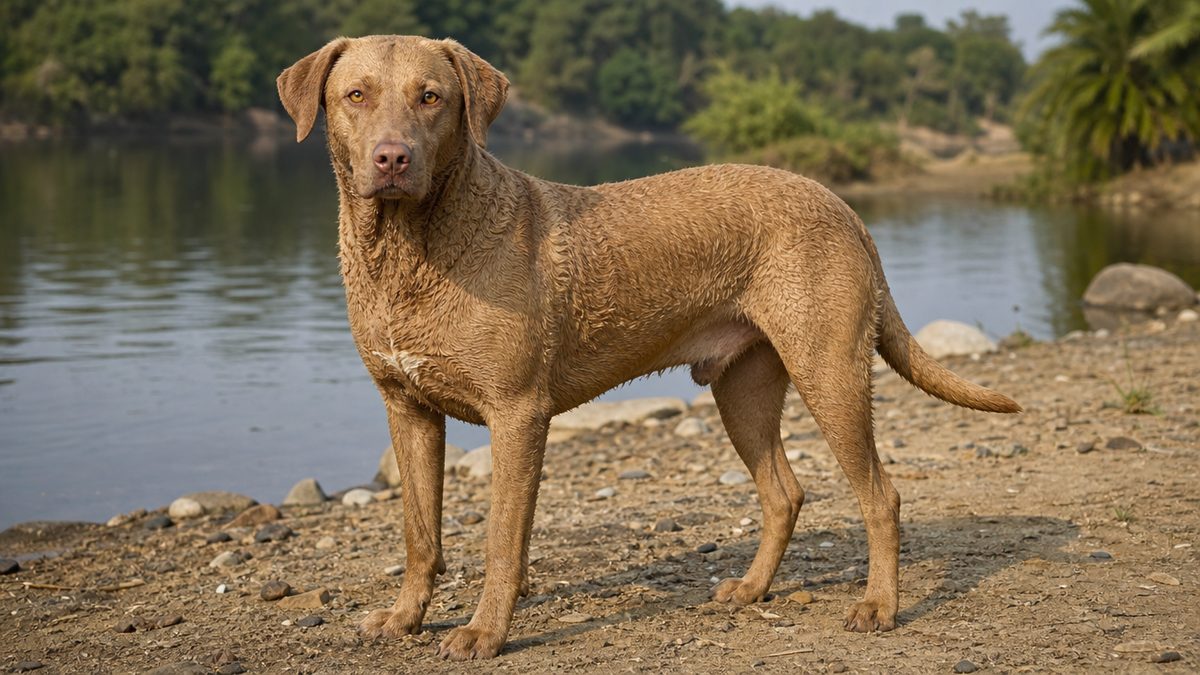
The Chesapeake Bay Retriever is an American waterfowl retriever of 25 to 36.5 kg built around one feature, an oily double coat designed to shed ice water, and it is fully recognised by the Fédération Cynologique Internationale as standard number 263 in Group 8, Section 1 Retrievers, accepted on a definitive basis on 15 September 1964.
Everything about this breed follows from the job. The standard opens by saying the Chesapeake was developed along the Chesapeake Bay to hunt waterfowl 'under the most adverse weather and water conditions, often having to break ice during the course of many strenuous multiple retrieves';. Breaking ice is not decoration. It is the design brief, and it is the reason the coat is what it is and the reason this page spends so long on Indian humidity.
Recognition, established from the register rather than assumed
The FCI nomenclature entry for number 263 names the breed as CHESAPEAKE BAY RETRIEVER, places it in Group 8, Retrievers, Flushing Dogs and Water Dogs, Section 1 Retrievers, with a working trial, gives the country of origin as the United States of America, and records the breed status as 'Recognized on a definitive basis' with a date of acceptance of 15 September 1964. The valid official standard is dated 14 February 1995 and the published FCI text is dated 12 March 1999, in English, the official authentic language.
FCI nomenclature URLs resolve on the trailing number and ignore the breed name in the slug entirely. We proved it on this breed: fci.be/en/nomenclature/LABRADOR-RETRIEVER-263.html returns HTTP 200 and serves a complete, correct Chesapeake Bay Retriever page, because 263 is the Chesapeake's number. Anyone building an FCI link from a breed name plus a guessed number will be handed a real page for the wrong dog with nothing that looks broken. Read the breed name printed inside the document.
For India specifically, the operative standard is the FCI text rather than the American one, because the Kennel Club of India is the FCI's Full member for India, listed at its Anna Nagar, Chennai address on the FCI's own members and contract partners register. The two documents are nearly identical anyway, which is unsurprising: the American Kennel Club standard was approved on 9 November 1993 and became effective on 31 December 1993, and the FCI simply adopted it.
Size, colour and the parts of the breed standard that decide a sale
| Measure | Males | Females |
|---|---|---|
| Height at withers | 23 to 26 inches (58 to 66 cm) | 21 to 24 inches (53 to 61 cm) |
| Weight | 65 to 80 pounds (29.5 to 36.5 kg) | 55 to 70 pounds (25 to 32 kg) |
| Coat length | Nowhere over 1.5 inches (4 cm) | Nowhere over 1.5 inches (4 cm) |
| Feathering limit | Over 1.75 inches (4.5 cm) disqualifies | Over 1.75 inches (4.5 cm) disqualifies |
Oversized or undersized animals are to be severely penalised, which is a fault rather than a disqualification. Colour is stricter. Any shade of brown, sedge or deadgrass is acceptable and self-coloured dogs are preferred, with the standard stating that 'one colour is not to be preferred over another' and that the aim is a dog coloured as nearly as possible like its working surroundings. A white spot is permitted on the breast, belly, toes or the back of the feet immediately above the large pad, and the smaller the better. Black is a disqualification, and so is white anywhere else on the body.
The eyes, and why they are the quickest field check
A Chesapeake's eyes are 'medium large, very clear, of yellowish or amber colour and wide apart';. Amber eyes on a brown dog are the fastest visual confirmation available to a buyer standing in front of a puppy, and they are the detail most commonly missing from Indian listing photographs. The other distinctive features the standard names are hindquarters as high as or a trifle higher than the shoulders, and a double coat that waves only on the shoulders, neck, back and loins.
The American Kennel Club's own breed page ranks the Chesapeake 52 of 210 for popularity in the United States, gives a life expectancy of 10 to 13 years, and sums the breed up in one phrase that this page will spend the next several thousand words testing: 'The Chessie is famous for his waterproof coat';. Waterproof is exactly right, and waterproof is exactly the problem in India. One measure of how far this breed sits from the Indian mainstream: a PubMed search for the exact phrase 'Chesapeake Bay Retriever' returns 19 records in total, across fifty-three years, from a 1973 case report of eosinophilic enteritis to a 2026 orthopaedic case report. The same search for 'Labrador Retriever' returns 1,107. That is the entire peer-reviewed literature this page had to work with, and it is why every figure here names its source.
AKC against FCI-263: what the two breed standards actually say differently
FCI-263 is the AKC's 1993 standard with metric conversions and two extra disqualifications bolted on. The AKC disqualifies seven things; the FCI disqualifies nine, adding aggression or extreme shyness and any dog clearly showing physical or behavioural abnormalities, which are FCI house clauses rather than breed-specific ones.
This matters in India because the Kennel Club of India registers to FCI standards, so a dog judged here is judged against the nine-item list, not the seven-item one. The extra two clauses give an Indian judge grounds to put out a Chesapeake for temperament that an American judge would only penalise.
| Disqualifying fault | AKC standard | FCI-263 |
|---|---|---|
| Specimens lacking in breed characteristics | Yes | Yes |
| Teeth overshot or undershot | Yes | Yes |
| Dewclaws on the hind legs | Yes | Yes (printed as 'Declaws') |
| Coat curly or with a tendency to curl all over the body | Yes | Yes |
| Feathering on tail or legs over 1.75 inches (4.5 cm) | Yes | Yes |
| Black coloured | Yes | Yes |
| White outside breast, belly, toes, back of feet | Yes | Yes |
| Aggressive or overly shy | Not a disqualification | Yes |
| Clear physical or behavioural abnormalities | Not a disqualification | Yes |
The FCI text also adds two closing notes the American document does not carry: that males should have two apparently normal testicles fully descended into the scrotum, and that 'only functionally and clinically healthy dogs, with breed typical conformation should be used for breeding';. It also carries a visible transcription error, printing 'Declaws on the hind legs' where the AKC text reads 'Dewclaws on the hind legs', and misspelling the breed as 'Chespeake' in the coat paragraph. Neither changes the meaning, but both tell you the FCI text is a retyped copy rather than an independent revision.
The scale of points settles what the breed is for
Both standards print an identical hundred-point scale, and coat is the single heaviest item on it. Coat and texture scores 18 points, more than the head at 16, more than shoulders and body at 12, more than hindquarters and stifles at 12. Colour scores 4. Both texts then say the same thing in plain words: 'the question of coat and general type of balance takes precedence over any scoring table which could be drawn up', and a dog with a good coat and general balance is preferable to one excelling in some points and weak in others.
So the breed standard's own weighting says the Chesapeake Bay Retriever is a coat with a dog attached. That is the finding this whole page turns on, and it is why the Indian climate question is not a footnote here the way it would be on a Labrador page.
The dewclaw clause and Indian law collide
Both standards require the removal of hind dewclaws and disqualify their presence Fédération Cynologique Internationale. Indian law prohibits the removal. Second Schedule Part II paragraph 6(8) of the Prevention of Cruelty to Animals (Dog Breeding and Marketing) Rules 2017, notified as G.S.R. 496(E) on 23 May 2017, states that 'there shall be no tail docking, ear cropping de-barking, de-clawing, branding, dyeing, injecting substances to enhance visual appeal, performing a surgery or procedure to camouflage or hide any defect or infirmity or any other kind of mutilation of any body part of the pup and any change of appearance by artificial means is strictly forbidden'.
A Chesapeake puppy born in India with hind dewclaws must keep them, and a puppy that keeps them is disqualified in the ring. A breeder who removes them to make the dog showable has committed an offence under the Rules. The neighbouring paragraph 6(9) reinforces the point by prohibiting breeding to create new breeds or unusual looks. This is not a theoretical clash: it is the same conflict that makes docked Boxers and cropped Dobermanns unlawful here, applied to a clause almost nobody reads.
The forelegs are treated differently and cause no problem. The AKC text says 'dewclaws on the forelegs may be removed' and the FCI text says only 'dewclaws may be removed' under Pastern Fédération Cynologique Internationale. Permissive language, not a requirement, and no disqualification either way. So an Indian-bred Chesapeake with all four front and rear dewclaws intact is fully lawful and only fails the standard on one point, which for a pet home is no point at all.
One genetic footnote to the curly-coat disqualification. A 2019 study identified a second curly-coat variant in the KRT71 gene, a structural change in exon 7 written c.1266_1273delinsACA, and found it at low frequency in five breeds besides the Curly Coated Retriever, one of which is the Chesapeake Bay Retriever. The breed therefore carries a known genetic route to the exact coat texture its own standard disqualifies.
Chesapeake Bay Retriever price in India, and why the consensus figure is an exchange rate
No verified chesapeake bay retriever price in india exists. Published Indian bands run from Rs 2,000 to Rs 7,00,000, a 350-fold spread, and the single figure Google's AI Overview now repeats as the 'Average Market Rate', Rs 74,000, is USD 1,000 converted at exactly 74.00 from an American price list.
Two of the pages ranking on this query do not contain the breed at all. Supertails, at position seven, publishes a 'Dog Price List in India 2026: Top 40 Breeds' with a named veterinary team behind it, and the phrase 'Chesapeake' appears nowhere in the document. Wrapinfur, at position nine, publishes a '50+ Breeds' list and likewise carries no Chesapeake row. So two of the ten results Google returns for a Chesapeake price query are price lists that have never priced one. Start with how small this market is. Google India returns 'About 163 results' for the query, and Bing India returns about 770 Microsoft Bing India search results page…. For comparison, that is the entire Indian-facing corpus on the subject. Inside it, four different published price bands disagree with each other by more than two orders of magnitude.
| Source | Claimed price | / 84.38 | / 74 | / 80 |
|---|---|---|---|---|
| Pet House NCR, quoted by Google's AI Overview | Rs 74,000 average, Rs 40,700 to Rs 88,800 | 877.0 | 1,000.0 exact | 925.0 |
| Puppiezo, meta description | Rs 30,000 to Rs 50,000 | 355.5 to 592.6 | 405.4 to 675.7 | 375 to 625 |
| BarkJunction | Rs 30,000 to Rs 60,000 (puppies Rs 40,000 to 60,000) | 355.5 to 711.1 | 405.4 to 810.8 | 375 to 750 |
| Asia Pets, breed card | Rs 40,000 to Rs 80,000 | 474.0 to 948.1 | 540.5 to 1,081.1 | 500 to 1,000 |
| Happy Pet | Rs 3,00,000 to Rs 7,00,000 | 3,555.3 to 8,295.8 | 4,054.1 to 9,459.5 | 3,750 to 8,750 |
| Google AI Overview headline band | Rs 40,000 to Rs 1,00,000 | 474.0 to 1,185.1 | 540.5 to 1,351.4 | 500 to 1,250 |
| Bing AI summary | Rs 2,000 to Rs 80,000 | 23.7 to 948.1 | 27.0 to 1,081.1 | 25 to 1,000 |
The Rs 74,000 figure resolves completely, and it is not Indian
Google's AI Overview cites pethouse.co.in for an 'Average Market Rate: Around Rs 74,000 across major pet networks'. We downloaded that page and tested every rupee figure in its 155-breed table against the three exchange rates this site checks. The result is not ambiguous. 453 of 463 rupee figures divide to an exact whole number of US dollars at 74.00, which is 97.8 percent of them. At 84.38, zero of 463 divide cleanly. At 80.00, 207 of 463 divide cleanly, and that is arithmetic noise rather than evidence, because any figure ending in three zeros divides cleanly at 80 by construction.
The Chesapeake row reads Rs 74,000 average with a range of Rs 40,700 to Rs 88,800. Divide by 74 and those are USD 1,000, USD 550 and USD 1,200. Round American numbers, in an American band, for an American breed.
Ten of the 463 figures fail the 74 test, and all ten sit in four rows: Indian Pariah Dog, Rajapayam Dog, Indian Spitz and Carvan Hound. Every one of them is an Indian breed and every one is spelled the way a person types rather than the way a list is copied. One of them prints the price range as 'Rs 8,ooo' with two lower-case letter o's where the zeros should be. So a whole American price list was converted at 74 rupees to the dollar, and four local breeds were typed in by hand afterwards. The exceptions tell you which rows a human actually wrote.
Two further things about that table make it unusable as an Indian price guide. Nineteen unrelated breeds share the identical Rs 74,000 'average', from the Papillon and the Jack Russell Terrier to the Doberman Pinscher and the Great Dane, and the whole 155-row table contains only 48 distinct average-price values. A real market does not price a Papillon and a Great Dane at the same number.
What the other price bands are worth, and what Bonbeno will say
The remaining Indian price claims run from Rs 2,000 to Rs 7,00,000 and none of them survives inspection. Bonbeno will not publish a rupee price band for this breed, because no source we opened produced one that does.
The Happy Pet band of Rs 3,00,000 to Rs 7,00,000 is the outlier at the top, and its stated reason is 'since most are imported'. That reason is wrong on the law: commercial import of dogs for breeding is not permitted, and applications for trading or breeding purposes shall be duly rejected. The band does not divide cleanly at 84.38 or 74. At 80 it resolves to USD 3,750 and USD 8,750, and USD 8,750 is a figure this site has caught before on Indian finance pages, but the 80 test is structurally weak and we are not going to claim a conversion on it alone. The honest statement is that no published basis for a Rs 7 lakh Chesapeake exists anywhere we could find.
At the bottom, Bing's AI summary opens the band at Rs 2,000, which is the price of an Indian street-dog adoption and not of any imported breed. It is a generic dog-price floor pulled into a breed answer.
What Bonbeno will say about price
We will not publish a Chesapeake Bay Retriever price band for India, because no source we opened produced one that survives inspection. What we will say is that the American retail band the converted list encodes, USD 550 to USD 1,200, is a real range for a real market, and that anyone in India quoting a rupee figure derived from it is quoting an American price with an exchange rate on it, not a local one. Ask the seller what their number is based on, and if the answer is Rs 74,000, you now know. One piece of advice from that ranking set is worth keeping. Supertails tells buyers that 'regardless of breed or price, always request a pre-purchase veterinary health check from an independent vet before completing payment', and puts that consultation at Rs 800 to Rs 1,500. On a breed with a 40.6 percent degenerative myelopathy carrier rate and 19.0 percent hip dysplasia, an independent examination before payment is the cheapest insurance available. Wrapinfur adds the running-cost frame, noting that in many urban Indian households monthly dog ownership costs range 'from a few thousand rupees to well over Rs 10,000 depending on the breed'.
What Indian sellers are actually offering under this breed name
Nothing. The page ranking first in India for chesapeake bay retriever price in india offers eight puppies, and not one of them is a Chesapeake Bay Retriever. They are two Maltipoos, two Poodles, a Cane Corso, a Goldendoodle, a Rottweiler and a Doxiepoo.
This is the most useful thing an Indian buyer can be told about supply, so it goes near the top rather than in a footnote. We opened the position-one page and read its available-puppy carousel line by line.
| Puppy name | Breed actually offered | Price shown | Age |
|---|---|---|---|
| Fizey | Maltipoo | Rs 98,999 | 8 weeks |
| Kuzo | Poodle | Rs 92,599 | 8 weeks |
| Dugu | Poodle | Rs 92,599 | 8 weeks |
| Kazuka | Cane Corso | Rs 94,999 | 8 weeks |
| Doir | Goldendoodle | Rs 1,20,000 | 8 weeks |
| Samy | Maltipoo | Rs 98,999 | 8 weeks |
| Tugi | Rottweiler | Rs 76,499 | 8 weeks |
| Yoki | Doxiepoo | Rs 98,999 | 8 weeks |
The same figure appears three times in that one carousel, attached to a Maltipoo, a different Maltipoo and a Doxiepoo. Bonbeno has now recorded Rs 98,999 on eleven separate pages of this one Indian listing site, always attached to whichever puppy happens to be in stock rather than to any breed. Divide it by 84.38 and you get 1,173.25, which is not a price anybody would quote, so it is not even a conversion. It is a rupee-native charm price, and it should never be reported as the price of any breed, least of all one the site is not stocking.
The page's own metadata says something different again. Its meta description reads 'Chesapeake Bay Retriever Puppies For Sale in Delhi NCR, India, At the Best Prices from KCI-Registered Breeders. Our Chesapeake Bay Retriever Price in India Rs 30,000 to Rs 50,000';. So the page tells Google Rs 30,000 to Rs 50,000, tells a human reader nothing, and shows a human reader eight dogs of six other breeds priced between Rs 76,499 and Rs 1,20,000.
The rest of the ranking set is thinner still
- BreednBreeder, at position five, carries no price anywhere in the entire document. The whole offer is a heading reading 'Mr. Vansh will connect with you to discuss the Chesapeake bay retriever puppies price, Behaviour and quality'.
- Mr n Mrs Pet returns HTTP 403 to a direct fetch, so we took nothing from it, and it runs an auto-generated city set that includes a dedicated Chesapeake Bay Retriever page for Gaya.
- Asia Pets publishes a breed card giving 25 to 36 kg, 53 to 66 cm, a 10 to 13 year lifespan and Rs 40,000 to Rs 80,000, and its FAQ answers questions about delivery and booking rather than about the breed.
- Pet House NCR is not a Chesapeake page at all. It is a 155-row price table on a Delhi, Gurgaon and Noida dog shop's site, and it is the source Google's AI Overview leans on.
Reading a listing that might be real
A genuine Indian Chesapeake will be rare, and it will look different from the pages above. Expect a named kennel rather than a marketplace, a litter registration number, a written pedigree showing where the founding stock came in from, amber eyes in the photographs, a solid brown, sedge or deadgrass coat with at most a small white breast spot, and hind dewclaws present because Indian law forbids their removal Ministry of Environment. Expect the seller to know what degenerative myelopathy is without being prompted.
Expect also to wait. There is no lawful commercial import route for breeding stock, entry is restricted to seven ports, and applications made on behalf of another person or entity are rejected outright Department of Animal Husbandry…. A breed this rare cannot have a fast supply chain in India, and any listing promising immediate pan-India home delivery of one is describing a logistics operation, not a breeding programme. The full route is set out in how to import a dog to India.
If a seller quotes you a figure, do the division yourself before you negotiate. Divide by 84.38 first, because that is the strong test, then by 74. A number that lands on a round dollar amount at either rate came off an American price list, and the seller is quoting a market you are not buying in.
Monthly cost of ownership for a Chesapeake Bay Retriever in India
Two Indian sources publish a monthly cost of ownership for this breed and they land in the same region, roughly Rs 4,900 to Rs 7,650 a month, but neither is a survey. One is the arithmetic sum of its own three component ranges, and the other is a generic large-dog estimate. Treat both as a starting frame, not a budget.
Happy Pet publishes an average monthly expense of Rs 4,900 and a premium lifestyle figure of Rs 7,650, broken into food at Rs 3,000 to Rs 4,500, health at Rs 1,200 to Rs 1,950 and grooming at Rs 700 to Rs 1,200. Check the arithmetic and the structure becomes obvious. The three lower bounds sum to exactly Rs 4,900 and the three upper bounds sum to exactly Rs 7,650. So the headline figure is not observed spending; it is the total of three assumed ranges. That does not make it wrong, but it means nobody surveyed an Indian Chesapeake household to produce it.
BarkJunction gives food at Rs 3,000 to Rs 6,000 a month, professional grooming at Rs 1,000 to Rs 3,000 every few months, an initial vaccination series at Rs 5,000 to Rs 10,000, annual vaccinations at Rs 2,000 to Rs 5,000 and optional pet insurance at Rs 2,500 to Rs 8,000 a year. Its food band overlaps Happy Pet's at the bottom and runs a third higher at the top.
| Line | Happy Pet | BarkJunction |
|---|---|---|
| Food, per month | Rs 3,000 to Rs 4,500 | Rs 3,000 to Rs 6,000 |
| Health, per month | Rs 1,200 to Rs 1,950 | Not given monthly |
| Grooming | Rs 700 to Rs 1,200 per month | Rs 1,000 to Rs 3,000 every few months |
| First-year vaccination course | Not given | Rs 5,000 to Rs 10,000 |
| Annual vaccination | Not given | Rs 2,000 to Rs 5,000 |
| Insurance | Not given | Rs 2,500 to Rs 8,000 per year |
| Stated monthly total | Rs 4,900 to Rs 7,650 | Not totalled |
Four costs specific to this breed that neither source carries
- Calories, not portions. Happy Pet puts an adult Chessie at 1,500 kcal a day and a puppy at 1,800 kcal. A working-line 34 kg male exercised properly in a Bengaluru winter will eat toward the top of that; the same dog kept quiet through a Chennai May will not. Feed to body condition and let the monthly cost move with it.
- Ear care through the monsoon. This is a drop-eared water dog and its ears hang loosely against the head. Budget for a veterinary ear cleaner and for at least one vet visit in a bad monsoon year rather than assuming none.
- Tick prevention as a fixed line, not an occasional one. A Punjab survey of 719 dogs found Babesia gibsoni in 8.9 percent, Hepatozoon canis in 5.1 percent, Ehrlichia canis in 2.6 percent and Babesia vogeli in 1.1 percent by multiplex PCR, with breed among the factors significantly associated with B. gibsoni infection. A monthly ectoparasiticide is cheaper than one babesiosis.
- The DNA panel, once. Degenerative myelopathy, prcd-PRA and exercise-induced collapse are cheek swabs you post. It is a one-off cost in year one and it is the highest-value money you will spend on this breed, given a 40.6 percent degenerative myelopathy carrier rate among 3,112 tested dogs.
The cost nobody prices: air conditioning
Every Indian breed guide that calls a dog heat-sensitive quietly assumes an air-conditioned room and never puts a number on it. We are not going to invent one either, because electricity tariffs differ by state and no source we opened gives a verified figure for running a room cooler for a dog. What we can say is what the requirement is. Happy Pet's own spec card sets this breed's 'Ideal Weather' at 10 to 25 C, and by NASA POWER's 2001 to 2020 climatology the mean monthly temperature in Chennai exceeds 25 C in ten months of the year and in Mumbai in nine. If you take that spec card seriously, the cooling is not an optional line in your monthly cost. It is most of the year.
On running cost alone a Chesapeake Bay Retriever is no more expensive than a Labrador of the same weight, and both are affordable next to the purchase claims floating around this query. The expensive part is not the food. It is the screening you should insist on, the cooling the coat needs in most Indian cities, and the exercise time the breed will not do without. Those are costs in money, electricity and hours, and only one of the three appears in any published Indian estimate.
Heat tolerance: what the Chesapeake Bay actually feels like, and what India does not
The Chesapeake Bay Retriever was built for water at an annual mean of 14.18 C and a mean dew point of 9.79 C. Chennai's annual mean is 27.95 C and its mean dew point is 21.94 C. That 12.15 C dew-point gap, not the air temperature, is the number that decides how this breed copes in India.
Every ranking page on this query either ignores the climate question or answers it with a single adjective. We queried NASA POWER by explicit latitude and longitude for the 2001 to 2020 climatology, and echoed the returned coordinates in every case so that no city could be silently swapped for another. The mid-Chesapeake Bay query at 38.5 N, 76.3 W returned coordinates [-76.3, 38.5]; the Chennai query at 13.0827 N, 80.2707 E returned [80.271, 13.083].
| Location | Annual mean T2M | Annual mean dew point | Months with mean T2M above 25 C | Months with dew point above the Bay's July peak |
|---|---|---|---|---|
| Chesapeake Bay, mid-bay (38.5 N, 76.3 W) | 14.18 C | 9.79 C | 2 of 12 | 0 of 12 |
| Chennai (13.0827 N, 80.2707 E) | 27.95 C | 21.94 C | 10 of 12 | 10 of 12 |
| Kolkata (22.5726 N, 88.3639 E) | 25.81 C | 19.90 C | 8 of 12 | 7 of 12 |
| Mumbai (19.0760 N, 72.8777 E) | 26.77 C | 18.70 C | 9 of 12 | 6 of 12 |
| Delhi (28.6139 N, 77.2090 E) | 25.60 C | 10.47 C | 7 of 12 | 3 of 12 |
| Pune (18.5204 N, 73.8567 E) | 23.86 C | 15.46 C | 4 of 12 | 4 of 12 |
| Bengaluru (12.9716 N, 77.5946 E) | 23.74 C | 15.87 C | 3 of 12 | 0 of 12 |
The last column is the one to read. The Chesapeake Bay's most humid month is July, at a mean dew point of 20.15 C. Ten of Chennai's twelve months carry a higher mean dew point than that, and Chennai's driest month, February at 19.34 C, sits within 0.81 C of the Bay's annual peak. In plain terms, a Chesapeake standing in Chennai in what passes for winter is in air roughly as wet as the worst week of its ancestral summer.
Bengaluru is the exception, and the numbers say why
Bengaluru's highest monthly mean dew point is 19.08 C in September, which never reaches the Chesapeake Bay's July peak of 20.15 C, and its mean monthly temperature exceeds 25 C in only three months, March, April and May. That is not a marketing claim about the Garden City; it is arithmetic on the same dataset that condemns Chennai. Of the six Indian metros we tested, Bengaluru is the only one whose air is never wetter than the breed's home water, and Pune at 15.46 C annual mean dew point is the runner-up.
Delhi is the interesting case. Its annual mean dew point of 10.47 C is the closest of any Indian city to the Chesapeake Bay's 9.79 C, so on paper the dry season suits the coat. Then the monsoon arrives: Delhi's August dew point is 24.37 C, higher than anything Chennai records, alongside a mean August temperature of 29.79 C and a May maximum of 48.08 C. Delhi is not a mild city for this breed; it is two hostile climates in sequence.
Relative humidity is a ratio and it falls as the air heats even when the air is getting wetter. Chennai's relative humidity in May reads 64.52 percent, lower than the Chesapeake Bay's May reading of 77.69 percent, which makes Chennai look drier. It is not. Chennai's May dew point is 23.21 C against the Bay's 13.82 C. A dog cools by evaporating water from its airway, and evaporation is driven by the gap between the moisture already in the air and the moisture the airway can add. Dew point measures that directly. Relative humidity does not, and a breed page that quotes it is telling you the wrong thing.
One caveat on the data, stated rather than hidden
NASA POWER serves a gridded reanalysis, not a weather-station reading, so a point query returns the average of a grid cell rather than a street. We tested that limit deliberately by also querying Shimla at 31.1048 N, 77.1734 E; the API returned an elevation of 897.65 m for that cell, well below Shimla's actual altitude, which means the cell averages the valley as well as the ridge. So the hill-station figures on this page are not reliable and we have left them out. The six metro figures sit on flat coastal or plateau terrain where a grid cell is a fair description, and each returned coordinate matched what was asked for.
What an oily double coat actually does in Indian humidity
An oily double coat is a waterproofing system, not an insulating one, and in Indian humidity it stops doing the job it was built for and starts doing three jobs nobody wanted. It repels the rinse water you need to cool the dog, it holds a warm wet layer against the skin once it is finally wet, and it feeds the yeast and bacteria that live on skin lipid.
Take the standard at its word first. The coat is 'thick and short, nowhere over 1.5 inches (4 cm) long, with a dense, fine, woolly undercoat', and 'the oil in the harsh outer coat and woolly undercoat is of extreme value in preventing the cold water from reaching the Chesapeake's skin and aids in quick drying'. The standard then sets the performance test explicitly: 'A Chesapeake's coat should resist the water in the same way that a duck's feathers do. When the Chesapeake leaves the water and shakes, the coat should not hold water at all, being merely moist';.
That is a description of a barrier. The oil makes the outer coat hydrophobic so that water beads and is thrown off by a shake, and the woolly undercoat traps a layer of air the water never reaches. In Maryland in February, where the mean January air temperature is 1.58 C, that barrier is the difference between a working dog and a hypothermic one.
Consequence one: the coat resists the cooling you are trying to apply
The standard commissions a coat that refuses to get wet. In Chennai in May, the standard Indian first-aid response to an overheating dog is to soak it. A correctly-coated Chesapeake will shed a bucket of water off its back the way a duck does, leaving the skin dry and the dog just as hot. The water that matters is water on skin, not water on hair, and the wetting has to be worked in against the oil rather than poured on. Owners who have only ever cooled a Labrador or an indie will get this wrong, because those coats wet through in seconds.
Consequence two: once it is wet, it stays wet in the wrong way
The same barrier that keeps cold water out slows drying from the inside. In Bay conditions that is fine, because 'aids in quick drying' works when the surrounding air is dry: the Chesapeake Bay's annual mean dew point is 9.79 C, so air leaving the coat is dumping moisture into air that can take it. Now run the same coat in Mumbai in August, at 90.36 percent relative humidity and a dew point of 24.32 C, or Kolkata in August at 89.07 percent and 26.20 C. The air cannot accept much more water. A woolly undercoat wetted through in those conditions is a warm, wet, poorly-ventilated layer sitting on skin for hours.
Consequence three: the oil is a substrate
Here the breed's own literature is unusually direct. A University of Pennsylvania study of ten Chesapeake Bay Retrievers recruited with the American Chesapeake Club found nonpruritic, noninflammatory, regionalised hair loss affecting the same body areas in males and females, with follicular hyperkeratosis and plugging, follicular atrophy and occasional melanin clumping with malformed hair shafts on histopathology, and raised adrenal and sex steroid concentrations in seven of the ten dogs. The authors concluded that hair loss in Chesapeakes is a breed syndrome with a likely familial predisposition.
Read 'follicular hyperkeratosis and plugging' next to 'an abundance of natural oil'. This is a breed whose follicles are already known to block, in a temperate climate, in a study population that was not living at a dew point above 21 C. Indian humidity is the condition under which lipid-rich, occluded, poorly-ventilated skin does worst, and the breed brings a documented follicular problem to it.
Northern-hemisphere guidance for oil-coated water dogs says to bath rarely, because bathing strips the oil the coat depends on. In Wisconsin or Maryland that is correct. In an Indian coastal monsoon it is the advice that produces a dog with occluded follicles and a smell, and it is repeated verbatim on Indian pages that have never asked what climate it assumes. The resolution is not to bath more often; it is to rinse more often and shampoo rarely. Clear water lifts salt, pond debris and surface grime without stripping the coat's lipid, and it is the drying afterwards that matters most.
So is the coat a heat problem or not
Not in the way people assume. The Chesapeake is mesocephalic, so it sits in the reference group of the UK VetCompass heat-related illness study rather than in the brachycephalic group that carried 2.10 times the odds. Its coat is short by design, capped at 4 cm, and it is not the heat-trapping blanket a Husky carries. The risk is not the coat's thickness. The risk is that the coat's whole engineering assumes evaporation into dry air, and most of urban India does not supply dry air for most of the year. Manage the skin under it, and this breed handles Indian heat better than its reputation suggests. Ignore the skin, and the coat becomes the problem.
Temperament and household fit: who should and should not buy this breed
The Chesapeake Bay Retriever is a protective, independent, strongly bonded working retriever, and the breed standard says so in words no Labrador standard uses. It suits an experienced owner with space and a job for the dog. It does not suit a first-time owner in a shared-lift apartment.
The standard's temperament clause is short and every word in it is load-bearing. The Chesapeake 'is valued for its bright and happy disposition, intelligence, quiet good sense, and affectionate protective nature', and 'courage, willingness to work, alertness, nose, intelligence, love of water, general quality and, most of all, disposition should be given primary consideration in the selection and breeding';. Then the warning: 'extreme shyness or extreme aggressive tendencies are not desirable in the breed either as a gun dog or companion'.
No breed standard warns against a fault the breed does not produce. The Golden Retriever is not warned about aggression and the Labrador is not warned about shyness. The FCI went further than the AKC here and made 'aggressive or overly shy' an outright disqualifying fault rather than a piece of prose, which is the standard an Indian judge applies American Kennel Club.
What 'protective' means in an Indian building
It means the dog will form an opinion about who belongs. A Chesapeake that has decided the family is its responsibility will position itself between the family and an approaching stranger, and it will do that in a lift lobby, on a stairwell landing and at a gate. That is a feature in a farmhouse in rural Maharashtra and a liability in a Mumbai tower with a shared lift, a housing-society WhatsApp group and delivery riders arriving four times a day.
The management is not a muzzle. It is early, deliberate exposure. Take the puppy to the lift, the gate and the parcel handover fifty times before it is six months old, pair each with food, and let it learn that arriving strangers are boring. Socialise it to the specific Indian situations it will meet daily rather than to a generic idea of 'other people'.
With children, other dogs and the household staff
- With its own children, the affectionate half of the standard's phrase dominates, and this is a tolerant, physically robust dog around a family it knows.
- With visiting children, treat it as an unknown until proven otherwise, because a protective dog and a shrieking group of unfamiliar kids is the classic incident.
- With other dogs, expect same-sex friction in unneutered adults and expect to manage it rather than hope it resolves. This is a hunting breed with a strong idea of resources.
- With household staff and drivers, do the introductions formally and repeatedly. A dog that meets the same person at the door every day and is never introduced will keep treating that person as an intruder.
Independence is not disobedience
A retriever bred to work several hundred metres out, in cold water, out of sight of the handler, has to be able to make decisions alone. That is what the standard means by 'quiet good sense'. It produces a dog that will consider an instruction rather than execute it instantly, which owners coming from a Labrador read as stubbornness. It is not. It is a working trait, and it is why the FCI classifies this breed 'with working trial' rather than as a companion.
Ask yourself honestly whether you will be able to give it a job three times a week for the next twelve years. Not a walk. A job: retrieving into water, scent work, a long structured retrieve session, dock work, anything with a task and a finish. Owners who can, describe an easy dog. Owners who cannot, describe a difficult one. The breed does not change; the household does.
Who should not buy one
Skip this breed if it is your first dog, if you live in a flat with no reliable access to open water or a large secure ground, if nobody in the household will be home during the day, or if you want a dog that is friendly to everyone on sight. Every one of those is a reasonable thing to want, and every one of them describes a different breed. An Indian buyer who wants the retriever temperament without the guarding component should read the Labrador and Golden Retriever pages instead, and both are far easier to source lawfully here.
Training a Chesapeake Bay Retriever, and what this breed resists
Train this breed with short, high-value, task-shaped sessions and it is highly trainable. Train it with repetition drills and corrections and it shuts down or argues. The breed resists pointless repetition, harsh handling and being asked to work in heat, and the third of those is the one that catches Indian owners.
The standard names 'willingness to work' and 'intelligence' as primary breeding considerations, and the FCI classifies the breed with a working trial Fédération Cynologique Internationale. Those are the two things you are training with. A Chesapeake will do almost anything for a task that ends in a retrieve. It will do very little for a sit repeated forty times in a row.
A realistic first-year timeline
| Age | Target | Why it matters here |
|---|---|---|
| 8 to 12 weeks | Name, recall in one room, crate settled, handled all over | The socialisation window is short and the Indian monsoon can swallow weeks of it |
| 12 to 16 weeks | Lift, gate, stairwell, delivery rider, watchman, all paired with food | This is where a protective breed's adult behaviour is decided |
| 4 to 6 months | Loose-lead walking, sit and down under mild distraction, first swim | Teach swimming before the dog is heavy enough to panic in water |
| 6 to 9 months | Recall away from another dog, retrieve to hand, wait at doors | Adolescent testing starts here and lasts months |
| 9 to 12 months | Formal retrieve, marked memory retrieve, settle on a mat for an hour | The mat settle is what makes the dog liveable in a flat |
| 12 to 24 months | Water retrieves at distance, scent work, structured jobs | Mental work substitutes for the physical work Indian heat forbids |
The three things this breed genuinely resists
- Drilling. Ten good repetitions beat sixty mediocre ones. A Chesapeake that has decided a session is pointless will stop offering behaviour rather than argue about it, and getting the engagement back takes longer than the drill saved.
- Harsh correction. This is a courageous breed and it will absorb pressure rather than yield to it, which owners mistake for defiance and escalate against. The standard's warning about extreme aggressive tendencies is a warning about what happens at the end of that road.
- Working in heat. A Chesapeake will keep retrieving past the point of safety, because willingness to work is what it was selected for. Exertional heat-related illness was the trigger in 74.2 percent of the 879 heat-related illness events with a recorded trigger in a study of 905,543 UK dogs, more than environmental and vehicular causes combined. In India the handler has to end the session, and the dog will not thank you for it.
Training around the exercise-induced collapse question
If your dog carries two copies of the DNM1 mutation, high-intensity, high-excitement retrieving is the exact trigger pattern for exercise-induced collapse, and the collapse typically follows five to twenty minutes of strenuous excited exercise. The mutation is documented in Chesapeake Bay Retrievers, with carriers and homozygous dogs showing a collapse phenotype found in the breed alongside Curly-coated Retrievers, Boykin Spaniels and Pembroke Welsh Corgis. OFA's register shows 9.6 percent carriers among 571 tested Chesapeakes and no registered affected dogs, against 12.1 percent carriers and 0.7 percent affected among 9,497 Labradors.
OFA's Chesapeake table shows 0.0 percent affected, which reads as though no homozygous Chesapeake exists. Minor and colleagues found them: their survey reported both carriers and homozygous mutant dogs with a collapse phenotype in the breed Orthopedic Foundation for Animals. The likely explanation is the denominator, 571 tests against the Labrador's 9,497, but we cannot prove that and we are not going to pretend the two sources agree. Test your dog rather than relying on either number.
Note also that The Royal Kennel Club's Health Standard does not list an exercise-induced collapse test for the Chesapeake Bay Retriever at all, in either the Good Practice or Best Practice column, while the American Chesapeake Club's Board explicitly recommends that all breeding stock be tested for it American Chesapeake Club. A British-bred Chesapeake may therefore arrive untested for a condition its American parent club treats as one of four core screens. Ask which club's protocol your breeder followed.
Daily exercise requirement, and how to deliver it in an Indian city
A healthy adult Chesapeake Bay Retriever needs one to two hours of real work a day, and in most of India that hour has to happen before sunrise or after dark. The published Indian estimates agree on the duration and say nothing about the timing, which is the part that matters.
Two Indian pages give the same number. Puppiezo's spec card puts the exercise routine at one to two hours daily with a High energy level, and Happy Pet's FAQ says 'around 1 to 2 hours daily, split between walks, play, and swimming';. That is a fair figure for the breed. What neither says is when.
The timing rule, derived rather than asserted
Happy Pet's own spec card sets this breed's ideal weather band at 10 to 25 C. Cross that with NASA POWER's 2001 to 2020 climatology and the working window becomes visible. Chennai's mean monthly temperature stays above 25 C in ten months of the year, Mumbai's in nine, Kolkata's in eight, Delhi's in seven, Pune's in four and Bengaluru's in three. Those are 24-hour means, so the dawn and late-evening hours sit well below them, but the middle of the day sits well above.
| City | Months above a 25 C monthly mean | Practical exercise window for most of the year |
|---|---|---|
| Bengaluru | 3 of 12 | Broadest of the metros; morning and evening both usable most months |
| Pune | 4 of 12 | Morning and evening usable outside March to May |
| Delhi | 7 of 12 | Dawn only from April to October; winter is genuinely comfortable |
| Kolkata | 8 of 12 | Dawn only outside December to February, and the monsoon adds humidity |
| Mumbai | 9 of 12 | Dawn or after 21:00, all year, with the monsoon the worst period |
| Chennai | 10 of 12 | Dawn only, all year, and swimming rather than running wherever possible |
Swimming is the answer, where you can get it
This is the one breed on the Indian market for which swimming is not a luxury. The coat is engineered for it, the hindquarters are described in the standard as 'especially powerful to supply the driving power for swimming', and the feet are 'well webbed harefeet';. A twenty-minute swim delivers more work and less heat load than an hour of road walking, because the water carries the heat away instead of the dog's airway having to.
Practical Indian options, in descending order of usefulness. A private or society pool where dogs are permitted, usually early morning. A clean reservoir, backwater or river stretch with a gradual entry and no current, checked for effluent. A large stock tank or a filled paddling pool on a terrace, which is not swimming but is a genuine cooling and enrichment tool. A hydrotherapy pool at a veterinary rehabilitation centre, which several metros now have.
Rinse with clean water, then dry the ear canals. This is a drop-eared dog whose ears hang loosely against the head, and water left in a warm canal during a monsoon is how otitis starts. Do not plug the ears with cotton wool and forget them. Wipe the outer canal dry with gauze and let the dog shake. Check the ears the next morning as a habit, not as a response to a smell.
What happens without the exercise
An under-exercised Chesapeake does not become a couch dog. It becomes a loud, destructive, increasingly reactive one, and the protective streak the standard describes sharpens into something the housing society will notice. The commonest sequence in Indian flats is a bored adolescent, an owner who reduces the walks because the dog pulls, and a dog that arrives at eighteen months with no outlet and a strong opinion about the lift.
Substitute mental work when the weather forbids physical work rather than skipping the session. Scent games in an air-conditioned room, a frozen food puzzle, a structured indoor retrieve down a corridor, and short shaping sessions all draw on the same drive. Twenty minutes of nose work tires this breed roughly as much as a walk of twice that length, and it costs nothing in heat load.
Grooming an oily double coat in Indian humidity
Brush this coat weekly, rinse it often, shampoo it rarely, dry the skin properly and never clip it. Those five rules follow directly from what the breed standard says the coat is, and three of them contradict the advice Indian pages copy from northern-hemisphere sources.
The coat you are working on is short by design. The standard caps it at 1.5 inches, roughly 4 cm, with hair on the face and legs 'very short and straight', a tendency to wave only on the shoulders, neck, back and loins, and moderate feathering permitted on the rear of the hindquarters and tail. Anything longer than 1.75 inches on the tail or legs is a disqualifying fault. So this is not a coat you scissor, strip or shape. It is a coat you keep clean and keep intact.
The weekly routine
- Brush once or twice a week with a firm bristle brush or a rubber curry, working against the lie and then with it. The aim is to lift dead undercoat and redistribute the coat's own lipid, not to thin it.
- Rinse after every swim and after any dusty walk, with plain water and no product. Rinsing removes salt, chlorine, pond debris and road dust without stripping the oil that makes the coat waterproof.
- Shampoo only when the dog is genuinely dirty, which in most Indian households is every six to ten weeks rather than every fortnight. Use a soap-free or mild veterinary shampoo, and lather twice only if the first pass ran off, because a correctly-oiled coat resists the first application.
- Dry the skin, not just the hair. Towel hard, get the dog to shake, then let it dry in moving air. A ceiling fan on a tiled floor does more than an hour in still humid air.
- Check ears, armpits, groin and tail base every week for damp, odour or scurf, because those are the four places an occluded coat fails first.
Never clip, and here is the mechanism
Clipping a double coat removes the guard hairs first and leaves the woolly undercoat, which is the layer that holds moisture and the layer that mats. The dog loses its sun barrier, gains exposed skin in a country where solar load is the constraint, and regrows an undercoat-dominant, texture-damaged coat. In this breed there is a second reason: coat texture is 18 of the standard's 100 points, the single heaviest item, and a clipped Chesapeake's texture may not recover. If a groomer in an Indian metro offers a summer clip for this breed, decline it.
Overseas guidance for oil-coated water dogs says to bath rarely and let the dog air dry. Both halves are written for dry temperate air. 'Bath rarely' transfers to India; 'air dry' does not, because air drying assumes the surrounding air can accept the water. In Mumbai in August the mean relative humidity is 90.36 percent and the dew point is 24.32 C, and in Kolkata in September they are 89.34 percent and 25.70 C. A woolly undercoat left to air dry in that will still be damp hours later. Dry it actively, with towels and moving air, and pay particular attention to the ear canals.
Shedding, and one seller claim worth correcting
This breed sheds. Puppiezo's own spec card says 'Shedding: Yes' and Happy Pet rates it 'Moderate Shedding'; Happy Pet, Chesapeake Bay Retriever…. Happy Pet then lists 'Low Shedding' and 'Odourless' among the benefits of grooming on the same page. Grooming does not make a double-coated water dog odourless. An oiled coat has a smell, that smell intensifies when the coat is damp, and the honest management is rinsing and drying rather than a claim that it goes away. Buyers who cannot live with a faint wet-dog note in a humid month should not buy a breed whose standard is built around retained coat oil.
Nails, teeth and the parts that are not the coat
Nails need trimming every three to four weeks in a city dog, and remember that on a lawfully-bred Indian Chesapeake the hind dewclaws will still be present, because removing them is de-clawing under Second Schedule Part II paragraph 6(8). Hind dewclaws sit off the ground, never wear down, and will curl into the pad if nobody trims them. Add them to the routine rather than discovering them at eighteen months. Teeth need brushing several times a week; the standard prefers a scissors bite and disqualifies overshot or undershot jaws, and Indian law lists overshot and undershot jaw among the genetic defects a breeder's dogs are required to have been tested for Ministry of Environment.
Health risks and lifespan, with every denominator published
The Chesapeake Bay Retriever's biggest measured health issues are hips, at 19.0 percent dysplastic of 16,735 evaluations, and degenerative myelopathy, at 9.2 percent at risk and 40.6 percent carriers of 3,112. Its published median survival is 11.6 years, built on 42 deaths, and it is not statistically different from the crossbred average.
Every figure in this section came off the Orthopedic Foundation for Animals' own statistics tables, read against the breed code CB taken from OFA's own selector markup, where the attribute reads data-name="CHESAPEAKE BAY RETRIEVER";. OFA codes collide when guessed, so this matters. The tables are a live register and the counts move as evaluations are added, which is why the sample size is printed beside every percentage below rather than a bare decimal.
| Screen | Evaluations | Chesapeake result | All breeds | OFA rank |
|---|---|---|---|---|
| Hips | 16,735 | 19.0% dysplastic (10.9 mild, 7.4 moderate, 0.8 severe); 15.3% excellent | 14.2% of 1,712,315 | 56 |
| Elbows | 5,598 | 7.0% abnormal (5.2 grade 1, 1.6 grade 2, 0.3 grade 3) | 12.0% of 649,987 | 61 |
| Eyes (CAER) | 4,887 | 4.8% abnormal | 6.6% of 886,458 | 102 |
| Degenerative myelopathy (SOD1) | 3,112 | 9.2% at risk, 40.6% carrier | 13.2% at risk of 90,483 | 21 |
| Progressive retinal atrophy (DNA) | 406 | 0.0% affected, 11.1% carrier | 1.1% affected of 44,154 | 40 |
| Exercise-induced collapse (DNM1) | 571 | 0.0% affected, 9.6% carrier | 0.7% affected of 14,044 | 12 |
| Thyroid | 242 | 5.0% compensative autoimmune thyroiditis, 0.4% idiopathic hypothyroidism | 4.5% of 121,396 | 35 |
| Patella | 220 | 100.0% normal | 3.5% abnormal of 225,469 | 170 |
| Shoulder (OCD) | 63 | 3.2% abnormal | 2.6% of 11,626 | 7 |
| Cardiac, advanced | 126 | 3.2% abnormal, 6.3% equivocal | 5.4% abnormal of 93,365 | 69 |
| Cardiac, congenital | 374 | 0.5% abnormal | 0.5% of 209,851 | 42 |
Check the hip arithmetic yourself: 15.3 percent excellent plus 52.5 good plus 11.8 fair is 79.6, against a printed normal figure of 79.7, and 10.9 mild plus 7.4 moderate plus 0.8 severe is 19.1 against a printed 19.0. Both gaps are rounding, and the table is internally consistent.
Hips are the headline, and the breed is worse than average
Nineteen percent of 16,735 evaluated Chesapeakes are dysplastic against an all-breed figure of 14.2 percent of 1,712,315. That is a large, well-evidenced sample and it puts the breed clearly on the wrong side of the average. The one bright spot is the excellent rate: 15.3 percent of Chesapeakes grade excellent against 5.9 percent of Golden Retrievers, so the good hips in this breed are genuinely good and there is something for a breeder to select toward.
Cranial cruciate ligament rupture in young dogs
The Chesapeake Bay Retriever is one of nine breeds identified as predisposed to cranial cruciate ligament rupture before two years of age in a case-control study of 201 affected dogs against 804 age-matched controls, alongside the Neapolitan Mastiff, Akita, Saint Bernard, Rottweiler, Mastiff, Newfoundland, Labrador Retriever and American Staffordshire Terrier. The same study found increased risk in neutered dogs of both sexes compared with sexually intact dogs, and greater body weight in affected dogs. For an Indian owner that translates into two decisions: keep the growing dog lean, and discuss neutering timing with your vet rather than defaulting to six months.
Bloat, cruciate rupture and lifespan
The Chesapeake Bay Retriever sits in the 23 to 45 kg band where gastric dilatation-volvulus incidence was measured at 23 cases per 1,000 dog-years, but it was not one of the eleven breeds in that cohort, so the figure is a band estimate rather than a breed one. Its published median survival is 11.6 years on 42 deaths.
Gastric dilatation-volvulus is the emergency every deep-chested retriever owner should be able to recognise, and the Chesapeake's chest is described in the standard as 'strong, deep and wide' with a barrel, round and deep rib cage. The largest prospective study reported an incidence of 23 cases per 1,000 dog-years at risk across seven large breeds of 23 to 45 kg, a cumulative incidence of 5.7 percent across all breeds studied, and death in 30 of the 105 dogs that developed it, 28.6 percent. The Chesapeake Bay Retriever was not one of the eleven breeds in that cohort, so the 23 per 1,000 figure is a weight-band estimate rather than a breed-specific one, and we are labelling it as such rather than borrowing it.
Lifespan
McMillan and colleagues report a median survival of 11.6 years for the Chesapeake Bay Retriever, with a lower 95 percent confidence bound of 10.5 years and an upper bound that could not be estimated, based on 42 recorded deaths. The hazard ratio against the crossbred reference is 1.16 with a 95 percent interval of 0.85 to 1.56 and p = 0.35, so this breed falls into the 27.1 percent of purebreds, 42 breeds in all, that did not differ significantly from the crossbred group's median of 12.0 years. Indian pages that print a life expectancy of '10 to 13 years' are not wrong, but they are quoting a range with no source; the figure with a paper behind it is 11.6 years on 42 deaths.
Supplementary Table 3 gives the Chesapeake a sample of 126. Supplementary Tables 6 to 11 give 87 alive plus 42 deaths, totalling 129. The deaths are identical at 42 in both, so we have built the sentence on deaths. The same discrepancy runs through the dataset, with the Labrador at 43,428 against 43,182 and the Golden at 11,506 against 11,504 McMillan KM et al. 2024. Whatever causes it does not touch the death counts, which is why they are the safe figure to quote. The paper also carries an Author Correction published on 16 April 2024, which almost nobody cites; it alters a single Miniature Dachshund median in the legend of Figure 3, from 12.2 to 14.0 years, and touches nothing else. Reading Supplementary Table 3 directly, as we have, avoids the error entirely.
The three DNA tests, and which ones an Indian owner can actually post a sample for
All three of this breed's core DNA screens are cheek swabs you collect at home and post to a laboratory, which makes them the only part of the screening protocol an Indian owner can complete without specialist equipment. The three are degenerative myelopathy, prcd-PRA and exercise-induced collapse, and Indian law separately requires that a breeder's dogs have been tested for progressive retinal atrophy.
The American Chesapeake Club's Board of Directors approved a Breed Health Statement on 11 September 2016, Board Motion 16:39, which 'strongly recommends that all breeding stock be free of Hip/Elbow Dysplasia, Progressive Retinal Atrophy (PRA) in addition to all hereditary eye diseases, Exercise Induced Collapse (EIC), and Degenerative Myelopathy (DM) - tested Normal or otherwise'. The club's own health index lists the PRA entry as 'Progressive Retinal Atrophy prcd', naming the specific form.
1. Progressive retinal atrophy, and it is specifically prcd
The Chesapeake Bay Retriever's form of progressive retinal atrophy is prcd, progressive rod-cone degeneration, a late-onset autosomal recessive photoreceptor degeneration. The mutation is a single homozygous change in the second codon of the PRCD gene, TGC to TAC, and Zangerl and colleagues found complete concordance between it and the disease across eighteen dog breeds and breed varieties, of which the Chesapeake Bay Retriever is one, listed in the paper's Table 1 as CBR. The same paper reports that pedigrees were available for four breeds including the Chesapeake, and that with one exception there was complete concordance between the mutation and affected or obligate carrier status.
A PubMed search for the exact phrase "Chesapeake Bay Retriever" combined with prcd or rod-cone returns zero records, and the reported query translation confirms the phrase was preserved rather than rewritten. Every identifier cited on this page was resolved through NCBI's own ID converter rather than guessed, because a guessed PMC identifier returns a real paper on an unrelated subject rather than an error. The control passed in the same session: the same phrase alone returns 19 records and "Labrador Retriever" returns 1,107. So the search worked and the zero is real, but the conclusion an abstract-level search would support is false. The breed is named in Table 1 of the full text of Zangerl 2006, which the abstract does not reproduce. Absence from an abstract index is not absence from the literature.
The Kennel Club describes the mechanism plainly: progressive retinal atrophy causes cells in the retina to degenerate and die even though they developed normally early in life, owners first notice night blindness, and this eventually progresses to total blindness. Crucially, 'in all cases puppies are born with perfect vision and their sight begins to degenerate later in life, from around 3 years of age or later', and the condition is autosomal recessive, so a dog needs two copies before its health is affected while a single copy makes it a silent carrier. The practical detail is when the disease appears. The United Kingdom breed club notes that dogs affected with PRA 'will often not show symptoms until aged 8 or 9 years, which may be after they have been bred from', and that early signs are failing eyesight in low light. That is precisely why the DNA test matters more than an eye examination for breeding decisions: a five-year-old dog can pass a clinical eye examination and still be affected. OFA's DNA register shows 11.1 percent carriers among 406 tested Chesapeakes and no registered affected dogs.
For completeness, one gene has been formally excluded. Dekomien and Epplen investigated PDE6A across thirteen affected breeds and concluded that the gene is unlikely to harbour the mutation causing generalised progressive retinal atrophy in eleven of them, the Chesapeake Bay Retriever named first among them. So the prcd test is the right test, and a laboratory offering a generic 'PRA panel' should be asked which mutation it assays.
Degenerative myelopathy and exercise-induced collapse, the two swabs that matter most
Half the tested Chesapeake population carries the degenerative myelopathy mutation, at 40.6 percent carriers and 9.2 percent at risk of 3,112 dogs, and the DNM1 mutation behind exercise-induced collapse is documented in the breed. Both are cheek swabs, and neither is required by Indian law.
Half the tested population carries it. OFA records 40.6 percent carriers and 9.2 percent at risk among 3,112 evaluated Chesapeakes, which is 49.8 percent carrying at least one copy. The UK breed club is blunt about the consequence: 'Due to the high prevalence of DM in Chesapeakes, it's important that breeders are careful to breed this gene out of the population gradually over time, to avoid rapid loss of genetic diversity';. The Royal Kennel Club accordingly puts the DM test in the Good Practice column for this breed, the baseline, rather than in Best Practice.
The Kennel Club puts the onset of degenerative myelopathy 'typically between 7 and 14 years of age', beginning with a loss of coordination in the hind limbs and progressing chronically to paralysis, and describes it as believed to be autosomal recessive with environmental or other genetic factors also contributing. That is why it is registered as a risk test rather than a diagnosis: 'unlike most other DNA tests, this test evaluates a dog's risk of developing the disease, rather than giving a definitive result';. The test result is reported as clear, carrier or at risk rather than affected, because it identifies one of the genes involved and an at-risk dog may never develop the disease. Clinically the disease begins as a slight wobble in the rear legs, progresses to dragging of the rear feet, and ends with the dog unable to walk.
3. Exercise-induced collapse
The DNM1 mutation is documented in the breed, with carriers and homozygous mutant dogs showing a collapse phenotype detected in Chesapeake Bay Retrievers alongside Curly-coated Retrievers, Boykin Spaniels, Pembroke Welsh Corgis and Labrador crosses, and the same survey found the mutation absent from Golden, Flat-coated and Nova Scotia Duck Tolling Retrievers and from fifteen non-retrieving breeds. The authors add a caution that applies directly to interpreting a test result: the homozygous genotype is not completely penetrant, and 83.6 percent of homozygous Labradors in their survey were reported to have collapsed by four years of age.
What Indian law requires on screening, and what it leaves out
Indian law compels a breeder to test for progressive retinal atrophy and hip dysplasia, and says nothing at all about degenerative myelopathy or exercise-induced collapse. So the two screens this breed most needs are the two the Rules do not require.
Second Schedule Part III paragraph 8(10) of the Prevention of Cruelty to Animals (Dog Breeding and Marketing) Rules 2017 states that 'the dogs shall have been tested for genetic defects, including hip dysplasia, progressive retinal atrophy, night blindness, hypothyroidism, entropion, ectropion, overshot, undershot jaw (when incisors do not touch or mesh), wry mouth, two or more missing teeth, unilateral cryptorchid or full cryptorchid males';. So progressive retinal atrophy and hip dysplasia are legal requirements on an Indian breeder, not optional extras. The two demand very different infrastructure, and that is the practical point for an Indian owner. A hip score under the British Veterinary Association scheme requires an X-ray taken by a vet registered with the scheme's portal, uploaded for quality control and then assessed by a pair of expert scrutineers who agree a score; the scheme processed over 6,200 hip scorings, over 5,000 elbow gradings and over 14,000 eye examinations in 2024. None of that can be posted from Pune. A cheek swab can. Degenerative myelopathy and exercise-induced collapse are not named in the Rules at all, which means the two screens the Chesapeake most needs are the two Indian law does not compel. Ask for them anyway.
Skin, coat and eyes: the breed-specific problems nobody in India writes about
The Chesapeake Bay Retriever is the dog in which ectodermal dysplasia-skin fragility syndrome was first described in any animal species, and it has a documented breed-specific adult-onset hair loss syndrome. Both sit on the same tissue the breed's whole reputation rests on, and neither appears on any page ranking in India for this query.
Ectodermal dysplasia-skin fragility syndrome, PKP1
Nine affected puppies in four different litters, born to eight closely related but clinically normal dogs, developed a condition in which the superficial layers of the skin sloughed under pressure from the moment of birth. By three months the dogs showed recurrent superficial skin sloughing and erosions at points of friction and at mucocutaneous junctions, and, tellingly for this breed, 'their coat was also finer than normal and there were patches of partial hair loss'. Sequencing found a homozygous splice donor site mutation in the first intron of PKP1 producing a premature stop codon, so plakophilin-1 could not be detected in the skin at all. Transmission was consistent with autosomal recessive inheritance.
The paper is open access at the publisher, so an Indian owner or vet can read the full text and the electron microscopy for themselves rather than taking this page's word for it. The authors state plainly that this was 'the first occurrence of ectodermal dysplasia-skin fragility syndrome in an animal species';. Its footprint on OFA is visible: the Chesapeake Bay Retriever is rank 1 in OFA's ectodermal dysplasia table with 157 evaluations and 3.8 percent carriers, out of an all-breed total of just 197 evaluations. In other words, this breed is very nearly the entire dataset for the test, because it is very nearly the only breed in which anyone tests for it.
Adult-onset hair loss, a documented breed syndrome
Ten Chesapeake Bay Retrievers with hair loss were recruited in collaboration with the American Chesapeake Club and worked up at the University of Pennsylvania. Every dog had nonpruritic, noninflammatory, regionalised hair loss affecting the same body areas in males and females. Hormonal investigation showed increased adrenal and sex steroid concentrations in seven of the ten. Histopathology showed follicular hyperkeratosis and plugging, follicular atrophy and occasional melanin clumping with malformed hair shafts. The authors concluded that this is a breed syndrome of young adult dogs with unusual histological features and abnormal steroid production, that a familial predisposition seems likely, and that selective breeding might reduce it.
Ten dogs is a small series, and it was collected in a temperate climate. The finding that travels is the mechanism, not the prevalence: this breed's follicles are known to hyperkeratinise and plug. Now add a coat the standard describes as carrying an abundance of natural oil, and an environment where the mean dew point sits above 21 C for most of the year. Nobody has studied Chesapeakes in India, so we cannot give you an Indian prevalence, and we are not going to invent one. What we can say is that a documented follicular problem plus a lipid-rich occlusive coat plus persistent high humidity is not a combination anyone should meet by accident.
Eyes, in detail, because the breed's own register holds the numbers
OFA's eye database records 4,886 examined Chesapeake Bay Retrievers, of which 3,485 were normal, 71.3 percent. The named findings, all against that same denominator, are worth reading in full because they are not what people expect.
| Finding (ACVO code) | Affected | Percent |
|---|---|---|
| Normal | 3,485 | 71.3% |
| Distichiasis (eyelids 25.110) | 416 | 8.5% |
| Other, suspected as not inherited (900.110) | 311 | 6.4% |
| Cataract, significance unknown (lens 100.210) | 265 | 5.4% |
| Persistent pupillary membranes, lens pigment foci (uvea 93.750) | 146 | 3.0% |
| Persistent pupillary membranes, iris to iris (uvea 93.710) | 129 | 2.6% |
| Punctate cataract, anterior cortex (lens 100.301) | 84 | 1.7% |
| Incipient cataract, posterior cortex (lens 100.312) | 84 | 1.7% |
| Vitreous degeneration, anterior chamber (110.200) | 51 | 1.0% |
| Retinal dysplasia, folds (fundus 120.170) | 14 | 0.3% |
| Retinal atrophy, generalised (fundus 120.310) | 9 | 0.2% |
| Retinopathy, CMR or CMR-like (fundus 120.970) | 3 | 0.1% |
Distichiasis at 8.5 percent of 4,886 is the commonest single finding and it is a lash growing from the wrong place, which in most dogs is asymptomatic and in some causes chronic irritation. The generalised retinal atrophy line, the phenotype prcd eventually produces, appears in only 9 of 4,886 examined dogs, 0.2 percent, which is exactly what a late-onset disease looks like in a population examined mostly while young. It is the strongest possible argument for using the DNA test rather than the eye examination to make breeding decisions.
One data note. OFA's summary eye table gives 4,887 evaluations for this breed while its detailed finding tables all use a denominator of 4,886, on the same page load. The difference is one dog and it changes nothing, but a live register drifts, so publish the denominator you actually saw rather than a bare percentage.
Feeding a Chesapeake Bay Retriever in India, and the body-condition test the standard gives you
Feed to body condition rather than to a cup measurement, and use the breed standard's own description as the target: flanks well tucked up, the body 'approaching hollowness from underneath'. A Chesapeake with a straight underline is overweight, and in India an overweight dog is a heat-risk dog.
Start with the number, then the reason to distrust it. Happy Pet puts an adult Chesapeake at 1,500 kcal a day and a puppy at 1,800, with monthly food spend of Rs 3,000 to Rs 4,500; BarkJunction gives Rs 3,000 to Rs 6,000 a month BarkJunction, Chesapeake Bay Retriever Dog…. Neither states a bodyweight the figure assumes, and this breed spans 25 to 36.5 kg across the sexes, so a single daily calorie figure covers a 46 percent weight range. Use it as an opening guess and correct with your hands.
The standard is a body-condition chart
FCI-263 describes the body as 'of medium length, neither cobby nor roached, but rather approaching hollowness from underneath as the flanks should be well tucked up', with a chest 'strong, deep and wide' and a rib cage 'barrel, round and deep';. That is a specific silhouette: deep through the chest, then a clear rise into the loin. Stand behind your dog and look down for a waist, then look from the side for the tuck. If the underline runs level from chest to hind leg, the dog has gained weight regardless of what the scale says.
In the UK VetCompass study of 905,543 dogs, bodyweight relative to the breed and sex mean was a significant risk factor for heat-related illness in the final multivariable model, and it stayed in the model alongside age and breed type. Being heavy for your own breed raised the odds, independently of being a heavy breed. In a country where the exercise window is already narrow, letting a Chesapeake carry two extra kilograms narrows it further.
Life stages
| Stage | Approach | The Indian complication |
|---|---|---|
| 8 weeks to 5 months | Large-breed puppy food, four meals a day falling to three, fed to keep the puppy lean rather than round | Controlled growth matters because the breed is predisposed to cranial cruciate rupture before two years |
| 5 to 12 months | Three meals falling to two, protein steady, calories tracking actual activity | Activity collapses during the hot months, so the food has to fall with it or the dog gains |
| 12 to 24 months | Adult food, two meals, still lean | Adolescent Chesapeakes look thin to Indian relatives; they should |
| 2 to 7 years | Two meals, adjusted seasonally, calories up in the cool months and down in the hot ones | A Chennai dog and a Bengaluru dog on the same food will not carry the same weight |
| 7 years and up | Senior formulation, joint support discussed with your vet, weight held down hard | A dog carrying the degenerative myelopathy mutation is easier to nurse if it is light |
Feeding practice around bloat
The Chesapeake's chest is deep and wide by design, which is the conformation associated with gastric dilatation-volvulus, and although the breed was not among the eleven in the largest prospective cohort, the study reported an incidence of 23 cases per 1,000 dog-years at risk across the seven large breeds of 23 to 45 kg, the weight band this breed sits in. The sensible practice is unglamorous: split the daily ration into two or three meals rather than one, avoid a large meal immediately before or after hard exercise, and slow a fast eater with a puzzle bowl. Know what bloat looks like, a distended abdomen with unproductive retching and rapid deterioration, and know which of your local clinics is open at 2 a.m.
What to actually feed, in India
Any complete large-breed food from a brand with a published nutritional adequacy statement will do the job, and there is no evidence that this breed needs anything exotic. What it does need is enough dietary fat to keep a lipid-rich coat in condition, so a low-fat weight-loss diet run for months without veterinary supervision is a bad idea in a Chesapeake specifically. If you are feeding fresh or home-cooked, get the ration formulated by a veterinary nutritionist rather than assembled from a blog, because calcium-to-phosphorus balance during growth is the single easiest thing to get wrong in a large-breed puppy.
Two Indian practicalities. Store dry food in a sealed container in a cool room, because a monsoon-humid kitchen turns a 15 kg bag stale and mould-prone faster than most owners expect. And keep water available and cool at all times: a dog that cools by panting is losing water constantly, and in a Chennai May it is losing it all day.
Month by month through the first year
The first year of a Chesapeake Bay Retriever in India has three hinge points: the socialisation window that closes around sixteen weeks, the first swim before the dog is heavy enough to panic, and the adolescent months from eight to fourteen when a protective breed decides who it is.
| Month | Developmental focus | Health and legal checkpoint |
|---|---|---|
| Month 2 (8 weeks) | Home, crate, name, gentle handling of feet, ears and mouth every day | Rule 8(1)(a) forbids the sale of pups under eight weeks, so this is the earliest lawful collection date |
| Month 3 | Lift, gate, watchman, delivery rider, car, rain, all paired with food | Vaccination course under way; the Rules note pups can start at seven to eight weeks and usually finish by eighteen weeks |
| Month 4 | Loose-lead work, other vaccinated dogs, handling by strangers | Socialisation window closing; monsoon can steal weeks, so plan indoor exposure |
| Month 5 | First shallow-water session; teach entry and exit, never throw the puppy in | Post the degenerative myelopathy, prcd-PRA and exercise-induced collapse swabs if the breeder did not |
| Month 6 | Recall under mild distraction; formal settle on a mat | Discuss neutering timing rather than defaulting, given the cruciate finding in young dogs |
| Month 7 | Retrieve to hand; introduce a short marked retrieve | Hind dewclaws will be present and need trimming; they never wear down |
| Month 8 | Adolescence starts; expect recall to fall apart and rebuild it | Growth plates still open, so no forced running on hard surfaces |
| Month 9 | Same-sex dog manners; structured greetings rather than free play | Weigh monthly and keep the tuck visible |
| Month 10 | Longer water retrieves; introduce a wait before the send | First seasonal heat test; learn where your dog's limit is before you need to know |
| Month 11 | Scent work as a wet-season substitute for physical exercise | Ear check after every swim becomes a fixed habit |
| Month 12 | Settle for an hour in a busy room; a job three times a week | Adult food; consider a baseline hip radiograph discussion with your vet |
The socialisation window and the Indian monsoon
The window in which a puppy accepts novelty easily closes around sixteen weeks, and in much of India that window can land inside the monsoon. Kolkata's mean relative humidity runs 86.95 percent in July, 89.07 in August and 89.34 in September, and Pune's peaks at 90.80 percent in August. Owners simply stop taking the puppy out. Plan around it: carry the puppy to the lift lobby and the gate under an umbrella, invite people in, run the delivery-rider handover at your own door, and use a covered basement car park as a training hall. A protective breed that missed its window is the hardest kind of adult to fix.
Teaching the first swim properly
Do not throw a Chesapeake puppy into water on the assumption that a water breed will cope. Find a gradual entry, walk in yourself, and let the puppy follow. The coat's engineering means the dog will not feel wet the way you expect, and the first shake will throw most of the water straight off, which is the standard working as designed. What you are teaching is the entry, the exit and the recall out of the water, and all three are far easier at 12 kg than at 30 kg.
Lean enough that the flanks are tucked and the ribs are easy to feel. Amber eyes, a solid brown, sedge or deadgrass coat with at most a small white breast spot, hind dewclaws present, and a coat you have never clipped. Able to settle on a mat for an hour in a room full of people, able to be recalled off another dog, and comfortable with the specific humans who arrive at your door every day. That dog is manageable in an Indian flat for the next decade. The one that missed those things is not, and no amount of adult training buys the window back.
What to record as you go
Keep a one-page file from week one: microchip number, litter registration, both parents' degenerative myelopathy and prcd-PRA results, vaccination dates, monthly weights, and the date of every heat incident however minor. Indian law requires breeders to maintain individual health records for animals above eight weeks and to pass them on at transfer of ownership, so ask for that file rather than starting one from scratch. If the breeder cannot produce it, that is the answer to a different question you were already asking.
Chesapeake Bay Retriever against the retrievers Indian buyers actually cross-shop
Against the Labrador and the Golden, the Chesapeake Bay Retriever loses on hips, loses badly on degenerative myelopathy, wins on elbows, and has a shorter published median lifespan measured on far fewer deaths. Every figure below carries its own denominator, because a percentage without one is not evidence.
Indian buyers reach this breed by walking down the retriever list. Google's own related-searches strip for this query proves it, offering Golden Retriever, Labrador Retriever, Curly Coated Retriever, Flat Coated Retriever and Nova Scotia Duck Tolling Retriever as the next things to look at. So the honest comparison is not against a mastiff. It is against the four retrievers a buyer will see on the same afternoon.
| Screen | Chesapeake Bay Retriever | Labrador Retriever | Golden Retriever | Flat-Coated Retriever | All breeds |
|---|---|---|---|---|---|
| Hips, dysplastic | 19.0% of 16,735 | 11.3% of 324,731 | 19.3% of 192,909 | 3.9% of 7,709 | 14.2% of 1,712,315 |
| Hips, excellent | 15.3% of 16,735 | 21.7% of 324,731 | 5.9% of 192,909 | 23.3% of 7,709 | 14.6% of 1,712,315 |
| Elbows, abnormal | 7.0% of 5,598 | 9.9% of 148,607 | 11.8% of 84,056 | 0.8% of 4,233 | 12.0% of 649,987 |
| Eyes, abnormal | 4.8% of 4,887 | 4.3% of 101,298 | 6.9% of 125,440 | 3.3% of 5,089 | 6.6% of 886,458 |
| Degenerative myelopathy, at risk | 9.2% of 3,112 | 2.1% of 2,971 | 0.3% of 3,617 | no table entry | 13.2% of 90,483 |
| Degenerative myelopathy, carrier | 40.6% of 3,112 | 1.9% of 2,971 | 0.3% of 3,617 | no table entry | 21.3% of 90,483 |
| Exercise-induced collapse, carrier | 9.6% of 571 | 12.1% of 9,497 | 0.0% of 139 | no table entry | 11.3% of 14,044 |
| Progressive retinal atrophy, carrier | 11.1% of 406 | 6.9% of 5,699 | 2.5% of 3,858 | no table entry | 12.3% of 44,154 |
Read the degenerative myelopathy row twice. Add the Chesapeake's carriers to its at-risk dogs and 49.8 percent of the 3,112 tested carry at least one copy of the mutation, against 4.0 percent of 2,971 Labradors and 0.6 percent of 3,617 Golden Retrievers. That is not a rounding difference. It is why The Royal Kennel Club places the degenerative myelopathy DNA test in Good Practice for this breed, the minimum expected of a breeder, rather than in the aspirational Best Practice column where it puts the prcd-PRA test.
Lifespan, and why the Chesapeake number is weaker than it looks
McMillan and colleagues put the Chesapeake Bay Retriever's median survival at 11.6 years, built on 42 recorded deaths, with a lower 95 percent confidence bound of 10.5 years and no estimable upper bound. The Labrador's median in the same table is 13.1 years on 16,155 deaths and the Golden Retriever's is 13.2 years on 4,252 deaths. Both of those are firm. The Chesapeake's is not, and the paper's own hazard ratio says so: 1.16 with a confidence interval of 0.85 to 1.56 and a p-value of 0.35, meaning the breed does not differ significantly from the crossbred reference group's 12.0 years.
Supplementary Table 3 gives the Chesapeake Bay Retriever a sample of 126 dogs. Supplementary Tables 6 to 11 give 87 alive plus 42 deaths, a total of 129. The death count, 42, is identical in both. We have built the lifespan sentence on the deaths and named the disagreement rather than quietly picking one N, because the discrepancy runs through the whole dataset (the Labrador is 43,428 in one table and 43,182 in the other) and nobody has explained it.
What the comparison means for an Indian household
- Choose the Labrador if hips and shoulder-season heat are your worry. It is the only one of the four with hip dysplasia in single figures relative to the all-breed rate, at 11.3 percent of 324,731, and it is the breed every Indian vet has already treated a thousand of.
- Choose the Golden if you want a soft, biddable temperament and can accept a coat that mats. On hips it is no better than the Chesapeake, 19.3 percent of 192,909 against 19.0 percent of 16,735, which is the opposite of the received wisdom.
- Choose the Flat-Coated Retriever on orthopaedics alone. At 3.9 percent dysplastic of 7,709 hips and 0.8 percent abnormal of 4,233 elbows it is the healthiest joints in the group, though it is effectively unobtainable in India.
- Choose the Chesapeake only if you want a protective, independent working retriever, will train it seriously, can screen for degenerative myelopathy before you buy, and have somewhere it can genuinely swim.
One correction to the ranking pages while we are here. Asia Pets gives the breed as 25 to 36 kg and 53 to 66 cm, which merges the male and female bands correctly. Puppiezo gives 25 to 38 kg, and 38 kg is outside the breed standard: FCI-263 sets males at 29.5 to 36.5 kg and females at 25 to 32 kg Fédération Cynologique Internationale. A 38 kg Chesapeake is either overweight or not a Chesapeake.
Mistakes Indian owners make with a Chesapeake Bay Retriever
The commonest mistake is treating the Chesapeake as a brown Labrador. It is not one. It has a harder temperament, a fundamentally different coat, a degenerative myelopathy carrier rate ten times higher, and an Indian price story built on an exchange rate rather than a market.
1. Paying the Rs 74,000 average without checking where it came from
Rs 74,000 is USD 1,000 at 74.00, and it is not an Indian market rate. It sits on a single price table where 453 of 463 rupee figures divide to a whole number of dollars at exactly 74.00, and where nineteen unrelated breeds from the Papillon to the Great Dane all carry the identical Rs 74,000 'average';. Google's AI Overview repeats it as the 'Average Market Rate ... across major pet networks';. Ask any seller quoting a number near it to show you what the number is based on.
2. Shaving the coat in April
Shaving is the single most damaging thing you can do to this breed in India, and it is the instinct every summer produces. The coat the standard describes is a short harsh outer coat over a dense woolly undercoat carrying an abundance of natural oil, and its total length is capped at 1.5 inches, roughly 4 cm. It is not a long coat trapping heat. Clip it and you remove the layer that reflects sun and holds the dog's own shade, you expose skin that has never seen ultraviolet, and you invite the follicular damage the breed is already prone to.
3. Assuming a water dog is safe in Indian heat
The Chesapeake is not brachycephalic, so it does not carry the airway risk that dominates heat-related illness statistics. What it carries instead is the exertional risk, and exertional heat-related illness accounted for 74.2 percent of the 879 events with a recorded trigger in the UK VetCompass study, more than environmental and vehicular causes combined. This is a dog that will keep retrieving until it collapses. In India the owner has to be the one who stops the game.
4. Skipping the degenerative myelopathy test because the puppy looks fine
Degenerative myelopathy does not show in a puppy. It shows at eight or nine, as a wobble in the hind legs that progresses to dragging feet and then to an inability to walk, and by then the dog has usually already been bred from. The test is a cheek swab, it is done once, and it settles the question for life. With 40.6 percent carriers and 9.2 percent at risk among 3,112 tested Chesapeakes, this is the one screen an Indian buyer should refuse to waive.
5. Buying on a photograph of a black Chesapeake
Black is a disqualifying fault in both the AKC standard and FCI-263 Fédération Cynologique Internationale. So is white anywhere except the breast, belly, toes and the back of the feet immediately above the large pad. A black 'Chesapeake' in an Indian listing is either a mislabelled dog or a cross, and either way it cannot be registered to the standard. The permitted colours are brown, sedge and deadgrass in any shade, self-coloured preferred, because the standard's stated aim is a dog coloured 'as nearly that of its working surroundings as possible'.
6. Letting a breeder remove the hind dewclaws
Both standards require it and Indian law forbids it. FCI-263 states that dewclaws, if any, must be removed from the hind legs, and lists dewclaws on the hind legs among the disqualifying faults. Second Schedule Part II paragraph 6(8) of the Prevention of Cruelty to Animals (Dog Breeding and Marketing) Rules 2017 names de-clawing among the procedures that are 'strictly forbidden', alongside tail docking, ear cropping, de-barking and 'any other kind of mutilation of any body part of the pup';. A breeder who removes them to make a show dog has broken the Rules. A puppy that has them cannot win. Nobody has written this down before, so ask the question yourself.
7. Treating it as a first dog
The standard calls the breed 'affectionate protective', names courage and willingness to work as primary breeding considerations, and specifically warns that extreme shyness and extreme aggressive tendencies are undesirable 'either as a gun dog or companion';. A standard that has to say that is describing a breed where temperament goes wrong when it is not managed. In an Indian apartment block with shared lifts, that matters more than it does on a Maryland shoreline.
Owners worry that letting a Chesapeake swim in an Indian pond or pool will wreck the coat. It will not. The coat is built for exactly that, and the standard says a Chesapeake leaving the water and shaking should not hold water at all, being merely moist. What wrecks the coat is chlorine left in it, salt left in it, and pond water left to sit in the ears. Rinse, dry the ear canals, and let the dog swim.
Adoption, lawful sourcing and how to verify a Chesapeake Bay Retriever in India
Adopt first, and if you buy, buy from a breeder who can produce a degenerative myelopathy result, a hip score and a written pedigree. There is no Chesapeake Bay Retriever rescue network in India, so the realistic adoption route is a general large-dog rescue plus patience, and the realistic purchase route is a small number of imports and their descendants.
Start with the honest position on supply. India has no breed-specific Chesapeake rescue, and the American Chesapeake Club's Rescue Network operates in the United States. What an Indian household can do instead is register interest with a metro rescue that handles large working dogs, and say plainly what you are looking for. Retriever crosses and surrendered gundogs turn up in Indian shelters far more often than purebred Chesapeakes ever will, and a 28 kg retriever cross with a short harsh coat will live your life just as well.
Why the import route is closed to anyone selling you a puppy
Dogs are a Restricted import into India under ITC(HS) 01061900 and can be brought in for only three purposes: a pet dog with a valid pet book in the importer's own name, research by an organisation with a CPCSEA recommendation, and internal security by the Defence and Police forces. Policy Condition 8 states that the import of commercial dogs for breeding or any other commercial activity is not permitted, and the trade notice adds that applications made for trading or breeding purposes, or made on behalf of another person or entity, 'shall be duly rejected';. Entry is limited to the airports and seaports of Delhi, Mumbai, Chennai, Hyderabad, Bengaluru and Kolkata and, since October 2024, Kochi airport.
Read that against the marketing. A seller offering pan-India home delivery of a rare American breed cannot lawfully have imported the parents as breeding stock. Either the dogs descend from pets legitimately brought in by returning residents, which is possible and would show in a pedigree, or the animal is not what the listing says it is. Ask which.
The five checks that actually separate a real Chesapeake from a story
- Ask for the degenerative myelopathy result on both parents, by name, with the testing laboratory's own report. At 40.6 percent carriers and 9.2 percent at risk among 3,112 tested dogs, a breeder who has not run this test on a Chesapeake is not screening the breed's biggest known genetic problem.
- Ask for hip scores on both parents. Nineteen percent of 16,735 evaluated Chesapeakes are dysplastic, which is above the all-breed rate of 14.2 percent of 1,712,315. A radiograph cannot be posted; it has to be taken, so this is a question about whether the breeder has a working relationship with a veterinary practice.
- Look at the hind legs for dewclaws and ask whether any were removed. Removal is de-clawing, which Second Schedule Part II paragraph 6(8) forbids outright.
- Check the colour against the standard. Brown, sedge or deadgrass, self-coloured preferred, with white permitted only on breast, belly, toes and the back of the feet. Black is a disqualification.
- Check the age. Rule 8(1)(a) of the same Rules requires every breeder to ensure that pups less than eight weeks in age are not sold. A listing advertising '45+ days old' puppies is advertising six-and-a-half-week-old puppies.
What KCI registration does and does not tell you
The Kennel Club of India is the FCI's Full member for India, listed at its Chennai address on the FCI's own members register. That is meaningful: it means FCI-263 is the operative breed standard for a KCI-registered Chesapeake, not the AKC text, even though the two are near-identical. What KCI registration is not is a health guarantee. As at 26 August 2026 the KCI's own website is serving a temporary forms-and-contact page with no published breed register and no published breed standards at all, so 'KCI registered' in a listing is a claim about paperwork you cannot check online. Ask for the registration certificate number and the litter registration, and match the microchip.
Degenerative myelopathy, prcd-PRA and exercise-induced collapse are all cheek-swab DNA tests. The UK breed club describes the process in one sentence: 'Testing is done with a simple swab sample you collect from your dog and post to the lab for processing';. That is the practical difference between the DNA panel and the radiographic screens. You cannot post a hip film, but you can post a swab, which is why an Indian buyer should insist on the DNA results even where hip scoring is hard to arrange.
Finally, if you are adopting an adult Chesapeake or a retriever cross of unknown history, run the degenerative myelopathy swab anyway. A dog that tests at risk is not doomed, since the test identifies one of the genes involved and an at-risk dog may never develop the disease, but knowing lets you plan a house without stairs before you need one.
Chesapeake Bay Retriever questions Indian buyers actually ask
What is the price of a Chesapeake Bay Retriever in India?
No verified figure exists. Published Indian claims run from Rs 2,000 to Rs 7,00,000, and the Rs 74,000 'average market rate' Google's AI Overview repeats resolves to exactly USD 1,000 at an exchange rate of 74.00, taken from a price table where 453 of 463 rupee figures divide to whole dollars at that same rate.
What is the no. 1 costly dog?
Google's own answer to this question names the Tibetan Mastiff, on the strength of record auction sales rather than any Indian retail market. It has nothing to do with the Chesapeake Bay Retriever, and Bonbeno does not report auction figures as breed prices, because a single headline sale tells a buyer nothing about what a dog costs to acquire or keep.
Which dog's price is 1 crore?
No dog has a one-crore price in any Indian market Bonbeno can verify, and figures of that scale trace to one-off auction stories rather than to listings anyone can act on. For the Chesapeake Bay Retriever specifically, every published Indian claim sits below Rs 7,00,000 and the best-evidenced number resolves to USD 1,000 converted at 74.
Which dog will come in 5000 rupees?
An Indian street dog adopted from a shelter, where the fee covers vaccination and sterilisation rather than the animal. No imported breed is available at that figure, and a Chesapeake Bay Retriever offered for Rs 5,000 in India is not a Chesapeake Bay Retriever. The lowest published claim for this breed anywhere is Bing's Rs 2,000 floor, which is a generic dog-price floor pulled into a breed answer.
Which dog under 3000?
Only an adopted indie or a rescue dog, and the fee is for vaccination and sterilisation rather than the animal itself. Bonbeno does not broker sales and does not publish any breed as available under Rs 3,000. If a listing offers an imported breed at that price, the listing is not describing the dog it names.
Is the Chesapeake Bay Retriever suited for India's climate?
Only in the drier metros, and only with the exercise moved to dawn. The mean dew point over the Chesapeake Bay is 9.79 C and Chennai's is 21.94 C, so ten of Chennai's twelve months are more humid than the Bay's single most humid month. Bengaluru is the one Indian metro tested whose air never exceeds that peak.
How long do Chesapeake Bay Retrievers live in India?
No Indian lifespan study exists for this breed. The best available figure is a median survival of 11.6 years from a United Kingdom dataset, built on 42 recorded deaths, with a lower confidence bound of 10.5 years and an upper bound that could not be estimated. Indian pages giving '10 to 13 years' quote no source at all.
How much exercise does a Chessie need?
One to two hours a day of real work, and in most Indian cities that has to happen before sunrise or after dark. Swimming delivers more work for less heat load than road walking, because the water carries the heat away rather than the dog's airway having to do it.
What are their grooming needs?
Brush weekly, rinse after every swim, shampoo rarely, dry the skin actively and never clip. The coat is capped at 4 cm by the standard and carries an abundance of natural oil, so stripping it with frequent shampoo defeats the design while leaving it damp in Indian humidity risks the follicular plugging this breed is documented to develop.
Can a Chesapeake Bay Retriever be registered with the Kennel Club of India?
In principle yes, because the Kennel Club of India is the FCI's Full member for India and FCI-263 is therefore the operative standard here. In practice the KCI website is currently serving a temporary forms-and-contact page with no published breed register, so a 'KCI registered' claim in a listing is paperwork you cannot verify online. Ask for the certificate number and match the microchip.
Which health tests should an Indian buyer insist on?
Four. Hip and elbow radiographs on both parents, an eye examination, and a DNA panel covering degenerative myelopathy, prcd-PRA and exercise-induced collapse. The American Chesapeake Club's Board recommends exactly that set. The DNA tests are cheek swabs you collect at home and post, which makes them the part an Indian owner can complete without specialist equipment.
How common is degenerative myelopathy in Chesapeake Bay Retrievers?
Very. Of 3,112 Chesapeakes tested by the Orthopedic Foundation for Animals, 40.6 percent are carriers and 9.2 percent are at risk, so 49.8 percent carry at least one copy of the mutation. The comparable figure is 4.0 percent of 2,971 Labradors and 0.6 percent of 3,617 Golden Retrievers.
Should I shave my Chesapeake Bay Retriever in summer?
No. The coat is short by design, capped at 4 cm, and clipping removes the guard hairs that provide the sun barrier while leaving the woolly undercoat that holds moisture. You lose the shade, expose skin that has never seen ultraviolet, and risk permanent damage to a coat texture that scores 18 of the breed standard's 100 points.
Are black Chesapeake Bay Retrievers real?
Not as the breed. Black is a disqualifying fault in both the American Kennel Club standard and FCI-263, as is white anywhere except the breast, belly, toes and the back of the feet. The permitted colours are brown, sedge and deadgrass in any shade, self-coloured preferred, so a black dog sold as a Chesapeake is mislabelled or crossbred.
Why do Indian Chesapeake Bay Retrievers have hind dewclaws when the standard says to remove them?
Because Indian law forbids the removal. Second Schedule Part II paragraph 6(8) of the Dog Breeding and Marketing Rules 2017 names de-clawing among the procedures that are strictly forbidden, while both breed standards require hind dewclaws to be removed and disqualify their presence. A lawfully bred Indian Chesapeake therefore cannot meet its own standard on that one point, and that is the law's problem to resolve, not the dog's.
Is the Chesapeake Bay Retriever a good first dog?
No. The breed standard specifically warns that extreme shyness and extreme aggressive tendencies are undesirable 'either as a gun dog or companion', and the FCI goes further and makes aggression or extreme shyness an outright disqualifying fault. A protective, independent working retriever in an Indian apartment block needs an owner who has already raised a dog.
Compare with similar breeds
Chesapeake Bay Retriever sits in 2 Bonbeno groups. Each one compares it directly against the breeds it is genuinely an alternative to, on the same figures.