
Breed profile
Landseer: one name, two registries, and a test you can run
Search Landseer and you get two different animals wearing one name. One is an FCI breed with its own standard number. The other is a colour on a Newfoundland. Here is which one India actually sells, and what either costs to keep in Chennai heat.
Quick answer
The Landseer is one name for two registry positions. The FCI recognises the Landseer (European Continental Type) as a separate breed, number 226, from Germany and Switzerland, accepted 24 August 1960. The American Kennel Club and the Kennel Club recognise no such breed and use Landseer only as the name of the white-and-black colour on a Newfoundland. India follows FCI nomenclature through the Kennel Club of India, so ask which document your puppy's pedigree names.
This page reports published veterinary research, registry screening data and Indian care costs for general information. It is not a diagnosis and it is not treatment advice. Heat collapse, subaortic stenosis, cystine urinary obstruction and the muscular dystrophy described here are emergencies or lifelong conditions that need an in-person veterinarian who has examined your dog. Take any collapse, straining to urinate, exercise intolerance or sudden weakness to a veterinarian the same day.
Landseer at a glance
What a Landseer is, and what its own standard actually says
A Landseer is a tall, powerful, white-and-black dog whose own breed standard defines it against the Newfoundland rather than on its own terms. FCI Standard 226 opens by saying the Landseer should convey the impression of a tall, powerful and well balanced dog, then immediately adds that the legs are comparatively longer than those of the black Newfoundland, especially in the male.
That sentence is the breed in one line. Everything distinctive about the Landseer is a departure from a dog that already existed, and the registries have never agreed on whether a departure is enough to make a breed.
The size and weight picture is where the disagreement bites first. FCI 226 gives height at the withers as 72 to 80 cm for dogs and 67 to 72 cm for bitches, with small deviations below or above to be tolerated. FCI Standard 50 gives the Newfoundland an average of 71 cm for adult males and 66 cm for adult bitches. So the Landseer's floor for a male sits one centimetre above the Newfoundland's average, and its ceiling sits nine centimetres above it. This is a genuinely leggier, lighter animal, not a colour swap.
The weight figure everyone prints does not exist
FCI Standard 226 contains no weight at all. Bonbeno extracted both the English and the German PDFs with pypdf and searched them: the strings kg, weight and Gewicht appear zero times in either document Federation Cynologique Internationale. The standard describes bone, muscle and proportion, and stops there.
That matters because almost every page that ranks for this breed prints a weight anyway. English Wikipedia's ECT infobox gives males an average of 150 lb (68 kg) and females 119 lb (54 kg). Those are the Newfoundland's numbers: FCI 50 gives approximately 68 kg for males and approximately 54 kg for bitches. Dogbreedslist prints 130 to 150 pounds (59 to 68 kg) for males and 100 to 120 pounds (45 to 54 kg) for females, which are the American Kennel Club's Newfoundland figures. Its heights, 72 to 80 cm and 67 to 72 cm, are FCI 226's own, so a single table on a single page mixes one breed's heights with another breed's weights.
The practical answer is that a correct Landseer weighs roughly what a Newfoundland of the same height weighs, minus the Newfoundland's extra bulk, and that no registry publishes a number. Expect a mature male in the 55 to 70 kg range and verify by body condition rather than by a scale target.
Coat and colour are the only thing the registries agree on
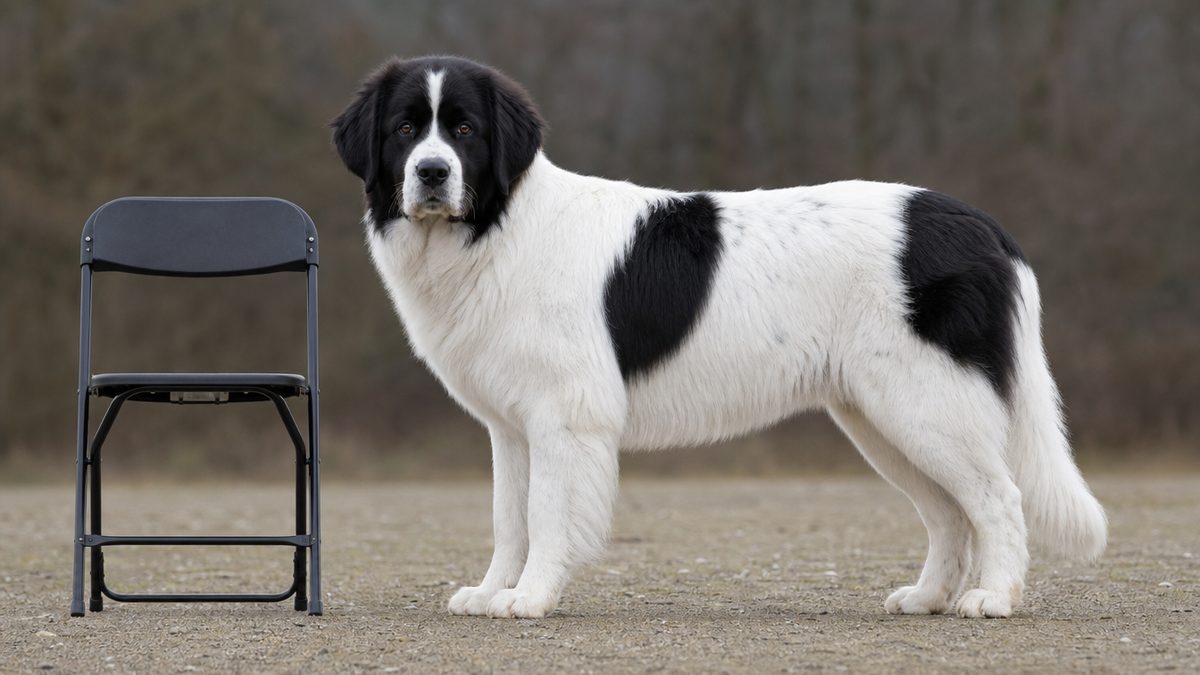
Coat colour is prescribed tightly and identically wherever the breed appears. FCI 226 asks for a main coat of clear white with distinct black patches on body and croup, with collar, forechest, belly, legs and tail white, and a black head carrying a white muzzle and a white symmetrical blaze extending from muzzle over head to the white collar, which it calls a definite breeding goal. Ticking still occurring in the white is not to be penalised but should be bred away.
The Kennel Club's Newfoundland standard describes the same animal under the same name in its colour clause: Landseer (white and black), predominantly white with black markings, head with or without white blaze, black saddle, black rump extending to tail, coat white with minimal ticking. Two registries, two documents, one dog on the page.
The coat itself is a double coat. FCI 226 asks for a top coat that is long and as straight and dense as possible, soft to the touch, with a good undercoat which is expressly not as dense as in the black Newfoundland. That single clause is the most useful line in the standard for an Indian reader, and the grooming section below returns to it.
Where the dog came from, and why the history is contested
The Landseer's ancestry runs back to the St. John's water dog of Newfoundland, the extinct Canadian landrace that also produced the Labrador Retriever and the modern Newfoundland. Black-and-white dogs of this type were common in Victorian England and were painted repeatedly, most famously by Sir Edwin Landseer, whose name was being used for black-and-white Newfoundlands as early as 1896.
Solid black then became fashionable and the parti-coloured dogs faded. In the 1930s German and Swiss breeders set out to recreate the dogs in the paintings, crossing Landseer-coloured Newfoundlands with livestock guardian breeds, and a separate breed club for the taller parti-coloured dogs was formed in Germany in 1960. The FCI accepted the result on a definitive basis on 24 August 1960, with Germany and Switzerland as the country of origin.
Its declared job is not water rescue but guarding. FCI 226 lists utilization as guard dog and companion, where FCI 50 lists the Newfoundland as a sledge dog for heavy loads and a water dog. Both standards nonetheless describe webbed toes, and FCI 226 asks for webbing that is strong and almost reaches the tip of the toes. A Landseer will still swim, and swimming is the only exercise an Indian owner can safely give one in summer.
The Landseer is a taller, longer-legged, lighter-coated white-and-black dog that the FCI treats as its own breed and the English-speaking registries treat as a Newfoundland in a particular coat. Its own standard gives you heights and no weight, so any weight you are quoted came from somewhere else.
Why the coat colour is the reason the two dogs ever split
The Landseer's white-and-black coat is a piebald pattern, and the genetics explain why one registry could treat it as a colour and another could build a breed on it. Piebald is a recessive colour allele found in Newfoundlands, so solid-coloured and Landseer-coloured puppies can appear in the same Newfoundland litter, while ECT Landseers are always piebald.
That asymmetry is the whole argument in one line. If a colour turns up unpredictably inside a litter, it is a colour. If a population breeds true for it and has done so for sixty years, a registry can reasonably call it a breed.
The pattern is not a single switch. A 1990 study of Landseer spotting, using breeding data from the Swiss Dog Stud Book and from breeders' own records, divided the black-and-white patterns into qualitatively recognisable phenotypic classes and interpreted them as the generally accepted piebald spotting gene acting with at least two modifier genes. Those modifiers are proposed as the same minor spotting genes responsible for white markings in the related Newfoundland, which had been cross-bred with Landseers.
So the Landseer's markings are polygenic rather than a clean on-off trait, which is exactly why FCI 226 has to describe the wanted pattern in such detail and then concede that ticking still occurring in the white is not to be penalised but should be bred away. A standard that could simply name a gene would not need that sentence.
The history of the colour has itself been re-examined. A 2015 historical analysis of Newfoundland dog fur colour genetics reviewed how the breed's colours were understood and recorded over time, and the broader review literature places the Landseer pattern within the general framework of coat colour and pattern genes in domestic dogs.
For a buyer the practical consequence is small but real. Ticking in the white is common, it is a fault rather than a defect, and it has no bearing on health, temperament or heat tolerance. Nobody should pay more for a cleaner blaze, and a seller charging a premium for markings is charging for a polygenic accident.
Club recognition: the registries disagree, and both are right
To settle club recognition for the Landseer, read each body's own document rather than looking for a winner. The FCI recognises the Landseer (European Continental Type) as a separate breed with its own number. The American Kennel Club and the Kennel Club recognise no Landseer breed and use the word only as a colour name. Neither position is an error, and India follows the first one.
Here is what each register actually prints.
| Body | Is Landseer a breed? | What the document says | Number |
|---|---|---|---|
| FCI | Yes | LANDSEER (EUROPAEISCH-KONTINENTALER TYP), Group 2, Section Molossian type, Subsection Mountain type, definitive acceptance 24 August 1960, origin Germany and Switzerland | 226 |
| FCI | Also a Newfoundland colour | Newfoundland number 50 lists three varieties: a) BLACK, b) WHITE AND BLACK, c) BROWN | 50 |
| The Kennel Club | No | Newfoundland breed standard, colour clause: Landseer (white and black), predominantly white with black markings | n/a |
| American Kennel Club | No | Newfoundland breed page: colours are gray, brown, black, and a black-and-white coat named for artist Sir Edwin Landseer | n/a |
| Continental Kennel Club | Yes, as two varieties | Landseer entry in Breed Group 9, aliases including Continental Landseer and LANDSEER NEWFOUNDLAND | n/a |
The detail nobody prints: the FCI does both
The FCI's Newfoundland record does not merely tolerate a white-and-black dog. It formally lists WHITE AND BLACK as one of three varieties of breed number 50, and FCI Standard 50's colour clause describes that variety in full, calling it of historical significance for the breed and specifying a black head with a white blaze, a black saddle and a black croup and upper tail.
So the FCI is not simply the body that split the two. It is the body that recognises a white-and-black Newfoundland AND a separate Landseer breed at the same time, which is a distinction no ranking page makes. The Landseer ECT is a different gene pool with a different build, not a differently coloured Newfoundland, and a white-and-black Newfoundland is still a Newfoundland to the FCI as much as to the Kennel Club.
Why the FCI's answer is the one that binds in India
The FCI's members register lists India as a full member represented by the Kennel Club of India, Nr 28 AA Block, First Street Anna Nagar, Chennai 600 040. The KCI therefore issues pedigrees against FCI nomenclature, which makes FCI recognition the practical answer to the question of whether a breed is recognised in India.
Bonbeno could not retrieve a published KCI breed list to confirm this from the KCI's own side, and says so rather than reporting the absence as a finding. The recognition claim on this page rests on the FCI's members register, which is checkable, and not on any KCI document.
The test you can run on a real puppy
One question separates the two animals in front of you. Ask which breed name the pedigree carries.
- Ask to see the pedigree, not a photograph. A Landseer ECT pedigree names Landseer (European Continental Type) or a national-language equivalent. A Newfoundland pedigree names Newfoundland, whatever colour the dog is.
- Measure the dog at the withers. FCI 226 sets 72 to 80 cm for males; FCI 50 gives the Newfoundland an average of 71 cm. A 68 cm male is not an ECT under its own standard.
- Look at the leg length against the body depth. FCI 226's opening comparison is that the legs are comparatively longer than the black Newfoundland's, especially in the male.
- Ask whether the litter's parents included any solid black or brown dog. An ECT litter is white-and-black on both sides; a Newfoundland litter can throw black, brown and white-and-black puppies together.
- Compare the coat by hand. FCI 226 says the undercoat is not as dense as in the black Newfoundland, which is the one difference an Indian owner feels every summer.
None of those five answers is proof on its own. Together they tell you which of two standards the dog in front of you was bred to, and that is the only thing the name Landseer actually decides.
No Indian seller Bonbeno found publishes a Landseer ECT pedigree. Every Indian listing located for this term was filed under the breed Newfoundland, including one titled Landseer Newfoundland Puppies for sale on a marketplace whose own breed dropdown contains no Landseer entry at all. Assume you are being offered a white-and-black Newfoundland until a pedigree says otherwise, and price it as one.
Landseer price in india: there is no Landseer price, only a Newfoundland one
No published Landseer price in india exists, and every rupee figure attached to the name belongs to a Newfoundland. Bonbeno checked the first page of Google India for both landseer dog and landseer dog price in india on 2 September 2026, opened every Indian result, and found no seller anywhere quoting a price against a Landseer pedigree.
Start with how thin the ground is, measured by what the results actually are rather than by how many Google claims there are. Every Indian result on page one for landseer dog price in india is a Newfoundland listing. The only page carrying the word Landseer in its title prints no price, and the only price attached to the word anywhere in the result set is in United States dollars. Google printed About 157 results for that query, but Bonbeno does not treat that number as evidence: a control at the same endpoint on the same day returned About 183 results for labrador retriever price in india, which cannot be true of India's most popular breed, so the printed count measures nothing here.
What the four published Indian bands actually say
Four Indian sources publish a rupee band for the Newfoundland, and they disagree by more than Rs 3,00,000 at the top.
| Source | Band printed | What the page attaches it to |
|---|---|---|
| Mr n Mrs Pet, overall | Rs 1,20,000 to Rs 3,50,000+ | Newfoundland, all colours |
| Mr n Mrs Pet, basic quality | Rs 1,20,000 to Rs 1,50,000 | Newfoundland without show or breeding rights |
| Mr n Mrs Pet, KCI registered | Rs 1,50,000 to Rs 2,50,000 | Newfoundland with KCI certification |
| Mr n Mrs Pet, champion bloodline | Rs 2,50,000 to Rs 3,50,000 | Newfoundland from imported or award-winning parents |
| Asia Pets, single listing | Rs 95,000 | One dog, and the figure appears only in the page metadata |
| Tegha Kennel | No price printed | A listing titled Landseer Newfoundland Puppies for sale |
| Dogbreedslist | USD 2,000 to USD 2,500 | A page titled Landseer, with no rupee figure at all |
Read that table twice. The only source that puts a number against the word Landseer prints it in United States dollars, and the only Indian page that ranks first for the term prints no number at all.
Run the division tests, and note what they do not find
Indian pages routinely publish a dollar figure converted at one exchange rate and presented as a rupee price. Bonbeno tested every figure above and the answer here is that these are not converted numbers.
Rs 1,20,000 divided by 84.38 is 1,422.13, and Rs 3,50,000 divided by 84.38 is 4,147.90. Neither is a price a shop would print. At 74 the quotients are 1,621.62 and 4,729.73, which are no better. At a flat 80 the quotients become 1,500, 1,875, 3,125 and 4,375, and only the first of those is a number a seller would actually quote. That pattern, where a set of figures divides cleanly only because every one of them ends in three zeros, proves nothing at all, because 1,000 divided by 80 is 12.5.
The honest reading is that these are rupee-native round numbers chosen for their shape, not a converted American price list. That is a different failure from conversion and it needs saying differently: nobody has quietly re-badged a dollar band here, they have simply picked large round rupee figures.
The dollar figure on the Landseer page is worth converting the other way, because it is the only Landseer-labelled price anywhere in the result set. USD 2,000 to USD 2,500 at 84.38 is Rs 1,68,760 to Rs 2,10,950. That band sits inside the Indian Newfoundland range but nowhere near its edges, so even the arithmetic does not reconcile the two.
The eight-city table that prints one number eight times
Mr n Mrs Pet publishes a section headed Newfoundland Puppy Price in India, inviting you to know the average price of Newfoundland puppies in your city, followed by a table of eight cities: Hyderabad, Bangalore, Delhi, Chennai, Lucknow, Mumbai, Jaipur and Pune. Every one of the eight rows reads INR 1,20,000 to INR 3,50,000. There is no city variation in a table whose entire purpose is city variation.
The same page prints identical height and weight for all three of its quality tiers, 26 to 28 inches and 45 to 70 kg, which is another sign that the tiers are a pricing template rather than an observation of three kinds of dog.
The AI answer that turns a Newfoundland price into a Landseer price
Google India's own generated answer for landseer dog price in india states that a Landseer dog typically costs between Rs 1,20,000 and Rs 3,50,000 in India, and that KCI registered puppies usually range from Rs 1,50,000 to Rs 2,50,000. Both figures are lifted verbatim from the Mr n Mrs Pet Newfoundland page, which the answer itself displays as its source.
So the loop is closed in public. A seller publishes a Newfoundland band, an answer engine restates it as the Landseer's price, and the next buyer reads it as an independent confirmation. A price gains no credibility by being repeated in a generated answer, and this one has changed breed on the way through.
The same answer offers monthly maintenance figures with no source shown at all, including a food line of around Rs 6,000 to Rs 10,000 a month. Bonbeno does not use unsourced figures from a generated answer, and the cost section below quotes an Indian retailer's published table instead.
Ask three questions before any money moves. Which registry does the pedigree name, Landseer (European Continental Type) or Newfoundland? Is the KCI registration number real and checkable? And what is the price for the same seller's black Newfoundland from the same litter line? If the answer to the third is the same number, you are paying a colour premium for a dog whose registry does not think colour is a breed.
What a Landseer costs to run in India every month
Budget Rs 12,000 to Rs 20,000 a month for a giant dog in India, and treat that as a floor for this one. That band comes from the giant-breed column of the monthly cost table published by Supertails, India's largest online pet retailer, in its 2026 dog price guide.
The line items behind the band matter more than the band, because a Landseer loads two of them harder than a Great Dane does.
| Line | Published giant-breed figure | What a Landseer does to it |
|---|---|---|
| Dry or wet food | Rs 6,000 to Rs 10,000 | Top of the band. A 60 to 70 kg dog on a large-breed formula sits at the high end. |
| Routine vet visits | Rs 1,500 to Rs 3,000 | Higher. Cardiac screening is a specialist visit, not a routine one. |
| Vaccinations | Rs 2,000 a year | Unchanged. Vaccine dosing is not weight-based. |
| Grooming | Rs 600 to Rs 1,500 | Understated. A double coat on a giant dog in humidity needs more than a monthly bath. |
| Training, first six months | Rs 5,000 to Rs 10,000 | Unchanged, and worth spending early while the dog is liftable. |
| Treats and toys | Rs 800 to Rs 1,500 | Unchanged. |
| Flea, tick and deworming | Rs 600 to Rs 1,000 | Higher. A thick coat makes tick checks slower and topicals harder to apply to skin. |
| Printed monthly total | Rs 12,000 to Rs 20,000 | Realistic floor, not a ceiling. |
Check the table's own arithmetic before you trust it
That published total does not reconcile with its own rows, and it is worth saying so. Adding the giant column's monthly lines gives Rs 9,500 at the low end and Rs 17,000 at the high end, plus about Rs 167 a month for the annual vaccination. The printed total of Rs 12,000 to Rs 20,000 therefore overstates its own rows by roughly Rs 2,300 at the bottom and Rs 2,800 at the top.
The same table also prices grooming for a giant breed at Rs 600 to Rs 1,500 a month while pricing a Shih Tzu at Rs 1,500 to Rs 3,000. A double-coated 65 kg dog is not cheaper to groom than a small dog, and that inversion is the clearest sign that the grooming row is a category default rather than an observation.
Use the table for the shape of the budget and for the food figure, which is the one line that genuinely scales with body mass. Do not treat the printed total as a measured number.
The first-year costs that sit outside the monthly band
Year one carries charges that no monthly table shows.
- Full puppy vaccination course, Rs 3,000 to Rs 6,000 across all visits, made up of DHPPi doses at Rs 500 to Rs 1,200 each and anti-rabies at Rs 300 to Rs 600, plus a consultation or injection charge of Rs 300 to Rs 800 per visit.
- Annual booster thereafter, roughly Rs 1,000 to Rs 2,000 for one DHPPi and one rabies dose together.
- Hip and elbow radiographs under sedation at 12 to 24 months, which for a giant dog means a general anaesthetic and a specialist reading.
- A cardiac examination, which for this breed group is the screening most Indian clinics cannot do in-house.
- Continuous cooling. Air conditioning for the room the dog sleeps in is not a luxury purchase for this breed, and it runs eight months of the year in most Indian metros.
Put a real number against the risk side too. A parvo hospital stay in India runs Rs 15,000 to Rs 50,000, which is why the vaccination course is the cheapest money in the whole budget.
A Landseer or a white-and-black Newfoundland in an Indian metro costs roughly Rs 1,50,000 to Rs 2,40,000 a year to run before any illness, on top of a purchase price that starts near Rs 1,20,000. Over a nine-year life that is more than the puppy, several times over. Budget for the decade, not for the transaction.
Heat tolerance: the gap between Chennai and the homeland is the whole argument
A Landseer has poor heat tolerance in every Indian metro, and the size of the gap is measurable rather than a matter of opinion. Bonbeno queried NASA POWER by explicit latitude and longitude for eleven points and echoed back the grid-cell elevation each one returned, so the figures below can be checked.
The Landseer's homeland is Germany and Switzerland, which FCI 226 states as the country of origin. Bremen in northern Germany returns an annual mean of 9.44 C from a cell at 25.71 m against a city near 11 m. Zurich returns 9.07 C from a cell at 566.56 m against a city near 408 m. The breed's ultimate ancestral island, Newfoundland itself, returns 5.38 C at St John's from a cell at 21.05 m.
| Place | Annual mean C | Coolest month C | Annual mean RH % | Cell elevation m | Real elevation m |
|---|---|---|---|---|---|
| St John's, Newfoundland | 5.38 | -2.47 (Feb) | 87.67 | 21.05 | about 60 |
| Zurich, Switzerland | 9.07 | -0.69 (Jan) | 82.63 | 566.56 | about 408 |
| Bremen, Germany | 9.44 | 1.01 (Jan) | 84.88 | 25.71 | about 11 |
| Bengaluru | 23.74 | 20.22 (Dec) | 67.94 | 841.72 | about 920 |
| Pune | 23.86 | 19.62 (Dec) | 66.80 | 635.99 | about 560 |
| Delhi | 25.60 | 13.61 (Jan) | 45.56 | 206.37 | about 216 |
| Kolkata | 25.81 | 17.31 (Jan) | 73.93 | 7.35 | about 9 |
| Mumbai | 26.77 | 23.19 (Jan) | 67.39 | 97.15 | about 14 |
| Chennai | 27.95 | 24.09 (Jan) | 72.39 | 48.95 | about 6 |
The sentence that decides it
Chennai's coolest month is warmer than the homeland's hottest month. Chennai's January mean is 24.09 C. Bremen's warmest month, July, is 18.20 C, and Zurich's is 18.71 C. So the coldest four weeks a Landseer will ever experience in Chennai run about 5.4 C hotter than the hottest four weeks it would experience in Zurich.
That holds even in the coolest Indian metro. Bengaluru's coolest month is 20.22 C in December, still above Bremen's July. Only Delhi drops below the homeland's summer, at 13.61 C in January, and Delhi pays for it with a June mean of 35.88 C and a June record high of 48.79 C.
Humidity runs the other way, and the honest version matters. Bremen at 84.88 percent, Zurich at 82.63 percent and St John's at 87.67 percent are all more humid than Chennai at 72.39 percent. The homeland is not dry. What India adds is not moisture but heat, and heat plus a dense undercoat is what defeats a panting dog.
Where NASA POWER is wrong, and by how much
Two of the points Bonbeno queried are unusable as printed, and saying so is more useful than quietly publishing them. NASA POWER returns a grid cell, not a point, and in mountains the cell's mean elevation misses the town underneath it.
Shimla came back from a cell at 897.65 m against a real town near 2,200 m, an error of about 1,302 m. Ooty came back from a cell at 784.64 m against a town near 2,240 m, an error of about 1,455 m. Applying the standard lapse rate of roughly 6.5 C per 1,000 m gives an estimated real annual mean of about 12.7 C for Shimla and about 14.0 C for Ooty, against the 21.15 C and 23.50 C the cells report. Both corrected estimates are labelled estimates and should be treated as such.
Every plains point checked out. Chennai came back 43 m above its real elevation, Delhi 10 m below, Kolkata 2 m below, Mumbai 83 m above, Bengaluru 78 m below and Pune 76 m above. So the metro figures in the table above are the towns; the hill-station figures are not.
What the heat literature says about a dog this size
Bodyweight is the risk factor that transfers. Hall and colleagues studied 905,543 UK dogs under primary veterinary care in 2016 and found 395 confirmed heat-related illness events, with dogs at or above their breed and sex mean bodyweight carrying an odds ratio of 1.42 and dogs over 50 kg carrying an odds ratio of 3.42. A companion paper on the same cohort found 1,259 events from 1,222 dogs, of which 879 had a recorded trigger, and 652 of those 879, or 74.2 percent, were exertional.
Neither paper modelled the Landseer, and it would be fabrication to claim otherwise. What transfers is the weight band: a 60 to 70 kg dog sits inside the over-50 kg group that carried more than three times the odds, and the trigger split says the danger is exercise rather than a parked car.
Walk before 06:30 and after 20:30, never in between, from March to October in any Indian plains city. Carry water. Stop at the first sign of a dog that will not settle its panting within two minutes of shade. A Landseer that collapses in Indian heat is a same-day emergency, not a rest-and-see.
Temperament and who should not buy one
A Landseer's temperament is gentle, patient and steady, and it is the least of your problems. Both the registries that describe this dog and the club that treats the two as varieties of one breed say the same thing, and none of them describes a difficult animal.
The Continental Kennel Club, which recognises both, writes that both the Newfoundland and Landseer are known as gentle giants, renowned for their patience, loyalty, serene nature and courage, friendly toward other dogs, animals and people, and especially fond of children. It adds one real distinction: the Newfoundland is known for a calm demeanour while the Continental Landseer is described as a bit more energetic.
FCI Standard 50 gives the Newfoundland an expression reflecting benevolence and softness, and calls it dignified, joyful and creative, known for sterling gentleness and serenity. The AKC reports that its breed standard calls a sweet temperament the most important single characteristic of the breed. FCI 226 says less about character and more about build, which is itself telling: it lists utilization as guard dog and companion and leaves temperament to the disqualifying faults, which cover aggressive or overly shy dogs.
The households this suits
A Landseer fits a household with three things: ground-floor or lift access, continuous cooling in at least one room, and an adult at home during the day. It is not a dog that copes with being left, and the CKC's note that the ECT is more energetic than the Newfoundland means an Indian owner is managing a dog with real drive inside a climate that will not let it use that drive outdoors.
- Suits a family with children, because patience with kids is the single most consistently reported trait across all three registry descriptions.
- Suits a household that can supervise water access, since swimming is the only summer exercise that works and an unsupervised 65 kg dog in a pool is a hazard to itself.
- Suits an owner who will groom weekly for a decade rather than book a monthly salon slot.
- Does not suit a first-time owner, because the mistakes here are expensive and some of them are irreversible.
- Does not suit anyone buying a guard dog. A Landseer's presence deters; its behaviour does not.
The size problem nobody plans for
A massive dog is a different animal from a large one, and the change happens fast. A Landseer male reaches 72 to 80 cm at the withers, which puts its head at dining-table height. It will lean on people, because leaning is how these breeds show affection, and a 65 kg lean knocks over a child or an elderly relative without any aggression involved.
Plan for that early. Teach a settle on a mat before the puppy is heavy enough to argue about it, and decide in month two whether the dog is allowed on furniture, because a decision made in month eight is a negotiation you lose.
Noise, strangers and Indian apartment life
Alarm barking is moderate rather than heavy. FCI 226 calls the breed a guard dog, but every temperament description across the registries is of a friendly, non-sharp animal, and the practical Indian experience of giant water breeds is presence rather than volume. A Landseer that barks constantly in an Indian flat is usually overheated, understimulated or both, and the fix is climate and exercise rather than a correction collar.
Strangers are generally welcomed. That is a security problem rather than a temperament one, and it is worth being honest with yourself about it before paying a guard-dog premium for a dog whose own club calls it especially fond of children.
You are buying an easy temperament and a hard environment. Nothing about this dog's character will fight you. The coat, the heat, the cost and the joints will.
Training a Landseer in India, and what the heat takes away
To train a Landseer in India, do the work indoors and do it before the dog is heavy. This breed is trainable and willing, so the constraint is not motivation. It is that an Indian summer removes most of the outdoor hours in which conventional training happens.
Start with the honest budget. In Chennai, Mumbai or Kolkata from March to October, a giant double-coated dog has perhaps 40 usable outdoor minutes a day, split across dawn and late evening. Everything else has to happen inside. That is a different training plan from the one every overseas guide describes.
The first sixteen weeks decide the next ten years
Socialise deliberately and early, and keep the socialisation window separate from the vaccination window in your head. Indian vaccination practice starts the core course at 6 to 8 weeks and completes it at or after 16 weeks, and the standard advice is to keep an unfinished pup off unknown ground until about a week after the final booster.
That leaves a real conflict, because the behavioural window closes while the immunological one is still open. Resolve it the way Indian veterinary practice does: carry the puppy, invite vaccinated adult dogs to your home, use clean private terraces, and expose the pup to lifts, traffic noise, doorbells, cookers, autorickshaws and the building's watchman without putting its feet on public ground.
- Weeks 8 to 12: name response, handling of feet and ears, crate as a cool resting place, and one new indoor surface every day.
- Weeks 12 to 16: settle on a mat, a reliable recall inside the flat, and grooming tolerance built with a soft brush before the coat needs it.
- Weeks 16 to 24: loose-lead walking at dawn only, meeting five new vaccinated dogs, and the first supervised swim if a safe pool exists.
- Months 6 to 12: door manners, lift manners, and a stand for examination that a vet can actually use on a 50 kg adolescent.
- Months 12 to 24: nothing new, just maintenance, because this is when the dog gets strong enough to test every earlier shortcut.
What this breed resists
Very little, and that is the trap. A willing dog trains itself into bad habits as readily as good ones. The two behaviours that go wrong most often in Indian homes are leaning and door-rushing, both of which are affectionate rather than defiant, and both of which become dangerous at 65 kg.
Force-based handling is the wrong tool here for a specific reason beyond ethics: you cannot out-muscle this dog once it is grown, so any method that depends on physical control expires around month ten. Build the behaviour while the puppy weighs less than you do.
Indoor work that replaces the walk
Substitute mental load for distance. Scent games, a snuffle mat, food puzzles, a long settle while the family eats, and short shaping sessions of three to five minutes each will tire a giant dog more reliably than a hot walk will, and they carry no heat risk.
Swimming is the exception worth arranging. FCI 226 asks for strong webbing that almost reaches the tip of the toes, and this is a breed built to work in water. A supervised swim replaces an hour of walking and cools the dog while it exercises. Rinse and dry the coat afterwards, because the drying is where Indian skin problems start.
Teach a chin rest in the first month. A giant dog that voluntarily rests its chin in your palm can be examined, have its ears checked, have a tick pulled and have a blood sample taken without sedation. On a dog this size that single behaviour saves thousands of rupees and a great deal of stress across a lifetime.
Exercise needs: 40 usable minutes, and water beats distance
A Landseer's exercise needs are moderate in volume and severe in timing. FCI 226 asks for movement presenting a free, long stride that covers ground well, which is a dog built to travel, and an Indian plains summer gives you two short windows a day in which it can safely do so.
Aim for 45 to 60 minutes of total daily activity for an adult, split into two sessions, plus indoor enrichment. In the cool season in Delhi, Pune or Bengaluru you can lengthen that. In Chennai or Mumbai in May you cannot, and trying is what produces the emergency.
The timing rule, in numbers
The hottest readings the climatology holds are 42.70 C for Chennai in May, 48.79 C for Delhi in June, 46.81 C for Kolkata in May and 44.91 C for Mumbai in April. Those are period extremes rather than routine afternoons, and the routine figures are the monthly means beside them: 31.51 C, 35.88 C, 31.53 C and 30.73 C. A dog whose ancestors evolved at an annual mean of 9 C cannot work in the means, let alone the extremes, and the heat literature says the danger is exertion rather than confinement: of 879 heat-related illness events with a recorded trigger, 652, or 74.2 percent, were exertional.
- Walk before 06:30 and after 20:30 from March to October in any plains city.
- Test the pavement with the back of your hand for five seconds. If you cannot hold it, the dog cannot stand on it.
- Carry water on every walk longer than fifteen minutes, and offer it whether or not the dog asks.
- Turn back at the first panting that does not settle within two minutes of shade.
- Never jog or cycle with an adult Landseer in Indian conditions. The gait the standard describes is a working trot, not a road-running one.
Swimming is the exercise this breed was built for
Water solves the problem that land creates. This is a webbed-footed dog whose standard specifies webbing that is strong and almost reaches the tip of the toes, and whose closest relative is classified by the FCI as a water dog. Twenty minutes of swimming does the work of an hour of walking, loads the joints far less, and cools the dog while it works.
In practice that means a society pool at an off hour, a private pool, a clean reservoir or a shallow river stretch with no current. Rinse the coat with fresh water afterwards, dry the ears, and dry the dog properly rather than letting it air dry, for reasons the grooming section sets out.
Growth-plate rules that override everything above
Restrict impact until the growth plates close, which for a giant breed means about 18 months rather than 12. Free play on grass is fine. Forced repetitive exercise is not.
The specific prohibitions for the first eighteen months are stairs in volume, jumping down from height, long lead walks on hard surfaces and any organised running. This matters more in this breed than in most, because OFA's tables record 25.8 percent of 20,050 Newfoundland hip evaluations as dysplastic and 23.3 percent of 10,718 elbow evaluations as abnormal. Joints that start with that much inherited risk do not need help from an owner in a hurry.
Because the heat rules are strict, Indian owners of giant coated breeds frequently end up doing nothing at all. An under-exercised Landseer gains weight, and body weight at or above the breed mean is itself an independent heat-illness risk factor at an odds ratio of 1.42. The dog then becomes less able to tolerate the exercise it needs. Indoor enrichment and swimming are how you break that loop.
Grooming a double coat through an Indian monsoon
To groom a Landseer in India, brush to the skin at least twice a week, dry the dog mechanically after every wetting, and never shave the coat. The breed carries a moderately long straight outercoat over a soft dense undercoat, and the standard says that undercoat is not as dense as in the black Newfoundland, which is the single mercy an Indian owner gets.
That clause is worth reading carefully, because it is the only place any registry says a Landseer is easier to keep than its relative. FCI 50 describes the Newfoundland's undercoat as soft and dense, denser in winter than in summer, but always present to some extent on the croup and chest. FCI 226 asks for a good undercoat and then explicitly qualifies it as less dense. A Landseer sheds less bulk and traps marginally less heat than a black Newfoundland. Marginally.
The routine that works in Indian humidity
- Line brush to the skin twice a week with a slicker and a wide-tooth comb, working in sections from the rear forward. Brushing the top of the coat achieves nothing; the mats form underneath.
- Comb daily through a coat blow, which in Indian metros tends to arrive twice a year and to be messier than in a temperate climate because the coat never fully sets.
- Check behind the ears, in the armpits, under the tail and around the ruff every session. Those four places mat first and they are where a maggot wound starts in the monsoon.
- Dry mechanically after every bath and every swim, with a blaster or a stand dryer, until the undercoat is dry to the skin rather than merely the surface.
- Trim the hair between the pads and keep the nails short. A giant dog on wet Indian tiles with long pad hair slips, and a slip damages a hip.
Where the overseas advice is wrong for India
The most widely repeated Landseer grooming instruction in the English-language results does not transfer. Dogbreedslist tells readers to avoid bathing unless absolutely necessary, because bathing strips the coat's natural oils, and to use dry shampoo from time to time instead.
That is sound advice in a cool dry climate and poor advice in Chennai in August, where a dog carrying 72 percent ambient humidity in a double coat develops hot spots, folliculitis and ear infections from damp rather than from dirt. The Indian version of the same rule is: bathe as often as the coat needs, use a gentle shampoo, and put all of your effort into the drying rather than into avoiding the water.
The drying is the load-bearing part. A double coat that is dry on top and damp underneath is a warm wet enclosed space against skin, and that is the mechanism behind most monsoon skin disease in coated breeds. Air drying a Landseer in Indian humidity is not a shortcut; it is the cause.
Never shave it, and what to do instead
Shaving a double-coated dog to cool it is the most common well-meant mistake in Indian giant-breed ownership. The undercoat insulates against heat as well as cold, the outercoat is the dog's sun protection, and a shaved double coat can grow back patchy or not at all. The Kennel Club's Newfoundland standard describes the coat as double, flat and dense with a coarse, oily, water-resistant outer coat, and FCI 50 states plainly that trimming and scissoring are not encouraged.
The legitimate alternatives are a thorough de-shed of the undercoat, a sanitary trim, a feet-and-pad tidy, and cooling by environment rather than by clipper. A fan moving air over a wet belly cools a dog. Removing its coat does not.
Ticks, ears and the monsoon
A thick coat hides ticks, and India's tick season overlaps its humid season. Part the coat and run fingers over the skin daily during the monsoon, concentrating on ear margins, between the toes, under the collar and around the tail base. Keep a preventive on schedule; on a 65 kg dog that is a full-size dose and it is one of the few running costs that scales with weight.
Ears need the same discipline. These are pendant ears lying close to the head over a dog that swims, which is the anatomy most prone to otitis externa. Dry the ear canals after every swim and every bath, and see a veterinarian at the first head-shake rather than the third.
Budget 45 minutes twice a week for brushing, plus 60 to 90 minutes for a bath and a full mechanical dry. That is roughly three hours a week, every week, for nine or ten years. Owners who cannot commit that should not buy a coated giant, and no Indian salon schedule replaces it.
Health issues, life expectancy, and the one disease that is the Landseer's own
The Landseer's health issues divide cleanly into one condition described in Landseer dogs specifically and a set of conditions documented in the Newfoundland, which is the dog Indian buyers are actually offered. Keeping those two lists apart is the whole discipline of this section, because the ECT has been a separate gene pool only since 1960 and its literature is seven papers deep.
Bonbeno searched PubMed for Landseer in three query forms on 2 September 2026, all-fields, title-and-abstract, and combined with dog. All three returned the same seven records, against a control search for Labrador retriever and hip dysplasia that returned 126 in the same session. Seven papers is the entire published literature under this name.
COL6A1 muscular dystrophy, described only in Landseers
One inherited disease belongs to this breed and not to the Newfoundland. Researchers in Zurich, Duesseldorf and Bern described a novel canine muscular dystrophy in Landseer dogs, with access to five affected dogs from two litters. Clinical signs started at a few weeks of age, and severe progressive muscle weakness led to euthanasia between 5 and 15 months of age.
The cause is a single nonsense variant. Whole-genome sequencing of one affected Landseer against 170 control dogs from other breeds found the affected dog homozygous for a nonsense variant in COL6A1 (Chr31:39,303,964G>T; COL6A1:c.289G>T; p.E97*), with genotypes showing perfect concordance with the phenotype in all five cases and more than 1,000 control dogs. The pedigrees indicated monogenic autosomal-recessive inheritance, which means carriers are clinically normal and two of them can produce affected puppies.
A follow-up study confirmed the pathology, reporting muscle biopsies with the virtual absence of collagen VI in skeletal muscle, matching human Ullrich congenital muscular dystrophy. That is why the breed now serves as an animal model for a human disease.
For a buyer, the practical point is short. A Landseer puppy that is weak, floppy or slow to stand in its first weeks needs a veterinary neurologist, not more time. There is no treatment, and the reported outcome in every described case was euthanasia inside fifteen months.
Subaortic stenosis, and how much of it there is
Subaortic stenosis is the cardiac disease this breed group carries, and the largest study of it is a Newfoundland study. Researchers analysed pedigree data on more than 230,000 Newfoundland dogs from the European and North American populations reaching back to the 19th century, including 6,023 dogs with a subaortic stenosis diagnosis.
Their findings were that incidence and prevalence in that sample were much higher than earlier smaller studies had reported, that affected dogs were more often inbred and more closely related to one another than unaffected dogs, that sex had no significant effect, and that the only simple mode of inheritance fitting the data was autosomal codominant with lethal homozygosity and a penetrance of one third in heterozygotes. The disease usually leads to death in early adulthood.
OFA's own advanced cardiac table records 4.6 percent of 1,677 Newfoundland evaluations as abnormal, against 91.5 percent normal and 3.9 percent equivocal. That is a screened population rather than a random one, so read it as what breeders' dogs look like, not as a prevalence.
Cystinuria, and why castration does not fix it here
Cystinuria in this breed is autosomal recessive and severe. A study of two families of Newfoundlands found eleven dogs with dysuria, stranguria or obstruction from cystine calculi, nine with pure cystine bladder stones and four of those with renal stones as well; affected dogs excreted more than 500 nmol of cystine per mg of creatinine against a reference of 54 plus or minus 38, and showed a complete lack of reabsorption plus active secretion of cystine.
A 2025 epidemiological study of 5,477 dogs with cystine uroliths found that 99 percent were male and that intact males were overrepresented in almost every breed, with eight exceptions. The Newfoundland is one of those eight. That single finding changes the advice: for most breeds castration reduces cystine stone risk, and for this one it does not, because the Newfoundland form is not androgen-dependent.
OFA's cystinuria DNA table records 12.3 percent of 2,646 tested Newfoundlands as carriers and 0.0 percent as affected. Roughly one in eight tested dogs carries it, which is why the DNA test is on the national breed club's recommended list.
Life expectancy
No mortality study gives a life expectancy for either the Landseer ECT or the Landseer-coloured Newfoundland, and Bonbeno publishes no median rather than borrowing one. What exists is a set of club and directory estimates that broadly agree: the AKC gives 9 to 10 years for the Newfoundland, the Continental Kennel Club gives 8 to 10 years for the Landseer, and Dogbreedslist gives 9 to 11. Treat 8 to 11 years as the working range and treat none of those figures as measured.
Four things take a Landseer to a veterinarian the same day: collapse or a panting dog that will not settle, a male straining to urinate without producing urine, sudden exercise intolerance or fainting in a young adult, and a puppy under four months that is weak or reluctant to stand. The first is heat, the second is a cystine obstruction, the third is cardiac and the fourth may be the COL6A1 dystrophy.
Screening: what the registry data shows, and where it contradicts itself
Ask a breeder to screen for four things and to show you the certificates: hips, elbows, heart and cystinuria. Those are exactly the four the AKC's national breed club recommends for the Newfoundland, and OFA's published tables show why each one is on the list.
First, the honest limit on all of it. There is no Landseer row anywhere in OFA's disease statistics. Bonbeno searched the full table dump for LANDSEER and found zero occurrences, against 63 for NEWFOUNDLAND and 109 for LABRADOR in the same file, and confirmed that the only LANDSE fragments present belong to NEDERLANDSE KOOIKERHONDJE. OFA publishes a breed only once it holds 100 hip evaluations, or 50 for its other databases, so the correct statement is that the Landseer has no row in OFA's published statistics tables, not that it is absent from the database.
Everything below is therefore Newfoundland data, and it is the right data for the dog an Indian buyer is actually offered.
| Database | Evaluations | Normal % | The finding |
|---|---|---|---|
| Hips | 20,050 | 72.2 | 25.8 percent dysplastic: mild 13.5, moderate 9.7, severe 2.6 |
| Elbow | 10,718 | 76.4 | 23.3 percent abnormal: grade 1 15.7, grade 2 4.7, grade 3 3.0 |
| Congenital cardiac | 6,486 | 98.8 | 0.7 percent abnormal |
| Advanced cardiac | 1,677 | 91.5 | 4.6 percent abnormal, the figure that matters for subaortic stenosis |
| Cystinuria DNA | 2,646 | 87.7 | 12.3 percent carriers, 0.0 percent affected |
| Patella | 3,771 | 99.4 | 0.6 percent abnormal |
| Thyroid | 1,225 | 93.9 | 1.1 percent compensative autoimmune thyroiditis |
| Shoulder | 165 | 90.9 | 9.1 percent abnormal, and the breed ranks first on this table |
| Eyes, summary line | 1,630 | 94.0 | 6.0 percent abnormal, and see the contradiction below |
Two of those rows deserve a note. The hip row's components reconcile: excellent 9.8 plus good 46.0 plus fair 16.3 gives 72.1 against a printed 72.2, and mild 13.5 plus moderate 9.7 plus severe 2.6 gives exactly 25.8. The elbow row is one tenth out, 15.7 plus 4.7 plus 3.0 being 23.4 against a printed 23.3, which is ordinary rounding.
The shoulder row is small and should be read with care. 165 evaluations is a thin sample, and a rank of one on a table that thin says more about who submits shoulder films than about the breed.
The eye table contradicts itself, again
OFA's eye summary reports the Newfoundland at 94.0 percent normal across 1,630 evaluations. Its own per-diagnosis detail rows, on the identical denominator of 1,630, record 1,198 dogs as normal, which is 73.5 percent. That is a gap of 20.5 percentage points inside one registry's tables on one breed.
It gets sharper. The entropion detail row records 116 of 1,630, or 7.1 percent, and the ectropion row 75 of 1,630, or 4.6 percent. Entropion alone therefore exceeds the summary's entire 6.0 percent abnormal figure. A part cannot be larger than its whole, so the two numbers are not measuring the same thing and neither should be quoted as the breed's eye rate.
Bonbeno publishes both with the arithmetic shown and quotes neither as the rate. This is not a Newfoundland problem; it is a property of OFA's eye tables that this site has now recorded on many breeds.
What to ask for, in order
- Hip and elbow certificates for both parents, with the registry, the number and the date. Verify the numbers against the issuing registry's own search rather than accepting a photograph.
- A cardiac certificate from a specialist, not a general practitioner's auscultation. Subaortic stenosis is missed on a routine listen.
- The cystinuria DNA result for both parents. Two carriers must not be bred together, and the test is definitive.
- The breeder's own answer to what the litter's grandparents died of and at what age. No registry captures this and it is the most informative question you can ask.
- For any dog sold as a Landseer ECT, the pedigree naming that breed. Without it you are buying a Newfoundland and should screen it as one.
OFA counts change as evaluations are added, so publish the sample size next to any percentage and re-check before relying on it. The figures above were read on 2 September 2026 from OFA's full statistics dump, with a Labrador control confirming the search worked.
Feeding a giant dog in India, and the taurine finding that changes the diet
Feed a Landseer a large-breed formula measured by body condition rather than by the bag's chart, and avoid one specific category of diet. A study of nineteen privately owned Newfoundlands found twelve of them taurine deficient on plasma concentrations below 40 nmol/mL, and every taurine-deficient dog had been fed a lamb meal and rice diet.
That finding is unusually actionable in India, because lamb-and-rice and mutton-and-rice formulations are common on Indian shelves and are often marketed as the gentle option. The dogs in the study were eating commercial dry diets that met established nutrient recommendations, so the labels were not wrong; the breed's requirement was.
The deficiency reversed with a change of diet or with methionine supplementation, and the authors concluded that blood taurine concentrations indicating deficiency in Newfoundlands may be substantially lower than the thresholds used in cats. That is a breed-specific metabolic quirk, not a general dog-food warning.
- Choose a large-breed or giant-breed adult formula with a named animal protein first on the ingredient list.
- Avoid single-protein lamb meal and rice diets for this breed group specifically, on the strength of the taurine finding above.
- Ask a veterinarian to check plasma taurine if the dog has been on such a diet for months, particularly before any cardiac workup.
- Split the daily ration into two or three meals, never one, and never feed immediately before or after exercise.
- Weigh the food. A cup is not a unit, and on a 65 kg dog a careless scoop is several hundred extra calories a day.
Growth is where giant breeds are ruined
Feed a giant-breed puppy formula, not an adult one and not a small-breed puppy one, and keep the puppy lean enough that you can feel the ribs under a thin fat cover. Rapid growth and excess calcium are the two dietary levers that worsen developmental joint disease, and this is a breed in which 25.8 percent of 20,050 OFA hip evaluations came back dysplastic.
The single most useful habit is monthly weighing and a photograph from above and from the side. Body condition on a heavily coated dog cannot be judged by eye; it has to be judged by hand and by trend.
Move to an adult formula at around 18 months for a giant breed, not at 12. The growth plates are still closing at a year, and the puppy formula's mineral profile is built for that.
Bloat, water and the Indian summer
Deep-chested giant breeds carry gastric dilatation and volvulus risk, and Indian heat makes the standard precautions harder to keep. FCI 50 describes the Newfoundland's chest as broad, full and deep with a good spread of ribs, which is the conformation the risk attaches to.
The practical rules are to feed two or three smaller meals, to avoid a large volume of water gulped immediately after a meal, to keep the dog quiet for an hour either side of feeding, and to know where the nearest 24-hour surgical facility is before you need it. A dog with a distended abdomen retching without producing vomit is a surgical emergency measured in hours.
What Indian availability actually looks like
Large-breed and giant-breed formulas are available in Indian metros from the main international brands and from several Indian manufacturers, and the food line is the largest single running cost. India's biggest online pet retailer prices giant-breed food at Rs 6,000 to Rs 10,000 a month, which for a 65 kg dog is realistic at the upper end rather than the lower.
Home-prepared diets are common in Indian households and are not automatically wrong, but a giant growing dog is the hardest case to get right. If you feed home food, do it on a written plan from a veterinarian who has calculated the calcium and phosphorus, not on a recipe from a forum.
Run both hands flat along the ribs. You should feel each rib with light pressure and see a waist from above and a tuck from the side. On a coated giant that check is worth more than any weighing scale, because it survives the coat and it catches a slow drift before it becomes a joint problem.
The first year, month by month, on an Indian calendar
Plan a Landseer's first year around two clocks that do not align: the vaccination clock and the socialisation clock. Indian law sets the earliest legal collection at eight weeks, because Rule 8(1)(a) of the Dog Breeding and Marketing Rules 2017 requires every breeder to ensure that pups less than eight weeks in age are not sold.
| Age | What is happening | What you do |
|---|---|---|
| 8 weeks | Legal earliest collection. First DHPPi usually already given at 6 to 8 weeks. | Collect only with a vaccination card. Set up a cool room. Start handling feet and ears daily. |
| 9 to 11 weeks | Second DHPPi booster. Socialisation window wide open, immunity not yet sealed. | Carry the pup outdoors. Invite vaccinated adult dogs home. No public ground. |
| 12 to 14 weeks | Third DHPPi plus first anti-rabies. | Introduce the brush before the coat needs it. Begin settle-on-a-mat. |
| 14 to 16 weeks | Final puppy booster; anti-rabies completed. Immunity sealed about a week later. | First short dawn walks. First supervised swim if a clean pool exists. |
| 4 to 6 months | Fast growth. Adult teeth in. Dog reaches 25 to 35 kg. | Loose lead work while you can still physically manage the dog. No stairs in volume. |
| 6 to 9 months | Adolescence. Coat begins to thicken. First full Indian summer for a winter litter. | Hold the line on door manners. Move all exercise to dawn and late evening. |
| 9 to 12 months | Height largely reached, body still filling. | Book a veterinary check for baseline weight, heart auscultation and a body condition score. |
| 12 to 18 months | Growth plates closing. Weight still rising toward adult. | Hip and elbow radiographs from 12 months at the earliest, 18 to 24 months for a final read. |
| 18 months | Adult. Move to an adult formula. | Establish the lifelong grooming and dawn-walk routine that the next eight years run on. |
The socialisation window, and the Indian conflict inside it
The socialisation window closes long before the vaccination course finishes, and pretending otherwise produces a fearful giant. Indian practice completes the core course at or after 16 weeks and advises keeping an unfinished pup off unknown ground until about a week after the final booster.
Resolve it by moving the world to the puppy rather than the puppy to the world. Lifts, the watchman, the pressure cooker, the doorbell, children, umbrellas, a running tap, a hair dryer and the sound of an autorickshaw can all be introduced indoors. A dog that is unbothered by a hair dryer at ten weeks is a dog you can dry properly for the next decade.
Three things to get right before month six
- Cool sleeping. Decide now which room stays cooled and put the crate there. A giant coated puppy through its first Indian summer needs somewhere it can genuinely rest.
- Grooming tolerance. Brush for two minutes a day from week nine, whether or not the coat needs it. Retrofitting this to a 50 kg adolescent is a fight you will lose.
- Weight discipline. A fat giant puppy is not a healthy one, and body weight at or above the breed mean is itself a heat-illness risk factor at an odds ratio of 1.42.
Timing the purchase against the calendar
A puppy collected in October gets six mild months to grow into before its first real summer. A puppy collected in March spends its most vulnerable weeks in the worst heat of the year. In Chennai the difference between those two is a January mean of 24.09 C and a May mean of 31.51 C.
That is a small thing that Indian buyers can control and rarely do. If you have a choice of litters, take the autumn one.
A breeder offering a puppy at six or seven weeks is breaking Rule 8(1)(a) of the 2017 Rules, and a breeder who will hand over a giant-breed puppy early is telling you something about everything else they do. Walk away rather than negotiate.
Head to head against the giants Indian buyers actually compare
Compare a Landseer against the three giants it loses buyers to in India, and the differences that matter are coat, cooling and cost rather than temperament. All four are gentle with families; only one of them copes with a Chennai afternoon.
| Landseer ECT | Newfoundland | St Bernard | Great Dane | |
|---|---|---|---|---|
| Recognised as a breed by | FCI only, number 226 | FCI, AKC and the Kennel Club | FCI, AKC and the Kennel Club | FCI, AKC and the Kennel Club |
| Height, males | 72-80 cm (FCI 226) | About 71 cm average (FCI 50) | Giant, taller than the Newfoundland | Giant, tallest of the four |
| Weight in its own standard | Not stated at all | About 68 kg (FCI 50) | Stated | Stated |
| Coat | Double, moderately long, undercoat less dense than the Newfoundland's | Double, dense undercoat | Long or short varieties | Single short coat |
| Heat tolerance in India | Very poor | Very poor | Very poor | Moderate |
| Grooming load | Very high | Very high | High to very high | Low |
| Drool | Moderate, tight lips required | Moderate | Heavy | Moderate |
| Published Indian price | None exists | Rs 1,20,000 to Rs 3,50,000 | Rs 25,000 to Rs 1,00,000 | Rs 20,000 to Rs 80,000 |
| In India's top-40 price list | No | No | Yes | Yes |
The price row is the one to sit with. India's largest pet retailer publishes a 40-breed price table that includes the Saint Bernard at Rs 25,000 to Rs 1,00,000 and the Great Dane at Rs 20,000 to Rs 80,000, and contains neither the Newfoundland nor the Landseer. A breed missing from the country's most comprehensive price list is a breed the country does not really trade.
Landseer against the Newfoundland
Choose between these two on registry, not on looks. If you want the FCI's separate breed you need a pedigree naming Landseer (European Continental Type), and Bonbeno found none offered in India. If you want the dog, the white-and-black Newfoundland is a formally recognised variety of FCI 50 and is what Indian sellers actually have.
The build difference is real but modest: longer legs, less bulk, a longer more tapered head, and an undercoat the standard itself calls less dense. In Indian conditions the last of those is the only one you will notice day to day, and it is a small mercy rather than a solution.
Landseer against the Great Dane
The Great Dane is the giant that actually works in India, and the reason is one line long: a single short coat. It carries the same joint and cardiac cautions and the same bloat risk, it has a shorter life expectancy, and it needs the same careful growth management. What it does not need is three hours of brushing a week and a cooled room to survive August.
For an Indian family that wants a very large gentle dog and is not attached to the coat, this is the honest recommendation, and it is also cheaper to buy and cheaper to run.
Landseer against the St Bernard
The St Bernard is the closest Indian analogue in temperature terms and the most widely available giant here. FCI 226 itself uses it as a reference point, saying the Landseer's stop is decided but not as pronounced and steep as in the Saint Bernard Dog.
It drools substantially more, it is more widely bred in India so the health variance is wider, and it is materially cheaper. It is not better adapted to heat. Anyone choosing between these two on climate grounds is choosing between two bad options.
The fourth option is not on the table above. An adopted Indian street dog costs Rs 0 to Rs 3,000, is adapted to the climate you actually live in, and has none of the inherited screening burden. It will not look like a Landseer. It will also not need a cooled room to survive May.
Mistakes Indian owners actually make with this breed
Six mistakes account for most of what goes wrong with a Landseer or a white-and-black Newfoundland in India, and five of them are made before the dog is a year old. None of them involves temperament.
1. Paying a colour premium for a breed that is not one
Indian sellers use Landseer as a marketing word, and buyers pay for it. Every Indian listing Bonbeno found was filed under the breed Newfoundland, including one titled Landseer Newfoundland Puppies for sale on a marketplace whose breed dropdown contains no Landseer entry. Ask what the seller's black Newfoundland from the same lines costs. If the answer is the same, you are paying for a coat pattern.
2. Believing a price that an answer engine invented for you
Google India's generated answer prints Rs 1,20,000 to Rs 3,50,000 as the Landseer's price and displays as its source a page selling Newfoundlands. Repetition by a machine is not corroboration. Trace any rupee figure to the page it came from and check what that page is actually selling.
3. Shaving the coat to cool the dog
This is the most common well-meant error in Indian giant-breed ownership and it is counterproductive. The undercoat insulates against heat as well as cold and the outer coat is sun protection, which is why FCI 50 states that trimming and scissoring are not encouraged. Cool the environment, not the dog's coat.
4. Letting the dog air dry
The overseas guidance to avoid bathing and dry-shampoo instead assumes a cool dry climate. In Indian humidity the failure mode is not dirt, it is a coat that is dry on the surface and damp against the skin. Bathe as often as needed and spend the effort on mechanical drying, ears included.
5. Exercising in the wrong half of the day
Indian owners walk their dogs when they are free, which is usually the evening rush or a weekend morning that starts at nine. Chennai averages 31.51 C in May and has recorded 42.70 C, and Delhi averages 35.88 C in June and has recorded 48.79 C, and the heat literature shows exertion, not confinement, as the dominant trigger: 652 of 879 events with a recorded trigger, 74.2 percent, were exertional. Dawn and late evening, or nothing.
6. Skipping the cardiac screen because the puppy sounds fine
Subaortic stenosis is missed on a routine auscultation and it kills in early adulthood. The largest pedigree study of the disease covered more than 230,000 Newfoundlands and 6,023 diagnosed dogs. A specialist cardiac examination on both parents is the screen that matters, and it is the one Indian buyers most often leave out because it is the hardest to arrange.
The mistakes a breeder makes that you inherit
- Removing hind dewclaws to satisfy an overseas standard, which the 2017 Rules describe as de-clawing and any change of appearance by artificial means.
- Releasing puppies before eight weeks, which Rule 8(1)(a) prohibits outright.
- Breeding two cystinuria carriers together, when 12.3 percent of 2,646 tested Newfoundlands come back carrier and the test is definitive.
- Line breeding inside four generations in a small imported gene pool, which Second Schedule Part II paragraph 6(3) prohibits.
- Advertising a 10 year Breed Guarantee, as one Indian listing does, for a breed whose own club estimates put life expectancy at 8 to 10 years Continental Kennel Club.
The Indian page ranking first for this breed shows every trait bar at 0 percent, prints no price, and describes its Landseer puppies as having a nice black hairy coat, which is the one coat colour the standard excludes. Google's index still shows that page's old filled-in values of 73 percent, 95 percent, 80 percent and 78 percent in the search snippet, so what you read on the results page is not what the live page serves. Open the page.
Indian law: the breed standard tells you to do something the Rules forbid
Read FCI Standard 226 alongside the Prevention of Cruelty to Animals (Dog Breeding and Marketing) Rules 2017 and one instruction collides. The standard says dewclaws are objectionable and should be removed as soon as possible after birth. The Rules forbid de-clawing and any change of appearance by artificial means.
The clause is Second Schedule Part II paragraph 6(8), and it is worth quoting because it is longer than people assume. It reads: There shall be no tail docking, ear cropping de-barking, de-clawing, branding, dyeing, injecting substances to enhance visual appeal, performing a surgery or procedure to camouflage or hide any defect or infirmity or any other kind of mutilation of any body part of the pup and any change of appearance by artificial means is strictly forbidden.
Bonbeno extracted the AWBI gazette PDF with pypdf and searched it. The words dewclaw and dew claw appear zero times in the document, so the Rules do not name the procedure the standard describes. What they do name is de-clawing, any other kind of mutilation of any body part of the pup, and any change of appearance by artificial means. A registered Indian breeder removing a Landseer's hind dewclaws to satisfy FCI 226 is doing exactly what those words describe.
State the position carefully, because the precision is the point. The Rules do not say dewclaw removal specifically. They forbid a category into which it plainly falls, and an Indian breeder following the German standard's instruction is at least arguably in breach. The same instruction has already propagated to the ranking pages: Dogbreedslist tells Indian readers that dewclaws should be removed on the hind legs.
The housing clause that names this breed type
One provision reads as though it were written for a Landseer in Chennai. Second Schedule Part IV paragraph 21(1), headed Outdoor housing facilities, provides that the following categories of dogs shall not be kept in outdoor facilities unless that practice is specifically approved by the attending veterinary practitioner in writing: dogs that are not accustomed to the temperatures prevalent in the area or region in question; dog breeds that cannot tolerate the temperatures prevalent in the area or region in question, such as long-haired breeds in high temperature locations; and sick, infirm, aged or young animals.
That is a long-haired breed in a high temperature location, described by the Rules in almost those words. Note the citation form: this is a Second Schedule paragraph, not a Rule. The Rules themselves stop at Rule 13, and the string Rule 21 appears zero times in the gazette.
Two more clauses a buyer should know
- Rule 8(1)(a): every breeder shall ensure that pups less than eight weeks in age are not sold. This is a Rule, not a Schedule paragraph, and it is the one most often broken.
- Rule 8(1)(b): dogs over six months in age are not sold without first being sterilised, unless they are being sold to another licensed breeder.
- Second Schedule Part III paragraph 8(10): dogs shall have been tested for genetic defects, including hip dysplasia, progressive retinal atrophy, night blindness, hypothyroidism, entropion, ectropion, overshot, undershot jaw, wry mouth, two or more missing teeth and cryptorchidism. Hip dysplasia is named explicitly, which matters for a breed whose OFA hip table shows 25.8 percent of 20,050 evaluations dysplastic.
- Second Schedule Part II paragraph 6(3): in-breeding within the first four generations and incest breeding between parents and children or brother and sister are both prohibited. That bites in a small imported gene pool.
The word including in paragraph 8(10) matters. The list is illustrative rather than closed, so do not conclude that a defect is outside the clause merely because it is unlisted. Cystinuria is not named, and it is still the test the breed's own national club recommends.
What is not prohibited
No Indian law in force today bans owning, breeding or selling a Landseer or a Newfoundland. Neither breed appears on any restricted list currently in effect, and the Rules quoted above regulate conduct rather than breed.
Equally, the Rules contain no patella-testing requirement, no dental requirement and no deafness test. A breeder who tells you Indian law requires something should be asked which clause, and the answer should be checkable.
If a breeder has removed a puppy's dewclaws, ask which veterinary practitioner did it and on what written indication. If the answer is that the breed standard requires it, that is not a defence under paragraph 6(8), and it tells you the breeder is following an overseas document rather than Indian law.
Adoption, and how to verify a seller before any money moves
Adoption is the realistic route to a Landseer-type dog in India, and it is also the only route that carries no risk of paying a breed premium for a colour. Giant coated dogs are surrendered in Indian cities for exactly the reasons this page lists: heat, cost, size and coat.
Start with the breed-specific route even though it is thin. Newfoundland and giant-breed rescue in India runs through informal networks rather than registered breed clubs, so the practical channels are city rescue groups, veterinary noticeboards, and the surrender posts that circulate in Indian Newfoundland owner groups on social media. A dog surrendered at three or four years old has already passed the ages at which the COL6A1 dystrophy and most subaortic stenosis deaths occur, which is a genuine advantage rather than a consolation.
Verify a seller in five checks
- Ask which breed the pedigree names. Landseer (European Continental Type) and Newfoundland are different documents, and only one of them exists in Indian listings.
- Ask for the KCI registration number and check it, rather than accepting a photograph of a certificate. India is an FCI full member through the Kennel Club of India in Chennai, so a genuine pedigree is traceable.
- Ask to see the dam, in the place the puppies were raised. A seller who will only meet you at a third location is a broker.
- Ask for hip, elbow, cardiac and cystinuria results on both parents, with numbers and dates.
- Ask the puppy's date of birth and count. Below eight weeks the sale is prohibited by Rule 8(1)(a).
The seller signals this SERP threw up
Three of the Indian pages ranking for this breed carry a tell worth naming, because the same tells recur across Indian pet marketplaces.
The first prints no price and shows every one of its five trait bars at 0 percent, which means the template's rating fields were never filled, and its description advertises a nice black hairy coat on a breed defined by white. The second shows a figure of Rs 95,000 in its page metadata and Open Graph description while the visible listing prints no price at all, and the same listing reads Vaccinated: No on a site that promises every pet is vaccinated. The third publishes an eight-city price table in which all eight cities print the identical band.
None of those is proof of bad faith. All three are signs that you are reading a template rather than a description of a specific dog, and a template cannot tell you anything about the puppy you are about to buy.
The honest alternative
Most Indian households drawn to this breed want a very large, very gentle, family-safe dog. An adopted Indian street dog delivers the temperament, costs Rs 0 to Rs 3,000 against Rs 1,20,000 and up, carries none of the inherited screening burden, and is adapted to the climate you actually live in.
It will not be white with black patches and it will not be 78 cm tall. Everything else on the list, it does better.
If you adopt an adult of this type
Do four things in the first fortnight. Get a full veterinary examination including a heart auscultation and a body condition score. Get a urinalysis, because a male of this breed group with an unknown history may be a cystine stone former. Start the coat work immediately, since a surrendered coated giant is usually matted. And set up the cooled room before the dog arrives rather than after.
Bonbeno does not broker puppy sales, does not take payment from breeders and does not link to listings. The prices on this page are reported as editorial evidence about what the Indian market publishes, and several of them are reported precisely because they are unreliable.
Landseer questions Indian buyers actually ask
What kind of dog is a Landseer?
A Landseer is a large white-and-black water and guard dog, and which kind depends on the registry. To the FCI it is the Landseer (European Continental Type), breed number 226, a separate breed from Germany and Switzerland with its own standard, used as guard dog and companion. To the American Kennel Club and the Kennel Club it is not a breed at all, only the name of the white-and-black colour on a Newfoundland.
What is the difference between a Landseer and a Newfoundland?
The difference is registry position first and build second. FCI Standard 226 says the Landseer's legs are comparatively longer than those of the black Newfoundland, especially in the male, and that its undercoat is not as dense. It sets height at 72-80 cm for dogs where FCI Standard 50 gives the Newfoundland an average of 71 cm, and it permits only white with black patches where the Newfoundland may also be black or brown.
Are Landseers good family dogs?
Yes, temperament is the easy part. Both standards describe a gentle, patient dog, the Continental Kennel Club calls both the Newfoundland and the Landseer gentle giants renowned for patience and serenity, and the AKC's Newfoundland page reports the breed standard calling sweet temperament the most important single characteristic. The hard parts for an Indian family are heat, coat and cost, not character.
What is the lifespan of a Landseer dog?
No breed-specific lifespan study exists for the Landseer, so quote a range and say where it comes from. The Continental Kennel Club gives 8 to 10 years, Dogbreedslist gives 9 to 11, and the AKC gives 9 to 10 years for the Newfoundland. None of these is a mortality study; they are club and directory estimates, and Bonbeno found no VetCompass or Dogs Trust figure for either the ECT or the Landseer-coloured Newfoundland.
How much is a Landseer dog?
Nobody in India publishes a Landseer price, and the figures that circulate are the Newfoundland's. Google India's own AI answer prints Rs 1,20,000 to Rs 3,50,000 for the Landseer and cites a page that is selling Newfoundlands. The one Indian site ranking first for the term prints no price at all. Treat any Landseer-specific rupee figure you are shown as a Newfoundland figure until the seller shows you the pedigree.
What is the price of a Newfoundland dog in India?
Published Indian asking prices for a Newfoundland run from Rs 1,20,000 to Rs 3,50,000 on the largest listing site, split as Rs 1,20,000 to Rs 1,50,000 basic, Rs 1,50,000 to Rs 2,50,000 KCI registered and Rs 2,50,000 to Rs 3,50,000 champion bloodline. A second Indian marketplace advertises a single dog at Rs 95,000 in its page metadata. The sources disagree by more than Rs 2,50,000 at the top.
Which dog is 20 crore price in India?
No dog has a 20 crore price, and this question is a good example of a number that travels without a source. It appears on Google India's People Also Ask box for the Landseer price query, and Bonbeno found no registry, sale record or veterinary source behind any such figure. Ignore it. The relevant Indian number for this breed is a running cost of Rs 12,000 to Rs 20,000 a month for a giant dog.
Which dog is under RS 5000?
An adopted Indian street dog is, and for a family drawn to a big gentle animal it is the honest answer. India's largest pet retailer prices adopted indies at Rs 0 to Rs 3,000, a Mudhol Hound at Rs 3,000 to Rs 15,000 and a Kanni at Rs 3,000 to Rs 12,000. No Landseer or Newfoundland is available anywhere near that figure, and none of them is adapted to Indian heat the way an indie is.
Is a Landseer legal to own in India?
Yes. No Indian law in force today bans owning, breeding or selling a Landseer or a Newfoundland. What Indian law does regulate is how the dog is bred, sold and housed: the Dog Breeding and Marketing Rules 2017 forbid sale of pups under eight weeks, forbid de-clawing and any change of appearance by artificial means, and restrict outdoor housing of long-haired breeds in hot locations without a veterinarian's written approval.
Can a Landseer survive in Indian heat?
A Landseer can live in India only with continuous indoor cooling, and the climate gap is the reason. NASA POWER gives Chennai an annual mean of 27.95 C against 9.44 C at Bremen and 9.07 C at Zurich, and Chennai's coolest month at 24.09 C is warmer than the warmest month in either European city. Bengaluru at 23.74 C annual mean is the least bad Indian metro, not a good one.
Does the Kennel Club of India recognise the Landseer?
The KCI issues pedigrees against FCI nomenclature, because the FCI lists India as a full member represented by the Kennel Club of India in Chennai. That makes FCI recognition the practical answer to the India question, and the FCI does carry the Landseer (European Continental Type) as breed 226. Bonbeno could not retrieve a published KCI breed list, so this is stated from the FCI's own members register rather than from a KCI document.
What health tests should a Landseer or Newfoundland breeder show me?
Ask for four documents: a hip score, an elbow score, a cardiac examination by a specialist, and the cystinuria DNA result. Those are exactly the four the AKC's national breed club recommends for the Newfoundland, and OFA's own tables show why: 25.8 percent of 20,050 hip evaluations were dysplastic, 23.3 percent of 10,718 elbow evaluations abnormal, and 12.3 percent of 2,646 DNA tests came back carrier for cystinuria.
Is the Landseer a rare breed in India?
Effectively yes, and the listings show it rather than the search counts. Every Indian listing Bonbeno found was filed under the breed Newfoundland, including one titled Landseer Newfoundland Puppies for sale on a marketplace whose own breed dropdown has no Landseer entry, and India's largest pet retailer omits both names from its 40-breed price table. Google India's printed result counts look tiny for this term, but a Labrador control returned an equally tiny count on the same day, so that number proves nothing either way.
Compare with similar breeds
Landseer sits in 1 Bonbeno group. Each one compares it directly against the breeds it is genuinely an alternative to, on the same figures.