
Breed profile
Pyrenean Sheepdog in India: One Breed or Two, and What It Costs
A small French herding dog that four registries file four different ways, with two FCI standards accepted two days apart in January 1955 and one of them calling the other's dog a variety of itself.
Quick answer
No Pyrenean Sheepdog price in India can be verified. The page Google ranks first for the query is selling a Great Pyrenees, and the Rs 92,599 its snippet attaches to this breed belongs to a Poodle named Dugu. The FCI holds the breed as two standards, 141 for the long-haired accepted on 28 January 1955 and 138 for the smooth-faced accepted two days earlier.
This page is reference information, not veterinary advice. The Pyrenean Sheepdog carries merle in its breed standard colours and shows merle-associated eye findings in the OFA tables, and no page can tell you what any individual dog's eyes are doing. A registered veterinarian who has examined your animal, and an ophthalmologist where merle is involved, outranks everything written here.
How the Pyrenean Sheepdog rates for an Indian home
What the Pyrenean Sheepdog is
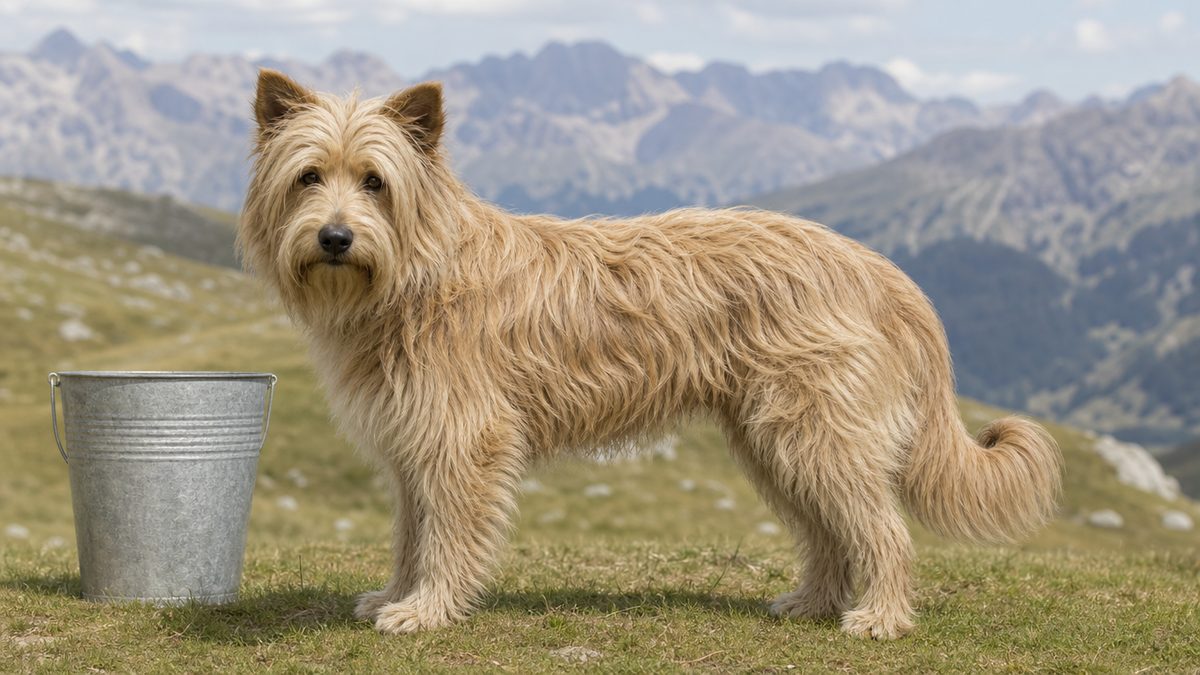
The Pyrenean Sheepdog is a small French herding dog, 42 to 48 cm at the withers for a long-haired male, bred to move flocks in the high Pyrenean pastures alongside the much larger guardian that protected them.
Its FCI standard opens with the best one-line description any breed has: 'Dog displaying a maximum of nervous energy in a minimum of size and weight. An ever alert physiognomy, a knowing air combined with great liveliness of movement give this dog a characteristic appearance unlike any other';. The Royal Kennel Club renders the same idea in the breed's traditional phrase, 'a minimum of size with a maximum of strength', and describes a dog that is 'quite lightly built and energetic... independent, but also a little sensitive and wary of strangers';.
The behaviour paragraph is equally direct. The standard calls it 'a courageous, resourceful little dog, showing initiative', and the smooth-faced standard describes a 'lively, biddable dog, sometimes wary of strangers'; FCI-Standard N° 138. Both FCI standards make the breed subject to a working trial, which is a meaningful signal: the FCI does not require working trials of companion breeds.
The history, and one date that does not agree
The standard's own history is unusually honest about how recent the breed's paperwork is. It records that the dog was 'practically unknown to the official dog scene until the early 20th century', that 'its type varies considerably from one valley to the next, its shape, its coat can be very different, but its character and behaviour never vary', and that 'the first official standard was drawn up between 1921 and 1925 by Mr. Bernard Senac-Lagrange';. The Royal Kennel Club, describing the same event, says 'the first French Breed Standard was published in 1926';.
Those are not the same claim. Drawn up between 1921 and 1925 and published in 1926 can both be true, and this page publishes both rather than picking one, because neither body shows its working. What both agree on is the mechanism: almost every valley had its own type, and a standard was imposed on that variation rather than discovered in it. That is why the coat question in the next section is as tangled as it is.
Size, and three sets of numbers
The long-haired standard gives males 42 to 48 cm and females 40 to 46 cm with a tolerance of plus or minus 2 cm. The smooth-faced standard gives males 40 to 54 cm and females 40 to 52 cm, with no tolerance stated, and the authentic French text prints the same figures. The smooth-faced dog is therefore the taller of the two at the top end by six centimetres.
| Source | Long-haired male | Long-haired female | Smooth-faced male | Smooth-faced female |
|---|---|---|---|---|
| FCI standards 141 and 138 | 42-48 cm (plus or minus 2) | 40-46 cm (plus or minus 2) | 40-54 cm | 40-52 cm |
| Societe Centrale Canine breed page | 40-48 cm | 38-46 cm | 42-54 cm | 40-52 cm |
| American Kennel Club, by variety | 15.5-18.5 in rough-faced | 15-18 in rough-faced | 15.5-21 in smooth-faced | 15.5-20.5 in smooth-faced |
Two things fall out of that table. The SCC's long-haired range sits exactly 2 cm below the FCI's at the floor for both sexes, which is what folding the standard's downward tolerance into the range produces. Its smooth-faced male floor, at 42 cm, sits 2 cm above the FCI's 40 cm, and that cannot be a tolerance fold because standard 138 states no tolerance at all. So on one figure the French national body and the FCI genuinely disagree. Read the standard, not the summary, and read the range separately from its tolerance.
The AKC, meanwhile, files a single breed and gives its weight as 15 to 30 pounds, roughly 7 to 13.5 kg. Neither FCI standard states a weight at all.
If a photograph shows a large white dog, you are looking at the Pyrenean Mountain Dog at 70 to 80 cm, or the Pyrenean Mastiff. White coats are not permitted in this breed at all. The two dogs worked the same flocks and are constantly confused, which is why Google's People also ask box for this query returns three questions about the other one.
One breed or two? Four registries, four answers
The Pyrenean Sheepdog's coat varieties are filed as two breeds by the FCI and by the Kennel Club, as one breed with two varieties by the AKC and the OFA, and as two breed records under one club and one shared selection grid in France.
This is the question every ranking page skips, and the answer is genuinely unsettled rather than merely unclear. Even finding the breeds in the FCI's own index takes care: its letter pages are keyed on the original-language name, so both dogs file under C as Chien de Berger des Pyrenees, and a search under P for 'Pyrenean' returns 27 entries with Pekingese, Pug and Puli in them and no Pyrenean breed at all. Bonbeno read each body's own documents on 8 September 2026 rather than any summary of them.
Start with the coat types, of which there are three
France recognises three coat types and the FCI splits them two-to-one. The Societe Centrale Canine's own breed text describes all three in one paragraph: the poil long is 'assez sec sur les epaules et plus laineux sur l'arriere du corps' and can form cords called cadenettes or felted mats called matelotes; the poil mi-long is 'generalement de texture plus poil de chevre', a goat-hair texture; and the face rase coat is 'nettement plus court et plus fin';. FCI standard 141 covers the first two together, describing hair that is 'long, or semi-long, but always dense', and standard 138 covers the third.
The FCI splits them, and its own standard calls them varieties
The FCI's register holds two separate breed numbers with two separate definitive acceptance dates. Standard 141 was accepted on 28 January 1955 and standard 138 on 26 January 1955, two days earlier Federation Cynologique Internationale. Both dates were proved from each record's own face rather than assumed: the records print M/D/YYYY, and the second field carries 25, 21, 28, 26, 15, 17 and 13 across the two pages, none of which can be a month, while no first field exceeds 12.
Then standard 138 undercuts the split in its own text. Its history opens 'This variety of Pyrenean Sheepdog was principally found in the Pyrenean foot-hills', its general appearance reads 'Overall, the smooth-faced Pyrenean Sheepdog has the same characteristics as the long-coated Pyrenean Sheepdog', and its faults clause reads 'The faults and eliminating faults are the same as those indicated for the long-coated variety, except for those describing coat and proportions';. The authentic French says the same, 'Cette variete du berger des Pyrenees' and 'la variete a poil long';. Standard 138 is five pages and 3,883 characters against 141's nine pages and 10,460, because it is a differential standard that defines a dog by reference to another one.
Standard 138 records that the smooth-faced dog's distinctive features 'gained it an appendix in the breed standard from the 1920s'. An appendix to another breed's standard is exactly what a variety is, and the FCI nonetheless gave it its own number two days before it gave one to the dog it is an appendix to.
The four positions, side by side
| Body | Filing | Evidence |
|---|---|---|
| FCI | Two breeds | Standards 141 and 138, definitive 28 and 26 January 1955, each with its own record |
| The Kennel Club (UK) | Two breeds, 33 years apart | Long-haired recognised 1988; smooth-faced with effect from 1 April 2021, on the Imported Breed Register |
| American Kennel Club | One breed, two varieties | 'Pyr Sheps come in rough-faced and smooth-faced coat varieties', with height printed per variety |
| Orthopedic Foundation for Animals | One breed, one code | A single checkbox, value PS, data-name PYRENEAN SHEPHERD; no variety split anywhere in 478 breed entries |
| Societe Centrale Canine | Two records, one club, one grid | Separate breed records linking standards 138 and 141, one breed club (RACP), and one selection grid covering both |
The Kennel Club's recognition announcement is the most precise document in that table. It states verbatim that 'the Pyrenean Sheepdog (Smooth Faced) has been recognised by The Kennel Club with effect from 1 April 2021' and 'will be classified in the Pastoral Group on the Imported Breed Register', that it 'is very closely related to the Pyrenean Sheepdog (Long Haired), recognised by The Kennel Club in 1988', and that the club then recognised 222 breeds in total. So Britain took 66 years longer than the FCI to reach the same split.
The Kennel Club then contradicts its own filing on the breed page. Its Breeds A to Z entry for the long-haired dog says 'Both varieties thrive on training and an active, varied life', using the word variety on a page that belongs to one of two separately registered breeds.
What France actually does, and where Wikipedia goes wrong
English Wikipedia states that the smooth-faced dog 'is recognised as a separate breed from the former two by the Societe Centrale Canine';. Bonbeno tested that against the SCC's own documents and the picture is more mixed than the claim allows.
The SCC does maintain two breed records, and the face rase record links standard 138 directly. But that same record describes both coats in one continuous text under one heading, it names one breed club for both, the Reunion des Amateurs de Chiens Pyreneens, and the SCC publishes a single selection grid titled 'GRILLE DE SELECTION DU BERGER DES PYRENEES A FACE RASE ET A POIL LONG', approved by its breeding commission on 2 December 2025 and validated by its committee on 29 January 2026. One grid, one club, one description, two records.
The Livre des Origines Francais adds a fourth layer. A pedigree record read on the same day prints the breed as 'Berger des Pyrenees A Poil Long' and then a separate variety line reading 'A poil long';. So the French studbook carries a race field and a variety field for the same dog, which is precisely the structure a body uses when it is holding one breed with named varieties.
The honest summary is that France files them as two records administered as one breed, the FCI files them as two breeds while calling one a variety of the other, Britain files them as two breeds recognised 33 years apart, and America files them as one breed with two varieties. A buyer in India should therefore expect a pedigree document to name a coat, and should not be surprised if two documents from two countries disagree about whether that coat is a breed.
Pyrenean Sheepdog price in India
No Pyrenean Sheepdog price in India survives inspection, and the figure Google attaches to the breed belongs to a Poodle named Dugu.
Search the commercial query from an Indian connection and the page Google ranks first is not about this breed at all. It is a Great Pyrenees sales page, which is the Pyrenean Mountain Dog, a breed five times the weight. The page that does carry the breed's name sits at position six.
The Rs 92,599 figure, traced to its source
Google's snippet for that sixth result reads 'Price Rs 92,599 Platinum Dugu'. Bonbeno pulled the page's raw HTML and audited every price span and every carousel entry. There are thirteen rupee price spans on the page: Rs 98,999 six times, Rs 92,599 four times, Rs 76,499 twice and Rs 94,999 once. Not one is attached to a Pyrenean Sheepdog.
The carousel lists eight named animals, all eight weeks old, and the site's own image filenames say what each one actually is.
| Animal | Image filename in the site's own markup | Actual breed |
|---|---|---|
| Dugu | Poodle-Dugu | Poodle, and the animal Google's Rs 92,599 belongs to |
| Kuzo | Poodle-Kuzo-male | Poodle |
| Samy | Maltipoo-samy | Maltipoo |
| Fizey | Maltipoo-Male-Fizzy | Maltipoo |
| Tugi | Rottwieler-tugi | Rottweiler |
| Yoki | Dachshund-yoki | Dachshund |
| Kazuka | Cane-corse-kazuka | Cane Corso |
| Doir | GD-Dior | Goldendoodle |
The page's own photographs are stock images, filed as istockphoto-585179054 and istockphoto-1176188114. So the listing is a stock photograph of the breed above a carousel of eight animals of other breeds, and a search engine has lifted one of their prices and printed it beside this breed's name. That is the whole laundering mechanism visible in a single page.
Rs 92,599 sits inside a set of recurring house figures that Bonbeno has now recorded on two separate pages for two separate Pyrenean breeds, always attached to the same eight animals. Trace any quoted figure back to the page it came from, then check what that page is actually selling.
What the spec card says, and why it is not evidence either
The same page prints a specification card giving height 16 to 19 inches, weight 9 to 14 kg, life expectancy 12 to 14 years, shedding yes, origin France, ideal space 'Farmhouse', and an exercise routine of 60 to 90 minutes a day. The height and weight are broadly consistent with the AKC's figures, and the life expectancy is not consistent with anything: the AKC prints 17 to 19 years and the Royal Kennel Club prints 'over 12 years', neither with a source.
The honest position
Treat any Pyrenean Sheepdog price in India as unverified. Ask which coat variety the dog is, ask for the pedigree document, and expect that document to name a coat because the FCI, the Kennel Club and the SCC all record one. Bonbeno reports published prices as editorial content and does not sell dogs, broker sales, recommend breeders or link listings. The cost that is real and checkable is the cost of keeping the dog, and that is next.
Cost of ownership in India for a 9 to 15 kg working dog
Budget the cost of ownership for a small, high-energy working dog rather than a breed price, because that is the number Indian sources actually publish and it is the number that recurs every month.
This breed sits in a cheaper weight band than most of the imported dogs Indian buyers consider, which changes the arithmetic in the owner's favour. Parasite cover is the clearest example: the NexGard Spectra pack for a 15 to 30 kg dog works out at Rs 1,103 a month, and a Pyrenean Sheepdog at 9 to 14 kg sits below that band, so the lighter pack applies. Deworming with Drontal Plus is Rs 125.67 a tablet dosed at one per 10 kg, so a single deworming is roughly Rs 126 to Rs 189 rather than the Rs 566 a giant would cost.
Vaccination is a spread rather than a price. One metro chain lists anti-rabies at Rs 699, the nine-in-one DHPPiL at Rs 899, canine corona at Rs 899 and kennel cough at Rs 1,349, with an annual booster course starting at Rs 3,199 on its national page and Rs 3,299 on its Mumbai page on the same day. Those are promotional floors from one chain, and the per-vaccine prices are the stable layer.
| Item | Published Indian figure | Frequency |
|---|---|---|
| Anti-rabies vaccine | Rs 699 | Annual |
| Nine-in-one DHPPiL | Rs 899 | Annual |
| Kennel cough | Rs 1,349 | Annual, if boarded |
| Annual booster course | From Rs 3,199 to Rs 3,299 by city page | Annual |
| Tick and flea cover | Below the Rs 1,103 per month 15-30 kg band | Monthly |
| Deworming, Drontal Plus | About Rs 126 to Rs 189 per dose | Two to three times a year |
| Delhi MCD dog registration | Rs 500 new, Rs 500 renewal | Annual |
| Chennai GCC pet licence | Rs 50 | Annual |
Municipal fees are the only durable rows here. Delhi's corporation charges Rs 500 to register a pet dog and the same to renew, with a Rs 100 monthly late fee, and its counter records 18,958 certificates issued since 2021 and 71 of 1,006 applications rejected in 2026-27. Greater Chennai Corporation charges Rs 50, issued 9,115 licences in 2024, and runs six municipal pet clinics that provide treatment and anti-rabies vaccination free of cost.
The two lines nobody prices
The first is hip screening. The Societe Centrale Canine's selection grid for this breed requires a hip dysplasia reading of A, B or C before a dog reaches even the second of six cotation levels, and A or B for the Elite levels, and for dogs living in France the radiographs must be read by one of the breed club's own official readers. In India there is no equivalent club reader, so the cost is a sedated radiograph plus an independent reading, and it is a cost worth paying on a breed running 13.8 percent dysplastic.
The second is time. The Royal Kennel Club asks for more than two hours of exercise a day for this breed. In an Indian summer that has to happen in the two coolest hours of the day, which for a working household is the real constraint. The Societe Centrale Canine puts the consequence of failing it bluntly: left alone in a flat or a garden, this dog 'aura toutes les chances d'etre aboyeur, voire destructeur';.
Bonbeno does not publish a monthly kibble figure for this breed. Indian retail bag prices move within days, and grams per day for a 9 to 14 kg dog working two hours a day differ sharply from the same dog kept quietly. Weigh your dog, read the chart on the pack you actually buy, and calculate it yourself.
One caution on Indian cost tables generally. Several Indian breed sites publish monthly running costs assembled from a small set of preset lines, so the same food, health and grooming figures appear across unrelated breeds. If you meet a tidy monthly total for this breed, pull one unrelated breed from the same site and compare the component lines to the rupee before you trust it.
Indian climate: a working dog in a country it cannot work in
The Pyrenean Sheepdog's heat problem is not its coat, it is its job, because a breed asked for more than two hours of daily work cannot get that work in an Indian summer without exertional risk.
Bonbeno pulled NASA POWER climatology by explicit latitude and longitude for six Pyrenean points and eight Indian ones on 8 September 2026, echoing the elevation of the grid cell the model used against the real elevation of each place. That check matters here because the Pyrenees are exactly the terrain where the model collapses.
Five Pyrenean towns came back as one grid cell
Five of the six Pyrenean points returned a byte-identical series from a single cell at 980.73 m: Lourdes at a real 410 m, Argeles-Gazost at 450 m, Bagneres-de-Bigorre at 551 m, Cauterets at 932 m and the Pic du Midi de Bigorre at 2,877 m. One cell was reporting a foothill town and a 2,877 m summit at once, an error of 1,896 m at the top end. Only Gavarnie returned its own cell, at 1,323.90 m against a real 1,375 m, and Gavarnie is therefore the one Pyrenean figure this page will quote.
That collapse is itself relevant to the breed. The standard says its type varied from valley to valley, and the reason is that the Pyrenees are a place where conditions change over a few kilometres. A climate model that cannot tell Lourdes from a mountain summit is failing on the same terrain that produced the breed's variation.
| Place | Cell elevation | Annual mean | Warmest month mean | Annual RH2M | Peak wet bulb |
|---|---|---|---|---|---|
| Gavarnie, French Pyrenees | 1,323.90 m | 8.60 C | 18.12 C (July) | 71.92% | 13.45 C (July) |
| Delhi | 206.37 m | 25.57 C | 35.88 C (June) | 45.51% | 26.50 C (July) |
| Kolkata | 7.35 m | 25.80 C | 31.53 C (May) | 73.84% | 27.09 C (June) |
| Chennai | 48.95 m | 27.94 C | 31.51 C (May) | 72.39% | 26.11 C (May) |
| Mumbai | 97.15 m | 26.77 C | 31.19 C (May) | 67.28% | 25.77 C (June) |
| Pune | 635.99 m | 23.86 C | 28.93 C (April) | 66.68% | 22.97 C (June) |
| Bengaluru | 841.72 m | 23.74 C | 28.37 C (April) | 67.84% | 21.86 C (May) |
The humidity claim is wrong here too
The Pyrenees are damp. Gavarnie runs 71.92 percent annual relative humidity, above Mumbai at 67.28, Bengaluru at 67.84 and Pune at 66.68, and essentially level with Chennai at 72.39. So the standard line that Indian humidity will destroy a mountain breed does not survive the homeland's own numbers. This dog is heat-sensitive, and it is heat-sensitive because of temperature and workload rather than because of damp air. What changes is heat, and heat combined with moisture.
Wet bulb is the measure that matters, because a panting dog cools by evaporation and wet bulb is the floor evaporation can reach. Computed from mean temperature and mean relative humidity, Gavarnie peaks at 13.45 C in July. Kolkata peaks at 27.09 C, Delhi at 26.50 C and Chennai at 26.11 C. That is a gap of 12.7 to 13.6 degrees in the one variable that governs whether panting works at all.
Why the job is the risk, not the coat
In a cohort of 905,543 UK dogs, of the 1,259 heat-related illness events recorded from 1,222 dogs, 879 had a recorded trigger and 652 of those, or 74.2 percent, were exertional rather than caused by a hot vehicle. A companion paper on the same cohort put overall incidence at 0.04 percent and case fatality at 14.18 percent. Exercise in heat is what fills the clinic.
This breed is the exertional case by design. It wants more than two hours of hard work a day and it will invent work if you do not supply it Societe Centrale Canine. Give an Indian Pyrenean Sheepdog its two hours in a Delhi May and you have created the exact exposure the UK data measures.
The clearest published guidance in a Pyrenean breed comes from a fatal case in the Pyrenean Mountain Dog, and its clinical advice is general. Cold-hosing 'causes peripheral vasoconstriction that impedes heat loss'. Use cool wet towels, move to a vet, stop cooling before the temperature reaches normal because it keeps falling, and know that maximum heat loss occurs when the skin temperature is 22 to 28 C.
The city verdict
Bengaluru and Pune are the two mainland Indian cities where this breed can get its exercise most of the year, with annual means of 23.74 C and 23.86 C and April peaks under 29 C. Delhi, Chennai, Kolkata and Mumbai each pair a hotter peak with a wet bulb above 25 C, and in those cities the two-hour requirement has to be split across a pre-dawn and a late-night session for six months of the year. If you cannot commit to that, the breed will fail in your home and it will fail loudly.
Temperament, and the flat problem stated plainly
The Pyrenean Sheepdog is intelligent, wary of strangers and intensely bonded to one person, and the Societe Centrale Canine warns in its own text that left alone it will very likely become a barker or destructive.
The FCI standard calls it 'a courageous, resourceful little dog, showing initiative', and the smooth-faced standard describes a 'lively, biddable dog, sometimes wary of strangers'; FCI-Standard N° 138. Purina UK, whose page ranks first in India for the informational query, adds that the breed is 'loyal and responsive to their owners' but 'suspicious of strangers and strongly motivated to watch for movement, herd and bark';.
Notice what those three descriptions have in common. Every one of them names watchfulness and initiative before it names affection. This is a dog that decides things.
The French text is the most useful, and the least quoted
The Societe Centrale Canine's own breed article is franker than any English-language page about this breed. It describes 'un chien a la fois tetu et sensible', a dog both stubborn and sensitive, requiring 'un certain doigte pour l'eduquer', a certain deftness to train. It warns that because the dog is small with a rascally air, owners are easily softened, 'ce qui a generalement pour resultat d'en faire un chien demoniaque', which generally results in a demonic dog. That is not a translation joke; it is a national kennel club telling prospective owners that this breed exploits indulgence.
Who it suits in India, and who it does not
It suits a single dedicated owner or a couple who will work the dog daily, in Bengaluru or Pune, ideally with access to open ground, dog sport, or an actual job. The SCC lists the activities that work: 'travail sur troupeau, pistage, agility, obeissance, oberythmee', herding work, tracking, agility, obedience and canine freestyle.
It does not suit a household with toddlers, and Purina UK says so directly: the breed is 'not suited for homes busy with small children' and 'not at all suited for first time owners';. A herding dog with a strong instinct to move things that run will try to move a running child. It also does not suit anyone who leaves a dog alone all day, and it does not suit a household unwilling to socialise it hard against the constant stream of people who come to an Indian door.
- Wariness of strangers is the trait to work on first, because an Indian household has daily help, a cook, a driver, couriers and building staff at the door.
- Barking is the trait that will get you complaints, and the SCC names it as the direct consequence of leaving this dog alone.
- Herding pressure on children and on other pets is manageable with training and impossible to ignore.
- Attachment to one person is a feature until you travel, at which point it becomes a boarding problem.
The SCC's own view is that this dog 'est plus campagnard que citadin', more countryman than city dweller, but that it is above all the dog of one master, and it is happier with a city owner who takes it everywhere and gives it a solid hour of free exercise in a wood than in the small garden of a house where it spends long hours alone. The condition is your time, not your floor area.
Training a dog the FCI puts through a working trial
Train this breed for real work rather than for manners, because both FCI standards make it subject to a working trial and because the Royal Kennel Club says both varieties thrive on training and an active, varied life The Royal Kennel Club.
The working-trial line in the FCI record is the single most useful training fact about this breed, and it separates it sharply from the giant it worked beside. FCI 141 and FCI 138 both read 'subject to a working trial according to the FCI Breeds Nomenclature', while FCI 137, the Pyrenean Mountain Dog, reads 'not subject to a working trial'; Federation Cynologique Internationale. One of those two dogs was selected to take instruction and one was selected to work without it.
So the ceiling here is genuinely high. The Societe Centrale Canine recommends herding work, tracking, agility, obedience and canine freestyle by name, and adds that basic education matters as much as sport: lead walking, heeling, recall, sit, down and retrieve. In an Indian city, agility and scent work are the two that are actually available.
The socialisation window is the whole game
Both standards describe a dog that is wary of strangers, and an Indian home presents more strangers per week than the pastures this breed came from present in a season. Work deliberately through the first sixteen weeks.
- Weeks 8 to 16: introduce every routine visitor by repetition, with the puppy calm and away from the door, never at the gate and never barking.
- Weeks 8 to 16: build a settle on a mat, so a doorbell means a place rather than a challenge.
- Months 3 to 6: start scent games and simple problem-solving, because an unstimulated dog of this breed invents its own work.
- Months 4 to 9: build recall on a long line in cool hours, and never off-lead near traffic given the herding instinct.
- Months 6 to 12: teach standing for grooming and for coat handling, because cords and mats have to be worked out by hand.
- Months 9 to 18: expect the herding instinct to sharpen and manage it around children and other pets rather than punishing it.
The training mistake specific to this breed
The SCC names it precisely: because the dog is small and looks mischievous, owners indulge it, and the result is a dog that runs the household. That is a different failure from the giant guardian's, which simply ignores you. This dog will take every inch it is offered and then defend the territory it has acquired with barking.
The second mistake is training in heat. With more than two hours a day required and 74.2 percent of UK heat-illness events with a recorded trigger being exertional, every training session in an Indian April, May or June belongs in the coolest hour available.
Exercise: more than two hours, and where it has to happen
The Royal Kennel Club puts this breed's requirement at more than two hours per day, which is the highest figure on any Pyrenean breed page on this site.
Compare that with the Pyrenean Mountain Dog, which the same club rates at up to one hour per day, and the difference in job shows immediately. A guardian conserves energy; a herder spends it. The Indian sales pages that do carry this breed describe it as agile before they describe it as anything else, and on that one point they are right. The SCC describes a dog whose energy 'est considerable' and which must have that energy channelled.
One Indian sales page prints 60 to 90 minutes a day, which is below the Royal Kennel Club's figure and is worth naming as a disagreement rather than adopted quietly. Where a national kennel club and a seller disagree about how much work a dog needs, the seller has an interest and the club does not.
Splitting two hours in an Indian summer
Two hours cannot be done in one block from March to October in most Indian cities. The workable pattern is a long session before sunrise, a short one after dark, and mental work indoors through the day.
| City | Hottest month mean | Workable outdoor window | Indoor substitute needed |
|---|---|---|---|
| Bengaluru | 28.37 C (April) | Wide most of the year | Occasional, April and May |
| Pune | 28.93 C (April) | Wide most of the year | Occasional, April and May |
| Mumbai | 31.19 C (May) | Pre-dawn and after dark | Daily, March to October |
| Chennai | 31.51 C (May) | Pre-dawn and after dark | Daily, most of the year |
| Kolkata | 31.53 C (May) | Pre-dawn and after dark | Daily, March to October |
| Delhi | 35.88 C (June) | Pre-dawn only in June | Daily, and heavily, April to July |
Indoor substitutes are not filler for this breed, they are the part of the plan that makes an Indian summer survivable. Scent work in a cool room, food puzzles, trick chains and short shaping sessions burn a herding dog's attention in a way that a longer walk does not.
The SCC states that this breed, alone in a flat or a garden, has every chance of becoming a barker or destructive, and separately that it is an economical eater that gains weight easily without enough exercise. In India those two failures arrive together, because the months when exercise is hardest are the months the dog is indoors most.
Grooming cords and mats in Indian humidity
Line-brush this coat at least twice a week and know which of the three coat types you own, because the long-haired dog forms cords and felted mats that the smooth-faced dog never will.
The FCI describes the long-haired coat as 'long, or semi-long, but always dense, almost flat or slightly wavy, thicker and woollier on the croup and thighs, texture somewhere between goat's hair and sheep's wool', and adds that in some dogs the mixture of coarse and woolly hair produces 'sorts of strands or cords called cadenettes and sometimes matted or felted hair called matelotes';. Those two French words are the whole grooming problem in one sentence.
Cords are a feature of the working coat. Felted mats are not, and in Indian humidity the distance between the two is short. The SCC's own description separates the three coats cleanly: the poil long is drier over the shoulders and woollier behind, the poil mi-long is closer to goat hair, and the face rase coat 'est nettement plus court et plus fin';. The smooth-faced dog's standard gives its longest hair as 6 to 7 cm on the neck and withers and 4 to 5 cm along the midline of the back.
| Coat | Baseline frequency | The Indian complication |
|---|---|---|
| Long-haired (poil long) | Line brushing three times a week | Cadenettes tighten and felt into matelotes when the coat stays damp |
| Semi-long, goat-haired (poil mi-long) | Twice a week | Harsher texture sheds water better but still mats behind the ears |
| Smooth-faced (face rase) | Twice a week | Shortest coat of the three, but the neck and withers still reach 6 to 7 cm |
| All three | Full dry after every bath | Air drying is standard overseas advice and it is wrong in a monsoon |
| All three | Weekly ear and skin check | The SCC names skin problems, tied to a sedentary life and excess weight, as the breed's main recorded issue |
The Royal Kennel Club rates this breed's grooming as 'more than once a week';. Take that as an English floor and raise it through the Indian monsoon, particularly on a corded long-haired dog.
Ticks matter more than tangles
A dense coat hides ticks, and India's tick-borne disease pressure is heavy. Among 584 dogs screened at veterinary clinics in West Bengal, Babesia gibsoni was found in 76.54 percent and 72.9 percent of the 584 dogs screened carried two or more pathogens. A southern Indian series of 120 dogs found Babesia in 66.7 percent with a pre-monsoon March to May peak. Both sampled clinic caseloads rather than random populations, so the percentages describe dogs brought in sick. On a coat like this, the monthly parasite tablet in the cost section does the work your eyes cannot.
This is one of the few breeds where the hypoallergenic question has actually been measured on the breed itself. A French study weighed Can f 1 on shaved fur from 288 healthy dogs across eight breeds including the Pyrenean Shepherd, and found only the Labrador significantly different from every other breed. A larger study of 196 so-called hypoallergenic dogs against 160 controls found the hypoallergenic group carried more allergen on hair and coat, not less. No dog breed is hypoallergenic, and this one sheds.
Health, screening, and a lifespan nobody has measured
The Pyrenean Sheepdog has no measured median lifespan, clean elbows on 130 OFA evaluations, and a hip dysplasia rate of 13.8 percent on 347 evaluations, which is higher than the giant it worked beside.
Start with what does not exist. This breed is absent from the 155 recognised purebreds in McMillan's 2024 UK longevity study, and that absence was established from the supplementary table itself rather than from the article body. That distinction matters, because a body-text search of the same paper returns zero for 'Pyrenean' and 'Pyrenees' while the Pyrenean Mountain Dog is present in the supplementary table with a median of 10.9 years. Searching the article alone would have produced a false absence for one breed and a true one for this breed, for the same reason, which is not a method anyone should rely on.
So the lifespan figures circulating are claims rather than measurements. The AKC prints 17 to 19 years, which would make this one of the longest-lived breeds on earth, with no source given. The Royal Kennel Club prints 'over 12 years';. An Indian sales page prints 12 to 14 years. Three sources, a seven-year spread, and no study behind any of them. This page will not average them.
The OFA tables, and the finding that inverts expectations
The Orthopedic Foundation for Animals holds this breed under a single code, PS, with no split by coat variety anywhere among its 478 breed entries. Searching for the FCI and Kennel Club name returns nothing: 'PYRENEAN SHEEPDOG' appears zero times in a 2,232,040-character retrieval of the OFA statistics, while the control string LABRADOR appears 109 times. The data sits under PYRENEAN SHEPHERD.
| Test | Evaluations | Result |
|---|---|---|
| Hips | 347 | 85.3% normal, 13.8% dysplastic (mild 9.5, moderate 4.0, severe 0.3) |
| Elbows | 130 | 100.0% normal, 0.0% dysplastic |
| Patellae | 294 | 98.3% normal |
| Dentition | 131 | 96.9% normal |
| Cardiac, advanced | 69 | 82.6% normal, 5.8% equivocal, 11.6% abnormal |
| Cardiac, basic | 67 | 100.0% normal |
| Cardiac, congenital | 120 | 99.2% normal |
| Eyes, summary row | 663 | 94.3% normal |
| Eyes, detail rows | 663 | 549 normal, which is 82.8% |
The hip row sums exactly in both directions, 11.8 plus 62.8 plus 10.7 equals 85.3 percent normal and 9.5 plus 4.0 plus 0.3 equals 13.8 percent dysplastic. Check that arithmetic on any table before quoting it.
This breed runs 13.8 percent dysplastic on 347 evaluations. The Pyrenean Mountain Dog, at three to five times the weight, runs 9.5 percent on 7,501, and the Pyrenean Mastiff runs 34.6 percent on 104. Size does not predict hip dysplasia within one mountain range, and anyone who assumes a small herding dog is safe has assumed wrong.
The elbow row is the good news and deserves saying plainly: zero dysplastic elbows in 130 evaluations. The cardiac rows are the ones to watch, because the advanced cardiac table reports 11.6 percent abnormal on 69 evaluations, which is a high proportion on a small denominator and is worth asking a breeder about.
The eye tables contradict themselves here too
The eye summary row reports 94.3 percent normal across 663 evaluations. The per-diagnosis detail rows on the same denominator report NORMAL at 549, which is 82.8 percent, a gap of 11.5 points. Publish both, quote neither as the rate, and read the detail rows because they name diagnoses.
Those diagnoses matter more in this breed than in most, because several of them are merle-associated. Choroidal hypoplasia appears in 18 of 663 dogs (2.7 percent), retinal dysplasia folds in 12 (1.8 percent), persistent pupillary membranes iris-to-iris in 19 (2.9 percent), microphthalmos in 2, iris hypoplasia in 2, iris coloboma in 1 and optic nerve hypoplasia in 1. That is a cluster of developmental ocular findings, on the one breed on this page whose standard colours include blue merle.
The merle rule, and why it is a registration bar rather than advice
The Kennel Club's breed standard colours for this breed include Black, Black & White, Blue Merle, Brindle, Fawn, Grey and Slate Blue. On the same page it records a hard restriction: 'With effect from 1 January 2013, The Kennel Club will not register puppies whelped from a merle to merle mating born on or after this date. This is due to associated health risks of impaired vision and hearing associated with the merle gene in this breed.'
Read that against the OFA eye detail rows and the point is obvious. Two attractive blue merle parents can produce a litter that is unregistrable in Britain and impaired for life. An Indian buyer offered a merle puppy should ask what both parents were, and should treat 'both merle' as a reason to walk away rather than as a reason to pay more.
What the literature does have
A strict phrase search would tell you this breed has no literature and it would be wrong. '"Pyrenean Sheepdog"[tiab]' returns zero with the warning quotedphrasesnotfound; the unquoted form is broadened by PubMed into 'Pyrenean' anywhere plus 'Shepherd' in the title or abstract and returns four records, of which two are genuinely about the breed. One is a case of granulomatous mural folliculitis with scarring alopecia in a 13-year-old spayed female Pyrenean shepherd, managed with ciclosporin and methotrexate and stable for six months. The other measured Can f 1 allergen on the breed's fur. Under the French name, '"Berger des Pyrenees"[tiab]' returns four more, all pedigree genetics and canine genomics.
Screening this breed properly
The Societe Centrale Canine's own selection grid is the most concrete screening guidance available for this breed anywhere. It requires, from the second of six cotation levels upward, confirmation plus a hip dysplasia reading of A, B or C plus a behaviour or herding test plus one Excellent in show plus genetic identification, and it raises the hip requirement to A or B at the Elite levels. For dogs living in France the radiographs must be read by one of the breed club's official readers.
In India, ask for hips at minimum and ask what both parents' coat colours were. Second Schedule Part III paragraph 8(10) of the 2017 Rules already requires that breeding dogs have been tested for genetic defects including hip dysplasia, so a breeder who cannot produce a hip result is not merely unhelpful. The SCC's own health note on the breed is otherwise reassuring: it calls the dog resistant and says the main problems, and still rarely, are skin problems generally tied to a too-sedentary life and excess weight.
Feeding an economical eater that gains weight easily
Feed this breed to body condition rather than to appetite, because the Societe Centrale Canine describes an economical dog that is satisfied with little and puts on weight readily if it is under-exercised and fed freely.
The SCC's own wording is worth quoting: the breed is 'un chien economique, qui se satisfait de peu et prend facilement du poids s'il n'a pas assez d'exercice et si on se laisse aller a lui donner a manger autant qu'il veut car il est volontiers glouton';. An economical eater that is also willingly greedy is a combination that produces an overweight dog in a household that measures by the bowl rather than by the ribs.
That matters here more than it sounds, for two reasons. The SCC names skin problems tied to a sedentary life and excess weight as the breed's main recorded health issue. And in the UK heat data, bodyweight at or above the breed and sex mean carried odds of heat-related illness of 1.42. An overweight Pyrenean Sheepdog in an Indian summer is carrying both risks at once.
- Feed twice a day on a measured ration, and measure it with a scale rather than a cup.
- Score body condition monthly by feeling for ribs, because a dense coat hides a fat dog completely.
- Cut the ration in the months when exercise is restricted rather than after the weight appears.
- Keep water available at all times, especially in the months when the dog's work moves to pre-dawn.
- Move the main meal to the coolest hour, because a hot dog eats poorly and then overeats when it cools.
Indian availability, and one honest gap
The SCC's own advice is unfussy: good-quality commercial food, kibble or wet, matched to the dog's size and lifestyle, plus deworming two to three times a year and vaccination on the vet's schedule. All of that is available in Indian metros through the retailers that stock the parasite products in the cost section.
What this page will not give you is a monthly food figure in rupees. Indian retail bag prices moved within days the last time Bonbeno priced them, and grams per day for a 9 to 14 kg dog working two hours differ sharply from the same dog kept quietly indoors through a Chennai May. Weigh your dog, read the chart on the pack you actually buy, and do the arithmetic yourself.
The failure mode here is not underfeeding, it is table scraps and training treats that nobody counts. Subtract the day's treats from the day's ration, and use part of the meal itself as the training reward, which suits a breed that responds to work anyway.
Month by month through the first year in India
Plan the first year around the socialisation window that closes at sixteen weeks, the heat calendar, and the fact that this breed's energy arrives before its judgement does.
| Age | What matters most | The Indian detail |
|---|---|---|
| Under 8 weeks | Stay with the litter | Rule 8(1)(a) makes selling a pup under eight weeks unlawful in India |
| 8-12 weeks | Core vaccination begins | Anti-rabies Rs 699 and nine-in-one Rs 899 as single vaccines at one metro chain |
| 8-16 weeks | Socialisation window | Every routine visitor: help, cook, driver, courier, security. This window decides the adult dog |
| 3-4 months | Coat handling starts | Teach standing for line brushing before the coat needs it, not after |
| 4-6 months | Energy outruns judgement | Structured work indoors, and outdoor sessions only in cool hours |
| 6 months | Municipal registration | Delhi MCD Rs 500, Chennai GCC Rs 50 |
| 6-12 months | Herding instinct sharpens | Manage pressure on running children and other pets; do not punish the instinct |
| 9-12 months | First full Indian summer | The two-hour requirement splits into pre-dawn and post-dusk sessions |
| 12-18 months | Coat matures | On a long-haired dog, cords begin to form and need hand separation |
| 12-24 months | Hip screening becomes meaningful | The SCC grid requires an A, B or C reading before a dog is even breeding-recommended |
The heat calendar decides the arrival month
Time the puppy's arrival if you can. A puppy landing in a Delhi home in April meets a June averaging 35.88 C during the months it most needs to be outside learning about the world, and a socialisation window spent indoors is a window wasted. A puppy arriving in October has six workable months. Bengaluru and Pune, peaking in April at 28.37 C and 28.93 C, are the two mainland cities where the calendar is forgiving.
Three checks to make in month one
Ask which coat variety the pedigree names, because the FCI, the Kennel Club and the SCC all record one and they do not agree with each other about whether it is a breed or a variety. Ask what colour both parents were, because a merle to merle mating produces puppies The Kennel Club will not register and the OFA eye tables show why. And ask for the parents' hip results in writing, because 13.8 percent of 347 evaluated dogs of this breed are dysplastic.
How it compares with the herding dogs Indian buyers cross-shop
Against the herding and Pyrenean breeds an Indian buyer considers, the Pyrenean Sheepdog is the least documented on lifespan and among the most demanding on time.
| Breed | Measured median lifespan | OFA hip dysplasia | Daily exercise | In McMillan's 155? |
|---|---|---|---|---|
| Pyrenean Sheepdog | None measured | 13.8% of 347 | More than 2 hours | No |
| Pyrenean Mountain Dog | 10.9 years (10.5-11.3) | 9.5% of 7,501 | Up to 1 hour | Yes |
| Pyrenean Mastiff | None measured | 34.6% of 104 | See breed page | No |
| Border Collie | 13.1 years | See breed page | More than 2 hours | Yes |
| Labrador Retriever | 13.1 years | See breed page | 1 to 2 hours | Yes |
Three conclusions follow, and each of them points somewhere different.
It is the least evidenced of the three Pyrenean breeds
Of the three Pyrenean breeds on this site, only the Pyrenean Mountain Dog appears in McMillan's 155-breed table, at a median of 10.9 years from 128 deaths. This breed and the Pyrenean Mastiff are both absent, verified against the supplementary table itself. If a measured lifespan matters to you, this is not the Pyrenean to buy.
Its hips are worse than the giant's and far better than the mastiff's
At 13.8 percent dysplastic on 347 evaluations it sits between its two Pyrenean relatives, worse than the Mountain Dog's 9.5 percent on 7,501 and much better than the Mastiff's 34.6 percent on 104. All three figures came out of the same OFA retrieval on the same day, which is the only way to compare them honestly.
The real comparison is with the Border Collie
For an Indian buyer, the closest available dog is the Border Collie: a comparable herding intelligence, a comparable two-hour requirement, a measured median of 13.1 years, and an actual Indian presence with rescues and breeders you can visit. The Pyrenean Sheepdog offers a rarer dog with no measured lifespan, no verifiable Indian price, and a coat that needs more work in a monsoon. If the appeal is the working intelligence rather than the rarity, the Collie is the better answer.
Mistakes Indian owners actually make with this breed
Six mistakes account for most of the trouble Indian households have with this breed, and the first one happens before anyone has met a dog.
1. Buying the wrong Pyrenean entirely
Search this breed's price from India and the first result is a Great Pyrenees sales page, which is the Pyrenean Mountain Dog at 70 to 80 cm. Google's own People also ask box for the sheepdog returns three questions about that other breed. If a photograph shows a large white dog, it is not this one; white is not a permitted colour here at all.
2. Believing the rupee figure Google prints
The Rs 92,599 that Google's snippet attaches to this breed belongs to a Poodle named Dugu, proved from the selling site's own image filenames and product-category classes. The same page's carousel holds two Poodles, two Maltipoos, a Rottweiler, a Dachshund, a Cane Corso and a Goldendoodle, and no Pyrenean Sheepdog. Trace any figure back to the page it came from before you use it.
3. Breeding or buying merle to merle
Blue merle and slate blue are both breed standard colours, and The Kennel Club will not register puppies from a merle to merle mating born on or after 1 January 2013, naming 'associated health risks of impaired vision and hearing associated with the merle gene in this breed'. Ask what colour both parents were. Two merle parents is a reason to walk away.
4. Treating a two-hour dog as a flat dog
The Royal Kennel Club asks for more than two hours a day and the Societe Centrale Canine warns that this dog, left alone in a flat or a garden, will very likely become a barker or destructive Societe Centrale Canine. Neither body is describing a difficult dog. Both are describing an unemployed one.
5. Indulging a small dog because it looks mischievous
The SCC names this failure specifically, warning that because the breed is small with a rascally air it is easy to soften towards, which generally produces a demonic dog. This is the opposite of the giant guardian's failure mode, and it needs the opposite correction: consistency early, not force later.
6. Assuming a small herding dog has good hips
It runs 13.8 percent dysplastic on 347 OFA evaluations, higher than the giant Pyrenean Mountain Dog at 9.5 percent on 7,501. Ask for hip results in writing, and know that the French breed club requires an A, B or C reading before a dog is even recommended for breeding.
Cords forming in a long-haired coat are normal and named in the standard as cadenettes. Felted mats, called matelotes, are not the same thing and are what to prevent. Learn the difference before you reach for clippers.
Adoption and responsible sourcing in India
Adopt where you can, and where you cannot, verify five things before money changes hands: the coat variety on the pedigree, both parents' colours, the parents' hip results, the puppy's age and four generations of the pedigree.
Breed-specific rescue for this dog does not meaningfully exist in India, because the breed does not meaningfully exist here. What does exist is a very large population of small to medium Indian dogs in every municipal shelter in the country, many of them with the same energy and problem-solving drive that attracts people to this breed, and every one of them better adapted to the climate. Greater Chennai Corporation's six municipal pet clinics provide treatment and anti-rabies vaccination free of cost, which materially lowers the running cost of a rescued dog in that city.
If you are buying, verify these five things
- The coat variety named on the pedigree. The French studbook prints a race field and a separate variety field for the same dog, and the FCI, the Kennel Club and the SCC do not agree on whether that coat is a breed or a variety.
- Both parents' colours, because The Kennel Club will not register a litter from a merle to merle mating and the reason is impaired vision and hearing.
- The parents' hip results in writing. Second Schedule Part III paragraph 8(10) of the 2017 Rules requires breeding dogs to have been tested for genetic defects including hip dysplasia.
- The puppy's age. Rule 8(1)(a) makes it unlawful to sell a pup under eight weeks, so an offer of a six-week-old puppy tells you about the seller.
- Four generations of the pedigree, not two, for the reason in the next paragraph.
The genetics point that makes four generations matter
This breed's French population rests on a narrow base. Analysing pedigree data from the Livre des Origines Francais, the effective number of ancestors for Berger des Pyrenees dogs born between 1997 and 2001 was 16.0, against 34.0 for the Montagne des Pyrenees in the same study, and the average coefficient of inbreeding with both parents known was 7.2 percent against the Montagne's 4.0 percent. The authors also record that the expected contributions of the major ancestors were 'highly unbalanced' in this breed, which means a small number of dogs are over-represented in the modern population.
Indian law reaches this directly. Second Schedule Part II paragraph 6(3) permits only out breeding and line breeding, and prohibits in breeding, defined as 'breeding between relatives of the 2nd to 4th grade in straight or side line within the first four generations e.g. uncle to niece, nephew to aunt, cousin to cousin, grandparents to grandchildren', and incest breeding between parents and children or brother and sister. A breed with 16 effective ancestors and 7.2 percent average inbreeding is exactly the breed where four generations of pedigree is the minimum useful document, not the maximum.
The Societe Centrale Canine already publishes a per-dog inbreeding coefficient on its pedigree records, alongside the dog's FCI hip grade. If you are importing, that number is available and worth asking for.
Bonbeno does not sell dogs, broker puppy sales, recommend breeders or link puppy listings. Published price ranges appear here as editorial content and as evidence about the market, never as an offer.
The honest recommendation
If you live in Bengaluru or Pune, can give a dog more than two hours of real work every day for twelve to fifteen years, and want a small, intelligent, wary working partner rather than a companion, this breed can work in India. If you cannot commit the time, it will not, and the failure mode is a bored, vocal, overweight dog with skin problems, which is precisely the failure the French national body describes. Everything on this page is reference information rather than veterinary advice, and a registered veterinarian who has examined your animal outranks all of it.
Questions Indian buyers actually ask about the Pyrenean Sheepdog
What is the #1 best family dog?
Google's own answer names the Labrador Retriever, and for an Indian family that answer holds far better than this breed. The Labrador is the control breed behind every search on this page, it is available and rescuable everywhere in India, and it does not need the two hours of daily work the Royal Kennel Club asks for here. The Pyrenean Sheepdog is a working herder first.
Are Great Pyrenees on the aggressive dog list?
Great Pyrenees are on no Indian list, and no Indian list is in force. The March 2024 central circular naming so-called ferocious breeds was quashed by the Karnataka High Court and set aside by the Delhi High Court in April 2024, and the Centre told the Bombay High Court in January 2025 that it is not acting on it. Note that this question is about a different breed from the one on this page.
Is it better to have 1 or 2 Great Pyrenees?
This question is about the Pyrenean Mountain Dog rather than the Pyrenean Sheepdog, and Google returning it here is itself the finding. Livestock guardians were traditionally worked in pairs or groups because a single dog cannot cover a flock. The Pyrenean Sheepdog is the opposite case: it is a one-handler herding dog that works to a person, not to another dog.
What are the downsides of owning a Great Pyrenees dog?
The downsides of the Great Pyrenees are size, barking, shedding and independence, and three of those four transfer to the Pyrenean Sheepdog at a quarter of the weight. The Societe Centrale Canine warns that this breed left alone in a flat or a garden will very likely become a barker or destructive, and Purina UK says it is not at all suited to first-time owners.
What is the Pyrenean Sheepdog price in India?
No Pyrenean Sheepdog price in India can be verified. The page ranking first for the query is selling a Great Pyrenees. The page ranking sixth carries a snippet reading 'Price Rs 92,599 Platinum Dugu', and its own raw markup shows Dugu is a Poodle, alongside two Maltipoos, a Rottweiler, a Dachshund, a Cane Corso and a Goldendoodle, and not one Pyrenean Sheepdog.
Is the smooth-faced Pyrenean Sheepdog a separate breed?
It depends entirely on which body you ask, and the disagreement is real. The FCI files it as its own breed number, 138, accepted definitively on 26 January 1955, two days before the long-haired at 141. The Kennel Club recognised it separately with effect from 1 April 2021. The AKC files one breed with two coat varieties. FCI standard 138 itself calls the dog 'this variety of Pyrenean Sheepdog'.
How long does a Pyrenean Sheepdog live?
No measured median lifespan exists for this breed. It is absent from the 155 breeds in McMillan's 2024 UK study, verified by searching the supplementary table rather than the article body. The AKC prints 17 to 19 years with no source, the Royal Kennel Club prints 'over 12 years', and one Indian sales page prints 12 to 14 years. Those are three unsourced claims, not three measurements.
Can a Pyrenean Sheepdog cope with Indian heat?
A Pyrenean Sheepdog copes with Indian heat better than the giant it worked beside and still poorly. Its homeland's warmest month averages 18.12 C against Delhi's June at 35.88 C, and the breed wants more than two hours of daily work, which is exactly the exertion behind 652 of the 879 UK heat-illness events with a recorded trigger. Bengaluru and Pune are the workable cities.
Is the Pyrenean Sheepdog hypoallergenic?
No dog breed is hypoallergenic, and this one has actually been measured. A French study weighed Can f 1 on shaved fur from 288 healthy dogs across eight breeds including the Pyrenean Shepherd, and found only the Labrador significantly different from every other breed. A larger study of 196 so-called hypoallergenic dogs against 160 controls found the hypoallergenic group carried more allergen, not less.
Why will the Kennel Club not register some Pyrenean Sheepdog puppies?
The Kennel Club refuses to register puppies whelped from a merle to merle mating born on or after 1 January 2013, and it names the reason as 'associated health risks of impaired vision and hearing associated with the merle gene in this breed'. Blue merle and slate blue are both breed standard colours here, so two attractive parents can produce an unregistrable and impaired litter.
Does the Pyrenean Sheepdog need double dewclaws?
No. FCI standard 141 states that 'single or double dewclaws are acceptable on hind legs as is their absence', which is the opposite of the rule for the Pyrenean Mountain Dog, whose standard makes their absence an eliminating fault. Two breeds from the same mountain range therefore carry opposite requirements on the same anatomical feature.
How much does it cost to keep a Pyrenean Sheepdog in India each month?
Budget for a 9 to 15 kg working dog rather than a breed price. Monthly parasite cover runs about Rs 1,103 at the 15 to 30 kg NexGard Spectra band and less below it, deworming is Rs 125.67 per tablet at one per 10 kg, an anti-rabies vaccine is Rs 699 and a nine-in-one is Rs 899 at one metro chain, and Delhi charges Rs 500 to register a pet dog against Chennai's Rs 50.
Compare with similar breeds
Pyrenean Sheepdog sits in 2 Bonbeno groups. Each one compares it directly against the breeds it is genuinely an alternative to, on the same figures.