
Breed profile
Tamaskan Dog: the wolfdog without the wolf, checked against its own registers
A deliberately wolf-like sled-dog composite begun in the 2000s, holding a written standard and an open studbook under two competing registers, carrying no wolf ancestry at all, and recognised by no national kennel club.
Quick answer
The tamaskan dog is a modern sled-dog composite bred to look like a wolf while containing no wolf ancestry, held by two competing private registers with open studbooks and recognised by no national kennel club. Males stand 25 to 29 inches under the register's standard, and no verifiable Indian price or supply exists.
This page reports published research, registry documents and breed club statements for general information. It is not veterinary advice and cannot diagnose any individual animal. This breed has almost no published clinical literature, so the health conditions named here come from its own registers rather than from prevalence studies. If a dog of this type has a seizure, becomes weak or uncoordinated behind, or shows lameness while growing, consult your nearby veterinarian promptly rather than searching for a breed-specific answer that does not exist.
Tamaskan Dog at a glance, rated for India
What a Tamaskan Dog is, and what the register's standard requires
A Tamaskan Dog is a modern sled-dog composite bred to look like a wolf while containing no wolf ancestry, and its own register coined the description: 'the Wolfdog without the Wolf'.
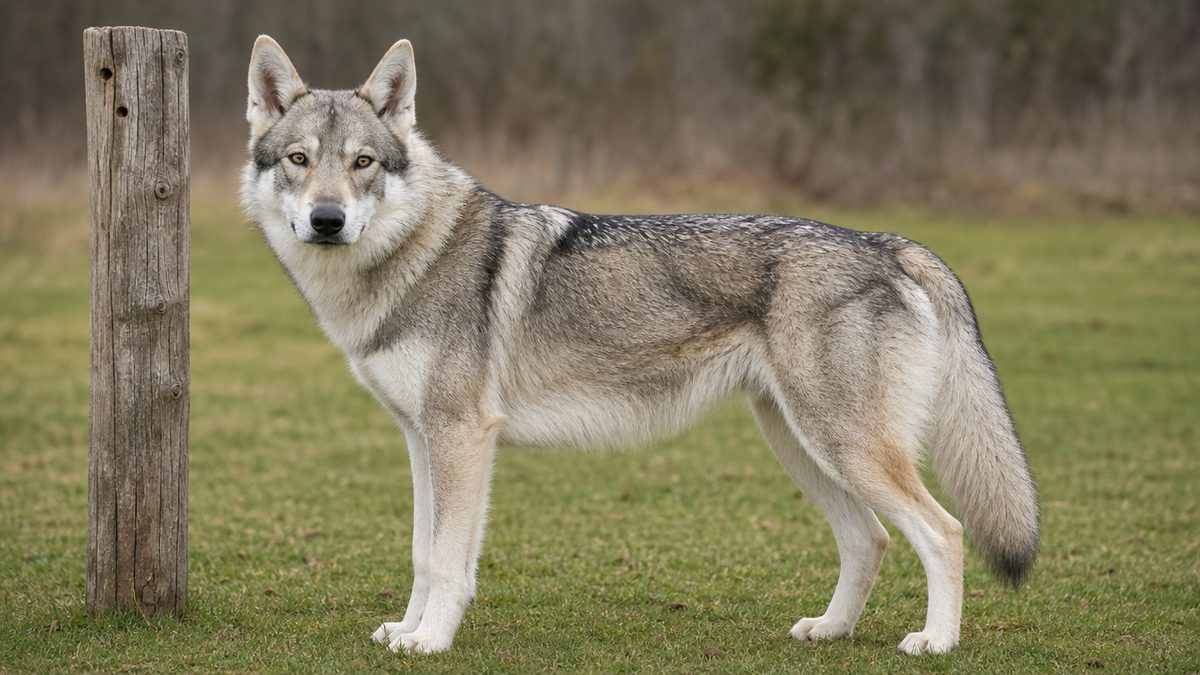
The Tamaskan Dog Register's breed standard describes a large, rangy, wolf-like dog bearing witness to a northern heritage of sled dog type: a well-balanced working dog, quick and light on its feet, free and graceful in action, with a well-furred body, erect ears and a bottle-brush shaped tail. It adds a sentence most standards leave out: the Tamaskan is intelligent and a fast learner, however he may be willful.
Size and weight, and three figures that do not agree
The register's standard gives an ideal height at the withers of 63.5 to 73.66 cm, that is 25 to 29 inches, for males and 61 to 71 cm, 24 to 27.9 inches, for females, and gives no weight at all. English Wikipedia's infobox says 25 to 33 inches for males, and its own body text, two screens further down the same article, says 24 to 28 inches. Three numbers, one of them from the register that writes the standard.
| Measure | Tamaskan Dog Register standard | Wikipedia infobox | Wikipedia body text |
|---|---|---|---|
| Height, males | 63.5 to 73.66 cm (25 to 29 in) | 25 to 33 in | 24 to 28 in (60 to 70 cm) |
| Height, females | 61 to 71 cm (24 to 27.9 in) | 24 to 28 in | Slightly smaller than males |
| Weight, males | Not stated | 65 to 95 lb | 55 to 88 lb, heaviest just under 50 kg |
| Full maturity | Three to four years | Not stated | Not stated |
| Country of origin | Not stated on the standard page | Finland | Finland |
| Eye colour | Yellow through amber and brown; blue is disqualifying | Yellow to amber and brown; blue not acceptable | As infobox |
A 33-inch dog is four inches above the register's own ceiling and would be taller than an Irish Wolfhound's minimum. Where a breed's own standard and an encyclopaedia disagree, this guide follows the standard and prints the disagreement rather than averaging it. The commercial breed directories that rank alongside them print ranges of their own, none of which cites the register.
Coat and colour, where the standard is strictest
The coat is a weather-resistant guard coat of medium length over a soft undercoat that varies in quantity with climate and season, short and smooth on the head, ears, fronts of the forelegs and below the hocks, with a moderate ruff and no trimming allowed. Colour is where the standard is unusually narrow: acceptable colours are red gray, wolf gray and black gray agouti patterns, and the disqualifying faults include piebald, solid white, solid black, liver and lack of agouti colouration. A Tamaskan without banded hairs is not a Tamaskan under the standard it is bred to.
The standard disqualifies blue eyes, hanging ears in a dog over 12 months, aggression, a double-curled tail and a male lacking two descended testicles. Blue eyes are the one to check first, because they are common in the Siberian Husky that helped found the breed and are barred here, so a blue-eyed puppy offered as a Tamaskan is being mis-sold whatever paperwork accompanies it.
Wolf content: there is none, and the register says so first
The Tamaskan Dog contains no wolf ancestry, and this is one of the few breeds on this site where the claim comes from the breed's own register rather than from an outside genetic study.
The International Tamaskan Register's own words are the clearest statement available: the breed was 'originally coined the Wolfdog without the Wolf', and these dogs 'are designed to look as wolflike as possible, without the typically associated behavioral traits of true wolfdogs'. The ARBA's brief historical summary agrees on composition, naming imported United States sled type dogs mixed with Siberian Husky, Alaskan Malamute and German Shepherd, then exported to Finland where other sled type dogs were added.
That distinction matters more in India than anywhere. A dog with documented wolf ancestry raises a question under Indian wildlife law that this site refuses to answer from a secondary source, and it also sits inside the category words used in Indian import circulars. A dog assembled entirely from domestic northern breeds does not.
| Breed | Wolf ancestry | Source of the claim |
|---|---|---|
| Tamaskan Dog | None | Its own register, which coined 'the Wolfdog without the Wolf' |
| Northern Inuit Dog | None established | Its own society, on the sibling page |
| Saarloos Wolfdog | 18 to 33 percent, measured on two dogs | A genome-wide study in Scientific Reports |
| Czechoslovakian Wolfdog | 11 to 12 percent, measured on three dogs | The same study |
| Siberian Husky | Not a wolf cross | A founding breed of the Tamaskan |
Why the look works without the ancestry
Because the wolf-like traits an eye reads are coat pattern, ear shape, eye colour and outline, and all four exist inside northern domestic breeds. The standard's colour clause is the mechanism: it demands agouti banding and disqualifies a dog that lacks it. Agouti is the banded hair pattern that makes a wolf look like a wolf, and the Alaskan Malamute and Siberian Husky both carry it. Add erect triangular ears, an amber eye and a level back and the impression is complete without a single wolf in the pedigree.
If a seller in India tells you a Tamaskan is part wolf, they are contradicting the breed's own register and they are also, unhelpfully, moving the dog into a legal category that a genuine Tamaskan does not belong in. Ask them to point at the register that says so. There isn't one.
Two registers, one breed: the structural fact nobody writes down
Two separate organisations both describe themselves as the register for the Tamaskan Dog, and both operate an open studbook into which outcross dogs are still being added.
The Tamaskan Dog Register was founded in February 2006 to serve as the official breed registry for authentic Tamaskan Dogs worldwide. It established rules and regulations for registered breeders and a code of ethics, including mandatory health, structure, genetic and temperament requirements for all breeding or potential breeding dogs and standards of practice for breeding and whelping litters.
It also founded two projects worth naming. The International Tamaskan Database records every Foundation Dog used in the breed, every new approved outcross dog, every breeding Tamaskan and the registry of every Tamaskan, which the register describes as recording the genetic history of the breed and identifying lines with possible genetic issues. The International Tamaskan Rescue Organization rehomes Tamaskans and, notably, Tamaskan-look-alike dogs in need.
The corporate history, which is unusually well documented
- February 2006: founded, out of a split in a British breed society, as the register for the breed.
- 2012: officially registered as a non-profit company in Scotland, and restructured with an international roundtable committee of representatives from each national club.
- 2016: the Scottish branch closed and the register re-registered as a 501(c)(4) corporation in the United States, governed by a Board of Directors, which appointed an advisory Committee of Breeders to manage breed development.
- Today: the site's own copyright line reads 2006 to 2026, Tamaskan Dog Register 501(c)(4) not-for-profit organization.
Alongside it, the International Tamaskan Register publishes its own breed information and runs its own Committee of Breeders, which selects each candidate outcross dog against guidelines on health, temperament and appearance. Both bodies rank on the first page of an English-language search for the breed. Neither page mentions the other.
The open studbook, and why it is the right call
The International Tamaskan Register states the position plainly: the breed is still considered a 'work in progress' and, because of its rarity and a limited gene pool, the register operates an open-studbook policy whereby unrelated outcross dogs are occasionally added to increase genetic diversity, with new outcrosses sometimes introducing desirable features and sometimes negative ones. That is a register publishing the trade-off rather than hiding it, and it is the same reasoning the Dutch Saarloos club uses for its own approved outcross programme.
It means the first question is not what the puppy looks like but which register issued its papers, because the two bodies maintain separate records International Tamaskan Register. This site has met exactly the same structure on the Shiloh Shepherd, where two registries publish two standards that disagree on measurable points. A breed with two registers is not a fake breed. It is a breed with two sets of paperwork, and you need to know which one you hold.
Is the Tamaskan a breed? The two-condition test, applied with controls
The Tamaskan Dog passes Bonbeno's two-condition test: a written standard exists and a studbook exists, both held by private registers rather than by any national kennel club.
The rule is short. A breed has a written standard and a studbook behind it, so a puppy can be measured against a document. A national kennel club is one way of supplying both and it is not the only way. Applied here the test comes out yes on both limbs, and no on the separate question of kennel club recognition.
Condition one: is there a written standard?
Yes, and there are effectively two. The Tamaskan Dog Register publishes a full conformation standard covering general appearance, size and proportion, head, neck and body, forequarters, hindquarters, coat, colour, gait and temperament, closing with a list of five disqualifications. The American Rare Breed Association separately publishes a brief historical summary and general appearance clause for the breed in its Group 5 gallery.
Condition two: is there a studbook?
Yes, and it is described in more detail than most. The International Tamaskan Database records every Foundation Dog, every approved outcross dog, every breeding Tamaskan and every registered Tamaskan, and the register attaches mandatory health, structure, genetic and temperament requirements to breeding animals. It is open rather than closed, which is a design choice the register defends in writing.
| Register | Holds the Tamaskan? | Control that passed on the same document |
|---|---|---|
| The Royal Kennel Club, Breeds A to Z | No. 'Tamaskan' occurs 0 times in 2,495,636 characters | 'Labrador' 7 times, 'White Swiss' 2 times |
| American Kennel Club, FSS and Miscellaneous | No. Absent from all seven group blocks | Saarloos Wolfhond and Dutch Shepherd present in the 18-breed herding block |
| United Kennel Club, Breed Standards index | No. Absent from the whole index | 43 breeds present in the Herding Dog Group alone |
| American Rare Breed Association, Group 5 | Yes, with a brief standard | The Alaskan Klee Kai entry on the same gallery page |
| Tamaskan Dog Register | Yes, with a full standard and a database | Founded February 2006, US 501(c)(4) since 2016 |
| International Tamaskan Register | Yes, with its own Committee of Breeders | Publishes the open-studbook policy in its own words |
Two of those absences deserve a note. The Royal Kennel Club's list matters most, because the founding split happened in Britain: a breed begun there is absent from its own country's register twenty years later, and the same page carries 'Utonagan' and 'Inuit' at zero as well, while returning 'Labrador' seven times and 'White Swiss' twice as controls. And the American Kennel Club publishes the reason a breed like this waits: since July 2022 its Foundation Stock Service requires 40 years of registry recognition with three-generation dogs, which a register founded in 2006 reaches in 2046.
A breed, held privately, with an open studbook. A written standard and a recorded studbook satisfy both conditions, even though the breed is unrecognised by every national kennel club checked here, including the United Kennel Club whose own index carries 43 herding breeds and no Tamaskan. The honest qualification is that the studbook is open by policy and the breed is described by its own register as a work in progress, so a Tamaskan bought today comes from a population still being assembled. Type is therefore unsettled in a way it is not for a breed like the German Shepherd, whose FCI standard has fixed males at 60 to 65 cm since 2010. An unrecognised breed is not a fake one and an unsettled type is not a defect, but a buyer should be told both before, not after.
History: a British split, a Finnish purchase, and a register founded in 2006
The Tamaskan Dog began as a split from a British wolf-look breeding project, when two founders went to Finland for genetic diversity and started their own register in February 2006.
The prehistory is the Northern Inuit project. In the 1980s dogs of unrecorded origin imported from North America were crossed with Alaskan Malamutes, Siberian Huskies and German Shepherds in the United Kingdom to produce a wolf-like dog with a good temperament, and that programme diverged into several related names. Two committee members of a Utonagan society, believing the dogs were becoming too closely related, bought working husky crosses in Finland to widen the pool; when most other breeders were not interested in the new additions, they left and founded the Tamaskan Dog Register English Wikipedia, 'Tamaskan Dog'.
Which country is this breed from?
Two sources give two answers, and both are published. English Wikipedia's infobox says Finland. The American Rare Breed Association's own gallery entry gives Country Of Origin: USA, with a history reading that the breed originated from imported United States sled type dogs mixed with Siberian Husky, Alaskan Malamute and German Shepherd, which were then exported to Finland where more sled type dogs were added 'to improve the American Tamaskan'.
Neither is obviously wrong, because the breed's founding stock crossed the Atlantic twice and the register itself has been British, Scottish and American in turn. What a reader should not do is quote one country as settled fact. This page prints both and names the source of each.
| Date | What happened | Stated by |
|---|---|---|
| 1980s | A British wolf-look breeding project using Malamute, Husky and German Shepherd stock | The sibling literature and Wikipedia |
| Early 2000s | Founders buy Finnish working husky crosses to widen the gene pool | Wikipedia and the register |
| February 2006 | The Tamaskan Dog Register founded as the breed's register | Tamaskan Dog Register |
| 2012 | Registered as a non-profit company in Scotland, with an international roundtable committee | Tamaskan Dog Register |
| 2016 | Scottish branch closed; re-registered as a US 501(c)(4) corporation | Tamaskan Dog Register |
| Undated | Recognised by the American Rare Breed Association, country of origin recorded as USA | ARBA Group 5 gallery |
Nothing on this page treats recency as a defect. What it does treat as relevant is that a breed founded in 2006 has had roughly five to seven generations to fix type, that its own register calls it a work in progress, and that the studbook is still open. Those three facts together are why two Tamaskans can look meaningfully different from each other.
The ancient gene this breed was used to decode, and the claim it did not support
A 2020 study used the Tamaskan Dog as its model breed to characterise the phenotype of one of the earliest mutations captured by dog domestication, and 43 Tamaskans did the work.
The variant is MC1R R301C, first identified in archaeological dog specimens over 10,000 years old. A commercial genotyping programme screened 11,750 dogs and found it in 35 breeds or breed varieties at an overall allele frequency of 1.5 percent, with no linkage disequilibrium to the other known alleles of the E locus, and proposed it as a new allele termed eA, for 'e ancient red'.
Phenotyping then focused on this breed. Of the 125 dogs with usable owner-submitted photos, 43, or 35 percent, were Tamaskan Dogs. Twenty-six of them carried one copy of the variant with one copy of E or the melanistic mask allele and showed no domino pattern. Seventeen showed the pattern, with more abundant pheomelanic hairs on the head, legs and body. Two copies of the variant (four dogs) or one copy paired with a recessive red allele (thirteen dogs) were significantly associated with the domino phenotype at P = 2.37 x 10 to the minus 12, and 39 further Tamaskans with no copies showed no domino at all.
The paper's conclusion for this breed is unusually clean: the eA allele explains the presence of all domino phenotypes observed in Tamaskan Dog. A breed assembled in the twenty-first century turned out to be the clearest available window on a mutation older than agriculture.
And the claim the paper does not make
English Wikipedia states that 'at least 50%' of Northern Inuit and Tamaskan dogs carry the variant, and cites this paper for it. The paper's own sentence reads: 'A frequency of 50% or higher for R301C was observed in Spitz breeds (Alaskan Klee Kai, Northern Inuit Dog, Siberian Husky), and in Hound breeds (Drever, English Foxhound, Plott and Serbian Hound)'. The Tamaskan is not on that list. The encyclopaedia has taken a figure attached to a sibling breed and extended it to this one.
| Claim | Where it appears | What the paper actually says |
|---|---|---|
| At least 50 percent of Tamaskans carry the variant | English Wikipedia, citing this paper | The 50 percent list names the Northern Inuit Dog, not the Tamaskan |
| The variant was found in 35 breeds | The paper | Confirmed, at a 1.5 percent allele frequency across 11,750 dogs |
| Tamaskans supplied most of the phenotype data | Not widely reported | 43 dogs, 35 percent of the 125 phenotyped |
| The variant explains domino in this breed | The paper | Confirmed, and 39 Tamaskans with no copies showed no domino |
| The Saarloos Wolfdog also carries it | The paper | Listed among the recently created breeds carrying the variant |
Because it means the domino pattern is a recessive colour trait with a known genotype, not a sign of wolf ancestry or of mixed breeding. A domino Tamaskan is a Tamaskan carrying two copies of an ancient allele, or one copy alongside recessive red. If somebody tells you a domino-marked dog is 'more wolf', the paper is the answer.
Health: what the registers require, and how little is published
The Tamaskan Dog has almost no published clinical literature, so every health claim on this page is labelled by its source: one PubMed record carries the breed name at all, and the breed is only the patient's label in it.
Searching PubMed on 9 September 2026 with the query translation line read each time, 'Tamaskan[tiab]' returns exactly one record, with an unrewritten translation, and the in-session control returned 126. That record is a surgical case report of a dog with epileptic seizures and a naso-ethmoidal meningoencephalocele, in which the breed is the patient's description rather than the subject.
One caution about looking further. A Europe PMC search for the same word returns ten records, headed by a 2025 paper on genetic entanglement with wolves and the MC1R study, which is a reminder that an unquoted count in that database is not a measure of breed coverage. Open the records before believing the number.
What the registers themselves require
The Tamaskan Dog Register states that its rules include mandatory health, structure, genetic and temperament requirements for all breeding or potential breeding dogs, alongside standards of practice for breeding and whelping litters. The conditions named in the breed's own material are epilepsy, degenerative myelopathy and hip dysplasia, all inherited from the founding northern and shepherd breeds, with hip scoring required before mating.
| Condition | Source of the claim | Published prevalence |
|---|---|---|
| Hip dysplasia | The register, which requires scoring before mating | None published for this breed |
| Degenerative myelopathy | The register, which requires DNA testing | None published for this breed |
| Epilepsy | The register and the breed literature | None published for this breed |
| Cryptorchidism | Wikipedia, uncited | None published, and the figure carries no source |
| Naso-ethmoidal meningoencephalocele | One peer-reviewed case report | A single dog, not a breed finding |
Read that table honestly and it says one thing: for this breed, the registers are the only health authority that exists. That is not unusual for a twenty-year-old breed, and it is a reason to buy only from a breeder inside a register's testing regime rather than from someone selling the look.
The gene pool question, which the register answers itself
The International Tamaskan Register describes the breed as rare and scarce with a limited gene pool, and says that is precisely why the studbook is open and unrelated outcross dogs are occasionally added. A register that names its own limitation and publishes its remedy is more useful to a buyer than one that does not, and this site has said the same about the Dutch Saarloos club's outcross programme.
The register warns that Tamaskan Dogs are very loyal and family or pack oriented, which means the breed can be prone to separation anxiety or destructive behaviour if left alone for extended periods. In an Indian household where everyone leaves for work and school, that is a predictable problem rather than a possible one, and it is the commonest reason dogs of this type are rehomed anywhere in the world.
Tamaskan Dog price in India, and two searches that failed in different ways
No verifiable tamaskan dog price in india exists, and 'Tamaskan' occurs zero times on India's fullest published dog price list.
That list covers India's top 40 breeds with city-wise costs, and its in-document controls pass: 'German Shepherd' appears 15 times and 'Labrador' 30 times on the same page, while 'Tamaskan' and 'Wolfdog' each appear zero times.
The two searches, and why neither is evidence about the market
Two Bing India queries were run in one session and both failed, in different and instructive ways. 'tamaskan dog price in india' returned About 652 results and a set headed by three United States court-record lookup services, a legal research site and an unrelated American local news story. 'tamaskan dog' returned no printed result count at all and a set of Indonesian-language adult-content sites, apparently captured by an Indonesian word sitting inside the breed name.
In the same session the control query 'labrador retriever price in india' returned About 16,200 results and ten genuine Indian pet-commerce pages. So the engine was healthy and both failures are properties of the query rather than of the Indian market. No absence of Indian supply is claimed from those zeros, and a reader should know that searching this breed's plain name from India returns something they did not ask for.
| Query | Printed count | What came back |
|---|---|---|
| tamaskan dog price in india | About 652 | United States court-record lookup services and unrelated news |
| tamaskan dog | None printed | Indonesian-language adult-content sites |
| labrador retriever price in india | About 16,200 | Ten genuine Indian Labrador pages. Control passed |
What you can price instead
The nearest honest puppy price anchor is a founding breed. India's own market prices the German Shepherd at Rs 20,000 to Rs 75,000 on the list that omits this breed entirely, and puts professional training at Rs 5,000 to Rs 15,000. A wolf-grey puppy offered in India at a German Shepherd price is a Husky cross or a German Shepherd cross, and there is nothing wrong with either of those dogs. A wolf-grey puppy offered at a large premium is being sold on a name that no Indian registry can put on paper.
Ask which register issued the papers, the Tamaskan Dog Register or the International Tamaskan Register, and ask to see the entry in the International Tamaskan Database. Neither can be converted into a Kennel Club of India pedigree, because the KCI issues against FCI nomenclature and the FCI does not hold this breed. Whatever paperwork you are shown in India, it will not be an Indian registration for a Tamaskan Dog.
Cost of ownership in India for an arctic-coated dog of 25 to 29 inches
The recurring cost of ownership for a dog this size in India is knowable from published rate cards even though its purchase price is not, because vaccination, parasite control, registration and boarding are priced by size rather than by breed.
Every figure below was read from the seller's own page on 9 September 2026 and is what that seller charges rather than a market average.
| Item | Published price | Source and caveat |
|---|---|---|
| Puppy vaccination course | From Rs 6,499 | Vetic, six visits at days 30, 45, 75, 90, 105 and 120, against a struck-through Rs 8,111 |
| Annual booster | From Rs 3,199 | Vetic, against a struck-through Rs 3,806 |
| Anti-rabies, single dose | From Rs 699 | Vetic |
| Consultation | Rs 500 to 1,000 | VOSD. One data point, because a general insurer publishes the identical range |
| Tick, flea and worm cover | Rs 3,308 for three months | Supertails, NexGard Spectra 15 to 30 kg, so Rs 1,102.67 a month, and this dog may need the larger pack |
| Pet dog registration, Delhi | Rs 500 new, Rs 500 renewal | MCD, valid one year, late fee Rs 100 per month |
| Boarding, Bengaluru | Rs 899 for up to 24 hours | PawSpace, with day care to ten hours at Rs 799 |
| Professional training | Rs 5,000 to 15,000 | Supertails, quoted for the German Shepherd and applicable here |
The three lines that are larger for this breed
- Cooling. An arctic double coat in a country whose coolest plains month is warmer than the homeland's hottest is an electricity bill, not an inconvenience.
- Day care or a companion. The register warns of separation anxiety in a pack-oriented breed left alone for long periods, and Rs 799 for ten hours of day care in Bengaluru is a real recurring cost rather than a luxury PawSpace, pet boarding in Bangalore.
- Containment. A husky-derived dog with a strong prey drive and a taste for distance needs fencing, and a Tamaskan that leaves is a Tamaskan nobody in India will recognise or return.
One cost is genuinely lower than the ranking pages assume. Grooming a double coat is brushing rather than clipping, and Indian salon prices of Rs 300 to 2,000 for a bath and tidy do not apply to a dog whose standard forbids a trimmed coat. What this coat costs is time and an undercoat rake.
Greater Chennai Corporation's municipal veterinary clinics provide treatment and anti-rabies vaccination free of cost, against Delhi's Rs 500 registration fee and a private chain's Rs 699 rabies floor Vetic, 'Dog Vaccination Near Me'. Where you live changes this budget more than which breed you own.
Heat tolerance: an arctic composite meeting an Indian year
The Tamaskan Dog is the most heat-sensitive kind of dog this site rates, at 1 of 5 for Indian conditions, and the comparison that earns it is one line: Helsinki's July mean is 17.55 degrees Celsius while Chennai's coolest month averages 24.09 NASA POWER climatology 2001-2020 for twelve….
The homeland baseline was taken at Helsinki by explicit latitude and longitude, 60.1699 north and 24.9384 east. NASA POWER returns a cell elevation of 9.17 m against a real elevation of about 26 m, an error of 17 m, so the cell describes the city. Its climatology for 2001 to 2020 gives an annual mean of 6.37 C, annual relative humidity of 86.31 percent, a July mean of 17.55 C and a February mean of minus 3.94 C. The breed's other founding line runs through the United States, where a New York July averages 23.71 C, still below a Chennai May.
| Place | Cell elevation | Hottest month | Coolest month |
|---|---|---|---|
| Helsinki, Finland | 9.17 m | July, 17.55 C | February, minus 3.94 C |
| New York, United States | 10.17 m | July, 23.71 C | January, 1.06 C |
| Delhi | 206.37 m | June, 35.88 C | January, 13.61 C |
| Chennai | 48.95 m | May, 31.51 C | January, 24.09 C |
| Mumbai | 97.15 m | May, 31.19 C | January, 23.19 C |
| Bengaluru | 841.72 m | April, 28.37 C | December, 20.22 C |
| Pune | 635.99 m | April, 28.93 C | December, 19.62 C |
Read the last two columns together. Chennai's coolest month is 6.5 degrees warmer than Helsinki's hottest, and Delhi's June is 18.3 degrees above it. Bengaluru and Pune, peaking at 28.37 and 28.93 C in April rather than May and bottoming out in December rather than January, are the least bad Indian option and are still ten degrees above the founding summer.
Humidity is not the shock
Helsinki runs 86.31 percent annual relative humidity, which is higher than Chennai, Mumbai, Bengaluru or Pune. A Baltic coastal dog is not going to be surprised by damp air. What it has never met is damp air at 31 degrees, so frame the Indian risk as wet-bulb load rather than as monsoon, and move the exercise rather than shortening it.
The largest study of canine heat-related illness, on 905,543 UK dogs, recorded 395 confirmed events with an event fatality rate of 14.18 percent and identified higher bodyweight relative to the breed and sex mean, age over two years, brachycephaly and a bodyweight over 50 kg as risk factors. Neither 'Tamaskan' nor 'wolfdog' appears in that paper's full text, while the in-document control 'Siberian Husky' appears once, so no breed-level odds ratio exists here and none is invented. What transfers is the bodyweight finding and the fact that exertion in the heat is the trigger an owner controls.
Temperament: friendly by design, willful by inheritance
The Tamaskan Dog's own register asks for dogs that are friendly, social, outgoing and playful, without any signs of aggression nor overly shy, and the standard adds that the dog is intelligent and a fast learner however he may be willful Tamaskan Dog Register, 'Breed Standard'.
Those two sentences describe the whole breed. The friendliness is deliberate: the founding purpose was a dog that looks like a wolf without the behavioural traits of a true wolfdog, and the standard makes aggression a disqualification Tamaskan Dog Register, 'Breed Standard'. The willfulness is inherited from the purebred sled dogs it was built from, and it shows up where sled-dog willfulness always shows up, which is recall. A trainable dog is not the same as a compliant one, and this breed is trainable in the first sense only.
The register is also explicit about the failure mode. Tamaskan Dogs are very loyal, family and pack oriented, which means the breed can be prone to suffering from separation anxiety or exhibiting destructive behaviour if left alone for extended periods. That is a register warning buyers away from a common household pattern rather than selling to it.
| Household | Verdict | Why |
|---|---|---|
| Indian flat where everyone leaves for the day | No | The register names separation anxiety as a breed tendency |
| House with a secure garden and someone home | The best available case | Still constrained by the climate section above |
| Home with children | Good | The standard asks for friendly, social, outgoing dogs and disqualifies aggression |
| Home with cats or small pets | Caution | A sled-dog composite with an intact prey drive, and no breed study measuring it |
| Guarding role | Poor fit | Aggression is a disqualifying fault; this is a look, not a guard dog |
| Off-lead freedom | No | The standard's own word for the temperament is willful |
The wolf look is a handling problem in India
A wolf-grey agouti dog of 70 cm in an Indian street draws a crowd, and not always a friendly one. The breed was designed to look like a wolf and it succeeds, which means an owner is managing other people's reactions as much as the dog's. A reliable settle, a short lead in crowds and a willingness to walk at dawn rather than at six in the evening solve most of it. Nothing solves being mistaken for a wolf by someone with a stick.
This site rates trainability 3 of 5 for this breed, which is a compromise between two true things. The dog learns quickly, and it decides for itself whether to comply. That combination rewards short, motivating sessions and punishes repetition, and it means recall around livestock should be treated as unproven in the individual dog until proved on a long line.
Training a willful sled-dog composite through an Indian socialisation window
To train a Tamaskan Dog, spend the socialisation window on Indian city life and the first two years on recall, because the standard describes a fast learner who may be willful.
In India the socialisation window collides with the vaccination course: a published Indian puppy course runs six visits from day 30 to day 120, which finishes at about seventeen weeks. Do not choose between them. Carry the puppy, use a car, use the lift, sit on a balcony above traffic, invite people into the house rather than taking the dog out.
- Weeks 8 to 12: register the household, one regular visitor at a time.
- Weeks 8 to 12: register the city, from a balcony or a car: horns, bells, lifts, marble floors, metal stairs, monsoon rain on tin.
- Weeks 12 to 20: teach alone-time deliberately, in short absences that end before the dog is worried, because separation anxiety is the register's own named risk.
- Months 4 to 18: pay for attention offered voluntarily, on a long line, outdoors, before asking for anything.
- Months 6 to 24: proof recall against movement, around cattle, cats and community dogs, for as long as it takes.
What Indian law says about the equipment you may be offered
Second Schedule Part II paragraph 6(8) of the Prevention of Cruelty to Animals (Dog Breeding and Marketing) Rules, 2017 forbids tail docking, ear cropping, de-barking, de-clawing, branding, dyeing, injecting substances to enhance visual appeal and any other mutilation, and states that any change of appearance by artificial means is strictly forbidden. The breed standard agrees from the other direction: it requires the dog to be shown in its natural appearance and lists a trimmed coat as a fault.
Teach the dog to be alone before you need it to be. The register names separation anxiety as a breed tendency rather than an individual quirk, and an Indian household with a working couple and a school run is exactly the pattern that produces it. Ten minutes a day from week nine is cheaper than a behaviourist at eighteen months.
Daily exercise, and the Indian clock that limits it
A Tamaskan Dog needs 60 to 90 minutes of real daily exercise, because its standard describes a capable and adaptable worker able to function as a sled dog, service dog or tracking dog and to carry a light load at a moderate speed.
The standard's gait clause asks for a smooth, effortless movement with good forward reach and rear extension, which is the description of a dog built to travel. That requirement does not soften in an Indian climate; only the hours available to meet it do.
- Dawn, 45 to 60 minutes of steady walking or trotting, which in a plains city is the only reliably usable window from March to October.
- Evening, 30 minutes, later than feels necessary, because tarmac holds heat after the air cools.
- Mental work through the middle of the day, scent games and food puzzles, substituting for movement rather than adding to it.
- No structured running before 14 months, on a breed the standard says matures at three to four years.
- Never off-lead in open country until recall is proved against moving animals, which on a willful sled-dog composite is a two-year project.
The constraint is the clock. Delhi's June mean is 35.88 C and Chennai's May mean 31.51 C, and those are means rather than peaks. For a dog whose homeland peaks at 17.55 C those figures rule out the middle of the day across most of the year.
Exertion in warm conditions is the commonest trigger recorded in the heat-illness literature, and 14.18 percent of confirmed events in the largest study were fatal. A dog that has not moved all day will move badly when it finally does, and a dog with an arctic coat has one cooling system.
Grooming an arctic double coat in Indian humidity
To groom a Tamaskan Dog in India, rake the undercoat out twice weekly all year and never trim the coat, because the standard requires the dog to be shown in its natural appearance and lists a trimmed coat as a fault.
The standard describes a guard coat of moderately coarse texture, straight, weather resistant and of medium length, over a soft undercoat whose quantity varies with variations in climate or season, with short smooth fur on the head, ears, fronts of the forelegs and below the hocks and a moderate ruff. That phrase about climate is the one that matters in India.
Why the Indian plains break the shedding cycle
An undercoat that varies with season needs a season. Chennai runs from 24.09 C in January to 31.51 C in May, a swing of 7.4 degrees, against Helsinki's swing of 21.5 degrees from February to July NASA POWER, climatology point API. In practice a Tamaskan in an Indian coastal city does not shed cleanly twice a year. It sheds untidily all year, holds dead undercoat against the skin, and that trapped layer is where humid-climate skin problems begin.
- Twice weekly, all year, with an undercoat rake rather than a slicker, down to the skin on the ruff, breeches and behind the ears.
- Daily for three weeks, twice a year, on dates you choose, because the dog will not choose them for you here.
- Dry the dog actively after every bath, ears included, rather than letting it air dry.
- Bath rarely, because stripping the coat's oils in humid weather makes skin problems worse. The coat is hardy against cold and wet and is not hardy against trapped damp.
- Check the belly, groin and armpits weekly, where hot spots start under a coat this dense.
Never clip the coat, and here the standard agrees with the vet
The guard coat is the sun barrier and the undercoat is the insulation, and a clipped double coat regrows unevenly with the undercoat first, leaving the dog hotter rather than cooler. The standard forbids a trimmed coat outright and requires natural appearance, and Indian law forbids any change of appearance by artificial means. A groomer offering a summer cut for an agouti-coated dog has not understood either document.
A raised mesh cot bed under a fan moves air under the dog and does more for an arctic-coated animal in an Indian summer than any grooming decision. It costs less than one salon visit at the Rs 300 to 2,000 range Indian sources quote, and it does not have to be repeated.
Feeding: a slow-maturing breed with no published weight
Feed a Tamaskan Dog to body condition rather than to a chart, because the register's standard gives no weight at all and says the breed matures slowly, reaching full maturity at three to four years.
That absence is the practical starting point, and it is worse here than usual because the circulating weight figures disagree. Wikipedia's infobox says 65 to 95 lb for males while its own body text says 55 to 88 lb with the heaviest recorded males just under 50 kg. A portion calculated from the wrong end of that spread is out by a third. Use your hands: ribs easily felt under a thin layer of fat, a visible waist from above, a tucked abdomen from the side, checked weekly.
- Weeks 8 to 16: four meals a day on a large-breed puppy formulation.
- Months 4 to 8: three meals a day, and the point at which most owners overfeed a visibly growing dog.
- Months 8 to 14: two meals a day, still on a growth formulation, still visibly lean.
- Adult: two meals a day rather than one, because a dog of this size and shape sits in the body type associated with gastric dilatation and volvulus.
- Never free-feed, because a slow-maturing dog you cannot easily weigh needs an owner who can see what it ate.
The Indian cost lines that go with the bowl
Parasite control is a firmer number than food. NexGard Spectra for a 15 to 30 kg dog costs Rs 3,308 for three tablets against an MRP of Rs 3,375, which is Rs 1,102.67 a month, and a male at the top of this breed's height range may need the pack above that. In an Indian climate tick and worm cover is not seasonal and not optional, and it is the recurring line most new owners forget to budget.
This breed contains no wolf ancestry, which its own register states plainly. Nothing in the standard or the literature supports feeding it differently from any other large northern dog. Raw feeding in an Indian summer, with ambient temperatures above 30 C for months, adds a bacterial risk a Finnish kitchen does not face. Take that decision with your nearby veterinarian rather than because of the word wolf.
Month by month through the first year in Indian conditions
The first year of a Tamaskan Dog in India runs on two clocks that do not agree: a socialisation window closing at about twelve weeks and a vaccination course finishing at about seventeen.
| Age | What is happening | What it costs or constrains in India |
|---|---|---|
| Under 8 weeks | Legally unsaleable under Rule 8(1)(a) of the 2017 Rules | A seller offering a six-week puppy has answered every other question for you |
| 8 to 12 weeks | The socialisation window, and the time to teach being alone | Vaccination is incomplete, so socialise carried, in a car, indoors and on a balcony |
| Day 30 to 120 | The published Indian puppy course, six visits | From Rs 6,499 as a promotional floor, plus anti-rabies from Rs 699 |
| 3 to 4 months | First Indian summer for a winter-born puppy | A cot bed and a fan, or air conditioning, before May |
| 4 to 6 months | Hip and degenerative myelopathy testing, if the breeder has not done it | The register requires hip scoring before mating |
| 6 months | Rule 8(1)(b) bars sale over six months without sterilisation, unless to a licensed breeder | Relevant when rehoming rather than buying |
| 6 to 12 months | Ears must be standing; hanging ears after 12 months are a disqualification | A show-relevant deadline written into the standard |
| 9 to 14 months | Growth plates closing on a 63 to 74 cm frame | No structured running, keep the dog lean |
| 12 months | Delhi registration renewal, Rs 500, tied to the anti-rabies date | Late fee Rs 100 per month after a one-month grace period |
| 3 to 4 years | Full maturity, per the standard | Treat years two and three as build years rather than adulthood |
Two of those rows are Indian law rather than preference. The 2017 Rules provide at Rule 8(1)(a) that pups less than eight weeks in age are not sold, and at Rule 8(1)(b) that dogs over six months in age are not sold without first being sterilised unless they are being sold to another licensed breeder.
The standard disqualifies hanging ears in a dog over 12 months. That is earlier than the equivalent deadline in several other modern breeds and it is worth knowing before you buy a puppy whose ears are still soft at nine months, because nothing about it is fixable and it is not a health problem either.
Legal status in India: no wolf content, no ban, and ordinary import law
No Indian law in force names the Tamaskan Dog, and because the breed contains no wolf ancestry it does not raise the wildlife-law question its wolf-like appearance suggests Prevention of Cruelty to Animals.
This is the cleanest legal position of any breed in this group, and the reason is genetic rather than legal. CITES lists Canis lupus at Appendix I for the populations of Bhutan, India, Nepal and Pakistan and at Appendix II elsewhere, with both entries annotated to exclude the domesticated form, referenced as Canis lupus familiaris, from the Convention entirely. A dog assembled from Siberian Huskies, Alaskan Malamutes, German Shepherds and Finnish working huskies is a domestic dog on any reading.
The appearance problem is practical rather than legal
What a Tamaskan owner in India faces is not a statute but a misidentification. A dog bred to look as wolflike as possible will be described as a wolfdog by a neighbour, a housing society or, at a border, an official reading a description rather than a pedigree. The defence is documentary: carry the register's papers and the breed standard, both of which state the composition in writing Tamaskan Dog Register, 'Breed Standard'.
The breeding clauses that do apply
- Rule 8(1)(a): pups less than eight weeks in age are not sold.
- Rule 8(1)(b): dogs over six months are not sold without first being sterilised, unless sold to another licensed breeder.
- Second Schedule Part II paragraph 6(3): in breeding between relatives of the second to fourth grade within the first four generations, and incest breeding, are both prohibited.
- Second Schedule Part II paragraph 6(9): breeding to create new breeds of dogs or unusual looks is strictly prohibited.
- Second Schedule Part III paragraph 8(10): breeding dogs must have been tested for a list of genetic defects that opens with hip dysplasia.
Two of those bear on this breed specifically. Paragraph 6(3) is the harder one for a breed with a small gene pool, because a limited founder base and a four-generation rule pull in opposite directions, which is exactly why both registers keep the studbook open. And paragraph 6(9) reaches the project rather than the dog: owning a Tamaskan in India is not what it prohibits, but assembling a wolf-look composite here from Huskies and German Shepherds is.
Two separate instruments govern a dog entering India and they are constantly conflated: the commercial route under the Directorate General of Foreign Trade's restricted-import policy for live animals, and personal pet import under the baggage rules. This session could not retrieve the current DGFT trade notice at its published address, so no port list and no policy condition is quoted here from memory. Read the live text for your own route and get the answer in writing.
Head to head against the wolf-look dogs an Indian buyer is really choosing between
Compare the Tamaskan against the Northern Inuit, the Siberian Husky and the two genuine wolf crosses and one difference decides it in India: only one of the five can actually be bought here.
| Breed | Registry position | Wolf ancestry | Heat rating | Indian supply |
|---|---|---|---|---|
| Tamaskan Dog | Two private registers plus ARBA; no kennel club | None | 1 of 5 | None verified |
| Northern Inuit Dog | Private societies only; no kennel club | None established | 1 of 5 | None verified |
| Siberian Husky | FCI 270, recognised worldwide | Not a wolf cross | 1 of 5 | Widespread and heavily mis-sold |
| Saarloos Wolfdog | FCI 311 definitive 1981 | 18 to 33 percent, measured on two dogs | 1 of 5 | None verified |
| Czechoslovakian Wolfdog | FCI 332 definitive 1999 | 11 to 12 percent, measured on three dogs | 1 of 5 | None verified |
Against the Northern Inuit Dog, which is its sibling
The two come out of the same British project and separated over exactly the question this page is about: whether to widen the gene pool. The Tamaskan founders bought Finnish working husky crosses and left when other breeders were not interested. Twenty years later the Tamaskan register runs a declared open studbook with committee-approved outcrosses, which is the same policy from the same argument. One genetic difference is documented: the MC1R paper's list of breeds carrying the ancient allele at 50 percent or higher names the Northern Inuit Dog and does not name the Tamaskan.
Against the Siberian Husky, which India actually sells
This is the honest comparison for an Indian buyer, because the Husky is available here and the Tamaskan is not. The Husky is one of the Tamaskan's founding breeds, it is FCI recognised and registrable, and it is rated 1 of 5 for heat on this site for the same reasons. What the Tamaskan adds is a larger frame, a standard that disqualifies blue eyes and demands agouti banding, and a temperament selected away from aggression. What it subtracts is any possibility of buying one in India.
If you want a wolf-look dog in India, the realistic answer is that no wolf-look breed suits an Indian plains climate, and the two that are available here, the Siberian Husky and the Alaskan Malamute, are both rated 1 of 5 for heat and are both heavily mis-sold. The Tamaskan is a well-governed breed with two registers, an open studbook and an honest set of published limitations, in a country where you cannot buy one and could not keep one comfortably if you did.
Seven mistakes people make about this breed
Most errors about the Tamaskan Dog come from reading a directory rather than a register, and each one below is settled by opening one document.
- Calling it part wolf. Its own register coined the phrase 'the Wolfdog without the Wolf'.
- Quoting a 33-inch male. The register's standard gives 25 to 29 inches, and the encyclopaedia's own body text gives 24 to 28 English Wikipedia, 'Tamaskan Dog'.
- Repeating the 50 percent MC1R figure. The paper's 50 percent list names the Northern Inuit Dog, not the Tamaskan.
- Buying a blue-eyed puppy as a Tamaskan. Blue eyes are a disqualifying fault in the standard, even though the founding Husky carries them.
- Assuming one register. Two organisations both publish breed material and both run a Committee of Breeders.
- Treating an open studbook as a defect. The register publishes its reasoning, and it is the same reasoning a Dutch kennel club approved for the Saarloos Wolfdog.
- Reading a failed Indian search as an absent Indian market. Two India-located queries failed in two different ways while a control passed in the same session.
One mistake this page had to avoid itself
It would have been easy to publish a Tamaskan-specific prevalence figure for hip dysplasia or epilepsy, because such numbers circulate on directory pages. None of them traces to a study: one PubMed record carries the breed name at all, and it is a surgical case report Mojarradi A, Van Meervenne S. So this page publishes none, and says which register makes each health claim instead.
Watch for a Husky cross sold as a Tamaskan on the strength of its colour. The standard's own colour clause is the test: acceptable colours are red gray, wolf gray and black gray agouti patterns, and piebald, solid white, solid black, liver and any lack of agouti banding are disqualifying. A wolf-grey dog with blue eyes and no banding is not this breed under the document it is supposedly bred to.
Adoption, responsible sourcing and the honest Indian recommendation
Adopting a Tamaskan Dog in India is not a realistic route, because no verified Indian population exists to surrender from, and the register's own rescue arm operates internationally rather than here.
The register founded the International Tamaskan Rescue Organization to rescue or rehome Tamaskan Dogs and Tamaskan-look-alike dogs in need, which is a candid acknowledgement that dogs sold as this breed are often not it. In India the practical version of that sentence is that every wolf-grey dog offered as a Tamaskan is a look-alike until a register's paperwork says otherwise.
The four questions that separate a breeder from a seller
- Which register issued the papers? The Tamaskan Dog Register and the International Tamaskan Register are separate bodies with separate records.
- Is the dog in the International Tamaskan Database? That database records every foundation dog, every approved outcross and every registered Tamaskan.
- Have the parents been hip scored and DM tested? The register requires health, structure, genetic and temperament testing on breeding animals.
- Is the puppy at least eight weeks old? Rule 8(1)(a) of the 2017 Rules prohibits selling younger.
The realistic Indian alternative
If the wolf look is the draw, the honest answer is that India's shelters are full of agouti-coated, prick-eared, amber-eyed dogs that were born for this climate, and that the two arctic breeds India does sell are both rated 1 of 5 for heat on this site. Buying a Husky because the Tamaskan is unavailable solves nothing, because the Husky has the same coat and the same problem.
If the breed's governance is what interests you, the Tamaskan Dog Register's history page and the International Tamaskan Register's open-studbook statement are free to read and are a better education in how a modern breed is actually built than any breed book International Tamaskan Register. If a wolf-coloured dog is what you want, an Indian shelter has one, and it will survive May.
Tamaskan Dog questions Indian readers actually ask
Is a Tamaskan part wolf?
No, and the breed's own register settled it by nickname. The International Tamaskan Register describes the breed as originally coined 'the Wolfdog without the Wolf', designed to look as wolflike as possible without the behavioural traits of true wolfdogs. Its founding stock is Siberian Husky, Alaskan Malamute, German Shepherd and later Finnish working huskies.
How expensive are Tamaskan dogs?
No verifiable Indian price exists. 'Tamaskan' occurs zero times on India's fullest published dog price list, which covers 40 breeds and names the German Shepherd 15 times at Rs 20,000 to Rs 75,000. Any rupee figure quoted for this breed is not an Indian market observation.
How big is a Tamaskan Dog?
Under the register's standard, males stand 63.5 to 73.66 cm, which is 25 to 29 inches, and females 61 to 71 cm, or 24 to 27.9 inches. The standard gives no weight at all and says the breed matures slowly, reaching full maturity at three to four years.
Is the Tamaskan Dog a recognised breed?
By no national kennel club. It is absent from the Royal Kennel Club's A to Z, the American Kennel Club's Foundation Stock Service list and the United Kennel Club's breed index, each checked with controls on the same document. The American Rare Breed Association does hold it.
Who registers Tamaskan Dogs?
Two organisations, which is the fact most pages miss. The Tamaskan Dog Register, founded in February 2006 and now a United States 501(c)(4) corporation, and the International Tamaskan Register. Both run a Committee of Breeders and both operate an open studbook into which outcross dogs are still added.
Do Tamaskan Dogs have health problems?
The registers name epilepsy, degenerative myelopathy and hip dysplasia as the concerns inherited from the founding breeds, and require hip scoring before mating. No published prevalence figure exists for any of them in this breed, because only one PubMed record carries the breed name at all.
Can a Tamaskan Dog live in India?
Poorly. This is an arctic sled-dog composite whose homeland records a July mean of 17.55 degrees Celsius at Helsinki, which is below Chennai's coolest month of 24.09. Every month of an Indian plains year is warmer than the hottest month the breed was assembled in.
What is the domino pattern in Tamaskan Dogs?
It is a coat pattern caused by an ancient MC1R variant, and this breed is where it was characterised. A 2020 study phenotyped 43 Tamaskans and found that two copies of the variant, or one copy with a recessive red allele, explained every domino phenotype observed in the breed, at P = 2.37e-12.
What is the difference between a Tamaskan and a Northern Inuit Dog?
They come from the same British project. Two founders who were committee members of a Utonagan society sought genetic diversity abroad, bought Finnish working husky crosses, and left to start the Tamaskan Dog Register in 2006 when other breeders were not interested. The two are cousins with separate registers.
What is the Tamaskan Dog's life expectancy?
No breed-specific life expectancy figure could be sourced. One PubMed record carries the breed name and it is a surgical case report, and neither register publishes a longevity study. A directory page quoting a lifespan for this breed is not citing research.
Are Tamaskan Dogs good for first-time owners?
Rarely, and the register says why. It warns that the breed is very loyal and pack oriented and can therefore be prone to separation anxiety or destructive behaviour if left alone for extended periods, and the standard notes the dog may be willful. That is a demanding combination in a working household.
Why does searching this breed's name in India return the wrong thing entirely?
Because the engine is not reading the query. One Bing India search for the breed returned United States court-record lookup services and another returned Indonesian adult-content sites with no result count printed at all, while a Labrador control passed in the same session. Search the register's name instead.
Are Tamaskan dogs aggressive?
No, by design and by rule. The breed's founding purpose was a dog that looks like a wolf without the behavioural traits of a true wolfdog, the International Tamaskan Register asks for dogs that are friendly, social, outgoing and playful, without any signs of aggression nor overly shy, and the Tamaskan Dog Register's standard lists aggression among its five disqualifications alongside blue eyes, hanging ears in a dog over 12 months, a double-curled tail and a male lacking two descended testicles. This is a look, not a guard dog. What the standard does warn of is willfulness, inherited from the purebred sled dogs it was built from, which shows up in recall rather than in temper.
Are Tamaskan dogs good pets?
For a household that is rarely empty and never hot, yes; the register itself names the two ways it goes wrong. It warns that Tamaskan Dogs are very loyal and family or pack oriented, which means the breed can be prone to separation anxiety or destructive behaviour if left alone for extended periods, so an Indian home where everyone leaves for work and school faces a predictable problem rather than a possible one, and ten hours of day care at Rs 799 in Bengaluru becomes a recurring cost. The standard calls the dog intelligent and a fast learner but adds that he may be willful, which is trainable in the first sense only. And it is an arctic sled-dog composite whose Helsinki homeland records a July mean of 17.55 degrees Celsius, so in India it lives indoors under cooling or not at all.
Compare with similar breeds
Tamaskan Dog sits in 1 Bonbeno group. Each one compares it directly against the breeds it is genuinely an alternative to, on the same figures.