
Breed profile
White Swiss Shepherd Dog: an American breed with a Swiss passport
A white German Shepherd derivative built in the United States and Canada, registered as a Swiss breed in 1991, accepted by the FCI in 2011, and carrying a drug-sensitivity mutation an Indian vet needs to know about before surgery.
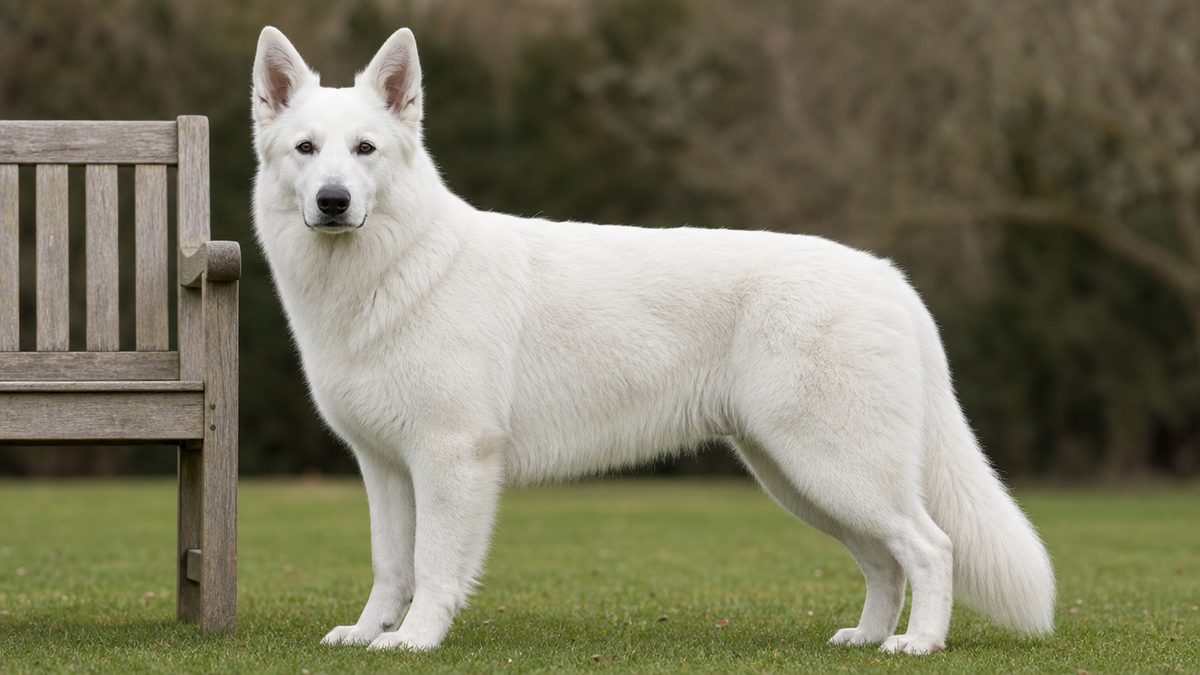
Quick answer
The white swiss shepherd dog is a Swiss breed built from white-coated German Shepherd Dogs imported from the United States and Canada, holding FCI standard 347 since 2011. It stands 58 to 66 cm in males, carries the MDR1 drug-sensitivity mutation at a 14 percent allele frequency, and has no verifiable Indian price or supply chain.
This page reports published veterinary research and registry documents for general information. It is not veterinary advice and cannot diagnose any individual animal. Screening percentages describe populations rather than your dog. One point on this page is urgent enough to repeat: this breed carries a drug-sensitivity mutation, so tell your nearby veterinarian the breed before any anaesthetic, sedative or antiparasitic is given, and ask about MDR1 testing rather than waiting for a reaction.
White Swiss Shepherd Dog at a glance, rated for India
What a White Swiss Shepherd Dog is, and what FCI standard 347 requires
A White Swiss Shepherd Dog is a white-coated German Shepherd derivative that Switzerland registered as a breed and the Federation Cynologique Internationale accepted definitively on 4 July 2011 as standard 347.
The record places it in Group 1, Sheepdogs and Cattledogs (except Swiss Cattledogs), Section 1 Sheepdogs, without a working trial, with Switzerland as the country of origin and French as the official authentic language, which is why the breed's own name in the register is Berger Blanc Suisse. Provisional acceptance came first, on 26 November 2002, and the definitive grant followed nearly nine years later.
The standard's UTILIZATION line is one word longer than the Saarloos Wolfdog's and says something quite different: companion and family dog. Its behaviour clause asks for a lively and balanced temperament, attentive, with good ability to be trained, friendly and discreet, with high social competence, devoted to its owner and never afraid or aggressive without provocation. That is a registry describing an ordinary good dog, and it is the reason this breed rates 5 for trainability where the wolfdogs rate 2.
Size and weight, and a figure Wikipedia gets wrong
The FCI standard gives males 58 to 66 cm and females 53 to 61 cm at the withers, with weights of about 30 to 40 kg and 25 to 35 kg. The Royal Kennel Club's standard for the breed, last updated on 1 April 2025, prints exactly the same four figures. English Wikipedia's infobox gives 60 to 66 cm and 55 to 61 cm, and links the FCI standard PDF in the same infobox. Two national standards agree and the encyclopaedia that cites one of them does not.
| Measure | FCI 347 | Royal Kennel Club | English Wikipedia |
|---|---|---|---|
| Height, males | 58 to 66 cm | 58 to 66 cm (23 to 26 ins) | 60 to 66 cm |
| Height, females | 53 to 61 cm | 53 to 61 cm | 55 to 61 cm |
| Weight, males | About 30 to 40 kg | 30 to 40 kg (66 to 88 lbs) | 30 to 40 kg |
| Weight, females | About 25 to 35 kg | 25 to 35 kg (55 to 77 lbs) | 25 to 35 kg |
| Coat varieties | Medium length and long | Medium and Long | Medium-length or long |
| Eyes | Brown to dark brown, almond, slightly oblique | Brown to dark brown | Light to dark brown |
| Colour | White | White, dark skin desirable | White |
Coat and colour, and the faults that separate a good dog from a pretty one
Both coat varieties carry a dense, close-lying double coat with abundant undercoat under hard, straight protection hair, with shorter hair on the face, ears and fronts of the legs. The long variety adds a distinct mane at the neck, trousers at the back of the hindlegs and a bushy tail, and the standard adds that coat length should never be exaggerated. Colour is white, with dark skin desirable and any fawn overlay on ear tips, back or upper tail treated as a fault or, if distinct, a severe fault.
The standard disqualifies one or both eyes blue and albinism outright, alongside total loss of pigment on the nose, lips, eye rims, skin or pads. A white dog with blue eyes being offered as this breed is not this breed, and a white dog with a pink nose is a pigment problem rather than a rare colour. Both are easy to check in a photograph before you travel.
History: an American and Canadian breed that Switzerland registered
The White Swiss Shepherd Dog's founding stock is North American, and the FCI standard says so on its own face rather than leaving it to be inferred.
The BRIEF HISTORICAL SUMMARY of standard 347 reads, in the FCI's own words: in the USA and Canada White Shepherd dogs have gradually become to be accepted as a distinct breed; the first dogs of this breed were imported to Switzerland in the early seventies; the American male Lobo, whelped on 5 March 1966, can be considered as the progenitor of the breed in Switzerland; the descendants of this male registered with the Swiss Stud Book (LOS) and other White Shepherd dogs imported from the USA and Canada gradually multiplied; and these dogs have been registered as a new breed in the appendix of the Swiss Stud Book since June 1991.
Read that against the colour's history in Germany and the shape of the thing becomes clear. White-coated German Shepherds existed from the breed's earliest days. The German standard was amended in the 1930s to bar white-coated dogs from registration, the colour kept a following in the United States and Canada, a dedicated breed club formed there in 1969, and the whites drifted into a separate type and then a separate breed. Switzerland imported that American population and gave it a studbook, a standard and eventually an FCI number.
| Date | What happened | Which body |
|---|---|---|
| 1930s | White-coated dogs barred from registration in Germany | The German parent club |
| 5 March 1966 | Lobo whelped in the United States | Not applicable |
| Early 1970s | First dogs of the type imported to Switzerland | Private importers |
| 1969 | A breed club forms in North America for white-coloured German Shepherds | Private club |
| June 1991 | Registered as a new breed in the appendix of the Swiss Stud Book (LOS) | Societe Cynologique Suisse |
| 14 April 1999 | The White Shepherd recognised in the United States | United Kennel Club |
| 26 November 2002 | Provisional acceptance as Berger Blanc Suisse | FCI |
| 4 July 2011 | Definitive acceptance, standard 347 | FCI |
| 1 April 2025 | Current British standard, imported register, Pastoral group | The Royal Kennel Club |
Why the country of origin is Switzerland and not the United States
Under FCI rules the country of origin is the country whose national body developed and patronises the breed, not the country the founding animals came from. Switzerland ran the studbook, wrote the standard in French and took it through the FCI's provisional and definitive stages. That is why a breed whose progenitor was an American dog whelped in 1966 is, correctly, a Swiss breed. It is also why the American population kept its own name and its own register, which the next section deals with.
This site has repeatedly found readers taking an FCI country of origin as a claim about where a dog's ancestors lived. It is not. It is a statement about which national kennel club is responsible for the standard, and on this breed the FCI's own history section makes the difference explicit in its first sentence.
One dog or two? The White Swiss Shepherd and the White Shepherd, settled from the registers
They are one founding population registered as two breeds, and no registry holds both: the FCI and the Royal Kennel Club hold the White Swiss Shepherd Dog, the United Kennel Club holds the White Shepherd, and neither list carries the other's name.
This is the question the ranking set circles and never answers with a document, so here is the documentary answer. The FCI standard for the Swiss breed states that its founding dogs were White Shepherd dogs imported from the USA and Canada, and names the progenitor. The UKC's standard for the American breed states that the whites, excluded from most German Shepherd breeding programmes, 'rather quickly evolved into a distinct type, and eventually into a separate breed', and records recognition on 14 April 1999. Same dogs, two registers, two dates, two names.
Where the two standards actually disagree
Being one population does not make the two standards interchangeable, and a buyer comparing a European and an American dog should know which document the animal was bred to. The differences are small, consistent and measurable.
| Point | FCI 347, White Swiss Shepherd Dog | UKC, White Shepherd |
|---|---|---|
| Height, males | 58 to 66 cm | Ideal 25 inches, about 63.5 cm, plus or minus one inch |
| Height, females | 53 to 61 cm | Ideal 23 inches, about 58.4 cm, plus or minus one inch |
| Weight, males | About 30 to 40 kg | 75 to 85 pounds, about 34 to 38.6 kg |
| Weight, females | About 25 to 35 kg | About 60 to 70 pounds, about 27 to 32 kg |
| Coat varieties | Two, medium and long | One, a medium-length weather-resistant double coat |
| Colour tolerance | White; distinct fawn overlay is a severe fault | Pure white ideal; very light cream to light biscuit tan acceptable but not preferred |
| Group | Group 1, Sheepdogs, without working trial | Herding Dog Group |
| Blue eyes | Disqualifying | Disqualifying |
| Albinism | Disqualifying | Disqualifying |
Two of those rows matter in practice. The UKC standard is narrower on height at the top end, since 26 inches is about 66 cm and that is the FCI's ceiling rather than its ideal, and wider on colour, permitting light cream to light biscuit tan where the FCI and the Royal Kennel Club treat a distinct fawn overlay as a severe fault. A cream-tinged dog is acceptable in one system and penalised in the other.
Where the encyclopaedias sit, and where the search engines sit
English Wikipedia keeps two separate articles and opens the White Shepherd one with a hatnote distinguishing it from the White Swiss Shepherd Dog, calling the American animal 'a variety of the German Shepherd bred in the United States' while noting that the UKC recognises it as a separate breed. So the encyclopaedia records both positions rather than choosing, which is defensible. What is not defensible is its height figures, which match neither standard. The ranking set does not even try: one top-five result uses Berger Blanc Suisse, White Swiss Shepherd Dog and Swiss White Shepherd dog interchangeably inside a single page, and another files the breed only under its French name 101dogbreeds, 'Berger Blanc Suisse Info.
On this site's two-condition test, both are breeds. Each has a written standard and a studbook behind it, held by a national or international kennel club rather than a private club, so a puppy of either can be measured against a document. They are not two populations, they are two registrations of one population that have been diverging under different standards since 1991. Bonbeno publishes a page for each, and each page says so.
Legal status in India: no ban, real import law, and one clause about breeding
The legal status of a White Swiss Shepherd Dog in India is straightforward in a way the wolfdog breeds are not: no Indian law in force names this breed, and the only provisions that reach it are ordinary import law and the breeding rules that apply to every purebred dog.
That is worth saying plainly because the neighbouring pages on this site are not able to say it. A breed with documented wolf ancestry raises a question about the Wild Life (Protection) Act that remains unsettled and that this site refuses to answer from a secondary source. This breed has no wolf content at all. It is a white-coated German Shepherd derivative, registered as a purebred dog by three national kennel clubs, and nothing in Indian wildlife law engages with it.
Import law, which is where the real friction is
Two separate instruments govern a dog entering India and they are constantly conflated. The commercial route runs on the Directorate General of Foreign Trade's restricted-import policy for live animals, and personal pet import under the baggage rules runs on a different statute entirely. This session could not retrieve the current DGFT trade notice at its published address, so this page quotes no port list and no policy condition from memory. What an intending importer needs is the live text of whichever route applies, plus a written answer before booking a flight, because import law is applied by an officer at a port rather than by a website.
The breeding clauses that do apply
Three provisions of the Prevention of Cruelty to Animals (Dog Breeding and Marketing) Rules, 2017 reach anyone breeding this dog in India, and all three were read verbatim from the gazette.
- Rule 8(1)(a): pups less than eight weeks in age are not sold.
- Rule 8(1)(b): dogs over six months in age are not sold without first being sterilised, unless they are being sold to another licensed breeder.
- Second Schedule Part II paragraph 6(3): in breeding, defined as breeding between relatives of the second to fourth grade within the first four generations, and incest breeding, are both prohibited. That clause matters here because the breed's documented cerebellar hypoplasia case arose in a litter with a recent common ancestor on both sides of the pedigree.
- Second Schedule Part III paragraph 8(10): breeding dogs must have been tested for a list of genetic defects that opens with hip dysplasia, which is the single condition this breed has the most published data on.
A breed built from a handful of imported dogs is a breed where paragraph 6(3) bites quickly, because the four-generation rule and a small founder pool pull in opposite directions. The Dutch Saarloos club's answer to exactly that problem, an approved outcross programme that uses this breed among its partners, is the model worth reading before anyone attempts an Indian line AVLS, 'Zwitserse Witte Herder' page.
White Swiss Shepherd Dog price in India, and why the search itself fails
No verifiable White Swiss Shepherd Dog price in india exists, and the breed is absent from India's fullest published dog price list under all four of its names.
The absence is measured rather than assumed. Supertails publishes a price list covering India's top 40 breeds with city-wise costs, and searched in full it contains 'White Swiss' zero times, 'Berger Blanc' zero times, 'Swiss Shepherd' zero times and 'White Shepherd' zero times, while the in-document controls 'German Shepherd' appears 15 times and 'Labrador' 30 times. The instrument works and the breed is not on it.
The search failure is itself the story
Four Bing India queries were run in one session and returned one byte-identical set of ten results about the colour white, headed by the Wikipedia articles 'White' and 'Shades of white' and including a Figma hex-code page and a Canva colour guide, under an identical printed count of 'About 209,000 results' for all four: 'white swiss shepherd dog price in india', 'white swiss shepherd dog', 'white swiss shepherd' and 'white shepherd dog breed'.
Identical output across genuinely different queries is the query-insensitivity signature, and two controls in the same session prove the engine was healthy: 'labrador retriever price in india' returned About 16,200 results and ten genuine Indian Labrador pages, and 'berger blanc suisse' returned About 22,400 results and ten genuine breed pages headed by the Swiss breed club. So the trigger is the leading token 'white', and no absence of Indian supply can be claimed from those zeros. What can be said is practical: an Indian buyer searching the English name will not find this dog, and searching berger blanc suisse will.
| Query | Printed count | What came back |
|---|---|---|
| white swiss shepherd dog price in india | About 209,000 | Ten results about the colour white |
| white swiss shepherd dog | About 209,000 | The same ten results, byte for byte |
| white swiss shepherd | About 209,000 | The same ten results |
| white shepherd dog breed | About 209,000 | The same ten results |
| labrador retriever price in india | About 16,200 | Ten genuine Indian Labrador pages. Control passed |
| berger blanc suisse | About 22,400 | Ten genuine breed pages, Swiss club first. Control passed |
What you can price instead
The nearest honest puppy price anchor is the parent breed. India's own market prices the German Shepherd at Rs 20,000 to Rs 75,000 on the list that omits this breed entirely, with a note beneath the table that a standard puppy starts at Rs 20,000 while show-quality dogs reach Rs 50,000, which is a disagreement inside a single page and worth noticing. A white puppy offered in India at a German Shepherd puppy price is most likely a white-coated German Shepherd, which is a perfectly good dog and is not this breed. A white puppy offered at a large premium is being sold on a name, and no puppy price for the breed itself can be sourced in India at all.
Ask for the pedigree and read which register issued it. An FCI or Royal Kennel Club pedigree naming Berger Blanc Suisse or White Swiss Shepherd Dog is one thing; a United Kennel Club pedigree naming White Shepherd is another; and a Kennel Club of India pedigree naming a German Shepherd Dog with a white coat is a third, and perfectly honest, thing. All three are real dogs. Only the paperwork tells you which one you are buying.
Cost of ownership in India for a 30 to 40 kg double-coated dog
The recurring cost of ownership for this breed in India is knowable from published rate cards even though its purchase price is not, because vaccination, parasite control, registration and boarding are priced by dog size rather than by breed.
Every figure below was read from the seller's own page on 9 September 2026 and is what that seller charges rather than a market average.
| Item | Published price | Source and caveat |
|---|---|---|
| Puppy vaccination course | From Rs 6,499 | Vetic, six visits at days 30, 45, 75, 90, 105 and 120, against a struck-through Rs 8,111 |
| Annual booster | From Rs 3,199 | Vetic, against a struck-through Rs 3,806 |
| Anti-rabies, single dose | From Rs 699 | Vetic |
| Consultation | Rs 500 to 1,000 | VOSD. One data point, because a general insurer publishes the identical range |
| Tick, flea and worm cover | Rs 3,308 for three months | Supertails, NexGard Spectra 15 to 30 kg, MRP Rs 3,375, so Rs 1,102.67 a month |
| Pet dog registration, Delhi | Rs 500 new, Rs 500 renewal | MCD, valid one year, late fee Rs 100 per month |
| Boarding, Bengaluru | Rs 899 for up to 24 hours | PawSpace, with day care to ten hours at Rs 799 |
| Professional training | Rs 5,000 to 15,000 | Supertails, quoted for the German Shepherd and applicable here |
The one line that is genuinely breed-specific
MDR1 testing. A dog carrying the nt230(del4) deletion metabolises a list of common drugs differently, and the breed's mutant allele frequency is 14 percent. A single DNA test, done once, changes how every future anaesthetic, sedative and antiparasitic is chosen, and it costs a fraction of one emergency. It is the highest-value rupee an owner of this breed will spend, and almost nobody in India spends it because almost nobody knows the breed carries the mutation.
- Budget cooling, not clipping. A raised mesh cot bed and a fan beat any grooming decision for a double-coated dog, and cost less than one salon visit at the Rs 300 to 2,000 range Indian sources quote.
- Budget an undercoat rake, not a groomer. This coat needs brushing rather than clipping, and a shaved double coat regrows undercoat first.
- Budget boarding early. A 35 kg white shepherd is harder to place at short notice than a Labrador, and a Bengaluru home-boarding service publishes Rs 899 for a stay of up to 24 hours and Rs 799 for day care to ten hours.
- Budget joint screening. Two large French studies include this breed by name for hips and elbows, so there is a real screening culture to buy into.
Greater Chennai Corporation's municipal veterinary clinics provide treatment and anti-rabies vaccination free of cost, against Delhi's Rs 500 registration fee and a private chain's Rs 699 rabies floor Vetic, 'Dog Vaccination Near Me'. Where you live changes this budget more than which breed you own.
Heat tolerance: an American founding climate, and why no Swiss figure appears here
The White Swiss Shepherd Dog rates 2 of 5 for heat tolerance in Indian conditions, one point better than the wolfdog breeds, because its founding population came from the temperate United States and Canada rather than from an Arctic one.
The homeland baseline on this page is deliberately American, and the reason is in the breed's own standard: the progenitor was an American male and the founding dogs were imported from the USA and Canada. New York, queried by explicit latitude and longitude, returns a cell elevation of 10.17 m against a real 10 m, an annual mean of 12.26 C and a July mean of 23.71 C. Toronto returns 98.64 m against a real 76 m, an annual mean of 9.10 C and a July mean of 21.66 C.
| Place | Cell elevation | Hottest month | Coolest month |
|---|---|---|---|
| New York, United States | 10.17 m | July, 23.71 C | January, 1.06 C |
| Toronto, Canada | 98.64 m | July, 21.66 C | February, minus 2.76 C |
| Delhi | 206.37 m | June, 35.88 C | January, 13.61 C |
| Chennai | 48.95 m | May, 31.51 C | January, 24.09 C |
| Mumbai | 97.15 m | May, 31.19 C | January, 23.19 C |
| Bengaluru | 841.72 m | April, 28.37 C | December, 20.22 C |
| Pune | 635.99 m | April, 28.93 C | December, 19.62 C |
Two readings follow. A New York July at 23.71 C is genuinely warmer than the northern European homelands this site usually meets, which is why this breed is rated less heat-sensitive than the wolfdogs at 2 rather than 1. And it is still 12.17 degrees below a Delhi June and 7.8 below a Chennai May, so a heat-sensitive double coat still governs the day. Bengaluru and Pune, at 28.37 and 28.93 C in April, are the only Indian cities in the table that get within five degrees of the founding summer, and both peak in April rather than May, which matters if you are planning a coat and exercise calendar. The coat is hardy against cold and rain and is not hardy against trapped damp underneath it.
Why this page publishes no Swiss climate figure at all
Because the instrument does not work there. NASA POWER returns a grid cell rather than a point, and in Swiss terrain the cell is systematically too high: Bern reads 752.22 m against a real 540 m and Zurich 566.56 m against a real 408 m, errors of 212 and 159 metres. Temperature falls with altitude at roughly 6.5 C per 1,000 m, so those cells describe a colder Switzerland than the one the dogs live in. Publishing them would be publishing an artefact, and the breed's founding climate is American anyway.
The largest study of canine heat-related illness, on 905,543 UK dogs, recorded 395 confirmed events with a 14.18 percent fatality rate and identified higher bodyweight relative to the breed and sex mean, age over two years and a bodyweight over 50 kg as risk factors. Neither 'White Swiss Shepherd' nor 'Berger Blanc Suisse' appears in that paper's full text, while the control 'German Shepherd' appears once, so no breed-level odds ratio exists for this dog and none is invented here. A 30 to 40 kg dog sits below the 50 kg band; the transferable finding is that a heavy individual of any breed is at higher risk than a lean one.
Health: a drug-sensitivity mutation, a falling hip rate, and a DNA test that does not work
The White Swiss Shepherd Dog's health picture is unusually well measured for a rare breed, and three findings decide it: a 14 percent MDR1 allele frequency, a hip dysplasia rate that fell from 34.6 to 20.3 percent across twenty years, and a megaoesophagus risk test that a 2025 study found almost uninformative in this breed Baldinger A, Genevois JP, Moissonnier P Kehl A, Schelling C. 'Is the megaesophagus….
MDR1: the thing to tell an Indian vet before anything else
The breed entered the veterinary literature in 2007 through case reports of doramectin toxicosis, together with a demonstration of breed predisposition and a microsatellite analysis. A larger German study then screened 7,378 dogs and placed the White Swiss Shepherd's mutant MDR1 allele frequency at 14 percent, between the Waeller at 17 and the Old English Sheepdog at 4, on a scale headed by the Collie at 59 percent.
| Breed | Mutant MDR1 allele frequency |
|---|---|
| Collie | 59 percent |
| Longhaired Whippet | 45 percent |
| Shetland Sheepdog | 30 percent |
| Miniature Australian Shepherd | 24 percent |
| Australian Shepherd | 22 percent |
| Waeller | 17 percent |
| White Swiss Shepherd | 14 percent |
| Herding-breed mixes | 8 percent |
| Old English Sheepdog | 4 percent |
| Unclassified mixed breeds | 2 percent |
| Border Collie | 1 percent |
What that means at an Indian clinic is concrete. A dog carrying the deletion clears a list of ordinary drugs poorly, and the practical instruction is simple: say the breed before any anaesthetic, sedative or antiparasitic, and test once rather than finding out during a reaction. The study's own conclusion is that the mutation's wide breed distribution makes it hard for vets and owners to know whether it matters for an individual animal, which is exactly the argument for testing.
Hips and elbows, measured on real French screening data
A twenty-year French screening study covering 27,710 dogs across 10 breeds included 2,924 White Swiss Shepherd Dogs, split 225, 1,063 and 1,636 across three periods. Its dysplastic proportion fell from 34.6 percent in 1997 to 2003, to 24.5 percent in 2004 to 2010, to 20.3 percent in 2011 to 2017, a statistically significant fall at p below 0.0001 across the full span. In the final period grade C accounted for 15.6 percent, grade D for 4.0 and grade E for 0.7.
A companion study of 17,861 elbow radiographs across 13 French breeds includes this breed by name and puts overall elbow dysplasia prevalence at 11.4 percent, ranging from 1.1 percent in the Czechoslovakian Wolfdog to 32.2 percent in the Dogue de Bordeaux, with males significantly more affected than females at 17.5 against 10.5 percent. Joint incongruity and fragmented coronoid process were the two commonest lesions.
A 20.3 percent hip dysplasia rate is not low. What makes it worth quoting is that it is fourteen points lower than the same breed twenty years earlier, in the same country, on the same scoring scheme. That is what a screening culture looks like when it works, and it is the strongest argument on this page for buying only from a breeder who screens.
Three genetic findings this breed carries, and one test not worth buying
Beyond the drug-sensitivity mutation, three published genetic findings attach to this breed specifically, and one of them is a warning about a test rather than about a disease.
The megaoesophagus test that does not transfer
Risk tests are sold on the assumption that a variant found in one breed predicts disease in a related one. A 2025 Swiss study tested that assumption directly, taking the congenital idiopathic megaoesophagus risk test developed for German Shepherds and evaluating it in the closely related White Swiss Shepherd. Its conclusion, in the authors' own words, is that the test in this breed is almost not informative, and that selecting on it would probably not reduce the prevalence but only lower the genetic variability, so breeders and owners should be informed accordingly.
That is a rare and useful thing to be able to tell a buyer: a commercially available DNA test for this breed is, on the published evidence, not worth its price and may do harm by shrinking an already small gene pool. Spend the money on MDR1 instead.
Cerebellar hypoplasia, and a mutation that looks new
In 2023 two affected puppies were identified in a litter with a recent common ancestor on both sides of the pedigree. Whole genome sequencing of ten dogs in the family and filtering on a recessive hypothesis produced five candidate variants, among them a frameshift deletion of the Reelin gene, RELN p.Val947*, a gene already responsible for cerebellar hypoplasia in humans, sheep and mice. The authors note that the variant was not found in other dog breeds nor in a cohort of European White Swiss Shepherds, which they read as a recent mutation event.
For a buyer that last sentence is the important one. This is not a breed-wide problem on the current evidence; it is a documented family-level finding in one population, with a clear message about mating close relatives. Indian breeding law happens to agree: Second Schedule Part II paragraph 6(3) of the 2017 Rules prohibits in breeding within the first four generations and incest breeding outright.
Pituitary dwarfism, inherited from the German Shepherd side
A 2025 case report describes a nine-week-old female White Swiss Shepherd with growth retardation, diagnosed with pituitary dwarfism due to an LHX3 mutation, which two years after diagnosis developed persistent lymphocytosis, eosinophilia and confirmed pituitary hypocortisolism, improving on physiological doses of prednisolone. The paper's conclusion is that corticotrope function may decline over time in dogs with LHX3 mutations, so ACTH deficiency should be screened for in dwarf dogs.
That is the same gene, and in the German Shepherd derived breeds the same 7 base-pair deletion in intron 5, that causes dwarfism in the Saarloos and Czechoslovakian wolfdogs at carrier frequencies of 31 and 21 percent. A white shepherd, a wolfdog and a German Shepherd share the problem because they share an ancestor.
| Test | Worth doing? | Why |
|---|---|---|
| MDR1 / ABCB1 nt230(del4) | Yes, once, before any anaesthetic | 14 percent mutant allele frequency in a 7,378-dog study |
| Hip radiographs | Yes | 2,924 dogs screened in France; 20.3 percent dysplastic in the latest period |
| Elbow radiographs | Yes | Included by name in a 13-breed, 17,861-record French study |
| Pituitary dwarfism (LHX3) | Yes if the line has produced a dwarf | Documented in the breed and shared with related breeds |
| Megaoesophagus risk test | No, on the published evidence | Found almost uninformative in this breed in 2025 |
| RELN cerebellar hypoplasia | Only where the family is known to carry it | Not found in a cohort of European dogs of the breed |
Temperament and household fit, in the standard's own words
The FCI standard asks for a lively and balanced temperament, attentive, with good ability to be trained, friendly and discreet, with high social competence and devotion to the owner, and never afraid or aggressive without provocation.
Compare that with the wolfdog breeds this site has built alongside it and the difference is not a matter of degree. Where the Saarloos Wolfdog's standard describes a proud independent character known to foremost obey his own will, this one describes a joyful and easy to teach working and sporting dog with capability for all round education, whose high social competence allows a marked ability to adapt and integrate to all kinds of social events and situations. That is a registry asking for the opposite animal.
The Royal Kennel Club's wording is shorter and no softer: a versatile working and companion dog, attentive, alert and resilient, with a lively and friendly temperament, never shy or aggressive, that can be reserved and is easily trained. Note the one hedge both standards keep. Reserved is permitted; shy is not, and the FCI list of disqualifying faults includes anxiety, high grade fearfulness, aggression due to anxiety, unnecessary aggression and lethargic behaviour.
| Household | Verdict | Why |
|---|---|---|
| First-time owner with time and space | Possible | The standard asks for an easily trained, friendly dog, which is unusual among shepherd derivatives |
| Indian apartment, small, no lift access | Poor | Coat and exercise budget, not temperament, are what fail here |
| Large flat or house with an active adult | Good | This is the breed's natural home in an Indian city |
| Home with children | Good, with the usual supervision | High social competence is written into both standards |
| Guarding role | Poor fit | Both standards ask for friendly and discreet, not protective |
| Sport or working home | Good | The FCI text names a working and sporting dog with all round education |
The Indian complication nobody mentions
A pure white dog of 30 to 40 kg attracts attention in an Indian street in a way a black and tan German Shepherd does not, and a friendly, socially confident dog will go towards that attention rather than away from it. That is a management problem rather than a temperament problem, and it is solved with a reliable settle and a short lead in crowds rather than with a muzzle.
A previously ordinary dog that becomes wobbly, tremulous or oddly withdrawn needs a neurological examination rather than a training plan. Cerebellar hypoplasia has been documented in this breed at family level and pituitary dwarfism at individual level, and both present as something an owner first reads as behaviour Schils G, Stammeleer L. Consult your nearby veterinarian rather than a trainer first.
Training a highly trainable dog in an Indian city
To train a White Swiss Shepherd Dog, spend the socialisation window on Indian city life rather than on obedience, because both standards already promise you a dog that is easily trained.
This is the rare breed page on this site where trainability is rated 5 of 5, and the rating comes from the standards rather than from enthusiasm. What an owner has to supply is not method but exposure, and in India the socialisation window collides with the vaccination course: a published Indian puppy course runs six visits from day 30 to day 120, which finishes at about seventeen weeks.
Resolve it the same way any large-breed owner should. Carry the puppy, use a car, use the lift, sit on a balcony above traffic, invite people in rather than taking the dog out. Almost every exposure this breed needs is a person, a surface, a sound or a vehicle, and none of those requires an unvaccinated puppy on Indian ground.
- Weeks 8 to 12: register the household. Every regular visitor a flat has, one at a time.
- Weeks 8 to 12: register the city. Horns, bells, pressure cookers, lifts, marble, metal stairs, monsoon rain on a tin awning.
- Weeks 12 to 20: build a settle. A white dog attracts hands, so a reliable down-stay in public is worth more than any trick.
- Months 4 to 12: proof recall. Around cattle, cats and community dogs, on a long line.
- Months 6 to 18: teach handling. Ears, feet, mouth and belly, because this is a breed that will need veterinary handling and a DNA swab.
What Indian law says about the equipment you may be offered
Second Schedule Part II paragraph 6(8) of the Prevention of Cruelty to Animals (Dog Breeding and Marketing) Rules, 2017 forbids tail docking, ear cropping, de-barking, de-clawing, branding, dyeing, injecting substances to enhance visual appeal and any other mutilation, and states that any change of appearance by artificial means is strictly forbidden. Nothing in either breed standard asks for a cropped ear or a docked tail, so on this breed the standard and Indian law agree completely.
A dog described by its own registry as having capability for all round education is a dog that can be taught to cooperate with veterinary care. Teach a chin rest and a voluntary paw before you need them, because a breed carrying a drug-sensitivity mutation is a breed whose blood samples and examinations should be easy rather than sedated.
Daily exercise, and the Indian clock that limits it
A White Swiss Shepherd Dog needs a real daily exercise budget of 60 to 90 minutes, because its standard describes a rhythmical, enduring, ground-covering trot with strong thrust from the rear.
The Royal Kennel Club's gait clause says the same in fewer words: even, rhythmical gait with forelegs extending well, good drive from the rear, covers the ground easily. This is a trotting dog rather than a sprinting one, and it is satisfied by distance at a steady pace.
- Dawn, 45 to 60 minutes of steady walking or trotting, which in a plains city is the only reliably usable window from March to October.
- Evening, 30 minutes, later than feels necessary, because tarmac holds heat after the air cools.
- Mental work through the middle of the day, scent games and food puzzles, substituting for movement rather than adding to it.
- No structured running before 14 months, on a dog that finishes at 58 to 66 cm.
- Swimming where it is available and clean, which is the one form of exercise that solves the heat problem instead of fighting it.
The constraint is the clock rather than the dog. Delhi's June mean is 35.88 C and Chennai's May mean 31.51 C, and those are means rather than peaks, so for a double-coated dog they rule out the middle of the day across most of the year. Bengaluru and Pune, peaking at 28.37 and 28.93 C in April, give a genuinely wider window and are the two Indian cities where this breed is most keepable.
Exertion in warm conditions is the commonest trigger recorded in the heat-illness literature, and the fatality rate among confirmed events in the largest study was 14.18 percent. A dog that has not moved all day is a dog that will move badly when it finally does. Shift the schedule rather than cutting it.
Grooming a white double coat in Indian humidity
To groom a White Swiss Shepherd Dog in India, rake the undercoat out twice weekly all year and never shave the dog, because both standards specify a dense close-lying double coat with an abundant undercoat The Royal Kennel Club.
The coat comes in two varieties and both are double. The medium variety has shorter hair on the face, ears and fronts of the legs with slightly longer coat at the neck and the backs of the legs. The long variety adds a distinct mane, trousers and a bushy tail, with the standard warning that coat length should never be exaggerated. Slightly wavy, hard hair is permitted in both.
Why the Indian plains break the shedding cycle
A double coat sheds on a temperature and daylight cue. Chennai runs from 24.09 C in January to 31.51 C in May, a swing of 7.4 degrees, against a New York swing of 22.65 degrees from January to July NASA POWER, climatology point API. In practice the dog does not shed in two clean bursts here. It sheds untidily all year and holds dead undercoat against the skin, and that trapped layer is where humid-climate skin problems start.
- Twice weekly, all year, with an undercoat rake rather than a slicker, down to the skin on the ruff, breeches and behind the ears.
- Daily for three weeks, twice a year, on dates you choose, because the dog will not choose them for you in an Indian climate.
- Dry the dog actively after every bath, ears included, rather than letting it air dry.
- Bath rarely and rinse thoroughly, because a white coat tempts owners into frequent washing and stripped oils make humid-climate skin worse.
- Check the belly, groin and armpits weekly, which is where hot spots start under a coat this dense.
Never shave a double coat, however white it is
The topcoat is the sun barrier and the undercoat is the insulation, and a shaved double coat regrows unevenly with the undercoat first, leaving the dog hotter rather than cooler. On a white dog there is a second reason: the coat is also the sunscreen. A clipped white dog in Indian sun is a dog with pale skin exposed to it, and the standard asks for dark skin under white hair precisely because the pigment is doing a job.
A raised mesh cot bed under a fan moves air under the dog and does more for a double-coated animal in Chennai than any grooming decision. It costs less than one salon visit at the Rs 300 to 2,000 range Indian sources quote, and it does not have to be repeated.
Feeding: life stage, body condition and Indian availability
Feed a White Swiss Shepherd Dog on a large-breed growth diet to a target of 30 to 40 kg in males and 25 to 35 kg in females, and check body condition weekly with your hands rather than reading the bag.
This breed has a published weight range, which is more than the wolfdog breeds offer, and that makes portioning straightforward. What it does not remove is the large-breed growth problem: a puppy fed generously grows faster rather than bigger, and the joints pay for it. Given a documented hip dysplasia rate of 20.3 percent in the most recently screened French cohort, keeping a growing dog lean is not a cosmetic decision.
- Weeks 8 to 16: four meals a day on a large-breed puppy formulation.
- Months 4 to 8: three meals a day, and the point at which most owners overfeed.
- Months 8 to 14: two meals a day, still on a growth diet, still visibly lean.
- Adult: two meals a day rather than one, because a deep-chested dog of this size sits in the body shape associated with gastric dilatation and volvulus.
- Never free-feed, because a dog you do not weigh needs an owner who can see what it ate.
The Indian cost lines that go with the bowl
Parasite control is a firmer number than food. NexGard Spectra for a 15 to 30 kg dog costs Rs 3,308 for three tablets against an MRP of Rs 3,375, which is Rs 1,102.67 a month, and a male at the top of this breed's range needs the pack above that. In an Indian climate tick and worm cover is not seasonal and not optional, and it is the recurring line most new owners forget to budget.
Some antiparasitic drugs are exactly the class that a dog carrying the MDR1 deletion handles badly, and the breed's mutant allele frequency is 14 percent. Do not choose a dewormer or a tick product for this breed from a shop shelf. Choose it with your nearby veterinarian, having told them the breed and, ideally, having had the dog tested.
Month by month through the first year in Indian conditions
The first year of a White Swiss Shepherd Dog in India runs on two clocks: a socialisation window closing at about twelve weeks and a vaccination course finishing at about seventeen.
| Age | What is happening | What it costs or constrains in India |
|---|---|---|
| Under 8 weeks | Legally unsaleable under Rule 8(1)(a) of the 2017 Rules | A seller offering a six-week puppy has answered every other question for you |
| 8 to 12 weeks | The socialisation window | Vaccination is incomplete, so socialise carried, in a car, indoors and on a balcony |
| Day 30 to 120 | The published Indian puppy course, six visits | From Rs 6,499 as a promotional floor, plus anti-rabies from Rs 699 |
| 3 to 4 months | First Indian summer for a winter-born puppy | A cot bed and a fan, or air conditioning, before May |
| 4 to 6 months | MDR1 testing, if the breeder has not done it | The single highest-value test this breed can have |
| 6 months | Rule 8(1)(b) bars sale over six months without sterilisation, unless to a licensed breeder | Relevant when rehoming rather than buying |
| 9 to 14 months | Growth plates closing on a 58 to 66 cm frame | No structured running, keep the dog lean |
| 12 months | Delhi registration renewal, Rs 500, tied to the anti-rabies date | Late fee Rs 100 per month after a one-month grace period |
| 12 to 24 months | Hip and elbow radiographs if the dog will be bred | The French data show what screening achieves over twenty years |
Two of those rows are Indian law rather than preference. The 2017 Rules provide at Rule 8(1)(a) that pups less than eight weeks in age are not sold, and at Rule 8(1)(b) that dogs over six months in age are not sold without first being sterilised unless they are being sold to another licensed breeder.
Ask for the parents' hip and elbow scores and the MDR1 result before you ask anything about temperament. A breeder inside the European screening culture will produce all three without hesitation, because the 2,924-dog French dataset exists precisely because breeders submit radiographs Roels J, Genevois JP, Fostier-Humbert M.
Head to head against the white and near-white dogs an Indian buyer cross-shops
Compare the White Swiss Shepherd Dog against the White Shepherd, the German Shepherd and the wolfdog breeds and the practical difference is availability: only one of them can be bought and registered in India today.
| Breed | Registry position | Heat rating | Key health flag | Indian supply |
|---|---|---|---|---|
| White Swiss Shepherd Dog | FCI 347 definitive 2011; Royal Kennel Club pastoral, imported register | 2 of 5 | MDR1 at a 14 percent allele frequency | None verified |
| White Shepherd | United Kennel Club, herding group, since 14 April 1999 | 2 of 5 | Same founding population, same flags | None verified |
| German Shepherd Dog | FCI 166, registrable through the Kennel Club of India | 2 of 5 | Hip and elbow dysplasia, degenerative myelopathy | Widespread, Rs 20,000 to 75,000 |
| Saarloos Wolfdog | FCI 311 definitive 1981 | 1 of 5 | 31 percent LHX3 carriers, 9.9 percent PCYT2 allele | None verified |
| Czechoslovakian Wolfdog | FCI 332 definitive 1999 | 1 of 5 | Lowest elbow dysplasia of 13 French breeds at 1.1 percent | None verified |
Against the White Shepherd, which is the same dog
The two are one founding population under two registers, so the comparison is between documents rather than between animals. The FCI and Royal Kennel Club standards agree on 58 to 66 cm for males; the UKC standard sets an ideal of 25 inches with an inch either way, which is a narrower band inside the same range. The UKC permits light cream to light biscuit tan; the European standards treat a distinct fawn overlay as a severe fault. Buy to whichever document your dog's register uses, and do not let a seller quote one standard's tolerance against the other's measurement.
Against the German Shepherd, which is the parent
The honest comparison favours the German Shepherd on every practical Indian axis except one. It is registrable through the Kennel Club of India, available in every metro at Rs 20,000 to Rs 75,000, and served by vets who have seen the breed a thousand times. What the White Swiss Shepherd offers is a standard that asks for a friendly, socially confident, easily trained dog and, on the French screening data, a population whose hip dysplasia rate has been falling for twenty years.
If what you want is a large white shepherd-type dog in India, a white-coated German Shepherd from a KCI-registered litter is available, legal, priced in rupees and genetically the same stock this breed was built from. It cannot be shown in the colour under German Shepherd rules, which is a show problem rather than a dog problem. Buying one is not settling.
Seven mistakes Indian buyers make about this breed
Most errors about the White Swiss Shepherd Dog in India come from reading a directory rather than a standard, and each one below is settled by opening a single document.
- Calling it an albino German Shepherd. Albinism is a disqualifying fault in the FCI standard, and a correct dog has dark skin, a black nose and dark eyes.
- Quoting Wikipedia's height. Its infobox says 60 to 66 cm for males; the FCI standard it cites and the Royal Kennel Club standard both say 58 to 66 The Royal Kennel Club.
- Buying a blue-eyed white puppy as this breed. One or both eyes blue is disqualifying in both the FCI and the UKC standards.
- Assuming the American and Swiss dogs are unrelated. The FCI standard names an American male whelped in 1966 as the progenitor of the Swiss line.
- Buying the megaoesophagus risk test. A 2025 study found it almost uninformative in this breed and warned that selecting on it would only lower genetic variability.
- Skipping the MDR1 test. The breed's mutant allele frequency is 14 percent and its first appearance in the literature was a drug toxicosis case report Gramer I, Leidolf R, Doering B.
- Reading a failed Indian search as an absent Indian market. Four Bing India queries beginning with 'white' returned one identical result set about the colour, while two controls passed in the same session.
One mistake sellers make
Watch for a white German Shepherd sold as a White Swiss Shepherd at a premium. They are closely related and often physically similar, and the only thing that separates them is the register the pedigree came from. There is nothing wrong with either dog. There is something wrong with charging for one and delivering the other.
Second Schedule Part II paragraph 6(9) of the 2017 Rules provides that 'Breeding to create new breeds of dogs or unusual looks shall be strictly prohibited', and paragraph 6(3) prohibits in breeding within the first four generations. Owning an imported dog is not what those clauses reach. Trying to establish a white line here from a small founder base is.
Adoption, responsible sourcing and the honest Indian recommendation
Adopting a White Swiss Shepherd Dog in India is not a realistic route, because no verified Indian population exists to surrender from, and the practical alternative is a white-coated German Shepherd or a shelter dog.
That is not a consolation line at the end of a breed page. Every Indian metro has shelters holding large dogs that will meet an Indian summer better than this breed and need a home now, and India has a functioning German Shepherd market in which white-coated puppies occur. If the white coat is what draws you, the second of those routes gets you there legally, cheaply and quickly.
The four questions that separate a breeder from a seller
- Which register issued the pedigree? The FCI holds this breed as standard 347 and the Royal Kennel Club holds it on the imported register in the Pastoral group The Royal Kennel Club.
- What is the MDR1 result for both parents? At a 14 percent allele frequency this is not an exotic request.
- What are the hip and elbow scores? The French screening data exist because breeders submit radiographs, and the breed's dysplastic rate fell 14 points in twenty years as a result.
- Is the puppy at least eight weeks old? Rule 8(1)(a) of the 2017 Rules prohibits selling younger.
If you are importing, read the instrument rather than a forum
Two separate rules govern a dog entering India and they are constantly conflated: the commercial route under the Directorate General of Foreign Trade's restricted-import policy for live animals, and personal pet import under the baggage rules. This session could not retrieve the current trade notice at its published address, so no port list and no policy condition is quoted here from memory. Read the live instrument for the route that applies to you, and get the answer in writing before you book a flight.
This is one of the better-evidenced rare breeds on this site and one of the least available in India. If you can get a screened dog from a European or American register and you live in Bengaluru or Pune rather than Chennai or Delhi, it is a genuinely good dog with an unusually honest set of published health data behind it. If you cannot, buy the German Shepherd and spend the difference on the vet.
White Swiss Shepherd Dog questions Indian readers actually ask
Is the White Swiss Shepherd the same as the White Shepherd?
They are one founding population registered as two breeds under two names. The FCI standard for the White Swiss Shepherd says so itself: white shepherd dogs became accepted as a distinct breed in the USA and Canada, and the American male Lobo, whelped in 1966, is the progenitor of the Swiss line. The two standards now differ on height, weight and coat varieties.
Is the White Swiss Shepherd just an albino German Shepherd?
No, and the standard rules it out explicitly. Albinism is a disqualifying fault in the FCI standard, alongside total loss of pigment on the nose, lips, eye rims, skin or pads. A correct dog has a white coat with dark skin, a black nose and dark eyes, which is the opposite of albinism.
What is the White Swiss Shepherd Dog price in India?
No verifiable Indian price exists. The breed appears zero times on India's fullest published dog price list under all four of its names, while the German Shepherd appears 15 times on the same page at Rs 20,000 to Rs 75,000. Any Indian rupee figure you are shown for this breed is either a converted foreign price or an invention.
Do White Swiss Shepherds have drug sensitivity?
Yes, and it is the single most important thing to tell an Indian vet. The nt230(del4) MDR1 deletion was found in this breed at a mutant allele frequency of 14 percent across a 7,378-dog German screening study, and the breed's first appearance in the literature was a case report of doramectin toxicosis.
How common is hip dysplasia in White Swiss Shepherds?
It fell from 34.6 percent to 20.3 percent over twenty years of French screening. Across 2,924 radiographs read between 1997 and 2017, the dysplastic proportion dropped period by period, and the change was statistically significant at p below 0.0001. In the most recent period, grade C accounted for 15.6 percent, D for 4.0 and E for 0.7.
Can a White Swiss Shepherd Dog live in India?
Better than a wolfdog and worse than a short-coated breed. It is rated 2 of 5 for heat here. Its founding stock came from the United States and Canada rather than the Arctic, so it is not a polar dog, but the standard requires an abundant undercoat and Delhi's June mean of 35.88 C is 12 degrees above a New York July.
Is the megaesophagus DNA test worth doing for this breed?
Almost certainly not, on the published evidence. A 2025 Swiss study tested the congenital idiopathic megaoesophagus risk test developed for German Shepherds in this closely related breed and found it 'almost not informative', concluding that selecting on it would probably not reduce prevalence and would only lower genetic variability.
Are White Swiss Shepherds recognised by the American Kennel Club?
No. The breed appears nowhere on the AKC's Foundation Stock Service and Miscellaneous list, which carries 88 breeds across seven groups, including 18 in the herding block. The United Kennel Club does register the closely related American White Shepherd, which is a different entry under a different name.
Do White Swiss Shepherds shed a lot?
Heavily and seasonally. Both coat varieties carry an abundant undercoat under hard straight guard hair, and in an Indian climate the seasonal shedding signal is weak, so the dead undercoat comes out untidily across the year rather than in two clean bursts. Brush on a calendar, not on the weather.
What is the White Swiss Shepherd Dog's life expectancy?
No breed-specific life expectancy figure could be sourced. The breed is absent from the large UK life-table studies this site normally uses, and neither the FCI nor the Royal Kennel Club publishes a lifespan in its standard. Directory pages that quote a number for this breed are not citing a study.
Can a White Swiss Shepherd be registered with the Kennel Club of India?
In principle yes, in practice almost certainly not. India is a full FCI member represented by the Kennel Club of India, so Indian pedigrees are issued against FCI nomenclature and this breed holds FCI standard 347. Whether any dog of the breed has ever been registered in India is a separate question and no evidence of one was found.
Why do searches for this breed return colour charts?
Because the engine is reading the first word rather than the query. Four different Bing India queries beginning with 'white' returned one byte-identical set of ten results about the colour white, under one identical count of about 209,000, while a Labrador control passed in the same session. Search the French name instead.
What is the difference between a white German shepherd and a Berger Blanc Suisse?
Paper rather than genes. The Berger Blanc Suisse is FCI breed 347, a Swiss breed built from white-coated shepherd dogs imported from the USA and Canada, with the American male Lobo, whelped in 1966, as progenitor of the Swiss line; a white German Shepherd is the same recessive colour still inside the German Shepherd breed, whose own standards disqualify it. The two standards now differ on height, weight and coat varieties, and a white puppy offered in India is almost certainly the disqualified German Shepherd colour rather than a registered 347 dog.
What is a Berger Blanc Suisse?
The FCI's name for the White Swiss Shepherd Dog, breed 347 in Group 1 Section 1 without working trial, country of origin Switzerland, official language French, accepted provisionally on 26 November 2002 and definitively on 4 July 2011. It is a powerful, well-muscled, medium-sized white shepherd in medium and long coat varieties, built from White Shepherd dogs imported from the USA and Canada after the colour was disqualified in the German Shepherd, and it is the name under which the breed holds a Kennel Club of India pedigree route.
How big do Berger Blanc dogs get?
Dogs 58 to 66 cm at the withers and 30 to 40 kg, bitches 53 to 61 cm and 25 to 35 kg, which is what both the FCI standard and the Royal Kennel Club's White Swiss Shepherd Dog (Imp) standard print. Wikipedia's infobox gives 60 to 66 and 55 to 61 cm while citing the FCI standard that prints the lower figures, so a page quoting the higher numbers is copying the encyclopedia rather than the registry document.
Are white Swiss shepherds rare?
In India, entirely: the breed appears zero times on India's fullest published dog price list under all four of its names while the German Shepherd appears 15 times on the same page, and no evidence was found that any dog of the breed has ever been registered with the Kennel Club of India, although FCI standard 347 makes that possible in principle. It is absent from the American Kennel Club's 88-breed Foundation Stock Service list, while in Europe it holds an FCI standard and a Royal Kennel Club import-register standard.
How much does a white Swiss shepherd cost?
No verifiable Indian price exists. The breed appears zero times on India's fullest published dog price list under all four of its names, while the German Shepherd appears 15 times on the same page at Rs 20,000 to Rs 75,000, so any Indian rupee figure you are shown for this breed is either a converted foreign price or an invention, and a white puppy sold locally is almost certainly a white-coated German Shepherd rather than a registered White Swiss Shepherd Dog.
Compare with similar breeds
White Swiss Shepherd Dog sits in 1 Bonbeno group. Each one compares it directly against the breeds it is genuinely an alternative to, on the same figures.