
Breed profile
Czechoslovakian Wolfdog: The Legal, Health and Climate Reality in India
A German Shepherd and Carpathian wolf cross created by the Czechoslovak army in 1955, recognised by the FCI as standard 332, and the one breed where an Indian buyer's first question should be a legal one.
Quick answer
The Czechoslovakian Wolfdog is an FCI-recognised working breed created in 1955 by crossing German Shepherd Dogs with Carpathian wolves, standing at least 65 cm and 26 kg in males. In India its legal status is unsettled rather than clearly legal or clearly banned, it is profoundly heat-intolerant, and no verifiable Indian market for it exists.
This page reports published veterinary, registry and legal documents and is not veterinary advice or legal advice. Screening percentages come from voluntary databases and small European studies and cannot tell you anything about an individual animal. Consult a registered veterinarian before acting on any health information here, and a qualified lawyer before acting on any statement about Indian law.
Czechoslovakian Wolfdog at a glance
What the Czechoslovakian Wolfdog is, and what FCI standard 332 actually requires
The Czechoslovakian Wolfdog is a working breed created in 1955 in the former Czechoslovakia by crossing German Shepherd Dogs with Carpathian wolves, standing at least 65 cm at the withers in males and weighing at least 26 kg, and recognised on a definitive basis by the Federation Cynologique Internationale as standard 332 since 30 May 1999.
Read the governing document rather than the enthusiast pages and the breed sharpens. FCI standard 332 is published in four languages under the breed's Slovak name, Ceskoslovensky Vlciak, with the English name Czechoslovakian Wolfdog printed beside it, and it sits in Group 1 Sheepdogs and Cattledogs, Section 1 Sheepdogs, with a working trial attached. The country of origin is recorded as Czechoslovakia and the country of patronage as Slovakia, the official authentic language of the text is German, and the current valid English translation is dated 3 September 1999.
That classification matters more than it looks, in two ways. A working trial requirement means the FCI treats this as a dog with a job, and the standard's utilisation line reads simply Working Dog. The group placement is the second surprise: a wolf-derived breed might be expected to sit in Group 5, the spitz and primitive types, alongside the sled dogs. It does not. The FCI files it with the sheepdogs, which is a statement about what the breed was built to do rather than about what it looks like. The head is symmetrical and well muscled, forming a blunt wedge from the side and above, and the picture is of a lean, muscular, rectangular dog rather than a heavy one.
Size and weight: the standard sets floors, not ranges
The standard gives minima and no maxima at all. Males must be at least 65 cm at the withers and at least 26 kg; bitches at least 60 cm and at least 20 kg. There is no upper limit anywhere in the document, which is why published height and weight ranges for the breed vary so widely across secondary pages. Any source that gives you a tidy range like 60 to 65 cm has added an upper bound the register never wrote.
| Measure | Males | Bitches | What the standard says |
|---|---|---|---|
| Height at withers | At least 65 cm | At least 60 cm | A minimum only, with no stated maximum |
| Weight | At least 26 kg | At least 20 kg | A minimum only, with no stated maximum |
| Body length to height | 10 : 9 | 10 : 9 | A rectangular frame, longer than tall |
| Muzzle to cranial region | 1 : 1.5 | 1 : 1.5 | The skull is half again as long as the muzzle |
| Forearm plus pastern | 55 percent of height | 55 percent of height | Long-legged for its depth of body |
Coat and colour, and the mask that identifies the breed
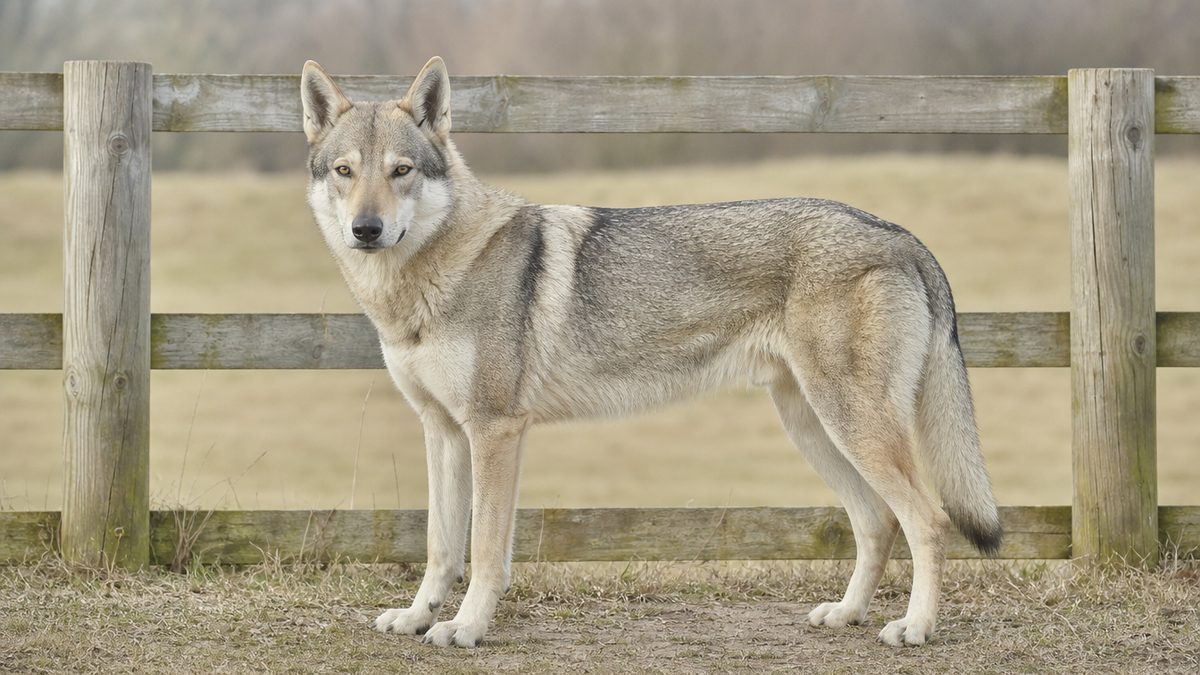
The coat is straight and close, with winter and summer states the standard calls greatly different. In winter an immense undercoat predominates and, with the topcoat, forms a thick coat all over the body, and the standard requires hair covering the belly, the inside of the upper thigh, the scrotum, the inner part of the ear and the area between the toes. Colour runs yellowish-grey to silver-grey with a characteristic light mask, and dark grey with a light mask is also permitted. Every other colour is a disqualifying fault.
Eyes are small, slanting and amber, and dark brown, black or differently coloured eyes are a fault. Ears are pricked, thin, triangular and short, no longer than one sixth of the height at the withers. Those ears that stand erect, that ear length ratio and the amber eye are the three cheapest ways to tell a purebred animal from a wolf-like crossbreed in a photograph.
A blue-eyed, mask-free, heavily plumed animal being offered as a Czechoslovakian Wolfdog is describing a Siberian Husky or a Husky cross. The standard requires an amber eye and disqualifies colours outside the yellowish-grey to silver-grey range.
The temperament clause is worth quoting because it is short and unusually candid for a breed standard. It reads: lively, very active, capable of endurance, docile with quick reactions, fearless and courageous, suspicious, shows tremendous loyalty towards his master, resistant to weather conditions, versatile in his uses. The word suspicious is doing real work there, and no marketing page for the breed quotes it.
Two registries outside the FCI also publish for this breed. The United Kennel Club carries a full standard under the name Czechoslovakian Vlcak, with its own Faults and Disqualifications sections. The American Kennel Club lists the breed as the Czechoslovakian Vlciak and, when its Miscellaneous Class page was read on 27 August 2026, the breed was still on it, which means it is enrolled in Foundation Stock Service and competing in Miscellaneous rather than fully recognised. It was approved to compete in that class effective 26 June 2024.
History: a 1955 army experiment, and the two dates the sources disagree on
The breed began as a military biological experiment in the Czechoslovak Socialist Republic, in which German Shepherd Dogs were crossed with Carpathian wolves, and the sources disagree by three years on when the first hybrids were actually produced.
The FCI standard's own historical summary is the primary account, and it is worth quoting because it is more specific than most secondary retellings. It states that in the year 1955 a biological experiment took place in the CSSR of that time, namely the crossing of a German Shepherd Dog with a Carpathian wolf, and that the experiment established that the progeny of the mating of male dog to female wolf as well as that of male wolf to female dog could be reared. Both directions worked, which is not a trivial detail in hybrid biology and is why the founding pedigree has wolves on both the sire and dam sides.
The peer-reviewed genetic literature dates the first generation differently. Smetanova and colleagues, working from the breed's own pedigree records, describe the F1 German Shepherd by Carpathian wolf hybrids as obtained in 1958 as a military project in the former Czechoslovakia. Both dates are published, neither is obviously wrong, and they are probably describing different milestones: the start of the programme and the first surviving litter. We print both rather than picking one.
| Year | Event | Source |
|---|---|---|
| 1955 | Biological experiment begins, German Shepherd crossed with Carpathian wolf | FCI standard 332 |
| 1958 | F1 hybrids obtained as a military project | Smetanova et al. 2015 |
| 1958-1983 | Repeated backcrossing to dogs; the genomes of two male and two female Carpathian wolf founders introgressed into the German Shepherd gene pool | Smetanova et al. 2015 |
| 1965 | Experiment ends; a plan for breeding the new breed is drawn up | FCI standard 332 |
| 1982 | Recognised as a national breed by the general committee of the breeders' associations of the CSSR | FCI standard 332 |
| 30 May 1999 | Accepted on a definitive basis by the FCI | FCI nomenclature |
| 3 Sept 1999 | Official valid standard published | FCI nomenclature |
What the programme was actually for
The stated purpose was border work. The initial aim of the breeders was to select hard-working dogs for military purposes, to guard the mountainous borders of the former Czechoslovakia during the Cold War, by improving their health, vitality, endurance and sensory abilities such as night vision. The FCI standard puts the same idea more simply: the 1965 breeding plan was to combine the usable qualities of the wolf with the favourable qualities of the dog.
The programme also recorded what did not work, and this is the most useful sentence in the whole history for a prospective owner. Backcrosses with dogs produced individuals that were less aggressive and easier to train than the F1 and F2 hybrids. In other words, the people who ran the experiment found the early-generation hybrids unmanageable and bred away from them deliberately, over 25 years. Anyone selling a modern low-generation wolf cross as an improvement on this breed is selling you the version the Czechoslovak army rejected.
English Wikipedia attributes the 1955 experiment to Colonel Karel Hartl working with the cynologist Heiri Machat, and records that the breed was known as the Czech Wolfdog until 1982. Neither the FCI standard nor the genetic papers name the individuals, so treat the attribution as secondary and the date change as the well-documented part.
This is not a landrace that drifted toward wolves. It is a documented, dated, state-run breeding programme with recorded founders and a recorded number of backcross generations. That is why claims about it are checkable, and why an unverifiable claim about a wolfdog in India should be treated as a claim about a different animal entirely.
What the genome says: how much wolf is actually in a Czechoslovakian Wolfdog
Genomic studies find a limited introgression of wolf alleles inside a much larger proportion of dog genome, which is exactly what 25 years of deliberate backcrossing to German Shepherds would produce.
The question every buyer asks is what percentage of wolf the dog is, and the honest answer is that the question does not have a single number. Two studies have measured it with different tools and both describe the same shape of answer. Smetanova and colleagues sequenced the hypervariable part of the mitochondrial control region and genotyped 39 autosomal microsatellites in 79 Czechoslovakian Wolfdogs, 20 German Shepherds and 28 Carpathian wolves, and concluded that the breed shows a limited introgression of wolf alleles within a higher proportion of the dog genome, consistent with the reiterated backcrossing used in the pedigree.
Their most concrete finding is about diversity rather than percentage. Only two mitochondrial haplotypes and two Y-linked haplotypes were found across the whole sample, and both mitochondrial haplotypes were of domestic origin, meaning the maternal line traces to dogs rather than to the founding wolves. One of the two Y-haplotypes was shared with German Shepherds and the other was unique to the breed. That is a very narrow founding base for a breed with a worldwide population.
The SNP study, and which genes came from which parent
Caniglia and colleagues went further with a 170,000 SNP panel and reconstructed ancestry gene by gene. They identified more than 300 genes with an excess of wolf ancestry compared with random expectations, mainly related to key morphological features, and more than 2,000 genes with an excess of dog ancestry, playing roles in lipid metabolism, in the regulation of circadian rhythms, in learning and memory processes, and in sociability, including the COMT gene which has been described as a candidate gene for sociability in dogs.
That is a precise and unusually satisfying result: the wolf contributed the look, and the dog contributed the brain chemistry. It also explains why the breed can be a registered companion animal at all. The same study found individual inbreeding levels calculated from homozygosity regions to be relatively high, consistent with the low number of founders, and found that pedigree-based relatedness coefficients often underestimated the identity-by-descent scores measured from genetic profiles. In plain terms, dogs are more closely related to each other than their papers suggest.
| Study | Marker set | Wolfdogs sampled | Headline finding |
|---|---|---|---|
| Smetanova et al. 2015 | mtDNA control region, 4 sex-linked and 39 autosomal microsatellites | 79 | Two mtDNA and two Y haplotypes only; both mtDNA haplotypes of domestic origin |
| Caniglia et al. 2018 | 170k SNP panel | Not stated in the abstract | 300-plus genes with excess wolf ancestry, 2,000-plus with excess dog ancestry |
Neither peer-reviewed study reduces the breed to a single wolf percentage, because ancestry is not distributed evenly across a genome and individual animals differ. A seller quoting a precise wolf percentage for a Czechoslovakian Wolfdog is quoting a number that does not come from either published analysis.
One practical consequence follows for India. Caniglia and colleagues explicitly frame their ancestry-informative markers as a forensic tool, useful to unmask illegal crossings with wolves and uncontrolled trades of recent and undeclared wolfdog hybrids. The technology to tell a registered Czechoslovakian Wolfdog from a recent backyard wolf cross exists and is published. Nothing in India currently uses it.
Is a Czechoslovakian Wolfdog legal in India? The position is unsettled, and here is exactly why
No Indian statute, rule or reported judgment decides whether a registered wolf-derived dog breed is a wild animal, so the correct answer is that the legal status is unsettled rather than clearly permitted or clearly prohibited, and anyone telling you otherwise has not read the Act.
Two provisions decide this and they have to be read together. The Wild Life (Protection) Act 1972, as amended with effect from 19 December 2022, defines the term at section 2(36) in these words: wild animal means any animal specified in Schedule I or Schedule II and found wild in nature. That is a two-limb test. An animal has to be on a schedule, and it has to be found wild in nature.
The first limb is satisfied for the wolf. Schedule I of the Act, under the heading CANIDS, lists at entry 21 the Grey Wolf, Canis lupus, alongside the Asiatic Wild Dog or Dhole at entry 20 and the Jackal, Canis aureus, at entry 22. Section 2(5) then defines a captive animal as any animal specified in Schedule I or Schedule II which is captured or kept or bred in captivity, which is the clause that would catch a privately held wolf.
The second limb is where a registered breed stops fitting
A Czechoslovakian Wolfdog is not found wild in nature. It is a registered domestic breed with a published standard, a patronage country and an FCI number, and its own genomic studies describe a genome that is mostly dog, with the wolf contribution concentrated in morphology rather than in behaviour. On the plain words of section 2(36), the second limb fails, and if it fails the animal is not a wild animal for the purposes of the Act.
The Act supports that reading in one further place, and this is the single strongest textual point available. Schedule IV of the Act reproduces the CITES appendices, and its Canidae entry for Canis lupus carries this annotation verbatim: Excludes the domesticated form and the dingo which are referenced as Canis lupus familiaris and Canis lupus dingo, respectively, which are not subject to the provisions of the Convention. The Act's own text therefore knows that Canis lupus familiaris is a separate thing from Canis lupus and says so.
What the Act does not contain, checked rather than assumed
The full consolidated text was searched term by term. Across the entire Act the phrases wolf dog and wolfdog appear zero times. The word hybrid appears eleven times, and every one of those eleven is unrelated to canids: they are the butterfly Heliophorus hybrida, the Whiskered Tern Chlidonias hybrida, and CITES annotations about artificially propagated plant hybrids in Schlumbergera, Cymbidium, Dendrobium, Phalaenopsis, Vanda, Taxus cuspidata and Cyclamen persicum. The phrase domestic animal appears zero times. The search instrument was proved in the same session, because Canis returned nine hits and wolf returned one, both correctly.
| Question | What the Act says | Effect |
|---|---|---|
| Is the wolf protected? | Schedule I, CANIDS, entry 21, Grey Wolf, Canis lupus | Yes, at the highest level |
| What is a wild animal? | Section 2(36): specified in Schedule I or II AND found wild in nature | Two limbs, both required |
| Is there a wolf-content threshold? | No occurrence of wolf dog, wolfdog or any percentage rule | No statutory line to be on either side of |
| Is the domestic dog distinguished? | Schedule IV annotation excludes Canis lupus familiaris from the Convention | The Act's own text separates them |
| Has a court applied this to a breed? | No reported judgment found | The question is untested |
We will not tell you that owning a Czechoslovakian Wolfdog in India is legal, and we will not tell you it is banned. Neither statement can be supported. What can be supported is that the statute's two-limb definition is not obviously met, that no Indian court has ruled on it, and that an enforcement officer at a port or a municipal authority is entitled to form a different view from yours until one does.
One further limitation belongs on the record. No state law and no municipal by-law specific to wolf hybrids was found in this research. That is a limit of the search rather than proof that none exists, and municipal pet by-laws in India are poorly indexed and change without notice. If you are in a housing society, the society's own rules will reach you long before any statute does.
Import law: the clause that actually decides this at an Indian port
Importing a dog into India runs on DGFT Trade Notice 22/2022-23, and its Policy Condition 6 makes the Wild Life (Protection) Act definition the operative test, which is precisely why the unsettled question in the previous section is not academic.
Dogs enter India under ITC(HS) 01061900, described in the schedule as Mammals, Other, with an import policy of Restricted and the note Subject to Policy Condition 6 of this Chapter. The trade notice then prints the three policy conditions in full, and the first of them is the one nobody quotes.
Policy Condition 6, verbatim: Import of Wild Animals (including their parts and products) as defined in the Wild Life (Protection) Act, 1972 (as amended from time to time) is prohibited and those species which are listed in CITES are subject to the provisions of CITES.
Policy Condition 7, verbatim: Import of dogs is allowed only for the following specific purposes: i. Pet dog with valid pet book and relevant records or documents in the name of importer. ii. Dogs imported by the R&D Organisations for conducting research with the recommendation of CPCSEA. iii. For the internal security by the Defence and Police Force.
Policy Condition 8, verbatim: Import of commercial dogs for breeding or any other commercial activities other than the purposes mentioned above is not permitted.
Reading the two instruments together
Put Policy Condition 6 next to section 2(36) of the Act and the shape of the problem is clear. A customs or quarantine officer deciding whether to admit an animal described on its paperwork as a wolfdog has to decide whether it is a wild animal as defined in the Act. If the officer applies the two-limb test and concludes the animal is a registered domestic breed not found wild in nature, it is not prohibited under Policy Condition 6 and falls to be assessed under Conditions 7 and 8 like any other dog. If the officer reads the word wolf in the breed name and stops, it is prohibited. There is no published guidance resolving that, and the outcome turns on a judgement call rather than a rule.
The rest of the trade notice, which applies whatever the answer
- Two pets as baggage, but only after two years abroad. Import is allowed as passenger baggage without DGFT authorisation only to persons transferring their residence to India after two years of continuous stay abroad, and only cats and dogs may be imported under the baggage rules.
- A DGFT authorisation is required otherwise, including where the continuous stay abroad is less than two years, where the pet is not travelling as passenger baggage, or where more than two pets are involved.
- Trading and breeding applications are rejected by design. Paragraph 6 of the notice states that any applications for trading or breeding purposes, or applications made on behalf of some another person or entity, shall be duly rejected.
- Seven entry points only. Import of pet animals is allowed only through the airports and seaports of Delhi, Mumbai, Chennai, Hyderabad, Bengaluru and Kolkata and, since October 2024, Kochi airport, and the animals may be quarantined at the government station of those ports Department of Animal Husbandry…. The full route is set out in how to import a dog to India.
- An advance No Objection Certificate from the Regional or Quarantine Officer (AQCS) is needed seven days before travel, relaxable to three days, on production of the DGFT licence and a health certificate from a veterinarian in the exporting country.
- Start two months early. The notice advises pet owners travelling to India to begin the import authorisation process at least two months in advance of travel.
In June 2023 the Madras High Court, per Anita Sumanth J, set aside the DGFT notification restricting dog imports, holding it had been issued without the necessary scientific study and due diligence. The Centre appealed, and the appeal was listed before Chief Justice S.V. Gangapurwala and Justice D. Bharatha Chakravarthy. We could not establish the outcome of that appeal, so we do not state the current DGFT position as settled. Read the instrument yourself before you rely on it.
The 2024 circular that named wolf dogs, and the four High Courts that took it apart
A Government of India circular dated 12 March 2024 named wolf dogs among the breeds prohibited for import, breeding and sale as pets, and within about five weeks it had been stayed by two High Courts, quashed by a third and set aside by a fourth.
The list itself is best read in the customs instruction that relayed it, because that document reproduces it word for word. CBIC Instruction No. 05/2024-Customs dated 14 March 2024, headed Prohibition for import of ferocious breeds of dog, records that it acts on an office memorandum of 12 March 2024 from the Department of Animal Husbandry and Dairying and states that the following breeds of dogs have been identified as ferocious which are dangerous for human life and shall be prohibited for import, breeding, selling as pet dogs and other purposes.
The list it then quotes, verbatim, begins breeds (including mixed and cross breeds) like and runs through Pitbull Terrier, Tosa Inu, American Staffordshire Terrier, Fila Brasileiro, Dogo Argentino, American Bulldog, Boerboel, Kangal, Central Asian Shepherd Dog (ovcharka), Caucasian Shepherd Dog (ovcharka), South Russian Shepherd Dog (ovcharka), Tornjak, Sarplaninac, Japanese Tosa and Akita, Mastiffs (boerbulls), Rottweiler, Terriers, Rhodesian Ridgeback, Wolf dogs, Canario, Akbash dog, Moscow Guard dog, Cane corso and every dog of the type commonly known as a Ban Dog or Bandog.
Two features of that wording matter for this breed. Wolf dogs is a category rather than a named breed, and the opening words expressly extend the list to mixed and cross breeds. A dog whose FCI standard describes it as the product of crossing a German Shepherd Dog with a Carpathian wolf is squarely within the ordinary meaning of both phrases.
What the courts did, in order
| Court | What it did | Reported |
|---|---|---|
| Calcutta High Court | Partially stayed the notification | March 2024 |
| Madras High Court | Temporarily stayed the circular | March 2024 |
| Karnataka High Court | Quashed the circular, recording that none of the stakeholders were heard | 10 April 2024 |
| Delhi High Court | Set the circular aside, the Union stating it had no objection | 19 April 2024 |
| Department of Animal Husbandry and Dairying | Issued a public notice inviting written objections | 2 May 2024 |
| Bombay High Court | Told by the Centre that it is not acting on the circular at present | 24 January 2025 |
The Delhi High Court order is the operative one for the text of the circular. A division bench of Manmohan, ACJ and Manmeet Pritam Singh Arora, J. recorded the Union's statement of no objection and held that the impugned circular dated 12th March 2024 is set aside, directing the respondents to issue a public notice in a national newspaper and on their website inviting written objections to any proposed notification or amendment within two weeks The Indian Express. The Karnataka High Court had already quashed it, observing that it is an admitted fact that none of the stakeholders were heard, and the Madras High Court had stayed it.
The Department issued the required public notice on 2 May 2024 seeking objections, and on 24 January 2025 counsel for the Union told the Bombay High Court, hearing a public interest litigation by the NGO Animal Rescue Trust through Vineeta Tandon, that at present it is not acting on the March 2024 circular and will decide after considering the objections.
First, we found no instrument withdrawing CBIC Instruction 05/2024-Customs itself. The customs instruction is a separate document from the departmental circular the courts dealt with, and its status was not resolved by this research. Second, we found no fresh notification replacing the 12 March 2024 circular as at 27 August 2026. Both are limits of our search rather than findings. A reader planning to import should assume a customs officer may still be working from the 2024 instruction until shown otherwise.
The practical effect for an Indian buyer is narrower than the headlines suggest. The circular no longer stands, so there is no enforceable nationwide breed ban naming wolf dogs. But the Centre has said it intends to take a fresh decision after considering objections, which means the position could change with a single notification, and it would name the same category.
Indian breeding law collides with this breed's own standard in three places
The Prevention of Cruelty to Animals (Dog Breeding and Marketing) Rules 2017 prohibit exactly three things that the Czechoslovakian Wolfdog's own history and standard require, and any Indian breeder following the FCI text without reading the Rules would break them.
These Rules are made under the Prevention of Cruelty to Animals Act 1960 and are notified as G.S.R. 496(E). Their Second Schedule is expressed to be read with rules 5(2) and 6 of the main Rules, and it is numbered separately from them, which is why the clauses below must be cited as Second Schedule paragraphs and never as Rules.
Collision one: creating the breed at all
Second Schedule Part II paragraph 6(9) is one sentence long: Breeding to create new breeds of dogs or unusual looks shall be strictly prohibited. The Czechoslovakian Wolfdog exists only because a state programme did precisely that between 1955 and 1983, deliberately crossing two species to produce a new breed with a wolf-like appearance.
That does not make owning an existing dog unlawful, and we are not saying it does. What it does mean is that recreating the cross in India, or breeding a Czechoslovakian Wolfdog back to a wolf or to another breed to produce a new wolf-like type, runs directly into a prohibition written in plain words.
Collision two: the dewclaw instruction
The FCI standard says of the hindquarters, in terms: The dewclaws are undesirable and must be eliminated. Second Schedule Part II paragraph 6(8) reads, verbatim: There shall be no tail docking, ear cropping, de-barking, de-clawing, branding, dyeing, injecting substances to enhance visual appeal, performing a surgery or procedure to camouflage or hide any defect or infirmity or any other kind of mutilation of any body part of the pup and any change of appearance by artificial means is strictly forbidden.
So the breed standard instructs a procedure that Indian law names and forbids. An Indian breeder who follows the FCI text here commits an offence, and an Indian buyer who asks for a dewclaw-free puppy is asking for one. This is the clearest single example on this page of overseas breed guidance that does not transfer to India, and it is worth stating plainly rather than leaving in a footnote.
Collision three: what a breeding dog must have been tested for
Second Schedule Part III paragraph 8(10) reads, verbatim: The dogs shall have been tested for genetic defects, including hip dysplasia, progressive retinal atrophy, night blindness, hypothyroidism, entropion, ectropion, overshot, undershot jaw (when incisors do not touch or mesh), wry mouth, two or more missing teeth, unilateral cryptorchid or full cryptorchid males.
Read that word including carefully, because it makes the list illustrative rather than closed. Pituitary dwarfism is not named, but the clause does not therefore exclude it, and in a breed where between a fifth and a third of tested breeding animals carry the mutation, a breeder who has not run the LHX3 test has not met the spirit of the clause even if they have met its letter.
The hip dysplasia limb is directly checkable for this breed. OFA holds 130 hip evaluations on the Czechoslovakian Vlciak, so the test exists, is routine, and produces a comparable number. The eye limbs bite too, given that a Slovak clinical series found multifocal retinal dysplasia in six of 117 dogs in a breed generally described as free of significant eye problems.
Rule 8(1)(a) of the same instrument, which is part of the main Rules and not the Second Schedule, requires that pups less than eight weeks in age are not sold. That one is correctly cited as a Rule. The three clauses above are not, and writing Rule 6(8) or Rule 8(10) sends a reader to a different provision entirely.
Czechoslovakian Wolfdog price in India: there is no verifiable price, and here is the arithmetic that shows it
No verifiable Indian price for a Czechoslovakian Wolfdog exists, because no verifiable Indian litter, breeder or transaction was found, and every rupee figure ranking for the price in india query belongs to a page that is not about this breed.
Start with what the ranking page actually is. The Indian page that appears for the wolfdog price query is titled Wolf Dog Price in India and is about a generic wolf hybrid rather than about FCI standard 332. Its own specification box gives the origin as Northern Eurasia in 1932, the life expectancy as 12 to 18 years, the height as 50 cm to 58 cm for males and the weight as 20 kg to 27 kg for males. FCI standard 332 dates the breed to 1955 in Czechoslovakia and sets a floor of 65 cm and 26 kg for males. Not one of the page's own figures describes this breed.
The division test, run on every figure rather than a sample
This site tests any suspicious Indian rupee price by dividing it by the exchange rates that Indian content farms have been caught using. Fifteen distinct rupee figures appear on that page. Not one divides to a whole number of US dollars at 84.38. Not one divides cleanly at 74.00. Not one divides cleanly at 66.67. Eight of the fifteen appear to give whole dollars at 80.00, producing 150, 250, 475, 500, 600, 625, 750 and 875.
That eight-of-fifteen result proves nothing, and saying why is the useful part. One thousand rupees divided by eighty is twelve and a half, so any rupee figure ending in three zeros with an even thousands digit divides cleanly at 80 by construction. The strong test is 84.38, and it returned zero matches. These figures are rupee-native and arbitrary, which is a different kind of contamination from a converted price list and needs saying differently: nobody converted an American price sheet here, somebody typed numbers.
| Rupee figure | At 84.38 | At 74.00 | At 80.00 | At 66.67 |
|---|---|---|---|---|
| Rs 12,000 | 142.21 | 162.16 | 150.00 | 179.99 |
| Rs 20,000 | 237.02 | 270.27 | 250.00 | 299.99 |
| Rs 25,000 | 296.28 | 337.84 | 312.50 | 374.98 |
| Rs 35,000 | 414.79 | 472.97 | 437.50 | 524.97 |
| Rs 40,000 | 474.05 | 540.54 | 500.00 | 599.97 |
| Rs 45,000 | 533.30 | 608.11 | 562.50 | 674.97 |
| Rs 50,000 | 592.56 | 675.68 | 625.00 | 749.96 |
| Rs 60,000 | 711.07 | 810.81 | 750.00 | 899.96 |
| Rs 61,000 | 722.92 | 824.32 | 762.50 | 914.95 |
| Rs 70,000 | 829.58 | 945.95 | 875.00 | 1049.95 |
| Rs 75,000 | 888.84 | 1013.51 | 937.50 | 1124.94 |
The same page contradicts itself twice
Its city table lists Delhi at Rs 60,000 to Rs 75,000, while the numbered list two paragraphs below gives Delhi as Rs 60,000 to Rs 70,000 for males and Rs 45,000 to Rs 50,000 for females. Its Chennai row is Rs 12,000 to Rs 25,000 for males and Rs 35,000 to Rs 40,000 for females, so the females cost roughly double the males in one city and less than the males in most others. A price table that cannot agree with its own prose one screen later is not reporting a market.
What the page can honestly say about puppy price
There is no Czechoslovakian Wolfdog puppy price in India, because there is no lawful supply chain for one to form in. Import for breeding or trading is not permitted and such applications shall be duly rejected. Breeding to create new breeds or unusual looks is prohibited. Between those two provisions, a legitimate Indian breeder of this breed cannot come into existence, and no register in India lists one.
A Facebook post from Ludhiana advertises what it calls the one and only czechoslovakian wolfdog in india, open for stud service at a mating fee of Rs 1,00,000. That is a seller's own claim about a single animal, with no pedigree, no register entry and no verification, and it is the entire visible Indian market for this breed. We name it because knowing what is actually on offer is more useful than any invented price band.
For comparison rather than as a price to pay, an American breed-list site publishes an average of 800 to 1,500 US dollars for a Czechoslovakian Wolfdog puppy. That is a US figure for a US market, it is not what an Indian buyer would pay, and running it through any exchange rate to produce a rupee number is exactly the practice this section exists to expose.
What an Indian search for this breed actually returns
Search for this breed from India and you get four things, none of which is a Czechoslovakian Wolfdog for sale: an encyclopaedia entry, two foreign registries, a generic price farm and a Rs 50 crore news story about a different animal.
The most instructive result is the news story, because it is India's most publicised wolfdog and it is not this breed. In March 2025 The Hindu reported that Satish S. of Bengaluru claimed to have bought an eight-month-old animal called Cadabom Okami from the United States for Rs 50 crore, describing it as the fifth-generation descendant of a wolf-dog cross. He explained the origin as a rescued wolf crossed with a Caucasian Shepherd in the United States about twenty years ago, and said the dog weighs 75 kg, stands 30 inches and eats about 3 kg of chicken a day.
One sentence in that report is checkable and wrong. He is quoted saying: Wolf-dog is a new and very rare breed and you wouldn't find it even in the records of American Kennel Club. This is the first time a wolf dog is being introduced to the world. The Czechoslovakian Vlciak has been in AKC records since it entered Foundation Stock Service and has been eligible to compete in the AKC Miscellaneous Class since 26 June 2024 American Kennel Club. The Saarloos Wolfhond is in AKC records too. Wolf-derived breeds are neither new nor unrecorded.
The same report records the owner's other claims: a Korean Mastiff at Rs 1 crore, an Alaskan Malamute at Rs 8 crore, a Tibetan Mastiff at Rs 10 crore and a Caucasian Shepherd at Rs 20 crore, around 150 dogs in total, and an appearance fee of Rs 2.5 lakh per hour. These are reported as the owner's claims and we repeat them as claims, not as verified transactions. Nothing in the report is a market price for anything.
Why this matters to a buyer
Because it tells you what the word wolfdog is being used to sell in India. It is being used for a Caucasian Shepherd cross of unstated pedigree, and the price attached to it is a number chosen for a press story. An Indian buyer who searches the term and reads that story learns nothing about the animal FCI standard 332 describes, and is being primed to accept a very large figure as normal.
| Source type | Example | What it gives an Indian reader |
|---|---|---|
| Encyclopaedia | Wikipedia | History, characteristics, use, notability. No India content |
| Foreign registry | AKC and UKC | Breed standards and trait bars. No India content |
| Brand breed page | Royal Canin India | Three headings: About the breed, Breed specifics, Key facts. Nothing India-specific |
| Price farm | Wolf Dog Price in India | Rupee figures for a different animal, plus a false claim about rabies vaccination |
| News | The Hindu, March 2025 | A Rs 50 crore Caucasian Shepherd cross described as a wolf-dog |
Google's own answer reflects that source pool. The AI Overview served for this term from India on 27 August 2026 opens by saying that Czech wolfdogs are generally not good pets for most people, and its cited sources are Reddit, a Facebook page and a YouTube channel. No registry, no statute and no veterinary study appears in it. The conclusion is defensible; the evidence base underneath it is not.
A page titled Wolf Dog Price in India is not a page containing a Czechoslovakian Wolfdog price. Check three things before you believe any Indian price page for any rare breed: does its own height and weight match the breed standard, does its price table agree with its own prose, and does it name a single verifiable seller. The page ranking for this breed fails all three.
Cost of ownership in India: the structure, and the four numbers nobody can honestly give you
Budget for a large working dog rather than for a breed, because no Indian cost data exists for this breed specifically and inventing a monthly rupee figure would be the same error the price pages make.
We are not going to publish a monthly rupee total for this breed, and the reason is simple: it would be fabricated. There is no verifiable Indian population to survey, no Indian veterinary practice publishing case costs for it, and no insurer rating it. What can be given honestly is the cost structure, the drivers that are unusually expensive for this particular animal, and the four line items that are genuinely unknowable.
What is unusually expensive about this dog, specifically
- Food volume, set by body mass rather than breed. The FCI standard's floor is 26 kg for males with no ceiling, and the breed is built long and dry rather than heavy. Feed for a 30 to 40 kg working dog, not for a German Shepherd-sized pet, and expect the bill to move with activity rather than with age.
- Containment, which is a capital cost most Indian buyers never budget. A boundary that will hold a large athletic dog with a documented preference for solving problems alone is construction, not a purchase. Budget it before the puppy, not after the first escape.
- Cooling, running twelve hours a day for six months. In Delhi the annual mean is 25.6 degrees Celsius and June peaks at a monthly maximum of 48.8. For a dog whose standard requires an immense winter undercoat, cooling is not a comfort spend, it is the difference between keeping the animal alive in May and not.
- DNA screening, which Indian law effectively requires of any breeding animal under Second Schedule Part III para 8(10), and which is not offered as a routine panel by most Indian labs for the LHX3 mutation.
- Specialist veterinary access. A baseline echocardiogram is a sensible investment given that 12 of 117 apparently healthy dogs in the Italian series had more than trivial mitral regurgitation, and veterinary cardiologists exist in perhaps six Indian cities.
The four numbers we refuse to invent
| Cost line | Why no honest figure exists |
|---|---|
| Puppy price in India | No lawful breeding route and no verified litter. Import for breeding is expressly not permitted |
| Monthly upkeep in rupees | No surveyed Indian population of this breed to average |
| Insurance premium | No Indian insurer publishes a rating for the breed |
| Lifetime veterinary cost | No breed-specific Indian morbidity data, and no published lifespan study for the breed anywhere |
The honest planning approach is to price the dog as a 30 to 40 kg working animal in your own city, add a containment build, add year-round cooling, and then add a contingency for the fact that any veterinary problem will be handled by a clinician who has never seen the breed before. If that total makes you hesitate, the hesitation is the correct response and it has arrived at the right time.
Heat tolerance: Chennai's coolest month is warmer than a Czech summer
This breed has the lowest heat tolerance rating on this site, because in Mumbai and Chennai the coolest month of the year is warmer than the hottest month in the country the breed was built for, and the dog's own standard requires a coat designed for the opposite problem.
Every figure below comes from NASA POWER's climatology API, queried by explicit latitude and longitude rather than by place name, over the stated period January 2001 to December 2020. Querying by coordinates matters, because place-name climate lookups have repeatedly served this site a document for a different city at HTTP 200.
The comparison point is Brno, in the Czech Republic, at 49.195 N and 16.607 E. The returned grid cell sits at 243 m, which is within a few metres of the real city, so it is a fair lowland proxy for the country the breed was developed in. Its annual mean temperature is 9.61 degrees Celsius and its warmest month, July, averages 21.45 degrees.
| Location | Annual mean C | Coolest month C | Warmest month mean C | Annual RH percent |
|---|---|---|---|---|
| Brno, Czech Republic | 9.61 | -2.56 (Jan) | 21.45 (Jul) | 77.1 |
| Poprad, High Tatras | 4.50 | -7.02 (Jan) | 15.30 (Jul) | 86.8 |
| Chennai | 27.95 | 24.09 (Jan) | 31.51 (May) | 72.4 |
| Mumbai | 26.77 | 23.19 (Jan) | 31.19 (May) | 67.4 |
| Kolkata | 25.81 | 17.31 (Jan) | 31.53 (May) | 73.9 |
| Delhi | 25.60 | 13.61 (Jan) | 35.88 (Jun) | 45.6 |
| Pune | 23.86 | 19.62 (Dec) | 28.93 (Apr) | 66.8 |
| Bengaluru | 23.74 | 20.22 (Dec) | 28.37 (Apr) | 67.9 |
The single sentence that settles it
Chennai's coolest month averages 24.09 degrees Celsius. Brno's warmest month averages 21.45. That is a difference of 2.64 degrees, in the wrong direction, for every day of the year. Mumbai is 1.74 degrees warmer in January than Brno is in July. Bengaluru, which Indians reach for whenever a northern breed is discussed, is only 1.2 degrees cooler in its coolest month than Brno is in its warmest. There is no Indian metro in which this dog experiences a season that a Czech dog would recognise as summer, let alone as winter.
Take the wolf side of the pedigree instead and the gap widens. The Poprad cell in the High Tatras, the Carpathian range the founding wolves came from, has an annual mean of 4.50 degrees and a July mean of 15.30. Bengaluru's coolest month is 4.92 degrees warmer than that. Chennai's is 8.79 degrees warmer.
Peak heat, which is the thing that kills
Annual means understate the risk, because a double-coated dog dies in a heatwave rather than in an average. Over the same period the highest monthly maximum recorded in the Delhi cell was 48.79 degrees in June, in Kolkata 46.81 in May, in Mumbai 44.91 in April, in Pune 43.20 in April, in Chennai 42.70 in May and in Bengaluru 40.38 in April. A dog whose standard requires an immense winter undercoat, plus hair covering the belly, the inner thigh and between the toes, has no evaporative route out of that.
Humidity decides which failure mode you get. Delhi is dry for most of the year at 45.6 percent annual relative humidity, but its August figure is 74.9 percent, so the monsoon humidity arrives exactly when the dog is already heat-loaded. Mumbai runs at 90.4 percent in August and Chennai at 82.3 percent in November. Panting is an evaporative mechanism, and it fails as ambient humidity rises, which is why a coastal Indian city at 33 degrees is more dangerous to this dog than Delhi at 40.
The hill-station figures from this dataset are unusable at town level and we are not publishing them as such. The grid cell returned for Shimla sits at 898 m against a town at roughly 2,200 m, and the cell returned for Gangtok sits at 3,240 m against a town at roughly 1,650 m. Where a model cell and a town differ by more than a kilometre of elevation, the temperature is the cell's, not the town's, and quoting it as the town's would be exactly the silent substitution this site exists to catch. The plains cities above have cells within tens of metres of reality and are sound.
The only Indian location in this pull that is genuinely cooler than the breed's origin is the Leh cell in Ladakh, whose annual mean is minus 2.75 degrees and whose warmest month, July, averages 10.18 degrees. That cell also sits about a kilometre above the town, so treat it as directional. Ladakh is the honest answer to where in India this dog would be comfortable, and it is a narrow answer, because Ladakh is not where anyone is buying one.
Exercise and containment: what this dog needs daily, and why an Indian compound wall is not a fence
Plan for two to three hours of real work a day, split to avoid the heat, and treat containment as a construction project rather than a purchase, because a working breed with a working trial attached to its registry classification does not settle for a walk.
The FCI classification carries the phrase with working trial, which means the FCI expects dogs of this breed to be assessed on work rather than on appearance alone. The standard describes a dog that is lively, very active and capable of endurance, with a gait it calls a harmonious, light-footed, ground-covering trot in which the limbs skim over the ground as closely as possible. That is a description of a distance animal, not a sprinter, and distance is the thing an Indian city is worst at supplying.
A realistic Indian daily plan
- Before sunrise, 60 to 90 minutes, which is the only window in a plains city between March and October when ambient temperature is survivable for a double-coated dog. In Delhi that means being out before roughly 05:30 in June.
- Mid-day, indoors, 20 to 30 minutes of scentwork or problem-solving. The impossible-task study is useful here: Czechoslovakian Wolfdogs spent significantly more time manipulating the apparatus than Labradors did. This dog will work a puzzle for longer than a retriever will. Use that.
- After dark, 45 to 60 minutes, on a long line rather than off lead, because prey drive and recall are the two things this breed is worst at reconciling.
- Weekly, one long low-intensity outing of two hours or more in the coolest conditions you can reach. Endurance work cannot be replaced by intensity, and trying to replace it with intensity in Indian heat is how dogs collapse.
Containment, honestly costed
Most Indian homes that can house a dog this size have a compound wall, a gate and a latch. None of those three is containment for this animal. The behavioural literature is consistent that this breed acts on its own judgement rather than checking in: German Shepherds were 9.1 times more likely to look back at a human when a task became impossible, and in the Tuscan study only 3 of 17 Czechoslovakian Wolfdogs gazed at a human even during the solvable version of the task, against 8 of 14 Labrador Retrievers and 5 of 12 German Shepherds.
A dog that does not consult you is a dog that will resolve a closed gate by itself. Build to contain rather than to discourage: a continuous barrier with no climbable furniture within a body length of it, a dug footing rather than a surface-set fence, a gate that locks rather than latches, and a second containment layer between the dog and the street. If you cannot build that, this is not a dog you can keep in an Indian city, and no amount of training substitutes for the wall.
An under-exercised specimen of this breed does not become a lazy dog. It becomes a dog that has taught itself a job, and the job it picks is usually leaving.
The FCI standard lists aggressive or overly shy as a disqualifying fault, and adds that any dog clearly showing physical or behavioural abnormalities is likewise disqualified. A breed standard that has to say that is a breed standard written by people who had seen what an under-exercised, under-socialised specimen becomes. In India the failure mode is not a bored dog on a sofa. It is a 30 kg heat-stressed animal with an unmet endurance requirement and a boundary it has already learned to defeat.
One practical note on the heat interaction. Exercise volume has to fall in May and June, which means the mental work has to rise to compensate, and most Indian owners do the opposite: they cut the walk and add nothing. Track the swap deliberately rather than letting it happen.
Temperament, measured rather than described
Two peer-reviewed studies have tested this breed against ordinary dogs, and both found the same thing: the Czechoslovakian Wolfdog is markedly less inclined to turn to a human for help, and neither study found it to be more aggressive, because neither study measured aggression at all.
Start with the numbers, because adjectives are what every other page on this breed offers. Sommese and colleagues ran the impossible-task paradigm on 73 Czechoslovakian Wolfdogs and 27 German Shepherd Dogs, using a glass container placed upside down over food, with three solvable trials followed by one in which the container was fixed to the board. The probability of looking back at a human was higher in German Shepherds than in Czechoslovakian Wolfdogs, with an odds ratio of 9.1, and the German Shepherds' looks were also longer.
The same study tested and rejected the assumption every seller makes. There was no significant correlation between the probability of looking back in Czechoslovakian Wolfdogs and their proportion of wolf blood. In other words, within this breed, a dog with more recorded wolf ancestry is not measurably less human-oriented than one with less. The trait belongs to the breed, not to a percentage.
The Tuscan study, with its denominators printed
A second group tested 23 Czechoslovakian Wolfdogs, 18 Labrador Retrievers and 15 German Shepherds in their own homes, all acquired at two months old and all living with their owners. Of the 56 dogs tested, 43 solved the easy version often enough to advance.
| Measure | Czechoslovakian Wolfdog | German Shepherd | Labrador Retriever |
|---|---|---|---|
| Gazed at a human during the SOLVABLE task | 3 of 17 (23.5 percent) | 5 of 12 (41.6 percent) | 8 of 14 (57.1 percent) |
| Gazed at a human during the UNSOLVABLE task | 9 of 17 (53 percent) | 9 of 12 (75 percent) | 13 of 15 (86 percent) |
| Who they looked at | Preferred the unfamiliar experimenter | Preferred the owner | No preference |
| Time manipulating the apparatus | Longer than Labradors | No difference from either | Shortest |
The Labrador row above is printed in the paper as 13 out of 15, which is 86.7 percent, while every statistical test on the same page gives the Labrador group as N = 14. A part cannot come from a whole the same page says is smaller, so one of the two figures is a slip. We print what the paper prints and flag it rather than quietly picking one.
The comparison the authors drew is the most quotable finding in the literature on this breed. They set their gazing durations against a published study of dingoes and found that the amount of time Czechoslovakian Wolfdogs spent gazing at humans was statistically indistinguishable from the dingoes, while Labradors spent significantly more time gazing than the dingoes did. On this one measure, the breed sits with a free-living Australian canid rather than with a retriever.
What the standard says, and what it does not
FCI standard 332 describes the temperament as lively, very active, capable of endurance, docile with quick reactions, fearless and courageous, suspicious, showing tremendous loyalty towards his master, resistant to weather conditions and versatile in his uses. It then lists aggressive or overly shy as a disqualifying fault, alongside any dog clearly showing physical or behavioural abnormalities.
So the register itself expects a suspicious dog and disqualifies an aggressive one, which is a distinction most Indian coverage of this breed loses. Suspicion of strangers is written into the standard. Aggression is a reason to remove the dog from the breeding pool.
No peer-reviewed study of aggression, bite incidence or dangerousness in the Czechoslovakian Wolfdog was found in this research. The two behavioural studies above measured human-directed gazing and problem-solving persistence and nothing else. Anyone citing them as evidence that the breed is dangerous is misusing them, and anyone citing them as evidence that it is safe is doing the same thing in the other direction. The honest statement is that the question has not been studied.
One genomic note completes the picture. When ancestry was reconstructed gene by gene, sociability-related genes including COMT came out on the dog side of the ledger rather than the wolf side. The breed is social. It is simply social on its own initiative rather than on yours.
Training: build the checking-in habit, because it is not installed
Train this breed by paying for voluntary attention rather than by drilling obedience, because the measured difference between it and a German Shepherd is not intelligence, it is a nine-fold difference in the tendency to turn to a human when something goes wrong.
Everything in this section follows from one number. In a matched task, German Shepherds were 9.1 times more likely than Czechoslovakian Wolfdogs to look back at a human when a problem became unsolvable. A dog that does not look at you cannot be corrected, cued or reassured, so the first behaviour to build is not sit or heel. It is looking at you when nothing has asked it to.
The AKC's own page for the breed frames the same thing in plainer language, describing it as very intelligent and self-thinking, and not well suited to repetitive tasks or service-type work. That is a registry saying, in a marketing document, that its own breed will refuse drills.
What works, in order
- Pay for offered eye contact, from week eight. Mark and reward every unprompted glance for the first three months. You are not teaching a cue, you are buying a habit the breed does not come with.
- Train in single short sessions, three to five minutes. The impossible-task data shows persistence at a puzzle, not tolerance of repetition. Repetition is where this breed disengages.
- Use problems rather than commands. Czechoslovakian Wolfdogs spent significantly more time manipulating the apparatus than Labradors did, so scentwork, food puzzles and search games hold attention where a recall drill will not.
- Socialise deliberately and early, because the standard says suspicious. The FCI text expects suspicion of strangers as normal breed character, which means the socialisation window is not optional maintenance, it is the difference between a suspicious dog and a fearful one.
- Never train off lead in an unfenced Indian space. Recall is the weakest link in a breed that preferentially attends to an unfamiliar person handling food rather than to its owner. Use a long line for the first two years and probably beyond.
- Train in the cool hours only. In a plains Indian city that means before sunrise and after dark for six months of the year, which cuts your available training time roughly in half compared with a European owner's.
Realistic timelines
| Skill | A Labrador or German Shepherd | This breed, realistically |
|---|---|---|
| Reliable name response indoors | 2 to 4 weeks | 6 to 12 weeks of paid attention work |
| Sit, down, stationary cues | Days | Days, and then refusal on repetition |
| Recall in a low-distraction fenced space | 8 to 16 weeks | 6 to 12 months, and never assume it |
| Recall around live prey | Achievable in many individuals | Do not plan for it. Manage instead |
| Calm around strangers at home | Weeks | Ongoing management; the standard expects suspicion |
The Sommese study specifically tested whether a dog's recorded proportion of wolf blood predicted its tendency to look back at a human, and found no significant correlation. If a seller offers you a lower-wolf-content dog as an easier dog to train, that offer is not supported by the only study that has measured it.
One last framing point. None of this makes the breed untrainable. It makes it trainable on different terms: attention has to be earned rather than assumed, and the owner has to be the most interesting problem in the room. Owners who accept that get a dog that works with them. Owners who expect a German Shepherd with a wolf coat get a dog that has stopped listening by month four.
Grooming a double coat in Indian humidity, and the one instruction not to follow
Groom this breed by clearing dead undercoat rather than by shortening the coat, because the double coat is the dog's only heat defence and shaving it removes the defence while leaving the heat, and in Indian humidity the real problem is drying rather than brushing.
The standard describes what you are managing. The hair is straight and close, winter and summer coats differ greatly, and in winter an immense undercoat predominates and together with the topcoat forms a thick coat all over the body. It also specifies that hair must cover the belly, the inside of the upper thigh, the scrotum, the inner part of the ear and the area between the toes. Every one of those five locations is a place that stays damp in an Indian monsoon.
The routine, adjusted for India
- Weekly line-brushing out of season, daily during a coat blow. A straight close coat does not mat the way a Spaniel's does; it packs. The job is to remove dead undercoat before it traps moisture against skin.
- Never shave. A shaved double coat loses its insulating air layer, which works in both directions, and regrows unevenly. In a country where the dog is already thermally compromised, shaving makes the situation worse, not better.
- Dry the five standard-specified locations deliberately after any bath or rain: belly, inner thigh, scrotum, inner ear and between the toes. Air drying is the default advice in European breed guidance and it is written for European humidity.
- Plug the ears before bathing and dry them afterwards. The standard requires hair inside the ear, which slows drying in exactly the season when ambient humidity is highest.
- Check between the toes weekly in the monsoon, because the interdigital hair the standard requires is a moisture trap and interdigital dermatitis is one of the commonest Indian presentations in any hairy-footed breed.
Why Indian humidity is the operative variable
Look at the annual relative humidity figures from the same NASA POWER pull used for the heat section. Mumbai reaches 90.4 percent in August, Chennai 82.3 percent in November, Kolkata sits at 73.9 percent for the year and even Delhi, which is dry at 45.6 percent annually, reaches 74.9 percent in August. Against that, Brno runs at 77.1 percent annually and Poprad at 86.8 percent, but at 9.6 and 4.5 degrees mean temperature respectively, where high humidity is condensation rather than incubation.
The distinction matters because warm humidity and cool humidity do different things to a dog's skin. A dense undercoat that stays damp at 30 degrees is a growth medium. The same coat damp at 8 degrees is simply cold. That is why European grooming guidance for this breed transfers badly to India even though the coat is identical, and it is the single adjustment an Indian owner most needs to make.
No Indian veterinary series on otitis or interdigital dermatitis in this breed exists, because the breed has no Indian population to study. The advice above is derived from the coat requirements the standard itself sets out and from the humidity figures for Indian cities, not from an Indian case series, and we are saying so rather than borrowing another breed's numbers. Separately, no published shedding-volume measurement for the breed was found, so no page including this one can honestly tell you how much it sheds in kilograms.
Health: what the screening databases actually hold for this breed
The Czechoslovakian Wolfdog screens better than most large breeds on hips and elbows and worse than any breed on one specific DNA test, and every figure below is published with the number of animals it rests on.
The Orthopedic Foundation for Animals holds records for this breed under the label CZECHOSLOVAKIAN VLCIAK. That label matters, because searching the same dataset for VLCAK or WOLFDOG returns zero, and reporting zero would have been a manufactured absence produced by the query rather than by the source. LABRADOR and GERMAN SHEPHERD were run as controls in the same retrieval and returned 109 and 75 rows respectively, so the instrument was working.
| Database | Evaluations | Normal | Abnormal or at risk |
|---|---|---|---|
| Hips | 130 | 90.8 percent | 8.5 percent dysplastic |
| Elbows | 130 | 100.0 percent | 0.0 percent |
| Eyes, summary table | 142 | 99.3 percent | 0.7 percent |
| Dentition | 95 | 97.9 percent | 2.1 percent |
| Basic cardiac | 69 | 100.0 percent | 0.0 percent |
| Degenerative myelopathy DNA | 148 | 66.9 percent clear | 29.7 percent carrier, 3.4 percent at risk |
| Pituitary dwarfism DNA | 71 | 67.6 percent clear | 32.4 percent carrier |
The hip breakdown is worth printing in full because the summary hides the shape of it. Of 130 evaluations, 22.3 percent were graded excellent, 62.3 percent good and 6.2 percent fair, which together make the 90.8 percent normal. The 8.5 percent dysplastic splits as 6.2 percent mild, 2.3 percent moderate and 0.0 percent severe. Not one severe hip has been recorded in the breed's OFA file. Those figures add up, which is a check worth doing: 22.3 plus 62.3 plus 6.2 is 90.8, and 6.2 plus 2.3 plus 0.0 is 8.5.
Elbows, independently confirmed in France
The elbow result is unusually strong and it has been replicated on a larger sample by a different body. A French study read 18,870 elbow radiographs taken between 2002 and 2022 and analysed 17,861 records across 13 breeds. The Czechoslovakian Wolfdog row rests on 186 radiographs, 107 from females and 79 from males, representing 2.88 percent of the 6,455 births registered for the breed in that period. Of those 186, 184 were graded ED0, one ED1, none ED2 and one ED3, giving 1.08 percent affected, the lowest of all 13 breeds against a study-wide 11.4 percent and a Dogue de Bordeaux figure of 32.2 percent.
One inconsistency inside OFA's own eye data
OFA's summary eye table reports 99.3 percent normal and 0.7 percent abnormal across 142 evaluations, which is one abnormal dog. Its detail rows for the same 142 tested animals record nine dogs, or 6.3 percent, with a cataract of unknown significance, six with micropapilla, five with a punctate nuclear cataract, and only 118 of 142, or 83.1 percent, coded as plain normal. A part cannot exceed its whole, so the two are not measuring the same thing: the summary Abnormal column plainly excludes findings the detail codes record. Publish both, and never quote either as the breed's eye disease rate.
First, the French hip dysplasia study covering the 1993 to 2019 screening period includes the Czechoslovakian Wolfdog in its list of 17 breeds and reports a range across breeds of 8.8 percent in the Hovawart to 49.2 percent in the American Staffordshire Terrier, but its per-breed table is behind a paywall and the open repository copy sits behind a proof-of-work wall. We could not read the breed's own row and we are not guessing where in that range it falls. Second, no published lifespan or longevity study for this breed was found. A literature search that returned eight genuine breed-specific papers on genetics, dwarfism, cardiology, ophthalmology and behaviour returned none on life expectancy, so the absence is a finding rather than a gap in the search.
Hearts and eyes: two studies that went looking, and found things
Two research groups have examined this breed's hearts and eyes systematically, both on samples of 117 dogs, and both found low-level disease in a population widely described as free of it.
An Italian cardiology group echocardiographed 117 apparently healthy client-owned Czechoslovakian Wolfdogs and used 103 of them to generate breed reference intervals. The remaining 14 had abnormalities: 12 with more than trivial mitral regurgitation, one with subaortic stenosis and one equivocal for subaortic stenosis. The authors concluded that subclinical cardiac abnormalities were uncommon in this population and were mainly mitral regurgitation. Fourteen of 117 is 12.0 percent, and it is the only breed-specific cardiac dataset that exists for the breed anywhere.
The reference intervals are the more useful output for a practising vet. Because they were generated on this breed rather than borrowed from a general canine population, an Indian clinician measuring a Czechoslovakian Wolfdog now has breed-appropriate numbers to compare against, which matters in a dog that is longer, drier and deeper-chested than the breeds most reference ranges were built on Federation Cynologique Internationale.
The eye finding that contradicts the breed's reputation
A Slovak group put that reputation to the test. Their paper opens by noting that the Czechoslovakian Wolfdog is generally known for being free of significant eye problems, and then reports that a clinical study of 117 Czechoslovakian Wolfdogs found six with signs of multifocal retinal dysplasia. A genome-wide case-control association study of 36 adult dogs identified an association on chromosome CFA37, in the first intron of the CYP27A1 gene, in a region where other genes linked to ocular disease in animal models also sit. Six of 117 is 5.1 percent, and it means the phrase free of eye problems needs retiring.
| Study | System examined | Dogs | Affected | Rate |
|---|---|---|---|---|
| Ivasovic et al. 2024, Italy | Heart, echocardiography | 117 | 14 | 12.0 percent |
| Gabor et al. 2025, Slovakia | Eyes, clinical plus GWAS | 117 | 6 | 5.1 percent |
Both studies report 117 dogs, which is the kind of coincidence worth checking rather than assuming. They are different populations examined by different specialties in different countries: an Italian cardiology series and a Slovak ophthalmology series with a separate GWAS arm of 36 adults Gabor M, Candrak J, Miluchova M. Nothing links the two cohorts, and neither cites the other's sample.
For an Indian owner the practical consequence is short. Both findings are the kind that only appear when somebody looks with equipment, and neither produces symptoms an owner would notice. If you have this breed in India and can reach a veterinary cardiologist or ophthalmologist, a baseline in the first two years is worth the trip, because nobody in the country is going to catch either problem incidentally.
Pituitary dwarfism: the one disease with a DNA test, a breed-specific paper and two disagreeing numbers
Pituitary dwarfism in this breed is caused by a single 7 base-pair deletion in intron 5 of the LHX3 gene, it is recessive so carriers look completely normal, and the two published carrier rates disagree by more than eleven percentage points.
The definitive paper is from Utrecht University. Voorbij, Leegwater and Kooistra examined four client-owned Czechoslovakian Wolfdog dwarfs, one male and three females aged three to four months, alongside two Saarloos dwarfs, and then screened a much larger group of clinically healthy dogs intended for breeding. All six dwarfs had retained their puppy coat with a variable degree of alopecia, and all were homozygous for the same 7 base-pair deletion found in German Shepherd dwarfs.
The mechanism is precise enough to be worth stating. Intron 5 of the canine LHX3 gene normally runs to 75 base pairs and contains six imperfect repeats of the seven-base consensus sequence GCGCCCC. The mutation deletes seven consecutive nucleotides from the region of repeats four to six, shrinking the intron to 68 base pairs, at which size it is too small to be spliced efficiently. The result is combined pituitary hormone deficiency: growth hormone, thyroid-stimulating hormone, prolactin and the gonadotropins are all deficient, while adrenocorticotropic hormone secretion is preserved.
The two carrier rates, and why we print both
| Source | Dogs tested | Carriers | Carrier rate |
|---|---|---|---|
| Utrecht University, Czechoslovakian Wolfdogs | 200 | 42 | 21 percent |
| OFA DNA database, Czechoslovakian Vlciak | 71 | 23 | 32.4 percent |
| Utrecht University, Saarloos Wolfdogs | 239 | 75 | 31 percent |
| OFA DNA database, German Shepherd Dog | 58 | 8 | 13.8 percent |
Both numbers are real and neither is wrong. The Utrecht figure rests on 200 dogs screened as part of a research programme; the OFA figure rests on 71 dogs whose owners chose to test and submit, which is a self-selecting group and can run high where owners test because dwarfism appears in the pedigree. The authors of the Utrecht paper flagged that exact bias themselves. We publish the disagreement rather than averaging it, and note that on either figure the rate is high enough to make testing non-optional.
One further fact from OFA is worth stating plainly. Across every breed in its pituitary dwarfism database, the Czechoslovakian Vlciak ranks first, ahead of the German Shepherd Dog at 13.8 percent of 58 and the Tibetan Terrier at 9.4 percent of 85, against an all-breeds figure of 16.7 percent of 234. This is the disease on which the breed is genuinely an outlier.
Where the mutation came from, and why that matters here
Genealogical work traces the origin of the recessive allele to a mutation that arose in the German Shepherd population in 1940 or earlier. The Czechoslovakian Wolfdog programme began in 1955, after the mutation already existed, so one or more of the founding German Shepherds carried it and introduced it into a breed that has since passed through a narrow founder bottleneck. The wolf side of the pedigree contributed nothing to this disease. The dog side did.
Prognosis, and why an Indian owner should care before buying
Untreated dwarfs suffer a wide range of clinical problems and many will not live more than four to five years. Treatment with porcine growth hormone and synthetic l-thyroxine improves the outlook considerably but the prognosis remains guarded. Neither drug is a routine Indian small-animal stock item, and no Indian laboratory was found offering the LHX3 assay as a standard panel. An Indian owner who acquires an affected puppy is therefore facing a lifelong condition with a treatment pathway that has to be improvised.
The authors state it flatly: if all breeding animals were genetically tested for the presence of the LHX3 mutation and a correct breeding policy implemented, this disease could be eradicated completely. Indian law already points the same way, because Second Schedule Part III para 8(10) of the 2017 Rules requires breeding dogs to have been tested for genetic defects and uses the word including, which leaves the list open. Ask for both parents' results in writing. A breeder who cannot produce them has not done the one thing that would have made this disease disappear.
Feeding: life stage, body condition and what is actually on an Indian shelf
Feed to body condition rather than to a chart, because the breed standard sets a weight floor of 26 kg for males with no ceiling, and because a lean working outline is normal in this breed rather than a sign of underfeeding.
The standard describes a dry, taut animal: a clean, well-muscled neck, a taut belly tucked up, slightly hollow flanks, and a chest whose depth does not reach the elbows. Indian owners used to German Shepherds and Labradors routinely read that outline as thin and feed up to correct it, which is the commonest feeding mistake made with the breed. The correct target is a dog you can feel ribs on easily and see a waist on from above.
Life-stage guidance
- Eight weeks to six months. Four meals a day falling to three, on a large-breed puppy formulation with controlled calcium, because skeletal growth rate is one of the few hip dysplasia risk factors an owner controls. The breed's OFA hip file already sits at 8.5 percent dysplastic of 130, and overfeeding a growing large-breed puppy is the reliable way to make an individual worse than its pedigree.
- Six to eighteen months. Two meals a day. Growth in this breed continues later than in a Labrador and the adult outline arrives well after the adult height does. Do not switch to adult food on the twelve-month calendar date; switch when growth stops.
- Adult, eighteen months onward. Two meals a day, adjusted seasonally rather than annually. Energy requirement in a plains Indian city falls sharply in May and June because exercise volume has to fall, and an unadjusted bowl in those months is how a lean breed becomes a heavy one.
- Senior. No breed-specific senior guidance exists, because no lifespan study for the breed exists. Follow general large-breed practice and let bloodwork rather than a birthday decide the transition.
The Indian availability question
Large-breed formulations from the major international manufacturers are widely stocked in Indian metros, and Royal Canin publishes an India-facing page for this breed, although that page carries only three headings and nothing India-specific in it. There is no breed-specific formulation for the Czechoslovakian Wolfdog and there does not need to be. Any complete large-breed diet appropriate to the life stage will do the job.
Two Indian-specific adjustments matter more than the brand. First, water: a double-coated dog in Indian heat drinks substantially more than the same dog in Europe, and multiple water points that are refreshed rather than topped up are worth more than any supplement. Second, feeding time: move meals out of the hottest part of the day, because a large deep-chested dog that eats and then exercises in heat is carrying two risks at once.
The wolf in the breed name is not a dietary instruction, and the paragraph below explains why the genomic evidence says so.
A raw-meat-only diet is often recommended for wolfdogs on the strength of the wolf in the name, including on the Indian page that ranks for the price query, which asserts that raw meat is something they want to eat daily and that a handful of pounds of raw chicken per day is recommended. The genomic evidence points the other way: genes with excess dog ancestry in this breed include those involved in lipid metabolism, which is one of the classic domestication signatures. This is a dog's digestive system in a wolf's coat, and it should be fed as one.
Month by month through the first year in India
Plan the first year around three fixed constraints: the socialisation window closes early, the containment has to be finished before the puppy arrives, and in a plains Indian city half the year is unusable for outdoor work.
| Age | Priority | The India-specific note |
|---|---|---|
| Before arrival | Finish the containment build and the vet search | Identify the nearest veterinary cardiologist now, not after a murmur is found |
| 8 to 12 weeks | Socialisation, and paid eye contact from day one | Do exposure work at dawn and after dark from March onward |
| 3 to 4 months | Continue socialisation; introduce scentwork | Watch interdigital skin weekly once the monsoon starts |
| 4 to 6 months | Long-line habits; never off lead outdoors | Cut outdoor volume hard in May and June; substitute puzzles |
| 6 to 9 months | Test the containment deliberately before the dog does | Adolescent escape attempts peak here, and Indian streets are unforgiving |
| 9 to 12 months | Hip and elbow radiographs can be planned | FCI screening is normally read from 12 months, 18 in large breeds |
| 12 months | Switch to adult feeding when growth stops, not on the date | Re-plan exercise for a second hot season with an adult dog |
The socialisation window is the part you cannot redo
The standard expects a suspicious dog, and lists overly shy as a disqualifying fault alongside aggressive. Those two facts together define the job of the first four months: produce a dog that is watchful rather than frightened. The behavioural evidence says you are working against the default, because this breed does not spontaneously orient to humans the way a Labrador does. Every neutral exposure in the socialisation window is worth more here than in a biddable breed, and a missed window is not recoverable with adult training.
The Indian complication is that the window falls in whatever season the puppy is born into. A puppy arriving in February gets a usable April and May only at dawn; a puppy arriving in September gets a genuinely usable window through the cool months. If you have any choice about timing, take an autumn puppy in a plains city.
Screening milestones worth diarising
Hip and elbow radiographs are normally read from 12 months, and from 18 months in large and giant breeds, under the FCI five-class system used across continental Europe. If you intend to breed, the LHX3 test should be done before the first season rather than after, and Indian law requires genetic-defect testing of breeding dogs in any event. A baseline echocardiogram at around 12 months is reasonable given that 12 of 117 apparently healthy dogs in the Italian series had more than trivial mitral regurgitation.
Rule 8(1)(a) of the Prevention of Cruelty to Animals (Dog Breeding and Marketing) Rules 2017 requires that pups less than eight weeks in age are not sold. That is a genuine Rule of the main instrument, unlike the Second Schedule paragraphs cited elsewhere on this page. A seller offering a six-week-old puppy is breaking it, and has told you something about everything else they do.
Czechoslovakian Wolfdog against the breeds Indian buyers cross-shop
Compare this breed against the German Shepherd, Siberian Husky, Saarloos Wolfdog and Belgian Malinois and one difference dominates every other: three of those four have a settled legal position in India and a functioning supply chain, and this one has neither.
Indian buyers who search for a wolf-like dog end up in one of five places. The table below sets out what each option actually costs a buyer in legal risk, heat risk and availability, which are the three variables that decide the outcome here, rather than in coat colour, which does not.
| Breed | Registry position | Named in the March 2024 circular | Heat tolerance rating | Verified Indian supply |
|---|---|---|---|---|
| Czechoslovakian Wolfdog | FCI 332, definitive 1999; AKC Miscellaneous Class | Arguably, as a wolf dog and an express cross breed | 1 of 5 | None found |
| Saarloos Wolfdog | FCI 311; AKC Foundation Stock Service | Arguably, on the same reading | 1 of 5 | None found |
| German Shepherd Dog | FCI 166, fully recognised worldwide | No | 2 of 5 | Widespread |
| Siberian Husky | FCI 270, fully recognised worldwide | No | 1 of 5 | Widespread, and heavily mis-sold |
| Belgian Malinois | FCI 15, fully recognised worldwide | No | 3 of 5 | Widespread |
Against the German Shepherd, its own founding breed
The German Shepherd is the honest comparison, because half the founding cross was a German Shepherd and the two share a mutation. Both breeds carry the same 7 base-pair deletion in intron 5 of LHX3 that causes pituitary dwarfism, and the wolfdog carries it at a higher rate: 21 percent of 200 Czechoslovakian Wolfdogs screened at Utrecht were carriers, while OFA's own DNA-test table puts the Czechoslovakian Vlciak first among all breeds tested at 32.4 percent of 71, against 13.8 percent of 58 German Shepherd Dogs.
On behaviour the two separate cleanly. In the impossible-task study, German Shepherds were 9.1 times more likely than Czechoslovakian Wolfdogs to look back at a human when the task became unsolvable. In the Tuscan gazing study, German Shepherds preferentially gazed at their owner while Czechoslovakian Wolfdogs preferentially gazed at the unfamiliar experimenter who had handled the food. If you want a dog that checks in with you, one of these two breeds does that and the other does not.
Against the Siberian Husky, the dog most Indian buyers actually end up with
The Husky is what an Indian buyer searching for a wolf-like dog is usually sold, and the two are easy to tell apart on the standard. FCI 332 requires an amber eye and disqualifies other colours, so a blue eye rules the breed out immediately. The Husky standard permits blue. The wolfdog is also substantially larger, with a floor of 65 cm and 26 kg in males and no ceiling, where the Husky standard caps males at 60 cm. Neither dog belongs in Chennai, but only one of them raises a legal question at the same time.
Against the Saarloos Wolfdog, its nearest relative
The Saarloos is the other German Shepherd and wolf cross, created in the Netherlands in 1921 by Leendert Saarloos, and the two breeds share the dwarfism mutation and the same clinical picture. The Saarloos carries it at a higher rate again: 75 carriers among 239 clinically healthy dogs, or 31 percent. Anyone who tells you the Saarloos is the calmer of the two has not cited a study, because no head-to-head behavioural comparison of the two breeds was found in this research.
If what you want is a large, intelligent, wolf-coloured working dog in India, a well-bred German Shepherd or Belgian Malinois gives you almost all of it, with a settled legal position, a real breeder network, published Indian veterinary support and no import question. That is not a compromise. It is the same dog with the unsolvable parts removed.
Eight mistakes Indian buyers make with this breed, and how to catch each one
Catch these eight before money changes hands, because seven of them are visible in the advertisement itself and the eighth is visible in the paperwork.
- Treating the AKC as proof of full recognition. An Indian page ranking for the price query states that the Czechoslovakian Wolfdog is approved by none other than the American Kennel Club. The breed sits in the AKC Miscellaneous Class and remains enrolled in Foundation Stock Service, which is two steps short of full recognition, and it entered that class only on 26 June 2024. Check the AKC's own Miscellaneous Class page, where the breed still appeared on 27 August 2026.
- Believing a rupee price you found on a listicle. Fifteen distinct rupee figures on the highest-ranking Indian wolfdog price page were tested against every exchange rate this site has caught in use. Not one divided to a whole number of US dollars at 84.38, at 74.00 or at 66.67. Eight of the fifteen appear to divide cleanly at 80.00, but that is arithmetic rather than evidence, because any rupee figure ending in three zeros with an even thousands digit divides cleanly at 80 by construction. The figures are rupee-native and arbitrary.
- Assuming a wolf dog is legal because nobody stopped anyone. The Wild Life (Protection) Act 1972 lists the Grey Wolf, Canis lupus, in Schedule I, and DGFT Policy Condition 6 prohibits the import of wild animals as defined in that Act Directorate General of Foreign Trade. Whether a registered wolfdog breed falls inside that definition has never been decided by an Indian court. Absence of enforcement is not a legal position.
- Repeating the FCI standard's dewclaw instruction to an Indian breeder. The standard says of the hindquarters that the dewclaws are undesirable and must be eliminated. In India, de-clawing is named in the Prevention of Cruelty to Animals (Dog Breeding and Marketing) Rules 2017, Second Schedule Part II para 6(8), which forbids it outright along with any change of appearance by artificial means.
- Buying a blue-eyed dog. FCI standard 332 requires small, slanting, amber eyes and lists dark brown, black or differently coloured eyes as a fault. A blue eye is a Siberian Husky marker, not a wolfdog one, and it is the single fastest way to spot a mis-sold animal in a photograph.
- Expecting obedience-shaped training to work. Two independent studies say it will not on its own. German Shepherds were 9.1 times more likely to look back at a human on an unsolvable task, and only 3 of 17 Czechoslovakian Wolfdogs gazed at a human even during the easy version of the task, against 8 of 14 Labradors. This dog does not consult you by default. You have to build the habit.
- Skipping the DNA test because the dog looks healthy. Pituitary dwarfism is recessive, so carriers are clinically normal, and roughly one breeding dog in five to one in three is a carrier depending on which database you read. Indian law is on your side here: the 2017 Rules, Second Schedule Part III para 8(10), require breeding dogs to have been tested for genetic defects, and the clause is expressly illustrative rather than closed.
- Planning to contain the dog behind an ordinary Indian compound wall. This is a working breed with a working trial in its FCI classification and a documented prey drive, and its standard demands endurance rather than sprints. A gate that latches but does not lock, and a boundary that a determined 30 kg athlete can dig under, is not containment.
The Indian page that ranks for the wolfdog price query tells readers that wolf dogs cannot be vaccinated for rabies and that there is no known vaccine for rabies yet made. Rabies vaccines exist and are used across India every day. The real and much narrower issue is that rabies vaccines are licensed for domestic dogs, and licensing for wolf hybrids is a regulatory question in several countries. In a country with India's rabies burden, publishing the first sentence is dangerous, and it is one reason this page exists.
Adoption, responsible sourcing and what to do if you already have one
Start with the shelter question rather than the breeder question, because in India the realistic route to a large, wolf-coloured working dog is a rescue, and the realistic route to a Czechoslovakian Wolfdog is not to acquire one at all.
No Indian rescue organisation was found publishing a Czechoslovakian Wolfdog intake. That is unsurprising, because no verifiable Indian breeding population was found either. What Indian shelters do have, in every metro, is large intelligent working-type dogs surrendered by owners who bought on appearance, and Indian streets have a hardy indigenous dog population that outperforms any imported northern breed on heat, disease exposure and cost. If the appeal is a big alert dog with a wolfish outline, a shelter is the only route here that involves no import law, no legal ambiguity and no wait.
If you are set on the breed, this is the verification sequence
- Ask which register the parents are entered in, and get the numbers. The FCI recognises this breed as standard 332, and India is an FCI member country, so a legitimate pedigree traces to FCI nomenclature rather than to a private registry invented for the sale Federation Cynologique Internationale.
- Ask for the LHX3 result on both parents, in writing. Carrier frequency in tested breeding populations runs from 21 percent to 32.4 percent depending on the database, so the probability that at least one parent is a carrier is not small.
- Ask for hip and elbow scores with the reading body named. OFA has 130 hip evaluations and 130 elbow evaluations on record for this breed, so scores exist and can be produced. A breeder who says the breed does not need screening is contradicting Indian law as well as the register.
- Ask how the dog entered India, and for the document. Import of dogs is Restricted under ITC(HS) 01061900, and applications for trading or breeding purposes shall be duly rejected in terms of the DGFT trade notice itself. A seller who cannot show a lawful route has either not imported the animal or has not imported this breed.
- Ask whether the animal has ever been described as a wolf hybrid on any document. That single word changes which statute is in play, and you want the answer before you own the dog rather than after.
If you already own one in India
Do four things, in this order. Get the dog microchipped and registered with your municipal corporation under whatever pet-registration scheme applies, so its status is documented rather than discovered. Get the LHX3 status established if the dog is intact and might be bred, because the 2017 Rules make genetic-defect testing a condition of lawful breeding. Get a baseline echocardiogram if you can reach a cardiologist, because the Italian series found more than trivial mitral regurgitation in 12 of 117 apparently healthy dogs, which is the kind of finding that only shows up if somebody looks. And write down your heat plan before summer rather than during it.
The most responsible act available to an Indian reader who wants this breed is to not create demand for it. There is no lawful breeding route, no screening infrastructure, no Indian veterinary literature and no climate case. Adopting a large Indian dog instead is not second best. It is the only option on this page that survives every test.
Bonbeno does not sell dogs, recommend breeders or link puppy listings. Everything above is reported from published documents, and the numbers move, so check the registers yourself before you act on any of them.
Czechoslovakian Wolfdog questions, answered from the documents
Are Czech wolfdogs good pets?
For almost every household, no. FCI standard 332 describes a suspicious, very active working dog with an endurance requirement and a working trial attached to its registry classification, and two peer-reviewed studies found it markedly less inclined than ordinary dogs to turn to a human for help. In India the answer is harder still, because the legal position is unsettled and the climate is wrong.
Are Czechoslovakian Wolfdogs legal in the US?
United States law on wolf hybrids is set state by state and in many places county by county, so there is no single national answer, and this page does not attempt to give one because it is written for Indian readers. What is established is that the American Kennel Club records the breed as the Czechoslovakian Vlciak and made it eligible to compete in the Miscellaneous Class from 26 June 2024.
Which dog has the most wolf DNA?
No single breed holds that title in a way genomics supports, because wolf ancestry is not distributed evenly across a genome and individuals within a breed differ. For the Czechoslovakian Wolfdog, a 170,000 SNP study found more than 300 genes with excess wolf ancestry, mainly morphological, against more than 2,000 genes with excess dog ancestry covering metabolism, circadian rhythm, learning and sociability.
Can you own a Czechoslovakian Wolfdog in Australia?
Australian rules on wolf hybrids sit with state and territory governments and with federal import controls, and this page does not advise on them. The Indian question is different and is answered above: the Wild Life (Protection) Act 1972 defines a wild animal as one specified in Schedule I or II and found wild in nature, and no Indian court has decided whether a registered wolfdog breed meets that test.
Is a Czechoslovakian Wolfdog legal in India?
The position is unsettled rather than clearly legal or clearly banned. The Grey Wolf, Canis lupus, is in Schedule I of the Wild Life (Protection) Act 1972, but the Act defines a wild animal as one both scheduled and found wild in nature, and its own Schedule IV excludes the domesticated form Canis lupus familiaris from the CITES provisions. No Indian judgment applies that test to a registered breed.
Was the Czechoslovakian Wolfdog banned in India in 2024?
A circular dated 12 March 2024 named wolf dogs among breeds prohibited for import, breeding and sale as pets, and it expressly extended to mixed and cross breeds. It was stayed by the Calcutta and Madras High Courts, quashed by the Karnataka High Court and set aside by the Delhi High Court, and in January 2025 the Centre told the Bombay High Court it was not acting on it.
How much does a Czechoslovakian Wolfdog cost in India?
No verifiable Indian price exists. The page ranking for that query is about a generic wolfdog, gives a height of 50 to 58 cm for males where the standard requires at least 65 cm, and its fifteen rupee figures divide cleanly to whole US dollars at none of 84.38, 74 or 66.67. Import for breeding or trading is expressly not permitted, so no lawful Indian supply chain exists.
Can a Czechoslovakian Wolfdog survive in Indian heat?
Not comfortably anywhere on the Indian plains. Chennai's coolest month averages 24.09 degrees Celsius while Brno's warmest averages 21.45, so the dog's coolest Indian month is warmer than the hottest month in its home country, and its standard requires an immense winter undercoat plus hair covering the belly, inner thigh and toes.
How common is hip dysplasia in the Czechoslovakian Wolfdog?
OFA holds 130 hip evaluations for the breed, of which 90.8 percent are normal, made up of 22.3 percent excellent, 62.3 percent good and 6.2 percent fair, and 8.5 percent dysplastic, split as 6.2 percent mild, 2.3 percent moderate and no severe cases at all. That is a good result for a large working breed, and it rests on a small sample.
What is pituitary dwarfism in the Czechoslovakian Wolfdog?
It is a recessive disorder caused by a 7 base-pair deletion in intron 5 of the LHX3 gene, the same mutation found in German Shepherd dwarfs, which leaves the intron too short to splice and produces combined pituitary hormone deficiency. Utrecht University found 42 carriers among 200 clinically healthy breeding dogs, and OFA reports 32.4 percent carriers of 71.
Is the Czechoslovakian Wolfdog recognised by the FCI?
Yes. It is FCI standard 332, accepted on a definitive basis on 30 May 1999, with the official valid standard published on 3 September 1999. It sits in Group 1 Sheepdogs and Cattledogs, Section 1 Sheepdogs, with a working trial, its country of origin is recorded as Czechoslovakia and its country of patronage as Slovakia.
Is the Czechoslovakian Wolfdog recognised by the American Kennel Club?
Not fully. The breed is recorded as the Czechoslovakian Vlciak, is enrolled in the AKC Foundation Stock Service, and became eligible to compete in the Miscellaneous Class with effect from 26 June 2024. It was still listed on the AKC Miscellaneous Class page when that page was read on 27 August 2026, which means it has not advanced to full recognition.
How big does a Czechoslovakian Wolfdog get?
FCI standard 332 sets minimums and no maximums: males at least 65 cm at the withers and at least 26 kg, bitches at least 60 cm and at least 20 kg. Any published range with an upper bound has added a ceiling the register never wrote, which is why size figures for the breed vary so much between secondary sources.
How long do Czechoslovakian Wolfdogs live?
No published lifespan or longevity study for this breed was found. A literature search that returned eight genuine breed-specific papers on genetics, dwarfism, cardiology, ophthalmology and behaviour returned nothing on life expectancy, so any single figure you see quoted for the breed is a club or aggregator estimate rather than a measured result.
Do Czechoslovakian Wolfdogs have eye problems?
The breed's reputation for clear eyes needs qualifying. A Slovak clinical study of 117 Czechoslovakian Wolfdogs found six with signs of multifocal retinal dysplasia, or 5.1 percent, and a genome-wide association study of 36 adults located a signal on chromosome CFA37 in the first intron of CYP27A1. OFA's own detail rows also record nine cataracts of unknown significance among 142 tested dogs.
Is the Czechoslovakian Wolfdog the same as a Siberian Husky?
No, and the fastest way to tell them apart is the eye. FCI standard 332 requires small, slanting, amber eyes and lists differently coloured eyes as a fault, so a blue eye rules the breed out. The wolfdog is also larger, with a floor of 65 cm and 26 kg in males and no stated ceiling, and it carries a characteristic light face mask that the Husky standard does not require.
Compare with similar breeds
Czechoslovakian Wolfdog sits in 1 Bonbeno group. Each one compares it directly against the breeds it is genuinely an alternative to, on the same figures.