
Breed profile
Lupo Italiano: breed status, wolf content and India
An Italian dog whose breed standard and stud register are both approved by a ministerial decree, whose association still advertises 30 to 35 percent wolf DNA, and whose genome contains no wolf at all.
Quick answer
The Lupo Italiano is a breed on Bonbeno's two-condition test, and it clears both conditions inside an Italian ministerial decree rather than a kennel club. A written standard sits in Titolo 1 of the Norme Tecniche annexed to decree 0147749 of 30 March 2021, and the Registro Anagrafico Ufficiale that records ancestry is entrusted to the AAALI by decree. Neither the ENCI nor the FCI recognises it. No lupo italiano price in india exists, because the association forbids sale anywhere. Heat tolerance 2 of 5.
This page reports published veterinary research, registry data and government documents for general information. It is not a diagnosis and it is not a treatment plan. Heat-related illness, hip dysplasia and the consequences of a small closed gene pool all need an in-person examination by a registered veterinarian, and an Indian summer can kill a heat-intolerant dog in hours. If your dog is panting hard, unsteady or collapsed, cool it and reach a veterinarian immediately rather than reading further.
Lupo Italiano at a glance
What the Lupo Italiano is, and what document says so
The Lupo Italiano is an Italian working dog created from a single 1966 cross and managed today under a breed standard and a stud register that an Italian ministry approved by decree. That is an unusual combination, because the dog holds no kennel-club recognition anywhere in the world.
Start with the paper, because on this breed the paper is the story. On 30 March 2021 the Director General for Rural Development at Italy's Ministry of Agriculture, Food and Forestry signed a decree, protocol number 0147749, whose single operative article approves two annexes: the Disciplinare of the Registro Anagrafico Ufficiale of the Cane Lupo Italiano, and the associated Norme tecniche di selezione. Open the second annex and its Titolo 1 is headed Standard del Cane Lupo Italiano, with articles on the purpose of selection, on origin, characteristics and use, and on morphological characters. An Italian ministerial decree therefore carries this dog's breed standard as an attachment. Very few unrecognised breeds anywhere can say that.
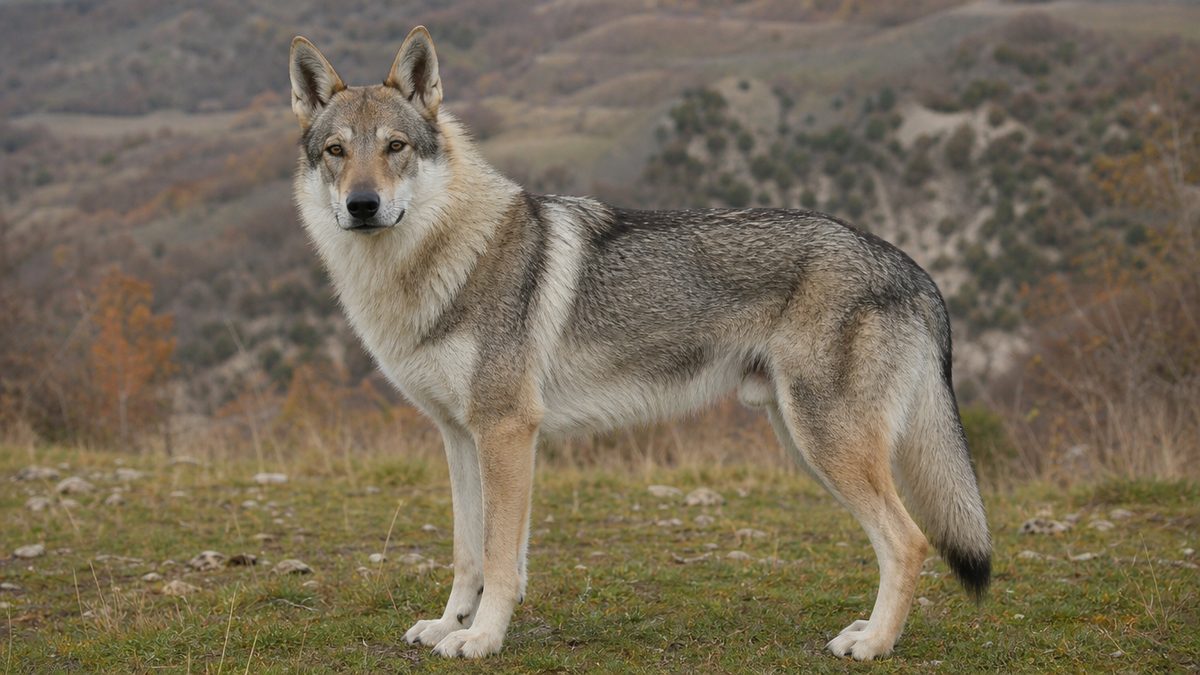
The dog itself is medium to large, dry in build and wolf-like in outline. The state-approved standard gives males 60 to 70 cm at the withers and females 58 to 65 cm, a wolf-type muzzle tapering moderately towards the tip, a nasal bridge slightly shorter than the skull, a scissor bite, medium ears carried perfectly straight and parallel when the dog is alert, and medium oblique eyes that should never be too dark and preferably have a golden ground. The coat is grey, variably marked, shading through fulvous to beige, with a clearly delineated ruff, and a uniform black coat is also admitted, as is a small white patch on the chest.
The one number the standard does not give
The standard states no weight. Not a range, not a guide, nothing. That matters because every English page prints one. Wisdom Panel gives 55 to 77 lb, a height of 23 to 28 in and a lifespan of 12 to 16 years, and files the dog under the Herding breed group. None of those four figures appears in the Italian document, and the standard's stated use is mountain rescue, avalanche and disaster search rather than herding. Where a page prints a weight for this breed, it is not quoting the standard, and it does not say where it is quoting from.
English Wikipedia's prose says the adult should be 58 to 68 cm at the shoulder, while its own infobox on the same screen gives males 60 to 70 cm and females 58 to 65 cm and cites the association's standard for both. The infobox matches the Italian document. The prose figure of 58 to 68 cm matches nothing, in either source. If you have read that number somewhere else, this is where it came from.
The origin story is short and specific. According to its creator, the former banker Mario Messi, the line began in 1966 with a hybrid born from a female Italian wolf, caught in the Province of Rieti by a hunter in his employ, and a male German Shepherd trained for rescue work. That hybrid, named Zorro, was then mated to German Shepherds and to the resulting female offspring. The dogs were kept at a nineteenth-century villa at Cumiana, in the province of Turin, and later moved to a purpose-built facility. In 1982 Messi described the dog as 62.5 percent German Shepherd and 37.5 percent Italian wolf; in a 2002 interview he called it 60 percent wolf and 40 percent dog. Those two accounts cannot both be right, and the section on wolf content below settles what the genome shows.
The standard's own account of origin is more careful than the interviews. It says the Cane Lupo Italiano relates genetically to the wild wolf, and more precisely to a variant now vanished from the Alto Lazio, appreciably different from other types. That is a claim of relationship in a legal annex, not a measurement, and this page treats it as what it is.
Why an Indian reader should care about any of this
Because the paperwork is the only thing you can check, and in India nothing else about this dog is checkable at all. There is no Indian breeder, no Indian club, no Indian litter, and no price in india. What a reader in Pune or Kochi will actually meet is a photograph of a grey wolf-like dog attached to a name, and the way to test that name is to ask which register the dog is on and then read the register's rules yourself. This page does that, in order, and reports what the documents say rather than what the breed's reputation says.
- Origin. Italy, from a documented 1966 crossing programme rather than a landrace.
- Standard. Yes, annexed to an Italian ministerial decree of 30 March 2021.
- Studbook. A Registro Anagrafico Ufficiale entrusted to the AAALI by ministerial decree.
- Kennel-club recognition. None, from the ENCI, the FCI or anyone else.
- Availability in India. None, and sale is forbidden by the breed's own rules.
Is the Lupo Italiano a breed? Tested against Bonbeno's own rule
The Lupo Italiano is a breed on Bonbeno's two-condition test, and it is the first dog this site has assessed that clears both conditions inside a government document. The rule is published on Bonbeno's own page for names used like breeds that are not breeds, and it is short: a breed has a written standard and a studbook behind it, so a puppy can be measured against something.
Take the conditions one at a time, because a test is only worth running if it can come out either way. Bonbeno applied the same rule to the Koolie, an Australian working dog no national kennel club recognises, and concluded that the Koolie is a breed on an unofficial club document and three private registers. It applied the same rule to the Kuchi and concluded that the Kuchi is not, because neither a standard nor a register exists anywhere. This dog is the third case, and it clears the bar higher than either.
Condition one: is there a written standard?
Yes, and the Italian state approved it. Titolo 1 of the Norme Tecniche, Allegato 2 to the ministerial decree of 30 March 2021, is headed Standard del Cane Lupo Italiano and runs to three articles. Article 1 sets the aim of selection as conservation in purity, safeguarding genetic variability, improving reproductive characters and promoting zoological valorisation. Article 2 covers origin, general appearance, psychical characteristics and use. Article 3, Caratteri morfologici, gives size, head, trunk, limbs, coat, hair, tail and tolerances, in the order and at the level of detail an FCI standard uses. It even carries a tolerances clause, permitting the absence of two premolars and a modest hook at the tip of the tail.
The decree's own recitals confirm this is not incidental. They record that the technical norms were updated in relation to a more precise definition of the breed standards, to the introduction of a body of breed experts, and to the procedures for entering dogs in the register. So the ministry was explicitly asked to approve a sharper breed standard, and did.
Condition two: is there a studbook?
Yes, and it is a real one with sections, certificates and DNA verification. The Registro Anagrafico Ufficiale of the Cane Lupo Italiano was established on 30 March 1988 at the Ente per la tutela del Lupo italiano, its keeping rules were approved by a further ministerial decree of 20 April 1994, and after the ETLI was wound up the register was entrusted to the AAALI from 1 January 2012 by decree number 651 of 11 January 2012. The register has four sections: RAGA for young animals entered at birth with at least two known generations of ancestors, RAF for females that have whelped, RAM for male sires, and RAS, a supplementary section for dogs that cannot enter the other three.
The machinery around it is not decorative. A Central Technical Commission includes a ministry official charged with continuous supervision and a representative of the Ministry of Health's veterinary services. A Central Office issues the official documents, may inspect dogs to check the truth of registration declarations, and issues a Certificato genealogico for dogs in RAGA, RAF and RAM and a Certificato di iscrizione for those in RAS. The Central Office may at any time take biological samples to verify declared descent by DNA, and the technical norms make that verification mandatory for any dog on the register. Article 19 states that registers, certificates and forms of the RAU have official value and that anyone who removes, alters or counterfeits them will be prosecuted.
| Condition | Koolie | Kuchi | Lupo Italiano |
|---|---|---|---|
| A written standard | Yes, an unofficial club document | No | Yes, annexed to a ministerial decree |
| A studbook | Yes, three private club registers | No | Yes, a state-entrusted register with DNA checks |
| National kennel club recognition | No | No | No |
| Verdict on Bonbeno's rule | A breed | A type, not a breed | A breed |
What the register is NOT, and the distinction is the whole point
A Registro Anagrafico is not a libro genealogico, and Italian law keeps the two apart. The register is defined in Annex A to decreto legislativo 30 December 1992 no. 529 as the register kept by a national association with legal personality, or by a public body, in which the breeding animals of a given breed are recorded with an indication of their ancestors, if known, and of any reproductive and productive performance. Registri anagrafici are established for native species and breeds of limited diffusion, on the basis of disciplinari that the minister also approves by decree. A libro genealogico, the instrument the ENCI keeps for the 18 Italian breeds it maintains, is the higher category.
Read the definition again and notice the phrase if known. A registro anagrafico is designed for populations whose ancestry is partly unrecorded, which is exactly why it exists for rare native stock. So the honest description is that the Lupo Italiano has a state-supervised ancestry register that issues pedigree certificates, not a closed studbook of the kennel-club kind. On the test as Bonbeno states it, a register that records ancestors and issues a genealogical certificate satisfies condition two. Saying only that would be lazy, and the difference is what a buyer would actually notice.
The Lupo Italiano does not belong on Bonbeno's dog types that are not breeds page. That page's rule is that a missing standard puts a dog there, and this dog's standard is not merely present, it is annexed to a government decree. Landrace status is not what puts a dog on that page either, and in any case this is not a landrace. It is a created breed with a documented founding cross and a named creator.
What the Italian state actually recognised, document by document
The Italian state has recognised three different things about this dog at three different times, and English pages collapse all of them into one sentence about the breed being protected by the government. Read the instruments in order and each turns out to be narrower and stranger than the summary.
Bonbeno holds this to the standard its Komondor page set, where Hungary's national-treasure claim was traced to a numbered parliamentary resolution on the state legal database rather than taken from a breed club. The same discipline applied here produces a different shape of answer, because Italy did not pass a law about the dog. It approved documents about the body that keeps the dog.
1988 and 1989: the state recognised an association, not a breed
The Gazzetta Ufficiale of 29 March 1989 carries a communication from the Ministry of Agriculture and Forests. Its whole operative content is one sentence, and it reads that by decree of the President of the Republic of 21 December 1988, registered with the Court of Auditors on 3 February 1989, on the proposal of the Minister of Agriculture and Forests, the new statute of the former Associazione selezione originale Lupo italiano, now named Ente per la tutela del Lupo italiano, abbreviated E.T.L.I., with its seat at Cumiana in Turin, was approved.
That is corporate recognition. A Presidential decree approved a private association's articles. It creates no breed, confers no standard and, in the published text, prohibits nothing. English Wikipedia summarises the same notice as the moment private ownership of the Lupo Italiano was prohibited by presidential decree. Open the notice and no such prohibition is in it. Whatever restricts ownership sits in the association's own statute, which the decree approved, and a rule inside a private statute is a different animal from a rule inside a decree. Anyone quoting this as an Italian law against owning the breed has not read it.
Two days short of a year earlier, on 30 March 1988, a separate ministerial decree established the Registro anagrafico ufficiale of the Lupo Italiano at the ETLI, and a decree of 20 April 1994 approved the rules for keeping it. Those are the instruments that actually did something technical, and neither is the one the internet cites.
2010 and 2012: the state took the register away and parked it with a cattle association
The most revealing document in the chain is the 2012 decree, because it recites what went wrong. Decree number 15869 of 14 July 2010 revoked the ETLI's custody of the register, following inadequate management by the ETLI and its extinction, declared by the Prefect of the Province of Turin on 17 May 2010. Custody was transferred, for six months and renewable, to the Associazione Nazionale Allevatori Bovini di Razza Piemontese, ANABORAPI, in collaboration with the University of Turin and the AAALI. Decree 14758 of 6 July 2011 extended that to 31 December 2011.
Read that again. For roughly eighteen months, the official ancestry register of Italy's only home-made wolf-type dog was kept by the national association of Piedmontese beef-cattle breeders. The AAALI itself records the period plainly, and says the two organisations used it to computerise the register on a server housed at ANABORAPI, building a database that can construct each dog's pedigree, calculate every dog's coefficient of consanguinity, and compute the consanguinity that any hypothetical mating would produce. That is a better-instrumented register than most kennel clubs run, and it exists because a cattle association had the software.
Decree 651 of 11 January 2012 then entrusted the register to the AAALI from 1 January 2012, after verifying that the association held the requirements set by the decree of 26 July 1994 for national breeders' associations that wish to keep genealogical books, and recording the need to protect a dog of limited diffusion and at risk of extinction.
The AAALI's own website titles the current decree 'D.M. 147749 del 20/03/2021'. The document's protocol block reads N.0147749 del 30/03/2021. The club's page is ten days out on its own founding document, and the decree is signed by a Director General rather than by the Minister, so 'D.M.' is itself loose. Where this page needs a date, it uses the one printed inside the PDF.
2021: the state approved the rules and the standard
The current instrument is the decree of 30 March 2021, and it is the strongest of the three. Its legal base is decreto legislativo 529 of 30 December 1992, which transposes Council Directive 91/174/EEC on the zootechnical and genealogical conditions governing the marketing of pure-bred animals. Its single article approves the Disciplinare and the Norme tecniche, both of which become an integral part of the decree. Article 2 of the Disciplinare states that the register's activities are carried out under the supervision of the Ministry of Agriculture, Food and Forestry.
| Instrument | Date | What it does |
|---|---|---|
| Ministerial decree | 30 March 1988 | Establishes the Registro anagrafico ufficiale at the ETLI |
| Presidential decree, in GU n.73 | 21 December 1988 | Approves the association's new statute and its renaming to ETLI |
| Ministerial decree | 20 April 1994 | Approves the rules for keeping the register |
| Ministerial decree 15869 | 14 July 2010 | Revokes ETLI custody, moves the register to a cattle association |
| Ministerial decree 651 | 11 January 2012 | Entrusts the register to the AAALI |
| Director General's decree 0147749 | 30 March 2021 | Approves the current Disciplinare and the breed standard |
So the honest sentence is this. The Italian state has never declared the Lupo Italiano a national symbol, never banned its sale by statute, and never made it a breed. What it has done is approve, by decree, the rules of an ancestry register and the technical standard against which dogs are entered in it, and appoint the association that keeps it. That is more than a breed club can give itself and less than recognition. It is a third thing, and naming it precisely is the only way a reader can judge what a certificate is worth.
The wolf content question, and what the genome answered
The Lupo Italiano's genome shows no significant sharing with the Apennine wolf, and the samples that produced that result were supplied by the breed's own association. The association's website still publishes an average wolf DNA content of around 30 to 35 percent. Both of those statements are current, and the page prints both.
The study is Talenti and colleagues, published in Ecology and Evolution in 2018, and it is not a small piece of work. It used 142,840 genome-wide SNPs across a dataset of 1,609 canids representing 182 breeds and 16 wild canids, built by genotyping 256 Italian dogs and seven Apennine wolves on the Illumina CanineHD chip and merging them with an existing set of 1,346 dogs from 161 breeds. Twenty-four of those dogs were Lupo Italiani. The acknowledgements name the Associazione degli Affidatari Allevatori del Lupo Italiano as the source of the Lupo Italiano samples, pictures and information.
That provenance matters. This is not a hostile study built on dogs of doubtful identity. It is a study whose Lupo Italiano material came from the body that keeps the register, and which describes the breed in its own table as an Apennine wolf hybrid that is nationally managed, with a footnote saying the breed was reportedly produced through breeding of an Apennine wolf and multiple German Shepherd Dogs and is closely managed and maintained by the Italian government.
What the paper found
Two sentences in the discussion carry the answer. The Lupo Italiano is believed to have been developed from a purposeful cross of a German Shepherd Dog and an Apennine wolf in the mid-1960s. While our data support the strong relationship between the Lupo Italiano and German Shepherd Dog, there is no significant level of haplotype sharing between it and the Apennine wolf. In the neighbour-joining phylogeny the Lupo Italiano is monophyletic to the German Shepherd Dog, and the paper's structural analysis at K equals 10 identifies it as one of four Italian populations carrying a unique genetic signature.
So the dog is genuinely distinct, genuinely stable and genuinely not wolf. Those three findings sit together comfortably. Sixty years of closed breeding from a German Shepherd base will produce a distinct population whatever the founder was, and the paper's own population-status column classifies the Lupo Italiano as a Breed rather than a variety.
What the association still publishes
The AAALI's training page states that the dog's robustness is due to the share of wolf DNA present in its organism, with an average value of around 30 to 35 percent, and attributes its scenting ability to the same source. The page was last modified in January 2015, three years before the study. It has not been changed since. The wolf content claim is therefore not a historical curiosity but a live statement on the register-holder's own website, sitting a few clicks from the register whose samples disproved it.
This is the pattern Bonbeno's playbook warns about from another direction, where a translated word manufactures a wolf where the source language meant a shepherd type. Here nothing was mistranslated. The wolf ancestry was asserted by the founder, repeated in the standard's origin clause, published as a percentage by the association, and then not found. A claim can be sincere, official and wrong at the same time.
| Source | Year | Wolf content claimed |
|---|---|---|
| Mario Messi, quoted in La Stampa | 1982 | 37.5 percent, with 62.5 percent German Shepherd |
| Mario Messi, in interview | 2002 | 60 percent wolf, 40 percent dog |
| AAALI, its own training page | 2015, still live | An average of around 30 to 35 percent |
| Talenti et al., 24 AAALI-supplied samples | 2018 | No significant haplotype sharing with the Apennine wolf |
An earlier check pointed the same way. In 2007 ecologists backed by the Lega Anti Vivisezione commissioned the Turin chamber of commerce to analyse the breed's genetic profile, and the analyses indicated no wolf content, which led to a request that funding to the ETLI be suspended. Bonbeno could not obtain that analysis itself and reports it only as the press account it is. The 2018 paper is the source this page rests on, because it can be opened and read.
If someone in India offers you a wolfdog and uses this breed's name, the wolf part of the pitch has no support in the only genome-scale study of the population, and the dog part cannot be verified because no dog of this breed has ever been registered outside Italy's own scheme. A grey German-Shepherd-type dog with erect ears is not evidence of anything. Ask for the RAU number, and read the section on price below for what the association says about people who sell puppies under this name.
One more consequence is worth stating plainly, because it runs the other way. If the dog carries no wolf content, then it is a dog in law as well as in fact, and the Indian wildlife route discussed later on this page does not apply to it. The genetics that deflate the marketing also remove a legal problem.
Lupo Italiano price in India: there is not one, and there is not one anywhere
No lupo italiano price in india exists, and the reason is not that India is a small market. The breed's own rules forbid sale everywhere in the world, so there is no legitimate price to quote in any currency. Anyone quoting you one is either selling a different dog or has invented the figure.
The association that holds the register says it in its first line. The Lupo Italiano dog cannot be purchased like any other dog breed. To protect its limited diffusion it is entrusted, on the basis of a specific Disciplinare that requires the recipient to sign an assumption-of-obligations document. The word used throughout is affido, entrustment, and the person who takes the dog is an affidatario allevatore, a caregiver-breeder, not an owner.
What the entrustment actually involves
The commitment is heavier than a purchase. A person taking a Lupo Italiano joins a selection programme coordinated by the AAALI, undertakes to make the dog available for reproduction, commits to training mainly in civil protection and public utility, and agrees to take part in the association's activities and events. Only members can apply, the application for entrustment and the application for membership cannot be submitted together, and a regional delegate must make direct contact before anything proceeds.
- Supply. Generally no more than about fifty puppies a year are available for new entrustments.
- Waiting time. From a few months to a year, depending on how many puppies exist.
- Priority. Dog units working in civil protection or public utility come first, then members who have already proved good caregivers.
- Conditions. Unconditional acceptance of the statutory rules and the breed disciplinare, on pain of revocation and withdrawal of the dog.
- Certificate. One Certificato genealogico per dog, issued at the moment of entrustment; a replacement is stamped DUPLICATO.
Article 14 of the technical norms closes the loop. A dog whose caregiver loses AAALI membership and is not returned to the association is moved into the supplementary section, its genealogical certificate is cancelled and a plain certificate of registration replaces it. The paperwork follows the relationship with the association rather than the dog.
The association's own warning about people selling puppies
The AAALI publishes a warning that is unusually direct for a breed club, and it is the most useful thing on this subject in any language. It puts anyone interested in having a Lupo Italiano on guard against offers of puppies for payment circulating on the internet, states that the association is not the origin of such offers, and asks people not to feed those channels. It then describes what those puppies are: mainly animals born from unauthorised matings and not entered in the Registro Anagrafico Ufficiale that the AAALI holds by ministerial decree.
The sentence that follows is the one to remember. All puppies without their RAU number are not in fact Lupi Italiani, even if born from officially registered dogs, and issuing the pedigree is the exclusive competence of the AAALI. So the breed's own definition of membership is administrative, not genetic. Two registered parents do not produce a Lupo Italiano unless the mating was planned by the Central Office and the litter was entered.
What the Indian market contains instead
Nothing, and that was tested rather than assumed. India's fullest published price list, Supertails' 40-breed guide, was retrieved in full and searched case-insensitively: the strings Lupo and wolfdog return zero occurrences on a page that prices everything from the Labrador to the Rajapalayam at Rs 5,000 to Rs 20,000 and the Mudhol Hound at Rs 3,000 to Rs 15,000. An India-located search for Lupo Italiano puppies for sale returned exactly one result, a discussion of Australian import rules, while the control search for Labrador puppy prices in the same session returned six Indian selling pages with real rupee bands.
Creatures.com runs a Lupo Italiano page offering a marketplace, a herdbook, community profiles and a breeder directory. All four counters read zero, and the herdbook says no public herdbook records yet exist. Bonbeno's Kuchi page documented the identical furniture on an Afghan breed. The difference here is sharper and worth the sentence: a real herdbook for this dog does exist, it is held in Italy under ministerial decree, and it is not that one.
So the price section for this breed has no table of disagreeing figures, because there are no figures to disagree. That is a cleaner answer than most breeds get. What follows below is the part an Indian reader can actually use, which is what a dog of this size and coat costs to keep here, whatever it is called.
Cost of ownership in India for a dog of this size and coat
Budget Rs 4,000 to Rs 12,000 a month for a 25 to 35 kg double-coated working dog in an Indian metro, and Rs 5,000 to Rs 8,000 a year on preventive veterinary care alone. Those figures are Indian, published and cited, and they apply to any dog of this build whatever name is on it.
Bonbeno separates two things that other pages merge. There is no purchase price for this breed and inventing one would be fabrication. But Indian cost of ownership is real, published and sourceable, and it is the number a reader actually plans around. The figures below come from an Indian source writing about Indian conditions.
| Line | Published Indian figure |
|---|---|
| Total monthly cost of owning a dog | Rs 3,000 to Rs 10,000 and beyond |
| Annual spend, most owners | Rs 25,000 to Rs 80,000 or more |
| Food, large or working breeds | Rs 5,000 or more a month |
| Standard consultation, good clinic | Rs 500 to Rs 1,000 |
| Annual vaccinations | Rs 1,500 to Rs 3,000 |
| Preventive care done properly, per year | Rs 5,000 to Rs 8,000 |
| Basic grooming session | Rs 300 to Rs 2,000 |
| Starter kit, bed, bowls, collar, leash, tag | Rs 2,000 to Rs 5,000 |
| First month, before anything unexpected | Rs 15,000 to Rs 25,000 or more |
The source is explicit that the purchase price is the smallest number in the equation, whether you buy a puppy for Rs 80,000 or adopt a dog for Rs 500, because what follows is a ten to fifteen year financial commitment. For this breed that framing is literally the only framing available, since the purchase price is zero and unavailable at the same time.
Where this dog costs more than the table suggests
Three lines run high for a dog of this type in India, and they are worth planning for separately.
- Food. A 25 to 35 kg dog selected for endurance work sits at the top of the published band rather than the middle, so use Rs 5,000 a month as the floor and not the ceiling. Wisdom Panel gives the breed 55 to 77 lb, which is 25 to 35 kg.
- Cooling. A working dog with a double coat in Delhi is an air-conditioning line item from April to July, not an optional comfort. That is electricity, and it does not appear on any published dog-cost table.
- Skin and ear care. The German Shepherd, the acknowledged parent breed, records otitis externa as its commonest disorder in UK primary care at 7.89 percent. In an Indian monsoon that line goes up, not down, and repeated ear consultations at Rs 500 to Rs 1,000 each add up fast.
The cost you cannot budget for
Emergency care in India starts high and has no ceiling. The same Indian source notes that a dog swallowing something foreign needs endoscopy or surgery, and that this is where the real money sits rather than in the monthly kibble. For a breed with no Indian veterinary familiarity, add a practical cost that nobody prices: the time spent explaining what your dog is. A vet in Coimbatore who has never seen one will treat it as a German Shepherd, which is medically reasonable and is exactly what the genome supports, but it means you will not get breed-specific guidance because none exists.
Over a twelve-year life at the middle of the published Indian band, this dog costs roughly Rs 6 lakh to Rs 10 lakh to keep properly, before a single emergency. That is the number to weigh, and it is identical for a German Shepherd you can actually obtain in India, with a decade of local veterinary experience behind it and a real supply chain. If the budget is the obstacle, the breed is not the answer. If the budget is fine, the German Shepherd still is.
Heat tolerance in India, measured against the homeland
Bonbeno rates the Lupo Italiano 2 of 5 for heat tolerance in Indian conditions. The homeland grid cells give annual means of 10.82 C at Rieti and 11.2 C at Cumiana against 27.95 C at Chennai, and the state-approved standard's only claim about the dog's eyes concerns glare on snow.
Two Italian places matter here and they are not the same place. The founding wolf came from the Province of Rieti in Alto Lazio, and the standard's origin clause names the Alto Lazio explicitly. The breeding centre was at Cumiana in Piedmont, and the association's seat today is in the province of Piacenza. All three are northern or central Italian, and none of them is remotely Indian.
The grid-cell check, run on the homeland as well as on India
NASA POWER returns a grid cell rather than a point, and in hilly terrain the cell's mean elevation can miss the town underneath it badly. Bonbeno therefore read back the elevation POWER reports for every coordinate and compared it against a Copernicus digital elevation model at the same latitude and longitude. Both Italian points failed that check, and the failure runs the same way at both.
| Point | POWER cell elevation | Copernicus DEM | Divergence |
|---|---|---|---|
| Rieti, Lazio | 949.86 m | 405 m | +545 m |
| Cumiana, Piedmont | 705.88 m | 354 m | +352 m |
| Travo, Piacenza | 288.19 m | 224 m | +64 m |
| Delhi | 206.37 m | 214 m | -8 m |
| Chennai | 48.95 m | 12 m | +37 m |
| Pune | 635.99 m | 561 m | +75 m |
So the Indian cells are the cities, and the Italian ones are the mountains around the towns. At a lapse rate of roughly 6.5 C per 1,000 m, the Rieti cell is about 3.5 C too cold for the town and the Cumiana cell about 2.3 C too cold. Correcting for that gives Rieti a real annual mean near 14.3 C and Cumiana near 13.5 C, which is the honest baseline. Bonbeno publishes the correction as an estimate and labels it one.
| Measure | Rieti cell | Cumiana cell | Delhi | Chennai | Pune |
|---|---|---|---|---|---|
| Annual mean temperature | 10.82 C | 11.20 C | 25.60 C | 27.95 C | 23.86 C |
| Hottest month, mean | 21.5 C (Jul) | 21.8 C (Jul) | 35.9 C (Jun) | 31.5 C (May) | 28.9 C (Apr) |
| Coolest month, mean | 1.6 C (Jan) | 1.2 C (Jan) | 13.6 C (Jan) | 24.1 C (Jan) | 19.6 C (Dec) |
| Highest recorded maximum | 37.7 C | 37.8 C | 48.8 C | 42.7 C | 43.2 C |
| Annual mean relative humidity | 75.1 percent | 67.5 percent | 45.6 percent | 72.4 percent | 66.8 percent |
Even after the lapse-rate correction, the Rieti homeland's hottest month sits near 25.0 C, which is below Chennai's annual mean of 27.95 C NASA POWER, temporal climatology API. That is the sentence to carry away. Chennai's average year is hotter than the Italian homeland's hottest month.
What the standard says about the climate it assumes
The standard is unusually explicit, and it gives the game away in one clause. Under Impiego it says the dog is particularly suited to mountain rescue, avalanche work and disaster search, with great resistance to weather, hunger and thirst, and adds that it is not subject to conjunctivitis from glare on snow. That is the only ophthalmic statement in the document. A breed standard whose sole eye claim is about snow was not drafted with Nagpur in mind.
Overseas care advice needs the same scrutiny, because it assumes an overseas climate. The coat clause specifies a thick undercoat in dogs that live outdoors, which in Piedmont is an asset and in Kolkata is a heat trap. And the housing that the association's programme assumes, with dogs worked outdoors in mountain conditions, collides directly with Indian law. Second Schedule Part IV paragraph 21(1) of the Prevention of Cruelty to Animals (Dog Breeding and Marketing) Rules 2017 bars keeping in outdoor facilities, without the attending veterinary practitioner's written approval, dogs not accustomed to the temperatures prevalent in the area, and breeds that cannot tolerate them, such as long-haired breeds in high temperature locations.
The 2017 Rules stop at Rule 13. The heat provision is a Second Schedule paragraph, not a Rule, and the string 'Rule 21' appears zero times in the gazette. Several Indian pages cite it wrongly, which sends a reader looking for a provision that does not exist.
The evidence on heat itself is not breed-specific and this page does not pretend otherwise. Hall and colleagues, working on 905,543 UK dogs under primary veterinary care in 2016, found that a bodyweight at or above the breed and sex mean carried an odds ratio of 1.42 for heat-related illness, rising to 3.42 for dogs over 50 kg. Their companion paper in Animals reports that of the 879 heat-illness events with a recorded trigger, 652, or 74.2 percent, were exertional rather than environmental. The Lupo Italiano was not in either model, and Bonbeno does not import an odds ratio onto a breed the authors never studied. What transfers is the bodyweight factor and the exertional finding, and for a dog selected to search mountainsides the exertional finding is the one that matters. It does not take a hot car to kill this dog. A long walk at two in the afternoon in Ahmedabad will do.
Temperament and household fit, from the standard rather than the folklore
The Lupo Italiano's temperament is described in a state-approved document, which is more than most breeds can offer, and what it describes is an independent, exclusively bonded, strongly territorial working dog. That is a specific profile, and it fits a small number of Indian households.
The standard's Caratteristiche psichiche clause reads as one sentence and every clause in it does work. An extremely lively animal, endowed with an independent and proud character, with a notable propensity for learning, extremely affectionate towards the person to whom it attaches itself in an exclusive way, with a marked sense of property and of the defence of the people entrusted to it, unsurpassed at sighting.
Unpack the three clauses that decide whether this dog suits you
- Attaches in an exclusive way. Not a family dog in the retriever sense. The standard says the bond is exclusive, and the association's placement scheme is built around one handler working one dog. In a joint Indian household with four adults and rotating caregivers, that produces a dog who is a different animal with each of them.
- A marked sense of property. The association puts it more bluntly, saying the breed is extremely territorial and, independently of its training, instinctively defends the place where it lives and the members of its pack-family. In a gated apartment complex with shared corridors, a dog that defends territory by instinct is a management problem before it is a temperament.
- Unsurpassed at sighting. That is a working attribute, and in an Indian street it means a dog that notices and reacts to everything, from a cat on a wall to a delivery rider on a scooter.
The association also records the softer side and it is not a marketing line. It says the dog is capable of blind trust in the person it considers its pack leader, that it loves children greatly and treats them as cubs to look after, and that this makes it usable in pet therapy with children, the elderly and people with disabilities. Those two accounts, a territorial defender and a pet-therapy dog, coexist in the same document, and the reconciliation is that the dog distinguishes sharply between its people and everyone else.
The comparison an Indian buyer is actually making
Almost everyone who searches this breed is really comparing it to a German Shepherd, and the genome says the comparison is closer than the marketing suggests, because the two are monophyletic. Where they differ is the selection history. The German Shepherd has been bred for a century across show and working lines with a huge population behind it. This dog has been bred for sixty years inside a closed programme of about fifty puppies a year, selected on search work rather than on protection sport.
The practical consequence is temperament predictability. A large gene pool with many breeders produces variation you can shop within; a small one with a single central office produces a narrower dog, for better and worse. The narrower dog is what the register is for.
Who this breed does not suit
- First-time owners. An independent, territorial, exclusively bonded working dog is a second or third dog, and the association effectively screens for that by requiring a suitability assessment before entrustment.
- Apartment households. The exercise requirement is a mountain requirement and the territorial instinct is a liability in shared space.
- Anyone away all day. The exclusive bond means separation distress is the predictable failure, not a possibility.
- Anyone who wants a wolf. The genome says there is no wolf here, and a person who wants the wolf will be disappointed by a dog and dangerous to it.
The breed's creator claimed the dog could run at 70 km/h. Bonbeno found no measurement behind that anywhere, and it would put the dog within reach of a racing Greyhound, which is implausible for a 60 to 70 cm shepherd-type animal. Treat it as folklore. It is the kind of claim that gets attached to a rare breed precisely because nobody can test it.
Training: what works, and the one thing this breed refuses
To train a Lupo Italiano, work it. The state-approved standard says the dog is trainable for any search activity of public utility and has a notable propensity for learning, and the association adds the condition that it demands a relationship of mutual respect with its handler rather than obedience for its own sake.
The breed's own literature is unusually consistent on this, and it says the same thing twice in two documents. The standard calls the dog trainable for every research activity of public utility and, in the technical norms, addestrabile a tutti i compiti di cane da polizia, trainable for all police-dog tasks. The association's training page says the dog is extremely lively and easily trainable in any type of activity, but that it demands to establish with its handler a relationship of mutual respect.
The register makes training a condition, not an option
This is where the Lupo Italiano differs from every other breed on this site. Training is written into the register's own rules. The Norme Tecniche create a body of breed experts divided into three sections, and one of them, the Esperti Valutatori di Prove, exists to assess aptitude, character and the level of training preparation of dogs put through trials at association events. The Central Office is required to monitor the participation of registered dogs in training activities, including specific certifications.
The transitional clause is more revealing still. Pending the technical commission producing full trial regulations, section two of the expert register is to assess only the activities of search-and-rescue dog units as defined in the guidelines of Italy's Department of Civil Protection. So the default assessment for this breed's working aptitude is a civil-protection search and rescue standard. That is what the selection is aiming at.
What that means for an Indian handler
- Give it a job with a search shape. Scent games, find-the-handler, article searches and tracking suit the selection history. Repetitive heelwork does not.
- Two short sessions beat one long one, especially between March and June, because an exertional heat event is the documented risk for a working dog and 652 of 879 recorded heat-illness events with a known trigger were exertional.
- Socialise deliberately and early, because the territorial clause in the standard is not a training artefact, it is what the dog was selected for. Every delivery rider, every neighbour, every visiting cousin, before sixteen weeks.
- Train the recall on a long line for a year. An independent dog with an exclusive bond and unsurpassed sighting will make its own decisions about a cat.
- Never train in the middle of an Indian afternoon. Early morning and after dark, from the day the dog arrives.
The thing this breed resists
Handler churn. A dog whose standard says it attaches to its person in an exclusive way, and whose placement scheme puts one dog with one caregiver-breeder who signs a personal undertaking, is not built for a household where four people take turns and a professional trainer visits twice a week. The same dog will also resist correction-heavy handling, because a demand for mutual respect from an independent dog usually means it will disengage rather than comply.
If what attracts you is a wolf-like working dog you can genuinely train to a search standard in India, the German Shepherd is the same genetic clade, has a real Indian supply chain, has KCI registration available, and has a century of published training literature behind it. You lose the grey coat and the story. You keep everything that makes the dog work.
Daily exercise, and what happens in an Indian summer without it
Plan on two hours of real work a day, split around the heat, for a dog selected to search avalanche debris. The standard describes an athletic animal with great resistance to weather, hunger and thirst, and the association places dogs preferentially with civil-protection units, which tells you the workload the selection assumes.
Read the gait clause in the standard and the requirement is obvious. The limbs are described as extremely robust but dry, giving no impression of heaviness, with a loose and light gait, and the animal, even at maximum size and weight, must give in walk, trot and gallop an impression of elegant strength recalling the gait of the wild wolf, with the tracks aligned when the trot is fast. A dog built and selected to move like that for hours does not decompress on a fifteen-minute walk around a colony park.
A workable Indian schedule
| Window | Activity | Why |
|---|---|---|
| 05:30 to 06:45 | Long walk plus scent work | Coolest hour of the Indian day, and the exertional risk window is closed |
| Midday | Indoors, on a cool floor | Exertional heat illness accounted for 652 of 879 triggered events in the UK study |
| 17:00 to 17:30 | Short lead walk only | Surfaces are still hot; check tarmac with the back of your hand |
| 20:00 to 21:00 | Second long session, training or search games | Bulk of the mental work belongs here |
Two hours is the floor, not the target, and the split matters more than the total. Hall and colleagues found that of the heat-illness events with a recorded trigger, 74.2 percent were exertional rather than environmental. That statistic is the whole argument for splitting exercise around the heat instead of shortening it. A dog does not overheat because it is outside. It overheats because it is working while it is outside.
What happens without it
The standard names a dog that is extremely lively, independent and territorial, unsurpassed at sighting, with a marked sense of property. Under-exercised, every one of those traits points somewhere unhelpful. The sighting becomes barking at the gate. The territoriality becomes lunging at the lift. The independence becomes a dog that stops offering you attention because you have never been interesting.
Two of the German Shepherd's five commonest recorded disorders in UK primary care are overweight or obesity at 5.18 percent and aggression at 4.76 percent. Both are what an under-exercised working shepherd looks like in a clinic record, and both are preventable with a schedule.
Hall's Scientific Reports paper found an odds ratio of 1.42 for heat-related illness in dogs at or above the mean bodyweight for their breed and sex, rising to 3.42 above 50 kg. This breed was not modelled and Bonbeno does not claim its odds ratio. But keeping a 25 to 35 kg dog at the lean end of its own range is a decision with published evidence behind it, and in an Indian April it is the cheapest protection available.
For an Indian household that cannot supply two hours a day of structured work, the honest recommendation is not a smaller version of this dog. It is a different dog. The Indian Pariah Dog manages heat natively, needs far less structured work and is available for free from any shelter in the country.
Grooming a medium double coat in Indian humidity
Brush this coat weekly in dry months and two or three times a week through the monsoon, and never shave it. The standard specifies hair of medium length and hardness with a thick undercoat in dogs that live outdoors, which is a coat built to insulate against cold and to be brushed rather than clipped.
Read the two coat clauses together, because they describe different things. Manto covers colour: grey, variably marked, more or less dark, with backgrounds shading from subject to subject through to fulvous or beige, sometimes with a dark saddle, a well-delineated ruff, lighter belly, limbs and inner and rear thighs, a frequently darker muzzle tip and tail tip, and a uniform black coat also admitted, with a small white chest patch permitted in any coat type. Pelo covers texture: medium in length and hardness, smooth or somewhat wavy on the trunk and thighs, finer and shorter on the head and limbs, with a thick undercoat in dogs living outdoors.
That last conditional is the operative phrase for an Indian owner. The undercoat is described as a response to outdoor living, not as a fixed feature. A dog kept largely indoors in Bengaluru will carry less of it than a dog worked on a Piedmontese hillside, and shedding will be more continuous and less seasonal, because a coat cycle driven by an air-conditioned indoor climate never gets a clean signal to blow.
A practical Indian routine
- Groom weekly with an undercoat rake from October to March, working the ruff, the trousers and behind the ears where the coat is densest.
- Two or three times a week from June to September, because a damp undercoat against skin is where Indian coat problems start.
- Dry the dog properly after every bath and every rain, and plug or dry the ears deliberately rather than towelling and leaving it. Overseas grooming guides that say to towel off and let the dog air dry were written for a climate that dries; an Indian monsoon does not.
- Never shave. The undercoat is sun protection as well as insulation, and a shaved double coat in Indian sun exposes skin that has never seen it.
- Check between the toes weekly in the monsoon, and after every walk in tick season.
The ear problem is the real grooming problem
The German Shepherd, the acknowledged parent breed and the population this dog is monophyletic to, records otitis externa as its single commonest disorder in UK primary veterinary care, at 7.89 percent with a 95 percent confidence interval of 6.64 to 9.29. That is in a temperate climate with low humidity. The standard gives this dog medium erect ears carried perfectly straight and parallel, which is the best possible ear geometry for airflow and the reason this is a manageable problem rather than a chronic one. Erect ears dry. Pendulous ears do not.
So the Indian owner's advantage here is real and should be used. Keep the canal dry, do not pour cleaner into an ear you have not looked into, and treat a head shake in August as a reason to book a consultation at Rs 500 to Rs 1,000 rather than to buy a bottle.
An Indian salon that has never seen this breed will treat a grey double-coated dog as a Husky and reach for the clippers, because that is what the market asks for in April. Say no in writing when you book. A basic grooming session costs Rs 300 to Rs 2,000, and a shaved working coat costs an entire summer of skin management.
One more thing the standard is silent on. It says nothing about shedding volume and nothing about allergy suitability, and nobody should read a hypoallergenic claim into a breed with a thick undercoat. Where a seller attaches that word to a grey wolf-like dog, it is a sales line and not a description.
Health, life expectancy and the inbreeding number nobody prints
No breed-specific health survey of the Lupo Italiano exists, and no life expectancy figure for it can be sourced. What can be sourced is a genome-wide inbreeding coefficient of 0.478, the highest of the 26 Italian populations measured in the same study, and a mandatory screening regime written into the register's own rules.
Start with what is missing, because the absence was tested rather than assumed. PubMed returns 13 records for the phrase Lupo Italiano and its own query-translation line shows why: the search was rewritten to Lupo AND Italiano across all fields, and every hit is a paper by an Italian author surnamed Lupo, on HIV therapy, myelofibrosis, cerebellar function and neonatal hypoglycaemia. Not one is about a dog. Controls run in the same session returned 126 records for Labrador Retriever with hip dysplasia and 14 for Czechoslovakian Wolfdog, so the database was working. The honest finding is that this breed has no veterinary literature of its own, and the only genome-scale study of it is a population-genetics paper rather than a health survey.
The one number that should be on every page about this dog
Talenti and colleagues report a SNP-based inbreeding coefficient for each Italian population, calculated across 142,840 markers and averaged over all individuals of the breed. The Lupo Italiano's is F = 0.478 on 24 dogs. Set it against the rest of the same table and the scale becomes visible.
| Population | Dogs sampled | Inbreeding coefficient F | Shared homozygosity (Mb) |
|---|---|---|---|
| Lupo Italiano | 24 | 0.478 | 1,400.99 |
| Neapolitan Mastiff (Italy) | 6 | 0.318 | not reported |
| Italian Greyhound (US) | 10 | 0.290 | 607.85 |
| Cirneco dell'Etna | 14 | 0.222 | 418.46 |
| Volpino Italiano | 15 | 0.213 | 361.28 |
| Lagotto Romagnolo | 18 | 0.171 | 378.57 |
| Spinone Italiano | 16 | 0.136 | 308.59 |
| Maremma Sheepdog | 14 | 0.124 | 274.15 |
The Lupo Italiano's figure is the highest in the table by a wide margin, more than half again the next highest, and its shared homozygosity of 1,400.99 Mb is more than double that of any other population measured. That is what sixty years of closed breeding from a single founding hybrid, in a population placing about fifty puppies a year, does to a gene pool. The inbreeding coefficient is not a criticism of the association, which cannot conjure founders it does not have. It is the price of the programme, and a buyer is entitled to see it.
Put that in plain language. On the only genome-wide measurement anyone has taken, this is the most inbred dog population in Italy, and it is more inbred than the Neapolitan Mastiff, the Italian Greyhound and the Cirneco dell'Etna put together on that measure. An inbred population is not a doomed one, and the register's mating software exists precisely to slow the trend by calculating the consanguinity of every proposed pairing before it happens. But a buyer weighing this breed against a German Shepherd is weighing 24 measured dogs at F equal to 0.478 against a breed with millions of registered animals, and that is the trade the documentation cannot hide.
What the register requires, and it is more than most kennel clubs
The technical norms make two things compulsory. The Central Office must verify the correct attribution of paternity and maternity of any dog on the register through DNA analysis at a laboratory of its choosing. And it must screen any registered dog, and its direct ancestors and descendants, for specific conditions through analyses, samples and examinations, with the presence of conditions the technical commission deems disqualifying for reproduction, giving dysplasia and some cardiac diseases as its examples, resulting in non-registration or removal from the register, extending to ancestors and descendants where the condition is genetic.
For a litter born from an unplanned mating, entry requires DNA of both parents and of the dog showing 100 percent concordance, and even then the dog goes into the supplementary section rather than the main one. That is a stricter identity regime than most national kennel clubs operate.
The health data that does transfer
The genome says this dog is monophyletic to the German Shepherd, so German Shepherd data is the closest evidence available and this page uses it as that rather than as the breed's own. In UK primary veterinary care, German Shepherd life expectancy has a median of 10.3 years with an interquartile range of 8.0 to 12.1 and a range of 0.2 to 17.0. The commonest causes of death are musculoskeletal disorder at 16.3 percent and inability to stand at 14.9 percent. The commonest recorded disorders are otitis externa at 7.89 percent, osteoarthritis at 5.54 percent, diarrhoea at 5.24 percent, overweight or obesity at 5.18 percent and aggression at 4.76 percent.
Note the arithmetic on those prevalences. Otitis externa at 131 cases and 7.89 percent implies a denominator near 1,660, not the 8,177 German Shepherds in the demographic analysis, so the disorder figures come from a coded sample rather than from the whole cohort. Quote them as sample prevalences, which is what they are.
It will not publish a life expectancy for the Lupo Italiano. Wisdom Panel prints 12 to 16 years and gives no source, and no study of this population reports longevity at all. And it will not report an OFA screening rate, because holding no entry in a registry's published statistics is not the same as being healthy. Hip dysplasia is named in the register's own disqualifying examples, which tells you the breed's own technical commission considers it a live risk.
Feeding a 25 to 35 kg working dog in India
Feed to body condition rather than to a chart, because the state-approved standard gives no weight at all and every published weight for this breed comes from somewhere else. Budget Rs 5,000 a month or more for food, which is where an Indian large-breed diet lands.
The standard states height and says nothing about weight. That is not an oversight in a document that specifies tooth count tolerances and the permitted hook at the tail tip. It means the breed is judged on proportion, and a handler is expected to feed to the dog in front of them. The only weight figure in circulation, 55 to 77 lb or roughly 25 to 35 kg, comes from Wisdom Panel and is not sourced to any Italian document.
Body condition, not a number
Run the standard's own description as a check. The trunk should be robust and not too long, with a well let-down chest, a straight dorso-lumbar line and a croup that is not too low, and the limbs extremely robust but dry, giving no impression at all of excessive heaviness. Ribs you can feel without pressing, a visible waist from above and a tucked abdomen from the side are the working targets, and they match what the standard is asking for.
Keeping the dog at the lean end matters more here than for most breeds, because Hall and colleagues found an odds ratio of 1.42 for heat-related illness in dogs at or above the mean bodyweight for their breed and sex. In an Indian summer that is not an abstract risk, and food is the cheapest lever you control.
A practical Indian feeding plan
| Stage | Meals a day | Notes for Indian conditions |
|---|---|---|
| 8 to 16 weeks | 4 | Large-breed puppy food, controlled growth; do not push weight gain |
| 4 to 12 months | 3 | Slow, steady growth protects developing joints |
| 1 to 7 years | 2 | Feed the larger meal after the evening work session, not before |
| 7 years on | 2 | Reassess protein and joint support with your vet, not with a blog |
Two Indian specifics are worth planning for. First, never feed a large meal immediately before or after hard work in heat, because the exertional pattern is the dominant heat-illness trigger and a full stomach is a known deep-chested-dog risk. Second, water availability is a summer discipline, not a bowl you top up. A dog the standard describes as resistant to thirst is a dog that will keep working past the point where it should have stopped drinking, and that trait is a hazard in India rather than a virtue.
What it costs
Published Indian figures put the total monthly cost of dog ownership at Rs 3,000 to Rs 10,000 and beyond, with food for large or working breeds alone pushing to Rs 5,000 or more a month. Over a year that is Rs 60,000 on food at the working-breed rate, against Rs 25,000 to Rs 80,000 for everything an average Indian owner spends. Plan for the top of the published band, because a 30 kg dog exercised for two hours a day is at the top of it.
There is no breed-specific diet for this dog, no published nutritional requirement, and nobody in India stocks anything aimed at it. A good large-breed food that suits your dog's stools, coat and energy is the whole answer, and the money saved on a boutique bag is better spent on the annual blood profile that Indian preventive care at Rs 5,000 to Rs 8,000 a year already includes.
The first year, month by month, on the register's own clock
The Lupo Italiano's first year is scheduled by a document rather than by a breeder's habit. The register's technical norms set deadlines in days for mating declaration, birth declaration, microchipping and registration, and a puppy that misses them is not a Lupo Italiano no matter who its parents were.
Read the schedule first, because it is the clearest picture anyone has of how this breed is actually produced. Registration happens by litter and covers every puppy born from a mating between registered dogs that the Central Office itself selected, with the brood bitch normally not over seven years old, and older bitches allowed only after a specific veterinary examination with a positive result.
| Event | Deadline | Who acts |
|---|---|---|
| Mating declaration | By the day after the mating | The bitch's caregiver notifies the Central Office |
| Birth declaration, number and sex of puppies | Within 2 days of birth | The bitch's caregiver |
| Dam entered in RAF, sire in RAM if first litter | Within 15 days | The Central Office |
| Microchip implanted by an authorised vet | Within 60 days of birth | The bitch's caregiver |
| Microchip data reported | Within 2 days of implant | The bitch's caregiver |
| Whole litter entered in RAGA | Within 2 days of that report | The Central Office |
| Genealogical certificate issued | At entrustment | The Central Office, to the new caregiver |
Note what the microchip clause requires. The chip is supplied by the association and implanted by a veterinarian authorised to register the dog with the national canine registry, and a dog cannot enter the RAU at all unless it is identified and recorded there under the legislation in force. Identity is established twice, once in the state's dog registry and once in the breed's.
Months one to twelve, if a dog of this type were being raised in India
- Weeks 8 to 12. Socialisation window and it is the whole ball game for a breed the standard calls territorial with a marked sense of property. Meet delivery riders, security guards, autos, lifts, children and other dogs, every day, in short cheerful doses.
- Weeks 12 to 16. First full vaccination course, at Rs 1,500 to Rs 3,000 for the year, plus deworming and a first health check at Rs 2,000 to Rs 5,000. Start the long-line recall now.
- Months 4 to 6. Controlled growth, four meals dropping to three, no forced running and no stairs work. Joint development is the reason the register names dysplasia among its disqualifying examples.
- Months 6 to 9. Adolescence, and the territorial and independent traits arrive together. Keep socialising, keep sessions short, and do not start protection work of any kind.
- Months 9 to 12. First full Indian summer. Move all exercise to before six in the morning and after eight at night, and treat any exertional wobble as an emergency.
- Month 12. Adult coat and adult weight, and the point at which the standard notes the coat is not definitive until development is complete.
Two Indian legal points for anyone breeding any dog
If a dog of any breed is being bred in India, the Prevention of Cruelty to Animals (Dog Breeding and Marketing) Rules 2017 apply and two clauses bite early. Rule 8(1)(a) provides that pups less than eight weeks in age are not sold. And Second Schedule Part III paragraph 8(10) requires that dogs have been tested for genetic defects, including hip dysplasia, progressive retinal atrophy, night blindness, hypothyroidism, entropion, ectropion, overshot and undershot jaw, wry mouth, two or more missing teeth and cryptorchidism.
The standard's Tolleranze clause permits the absence of two premolars, while paragraph 8(10) names two or more missing teeth among the genetic defects an Indian breeding dog must have been tested for. The Indian rule requires a test, not a disqualification, so the two do not conflict. But a breeder here would have to record the result rather than treat the absence as within tolerance and move on.
Indian law: which route a wolf-type dog actually travels
A registered dog enters India under the pet-dog conditions, and a wolf does not enter at all. Since the only genome-scale study of this population found no significant wolf haplotype sharing, the Lupo Italiano is a dog in law as well as in fact, and the wildlife route does not apply to it.
Two Indian import routes exist for a live mammal and they have different law behind them. The commercial route runs on DGFT Trade Notice 22/2022-23 of 19 December 2022, which places mammals under ITC(HS) 01061900 as Restricted and subject to Policy Condition 6 of the chapter. The personal pet route runs on baggage rules under the Livestock Importation Act, 1898. Do not conflate them.
Policy Condition 6, the wildlife route
The trade notice reproduces the condition in full. Policy Condition (6): Import of Wild Animals (including their parts and products) as defined in the Wild Life (Protection) Act, 1972 (as amended from time to time) is prohibited and those species which are listed in CITES are subject to the provisions of CITES. That is the clause a genuine wolf would meet, and Bonbeno's Fuegian dog page routes a South American wild canid through exactly it.
CITES answers the rest. Its Appendices, valid from 5 March 2026, list *Canis lupus* in Appendix I for the populations of Bhutan, India, Nepal and Pakistan, and in Appendix II for all other populations, with a bracketed note in both entries that excludes the domesticated form and the dingo, referenced as Canis lupus familiaris and Canis lupus dingo, which are not subject to the provisions of the Convention.
Three consequences follow, and the third is the one Indian pages miss.
- A registered dog is not a CITES specimen. The exclusion of the domesticated form is explicit, so a documented dog is a dog for Convention purposes whatever its ancestry story says.
- The Italian wolf is Appendix II. Italy is not among the four Appendix I countries, so the wild animal this breed's founder is said to have come from sits in the lower category.
- India's own wolves are Appendix I, the strictest listing there is. A country that protects its own wolves at the highest level is not a country in which to arrive holding a dog you are describing as part wolf.
Policy Conditions 7 and 8, the dog route
The same trade notice sets out what is allowed. Policy Condition (7) permits import of dogs only for a pet dog with a valid pet book and relevant records in the name of the importer, for dogs imported by R&D organisations for research on the recommendation of the CPCSEA, and for internal security by the Defence and Police Force. Policy Condition (8) provides that import of commercial dogs for breeding or any other commercial activities other than those purposes is not permitted.
Import of pet animals is allowed only through the airports and seaports of Delhi, Mumbai, Chennai, Hyderabad, Bangalore and Kolkata, an advance No Objection Certificate must be obtained from the Regional or Quarantine Officer, and the notice states plainly that any applications for trading or breeding purposes, or made on behalf of another person or entity, shall be duly rejected. DAHD added a seventh port, Cochin International Airport at Kochi, for pets arriving under the baggage rules in October 2024. The full route is set out in how to import a dog to India.
| Obstacle | Source |
|---|---|
| Sale forbidden by the breed's own rules, worldwide | The AAALI disciplinare and the association's own page |
| Only members who sign an obligations document can receive a dog | AAALI entrustment conditions |
| Import for breeding or commerce not permitted in any case | DGFT Policy Condition 8 |
| Pet route needs a pet book in the importer's own name | DGFT Policy Condition 7 |
| No FCI nomenclature entry, so no KCI pedigree possible | FCI Group 1 and provisional registers |
Put those together and the position is unusually clean. Even a person willing to move to Italy, join the association, prove suitability, wait a year, accept a dog on entrustment and then relocate to India would be bringing a dog that remains the property of a selection programme, under a certificate that is cancelled if their membership lapses. That is not a supply chain. It is a closed loop with an exit clause.
India's Union government issued a circular on 12 March 2024 naming breeds it called ferocious, and the full list survives in CBIC Instruction 05/2024-Customs of 14 March 2024, which prints 24 comma-separated entries, while press reports say 23 because they fold the closing Bandog clause in, and 25 appears where Japanese Tosa and Akita is split into two. The nineteenth entry is the bare phrase Wolf dogs, which the instrument never defines. A dog sold in India as an Italian wolfdog sits inside that phrase on its face, whatever the genome study above says about its actual wolf content, so this page does not claim the breed was outside the list. The legal position is separate and is settled enough to state. The Karnataka High Court quashed the circular on 10 April 2024, the Delhi High Court set it aside on 16 April 2024, and no Indian law in force today bans owning, breeding or selling any of those breeds. Karnataka expressly left the door open to a Rules amendment after due process, so neither banned nor settled all-clear is the right summary.
Head to head against the dogs an Indian buyer is really choosing between
Anyone searching this breed in India is choosing between three wolf-type dogs and one that is actually obtainable. Compared on recognition, availability and heat, the Lupo Italiano loses on every practical axis and wins only on documentation, which is the one axis that cannot help you here.
The three comparisons that matter are the two other wolfdog breeds, both of which the FCI does recognise, and the parent breed. Bonbeno adds the Koolie because it is the site's other close call on breed status, and the Indian Pariah Dog because it is what an honest heat answer looks like.
| Breed | FCI status | Written standard | Ancestry register | Obtainable in India | Bonbeno heat rating |
|---|---|---|---|---|---|
| Lupo Italiano | Absent from both registers | Yes, in a ministerial decree | Yes, state-entrusted | No, sale forbidden | 2 of 5 |
| Czechoslovakian Wolfdog | Standard 332, Group 1 Section 1 | Yes, FCI | Yes, national kennel clubs | Rarely, via import | See its own page |
| Saarloos Wolfhond | Standard 311, Group 1 Section 1 | Yes, FCI | Yes, national kennel clubs | Rarely, via import | Not yet built |
| German Shepherd | Standard 166, Group 1 Section 1 | Yes, FCI | Yes, and KCI pedigrees available | Yes, widely | See its own page |
| Koolie | Absent | Yes, an unofficial club document | Yes, three private registers | No | 3 of 5 |
| Indian Pariah Dog | Absent | No | No | Yes, free, from any shelter | See its own page |
The control that makes the FCI absence mean something
An absence is only evidence if the instrument works, and here the instrument proves itself on the same page. FCI Group 1 Section 1 is the section that holds sheepdogs, and it contains both of the world's other recognised wolfdog breeds: the Ceskoslovenský Vlciak at number 332, valid from 3 September 1999, and the Saarlooswolfhond at 311, valid from 3 November 2014. It also contains the Deutscher Schäferhund at 166. Italy appears in the same section with exactly two entries, the Cane da Pastore Abruzzese Maremmano at 201 and the Cane da Pastore Bergamasco at 194.
So the FCI recognises wolfdogs, recognises Italian sheepdogs, and does not recognise this one. The provisional register was checked separately, because a breed can sit there for years, and its 21 entries include two Italian hounds admitted on 11 February 2026 but no Lupo Italiano. Both checks passed their controls.
And the national kennel club says the same thing
The ENCI publishes its own list of Italian native breeds and states that it reserves particular attention to their valorisation and promotion, describing 18 native breeds of ancient origin. The list runs from the Bolognese to the Volpino Italiano and includes the Cane Corso, the Bergamasco, the Maremmano, the Cirneco dell'Etna, the Lagotto Romagnolo, the Spinone and both Segugi Italiani. The Lupo Italiano is not on it. The Talenti study confirms the same position independently, recording that the ENCI recognises 13 of the 23 Italian populations it sampled and filing this one under nationally managed rather than under a registry.
What the comparison actually settles
For an Indian reader the table collapses to one row. Three of these dogs can be obtained here with paperwork you can check, and the German Shepherd is the one with a real supply chain, KCI registration and a decade of Indian veterinary familiarity. The Lupo Italiano is the best-documented dog in the table and the least available, and no amount of documentation converts into a puppy in Pune.
The same 2018 study measured the Cane Paratore, which it classified as insufficiently sampled at two dogs, and the Pastore d'Oropa, covered on this site as the Cane di Oropa, which it named as one of four Italian populations with a unique genetic signature. If you find the Italian breed-status question interesting, those two pages are where it gets messier.
Six mistakes Indian readers make about this breed
Every mistake below comes from a page that ranks for this breed's name, and each one is checkable in a document. They are listed in the order a buyer meets them.
1. Believing the wolf percentage
The association publishes an average wolf DNA content of around 30 to 35 percent on its own training page. The only genome-scale study of the population, using 24 samples the same association supplied, found no significant haplotype sharing with the Apennine wolf and placed the dog monophyletic to the German Shepherd. Both statements are live. Only one of them is a measurement.
2. Reading state involvement as a ban on selling
English pages say private ownership was prohibited by presidential decree and cite the 1989 Gazzetta Ufficiale notice. Open the notice and it approves an association's statute and nothing else. The prohibition on sale is real, but it lives in the association's own disciplinare and rules, which is a private instrument that the state approved rather than a state prohibition. The practical effect is the same. The legal description is not, and it matters when someone tells you Italian law lets them sell you one.
3. Trusting a weight, a lifespan or a breed group
The state-approved standard gives height and no weight, and its stated use is mountain rescue and disaster search. Wisdom Panel prints 55 to 77 lb, a 12 to 16 year lifespan and a Herding breed group. English Wikipedia's prose prints a height of 58 to 68 cm that contradicts its own infobox. Three numbers, three sources, none of them the document.
4. Taking a herdbook counter for a herdbook
An aggregator page for this breed offers a marketplace, a herdbook, profiles and a breeder directory, and every counter reads zero, with the herdbook stating that no public records yet exist. A reader who lands there concludes the breed has no register. The register exists, is held in Italy under ministerial decree, and computes an inbreeding coefficient for every proposed mating. Empty furniture on an aggregator is not evidence about a breed.
5. Assuming two registered parents make a registered puppy
They do not, and the association says so in terms. Puppies without their RAU number are not in fact Lupi Italiani even if born from officially registered dogs, and issuing the pedigree is the association's exclusive competence. A litter from an unplanned mating needs DNA from both parents and the puppy at 100 percent concordance, and even then the dog enters the supplementary section rather than the main register. So an unregistered puppy from two registered dogs is, by the breed's own definition, not the breed.
6. Searching for the breed in India and believing the result
Two India-located searches for this breed returned HTTP 200, a correct page title and a plausible result count, and served ten results about Google Classroom and ten about how to get help in Windows. The Labrador control in the same session returned 46,600 results and ten genuine Indian Labrador pages. The instrument was working and the query was hijacked. If you search this breed's name in India and get a result set that looks unrelated, that is what happened, and neither the results nor the count tells you anything about the dog.
Buying a grey German Shepherd cross in India under this name. It is the single most likely transaction, the seller has no register to point at, the association warns against exactly these offers on its own site, and the dog you take home will be a working shepherd with a made-up pedigree and a heat tolerance problem. If you want that dog anyway, buy it as what it is, from someone who calls it what it is.
What the ranking pages actually cover, and where the hole is
Read the pages that rank for this breed's name and the shape of the gap becomes obvious. K9Sphere runs a long owner's guide with a breed snapshot, a screening and conditions section, a four-way comparison against the German Shepherd, the Tamaskan and the Czechoslovakian Wolfdog, and a heading reading 1988: Official State Recognition, without naming the 1988 instrument or what it did. 101DogBreeds answers five reader questions on temperament, size, shedding, trainability and health issues, none of them from a document. Koko Genetics organises a profile around general details, breed history, breed characteristics and common health problems. Italian Wikipedia is the only one of the four that states the position correctly in its opening line, saying the breed is not recognised by the ENCI and that selection and breeding are carried out by the association. Not one of the four opens the decree, the disciplinare or the register's technical norms, which is why this page exists.
Adoption, and the only responsible sourcing route that exists
You cannot adopt a Lupo Italiano in India and you cannot buy one anywhere. The only lawful route to the breed runs through membership of the Italian association, a suitability assessment and an entrustment agreement, and it has never produced a dog in India. What you can adopt here is a dog that does the same job better in this climate.
Take the two routes in order, because one of them is real for a reader in Rome and neither is real for a reader in Raipur.
The Italian route, in full
- Join the association first. Only a member can submit a Domanda di Affido, and the membership application and the entrustment application cannot be submitted together.
- Meet your regional delegate. The country is divided into zones with a delegate who is the reference point for caregivers in that area, and direct contact is described as important and necessary before anything proceeds.
- Pass a suitability assessment. Selection of new caregivers rests on a judgement of suitability produced through a specific verification process, taking chronological order of requests into account but not only that.
- Accept the obligations. The caregiver signs an Assunzione di Obblighi, undertakes to make the dog available for reproduction, commits to training mainly in civil protection and public utility, and accepts that failure to comply means revocation of entrustment and withdrawal of the dog.
- Wait. From a few months to a year, on a supply of generally no more than about fifty puppies a year.
Priority goes to dog units working in civil protection or public utility, to members who have already proved good caregivers, and to dogs specifically identified for selection projects by the expert team. An Indian applicant with no Italian residence, no civil-protection unit and no way to present the dog for the association's own events is not a candidate the scheme was designed for, and nothing in the published rules suggests it would be granted.
Verifying anything offered to you in India
There is one check and it is short. Ask for the RAU number, then ask which section of the register the dog sits in. A dog in RAGA, RAF or RAM carries a Certificato genealogico; a dog in RAS carries only a Certificato di iscrizione. Only the association issues either, only one is issued per dog, and a replacement is stamped DUPLICATO. If the seller cannot produce a number, the association's own position is that the animal is not a Lupo Italiano, whatever its parents were.
A second check costs nothing. The register is computerised on a database that reconstructs each dog's pedigree and calculates its consanguinity, and access is by personal password for authorised people. A seller in India who claims to have a registered dog and cannot get a delegate to confirm it has told you the answer.
What to adopt instead, and why it is not a consolation prize
The three things people want from this dog are a wolf-like look, a working brain and a bond. India can supply all three today, for free, and with better heat physiology.
- The Indian Pariah Dog. Erect ears, an athletic outline, a real gene pool, and a body that evolved in this climate rather than in the Apennines. Available from every shelter in the country.
- A German Shepherd in rescue. The same genetic clade this breed is monophyletic to, frequently surrendered in Indian metros, and the closest thing to the working temperament described in the Italian standard.
- A shepherd cross from a municipal shelter. Most of what people photograph and label a wolfdog in India already is one.
The Lupo Italiano is a breed by Bonbeno's rule, and it is one of the best-documented dogs on this site: a standard inside a ministerial decree, a register with DNA verification and ministerial supervision, and a published inbreeding coefficient. None of that documentation can be converted into a dog you can own in India, and that is not a defect in the breed. It is what a closed conservation programme is for. Read the register, admire the discipline, and then go and adopt a dog that can survive May in your city.
Common questions about the Lupo Italiano
Is the Lupo Italiano a real breed?
Yes, on Bonbeno's two-condition test, and it passes on state paper rather than kennel-club paper. A written breed standard sits in Titolo 1 of the Norme Tecniche annexed to Italian ministerial decree 0147749 of 30 March 2021, and a register recording ancestry, the Registro Anagrafico Ufficiale, is entrusted to the AAALI by an earlier decree. Both conditions are met. No kennel club anywhere agrees.
Is the Lupo Italiano part wolf?
The genome says no. A study using 142,840 SNPs across 1,609 canids, including 24 Lupo Italiano samples supplied by the breed's own association and seven Apennine wolves, found the dog monophyletic to the German Shepherd and reported no significant haplotype sharing with the Apennine wolf. The association still publishes an average wolf DNA content of around 30 to 35 percent.
How much is a Lupo Italiano in India?
There is no lupo italiano price in india, and there is no price anywhere. The association that holds the register states plainly that the dog cannot be bought like any other breed, and its own disciplinare forbids commercialisation in favour of entrustment. India's fullest published 40-breed price list does not mention the breed at all.
Can you buy a Lupo Italiano?
No. The dog is entrusted rather than sold, to a member of the association who signs an obligations document, undertakes to make the dog available for the selection programme and commits to training, mostly in civil protection and public utility. Waiting times run from a few months to a year, and no more than about fifty puppies are generally placed in a year.
Is the Lupo Italiano recognised by the FCI or the Kennel Club of India?
No, and the checks were run with controls. FCI Group 1 Section 1 lists exactly two Italian breeds, the Maremmano and the Bergamasco, while carrying both other wolfdog breeds, the Czechoslovakian Wolfdog at 332 and the Saarloos at 311. The provisional register's 21 entries do not include it either. Since Indian pedigrees run against FCI nomenclature, no KCI registration is possible.
What is the typical temperament of a Lupo Italiano?
The state-approved standard describes an extremely lively animal with an independent and proud character, a notable propensity for learning, extremely affectionate towards the person it attaches to exclusively, with a marked sense of property and of defending the people entrusted to it, and unsurpassed at sighting. The association adds that it is extremely territorial and defends its home instinctively.
How large does a Lupo Italiano usually grow?
The state-approved standard gives males 60 to 70 cm and females 58 to 65 cm at the withers, and gives no weight at all. English pages that print a weight are not quoting the standard. Wisdom Panel prints 55 to 77 lb and English Wikipedia's prose prints a height of 58 to 68 cm, a range that appears in neither the standard nor Wikipedia's own infobox.
Does the Lupo Italiano shed a lot and what grooming do they require?
The standard specifies hair of medium length and hardness, smooth or somewhat wavy on the trunk and thighs, finer and shorter on the head and limbs, with a thick undercoat in dogs that live outdoors. In Indian conditions that means a weekly brush in dry months, more in the monsoon, and never a shave, because the undercoat is what keeps sun off the skin.
Are Lupo Italiano dogs easy to train?
Yes, on the documents, with a condition attached. The standard describes a notable propensity for learning and trainability for any search activity of public utility, and the association says the dog is easily trainable in any activity but demands a relationship of mutual respect with its handler. That is a working handler's dog, not a first dog.
What health issues should I watch for in a Lupo Italiano?
No breed-specific disease survey exists. Two things do. The register's technical norms require DNA parentage checks and screening for conditions the technical commission considers disqualifying, naming dysplasia and some cardiac diseases. And the population's published inbreeding coefficient is 0.478, the highest of the 26 Italian populations measured in the same table.
Can a Lupo Italiano live in Indian heat?
Badly. The founding population comes from Alto Lazio and the breeding centre was in Piedmont, where the NASA POWER grid cells give annual means of 10.82 C and 11.2 C against 27.95 C at Chennai. The standard's only ophthalmic claim is that the dog does not get conjunctivitis from glare on snow, which tells you what climate it was written for.
Is it legal to own a wolfdog in India?
A registered dog is a dog, and CITES excludes the domesticated form from the Convention entirely. A genuine wolf is different. India's import policy prohibits import of wild animals as defined in the Wild Life (Protection) Act 1972 and makes CITES-listed species subject to CITES, and India's own wolf population sits on Appendix I. Since this dog has no verifiable wolf content, that route does not apply to it.
What does the Italian state actually protect, the breed or the association?
Both, but not in the way English pages describe. The 1989 Gazzetta Ufficiale notice records a Presidential decree approving the association's statute, which is corporate recognition of a body. The 2021 decree approves the register's rules and the breed standard, which is technical recognition of a document. Neither is a declaration that the dog is a national treasure.
Compare with similar breeds
Lupo Italiano sits in 1 Bonbeno group. Each one compares it directly against the breeds it is genuinely an alternative to, on the same figures.