
Dog life guide
Dog sports in India: which disciplines actually exist here, and the honest way in
The lists say agility, flyball, dock diving, rally, herding. India's two kennel bodies publish registration forms and almost no sport. Here is what we could verify, and what we could not.
Quick answer
Dog sports India is a shorter list than the global one. Scent work, agility and protection sport have a verifiable Indian presence; dock diving, flyball and herding trials, as far as their own governing bodies publish, do not. Neither Indian kennel body puts a sport rulebook or a trial calendar on its public site. For most cities the realistic route is a trainer and a field rather than a club, and scent work needs the least equipment of any discipline.
This guide is general information for Indian pet owners and is not a diagnosis. Always consult a registered veterinarian near you before acting on anything you read here, and treat any sudden change in your pet's condition as urgent.
What organised dog sport actually exists in India
Organised dog sport in India covers three disciplines we could verify from a body's own published material on 22 October 2026: scent work as taught by private trainers, agility as run by private facilities, and protection sport under a club affiliated to the Protection Sports Association. Conformation showing is much larger than all of them and is not a sport in the athletic sense.
Start with the gap between the lists and the ground. Canine sports as the global lists describe them are a long menu, and the Indian version of that menu is short. The Fédération Cynologique Internationale, the world federation whose full Indian member is the Kennel Club of India, publishes regulations for 21 disciplines beyond conformation showing. Its own regulations index names agility, obedience, utility dogs, mondioring, search and rescue dogs, herding dogs, earth dogs, sledge dogs, hounds, continental pointers, British pointers, retrievers, spaniels, sighthound races and coursing, flyball, dog dancing, grooming, rally obedience, truffle search, water work and hoopers.
Now the Indian side. On 22 October 2026 the Kennel Club of India's public site was a single page headed "Temporary Arrangement as the new website is being deployed", carrying 14 downloadable forms and a Chennai contact block. The forms cover litter registration, single dog registration, transfer of ownership, change of name, prefix and affix, the Indian Kennel Gazette subscription, judge contracts, professional handler licensing, the annual return and the 2024 tariff. Exactly one of the 14 concerns an event, and it is headed "Application to Hold a Dog Show";. There is no agility regulation, no obedience schedule, no working-trial rulebook, no entry form for any discipline and no calendar. What a KCI certificate does and does not prove is set out on our guide to KCI registration.
The Indian National Kennel Club, a separate registry in Mumbai, says more. Its own home page, read the same day, claims INKC is the first "kennel club in India to conduct Police Dog Trials", the first "kennel club in India to promote Dog Agility", the only one "to have a unique Dog Lovers' Test", and the only one "to allocate 10% points in all obidience tests to ensure that the dog performs in a happy manner";. Those are the club's own claims, reported here as claims. Its functioning public links are registration, puppies available and studs available; we found no sport calendar there either.
Discipline by discipline, with what we could and could not verify
The table below records what we read, and where. A blank is not a judgement about enthusiasts who may be training privately; it is a statement that no governing body or facility published anything we could open.
| Discipline | What it is | Indian presence we could verify | Where we looked |
|---|---|---|---|
| Scent work | The dog finds a hidden target odour and tells the handler, indoors, outdoors, in containers or buried | Taught privately; no Indian sanctioning body or titling scheme found | AKC Scent Work regulations; Indian trainer pages |
| Agility | A timed obstacle course run off lead on voice and body language | Private facilities in Mumbai and elsewhere sell agility training; INKC claims to have promoted the sport; no Indian rulebook or results found | Facility pages, INKC home page, KCI site |
| Protection sport | Obedience, control and protection work scored together | A Hyderabad club affiliated to the Protection Sports Association advertised a two-day trial on 6 and 7 December 2025 | The club's own article |
| Conformation showing | A judge assesses a registered dog against its breed standard | The largest organised activity by far; both kennel bodies are built around it | KCI show application form; INKC Dog of the Year records |
| Obedience and rally obedience | Scored heelwork and sign-posted exercise courses | INKC says it scores obedience tests; no public rulebook, schedule or results found on either body's site | INKC home page, KCI site |
| Dock diving | The dog jumps from a dock for distance or height | None. DockDogs lists 31 affiliated clubs and sanctioned facilities worldwide, in the United States, Canada, Italy and Australia, and none in India or anywhere in Asia | DockDogs affiliate directory |
| Flyball | Two teams of four dogs race over jumps to a ball-release box | None found. No Indian league, club or event page opened | Search of Indian results; kennel body sites |
| Herding trials | A dog moves livestock to a handler's direction over a scored course | None found | Search of Indian results; kennel body sites |
| Canicross and bikejoring | Running or cycling with the dog in harness ahead of you | Practised informally; no Indian race series found | Covered in full on our running guide |
Google's AI Overview for "dog agility india" on 22 October 2026 stated that "KCI and private training networks organize formal agility trials and height-divided categories for small and large breeds alike". We read every document the KCI publishes and found no agility regulation, no height divisions, no entry form and no results. Before you buy equipment or book travel for an event, open the organiser's own page and look for a date, a venue and an entry form. An Indian reader acting on a club that does not run is the failure this page exists to prevent.
Canicross is the one discipline with a complete rulebook that an Indian owner can read and apply alone, and it is covered elsewhere. Our guide to running and cycling with your dog sets out the International Federation of Sleddog Sports rules, the eighteen-month minimum age, the harness and shock-absorbing tugline, and the finding that a trotting dog takes one breath per stride, so this page writes no running content.
The Indian law nobody writing about dog sports mentions
Indian law regulates the training and exhibition of performing animals through Chapter V of the Prevention of Cruelty to Animals Act, 1960, which requires registration with the Animal Welfare Board of India before a person may exhibit or train a performing animal, and which exempts military and police training outright.
Section 21 of the Act defines the terms narrowly. In that Chapter, "'exhibit' means exhibit at any entertainment to which the public are admitted through sale of tickets, and 'train' means train for the purpose of any such exhibition";. Section 22 then says that "No person shall exhibit or train any performing animal unless he is registered in accordance with the provisions of this Chapter";.
Read those two sections together and the practical boundary is the ticket. On the face of section 21, a club trial or a training session that the public is not admitted to through sale of tickets is not an "exhibition" within Chapter V, so the registration duty in section 22 is not engaged. A ticketed public event is a different question, and it is one for the organiser to put to the Board rather than for a reader to assume either way. We are stating what the sections say, not giving legal advice.
Who registers, and what the register actually holds, is the part that tells you how small organised dog sport is here. The Government of India notified the Performing Animals (Registration) Rules, 2001 on 26 March 2001 and amended them in 2002, and "Section 3 of the rules requires that any person desirous of training or exhibiting a performing animal shall apply for registration to the Board, which is the prescribed authority". The same government document records the register's contents: "Only 5 circuses are having registration certificate as of today", and the Board "had registered 6326 nos. of horses for race of different Race Horse Clubs";.
The Board's own public FAQ treats the process as a film-industry one. It tells an applicant that "The animal owner having animals to be performed in Films or for other entertainment purposes should apply online for registration of animals", sets the application fee at "A sum of Rs.5000/-", and answers the question "WHAT DOCUMENTS ARE NECESSARY FOR REGISTRATION OF DOGS USED IN FILMS?" with "The Fitness Certificate of the dogs alongwith the dog vaccination record";.
Section 24 gives a magistrate real power. Where it is proved "that the training or exhibition of any performing animal has been accompanied by unnecessary pain or suffering and should be prohibited or allowed only subject to conditions, the court may make an order against the person in respect of whom the complaint is made, prohibiting the training or exhibition or imposing such conditions in relation thereto, as may be specified by the order";. Section 25 lets an authorised person or a police officer of at least sub-inspector rank enter and inspect premises where performing animals are trained, exhibited or kept.
So the Indian legal position on dog sports is unusual and worth stating plainly. A framework exists, it is forty-five years older than the current interest in canine sport, its prescribed authority is the Animal Welfare Board of India, and its register contains circuses and race horses. No dog sport club appears in the figures the Board publishes.
The Army and the police are a separate world, and the Act says so
India's largest and oldest organised canine training is military and police working-dog training, and it sits outside the performing-animal chapter by statute: section 27 says nothing in that Chapter applies to "the training of animals for bona fide military or police purposes or the exhibition of any animals so trained";.
The Indian Army's Remount Veterinary Corps Centre and College at Meerut runs the establishment. Its own page on the Army's site, retrieved on 22 October 2026, describes a Dog Training Faculty responsible for breeding, training and issuing military dogs to the Army's dog units, and training dogs and their handlers in explosive detection, mine detection, tracking, guard duty, infantry patrol, avalanche rescue, assault and room intervention, and search and rescue. The faculty runs courses for all ranks of the three services, the paramilitary forces, the central armed police forces and friendly foreign countries, including a kennel-man course.
Two details from that page matter to a pet owner. Under the Make in India provision, Mudhol Hound dogs were trained for explosive detection and are now deployed in dog units, which makes an Indian breed a working dog in the country's own establishment. And the centre runs a Canine Geriatric Care and Rehabilitation Centre where elderly dogs are kept and managed for the rest of their lives. The faculty was awarded Centre of Excellence status by Army Training Command on 12 March 2013.
The police side is organised the same way. The Central Reserve Police Force runs a Dog Breeding and Training School and publishes a public page listing retired K9s available for adoption, state by state and breed by breed, with Labradors and Belgian Shepherd Malinois on the list when we read it.
Why none of this is a route into sport for your dog
These are selection-and-deployment pipelines for government service, not clubs taking entries. A privately owned pet cannot enter them, the dogs are bred or procured for the role, and the training is occupational rather than competitive. The reason they matter on this page is different. When an Indian article says canine sport is thriving here and illustrates it with footage of army dogs scaling walls, it is showing you a world your dog has no access to, and the statute itself draws the line.
The honest beginner path, and what it costs
To get a dog into a sport in India, start with a trainer and a field rather than a club, because in most Indian cities no club exists. Expect to pay in thousands of rupees rather than hundreds, to travel to whatever facility is nearest, and to do the work yourself between sessions.
Prices first, as the services themselves print them. One Bengaluru service quotes market bands of "Puppy training: ₹3,000 - ₹8,000", "Basic training: ₹5,000 - ₹12,000" and "Behavior training: ₹8,000 - ₹20,000", and prices its own at-home training "from ₹3,500";. A Pune facility prices a basic course, which it says includes "Daily Exercise and Agility Training for super active dogs", at "Rs 12000/-(Membership Fees and Boarding Fees will be additional)", and a behavioural course at "Rs 20000/-" on the same terms. Neither is a recommendation; these are two rupee figures printed on Indian pages, read on 22 October 2026, so you can judge a quote against something real.
The board-and-train problem, which is specific to India
The dominant Indian commercial model for sport-style training is residential, and it cannot produce a sport team. The Pune facility's own page states that "our training is conducted in-house and your canine needs to stay for a minimum of 30 days with us", that there are "Strictly no updates during the training period", and that on the thirtieth day it requires the owner "to be present for at least 1 hour to understand how to communicate with his/her pet".
Hold that against what the sports themselves require. The AKC's Scent Work regulations state that "In order for a team to qualify, both the dog and handler must be working together and able to read each other's reactions";. Every discipline on the FCI's list is scored on a handler and a dog as one unit. A month in which the dog learns and the owner is absent trains half the team. If your goal is a sport rather than a trained dog, the session you attend is the session that counts.
- Pick the discipline by your constraints, not by the video. A flat with no garden rules out agility equipment and rules in scent work.
- Ask the trainer which body they answer to and which rulebook they teach from. If the answer is none, you are buying coaching rather than a route to competition, which is fine as long as you know it.
- Ask whether you attend. Any programme where the owner is absent is not preparing a team.
- Book a veterinary examination before you start, not after a problem. A dog with a joint, heart or airway issue needs a ceiling set by a vet who has examined it.
- Start on grass or packed earth rather than tile or tar, and keep the first sessions short enough that the dog leaves wanting more.
- Film one session a month. Reviewing your own footage is the cheapest coaching there is, and it shows you the dog's body language you miss while handling.
How far people travel is the part no page states, and we will not invent a figure for it. What is checkable is that we found facilities advertising agility in Mumbai, Bengaluru, Pune and Hyderabad and none advertising it in most Indian cities, so for a reader in a smaller city the distance is the whole trip, not a cross-town drive. Our guide to things to do with your dog in India covers the trainer-registration point and what else is available by life stage.
Scent work, the discipline that fits an Indian flat
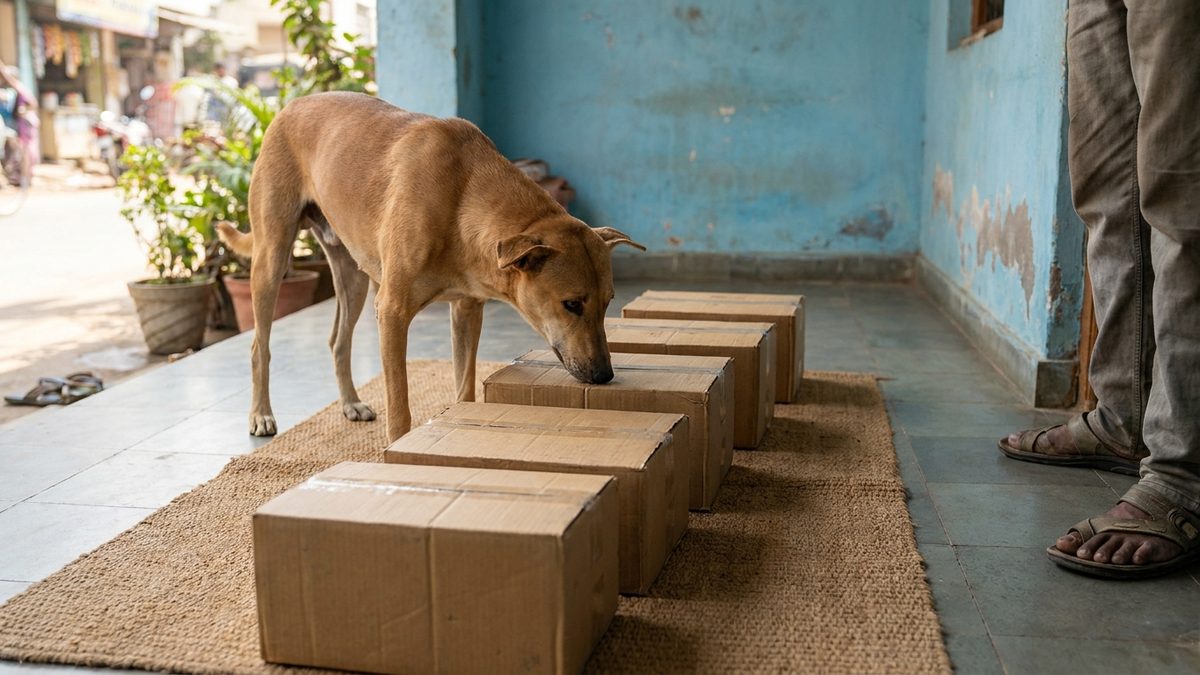
Scent work suits Indian conditions better than any other discipline because it needs almost no equipment, runs indoors, admits dogs that no other sport will take, and asks nothing of the joints. It is the one entry point we would put in front of a reader in a city with no club at all.
The sport is well defined even where no Indian body runs it. In the AKC's Odor Search Division the elements are container, interior, exterior and buried: "In the Container element the target odor is concealed within a container (such as a cardboard box or briefcase)", in the Interior element it is "concealed on or in an object in an indoor search area", in the Exterior element it is outdoors "despite changing airflow patterns, weather conditions, and natural distractions", and in the Buried element it is "concealed within a small container and then buried beneath sand or water";. Each element has four difficulty levels, novice, advanced, excellent and master, and three qualifying searches earn a title at any level.
The eligibility rules are the reason this discipline belongs on an Indian page. Classes are open to all dogs at least six months of age. "Dogs with physical challenges (including amputees) are eligible to participate provided that, in the opinion of the judge, they display no signs of physical discomfort and can safely complete the search." "Deaf dogs and blind dogs are allowed to enter." And trials "must be open to all breeds and to mixed breeds";.
This section is about the organised discipline: its elements, its levels and who may enter. Sniffing as daily enrichment is a different subject with its own evidence, including what the nose work experiment actually measured and what it did not, and it is set out in full on dog boredom and enrichment in India. Read that page before you decide how much sniffing your dog's week needs. This one tells you what the sport is.
Four practical consequences follow for an Indian household, and three of them are about the weather and the floor plan.
- The interior element is a room, so a monsoon week and a 42 degree afternoon both stop being obstacles. The search runs on the floor you already have.
- An elderly or arthritic dog can work a container search at a walk. The clinical ceiling is still a veterinary question; see arthritis in dogs and cats.
- A nervous dog works alone in the search area, which removes the crowd, the other dogs and the noise that make a group class hard for it.
- An Indie or any other mixed-breed dog is eligible by rule, which is not true of the conformation ring.
- The kit is a few cardboard boxes and something the dog wants. Nothing on this list has to be imported.
One limit, stated plainly. We found no Indian sanctioning body, no Indian titling scheme and no Indian trial calendar for scent work on 22 October 2026. You can train the discipline here and you cannot currently compete in it under a rulebook in India, so treat a trainer who offers scent work as offering the activity rather than a route to a title.
Which dogs, including the Indie
Sport is an aptitude and a temperament question before it is a breed question, and the rules of the disciplines themselves say so: scent work trials must be open to mixed breeds, while the conformation ring a mixed-breed dog cannot enter is the one activity Indian kennel bodies actually run The Kennel Club of India, public site.
The useful questions are about the individual animal. Does this dog work for food or a toy for more than two minutes with another dog nearby? Does it recover quickly after a fright? Does it offer behaviour, or wait to be told? Does it come back when it is excited? Those four answers predict more about a dog's first six months in any discipline than its breed does, and none of them is on a pedigree.
Breed still decides the ceiling in two ways that are not negotiable. A flat-faced dog has an airway limit that conditioning does not raise, and a heavy-coated dog cannot lose the heat the work makes. The measured breed odds of heat-related illness, and why a long nose and a short coat are the lowest-risk shape, are on heat safety for dogs in India, and the dose question is on how much exercise a dog needs.
The Indie, and what is actually known
The Indian Pariah Dog has the body shape every sport wants, a long muzzle, a short coat and a moderate frame, and nobody has measured its exercise tolerance or its injury risk in any discipline. We will not put a number on it. What is documented is that an Indian breed does the hardest canine work in the country: under Make in India, Mudhol Hound dogs were trained for explosive detection at the Army's Meerut centre and are now deployed in its dog units.
The practical point for a reader with an Indie is procedural rather than physical. Sport disciplines admit mixed breeds by rule; the conformation ring does not, and a registration certificate is a declaration about a declared pedigree rather than a judgement of quality, as our KCI registration guide sets out. If you have an Indie and you want to compete at something in India, scent work and agility are open to you and the show ring is not.
No study has measured the age at which starting a jumping sport is safe. Growth plates are real and the numbers attached to them are borrowed, which our running guide sets out from the primary literature. Ask your own veterinary surgeon to examine your dog before any jumping or impact work begins, and ask specifically about the hips and the knees. The conditions behind that advice are hip dysplasia in dogs and cruciate ligament rupture. Bonbeno does not diagnose and does not recommend a drug or a dose.
What the evidence says about injury, and what the denominators are
The best injury evidence in any dog sport is an agility survey, and its headline is 14 percent: of 864 Finnish competition-level agility dogs, 119 suffered an agility-related injury during the calendar year 2019. Read that number with its denominator attached, because the other figures in circulation count a different thing.
The authors state the problem with the literature themselves. Across the four survey studies known to them, 8 to 33 percent of agility dogs suffer an agility-related injury, but "the evaluation periods of the four studies varied markedly, ranging from three months to potentially the whole sporting career of the dog". So a 32 percent figure and a 14 percent figure are not in conflict; one is a career and one is a year. Anybody quoting a single injury rate for dog sports without saying over what period has not read the papers.
The Finnish study also gives the only rate per unit of exposure anyone has: across all 2019 runs of those 864 dogs, the incidence of competition-related injury was 1.44 per 1,000 competition runs.
| What was measured | Finding | Out of |
|---|---|---|
| Dogs injured in agility during one calendar year | 14 percent | 119 of 864 dogs |
| Competition-related injury rate | 1.44 per 1,000 runs | All 2019 runs of 864 dogs |
| Injuries occurring in training rather than competition | 66.9 percent | 79 of 118 injuries |
| Training injuries in the second half of the session | 71.7 percent | 33 of 46 with the timing recorded |
| Front limb involved | 60.5 percent | 72 of 119 dogs |
| Neck or trunk involved | 34.5 percent | 41 of 119 dogs |
| Commonest single site: the back | 19.3 percent | 23 of 119 dogs |
| Commonest injury type: muscle strain | 42.0 percent | 50 of 119 dogs |
| Presented as lameness | 64.8 percent | 70 of 108 with signs recorded |
| Noticed only after the session, not during it | 62.3 percent | 71 of 114 dogs |
| Taken to a veterinary surgeon | 41.2 percent | 49 of 119 dogs |
| Career-ending | 11.1 percent | 11 of 99 graded for severity |
Four of those rows change what a beginner should do. Two thirds of the injuries happened in training, not at a competition, so the risk is in the weekday session rather than the big day. Nearly three quarters of the training injuries happened in the second half of the session, which points at fatigue rather than at any one obstacle. Almost two thirds were noticed only after the dog had finished, so the handler's judgement during the run is not the safety net people assume. And fewer than half of the injured dogs were taken to a vet at all.
Recovery takes longer than people plan for
Recovery to normal daily exercise took a median of 14 days, with a range of 7 to 37; recovery to the dog's previous level in agility took a median of 28 days, with a range of 14 to 70. Graded by that recovery time, 26.3 percent of injuries were minor at under three weeks, 29.3 percent moderate at three to eight weeks, 33.3 percent severe at eight weeks or more with a return, and 11.1 percent career-ending. Exercise restriction was the commonest treatment, used for 77.1 percent of the dogs.
One risk factor dwarfs the rest and it is the one an owner controls. Dogs with multiple previous agility-related injuries had an odds ratio of 11.36 for being injured again, with a 95 percent confidence interval of 6.10 to 21.13. The authors are careful that "These associations do not confirm causality", and the direction could run either way, but the instruction is the same whichever way it runs: a dog that has been hurt twice is the dog to stop and investigate, not the dog to manage around.
Lameness was the commonest sign at 64.8 percent, pain on palpation second at 49.1 percent, and a stiff gait or stiffness on getting up appeared in 28.7 percent. None of those is a thing to train through. Stop, rest the dog and have your own veterinary surgeon examine it. Take a note of what the dog was doing, on what surface, and how long into the session. Bonbeno does not diagnose, and this page publishes under the medical disclaimer for that reason.
Where enthusiastic training becomes over-training
Over-training begins at the point where the session continues past the dog's interest rather than ending inside it, and the clearest evidence for where that point sits is how little successful competition dogs actually train.
The number is smaller than almost anyone expects. In the three months before their injury, those Finnish competition-level agility dogs did a median of 18 minutes of agility a week, with an interquartile range of 13 to 25 minutes, and a typical session held 10 to 15 minutes of active training time. Most trained once or twice a week. These are dogs competing at national level, including handlers who had represented their country.
Set that beside the Indian offer of daily agility training inside a thirty-day residential course and the mismatch is obvious. High training frequency was among the main risk factors the Finnish model identified for injury during 2019. More is not the direction of travel in this sport, and the enthusiasm that makes a beginner good at it is the same enthusiasm that overdoes it.
What a dog that has stopped enjoying it looks like
Read the dog, not the clock. The signs below are behaviour changes within a session or across weeks, and each of them is a reason to end the session early rather than to repeat the exercise.
- Slowing between exercises while still completing them, which is the earliest honest signal and the one handlers jog straight past.
- Sniffing the ground, scratching, shaking off or yawning between repetitions, which are displacement behaviours rather than disobedience.
- Leaving the working area, going to the gate, the shade or the water, or lying down without being asked.
- Taking food more slowly than usual, or refusing a reward it took happily ten minutes earlier.
- Needing a louder or more repeated cue for something it did first time last week.
- Stiffness on rising the morning after a session, or reluctance to jump into the car.
One Indian body has written the principle into its own scoring, which is worth knowing because nobody quotes it. The Indian National Kennel Club says it is the only kennel club in India "to allocate 10% points in all obidience tests to ensure that the dog performs in a happy manner";. A tenth of the marks for the dog looking like it wants to be there is a blunt instrument, and it is a clearer welfare statement than any Indian training page we read.
There is also a statutory backstop, which is unusual in this subject. Section 24 of the Prevention of Cruelty to Animals Act, 1960 lets a magistrate prohibit the training or exhibition of a performing animal, or allow it only on conditions, where it is proved that the training or exhibition "has been accompanied by unnecessary pain or suffering". The threshold is high and the clause is rarely used. It is still the one place in Indian law that treats training a dog too hard as a thing a court can stop.
That single habit covers most of what the evidence says. It ends the session in the first half, where 28.3 percent rather than 71.7 percent of the training injuries happened. It keeps the dog's motivation attached to the activity instead of to escaping it. And it means that when the dog does slow down, the change is information rather than the normal state of the last ten minutes.
Most of the Indian year is not sport weather
Heat rules out sustained work for much of the Indian calendar, and the governing instrument is the India Meteorological Department's own guidance rather than any sporting body's: "Avoid strenuous activities when the outside temperature is high. Avoid working outside between 12 noon and 3 p.m.";.
IMD declares a heat wave when a plains station reaches at least 40 degrees Celsius, or departs from normal by 4.5 to 6.4 degrees, or reaches 45 degrees outright, with the criteria met at two stations in a sub-division on two consecutive days. The season runs from March to June, occasionally into July, and "The peak month of the heat wave over India is May";. The same guidance asks people to "Keep animals in shade and give them plenty of water to drink";.
Three consequences for a training plan. In Delhi, Ahmedabad, Hyderabad and Chennai the outdoor season for any jumping or running discipline is the cool months, and within them the early morning. In Mumbai, Kolkata and along the humid coast of Maharashtra, Karnataka and Tamil Nadu the thermometer understates the problem, because a panting dog cools by evaporation and wet air blunts it. And in the monsoon the surface decides: a wet mat, wet grass or a wet contact obstacle is a slip, and slipping during obstacle performance was reported in 42.3 percent of the obstacle-related agility injuries in the Finnish data.
The hour-by-hour city table, the pavement test and the alert-day rule are on heat safety for dogs in India, which this page does not repeat. Plan the sport year around it rather than the other way round. The honest reading is that scent work, which runs indoors, is the discipline that survives the Indian calendar, and that everything run on a field is a cool-season activity in most of this country.
What nobody has measured, and what this page cannot tell you
Five things an Indian owner would reasonably want from this page do not exist in any source we could open, and saying so is more useful than filling the space.
- There is no count of how many dogs compete at anything in India. Neither kennel body publishes participation figures, and the performing-animal register holds circuses and race horses rather than dog clubs.
- There is no Indian injury data for any dog sport. Every figure on this page comes from Finland, and the authors note that most earlier work was North American and that regional differences in training and management exist.
- There is no published calendar of sanctioned Indian events. The KCI's public site carries 14 forms and no schedule, and the INKC's carries registration links and no schedule.
- There is no study of any Indian native breed in any sporting discipline, so the Indie's suitability is reasoning from body shape rather than a finding.
- There is no Indian ruling on whether an unticketed dog trial falls inside Chapter V of the 1960 Act that we could locate, so the reading above rests on the text of section 21 alone.
Two things we tried and could not get. The KCI's own "Application to Hold a Dog Show" form downloads as a scanned image whose extracted text is unreadable, so we cannot say what event types or classes it offers; the file returned HTTP 200 on this attempt, 22 October 2026, and the text layer was garbled. And a Ministry of Home Affairs parliamentary answer listing central armed police training facilities, including the National Training Centre for Dogs at Tekanpur, returned HTTP 404 on this attempt, 22 October 2026, so that establishment is named here only through the CRPF's own live page for its Dog Breeding and Training School.
What would settle most of it is not exotic. If either Indian kennel body published a sport calendar, a rulebook and a results archive, a reader could plan a season instead of guessing at one, and this page would be half as long. Until then, verify every event before you travel to it, train the discipline that fits your flat and your climate, and judge the week by how your dog looks at the end of a session rather than by how much you got through.
Common questions
What sports can I do with my dog?
In India, realistically three: scent work, which needs almost no equipment and runs indoors; agility, where a private facility exists near you; and protection sport under a club affiliated to the Protection Sports Association. Worldwide the FCI publishes regulations for 21 disciplines including flyball, herding, rally obedience, water work and hoopers, but we found no Indian club running those. Canicross is covered on our running guide.
How do I get my dog in competition?
To get a dog into competition in India, first confirm an event actually exists by opening the organiser's own page and finding a date, a venue and an entry form. For conformation showing, the dog must be registered with a kennel club and entered in the right breed and age class. For sport disciplines there is no published Indian rulebook or calendar on either kennel body's site, so in practice you train with a private trainer and watch for one-off trials.
Can any dog do scent work?
Almost any dog can. Under the AKC's Scent Work regulations, classes are open to all dogs at least six months of age, dogs with physical challenges including amputees are eligible if they show no signs of physical discomfort and can safely complete the search, deaf dogs and blind dogs are allowed to enter, and trials must be open to all breeds and to mixed breeds. An Indie, a senior dog and a nervous dog are all eligible by rule.
How much does a dog trainer cost in India?
Indian services print bands rather than a single price. One Bengaluru service quotes puppy training at ₹3,000 to ₹8,000, basic training at ₹5,000 to ₹12,000 and behaviour training at ₹8,000 to ₹20,000, with its own at-home training from ₹3,500. A Pune facility prices a 30-day residential basic course at Rs 12,000 with membership and boarding extra. Ask what is included, whether you attend, and what the total is before boarding.
Does the Kennel Club of India run agility or obedience trials?
Nothing on its public site says so. On 22 October 2026 the KCI's site carried 14 downloadable forms and a Chennai contact block, with one event form headed Application to Hold a Dog Show, and no agility regulation, obedience schedule, working-trial rulebook, entry form or calendar for any discipline. The KCI is a full member of the FCI, which publishes regulations for 21 disciplines, so the capacity exists on paper.
Do I need a licence to run a dog sport event in India?
Chapter V of the Prevention of Cruelty to Animals Act, 1960 requires registration with the Animal Welfare Board of India before a person may exhibit or train a performing animal. Section 21 defines exhibit as exhibiting at an entertainment to which the public are admitted through sale of tickets, so on its face an unticketed club trial is outside the Chapter. A ticketed public event is a question for the organiser to put to the Board.
How often should a sport dog train?
Less than most beginners assume. Finnish competition-level agility dogs did a median of 18 minutes of agility a week, interquartile range 13 to 25 minutes, with a typical session holding 10 to 15 minutes of active training and most dogs training once or twice a week. High training frequency was among the risk factors for injury in the same study. End the session while the dog still wants another repetition.