
Dog life guide
Dog boredom busters that have evidence behind them, and what an Indian flat changes
Almost every page on this query is a numbered list of activities with a product link under each one. This one starts with the studies instead: the twenty-dog nose work experiment that is cited everywhere and measured something other than tiredness, the kennel trial where a stuffed food toy cut inactive time by nearly half and then gave it all back, the thirty-eight dogs who would work for food but did not prefer to, and the review that says nobody knows how much chewing a dog actually needs.
Quick answer
Dog boredom busters worth your time are foraging, chewing and scent work, in that order of published support. Two weeks of five-minute nose work sessions made 10 pet dogs measurably more optimistic. A stuffed food toy cut kennelled dogs' inactive time from 21 to 13 percent while it was there. A long-lasting chew beat three other enrichments during 20 minutes alone. No study has measured how tired sniffing makes a dog. Repetitive licking, tail chasing and pacing are veterinary questions first.
This guide is general information for Indian pet owners and is not a diagnosis. Always consult a registered veterinarian near you before acting on anything you read here, and treat any sudden change in your pet's condition as urgent.
What boredom costs a dog, and how it differs from under-exercise and frustration
Boredom costs a dog the behaviour it would otherwise have been doing, and the bill usually arrives as destructiveness, because a dog with an unfilled day fills it with whatever the room offers.
Start with an honest statement that no page ranking for dog boredom busters makes. Nobody has measured boredom in a domestic dog. The experimental work on whether animals suffer monotony has been done in other species, and what exists for dogs is a set of adjacent measurements: how optimistic a dog is after two weeks of a particular activity, how much it moves when given a food toy, how long it engages with a chew. Those are useful. They are not a measurement of boredom, and this page will keep saying so.
What is documented is the cost. The 2025 University of Sydney review of chewing describes the mechanism in one sentence: denial of the opportunity to chew appropriate substrates may leave the motivation unfulfilled and cause frustration, so a dog seeking to fulfil its need to chew targets available but inappropriate substrates, or ones valued by humans, such as bedding or furniture. The same review reports that veterinarians in Spain, 236 of them, named destructiveness as the most frequent behaviour-related complaint owners brought them, and that in an Australian shelter study 11 percent of all dogs were relinquished for behaviour-related reasons, 6.8 percent of them for destructive behaviour. Both of those figures are quoted inside the review rather than read at their own sources, and we are flagging that rather than dressing them up.
So the cost is not that your dog is sad. It is that an under-stimulated dog redirects. The sofa, the chappals, the door frame and your neighbour's patience are what absorb the redirection.
Four states that look identical from the doorway
Boredom, under-exercise, frustration and separation distress produce overlapping behaviour and need opposite responses, which is why the label matters more than the list of fixes. A bored dog needs something to solve. An under-exercised dog needs a longer walk. A frustrated dog needs the thing it is being blocked from, or a substitute for it. A distressed dog needs less stimulation, not more, while the real problem is treated.
| State | What it looks like | What it responds to | Where the evidence sits |
|---|---|---|---|
| Boredom and under-stimulation | Destructive chewing of household items, attention-seeking, restlessness in a dog whose physical needs are met | Foraging, chewing and problem-solving, delivered before the empty stretch rather than after it | No direct measurement in dogs; inferred from enrichment trials that moved activity and emotional-state scores |
| Under-exercise | The same restlessness, but it settles after a long walk and returns on the day the walk is skipped | A walk sized to the breed, taken in the hours the Indian heat allows | Covered with the Kennel Club bands and the city walk hours on things to do with your dog in India |
| Frustration | Barking or chewing aimed at a specific barrier: the grille, the gate, the door the cat went through | Access, or a genuine substitute for the blocked goal, not a louder correction | Redirected chewing onto inappropriate substrates is described in the 2025 chewing review |
| Separation distress | Vocalising from the first minutes, damage concentrated at exits, refusing food the whole time you are out | Treatment with veterinary involvement; adding a puzzle to a panicking dog achieves nothing | The clinical disorder is on separation anxiety in dogs in India, and the phone-video test that tells the two apart is on leaving your dog alone at home |
The practical rule that follows is short. Run the walk and the vet check first, then judge what is left over. Most Indian households discover that the dog is both under-exercised and under-stimulated, because the hot months and the monsoon cut the walk and nothing replaced it.
This page publishes under the medical disclaimer at the top because the honest version of 'my dog is bored' is often 'my dog is uncomfortable'. A dog that has started licking one spot, chewing furniture it ignored for years, pacing at night or waking the house has a differential diagnosis before it has an enrichment plan. Pain, itch and endocrine disease all present as a change in activity. Take the change to a veterinarian who can examine the dog. Bonbeno does not diagnose and does not recommend a drug or a dose.
Does sniffing tire a dog more than walking? What the nose work study actually measured
Sniffing has not been shown to tire a dog more than walking, because no published study has compared the two for tiredness, and the experiment everyone cites for that claim measured optimism instead.
Here is the study, in full, because it is quoted constantly and almost never described. Twenty pet dogs of mixed breeds were split into two groups of ten. The nose work group learned to find a single treat the owner would hide in one of several boxes, and practised one session a day, roughly five minutes, for fourteen days at home. The control group did heelwork for the same five minutes a day across the same fourteen days, with the same number of classes, the same owner time and the same quantity of food.
Both groups were given a cognitive bias test before and after. The dog is taught that a bowl on one side holds food and a bowl on the other does not, and is then shown an empty bowl exactly in the middle. How fast it goes to the ambiguous bowl is read as optimism. In the nose work group the latency fell from 4.74 plus or minus 0.80 seconds to 3.40 plus or minus 0.47 seconds, at P less than 0.01. In the heelwork group it moved from 5.28 plus or minus 0.81 to 4.40 plus or minus 0.70 and the change was not significant, at P equal to 0.15.
That is a real result and a careful one. The authors checked the obvious alternative explanations: the two groups needed the same number of trials to learn the task afterwards, so the nose work dogs had not simply become cleverer, and latency measures motivation rather than running speed, so they had not simply become fitter. Their conclusion is that an olfaction-based activity may be a useful tool to improve welfare in owned dogs.
Where the popular version overstates it
The sentence you keep reading, that ten minutes of sniffing tires a dog as much as an hour of walking, has no source in this literature. Nothing in the nose work experiment measured fatigue, sleep, heart rate or recovery. It measured how quickly a dog walked to a bowl. The ratio is somebody's rule of thumb that acquired a scientific accent by being repeated near a citation.
Two of the pages ranking in India make the claim without attaching anything to it. Vetic, an Indian veterinary clinic chain with more than 50 hospitals, tells readers that mental work during feeding often tires dogs more effectively than short bursts of physical exercise alone, and that even 10 to 15 minutes of focused learning may mentally exhaust many dogs more effectively than casual physical movement, and cites nothing for either sentence; its own reference list is three manufacturer pages and two veterinary manuals. Purina India is more careful and says only that mental stimulation is just as important as physical exercise, which is a claim about importance rather than about tiredness, and also carries no source.
We are not telling you to skip scent work. We are telling you what it is supported for. Five minutes a day for two weeks moved a welfare measure in twenty dogs. That is worth doing on a wet Pune afternoon. It is not a substitute for the walk, and the walk hours for your city are on heat safety for dogs in India.
The paper's own practical recommendation is broader than nose work. It is to increase a pet dog's foraging time, through nose work or any other activity, such as natural sniffing during walks or food-distributor toys. The reason they give is a figure worth keeping: free-ranging dogs spend at least 10 to 22 percent of their active time foraging, a number the paper quotes from two earlier field studies rather than measuring itself. A bowl deletes that entire block of a dog's day in about ninety seconds.
That is the frame for everything below. You are not entertaining a dog. You are putting back a cost the bowl removed.
Food, foraging and the snuffle mat: what the feeding trials found
Feeding enrichment works while it is in front of the dog, and the trials are honest that the effect does not outlast the session, which is an argument for using it daily rather than an argument against using it.
The cleanest dog trial is small and old and still the most useful. Seventeen laboratory dogs were split into eight who received a rubber toy stuffed with food twice a day for a week and nine who did not, with a week of observation before and a week after. While the toy was present, the eight dogs spent 31.78 plus or minus 8.26 percent of observed time working it, and their inactive time fell from 21.09 plus or minus 4.96 percent to 12.86 plus or minus 3.75 percent. Behavioural transitions, which is a measure of how varied a day is, rose from 114.73 to 145.10. Barking fell from 1.53 to 0.33 events, although that difference was not significant.
Now the part that matters more than any of it. In the week after the toy was removed, inactive time in the same eight dogs went to 28.52 plus or minus 6.17 percent, which is higher than it had been before the toy ever arrived. There was no carry-over. The authors say so in their own conclusion, that a simple feeding enrichment toy is a useful tool at least in the short term. Two of the eight dogs barely engaged at all, spending about 5 percent of the time on it.
| Measure | Week 1, no toy | Week 2, toy twice a day | Week 3, toy withdrawn |
|---|---|---|---|
| Inactive time, toy group of 8 | 21.09 percent | 12.86 percent | 28.52 percent |
| Inactive time, control group of 9 | 23.77 percent | 35.40 percent | 30.74 percent |
| Behavioural transitions, toy group | 114.73 | 145.10 | 98.45 |
| Time spent working the toy | none offered | 31.78 percent of observed time | none offered |
Dogs will work for food, but they do not prefer to
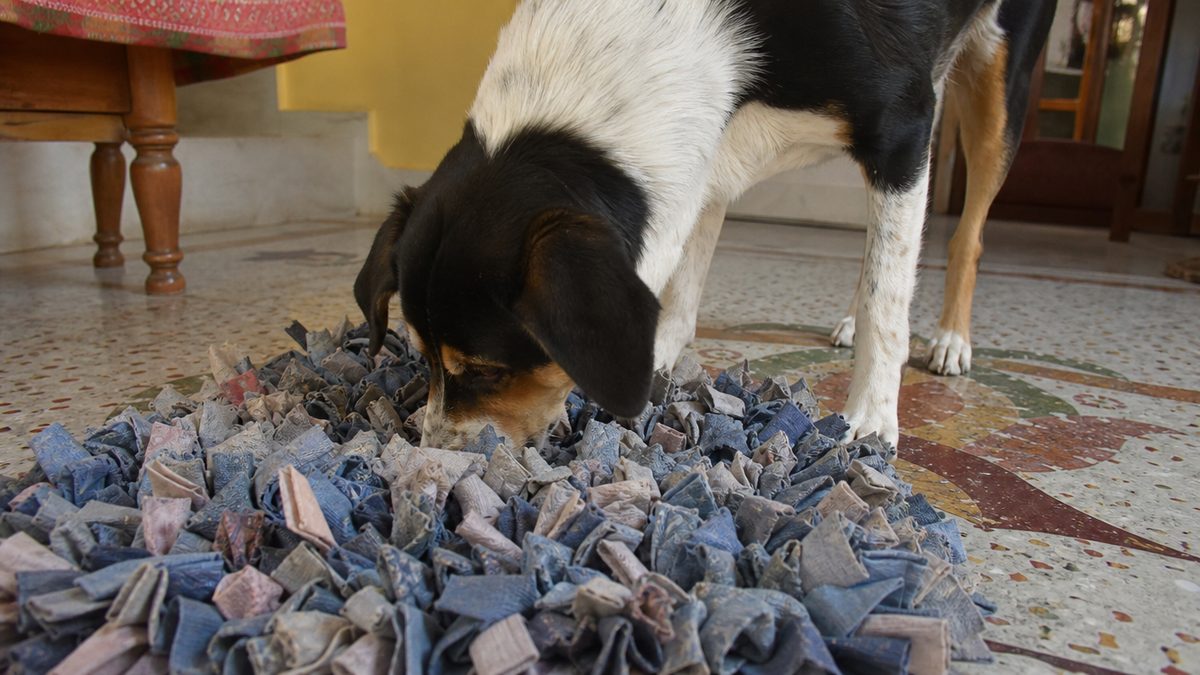
The result that complicates every puzzle-feeder recommendation was published in 2024 and almost nobody repeats it. Thirty-eight pet dogs were offered a snuffle mat and an open tray side by side, with the same food divided equally between them, across ten trials. Twenty-two of the 38 went to the mat first in fewer than 20 percent of trials. Exactly one dog went to the mat first in 80 percent of trials. Thirty of the 38 chose the mat at least once, and all 38 interacted with the mat at some point while food was still sitting free in the tray, averaging 0.98 interactions per trial. The authors' summary is precise: pet dogs show a willingness, but not a preference, to work for food.
One variable predicted anything at all, and it is an uncomfortable one. Owner-reported body condition score was significant, F(1,36) equal to 7.72 at P equal to 0.009, with heavier dogs making a greater proportion of first choices for the snuffle mat. Sex, age, previous puzzle experience and measured daily step count predicted nothing.
Read the two findings together and the instruction changes shape. A puzzle feeder is not something your dog wants more than a bowl. It is a way to put time, movement and problem-solving back into a day that lost them, and the dog will do it willingly without preferring it. That is also why staging matters. Start with the food more than half visible, let the dog succeed in under a minute, and make it harder only once it is finishing confidently.
Scatter feeding is the version that costs nothing and needs nothing. Take a quarter of the day's measured ration and throw it across a clean floor, a doormat, a towel folded loosely and the lower shelf of the shoe rack. The dog forages for ten minutes instead of eating for forty seconds. The portion arithmetic lives on the dog diet chart for India, because this only works if the enrichment food comes out of the ration rather than on top of it.
AAHA's own enrichment guidance says to use part of the dog's normal daily food whenever possible so the extra calories do not add up. A dog that gets its two meals plus a day of treats through a feeder gains weight while its owner believes it is being enriched. Weigh the ration once, split it into the bowl and the enrichment, and keep the total the same. What obesity then costs the dog is on obesity in dogs and cats.
Chewing is a need, not a vice
To treat chewing as a need rather than a vice, give the dog something it is allowed to destroy every day, because the published position is that chewing supports health and welfare and that a dog denied it redirects onto your furniture.
The 2025 review from the University of Sydney is the first place that assembles this properly. Its conclusion is that chewing positively impacts a dog's physical and psychological health, contributing to its welfare and appearing essential as a regular part of a dog's daily life. It lists what chewing is implicated in: dental and oral hygiene, digestion, bone strength, cognitive function, and stress management. It also states that chewing can alleviate negative states such as frustration, depression and boredom, and mitigate the effects of separation.
The scale of what has been removed from a modern dog's day is easier to see from the wild comparison in the same review. Australian dingoes average 26.1 minutes per feeding bout on a sambar deer carcass, and free-ranging dogs usually eat 4 to 8 meals a day. A bowl of kibble in an Indian flat replaces all of that with two events of under a minute each.
The one trial that put a chew against the alternatives
Twenty dogs at a petcare research institute were each left alone in a familiar room for 20 minutes, four times, with a different food enrichment on each occasion: a long-lasting chew, kibble in a treat-dispensing toy, kibble thrown by a smart dispensing device, and the same device with a recorded human voice. The chew won on every measure the study took. The dogs had lower arousal scores than with the device or the toy during the first five minutes, higher positive valence scores than with all three alternatives during the second five minutes, and spent the most total time engaged, at P less than 0.01 against all three. Adding a human voice to the device changed nothing at all.
Two qualifications belong with that. The study was funded by Mars Petcare UK, which makes chews, and we say so rather than leaving it in a footnote. And twenty dogs in a research facility for twenty minutes is not nine hours in a Mumbai flat. The direction is still the most useful thing published on what to leave with a dog you are about to leave.
The honest limit is the dose. The review states it without hedging: the amount of chewing needed for optimal health and the minimal chewing required for optimal welfare remain unknown. Nobody can tell you how many minutes a day your dog needs, and anybody who does is guessing.
This section argues that your dog needs to chew. It does not tell you what to give it, because the safety evidence is long and belongs in one place. Cooked bones, raw bones, curry-cut bone, buffalo marrow bone, the tooth-fracture forces and what to give instead are set out in full on bones for dogs in India. The fingernail test, the throat rule and the chews sold in India with prices are on puppy teething. Read one of those before you buy anything, and ask your nearby vet to look at the carnassial teeth of any dog that chews hard objects.
One further point from the review changes how you judge a toy. Studying laboratory dogs, one group found that the value of an enrichment item was determined by how much it could be chewed. A ball the dog cannot get its teeth into is a thing it pushes around for two minutes. Something it can work on, damage and keep returning to is what holds it.
How much enrichment, and when: a structure instead of a list
To work out how much enrichment a dog needs and when, drop the idea of a daily dose, because nobody has published one, and attach each activity to the hour it is covering instead.
Every ranking page is a list of ideas with no schedule attached. That is the actual gap. A dog does not need twenty boredom busters, it needs the right one at four specific points in the day, and the evidence tells you which point each one suits.
Before you leave is the slot with the most support behind it, because that is the slot the only relevant trial tested. A long-lasting chew produced the lowest arousal and the highest positive emotional scores of four options during 20 minutes alone, and a stuffed food toy cut inactive time by nearly half while it was present. Load the chew or the stuffed toy as you pick up your keys, not an hour earlier.
| The hour you are covering | What the dog has lost | What to deploy | Why that one |
|---|---|---|---|
| The ten minutes after you leave | Company, and the predictability of your presence | A long-lasting chew, given as you go | Lowest arousal and highest positive valence of four enrichments across the first ten minutes alone, in 20 dogs |
| A summer day when the only safe walk is before dawn | The afternoon and evening walk, and most of the day's movement | Scatter feeding on cool tile, plus a five-minute scent work session indoors | Nose work ran indoors in the published trial, with dogs mainly walking or trotting, so it costs the joints and the body heat almost nothing |
| A monsoon week when the street is flooded | Outdoor sniffing, which is the richest stimulation the dog gets | Three short hunts, the puzzle feeder promoted from occasional to every meal, toy rotation tightened to twice a week | Feeding enrichment moves activity only while it is there, so the monsoon is when frequency has to rise |
| A festival night when the dog must stay in | Nothing you should replace; this night needs less input, not more | Quiet, a safe room, and a chew only if the dog is settled enough to take it | A frightened dog does not forage; the plan for that night is on firecracker fear in dogs |
| The hour your society's lift and corridor are busiest | Rest, because the dog is tracking every arrival | A chew or a stuffed toy in the room furthest from the front door | Barrier and corridor triggers are a separate problem, set out on dog barking and your neighbours |
A weekday that fits an Indian working household
This costs nothing, takes about twenty minutes of human time in total, and assumes two adults out of the house from roughly nine to seven.
- Walk first, in your city's cool hour, because enrichment does not replace exercise and the heat decides when the walk happens.
- Feed breakfast through a puzzle feeder or scattered across a clean floor, so the meal takes ten minutes instead of forty seconds.
- Hand over the chew at the door, not before, so the thing the dog values most arrives at the moment you leave.
- Run five minutes of scent work when you get home, before the evening meal, while the dog is hungry and the search is worth something.
- Rotate the toy box on Sunday, keeping three out and the rest in a box on top of the almirah.
- Leave one day a week with no structured enrichment at all, so novelty stays novel and the routine does not become the new baseline.
Nobody has run the study that would produce one. The chewing review says the minimum required for welfare is unknown, the nose work trial used five minutes a day because that was a convenient session length rather than a measured dose, and the feeding trial used twice a day because that matched the kennel's feeding schedule. Treat the structure above as a sensible arrangement of activities that have evidence behind them, not as a prescription. Anybody printing a precise daily figure has invented it.
The Indian flat: no garden, a pre-dawn walk window and a quarter of the year indoors
An Indian flat removes a dog's enrichment twice a year on a schedule you can plan around, because the hot months cut the walk to one hour before dawn and the monsoon closes the street altogether.
This is the part no page on this query writes, and it is not complicated. A dog in Mumbai, Pune, Kolkata or Kochi loses most of its outdoor stimulation across the four southwest monsoon months. A dog in Chennai loses it later, in the northeast monsoon. A dog in Delhi, Ahmedabad, Hyderabad or Jaipur loses it to the hot months instead. In both cases the loss is predictable, which means the replacement can be scheduled rather than improvised in week three when the sofa has already gone.
We are not going to rebuild the calendar here. The monsoon's arrival date for your city, the walk in the rain, and the humid-season skin and ear routine are on monsoon care for dogs in India. The city-by-city cool hour, the pavement test and the alert-day rule are on heat safety for dogs in India. What this page adds is what goes into the hole those two pages describe.
The Indian street is the richest scent environment your dog has, and the one you cannot always use
A free-ranging dog spends at least 10 to 22 percent of its active time foraging by nose, and an Indian street delivers more olfactory information in one lamp post than a flat does in a week. That is the resource the monsoon takes away. It is also the resource that comes with the community dogs already living on that road, and with whatever is in the waterlogged gutter in August, so the decision about where and when to let a dog sniff is a safety decision as much as a welfare one. The law on resident community dogs and the way to walk past a pack are on things to do with your dog in India and free-ranging dogs in India.
Three Indian constraints change the standard advice, and none of them appears on an imported page.
- Humidity ruins the cheap enrichment first. Cardboard goes soft and grows mould in a humid monsoon week, and a cotton rope or a fabric snuffle mat that never fully dries turns sour. Treat a cardboard build as a weekly replacement from June to September, wash fabric items and dry them in the sun between uses.
- Ants find a food puzzle before the dog does. A kibble-loaded container left on a kitchen floor in Chennai or Bengaluru is a trail within the hour. Load it when you are leaving, not in advance, and wash it the same day.
- The flat has no garden, so the corridor and the terrace are the only extra floor you own. Both are shared, both have a lift opening onto them, and neither is a secure off-lead space. The flooring, stair and balcony constraints that decide what is safe to run on are on keeping a dog in an Indian flat.
Every study cited here was run in France, the Netherlands, the United States, the United Kingdom, Finland, Australia or Italy. We could find no published study of enrichment, boredom or activity budgets in pet dogs in India, and no Indian survey of how Indian owners actually fill a dog's day. The seasonal argument in this section is ours, applied from the Indian climate to foreign findings, and the reasoning is set out so you can disagree with it. The cat household version of the same problem, with the Indian rainfall and sunshine figures attached, is on indoor cat boredom and enrichment.
Homemade enrichment from what an Indian kitchen throws out
To build enrichment from Indian kitchen waste, put part of the measured ration inside something the dog has to work at, make the first version far too easy, and sit with the dog the first three times it uses it.
Imported puzzle feeders are expensive here and entirely optional. On Supertails, an Indian pet retailer, slow feeders, treat-dispensing toys and snuffle toys for dogs were listed between Rs 478 and Rs 899 on 20 October 2026. Dividing Rs 478 by 84.38 gives 5.67 and by 74 gives 6.46, so those are rupee-native prices rather than a converted dollar list. Every build in the table below does the same job for nothing.
AAHA's own indoor enrichment page is blunt about this: there is no need to buy a high-priced puzzle toy, make your own. It gives three builds. The muffin tin game, where treats go in several cups and all the cups are covered with tennis balls, soft toys or crumpled paper. The towel snuffle mat, where treats are sprinkled on a blanket or towel which is then folded several times. And the foraging box, a large cardboard box filled with toys, balls and scrunched paper with a few treats mixed through.
| What you were going to throw away | What it becomes | How to make it | Cost |
|---|---|---|---|
| An old cotton dupatta, towel or kurta | A snuffle mat for a dog that has to use its nose | Sprinkle a handful of kibble over it, fold it loosely three times, and let the dog unpack it; tighten the folds as it gets quicker | Rs 0 |
| A steel muffin tray or idli plate | A beginner's puzzle that cannot be chewed or swallowed | Kibble in alternate wells, a ball or a folded cloth over each; steel survives a monsoon that destroys cardboard | Rs 0 |
| A courier or grocery carton | A foraging box and a shredding outlet in one | Scrunched newspaper, two old toys and a scatter of kibble, mixed through so the dog has to dig | Rs 0 |
| An empty atta or masala dabba with a lid | A rolling slow feeder for a dog that has mastered the easy ones | Punch two holes slightly wider than a kibble, fill it a third full, close the lid, and let the dog roll it | Rs 0 |
| Yesterday's newspaper | A rustling search layer over a scatter feed | Crumple loosely over kibble in a shallow steel tray, so the dog has to dig through sound to find food | Rs 0 |
| Three plastic cups or katoris | The shell game, which is a scent discrimination task | Food under one cup, all three upturned in a row, and the dog indicates which one; shuffle only once the dog is reliable | Rs 0 |
| A plastic bottle that held water, never chemicals | A treat dispenser, supervised only | Cut two kibble-sized holes in the side, remove the cap and the ring entirely, and take it away the moment the plastic starts to crack | Rs 0 |
The safety rules, and the denominator behind them
Homemade enrichment hands a dog objects it is allowed to destroy, so the swallowing risk is the thing to take seriously. In a multicentre Italian study of 72 dogs that needed a gastrointestinal foreign body removed, the commonest objects were children's toys at 14 percent, metal objects or coins at 13 percent, cloth at 13 percent, socks at 8 percent, balls at 8 percent and plastic material at 8 percent. Forty-four percent of those dogs needed surgery rather than an endoscope, and the median age was three years, so this is not only a puppy problem.
Read that list against the table above and the rules write themselves.
- Supervise every new build for its first three sessions, and never leave a fabric or cardboard item with a dog you have not watched using it. Cloth and socks together accounted for 21 percent of the removed foreign bodies in the 72-dog series.
- Bin anything the dog starts eating rather than working. A dog that shreds and swallows the carton is telling you to switch to the steel version.
- Size every item so it cannot fit into the back of the dog's mouth, which is AAHA's own rule for enrichment toys.
- Remove bottle caps, rings, bells, buttons and any small part before the dog ever sees the object.
- Never use a container that held phenyl, bleach, detergent or pesticide, however well rinsed, because the residue sits on food the dog is about to eat.
- Count the food. Whatever goes into the build comes out of the day's ration, measured on the scale, not estimated.
The rupee figures above are a market reference read on one Indian retailer's category page on 20 October 2026, not a recommendation of any product on it. We do not rank or recommend a named toy, feeder or chew, because a verdict needs first-hand testing. What we can tell you is that no published study has compared a shop-bought puzzle with a homemade one in dogs, so the price difference buys durability and convenience rather than a measured welfare gain.
What does not work, and where the evidence runs out
Five popular boredom busters do less than the pages recommending them claim, and the television left on for the dog is the clearest case, because two shelter studies looked for an effect and did not find one.
A 2025 survey of 453 dog owners built a scale for how dogs behave towards television, and it is the best current source on the question precisely because it is honest about the earlier work. Its own discussion records that studies of television access in shelters noted a lack of engagement in one case and no decrease in cortisol levels in the other. The survey also found that excitable dogs and dogs rated higher on negative reactivity engaged with the screen more, not less, which is the opposite of what you want from something left on to settle a dog alone in a flat.
Two cautions on that survey. It is owner-reported, and the authors note openly that owners of dogs who watch television self-selected into it, which is why 88.3 percent of the original sample watched at all. It measures what dogs do with a screen, not whether a screen helps them.
Meanwhile Chewy's page, which holds position two on this query, recommends leaving the television on and even names a dog television channel, quoting a veterinarian's anecdote about a client's dog that enjoyed watching a sitcom, and cites no study anywhere on the page. It also recommends twenty boredom busters with a product card under most of them.
The five things to stop counting on are below, each with what the evidence supports instead.
- The television left on. Shelter studies found no engagement and no cortisol change, and the dogs who engage most are the excitable and negatively reactive ones. Use a chew instead, which has a measured arousal effect in the same situation.
- Every toy left out, all the time. Novelty is the active ingredient in all of this, and a toy that has sat in the same corner since Diwali has none left. Rotate three at a time, which is AAHA's own instruction.
- Buying the expensive puzzle first. Only 1 of 38 dogs preferred a snuffle mat to a free tray, and 8 never chose it at all. Stage the difficulty with a folded towel before you stage the spending.
- A second dog, bought as a cure. The measured evidence on whether a companion dog helps a dog left alone is set out on leaving your dog alone at home, and it is not encouraging. There is a genuine disagreement here worth knowing: in the 368-dog tail-chasing survey, dogs living with several other dogs chased less than dogs living alone, at P equal to 0.001. Those are different outcomes measured different ways, and neither makes acquiring a second dog a solution to a long working day.
- A longer walk as the whole answer. It is necessary and it is not sufficient. The feeding-enrichment trial moved inactive time, transitions and barking without changing the walk at all.
Three honest gaps, stated so you can judge the rest. Nobody has measured boredom in a domestic dog, so every use of the word on this page is shorthand for under-stimulation. Nobody has published a dose, for scent work, chewing or food enrichment. And nobody has studied any of it in India, so the seasonal structure here is reasoning from Indian weather onto foreign results rather than a finding.
We looked for an Indian legal or regulatory standard describing what a confined dog's day must contain, in the way the Dog Breeding and Marketing Rules set a human-company figure for kennels. The Animal Welfare Board of India's Pet Shop Rules PDF returned the board's PageNotFound placeholder on this attempt, on 20 October 2026, so we have not quoted it. The exercise clause of the Prevention of Cruelty to Animals Act, 1960, which is the one Indian law that names dogs and confinement, is quoted in full on leaving your dog alone at home.
When boredom is actually a medical problem, and a toy is the wrong answer
Repetitive licking, flank sucking, tail chasing and pacing are not boredom signs to be solved with a new toy, and each of them needs a veterinary examination before anybody changes the enrichment plan.
The distinction is the difference between a dog that will chew whatever you give it and a dog that performs the same act over and over whether or not there is anything to chew. The second pattern is a compulsive behaviour, and it has its own literature.
A questionnaire survey of 368 pet dogs across four breeds found compulsive tail chasing starting at 3 to 6 months of age, with wide variation in how often individual dogs did it. Almost half of the tail-chasing dogs showed lowered responsiveness during bouts, meaning the owner could not easily interrupt them, and those dogs displayed other compulsions more often than the controls. Three factors survived the model: dogs given dietary supplements chased less, dogs living with several other dogs chased less, and neutered females chased less. Tail chasers had also been separated from their mothers earlier than the control dogs.
Notice what is not on that list. Amount of exercise is not among the factors that came out significant, and nothing in the study supports treating an entrenched tail chaser with a puzzle feeder. A dog that cannot be interrupted mid-bout is a behavioural medicine case, not an enrichment case.
| What you see | What the boredom lists say | What to exclude first | First step |
|---|---|---|---|
| Licking one spot on a leg until the hair goes and the skin thickens | A bored dog with nothing to do | Itch, allergy, infection, and pain in the joint under the licked spot | A dermatology and pain work-up. See dog skin allergy and hot spots and pyoderma |
| Chasing or biting the tail, repeatedly, hard to interrupt | Excess energy, so add a longer walk | A compulsive disorder, anal gland pain, skin disease at the tail base, spinal pain | A veterinary examination; onset at 3 to 6 months and lowered responsiveness during bouts are the published pattern |
| Flank sucking, or sucking a blanket for long periods | Attention-seeking | A breed-associated compulsive behaviour, which is a clinical diagnosis rather than a habit | A veterinary behaviour referral, not a replacement blanket |
| Pacing the same track, or circling, especially at night in an older dog | A restless dog that needs more stimulation | Pain, failing vision, hypertension and canine cognitive dysfunction | An examination, and in an older dog the cognitive checklist on senior dog care in India. See also arthritis in dogs and cats |
There is a second medical trap in the opposite direction, and the chewing review names it. A dog seeking to fulfil its need to chew may target inappropriate substrates, and those items can cause dental erosion if chronically chewed and damage the gastrointestinal tract if swallowed. So a dog chewing the bed frame every day is not only a behaviour problem; it is also the dog most likely to end up on an operating table for a foreign body, which is what happened to 44 percent of the 72 dogs in the Italian series.
Take a phone video of the behaviour, note how old the dog was when it started, how many times a day it happens and whether you can interrupt it, and say those four things at the desk. That is the information a veterinarian needs to tell a habit from a compulsion, and it is faster than describing it. Never give a dog a human sedative, a calming supplement or anything from a neighbour's cupboard for a repetitive behaviour US Food and Drug Administration. Drug class and dose are a veterinary decision about an individual animal. The ordinary annual routine this all sits inside is on adult dog care in India.
Everything else on this page assumes a healthy dog with a dull day. Rule out the dog that is uncomfortable first, then build the day.
Common questions
What can I give my dog to stop boredom?
Give it something to chew and something to forage for, out of the day's own ration. A long-lasting chew beat a treat-dispensing toy and two versions of a smart dispensing device on arousal, positive emotion and total engagement in 20 dogs left alone for 20 minutes. Load it as you leave rather than an hour before.
What are the best boredom busters for dogs?
Foraging, chewing and scent work have the most published support, in that order. A stuffed food toy cut kennelled dogs' inactive time from 21.09 to 12.86 percent while it was present and raised behavioural transitions from 114.73 to 145.10, although inactivity rose above baseline in the week after the toy was withdrawn.
What is 15 minutes of mental stimulation for dogs?
It is a figure nobody has measured. The 2025 veterinary review of chewing states that the amount needed for optimal health and the minimum required for optimal welfare remain unknown, and no published trial has tested a daily dose of mental stimulation in dogs. Fifteen minutes is a reasonable session length, not a validated requirement.
How to tire out a dog indoors?
Honestly, no study has measured that. The nose work experiment cited for the claim that sniffing tires a dog measured how fast 20 dogs approached an ambiguous bowl, not fatigue, and found latency fell from 4.74 to 3.40 seconds after two weeks of five-minute daily sessions. Scent work improves mood on that evidence; it has not been shown to replace a walk.
How do I make my dog busy?
Deliver a meal through work instead of a bowl. Eight kennelled dogs given a stuffed food toy twice a day spent 31.78 percent of observed time working it, and their inactive time fell from 21.09 to 12.86 percent while it was there. Two of the eight barely engaged, so stage the difficulty down until yours succeeds quickly.
What are some fun indoor games to keep dogs occupied?
Three homemade ones need nothing you would not throw away. A muffin tin with treats in the cups and a ball over each, a towel sprinkled with kibble and folded several times, and a cardboard box of scrunched paper with food mixed through. AAHA publishes all three and says plainly that there is no need to buy a high-priced puzzle toy.
Does leaving the TV on help a bored dog?
The evidence does not support it. Two shelter studies cited in a 2025 survey of 453 dog owners found a lack of engagement in one and no decrease in cortisol in the other, and the dogs most likely to engage with a screen were the excitable ones and those rated high on negative reactivity, which is the opposite of settling.
Is my dog bored, or is something medically wrong?
Ask whether you can interrupt the behaviour. A bored dog stops when you offer something better; a compulsive one does not. In a 368-dog survey, compulsive tail chasing began at 3 to 6 months and almost half the affected dogs showed lowered responsiveness during bouts, alongside other compulsions. Any repetitive licking, circling or chasing goes to a veterinarian first.