
Dog life guide
Dog barking and your neighbours in India: what the law actually reaches, why your dog barks, and how to settle it
India's noise rules list loudspeakers, horns and machines, and never an animal. The one provision that reaches a barking dog bites only when the dogs are a trade, which is why every reported Indian judgment is about a breeding centre and none is about a flat.
Quick answer
Can neighbours complain about dog barking in India? Yes, and most complaints go nowhere, because the Noise Pollution Rules 2000 name loudspeakers, horns and machines rather than animals, and the Magistrate's nuisance power under section 152 of the Bharatiya Nagarik Suraksha Sanhita reaches dogs only when they are kept as a trade. The Animal Welfare Board of India says barking cannot ground a ban and that incessant barking still disturbs neighbours. Find the cause, keep a barking log, and talk to the neighbour before anyone writes to anyone.
This guide is general information for Indian pet owners and is not a diagnosis. Always consult a registered veterinarian near you before acting on anything you read here, and treat any sudden change in your pet's condition as urgent.
Can neighbours complain about dog barking in India, and who do they complain to
Neighbours can complain about dog barking in India, and a complaint can go to four places: you, the housing society, the designated authority under the noise rules, and an Executive Magistrate. Only the last of those holds a power that could ever reach a dog, and it almost never reaches a pet.
Start with the one document both sides will quote, because it says something useful to each of them. The Animal Welfare Board of India's guideline of 26 February 2015 tells pet owners that barking is a natural form of expression for a dog, and must and has to be tolerated in a society, that incessant barking can disturb neighbors, and that pet owners are advised to make every effort to keep their dogs quiet, particularly during night hours. The same document tells residents welfare associations and apartment owners associations that they cannot cite dog barking as a valid and compelling reason for any proposed ban or restriction.
Both halves are true at once, and almost every argument in an Indian building turns on quoting one and ignoring the other. Barking is not a ground for removing a dog. Barking at 2 am is still a reasonable grievance from the flat next door.
What the Bengaluru guideline adds, and why it is the more useful one
Bruhat Bengaluru Mahanagara Palike, the municipal corporation for Karnataka's capital, went further in its guideline of 22 July 2024 and wrote the owner's duty out explicitly. It states that barking is a way of expression for dogs similar to humans' speaking, that there cannot be any ban imposed on barking, and that incessant barking or howling can be addressed on a case by case basis by the association. On the owner's side it says that incessant barking or howling can be a cause of concern for neighbours, and that pet owners are advised to take appropriate measures to check the reason for such behaviour and make corrections to help solve the issue.
Read that second sentence again, because it is a municipal corporation in India instructing an owner to diagnose a cause rather than to suppress a noise. That is also the argument of this page. BBMP points residents at helpline 1533 for anything the association cannot settle.
No Indian instrument lets a society remove a dog or fine an owner over barking. The AWBI's clause (a) is explicit that an association cannot cite dog barking as a valid and compelling reason for any proposed ban or restriction, and BBMP repeats it Bruhat Bengaluru Mahanagara Palike. What a committee can lawfully do, clause by clause, is set out in our guide to pets in apartments in India. This page is about the noise itself.
Four routes exist for a neighbour who has had enough, and they produce very different things.
- Speak to the owner. Costs nothing, settles most cases, and is the only route that changes the dog's day rather than the owner's mood.
- Write to the housing society. Produces a case-by-case conversation under the BBMP and AWBI wording, and cannot produce a fine or a removal.
- Complain to the designated authority under the Noise Pollution Rules 2000, which is a District Magistrate, a Police Commissioner or a designated police officer, not the pollution control board.
- Apply to an Executive Magistrate under section 152 of the Bharatiya Nagarik Suraksha Sanhita 2023, which works only against dogs kept as a trade or occupation.
The AWBI also reminds associations that the law already provides for penalties for negligent pet owners, which the aggrieved parties can avail of. The next two sections set out exactly which penalties those are, and how little of the general law actually touches a family pet.
What Indian law actually reaches, and the trade-or-occupation line that decides it
Indian law reaches a barking dog through one provision, section 152 of the Bharatiya Nagarik Suraksha Sanhita 2023, and that provision bites only when the dogs are kept as a trade or occupation. A family pet in a flat falls outside it, and the Madras High Court said so in January 2025.
Section 152 lets a District Magistrate, a Sub-divisional Magistrate or a specially empowered Executive Magistrate make a conditional order for the removal of a nuisance, on a police report or other information. It carries forward section 133 of the old Criminal Procedure Code word for word, so every judgment decided under section 133 is the case law on it. Six clauses list what it can be used for. Clause (b) covers the case where the conduct of any trade or occupation, or the keeping of any goods or merchandise, is injurious to the health or physical comfort of the community. Clause (f) covers the case where any dangerous animal should be destroyed, confined or otherwise disposed of. A noisy dog is not a dangerous animal, so clause (f) is not the route.
The leading Indian judgment on barking is older than most people assume. On 23 December 2009 the Madras High Court upheld an order of the Sub-Divisional Magistrate, Coimbatore, directing a resident of Door No. 28, Circuit House Road, to remove every dog from his premises. The complaint was that he kept more than 30 dogs of different varieties abutting three neighbouring houses, that the dogs made peculiar noises of barking and howling during night hours and in the early morning, and that no licence had been obtained under section 352 of the Coimbatore City Municipal Corporation Act.
The court's reasoning is quotable and is still the high-water mark for a complaining neighbour. It held that the Court can take judicial notice that keeping even 6 or 7 dogs in a residential area will cause public nuisance on account of barking and howling of the dogs, that in a civilized society every one has a right to live peacefully without noise pollution and health hazardous atmosphere, which has been recognised as a fundamental right guaranteed under Article 21 of the Constitution of India, and that as a matter of right, no one is entitled to keep dogs or other animals in a residential area, so as to create public nuisance.
The 2025 order that drew the line a pet owner needs
The same premises came back to the Madras High Court fifteen years later, and the second judgment is the one that matters in a flat. An appeal against the 2009 order had already failed, the Supreme Court having dismissed SLP (Crl.) No.9294 of 2010 on 10 January 2011. Neighbours complained again on 31 December 2021 that a dog breeding centre was running at the same address, a Tamil Nadu Pollution Control Board engineer reported 32 dogs on the premises, and the Revenue Divisional Officer ordered the place vacated.
On 31 January 2025 Justice Sunder Mohan set that order aside and sent it back, on a point of law that no Indian pet page has picked up. He held that it is not in dispute that section 133(1)(a) and (c) to (f) would not be applicable, leaving only clause (b), and that unless the authority finds that keeping of dogs is pursuant to a trade or occupation, section 133 cannot be invoked. He added the balancing finding, that the injury to the health or physical comfort of a person would not depend on whether the dogs are kept as pets or pursuant to any trade or occupation. The noise is just as real. The power is not available.
He also restated what is left when it is not available. If there is only a private nuisance, the aggrieved persons can only approach the civil Court. One flat annoyed by one dog is a private nuisance, and a civil suit for an injunction is slow, paid for by the complainant, and almost never worth it over noise.
Public nuisance against private nuisance, and why a police complaint goes quiet
Public nuisance has a statutory definition, and it is about the public rather than about you. Section 270 of the Bharatiya Nyaya Sanhita 2023 makes a person guilty of a public nuisance who does any act or is guilty of an illegal omission which causes any common injury, danger or annoyance to the public or to the people in general who dwell or occupy property in the vicinity, and adds that a common nuisance is not excused on the ground that it causes some convenience or advantage.
Then look at what happens if the police do act. Section 292 provides that whoever commits a public nuisance in any case not otherwise punishable by this Sanhita shall be punished with fine which may extend to one thousand rupees, and the First Schedule classifies that offence as non-cognizable and bailable, triable by any Magistrate. Non-cognizable means a police officer may not arrest without a warrant. A maximum penalty of 1,000 rupees is the whole of the criminal exposure, and no station treats it as urgent.
The Madras court in 2009 got past that bar because three separate households complained, the police and the Joint Director of Health Services reported, and the corporation confirmed no permission had been given. The National Green Tribunal has separately confirmed that noise pollution is an offence under the old sections 268, 290 and 291 of the Penal Code and that proceedings can also be taken under section 133 before the Magistrate. That is the full toolkit, and for one pet dog it is thin.
| Instrument | What it reaches | Reaches one pet dog in a flat | Who decides |
|---|---|---|---|
| BNSS 2023, section 152(1)(b), carrying forward CrPC 133 | A trade or occupation injurious to the health or physical comfort of the community | No, unless the dogs are a breeding centre, boarding kennel or similar trade | District Magistrate, Sub-divisional Magistrate or empowered Executive Magistrate |
| BNSS 2023, section 152(1)(f) | A dangerous animal, to be destroyed, confined or otherwise disposed of | No, a noisy dog is not a dangerous animal | The same Magistrate |
| BNS 2023, sections 270 and 292 | Public nuisance, meaning common annoyance to the people in general in the vicinity | Only if the whole neighbourhood is affected, and the fine tops out at 1,000 rupees | Police, then any Magistrate; non-cognizable |
| Noise Pollution (Regulation and Control) Rules, 2000 | Loudspeakers, instruments, appliances, and trades attended with noise | No, the rules name no animal | The designated authority, usually a District Magistrate or senior police officer |
| AWBI guideline 2015 and BBMP guideline 2024 | What an association may and may not do about a pet | Yes, as a case-by-case conversation, with no fine and no ban | The residents welfare association or apartment owners association |
| Civil suit for nuisance and an injunction | Private nuisance, meaning interference with your own enjoyment of your home | Yes in principle, and it is slow and paid for by the complainant | A civil court |
One finding is worth stating plainly because it cuts both ways. Searching the reported Indian case law for this page turned up no judgment at all about a single household pet barking. Every decision found concerns 30 or more dogs, a kennel or a breeding centre, and the one Delhi High Court reference to the 6-or-7-dogs line used it as an analogy in a different dispute. A neighbour who threatens you with the Madras judgments is quoting a case about a commercial kennel. An owner who concludes from that that nothing can ever be done is reading it too comfortably, because the 2009 court also noted that even if a licence is obtained, the affected persons can file a complaint to take action under section 133.
Whether the Noise Pollution Rules reach a dog at all
The Noise Pollution (Regulation and Control) Rules, 2000 do not reach a dog, because they never mention an animal and because every enforcement power they create runs to instruments, loudspeakers and trades. Reading the rules is the fastest way to understand why a decibel-meter complaint about a dog dies in an inbox.
The notification that made the rules, S.O. 123(E) of 14 February 2000, opens by naming what it is aimed at. It recites increasing ambient noise levels in public places from various sources, inter-alia, industrial activity, construction activity, generator sets, loud speakers, public address systems, music systems, vehicular horns and other mechanical devices, and says the Central Government is making rules for the regulation and control of noise producing and generating sources. Seven named sources, plus other mechanical devices, and not one of them is an animal.
Two rules do apply to an area rather than to a source, and that is where a determined complainant starts. Rule 4 provides that the noise levels in any area or zone shall not exceed the ambient air quality standards specified in the Schedule, and rule 7 lets a person make a complaint to the authority if the noise level exceeds the ambient noise standards by 10 dB(A) or more. A barking dog does add to the measured level in a residential zone, so on paper the reading is available.
Then the enforcement power is read, and it closes. Rule 8 lets the authority issue written directions to prevent annoyance, disturbance, discomfort or injury to the public or to any person who dwell or occupy property in the vicinity, and lists exactly what those directions may control: any vocal or instrumental music; sounds caused by playing, beating, clashing, blowing or use in any manner whatsoever of any instrument including loudspeakers, public address systems, appliance or apparatus or contrivance which is capable of producing or re-producing sound; or the carrying on in or upon any premises of any trade, avocation or operation or process resulting in or attended with noise.
Notice the hinge. A dog is not an instrument, an appliance, an apparatus or a contrivance. A boarding kennel or a breeding centre is a trade attended with noise and is squarely inside the third limb. The noise rules and the criminal procedure code, written forty years apart for different purposes, draw the identical line at exactly the same place, and nobody writing about barking in India has pointed that out.
Who the designated authority is, and why an email to the pollution board bounces
Rule 2(c) defines authority to mean any authority or officer authorised by the Central or State Government, and to include a District Magistrate, Police Commissioner, or any other officer not below the rank of the Deputy Superintendent of Police designated for the maintenance of the ambient air quality standards in respect of noise. The Central Pollution Control Board publishes the actual list. It asked every State Pollution Control Board and Pollution Control Committee for the officer authorised in its territory, and sets out the replies state by state and district by district.
Two entries show the shape of it. For Delhi the list names, for each district, the Deputy Commissioner, the Sub-Divisional Magistrates, and the Assistant Commissioners of Police for the control room and traffic, with office addresses and email ids. For Arunachal Pradesh it names the Superintendent of Police in each of 26 districts. The document covers the States and union territories that replied, so check whether yours is in it before assuming a desk exists.
The National Green Tribunal has spelled out the division of labour, and it is the direct answer to the mistake most complainants make. Hearing a Delhi noise case on 14 March 2019, the Tribunal held that under rule 4 the responsibility of the State Pollution Control Board is to compile and publish technical data for assistance, while the responsibility of the authority as defined under rule 2(c) is the enforcement of noise pollution measures and the due compliance of the standards. The pollution board is the laboratory. The Magistrate and the police are the enforcement.
A noise complaint under the 2000 Rules goes to the designated authority, which in most States is the District Magistrate, the Sub-Divisional Magistrate or a senior police officer, and not to the State Pollution Control Board National Green Tribunal, Principal Bench. The same Tribunal order called a Delhi committee's compliance report an Inaction Report and told the Commissioner of Police and the Chief Secretary to replace nominees who could not do the job. The machinery exists and it is badly staffed, which is a different problem from the machinery not existing.
What happens when somebody actually tries this against a dog is on the record. In January 2025 the Hindustan Times reported a Baner resident in Pune who emailed the Maharashtra Pollution Control Board and other authorities with decibel readings taken during a dog's barking on 11 December, claimed the permissible limit had been exceeded, and threatened to take the matter to the National Green Tribunal. A senior MPCB official told the paper that every day they receive such complaints, that although the complaint is genuine, and people can complain with the relevant authorities, we have no idea as to what action can be taken in such cases. Pune Municipal Corporation's environment officer, Mangesh Dighe, said there are no guidelines available about action against noise caused by dog barking.
The residential background the dog is being measured against
An Indian residential zone is already over its night limit before any dog opens its mouth, and the measurement comes from the regulator's own network. Scientists at CSIR-National Physical Laboratory and the Central Pollution Control Board analysed ten consecutive years of data, 2011 to 2020, from the 70-station National Ambient Noise Monitoring Network across 7 major Indian cities, covering 25 commercial, 12 industrial, 16 residential and 17 silence-zone locations. Their finding is that no site in residential or silence zones meets the ambient noise limits for the past ten years.
That is not a defence for a dog and it is useful context for both sides of the argument. It means a decibel reading taken on a phone in a flat in Mumbai, Delhi, Chennai or Kolkata will exceed the residential standard on a quiet night with no dog in the building, so a reading alone proves nothing about your dog. The festival layer on top of that, including the 10 pm loudspeaker limit and the fifteen-day exemption that suspends it, is set out in our guide to firecracker fear in dogs in India.
None of this makes a complaint unreasonable, and Indian courts have been emphatic about why. Quoting the Supreme Court's judgment in In Re: Ramlila Maidan Incident, (2012) 5 SCC 1, the Tribunal recorded that deprivation of sleep has tumultuous adverse effects, that to take away the right of natural rest is also therefore violation of a human right, and that it becomes a violation of a fundamental right when it is disturbed intentionally, unlawfully and for no justification. The same judgment holds that the right of privacy and the right to sleep have always been treated to be a fundamental right like a right to breath, to eat, to drink, to blink, and the Tribunal concluded that noise free environment is a part of fundamental right to life for the citizens. A neighbour who has not slept for three weeks is standing on that. Treat them accordingly.
Why dogs bark: six causes, and why the fix is different for each
Dogs bark for six common reasons in an Indian home, and the correct response differs completely between them, which is why a single list of tips fails. The useful diagnostic question is not how loud your dog is, it is when the barking happens and what is happening at that moment.
The evidence that a bark carries its context is thirty years old and still rarely used by owners. Yin and McCowan recorded 4,672 barks from 10 adult dogs of six breeds in three situations, a disturbance situation in which a stranger rang the doorbell, an isolation situation in which the dog was shut away from its owner, and a play situation. They found that barks are graded vocalisations, that harsh, low-frequency, unmodulated barks were more common in the disturbance situation and more tonal, higher-pitched, modulated barks in the isolation and play situations, and that disturbance barks were longer with more rapid repetition. Discriminant analysis separated the subtypes by context even within a single dog.
You do not need a spectrogram to use that. You need to know whether the barking starts when somebody passes the door, when you leave, when nothing visible is happening, or when the dog has been shut on a balcony. Those four answers point at four different fixes, and the table below gives all six.
| Cause | When it happens | What it looks like | What changes it |
|---|---|---|---|
| Alarm and territorial barking | On a doorbell, a lift ping, a footstep in the corridor, a passing dog | Short harsh bursts, a run to the door or window, then settling | Block the line of sight and the sound of the trigger, before any training |
| Separation distress | Starts within minutes of you leaving and continues while you are out | Sustained vocalising, pacing, drooling, scratching at the exit door | A graduated absence programme, and veterinary advice where it is severe |
| Boredom and too little to do | Mid-morning and mid-afternoon, on nothing in particular | Monotonous repetitive barking, often rhythmic, with a flat posture | More walking, more sniffing and food puzzles that take real time |
| Barrier frustration | At a grille door, a gate, a balcony or the end of a tied lead | Fast high barking with lunging, stops the moment the barrier is removed | Remove the barrier or remove the dog from it; never both tie and expose |
| Attention seeking | When you are present, on the phone, eating or at a laptop | Barking directed at your face, pausing to check whether it worked | Reward silence and stop rewarding the bark, including by scolding |
| Pain or cognitive change | New in an adult or older dog, often at night, with no visible trigger | A change from the dog's own baseline, sometimes on being touched or rising | A veterinary examination first; this is a medical question, not a training one |
The one cause with a clock on it
Separation distress is the easiest cause to confirm because it runs to a schedule. Palestrini and colleagues filmed 23 dogs aged 5 months to 13 years alone at home for 20 to 60 minutes after the owner left. The dogs spent 22.95 percent of observed time, plus or minus 12.3, vocalising, more than they spent on any other single behaviour, along with panting at 14 percent and destroying at 6 percent. Most showed signs within less than 10 minutes of the departure, with a mean latency of 3.25 minutes to vocalise and 7.13 minutes to destroy something.
That gives you a test anyone can run. Leave a phone recording in the flat, go out, and look at the timeline rather than the total. Barking that begins inside five minutes of the door closing and continues is separation distress. Barking that begins forty minutes later in short bursts is almost certainly the corridor. The neighbour's complaint rarely distinguishes the two and the recording always does.
Five questions settle the cause in most households.
- At what clock times does it happen, on at least five days of records rather than on memory.
- Is anyone at home when it happens, and does it start within minutes of the last person leaving.
- What can the dog see and hear from where it is standing at that moment.
- Did the pattern change, and if so, what changed in the same week: a new job, a new gate, a new neighbour, a new dog downstairs.
- How old is the dog, and is this a behaviour it has always had or a new one.
Question four does most of the work. Barking that has been constant since puppyhood is a training and management problem. Barking that appeared in a settled adult dog within a month is a change, and a change deserves the next section before it deserves a trainer.
When a change in barking is a medical problem
Treat any new or changed barking in an adult dog as a medical question before a behavioural one, because pain is the most under-recognised driver of a new behaviour problem and the dog cannot tell you where it hurts.
A review of behaviour caseloads across six referral clinics puts a denominator on it. Mills and colleagues reported the proportion of behaviour cases in which a painful condition was suspected as 68 percent in Bristol, 82 percent in Lincoln, 23 and 29 percent at two Pennsylvania services, 79 percent in Missouri and Illinois, and 28 percent in Barcelona, and concluded from a review of 100 recent dog cases that a conservative estimate of around a third of referred cases involve some form of painful condition, and in some instances the figure may be nearly 80 percent.
Those six numbers disagree by a factor of more than three, and we are publishing the spread rather than an average, because the spread is the finding. These are referral caseloads with different intake criteria, not a population survey, so none of them is the prevalence of pain behind barking in Indian homes. What the paper also shows is the direction of travel. The first report of medical issues behind behaviour problems found 5 percent, a later one found 12 percent in dogs and 19 percent in cats, and an unpublished 2013 review of a Lincoln resident's case log returned 23 percent. The figure rises every time somebody looks harder.
In practice the pattern to watch for is a bark tied to movement or touch. A dog that barks when it is asked to get up, when a child approaches its bed, when it is lifted into a car or when somebody touches one side of its body is making a statement about pain rather than about the neighbour. Joints are a common source in an older dog, and our page on arthritis in dogs and cats covers the signs and what a vet can do.
Night barking in an old dog is its own category. Howling and restlessness at night are among the recognised signs of canine cognitive dysfunction, and the condition is heavily under-diagnosed: in a cross-sectional survey of 497 older dogs with a mean age of 11.67 years, the authors concluded that the majority of these dogs do not receive a formal diagnosis. Our senior dog care guide for India carries the screening checklist and what the veterinary conversation covers, so this page will not repeat it.
Hearing is worth raising with your vet too. A dog that is losing its hearing cannot hear how loud it is, and an owner who has stopped getting a response to a called name is describing something a veterinary examination should look at rather than something a training class will fix.
New barking, barking on being touched or moved, barking at night in a dog over seven, and barking alongside any change in appetite, thirst, gait or sleep are all reasons for a veterinary examination before any training plan starts. Bonbeno names no drug and no dose for a behaviour problem; what a dog needs, if anything, is a veterinary decision taken on that individual animal. This page is general information and does not replace an examination by a veterinarian.
What does not work, and what makes barking worse
Shouting, punishing after the event and anti-bark collars all fail for the same reason, which is that none of them touches the cause, and the aversive ones add fear to a dog that is already aroused.
The professional position is unambiguous and it names barking specifically. The American Veterinary Society of Animal Behavior states that common training issues such as jumping, barking, and housetraining can be managed by arranging the environment appropriately and reinforcing desirable responses, and that the application of aversive methods, which by definition rely on application of force, pain, or emotional or physical discomfort, should not be used in canine training or for the treatment of behavioral disorders. Its conclusion is that there is no evidence that aversive methods are more effective than reward-based methods in any context.
Shouting at a barking dog is the most common Indian household response and the least useful. From the dog's side a loud human voice arriving at the same moment is indistinguishable from the human joining in, and for an attention-seeking barker it is a reward delivered on schedule. Punishment after the event is worse again, because a correction delivered when you get home attaches to your arrival rather than to anything the dog did two hours earlier.
What the bark-collar trial actually tested, and what it did not
The honest place to start is the study that favours the collars, because it exists and most pages on either side ignore it. Steiss and colleagues took 24 healthy mixed-breed kennel dogs, screened them, confirmed they barked at an unfamiliar dog, and randomly assigned them to a control group, an electronic bark collar group or a lemon spray collar group, 8 per group. Dogs wore inactivated collars for three days, then activated collars for 30 minutes a day on three consecutive days in each of two weeks. Dogs wearing electronic or lemon spray collars barked less than controls by the second day of wearing an activated collar, with no significant difference between the two collars, and the mean number of corrections per dog fell from 4.0 for the electronic collar and 2.0 for the spray on day one to 0 for both by day three. ACTH did not differ between groups, and mean plasma cortisol stayed within the reference range for every group with no significant difference between them.
That is a real result and it is narrower than it sounds. It tested 8 dogs per arm, in kennel runs, against a single artificial trigger, an unfamiliar dog walked past three times for 30 seconds each, for half an hour a day over three days. It did not test a dog alone in a flat for nine hours, it did not test separation distress, it did not test a dog in pain, and it measured a cortisol window rather than fear or learning. A collar that suppresses barking at a passing dog tells you nothing about a dog that is barking because it is frightened of being left.
The veterinary bodies read the whole literature rather than one trial and land somewhere else. The New Zealand Veterinary Association states that electronic anti-bark collars that deliver aversive stimuli such as a shock or citronella spray have been shown to have limited efficacy in controlling excessive barking, and that veterinarians, dog owners and trainers should seek to identify when anxiety, loneliness, hunger or illness are contributing to excessive barking and address these issues. Its recommendation goes further than most, that local and regional councils should not promote the use of shock or citronella collars to manage nuisance barking in dogs, and that councils may need to allow additional time for owners to use other methods.
The same association records that electronic collars are banned in ten countries, among them England, Wales, Germany, Austria, Sweden, Denmark, Norway, Finland, Switzerland and Slovenia, and in some Australian states and Canadian provinces. India bans none of this. Bark collars, shock collars and prong collars are all sold freely here, which is why our puppy training guide for India treats choosing a trainer as a safety question.
Five responses make a barking problem worse, and all five are in daily use in Indian buildings.
- Shouting at the dog, which adds noise, raises arousal and rewards an attention barker.
- Punishing on your return, which teaches the dog to dread your arrival rather than to stay quiet.
- Fitting an anti-bark collar instead of finding the cause, which suppresses a signal and leaves the fear, pain or boredom behind it untouched.
- Tying a dog on a balcony or terrace to keep the noise out of the flat, which creates barrier frustration and puts the dog in direct line of every trigger on the street.
- Shutting a dog that is frightened of being alone into a closed room, which raises the distress instead of lowering it.
The Indian flat: the triggers your building creates
Most barking in an Indian flat is alarm barking at a building rather than a behaviour problem in a dog, because a typical floor delivers strangers to the door several times a day and puts the dog's eye line straight onto a shared corridor. Fix the building before you train the dog.
Remember what Yin and McCowan used to produce their disturbance barks. A stranger rang the doorbell. An Indian flat runs that experiment all day long, and the specific list is different from the one on an American or British page.
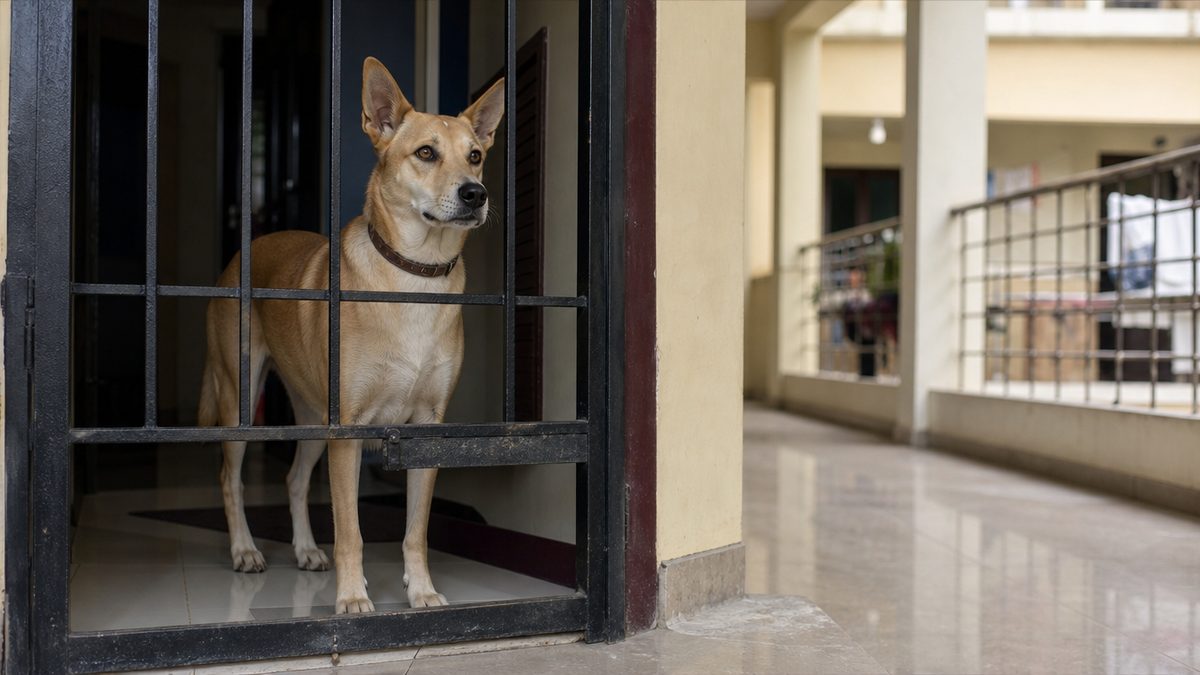
- The grille door. A dog standing behind a grille sees and smells every person on the landing while being unable to reach them, which is the textbook setup for barrier frustration layered on top of alarm barking.
- The lift lobby. In most towers the lift opens within a few metres of at least one front door, so the ping, the doors and a stranger's footsteps arrive dozens of times a day at a single flat.
- Shared walls and the stack. Flats share a wall, a shaft and a slab. A dog that barks at normal volume in one living room is audible in three others, which is why one dog in a Hyderabad or Ahmedabad tower generates complaints from neighbours who never see it.
- The balcony sightline. A balcony overlooking the internal driveway, the gate or the parking turns every arriving scooter into a trigger, and in a corner flat it covers two approaches at once.
- The gate bell and the intercom. Security calls up before letting anyone in, so a single visitor produces two alerts in the flat and one at the gate.
- The guard's whistle and the shift change. Night watchmen in many Indian complexes patrol with a whistle or a stick on the ground at fixed hours, which is a reliable nocturnal trigger that owners sleep through and neighbours do not.
- Delivery riders. Food, groceries and parcels arrive at the door at hours when nothing else does, including late at night, and each arrival is a stranger at a threshold.
- Street dogs outside. A territorial exchange between two dogs on the road at 1 am will start a dog inside a third-floor flat, and the dog inside is the one the building complains about.
- Monsoon thunder. A storm at 3 am between June and September is one of the few triggers the owner hears as well, and the barking that follows it is fear rather than territory.
Street dogs outside setting off the dog inside
The street-dog side of this has its own causes and they are not the same as your dog's. Asha Ambekar of the Shashwat Foundation in Pune, speaking about a noise complaint that reached the Maharashtra Pollution Control Board, listed hunger and health issues among the reasons dogs bark, and for street dogs pointed to a lack of adequate feeding points leading to the formation of large dog packs, to territorial fights, and to waste dumped in the open drawing dogs to an area. Her conclusion was that one should identify the root cause of dog barking, after which the simplest solution to it can be found.
If the trigger for your dog is a pack on the road, the fix is partly civic and partly yours. Our guide to stray dogs in India sets out the sterilisation route and what a resident association may and may not do, and inside the flat the answer is the same as for any outdoor trigger, which is to take away the sightline and mask the sound.
Season matters too. Festival weeks in October and November lay firecracker noise over all of the above, and a dog that has been frightened on a cracker night often barks at ordinary street noise for days afterwards. That pattern, and what to do about it, is on our page on firecracker fear in dogs in India.
Management works on the day you do it; training takes weeks. A film or a curtain on the grille, a bed moved away from the front door, a radio on low during delivery hours and a closed balcony during the guard's rounds will cut most alarm barking inside a week, with no training at all. Do those first, then train, then call a professional if what is left is still a problem.
What actually works, cause by cause
Change the trigger first, change the routine second, and train third, in that order, because management is immediate and training is gradual. Nine measures cover almost every case in an Indian flat.
The AVSAB position is the principle behind the order above, that barking can be managed by arranging the environment appropriately and reinforcing desirable responses. Everything below is one of those two things.
- Block the line of sight. Frosted film on a grille door, a curtain across the lower half of a balcony railing, or simply moving the dog's bed out of view of the front door removes the trigger rather than the response.
- Mask the sound at the trigger hours. A fan, a radio or a television left on at low volume during delivery and shift-change hours covers the lift ping and the corridor footsteps that start most sessions.
- Move the dog's resting place. A bed at the back of the flat, away from the front door and the shared wall, changes what a dog hears for the price of moving a mattress.
- Reward silence instead of punishing noise. Catch the two seconds after the bark stops, mark it and feed. A dog learns far faster what earns food than what earns shouting.
- Spend the energy before it becomes noise. A long sniffing walk at a cool hour, food scattered in grass, and a puzzle feeder that takes twenty minutes will empty a boredom barker in a way that a short lead walk does not.
- Make departures boring and gradual for a separation barker. Leave for one minute, then three, then ten, with no greeting ritual at either end, and stop short of the point at which the recording shows vocalising.
- Never tie a dog near a trigger. A tied dog at a grille or gate gets the full stimulus with no option to leave, which is how alarm barking becomes barrier frustration.
- Keep a written record from the first day you start, because the log is both the diagnosis and the evidence you will hand the society.
- Get a veterinary examination before concluding that any of this is a training problem, particularly in a dog over seven or a dog whose barking is new.
When a veterinary behaviourist is the right call
Refer the case up when four things are true: the barking is severe, it has not moved after four to six weeks of consistent management, the dog shows other signs of distress such as pacing, drooling, destruction or self-injury, or the dog is being left alone and the recording shows vocalising starting within minutes of the door closing. All four describe a clinical problem rather than a manners problem, and the evidence for separation-related behaviour in particular shows it running at nearly a quarter of a dog's observed time alone.
Ask your veterinarian to examine the dog first and to refer you if a behaviour programme is needed. India has no licensing regime for dog trainers, so the referral route matters more here than in countries that register them, and our puppy training basics guide sets out what to ask a trainer before hiring one. For a young dog whose barking comes bundled with mouthing and over-arousal, how to stop puppy biting covers the same reward-based method applied to teeth.
One thing to be realistic about. A dog in a city flat with three short lead walks a day and nothing else to do will bark, and no amount of training substitutes for giving it something to do. Our list of things to do with your dog in India is organised by life stage and by what the heat allows.
The neighbour conversation, the barking log, and what to do when it escalates
Open the neighbour conversation by conceding the part that is true, because the AWBI's own advice to owners is to distinguish between reasonable and unreasonable, and lawful and unlawful claims as to their pets being a source of nuisance, rather than to reject every claim.
The same guideline closes with a line worth putting at the top of any reply you write, that all points of view deserve consideration, and everybody is equal in the eyes of the law. An owner who opens with the ban clause has started an argument. An owner who opens by asking which hours are the problem has started a diagnosis, and the neighbour usually has better data than you do, because they are awake for it.
Six things to say, in roughly this order.
- Thank them for coming to you rather than to the committee, and mean it, because that is the cheap version of this for both of you.
- Ask for the specifics: which days, which hours, how long each time, and whether it is worse when your flat is empty.
- Say plainly that you did not know the extent of it, if you did not, because an owner at work genuinely does not hear the 11 am session.
- Name what you are going to change this week, in concrete terms: the curtain, the bed, the radio, the walk time.
- Give them a date to come back to you, two or three weeks out, and keep it.
- Ask them to tell you if it gets worse rather than better, because that is clinical information and you need it.
A barking log settles what two memories cannot
Keep a log for at least two weeks, and ask the neighbour to keep one too. Memory inflates a noise dispute in both directions, and two written records of the same fortnight end most of the argument on their own. Record the date, the start time, roughly how long it ran, who was at home, and what was happening outside. A phone left recording in the flat while you are out turns the second column from a guess into a measurement.
| Pattern in the log | Most likely cause | First move |
|---|---|---|
| Starts within five minutes of the last person leaving, continues in long runs | Separation distress | Graduated departures, and a veterinary consultation if it is severe |
| Short bursts scattered through the day, each a minute or two | Alarm barking at the corridor, the lift or the gate | Block the sightline and mask the sound at those hours |
| Long monotonous stretches mid-morning and mid-afternoon | Boredom and too little exercise | A longer sniffing walk and a food puzzle before you leave |
| Clustered at fixed night hours, every night | A nocturnal trigger outside, often the guard's round or street dogs | Move the dog's bed, close the balcony, mask the sound |
| New in the last month in a settled adult dog | A medical change, or a change in the building | A veterinary examination before anything else |
| Only when you are in the room and occupied | Attention seeking | Reward the silence, stop responding to the bark |
When it reaches the residents welfare association, put your reply in writing and attach the log. Say what the cause looks like from the records, what you have already changed, what you are doing next and by when. Quote the BBMP wording if you are in Bengaluru, that incessant barking or howling can be addressed on a case by case basis by the association, because it frames the matter as a conversation rather than as a vote. Keep the licence and vaccination papers ready, since those are the documents an association may lawfully ask for, as our pets in apartments guide sets out.
If it reaches the police, know what you are dealing with before you panic. A public-nuisance complaint under section 292 of the Bharatiya Nyaya Sanhita carries a fine which may extend to one thousand rupees and is classified as non-cognizable and bailable. If it reaches a Magistrate under section 152 of the Bharatiya Nagarik Suraksha Sanhita, the Madras High Court has held that such an order must be preceded by a preliminary order and an opportunity of hearing for the person affected, and that the keeping of dogs must be pursuant to a trade or occupation before the section can be invoked at all. You are entitled to be heard, and a pet is not a trade.
A resolution that holds has four parts. The owner names the cause from the log rather than denying the noise. The owner makes a specific change by a specific date, usually to the flat rather than to the dog. The neighbour agrees a review date and a way to say it is still happening. Nobody writes to the committee during that window. If the barking is unchanged after six weeks of real effort, the next call is a veterinarian, not a lawyer.
Nothing on this page is an argument for keeping a dog that is miserable in a flat it cannot cope with, and nothing here asks a neighbour to accept being woken every night. The law is thin on both sides: a complainant has almost no usable remedy against a pet, and an owner has no licence to ignore the building. What is left is the thing that actually works, which is finding out why the dog is barking and changing that.
Common questions
Can neighbours complain about dog barking in India?
Yes, and the complaint has limited legal reach. The Noise Pollution Rules 2000 regulate loudspeakers, horns, generator sets and machines, and never mention an animal. A Magistrate's nuisance power under section 152 of the Bharatiya Nagarik Suraksha Sanhita works only where dogs are kept as a trade or occupation, which the Madras High Court confirmed in January 2025. A neighbour's real routes are a conversation with you, a case-by-case complaint to the housing society, and a civil suit for private nuisance.
What happens if a neighbour complains about dog barking?
In practice, very little happens on paper and a great deal depends on you. A society can raise it case by case and cannot ban your dog or fine you over it. A police complaint would be for public nuisance, punishable by a fine of up to 1,000 rupees and classified as non-cognizable. A Magistrate's order to remove dogs needs a preliminary order, a hearing, and a finding that the dogs are kept as a trade. The practical consequence is a strained building, which is worth avoiding on its own.
What should I do if my neighbors complain about my dog barking?
Ask for the exact hours before you defend anything, then record a fortnight. Leave a phone recording while you are out, log the start time, the duration and what was happening outside, and read the pattern. Barking that begins within minutes of you leaving is separation distress; short scattered bursts are the corridor; new barking in an adult dog goes to a vet first. Change the flat before you train the dog, give the neighbour a review date, and keep it.
What can you do if a neighbor's dog won't stop barking?
Start with the owner, who often has no idea what happens while they are at work, and bring dates and times rather than adjectives. If that fails, write to the residents welfare association, which can address incessant barking case by case under the BBMP and AWBI wording. A noise complaint under the 2000 Rules goes to the designated authority, usually a District Magistrate or a senior police officer rather than the pollution control board. A civil suit for nuisance is the last resort and the slowest.
Is there a law against dog barking in India?
No Indian law makes barking itself an offence. The Animal Welfare Board of India's 2015 guideline states that barking is a natural form of expression for a dog and must be tolerated in a society, while advising owners to keep dogs quiet particularly at night. BBMP's 2024 guideline says there cannot be any ban imposed on barking. The general law of public nuisance and the Magistrate's power to remove a nuisance can reach dogs kept as a trade, and not a household pet.
Can a housing society fine me or ban my dog for barking?
No. The AWBI guideline states that an association cannot cite dog barking as a valid and compelling reason for any proposed ban or restriction, and BBMP repeats that there cannot be any ban imposed on barking. What an association may do is address incessant barking or howling case by case. It may also ask for your municipal licence and vaccination records, which is a separate matter covered in our guide to pets in Indian apartments.
Do anti-bark collars work?
The evidence is mixed and the professional advice is not. A controlled trial of 24 kennel dogs found that electronic and lemon spray collars reduced barking by the second day, with no measurable change in plasma cortisol, but it tested 8 dogs per group against one artificial trigger for 30 minutes a day over three days. The New Zealand Veterinary Association states that anti-bark collars have limited efficacy and that owners should instead identify whether anxiety, loneliness, hunger or illness is driving the barking.
Why does my dog bark at night in an Indian flat?
Night barking in a flat usually has an outside trigger, most often a security guard's round, a lift arriving late, a delivery rider, or street dogs in a territorial exchange on the road. Move the dog's bed away from the front door and the balcony, close the balcony overnight and run low background sound. If the dog is over seven and the night barking is new, see a veterinarian, because restlessness and vocalising at night are recognised signs of cognitive decline.