
Dog training guide
How to stop puppy biting: what is normal, what works and what makes it worse
Mouthing is social play, not defiance. The method that works is redirect, withdraw and reward, the punishments people reach for have measured fallout, and in India a bite that breaks skin is a rabies question before it is a training question.
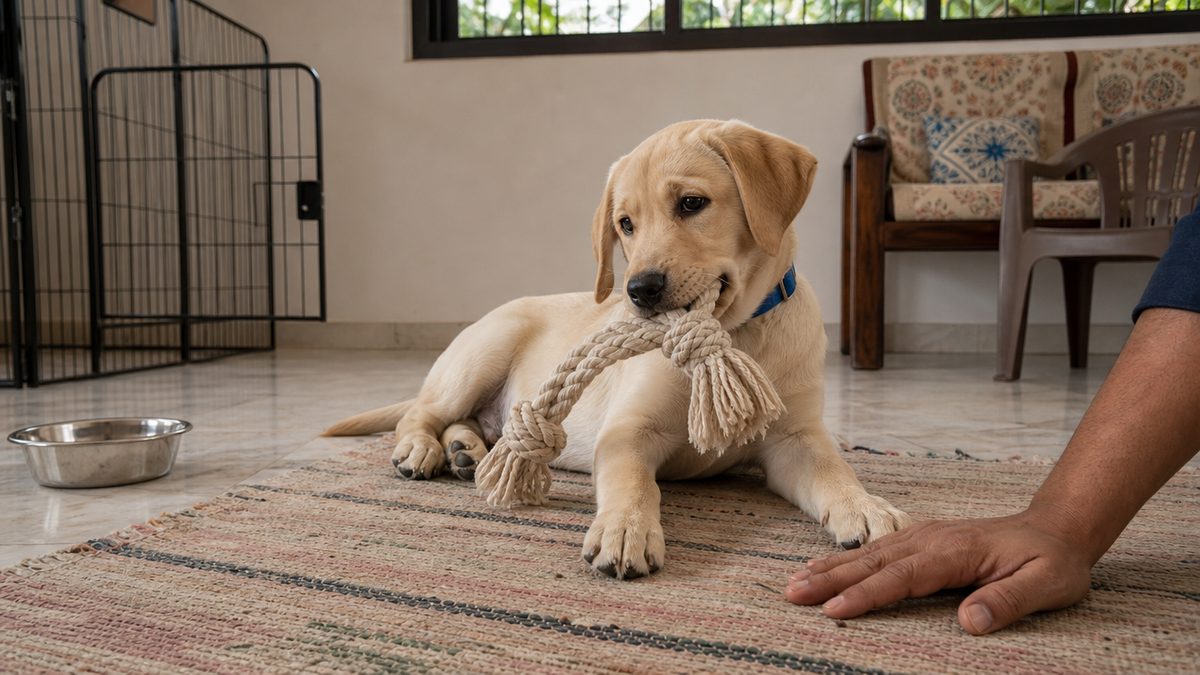
Quick answer
How to stop puppy biting has one rule: teeth on skin end the game, every time. Go still, withdraw attention for 10 to 60 seconds, then swap in a toy and reward calm. Mouthing is social play, not dominance; AVSAB recommends only reward-based methods, and hitting, nose taps and alpha rolls provoked aggression in 26 to 43 percent of 140 owners' dogs. In India, a bite that breaks skin is a rabies exposure, vaccinated or not: wash with soap for 15 minutes and see a doctor today.
This guide is general information for Indian pet owners and is not a diagnosis. Always consult a registered veterinarian near you before acting on anything you read here, and treat any sudden change in your pet's condition as urgent.
Puppy biting is normal: mouthing is social play, and bite inhibition is the lesson
Puppy biting is normal social play, not defiance and usually not teething. Two board-certified veterinary behaviourists writing for VCA state that nipping, mouthing and biting in young dogs 'is generally a form of social play', and that teething shows as gnawing on objects rather than on hands. The lesson a puppy has to learn is bite inhibition: how much jaw pressure causes pain, so that if it ever uses its mouth on a person it does so with minimal damage.
Puppies learn bite inhibition from each other first. When a littermate bites too hard, the bitten puppy screams and stops playing, which startles the biter and teaches it how hard is too hard; VCA gives this as one reason a puppy should not leave the litter before 7 to 8 weeks. The ASPCA adds why it matters at home: a puppy that has learned to be gentle with human skin is less likely to break skin if it ever bites when frightened or in pain. Oregon Humane allows play bites that do not hurt from 6 to 18 weeks so the puppy gets that feedback. A playful puppy is loose and wiggly with a relaxed face; a stiff puppy with a closed mouth and a high tail is not playing, and Karen Pryor asks the owner to read that before choosing a response.
The teething overlap: what the teeth are doing while the biting peaks
Teething overlaps the biting months without being their cause. The MSD Veterinary Manual gives the timeline: 28 deciduous teeth erupt at 3 to 5 weeks, the 42 permanent teeth begin to appear at 4 to 5 months, and all are in by 7 months. So the 8 to 16 week puppy mouthing your hands has a full set of needle-sharp milk teeth, and the 4 to 6 month puppy chewing the sofa leg has sore gums. What to give a teething puppy is in the puppy teething guide; this page is about the mouth on your skin.
The ages: when it peaks and when it fades, page by page
No veterinary body sets an age at which puppy biting stops, and the ranking pages disagree, so their ages are tabulated with their sources rather than averaged. Supertails, the Indian page that ranks for the India query, gives three ages on one page: a peak at 12 to 13 weeks, easing 'by the time they're about 6 months old', and 'around 5 to 6 months old' in its FAQ; PetMD puts the peak at about 13 weeks, Pet Health Club says 6 to 7 months, and Eukanuba says 'around six to nine months from birth';.
| Source | Peak | Fades or stops | Basis given |
|---|---|---|---|
| MSD Veterinary Manual (dental timeline, not a biting claim) | Milk teeth in from 3 to 5 weeks | All 42 permanent teeth by 7 months | Veterinary dental development, reviewed May 2018, updated June 2025 |
| PetMD | About 13 weeks | Adult teeth by 7 months | None cited |
| Supertails (India) | 12 to 13 weeks | 5 to 6 months, 6 months and 6 to 7 months on the same page | None cited |
| Pet Health Club (UK) | Not stated | 6 to 7 months | RVN-reviewed, none cited |
| Eukanuba Australia | Not stated | 6 to 9 months from birth | None cited |
| Oregon Humane (USA) | Not stated | Allow soft play bites from 6 to 18 weeks, then tighten | Shelter training practice |
| VCA (Horwitz and Landsberg) | Not stated | Play biting is social play that ends when it stops paying | Two DACVB authors, none cited |
Biting fades when two things happen together: the permanent teeth finish at about 7 months, and the puppy has learned, over hundreds of repetitions, that teeth on skin end the game. The second is the part you control. Breed changes the style of play, not the rule: VCA notes that hounds enjoy nose games and retrievers are happiest retrieving, so a Beagle puppy and a Labrador Retriever puppy both mouth, and both stop the same way.
How to stop puppy biting: the redirect-and-withdraw method, step by step
To stop puppy biting, make teeth on skin end the fun every single time, give the mouth something it is allowed to hold, and reward the calm that comes before a bite. The ASPCA, the Royal Kennel Club, VCA and Karen Pryor describe the same sequence with different emphasis The Royal Kennel Club VCA Animal Hospitals Karen Pryor Clicker Training; the steps below are theirs, in the order the puppy meets them.
- Set up before you play. Provide plenty of chew toys and rotate them, and keep a tug toy or a chew within reach in every room so the swap is instant. Do not wave fingers in the puppy's face or slap the sides of its face to start play.
- Let gentle mouthing happen at first. From 6 to 18 weeks, allow play bites that do not hurt, so the puppy gets feedback on the ones that do.
- The instant a bite hurts, go still and withdraw. Stop moving, let the hand go limp, turn your face away and tuck your limbs in; movement is what makes a hand fun. Do not jerk the hand away, which invites a lunge.
- Take attention away for a short, fixed time. The ASPCA's interval is 10 to 20 seconds of ignoring for a hard bite, rising to 30 to 60 seconds and leaving the room if the puppy follows; VCA calls this social withdrawal and says closing a door behind you teaches that biting leads to immediate inattention VCA Animal Hospitals.
- Come back, resume, and swap in the toy. Return calmly and offer the tug toy before the puppy reaches your hand again. The Kennel Club's version is to be 'one step ahead': meet the puppy running at your trouser leg with its favourite tuggy, or scatter a handful of its daily ration to change its mind.
- Reward the calm that comes before the bite. This is positive reinforcement doing the work punishment was supposed to do. Feed the puppy for standing or sitting quietly in front of you, because a puppy paid for calm standing offers it more often than it offers a bite; VCA's version is sit or down before every play session.
- Tighten the rule week by week. Once the hardest bites are gone, withdraw for the next-hardest, and so on, until the puppy holds your hand with no pressure and then not at all.
The yelp: the ASPCA says do it, the Kennel Club says it backfires
The yelp is the one step the two biggest bodies on the page disagree about, so both positions are printed with the date read. The ASPCA, read 18 September 2026, says to give a high-pitched yelp the moment a bite is hard, let the hand go limp, praise the puppy for stopping, and switch to time-outs after three yelps in 15 minutes. The Royal Kennel Club, read the same day, says 'the more you yelp, tell them off, or quickly move your limb, or clothing away, or push the dog off, the more likely they are to think the game is on', and that withdrawing is 'much more likely to get the right message across';. VCA offers a sharp 'yip', 'ouch' or 'off' purely as an interrupter and warns that some puppies read an owner's noise as rough play. The withdrawal governs, because all three agree on it and it carries the consequence; the yelp is optional, and if the puppy comes back harder, drop it, which is what the ASPCA itself prescribes when the yelp 'seems to have no effect';.
Rate the bite: Oregon Humane's 1 to 5 scale
A pressure scale turns 'be gentler' into a rule the whole family applies the same way. Oregon Humane rates bites from 1 to 5, times out only level 5 in week one, level 4 and above in week two, and so on until only level 1 remains.
| Level | What you feel | Response in week 1 | Response by week 3 |
|---|---|---|---|
| 1 | You can feel it, but barely | Play continues | Play continues |
| 2 | Some pressure, you barely flinch | Play continues | Play continues |
| 3 | Sharp little teeth, but tolerable | Play continues | Time-out |
| 4 | That hurts a bit, may leave a mark | Play continues | Time-out |
| 5 | Hurts and the skin is bleeding | Time-out of about one minute | Time-out |
Two cues worth teaching on top: 'Open' and 'Close mouth'
Karen Pryor's page adds two cues that give a family a word to use instead of a hand to pull. For 'Open', click when the puppy grabs a toy, hold out a treat so it lets go, click the release, and after several repetitions say 'Open' just before the release until the puppy drops on the word. For 'Close mouth', click and treat the moment the puppy shuts its mouth, add the cue, and teach every family member the word so they 'feel safer when they can say Close mouth and the puppy does it';. Both sit on top of the withdrawal rule; neither replaces it.
Consistency is the step most families skip. VCA says all family members must follow the same rule, and that if some people allow chewing on hands the puppy assumes it is acceptable; Oregon Humane says any method will probably fail unless everyone manages the behaviour the same way. In a joint family, the grandparent who lets the puppy gnaw a hand during the evening news is training the puppy harder than you are.
What the evidence says: reward-based methods work, and the aversive ones carry a denominator
The evidence favours reward-based training for stopping puppy biting, and it comes with sample sizes. AVSAB's 2021 position statement recommends 'that only reward-based training methods are used for all dog training, including the treatment of behavior problems', finds 'no evidence that aversive methods are more effective than reward-based methods in any context', and lists the studies behind that conclusion. The four that matter most for a biting puppy are below, each with its denominator.
| Study | Sample | What it found | What it means for a biting puppy |
|---|---|---|---|
| Hiby, Rooney and Bradshaw, 2004 | 364 dog owners, questionnaire | 66 percent used vocal punishment and 12 percent physical punishment; obedience rose with tasks trained by reward (P below 0.01) and not with punishment (P = 0.5); problem behaviours rose with punishment (P below 0.001) | Shouting at a mouthy puppy buys no obedience and is associated with more problems later |
| Herron, Shofer and Reisner, 2009 | 140 owners at a university behaviour service | Hitting or kicking provoked aggression in 43 percent of dogs it was tried on, growling at the dog 41 percent, forcing an item from the mouth 39 percent, the alpha roll 31 percent, staring down 30 percent, the dominance down 29 percent, grabbing the jowls and shaking 26 percent | The corrections people reach for when a puppy bites are the ones most likely to be answered with a bite |
| Vieira de Castro and colleagues, 2020 | 92 companion dogs from 7 schools: 42 reward, 22 mixed, 28 aversive | Aversive-school dogs showed more stress behaviours, higher post-training cortisol and a more pessimistic bias outside training | A puppy trained with aversives carries the stress home |
| Casey and colleagues, 2014 | UK owner survey, three contexts of aggression | Puppy classes reduced the risk of aggression to unfamiliar people; positive punishment raised the risk to family and to strangers; the measured variables explained under 10 percent of the variance | A puppy class from 7 to 8 weeks is a bite-prevention step, and the dog's experience matters more than its breed |
Hiby's 364 owners reported vocal punishment more often than any other method, and their obedience ratings correlated with reward and not with punishment while their problem-behaviour counts did the reverse. Herron's 140 owners had each tried a list of 30 interventions before reaching a behaviour clinic, and the confrontational ones came back with aggression in at least a quarter of the dogs; dogs already aggressive to familiar people were the most likely to answer an alpha roll or a yelled 'no' with a bite. Vieira de Castro's team filmed 92 dogs and sampled their saliva: dogs from high-aversive schools were more often tense, panted more, showed a higher cortisol rise and were more pessimistic in a cognitive bias task than the 42 reward-school dogs, which AVSAB reads as evidence that the effect 'persists beyond the time of training';.
Casey's survey is the one that speaks to breed, and it speaks carefully. Dogs in the Kennel Club's Utility and Hound groups had a higher risk of aggression to family members than cross-breeds, but the post hoc analysis 'identified no specific increased individual breed risks'; gundogs had a lower risk to unfamiliar people; and the authors conclude it 'would be inappropriate to make assumptions about an individual animal's risk of aggression to people based on characteristics such as breed';. The Kennel Club lists the Labrador and Golden Retriever as gundogs and the Beagle as a hound, so the owner of a Golden Retriever puppy and the owner of a Beagle puppy should take the same thing from the paper: what the puppy experiences predicts its adult behaviour better than its pedigree does. Every ranking page opened for this guide agrees that punishment is a bad idea, and not one prints a denominator for it; some go on to recommend the milder aversives the same evidence covers, which is the next section.
What makes puppy biting worse: alpha rolls, nose taps, shouting and startling
Physical corrections make puppy biting worse, and the milder-looking ones do too. AVSAB's list of techniques an appropriate trainer avoids covers pain (choke chains, prong collars, shock collars), intimidation (squirt bottles, shaker noise cans, compressed air, shouting, staring, alpha rolls and dominance downs), physical correction (leash jerks, physical force) and flooding. Every one of them has been recommended for puppy biting somewhere, including on pages that rank for this query in India.
The mechanism is not mysterious, and it explains why a puppy that is punished for mouthing mouths more. The ASPCA says slapping or hitting a puppy for playful mouthing 'can cause them to bite harder', can make the puppy afraid of you and 'can even cause real aggression';. Oregon Humane lists what follows a tap on the mouth: the puppy becomes hand-shy, stops approaching, bites in defence, or reads the slap as play and nips more. Herron's numbers put a denominator on the third outcome.
- Hitting, slapping or tapping the nose. Answered with a harder bite or fear of hands; 43 percent aggression when hitting or kicking was tried in Herron's 140 Herron ME, Shofer FS, Reisner IR.
- The alpha roll or dominance down. Forceful manipulation AVSAB rules out; 31 and 29 percent aggression in Herron's sample.
- Holding the mouth shut or grabbing the muzzle. Backfires into hand-shyness or defensive biting.
- Shouting or yelling 'no'. The most common method in Hiby's 364 owners, with no gain in obedience; a yelled 'no' was among the responses most likely to provoke dogs already aggressive to family Herron ME, Shofer FS, Reisner IR.
- Pulling the hand away fast or running. Turns the hand into prey; the Kennel Club and the ASPCA both say go limp instead.
- Wrestling and rough play with hands. Teaches that skin is part of the game; play tug and fetch with a toy instead.
- A choke chain, prong or shock collar on a puppy. Pain tools AVSAB rules out; the case of a one-year-old German Shepherd held off the ground by its choke chain during training, who developed ischaemic brain damage and was euthanised, is the worst documented outcome Grohmann K, Dickomeit MJ, Schmidt MJ. These tools are sold openly on Indian marketplaces and no Indian body licenses the trainers who use them, which the puppy training basics guide documents with prices.
The shaker can and the water spray: VCA says yes, AVSAB says no
Two sources this guide relies on disagree about startling a puppy, so both are printed with dates. VCA's play-biting page, read 18 September 2026, says owners who cannot stop the biting with a yelp 'could consider a shaker can, water or air spray, noise alarm, or ultrasonic device' to startle the puppy so it backs off. AVSAB's 2021 statement names 'squirt bottles, shaker noise cans, compressed air cans' under intimidation in its list of what to avoid, and says the learner 'must always feel safe';. AVSAB governs: it is the professional society's dated position, built on the studies above, and VCA itself places the startle tools after social withdrawal as a fallback. A puppy that has not stopped after two weeks of consistent withdrawal needs a better-timed withdrawal or a professional, not a louder can.
The Pedigree India advice: 'startle him with a loud noise' and 'you are the alpha'
The largest Indian dog-food brand's puppy pages carry two pieces of advice that AVSAB rules out by name. Pedigree India's potty-training page tells the reader to 'startle him with a loud noise' when a puppy is caught eliminating indoors, and says a class will teach the puppy 'that you are the alpha, or top, dog in the household';. Its training-tips page, Tip 9 on biting and nipping, says to 'pretend you're in a lot of pain when they bite or nip you; a sharp, loud yell should work', then trade a chew toy, then ignore. AVSAB lists shouting under intimidation and says a trainer who 'discusses out-dated ideas such as dominance, leader of the pack, or alpha theories' should not be hired; VCA adds, on the biting page itself, 'be assured your puppy is not trying to dominate or control you';. The trade-a-chew-toy and ignore steps are the method on this page; the loud yell and the alpha framing are not, and AVSAB governs on both.
A puppy that flinches from hands, growls when reached for, or bites harder after a correction is not being stubborn. AVSAB says animals with challenging behaviour 'should be treated with effective, compassionate, and humane methods of training, rather than with a heavy hand', with 'no exceptions to this standard';. Stop the correction the same day and read the section on when it is not play.
Children and puppies in an Indian joint family: the rules that stop the escalation
Children get bitten by puppies more than adults do, and in India the national data say so with denominators. The WHO-sponsored 2003 survey of 52,731 people in 8,500 households across 18 states found an annual animal-bite incidence of 1.7 percent overall and 2.6 percent in children, with dogs 91.5 percent of the biting animals; the WHO's fact sheet says 40 percent of rabies deaths worldwide are children under 15 and that children aged 5 to 14 are 'frequent victims'. A puppy in a home with children needs rules the children can follow.
The behaviour reason is the same on every source: a child's reaction to a nip is to squeal, push the puppy away or run, and the puppy reads all three as an invitation. VCA says children 'appear to be most vulnerable because their attempts at stopping the biting may not be properly timed or sufficiently abrupt', and that a child's response 'is often seen by the puppy as an invitation to increase its level of chase and play';; Oregon Humane adds that dogs 'should never be left alone with children';. In a joint family the puppy meets more hands, and not all of them are trained. The Faridabad study of 100 pet-dog-owning households in a Delhi NCR housing society found that 44 of 355 family members had been bitten in the previous year, 31 of the 44 by the family's own dog, and 30 of the 44 bled. Those were mostly adult dogs, but the direction is the point: the dog most likely to bite a member of a dog-owning family is that family's dog.
Five rules for the children, and two for the adults
The children's rules are short enough to say out loud before the puppy arrives.
- Be a tree. When the puppy's teeth touch you, freeze, fold your arms and look away; a hand that has gone still is boring.
- Pet with one hand, offer a chew with the other. Oregon Humane's method for children: as the child scratches behind the ears, the other hand holds a chew for the mouth.
- No running, no squealing, no chasing. All three are read as play and make the puppy escalate.
- Play with a long toy, not hands. Tug and fetch keep teeth on the toy; wrestling puts them on skin.
- Tell an adult if the puppy goes stiff. A stiff body, a closed mouth or a growl is the adult's job.
The two adult rules are to supervise and to be consistent. Nobody under about ten is left alone with the puppy, because a child cannot time a withdrawal well enough for the puppy to learn from it Oregon Humane Society (Portland, USA); and every adult, grandparents and domestic help included, applies the same rule, because a puppy allowed to mouth one person keeps mouthing everyone. Where nobody can supervise, the puppy rests in a pen with a chew, the place Karen Pryor says 'nippy puppies go back to';.
Casey's UK survey found that attending puppy classes reduced the risk of a dog later showing aggression to unfamiliar people. AVSAB's socialisation statement puts the class at 7 to 8 weeks, with one set of vaccines at least 7 days before the first class and a first deworming. Reward-based classes exist in Bengaluru, Pune, Mumbai, Chennai, Hyderabad, Kolkata and Delhi; the training basics guide explains how to check one, because no Indian licence tells you.
When a puppy bite breaks skin in India: the rabies question comes before the training question
A puppy bite that breaks skin in India is a rabies exposure until a doctor says otherwise, and the puppy's vaccination status does not change the first step. The National Centre for Disease Control's 2019 guideline says that in 'a rabies endemic country like India, where there is sustained dog-to-dog transmission, every animal bite is suspected as a potentially rabid animal bite, and treatment should be started immediately after exposure', and that 'irrespective of the vaccination status of the biting animal, the PEP should be given';. This section is medical information for the person bitten; your own doctor or the nearest anti-rabies clinic decides, and your nearby vet decides for the puppy.
The scale of the problem is why the rule is absolute. The ICMR-NIE survey of 337,808 people in 78,807 households counted 2,052 bites in a year, 1,576 of them (76.8 percent) by dogs, which scales to 9.1 million animal bites a year; 323 (20.5 percent) of the people bitten by a dog received no rabies vaccine, and the study estimates 5,726 human rabies deaths a year World Health Organization. Dogs cause about 97 percent of human rabies in India by the NCDC's 2015 count and about 96 percent of rabies deaths by the NAPRE page's. Pet dogs are inside those numbers: in the Faridabad housing society every dog was reported vaccinated, 31 of 44 bites were by the family's own dog, and only 10 of the 44 people bitten reliably received the vaccine afterwards.
The three categories, and what each one means for a puppy nip
The NCDC's Table 1 sorts contact into three categories of exposure with the post-exposure prophylaxis for each, and a puppy's mouth on a child's hand can land in any of them.
| Category | Type of exposure | Recommended post-exposure prophylaxis | The puppy version |
|---|---|---|---|
| I | Touching or feeding animals; licks on intact skin; contact of intact skin with secretions | None, if a reliable case history is available; wash exposed areas with soap and running water for 15 minutes, then apply antiseptic | A puppy licking an unbroken hand, or mouthing that leaves no mark |
| II | Nibbling of uncovered skin; minor scratches or abrasions without bleeding | Wound management (soap and running water, 15 minutes, antiseptic) plus rabies vaccine | The classic puppy nip that leaves red tooth marks or a scratch but does not bleed |
| III | Single or multiple transdermal bites or scratches; licks on broken skin; saliva on a mucous membrane | Wound management plus rabies immunoglobulin plus rabies vaccine | A bite that punctures or bleeds, or a puppy that licks a child's cut, mouth or eye |
The 2019 guideline replaced the 2015 one, and the two agree on everything a puppy owner needs. Both say the wound is washed at once with soap and running water, 15 minutes in the 2019 table, that chillies, turmeric, lime, oil or salt are 'unnecessary and damaging', that the wound is not stitched or dressed at once, and that the victim goes straight to a doctor or anti-rabies clinic. Both say a provoked bite is still an exposure, so a puppy that bit because a child pulled its ear is treated like one that bit unprovoked, and both say a vaccinated dog can still transmit rabies if its vaccination failed, so without laboratory proof of protection the certificate does not defer the human course National Centre for Disease Control. Both give the 10-day observation rule: PEP starts immediately, and if the dog stays healthy for 10 days the intramuscular course can be converted to a pre-exposure schedule by skipping the day-14 dose, while the intradermal course is completed regardless; the 2019 guideline adds that 'there is no contraindication to PEP', including pregnancy, infancy and old age.
The schedule, the cost and the helpline
The post-exposure course under the 2019 guideline is four visits by the intradermal route (days 0, 3, 7 and 28, two injections each) or five by the intramuscular route (days 0, 3, 7, 14 and 28), with immunoglobulin infiltrated into a Category III wound; a previously vaccinated person needs two visits, days 0 and 3. The NAPRE portal's 24x7 toll-free Rabies Helpline, 15400, gives first aid advice and the nearest facility holding vaccine and serum. The 2003 national survey put the cost of medicines for one bite episode at Rs 252, reported alongside its US$6 equivalent at that year's rate, and found that 39.5 percent of victims had not washed the wound with soap and water and 45.3 percent had tried an indigenous remedy first. The puppy's own rabies vaccine and the age it is given are in the dog vaccination schedule guide; a puppy that has not yet had it is, by definition, unvaccinated against rabies.
Wash the wound under running water with soap for 15 minutes, do not apply chilli, turmeric, lime, oil or a dressing, do not get it stitched, and go to a doctor or the nearest anti-rabies clinic the same day; call 15400 if you do not know where that is National Rabies Control Programme. Tell the doctor the puppy's age, where it came from and whether it has a dated rabies certificate, and keep the puppy confined and watched for 10 days. Whether the person bitten needs the course is the treating doctor's decision on the category of the wound; this page cannot make it. An adopted Indian Pariah Dog puppy of unknown history is the commonest version of this question, and the answer is the same.
When it is not play: fear, frustration and guarding need a behaviourist, not a firmer hand
Puppy biting stops being play when the body goes stiff, the bite is much harder than usual, and it happens while the puppy is being held, handled or made to give something up. The ASPCA calls these episodes puppy temper tantrums, says they are 'more serious than playful mouthing', and warns that 'repeated bouts of biting in frustration are not something that the puppy will simply grow out of';. Most puppy biting is play; this section is for the minority that is not.
The signs are consistent across the sources, and they are about the body before the teeth. Pet Health Club's line is that a puppy that 'growls, stiffens, or bites hard and doesn't let go' may be showing fear-based aggression and needs a vet to rule out pain and then a behaviourist; Supertails lists growling, snarling, snapping, a stiff body and more force than usual, and says fear- or frustration-driven biting is the point to consult a certified behaviourist; AVSAB's socialisation statement adds the earliest flag, that 'owners of puppies displaying fear should seek veterinary guidance';.
- Stiff or frozen body instead of a loose, wiggly one.
- Lips pulled back, teeth shown, a growl or a snarl before the bite Supertails (Indian pet retailer).
- A bite far harder than the puppy's play bites, or one that does not let go.
- Biting when held still, groomed, lifted or handled, rather than during a game.
- Biting when a person reaches for the bowl, a chew or a stolen object; VCA says tug is only acceptable 'if possessive behavior does not develop over the toy'.
- Shrinking, hiding or freezing from hands after a correction American Veterinary Society of Animal….
The response is the opposite of the instinct. The ASPCA says not to yelp during a tantrum, because it can intensify the behaviour; stay calm, hold the puppy firmly without hurting it until it stops struggling if you are already holding it, release it after a second of quiet, and then get professional help. AVSAB says aggression, anxiety and fear need 'a treatment plan that includes environmental management, behavior modification, and, in some cases, medication', that aversive methods have no role in it, and that a trainer who cannot shift a behaviour should refer to a veterinarian, a veterinary behaviourist or a certified applied animal behaviourist. The first stop in India is the puppy's own vet, who rules out pain and knows which behaviourists in the city work without force; the puppy training basics guide sets out how to vet a trainer in a market where nobody licenses them.
Why 'he'll grow out of it' is the wrong bet
The wrong bet is the one the surveys measured. Herron's 140 owners had tried confrontational methods for months before reaching a behaviour clinic, and the dogs already aggressive to family were the ones most likely to answer an alpha roll with a bite. AVSAB's socialisation statement says behaviour problems are 'the number one cause of relinquishment to shelters' and the leading cause of death in dogs under three, ahead of infectious disease. A puppy that guards its bowl at four months is cheaper and safer to help at four months than at fourteen.
A week-by-week plan from 8 weeks to 7 months
The plan below lines up what the teeth are doing, what the socialisation window is doing and what the withdrawal rule should look like at each age, using the veterinary dental timeline, AVSAB's socialisation window and the tightening rule from the shelter and ASPCA pages American Veterinary Society of Animal… ASPCA, Mouthing, Nipping and Biting… Oregon Humane Society (Portland, USA). It assumes a puppy that came home at 8 weeks, the earliest VCA and AVSAB would have it leave the litter American Veterinary Society of Animal….
| Age | Teeth and development | What to do about biting | What else is happening |
|---|---|---|---|
| 8 to 10 weeks | Full set of 28 milk teeth, needle sharp | Allow soft mouthing; withdraw for the hardest bites only (level 5); a toy in every room; children on the tree rule | Socialisation window open to about 12 weeks; puppy class from 7 to 8 weeks with one vaccine set 7 days earlier |
| 10 to 12 weeks | Milk teeth | Withdraw for level 4 and 5; reward calm sitting before play; start 'Open' on a clicker | The puppy's first rabies vaccine falls here in the schedules the vaccination guide tabulates |
| 12 to 16 weeks | Peak of biting on PetMD's and Supertails' account Supertails (Indian pet retailer) | Withdraw for level 3 and above; frozen chews for the gums; more sleep, since overtired puppies bite more | Socialisation window closing; keep carrying the puppy to new sights until the last vaccine dose |
| 4 to 5 months | Permanent teeth begin to appear | Withdraw for any pressure; teeth on skin end the game every time; tug only with a long toy | Chewing on objects rises; the teething guide covers what to give |
| 5 to 7 months | All 42 permanent teeth in by 7 months | No mouthing of people at all; a puppy still biting hard at 7 months is a behaviour question, not a teeth question | Adolescence; the reward-based curriculum in the training basics guide continues |
Two things in the table deserve a sentence each. The first is sleep and exercise: Pet Health Club lists tiredness and overstimulation among the reasons puppies bite, alongside too little exercise, so a puppy passed around a room of relatives for an hour needs a pen and a nap before it needs a correction. In a Chennai summer or a humid Mumbai monsoon, the walk that burns that energy moves to the early window the heat safety guide sets out, and the pen, the chew and the tug toy do more of the work indoors. The second is the socialisation window: AVSAB says the first three months are the period 'when sociability outweighs fear', that incomplete socialisation then raises the risk of fear and aggression later, and that the class and the exposure should not wait for the last vaccine. Socialise the puppy in that window, carried where the ground is unsafe, and it has fewer reasons to be fearful, and to bite from fear, at twelve months.
What the plan cannot promise is a date. The sources that name one disagree by three months, none cites anything, and the veterinary reference points are the teeth, not the behaviour. Judge progress the way Susan Garrett's page suggests, by writing down how many bites happened and how hard they were, and expect softer bites within a few days and fewer within a week if every adult applies the same rule; if nothing has moved in two weeks of genuine consistency, the timing of the withdrawal is usually the problem, and a reward-based trainer watching one session will see it.
Puppy biting questions people ask Google India
How do you discipline a puppy who is biting?
You do not discipline a biting puppy with a hand, a nose tap, a shout or an alpha roll; you take the fun away. Go still, withdraw attention for 10 to 60 seconds, then swap in a toy and reward calm. Among 140 owners who had tried them, hitting provoked aggression in 43 percent of dogs and the alpha roll in 31 percent, and AVSAB recommends reward-based methods only.
What age do puppies stop biting?
No veterinary body sets an age, and the pages that name one disagree: PetMD gives a peak at 13 weeks, Supertails gives 5 to 6 and 6 to 7 months on the same page, Pet Health Club 6 to 7 months, Eukanuba 6 to 9 months. The fixed point is the teeth: all 42 permanent teeth are in by 7 months, so biting after that is learned, not dental.
How can I train my puppy to stop biting?
Train a puppy to stop biting by making teeth on skin end every game: go limp, turn away, ignore for 10 to 20 seconds and leave the room for 30 to 60 if it follows, then return, offer a tug toy and praise gentle play. Tighten week by week from the hardest bites to any pressure, and pay the puppy for sitting calmly before play so calm, not mouthing, earns the game.
How can I stop a puppy from biting me?
Stop a puppy biting you by removing the two things that reward it: movement and attention. The Kennel Club's steps are to blank the puppy, tuck your limbs in, stand up or walk out for a few seconds, and to be one step ahead with its favourite tuggy or a scatter of treats before it reaches your trouser leg. Yelping and pulling away make the game more rewarding, not less.
At what age should a puppy stop biting?
A puppy should be biting softly by the time its adult teeth arrive at 4 to 5 months and not mouthing people at all by 7 months, when the last permanent teeth are in. Oregon Humane allows soft play bites from 6 to 18 weeks so the puppy learns which bites hurt, then tightens the rule weekly; a puppy still biting hard at 7 months needs a trainer, not more time.
My 7-month-old puppy is biting me. What should I do?
At 7 months all the permanent teeth are in, so a 7-month-old that bites you is not teething; it has learned that biting works, or it is frightened. If the body is loose and the bites are play, apply the withdrawal rule with total consistency from every adult for two weeks. If the body is stiff, the puppy growls or the bites are hard and do not let go, see your vet first and a reward-based behaviourist next.
My puppy is biting me and won't stop. What should I do?
First check the puppy is getting enough play, sleep and chewing, because VCA says no method works on a puppy whose social, exploratory and energy needs are unmet. Then make the withdrawal immediate and identical from every person in the house, closing a door behind you if the puppy follows. If a bite has broken skin in India, wash it with soap for 15 minutes and see a doctor the same day, whatever the puppy's vaccination status.
Do I need a rabies injection if my own vaccinated puppy bites me in India?
Under the NCDC's 2019 guideline the answer is decided by the wound category, not by the puppy's certificate: a nibble on uncovered skin without bleeding is Category II and gets the vaccine, a bite that breaks skin is Category III and gets immunoglobulin plus the vaccine, and PEP is given irrespective of the biting animal's vaccination status because a vaccination can fail. Your doctor makes the call; the toll-free helpline is 15400.