
Dog first weeks guide
Bringing a puppy home in India: the first 48 hours and the first two weeks
Ranking pages tell you to get the paperwork signed and book a vet. This guide names the paper, the rule number and the day: what a buyer must leave the breeder with under the 2017 Rules, a socialisation window that closes at three months and does not wait for the last vaccine, a shopping list priced from an Indian seller on the day it was written, and the rabies date that starts the licence clock.
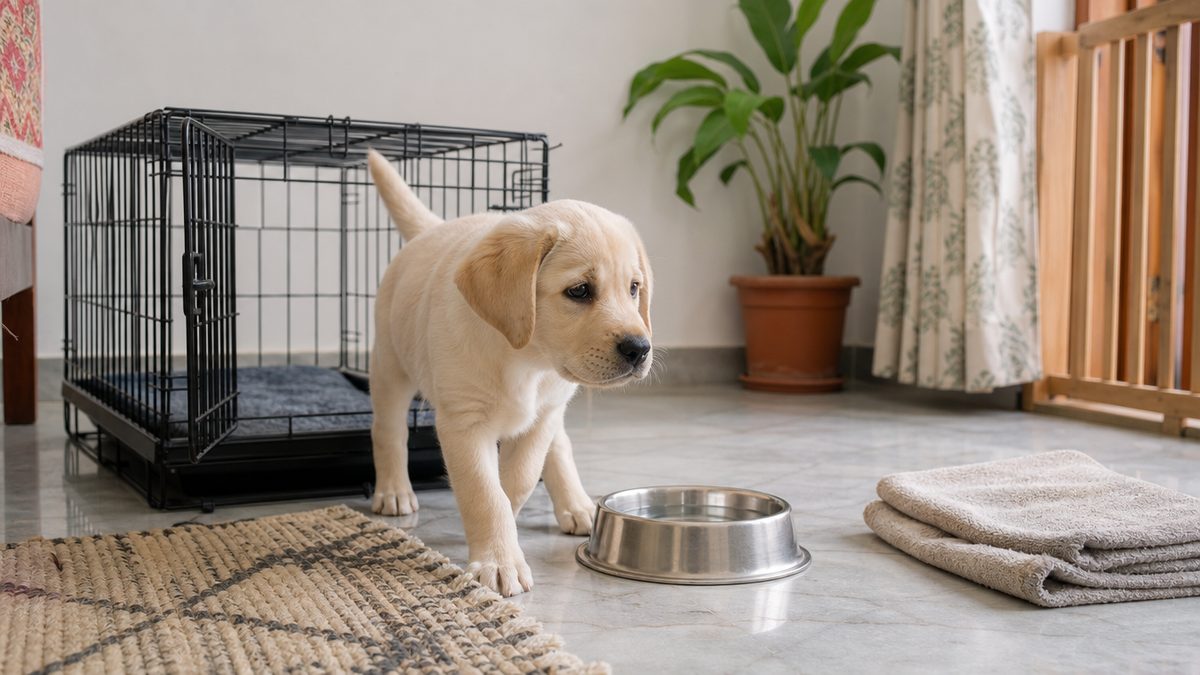
Quick answer
Bringing a new puppy home in India starts at the breeder: the puppy must be eight weeks or older and you leave with its written vaccination and deworming dates, microchip number and the vet's name, under Rule 8 of the 2017 Dog Breeding and Marketing Rules. At home: toilet spot first, one room, crate beside the bed, a vet visit within five days, and socialisation from week one, inside AVSAB's three-month window. Nine basics cost Rs 5,310 to Rs 6,996 from an Indian seller.
This guide is general information for Indian pet owners and is not a diagnosis. Always consult a registered veterinarian near you before acting on anything you read here, and treat any sudden change in your pet's condition as urgent.
What you must have in hand before you leave the breeder or shelter
Before you leave a breeder with a new puppy in India you must hold its written vaccination and deworming dates, its microchip number, a receipt and the attending vet's name and address, and the puppy must be at least eight weeks old, because the Dog Breeding and Marketing Rules, 2017 put each of those duties on the seller. Ranking pages say "get the paperwork signed"; this section says which paper, under which rule.
The Rules were notified as G.S.R. 496(E) on 23 May 2017, and Rule 8, Conditions for sale, is the buyer's clause. Rule 8(1)(a) reads "pups less than eight weeks in age are not sold"; 8(1)(d) permits the sale of "only dogs in good health, that have been provided the medical inoculations"; 8(1)(e) requires that "each pup sold is micro-chipped and complete record of treatment and vaccination is maintained"; 8(1)(g) requires a receipt, with the breeder's copy carrying the chip number and your name, address and phone number.
Rule 8(2) is the one to read aloud at the kennel: the breeder "shall furnish to the purchaser in writing, details of feeding, dates of inoculations and de-worming of the pup and the name and address of the veterinary practitioner who was attending to it". Rule 9(4) adds that a copy of the Form-V health and vaccination record "of any dog or pup that is sold shall be provided to the purchaser", Rule 9(3) requires a written Form-IV contract, and Second Schedule Part III paragraph 8(4) says health records "shall accompany all animals upon transfer of ownership";.
| What you leave with | Clause | What to check on the day |
|---|---|---|
| A puppy aged eight weeks or more | Rule 8(1)(a) | The date of birth on the record against today's date; count the weeks yourself |
| Dates of inoculations and deworming, in writing | Rule 8(2); Rule 9(4) and Form-V | Vaccine name, batch sticker and date for each dose; the next due date |
| A microchip | Rule 8(1)(e); Second Schedule Part IV para 30 | The 15-digit number written on the receipt; ask your vet to scan it at the first visit |
| A receipt | Rule 8(1)(g) | Your name, address and phone number on the breeder's copy, and the chip number on both |
| The attending vet's name and address | Rule 8(2) | Call the clinic and ask whether it holds the litter's record |
| A written sale contract | Rule 9(3) and Form-IV | Signed by both sides, with the puppy identified by chip number |
| A breeder registered with the State Animal Welfare Board | Rule 3(1) and 3(2) | The certificate of registration is required to be displayed in the establishment |
The Rules disagree with themselves on the chip: Rule 8(1)(e) makes it a condition of every sale, while Second Schedule Part IV paragraph 30(b) has "pups over three months" chipped by a vet. The sale condition governs, so ask for the chip number on the receipt; if the breeder chips at three months, write that into the contract and have your own vet implant it. Chennai's licence already requires the chip; see the pet licence guide for Chennai.
Two documents outside the Rules are worth asking for: the clinic's vaccination card with the vial sticker for each dose, read against the dog vaccination schedule for India and the dog deworming schedule for India, and the KCI certificate, which records a declaration of breed, sire, dam and breeder with no health test; KCI registration explained covers what it proves.
If the puppy is adopted, not bought
The 2017 Rules bind breeders and traders, so an adopted puppy arrives under a shelter's paperwork. People For Animals Mysuru charges nothing and requires an adopter of 18 or over with photo ID and proof of address; the CRPF rehomes retired working dogs at no fee with the KCI certificate, medical records and vaccination details. Ask a shelter for the same three things a breeder owes you. The AWBI protocol is in how to adopt a dog in India; the dog most shelters hand over is the Indian pariah dog.
Royal Canin's questions for the breeder decide your first week: what the puppy eats, how much and when; whether toilet training has begun; which vaccinations it has had and when the next is due; and whether a towel that smells of the mother can come home.
A puppy offered at five or six weeks is a breach of Rule 8(1)(a) by the seller. Royal Canin puts the best collection age at 8 to 10 weeks; Zoom Room calls an earlier offer "a red flag about the breeder, not a benefit for you";. Wait, or walk away.
The journey home and the first hour
Picking up your puppy and the journey home work best with the puppy in a small crate lined with something absorbent, a familiar blanket that smells of the litter, no meal in the hour before leaving, and the puppy carried straight from the car to its toilet spot Purina UK, Bringing Home a New Puppy. Puppy-proofing the one room it will live in, cords covered, shoes and medicines lifted, the bin lidded, is done before you leave to collect it.
Royal Canin's checklist covers the car: check the papers, no meal just before, a toilet stop before you set off, a collar with two fingers' room, and, if you drive alone, a crate with a towel that smells of the mother. It may cry even so; reassure it calmly. In India the crate goes on the back seat of a car, never in a two-wheeler basket, and from April to September the journey is planned for the cool end of the day.
Purina UK is blunt about the first minute: "Almost certainly, the very first thing they will need to do is go to the toilet", so carry the puppy to the spot you chose, treat ready, before anything else, then one room and the toilet area only, with someone present even while it sleeps. Zoom Room's family rule follows: everyone sits on the floor, nobody passes the puppy round, and children learn on day one to let it come to them.
- Carry the puppy to the toilet spot before you cross the threshold, wait, say your cue as it goes and reward at once.
- Open one room with the crate door open, a few treats inside and the water bowl shown, and gate off the rest.
- Sit on the floor and let the puppy explore you; no lifting, no crowding, no visitors.
- Feed the breeder's food at the breeder's time, in the crate, and lift the bowl after 15 to 20 minutes.
- Let the puppy sleep as soon as it wants to; an eight-week-old needs around 20 hours a day.
The 2017 Rules bar a breeder from keeping "young animals" or "dogs that are not accustomed to the temperatures prevalent in the area" outdoors without a vet's written approval. A puppy from a Bengaluru or Pune kennel collected in Delhi in May is that dog. Travel pre-dawn or after dark, keep the car cool and the puppy indoors through the afternoon for a fortnight. The walk window city by city is in heat safety for dogs in India.
The first 48 hours: less is more
The first 48 hours with a new puppy are for sleep, toilet trips and one or two rooms, not for visitors. Banfield gives a puppy 24 to 48 hours to relax, Purina puts an eight-week-old's sleep at about 20 hours a day and the AKC at 16 to 18, and every page opened puts a toilet trip inside every waking hour American Kennel Club.
Expect the puppy to eat less and to be tired. Banfield calls a puppy that "doesn't eat much or seems nervous the first day" normal; Zoom Room puts the appetite dip at one to three days and gives the rule: consistent meal times, the bowl down for 15 to 20 minutes and then lifted, no new food in a panic, and fresh water always. Refusing all food beyond 24 hours, lethargy, vomiting or diarrhoea turn the planned first-week visit into a same-day one; your nearby vet decides.
The toilet interval is set by the bladder: every 30 to 60 minutes and after every nap, meal, play and exit from the crate on Zoom Room's schedule, at least every 45 minutes when awake on the AKC's, hourly at eight weeks and no more than three hours at five months on Rover's.
| When | Do this | Who says so |
|---|---|---|
| Arrival | Toilet spot first, then one room with the crate door open | Purina, Zoom Room |
| Every 30 to 60 minutes awake | Carry the puppy to the toilet spot, reward, back inside | Zoom Room, AKC |
| Meal times, on the breeder's schedule | The breeder's food, in the crate, lifted after 15 to 20 minutes | Zoom Room |
| After every meal, nap and play | Toilet trip | AKC |
| Evening | A short play to use up the "witching hour", then toilet right before bed | AKC |
| Night | Crate beside the bed, one alarm for a boring toilet trip | AKC, Zoom Room |
| Day 2 | The same routine; book the first vet visit for day 3 to 5 | Banfield |
What stays off the list matters as much: no visitors, no pet shop, no park, no passing the puppy from lap to lap. Children play in short supervised sessions, and Purina's line is the one to pin up: let the puppy dictate the pace, and do not worry if it seems fearful for a day or two.
The first night and the crying
The first night goes best with the crate beside your bed, one toilet trip on an alarm rather than on crying, and no play or talk during it. The AKC says some puppies sleep through from the start, others cry for a few nights, and the middle-of-the-night toilet trip usually ends by four to five months.
The AKC's sequence is the most detailed on any ranking page. Set a bedtime and keep it. Put the crate in your bedroom with a blanket that smells of the mother, and treat the puppy for going in. If it cries, do not move it into your bed unless that is where you want it for twelve years; put a gentle hand inside the crate instead. If it cannot last the night, "quietly carry them out for a quick, boring potty break. Then put them back in the crate";. Zoom Room sets an alarm for that trip rather than waiting for desperate crying.
Purina answers the bed question directly: your choice, but a crate beside the bed is "easier and more practical", and "whatever you choose, they need to be close to you";.
The bedroom crate is not sentiment. Duxbury and colleagues surveyed the owners of 248 adult dogs adopted as puppies and found higher retention in the home for dogs that had attended puppy classes, were handled frequently, or "slept on or near the owner's bed";. AVSAB adds that crated puppies have "safe and secure places for rest" and are less stressed when hospitalised or travelling. In an Indian flat the wire crate priced below is the bedroom crate for a fortnight and the car crate on vet days.
Crying in the first nights is a puppy that has never slept away from its litter, not a toilet signal every time. Answer the first cry with a hand through the bars; answer the alarm, not the crying, with the toilet trip, and keep that trip boring Zoom Room (a US dog-training chain).
- Play in the evening, inside or in your own compound, to use up the witching hour.
- Carry the puppy to the toilet spot right before bed.
- Settle the puppy in the crate beside the bed with the litter blanket and a treat for going in.
- Switch the lights off at the same time every night.
- Set an alarm for three to four hours later, carry the puppy out, no play, no talk, back in the crate.
- Reassure with a hand through the bars if it cries, without opening the door.
- Carry it out first thing in the morning, before your own tea.
Toilet training from day one
Toilet training starts the moment the puppy's feet touch your floor: carry it to one chosen spot, wait, say the cue as it goes, reward at once, and repeat after every nap, meal and play and every 30 to 60 minutes in between. An accident indoors means the interval was too long, not that the puppy is defiant.
Every page agrees on the ban on punishment. The AKC's rule is never to punish housetraining "mistakes" but to reward outside at once; Zoom Room says punishment after the fact only teaches the puppy to hide when it needs to go; Rover's interval is hourly at eight weeks.
Clean-up decides whether an accident repeats. Banfield's explanation is that puppies return to their own scent, so every accident is cleaned with an enzymatic cleaner rather than a phenyl that masks it. The crate is the second tool, because a puppy avoids soiling where it sleeps: crated for naps and whenever unwatched, in your line of sight whenever out. AAHA's checklist has the vet discuss "the benefits to crate training relative to housetraining, safety, and comfort" at the first visit.
An Indian flat changes the geography, not the method. Until your vet clears the street, the spot is a pee pad in one fixed place, a balcony corner under cover through a Mumbai or Kolkata monsoon, or a patch in your own compound, chosen before the puppy arrives and never moved in the first two weeks. Greencross lists the signs that a trip is due.
- Circling on the spot or pacing with the nose down.
- Sniffing the ground in a corner it has used before.
- Whining or sitting at the door it was last carried through.
- Waking, eating or finishing a game, the three triggers that need a trip whether or not a sign shows.
The full method, the pad-to-street transition for a high-rise and the timings by age are in puppy toilet training in India.
The Indian shopping list, priced on 18 September 2026
The basic shopping list for a new puppy costs Rs 6,996 from one Indian seller's own pages on 18 September 2026 with a 3 kg bag of Royal Canin puppy food, or Rs 5,310 with a 3 kg bag of SmartHeart, before the vet and the licence. Nine items, one seller, one day, every price against its printed MRP.
The nine rows are the items every ranking page lists, read from Supertails' own product pages. Sizes suit a puppy that will be small to medium as an adult, a Beagle or a Shih Tzu; a Labrador Retriever or Golden Retriever puppy outgrows the size S crate within weeks, and the same seller's dual-door crate is Rs 2,459 in M, Rs 2,999 in L and Rs 3,999 in XL.
| Item | Product read | Price (Rs) | MRP (Rs) |
|---|---|---|---|
| Crate, wire, with tray | Chullbull single door iron crate, size S | 1,579 | 1,999 |
| Bowls, stainless steel, pair | Skatrs anti-skid bowl, pack of 2, size M 400 ml each | 250 | 798 |
| Collar, padded nylon | Basil nylon padded collar, size S, 10 to 16 in neck | 176 | 200 |
| Leash | Basil printed leash, size S, 12 mm | 270 | 300 |
| Puppy food, 3 kg | Royal Canin Labrador Retriever Puppy | 2,825 | 3,210 |
| Puppy food, 3 kg, budget row | SmartHeart Chicken Power Pack Puppy | 1,139 | 1,200 |
| Bed | Skatrs round donut bed, S, M or L | 699 | 1,498 |
| Floor cleaner, pet-safe, 1 litre | HUFT Pet Safe Floor Cleaner | 449 | 499 |
| Pee pads, 45 x 60 cm, 20 | Skatrs training pee pads | 599 | 1,598 |
| Poop bags, 60 | Skatrs poop bags, 4 rolls | 149 | 889 |
| Total with Royal Canin (eight items plus the first food row) | 6,996 | 9,991 | |
| Total with SmartHeart (eight items plus the budget row) | 5,310 | 7,981 |
Every figure passed this site's exchange-rate test: none of the nine prices divides to a whole number of US dollars at 84.38, one does at 74 (Rs 149 is 2.01 dollars, noise on a Rs 889 MRP), and each carries a printed Indian MRP. They are rupee-native prices from one seller on one day, so re-price before you order.
What is deliberately not on the list
What the list leaves out is deliberate: a harness waits for the vet's clearance to walk, a rolled towel serves as a toy for a week, and a brush is a breed question. PDSA suggests a pheromone diffuser for the first nights as a calming product rather than a requirement; no page opened gave evidence for it, so it is not priced.
Royal Canin's first question for the breeder is what the puppy eats, and Zoom Room's rule is not to switch foods while the puppy is eating less. Buy what the breeder fed, in the smallest pack listed; the 200 g Royal Canin Labrador puppy pack is Rs 230 against Rs 2,825 for 3 kg. Whether a home-cooked diet can replace kibble later is in homemade dog food in India.
The first vet visit and what it checks
The first vet visit belongs in the first week, within 3 to 5 days of arrival on Banfield's schedule and "in the first week" on Purina's, and the AAHA 2019 Canine Life Stage Guidelines set what a puppy visit checks: temperature, pulse and respiration, pain, a nutritional assessment with body weight and body and muscle condition scores, congenital disorders, permanent identification, parasites and the vaccine plan Purina UK, Bringing Home a New Puppy Creevy KE, Grady J, Little SE, et al..
AAHA defines the puppy stage as birth to the end of rapid growth, about 6 to 9 months, with visits every 3 to 4 weeks during it. The first visit is where the breeder's papers meet the clinic's record: the vet reads the dates Rule 8(2) obliged the seller to give you and scans the chip Rule 8(1)(e) says the puppy carries. Take every page.
- Examine the five vital assessments, temperature, pulse and respiration, pain, and a nutritional assessment with body weight and body and muscle condition scores.
- Evaluate congenital disorders, which is the visit at which a heart murmur, an umbilical hernia or a retained testicle is first noted.
- Confirm permanent identification, the microchip, and its registration.
- Plan deworming: from 2 weeks of age, repeated every 2 weeks until year-round control begins, with more frequent faecal examinations in the first year because intestinal parasites are common in puppies and some are zoonotic.
- Start flea and tick control as early as the product label allows, usually 6 to 8 weeks.
- Schedule the core vaccines to finish at 16 to 20 weeks, which for an Indian puppy means WSAVA's final dose at 16 weeks or older and the DBMR's 18-week horizon Squires RA, Crawford C, Marcondes M Ministry of Environment.
- Discuss crate training, house training, bite inhibition, sensitive periods and puppy classes, and how to choose a trainer.
- Establish a feeding schedule and a target weight range from the body condition score.
Three of those lines have Indian pages on this site: the 7-in-1 and 9-in-1 stickers and government against private prices in the dog vaccination schedule for India, the dose per kilogram in the dog deworming schedule for India, and the products licensed for a puppy's weight in dog ticks in India. AAHA's heartworm line, a preventive by 8 weeks, is a question for your nearby vet, who knows whether the disease is seen locally. Insurance belongs in the same week, because policies exclude conditions noted before the start date and the congenital-disorder line is written at this visit; see pet insurance in India.
Zoom Room's line matches Banfield's: a puppy that refuses all food for more than 24 hours, seems lethargic, or has vomiting or diarrhoea needs the vet that day, not on day five, because puppies dehydrate quickly. Nothing on this page replaces that call. Your nearby vet decides for your puppy.
The municipal registration clock starts with the rabies certificate
The municipal registration clock starts on the day of the rabies vaccination. Delhi's MCD makes the anti-rabies vaccination certificate from a registered veterinary practitioner a mandatory document, states that the certificate's validity is "maximum one Year duration Subjected to date of vaccination", and charges Rs 500 Municipal Corporation of Delhi. Register in the month of the shot and the licence calendar and the booster calendar stay aligned for the dog's life.
The SOP rests on section 399 of the Delhi Municipal Corporation Act, 1957: applicant 18 or over, one application per dog, and four uploads, the anti-rabies certificate (mandatory), identity proof, residence proof and a photograph of you with the dog. New registration Rs 500; renewal Rs 500, with one month's grace and then Rs 100 a month; surrender free Municipal Corporation of Delhi. The portal's counter read 19,024 certificates issued since 2021 on the day this was written.
The puppy's age sets the start. WSAVA's rabies row defers to local law and notes that "in some countries, the first dose is generally not given before 12 weeks of age";; Indian clinics give it at about three months. A puppy collected at eight weeks in Delhi therefore cannot be registered for about a month, and once it is, the certificate runs to the booster. Other cities' portals and fees are in dog licence and pet registration in India; Chennai's Rs 50 licence in the pet licence guide for Chennai.
- Vaccinate against rabies when your vet says the puppy is old enough, usually at about 12 weeks.
- Collect the anti-rabies certificate showing the date, the vaccine and the vet's registration; the MCD publishes an ARV certificate format on the portal.
- Sign up on mcdonline.nic.in with an Aadhaar-linked mobile number; the OTP goes to that number.
- Upload the four documents, pay Rs 500 online, and watch the dashboard for a document-deficiency note, which is the stated ground for rejection.
- Download the certificate with its token number and QR code, and diary the renewal for the month of the booster, one month before the Rs 100 late fee starts Municipal Corporation of Delhi.
Week one and week two: building the rhythm
By the end of week one the puppy has a fixed routine of wake, toilet, meal, play, nap and toilet, and by the end of week two it is in a class or on a planned socialisation list, comfortable in its crate for naps and used to short spells alone, which is the two-week mark Zoom Room and the RSPCA both set RSPCA (UK), How to look after a puppy.
The RSPCA's list for 8 to 12 weeks is four lines, every one a first-fortnight task: begin leaving the puppy alone for short periods to prevent separation-related behaviour, keep rewarding every toilet success, keep socialising although the course is not complete, and let the puppy rest. AVSAB says the same about time alone: play with a stuffed food toy and naps in the crate "may help to prevent problems of over attachment to the owners";.
Zoom Room's week two adds training without sessions: capture what you want and reward it, a sit before the bowl goes down, a walk into the crate, thirty seconds at a time. Its list of what not to expect by day fourteen is the honest one: not a house-trained dog, not a puppy that has stopped biting, not a dog that sleeps through every night.
- Book the first vet visit for day 3 to 5 and leave it with the next vaccine date written on the card.
- Diary the next deworming date from the breeder's record and the vet's plan.
- Scan the microchip at that visit and register your own phone number against it.
- Enrol in an indoor puppy class, or write the socialisation list above on the fridge, seven days after the first dose.
- Transfer the KCI registration into your name if the puppy came with papers, using the process in KCI registration explained.
- Diary the rabies date for the licence application in the same month.
- Settle the puppy for every nap in the crate, door open by day, closed at night.
- Leave the puppy alone for short periods from week two, starting with minutes, with a food toy in the crate.
- Keep the breeder's food and feeding times unchanged for the fortnight.
- Read the exclusions of any insurance policy before the first visit's findings are written down.
The first year is a different page. Adolescence, the switch from puppy food and the second vaccine season are in puppy care in India, and the sterilisation question, which Rule 8(1)(b) makes a condition of any sale over six months, is in dog sterilisation in India Ministry of Environment.
Bringing a puppy home: the questions people ask
What is the first thing to do with a new puppy?
The first thing to do with a new puppy is to carry it from the car to the toilet spot you chose in advance and reward it when it goes, because, in Purina's words, going to the toilet is almost certainly the first thing it needs to do. At the breeder, the first thing is to check the age, the written vaccination and deworming dates and the microchip number.
What is the first thing you should do when you bring a puppy home?
When you bring a puppy home the first thing you should do is take it to its toilet spot, then open one room with the crate door ajar and let it explore at its own pace. Zoom Room's rule for the first 48 hours is to keep it small: one or two rooms, family on the floor, no visitors, and a toilet trip every 30 to 60 minutes.
Where should a puppy sleep the first night home?
A puppy should sleep the first night home in a crate beside your bed. The AKC puts the crate in the bedroom with a blanket that smells of its mother, says not to move a crying puppy into your bed unless that is where you want it for life, and has you put a hand inside the crate instead and carry it out once for a quick, boring toilet trip.
Where should a puppy sleep the first night?
The first night a puppy should sleep close to you, and the practical answer is a crate beside the bed. Purina says whether it sleeps in your bed is your choice, that a crate beside the bed is easier, and that whatever you choose the puppy needs to be near you. A study of 248 adopted dogs linked sleeping near the owner's bed with staying in the home.
What is the rule of 3 for a new puppy?
The rule of 3 for a new puppy is a shelter rule of thumb, not a veterinary one: 3 days to decompress, 3 weeks to learn the routine and 3 months to feel at home, as Pasadena Humane states it for adopted dogs. No behaviour body publishes it. For a puppy the evidence-based clock is AVSAB's socialisation window, the first three months of life.
What is the 3-3-3 rule for puppies?
The 3-3-3 rule for puppies is the adjustment timeline shelters use for adopted dogs: 3 days to decompress, 3 weeks to learn the routine and 3 months to feel at home, in Pasadena Humane's wording. It sets expectations rather than a schedule. An eight-week-old puppy's real deadline runs the other way, because AVSAB's primary socialisation window closes at about three months of age.
Can I leave my 9 week old puppy home alone?
You can leave a 9 week old puppy home alone for short periods, and the RSPCA says to begin between 8 and 12 weeks to prevent separation-related behaviour, but not for a working day, because the AKC's toilet interval is at least every 45 minutes when awake. Start with minutes in the crate with a food toy, and arrange a midday visitor if you work.
What should I do in the first few days with a new puppy?
In the first few days with a new puppy you should keep it to one or two rooms, carry it to the toilet spot every 30 to 60 minutes and after every meal, nap and play, feed the breeder's food at the breeder's times, crate it beside your bed at night, and book the first vet visit within 3 to 5 days, Banfield's schedule.
Which dog is under RS 5000?
Under Rs 5,000, and under Rs 3,000 as the related question asks, the dog with papers is an adopted one: an Indian pariah dog from a shelter like PFA Mysuru costs nothing, and a retired CRPF dog comes at no fee with its KCI certificate. Among priced breeds only the Mudhol Hound's pet-quality band, Rs 3,000 to Rs 10,000 on an aggregator page, starts under Rs 5,000; the Labrador's starts at Rs 8,000.
The socialisation window: three months, and it does not wait for the last vaccine
The socialisation window is the first three months of a puppy's life, and AVSAB's position is that puppies should be socialised before they are fully vaccinated, starting puppy classes as early as 7 to 8 weeks provided the puppy has had one set of vaccines at least 7 days before the first class and a first deworming. Most of that window is spent by the time you collect the puppy at eight weeks.
AVSAB's words are worth carrying. "The primary and most important time for puppy socialization is the first three months of life", the months "when sociability outweighs fear", so it "should be the standard of care for puppies to receive such socialization before they are fully vaccinated". Its reasoning is a comparison of risks: "Behavioral issues, not infectious diseases, are the number one cause of death for dogs under three years of age", and the infection risk is "relatively small compared to the chance of death from a behavior problem";. The document carries a 2008 copyright on AVSAB's December 2024 upload; its relinquishment claim rests on a 1996 JAVMA shelter study by Miller and colleagues.
The studies behind the position, with their denominators
Two of the studies behind it have denominators. Duxbury and colleagues surveyed the owners of 248 adult dogs adopted as puppies from a humane society and found higher retention for dogs that had attended its puppy classes; they recommend enrolling at 7 to 12 weeks. Cutler, Coe and Niel followed 296 puppy owners across Canada and the United States to 20 weeks: 145, or 49.0 percent, attended puppy classes; their puppies were less likely to fear thunder, vacuum cleaners and crates; and almost one-third of all the puppies had only minimal exposure to people and dogs outside the home. AAHA's 2019 guideline cites that survey and states there is "no medical reason to delay puppy classes or social exposure until the vaccination series is completed as long as exposure to sick animals is prohibited, basic hygiene is practiced, and diets are high in quality";.
The vaccine calendar is why the two clocks collide. WSAVA 2024 recommends core doses every 2 to 4 weeks with the final dose "at 16 weeks of age or older" and another at or after 26 weeks, because maternal antibody blocks the vaccine in some puppies until 12 weeks or beyond. The Indian breeder's duty runs to "eighteen weeks";. So the series ends as the window closes, and waiting for the last dose spends it.
Where the ranking pages disagree, and which rule governs
Greencross tells owners to keep the puppy "away from public areas and other pets until after their 16-week vaccine";. PDSA says to socialise at home and by "carrying them out and about with you", with walks and unvaccinated dogs waiting for the full course. The RSPCA, for 8 to 12 weeks, says the puppy "isn't fully vaccinated yet, but it's important to continue socialisation", meeting "healthy, fully vaccinated dogs and cats". AVSAB and AAHA are the behaviour and practice bodies and their rule governs, with AVSAB's limits attached: washable indoor surfaces, every puppy vaccinated and parasite-free at the door, and no dog parks or areas "highly trafficked by dogs of unknown vaccination or disease status";.
That last limit describes an Indian street, where free-ranging dogs of unknown status are on most corners; the rules that govern them are in stray dogs in India. Before the 16-week dose the road is not a venue. Your arms are, and so are the car, the lift, the society garden at a quiet hour, friends' homes with calm vaccinated adult dogs, and an indoor class. A puppy collected in September meets Diwali fireworks at twelve to fourteen weeks, inside its window, so household sounds at low volume start in week one. AAHA warns that exposure without watching the response produces sensitisation, not socialisation.