
Dog nutrition guide
Feeding a dog in a vegetarian household: what a meat-free bowl actually requires
Dogs are facultative carnivores and cats are not, which is why one of these questions has an answer and the other has a line. The published evidence on plant-based dog food disagrees with itself, and in India nothing on the pack is backed by a mandatory standard.
Quick answer
Vegetarian dog food India sells as complete and balanced can keep an adult dog healthy, because a dog is a facultative carnivore carrying on average seven times the pancreatic amylase gene copies of a wolf. The evidence is genuinely contested, and the risk sits in six nutrients rather than in plants as such: taurine, L-carnitine, vitamin B12, vitamin D, preformed vitamin A, and EPA and DHA. For a cat the answer is no. Cats are obligate carnivores and a meat-free diet is a welfare problem, not a lifestyle choice.
This guide is general information for Indian pet owners and is not a diagnosis. Always consult a registered veterinarian near you before acting on anything you read here, and treat any sudden change in your pet's condition as urgent.
Why a dog can be fed without meat
A dog can be fed without meat because a dog is a facultative carnivore, an animal built to eat meat when it is there and to digest starch efficiently when it is not, and the genetic evidence for that second half is unusually clear.
Start with the measurement rather than the argument. When a large panel of dogs and wolves was compared for the genomic marks of domestication, selection had acted on a series of duplications of AMY2B, the gene coding for pancreatic amylase, the enzyme that breaks starch down to maltose in the small intestine. The result was an average sevenfold increase in copy number in dogs relative to wolves, with higher pancreatic expression and higher serum amylase activity to match. A wolf and a dog do not digest a bowl of rice the same way, and the difference is written into the genome.
A later study put a number on what each copy buys. In 55 dogs drawn from 35 breeds, mixed linear regression adjusting for breed found a positive association between copy number and amylase activity, corresponding to an increase of 5.4 percent in amylase activity for each extra copy, with copy number variation explaining 14.8 percent of the variance in activity. That is a real effect and a partial one. Copy number is not the only thing setting how well a dog handles starch.
Starch tolerance varies four-fold between breeds
The average hides the spread, and the spread is the part that matters to you. Across 171 dogs from 20 breeds, mean diploid AMY2B copy number was 11.2 plus or minus 4.0, individual estimates ran from 2 to 21, and a one-way analysis of variance found that copy numbers vary significantly among breeds with nearly 70 percent of the individual variation attributable to breed.
| Breed | Mean diploid copies | Standard deviation | What it implies |
|---|---|---|---|
| Greenland Sledge Dog | 4.3 | 2.7 | Lowest of the 20; several individuals carried only two copies |
| Samoyed | 6.9 | 2.6 | Consistently few copies |
| Polish Lowland Sheepdog | 10.8 | 1.0 | Near the mean and unusually uniform |
| Beagle | 11.9 | 4.7 | Near the mean and the most variable breed in the panel |
| German Shepherd | 15.8 | 1.9 | Consistently above 10 |
| English Springer Spaniel | 17.3 | 3.4 | Highest of the 20 |
Read the first and last rows together. A Greenland Sledge Dog and an English Springer Spaniel differ about four-fold in the gene that starts starch digestion. No Indian breed was in that panel, and nobody has published AMY2B copy numbers for the Indian pariah dog, the Rajapalayam or the Mudhol Hound, so the honest position for an Indie is that the species-level finding applies and the breed-level number is unknown.
A facultative carnivore eats meat by preference and survives without it. That is a statement about tolerance, not about what is optimal, and it is not a claim that plants and meat are interchangeable. The dog's advantage over the wolf is in starch digestion specifically. It does not extend to the nutrients further down this page, which plants carry poorly or not at all.
If your dog currently eats a home-cooked bowl of rice, roti and dal, the amylase finding is the reason that does not immediately make it ill. It is not a reason to think the bowl is complete. Our guide to homemade dog food in India covers the recipe side, and the companion page on balancing a home-cooked diet covers calcium and the nutrient profiles, which this page deliberately leaves alone.
Cats: the line that does not move
Do not feed a cat a vegetarian diet. A cat is an obligate carnivore whose extra dietary requirements exist because the species lost or downregulated the enzymes other mammals use to make those nutrients, and no commercial vegetarian cat food in the published analyses has met a recognised feline nutrient profile.
The mechanism is enzymatic, not cultural. A review of feline nutrient requirements sets out why cats differ from every other household mammal. The requirement for taurine and arginine follows from low activities of two enzymes in each synthesis pathway, which have a negative multiplicative effect on the rate of synthesis. The obligatory requirements for vitamin D and niacin follow from high activities of enzymes that destroy the precursors. The requirement for preformed vitamin A appears to result from deletion of the enzymes needed to cleave and oxidise carotenoids. Low desaturase activity indicates a need for preformed polyunsaturated fatty acids. The high protein requirement follows from a lack of regulation of the aminotransferases of dispensable nitrogen metabolism and of the urea cycle enzymes.
In plain terms, a cat cannot turn carrot pigment into vitamin A, cannot make enough taurine from its own sulphur amino acids, and cannot turn down its protein breakdown when protein is short. Those are not preferences you can train around.
The product evidence agrees. When all 26 commercial plant-based pet food products available in Ontario in 2018 were analysed against AAFCO and FEDIAF recommendations, no diet met either body's recommendations for feline maintenance or growth. In a separate Brazilian analysis, the single vegan cat food tested failed the minimum recommendation for arginine, and on a simulation of an animal with low energy requirements it also failed the minimum for protein and taurine.
Taurine deficiency in cats causes retinal degeneration and dilated cardiomyopathy, and the damage to the retina is not reversed by feeding taurine later. If the household cannot keep animal-source food in the home, the honest answer is that it cannot keep a cat, not that the cat can be adapted. Say this to a vet before you act on it, and say it early.
If you want the full picture for cats, our page on homemade cat food in India covers what a cat needs, what is unsafe and how to cost it. Everything after this section is about dogs.
What the research shows, including where it disagrees
The research on vegetarian and vegan diets for dogs splits into two camps that have not been reconciled, one reporting better guardian-assessed health on plant-based food and one finding that the association disappears once confounders are modelled, and this page publishes both rather than choosing.
The largest study is a survey. Researchers asked 2,639 dog guardians about one dog living with them for at least a year, and 2,536 gave usable information on a single dog fed a conventional meat diet (1,370, or 54 percent), a raw meat diet (830, or 33 percent) or a vegan diet (336, or 13 percent) for at least a year. Across 22 specific disorders, assessed from reported veterinary opinion, the percentages of dogs considered to have suffered from a health disorder were 49 percent on conventional meat, 43 percent on raw meat and 36 percent on vegan diets. The authors concluded that the healthiest and least hazardous dietary choices for dogs are nutritionally sound vegan diets.
Two years later a different team re-analysed the same dataset and reached a different answer. Their stated reason for doing so was that the original analysis did not consider possible confounding from variables it had not included. Using logistic regression and XGBoost machine-learning models, the best-fit models for the 'any health problem' outcome reached areas under the curve of 0.842 and 0.836 and contained dog age, veterinary visits and received medication, with owner age and breed size category also featuring. For the 'significant illness' outcome the figures were 0.903 and 0.887, with the same three variables dominating. Their finding on diet was blunt: any contribution from the dog vegan diet variable was negligible.
Both papers declare interests and both should be read with them in view. The re-analysis states that one author's university position is financially supported by a named pet food manufacturer, while recording that the company had no involvement in the study design, the analysis, the drafting or the decision to publish. We have published the disagreement rather than resolving it, because resolving a live question by picking the paper that reads better is how a directory loses the right to be cited.
What the feeding trials add, and what they do not
Three controlled or semi-controlled feeding studies sit alongside the surveys, and all three are short, small or both.
| Study | Design and size | Duration | Headline result | Main limit |
|---|---|---|---|---|
| Blinded dietary trial, 2024 | 61 healthy desexed adult dogs, 31 on a plant diet and 30 on a meat diet | 3 months | Health parameters, body weight, body composition, bone mineral content and bone mineral density all maintained; vitamin D2 appeared efficacious in maintaining serum total vitamin D | Three months is shorter than the time most nutritional deficiencies take to show |
| Prospective cohort, 2021 | 34 dogs on an extruded plant-based diet with pea protein as the primary protein, against 4 control dogs | 12 weeks | No essential amino acid or taurine deficiency; whole blood taurine was higher on the plant diet at 4 weeks | Four controls, and four of the 34 did not complete the study |
| Prospective cohort, 2024 | 15 clinically healthy adult dogs in Los Angeles County | 12 months | Clinical, haematological and nutritional parameters maintained, including cardiac biomarkers and plasma amino acids | Fifteen dogs, and the comparison is against their own baseline rather than a parallel control group |
The 2024 trial is worth one more line because it answers a specific objection. Dogs on the plant diet shifted from vitamin D3 to vitamin D2 metabolites, and total vitamin D analogue levels were unchanged except for 24,25-dihydroxyvitamin D, while bone mineral content and density did not differ from baseline. The ergocalciferol in a plant food did the job over three months. Platelet count, creatinine, blood urea nitrogen and cholesterol all fell significantly on the plant diet while staying inside normal reference ranges.
The 12-week cohort found the opposite of what most readers expect on taurine. Every essential amino acid except methionine was higher after four weeks on the plant diet than at baseline, whole blood taurine was higher, and the difference against the control group at four weeks reached significance in favour of the plant group. One cardiac measurement did move: left ventricular internal diastolic dimension was higher at 12 weeks than at baseline, though there was no difference between the two groups at either timepoint and no change in fractional shortening. The 12-month cohort reported maintained health on physical examination, complete blood count, serum chemistry, plasma amino acids, serum vitamins and cardiac biomarkers.
None of it ran in India. None of it ran longer than twelve months. The largest study is a survey of owner perception, which the re-analysis shows is dominated by the dog's age. The longest trial has fifteen dogs and no parallel control group. No published study has followed a dog through growth, pregnancy or lactation on a plant-based diet. Anyone telling you the question is settled, in either direction, is telling you about themselves.
The six nutrients a meat-free bowl has to be engineered to supply
Six nutrients carry almost all of the risk in a meat-free bowl, and they are taurine, L-carnitine, vitamin B12, vitamin D, preformed vitamin A and the long-chain omega-3 fatty acids EPA and DHA.
Each one is a different kind of problem. Two the dog can make for itself unless something is wrong, two have no plant source worth the name, one is a cat problem rather than a dog problem, and one has a non-animal source that most people have never heard of. Take them one at a time rather than as a block, because the mitigations differ.
| Nutrient | Why animal tissue normally supplies it | Can a dog make its own | Non-animal route |
|---|---|---|---|
| Taurine | Concentrated in animal muscle tissue, and particularly in marine muscle; plant products contain low or undetectable amounts | Yes in most breeds, by converting cysteine in the liver, with documented exceptions | Synthetic taurine added to the formulation |
| L-carnitine | Synthesised from lysine and methionine, and supplied in the diet mainly by muscle meat | Yes, given enough lysine and methionine | Synthetic L-carnitine, or sufficient dietary lysine and methionine |
| Vitamin B12 | Produced by bacteria and accumulated in animal tissue, not by plants | No | Supplemented cobalamin, which is how every commercial food supplies it |
| Vitamin D | Dogs cannot make useful amounts in skin, so it is a dietary vitamin in this species | No | Vitamin D2 from fungal or plant sources, which a three-month trial found efficacious |
| Preformed vitamin A | Cats cannot cleave carotenoids and need retinol itself; dogs are not described that way | In dogs, yes, from carotenoids | Carotenoids in a dog's food, or supplemented retinyl esters |
| EPA and DHA | Marine animal tissue is the usual source, and conversion from plant alpha-linolenic acid is poor | Poorly | Algal oil, which is where the marine chain starts |
The vitamin D row is the one with the hardest underlying measurement. Dog and cat skin was compared with rat skin for the vitamin D3 precursor 7-dehydrocholesterol before and after standardised ultraviolet exposure. Non-esterified 7-dehydrocholesterol was below the detection limit of the method in both dog and cat skin, and after saponification the total concentrations were 1,858 plus or minus 183 ng per square centimetre in the dog and 1,958 plus or minus 204 in the cat, against 17,620 plus or minus 2,345 in the rat. The authors titled the paper for the conclusion: dietary vitamin D dependence of cat and dog due to inadequate cutaneous synthesis of vitamin D. A dog sunning itself on a Mumbai terrace is not making its vitamin D. It is getting warm.
The vitamin A nuance most pages get wrong
Preformed vitamin A is a cat requirement, not a dog requirement, and the pages that list it as a danger of vegetarian dog food have copied a cat fact onto a dog page. The feline review is specific: the dietary requirement for preformed vitamin A appears to result from deletion of enzymes required for cleavage and oxidation of carotenoids, and it lists that alongside taurine, arginine, vitamin D and niacin as requirements that are not essential for other mammals. The practical effect is that a carotenoid source which covers a dog does nothing for a cat, which is one more reason the two species cannot share a feeding plan.
Taurine deserves the opposite correction. Dogs are usually able to convert cysteine into taurine in the liver, but the exceptions are documented and breed-linked. Between 1.3 and 2.5 percent of Newfoundland dogs fed commercially available balanced diets show taurine deficiency, possibly through gene mutations, and golden retrievers are more prone to taurine deficiency, possibly through lower hepatic activities of cysteine dioxygenase and cysteine sulfinate decarboxylase. If your dog is one of those breeds, taurine is a live question on any diet, and a sharper one on a plant-based diet.
The Ontario analysis that failed 22 of 26 plant-based products against canine maintenance profiles also recorded, in the same paper, that there were no nutrients unable to be provided from non-animal sources. The limit is formulation and verification, not botany. That cuts both ways: it removes the argument that a plant diet is inherently impossible, and it removes the excuse that a failing product could not have done better.
The honest summary of this section is short. Nothing on the list is unobtainable. Everything on the list has to be put there deliberately, measured, and still present in the bag when it reaches your kitchen.
Protein quality, not the protein percentage on the pack
Judge a meat-free food on its amino acid profile and its digestibility, not on its crude protein percentage, because a food can clear the protein minimum comfortably and still fall below the minimum for an individual amino acid.
This is not a theoretical risk, and there is a clean measurement of it. Twenty-four commercial vegetarian pet diets, 13 dry and 11 canned, were analysed for crude protein and amino acid concentrations and compared against the AAFCO nutrient profiles. Crude protein ranged from 19.2 to 40.3 percent on a dry matter basis, with a median of 29.8 percent, and 23 of the 24 met the minimum crude protein concentration for their stated species and life stage, the twenty-fourth having passed a feeding trial instead. Six of the 24 did not meet all amino acid minimums. One was below on four amino acids at once, which were leucine, methionine, methionine-cystine and taurine. Two were below on three, two on two, one on one.
Why 'it has 26 percent protein' is the wrong test
To test a protein claim, ask what the protein is made of rather than how much of it there is. Crude protein is a nitrogen measurement. It does not distinguish an amino acid pattern the dog can use from one that is short on the two or three amino acids that happen to limit it, and it says nothing about how much of that protein survives to be absorbed. India's own national nutrition body makes the same point for human diets. ICMR-NIN in Hyderabad writes that animal proteins are of high quality as they are bioavailable and provide all the essential amino acids in right proportions, while plant or vegetable proteins are not of the same quality because of their low content of some of the essential amino acids, and that a combination of cereals, millets and pulses provides most of the amino acids, which complement each other to provide good quality proteins.
That last clause is the workable half, and it is also the hard half. Complementation works when somebody computes it. A vegetarian Indian kitchen already holds the raw materials a plant protein dog food is built from, which are pulses, soya, cereals and millets, and it does not hold the software to balance their amino acid profile against a canine requirement. That is the gap a formulator is paid to close.
Nor is plant protein one ingredient. The 34-dog cohort above ran on a food whose primary protein source was pea protein, and a food built instead on soya, maize gluten or a pulse blend presents a different amino acid pattern to balance. Two foods can both say 'plant-based' on the front and need entirely different corrections at the back.
One more number sets the scale of what good protein does. A review of amino acid nutrition in dogs and cats recommends adequate intakes of high-quality protein, specifically 32 percent animal protein in the diets of aging dogs and 40 percent in aging cats on a dry matter basis, to offset the 21 percent of lean body mass a dog may lose and the 34 percent a cat may lose across adulthood. That recommendation is written in terms of animal protein, and a plant-based formulator has to hit the same amino acid outcome by another road.
- Ask for the amino acid profile, not the guaranteed analysis. Crude protein, fat, fibre and moisture tell you almost nothing about adequacy.
- Ask whether the figures come from chemical analysis of the finished product or from a database calculation on the recipe.
- Ask which nutrient profile the food was formulated against and for which life stage, since a food formulated for adult maintenance is not a puppy food.
- Ask whether the food has been through a feeding trial, which is a different and stronger claim than formulation to a profile.
- Treat methionine, cystine, lysine, tryptophan, leucine and taurine as the names to look for, because those are the ones that actually failed in testing.
What testing of commercial vegetarian and vegan foods found
Independent testing of commercial vegetarian and vegan pet foods has repeatedly found nutrients below recommended levels, and the newest and largest analysis found the same kind of shortfall in meat-based foods, which changes what the failure means.
Three analyses, in three countries, over five years, are the evidence base here. None of them tested a product sold in India, which is the first thing to say and the thing none of the ranking pages says.
| Analysis | What was tested | Result | Commonest shortfalls |
|---|---|---|---|
| Brazil, 2020 | All 4 vegan pet foods then available in the Brazilian market, 3 for dogs and 1 for cats | All 4 had one or more nutrients below recommended levels; copper exceeded the legal limit in all 4; no dog food met the minimum calcium to phosphorus ratio under FEDIAF or AAFCO | Calcium to phosphorus ratio, methionine, potassium, sodium, arginine in the cat food |
| Canada, 2021 | All 26 commercial plant-based extruded and wet pet foods available in Ontario in 2018 | 4 met AAFCO and 1 met FEDIAF for canine maintenance; none met either for feline maintenance or growth | Sulfur amino acids, taurine, arachidonic acid, EPA and DHA, calcium, phosphorus, vitamin D |
| United Kingdom, 2025 | 31 dry dog foods: 19 meat-based, 6 veterinary, 6 plant-based | Plant and meat foods were nutritionally similar except for iodine and B vitamins, which were lower in plant foods; 66 percent of veterinary diets were deficient in one or more essential amino acids | Across all food types, only 55 percent met all amino acid guidelines, 16 percent all mineral guidelines and 24 percent all B vitamin guidelines; 100 percent met vitamin D |
Read the 2025 row last and slowly, because it is the one that reframes the other two. Sixteen percent of 31 dry dog foods met every mineral guideline tested, and that figure is across meat-based, veterinary and plant-based products together. The authors' own conclusion is that adopting a plant-based dietary pattern can provide nutritional adequacy for the majority of macronutrients and micronutrients, with the exception of iodine and B vitamins, which could easily be supplemented. Their other finding is that 66 percent of veterinary prescription diets, which are low in protein by design, were deficient in one or more essential amino acids.
That paper also discloses that one author performs nutritional analysis for one of the tested companies and that another purchased shares in the same company after testing was complete. We are reporting it with the disclosure attached, as we did for the re-analysis above.
The Brazilian and Canadian results are harsher and older. Four vegan pet foods in Brazil all met the macronutrient minimums and all failed on something else, with arachidonic acid not reported on any label, copper above the legal limit in all four, and none of the three dog foods meeting the minimum calcium to phosphorus ratio under either FEDIAF or AAFCO. In Ontario, 4 of 26 products met AAFCO and 1 met FEDIAF for adult dogs.
Put the three analyses together and the pattern is not that plant ingredients cannot feed a dog. It is that a large share of pet food of every kind fails at least one guideline when somebody actually measures the finished product, and that the plant-based category is newer, smaller and less feeding-trial tested, so it fails more often. The question to put to a manufacturer is therefore the same for any food: who formulated it, against what, and was the finished bag analysed.
What 'complete and balanced' means on an Indian pack
On an Indian pack, 'complete and balanced' is a manufacturer's claim rather than a regulated one, because India has no mandatory composition standard for pet food and the voluntary one is not a condition of sale.
There is an Indian standard and it is real. The Bureau of Indian Standards lists IS 11968:2019, titled 'Pet food for dogs and cats - Specification (First Revision)', assigned to the Food and Agriculture Department under technical committee FAD 5, Animal Feeds and Nutrition, with the Ministry of Animal Husbandry, Dairying and Fisheries and the Ministry of Health and Family Welfare named against it. The certification field on the BIS record for that standard is blank.
A published legal analysis of the Indian pet care sector sets out what that blank means in practice. It states that there are currently no mandatory standards for domestic production of pet food and nutrition, and that standards like BIS Specification IS 11968:2019 relating to dog and cat food are voluntary in nature. It notes that the BIS standard for Compounded Feed for Cattle, IS 2052:2009, has been made mandatory by the FSSAI, while the pet food standards have not, and draws the conclusion plainly: animal nutrition in India is only regulated to the extent that it affects the health of human beings.
There is one more gap, and it lands precisely on this page's subject. The Pet Food Products of Animal Origin (Import into India) Order, 2008 defines what it covers as dried processed pet food containing the ingredients of meat and meat products from avian species, pig and product of animal origin. The same analysis points out the consequence: the 2008 Order does not regulate pet foods produced from vegetarian or vegan sources. An imported vegetarian dog food sits outside the pet food import order that does exist, by definition rather than by oversight.
It does not mean Indian pet food is unsafe, and we have no testing of our own to say either way. It means the adequacy claim on the pack is not verified by anyone before it reaches you, that no Indian regulator publishes a nutrient profile for a vegetarian dog food to be measured against, and that the burden of asking falls on the buyer. We tried to read the 2008 Order at its own government URL and that PDF returned HTTP 404 on this attempt, 20 October 2026, so the quoted definition is taken from the legal analysis that reproduces it rather than from the Order itself.
The WSAVA global nutrition committee publishes the questions that close this gap by hand. Its guidance opens by noting that pet food labels carry marketing phrases designed to promote sales rather than relay nutritional information, and that unregulated terms such as holistic or premium are of little practical value for nutritional assessment. Its checklist is short enough to read out over the phone.
- Ask whether the company employs a nutritionist, and ask for the name and qualification. The guidance names a PhD in animal nutrition or board certification by the ACVN or the ECVCN as the appropriate qualifications.
- Ask who formulates the diet, because recipe development needs knowledge of nutrition, raw materials and processing that is not taught in veterinary school programmes.
- Ask whether the food meets an AAFCO or FEDIAF nutrient profile, and whether that was established by database calculation on the recipe or by chemical analysis of the finished product.
- Ask for the nutritional adequacy statement and for the life stage it names, remembering that a diet labelled for all life stages is formulated for reproduction and growth.
- Ask who actually makes the food, since 'made by' is a different claim from 'made for' or 'distributed by';.
- Ask for a phone number or email for the company, and judge the answer you get by how specific it is rather than by how fast it arrives.
A manufacturer that can answer all six has built something you can verify. A manufacturer that answers with the word 'natural' has not.
How many Indian households this actually describes
Estimates of how many Indians are vegetarian range from under 20 percent to 39 percent depending on who asks and how, and the figure that decides what goes in a dog bowl is smaller again, because almost every Indian vegetarian household already keeps milk.
Three serious estimates disagree, and the disagreement is itself informative. A Pew Research Center survey of 29,999 adults, conducted face to face in 17 languages across 26 Indian states and three union territories between 17 November 2019 and 23 March 2020, found that 81 percent of Indian adults follow some restriction on meat and that 39 percent describe themselves as vegetarian, with the definition left to the respondent. By religion, 92 percent of Jains, 44 percent of Hindus, 10 percent of Christians and 8 percent of Muslims described themselves that way.
A peer-reviewed analysis of National Family Health Survey 3 data, covering 156,317 adults aged 20 to 49, classified diets by what people reported eating rather than by what they called themselves. It found 24.2 percent lacto-vegetarian, 3.2 percent lacto-ovo vegetarian, 1.6 percent vegan, 2.2 percent pesco-vegetarian, 5.2 percent semi-vegetarian and 63.6 percent non-vegetarian.
A 2018 analysis in the Economic and Political Weekly argues both of those are too high. Comparing the National Sample Survey Office, National Family Health Survey and India Human Development Survey estimates, which give 36.88 percent, 24.72 percent and 23.48 percent respectively, it argues for correcting the bias of under-reporting of meat and over-reporting of vegetarian diet, and concludes that the vegetarian population of India is at best 31 percent, and realistically less than 20 percent.
| State | Lacto-vegetarian | Non-vegetarian | What it means for a dog bowl |
|---|---|---|---|
| Haryana | 68.9 percent | 15.8 percent | Highest in the dataset; a meat-free kitchen is the local default |
| Rajasthan | 62.1 percent | 18.8 percent | Second highest |
| Gujarat | 55.6 percent | 28.5 percent | Large lacto-vegetarian majority, plus the highest vegan share at 4.9 percent |
| Delhi | 30.9 percent | 46.1 percent | Split household norms in the same building |
| Maharashtra | 22.7 percent | 63.3 percent | A vegetarian household here is a minority within a meat-eating city |
| Karnataka | 22.2 percent | 61.8 percent | Similar to Maharashtra |
| Tamil Nadu | 4.5 percent | 82.0 percent | Vegetarian households are a small minority despite the stereotype |
| West Bengal | 1.4 percent | 93.4 percent | Lowest in the dataset |
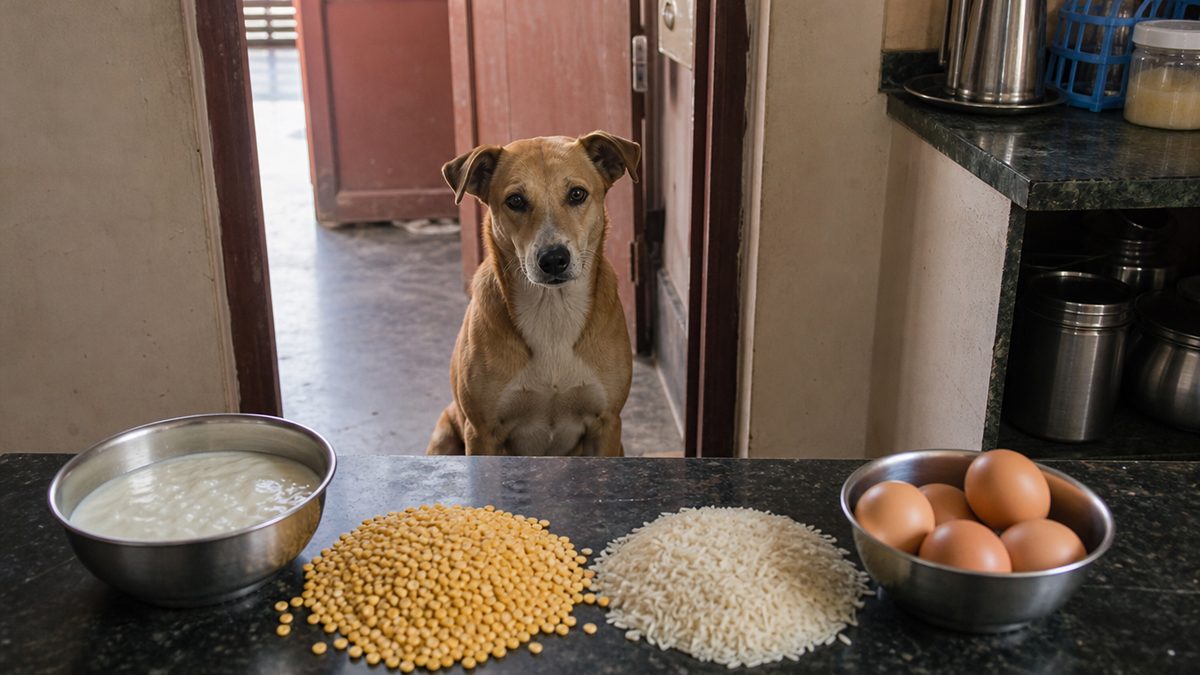
Now the number that matters. Only 1.6 percent of that sample consumed no animal products at all. The large majority of India's vegetarian households are lacto-vegetarian, which means milk, curd, paneer and ghee are already on the shelf, and a smaller group is lacto-ovo, which adds eggs. The problem most Indian readers of this page actually have is not 'how do I feed a dog with no animal products'. It is 'how do I feed a dog without cooking meat in my kitchen', and those are different problems with different answers.
The closest published picture of how South Asian households actually feed dogs comes from Sri Lanka rather than India. In 100 questionnaires collected at a veterinary practice in Colombo, 42 percent of dogs were fed only home-cooked food, 18 percent only commercial food and about 40 percent a mixture, 49 percent were given milk as a separate meal in addition to their normal diet, and 57 percent received dietary supplements. The authors note that home-cooked diets are often fed there because of the cost and poor availability of commercial diets. That is not India, and we found no equivalent published Indian survey, which is worth stating rather than papering over.
The four routes an Indian vegetarian household actually takes
Four routes are in use, and they are a complete commercial vegetarian food, eggs and dairy added to a home-cooked base, meat cooked and kept outside the kitchen, and a complete meat-based commercial food fed straight from the bag with no cooking at all.
Nobody is going to tell you which of these to pick, because the choice turns on what your household holds to be acceptable, and that is not a nutrition question. What follows is what each route solves and what it leaves open.
| Route | What it solves | What it leaves open | What to verify first |
|---|---|---|---|
| Complete commercial vegetarian or vegan food | No animal-source ingredient enters the house at all | Adequacy is a manufacturer claim with no mandatory Indian standard behind it; the testing record for this category is the weakest of the three analysed | The six WSAVA questions, plus the amino acid profile and the life stage on the adequacy statement |
| Home-cooked base plus eggs and dairy | Supplies vitamin B12, retinol and cholecalciferol that plants do not, and raises the sulfur amino acids the dog converts to taurine | Calcium, the calcium to phosphorus ratio and total adequacy are still unbalanced without a formulated supplement; taurine is not directly supplied | A formulation computed by a veterinary nutritionist, not a recipe found online |
| Meat cooked outside the kitchen | Keeps the family kitchen, utensils and stove meat-free while giving the dog animal protein | Food safety and storage in Indian heat and humidity; household agreement on where cooking and washing happen | A separate stove or outdoor point, separate utensils, and refrigeration the dog's food does not share with family food |
| Complete meat-based commercial food from the bag | No meat is ever cooked in the house; the bag is sealed, dry and stored like any other packaged good | The adequacy claim is as unverified as any other Indian pack; some households will not keep meat-derived food indoors at all | The same six WSAVA questions; the answer does not change because the protein is animal |
What eggs and dairy actually close, and what they do not
Eggs and dairy close three of the six gaps and leave the other three open. ICMR-NIN's food group composition tables put egg at 126.34 micrograms of retinol and 2.68 micrograms of cholecalciferol, against 17.20 micrograms of retinol and no cholecalciferol for milk, and 1.93 micrograms of retinol and 1.13 micrograms of cholecalciferol for the meat and poultry group. An egg carries more than twice the cholecalciferol of India's meat and poultry group in India's own national tables. The extract we read does not state the basis for those columns, so treat them as a ranking of sources rather than as a per-gram figure to feed from.
The gap eggs and dairy do not close is taurine. An analysis of taurine in feed ingredients found that animal muscle tissue, and particularly marine muscle, contained high taurine concentrations, while plant products contained either low or undetectable amounts, and that boiling an ingredient in water loses more taurine than baking or frying it. Eggs and milk are not muscle tissue, and we did not obtain that paper's per-ingredient table, so treat the taurine question as open in an ovo-lacto bowl rather than solved by it.
- Keep the dog's food storage separate from family food storage, whichever route you take, because the objection in most households is contact rather than calories.
- Buy the smallest bag that is still economical, since an opened bag in a humid coastal kitchen in Mumbai, Chennai or Kolkata through the monsoon does not keep the way the shelf life on the pack assumes.
- Stand the pack inside an airtight container and keep it, because the batch number and adequacy statement live on the bag you were about to throw away.
- Agree the washing-up rule before the first meal, not during an argument at the sink.
- Settle the rupee cost of each route against your dog's actual daily grams using our dog diet chart for India, which does the portion arithmetic this page deliberately leaves alone.
A word on Jain households specifically, because they face the sharpest version of this and are almost never addressed. Pew records 92 percent of Jains as vegetarian, and separately that about two-thirds of Jains, 67 percent, abstain from root vegetables such as garlic and onions. Garlic and onion are toxic to dogs in any case, so that restriction costs a Jain household nothing here. The route that fits a Jain kitchen is usually the sealed commercial bag or a formulated vegetarian food, and the conversation worth having is with a veterinary nutritionist about a formulation, not with a stranger about theology.
Indian veterinary opinion is not unanimous either, and it is worth knowing that before you walk into a clinic. A 2017 report from Coimbatore, in Tamil Nadu, quoted one consulting veterinarian saying that feeding dogs vegetarian food amounts to unknowingly torturing them, a government veterinarian saying that dogs can survive on a vegetarian diet though that does not necessarily make it a healthy one, and an animal welfare trustee putting the opposite view that dogs can adjust and lead normal lives on a balanced vegetarian or vegan diet. Two Indian veterinarians and a welfare trustee, one question, three answers, and that was eight years ago with no Indian data published since. Expect the disagreement, and bring the six questions above rather than an argument.
What to monitor if you go plant-based, and how often
To monitor a dog on a plant-based diet, book a baseline examination with blood work before you switch, repeat it at three and six months, then at least once a year, and add whole blood taurine and an echocardiogram if the dog belongs to a predisposed breed.
Monitoring is what turns an unverified claim into a managed risk, and it is the step the commercial pages leave out because it costs money and sells nothing. Every study on this page that found a plant diet maintained health found it by measuring. Nobody found it by looking at the dog.
| When | What to run | What it is looking for |
|---|---|---|
| Before the switch | Physical examination, body condition score, weight, complete blood count, serum biochemistry | A baseline, which is the only thing that makes a later number interpretable |
| 3 months | Weight, body condition score, complete blood count, serum biochemistry | Early drift in albumin, urea, creatinine and red cell indices |
| 6 months | The above, plus whole blood taurine where the assay is available | Taurine status, which the published cohorts measured and the guidance does not assume |
| 12 months and annually | The above, plus serum cobalamin and 25-hydroxyvitamin D where available | The two vitamins with no meaningful plant source |
| Any time, if signs appear | Cardiac examination and echocardiography | Exercise intolerance, cough, collapse, a new murmur or an arrhythmia |
The cardiac question is the one that makes this worth doing properly. In 24 golden retrievers diagnosed with taurine deficiency and dilated cardiomyopathy, 23 were fed diets that were grain-free, legume-rich or both, and none of those diets had been feeding-trial tested using AAFCO procedures. After a diet change and taurine supplementation, 23 of the 24 showed significant improvement in their echocardiographic parameters and normalisation of taurine concentrations, and 9 of the 11 that had congestive heart failure had resolution of their congestion at follow-up. The authors describe the condition as likely multifactorial, combining dietary, metabolic and genetic factors. Note what that study is and is not. Those were not vegan diets, and legume-rich does not mean meat-free. It does mean that a formulation heavy on pulses is the one pattern with a documented association, and pulses are exactly what a plant-protein food is built from.
Our page on dilated cardiomyopathy in dogs covers the condition, the breeds, the signs and the Indian testing position in full, and is the page to read before you decide how closely to watch.
- Tell your vet exactly what the dog is eating, by brand category and quantity, before the first blood draw. A diet history is part of the test.
- Ask for whole blood taurine rather than plasma taurine, since the published canine cohorts report whole blood values and the two are not interchangeable.
- Ask your clinic which laboratory runs that assay and what the turnaround is. We could not verify which Indian commercial laboratories offer a whole blood taurine assay, so confirm it locally rather than assuming it is routine.
- Keep every report. A single value means little; the same value three times in a year is a trend.
- Weigh the dog on the same scale at every visit and record the body condition score, because weight loss on a new diet is the cheapest early warning there is.
No published study has followed a dog through growth, pregnancy or lactation on a plant-based diet. Until one has, a puppy, a large-breed puppy in particular, a pregnant or lactating bitch, and any dog with a diagnosed condition that already constrains its diet are all outside the evidence. For puppies, follow our puppy feeding chart for India and raise the question with your vet before the growth plates close, not after.
Bonbeno does not recommend a brand, a supplement or a dose for any of this, and we do not rank vegetarian dog foods, because a verdict needs first-hand testing we have not done. Which food, which supplement and whether to switch at all are veterinary decisions made on the individual dog, which is why this page publishes under the medical disclaimer. What we can say is the thing the ranking pages will not. A dog in a vegetarian Indian household can be fed well. It takes a formulated food or a formulated recipe, a set of questions the seller may not enjoy, and a blood test twice in the first year. It does not take guilt, and it does not take a recipe off the internet.
Common questions
Is vegetarian food ok for dogs?
It can be, for an adult dog, if the food is genuinely complete and balanced rather than simply meat-free. Dogs are facultative carnivores carrying on average seven times a wolf's pancreatic amylase gene copies. The risk is not plants but formulation: of 26 plant-based products tested in Ontario, 4 met AAFCO and 1 met FEDIAF for adult dogs.
Can dogs live a vegetarian diet?
Published feeding studies say yes for healthy adult dogs over the periods tested. A blinded three-month trial of 61 dogs found health parameters, body weight, body composition and bone mineral density all maintained on a plant diet, and a 15-dog cohort reported maintained clinical, haematological and cardiac parameters over twelve months. No study has run longer than a year, and none has covered growth or pregnancy.
What's the best vegetarian dog food?
Bonbeno does not rank pet foods, because a verdict needs first-hand testing we have not done, and India has no mandatory pet food composition standard to rank against. Judge a food by six questions instead: who formulated it, with what qualification, against which nutrient profile, verified by database or by chemical analysis of the finished product, for which life stage, and made by whom.
What does a vegetarian dog eat?
A dog on a meat-free diet eats either a complete commercial vegetarian food or a home-cooked base formulated by a veterinary nutritionist, with six nutrients added deliberately: taurine, L-carnitine, vitamin B12, vitamin D, preformed vitamin A and the omega-3 fatty acids EPA and DHA. The Ontario analysis recorded that no nutrient on its list was unable to be provided from non-animal sources.
Can dogs eat veg every day?
Vegetables as part of a complete diet are fine every day; vegetables as the diet are not, because a bowl of rice, roti and sabzi is short on calcium, several amino acids and the vitamins plants do not carry. Dogs digest starch well, with amylase gene copy number explaining 14.8 percent of the variance in amylase activity, but starch tolerance is not the same as nutritional adequacy.
What Indian foods can dogs eat?
From a vegetarian Indian kitchen, the useful categories are plain cooked cereals and millets, pulses, curd and paneer in moderation, egg where the household eats eggs, and most vegetables other than onion and garlic, which are toxic to dogs. None of that adds up to a complete diet on its own, which is why the pulses-and-cereals complementation that works for people still needs a formulated supplement for a dog.
Can cats be vegetarian?
No. Cats are obligate carnivores whose requirements for taurine, arginine, preformed vitamin A, vitamin D and niacin come from having lost or downregulated the enzymes other mammals use to make them. In the only full-market analysis published, not one of 26 commercial plant-based products met AAFCO or FEDIAF recommendations for feline maintenance or growth. Treat this as a welfare line, not a preference.
Which blood tests should I ask for if my dog is on a plant-based diet?
Ask for a complete blood count and serum biochemistry at baseline, three months, six months and then annually, with whole blood taurine rather than plasma taurine where the assay is available, and serum cobalamin and 25-hydroxyvitamin D at the annual check. Add echocardiography for a predisposed breed, since 23 of 24 golden retrievers with taurine-deficient dilated cardiomyopathy were on grain-free or legume-rich diets.