
Cat nutrition guide
Cat diet chart for India: daily amounts by weight and life stage
A 4 kg neutered indoor cat needs somewhere between 132 and 253 kcal a day depending on which guideline body you ask, and Royal Canin India prints no kcal at all, so this chart works the arithmetic once, from the AAHA/AAFP 2021 formula through a named food's own kcal per kg to grams and rupees a day, then hands you the body condition score that corrects it for your cat.
Quick answer
A cat diet chart for India works from the 2021 AAHA/AAFP formula, 30 x body weight in kg + 70 kcal a day, to grams of a named food and rupees a day: a 4 kg neutered indoor cat needs about 190 kcal, which is 45 g of Farmina N&D Prime at its printed 4,204 kcal per kg, Rs 78 a day at the Supertails price of 18 September 2026, or 54 g of Royal Canin Fit 32 on Royal Canin India's own table, Rs 48 a day. FEDIAF and the NRC put the same cat between 132 and 253 kcal, so weigh and score the cat fortnightly.
This guide is general information for Indian pet owners and is not a diagnosis. Always consult a registered veterinarian near you before acting on anything you read here, and treat any sudden change in your pet's condition as urgent.
Cat diet chart for India: grams and rupees a day by weight and life stage
A cat diet chart for India starts from the energy a cat needs, 30 x body weight in kg + 70 kcal a day for a young healthy adult in the 2021 AAHA/AAFP guideline, and ends at grams of a named food and rupees a day: for a 4 kg neutered indoor cat, 190 kcal, 45 g of Farmina N&D Prime at its printed 4,204 kcal per kg and Rs 78 a day at the Supertails price of 18 September 2026, or 54 g of Royal Canin Fit 32 on Royal Canin India's own feeding table at Rs 48 a day Farmina Pet Foods India Supertails, Farmina N&D Prime Chicken &… Royal Canin India Supertails, Royal Canin Fit 32 Regular….
The two tables below are the chart: the first by weight for an adult of 1 to 7 years, the second by life stage for a 4 kg reference cat. Every kcal figure names the body it comes from, every gram figure is the maker's own page or its printed kcal per kg, and every rupee figure was read from an Indian seller on 18 September 2026 and divided by 84.38 and by 74 before it was printed Amazon.in, Royal Canin Fit 32 Regular Adult… Supertails, Farmina N&D Prime Chicken &….
| Cat weight | Energy, AAHA/AAFP RER (kcal a day) | Energy band, FEDIAF indoor-neutered low to NRC lean high (kcal a day) | Farmina N&D Prime, grams at the AAHA RER (maker's own table in brackets) | Rupees a day, Farmina 1.5 kg bag | Royal Canin Fit 32, maker's own table, ideal weight / overweight | Rupees a day, Fit 32 4 kg bag |
|---|---|---|---|---|---|---|
| 3 kg | 160 | 109 to 209 | 38 g (28 to 48 g) | Rs 66 (Rs 48 to 83) | 44 g / 35 g | Rs 39 / Rs 31 |
| 4 kg | 190 | 132 to 253 | 45 g (35 to 58 g) | Rs 78 (Rs 61 to 100) | 54 g / 43 g | Rs 48 / Rs 38 |
| 5 kg | 220 | 153 to 294 | 52 g (40 to 66 g) | Rs 91 (Rs 69 to 114) | 63 g / 51 g | Rs 56 / Rs 46 |
| 6 kg | 250 | 173 to 332 | 60 g (45 to 75 g) | Rs 103 (Rs 78 to 130) | 72 g / 58 g | Rs 64 / Rs 52 |
The energy column is the AAHA/AAFP formula with its needs factor of 1 for a young healthy adult; the band beside it runs from FEDIAF's 2025 low figure for a neutered or indoor cat to the NRC 2006 lean-adult figure the WSAVA calorie sheet is built on World Small Animal Veterinary Association. Farmina's own 35 to 58 g for a 4 kg cat is 147 to 244 kcal, almost exactly the guideline band, so the maker and the guideline bodies describe the same spread. Royal Canin India prints grams but no kcal per kg, so its column is the table as printed, not a conversion.
| Life stage | Energy rule and source | Kcal a day, worked | Named food and its own gram table | Rupees a day |
|---|---|---|---|---|
| Kitten, 10 weeks, about 1 kg | 200 kcal per kg body weight, AAHA/AAFP 2021 | 200 | Royal Canin Kitten, 1 to 2 months (0.4 to 1 kg): 29 to 48 g | Rs 30 to 49 |
| Kitten, 3 to 4 months, 1.3 to 2 kg | 2.0 to 2.5 x adult maintenance up to 4 months, FEDIAF 2025 | 2.0 to 2.5 x MER | Royal Canin Kitten: 61 to 66 g | Rs 63 to 68 |
| Kitten, 10 months, about 3.5 kg | 80 kcal per kg, AAHA/AAFP 2021 | 280 | Royal Canin Kitten, 7 to 12 months (3.1 to 4 kg): 64 falling to 51 g | Rs 53 to 66 |
| Young adult, active or intact, 1 to 7 years | 100 kcal x kg^0.67, NRC 2006 lean adult, via WSAVA | 253 | Royal Canin Fit 32, 4 kg ideal weight: 54 g | Rs 48 |
| Neutered or indoor adult, 1 to 7 years | 52 to 75 kcal x kg^0.67, FEDIAF 2025; AAHA RER x 1 Quimby J, Gowland S, Carney HC, DePorter T | 132 to 190 | Royal Canin Sterilised 37, 4 kg ideal: 57 g; Indoor 27: 56 g Royal Canin India | Rs 52 (Sterilised 37); Rs 54 (Indoor 27) Supertails, Royal Canin Indoor 27 Dry Cat… |
| Overweight adult, target weight 4 kg | Prescription weight-loss diet rather than less of a maintenance food, AAHA/AAFP 2021 | Vet's plan | Royal Canin Fit 32 'overweight' column: 43 g; Sterilised 37: 46 g Royal Canin India | Rs 38 to 42 Supertails, Royal Canin Sterilised/Neutered… |
| Mature adult, 7 to 10 years | DER may equal RER, AAHA/AAFP 2021 | 190 | Royal Canin Sterilised 7+, 4 kg ideal: 60 g | Rs 56 |
| Senior, over 10 years | RER x 1.10 to 1.20, up to 1.25, AAHA/AAFP 2021 | 209 to 238 | Same food, the vet sets the amount against weight and muscle | Rs 56 and rising with the ration |
| Pregnant queen, 4 kg | 140 kcal x kg^0.67, FEDIAF 2025; 40 to 50 percent weight gain by term, NRC National Research Council | 354 | Royal Canin Mother & Babycat, gestating queen 4 kg: 62 to 96 g | Priced on the cat pregnancy guide |
| Nursing queen, more than two kittens | 2 to 2.5 x her need at mating, NRC; free access to a growth food | 506 to 633 | Growth food without restriction until weaning | Rises with the litter |
The arithmetic, shown once
To turn the chart into a bowl, follow the 4 kg neutered cat through the sum. The AAHA/AAFP resting energy requirement is 30 x 4 + 70 = 190 kcal a day, and the needs factor for a young healthy adult is 1, so the need stays at 190 kcal. Farmina prints 4,204 kcal per kg, or 4.204 kcal per gram, so 190 divided by 4.204 is 45.2 g. The 1.5 kg bag was Rs 2,596 at Supertails, Rs 1.73 per gram, and 45.2 x 1.73 is Rs 78 a day, about Rs 2,350 a month. Royal Canin prints no kcal, so its table is used as it stands: 54 g for a 4 kg cat, and the 4 kg bag at Rs 3,573 is Rs 0.89 per gram, so 54 x 0.89 is Rs 48 a day; Amazon.in's Rs 3,569 gives the same Rs 48 Supertails, Royal Canin Fit 32 Regular… Amazon.in, Royal Canin Fit 32 Regular Adult….
The 7 steps to use the chart are listed below.
- Weigh the cat on baby scales, because a guess of 4 kg for a 5 kg cat moves the ration by 9 g and 30 kcal a day.
- Pick the row by weight, then the life-stage table if the cat is a kitten, neutered, over 7, pregnant or nursing.
- Read the pack for kcal per kg; divide if it prints one, use the gram table as printed if it does not.
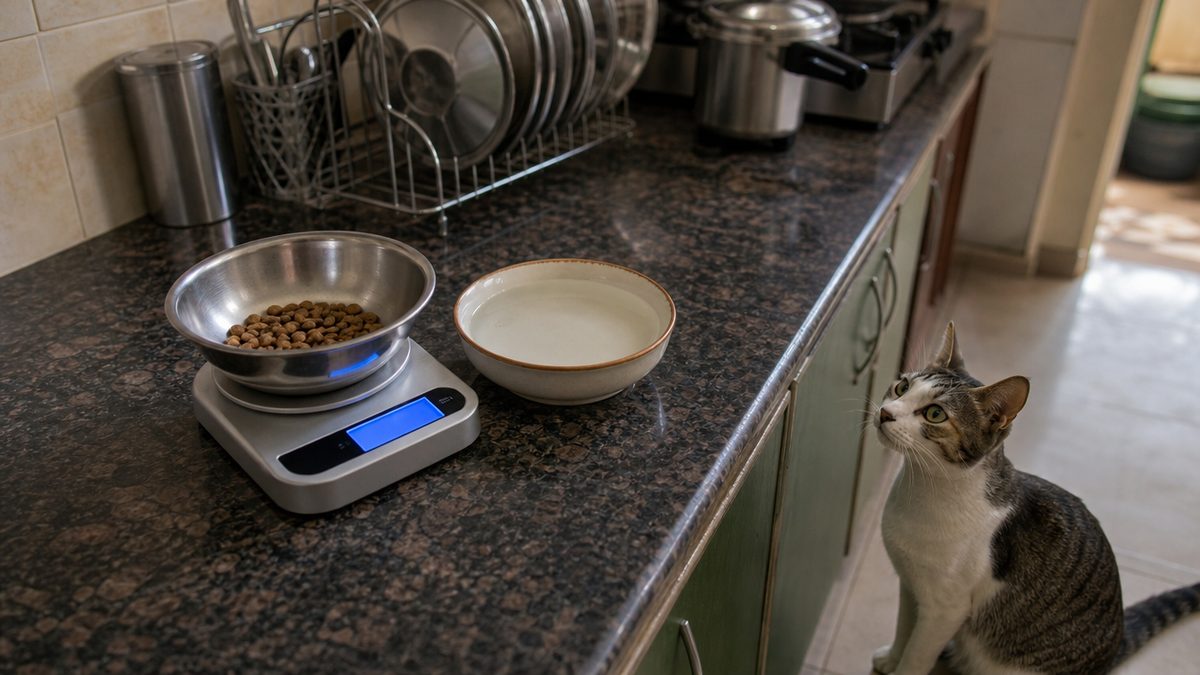
- Weigh the ration on a kitchen scale, which International Cat Care says adds under two minutes a day and could add years to the cat's life.
- Split it into at least five portions across 24 hours with a timed or puzzle feeder.
- Score body condition every two weeks against the WSAVA cat chart, aiming at a 5 out of 9.
- Adjust by about 10 percent and re-score in two weeks; the pack figure is a starting point.
The three guideline bodies give the same 4 kg neutered cat anywhere from 132 to 253 kcal a day and the pack tables span the same range, so no chart, including this one, can say which end your cat sits at Farmina Pet Foods. Start at the lower figure for a neutered flat cat, weigh and score every two weeks, and let the scale move the ration. A cat that is already overweight needs a weight-loss diet planned by your nearby vet, because feeding less of a maintenance food can leave it short of vitamins and minerals. Your nearby vet decides for your animal.
How the chart is worked out: RER, the life-stage multipliers and a food's kcal per kg
The chart is worked out in three steps, calculate a resting energy requirement from body weight, a multiplier for life stage and neuter status, and a division by the food's kcal per gram, and each step has more than one published version, which is why the same cat lands on different numbers on different pages FEDIAF (European Pet Food Industry… World Small Animal Veterinary Association.
The 2021 AAHA/AAFP guideline, written with the International Society of Feline Medicine, gives RER in kcal a day = 30 x body weight in kg + 70, multiplied by a needs factor that is 1 for a young healthy adult. It sets the other stages against the same RER: kittens need 200 kcal per kg of body weight at 10 weeks against 80 at 10 months; a mature adult of 7 to 10 years may need no more than RER; a senior over 10 needs 10 to 20 percent more, in some cases 25, because digestion falls off and being underweight becomes the common problem. Neutering is a named risk factor for obesity, especially in males, and free-choice feeding a habit that predisposes to overconsumption.
Two other bodies publish a different first step. FEDIAF's 2025 guideline uses metabolic body weight, kg to the power 0.67, and gives a neutered or indoor cat 52 to 75 kcal per kg of metabolic weight, printed as 35 to 45 kcal per kg for a 4 kg cat, against 100 for an active cat; kittens get 2.0 to 2.5 times adult maintenance to 4 months, 1.75 to 2.0 to 9 months and 1.5 to 12. The NRC's 2006 report, which the WSAVA calorie sheet reproduces, gives a lean adult 100 kcal x kg^0.67 and an obese-prone adult 130 kcal x kg^0.4, and prints 225 to 250 kcal for a 4 kg cat National Research Council.
| Source | Rule | Kcal a day for 4 kg | What it is for |
|---|---|---|---|
| AAHA/AAFP 2021, guideline text | 30 x kg + 70, needs factor 1 | 190 | Young healthy adult |
| AAHA/AAFP 2021 as read by the APOP calculator | 70 x kg^0.75, then 1.2 to 1.4 for a neutered adult, 1.0 if sedentary | 198 to 277 | Attributed to 'Box 1' of the guideline; the PDF text carries the linear form above |
| FEDIAF 2025, Table VII-9 | 52 to 75 kcal x kg^0.67 | 132 to 190 | Neutered and/or indoor cat |
| FEDIAF 2025, Table VII-9 | 100 kcal x kg^0.67 | 253 | Active cat |
| NRC 2006 via WSAVA 2020 | 100 kcal x kg^0.67; 130 x kg^0.4 if obese-prone | 225 to 250 as printed | Average healthy adult in ideal condition |
| NRC 2006 owner booklet | Table by weight | 280 for a 10 lb lean cat; 240 for a 10 lb overweight cat | Domestic cat, 4.5 kg |
| Hill's Pet Nutrition, 2021 | About 290 kcal for a ten-pound cat | 290 for 4.5 kg | Average activity, US page |
| Farmina's own table | 35 to 58 g x 4.204 kcal per g | 147 to 244 | Adult cat, the maker's range |
Where the sources disagree, the disagreement is the finding. The APOP calculator, third for the target keyword, attributes an exponential RER and a 1.2 to 1.4 multiplier to a 'Box 1' in the AAHA guideline; the 22-page guideline PDF opened for this page carries the linear form and a factor of 1 in its text, and no box of that name is in the extracted text Quimby J, Gowland S, Carney HC, DePorter T. For a 4 kg cat the two RER forms are close, 190 against 198 kcal; the multiplier is where they part, 190 kcal on the guideline's text against 238 to 277 on APOP's reading. This chart uses the guideline's text and prints APOP's figure as the upper bound. For a neutered flat cat in India the lower reading governs, because FEDIAF's indoor band and the AAHA RER meet there, 132 to 190 kcal, and the NRC lean figure describes a cat that is active. None of the formulas carries a climate term either, so a cat in Kolkata's humidity, a Mumbai monsoon or Delhi's dry May starts from the same row and is corrected by the same scale.
The third step is the one Indian packs make hardest. Farmina India prints 4,204 kcal per kg and a feeding guide that adds 1 cup = 98 g = 412 kcal, so any kcal target converts to grams by one division; Royal Canin India prints a gram table for 3 to 6 kg on every page opened and no kcal per kg on any of them, so a Royal Canin owner can follow the table but cannot check it against a guideline Farmina Pet Foods Royal Canin India Royal Canin India Royal Canin India Royal Canin India Royal Canin India. What the other packs print is in the next section.
What Indian cat food costs per day, and what each pack prints
A 4 kg cat costs between Rs 13 and Rs 100 a day to feed on a complete dry food in India, a seven-fold spread that runs from Drools Ocean Fish at Rs 25 per 100 g to Farmina N&D Prime at Rs 173 per 100 g at Supertails on 18 September 2026, and only one of the nine foods priced below prints the kcal per kg that would let an owner compare them per calorie Farmina Pet Foods India.
| Food | Pack and price (MRP) | Rs per 100 g | Kcal per kg printed? | Gram table printed? | Rs a day, 4 kg cat |
|---|---|---|---|---|---|
| Royal Canin Fit 32 | 4 kg, Rs 3,573 (Rs 4,060) | Rs 89 | No Royal Canin India | Yes, 54 g at 4 kg ideal | Rs 48; Amazon.in's Rs 3,569 gives the same Rs 48 |
| Royal Canin Indoor 27 | 2 kg, Rs 1,945 (Rs 2,210) | Rs 97 | No Royal Canin India | Yes, 56 g | Rs 54 |
| Royal Canin Sterilised 37 | 2 kg, Rs 1,830 (Rs 2,080) | Rs 92 | No Royal Canin India | Yes, 57 g | Rs 52 |
| Royal Canin Persian Adult | 2 kg, Rs 2,376 (Rs 2,700) | Rs 119 | No Royal Canin India | Yes, 40 to 50 g | Rs 48 to 59 |
| Royal Canin Sterilised 7+ | 1.5 kg, Rs 1,399 (Rs 1,590) | Rs 93 | No Royal Canin India | Yes, 60 g | Rs 56 |
| Farmina N&D Prime Chicken & Pomegranate | 1.5 kg, Rs 2,596 (Rs 3,090); 5 kg, Rs 6,350 | Rs 173 (Rs 127 on the 5 kg) | Yes, 4,204 | Yes, 35 to 58 g | Rs 61 to 100 on the maker's range; Rs 78 at the AAHA RER |
| Whiskas Adult Ocean Fish | 3 kg, Rs 1,086 (Rs 1,120) | Rs 36 | No Whiskas India (Mars Petcare) | No, 'as per the cat's body weight' | Rs 20 if fed the 54 g above, an illustration only |
| Drools Ocean Fish Adult | 3 kg, Rs 743 (Rs 799) | Rs 25 | No Drools Pet Food, Dry Cat Food range page | No | Rs 13 at 54 g, an illustration only |
| Me-O Adult Persian | 2.8 kg, Rs 899 (Rs 1,020) | Rs 32 | No | No, 'check the pack' | Rs 17 at 54 g, an illustration only |
The last three rows are not a cost per day for those foods, because none publishes a gram table on the pages opened; they apply Royal Canin's 54 g to a cheaper price so the shape of the spread shows. Whiskas India prints 30 percent crude protein and 9 percent fat with cereals first in the ingredients; Fit 32 prints 32 and 15; Farmina prints 44 and 20 and a 98 percent animal-protein claim, which is what Rs 173 per 100 g buys on the label Royal Canin India Farmina Pet Foods India. Over a year the same 4 kg cat costs about Rs 4,900 on Drools, Rs 17,600 on Fit 32 and Rs 28,500 on Farmina, and the homemade cat food in India guide works out why a properly completed home diet costs more than any of them.
Every rupee figure on this page passed the exchange-rate test: 33 figures were each divided by 84.38 and by 74, and 29 land nowhere near a whole dollar at either rate. Four do, within two paise: Fit 32's 2 kg price of Rs 1,857 is 22.01 dollars at 84.38 and its Rs 2,110 MRP is 25.01, the Persian Adult 2 kg MRP of Rs 2,700 is 32.00 at 84.38, and Me-O's 1.1 kg price of Rs 445 is 6.01 at 74 Supertails, Royal Canin Persian Adult Cat… Supertails, Me-O Adult Persian Cat Dry…. No single rate fits the set, three of the four are MRPs printed on Indian packs, and the 4 kg and 5 kg packs that carry the chart's arithmetic fail both tests, so the flagged figures are read as rupee-native round numbers. The one Indian ranking page's Me-O at Rs 350 to 400 a kg and Royal Canin at Rs 850 to 950 sit against Rs 321 and Rs 893 per kg at Supertails, a Delhi laboratory and a Bengaluru retailer agreeing rather than copying Supertails, Royal Canin Fit 32 Regular….
Each of the nine foods above is labelled complete and balanced, which is the claim that matters, and the AAHA/AAFP guideline asks only that a cat's food carry a nutritional adequacy statement for its life stage. What the price buys is protein percentage, animal protein first in the ingredient list and, in Farmina's case, a printed energy figure; what it does not buy is a different chart. A 4 kg cat needs 132 to 253 kcal whichever bag it comes from.
Wet or dry food, and how much water a cat needs in an Indian summer
A cat on dry food drinks about 2 ml of water for every gram of kibble, so the 54 g in the chart calls for roughly 108 ml from the bowl, while the same cat on a 73 percent moisture diet took in 145 ml a day in total against 103 ml on dry food in a six-cat cross-over study, and produced more dilute urine with a lower calcium oxalate risk.
The NRC booklet explains why water matters more for a cat than a dog: a cat evolved as a desert animal, drinks less per kilogram, and takes 24 hours to replace a water loss a dog replaces in one, which puts some cats at higher risk of urinary stones; canned food at 78 to 82 percent water, or water added to dry food, protects against stone formation. The Buckley study put numbers on it: six cats fed one dry food hydrated to 6.3, 25.4, 53.2 and 73.3 percent moisture drank less from the bowl as the food got wetter, total intake rose only on the 73.3 percent diet, to 144.7 ml a day or 30 ml per kg, and the relative supersaturation for calcium oxalate fell from 2.29 on dry food to 1.14. A 2026 scoping review of 32 papers found healthy cats taking 23 to 51 ml per kg of total water a day, and that the 42 to 51 ml per kg needed to keep urine below a specific gravity of 1.035 was reached only on a wet diet or a dry diet with nutrient-enriched water; cats on plain dry food had higher specific gravity, which the authors read as a greater risk of lower urinary tract disease and stones.
| Measure | Figure | Source |
|---|---|---|
| Drinking on dry food | About 2 ml per g of kibble: 108 ml for 54 g | NRC 2006 booklet |
| Total fluid on a 6.3 percent moisture dry food | 103.4 ml a day (6 cats) | Buckley 2011 |
| Total fluid on a 73.3 percent moisture diet | 144.7 ml a day, 30 ml per kg (6 cats) | Buckley 2011 |
| Total water across healthy cats, five groups | 23 to 51 ml per kg: 92 to 204 ml for 4 kg | Kosmal 2026, 32 papers |
| Intake at which urine stayed below 1.035 | 42 to 51 ml per kg: 168 to 204 ml for 4 kg, wet diet only | Kosmal 2026 |
| Water in canned food | 78 to 82 percent | NRC 2006 booklet |
For an Indian owner the practical reading is that a cat on dry food in a Delhi, Hyderabad or Chennai flat in May is at the dry end of every row above, and that the cheapest hydration is a pouch or a spoon of water in the kibble. International Cat Care recommends a mix of wet and dry for healthy cats, and Cats Protection lists the moisture of wet food as the reason to feed it to a cat with urinary problems Cats Protection (UK), Feeding your cat. The 6 ways the sources above raise a cat's water intake are listed below.
- Feed some wet food. Total fluid rose only when the diet reached 73 percent moisture in the Buckley study, and the review found urine stayed dilute only on a wet diet or an enriched-water dry one Kosmal PAL, Shoveller AK, Gillies G.
- Use the maker's mixed row. Royal Canin India prints every dry ration with a 'plus one pouch' alternative, 36 g of Fit 32 plus a pouch instead of 54 g dry for a 4 kg cat.
- Add water to kibble. The NRC booklet says simply adding water to dry food also helps protect against stone formation.
- Put water in two or three places, away from the food and the litter tray, in ceramic or glass rather than plastic, shallow enough that the whiskers do not touch the sides.
- Change it daily, and wet food twice a day in a warm kitchen, which in a Pune or Mumbai monsoon means the bowl is refilled before it is empty.
- Try moving water if the cat ignores the bowl; the AAHA/AAFP guideline lists freshness, taste, movement from a fountain or dripping tap, and the shape of the container as the factors an owner can test.
International Cat Care lists calcium oxalate urinary stones and feline idiopathic cystitis among the diseases Persians are predisposed to, and Royal Canin's Sterilised 37 page says neutered cats have an increased risk of urinary stones, so a neutered Persian on dry food in summer is the cat the wet-food arithmetic was written for Royal Canin India. Dry food's one advantage in this climate is that it can sit out; wet food in a warm kitchen needs changing at least twice a day.
How often should I feed my cat: two meals a day against at least five portions
Feed a cat at least five small portions across the full 24 hours, using a timed or puzzle feeder, is International Cat Care's rule, and it disagrees with the 'recommended to feed twice a day' on Whiskas India's pack, the 'at least twice daily' wet and 'at least once daily' dry of Cats Protection, and the two or three meals of Hill's, so the question 'Is 2 meals a day enough for a cat?' has a published no and several published yeses Whiskas India (Mars Petcare) Cats Protection (UK), Feeding your cat O'Brien C, reviewed by Hill's veterinary….
| Source | Meals or portions a day | Basis given |
|---|---|---|
| International Cat Care, updated September 2025 | At least five portions across 24 hours, timed and puzzle feeders | Wild cats eat frequent small meals day and night; two large meals are for the owner's timetable |
| NRC 2006 owner booklet | More than once a day; a cat with free access eats 12 to 20 meals | Feeding behaviour over the 24-hour light-dark cycle |
| Cats Protection | Wet food at least twice, dry at least once | A wild cat eats 10 to 12 small meals; pet cats often prefer the same |
| Hill's, 2021 | Two or three smaller meals, or free choice for cats with self-control | Cornell's Francis Kallfelz, cited on the page |
| Whiskas India pack guidance | Twice a day | None given |
| AAHA/AAFP 2021 | Small amounts hidden around the house or worked out of a food puzzle; free choice predisposes to overconsumption | Natural predatory feeding behaviour |
Which governs is a question of what the two schedules are for. Twice a day is a portion-control schedule that a working household can keep, and every source that gives it also says to measure the daily ration; five or more portions is the same measured ration divided further, which International Cat Care argues reduces the boredom, frustration and overeating of a bowl that is filled twice and emptied in minutes. The two agree on the total and disagree on the division, and a timed feeder that drops a weighed ration in five drops resolves it for less than the cost of a month of Farmina. What no source supports is the free bowl: the NRC says 30 to 40 percent of cats overeat and get fat when food is always out, and the AAHA/AAFP guideline names free-choice feeding as a predisposing habit.
Kittens are the one stage where frequency is not a matter of taste. A kitten at 10 weeks eating 200 kcal per kg of body weight has a stomach too small for that in two sittings, and the kitten care in India guide sets out the 4 to 6 meals of the first months, with the vaccine and deworming dates that fall in the same weeks. A queen feeding kittens is the other: she gets free access to a growth food until weaning, because her need rises to two to two and a half times her intake at mating.
Body condition score: the correction loop, and how many cats are overweight
Score the cat against the WSAVA nine-point chart every two weeks and move the ration until it holds a 5, ribs felt with slight fat covering, a waist seen behind the ribs but not pronounced, a minimal abdominal fat pad; the AAHA/AAFP guideline calls 6 or 7 overweight and 8 or more obese, and among 1,341,118 cats at US primary-care practices in 2020 to 2023, 47.2 percent of adults were overweight and a further 13.9 percent obese Quimby J, Gowland S, Carney HC, DePorter T Montoya M, Peron F, Hookey T, Morrison J.
| Score | What you see and feel | Band |
|---|---|---|
| 1 | Ribs very easily seen on short-haired cats, no fat pads, severe abdominal tuck, lumbar vertebrae and pelvic bones easily seen and felt | Under ideal |
| 2 | Ribs easily seen on short-haired cats, lumbar vertebrae obvious, pronounced abdominal tuck, no fat pads | Under ideal |
| 3 | Ribs easily felt with minimal fat covering, lumbar vertebrae obvious, obvious waist behind ribs, minimal abdominal fat pads | Under ideal |
| 4 | Ribs felt with minimal fat covering, noticeable waist behind ribs, slight abdominal tuck, minimal abdominal fat pads | Ideal |
| 5 | Well-proportioned, ribs felt with slight fat covering, waist seen behind ribs but not pronounced, abdominal fat pad minimal | Ideal |
| 6 | Ribs felt with slight excess fat covering, waist and abdominal fat pad present but not obvious, abdominal tuck absent | Over ideal; the chart's footnote says a 6 may be acceptable in some cats, especially older cats |
| 7 | Ribs not easily felt through moderate fat covering, waist not easily seen, slight rounding of abdomen, moderate abdominal fat pad | Over ideal |
| 8 | Ribs not felt due to excess fat covering, waist absent, obvious rounding of abdomen with prominent fat pad, fat over the lower back | Over ideal |
| 9 | Ribs not felt under heavy fat cover, heavy fat over lumbar area, face and limbs, distended abdomen with no waist | Over ideal |
The two authorities differ by one point at the top of the ideal band, and both are printed here. The AAHA/AAFP guideline scores 6 out of 9 as overweight; the WSAVA chart of June 2025 carries a footnote that a 6 may be acceptable in some cats, especially older ones, which matches the guideline's own warning that being underweight is the common problem in a senior. For a cat of 1 to 7 years the stricter reading governs; for a cat over 10 the vet's reading of muscle decides. The guideline asks for a score at every visit with dorsal and lateral photographs, which an owner can do with a phone every fortnight.
How many cats are overweight, with the denominators
Feline obesity prevalence runs from 1.8 to 40 percent across the studies the AAHA/AAFP guideline reviewed, and the largest recent figure sits at the top of that range. In the Banfield dataset of 1,341,118 unique cats seen between 2020 and 2023, overweight and obese condition together were 11.1 percent in late growth, 39.8 percent in young adults, 61.1 percent in adults (47.2 overweight plus 13.9 obese), 66.5 percent in mature cats and 44.6 percent in seniors, and a cat recorded overweight during growth had 1.52 times the odds of being overweight or obese as an adult. In a Glasgow first-opinion practice, 39 percent of cats scored overweight or obese on a five-point scale in a 118-questionnaire survey (95 percent confidence interval 30.2 to 47.8), the risk factors being frequency of feeding and neutered status, with owners misperceiving the condition of overweight and long-haired cats. No Indian prevalence study with a denominator surfaced on Europe PMC on 18 September 2026, so none is printed here.
Weight management is the correction loop, and the 5 steps of the loop are listed below.
- Weigh the cat on the same scale every two weeks and write the figure down; International Cat Care says weighing is what catches the gain a coat hides.
- Score it against the chart above, ribs by touch, waist from above, belly from the side, and photograph both views as the guideline asks the vet to.
- Cut the ration by about 10 percent if the score is 6 or more on a cat under 7, and re-score in two weeks; raise it if the score is 4 or below.
- Book the vet at a 7 or more, because a cat that needs to lose weight needs a weight-loss diet, not a smaller bowl of a maintenance food that would leave it short of vitamins and minerals.
- Recheck after neutering and again at 7 years, the two points the guideline names for a change in need.
Cornell calls obesity the most common nutrition-related problem in cats and lists arthritis and diabetes among its results; the guideline adds urethral obstruction, skin disease and lameness Quimby J, Gowland S, Carney HC, DePorter T. The cat neutering in India guide covers the surgery whose aftermath is why most rows in the chart say 'neutered'.
What should cats eat daily: a complete food, water, and treats under 10 percent
A cat should eat a food labelled complete for its life stage, in the grams the chart gives, with water always available and treats held under 10 percent of the day's calories, which for a 4 kg cat is 22 kcal, about five grams of kibble or less than a tablespoon of milk World Small Animal Veterinary Association.
A cat is an obligate carnivore, and four things follow that decide what 'complete' means: it burns protein for energy and needs far more than a dog, it needs taurine, arginine, methionine and cysteine that plants do not supply, it needs animal fat for preformed essential fatty acids, and it needs vitamin A, vitamin D and niacin ready-made. FEDIAF's 2025 minimums put that into figures per kilogram of metabolic weight for an adult cat: 6.25 g of protein, 0.25 g of arginine, 0.05 g of taurine in canned food and 0.03 g in dry, 2.25 g of fat, 1.5 mg of arachidonic acid, 83.25 IU of vitamin A. The AAHA/AAFP guideline's labelling rule is that the food carry a statement of nutritional adequacy for the cat's stage, and it says AAHA and the AAFP do not advocate feeding any raw or non-sterilised animal-origin food or treat. The homemade cat food in India guide carries the full FEDIAF table, the study that found 0 of 114 published home recipes complete, and the toxic Indian kitchen foods; the short version is that the boiled chicken, rice and curd plate the one Indian ranking page suggests is not a complete diet.
Can cats eat rice and milk?
Rice is not harmful and not needed: International Cat Care says a cat is less able to digest and use carbohydrate and gets most of its blood sugar from protein, and the NRC booklet lists carbohydrate as not essential National Research Council. Milk is on the WSAVA treats sheet's list of foods to avoid, many cats being lactose intolerant, and the sheet prices it: 59 ml of semi-skimmed cow's milk is 27 kcal, more than a 4 kg cat's entire treat allowance for the day. The Indian saucer of milk, or curd on the rice, is two problems in one bowl, lactose and calories, before the question of what it displaces.
| Cat weight | Maximum kcal a day from treats | What that buys |
|---|---|---|
| 2.5 kg | 18 kcal | Less than 28 g of cooked prawns (29 kcal) |
| 3 kg | 20 kcal | Less than 28 g of canned tuna in water (36 kcal) |
| 4 kg | 22 kcal | About 5 g of Farmina kibble; less than 59 ml of milk (27 kcal); less than 28 g of cooked chicken breast (47 kcal) |
| 5 kg | 25 kcal | Less than 28 g of cooked salmon (39 kcal) |
| 6 kg | 26 kcal | A quarter of 28 g of cheddar (120 kcal) |
| 7 kg | 28 kcal | About half of 28 g of lean cooked beef (64 kcal) |
The sheet's list of unsafe treats is the one for the fridge door, and it is reproduced below as WSAVA prints it.
- Onions, leeks, shallots, garlic and chives, which in an Indian kitchen means the tadka, the gravy and the leftover biryani.
- Grapes, raisins, currants and sultanas.
- Chocolate, xylitol, alcohol and raw yeast dough.
- Caffeinated drinks, including coffee, tea and energy drinks, so no saucer of chai.
- Milk and dairy products, because many cats are lactose intolerant.
- Bones, cooked or raw, for the damage they do if chewed or swallowed, and unprocessed raw animal treats for the pathogens they carry.
Cats Protection allows a little well-cooked plain chicken or fish occasionally and says to take the treat calories out of the daily ration rather than add them; Hill's and PDSA give the same 10 percent, and WSAVA's table is the one that turns it into a number you can weigh O'Brien C, reviewed by Hill's veterinary… World Small Animal Veterinary Association.
Persian cat diet chart, and the Persian cat diet chart by age: what changes for a Persian
A Persian cat diet chart is the same chart, because the energy formulas above have no breed term in them; what changes for a Persian is the coat it swallows, the jaw it eats with, a predisposition to calcium oxalate stones, and a mean adult weight of 3.9 kg that puts it on the lower rows, and Royal Canin India's Persian Adult table feeds a 4 kg Persian 40 g a day at low energy needs or 50 g at moderate, Rs 48 to 59 a day International Cat Care Royal Canin India Supertails, Royal Canin Persian Adult Cat….
International Cat Care's Persian page states the breed facts a diet has to work around, and only those are printed here. The coat is very long with a thick undercoat, many Persians cannot keep it free of mats, and regular grooming is needed to remove fur before the cat swallows it, because hairballs can be a problem. The flat skull means the teeth do not align, so short-nosed Persians cannot bite and chew properly, and jaw deformities can lead to problems with eating and drinking. The breed is predisposed to calcium oxalate stones and feline idiopathic cystitis, which sends the water section of this page straight to the Persian owner. Royal Canin's own page for Persian Adult claims an almond-shaped kibble that the brachycephalic jaw can pick up and chew, psyllium at 1 percent to move swallowed hair through, and 30 percent protein with 22 percent fat for the coat; those are the manufacturer's claims, and no study opened for this page tested kibble shape in Persians.
| Age | Energy rule | Royal Canin India's own table | Rupees a day | What else changes |
|---|---|---|---|---|
| Kitten to 12 months | 200 kcal per kg at 10 weeks, 80 at 10 months | Persian Kitten is on the kitten care guide; standard Kitten 29 to 66 g by month | Rs 30 to 68 on the standard Kitten bag | Daily combing starts now; ask the breeder for the parents' PKD result |
| Adult 1 to 7 years, 3 kg | RER 160 kcal | 33 g low energy needs, 41 g moderate | Rs 39 to 49 | Hairball fibre; water pushed towards wet food |
| Adult 1 to 7 years, 4 kg (the breed mean is 3.9 kg) | RER 190 kcal; FEDIAF indoor 132 to 190 FEDIAF (European Pet Food Industry… | 40 g low, 50 g moderate | Rs 48 to 59 | Most Persians in Indian flats are the low-energy column |
| Adult 1 to 7 years, 5 kg | RER 220 kcal | 47 g low, 59 g moderate | Rs 56 to 70 | A 5 kg Persian is about 28 percent over the breed mean; score it before feeding the 5 kg row |
| Mature 7 to 10 years | DER may equal RER | Persian Adult is labelled over 12 months with no upper age; the 7+ tables are for the non-breed foods Royal Canin India | Rs 48 to 59 | Yearly checks become the vet's call on kidneys, given the breed's PKD history |
| Senior over 10 years | RER x 1.10 to 1.25 | The vet sets the amount against weight and muscle | Rising with the ration | A 6 out of 9 may be acceptable in an older cat on the WSAVA chart |
The Persian rows cost more per gram than the plain adult rows, Rs 119 per 100 g for Persian Adult against Rs 89 for Fit 32, but not more per day, because the Persian table feeds fewer grams, 40 to 50 g against 54 g at 4 kg Supertails, Royal Canin Fit 32 Regular… Royal Canin India Royal Canin India. Me-O's Adult Persian, the cheaper breed food the Delhi laboratory page names, is Rs 32 per 100 g and prints no gram table on the page opened, so it cannot be put on the same row without inventing a figure. The New Zealand page that ranks first for 'persian cat diet chart' feeds a 5 to 6 kg 'average' Persian 55 to 70 g a day, which on Royal Canin India's table is the moderate ration for a cat 28 to 54 percent above the breed's measured mean. The Persian cat page carries that 3.9 kg mean with its 3,235-cat denominator and the grooming routine for Indian humidity; this page adds only the ration.
Kitten, senior, queen and large-breed rows: where the chart bends and where the vet decides
The chart bends most at the two ends of life and in a queen: a kitten at 10 weeks needs 200 kcal per kg of body weight against 80 kcal per kg at 10 months, a senior over 10 needs 10 to 25 percent more than its resting requirement while a mature cat of 7 to 10 may need no more than it, and a 4 kg queen needs 354 kcal a day in late pregnancy and up to two and a half times her mating intake when nursing National Research Council.
Kittens
Wean onto a complete kitten food from 3 to 5 weeks, feed it until 12 months, and weigh the ration from the maker's own kitten table rather than scaling an adult row down. Royal Canin India's Kitten table runs 29 to 48 g at 1 to 2 months, 61 to 66 g at 3 to 4 months, 69 falling to 67 g at 5 to 6 months and 64 falling to 51 g at 7 to 12 months, which at Supertails' Rs 2,059 for 2 kg is Rs 30 to 49, Rs 63 to 68, Rs 69 to 71 and Rs 53 to 66 a day; the ration falls in the second half of the year because 200 kcal per kg has become 80 Supertails, Royal Canin Kitten Cat Dry… Quimby J, Gowland S, Carney HC, DePorter T. Obesity prevention starts here: a kitten recorded overweight during growth carried 1.52 times the odds of being overweight or obese as an adult across 1.34 million cats, and neutering at 4 to 6 months is the point the guideline says to reassess the ration. The kitten care in India guide puts these rows beside the vaccine and deworming calendar, and the newborn kitten care guide covers the bottle weeks before weaning.
Mature and senior cats
A cat of 7 to 10 years may need only its resting requirement, 190 kcal at 4 kg, and a cat over 10 needs 10 to 20 percent more, in some cases 25, on a moderate protein diet of 30 to 45 percent dry matter with no protein restriction unless the vet has diagnosed kidney disease and prescribed a renal diet. Royal Canin India's Sterilised 7+, for neutered cats of 7 to 12 years, feeds 60 g at 4 kg against Sterilised 37's 57 g, with 36 percent protein and phosphorus at 0.73 percent, and costs Rs 56 a day on the 1.5 kg bag; it is the only senior-labelled dry food on the Indian retail list, the Ageing 12+ being a wet gravy Supertails, Royal Canin Sterilised 7+… Royal Canin India. The shift from too fat in mature cats to too thin in seniors is the reason the WSAVA footnote lets an older cat sit at a 6 World Small Animal Veterinary Association. The senior cat care guide in this series takes the rest: teeth, kidneys, arthritis and the blood work that decides the diet.
Pregnant and nursing queens
Feed a pregnant queen a growth food from mating, rising by late pregnancy to FEDIAF's 140 kcal per kg of metabolic weight, 354 kcal for a 4 kg queen, and let her gain 40 to 50 percent of her body weight by term; then give free access to the same food while she nurses, because a queen with more than two kittens needs two to two and a half times her mating intake and will lose weight whatever she is fed National Research Council. Royal Canin India's Mother & Babycat, 34 percent protein and 25 percent fat, prints 62 to 96 g a day for a 4 kg gestating queen and no lactation row, which is the free-access advice in table form. The cat pregnancy care guide prices that table and sets it against the JFMS review, VCA and Royal Canin's own article.
Large breeds and the other breeds Indian buyers ask about
A Maine Coon male at the 6.0 kg median its breed page records needs 250 kcal by the AAHA formula and 332 by the NRC lean figure, 72 g of Fit 32 on Royal Canin India's 6 kg row at Rs 64 a day, and the chart stops there; a heavier cat is off every Indian table opened for this page and its ration is the vet's arithmetic World Small Animal Veterinary Association Royal Canin India Supertails, Royal Canin Fit 32 Regular…. A British Shorthair is the breed whose page carries the 1.3 million-cat obesity figure, because a stocky, placid cat is where the neutered row bites hardest. A Bengal is the active-cat exception, the one Indian flat cat that can belong on the NRC lean row rather than the FEDIAF indoor band. A Siamese is lean by type and its page holds the Glasgow study, whose frequency-of-feeding risk factor is the reason its ration is split rather than bowl-fed. Nothing in the vaccine, worming or neutering calendar moves with the ration, and the cat deworming schedule for India guide is the one place a raw-fed cat's diet does change its medical calendar.
The chart gives a starting ration, a division of the day, a water figure and a body condition target. It cannot see kidney values, teeth, thyroid, a diabetic cat, a cat that vomits hairballs weekly or a senior losing muscle under a full coat, and the AAHA/AAFP guideline puts every one of those on a prescription diet that a maintenance chart cannot substitute for. Your nearby vet decides for your animal, and the ration on this page is what you bring to that appointment.
Common questions about a cat diet chart in India
What should cats eat daily?
A cat should eat a food labelled complete for its life stage, weighed rather than scooped: a 4 kg adult needs 132 to 253 kcal a day depending on whether FEDIAF's indoor band or the NRC lean figure is used, which is 35 to 58 g of Farmina N&D Prime on its own table or 54 g of Royal Canin Fit 32 on Royal Canin India's, with water always down and treats under 22 kcal Farmina Pet Foods Royal Canin India.
What is a suitable diet for a cat?
A suitable diet for a cat is a commercial food that says 'complete' on the pack, fed as a mix of wet and dry so the cat enjoys both and does not fix on one, in the maker's amount as a starting point and adjusted to the cat's weight; International Cat Care says a balanced home-prepared diet is extremely difficult to achieve and treats commercial food as the base.
Is 2 meals a day enough for a cat?
Two meals a day is enough for portion control and is what Whiskas India's pack and Hill's advise, but International Cat Care says it is not enough for the cat's behaviour and asks for the same daily ration divided into at least five portions across 24 hours with a timed or puzzle feeder; the total is the same, the division differs, and the free bowl is the one option no source supports Whiskas India (Mars Petcare) O'Brien C, reviewed by Hill's veterinary….
Can cats eat rice and milk?
Rice is harmless in a small amount and unnecessary, because a cat gets most of its blood sugar from protein and has no carbohydrate requirement; milk is on the WSAVA treats sheet's list of foods to avoid, many cats being lactose intolerant, and 59 ml of cow's milk is 27 kcal, more than a 4 kg cat's whole 22 kcal treat allowance for the day World Small Animal Veterinary Association.
What is the proper diet for a cat?
The proper diet for a cat is a meat-based complete food that supplies the nutrients an obligate carnivore cannot make: FEDIAF's 2025 adult minimums per kilogram of metabolic weight are 6.25 g of protein, 0.25 g of arginine, 0.05 g of taurine in canned food, 2.25 g of fat, 1.5 mg of arachidonic acid and 83.25 IU of preformed vitamin A, and every complete food sold in India claims a profile like it.
What can a cat eat daily?
Beyond its complete food a cat can eat treats worth under 10 percent of its calories, which WSAVA's November 2025 sheet prints as 18 kcal a day at 2.5 kg, 22 kcal at 4 kg and 28 kcal at 7 kg; 28 g of cooked chicken breast is 47 kcal and 28 g of canned tuna is 36 kcal, so a single kitchen treat can exceed the day's allowance for most cats.
What is the best diet for a Persian cat?
The best diet for a Persian cat is the same complete food and the same energy arithmetic as any cat, with three additions International Cat Care's breed page justifies: fibre or grooming to manage the hair it swallows, a kibble or wet food it can pick up with a jaw whose teeth do not align, and more water in the food because the breed is predisposed to calcium oxalate stones and idiopathic cystitis Royal Canin India.
Is a Persian cat can eat rice?
A Persian cat can eat a little plain cooked rice without harm, but it does not need it: International Cat Care says a cat is less able to digest and use carbohydrate and takes most of its energy from protein, and the boiled chicken, rice and curd plate one Indian page suggests for Persians is not a complete diet, and the curd adds lactose and calories a 3.9 kg Persian does not have room for Vetscan Diagnostics World Small Animal Veterinary Association.
How much should a Persian cat eat?
A Persian cat should eat what Royal Canin India's Persian Adult table prints for its weight, 33 g at 3 kg, 40 g at 4 kg, 47 g at 5 kg and 54 g at 6 kg at low energy needs, or 41, 50, 59 and 67 g at moderate needs, which at Rs 2,376 for 2 kg is Rs 39 to 80 a day; most flat-living Persians at the breed's 3.9 kg mean belong in the low column Supertails, Royal Canin Persian Adult Cat….
What is a good food schedule for a Persian cat?
A good food schedule for a Persian cat is the weighed daily ration from the table above split into at least five portions across 24 hours with a timed or puzzle feeder, International Cat Care's rule, rather than the two bowls a day the New Zealand ranking page and Whiskas India give; a low-activity, long-haired cat that eats in minutes and then grooms is the cat that rule was written for Petdirect (New Zealand retailer) Whiskas India (Mars Petcare).